Skull of Saint Valentine
In short. The Skull of Saint Valentine is kept in the Basilica of Santa Maria in Cosmedin, at Piazza della Bocca della Verità 18, in Rome, in the Ripa district.
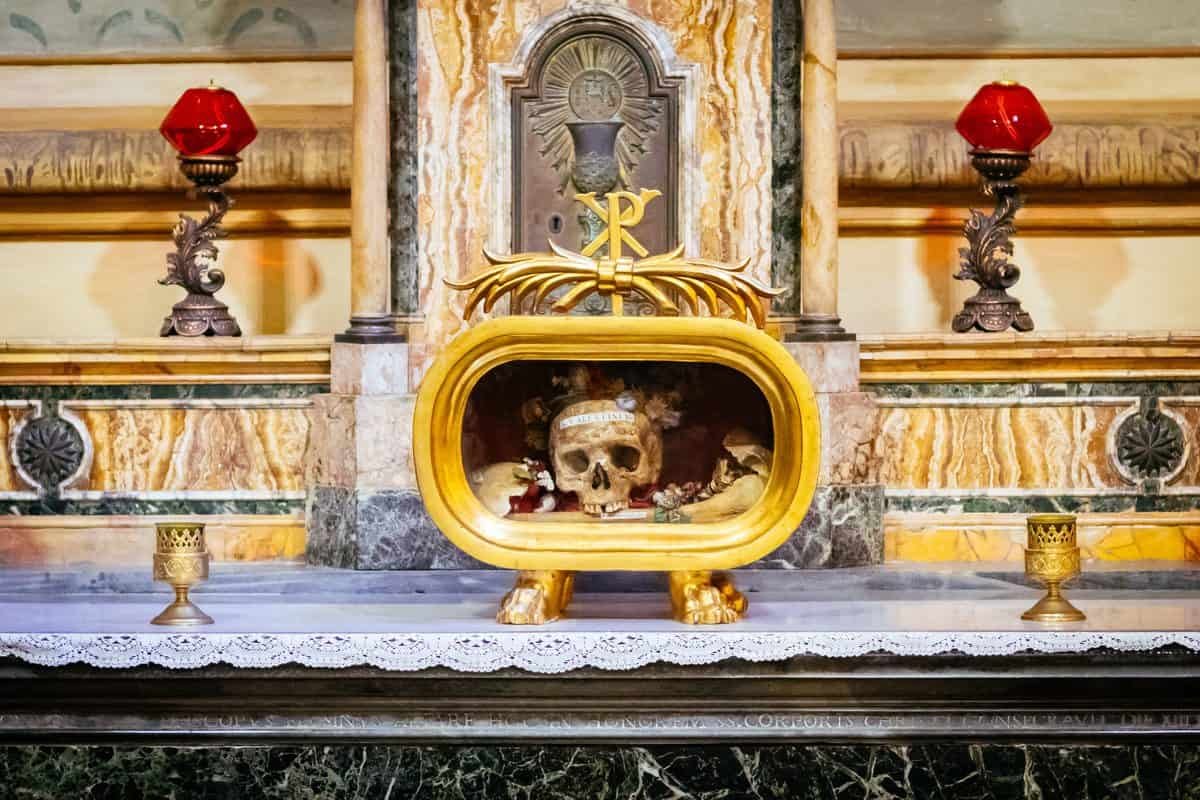
The Skull of Saint Valentine is kept in the Basilica of Santa Maria in Cosmedin, at Piazza della Bocca della Verità 18, in Rome, in the Ripa district. Free admission, no reservation, no ticket: the basilica is a church in active use and not a museum. The basilica's official website lists opening every day from 9.30 to 17.50, closed on January 1, with Sunday Divine Liturgy at 10.30. The basilica's phone number is 06 6787759. By metro you get off at Circo Massimo, line B, and walk about 500 meters along the slope of the Aventine. At street level, the square is served by bus lines 30, 44, 81, 83, 118, 160, 170, 628, 715, 716 and 781, all with a stop in front of Piazza della Bocca della Verità or on Lungotevere Aventino. The hours of Roman churches change with services and liturgical seasons: before setting out from far away it's worth checking the basilica's website.
A clarification that's worth the trip: the very long line you see in the portico is not for the relic. It's for the Mouth of Truth, which occupies the left wall of the portico and has a page all its own. The Skull of Saint Valentine is inside, past the threshold, and almost nobody in line is looking for it.
Where Exactly the Skull of Saint Valentine Is
Past the seven-arched portico and the central door, the basilica opens into three naves divided by reused columns. The relic is not on the high altar and not in the crypt of Hadrian, as is often read around: it is in a side chapel, dedicated to Saint John Baptist de Rossi, a Roman priest of the eighteenth century who was a canon of this very church. The skull is inside a glass case, resting on a cushion, surrounded by flowers. Red roses appear in great numbers around February 14 and in the following weeks. The rest of the year the case is plainer, and whoever comes in summer expecting the carpet of roses from the photographs circulating online is thrown off.
The visibility of the relic is not guaranteed in the same way every day. Devotion is concentrated on February 14, when the relic is displayed and venerated. At other times access to the chapel may be limited by services, restoration work or decisions of the rectory. If the Skull of Saint Valentine is the sole reason for your trip, a phone call to the basilica the day before avoids disappointment.

What You Really See in the Case of the Skull of Saint Valentine
A human skull complete with the cranial vault, the forehead and the eye sockets, with the mandible placed next to it. The color is the golden brown that ancient bones take on after centuries of contact with tufaceous soil and catacomb dust. There is no goldwork on it, no silver-foil crown of the kind that dresses the so-called saints of the catacombs kept in Alpine and Bavarian shrines: here the work of display was minimal, and paradoxically this increases the effect on the visitor. A bare skull inside a glass case, with flowers around it, in a medieval basilica a short walk from the Tiber.
This is the point on which people divide, and our verdict is clear: the Skull of Saint Valentine is not macabre. It's an object of worship that belongs to a religious grammar 15 hundred years old, where the martyr's body is the physical sign of the promised resurrection and not a trophy. Whoever comes here for a gothic thrill loses the sense of what is in front of them, and generally leaves after 30 seconds. Whoever stops for five minutes in silence understands why a community keeps bringing flowers to nameless bones.
A Curiosity About the Skull of Saint Valentine
The curiosity comes from a coincidence of names that no guide tells, and that is almost a historical joke. The chapel that houses the Skull of Saint Valentine is dedicated to San Giovanni Battista de Rossi, the priest born in Voltaggio in 1698, died in Rome in 1764, canon of Santa Maria in Cosmedin and apostle of the cart drivers and cattle herders who crowded the nearby Forum Boarium. A century later the greatest Christian archaeologist of the 19th century, the one who scientifically took apart the factory of false catacomb relics, was also named Giovanni Battista de Rossi: born in Rome in 1822, died in 1894, founder of modern Christian archaeology and among the voices that helped end the indiscriminate extraction of bodies from the catacombs.
Two different people, no ascertained kinship, simple namesakes. But the result is that the most debated relic in Rome rests in a chapel that bears the name of the man whose namesake would have cast doubt on relics like this one. It's not a judgment on devotion: it is one of those symmetries Rome produces by itself, without anyone having designed them. Tell it to your fellow visitors on the chapel threshold and you'll get more attention than any anecdote about February 14.
Second curiosity, subtler. The basilica that holds the Skull of Saint Valentine does not belong to the Latin rite: it is officiated by the Greek-Melkite Catholic Church, and the Sunday Divine Liturgy is celebrated according to the Byzantine rite in Greek, Arabic and Italian. It means that the relic most tied to the Western imagery of lovers is venerated in a place where they sing according to the tradition of Antioch. The church's very name recalls it: the Greek monks who officiated there in the early Middle Ages gave it the nickname Santa Maria in Schola Graeca.
The Holy Bodies: Where Relics Like the Skull of Saint Valentine Come From
To understand the Skull of Saint Valentine you need to know a huge and almost forgotten phenomenon of the modern age: the holy bodies. Without this chapter, the relic remains an oddity. With this chapter it becomes a document of the history of religion.
The Discovery That Opens the Season
The turning point is documented: in 1578, during work in a vineyard on Via Salaria, an underground gallery full of ancient Christian burials opens, the complex that archaeology calls the catacomb of the Giordani. Rome discovers it has a continent under its feet. In the decades after, explorations multiply, and Antonio Bosio's work gives the subject its first learned arrangement. From that moment until the mid-19th century, bones and whole skeletons come out of the catacombs of Rome in enormous numbers.
How They Decided a Dead Person Was a Martyr
Here is the crux. A pontifical commission set recognition criteria that no archaeologist would accept today: the presence in the burial niche of an engraved palm, a dove, the monogram of Christ, and above all a balsamarium or an ampoule presumed to contain the blood of the deceased. A dedicated office was born, with a Custodian of the Holy Relics and teams of authorized quarrymen. The problem is that the engraved palm could be a simple funerary ornament, and that the ampoules almost always contained perfumed ointments or wine residues used in the burial, not the blood of martyrdom.
Where Those Bodies Ended Up
Everywhere. Bishoprics, convents, confraternities and German, Austrian, Swiss, Spanish and Italian princes made requests to Rome and received a complete skeleton with a name, often taken from a nearby inscription and not from the burial niche itself. In the shrines of the Alpine area these catacomb saints were dressed in silks, pearls and gold leaf and put on display inside crystal urns. In Italy they were treated more soberly, but the mechanism was the same.
The End of the Practice
Extraction ceases around the middle of the 19th century, under the weight of learned criticism: the Congregation of Rites was already in the habit of denying feasts, offices and Masses in honor of holy bodies, advising to replace them with authenticated relics. The modern criticism of the Bollandists and then scientific Christian archaeology closed the matter. What remained, however, in churches throughout Europe, was a great many remains already venerated for centuries, with names that had by now entered popular devotion. It is in this set that historiography places, as a well-grounded hypothesis and not by document, the Skull of Saint Valentine as well.
Something Nobody Tells You About the Skull of Saint Valentine
What nobody tells you is that there is no published and accessible document, to date, declaring from which catacomb this skull comes, in what year it entered Santa Maria in Cosmedin and by whose hand. Popular pages speak generically of 18th-century finds tied to the rediscovery of the crypt of Adrian. Others link it to the flow of holy bodies. None displays an act of translation, a signed authentication, a register number. Anyone who tells you the precise date with confidence is repeating an oral tradition, not a source.
This gap is not a defect of the basilica: it is the normal condition of almost all the catacomb relics that have come down to us, and historiography has known it for at least a century and a half. The correct way to put it is this: that a skull attributed to Saint Valentine has long been venerated in the basilica is a verifiable fact. That the skull belongs to Valentine of Terni is devotional tradition. That it belongs to another individual extracted from the catacombs is the hypothesis scholars consider most likely, without being able to prove it on this single find.
Then there's the most interesting detail, which nobody mentions: the main relics attributed to Valentine of Terni are in Terni, in the basilica on the hill of Carsulae built, according to tradition, on the site of the burial, and they are kept there in a case. Rome has never claimed primacy over Terni. The two devotions have coexisted for centuries without contending for anything, and prose that presents the Skull of Saint Valentine as a sort of fraud against Umbria describes no real conflict.
Who Valentine Was: What Is Documented, What Is Tradition, What Is Hypothesis
There Is More Than One Valentine
The ancient martyrologies record at February 14 at least two Valentines, and some lists add a third martyred in Africa. The first is a Roman presbyter, the second is the bishop of Interamna Nahars, present-day Terni. Both are recorded as buried along Via Flaminia, at different distances from the City. Seventeenth-century scholarship already suspected that these were duplications of a single figure. The Roman Martyrology in its current version recalls for that day a martyr buried on Via Flaminia, without multiplying the figures.
The Passio and Its Date
The main hagiographic source is the Passio sancti Valentini episcopi et martyris, a late text that scholars place around the 6th century. It tells of the Greek philosopher Craton, of his son Cerimon afflicted by a serious illness, of the healing obtained by Valentine and the conversion of the family. Then of the intervention of the urban prefect and of the execution carried out at night, outside the walls. Tradition fixes his death at February 14, 273, under Aurelian, and attributes to the bishop a very long life.
Modern Readings
Recent research has questioned this chronology. Edoardo d'Angelo, in a 2010 study, proposes placing the events narrated in the Passio in the years 346 and 347, in the full post-Constantinian age, on the basis of the urban prefect named in the text, Furius Memmius Caecilianus Placidus. Rita Lizzi has advanced the hypothesis of identifying the character with a member of the gens of the Symmachi. These are scholars' hypotheses, not verdicts: I report them because they show how little solid ground the saint's current biography stands on.
The Legends, and What to Call Them
The bishop who secretly celebrated the weddings of young Christians when the religion was forbidden. The gift of a dowry to a poor girl so she could marry. The note signed from your Valentine written to the jailer's daughter. The roses from the garden given to lovers. These are all devotional narratives of late formation, some documentable only from the modern age. They should be told, because they are part of European culture, and they should be called by their name: hagiographic legends. Presenting them as third-century chronicle is an error you read everywhere and which helps nobody, least of all devotion.
Frequently Asked Questions About the Skull of Saint Valentine
Where is the Skull of Saint Valentine?
The Skull of Saint Valentine is in the Basilica of Santa Maria in Cosmedin, at Piazza della Bocca della Verità 18, in the Ripa district of Rome. It is kept in a glass case in a side chapel dedicated to Saint John Baptist de Rossi, and not on the high altar or in the crypt of Hadrian, as is often read around.
How much does it cost to see the Skull of Saint Valentine?
Nothing: admission to the basilica that keeps the Skull of Saint Valentine is free. It's good manners to leave an offering for the upkeep of the building, but no ticket is required to see the relic.
How do I get to the Skull of Saint Valentine by public transport?
To get to the Skull of Saint Valentine you can take metro line B, Circo Massimo stop, exit toward Via delle Terme di Caracalla and then about seven minutes on foot. By bus the square is a terminus or a transit point for several lines, including the 30, 44, 81, 83 and 118.
How much time do I need to visit the Skull of Saint Valentine and the basilica?
20 minutes are enough to see the Skull of Saint Valentine and the nave of the basilica of Santa Maria in Cosmedin. 40 minutes are needed to visit the whole interior properly, crypt included, and an hour and a half if you add the line for the Mouth of Truth, which in peak months runs between 20 and 50 minutes.
Which catacomb does the Skull of Saint Valentine come from?
It isn't confirmed: there is no published, accessible document to date stating which catacomb the Skull of Saint Valentine comes from, in what year it entered Santa Maria in Cosmedin and by whose hand. Popular pages speak generically of eighteenth-century finds tied to the rediscovery of the crypt of Hadrian, but the fact remains uncertain.
Is it worth visiting the Skull of Saint Valentine on February 14?
No, it's better to avoid February 14 if the goal is to see the Skull of Saint Valentine properly and at leisure: the basilica fills up, with services, groups and photographers, and in front of the case you stand in line for a few seconds of viewing. The day before or the day after, or any weekday morning in November, are better choices.
Are there other relics attributed to Saint Valentine?
Yes, the Skull of Saint Valentine is not a unique piece. In Terni the basilica of San Valentino keeps in a case the remains attributed to Bishop Valentine, according to tradition on the site of his burial along Via Flaminia. In Dublin, in the Carmelite church of Whitefriar Street, remains donated in 1836 and brought from Rome are kept.
My Advice for Visiting the Skull of Saint Valentine
The advice is blunt: don't come on February 14 if your aim is to see the relic well. Come on the 13th, or the 15th, or any weekday morning in November. On February 14 the basilica fills up, there are services, there are groups, there are photographers, and in front of the case you stand in line three minutes to look for 30 seconds. The day before and the day after, the floral display is already set up or still standing, the light is the same, and the chapel is yours.
Second piece of advice, about timing. The basilica opens at 9.30 and the tourist buses arrive in the square around 10 30 for the Mouth of Truth. So there is a good 60-minute window in which the church is practically empty. Go in at 9.30, do the nave and the chapel of the Skull of Saint Valentine first, then step out into the portico around 10 20: you'll find the line for the mask already formed, and you can calmly decide whether to spend 40 minutes on it or give up.
Third piece of advice, about behavior, and it's not a formality. Santa Maria in Cosmedin is a church in active use, not a museum: clothes that cover shoulders and knees, low voices, hats off, phones silent. In front of the case of the Skull of Saint Valentine there are often people praying. Take a step back and wait. If you're leading a group, the briefing is done outside, under the portico, never inside the chapel: you go in already knowing what you're looking at. For a well-run visit, with a licensed professional, the reference is the tour accompaniment service of TourLeaderPro.

The Basilica Around the Skull of Saint Valentine: What to Look At
Whoever comes for the Skull of Saint Valentine and then leaves without looking around makes one of the worst mistakes you can make in Rome. Santa Maria in Cosmedin is one of the three or four best-preserved medieval churches in the city. Here's the order in which I'd do it.
The Portico, the Facade and the Bell Tower
The seven-arched portico is crowned by as many windows. In 1718 Cardinal Annibale Albani entrusted Giuseppe Sardi with a Rococo-style facade, which was later removed in the great philological restoration carried out by Giovanni Battista Giovenale between 1894 and 1899: the declared goal was to bring the building back to its 12th-century form by eliminating later additions. The Romanesque bell tower, from the 12th century, reaches 34.20 meters and is articulated in seven tiers separated by cornices on marble brackets, with inserts of colored ceramic. It's one of the most beautiful in Rome and nobody photographs it, because everybody looks down at the mask.
The Three Naves and the Reused Columns
The interior is divided into three naves by columns that come from different ancient buildings: shafts and capitals don't match, and that is not a defect but the signature of an early medieval building site working with the materials available on the spot. The ceiling has exposed wooden trusses. The light comes in high and raking, and in the early morning hours it cuts across the central nave in a way that alone is worth the early rising.
The Cosmatesque Floor
The opus sectile floor, with polychrome marbles and mosaic inserts, dates in large part to the 12th-century reconstruction. It's the work of the Cosmati, the dynasty of Roman marble workers who gave their name to the technique and, by a coincidence that confuses many visitors, not to the church: the name Cosmedin comes from the Greek kosmidion, ornamented, and is older than the Cosmati.
The Schola Cantorum and the Ambos
The marble enclosure in the middle of the nave, bounded by screens, with the two side ambos in fine marbles, was reassembled in the late nineteenth-century restoration from the surviving original elements. It helps to understand how medieval liturgy worked physically: the clergy inside the enclosure, the people outside, the reading from the ambo.
The Altar, Deodato's Ciborium, the Cathedra
The red granite high altar is dated 1123, the year that marks the great campaign promoted under Callixtus II. Above it rises the Gothic ciborium made in 1249 by Deodato di Cosma, a work that echoes the ciborium of Arnolfo di Cambio at San Paolo fuori le Mura. At the back of the apse is the marble episcopal cathedra. The narthex and the bell tower also belong to the season of the Cosmati.
The Crypt of Hadrian
It's the most surprising space. In 782 Pope Hadrian I had the back wall of the late antique porticoed hall demolished and a crypt dug, using the tuff block base of the Ara Maxima of Hercules, the great altar of the Forum Boarium. You go down a few steps and find yourself inside a miniature church carved into the podium of an archaic pagan sanctuary. For lovers of layered Rome, it's all here in 10 square meters.
The Epiphany Mosaic in the Sacristy
Walled into the sacristy is a mosaic fragment from the oratory that Pope John VII had built, between 705 and 707, in the Constantinian basilica of Saint Peter: it depicts the Adoration of the Magi and is the largest and best-preserved piece of that lost cycle. Ask politely whether it can be visited. Access to the sacristy depends on the staff present.
The Layers Beneath Your Feet
Beneath the church remain the structures of a late antique porticoed hall, long identified with the Statio Annonae, the office of the grain supply. The identification is now considered wrong by archaeologists: the Statio Annonae stood farther south. The Christian diaconia, the center of assistance and distribution to the poor, is attested in the area from the 6th century, and the first written testimony falls under Hadrian I, pope from 772 to 790.
Another Well-Known Fact, Yet Rarely Mentioned
Everyone knows that February 14 is Saint Valentine's Day. Almost nobody knows that since 1969 that feast is no longer in the General Roman Calendar of the Catholic Church. The reform of the liturgical calendar after the Second Vatican Council removed from the universal count the memorials of saints about whom the historical information was too uncertain, and Valentine fell into that group. The saint remains listed in the Roman Martyrology, remains patron and titular where the cult is rooted, and local Churches continue to celebrate him: in Terni February 14 is a full patronal feast. But the universal memorial has been gone for over 50 years.
The second little-cited fact concerns the feast itself. The current explanation holds that Pope Gelasius I, in 496, instituted the observance to replace the Lupercalia of February 15, the ancient rite of purification and fertility celebrated by the luperci in the Lupercal at the foot of the Palatine, along the slope facing the Circus Maximus. Studies have taken this reconstruction apart: the document it relies on, the so-called Gelasian Decree, names Saint George and not Saint Valentine, and moreover is not by Gelasius. The overlap between the Lupercalia and Saint Valentine is a scholarly construction that takes shape between the seventeenth and eighteenth centuries, made popular by authors like Alban Butler around the middle of the 18th century, and repeated since by everyone.
That Gelasius I actually fought the Lupercalia is documented by a polemical letter of his. That he replaced them with the feast of a saint named Valentine is not. It's a distinction worth taking home: the Skull of Saint Valentine is kept in a church that stands 300 meters from the Lupercal, and the geographical coincidence has fed for centuries a link that the sources do not support.
The Right Photo to Take at the Skull of Saint Valentine
The photograph everyone tries is the frontal close-up of the case, and it almost always turns out badly: the glass bounces back the flash, the lighting in the chapel is warm and low, the skull comes out yellow and washed out. Turn off the flash, always. It isn't only a matter of respect for those who are praying: with flash the relic loses all volume. Rest the phone or camera on a stable surface, raise the ISO, shoot with a long exposure.
The photo that does work is another one: three-quarter view, slightly from below, with the skull on the left of the frame and on the right the depth of the chapel or the profile of a column. The glass should be approached at an angle, never head-on, so the reflections slide away. If there are roses, put them in the foreground out of focus: the contrast between the saturated red and the brown bone is the reason this image circulates so much.
Outside the chapel, the best photo of the whole complex is not the Mouth of Truth with a hand inside, which by now is a genre of its own. It's the seven-tier bell tower shot from the opposite sidewalk, on the side of Piazza della Bocca della Verità toward the Tiber, late afternoon, when the raking light lights up the brickwork and picks out the marble cornices. With the phone's wide-angle lens everything fits in, Fountain of the Tritons included. For the Skull of Saint Valentine, finally, a practical tip that is worth more than any setting: no selfies in front of the case. It's the wrong place and it shows.
Some Important Events That Happened Here in History
The history of this place is long and can be told through precise facts, not through atmosphere.
The 4th Century and the Porticoed Hall
On the eastern edge of the Forum Boarium, a market and archaic worship area dominated by the Ara Maxima of Hercules, a large porticoed hall was built in the late antique age. It's the structure onto which the basilica would be grafted. The identification with the Statio Annonae, handed down for generations, is now rejected.
The 6th Century and the Diaconia
A diaconia is attested in the area, the institution that distributed grain and assistance to the poor of the riverside district. Rome is a city that has just emptied out and lives off the port, the market and organized charity: the church is born as a social service before being a monument.
782 and the Crypt
Pope Hadrian I enlarges the building, knocks down the back wall of the hall and digs the crypt inside the tuff base of the Ara Maxima. In the same span of decades the church passes to the Greek community, which leaves it its name.
1123 and the Cosmati
Under Callixtus II the building is rebuilt: red granite altar dated to that year, Cosmatesque floor, narthex, seven-tier bell tower, demolition of the matroneum, a cycle of frescoes in the interior. It's the season that gives the basilica the face we see today.
1249 and the Ciborium
Deodato di Cosma signs the Gothic ciborium above the high altar, one of the great pieces of thirteenth-century Roman marble work.
1718 and the Baroque Facade
Cardinal Annibale Albani commissions the Rococo front from Giuseppe Sardi. Baroque Rome covers medieval Rome, as happens almost everywhere in the city.
Between 1894 and 1899, the Great Restoration
Giovanni Battista Giovenale dismantles the eighteenth-century facade and brings the building back to its 12th-century form, reassembling the schola cantorum and cleaning the interior of the overlays. It's one of the emblematic building sites of Italian philological restoration, and it is still debated: an ideal Middle Ages is recovered by erasing 500 years of the building's real history.
The Season of the Holy Bodies and the Arrival of the Relic
Between the end of the 16th century and the middle of the 19th the Roman catacombs fed the flow of holy bodies to half of Europe. In this frame is placed, by a hypothesis shared by scholars and not by a documented act, the entry into the basilica of the skull later venerated as the Skull of Saint Valentine.
Who Passed Through the Skull of Saint Valentine
The place has a list of illustrious visitors that nobody puts together, because the relic is always told about on its own.
Pope Hadrian I, pontiff from 772 to 790, is the patron of the crypt: his is the oldest signature still legible in the building. Pope Callixtus II promotes the reconstruction of 1123. Three cardinal deacons of Santa Maria in Cosmedin reached the throne or claimed it: Gelasius II in 1118, Celestine III in 1191 and the Avignon antipope Benedict XIII in 1394. The diaconal title of this church, therefore, was for centuries a weighty step in a curial career.
Saint John Baptist de Rossi, canon here from the eighteenth century and dead in 1764, is the figure who ties the basilica to the popular life of the district: confessor of the carters, cattle drovers and poor who gravitated to the Forum Boarium and the port of Ripa Grande. The chapel of the Skull of Saint Valentine bears his name.
Deodato di Cosma, marble worker, left the ciborium of 1249 here. Giuseppe Sardi, architect, the facade of 1718. Giovanni Battista Giovenale, architect and restorer, the building's present face between 1894 and 1899.
On the side of modern fame, the piazza and the portico entered the world's imagination with Roman Holiday by William Wyler, 1953, and the scene of the hand in the mouth shot with Gregory Peck and Audrey Hepburn: since then the line at the portico has never stopped. The detail I love to tell is that none of those countless visitors goes in looking for the Skull of Saint Valentine, which is 20 meters away.
Finally, the pilgrims. From the modern age onward, anyone who came to Rome for relics also stopped here, and the flow has never been interrupted: on February 14 the chapel welcomes couples who arrive from all over Italy and not a few from abroad, often for a blessing or a promise. It is a living pilgrimage, not a folkloric remnant.
February 14 at the Basilica of the Skull of Saint Valentine
On the day of the feast the relic is at the center of devotion: the floral arrangement is complete, a celebration is held in honor of the saint, and the chapel remains the busiest point of the church. Engaged couples arrive in the morning. The densest flow is between 11:00 and 13:00 and then in the late afternoon. The exact times of the celebrations change from year to year and depend on the Byzantine liturgical calendar as well as the civil one: you ask the basilica, you don't deduce them.
February 14 at Santa Maria in Cosmedin should be lived as a community event, not as a visit. If your interest is antiquarian or photographic, that day is the worst of the year. If instead you want to see how a medieval devotion keeps working in 2026, in front of a skull with no certain name, then it's the only day that counts.
Lupercalia, Gelasius I and Chaucer: How the Lovers' Feast Really Began
The Lupercalia
On February 15 the luperci, a priestly brotherhood tied to the cult of Faunus Lupercus, gathered in the Lupercal, the cave on the slopes of the Palatine where tradition placed the nursing of the twins by the she-wolf. They sacrificed goats and a dog, wrapped themselves in the skins and ran around the hill striking with strips of leather, the februa, the women who let themselves be met, in a rite of purification and fertility. The month itself takes its name from that verb. It was an archaic feast and survived until the late 5th century, when Pope Gelasius I wrote about it in polemical terms against the Roman aristocrats who defended it.
What Gelasius I Really Did
Gelasius I was pope from 492 to 496 and opposed the Lupercalia. It is not documented, however, that he established the feast of Saint Valentine to replace them: the text on which the claim rests, the Gelasian Decree, is not his work and names another saint. The chain leading from Gelasius to the February 14 of lovers is a modern learned construction.
Geoffrey Chaucer and the Parliament of Birds
The link between February 14 and love appears for the first time in literary form at the end of the 14th century, in England, with the Parlement of Foules of Geoffrey Chaucer, the poet of the Canterbury Tales. In the poem the birds gather on Saint Valentine's day to choose their mate. Jack Oruch's studies have shown that before Chaucer and his circle there is no evidence of a Saint Valentine of lovers, and that the romantic tradition is born there, in the English court of the late Middle Ages, not in imperial Rome. Put another way: the feast that today fills this chapel with roses has an English literary root six centuries old, and a much older Italian devotional root, and the two were welded together only afterward.
The Other Relics Attributed to Saint Valentine in Europe
The Skull of Saint Valentine is not a unique piece, and never has been. In Terni the Basilica of San Valentino keeps in a case the remains attributed to the bishop, which according to tradition stands on the site of his burial along Via Flaminia. In Dublin, in the Carmelite church on Whitefriar Street, remains donated in 1836 and arrived from Rome are preserved, destination of a flow of visitors that in February is not outdone by the Roman one. Relics attributed to Valentine are also venerated in Madrid, in Poland and in several Italian places: local sources record them in Trentino, Liguria, Calabria, Sardinia.
It isn't a contest and it isn't a scandal. The fragmentation of relics is a normal practice of Latin Christendom since at least the 4th century, and the multiplication of Valentines in the martyrologies did the rest. The honest point is that none of these sites has a complete documentary dossier, and that comparing them to establish which has the real one is an exercise without solution.
How to Get to the Skull of Saint Valentine
Metro line B, Circo Massimo stop: exit toward Via delle Terme di Caracalla, then down Via della Greca to the square, about seven minutes on foot. Bus: the square is a terminus or a transit point for lines 30, 44, 81, 83, 118, 160, 170, 628, 715, 716 and 781. From the historic center, on foot, you get there in 20 minutes from Piazza Venezia going down Via del Teatro di Marcello, and in 10 from the Tiber Island crossing toward the Ponte Rotto. Don't come by car: the area is inside the limited traffic zone and there is no reasonable parking.
How Much Time You Need and How to Organize the Visit to the Skull of Saint Valentine
20 minutes are enough for the relic and the nave. 40 to do the whole interior properly, crypt included. An hour and a half if you add the line for the Mouth of Truth, which in peak months runs between 20 and 50 minutes. The recommended combination is this: Santa Maria in Cosmedin early in the morning, then the Forum Boarium with the two Republican temples, then the climb up the Aventine with the Orange Garden and the Basilica of Santa Sabina, and finish at the Circus Maximus. That's three full hours and you don't take a bus. If you're traveling in English and want to fit this stop into a wider program, you'll find a reasoned order of visit in the ItalyPlanner three-day Rome itinerary.
Accessibility: the entrance from the portico is essentially level and the nave can be traversed in a wheelchair. The crypt of Hadrian, instead, is reached by steps and is not accessible. Children: it works better than you think, as long as the telling is honest and doesn't frighten. The question that always comes from the kids is whether it's a real skull. The answer is yes, and it's the right answer. For those organizing group trips or private experiences in Rome, the reference is the tourist services in Rome section of TourLeaderPro. For limited-capacity experiences there's the page of customized experiences for small groups.
What to See Around the Skull of Saint Valentine
Within a 10-minute walk is one of the densest concentrations in Rome. The Mouth of Truth is in the portico itself. The Forum Boarium occupies the square in front. Toward the river you reach the Ponte Rotto and the Tiber Island, from which you cross to Santa Cecilia in Trastevere. Behind you the Aventine rises with the Orange Garden and Santa Sabina, and then you go down toward the Pyramid of Cestius. To the southeast the Circus Maximus opens up and farther on the Baths of Caracalla. For those reading in English, the selection of the 30 things to see in Rome is gathered in the ItalyPlanner guide to things to do in Rome.
If the theme that brought you here is relics and Christian death, the coherent route continues elsewhere: the Catacombs of San Callisto and the Catacombs of Priscilla show the original context from which bodies like this one come, and the Capuchin Friars Museum on Via Veneto shows what Baroque culture did with the bones of its own dead. Seeing the three places on the same trip radically changes the way you look at the Skull of Saint Valentine.

Quick Questions About the Skull of Saint Valentine
Where is the Skull of Saint Valentine
In the Basilica of Santa Maria in Cosmedin, Piazza della Bocca della Verità 18, Ripa district, Rome. It is kept in a glass case in a side chapel dedicated to Saint John Baptist de Rossi.
How much does it cost to see the Skull of Saint Valentine
Nothing. Admission to the basilica is free. It's good manners to leave an offering for the upkeep of the building.
What are the hours for visiting the Skull of Saint Valentine
The basilica's official website lists opening every day from 9.30 to 17.50, closed on January 1. On days of services the hours may vary: better to check before leaving.
Do I need to book for the Skull of Saint Valentine
No. There is no reservation and there are no tickets. You go in from the portico.
Is the skull visible all year
Devotion is concentrated on February 14, when the relic is displayed and venerated with the complete floral display. At other times access to the chapel may be conditioned by services or the needs of the church: it's best to ask at the basilica.
Is it really the skull of Saint Valentine of Terni
There is no documentary proof that establishes it. Devotional tradition attributes it to the saint. Scholars consider it most likely a holy body, that is, a remain extracted from the Roman catacombs between the 16th and 19th centuries and identified by criteria that no longer hold up today. The main relics attributed to the bishop of Terni are in Terni.
What are the holy bodies
Human remains extracted from the Roman catacombs starting from the end of the 16th century and distributed across Europe as relics of martyrs. Recognition was based on clues such as the engraved palm, the dove, the monogram of Christ or a vial believed to contain blood. Arbitrary criteria: extraction ceased in the mid-19th century.
Why is the Skull of Saint Valentine surrounded by roses
Red roses are the popular attribute of the saint of lovers and accompany the display of the relic especially around February 14. They have no ancient liturgical meaning: they belong to modern devotion.
Can I take photos of the Skull of Saint Valentine
Generally yes, without flash and without a tripod, discreetly and without disturbing those who are praying. Rules may change: if there is a sign or a person in charge, what they say goes.
Is the Skull of Saint Valentine in the same church as the Mouth of Truth
Yes. The mask is in the portico, the relic is inside. The vast majority of visitors see the first and ignore the second.
How long does the visit take
20 minutes for the relic and the nave, 40 for the complete interior. If you add the line for the Mouth of Truth, count on 20 to 50 minutes more in peak periods.
How do I get to the Skull of Saint Valentine by public transport
Metro B Circo Massimo stop, then seven minutes on foot. Buses 30, 44, 81, 83, 118, 160, 170, 628, 715, 716 and 781 with a stop on the square or on Lungotevere Aventino.
Is the basilica wheelchair accessible
The entrance from the portico and the nave are, in essentially level conditions. The crypt of Hadrian is reached by steps and is not accessible.
Is it suitable for children
Yes, with an honest explanation. Children aren't frightened by a skull in a case if you tell them what it is and why it's there. They're frightened by unexplained mystery.
What to see inside the basilica besides the Skull of Saint Valentine
12th-century Cosmatesque floor, schola cantorum with ambos, red granite altar of 1123, Gothic ciborium by Deodato di Cosma of 1249, crypt of Hadrian dug in 782 into the podium of the Ara Maxima of Hercules, Epiphany mosaic fragment in the sacristy and the Romanesque bell tower of 34.20 meters.
Why is the church called in Cosmedin
From the Greek kosmidion, meaning ornamented, decorated. The name is tied to the presence of the Greek community that served the church in the early Middle Ages, so much so that the building was also called Santa Maria in Schola Graeca.
Who serves Santa Maria in Cosmedin today
The Greek Melkite Catholic Church. The Sunday Divine Liturgy is listed by the basilica's website at 10.30.
Why is Saint Valentine the saint of lovers
For a sum of late elements: hagiographic legends about the bishop who joined young Christians in marriage, and above all late 14th-century English literature, where Geoffrey Chaucer's Parlement of Foules associates February 14 with the choice of a mate for the first time. Before then no trace of it is found.
Is it true that the feast replaced the Lupercalia
It's the current version, but studies consider it unfounded. The text it relies on is not by Pope Gelasius I and names another saint. That Gelasius I fought the Lupercalia is documented. That he replaced them with the feast of Saint Valentine is not.
Is Saint Valentine still in the Church's calendar
Since 1969 the memorial has been out of the General Roman Calendar because of the uncertainty of the historical information on the saint. He remains in the Roman Martyrology and remains celebrated by local Churches, starting with Terni.
Are there other relics of Saint Valentine
Yes, many. In Terni, in Dublin in the Carmelite church of Whitefriar Street, in Madrid, in Poland and in several Italian places. No site possesses a complete documentary dossier.
What is the best time to go
A weekday morning at 9.30, off-season. On February 14 the basilica is full, and that's fine only if you're looking for the feast and not the relic.
The Verdict, in Closing
In front of this case the reaction always splits in two. Some are disappointed because they expected the tomb of a saint and find an anonymous skull on a cushion. And some stay, and understand. The Skull of Saint Valentine isn't worth it for what it is, because what it is we don't know. It's worth it for what it demonstrates: that in Rome devotion is a force capable of giving a name, a day, flowers and a prayer to a dead person with no identity, and of keeping him alive for centuries inside a Byzantine basilica built on the podium of a pagan altar. Call it the archaeology of faith if you like. It's the reason this city is never boring.
If I had to give just one piece of advice: don't come just for the skull. Come for Santa Maria in Cosmedin, look at the floor, go down into the crypt, raise your eyes to the bell tower, and then stop in front of the case knowing everything you've read here. Five minutes in silence are worth more than a photograph.
Article written by the editorial team of TourLeaderPro, contact them for Private/Corporate/V.I.P. Tours and Experiences.
Planning a trip to Rome? The English guides to visiting the city are on ItalyPlanner.com.