Ponte Sublicio
In short. You cross Ponte Sublicio on foot, for free and at any hour: it is a road bridge over the Tiber that connects Piazza dell'Emporio, on the side of Testaccio and the Aventine, with Piazza di Porta Portese, on the side of Trastevere.
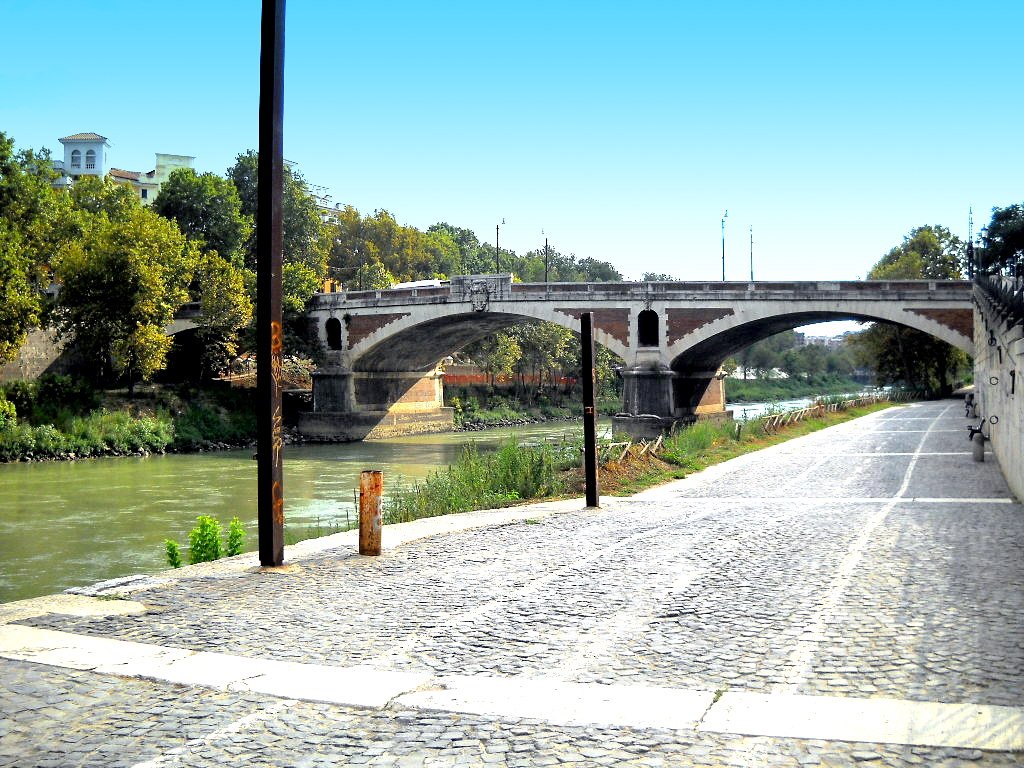
You cross Ponte Sublicio on foot, for free and at any hour: it is a road bridge over the Tiber that connects Piazza dell'Emporio, on the side of Testaccio and the Aventine, with Piazza di Porta Portese, on the side of Trastevere. There are no tickets, time slots or reservations. The tourism portal of Roma Capitale attributes it to the architect Marcello Piacentini and gives its construction as between 1914 and 1917, with the inauguration on April 21, 1919. It bears the name of the oldest bridge in Rome.
That ancient bridge was made of wood, and tradition attributes its construction to King Ancus Marcius. On it Livy sets the story of Horatius Cocles, the soldier who alone held off Porsena's Etruscans while the Romans cut the beams behind him. Today's bridge is not that one, and it isn't even in the same spot. It inherits the name, the function of a crossing between the two banks and a history of more than 25 centuries.
Data checked on September 29, 2026 on the pages of Turismo Roma dedicated to the bridge, to Porta Portese and its market, on the Virtual Museum of the Walls of Rome, on the page of the Capitoline Superintendency dedicated to the Fontana delle Anfore and on the encyclopedia entries cited later in the text. For the bridge there are no hours or fares, because it is a public road. For any information on works, closures or events the City's channel is the contact center 060608, active every day from 9:00 to 19:00.
In brief: address, hours, ticket
- Address: Ponte Sublicio, between Piazza dell'Emporio (Testaccio and Aventine side) and Piazza di Porta Portese (Trastevere side), Rome.
- Operator: it is a city bridge of Roma Capitale, the City's tourism pages don't indicate a reference office, for information the contact center 060608.
- How to enter: you cross it on the sidewalks, at any time, alongside vehicle traffic.
- Price: free, no ticket.
- Hours: no hours, the bridge is always open except for temporary closures decided by the City.
- How to get there: the Piramide stop of Metro B is about a kilometer from Testaccio according to Turismo Roma, the area is also served by Atac trams and buses.
- Accessibility: the City doesn't publish specific information for the bridge, for particular needs it's best to call 060608.
Where it is and what you really see
The bridge spans the Tiber in the southernmost stretch of the historic center, where the river has just left behind the Tiber Island and the Aventine and heads toward Ostiense. On the left bank is Piazza dell'Emporio, the gateway to Testaccio. On the right bank is Piazza di Porta Portese, with the 17th-century gate that marks the southern edge of Trastevere. In between, 105 meters of bridge according to Turismo Roma.
The structure is simple to read. Turismo Roma describes it with three masonry arches, a length of 105 meters and a width of 20. Compared to the more famous bridges of the center it has a sober look, with no statues on the parapets. It is a service bridge, designed to carry the district's traffic to the other bank. Those who cross it usually don't even notice it: they look at the gate, the market, the river.
And it is precisely the river that is the first reason to stop halfway. From here the Tiber flows wide between the embankment walls built at the end of the 19th century, with the low quays that Turismo Roma lists as a pleasant walking route and a bike path along the bank. Upstream the left bank rises toward the slopes of the Aventine. Downstream the river continues toward Ostiense, the neighborhood of the Gasometer and the Centrale Montemartini.
The Testaccio side opens onto Piazza dell'Emporio, a large traffic open space that takes its name from the ancient river port. From there you enter the grid of streets of the rione, with the early 20th-century buildings, the inner courtyards and the neighborhood market. Monte Testaccio, the artificial hill made of amphora shards, is a few blocks farther, along Via Galvani, and can be visited only by reservation according to Turismo Roma.
The Trastevere side is dominated by Porta Portese, which Turismo Roma dates to 1643-1644. Behind the gate, every Sunday, spreads the best-known flea market in Rome, between Piazza Ippolito Nievo, Via Ettore Rolli and Via Portuense. On the other days of the week the area is quiet, with cars parked in the spaces that on Sunday are occupied by the stalls. Come on a Monday and you find the gate and little else. Come on a Sunday morning and you find a crowd.
Don't expect a monument to visit at leisure, like Ponte Sisto or Ponte Sant'Angelo, where cars don't pass. Ponte Sublicio lives on traffic. The sidewalks are wide enough to walk, but the noise of vehicles drowns out any pause. Its value is in the name and in the spot it occupies, on the threshold between three different neighborhoods that each have a precise character.
A curiosity about Ponte Sublicio
Turismo Roma sets the inauguration of the modern bridge on April 21, 1919. It is not just any date. April 21 is the day tradition assigns to the founding of Rome, the city's birthday. Inaugurating on that date the bridge that bears the name of the oldest crossing of the Tiber meant tying a 20th-century public work to the story of the origins. Italy had come out of the First World War only a few months earlier, and the symbol carried its weight.
The name also has a precise story. Turismo Roma explains that the term sublicio derives from sublicae, the wooden beams with which the ancient bridge was built, easy to remove in case of attack. The encyclopedia entry dedicated to the ancient bridge translates sublicius as resting on piles, from the term that indicated the stilts driven into the riverbed. In both cases the name describes a technique, not a place or a person.
A bridge made to be dismantled is a military idea even before an engineering one. Rome, in its first centuries, had enemies on the Etruscan bank of the Tiber, and a stable crossing could become the best road for an army headed to the city. Being able to remove the beams quickly was a form of defense. The story of Horatius Cocles is born from this feature: without a bridge designed to be knocked down, the episode would make no sense.
There is also a detail that links the modern bridge to a fountain. From 1935 to 2012, according to the Capitoline Superintendency, Pietro Lombardi's Fontana delle Anfore stood right in Piazza dell'Emporio, at the end of the bridge on the Testaccio side. For almost 80 years those arriving from Porta Portese saw it as soon as they stepped off the bridge. Today it is back in Piazza Testaccio, where it was born, and at the end of the bridge what remains is a traffic square.
Something nobody tells you about Ponte Sublicio
The bridge you cross is not where Horatius Cocles supposedly fought. The sources place the wooden bridge farther upstream, downstream of the Tiber Island, in the area of the Forum Boarium and at the foot of the Aventine. The modern bridge is farther south, at the height of Porta Portese. It's common to take the opposite for granted. In our view it is the most widespread mistake about this place, and it's worth correcting before you arrive.
It's not a difference of a few steps. Between the Forum Boarium area, where the Temple of Hercules Victor and Santa Maria in Cosmedin are, and today's Ponte Sublicio there is a stretch of lungotevere that takes a good quarter of an hour to walk. Anyone who really wants to put themselves in the places of Livy's story has to go back up the river. The modern bridge took the name, not the position.
The reason, in our view, is practical. When Rome decided to build a new bridge in the early 20th century, the remains of the ancient one had been eliminated about 25 years earlier, during the works for the Tiber embankment walls. The new crossing served to connect Testaccio with Trastevere and the Porta Portese area. They chose the spot useful for modern traffic and recovered for the bridge the most illustrious name available.
There is also a second aspect often overlooked. The ancient bridge, according to Turismo Roma, did not stay wooden forever. It was restored several times in the imperial age, and the emperor Septimius Severus rebuilt its piers in masonry and travertine. The wooden bridge of Ancus Marcius, therefore, at some point ceased to exist as such. The Sublicius of the imperial age was a mixed bridge, with stone foundations, far from the image of a crossing of removable beams.
Where was the wooden bridge of Ancus Marcius?
The sources agree on the area but not on the exact spot. Turismo Roma writes that the ancient bridge crossed the Tiber just below the Tiber Island. The encyclopedia entry dedicated to the Pons Sublicius places it near the Forum Boarium, downstream of the Aemilian Bridge, today the Ponte Rotto, and near the Porta Trigemina of the Servian walls, at the foot of the Aventine. Neither gives precise coordinates, and on the exact position the discussion among scholars remains open.
The Porta Trigemina was one of the entrances to the city in the Servian Walls, the circuit attributed by tradition to King Servius Tullius. It opened toward the river, in an area of trade and landing places, and the bridge connected it to the Etruscan bank. Those coming from the Janiculum side could enter the city passing through here. The bridge was not an isolated work: it was part of a system of gates, walls and markets that had its center in the Forum Boarium.
According to the encyclopedia entry, King Ancus Marcius had the bridge built to connect the Janiculum, just fortified, to the rest of the city, alongside the ferry that already existed. The date given is around 642 BC, with a caveat: no ancient source records the construction precisely. Turismo Roma reports a wider interval, between 642 and 617 BC, that is the years tradition assigns to the reign of Ancus Marcius.
Of the last remains, nothing is left. Turismo Roma gives 1890 as the year of their destruction, during the construction of the Tiber embankment walls. The English entry on the modern bridge reports that notable remains were visible in the riverbed until about 1890, when they were demolished in the works against floods. Those looking for ancient stones along the quays near the modern bridge won't find them, and shouldn't go down into the water or onto unequipped banks to look for them.
To get an idea of the ancient landscape it's best to climb the Aventine and look toward the river, or stop in the Forum Boarium next to the Republican temples and the Mouth of Truth. The Forum Boarium was, as the name says, the cattle market, facing the river's landing places. Ponte Sublicio connected this trading area to the opposite bank, long before Rome built its stone bridges.
My advice for visiting Ponte Sublicio
The advice is not to treat it as a destination in itself. Ponte Sublicio works as a hinge between two rioni, and it's at its best when you cross it on foot as part of a walk that starts on one bank and ends on the other. Start from Testaccio, stop at the Fontana delle Anfore, go down toward Piazza dell'Emporio, cross the bridge unhurriedly and continue toward Trastevere passing under Porta Portese. In half an hour you'll have seen three different landscapes.
Choose the day carefully. On Sunday morning the Porta Portese side is taken over by the market, and the crossing becomes part of the crowd moving among the stalls. On other days the bridge is a quiet passage, with ordinary traffic and few pedestrians. If you're interested in the market, come early on a Sunday. If you're interested in the river and the 17th-century gate, a weekday is better, when the square is clear and the gate can be seen in full.
Stop halfway across the bridge, on the side facing upstream. From there you understand the geography of the ancient story: the river coming down from the Tiber Island, the left bank with the Aventine, the right bank rising toward the Janiculum. The bridge of Horatius Cocles stood farther up, beyond the bend. It's a good spot to mentally reconstruct the scene, with the city on one side and the Etruscan bank on the other.
If you have time, go down to the quays by one of the ramps from the lungotevere and look at the bridge from below. The three masonry arches can be read well only from there. Check the state of the river, though: after heavy rain the quays can be muddy or closed, and in that case stay on the road. Bring water in summer, because there's no shade on the bridge. For the city's public drinking fountains you'll find information on the page dedicated to the nasoni of Rome.
Do you pay anything to cross it?
No. Ponte Sublicio is a public road and you cross it for free, on foot, by bicycle or by vehicle, at any hour of the day and night. There is no ticket, no reservation, no opening time. The tourism pages of Roma Capitale describe it as a work by Marcello Piacentini without listing any visitor services. For works, traffic closures or extraordinary events the reference is the City's contact center, 060608.
There are no sales channels to recommend for the bridge, and be wary of anyone offering a ticket to cross it or to see the area. Monte Testaccio, not far away, is instead visited only by reservation, and Turismo Roma notes it on the page dedicated to the rione. The Porta Portese market is free like the bridge: you enter by walking among the stalls. The only costs of the walk are the ones you decide on, among a coffee, a purchase at the market and the public transport ticket.
If you prefer an organized visit to the Forum Boarium, the Aventine or Trastevere, you'll find offers from private operators and cultural associations, with prices and calendars published on their respective websites. For the bridge itself it isn't needed: everything there is to see can be seen from the street. The visit requires no equipment, only comfortable shoes and a bit of attention to traffic when crossing the lungotevere on the crosswalks.
Another well-known fact, yet rarely cited
Everyone knows the name of Horatius Cocles, few know that the ancient sources don't agree on his end. Turismo Roma recalls it precisely: according to the Greek historian Polybius, Horatius drowned in the Tiber after throwing himself into the water in his armor. According to Livy, instead, he was an excellent swimmer and reached Rome safe and sound. Two opposite versions of the same episode, both ancient, both handed down to us. The heroic version is the one that won in school books.
The detail changes the meaning of the story. In Polybius's version the hero dies for the city, as in the great narratives of sacrifice. In Livy's version he survives, goes home and receives public honors. The Italian encyclopedia entry on Horatius Cocles reports that Rome dedicated a statue to him and granted him as much land as he could plow in a whole day, while the citizens brought him food privately.
The nickname also has an explanation that is rarely cited. Cocles, according to the same entry, which refers to Pliny the Elder, means one-eyed. The name of the hero of the bridge thus describes an impairment, perhaps the memory of a war wound, perhaps a feature of the legend. The sources don't allow saying more, and caution is a must when speaking of episodes placed at the end of the 6th century BC.
Finally there is a third element, even less known. In Livy's story, Horatius was not alone at the start of the defense. The Italian encyclopedia entry reports that fighting with him were Spurius Larcius and Titus Herminius, two men of illustrious family, who withstood the first Etruscan onslaught. Only when the bridge was almost demolished did the two withdraw, and Horatius remained alone on the last stretch of beams. The famous scene is the last part of a longer fight.
The right photo to take at Ponte Sublicio
The best photo of the bridge is taken from below, from the Tiber quays, framing the three masonry arches with the river in the foreground. It's the only position from which the bridge reads as architecture and not as a road. Choose the quay on the Testaccio side in the late afternoon, when the light is softer and the arches take on color. The reflection in the water, on windless days, doubles the design of the arches.
From the bridge itself, the photo to take is toward upstream. The Tiber flows between the embankment walls, with the vegetation of the banks and the trees of the lungotevere. It's the framing that best tells the link between the modern bridge and the ancient one, which stood farther up, beyond the bend of the river. A wide-angle lens helps take in both banks in the same shot, with the Aventine on the right of anyone looking north.
On the Trastevere side it's worth photographing Porta Portese on a weekday, when the square is clear. Turismo Roma describes the columns that hold up the balustrade and the two empty niches on either side of the opening, with the coat of arms of Innocent X above the arch. Stand in the middle of the square, facing the gate, and wait for the traffic to pass. The symmetry of the facade works well with a frontal, centered framing.
On the Testaccio side the photo not to miss is the Fontana delle Anfore in Piazza Testaccio, a few minutes' walk away. The Capitoline Superintendency reports that the restoration completed in 2015 added, for the first time, interior lighting of the basins. In the evening the fountain photographs well with the square around it, maybe with people sitting on the edges. Respect those who live in the rione and don't climb on the fountain to look for a better framing.
How do you get there from central Rome?
On foot is the simplest solution. Turismo Roma calculates about 30 minutes' walk from Testaccio to Piazza Venezia passing by the Circus Maximus, or along the Tiber to the Jewish Ghetto. Following the lungotevere from the Tiber Island area downstream you pass by the Forum Boarium, skirt the Aventine and arrive at Piazza dell'Emporio. It's also the route that makes the relationship between the ancient bridge and the modern one clearest.
By public transport, the subway station closest to Testaccio is Piramide, on Line B, which Turismo Roma places about a kilometer from the rione. From the station you reach the bridge walking through Testaccio, passing by the Pyramid of Cestius and Porta San Paolo. The area is also served by trams and buses. Lines change often because of works, so it's best to check the updated routes on the Atac website before leaving.
By bicycle, Turismo Roma notes the bike path along the Tiber, useful for reaching the bridge area avoiding a good part of the lungotevere traffic. To get up onto the bridge you have to climb back up to the road. If you arrive by car you find the area congested especially on Sunday morning, when the Porta Portese market draws a lot of people. Parking in the two rioni is hard every day, and on weekends it's even harder.
From Trastevere you arrive going down Viale di Trastevere or following the inner streets of the rione to Piazza di Porta Portese. It's the most pleasant route for those coming from the area of Piazza di Santa Maria in Trastevere or Santa Cecilia. From here you pass under Porta Portese, cross the bridge and enter Testaccio. The reverse route works the same way and leads toward the river.
Some important events that happened here in history
Between 642 and 617 BC, according to the tradition reported by Turismo Roma, King Ancus Marcius has the first bridge of Rome over the Tiber built, entirely of wood. The encyclopedia entry on the ancient bridge specifies that the date is approximate, because no ancient source records the construction. The purpose was to connect the Janiculum, just fortified, with the rest of the city. It is the first bridge of Rome according to tradition, and the oldest whose name the sources preserve.
In 508 BC, according to Livy's account, the Etruscan king Porsena marches on Rome to restore Tarquin the Proud to power, expelled the previous year. Horatius Cocles defends the bridge with Spurius Larcius and Titus Herminius, then remains alone while the Romans tear it down behind him. The episode is legend in the technical sense of the term: a story handed down by ancient sources, with different versions of the ending, which cannot be verified with contemporary documents.
Every year, on the Ides of May, according to the encyclopedia entry on the ancient bridge, a procession set out from the temple of Fors Fortuna and reached Ponte Sublicio. The priests carried straw dummies representing bound men, called Argei, and the Vestals threw them into the Tiber from the bridge. The meaning of the rite is debated, and the same entry reports the hypothesis of an ancient Etruscan war ritual aimed at enemies.
In the Republican age, in the season of the Gracchi reforms, the bridge appears in political history. The encyclopedia entry tells that Gaius Gracchus, pursued by his opponents, directed his flight precisely toward Ponte Sublicio. Two friends who tried to defend him were killed, and Gracchus died shortly after in a grove nearby. It was one of the most violent episodes of the crisis of the Republic, and the bridge was its stage.
In the imperial age, according to Turismo Roma, the bridge is restored by Antoninus Pius, Trajan, Marcus Aurelius and Septimius Severus, who rebuilds its piers in masonry and travertine. In the 15th century Pope Sixtus IV has it demolished, and from its travertine, again according to Turismo Roma, 400 large cannonballs are made. In 1643-1644 Urban VIII and Innocent X build Porta Portese not far away, on the right bank, as part of the Janiculum walls.
In 1890 the last remains of the ancient bridge disappear with the construction of the Tiber embankment walls. Between 1914 and 1917, according to Turismo Roma, the current bridge is built to a design by Marcello Piacentini, inaugurated on April 21, 1919. The Virtual Museum of the Walls instead gives the period 1914-1919, and the English entry 1918: the sources don't agree on the end of the works. Around 1945, on the Trastevere bank, the Sunday market of Porta Portese is born.
Who passed through Ponte Sublicio
The first name is that of Horatius Cocles, who according to Livy defended the bridge against Porsena's army. With him, in the first phase of the fight, were Spurius Larcius and Titus Herminius, whom the Italian encyclopedia entry indicates as future consuls. From the other side of the river came the Etruscan army of the king of Chiusi. They are all characters of a traditional story, and for none of them do direct documents exist. Their presence on the bridge belongs to the memory Rome built of itself.
Over the bridge every year passed the Vestals, the priestesses of the sacred fire, for the rite of the Argei on the Ides of May. Gaius Gracchus, tribune of the plebs, passed over it in the flight that preceded his death. The bridge connected the Forum Boarium area, the cattle market, to the Etruscan bank. At the foot of the Aventine the waterway and the land route thus crossed, and anyone going to and from the Janiculum passed through here.
Among the popes, Sixtus IV is the one who decreed its end, having what remained demolished to obtain travertine. Urban VIII and Innocent X left their mark not far away, with Porta Portese and the Pamphilj coat of arms above the arch. The architects of the gate, according to Turismo Roma, were Giulio Buratti and Marcantonio De Rossi. In the 20th century came Marcello Piacentini, designer of the modern bridge, and Pietro Lombardi, author of the Fontana delle Anfore which for almost 80 years stood in Piazza dell'Emporio.
The bridge also had a literary life. The encyclopedia entry on the ancient bridge recalls that the British writer Thomas Babington Macaulay told Horatius's feat in a poem of 1842, titled Horatius, a text that made the episode known to many English-language readers. The wooden bridge, gone for centuries, thus became a literary place even before an archaeological one, and its name has outlasted its stones.
On the Trastevere bank Italian cinema passed through. Turismo Roma recalls that the Porta Portese market appears in films such as Bicycle Thieves and Big Deal on Madonna Street, two titles that tell of postwar Rome. If you want to follow the film locations in the city, you'll find a route on the page Rome in the movies. The market, born around 1945, was already then the place where you bought, sold and bartered everything.
Horatius Cocles: what do the sources say and what is legend?
It's best to distinguish three levels. The documented one concerns the bridge in the historical age: the imperial restorations of Antoninus Pius, Trajan, Marcus Aurelius and Septimius Severus, the demolition ordered by Sixtus IV, the disappearance of the last remains in 1890, the construction of the modern bridge in the early 20th century. These are facts the official sources report without hesitation, even when they don't agree on the exact year the works on Piacentini's bridge ended.
The second level is that of tradition. The construction of the bridge by Ancus Marcius, the dating to the 7th century BC, the bridge entirely of wood: these are elements that Roman tradition hands down and that modern sources report with caution. The encyclopedia entry warns that no ancient source records the construction, and that the date is approximate. The name itself, tied to beams and piles, is the most solid datum of this phase.
The third level is the legend proper. The feat of Horatius Cocles, the defense of the bridge against Porsena, the swim across the Tiber or the death in the waters belong to the story of the origins of the Republic. Livy and Polybius give different versions of it. No contemporary document confirms them. This is not a defect: it is the way Rome told its own story, and it should be read as such, without turning it into a chronicle.
On the meaning of the rite of the Argei the caution is greater still. The encyclopedia entry on the ancient bridge reports the procession on the Ides of May and the throwing of the straw dummies into the Tiber, and proposes the hypothesis of an Etruscan ritual tied to war. It is an interpretation, not an established fact. Be wary of anyone who confidently tells the meaning of such an ancient rite, because the explanations proposed remain hypotheses.
One fact remains that runs through all three levels: the wooden bridge was the city's weak point toward the Etruscan bank, and Rome was aware of it. The choice to build it removable, the story of Horatius and the rite of the Argei thrown from the bridge tell the same thing. A crossing of the river was both a resource and a danger, and had to be protected with force, with technique and with the gods.
What is on the Porta Portese bank?
Porta Portese, according to Turismo Roma, was commissioned by Pope Urban VIII Barberini in 1643 and completed by Innocent X Pamphilj, who placed his own coat of arms above the arch after his predecessor's death during the works. The architects were Giulio Buratti and Marcantonio De Rossi. The gate was part of the Janiculum walls, built to extend the city's protection to the Janiculum hill, and had mainly a commercial function, close to the port, the papal arsenal and the customs house.
The 17th-century gate replaced the ancient Porta Portuensis, one of the southern gates of the Aurelian Walls on the right bank of the Tiber. Turismo Roma tells that the ancient gate was torn down in 1643 and rebuilt about 100 meters farther north, partly using the ancient materials. From there began Via Portuensis, which led to Portus, the area of present-day Fiumicino. The name of the district and of the market comes from this road toward the sea.
The Sunday market, according to Turismo Roma, was born around 1945 to let Romans sell, buy and barter all kinds of objects, in continuity with the black market that was held earlier at Campo de' Fiori. Today it occupies a vast area between Piazza Ippolito Nievo, Via Ettore Rolli and Via Portuense, with stalls of antiques, books, records, clothing, household items and much more. It is held only on Sunday.
The market's precise hours are not given on the Turismo Roma page, which refers to the organizers' contacts. The advice is to arrive early, because the crowd grows as the morning goes on and the most interesting stalls are visited first. Keep your backpack and wallet under control, as in any crowded market. The bridge, on Sunday, becomes one of the most convenient accesses for those coming from Testaccio and the Piramide metro.
A clear position: the Porta Portese market is often sold as the place of impossible bargains, and in our view that is an outdated image. You find curious objects, used books, some interesting piece, and next to these many stalls of clothing, electronics and everyday household items. The reason to come is the experience of a Roman Sunday rite that has lasted 80 years, not the treasure hunt. Those who arrive with the right expectations have fun, those looking for the deal of a lifetime are usually disappointed.
What is on the Testaccio side?
Coming down from the bridge on the left side you enter Piazza dell'Emporio, and from there the rione of Testaccio. The name of the square recalls the ancient river port, where goods arrived from the sea going up the Tiber. The Capitoline Superintendency notes that nearby Monte Testaccio is formed by the fragments of Roman amphorae unloaded in that port. The rione keeps early 20th-century buildings and inner courtyards, which Turismo Roma notes as part of its character.
The Fontana delle Anfore stands in the center of Piazza Testaccio. The Capitoline Superintendency attributes it to the architect Pietro Lombardi, winner of a competition in 1924, and dates its inauguration to October 26, 1927 in what was then called Piazza Mastro Giorgio. A tall pinnacle made of amphorae recalls Monte Testaccio. Four rectangular basins open out from the base, decorated with ram heads and bas-reliefs of amphorae pouring water.
In 1935 the fountain was moved to Piazza dell'Emporio, at the end of Ponte Sublicio, because of ground subsidence under Piazza Testaccio. Between 2012 and 2015, according to the Superintendency, over 350 travertine blocks, numbered one by one, were dismantled, restored and reassembled. 45 water jets were restored and modern hydraulic systems added. On January 24, 2015 the fountain returned to its original position, where it still stands. It is part of the series of neighborhood fountains of Rome.
A little farther on, the rione offers other reasons to stop. Turismo Roma notes the Mattatoio, a large cultural space run by Palaexpo, with temporary exhibitions and contemporary art installations. The Non-Catholic Cemetery, along Via Caio Cestio next to the Pyramid, holds the tombs of Keats, Shelley and Andrea Camilleri. The new neighborhood market hosts stalls of fruit, bread, meat and fish, and under the floor lets you see ancient masonry.
Those with time can complete the tour on the Aventine, which overlooks the left bank a little upstream of the bridge. The hill hosts the Basilica of Santa Sabina, the Villa del Priorato di Malta and the churches of San Saba and Santa Prisca. It is the climb that connects the ancient port to the hill of the basilicas, and completes the reading of the area.
When is it closed and what not to expect?
The bridge never closes. It is a city road open day and night, except for temporary closures decided by the City for works, events or emergencies. There are no published closure calendars, because there is no opening time. If a closure affects the bridge, it usually concerns vehicle traffic and not pedestrians. To find out if there are works under way on the days of your visit, the channel is the contact center 060608.
Don't expect ancient remains. Of the bridge of Horatius Cocles nothing visible remains, and on the spot the history of the place has to be sought in names more than in stones. Don't expect either a monument to admire in silence: the traffic is continuous and noisy, especially at peak hours. Those looking for the quiet of the river have to go down to the quays, when they are open and dry, or choose the early hours of the morning.
The quays below street level are the part most exposed to Tiber floods. After heavy rain they can be muddy, flooded or closed. In that case stay on the lungotevere and on the bridge. Never go down toward the water where there are no equipped paths, and don't try to get close to the banks to look for remains or to photograph from particular angles. The river, even when it looks calm, has strong currents.
Eating nearby
Testaccio and Trastevere are two of the Roman rioni where people eat the most, and for this very reason they are full of traps. The most common ones are concentrated near the Porta Portese market on Sunday and along the most beaten streets of Trastevere: photo menus displayed at the entrance, a tout who stops you on the sidewalk, places open nonstop with no break between lunch and dinner, menu items without a price. These are signs Romans know and that keep them away.
Be wary also of fresh pasta made in the window or on the street as a show for passersby, of menus that differ inside and outside, of prices that change depending on who walks in. This is not snobbery: they are places designed for people who pass through once and don't come back, and the cooking follows that logic. Those who live in the two rioni eat elsewhere, often a few streets away, where the menu is handwritten and changes with the season.
The new Testaccio market, according to Turismo Roma, also hosts food kiosks next to the stalls of fruit, bread, meat and fish, and remains a practical solution for a quick lunch during the walk. For a more considered choice, with selected addresses in the nearby rioni and in the rest of the city, you'll find the list of addresses on Google Maps, which gathers places chosen away from the most touristy circuits.
What to combine in a day
The most sensible combination is a walk along the river that starts from the Forum Boarium and ends in Testaccio. You begin with the round temple and the Basilica of San Giorgio in Velabro, look at the area where the ancient bridge stood, climb the Aventine toward Santa Sabina, then go down toward Piazza dell'Emporio and cross Ponte Sublicio. It's a half day that puts back together the geography of the ancient port.
A second possibility is to start from the Tiber Island and the Theater of Marcellus, cross Trastevere passing by Santa Maria in Trastevere and the Museo di Roma in Trastevere, go down to Porta Portese and finish in Testaccio. On Sunday the route includes the market. On other days the final stretch is quieter and leaves time for the Fontana delle Anfore and for the rione.
Those who prefer to continue south can follow the Tiber to Ostiense. Beyond Testaccio are the Centrale Montemartini, with ancient statues among industrial machinery, the Gasometer, the Via Ostiense Museum inside Porta San Paolo and farther on the Basilica of St. Paul Outside the Walls. It's a day devoted to the Rome of the river and of industry, in which Ponte Sublicio serves as the starting point.
For those looking for a tour dedicated to bridges, Ponte Sublicio pairs well with Ponte Sisto and Ponte Sant'Angelo in the center, and with Milvian Bridge and Ponte Nomentano outside the historic center. Each tells a different era of the city. Those traveling with children also find ideas on the page Rome with kids, and those looking only for free places in Free Rome.
Frequently asked questions
Do you pay for Ponte Sublicio?
No. It is a public road in Rome and you cross it for free, on foot or by vehicle, at any hour of the day and night. There are no tickets, reservations or opening hours. The Porta Portese market, on the Trastevere side, is also free to enter. For information on works or temporary closures the reference is the City's contact center, 060608, active every day from 9:00 to 19:00.
Is today's bridge the one of Horatius Cocles?
No. The current bridge is a 20th-century work, attributed to Marcello Piacentini and inaugurated on April 21, 1919 according to Turismo Roma. The bridge of Horatius Cocles was of wood and stood farther upstream, downstream of the Tiber Island, in the area of the Forum Boarium and the Porta Trigemina, at the foot of the Aventine. The modern bridge took its name, not its position. The last remains of the ancient one disappeared around 1890.
Can you see remains of the ancient bridge?
No. Turismo Roma gives 1890 as the year the last remains were destroyed during the construction of the Tiber embankment walls, and the encyclopedia entry on the modern bridge confirms that until that date they could still be seen in the riverbed. Today nothing visible remains. To imagine the ancient landscape it's best to visit the Forum Boarium, with the Republican temples, and look at the river from the Aventine.
Who designed the modern Ponte Sublicio?
Turismo Roma and the Virtual Museum of the Walls of Rome attribute it to the architect Marcello Piacentini. The construction dates vary depending on the source: Turismo Roma gives the period 1914-1917 with inauguration on April 21, 1919, the Virtual Museum of the Walls the period 1914-1919, the English encyclopedia entry 1918. The bridge has three masonry arches and is 105 meters long and 20 wide, according to Turismo Roma.
When is the Porta Portese market open?
The market is held only on Sunday, according to Turismo Roma, in a vast area between Piazza Ippolito Nievo, Via Ettore Rolli and Via Portuense. The precise hours are not given on the Turismo Roma page, which refers to the organizers' contacts. It's best to arrive early, when the crowd is still contained. The market was born around 1945 and is free: you enter by walking among the stalls.
Why is it called Sublicio?
The name comes from the Latin sublicae, the wooden beams or piles with which the ancient bridge was built. Turismo Roma explains that the beams were easy to remove in case of attack, and the encyclopedia entry on the ancient bridge translates sublicius as resting on piles. The name therefore describes a construction technique. The modern bridge, in masonry, inherited it as a tribute to the oldest crossing of the Tiber.
How much time do you need to see the area?
For the bridge alone a few minutes are enough. With Porta Portese, Piazza dell'Emporio and the Fontana delle Anfore you need about an hour. It becomes a half day if you start from the Forum Boarium, climb the Aventine and cross the bridge toward Trastevere or Testaccio. On Sunday the Porta Portese market can take up a whole morning by itself, depending on how much time you spend among the stalls.
Is the bridge suitable for children?
Yes, with attention to traffic. The sidewalks are wide enough, but vehicles pass continuously and the crossings of the lungotevere must be made on the crosswalks. The story of Horatius Cocles works well with kids, if it is presented as an ancient legend and not as a chronicle. The Fontana delle Anfore in Piazza Testaccio is a pleasant stop, and the Tiber quays, when they are open and dry, allow walking away from cars.
Who wrote this and on which sources
The text comes from the editorial team of Tour Leader Pro, the Rome-based outfit that designs itineraries, visits and cultural events across Rome and Lazio. Fares, hours and booking procedures given here come from the official sources cited in the text, as of the date indicated at the top: for Ponte Sublicio the sources are the pages of Turismo Roma on the bridge, on Porta Portese and on the market, and the page of the Capitoline Superintendency on the Fontana delle Anfore. Tell us what you find changed.
Organizing a walk between Testaccio and Trastevere seems easy to many people, because there are no tickets or time slots. The real difficulty is the traffic on the bridge and on the lungotevere, the Sunday crowd at the market, the sidewalks that don't allow long stops with a large group. It's best to set the meeting point in one of the two squares and not on the bridge. A useful resource for those organizing group trips is Tour Leader Pro.
Ponte Sublicio is also the beginning of the road that leads from the center toward the sea, along the Tiber and Via Portuense to Fiumicino, where ancient Portus once stood. Putting together the city, the river and the coast in a single trip takes some planning, among transport, site hours and travel times. For those who want to look beyond Rome, a useful resource for building a multi-day itinerary is Italy Planner.