Rome in the Movies: The Filming Locations Worth Visiting
In short. Rome is one of the most filmed cities in the world and also the one with the most wrong attributions: a good share of the scenes that the public considers Roman were shot inside a soundstage on the Tuscolana, and some streets that tours…
Rome is one of the most filmed cities in the world and also the one with the most wrong attributions: a good share of the scenes that the public considers Roman were shot inside a soundstage on the Tuscolana, and some streets that tours walk as movie locations have never seen a movie camera. This map lines up the places you can really recognize on screen and can visit, separating them from the set reconstructions, and for each one it says what you see today, if you pay and how much time you need. We checked every address against the public database Italy for Movies of the Direzione generale Cinema, on the official websites of the bodies that run the places and in the location-verification registers, and where the sources disagree we say so. The criterion is simple: we care about the place, not the film.
How to Read This Map of Roman Locations
Movie places in Rome fall into three categories that are best kept apart, because they determine what you find when you get there: real exteriors that are still recognizable, real exteriors that have been transformed, and soundstage reconstructions that don't exist outside the studio. The third is the trickiest, and it's the one on which most wrong itineraries are built.
Real Exteriors, Still Recognizable
These are the best cases: the portico of Santa Maria in Cosmedin is identical to the one of 1953, the Trevi Fountain is the same as in 1960, the Janiculum of 2013 is the one you see today. Here the comparison between frame and reality works, framing included. The case of many Neorealist streets is different: they still exist with the same name but everything else has changed, so there the experience is documentary, not scenic.
Soundstage Reconstructions
This is the category that produces the most widespread mistakes. The via Veneto of La dolce vita, the square of the Bocca della Verità in Il marchese del Grillo, the Sistine Chapel of The Young Pope, Saint Peter's Square in Angels and Demons: none of them is the place that bears that name. They are sets, built at Cinecittà or, in the last case, in California. Knowing it in advance changes the meaning of the visit: you go to see the original that the movies didn't use.
The Mix-Ups We Run Into Most Often
The same five misunderstandings keep coming up: via Veneto searched for as the set of La dolce vita when the sequence was shot in Studio 5, the Sistine Chapel of The Young Pope, never shot in the Vatican, Saint Peter's Square in Angels and Demons, rebuilt in the United States, the square of the Bocca della Verità in Il marchese del Grillo, also a set, the terrace of La grande bellezza, which is a private apartment. We come back to each of them in the chapter that concerns it. A practical note on photographs: outdoors there are no restrictions, while inside museums and churches the rules of each body apply, and in the Sistine Chapel of the Vatican Museums you can't take photos at all.
Neorealism: Rome as an Open-Air Set
Filming of Rome, Open City began on January 18, 1945, with the city still marked by the war and with no working studios: hence the choice that set a school, shooting in the street, in the real neighborhoods. Neorealism is the only season of Italian cinema in which the place told and the place filmed almost entirely coincide, and that is why its addresses remain the most interesting to walk.
Via Raimondo Montecuccoli, the Most Quoted Scene in Italian Cinema
The run and death of the character Pina, played by Anna Magnani, were shot at via Raimondo Montecuccoli 17, in the Prenestino-Labicano neighborhood, right next to Pigneto. You often read that the scene is in Pigneto, and the simplification is understandable because the urban fabric is the same, but the street falls in Prenestino. It's a narrow residential street, today taken up by parked cars, and on site a display case recalls the filming. There is no visiting route, ticket or opening time: you find an ordinary outskirts setting, not a monumentalized place. You get there from the Pigneto station of the urban railway.
The Other Locations of Rome, Open City
The movie opens with a chase over the rooftops overlooking Piazza di Spagna, and in the very first frames you can recognize the staircase of Trinità dei Monti and the Barcaccia Fountain. The exteriors of the parish are those of Sant'Elena, on via Casilina, while the interiors were shot at Santa Maria dell'Orto, on via Anicia, in Trastevere. The partisan ambush was filmed in the Ostiense area, along via delle Tre Fontane, with the Palazzo della Civiltà Italiana in the background: the same frame holds together the monumental rhetoric of the regime and the Resistance that fought it. The final execution was shot at the Forte Trionfale barracks, which is not open to the public.
Bicycle Thieves, from Val Melaina to Porta Portese
Vittorio De Sica's 1948 film crosses Rome from north to south and touches places that for the most part still exist. The protagonist's home is in the public housing of Val Melaina, where a plaque marks the old employment office at the corner of via Scarpanto and via del Gran Paradiso. The theft of the bicycle happens on via Francesco Crispi. The search begins at the market in Piazza Vittorio and continues at Porta Portese, which is still the city's big Sunday market and which in those frames appears in its original form of a market for spare parts and used materials. Other scenes pass through Piazza San Cosimato, in Trastevere, and along the lungotevere at Ripetta.
The Stadium of the Ending, Which No Longer Exists
The epilogue takes place at lungotevere Flaminio, in front of the stadium where a Sunday game is being played. That stadium was the Stadio Nazionale, renamed Torino after the Superga tragedy, demolished in 1957 to make room for the Stadio Flaminio built for the 1960 Olympics. Anyone looking today for the building in the film won't find it: in its place is the facility designed by Pier Luigi Nervi, itself closed and waiting for restoration for years. The urban layout is the same, the facade in the frame is gone.
What Remains of Those Neighborhoods
Pigneto and Prenestino are today neighborhoods of bars and restaurants. The low building structure, houses of two or three floors with inner courtyards, is for the most part that of the 1930s and 1940s: it is this continuity, more than any single address, that makes the walk worthwhile. For the current relationship between the outskirts and cinema, it's worth combining the itinerary with the film series that take screenings out of the center, such as L'Aperossa between Garbatella and Ostiense and Cinema sul Tetto at Casilino Sky Park.
Roman Holiday: The Most Imitated Itinerary in the World
Roman Holiday, shot in 1952 and released in 1953, invented the Roman tourist itinerary as it is still sold: it was made almost entirely in real exteriors, with the interiors completed at Cinecittà, and this makes it the most reliable map of the whole list. The stops can be walked in half a day, with no tickets except for the museums.
The Bocca della Verità, That Is, the Portico of Santa Maria in Cosmedin
The mask is in the portico of the basilica of Santa Maria in Cosmedin, at Piazza della Bocca della Verità 18, and it is exactly the same place as in the film. Entrance is free, with no ticket and no reservation, because it is a church in active use and not a museum. The official website indicates opening every day from 9:30 to 17:50, closed on January 1. The line forms under the portico and in the middle hours often exceeds half an hour: the simplest way to avoid it is to show up at opening. You get there by metro line B, Circo Massimo stop, and 500 meters on foot. The Circus Maximus is the natural next stop.
The Trinità dei Monti Staircase, and the Ban That Changes the Visit
Since 2019 you can't sit on the Trinità dei Monti staircase: the ban is in force, the guards enforce it and fines are provided for. It's best to know this before you arrive, because the scene of the gelato on the steps, one of the most imitated in the history of cinema, can't be reproduced today. The square remains free and open 24 hours a day, line A has the Spagna stop a few steps away, and the best light is that of early morning, when the front of Trinità dei Monti catches the sun and the crowd hasn't arrived yet.
Via Margutta 51
The door of the American journalist's apartment is at number 51 on via Margutta, the street of artists' studios parallel to via del Babuino. The interiors were rebuilt in a studio, but the courtyard and the entrance hall in the film are the real ones. The street is public, the courtyards are private. Via Margutta is also the street where Federico Fellini lived for decades, at number 110: two different myths in 300 meters. You enter it from Piazza di Spagna or from Piazza del Popolo.
The Embassy: Palazzo Barberini and Palazzo Brancaccio Together
The confusion is old and worth untangling: the two palaces are both real and visitable, but they belong to different scenes. The monumental entrance of the embassy is that of Palazzo Barberini, on via delle Quattro Fontane, today home of the Galleria Nazionale d'Arte Antica. Some interior scenes and the courtyard of the escape were shot at Palazzo Brancaccio, on the Oppian Hill. Seeing both means two tickets and two separate routes, with hours to check on their respective websites. The final press conference was shot at Palazzo Colonna, in Piazza Santi Apostoli, which opens to the public on a very limited schedule.
The Dance on the Barge, Under Ponte Sant'Angelo
The nighttime dance party was shot on a barge moored at lungotevere Tor di Nona, under Ponte Sant'Angelo, with Castel Sant'Angelo in the background. The quay still exists and can be reached from the ramps of the lungotevere. The best spot to find the framing again is the parapet at the start of the bridge, on the left bank. Castel Sant'Angelo can be visited for a fee, with its own hours, while the bridge and the quay are free.
The Colosseum, the Forums, the Vespa
The scooter ride passes through via dei Fori Imperiali, Piazza Venezia and the Colosseum, and the nighttime meeting takes place in the Roman Forum, in front of the Arch of Septimius Severus. Compared with 1952 everything changes: back then the Forum could be walked almost without limits, today it is a fenced site with a single ticket that includes the Colosseum, the Forum and the Palatine, timed, with a reservation recommended. The night scene can't be repeated, because the Forum closes at sunset. The haircut was shot in a salon on via della Stamperia, 50 meters from the Trevi Fountain: the shop is gone, the street is still there.
La dolce vita: Half Rome, Half Studio 5
Federico Fellini's film released in 1960 is at once the one most identified with Rome and the most built in a studio of the whole list: the set designer Piero Gherardi created more than 80 settings at Cinecittà, including the whole of via Veneto and the dome of Saint Peter's with the staircase leading to it. Knowing what is real changes the itinerary, because two of the most sought-after stops belong to the second category.
The Trevi Fountain, This One Yes
The fountain sequence was shot on site, in Piazza di Trevi, in the dead of winter: the sources disagree on the month, because the BBC reconstruction indicates March while Anita Ekberg remembered late January, but they agree on the conditions, freezing water and night shooting, with Marcello Mastroianni wearing a wetsuit under his suit. It is one of the few cases in which the place of the myth coincides with the place of the shoot. The access conditions, however, have changed: the official tourism portal of Roma Capitale reports an access fee for the basin area, with time slots and exemptions for residents, small children and people with disabilities. The square remains public, but approaching the basin follows rules that didn't exist in 1960 and should be checked on the city's channels. Going into the water is forbidden and fined.
Via Veneto Is Not Via Veneto
This is the most important correction in the whole article. The via Veneto of La dolce vita, with the cafés, the tables, the photographers lying in wait, was entirely rebuilt inside Studio 5 at Cinecittà, the largest soundstage in Europe, which measures 79.94 meters by 35.94. The reason is practical: shooting on the real street would have meant stopping one of Rome's central arteries for weeks and giving up control of the light, and on top of that the real street is on a slope, while the set was built flat. The result is that the sequence that the world considers the authentic image of the boom-years Rome was shot inside a hangar on the Tuscolana, 8 kilometers from the sidewalk it imitated.
This takes nothing away from via Veneto, which remains the street of the Roman twentieth century, with its Umbertine buildings, its historic hotels and the curve that climbs toward Porta Pinciana and the entrance of Villa Borghese. But you go to see the original that the movies chose not to use, not the set.
The Opening: The Aqueduct, EUR, Saint Peter's
The opening sequence, with the helicopter carrying a suspended statue, flies over an ancient aqueduct on the southern outskirts, identified as the Claudian Aqueduct in the Aqueducts Park, then the new buildings and finally the center. The park is public, free, open all day, and is reached by metro line A at the Giulio Agricola or Subaugusta stops: it is the place where the comparison between frame and reality works best, because the arches are exactly those. The best hours are the first ones in the morning and the last ones before sunset. The film also features EUR, with the exteriors of the basilica of San Giovanni Bosco in Tuscolano and settings of the Rationalist neighborhood, and the Baths of Caracalla, where the nightclub sequence is set. The dome of Saint Peter's, on the other hand, with the staircase leading to the top, was rebuilt on another soundstage: anyone who really climbs the dome of Saint Peter's Basilica has a magnificent experience, but is not redoing that scene.
The Stops Outside Rome
The nobles' party was shot at Palazzo Giustiniani Odescalchi, in Bassano Romano in the province of Viterbo, which can be visited with its own hours to check on the complex's website. The beach of the ending is Passo Oscuro, on the coast north of Rome, about 30 kilometers from the center: a public beach, with no infrastructure dedicated to cinema. The exteriors of the house on the outskirts are at Tor de' Schiavi, in Centocelle.
Fellini, Cinecittà and the Built City
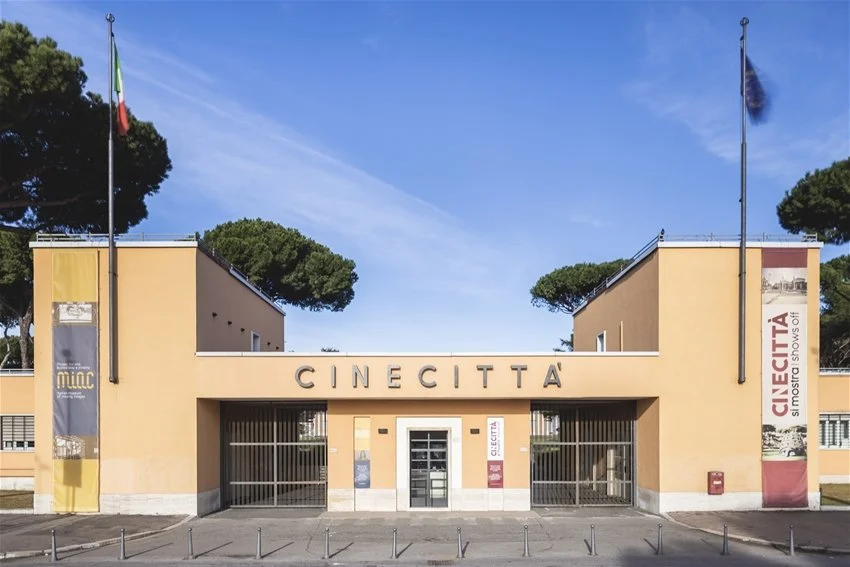
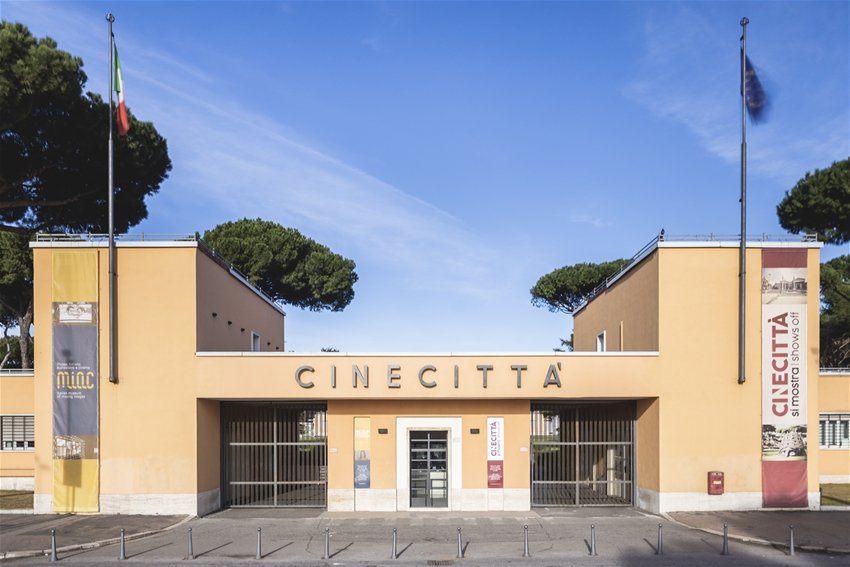
Cinecittà Studios covers 40 hectares at via Tuscolana 1055, 9 kilometers southeast of Piazza Venezia, and since 2011 part of the complex can be visited with the museum route Cinecittà si Mostra. It is the place where the mechanism is best understood: in these hangars the Rome of the movies was built of wood and papier-mâché, and the two ended up being confused.
Roma (1972) and the Papier-Mâché Ring Road
The film that Fellini explicitly dedicated to the city is the one that films it least from life. For the sequence of the Grande Raccordo Anulare in the rain the director had about 500 meters of four-lane highway built at Cinecittà, wider than the real ones, integrating it with shots made on the real artery in 1971. In the same way, the building on via Albalonga and the 1938 trattoria with tables on the sidewalk were rebuilt in the studio. The sequence of the frescoes dissolving in the air is a set, but it comes from a documented fact: the filming in the excavation sites of metro line A. Anyone driving the Raccordo today finds nothing of that scene, for the simplest reason: it was never there.
Studio 5
Studio 5 is the space to which Fellini tied a large part of his career and in which the via Veneto of La dolce vita and a large part of his later imagery were born. It is not part of the ordinary visiting route, because it is a working space: you enter only on special openings announced on the official channels. Anyone who arrives expecting to get in with a ticket is disappointed, and it's best to know that beforehand.
What You Visit Today at Cinecittà
The route is open every day except Tuesday, from 10:00 to 18:00, ticket office closing at 16:30. Annual closures are December 24 and 25 and January 1, besides the main holidays. Cinecittà si Mostra costs €10, the MIAC €10, the combined ticket €15. The reduced rate is €8 for under 26, over 65 and journalists, €5 for children from 5 to 10 years, free under 5. The guided tour with the permanent Ancient Rome set costs €15, €20 if combined with both routes. The outdoor sets can't be visited freely: you enter only with the guide, the tour lasts between 60 and 70 minutes, places are limited and on weekends they sell out. Reservations for individuals and families go through the address visit@cinecitta.it. You get there with line A, Cinecittà stop, in front of the gate.
A clarification on the permanent sets: the Ancient Rome one was built for a coproduced television series between 2005 and 2007 and is not a philological reconstruction, but a plausible Rome designed for the camera, with facades painted to imitate marble and tricked perspectives. Part of it was damaged by a fire in 2018. The other two reproduce a fifteenth-century Florence and the Temple of Jerusalem. Cinecittà is a working studio and productions take precedence: the accessible perimeter changes from week to week. The page dedicated to Cinecittà Studios gives the full price list, the history of the studios and the details of the routes: here we limit ourselves to what connects the sets to the films.
The MIAC, the Audiovisual Museum
The MIAC, Museo Italiano dell'Audiovisivo e del Cinema, is inside the Cinecittà complex, in a building recovered from the former development and printing plants, and it is not a museum of relics: it is a multimedia route by theme, in which cinema, television and radio are treated as a single story of twentieth-century Italy. Same hours as the visiting route, same €10 ticket, which is best bought in the combined version. Cinecittà si Mostra, the MIAC and the guided tour together take from three and a half to four hours.
Italian Comedy and the Memory of the City
We All Loved Each Other So Much by Ettore Scola, from 1974, and Il marchese del Grillo by Mario Monicelli, from 1981, are two opposite cases: the first uses real Rome as an archive of its own recent history, the second rebuilds it almost entirely elsewhere.
C'eravamo tanto amati and the Trevi Inside the Trevi
Scola shot almost everything in Rome, with the interiors at the Incir De Paolis studios, and the exteriors cross Piazza Caprera, Piazza della Consolazione, Piazza del Popolo, Piazza di Spagna, the Aventine and Garbatella. The scene of interest here is another: at the Trevi Fountain the film reconstructs the shooting of La dolce vita, with Fellini and Mastroianni playing themselves. It is the short circuit that makes that square the only place in Rome where you watch a film that watches another film shot exactly there. The villa that opens and closes the story is at Olgiata, a private residential complex north of the city.
Il marchese del Grillo: The Square That Is Not the Square
The correction is double. Piazza della Bocca della Verità seen in the film is not the real square: it was rebuilt at Cinecittà, and in front of Santa Maria in Cosmedin there is no trace of it. And the marquis's palace is not in Rome: the noble settings and the terrace were shot at Palazzo Pfanner, in Lucca. Still Roman are Piazza del Velabro, the Casa dei Cavalieri di Rodi at the Forum of Augustus for the terrace scenes, the papal apartments on the Capitoline Hill, today part of the Capitoline Museums, with the ending in the Sala degli Orazi e Curiazi, and the Parco degli Acquedotti. Outside Rome the film passes through the ruins of Monterano, in the Viterbo area, Villa Grazioli in Grottaferrata and a farmhouse near Tarquinia. The Casa dei Cavalieri di Rodi has limited openings and must be reserved. The Sala degli Orazi e Curiazi is part of the normal route of the Capitoline Museums.
Verdone and the Geography of the Neighborhoods
The cinema of Carlo Verdone, from his 1980 debut onward, has a different relationship with Roman geography: it doesn't look for the monument, it looks for the neighborhood, and places the characters with social precision before topographical, among the bourgeois historic center, the established first outskirts and the borgate. Verdone was born in Rome in 1950 and grew up on the lungotevere dei Vallati, in the Regola district. For these titles the attributions circulating online are often uncertain and not verifiable on production sources, and we prefer not to list unconfirmed addresses: those atmospheres are found in the neighborhoods, from Testaccio to the Monti district, more than in individual doorways.
The Great Beauty: Sorrentino's Itinerary
The Great Beauty, released in 2013 and awarded the Oscar for best foreign film, is the recent film that has put back into circulation the largest number of Roman places, and it is the one with the highest ratio between places filmed and places you can visit: almost all of the locations are real and many open to the public with an ordinary ticket. The exceptions are few but worth knowing.
The Fontanone and the Janiculum
The opening of the film is on the Janiculum, among the equestrian monument to Garibaldi, the cannon that fires at noon and the Acqua Paola Fountain, the Fontanone from which you see the whole city. It is all public, free and accessible at any hour: you climb on foot from Trastevere along via Garibaldi in about 20 minutes of continuous uphill, or by the bus that runs along the promenade. The cannon fires at exactly noon every day. The terrace of the Fontanone is the point of the itinerary where the framing of the film is found identical without paying anything.
Jep's Terrace, Which You Can't Visit
The terrace overlooking the Colosseum is a private penthouse in Piazza del Colosseo: on the street number the sources disagree, because the national tourism portal indicates 7 and the itinerary of the Roma Capitale tourist office indicates 9. In any case it is not a place open to the public and there is no way to get in as a visitor. We say it explicitly because it's the request we get most often.
Bramante's Tempietto and Villa Medici
Bramante's Tempietto is in the courtyard of the church of San Pietro in Montorio, on the Janiculum, and is run by the Real Academia de España: free entrance, open Tuesday to Sunday from 10:00 to 18:00, last entry at 17:30, closed Monday. It is 200 meters from the Fontanone and the two stops are done together. Villa Medici, which appears in the film in the nighttime sequence of the sculptures, can be visited only with a guided tour of about an hour and a half, closed Tuesday, full ticket €18 and reduced €15, with online reservation. Here too the detail that interests visitors, the statues in the dark, can't be reproduced: the villa is visited by day.
Caracalla, the Aqueducts, the Palaces
The Baths of Caracalla host one of the best-known sequences and are an archaeological site with a ticket and seasonal hours. In summer the same complex is home to the open-air opera season. The Parco degli Acquedotti returns here for the sequence of the artistic performance and remains public and free. Among the palaces, Palazzo Barberini appears with its picture gallery, Palazzo Spada with the Galleria Spada with Borromini's perspective gallery, Palazzo Altemps and the Museo di Roma at Palazzo Braschi with their displays: they are all museums open to the public with an ordinary ticket. Palazzo Sacchetti, at via Giulia 66, where the lunch of one of the characters is set, is instead a private palace and cannot be visited regularly. The film also passes through the Capitoline Museums, the basilica of Santa Sabina and the nearby Orange Garden on the Aventine, the Holy Stairs, the Etruscan Museum of Villa Giulia, the Verano Cemetery and the complex of the French Academy. At EUR the Salone delle Fontane appears. The sea sequence is not Roman: it was shot on the island of Giglio, in Tuscany.
Rome Seen From Outside: Ripley, Angels and Demons, To Rome with Love
International productions follow a different logic from Italian cinema: they look for a few immediately recognizable places and, when they don't get permits, rebuild them elsewhere. This is where the most glaring misunderstandings concentrate.
The Talented Mr. Ripley
The 1999 film uses Rome for the central part of the story. The appointment with the character Freddie takes place in Piazza Navona, in front of the Fountain of the Four Rivers. The protagonist's Roman apartment is at Palazzo Costaguti, in Piazza Mattei, the little square of the Turtle Fountain. Also appearing are Piazza di Spagna, the Capitoline Hill with the Capitoline Museums, the Imperial Forums, the grand hotel on Piazza della Repubblica, Castel Sant'Angelo and Ponte Sant'Angelo. Part of the interiors was shot at Cinecittà, the rest of the film is elsewhere, among Ischia, Procida, Anzio, Palermo and Venice. Piazza Mattei is public. Palazzo Costaguti is private and cannot be visited.
Angels and Demons: The Vatican That Is Not the Vatican
This is the most useful correction for anyone organizing an itinerary, because the 2009 film built an imagery that almost never corresponds to the real places. The Diocese of Rome denied permission to shoot inside two churches that are central in the story, Santa Maria del Popolo and Santa Maria della Vittoria, and the interiors were therefore rebuilt at the Sony studios in Culver City, California. Saint Peter's Square was made in the same way, built as a set in the United States and completed digitally, while the Vatican's formal rooms and the library were shot at the Reggia di Caserta. In Vatican City nothing was shot, for the simplest reason: you don't shoot there.
Several exteriors shot in June 2008 remain real, including Piazza del Popolo, corso Vittorio Emanuele II, the Pantheon, the lungotevere with Ponte Sant'Angelo, the church of Sant'Agostino with the Biblioteca Angelica and Castel Sant'Angelo. The two denied churches can still be visited for free as churches in active use and hold the works that the film mentions: whoever visits them sees the original, not the copy.
To Rome with Love
Woody Allen's 2012 comedy uses Rome in a declaredly postcard-like way and the verifiable production information is scarce. One of the few confirmed items concerns Piazza Venezia, where the director noticed a traffic cop who was really directing traffic and built a scene around him. Another is a sequence shot in a real television studio. For the rest, the itineraries circulating on this title mix places filmed and places that are simply plausible, and we prefer not to lengthen the list with unverified attributions.
The Series: The Young Pope, Romanzo Criminale, Suburra
Serial production of the last 20 years has moved the center of gravity of Roman cinema from the historic center to the outskirts and, at the same time, has brought back to the soundstages the places impossible to obtain. The two trends coexist, sometimes in the same title.
The Young Pope and the Rebuilt Sistine Chapel
The Sistine Chapel seen in Paolo Sorrentino's series is not the Sistine Chapel: it is a full-scale reconstruction made on the soundstages of Cinecittà, about 40 meters by 15 and more than 5 high, built because no movie shooting is done in the Vatican. Same logic for the facade of Saint Peter's Basilica, rebuilt in the studio and completed in postproduction. Whoever enters the real Sistine Chapel, inside the Vatican Museums, is not visiting a set but the original that the series couldn't use: there you can't take photos, the route is one-way and you need a ticket and a reservation.
The series does use a great many real, visitable Roman places, though: the papal apartments were recreated between Palazzo Braschi and Palazzo Venezia, the Vatican gardens are a montage of different places including Villa Medici, Villa Doria Pamphilj and the Botanical Garden, and the interiors of the basilica were shot in the church of Santi Luca e Martina, at the edge of the Roman Forum, which has very limited openings. Sant'Anselmo on the Aventine, in the confessional sequences, is an abbey church with regular hours.
Romanzo Criminale, Real Streets and Private Addresses
The series based on Giancarlo De Cataldo's novel was shot almost entirely in real Roman exteriors, without resorting to the studios, and crosses a geography that tourism doesn't frequent: Magliana, Pietralata, Centocelle, San Basilio, the Parioli, EUR. Some scenes touch the center, including via Giulia, Piazza Mattei and via dei Banchi Nuovi, and one sequence was shot in the archaeological area of Ostia Antica, the only one of these locations that is a site you can visit with a ticket. On the others, a recommendation of method: they are residential streets with inhabited houses, and the addresses circulating online correspond to private homes.
Suburra and the Coast
The 2015 film and the series that followed have as their center of gravity the Roman coast, in particular Ostia and its seafront, besides some areas of the center. Here too the specific production information is scarce compared with the quantity of itineraries circulating, and most of the places are ordinary urban spaces. What can be said with certainty is that these productions put the coast back on the map as a cinematic landscape, and that the village of Ostia Antica and the archaeological area remain the destinations in that zone that deserve an organized visit. On the Ostia seaplane basin a free film series takes place every year, the Puntasacra Film Fest.
Where You Can Watch Cinema in Rome Today
Rome has a film programming that goes beyond commercial theaters: a public house of cinema, an international festival in the fall and a network of free summer arenas covering the whole city. These are the occasions when cinema in Rome is watched, not just visited.
The Casa del Cinema at Villa Borghese
The Casa del Cinema is at largo Marcello Mastroianni 1, inside Villa Borghese, and is run by the foundation that also organizes the fall festival. It hosts screening rooms, film series, meetings with filmmakers, a study room open every day from 10:00 to 20:00 and a bar restaurant. A good part of the programming is free entry until seats run out, but the terms change from series to series and the calendar should be checked on the official website. You get there from the Spagna stop of line A, with the Pincio elevators. In summer the same complex hosts an open-air arena, the Teatro Ettore Scola, with free screenings under the pines.
The Rome Film Festival
The Festa del Cinema di Roma is held at the Auditorium Parco della Musica and the 21st edition is scheduled from October 13 to 25, 2026. It is a festival open to the public, with screenings accessible to anyone who buys a ticket and not only to the accredited, and a part spread across other theaters. Tickets are bought on the official channels and for the most anticipated titles they sell out in a few hours: anyone organizing a trip around the festival must move early. The Auditorium is reached by tram 2 from Piazzale Flaminio.
The Summer Arenas
From June to September Rome opens dozens of outdoor screens, many of them free. Among the most established series are the Notti di Cinema in Piazza Vittorio on the Esquiline, Il Cinema alle Mura under the Aurelian Walls, Roma Cinema Arena at the Parco degli Acquedotti, which screens exactly under the arches of the aqueduct of the opening of La dolce vita, Cinema a Forte Antenne inside Villa Ada, Vivi il Cinema among Santa Maria della Pietà, Corviale and Tor Marancia, the Festival del Cinema di San Lorenzo, Schermi di Piombo at the EUR Social Park, Celio Stellato and the evenings of Estate al MAXXI in the square of the museum. The programs come out between May and June and change every year: dates and entry conditions should be checked on the updated pages.
Cinecittà World, Which Is Something Else
Cinecittà World is a movie-themed amusement park on via Pontina, south of Rome, and has nothing to do with the studios on via Tuscolana except the thematic reference. It is a destination for families with children, with a ticket and seasonal hours: whoever looks for the sets where films are shot goes to the Tuscolana, whoever looks for the rides goes to the Pontina. The two places are more than 20 kilometers apart.
Three Itineraries Verified in the Field
Putting together locations from different films in a single route works only by respecting the geography. These three itineraries are the ones we propose most often.
Half a Day in the Center
Bocca della Verità at opening, Circus Maximus, Colosseum and Roman Forum from outside or with a timed ticket, via dei Fori Imperiali and Piazza Venezia, Trevi Fountain and via della Stamperia, Piazza di Spagna and via Margutta: 4.5 kilometers, 3 hours without going into anything. It covers almost all of Roman Holiday and the Trevi of La dolce vita, with a 300-meter detour to the Turtle Fountain if the reference to Ripley interests you. Best done early in the morning, because the Trevi-Spagna stretch in the afternoon is the most congested in the city. For a break, the Antico Caffè Greco on via Condotti is a historic café, not a location, and its table prices are very different from those at the counter.
A Day Between the Janiculum and the Aventine
Climb on foot from Trastevere along via Garibaldi, Fontanone dell'Acqua Paola, Bramante's Tempietto with free entrance, the Janiculum promenade to Piazzale Garibaldi for the noon shot, descent toward Santa Maria in Trastevere, Tiber Island, climb to the Aventine for Santa Sabina and the Orange Garden: 5 kilometers, two climbs, 4 hours. It is the backbone of The Great Beauty and costs nothing. With an extra hour you can add the Baths of Caracalla, a 20-minute walk downhill.
A Morning on the Tuscolana
Line A to Cinecittà, a visit to the studios with a guided tour of the sets booked in advance and the MIAC, then two stops back to Giulio Agricola or Subaugusta for the Parco degli Acquedotti, where you finish under the Claudian Aqueduct of the opening of La dolce vita. Anyone with time adds the Quadraro, the working-class neighborhood bordering the studios, where on April 17, 1944 a German roundup took place and where today you walk among murals. It is the densest itinerary for anyone really interested in cinema: in the same quadrant are the factory that built imaginary Rome and the landscape that real Rome made available. It takes a full half day.
Frequently Asked Questions About Rome in the Movies
Can you visit Cinecittà in Rome?
Cinecittà Studios can be visited at via Tuscolana 1055, every day except Tuesday from 10:00 to 18:00, with the ticket office closing at 16:30. The exhibition route Cinecittà si Mostra costs €10, the MIAC €10, the combined ticket €15. The guided tour of the permanent sets costs €15, or €20 with both routes. The outdoor sets are seen only with the guide and must be reserved, because places are limited.
Is the Sistine Chapel in The Young Pope the real one?
No, the Sistine Chapel in The Young Pope is a full-scale reconstruction built on the soundstages of Cinecittà, about 40 meters by 15 and more than 5 high. No movie shooting is done in the Vatican, and for the same reason the facade of Saint Peter's Basilica too was rebuilt in the studio and completed in postproduction. The original Sistine Chapel is visited inside the Vatican Museums, with a ticket, and inside it you can't take photos.
Where was the via Veneto scene of La dolce vita shot?
The via Veneto of La dolce vita was entirely rebuilt inside Studio 5 at Cinecittà, the largest soundstage in Europe, and not on the real street. The set designer Piero Gherardi created more than 80 settings for that film, including the dome of Saint Peter's with the staircase leading up it. Via Veneto remains an interesting walk for its buildings and historic hotels, but the scene people look for never took place there.
Can you still sit on the Trinità dei Monti staircase as in Roman Holiday?
No, you can't sit on the Trinità dei Monti staircase since 2019: the ban is in force, it is enforced by the guards and provides for fines. The scene of the gelato on the steps, therefore, can't be reproduced. The square remains public and free, open 24 hours a day, and is reached by the Spagna stop of metro line A. For the best photograph, early morning is best.
Is the Bocca della Verità of Roman Holiday the real place?
Yes, the Bocca della Verità is in the portico of the basilica of Santa Maria in Cosmedin, at Piazza della Bocca della Verità 18, and it is exactly the place of the 1953 shoot. Entrance is free, with no ticket and no reservation, with opening indicated by the official website every day from 9:30 to 17:50. The line in the portico in the middle hours often exceeds half an hour: the simplest way to avoid it is to show up at opening.
Which places in The Great Beauty can you really visit?
Almost all the locations of The Great Beauty can be visited, starting with the Fontanone dell'Acqua Paola and the Janiculum, which are free and always open, Bramante's Tempietto with free entrance, the Baths of Caracalla, Palazzo Barberini, Palazzo Spada, the Capitoline Museums and Villa Medici, the last ones with a ticket. Not visitable are Jep's terrace, which is a private penthouse in Piazza del Colosseo, and Palazzo Sacchetti on via Giulia.
Was Angels and Demons shot inside the churches of Rome?
No, the church interiors of Angels and Demons are not Roman: the Diocese of Rome denied permission to shoot inside Santa Maria del Popolo and Santa Maria della Vittoria, and those settings were rebuilt at the Sony studios in California, where Saint Peter's Square was also built. The Vatican's formal interiors were shot at the Reggia di Caserta. In Rome, real exteriors were filmed, including Piazza del Popolo, the Pantheon and Castel Sant'Angelo.
Where is the street of Rome, Open City?
The death scene of Pina in Rome, Open City was shot at via Raimondo Montecuccoli 17, in the Prenestino-Labicano neighborhood, right next to Pigneto and not inside Pigneto as you often read. It is a residential street with no visiting route or ticket, with a display case recalling the filming. It is reached from the Pigneto station of the urban railway or by the surface lines running along via Prenestina.
Are Cinecittà World and Cinecittà Studios the same thing?
No, Cinecittà World is a movie-themed amusement park on via Pontina, south of Rome, while Cinecittà Studios is the production complex on via Tuscolana where films are really shot and where you visit the permanent sets and the MIAC. The two places are more than 20 kilometers apart and have completely different tickets, hours and purposes: it's best to check which of the two interests you before booking.
Who Wrote This Page
This page is edited by the team of Tour Leader Pro, the Roman project office that designs and coordinates visits, itineraries and cultural events in Rome and Lazio. Hours, rates and access conditions given here were verified at the date of publication on the official sources indicated in the text: it's best to recheck them before leaving, because they change often. If you find an outdated piece of information, let us know.
Anyone building a Roman stay around movie places, combining the stops of the historic center with the day on the Tuscolana and with the calendar of the summer arenas, may find useful planning tools at Tour Leader Pro, while for a broader picture of transport and destinations in Lazio Italy Planner is a good resource.