Basilica of Sant’Agostino in Campo Marzio
In short. The Basilica of Sant’Agostino in Campo Marzio is one of the first great Renaissance churches built in Rome and, in all likelihood, the one with the most masterpieces per square meter compared with the fame it enjoys.
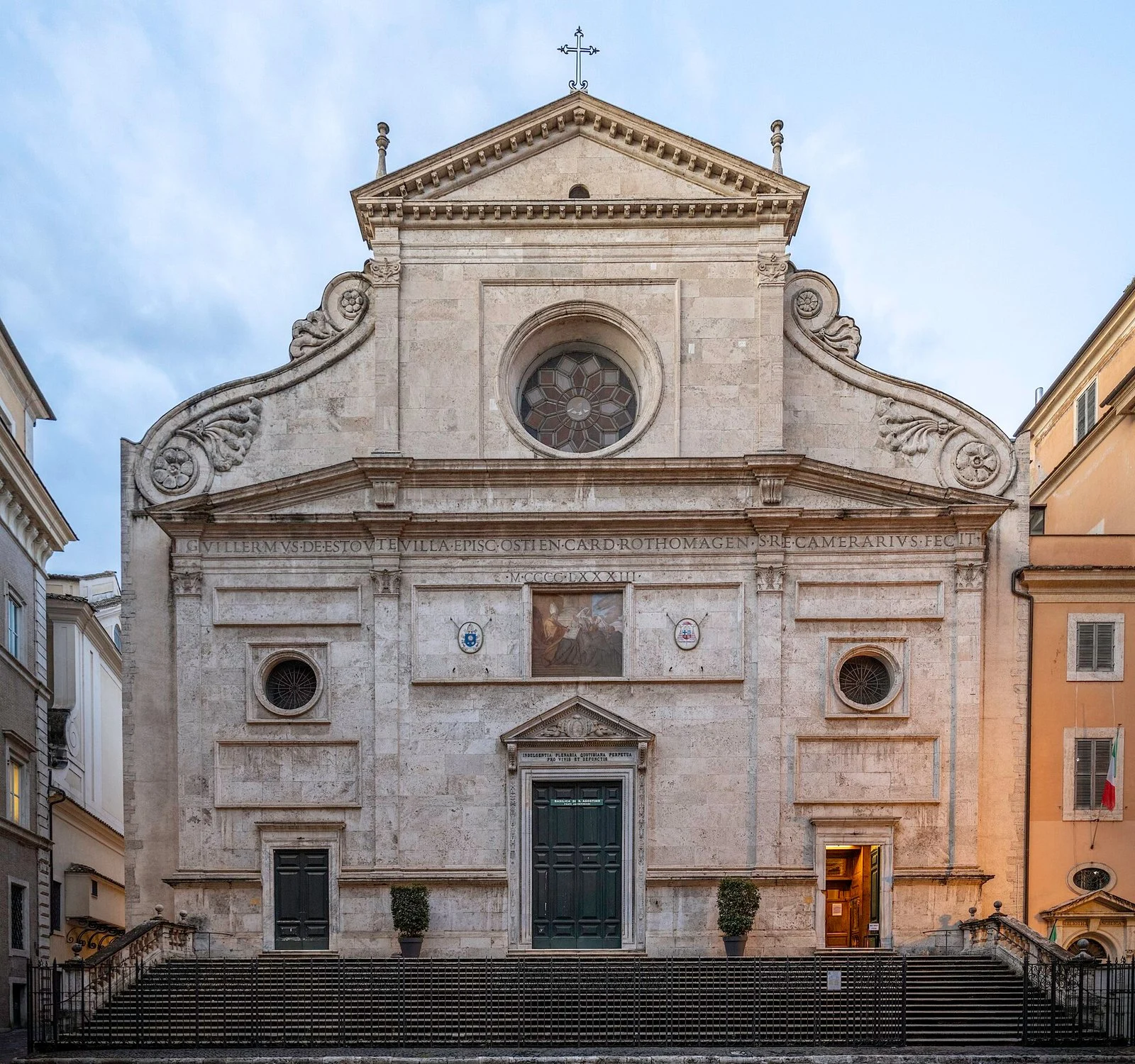
The Basilica of Sant’Agostino in Campo Marzio is one of the first great Renaissance churches built in Rome and, in all likelihood, the one with the most masterpieces per square meter compared with the fame it enjoys. It stands a short walk from Piazza Navona, on a side square that most tourists cross without looking up, and within a few dozen meters it holds Caravaggio's Madonna of the Pilgrims, the prophet Isaiah frescoed by Raphael, the marble group of Saint Anne, the Virgin and Child by Andrea Sansovino and the Madonna del Parto by Jacopo Sansovino, covered in votive offerings and the destination of a devotional pilgrimage that has never stopped in Rome. Next to the church, in the Augustinian convent, is the Biblioteca Angelica, the first library in Europe open to the public without distinction of social class. Entry to the basilica is free, as in almost all churches in Rome, and there is no need to book. The lines that follow tell what you see inside, in what order it's best to look at it, why the travertine facade has a controversial history behind it and how this church became, over five centuries, one of the most layered places in the historic center.
Where the Basilica of Sant’Agostino is and how to get there
The basilica faces Piazza di Sant’Agostino, a small rectangular square in the Sant’Eustachio district between Via della Scrofa and Via dei Pianellari, less than 200 meters from the northern side of Piazza Navona. If you come from Via della Scrofa, the artery that cuts through Campo Marzio from north to south, you meet it on your right after passing the intersection with Via dei Portoghesi. It's a paradoxical position: the church is in the absolute heart of Rome's tourist center, in the middle of the flow that every day links the Pantheon to Piazza Navona, and yet the square in front of it is almost always half empty, because it isn't on the main pedestrian axis and because the bulk of the facade, set back at the top of a flight of steps, can't be seen until you are right in front of it.
On foot from the historic center
From Piazza Navona it's barely three minutes: just leave from the north side of the square, the one with the Neptune Fountain, take Via di Sant’Agostino and keep straight until the street opens into the square. From the Pantheon the route is just as short, seven or eight minutes walking along Via della Scrofa or cutting through Piazza delle Cinque Lune area. From Campo de’ Fiori it takes about 15 minutes going by Corso Vittorio Emanuele II and heading back up toward Campo Marzio, while from Piazza di Spagna the walk is a little over a quarter of an hour following Via dei Condotti, Via Tomacelli and then the inner streets of the district.
By public transport
There is no metro stop in the immediate vicinity: Campo Marzio is the part of Rome's historic center farthest from lines A and B, a gap that anyone visiting Rome soon discovers. The most practical solution is to get off at Spagna or Barberini on line A and finish the trip on foot in about a quarter of an hour, or to use the surface buses that run along Corso del Rinascimento and Corso Vittorio Emanuele II, with stops a few hundred meters from the church. The lines that connect Termini to the historic center via Largo di Torre Argentina leave you about 10 minutes' walk from the basilica.
One of the first Renaissance churches in Rome
The Basilica of Sant’Agostino in Campo Marzio was rebuilt in its present form between 1479 and 1483, which makes it one of the very first fully Renaissance churches built from scratch in Rome. It's a fact worth bringing into focus, because in the popular view the Roman Renaissance means the 16th century of Bramante, Raphael and Michelangelo, and people tend to forget that in the preceding decades the city had already begun to adopt the architectural language developed in Florence in the first half of the 15th century.
Before 1483: the Augustinians and San Trifone
The Hermits of Saint Augustine, the mendicant order that brought together several hermit congregations under the Augustinian rule, had settled in this part of Campo Marzio as early as the end of the 13th century, when in 1287 they obtained the church of San Trifone in Posterula, not far away. The community grew quickly and at the end of the 14th century began building a new church dedicated to its spiritual founder, completed around 1420. That first church, however, soon proved inadequate: too small for a growing community and, above all, built at too low a level with respect to the Tiber, which in this stretch of Campo Marzio flooded regularly, inundating the streets and the ground floors of buildings.
Cardinal d’Estouteville, the patron
The rebuilding was financed by Cardinal Guillaume d’Estouteville, a French prelate from a noble Norman family, one of the richest and most influential men of the Roman curia in the heart of the 15th century. D’Estouteville, who was Camerlengo of the Holy Roman Church and bishop of Ostia, had already funded substantial works in other Roman churches, and his generosity toward the Augustinians had a precise reason: the order was at that time one of the most active in the intellectual and university life of the city. The inscription on the central portal of the basilica explicitly records his name and the year of completion, 1483, in a formula that credits him with authorship of the work.
Who designed it: a question with more than one answer
On the attribution of the design the sources don't fully agree, and it's worth saying so plainly rather than arbitrarily choosing one version. The most widespread Italian historiographical tradition attributes the rebuilding to Giacomo da Pietrasanta and Sebastiano da Firenze, two masters active in the Rome of Sixtus IV, and this is the version found both in parish documentation and in the entries of the municipal tourist bodies. Part of the English-language literature, instead, traces the overall design to Baccio Pontelli, the architect tied to other Sistine building sites, assigning only the facade to Giacomo da Pietrasanta. In the absence of a contract document settling the matter, the most honest position is to record both readings: the name that appears in all versions, and therefore the most solid, is that of Giacomo da Pietrasanta.
The dome: an architectural first often misunderstood
The 1483 building was crowned by a hemispherical dome set on a cylindrical drum, and several sources indicate it as the first Renaissance dome built in Rome not enclosed in a tiburio, that is, not hidden by an outer casing of a different shape, as happened in the medieval building tradition. Here a confusion needs flagging that circulates online and even in some institutional entries: some texts credit Luigi Vanvitelli, the 18th-century architect who intervened heavily on the basilica, with building the first Renaissance dome in Rome. It is an obvious chronological misunderstanding, given that Vanvitelli worked here in the mid-18th century, more than two and a half centuries later. The correct reading is the opposite: the 15th-century dome held the record, and it was Vanvitelli himself who transformed its interior arrangement.
The travertine facade: what you see and what is told
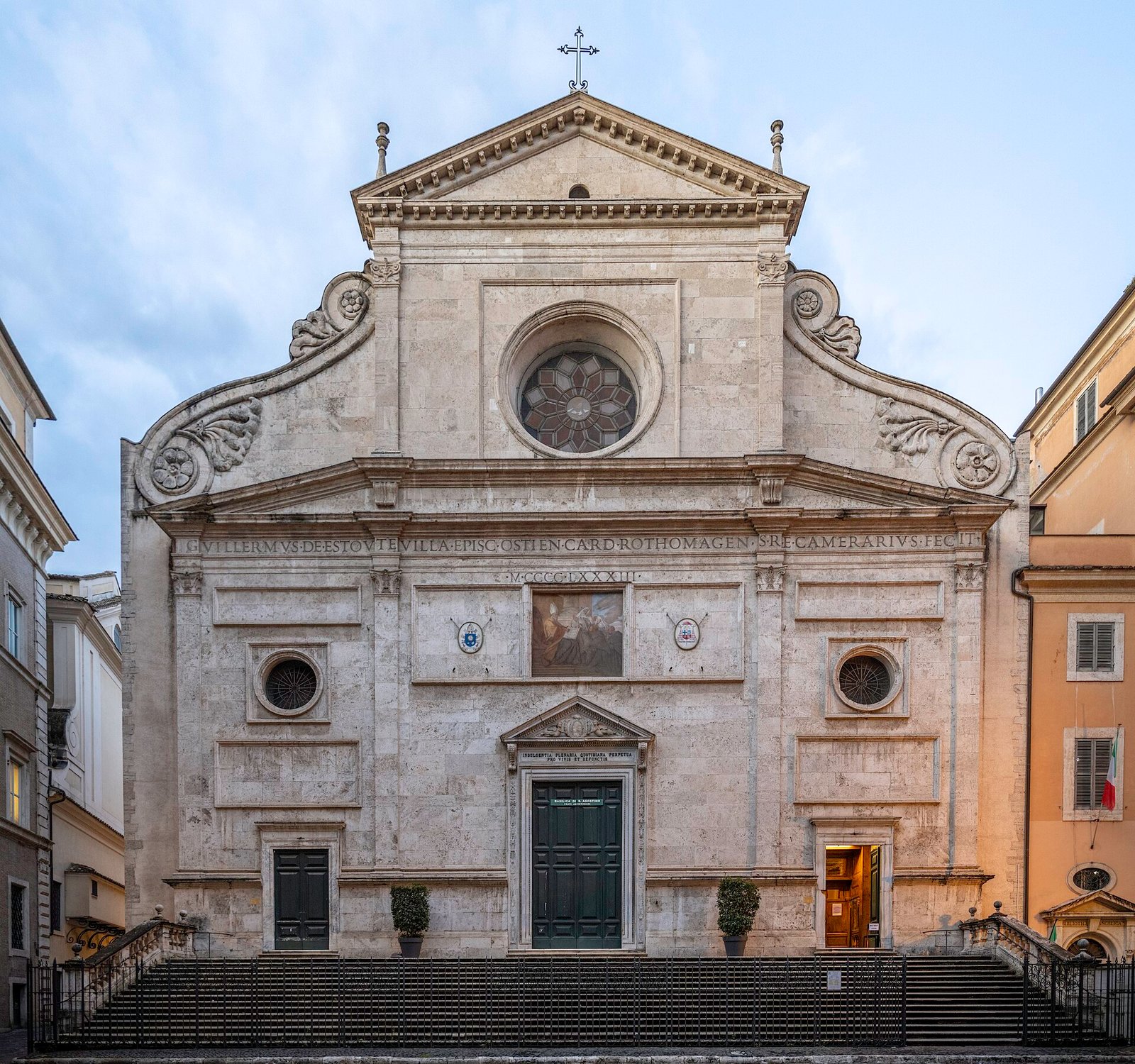
The facade of the Basilica of Sant’Agostino in Campo Marzio is entirely clad in blocks of travertine, the limestone quarried at Tivoli and along the Aniene that is the signature material of Roman architecture in every age. It is organized in two stacked tiers: the lower one, wider, matches the width of the three interior naves and has the central portal and two smaller side portals. The upper one, set back and narrower, matches the central nave alone and is closed at the top by a triangular pediment inside which stands the coat of arms of Cardinal d’Estouteville.
The Albertian model
The link between the two tiers is handled by two large side scrolls, that is, two curved curl-shaped elements that mask the step between the tall central nave and the lower side aisles. It's a solution that Leon Battista Alberti had codified in the facade of Santa Maria Novella in Florence, finished in 1470, and which from the second half of the 15th century onward became the canonical scheme for three-nave church facades all over Italy, eventually becoming one of the recognizable features of the Roman Baroque facade a century and a half later. At Sant’Agostino, however, the scrolls are a later addition, introduced by Vanvitelli in the 18th-century remodeling: the original 15th-century facade had a different profile, and this is one of the many points where the building we see is a palimpsest and not a pure document of its founding century.
The staircase
The monumental staircase in front of the facade was rebuilt in 1666, and its original function, as has been said, was to raise the level of the church above the height of the floods. The side effect, though, was theatrical: the basilica dominates the square from above, and whoever climbs the steps goes through an approach that is completely missing in Roman churches at street level. It's a device that visitors feel without knowing it, and that helps explain why the interior, once you cross the threshold, seems more solemn than its size would lead you to expect.
A curiosity about the Basilica of Sant’Agostino in Campo Marzio
The most repeated tradition about this church concerns the origin of the facade travertine: according to the story handed down by guides and reported by many local sources, the blocks were taken directly from the ruins of the Colosseum. It's a piece of news to be handled with some caution, and it's worth explaining exactly why.
What can be said with certainty
The general historical fact is not in dispute: between the Middle Ages and the full Renaissance the Colosseum functioned for all practical purposes as an open-air stone quarry, and its travertine blocks ended up in dozens of Roman building sites, including some of the most famous. The papal grants authorizing the removal of material from the Flavian Amphitheater are documented, and the practice of spoliation was stopped only in the 18th century, when Benedict XIV consecrated the monument to the memory of the Christian martyrs. That in the Rome of 1483 a large-scale building site supplied itself with reused travertine, instead of opening new quarries, was therefore the norm, not the exception.
Why the story has to be labeled as tradition
What is missing, in the specific case of Sant’Agostino, is direct documentary proof that the blocks come from the Colosseum itself and not from other ancient ruins or from active quarries. The sources that deal with the basilica use cautious formulas, speaking of travertine from the Colosseum “according to tradition,” and the same caution is found in the entries of the tourist bodies. Some accounts name the Colosseum with certainty, others widen the formula to a generic reuse of ancient material. The version that can be supported without strain is this: the facade travertine is almost certainly reused, the Colosseum is the traditionally indicated source, and in the absence of contract documents from the time the attribution remains an established tradition rather than a verified fact.
Caravaggio's Madonna of the Pilgrims: the first chapel on the left
Caravaggio's Madonna of the Pilgrims is in the first chapel of the left aisle, immediately to the left of whoever enters from the central portal, and it's an oil on canvas of monumental size, about 260 centimeters high by 150 wide. It is also known as the Madonna di Loreto, from the shrine in the Marche region to which the iconography refers, and it is one of the paintings that best sum up the revolution Caravaggio brought to Italian sacred painting at the start of the 17th century.
The commission: the Cavalletti chapel
The chapel was bought by the Cavalletti family on September 4, 1603, in execution of the will of Ermete Cavalletti, a Bolognese gentleman transplanted to Rome and tied to circles of Lauretan devotion, who had died the year before. It was the widow who oversaw the making of the altarpiece, entrusted to Caravaggio. On the exact date of execution the sources waver between 1604 and 1606, with the majority of studies placing the painting between 1604 and 1605 and some entries giving 1606: the sure fact is the chronological window, not the single year.
What the painting shows
The scene is disarmingly simple. The Virgin, standing on the threshold of a door, with the already fairly grown Child in her arms, shows herself to two pilgrims kneeling with hands joined: an elderly man with thinning hair and a woman in a worn cap. Behind the Madonna there is no Holy House flying borne by angels, as traditional Lauretan iconography would have it, but a plain peeling brick wall with a stone doorframe and a marble threshold. Put another way, Caravaggio takes a codified devotional theme and rewrites it as an encounter at the front door in some ordinary Roman alley.
The dirty feet that caused a scandal
The detail that set off the controversy is the most visible of all: the bare, muddy feet of the pilgrim kneeling in the foreground, with the soles turned toward the viewer and the dirt of the road perfectly rendered. In the climate of the Counter-Reformation, which demanded decorum and dignity from sacred art, showing the physical poverty of the faithful in an altarpiece was a provocation hard to swallow. Giovanni Baglione, a painter and contemporary biographer of Caravaggio as well as his declared adversary, recorded in his Lives the public's discontent precisely with this “extreme poverty” and with the filthy feet placed in the foreground, showing that the reaction was not a later invention but a fact contemporary with the work.
It must be said, though, that modern critical reading has overturned the judgment. As Ferdinando Bologna observed among others, that extreme realism did not at all drive ordinary worshippers away: on the contrary, the people who frequented the basilica recognized themselves in those worn and dusty figures far more than in the polished Madonnas of late Mannerist painting. The scandal, put another way, was a matter for the learned critics more than for popular devotion, and the long-lasting success of the painting in a parish church confirms it.
The model and her disputed identity
On the identity of the model who posed for the Virgin a traditional attribution has circulated for centuries: it has been suggested that she was Lena, identified by part of the critics with Maddalena Antognetti, a Roman woman tied to Caravaggio and mentioned in the court records of the time, described as a courtesan. If the identification were well founded, the provocation would be double, because Counter-Reformation rules discouraged the use of models of doubtful reputation for sacred figures. Here, though, caution is needed: this is a recurring historiographical hypothesis and not a definitively documented fact, and several scholars treat it as such.
How to look at it, concretely
The chapel is small and the painting, placed on the altar, appears very dark in natural light: as in almost all Roman churches that hold works of this importance, a coin-operated device turns on the spotlights for a few minutes, and whoever really wants to see the pilgrim's feet would do well to bring a few €1 coins.
Whoever wants to grasp the full scope of the Caravaggesque revolution would do well to complete the visit with the three canvases of the Contarelli Chapel in San Luigi dei Francesi, five minutes away on foot, and with the two large canvases of the Cerasi chapel in Santa Maria del Popolo. The three churches form, together with Sant’Agostino, Rome's free Caravaggio circuit, one of the densest zero-cost art itineraries in Europe.
Something nobody tells you about the Basilica of Sant’Agostino in Campo Marzio
In the 16th century the Basilica of Sant’Agostino in Campo Marzio took among its burials a social group that no other Roman church of equal rank would have accepted with the same ease: the city's high-class courtesans. Next to the tombs of cardinals, prelates and noble families, the basilica housed the sepulchers of some of the best-known and most discussed women of Renaissance Rome.
Who was buried here
Local sources recall in particular Fiammetta Michaelis, a celebrated courtesan tied to Cesare Borgia and owner of a house still identifiable today in the Ponte district, where a small square bears her name, Giulia Campana, also a successful courtesan, and the latter's daughter, Tullia d’Aragona, a figure of importance far beyond society gossip, because she was a poet, the author of a philosophical treatise on love and a recognized interlocutor of the literary circles of Rome, Florence and Ferrara. Next to her, according to the same sources, her sister Penelope was buried.
Why here
The explanation is geographical even before it is moral. The area north of Campo Marzio, between Via di Ripetta and the Tiber, hosted in the 16th century the quarter that the Romans called the Ortaccio, the area where the papal authorities tried to confine the city's prostitution. Sant’Agostino was the reference parish church for a considerable part of that population, and the right of burial followed residence. To this was added a practical factor: high-ranking courtesans had significant personal wealth and could afford generous bequests to the religious community, which made the question less controversial than common sense would suggest.
Nothing visible remains of those burials today: tombstones and funerary monuments were removed over the centuries, probably during the campaigns of strictness that followed the Council of Trent and then in the 18th-century remodeling. It should be added that the story circulates in very variable versions, enriched over time with novelistic details: the core attested by the Roman scholarly sources is the presence of the burials, while the details about epigraphs and the circumstances of the removals should be taken as local tradition and not as verified chronicle.
Raphael's prophet Isaiah on the third pillar
The prophet Isaiah frescoed by Raphael is on the third pillar of the left aisle of the basilica, on an exposed wall surface, not inside a chapel, and for this reason it escapes a great many visitors who come in looking only for the Caravaggio. It is dated to 1511 or 1512 depending on the studies, so at the most intense moment of Raphael's Roman activity, contemporary with the Vatican Stanze.
The patron: Johann Goritz and his devotion
The fresco was part of a votive complex commissioned by Johann Goritz, known in Rome in the Italianized form Giovanni Coricio or Coritius, an apostolic protonotary originally from Luxembourg and a leading figure in Roman humanism of the early 16th century. Goritz dedicated the monument to devotion toward Saint Anne, the Virgin and Christ, a familiar trinitarian theme that recurs explicitly in the inscription. The complex was conceived as a unit: Raphael's fresco above and, directly below, the marble sculptural group by Andrea Sansovino.
The Greek inscription and the Hebrew scroll
The prophet is portrayed seated, twisting, between two putti holding a tablet with a dedication in Greek, whose meaning is a tribute to Saint Anne mother of the Virgin, to the Virgin mother of God and to Jesus the savior from Johann Goritz. The scroll Isaiah holds in his hand bears a verse in Hebrew taken from the book of the same name, an invitation to open the gates so that the people who believe may enter. The presence of Greek and Hebrew together in a single work is a learned trait typical of the humanist milieu of early 16th-century Rome, in which knowledge of the languages of the Scriptures had become a mark of intellectual distinction.
Raphael in front of Michelangelo
The most interesting thing about the Isaiah, for those who know 16th-century painting, is how little it resembles the Raphael everyone has in mind. No sweetness, no light grace: the prophet has heavy musculature, a violently twisting pose, a physicality that derives directly from the prophets and sibyls Michelangelo had painted on the vault of the Sistine Chapel between 1508 and 1512. At the time Raphael painted the Isaiah, the Sistine vault was being completed and some parts of it had already been unveiled: the impact on Raphael was immediate and the fresco at Sant’Agostino is the most explicit evidence of it that survives in Rome outside the Vatican Palaces.
The anecdote about the fee
An anecdote handed down by the 16th-century biographical tradition is tied to the story of the fresco: Goritz is said to have found the fee requested by Raphael excessive and to have asked Michelangelo's opinion, who, after looking at the work, supposedly replied that the prophet's knee alone was worth the agreed sum. It's one of those stories that art historians treat with the right distance, because it belongs to the anecdotal repertoire built around the rivalry between the two artists. It remains significant, however, of how already the contemporaries read the Isaiah as a Michelangelesque work.
Saint Anne, the Virgin and Child by Andrea Sansovino
Below Raphael's fresco, on the same pillar, is the marble sculptural group showing Saint Anne, the Virgin and Child, a work by Andrea Sansovino datable to 1512, commissioned by the same Johann Goritz as a unified part of the same votive complex. It is a frequent mistake to consider it an independent work placed there by chance: fresco and sculpture were born together and should be read together.
What it shows
The subject is what iconography calls Saint Anne Metterza, that is, the representation of the three sacred generations: grandmother Anne, daughter Mary and grandson Jesus arranged in a pyramidal composition that physically links them. It's a theme of great success in the Italian Renaissance, which Leonardo had tackled in those same years in an interpretation destined to become famous, and which Sansovino here resolves in a monumental and composed key, with a pyramid of bodies that plays on the contrast between the materiality of the drapery and the smoothness of the flesh.
The tradition of the poets on Saint Anne's day
A detail that conveys the humanist atmosphere of the Rome of Leo X: on the feast day of Saint Anne, July 26, the intellectuals of Goritz's circle used to gather in front of the sculptural group and post Latin poems composed for the occasion. Those verses were later collected and published, and are a precious source on the literary sociability of early 16th-century Rome. It is a rare case in which we know not only the work of art, but also the collective rite that took place around it.
Jacopo Sansovino's Madonna del Parto and its cult
Jacopo Sansovino's Madonna del Parto is in a niche on the right wall, just after the main entrance, and it is the artwork in the basilica in front of which someone is almost always praying. It's a marble group showing the Virgin seated on a throne with the Child standing on her knees, made between 1516 and 1521 on commission from the Florentine Martelli family, whose coat of arms still appears on the architectural aedicule that frames it.
A statue buried under votive offerings
What strikes whoever enters for the first time is not the sculpture itself, but what surrounds it. The niche and the walls around it are literally covered with votive offerings: silver hearts, medals, chains, photographs, blue and pink ribbons, plaques with inscriptions of thanks, votive sashes. It is the material accumulation of an unbroken cult, practiced mostly but not exclusively by women who ask or give thanks for a pregnancy, a birth that went well, a long-wished-for child. In contemporary Rome, where many popular devotions have faded or been reduced to tourist folklore, this one is still very much alive and entirely spontaneous.
The silver foot
The most talked-about detail concerns the Virgin's foot, which juts out from the base and which the faithful have kissed and touched for centuries. In 1822 Pope Pius VII granted an indulgence to those who kissed the statue, and the wear caused by continual contact was such that the original marble foot had to be replaced with a silver plate. When you look at the sculpture up close, that shiny metal surface in the middle of the marble is immediately recognizable: it is the physical, measurable gauge of two centuries of popular devotion.
The legend of Agrippina and Nero
Before the group became an object of Marian cult, a completely different popular tradition circulated in Rome: that the statue actually showed Agrippina with the young Nero, and that it was therefore an ancient sculpture reused in the church. It's an unfounded legend, given that the work is documented as a 16th-century creation by Jacopo Sansovino, but it says something important about the Rome of those centuries: the habit of living with reused ancient marbles was such that a Renaissance sculpture of classicizing design could be mistaken for Roman without anyone finding it strange. The Marian devotion, according to the available accounts, consolidated and took its present form mainly during the 19th century.
Belli's sonnet
The quantity of jewels and ornaments piled on the statue struck Giuseppe Gioachino Belli so much that it drove him to dedicate to the Madonna del Parto one of his sonnets in Roman dialect, in an ironic key toward that devotional practice. It's a precious literary record, because it documents that already in the first half of the 19th century the look of the niche was substantially what we see today, with the sculpture almost hidden under the mass of votive offerings.
The 2022 restoration
Devotion, however, has a conservation cost. Centuries of physical contact, of sacred oils applied to the surface, of waxes and synthetic resins spread in not always careful interventions had produced an extensive, patchy browning of the Carrara marble, as well as widespread abrasions and scratches. In 2022 the sculpture underwent a restoration lasting about six months, coordinated by the restorer Anna Borzomati with the Soprintendenza Speciale di Roma and the support of a bank, which combined traditional organic solvents with a biocleaning technique based on selected bacterial strains, able to metabolize organic deposits without attacking the marble. The documentation of the work was produced with three-dimensional modeling.
My advice for visiting the Basilica of Sant’Agostino in Campo Marzio
The most useful advice concerns opening hours, because the Basilica of Sant’Agostino in Campo Marzio follows the afternoon closing pattern typical of Roman churches run by a religious community, and if you arrive around 1 in the afternoon you risk finding the doors shut. The available information speaks of a morning opening that closes around 12:30 and an afternoon reopening around 4 until the evening, with slightly different hours on holidays, but these windows change with the seasons and the liturgical calendar: it's always best to check them on the basilica's website or by phoning the parish before planning the visit, because no Roman church schedule is reliable when read from a third-party source.
The right time of day
If your main goal is to see the Caravaggio in the best conditions, early morning is preferable: the church is almost empty, the light coming in from the high windows is still soft and there are no guided groups in front of the chapel. In the late afternoon, by contrast, the atmosphere is completely different, with the artificial lighting on, services under way and a presence of local worshippers that gives the basilica back its dimension as a living parish church. They are two different visits and anyone with time would do well to make both.
Combining the visit with the rest of Campo Marzio
Sant’Agostino works better as a stop on a route than as a destination in itself. An itinerary that starts from Piazza Navona, touches Sant’Agostino, continues toward San Luigi dei Francesi and arrives at the Pantheon covers in a little over a kilometer some of the densest places in the historic center, all with free entry, and can be completed in a morning without rushing. Anyone with more time can extend it to Palazzo Altemps, which is a short walk away and houses one of the most beautiful collections of ancient sculpture in Rome, though this one needs a ticket.
Another well-known fact that is still rarely mentioned
Built against the basilica, in the convent complex of the Augustinians, is the Biblioteca Angelica, founded in 1604 and considered the first library in Europe conceived to be open to the public without distinction of social standing or wealth. It is a first that very few visitors to the church are aware of, also because the library's entrance is separate and opens onto the same square.
Angelo Rocca and his idea
The library takes its name from Angelo Rocca, an Augustinian bishop and scholar who had been in charge of the Vatican Press under Sixtus V. Rocca gave the convent of Sant’Agostino his personal collection, about 20,000 volumes, setting a condition destined to make history: that the new library be open to everyone, without limits of status or wealth. In an age when the great book collections were the prerogative of courts, convents and cardinals, and access was regulated by personal relationships, it was an idea of revolutionary scope.
The Vanvitelli reading hall
The reading room you visit today, one of the most photographed spaces in Rome among lovers of historic libraries, was designed by Luigi Vanvitelli and completed in 1765: a double-height space with wooden shelving rising to the ceiling all around the perimeter, run through by a gallery. It is the same Vanvitelli who in those same decades was remodeling the basilica next door, which makes the Sant’Agostino complex a rare case of coordinated work on church and convent.
The forbidden books
A detail worth mentioning: the Angelica had authorization to keep books placed on the Index, and for this reason it still holds a collection of censored volumes that elsewhere would have been destroyed. It's a paradoxical and precious function, that of a Catholic library which, thanks to an ecclesiastical privilege, ended up saving exactly the texts the Church condemned. Since 1940 the library also houses the Accademia dell’Arcadia, the literary institution founded in Rome at the end of the 17th century.
Anyone who wants practical details on access, hours and visits to the institution will find them in the page devoted to the Biblioteca Angelica, which treats the library as an institution in its own right: what matters here is above all that church and library were born from the same convent and should be read as a single organism. Those who love Rome's historic libraries can complete the route with the Biblioteca Vallicelliana and the Biblioteca Casanatense, both a few minutes' walk away and both tied to religious orders.
The right photo to take at the Basilica of Sant’Agostino in Campo Marzio
The best photograph to take at the Basilica of Sant’Agostino in Campo Marzio is not the interior, where the works are protected and the light is difficult, but the facade shot from the opposite side of the square, with the double-ramp staircase in the foreground and the travertine lit from the side. It's a framing that almost no one takes, because most visitors go in and out without ever turning back.
Where to shoot from
The right spot is the corner of the square toward Via dei Pianellari, stepping back as far as possible until you touch the front of the buildings opposite. From there the whole facade fits in the frame and the staircase gains depth, working as a leading line that carries the eye toward the portal. A moderate wide-angle lens helps, but even a phone camera in standard mode gives a decent result if you move far enough away.
The right hour
The facade faces a direction that receives direct light only in a limited part of the day, and the travertine does best when the sun hits it from the side, because the porous grain of the stone produces a micro-relief that disappears completely with the sun overhead. The early morning hours and the last light of the afternoon are the moments when the surface tells the most. On overcast days the travertine turns a flat gray and the photo loses almost all its interest.
The photo almost nobody thinks of taking
There is a photographic subject far more original than the facade, and it's the wall of votive offerings next to the Madonna del Parto: a surface entirely covered with silver hearts, plaques, ribbons and medals which, shot up close like an abstract texture, conveys the idea of accumulated devotion visually better than any caption. It must be done with absolute discretion, without flash and without framing the faces of people at prayer, and never pointing the lens at anyone who is praying.
The other works: Bernini, Guercino, Lanfranco and the tomb of Saint Monica
Whoever goes into Sant’Agostino for the Caravaggio and stops there misses at least half of what the church offers. Beyond the four best-known masterpieces, the basilica holds a remarkable decorative apparatus spread between the high altar, the side chapels and the transept.
Bernini's high altar
The high altar was designed by Gian Lorenzo Bernini in 1627, at a still youthful but already fully mature stage of his Roman career, the same years in which he was working on the baldachin of St. Peter's. At the center of the altar is placed a Byzantine icon of the Virgin with Child, which according to tradition comes from Hagia Sophia in Constantinople and reached Rome after the fall of the city. The image is the object of a specific veneration and is also known as the Madonna del Popolo or Madonna di Sant’Agostino: the Constantinopolitan attribution belongs to devotional tradition and not to a provenance documented with certainty, and as such it should be reported.
The tomb of Saint Monica
The basilica keeps the relics of Saint Monica, mother of Saint Augustine, who died at Ostia in 387 while returning to Africa with her son. The body was moved to Rome in the 15th century, first to the church of San Trifone, in 1430 according to the sources, and finally to the present basilica. The sarcophagus that holds it has an upper part sculpted by Isaia da Pisa around 1455, and it is placed in the chapel dedicated to the saint, moved to its present position during the 18th-century works. For Augustinian spirituality it's the most significant point in the whole building, and in the liturgical calendar the memorial of Saint Monica, August 27, comes one day before the feast of Saint Augustine himself.
Guercino and the 17th-century altarpieces
Next to the high altar is an altarpiece showing Saint Augustine attributed to Guercino, Giovanni Francesco Barbieri, one of the leading figures of 17th-century Emilian painting, and in the church's decorative ensemble works by Giovanni Lanfranco, another great name of the Emilian school active in Rome, are also documented. The 17th-century painted layering of the basilica is considerable and would deserve a visit on its own, but it remains almost invisible, crushed by the weight of the four Renaissance and Caravaggesque masterpieces.
Some important events that took place here in history
The history of the Basilica of Sant’Agostino in Campo Marzio can be summed up in a sequence of dates running from 1287, when the Augustinians obtained the nearby church of San Trifone, to the 2000s of the contemporary restorations. Here are the steps that really changed the building and its role in the city.
1287: the Augustinians arrive in Campo Marzio
The order of the Hermits of Saint Augustine, one of the four great mendicant orders recognized by the Church in the 13th century together with the Dominicans, Franciscans and Carmelites, settles in this sector of Campo Marzio by obtaining the church of San Trifone in Posterula. It is the founding act of the Augustinian presence in the district, which lasts unbroken to this day.
1479-1483: the Renaissance rebuilding
The building site financed by Cardinal Guillaume d’Estouteville produces in four years the building we substantially see today, with the travertine facade, the staircase and the hemispherical dome on a cylindrical drum. In 1484 the friars move in for good. It is the moment when Rome acquires one of its first great churches of fully Renaissance language.
1511-1512: Raphael and Andrea Sansovino
Within a very few years the basilica receives two works destined to remain among the peaks of early 16th-century Roman art: the fresco of the prophet Isaiah and the marble group of Saint Anne, the Virgin and Child, both commissioned by Johann Goritz. It is the moment when the church enters permanently into the circuit of Roman court humanism.
1516-1521: the Madonna del Parto
Jacopo Sansovino makes for the Martelli family the marble group that, over the following centuries, will become the center of the most intense popular devotion in the basilica, prevailing in local fame even over the Caravaggio.
1603-1606: Caravaggio
The Cavalletti family buys the first chapel on the left on September 4, 1603 and commissions the altarpiece from Caravaggio, made in the second half of the first decade of the 17th century. It is the basilica's entry into the history of modern European painting.
1604: the Biblioteca Angelica is born
Angelo Rocca gives the convent his own library with the condition that it be open to all, giving rise to what is considered the first public library in Europe. Church and convent become a cultural hub as well as a religious one.
1746-1750: Vanvitelli's building site
Luigi Vanvitelli carries out a deep transformation: he changes the arrangement of the dome, replacing the original hemispherical design with a vaulted solution, adds the side scrolls to the facade, turns the bell tower from pointed to square and reorganizes the interior. The work was physically carried out by collaborators, among whom Antonio Rinaldi and Carlo Murena are cited. Some sources extend the campaign to 1756 and others give 1763 as the year the restorations ended: here the precise chronology varies from source to source and it's best to keep the interval, that is, the mid-18th century, rather than a single year.
1822: Pius VII's indulgence
Pope Pius VII grants an indulgence to those who kiss the Madonna del Parto, giving a decisive push to a devotional practice that will lead to the wearing away of the marble foot and its replacement with a silver plate.
2022: the restoration of the Madonna del Parto
Jacopo Sansovino's sculpture undergoes a six-month restoration that combines traditional methods and bacterial biocleaning, giving back to the marble a legibility that centuries of physical devotion had compromised.
Who passed through the Basilica of Sant’Agostino in Campo Marzio
Few Roman churches can list, among those who worked or prayed inside them, a sequence of names comparable to that of the Basilica of Sant’Agostino in Campo Marzio: Raphael, Caravaggio, Bernini, the two Sansovinos, Guercino, Vanvitelli, as well as an intellectual community that for centuries gravitated around the convent and its library.
The artists
Raphael Sanzio frescoed the prophet Isaiah here at the moment when his painting was absorbing the shock of Michelangelo's Sistine Chapel. Andrea Sansovino sculpted the group below it. Jacopo Sansovino, his pupil, made the Madonna del Parto before moving to Venice, where he would become the absolute protagonist of the architecture of the Serenissima. Michelangelo Merisi da Caravaggio painted here one of his most discussed altarpieces. Gian Lorenzo Bernini designed the high altar. Guercino and Giovanni Lanfranco left painted works. Luigi Vanvitelli, the architect of the Royal Palace of Caserta, redesigned the interior and the adjoining library. It's a list that would be enough to fill a medium-sized national museum.
The patrons
Behind each of those works there is a patron who deserves to be remembered as much as the artist: Cardinal Guillaume d’Estouteville for the rebuilding of the church, Johann Goritz for Raphael and Andrea Sansovino's complex, the Florentine Martelli family for the Madonna del Parto, Ermete Cavalletti and his widow for the Caravaggio. They are names that tell the story of the Rome of learned patronage between the 15th and 17th centuries, in which foreign prelates, curia officials and Florentine merchant families transplanted to the capital competed to leave a mark on the churches of the center.
The women of the Ortaccio
Among those who passed through this church the courtesans of the neighboring quarter must also be counted, who were parishioners here and in some cases buried here. Tullia d’Aragona in particular was not only a figure of the world of gallantry: she was the author of a philosophical dialogue on the infinity of love and of a book of poems, and took part as a protagonist in the literary debates of her time. Her presence in the history of Sant’Agostino is a useful corrective to any simplified reading of Renaissance Rome.
What to see nearby
The Basilica of Sant’Agostino is in one of the points of greatest monumental density in Rome, and any itinerary that includes it can be extended without effort in any direction.
The Caravaggio circuit
Five minutes away on foot, San Luigi dei Francesi holds in the Contarelli Chapel the three large canvases devoted to Saint Matthew, the cycle that in 1600 revealed Caravaggio to the Roman public. A little farther north, Santa Maria del Popolo keeps the Crucifixion of Saint Peter and the Conversion of Saint Paul in the Cerasi chapel. The three churches, together with Sant’Agostino, offer free of charge six Caravaggio canvases within a radius of a little over a kilometer.
Piazza Navona and its underground
A short walk away opens Piazza Navona, which preserves in its elongated shape the outline of the Stadium of Domitian, which can be visited in its underground remains with a ticket. On the western side of the square, the church of Santa Maria della Pace holds the Sibyls frescoed by Raphael, which lend themselves to a direct comparison with the Isaiah at Sant’Agostino, painted in the same years.
The district's museums
Palazzo Altemps, home of the Museo Nazionale Romano, is a couple of minutes' walk away and houses top-level ancient sculpture collections, including the Galata suicida and the Ludovisi Throne. Not far off, Palazzo Madama, now the seat of the Senate, opens to the public on set days.
The churches of Campo Marzio
The district is packed with churches worth a stop: the Pantheon, which is the best-preserved ancient building in Rome and at the same time a working church, the Basilica of Santa Maria sopra Minerva, the only Gothic church in the historic center, the church of Sant’Ignazio di Loyola, with Andrea Pozzo's perspective vault, the Basilica of San Lorenzo in Lucina, which keeps a crucifix by Guido Reni. Toward the Tiber, the Ara Pacis and the Mausoleum of Augustus close the district on its northern side.
Frequently asked questions about the Basilica of Sant’Agostino in Campo Marzio
How much does it cost to enter the Basilica of Sant’Agostino in Campo Marzio?
Entry to the Basilica of Sant’Agostino in Campo Marzio is free, as in almost all the working churches of Rome, and no booking is required. The only possible expense is coins for the coin-operated devices that temporarily light the altars, in particular the one in the chapel with Caravaggio's Madonna of the Pilgrims, which in the dark is practically unreadable.
What are the opening hours of the Basilica of Sant’Agostino in Campo Marzio?
The Basilica of Sant’Agostino in Campo Marzio keeps the classic split schedule of Roman churches, opening in the morning until about 12:30 and reopening in the afternoon until the evening, with slightly different windows on holidays. Hours vary with the seasons and the liturgical calendar, so it's best to check them directly with the parish or on the basilica's website before you arrive.
Where is Caravaggio's Madonna of the Pilgrims?
Caravaggio's Madonna of the Pilgrims is in the first chapel of the left aisle of the Basilica of Sant’Agostino in Campo Marzio, immediately to the left of whoever enters from the main portal. It's an oil on canvas of about 260 by 150 centimeters, also known as the Madonna di Loreto, made between 1604 and 1606 for the chapel of the Cavalletti family.
Why did the Madonna of the Pilgrims cause a scandal?
Caravaggio's Madonna of the Pilgrims caused a scandal above all for the bare, muddy feet of the pilgrim kneeling in the foreground, judged indecorous for an altarpiece in the climate of the Counter-Reformation. The biographer Giovanni Baglione recorded his contemporaries' discontent at the extreme poverty of the figures, while popular devotion welcomed the work without difficulty, recognizing itself in those worn pilgrims.
How do I get to the Basilica of Sant’Agostino by public transport?
The Basilica of Sant’Agostino in Campo Marzio has no metro stop nearby, because Campo Marzio is the part of the historic center farthest from lines A and B. The most practical solution is to get off at the Spagna stop on line A and continue on foot for a quarter of an hour, or to use the surface buses that serve Corso del Rinascimento and Largo di Torre Argentina.
How much time do I need to visit the Basilica of Sant’Agostino?
To visit the Basilica of Sant’Agostino in Campo Marzio with attention you need between 40 minutes and an hour, enough time to see the Caravaggio, Raphael's Isaiah, Andrea Sansovino's group, the Madonna del Parto and the high altar. Anyone who limits themselves to the Caravaggio chapel alone takes less than a quarter of an hour, but misses the Renaissance part of the church, which is just as relevant.
Can I take photographs inside the Basilica of Sant’Agostino?
In the Basilica of Sant’Agostino in Campo Marzio photography is generally tolerated without flash and without a tripod, as in most Roman churches, but it depends on the notices posted at the entrance and must be suspended during services. In front of the niche of the Madonna del Parto, where there are almost always worshippers at prayer, discretion is a must and people's faces should never be framed.
Is the Basilica of Sant’Agostino accessible to people with disabilities?
The main access to the Basilica of Sant’Agostino in Campo Marzio is through a monumental double-ramp staircase, which is an obstacle for those who use a wheelchair or have mobility difficulties. There is no official, up-to-date information on possible alternative level entrances: anyone with specific accessibility needs should contact the parish beforehand to check the possible solutions.
One last piece of advice for planning your itinerary
Sant’Agostino rewards those who have already seen the obvious things in Rome and start looking for the next level: it's not a half-day destination, but for anyone building a Renaissance and Baroque itinerary in Campo Marzio it's a must-stop, and for anyone interested in popular Roman devotion it's perhaps the most significant place inside the walls. The ideal combination remains the one with San Luigi dei Francesi and the Pantheon, in a morning that costs nothing and crosses four centuries of art history.
If you are putting together a broader itinerary in the historic center, combining this stop with the other churches and museums of Campo Marzio, you may find useful planning tools at Tour Leader Pro, while for an overall picture of transport, connections and destinations in Lazio, Italy Planner remains a good resource.