Santa Maria della Pace
In short. Santa Maria della Pace is about 100 meters from piazza Navona, in the Ponte district, and manages the feat of staying invisible to almost everyone who walks past it: the lane that leads to it is narrow, the little square in front is…
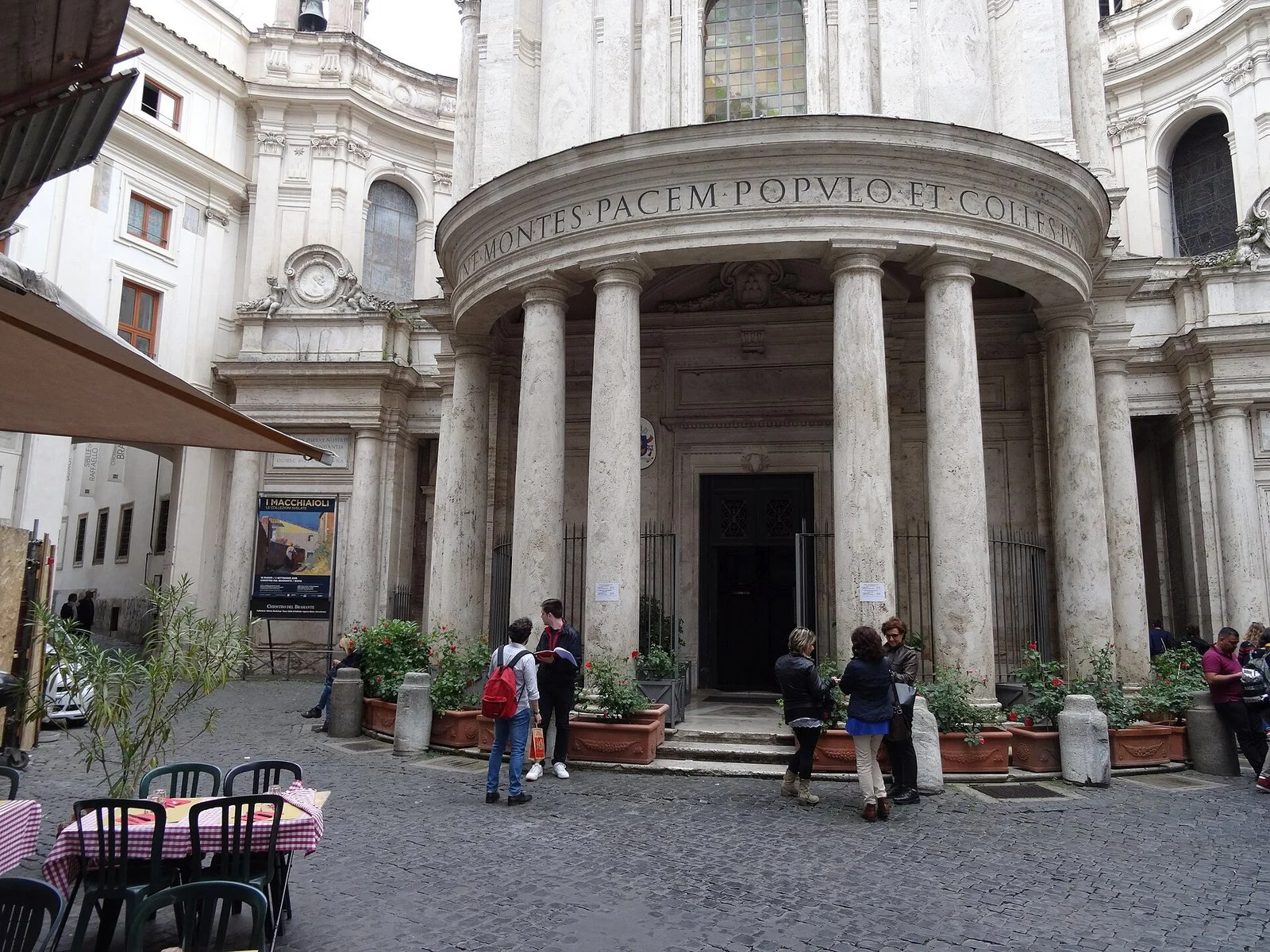
Santa Maria della Pace is about 100 meters from piazza Navona, in the Ponte district, and manages the feat of staying invisible to almost everyone who walks past it: the lane that leads to it is narrow, the little square in front is tiny, and whoever doesn't know where to look heads straight on toward the Fountain of the Four Rivers without noticing they have brushed past one of the most studied pieces of urban Baroque in the world. The facade that Pietro da Cortona built for Alexander VII in the mid-1600s is not just a facade: it is the central element of a project that demolished houses, widened streets and redrew an entire block to create a theater-shaped space, with the church in place of the stage and the surrounding houses in place of the boxes. Inside are the Sibyls frescoed by Raphael in the Chigi chapel, the frescoes of Baldassarre Peruzzi in the Ponzetti chapel, sculptures by Vincenzo de' Rossi and Cosimo Fancelli, canvases by Orazio and Artemisia Gentileschi. Next door, with a separate entrance that confuses half the visitors, is the cloister that Donato Bramante designed around 1500, now turned into one of the most visited exhibition centers in the city. The lines that follow tell how this church came about, what is really inside, why church and cloister are visited in two different ways and how to deal with hours that are, it has to be said right away, among the most unpredictable in Rome.
Where Santa Maria della Pace is and how to get there
The church's address is via Arco della Pace 5, in the Ponte district, in that knot of lanes between the western side of piazza Navona, via dei Coronari and via del Governo Vecchio. The little square in front of the facade is called piazza della Pace and is only slightly wider than the facade itself: whoever arrives from via della Pace finds it suddenly, after a bend, and this surprise effect is no accident but the intended result of a 17th-century urban project. The neighborhood is that of the Rome of the 1500s and 1600s, with Palazzo Altemps a short walk away, San Luigi dei Francesi on the other side of piazza Navona and the Pantheon less than 10 minutes on foot.
On foot from piazza Navona
The simplest route starts from the long western side of piazza Navona, the one opposite the facade of Sant'Agnese in Agone. Taking via di Tor Millina and continuing on via della Pace you reach the little square in three or four minutes of walking, with no chance of going wrong because there is only one street. Whoever instead comes from the Museo di Roma at Palazzo Braschi or from Campo de' Fiori goes up corso Vittorio Emanuele II and cuts north through the grid of lanes between the Chiesa Nuova and piazza Navona: the stretch is short but the maze of streets calls for a bit of attention, because the signs are few and the church can't be seen from afar.
By public transportation
There is no subway stop in the immediate vicinity of Santa Maria della Pace: the historic center between piazza Navona, the Pantheon and Campo de' Fiori is one of the areas of Rome farthest from the three metro lines, and anyone arriving by subway must allow at least 10 or 15 minutes on foot from the nearest stop. The most practical solution is the surface buses that run along corso Vittorio Emanuele II, including lines 46, 62, 64, 70, 81, 87, 492 and 628, which stop a few hundred meters away and let you go back up north in a few minutes. The most often cited reference stop is the one on corso Vittorio Emanuele II at the height of Sant'Andrea della Valle or the Chiesa Nuova, depending on the direction of arrival.
The address that confuses: church and cloister on the same street
The first practical obstacle is that church and cloister share the same stretch of street and almost the same street number, and that digital maps tend to overlap them. Via Arco della Pace 5 is the address that appears for both the church and the exhibition center of the Chiostro del Bramante, and whoever sets up navigation risks ending up at the wrong door. The practical rule is simple: the curved facade with the columns and the semicircular portico is the church, and you enter it from the little square. The cloister's door is a different entrance, on the side, with the ticket office of the exhibition center. They are two distinct accesses, with different hours, different tickets and different management, and it's the thing that most often confuses those who arrive without knowing.
The theater-shaped square and the facade by Pietro da Cortona
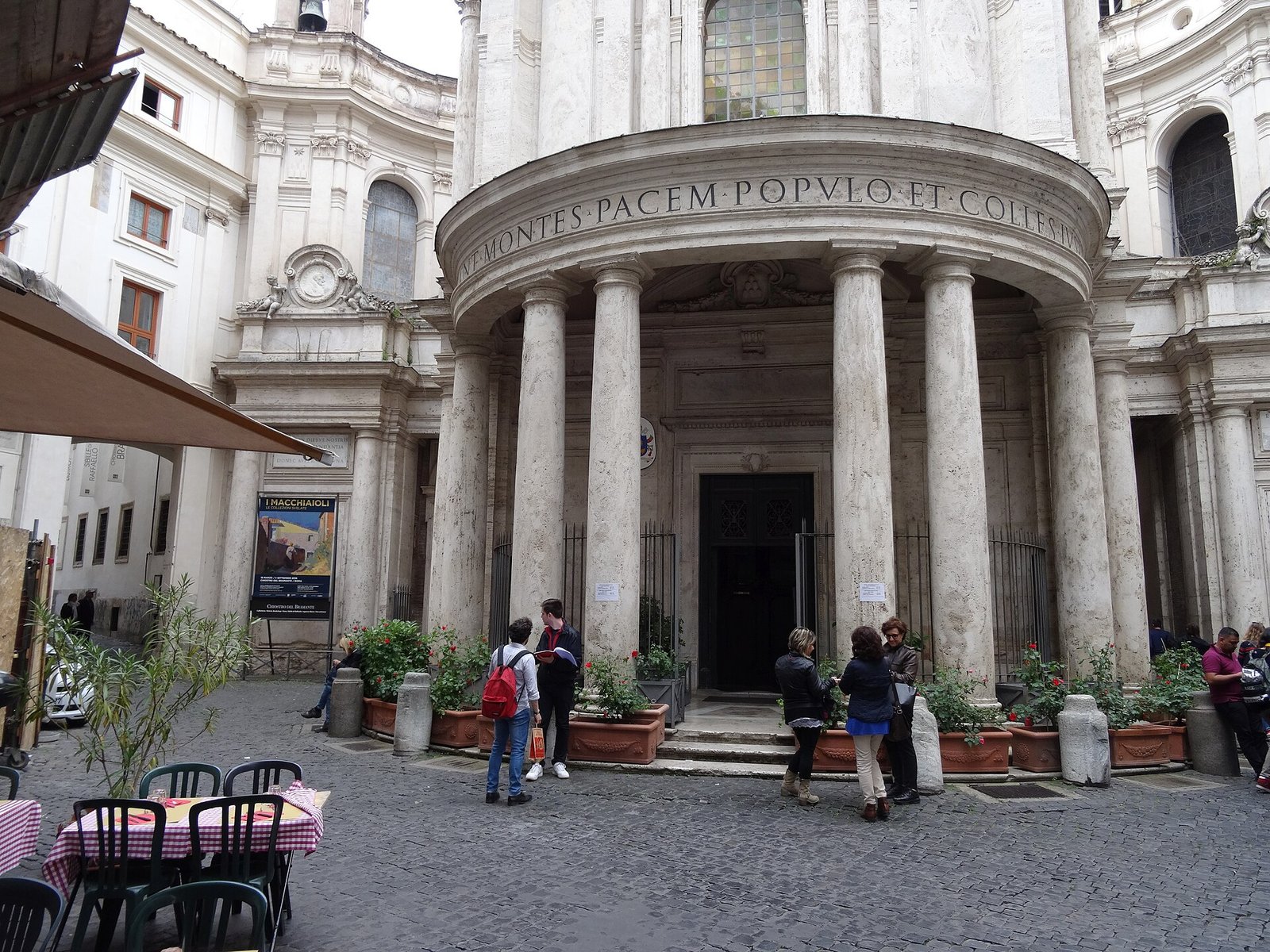
The facade of Santa Maria della Pace was designed by Pietro da Cortona at the wish of Pope Alexander VII Chigi and built starting in 1656: it is considered one of the highest points of Roman Baroque architecture not so much for the single building, as for the way the building and the space in front of it were conceived as one thing. The sources agree on the start of the building site in 1656 and place the completion of the facade between 1657 and 1659, while the overall work on the church and the interiors continued until 1667: whoever finds slightly different dates is taking them from different phases of the same site.
An urban planning project, not just a facade
The problem Cortona had to solve was concrete and not at all aesthetic. The church was wedged into a medieval fabric of very narrow lanes, and the aristocratic worshippers who attended it arrived by carriage: once they got down, the coachmen had no way to turn the vehicle and a permanent jam formed. The solution was to demolish a certain number of buildings in front of and around the church to make an irregularly shaped square, roughly trapezoidal in plan, wide enough to let carriages reverse direction. It is one of the few cases in which a masterpiece of Baroque architecture is born, literally, from a traffic problem.
Cortona, however, did not limit himself to clearing the space. He also redesigned the fronts of the buildings left at the sides, making them uniform, and bent them to frame the church like stage wings. The result is what generations of architectural historians have described with the same image: the church is the stage, the square is the audience, the houses at the sides are the boxes. Whoever enters the little square from via della Pace sees the facade appear suddenly, isolated and monumental, in the midst of much lower and more modest buildings, and it is exactly the effect the project meant to produce. The concave side wings, besides giving force to the curve of the portico, also served to hide from view the mouths of the streets behind, so that whoever looks at the facade is not distracted by lateral perspective escapes.
The semicircular portico
The body that projects into the square is a portico on a curved plan, built in travertine, supported by six columns of the Tuscan Doric order that carry a continuous entablature. The sources oscillate between the definition of semicircular portico and that of semi-elliptical portico, and the reason is that the original design probably envisaged a full semicircle curve, later slightly compressed in execution to make it fit in the available space without intruding too much on the little square. Some scholars have read in this shape a direct reference to the Tempietto that Bramante built in the courtyard of San Pietro in Montorio, which would give the facade an additional meaning: a Baroque homage to the architect who, a few meters away, had signed the Renaissance cloister of the same church. Above the portico the surface of the second order is slightly convex and holds a large central arched window, framed by two pediments nested one inside the other, the outer one triangular on Corinthian pilasters and the inner one curvilinear on Corinthian columns.
The Psalm inscription and the coats of arms
Along the entablature of the portico runs a Latin inscription taken from Psalm 72 in the modern numbering, 71 according to the Vulgate: Suscipiant montes pacem populo et colles iustitiam, meaning may the mountains receive peace for the people and the hills justice. The choice of the verse is no accident and works on two levels: on one hand it contains the word peace, which is the title of the church, on the other it names the mountains, and the mountains are the central element of the coat of arms of the Chigi family, the one with the six mountains topped by the star. Alexander VII, born Fabio Chigi, therefore had a biblical verse written on the facade that quotes him in secret. In the same logic, on the side wings appear the mountains and the star of the Chigi next to the oak of the Della Rovere, the family of Sixtus IV who had founded the church: two papacies almost two centuries apart placed side by side on the same facade.
At the sides, above the two smaller pavilions, there are two roundels with relief portraits of the two popes who are protagonists of the building's history, Sixtus IV and Alexander VII, surrounded by putti and festoons. The heraldic coat of arms that topped the central window, according to the descriptions, was chiseled away during the French occupation between the 1700s and the 1800s, when papal coats of arms were systematically erased from many Roman buildings: it's a detail you notice only by looking up and knowing what to look for, and it tells in one line a whole passage of the city's history.
The 15th-century origins: Sixtus IV, the struck image and the name of the Pace
The church in its current form was born in 1482 at the wish of Pope Sixtus IV, but on that spot stood a religious building documented since at least the end of the 12th century. Medieval records call it Sant'Andrea de Aquarizariis, with spelling variants that recur between the 1200s and the 1300s, and the name derives almost certainly from the acquaricari, the water sellers who drew from the Tiber and filtered it through sand before reselling it in the city. It was a small church, dependent on San Lorenzo in Damaso, entirely without monumental ambitions: the 15th century transformed it into something completely different.
1480 and the image that supposedly bled
Roman popular tradition, picked up by almost all the city's guides, tells that in 1480 an image of the Virgin placed under the portico of the old church was struck by a drunken soldier and began to bleed. Versions diverge on the detail of the weapon: some sources speak of a thrown stone, others of a knife or dagger blow. It must be said clearly that this is a devotional tale, handed down by tradition and not a historically verifiable fact: what is documented is the effect, that is a wave of popular devotion around that image and the direct interest of the pontiff.
According to the traditional account Sixtus IV went in person to the spot and made a vow to rebuild the church. The political context in which that vow matures is, however, decidedly concrete: these were the years after the Pazzi conspiracy of 1478, the Florentine plot against the Medici that had dragged central Italy into a diplomatic and military crisis, and the pope had promised to erect a great Marian church if peace returned. Popular devotion for the image and the pontiff's political calculation were welded into the same building site, and it is this double origin that explains both the title the church would take and the size of the undertaking.
Who was the architect: an open question
The building site started in 1482 and the church was substantially completed by 1483 or 1484, depending on the sources, when Sixtus IV was already dead or about to die and the pontificate had passed to Innocent VIII. On the architect's name historiography has not reached agreement. The traditional attribution, the most repeated, is to Baccio Pontelli, the Florentine architect active in Rome under Sixtus IV. Other scholars have proposed Meo del Caprino, also Florentine and also active on the Sistine building sites, and there is no lack of those who suggest work by several hands. Whoever reads a flat name in a guide, without any reservation, is receiving information that is sharper than the documentation allows.
Why it is called della Pace
On the origin of the title too the sources do not fully agree, and the two main readings are worth reporting. The first, very widespread, links the name to the peace of Bagnolo of 1484, which ended the war of Ferrara between Venice and the Este duchy with the involvement of the papacy and the other Italian states. The second, reported by other sources, speaks more generically of the peace concluded between the Papal State, Venice and the Kingdom of Naples. The two versions are not necessarily in conflict, because they refer to the same diplomatic tangle of those years, but the exact detail of the event to which the title alludes remains a matter of discussion. What is certain is that the name arises in a precise political context and not from a generic devotional aspiration.
Church and Chiostro del Bramante: two different entrances, two different tickets
The church and the cloister of Santa Maria della Pace are two adjoining but separate spaces, with distinct accesses, distinct hours and completely different entry rules: the church is a place of worship with free access and very limited hours, the cloister is a paid exhibition center open every day. It's the first thing to know in order not to waste time, and the most frequent source of misunderstandings among those who arrive on site convinced that a single ticket is valid for both.
The entrance of the church
You enter the church from the little square, passing under the curved portico by Pietro da Cortona and crossing the 15th-century portal, which is one of the few original elements of the Sistine phase still visible on the facade. Entry is free. The problem, as will be said in detail further on, is that the church is not open every day and that the hours given by the different sources do not match each other: planning the visit by taking for granted that you'll find it open is the quickest way to stay outside.
The entrance of the Chiostro del Bramante
The Chiostro del Bramante has a dedicated page on the site, which tells its architectural history and how it works as an exhibition center: here it is enough to say that access is through a different door, that there is a ticket office and that the price varies depending on the exhibition on view. The hours usually indicated by the center are Sunday to Thursday from 10:00 to 20:00 and Friday and Saturday from 10:00 to 21:00, with last entry one hour before closing, but they change for extraordinary openings and holiday periods. The temporary exhibitions that follow one another there are among the most visited in Rome: the immersive and monographic shows hosted in recent years, up to Flowers. Meravigliosa Natura, have made the cloister a destination frequented even by those who know nothing about the church.
A curiosity about Santa Maria della Pace
The nicest curiosity concerns the way the square in front of the church came about, and it's worth telling at length because it overturns the usual idea of the Baroque as a purely scenographic art. When Alexander VII commissioned Pietro da Cortona to work on the church, the problem put to him was not aesthetic but logistical: the church was attended by the Roman aristocracy, who arrived by carriage, and the medieval lanes around the building were so narrow that the carriages, once they reached the portal, could no longer turn. The result was a chronic jam, with vehicles getting stuck and coachmen forced into impossible maneuvers in spaces of a few meters.
The solution was radical: knock down the buildings that stood in front of the church and at its sides, making a free space of irregular shape large enough to allow a reversal of direction. Up to here it would have been simple 17th-century traffic engineering. But Cortona understood that this space, once created, would be the way anyone would look at the church for centuries to come, and designed it accordingly: he shaped the facades of the surviving buildings, made them uniform, bent them inward like stage wings, calculated the distances so that the facade would appear suddenly to those arriving from the lane, and built the curved portico so that it projected into the square enough to be seen at an angle even from the side streets. The result is that today, when you enter piazza della Pace, you perform a gesture that is at once entering a square and entering a theater.
What strikes you most, walking into it, is how small it is. It's not a monumental square like the one of St. Peter's, which plays on enormous scales: it's a widening of a few meters, in which the facade looms and in which you can never step back far enough to see it whole without effort. This compression is not a limit of the project but its strength, because it forces the gaze upward and multiplies the effect of monumentality of a building that, in absolute terms, is not large at all.
One thing nobody tells you about Santa Maria della Pace
Raphael's Sibyls can be seen even when the church is closed, because there is a vantage point reached from inside the Chiostro del Bramante: on the first floor of the cloister, next to the cafe, a room overlooking the Chigi chapel lets you look at the fresco from a height no visitor to the church can ever have. It is the most useful piece of information that can be given about this complex, and it escapes most guides.
The Sala delle Sibille
The exhibition center calls this space the Sala delle Sibille and describes it as a first-floor room adjacent to the bistro cafe, from which Raphael's fresco is visible up close. The advantage is not only getting around the church's hours: it is above all a question of point of view. From the floor of the nave the fresco is seen from below, against the light from the big window and from several meters away, at the worst possible angle for appreciating faces and hands. From the first floor of the cloister you see it almost on axis, at the same height, and you see things that can't be made out from below: the interlacing of fingers, the twist of necks, the quality of the painting in the draperies.
Why this view exists
The reason is simply that church and convent are the same building, grown by successive additions between the 1400s and the 1500s. The cloister of the Lateran canons is built against the side of the church, and the Chigi chapel, which opens on the first bay of the right aisle, borders the convent rooms of the upper floor. What today is a visitor's privilege was, for centuries, simply the wall of a convent corridor. The overall restoration that brought the complex back to new and turned the cloister into an exhibition center, concluded around 2010, enhanced this view by making it accessible to the paying public.
What exactly you see
The fresco depicts four Sibyls, according to tradition the Cumaean, the Persian, the Phrygian and the Tiburtine, accompanied by angels who bring them the revelation. The composition measures more than six meters in width. Above the Sibyls, in the upper band, are four Prophets, executed by Timoteo Viti, a pupil of Raphael, from drawings by the master: the sources identify them as Hosea, Jonah, Daniel and David. The iconographic logic is the classic one of the relationship between the pagan world and Christian revelation, the same that Michelangelo had staged a few years earlier on the ceiling of the Sistine Chapel, with which the comparison is inevitable and which Raphael himself had in mind while he worked.
A clarification on dates and authors
The most recurrent date for the Sibyls is 1514, with some sources generically indicating the years around 1515. On one point the sources diverge significantly: some claim the work was partly continued by Sebastiano del Piombo, others attribute the whole fresco to Raphael and credit Timoteo Viti only with the Prophets of the upper band. Whoever finds it written that the fresco was completed after Raphael's death is following a version that is hard to sustain chronologically, since Raphael died in 1520 and the work is dated six years earlier. Prudence advises saying that the invention and main execution are Raphael's, that the Prophets are by Timoteo Viti and that on the extent of any workshop intervention the discussion remains open.
The advice I give you for visiting Santa Maria della Pace
The most important practical advice concerns hours, which at Santa Maria della Pace are reduced, variable and reported in a contradictory way by the different available sources: any plan built by taking for certain an hour found online risks falling apart. It's best to organize the visit so that the church is not the only goal of the morning, and to consider any entry as a gain and not a fixed point of the program.
The question of hours, told as it is
The sources consulted give indications that are incompatible with each other. Some specialized portals and some reference guides indicate an opening limited to three mornings a week, Monday, Wednesday and Saturday, from 9:00 to about 12:00, with a variant that brings the closing forward to 11:45. Other general sites instead report a much wider daily opening, from 09:30 to 18:00 or from 08:30 to 19:30. The difference is not marginal: between the two hypotheses tens of hours a week swing. It is not possible to confirm here which of the two is in force today, and saying so openly is more useful than reporting an hour that might be years old. The window of Monday, Wednesday and Saturday morning is the one historically most cited by specialized sources and remains the most prudent to aim for, but checking directly with the rectory or with a phone contact before leaving is, in this case, truly indispensable.
The plan B that always works
Since the cloister is open every day with continuous hours while the church is not, the surest way to see something of Santa Maria della Pace is to go through the Chiostro del Bramante. From inside you see Bramante's architecture, you go up to the first floor and reach the room from which the fresco of the Sibyls is visible. Whoever has little time in Rome and only one possible pass through the area would do well to consider this as the main option and the church as an eventual supplement, not the other way around. The cloister ticket is tied to the exhibition on view and has to be checked each time.
Combining the visit with the rest of the district
Santa Maria della Pace works very well as a stop within a wider route and very badly as an isolated destination. A sensible itinerary links it to piazza Navona and to the Stadium of Domitian under the square, continues toward San Luigi dei Francesi for the Caravaggios, touches the Pantheon and ends at the Basilica of Santa Maria sopra Minerva. Whoever is interested in Raphael in particular can build a themed day that pairs the Sibyls with the Villa Farnesina, the other great Roman undertaking financed by Agostino Chigi, the same patron as the chapel: it is the smartest combination that can be made in the city on this front, because it shows the same artist and the same patron in two opposite settings, one sacred and one profane.
Image: Raphael's fresco of the Sibyls in the Chigi chapel, seen from the first-floor room of the cloister.
The chapels of Santa Maria della Pace, one by one
The interior of Santa Maria della Pace is built on a plan unusual for Rome: a short nave of two bays covered by cross vaults, followed by an octagonal space topped by a dome and closed by a rectangular presbytery. It's a scheme that joins a minimal longitudinal body to a central space, and that explains why the chapels are distributed in two groups, those of the nave and those facing the octagon.
The Chigi chapel
It is the first chapel on the right as you enter and it is the reason most visitors come all the way here. It was commissioned by Agostino Chigi, the Sienese banker who financed in Rome some of the most important artistic undertakings of the early 1500s, and the architecture is attributed to Raphael himself. Above the entrance arch develops the fresco with the Sibyls and the angels, and in the upper band the four Prophets by Timoteo Viti. The 17th-century arrangement of the altar is by Pietro da Cortona, who in his overall intervention deliberately chose to preserve the Raphaelesque fresco by integrating it into the new Baroque layout, a choice of respect that was by no means a given at the time.
The altar holds a bronze high relief with the Deposition of Christ supported by angels, the work of Cosimo Fancelli, set in a marble aedicula. At the sides are two statues of Sienese saints, Catherine of Siena and Bernardino, attributed to Fancelli and, according to some attributions, to Ercole Ferrata or Antonio Raggi: the choice of two saints from Siena is no accident and is the way the Chigi, Sienese in origin, signed the chapel. The fresco underwent in 1816 a restoration by Paolo Palmaroli that modern sources judge severely, and a recovery intervention carried out in 2003 corrected much of that damage.
The Ponzetti chapel
The first chapel on the left as you enter is dedicated to Saint Bridget and Saint Catherine of Alexandria and preserves one of the least known and most refined cycles of the Roman Renaissance. The altarpiece is by Baldassarre Peruzzi, dated 1516, and depicts the Madonna and Child between the two saints, with Cardinal Ferdinando Ponzetti kneeling as donor. In the apse basin Peruzzi himself painted a series of biblical episodes of small size but of very minute execution: the Sacrifice of Isaac, the Creation of Eve, the giving of the Tablets of the Law, the Nativity, the Adoration of the Magi, the Flight into Egypt, David and Goliath, Judith and Holofernes. In the Adoration of the Magi, a dog and a cat facing each other are the kind of detail that rewards whoever gets close.
On the walls are the family's funerary monuments: one for Beatrice and Lavinia Ponzetti, who died in an epidemic in 1505, and one from 1508 or 1509 erected by Cardinal Ferdinando for his own ancestors, attributed to the circle of Luigi Capponi. The patron cardinal, it should be remembered, would be killed during the Sack of Rome of 1527: the chapel that portrays him kneeling therefore has 11 years of life when its patron dies in the greatest catastrophe of Renaissance Rome.
The Cesi chapel
The second chapel on the right was designed by Antonio da Sangallo the Younger around 1525 for Cardinal Angelo Cesi and is dedicated to Saint Anne. The sculptural decoration is of the highest level: the two funerary monuments of the Cesi family are by Vincenzo de' Rossi, with the deceased half-reclined on sarcophagi resting on sphinxes, and to the same sculptor are owed the statues of Saint Peter and Saint Paul at the sides of the entrance. The decorative grotesque reliefs on the arch are attributed to Simone Mosca, one of the most refined ornamental artists of the Italian 1500s. On the vault there are frescoes attributed to Sermoneta, while the paintings around the window, depicting the Creation of Eve and the Original Sin, have been attributed by some sources to Rosso Fiorentino and by others to Filippo Lauri, with an attributional wobble that is worth pointing out instead of hiding.
The chapels of the octagon
On the sides of the octagonal space open four more chapels. The Olgiati chapel, dedicated to Saint John the Baptist, houses the Baptism of Christ by Orazio Gentileschi, dated 1607, one of the most important paintings in the church and a notable testimony to the first spread of the Caravaggesque language in Rome. The Benigni chapel, dedicated to Saint John the Evangelist, keeps an altarpiece by the Cavalier d'Arpino and two funerary monuments of the family, from 1588 and 1611, with good-quality busts. The chapel of the Crucifix, on the left side, holds a 16th-century wooden crucifix inside a frame of gilded stucco, and on the side walls two figures of female saints, Mary Magdalene and Martha, attributed to Artemisia Gentileschi: the presence, in the same church, of works by father and daughter is a circumstance that deserves mention. The chapel of the Nativity finally houses an Adoration of the Shepherds by Girolamo Siciolante da Sermoneta.
The presbytery and the venerated image
The high altar was designed by Carlo Maderno and placed around 1614, within a building campaign that the sources place between 1611 and 1614 and that was financed by the Rivaldi family. Four columns of gray marble support the structure, whose main function is to frame the 15th-century image of the Madonna and Child, the one tied to the 1480 story, kept within a mount in hardstones with a bronze crown held by putti. In the apse, the frescoes by Francesco Albani, executed between 1612 and 1614, depict the Assumption of the Virgin in the vault and an allegory of Justice and Peace in the lunette, with Moses and David in the pendentives. On the pillars of the triumphal arch, four female saints by Lavinia Fontana, one of the few women painters who in Rome of the early 1600s obtained public commissions of this standing.
The dome and the stucco
The octagonal drum in brick, with eight large arched windows, and the low eight-segment dome with lantern are attributed to Antonio da Sangallo the Younger and dated by the sources to 1524 or 1525, with the clarification, reported by some of them, that the material execution was entrusted to Jacopo Ungarino. Inside, the cap is decorated with eight rays converging toward an octagonal oculus that contains a fresco of God the Father attributed to Francesco Cozza. The stucco that covers the whole structure belongs to Pietro da Cortona's campaign and obsessively repeats the mountains and star of the Chigi next to the oak of the Della Rovere. On the inner facade wall, two allegorical figures of Peace and Justice sculpted by Cosimo Fancelli flank the large circular window.
Another well-known fact, yet rarely cited
The cloister of Santa Maria della Pace is the first Roman work of Donato Bramante, built between 1500 and 1504 for Cardinal Oliviero Carafa, and it is the building in which the architect abandons the Lombard decorative language he had practiced in Milan to adopt a classical severity that would change Italian architecture. It is a fact that every handbook reports and that almost nobody explains to visitors at the moment they find themselves inside.
What makes that cloister a turning point
Bramante arrives in Rome in 1499, after the fall of Ludovico il Moro, with a Milanese career made of decorated surfaces, terracottas, Lombard cornices and perspective inventions. The cloister of the Pace is the first thing he builds in the new city, and it is the exact opposite: no decoration, no added ornament, only architectural orders, proportions and smooth surfaces. The plan is a perfect square, with four arches per side on the ground floor set on pillars with applied Ionic pilasters, and a second trabeated order in which free columns correspond to the pilasters. The relationship between the two levels follows rules of Vitruvian derivation, with the second order reduced in height compared with the first according to a precise proportion.
What you see under the porticoes
The lunettes on the back wall of the portico hold frescoes with Stories from the life of the Virgin and episodes tied to the church and the venerated image, attributed by some sources to Nicolò Trometta. Walled in under the porticoes are Renaissance funerary monuments of notable quality, including that of Bishop Giovanni Andrea Bocciacci of 1497 and that of Laurentio Gerusino of 1498, as well as later memorials, including a neoclassical portrait of a girl who died at 16 in 1820. An inscription recalls the dedication by Cardinal Oliviero Carafa and the date 1503, and on two pillars of the upper floor his coat of arms appears. They are elements the visitor passes through absent-mindedly while looking for the entrance of the exhibition, and it's a pity because they tell five centuries of the complex's history in a few square meters of wall.
The right photo to take at Santa Maria della Pace
The photograph worth taking at Santa Maria della Pace is the one of the facade framed from the mouth of via della Pace, that is from the exact point where Pietro da Cortona wanted the visitor to see it appear: it is the only framing that simultaneously gives back the surprise effect, the curve of the portico and the compression of the lanes around.
The framing from the mouth of the lane
Arriving from via della Pace, the facade appears after a slight bend and occupies almost the whole field of view. Stopping a few meters before entering the little square you get an image in which the curved portico projects toward the observer while the walls of the side buildings squeeze the frame at the edges: it is the photograph that explains the project better than any description, because it shows the church set into the urban fabric instead of isolating it. A wide-angle lens helps, but there's no need to overdo it: the distortion of the verticals ruins the effect of the two superimposed pediments, which is the most delicate point of the composition.
Some important events that took place here in history
The history of Santa Maria della Pace reads as a succession of building campaigns decades apart, each tied to a pontificate or a family: the 1482 of Sixtus IV, the 1500 of Bramante and Carafa, the 1514 of Raphael and Chigi, the 1525 of Sangallo, the 1614 of Maderno, the 1656 of Cortona and Alexander VII. Few Roman churches condense in so little space such a continuous sequence of leading figures.
1482: the Sistine foundation
The building site opened by Sixtus IV transformed a minor parish church into a building of papal rank, in an operation that was part of the broader program of urban renewal promoted by the pontiff, the same one who left Rome the Sistine Chapel and ponte Sisto. The church was ready by 1483 or 1484 and Sixtus IV, who died in August 1484, according to the sources did not live to see it completed in full. In 1487 the complex became a convent with the settling of the Canons Regular of the Lateran.
1500-1504: Bramante's cloister
Cardinal Oliviero Carafa financed the construction of the cloister, entrusting it to an architect who had just arrived in Rome and was still to be tested in the Roman field. The dedicatory inscription bears the date 1503 and the sources place the end of the works in 1504. That building site in effect inaugurated Bramante's Roman season, and within a very few years he would be commissioned by Julius II with the project for the new St. Peter's Basilica.
1514: Raphael and the Sibyls
Agostino Chigi, banker of the popes and one of the richest men in Europe, obtained the privilege of two patronage chapels in this church and called Raphael, who for him was already working on the suburban villa on the Tiber now known as Villa Farnesina. The fresco of the Sibyls, dated 1514, was executed in the years immediately following Michelangelo's Sistine ceiling and in the midst of Raphael's activity in the Vatican Stanze: the comparison with Michelangelo, which scholars read in the poses and the construction of the bodies, is one of the recurring themes of the criticism on this work.
1611-1614: the Rivaldi, Maderno and Albani
The early 1600s brought the remaking of the presbytery and the high altar, financed by the Rivaldi family, with the marble structure designed by Carlo Maderno and the apse paintings by Francesco Albani. In the same years the Baptism of Christ by Orazio Gentileschi, of 1607, and the female saints by Lavinia Fontana entered the church. It is the phase in which the church acquires its basic 17th-century look, before the most radical intervention.
1656-1667: Alexander VII and Pietro da Cortona
The most celebrated building campaign is the one wanted by Alexander VII, which according to the sources also arises from devotional motives tied to a vow to the Virgin in a period marked by plague and international tensions. Cortona remade the facade, redesigned the square, reorganized the interior stucco and arranged the Chigi chapel while respecting Raphael's fresco. The intervention stretched over 11 years and definitively transformed the perception of the church, which from that moment is known above all for its Baroque front rather than for its 15th-century history.
The 19th and 20th centuries: abandonment
After the departure of the canons in 1815 and of the Dominicans in 1823, the suppression of the parish in the 1820s and the conversion of the convent rooms to civil uses, the complex entered a very long phase of marginality. From 1832 the convent was a dependency of the university, between 1870 and 1875 a school operated there, and for much of the 20th century the church remained in difficult conditions of conservation, open little and known mostly to specialists. In 1587 the church had been established as a cardinal's titular church, and this status continued to exist even in periods of lesser liturgical activity.
Who has passed through Santa Maria della Pace
The list of artists who worked in Santa Maria della Pace includes Bramante, Raphael, Baldassarre Peruzzi, Antonio da Sangallo the Younger, Vincenzo de' Rossi, Simone Mosca, Marcello Venusti, Carlo Maderno, Francesco Albani, Lavinia Fontana, Orazio and Artemisia Gentileschi, Pietro da Cortona, Cosimo Fancelli and Carlo Maratta: few buildings in Rome line up, in a few hundred square meters, such a sampler of signatures.
The patrons
Before the artists come the patrons, who in a church like this are the real key to reading. Sixtus IV della Rovere founds the building. Cardinal Oliviero Carafa, a Neapolitan, a man of great weight in the curia of the late 15th century, finances the cloister. Agostino Chigi, Sienese banker, obtains two patronage chapels and calls Raphael. Cardinal Ferdinando Ponzetti has his own chapel decorated by Peruzzi. Cardinal Angelo Cesi entrusts his to Sangallo the Younger. The Rivaldi family finances the 17th-century presbytery. Alexander VII Chigi, two centuries after his banker namesake, closes the cycle with Pietro da Cortona. The church is, in this sense, a map of Roman power between the 15th and 17th centuries.
The painters and sculptors
Raphael is the most celebrated presence, but the overall level of the painted decoration is high everywhere. Peruzzi, in the Ponzetti chapel, gives one of the most delicate performances of his career. Orazio Gentileschi brings to the church a painting of 1607 that belongs to the decisive season of Roman naturalism. Artemisia Gentileschi appears with two figures of saints, in an age when public commissions to women painters were extremely rare, a condition she shares with Lavinia Fontana, present on the pillars of the triumphal arch. Among the sculptors, Vincenzo de' Rossi signs the Cesi monuments, Simone Mosca the ornaments, Cosimo Fancelli the bronze of the Chigi chapel and the allegories of the inner facade wall.
The district around: what to see a short walk away
Santa Maria della Pace stands at the point where the Ponte district and the Parione district touch, one of the areas of highest monumental density in Rome: within a radius of 500 meters you count dozens of first-rate churches, palaces and museums. It's a context worth exploiting, because the church alone takes half an hour of visit at most.
Piazza Navona and its underground
The most obvious reference is piazza Navona, a few meters away, with Bernini's Fountain of the Four Rivers at the center and Borromini's facade of Sant'Agnese in Agone on the long side. Under the square, the Stadium of Domitian preserves the remains of the Roman structure that gave the square its elongated shape: it's a visit that takes little time and explains better than any sign why piazza Navona has that plan.
Frequently asked questions about Santa Maria della Pace
Where is Santa Maria della Pace in Rome?
Santa Maria della Pace is at via Arco della Pace 5, in the Ponte district, about 100 meters from the western side of piazza Navona. You get there on foot in three or four minutes from piazza Navona along via di Tor Millina and via della Pace, or by the buses that stop along corso Vittorio Emanuele II, including lines 46, 62, 64, 70, 81, 492 and 628.
How much does it cost to enter Santa Maria della Pace?
Entry to the church of Santa Maria della Pace is free, as in all the churches of Rome open for worship. The Chiostro del Bramante next to it is instead a paid exhibition center, with a ticket whose price changes depending on the temporary exhibition on view: church and cloister are two distinct accesses and the cloister ticket does not give the right to enter the church.
What are the opening hours of Santa Maria della Pace?
The hours of Santa Maria della Pace are reduced and reported in a contradictory way by the available sources, so they must be checked before going. Several specialized guides indicate an opening limited to Monday, Wednesday and Saturday morning, roughly from 9:00 to 12:00, while other sites report much wider daily hours. Since it is not possible to confirm which indication is up to date, it's best to contact the rectory directly before planning the visit.
Can you see Raphael's Sibyls at Santa Maria della Pace even if the church is closed?
Yes, Raphael's Sibyls can also be seen from the Chiostro del Bramante, which is open every day: on the first floor of the cloister, next to the bistro cafe, a room overlooking the Chigi chapel lets you observe the fresco almost at the same height. It's a better vantage point than the one from the floor of the church, where the fresco is seen from below and against the light.
Who designed the facade of Santa Maria della Pace?
The facade of Santa Maria della Pace is the work of Pietro da Cortona, who built it starting in 1656 at the wish of Pope Alexander VII Chigi. The project also included the demolition of some buildings and the creation of the little square in front, conceived to let carriages reverse direction: this is why architectural historians cite it as an example of integration between building and urban space.
How long does it take to visit Santa Maria della Pace?
To visit the church of Santa Maria della Pace 20 or 30 minutes are enough, sufficient to see the main chapels, the fresco of the Sibyls and the presbytery. Adding the Chiostro del Bramante and the exhibition on view you need to allow at least an hour and a half more, depending on the size of the show. Whoever wants to combine the visit with piazza Navona and the nearby churches should count on half a day.
Can you take photographs inside Santa Maria della Pace?
Some sources report that photography is not allowed inside Santa Maria della Pace, so it's best to ask on site before shooting. In any case, since it is a place of worship with 16th-century frescoes, the use of flash should always be avoided. Outside there are no restrictions and the facade with the semicircular portico is one of the most successful photographic subjects in the Ponte district.
Is Santa Maria della Pace suitable for children?
Santa Maria della Pace is a short visit and presents no particular difficulties for children, but it is a small church where silence is required and where there are no routes dedicated to families. The Chiostro del Bramante next door is instead equipped for the younger public and usually offers educational activities for schools and workshops for children and families tied to the exhibitions on view.
What is the difference between the church of Santa Maria della Pace and the Chiostro del Bramante?
The church of Santa Maria della Pace and the Chiostro del Bramante are two parts of the same complex but are visited separately: the church is the 15th-century place of worship with the Baroque facade and the frescoed chapels, with free access and reduced hours, while Bramante's Renaissance cloister is today a paid exhibition center open every day. The entrances are two different doors on the same street.
One last tip for those planning the itinerary
Santa Maria della Pace should be placed in a route and not treated as a stand-alone destination: the interior visit is short, the hours are unpredictable and the value of the experience grows enormously if you link it to the stops around it, from piazza Navona to San Luigi dei Francesi to the Pantheon. The surest strategy remains going through the Chiostro del Bramante, which is open every day and offers access to the close-up view of the Sibyls, and treating any opening of the church as an unexpected gain. Whoever manages to find it open should go in without hurry: half an hour in a church of this level is worth more than three monuments crossed at a run.
Whoever is planning a wider itinerary in the historic center of Rome, crossing this stop with the other stops between piazza Navona, the Pantheon and Campo de' Fiori, can find useful planning tools on Tour Leader Pro, while for a wider picture on transport and destinations in Lazio a good resource is Italy Planner.