MIAC – Italian Audiovisual and Cinema Museum
In short. Via Tuscolana 1055, 00173 Rome: the MIAC occupies a building inside the grounds of Cinecittà Studios and is open every day except Tuesday, from 10.00 to 18.00, with the ticket office closing at 16.30.
Via Tuscolana 1055, 00173 Rome: the MIAC occupies a building inside the grounds of Cinecittà Studios and is open every day except Tuesday, from 10.00 to 18.00, with the ticket office closing at 16.30. Annual closures on December 24 and 25 and January 1. The ticket for the MIAC alone costs 10 euros, the Cinecittà si Mostra route alone also costs 10 euros, and the combined ticket that includes both costs 15 euros and is the option I recommend to anyone who comes all the way out here. The reduced ticket is eight euros and is valid for people under 26, over 65 and journalists with a press card. Children aged five to 10 pay five euros, children under five enter free, as do companions of people with disabilities, licensed European Union tourist guides and ICOM members. There is a family ticket at 45 euros for two adults and two young people up to 18, with five euros for each additional child, and it is bought only at the physical ticket office. Organized groups start at 15 people: the group guided tour costs 14 euros per person, the double guided route 20 euros. Individual and family guided tours are booked by writing to visit@cinecitta.it. The guided tour of the permanent sets combined with Cinecittà si Mostra costs 15 euros, the one that also adds the MIAC costs 20 euros. The ticket bought online carries a time slot that corresponds to the first guided tour of the sets available after entry. Metro line A, Cinecittà stop: you exit, take Via Tuscolana toward number 1055 and in a few minutes on foot you are at the gate. If you arrive by car, you find the Studios' parking along the Tuscolana. Prices and hours are those published by the Studios: it is best to check them again on the official website before leaving, because special openings and closures for filming change the calendar.
If you are interested in the film chapter of Rome as a travel theme, it is worth reading also the page dedicated to Cinecittà Studios and the index of the city's tourist attractions.
What the MIAC - Museo Italiano Audiovisivo e Cinema really is
The MIAC is the Italian Museum of Audiovisual and Cinema, and the quickest way to understand it is to say what it is not. It is not a museum of memorabilia. It is not a collection of posters behind glass, with the label and the date. Nor is it, fortunately, one of those cinema museums that boil down to a row of posters and two dusty projectors. It is a museum made of moving images and sound, where the heritage on display is the films themselves, the newsreels, the television programs, the commercials, the archive fragments: 120 years of Italian audiovisual, edited, cut, put back into circulation and projected onto the visitor on walls as tall as a house.
It covers 1,650 square meters and spreads across 12 main rooms. It opened to the public in December 2019, after a press presentation on October 29 of the same year in the presence of the then minister Dario Franceschini. It was built by Istituto Luce Cinecittà with funding from the Ministry, 2,500,000 euros from the Piano strategico Grandi Progetti Beni culturali, in collaboration with a network of archives that includes Rai Teche, the Centro Sperimentale di Cinematografia, the Cineteca di Bologna, the Archivio Audiovisivo del Movimento Operaio e Democratico, the Museo Nazionale del Cinema di Torino, the Fondazione Cineteca Italiana, the Cineteca del Friuli, Mediaset and SIAE.
Let's say our opinion right away, because it is the reason to come after seeing the usual four things in Rome: the MIAC is the most modern museum in the city and almost nobody knows it. It doesn't appear in the tourist rankings. In the printed guides, when it is there, it gets three lines. Yet it is the only place in Rome where a bored teenager stops looking at the phone after 40 seconds, because the language of the museum is exactly theirs. And it is the only one where an adult who lived through the 1960s and 1970s stops in front of a wall and gets moved, because they recognize a face, a voice, a commercial they had forgotten to remember.
Why the MIAC is inside Cinecittà and not downtown
The location is not a logistical fallback, it is a statement. A museum of Italian audiovisual could have ended up in a palace in the historic center, with frescoed rooms and motion sensors. Instead it ended up in the place where films were actually made, inside an industrial complex still in operation, nine kilometers from the Campidoglio, along a consular road with nothing monumental about it. Whoever gets off at the Cinecittà stop on line A and walks along the Tuscolana sees buildings from the 1960s, workshops, traffic that shows no mercy. Then there is a long wall, a gate, and behind the gate another city begins.
This distance from the center is the first filter. It keeps hurried tourists away and leaves the museum to those who have decided to come. I don't say this out of snobbery: I say it because it changes the experience. You don't enter the MIAC by chance while strolling, the way you enter the Pantheon. You get there on purpose, and you can feel it in the quality of the public you find inside, made up of enthusiasts, film students, Roman families and very well-informed foreigners.
The MIAC building: the former development and printing laboratory
The choice of the building is the best part of the whole operation, and it deserves to be told well. The MIAC is housed in what was the Development and Printing Laboratory of the Studios, a building designed by Gino Peressutti in 1937 together with the rest of the complex and then renovated in 1975. In there, for decades, the film shot on the sets was developed and printed: the chemistry, the darkness, the tanks, the rollers, the smell. It was the place where the footage became visible image. It was, literally, the room in which Italian cinema took shape.
Then film died. Digital turned that laboratory into industrial archaeology, an empty shed with the pipes still hanging. Istituto Luce acquired it in 2017 and the overall regeneration work covered more than 3,000 square meters. The museum design decided to hide nothing: the industrial structure stays exposed, the ducts stay where they are, the technical floor is visible. The museum of the moving image was built inside the machine that used to fabricate those images. It's an architectural rhyme that works without needing to be explained, and in fact nobody explains it: you get it by walking.
The best detail is the conveyor belt. In the laboratory it served to move the films along the development chain. Today it's still there, for over 40 meters, and has been turned into an installation: the messages left by visitors scroll along the belt on a luminous surface. The same object, the same function of transport, a different content. Whoever thought of this understood what a museum is.
Who conceived and curated the MIAC
The scientific committee that built the museum's narrative is made up of Gianni Canova, film historian and critic, rector of IULM, Gabriele D'Autilia, historian of photography, Enrico Menduni, historian of mass media, Roland Sejko, director and documentary maker of Albanian origin, author for Istituto Luce of archive editing work. It's a well-built team: two historians of the medium, a historian of the still image, a director who knows what can be done with archive footage. The difference shows in the result, because the MIAC doesn't tell the history of Italian cinema through masterpieces and awards, it tells it through themes and obsessions.
The exhibition design is signed by the collective NONE, founded by Gregorio De Luca Comandini, Mauro Pace and Saverio Villirillo, with graphics by NOAO, video content by Daniele Spanò and illustrations and animations by Yassmin Yaghmai. The architecture of the adapted building is by Francesco Karrer. I point out something that escapes visitors: they are all names that come from contemporary art and video mapping, not from traditional museography. The MIAC was entrusted to people who design installations, not display cases. This explains why the museum resembles a contemporary art exhibition more than a historical museum, and it also explains its one limit: whoever is looking for the label with the date and the long caption comes away empty-handed.
The MIAC route, room by room
The route is not a corridor. It's a sequence of spaces that open onto one another, with dark thresholds, changes of light and changes of sound. There is no direction imposed by arrows on the floor, but there is a suggested order, and it's best to follow it the first time and then go back freely. The golden rule: you don't read, you look. Whoever enters the MIAC with an archaeological-museum mindset, looking for panels and captions, leaves after 20 minutes dissatisfied. Whoever enters and sits down leaves after two hours.
The MIAC Timeline, the 30-meter wall
You start here, and it's the installation that sets the tone for everything else. A wall of over 30 linear meters runs along the first space and hosts an animated timeline: a graphic graffiti that scrolls, assembles and disassembles, punctuated by the key dates of Italian audiovisual, with augmented reality inserts. It's not a written chronology, it's a drawn and moving chronology, with Yassmin Yaghmai's illustrations animating the transitions.
The starting point is the end of the 1800s, when the image learns to move. Then silent film, sound, the birth of the Studios, the war, neorealism, television, the boom, the years of lead, private television, digital, streaming. A hundred and 20 years compressed into a wall you travel by walking, and that changes speed depending on where you stop.
Practical tip: the Timeline should be walked twice. The first time on the way in, standing, walking slowly from left to right, without stopping to decipher everything. The second time on the way back, after seeing the other rooms, when the names and faces you met in the rest of the museum light up in your head and the timeline stops being a decoration and becomes a map. It is the difference between looking at an index before and after reading the book.
The interactive table and the 40-meter ribbon
The second strong element is the interactive table built on top of the old film conveyor roller, more than 40 meters long. The visitor writes, and the message enters the luminous flow that runs through the room. Put like that it sounds like a little game from a children's museum, but seen live it is something else, because the scale of the object is industrial and the text that scrolls mixes with the projected images.
Here one thing is worth observing: the MIAC is a museum that asks the public to take part, and it asks in the right way, that is, without forcing anyone. No station blocks your way, no screen asks you to register, no quiz. You can cross the whole museum without touching anything and the visit works just the same. Whoever wants to touch, touches. It is a rare delicacy, and anyone who has seen the interactive museums of the 2000s, with broken totems and dirty headphones, understands what I am talking about.
The History room of the MIAC
The room dedicated to History is the one that throws you off the most. The theme is how cinema, newsreels and television have told Italy, and therefore how Italians have learned to see themselves. It is not a room of events in chronological order. It is a room of gazes: the gaze of the Luce newsreel on the regime, the gaze of neorealism on the rubble, the gaze of the TV news on the 1970s, the gaze of private television on the Italy of the 1980s.
The editing is the strength of this room. The same event appears twice, filtered through two different media, and the difference is more eloquent than any commentary. This is the craft of Roland Sejko, who worked with the Luce archive for years, and you can tell. If I had to point to the room that justifies the ticket by itself, I would point to this one: whoever studied contemporary history from textbooks sees here the same material through the eyes of the people who were filming it while it happened.
An honest warning: some images of the 20 years of the regime and of the war are harsh. Not splatter, but harsh. If you bring small children, this is the room where it is best to walk a little faster.
The Power room at the MIAC
Power is one of the great thematic containers of the museum, and one of the most successful. The thread is simple and ferocious: in Italy power has always staged itself, and cinema and television have been both its stage and its distorting mirror. You go from the balcony of Piazza Venezia filmed by the Luce cameramen to the black-and-white political broadcasts, from rallies to talk shows, from presidential inaugurations to press conferences.
The thing worth observing, and which nobody will tell you out loud, is the mutation of posture. The Fascist hierarch who speaks from the stage keeps his chin up and looks above the crowd. The politician of the First Republic looks into the lens with the slowness of a grade-school teacher. The contemporary politician looks sideways, toward an off-camera interlocutor, because the camera is no longer a tribunal but a living room. Three grammars of the body in three eras. The MIAC doesn't write it anywhere: it lines them up and lets you notice it yourselves.
For foreigners this is the most recommended room of all. An American or a German who watches 50 years of Italian power through the archive footage understands more about our country than they would by reading three books of political history, because the tone of voice and the cut of the suit say things that the chronology doesn't.
The war told inside the MIAC
War is not a separable chapter: it runs through the History room, touches Power, resurfaces in the materials of the Archivio Luce. And it is perhaps the most delicate core of the museum, because the Istituto Luce was born as a propaganda tool of the regime and its archive is at once a documentary treasure and a historiographical problem.
The MIAC faces the question without pretense and without summary trials: it shows the material, declares its origin, places it next to other images. The newsreels celebrating the African campaigns, the enthusiasm built at a desk, the crowds shot from below to multiply them. Then 1943, then the rubble, then the cinema that leaves the studios and goes to shoot in the street. Whoever has in mind the sequence of neorealist films knows that that choice was not only aesthetic: the Studios were unusable and occupied, and the street was the only set available.
One thing must be said: the war footage is the part of the Italian audiovisual heritage that carries the greatest responsibility, and the way a museum displays it is a test of civic maturity. Here the test is passed. No aestheticization, no absolving sloppiness, no moralizing didacticism.
Utopia and the future: how Italy imagined itself
There is a thread, inside the MIAC route, that concerns the imagination of tomorrow: the Italy that dreams itself modern, the poor and brilliant science fiction of our genre cinema, the future told by the advertising of the boom, the new cities drawn in industrial documentaries. It's the chapter of utopia, and it ends in the section dedicated to the future, where the museum wonders what audiovisual will be when the screen is everywhere and nowhere.
The most beautiful material in this part, for me, are the industrial documentaries of the Fifties and Sixties: refineries filmed like cathedrals, workers in clean overalls, highways cutting through the countryside. That too was propaganda, the propaganda of progress, and today it's watched with a fierce tenderness. We knew exactly what country we wanted to become. Then it went the way it went.
Comedy at the MIAC
Comedy is one of the museum's declared thematic rooms, and in Italy it's serious matter. Commedia all'italiana is not a light genre: it's the way the country told the truth about itself when committed cinema couldn't. The MIAC lines up laughter, from silent-film comedies to the white-telephone comedy, from the postwar boom to the television mattatori, all the way to the comedy of variety shows and cabaret.
Look at how the target of laughter changes: in silent film you laugh at the body that falls, in the Thirties you laugh at class misunderstandings told as if classes didn't exist, in the Sixties you laugh at cynicism and making do, in the Eighties you laugh at the average Italian looking at himself in the mirror on vacation. A century of comic self-portraits.
A clear opinion: Italian television comedy holds up against the cinematic kind much better than critics admitted for 30 years, and in a room like this you see it immediately, because the editing places side by side materials that in the official cultural hierarchy were never touched.
Stardom: the room of the actors and actresses at the MIAC
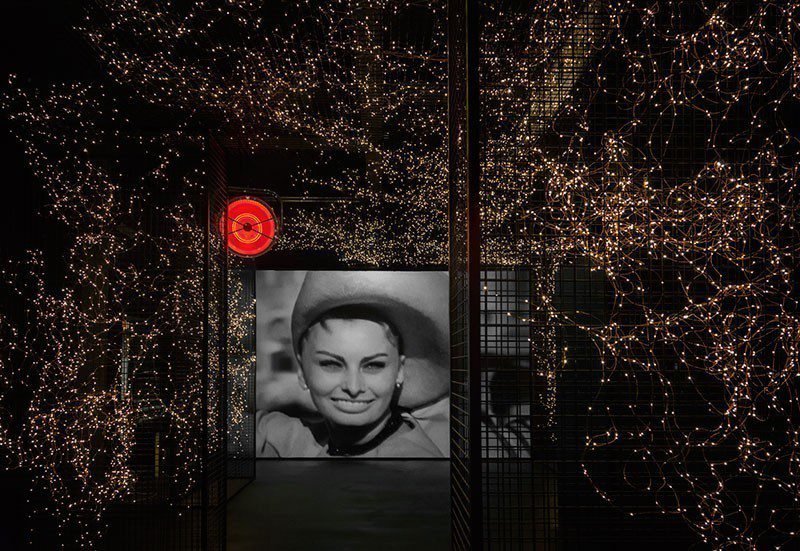
This is the space everyone photographs, and rightly so. Three large frames bordered by about a hundred light bulbs, the ones from dressing rooms, make up a mosaic of sequences of the faces that made Italian cinema and television. Anna Magnani, Alberto Sordi, Vittorio De Sica, Sophia Loren, Gina Lollobrigida, Claudia Cardinale, Marcello Mastroianni, Totò, and then the next generation and the one after that. Italian stardom was a strange affair, much less constructed than the Hollywood kind, much more mixed with dialect and body.
Here something happens that doesn't happen elsewhere: the faces are not still. They are not portraits on the wall, they are moving clips, and so you don't look at them as icons but as people acting. The difference is enormous. A still frame of Anna Magnani is a monument. Three seconds of Anna Magnani screaming is an electric shock.
The advice: stay here at least 10 minutes and wait for the cycle to repeat. The sequences are not few and they don't come back right away. Most visitors take the photo and move on after 90 seconds, missing two thirds of the material.
The Music room of the MIAC
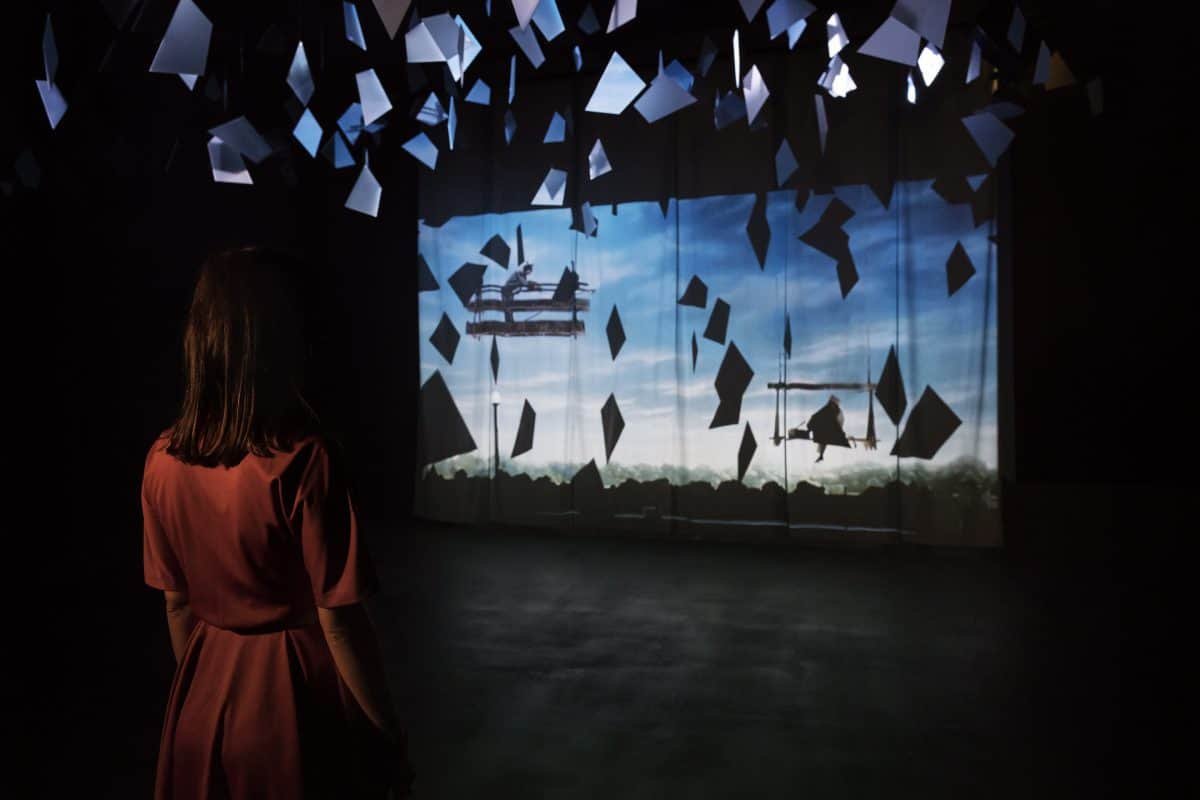
Music is the other great thematic container, and in the Italian case it mostly means one thing: soundtracks. No other country has produced, in proportion to the size of its industry, a similar quantity and quality of film music. Nino Rota with Fellini and with Visconti, Ennio Morricone with Leone and with 60 other directors, Piero Piccioni, Armando Trovajoli, Carlo Rustichelli, Piero Umiliani.
The room works because it separates sound from image and then reunites them. Hearing a theme without seeing the scene, and then seeing the scene, is an exercise that changes perception: you notice how much the music is doing the emotional work we used to attribute to the direction. Anyone who has taught cinema knows this is the quickest way to make a student understand what audiovisual editing means.
I add the television chapter, which the museum doesn't neglect: the theme tunes. The theme tunes of Italian programs are an enormous collective musical heritage and completely underrated. Three notes and an entire generation finds itself seated on the couch of 40 years ago.
Eros: the most discussed room of the MIAC
Eros is one of the thematic rooms of the route and it's best to say so clearly, because whoever arrives with a school group needs to know beforehand. The theme is the way desire, the body and sexuality have passed through the Italian screen: the censorship of the Fifties, the double entendre of variety shows, the sex comedy, auteur eroticism, the female body on television. There is archive footage, there are clips, there are contemporary photographic works, among them works by Vanessa Beecroft and Anna Di Prospero.
The room is not pornographic and is not provocative for the sake of it. It's a room of social history, and for me it is the most instructive in the museum if you look at it with the right eye: the history of Italian censorship is the history of what the country couldn't say to itself. The censor's scissors tell more than the cut scene.
That said, with a middle-school class it's best to walk through. Not out of modesty, out of opportunity: some conversations are held in the classroom, not in the hallway.
Language: how people speak in Italian films
The Language room is the one foreigners understand least and Italians understand perfectly. The theme is spoken Italian on screen: the artificial, stiff Italian of classic dubbing, the dialect that enters cinema with neorealism and then becomes a mask, the average Italian of television, Romanesco as the lingua franca of comedy, the youth slang of the films of the 2000s.
It's not an academic theme. In Italy television taught more people to read and write than school did for at least 20 years, and the documentary proof of this process is audiovisual. Hearing in a row the diction of an announcer from 1955, the voice of a dubber lending Italian to an American actor, a Roman actor speaking the way people speak in Quadraro, and then a kid from a recent film, is a lesson in sociolinguistics that no textbook can give.
I point out something that enthusiasts enjoy: here you understand how much Italian dubbing was a cultural industry in its own right, with a school, reference voices and a poetics. Loved, hated, but ours.
Landscape and environment: Italy seen from the set
Landscape is one of the spaces of the route and concerns a matter that Romans know from direct experience: the way cinema built the image of Italian places, and then the way those places changed. The beaches of the boom, the suburbs under construction, the buildings sprouting in the countryside, the cemented-over coastlines, the cities that become backdrops.
The industrial footage and the newsreels document the transformation of the Italian territory with a precision that no photographic archive reaches, because the movie camera pans and shows the context. For anyone who works on urban history, this material is pure gold.
One more observation: the eastern periphery of Rome, where you are while you visit the museum, was one of the most used natural sets in the history of Italian cinema. Pasolini shot around here, among borgate, leftover countryside and aqueducts. When you leave the museum, if you go to the Aqueducts Park, you walk inside one of the most reproduced shots of our cinema.
Sport, food and the other Italian obsessions
Among the themes the route crosses are also sport and food, two subjects that seem minor and are not. Sport in Italy was the first great mass television spectacle, and the collective rituals around radio commentary and then TV commentary built a national identity more solid than the one built by official celebrations. Food, for its part, moves from the educational documentary to the Carosello commercial, from the poor cooking told in postwar films to contemporary television ritual.
Carosello deserves a parenthesis: from 1957 to 1977 Italian television advertising was required to tell a little story before naming the product, and this absurd constraint produced 20 years of auteur short films, signed even by important directors. It's a case unique in the world of a restrictive rule that generates quality. In the museum you'll find a trace of it, and it's worth stopping.
The Masters of Italian cinema at the MIAC
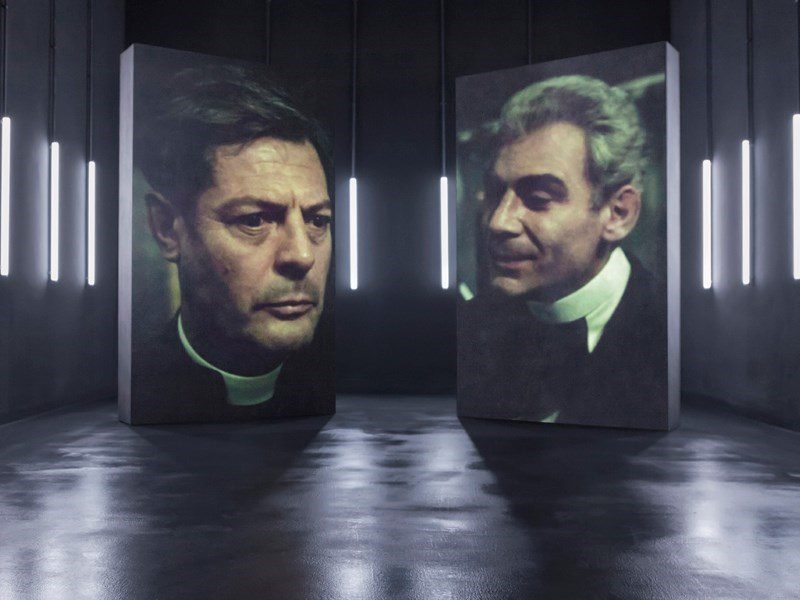
The Masters section gathers the great auteurs: Fellini, Visconti, Rossellini, De Sica, Antonioni, Pasolini, Leone, Scola, the Tavianis, Bertolucci. The museum doesn't make a pantheon of them with busts. It treats them as voices, that is, it makes them speak through their images and through the archive interviews, which are perhaps the most precious material in the whole collection.
Hearing Fellini explain why he preferred to rebuild the sea in the studio with a plastic sheet rather than go to the real sea is a lesson in poetics worth a university semester. Hearing Rossellini talk about television as a teaching tool, in the years when everyone despised it, makes you understand how far ahead he was.
A clear opinion, and I stand by it: the Masters section is better in the parts where the directors talk than in the parts where their films run. You can see the films anywhere. The interviews, no.
The Kaleidoscope: the mirror room of the MIAC
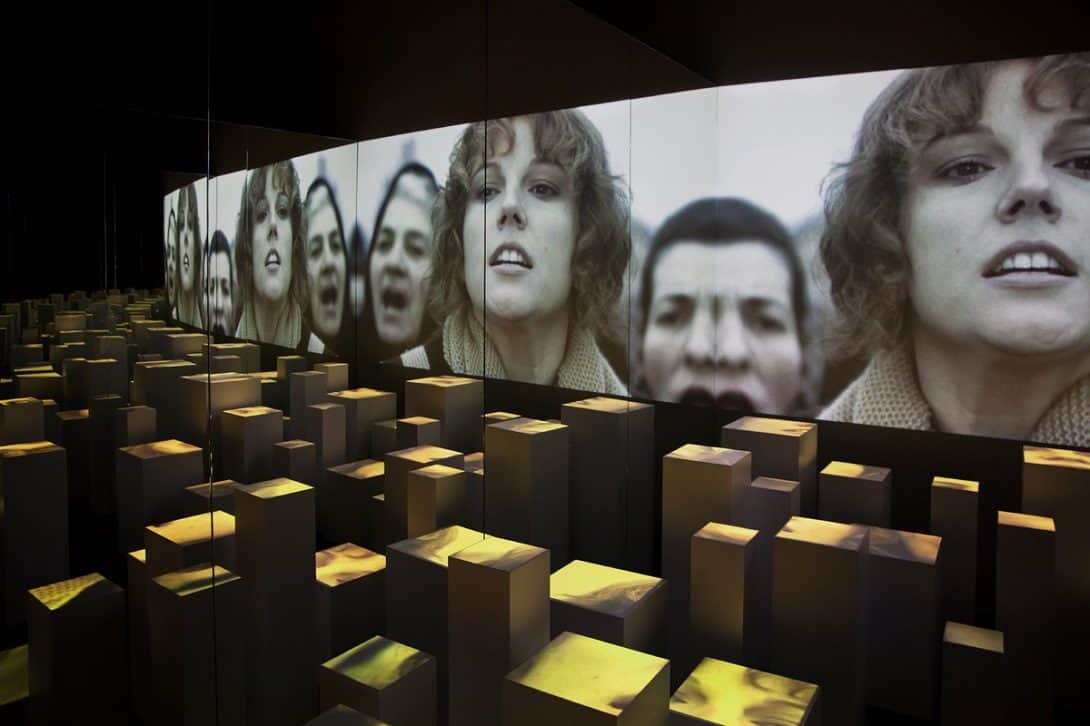
Toward the end of the route there is the space everyone remembers: a room lined with mirrors in which a video column multiplies light trails and images to infinity. It's the only room in the museum that allows itself a pure spectacular effect, and it does so at the end, when the visitor has already received three quarters of an hour of content and can afford the vertigo.
It works for a precise reason: mirror multiplication is exactly what audiovisual does to reality. It reflects it, duplicates it, sends it around until it loses its origin. The Kaleidoscope is not a decoration, it's the logical conclusion of the argument. And of course it's the place where 90 percent of the photographs you see circulating online are taken.
The real objects on display at the MIAC
The museum is almost entirely immaterial, but not completely. There are a few objects, and they are chosen with judgment. There are the scenic heads made for La città delle donne (City of Women) by Federico Fellini, which alone deserve a long look: they are the physical proof of what it meant to build an imaginary world by hand, in a workshop, inside the soundstages right next door. There is the restored sleigh used in Ludwig by Luchino Visconti, a prop and at the same time a relic of an unrepeatable production season. And there is a collection of vintage movie cameras and editing machines, which tell the technical evolution of the craft.
They are few pieces, and the choice is consistent: the MIAC doesn't want to compete with the Museo Nazionale del Cinema in Turin on the ground of the collection. It wants to do something else. Whoever arrives hoping for hundreds of costumes and relics is disappointed, and should know that the costumes are found on the Cinecittà si Mostra route, 50 meters away, included in the combined ticket.
The media library, the cinema room and the Spazio Tullio Kezich
The MIAC is not only the exhibition route. The building houses a media library, a cinema room for screenings, a space for conferences and meetings, and the Spazio Lettura named after Tullio Kezich, the Trieste critic who for decades wrote the most authoritative reviews in Italian film journalism and was Fellini's biographer. A film conservation and restoration laboratory is also planned.
This part is the one the passing tourist doesn't see, and it's the one that makes the difference between an exhibit and an institution. An audiovisual museum without a media library would be a theme park. With the media library it becomes a place of study. If you are students, researchers or serious enthusiasts, find out about access arrangements: the program of screenings and meetings changes over the course of the year.
The archives that feed the MIAC - Italian Audiovisual and Cinema Museum
A museum made of moving images is worth as much as the archives it draws from. Here the network is broad and made up of the institutions that in Italy really safeguard the audiovisual heritage: the historical archive of Istituto Luce, Rai Teche, the Centro Sperimentale di Cinematografia with its Cineteca Nazionale, the Cineteca di Bologna, the Archivio Audiovisivo del Movimento Operaio e Democratico, the Museo Nazionale del Cinema in Turin, the Fondazione Cineteca Italiana, the Cineteca del Friuli, Mediaset and SIAE.
Look at that list carefully, because it says something political: for the first time public archives and private archives, film libraries of the north and Roman institutions, the memory of the regime and the memory of the labor movement, public service and commercial television live together inside the same narrative. In a country that has made the fragmentation of archives a national sport, this is news.
The Istituto Luce historical archive, the documentary heart
Istituto Luce was founded in 1924 and since then has documented the transformations of Italy. Its archive holds over 77 thousand films and more than 5 million photographs, from the early 1900s to today: unique documents on the Fascist 20 years, but also on the postwar period, on reconstruction, on the economic boom and on the following decades. The registered office is the same as the museum's, Via Tuscolana 1055.
It must be said clearly where this material comes from. Luce was the instrument with which Fascism built its own image: the newsreels shown mandatorily in theaters before the film, the shots from below, the rhetoric of the leader, the documentaries on land reclamation and on the empire. That material is propaganda, and at the same time it is the richest visual source we have on those years. The two things coexist and must be held together: using it without saying so would be falsification, throwing it away would be amputation. The MIAC chooses the right path, which is to show it and put it in context.
Those who want to go beyond the visit can consult the digitized heritage on the portal of the Archivio Luce, which puts a substantial part of the holdings online. It's one of the most accessible audiovisual archives in Europe and in Italy too few people still use it.
The Cineteca del Friuli and the Giornate del Cinema Muto
Among the MIAC's partners is the Cineteca del Friuli, based in Gemona del Friuli, which organizes in Pordenone Le Giornate del Cinema Muto, the festival that since 1982 has been the worldwide reference point for early cinema. The 40-fifth edition is held in Pordenone from October 3 to 10, 2026, with an online part.
Why do I tell this on a page dedicated to a Roman museum? Because the presence of the Cineteca del Friuli among the partners explains the depth of the silent-film chapter inside the route: without that heritage, the MIAC Timeline would in effect begin with sound, and the first quarter of the history of Italian audiovisual would be a hole. Italian silent cinema of the 1910s was a world industrial power, with the historical costume epics that anticipated Hollywood. Whoever becomes passionate about this chapter after the visit has a precise destination: the Giornate del Cinema Muto are the appointment where those films are seen restored and with live musical accompaniment.
Cinecittà si Mostra: what you can see today in the Studios
The 15-euro combined ticket includes the MIAC and Cinecittà si Mostra, the Studios' exhibition route. They are two different and complementary things: the MIAC tells Italian audiovisual, Cinecittà si Mostra tells the factory. Whoever comes from far away and has a day should do both. Whoever has barely two hours and has to choose should choose based on what interests them: the museum if you love cinema as a language, the Studios route if you love cinema as a craft.
The permanent sets you walk through on foot
The part that strikes visitors most is the permanent outdoor sets, which are visited with a guide. The largest is the reconstruction of ancient Rome built for the series Rome produced by HBO and broadcast between 2005 and 2007: it covers about four hectares, reproduces the Forum with its civil and religious buildings, and is made of wood and fiberglass with the bright reds, blues and greens that the modern public doesn't associate with antiquity and that are instead closer to the truth than any white marble.
Then there is the Temple of Jerusalem, created by the set designer Francesco Frigeri for The Young Messiah in 2016, and the reconstruction of fifteenth-century Florence created by the set designer Marco Dentici in 2002 for a television production and then reworked for other projects. Walking in these three sets one after the other teaches something no book teaches: how thin the surface of fiction is. Behind the facade of the temple there is scaffolding, and the magic doesn't suffer.
A serious practical warning: the sets are outdoors and there is no shade. In July and August, at two in the afternoon, that route is hard. Hat, water, closed shoes. Those bringing small children should consider the early morning visit.
Teatro 5, Fellini's soundstage
Teatro 5 is the largest soundstage in Europe and was the kingdom of Federico Fellini, who shot several of his masterpieces there. Its dimensions, 40 meters by 80, explain why it was the only space in which a whole city could be built indoors. Fellini hated shooting on location: he preferred to rebuild the world inside a shed, light it the way he wanted and command it from top to bottom. Teatro 5 let him do it.
It must be said honestly that access to Teatro 5 depends on the filming in progress: Cinecittà is an active studio, and when there is a production inside, the stage is not visited. Whoever arrives hoping to enter with certainty will be disappointed on many days of the year. I recommend checking at the time of booking which spaces are actually accessible on the chosen date.
The exhibitions in the Palazzina Presidenziale and the Palazzina Fellini
The Cinecittà si Mostra route runs inside two historic buildings, the Palazzina Presidenziale and the Palazzina Fellini, and tells in an interactive way the history of the Studios, the history of cinema in Italy and in the world, and the trades of cinema. There are stage costumes worn by Italian and Hollywood stars, set design materials, reconstructions of departments, clips from famous films. There is a room dedicated to Fellini designed by important set designers.
The route also hosts temporary exhibitions, often dedicated to costumes from recent films. The program changes: before leaving it's worth checking the calendar on the official website of the Studios, where updated hours and rates are also published.

The history of Cinecittà, the place that hosts the MIAC
To understand the museum you have to understand the enclosure in which it stands. The Cinecittà Studios are a complex of 400 thousand square meters, 40 hectares, on Via Tuscolana, nine kilometers from the center of Rome. They are the largest film production complex in Europe and one of the largest in the world.
The founding: 1936 and 1937
The idea was born inside the Direzione generale per la cinematografia led by Luigi Freddi, who convinced the financier Carlo Roncoroni to build a large facility, with a share of public capital. The land along the Tuscolana was acquired in 1936, the first stone was laid in January 1936 and the official inauguration took place on April 28, 1937.
The architectural design is by Gino Peressutti, a Friulian architect born in 1885 and died in 1940. The initial plan called for 73 buildings, including 14 soundstages, spread over 14 hectares, with another 45 hectares reserved for future expansions. The style is rationalist, restrained, without emphasis: a notable choice for a work of the regime, and closer to industrial architecture than to the monumental rhetoric of those years. Roncoroni was its first director and died in 1938, shortly after the inauguration.
In 1975 the Development and Printing Laboratory designed by Peressutti was renovated. In 2017 Istituto Luce acquired it and inside those walls, two years later, opened the MIAC. The chain is linear: the building that developed the film today exhibits the result of that film.
The war and the refugee camp inside the soundstages
This is the page that almost no visitor knows, and that seems to me the most important of the whole history of the Studios. In 1943 the Germans emptied Cinecittà of its equipment, taken to Germany in freight cars. The Allied bombings destroyed seven soundstages. At the end of that year only four films were in production in the Studios.
Then the rest happened. From 1944 to 1950 Cinecittà was a refugee camp. Tens of thousands of people passed through the Studios: Italians repatriated from Libya, people displaced by the bombings, survivors of deportation, Julian-Dalmatian exiles. They lived inside the soundstages, in shacks built with what was available, using the set panels as partition walls and the lumber of the sets as fuel. The dream factory was, for six years, a camp of people who had lost everything.
This story is documented by the film Profughi a Cinecittà by Marco Bertozzi, from 2012, 52 minutes built on the testimony of those who were there. Along the sets of ancient Rome it deserves a sentence: under the fiberglass of the fake Forum there are six years of real history that left no scenery.
Hollywood on the Tiber
The Studios reopened in 1947 at reduced capacity and production remained modest until 1949, when co-production agreements with France changed the scene. The first film shot at Cinecittà in the postwar period was Cuore by Duilio Coletti, from 1947. In 1948 came the first American production, Prince of Foxes by 20th Century Fox.
The turning point is 1951, with Quo Vadis by Mervyn LeRoy produced by MGM. From then on, for two decades, about 40 American films were shot here, and the expression Hollywood on the Tiber was born. The reason was economic: skilled labor at low cost, unlimited extras, a set-building craft that no longer existed in Los Angeles. The peak of the genre is Ben Hur by William Wyler, from 1959, which owes a great deal of its 11 Oscars to the work done here.
In the same years the Studios hosted great Italian cinema: Luchino Visconti, Vittorio De Sica, Federico Fellini. Visconti's Bellissima and Fellini's Roma contain sequences shot inside Cinecittà that are, in effect, self-portraits of the factory. Over the course of its history the complex has hosted more than 3,000 films, which have collected 90 Oscar nominations and 51 statuettes won.
One thing the textbooks say little about: the real specificity of Cinecittà was never technology, it was the workshop. The production model of these Studios preserved artisanal methods and skilled workers in set design and set construction long after the rest of the world had industrialized them. That is why foreign producers came here: not for the machines, for the hands.
From decline to rebirth
The Seventies and Eighties were hard. In 1978 Istituto Luce passed under public control with new arrangements, in 1982 a new presidency arrived, in 1983 a fire destroyed some sheds and it took more than 24 hours to put it out. Then television progressively occupied the spaces: from 2000 one of the highest-rated television programs built its home inside the perimeter of the Studios, and that home was in turn destroyed by a fire in the night between December 13 and 14, 2013.
International cinema never completely left, however: The Godfather Part III in 1990, Daylight and The English Patient in 1996, Gangs of New York, The Life Aquatic with Steve Zissou, The Passion of the Christ, the series Rome between 2005 and 2007, an episode of Doctor Who in 2008, the remakes of Ben Hur and Zoolander 2 in 2015. In 2015 the Studios returned to profit and recorded record revenue. A fire in 2018 damaged part of the ancient Rome set, which was then rebuilt.
Today Cinecittà is once again a full production site, with streaming platforms renting soundstages for months. The MIAC was born in this moment of return, and it's consistent: a museum opens when the factory again has something to tell.
The facilities of the Studios
For those who love numbers: 21 soundstages, with surfaces ranging from 15 meters by 30 up to 40 by 80, all soundproofed, air-conditioned, equipped with grids, catwalks, overhead cranes and waterproof trapdoors. A 10-hectare backlot for outdoor constructions. A tank for water shooting of 7,000 square meters, two meters deep, with a volume of 13 thousand 500 cubic meters. A blue-screen backdrop 80 meters wide and 20 high. Screening rooms, conference spaces, canteen, restaurant, bar, parking lots and an internal security service.
Not all of these facilities can be visited: they are a working plant, not a theme park. The guided visit touches the outside of the soundstages and the permanent sets. Whoever expects to enter a soundstage where filming is under way has misunderstood what Cinecittà is.
How to get to the MIAC - Italian Audiovisual and Cinema Museum
The simplest way is the metro. Line A, direction Anagnina, Cinecittà stop: you exit onto Via Tuscolana and continue on foot to number 1055, where the gate of the Studios opens. It's a few minutes' walk on a sidewalk, with no climbs and no stairs, with only the annoyance of the traffic of the consular road. The next stop, Subaugusta, is just as convenient depending on the exit you choose: if in doubt, follow the signs for Cinecittà, which are clearly visible.
By car you arrive from the Tuscolana or from the Grande Raccordo Anulare. There is parking near the Studios. I don't recommend it lightly: the Tuscolana at rush hour is a long ordeal, and metro A takes you from the center in barely half an hour without worries. From Termini it's about 20 minutes by train.
Those arriving by bus will find several surface lines along the Tuscolana and in the neighboring streets, but frequencies change and there's no sense relying on the bus when the metro stops right in front. Those coming by taxi should give the full address, Via Tuscolana 1055, because the street number matters: the street is very long.
How far the MIAC is from the center of Rome
The Studios are about nine kilometers from the historic center. It sounds like a lot and it isn't, because the metro covers that distance in a straight line. The calculation is this: from the Colosseum, with line B to Termini and then A to Cinecittà, you arrive in a little over half an hour including the transfers. From Piazza di Spagna or from Barberini, which are already on A, even less.
This makes the MIAC compatible with a normal Roman day, as long as you put it in the morning or early afternoon and don't slip it in as the last stop after five hours of Forums. Arriving here exhausted is the best way to understand nothing.
How much time you need to visit the MIAC
The MIAC alone is visited well in an hour and a half. You can do it in 40 minutes walking, but it would be a waste: a museum built on audiovisual materials is enjoyed by stopping, and the cycles of the installations last from a few minutes to quite a few. Whoever rushes sees 10 percent of the content and judges the museum by that 10 percent.
With the combined ticket, putting together the MIAC and Cinecittà si Mostra with the guided visit of the sets, you stay inside a good three and a half hours, four at an easy pace. If you add lunch, you've filled the day. The operational recommendation: book the entry for the morning, do the guided visit of the sets first while the air is breathable, then the Studios' exhibition route, and keep the MIAC for last, because it's indoors, it's air-conditioned and it's the one that best withstands tiredness.
The advice on timing that nobody gives you
The MIAC has an internal rhythm that rewards those who retrace their steps. The rooms are not many and the route closes back on itself: doing two complete loops costs 20 more minutes and doubles what you take home, because the second time you recognize the materials and catch the cross-references between one room and another. No guide will ever tell you to redo a museum from the start.
The MIAC with children and teenagers
Is it suitable? It depends on age, and the honest answer is nuanced. Under six the museum doesn't have much to offer: the images are big and fascinating, the dark and the sound are appealing, but the content goes over their heads and the child gets tired. Between six and 10 it works in fits and starts: the room of the actors and actresses, the Kaleidoscope, the interactive table and the animated Timeline capture them, the rest less.
From 11 years up the MIAC becomes one of the most effective museums in Rome. The language is that of screens, which kids master better than adults, and the museum doesn't ask to read: it asks to look and to connect. In front of the History room even middle-school classes stay silent for 10 minutes, which doesn't happen at the Baths of Diocletian.
Two practical warnings for parents. The first: the room dedicated to Eros exists and deals with the theme of the body and sexuality through archive footage, so you know what you're walking into. The second: some war and news images are strong. No content is gratuitous or vulgar, but if the child is sensitive it's best to accompany them with an eye on them.
For the youngest age group, in the city, the right destination remains another: Explora, the children's museum of Rome, is built to their measure. The MIAC rewards those who are already a few years older.
The part kids really love: the sets
That said, the day at Cinecittà with children works thanks to the permanent sets. Walking inside the fake Forum, seeing that the columns are fiberglass, understanding that the temple is a facade propped up from behind: this amuses them and teaches something precious, namely that images are built. A child who has seen the back of a set watches television differently for the rest of their life.
Accessibility of the MIAC
The MIAC route runs over the surface of a former industrial laboratory, largely on one level, and the spaces are wide. Companions of people with disabilities enter free, according to the Studios' rate table. The permanent sets part, on the other hand, is outdoors and on natural ground: here the terrain is uneven, there are dirt stretches and the distances to cover are not short.
Those with specific needs should do just one thing before leaving: write to visit@cinecitta.it, give the date and ask for a precise answer on the accessible routes that day. The configuration of the spaces changes with the productions in progress, so an answer valid in the abstract is of no use.
How much the MIAC costs and how to save
The arithmetic rule is simple: two single tickets at 10 euros cost 20, the combined costs 15. If you have three hours, the combined is the obvious choice. If you are under 26 or over 65 the 8-euro reduced rate applies. With children between 5 and 10 you pay 5 euros each. Under 5 you enter free.
The 45-euro family ticket is worthwhile only in specific configurations, and it has a constraint: it's bought exclusively at the physical ticket office, so whoever wants to use it can't buy online and has to factor in the line. Do the math beforehand: two adults with two kids, with the combined ticket paid individually, come to a figure that must be compared with the 45 euros of the package, and the convenience depends on the ages and on the type of route chosen.
Groups of 15 people or more pay 14 euros each for the guided visit and 20 euros for the double guided route. Free admission applies to children under 5, companions of people with disabilities, accredited journalists, licensed European Union tour guides and ICOM members. The bookshop applies discounts in some formulas: ask at the register.
A professional's opinion: the MIAC is one of the museums with the best ratio of price to content in all of Rome. 10 euros for an hour and a half of well-edited archive material is little, if you consider that at certain entrances in the historic center you pay 20 euros for two rooms and a 40-minute line.
When to go to the MIAC and when to avoid it
It's closed on Tuesday, and that eliminates the first possible mistake. For the rest a seasonal rule applies: the MIAC is indoors and air-conditioned, the sets are outdoors and without shade. In July and August go early in the morning. In January and February, if it rains, the visit to the sets becomes a walk in the mud and the museum remains the only pleasant part of the day.
The best seasons are spring and autumn, and in autumn there is one more reason: the city gets into the cinema mood, with the Festa del Cinema di Roma bringing previews and retrospectives to the Auditorium. Those planning a cinema-themed trip in October can combine the two.
Moments to avoid: holiday long weekends, when Roman families fill the ticket office, and days when heavy productions are under way in the Studios, because some areas may be closed to the public. There's no way to predict it from the outside: you ask when booking.
What to see around the MIAC within a short radius
The area is not touristy and that makes it interesting for those who have already seen Rome. A short distance away opens the Aqueducts Park, where seven ancient aqueducts cross a meadow that Italian cinema has used dozens of times, from Pasolini onward. It's the right place for a walk at sunset after the museum, and it's free. In summer Roma Cinema Arena is also held there, an open-air arena with free screenings. Ending a day at Cinecittà with a film under the arches of an aqueduct is one of the best-working Roman sequences I know.
Continuing south you enter the Appian Way Regional Park and reach the Villa of the Quintilii, the most imposing imperial residence of the suburbium. On the same road there are the Catacombs of San Callisto. They are different worlds from the museum's, but the day handles the pairing well: in the morning the factory of images, in the afternoon the real archaeology that those images have copied for a century.
Those who instead want to stay on the industrial and twentieth-century theme have two strong destinations in the city: the Centrale Montemartini, where ancient statues coexist with the diesel engines of an old power plant, and the MAXXI for contemporary art and architecture. For those interested in cinema and its programming, downtown there remains the Casa del Cinema in Villa Borghese, with its free summer arena.
One last pointer for those with half a day more who love Rome's twentieth century: the EUR district and the complex of the Museum of Civilizations tell another face of the same decade that built Cinecittà, and they tell it in marble instead of fiberglass.
A curiosity about MIAC - Italian Audiovisual and Cinema Museum
The nicest curiosity concerns the floor and the ceiling, not what they project in front of you. The MIAC is built inside the former Development and Printing Laboratory, that is, inside the department in which the film shot on the sets was immersed in chemical baths, developed, printed and dried. It was a work environment dark out of necessity: light was the enemy, because light burns the negative. In those rooms people worked in red light or total black, and those who worked there say the strongest memory is the smell, not the image.
Today in that same volume light is the only material on display. The museum projects onto tall walls, multiplies the screens, fills with images a place that to survive had to stay in the dark. It's a reversal that no panel points out and no audio guide tells, and it's the smartest thing in the whole project.
There's more, and it concerns a specific object. The conveyor belt on which the rolls ran along the development chain, more than 40 meters, was not dismantled: it was preserved and converted into an installation. The messages that visitors write at the interactive table run along that belt the way film once ran along it. Same machine, same direction of travel, different content. Before, it carried other people's images toward the chemical bath. Now it carries the words of those who look.
I add the architectural curiosity that completes the picture: the building was designed by Gino Peressutti, the same architect who in 1937 designed the entire Cinecittà complex in the rationalist style. The museum of Italian audiovisual is therefore housed in a work of regime architecture, and this is consistent with the heritage it exhibits, because Istituto Luce too, which supplies a large part of the materials, was born as an instrument of that regime. There is no hypocrisy in the operation: there is an awareness that should be applied more often to Italian museums.
Something nobody tells you about MIAC - Italian Audiovisual and Cinema Museum
What nobody tells you is that the MIAC should be seen with the ears before the eyes, and that if you get the time of day wrong you lose half the museum. The advice has a technical reason.
The exhibit is built on open spaces that communicate with each other. Sounds flow from one room to the next, and this is deliberate: the museum wants you to hear the music of the next room while you look at the faces of the actors, because that is how audiovisual memory works, by contamination. But when the museum is crowded, the collective soundtrack is covered by the voices of visitors and the effect is lost. In a full room you see the images and no longer hear the sound editing that holds them together.
A precise recommendation follows: enter the MIAC in the first hour after opening, right after 10:00, or in the last hour and a half of the afternoon, when the groups have finished and the sets have emptied. In those moments the museum sounds the way it was designed to. There are days when, around 16:30, you find yourself alone in three rooms in a row, and then the experience changes in nature.
The second thing nobody says concerns seating. There isn't much, and most visitors watch standing. But the content has long durations: some cycles close after quite a few minutes, and those who stay standing almost never complete them. If you find a place to sit, sit and let a whole cycle run. It's the only way to understand that the edits are not random and that each room has a narrative structure, with an opening, a development and a close.
The third concerns wallets: the ticket for the MIAC alone costs the same as the ticket for the Studios route alone, 10 euros, while the combined one costs 15. Many visitors buy the single because they arrive with little time, and then realize they would have liked to see the other too. Buying the combined at the start costs five euros more and leaves you the freedom to decide on the spot how long to stay.
The advice I give you for visiting MIAC - Italian Audiovisual and Cinema Museum
The advice is just one and it goes against the instinct of anyone who buys a ticket: get the combined ticket, but don't do the MIAC first. Do it last. I know it seems the opposite of what people usually do, because the museum is the prize piece and the temptation is to attack it with fresh energy. Let me explain why you'd be wrong.
The Cinecittà si Mostra route and the guided visit to the permanent sets put the concrete in your head: how a set is built, how big a soundstage is, what a fake temple is made of, how many trades it takes to make a shot. These are physical, tactile notions. When you enter the MIAC after touching the fiberglass of the Forum, the museum stops being a nice installation and becomes the logical consequence of what you have just seen. The fragments projected on the walls have a different weight if you know that behind each one there was a shed, a crew, a carpenter.
By contrast, whoever starts with the MIAC reaches the sets with a head full of images and looks at them as backdrops for photographs. They lose the artisanal part, which is what Romans call il mestiere, and it's the reason Cinecittà still exists.
Second piece of advice, a practical one: book. The online ticket carries a time slot tied to the first guided visit of the sets available after entry, so choosing the time is not a bureaucratic detail, it determines how your day fits together. If you want the individual or family guided visit, you arrange it by writing to visit@cinecitta.it, and it's best to do it a few days ahead, not the night before.
Third piece of advice, on shoes and water: the sets are outdoors, the ground is natural, the Tuscolana sun in summer gives no discounts. Closed shoes, hat, a bottle. You sometimes see elegant people struggling among the plaster columns in thin sandals and cursing the day.
Fourth and last: drop the idea of seeing everything in two hours and then running downtown to do something else. Rome always tempts you with accumulation. This is a full half day, and if you break it up you lose the sense of the place. Go in the morning, leave in the early afternoon, and if you have energy left, devote the sunset to the aqueducts that are a short walk away, without going back downtown.
Another well-known fact, yet rarely cited
Everyone knows that Cinecittà was inaugurated in 1937 by the regime, and nobody remembers the fact that follows: between 1944 and 1950 the Studios were not a center of film production, they were a refugee camp. Inside the soundstages, the ones designed to contain sets, families lived. The walls of the sets had become dividers between one household and another. The wood of the constructions ended up in the stoves. In the sheds people cooked, slept, were born and died.
Tens of thousands of people passed through. Italians repatriated from Libya after the loss of the colonies, displaced people who had lost their homes under the bombings, survivors of the deportations, Julian-Dalmatian exiles arrived from Istria and Fiume. A transit camp lasting six years inside the largest film studio in Europe.
In 1943 the Studios had already been emptied: the Germans loaded the equipment onto freight cars and took it to Germany, the Allied bombings destroyed seven soundstages, and at the end of that year only four films remained in production. On that void the humanitarian emergency settled in. When production resumed in 1947, with Cuore by Duilio Coletti, crews and shacks coexisted in the same sheds.
The story is documented by the film Profughi a Cinecittà, made by Marco Bertozzi in 2012, 52 minutes built on the voices of people who lived in those soundstages as children. It is a piece of Italian history that is missing from almost all tourist accounts of the place, and which says something enormous: the dream factory, before going back to making dreams, gave a roof to people who no longer had one.
Inside the reconstruction of ancient Rome built for the television series it is worth stopping for a moment and remembering it. Not to put on a show of virtue, but because it changes the way you look: you walk among fake columns knowing that in the same compound, 70 years ago, someone slept under a dismantled set.
The right photo to take at MIAC - Museo Italiano Audiovisivo e Cinema
The photo everyone takes is the one of the Caleidoscopio, the mirror-lined room where a video column multiplies trails of light to infinity. It is the right photo, but it has to be done well, and nine out of 10 visitors get it wrong. Here is how it is done.
First: no flash. The flash bounces off the mirrors and gives you back a white blotch instead of the subject. If the phone decides by itself, turn it off by hand. Second: don't stand in the center. At the central point your reflection occupies all the surfaces and the photo becomes a repeated portrait, which gets boring after 10 seconds. Stand off-center, toward a corner, with the light column on the diagonal: the trails gain depth and your body becomes a silhouette inside the geometry, not the main subject.
Third: rest the phone or your elbow. The room is dark, exposure times get longer, and handheld the shot comes out blurred. If you have a camera, raise the sensitivity and lower the f-stop. Fourth: wait for the cycle. The projected images change, and there are moments when the column is all blue, others when a full red dominates. Wait for the color you prefer instead of shooting on the first try.
The second photo to take home, much less visited, is the room of the actors and actresses: the three large frames bordered by about 100 dressing-room bulbs. The advice here is the opposite: don't photograph yourselves, photograph only the frames, head-on, waiting for a recognizable face to appear in the frame. The contrast between the warm bulbs and the black-and-white image makes a much more elegant photo than any selfie.
Third possibility, for those with an eye: the Timeline. Photographing it whole is impossible, it is more than 30 meters long. It has to be shot at an angle, standing at one end and capturing the wall that flees in perspective, perhaps with a person backlit halfway down the corridor to give the scale. It is the only image that conveys to the viewer how long that wall is.
One last recommendation, which holds in every museum and doubly here: the rules on filming and on the use of tripods are decided by the venue and can change, especially with temporary exhibitions and materials lent by third parties. Ask at the ticket office when you enter. 30 seconds of asking saves an argument with the staff in the room.
Some important events that happened here in history
On April 28, 1937 Cinecittà was officially inaugurated, a little over a year after the laying of the first stone in January 1936. The complex had been wanted by the Direzione generale per la cinematografia of Luigi Freddi and built with financing from Carlo Roncoroni and the participation of public capital. The design was by Gino Peressutti. The plan called for 73 buildings and 14 soundstages on 14 hectares, with another 45 hectares set aside for expansions. Roncoroni, the first director, died the following year, in 1938.
In 1943 the catastrophe came. German troops removed the heavy equipment and moved it to Germany, and Allied bombings destroyed seven soundstages. By the end of the year only four films were in production at the Studios. Between 1944 and 1950 the complex housed 10,000s of refugees and displaced people.
In 1947 production resumed with Cuore by Duilio Coletti, still at reduced capacity. In 1948 the first American postwar production arrived, Prince of Foxes of 20th Century Fox. In 1949 the co-production agreements with France reopened the market.
In 1951 MGM shot Quo Vadis by Mervyn LeRoy here: it is the date that inaugurates the season of Hollywood on the Tiber, during which about 40 American productions chose Rome. The peak was Ben Hur by William Wyler, in 1959. In the same years Visconti, De Sica and Fellini were working at the Studios: Bellissima and Roma contain sequences shot right inside Cinecittà, that is, the factory that films itself.
In 1983 a fire destroyed some sheds and it took more than 24 hours to put out. On the night between December 13 and 14, 2013 another fire destroyed the house built inside the Studios for a well-known television program. In 2018 flames damaged part of the ancient Rome set, which was later rebuilt.
In 2015 the Studios returned to profit and posted record revenue after difficult years. In the same period they hosted the remakes of Ben Hur and Zoolander 2. In 2017 the building of the former Development and Printing Laboratory passed to Istituto Luce.
On October 29, 2019, the MIAC was presented to the press in the presence of Minister Dario Franceschini, Director General of Museums Antonio Lampis and regional secretary Leonardo Nardella. It opened to the public in December of the same year. The museum was built with 2,500,000 euros from the Grandi Progetti Beni Culturali Strategic Plan. Over a span of 80 years, the same compound has hosted a regime inauguration, a war, a refugee camp, the golden age of Italian cinema, the collapse, television and finally a museum that holds all these things together.
Who has passed through MIAC - Italian Audiovisual and Cinema Museum
The museum opened in 2019, so the people who have passed through it are mostly the ones who appear on its walls. But the compound where it stands has a list of visitors that few places in the world can claim, and it's worth putting it in order.
Federico Fellini first of all. Cinecittà was his workplace and Teatro 5 was his kingdom: there he built whole worlds instead of going outside to find them, and there he shot several of his masterpieces. The MIAC also keeps a material trace of his passage, the set heads made for City of Women.
Luchino Visconti, whose restored sleigh used in Ludwig is on display in the museum. Vittorio De Sica, Roberto Rossellini, Michelangelo Antonioni, Pier Paolo Pasolini, Sergio Leone, Ettore Scola: the generation that made Italian cinema a worldwide cultural power worked inside these stages or in the immediate surroundings.
The actors: Anna Magnani, Alberto Sordi, Marcello Mastroianni, Sophia Loren, Gina Lollobrigida, Claudia Cardinale, Totò. Their faces are the material of the actors and actresses room, and many of them spent years of their professional lives here.
The Americans. With Quo Vadis in 1951 and with Ben Hur in 1959, the big Hollywood productions arrived, and with them the stars. It was the season when Via Veneto filled with foreign actors and when the term paparazzo was born, from the photographer in Fellini's film. Cleopatra brought to Rome the most expensive production of its era. In the following years leading directors came back: Francis Ford Coppola with the third Godfather film in 1990, Anthony Minghella with The English Patient in 1996, Martin Scorsese with Gangs of New York, Wes Anderson with The Life Aquatic with Steve Zissou, Mel Gibson with The Passion of the Christ.
International television: the series Rome produced by HBO between 2005 and 2007, which left the permanent set that can still be visited today, and even an episode of Doctor Who shot here in 2008.
On the institutional side, on April 28, 1937, the inauguration of the Studios starred the head of government of the time, in a ceremony filmed by the Luce cameramen that you can now see inside the museum. 82 years later, on October 29, 2019, the museum was presented to the press by Minister Dario Franceschini together with the heads of the cultural heritage administration. Between these two ceremonies, in the same place, runs the whole history of the relationship between Italian power and images.
I'll add the names the public doesn't know and that deserve a line: Gianni Canova, Gabriele D'Autilia, Enrico Menduni and Roland Sejko, who built the museum's narrative, and the designers of the NONE collective who gave it form. In a country that dedicates statues to directors and forgets the curators, it's right to write it down.
Quick questions about MIAC - Italian Audiovisual and Cinema Museum
How much does a MIAC ticket cost?
10 euros for the full price for the museum alone, eight euros reduced for under 26s, over 65s and journalists with a press card. Children between 5 and 10 pay five euros, and under 5s get in free. The combined ticket that also includes Cinecittà si Mostra costs 15 euros.
Is the combined ticket with Cinecittà si Mostra worth it?
Yes, in almost every case. Two single tickets cost 20 euros, the combined one 15. The only case where it isn't worth it is if you have less than two hours and already know you'll see only one thing.
What are the MIAC's opening hours?
From 10.00 to 18.00 every day except Tuesday, with the ticket office closing at 16.30. Closed on December 24 and 25 and on January 1. Before you leave, it's best to check the official site again, because special openings change the calendar.
What day is the MIAC closed?
Tuesday. It's the most common mistake of people who plan the day at the last minute, because Tuesday is a day when most Rome museums are open.
Where exactly is the MIAC?
Via Tuscolana 1055, 00173 Rome, inside the compound of Cinecittà Studios, in the building of the former Development and Printing Laboratory. The street number should be given in full to the taxi driver, because the Tuscolana is a very long street.
How do you get to the MIAC by public transportation?
Metro line A, Cinecittà stop. You exit and continue on foot along the Tuscolana to number 1055: a few minutes on the flat. From Termini it is about 20 minutes by train.
Do you need to book to visit the MIAC?
The ticket is bought online or at the ticket office. Individual and family guided tours are booked by writing to visit@cinecitta.it. On weekends and long holiday weekends, booking online saves time at the register.
How long does it take to visit the MIAC?
An hour and a half for the museum alone, if you really look at it. Three and a half or four hours if you add Cinecittà si Mostra and the guided tour of the permanent sets.
Is the MIAC suitable for children?
From age 11 up it works very well. Between ages six and 10 it works in parts, with the strong moments in the room of the actors, in the Caleidoscopio and at the Timeline. Under age six the content goes over their heads: for that age group the outdoor sets are far more effective than the museum.
Is there content not suitable for the youngest?
One of the thematic rooms is dedicated to Eros and deals with the body and sexuality through film and television footage. Some war and news images are harsh. Nothing gratuitous or vulgar, but it is good for parents to know before.
Can you take photos at the MIAC?
The rules on filming are set by the venue and can vary with temporary exhibitions and with materials lent by third parties. It is worth asking at the ticket office as soon as you enter. Where photography is allowed, flash remains a terrible idea anyway because of the mirrors and the dark.
Is the MIAC wheelchair accessible?
The museum is housed in a former industrial laboratory, mostly on one level and with wide spaces, and companions of people with disabilities enter free. The permanent sets section, however, is outdoors and on natural ground. For a reliable answer for your chosen date, it is best to write to visit@cinecitta.it.
What is the difference between the MIAC and Cinecittà si Mostra?
The MIAC tells the story of Italian audiovisual, that is, cinema, television, radio and advertising as language, through edited archive materials and installations. Cinecittà si Mostra tells the story of the factory: the history of the Studios, the film trades, the costumes, the scenography and the permanent sets you walk through on foot.
Can you enter the soundstages of Cinecittà?
Usually not, because they are active workspaces. The guided tour touches the exterior of the soundstages and the permanent outdoor sets. Access to areas like Teatro 5 depends on the productions under way and is not guaranteed.
Which sets can you visit at Cinecittà?
The reconstruction of ancient Rome made for the series Rome, which covers about four hectares, the Temple of Jerusalem built by Francesco Frigeri for The Young Messiah in 2016, and the 15th-century Florence created by Marco Dentici in 2002 and later reworked.
Is there a bookshop at the MIAC?
Yes, and a discount on gadgets is also provided in some ticket packages. It is best to ask at the register which promotion is active on the day of your visit.
Does the MIAC have a library or a media library?
The building houses a media library, a cinema room, a conference space and the Spazio Lettura named after Tullio Kezich, as well as a laboratory for the conservation and restoration of film. Access arrangements and programming change over the course of the year.
How many rooms does the MIAC have?
12 main rooms spread over 1,650 square meters, with themes that include History, Power, Music, Comedy, Language, Eros, the Masters, the Actors and Actresses, Landscape and the future of audiovisual, plus the large installations of the Timeline, the interactive table and the Caleidoscopio.
Who curated the MIAC?
The scientific committee is made up of Gianni Canova, Gabriele D'Autilia, Enrico Menduni and Roland Sejko. The exhibit design is by the collective NONE, with graphics by NOAO, video content by Daniele Spanò and illustrations by Yassmin Yaghmai. The architecture of the readapted building is by Francesco Karrer.
When did the MIAC open?
In December 2019, after the press presentation on October 29 of the same year. It was funded by the Ministry with 2,500,000 euros from the Piano strategico Grandi Progetti Beni culturali.
Is the MIAC included in the Roma Pass or other museum cards?
The Studios' fare schedule provides free admission and reductions for specific categories, such as children under 5, companions of people with disabilities, accredited journalists, licensed European Union tourist guides and ICOM members. For city tourist passes it is best to check each time, because the agreements change.
Is there a bar or a place to eat?
The Studios complex has a bar, a canteen and a restaurant, intended also for those who work there. Outside the gate, along the Tuscolana and in the side streets, there are the normal neighborhood businesses: no tourist traps, which on a Roman day is already an advantage.
Do you wait long in line at the MIAC?
Much less than at the museums downtown. On weekdays you get in almost right away. On weekends and long holiday weekends the ticket office can slow down, above all because the family ticket is bought only in person. The online ticket reduces the wait.
Is it worth coming all this way if I have only a few days in Rome?
If it's your first time in Rome and you have two days, no: first come the Colosseum, the Pantheon, the Vatican Museums. If it's your second or third time, or if cinema really interests you, the MIAC is one of the best-spent half days in the city. Those planning their own itinerary can start from the page My trip to fit the stops together.
Are there temporary exhibitions?
Yes, both at the MIAC and on the Cinecittà si Mostra route, often dedicated to costumes and materials from recent films, and in collaboration with the Archivio Luce. The program changes several times a year: it's best to check the official calendar before leaving.
What can I see around the MIAC after the visit?
The Parco degli Acquedotti a few stops away, the Appian Way and the Villa dei Quintili continuing south, the Tuscolano district for those who love the working-class Rome of the twentieth century. In summer the open-air arenas in the area screen films for free under the arches of the aqueducts.
To conclude on the MIAC
For almost all of Rome's museums it's easy to predict what a group will say on the way out. Not with the MIAC. Here the reaction depends on how willing each person is to let themselves be crossed by images that don't explain themselves. Whoever arrives with a catalog mindset leaves saying it's nice but something is missing. Whoever arrives willing to look leaves with a list of films to catch up on and the feeling of having understood a piece of the country.
It's among the three museums to recommend to someone returning to Rome for the second time, along with the Centrale Montemartini and the Galleria Borghese, for a precise reason: it's the only one that speaks in the present tense. The ruins tell what we were. The MIAC tells how we looked at ourselves, and puts before us the uncomfortable evidence that the image of ourselves was built for a century by someone else, first the newsreel, then cinema, then television, now a screen we hold in our hand.
Go early in the morning or in the late afternoon, take the combined ticket, do the sets first and then the museum, and allow yourself the second loop. It costs 20 minutes and changes the visit. Then go out, walk five minutes on the Tuscolana with the noise of the cars, and try to think that behind that wall, since 1937, the images by which this country learned to recognize itself have been fabricated.
Article written by the editorial team of TourLeaderPro, contact them for Private/Corporate/V.I.P. Tours and Experiences.
Planning a trip to Rome? The English guides for visiting the city are on ItalyPlanner.com.