Basilica of Santa Prisca and Mithraeum
In short. The Basilica of Santa Prisca and Mithraeum occupies a quiet corner of the Aventine, on a small tree-lined square a few hundred meters from the Circus Maximus and the Giardino degli Aranci, where thousands of tourists arrive without…
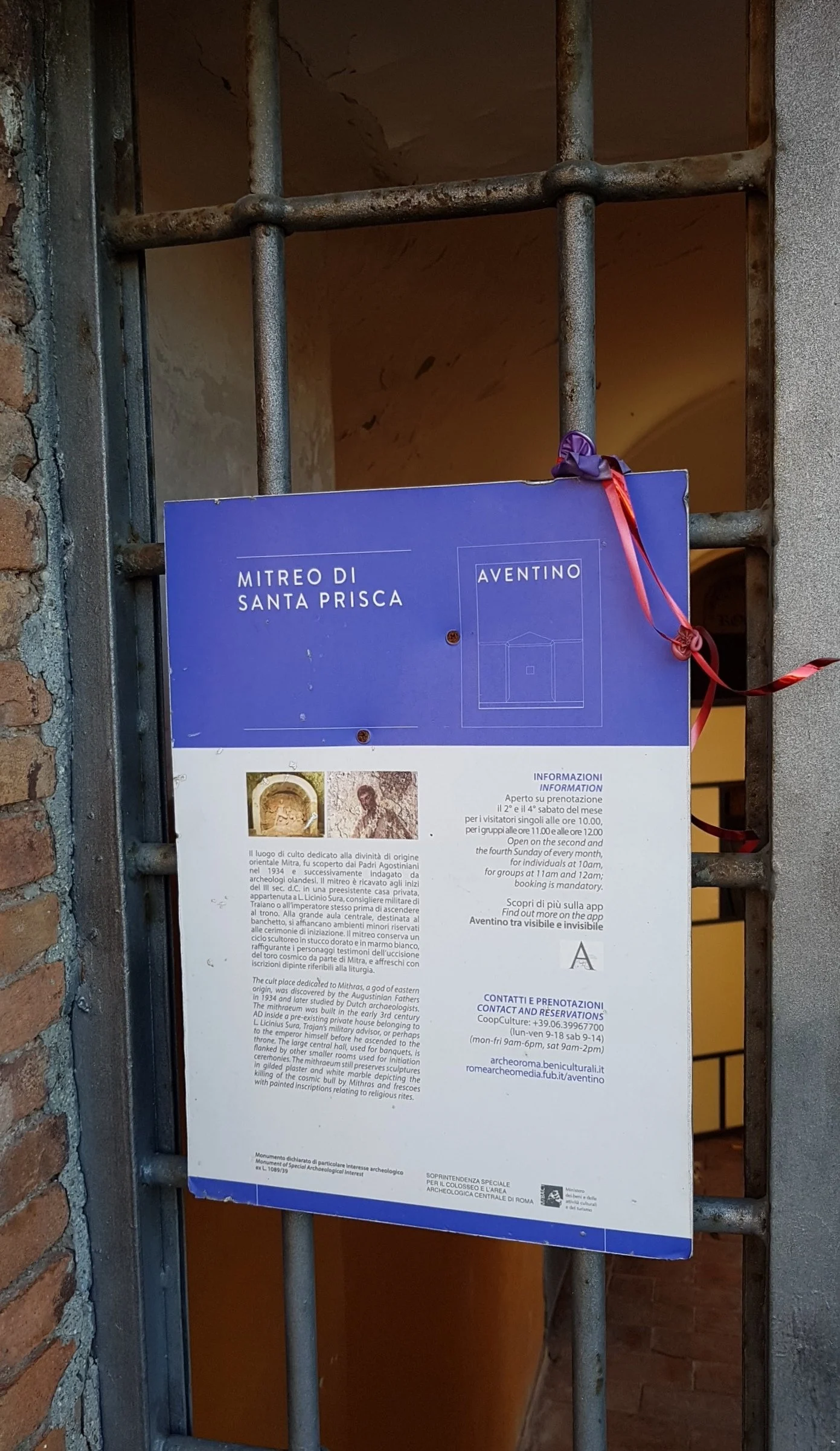
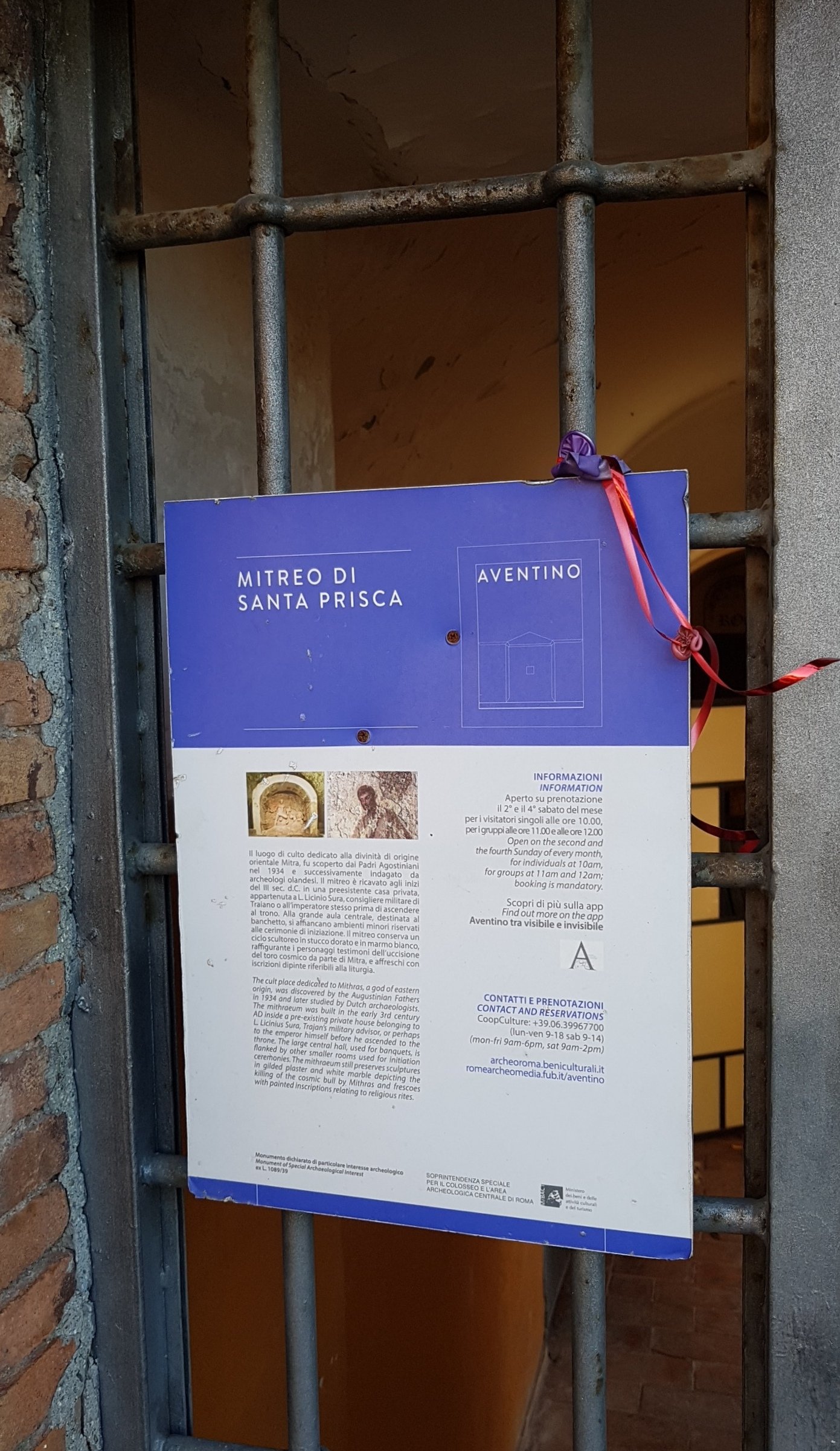
The Basilica of Santa Prisca and Mithraeum occupies a quiet corner of the Aventine, on a small tree-lined square a few hundred meters from the Circus Maximus and the Orange Garden, where thousands of tourists arrive without almost ever turning in this direction. Above is a titular church of late antique origin, remodeled several times and today entrusted to the Augustinians. Below, reached by a side staircase, is one of the most important Mithraic sanctuaries known: an elongated room dug into the structures of a Roman house, with walls covered in frescoes showing the procession of the seven grades of initiation and with painted inscriptions that are among the very few written testimonies of Mithraism to have come down to us. The complex came to light by chance in 1934, when the friars were looking for something else entirely, and was systematically excavated by a Dutch mission between the early 1950s and the mid-1960s. The mithraeum has no ordinary opening hours: it is visited only on extraordinary occasions and by reservation, and at the time these lines are written the official sources list it as closed to ordinary visits. The pages that follow tell what is really under Santa Prisca, what those frescoes say, how little we actually know about the doctrine they represented, and how access works.
Where the Basilica of Santa Prisca is and how to get there
The church of Santa Prisca and the mithraeum below are on Via di Santa Prisca, on the southeast side of the Aventine Hill, in the Ripa rione, about 10 minutes on foot from the Circo Massimo metro station of line B. The address that appears on the official records of the underground archaeological area is Via di Santa Prisca 8, while the entrance of the church faces the small square of the same name, a few steps away. Whoever arrives finds no showy sign and no ticket office: the complex looks like a neighborhood parish, and the archaeological part stays invisible from outside.
By public transport
The simplest way is metro line B, Circo Massimo stop, from which you walk up along Viale Aventino and then take one of the streets that climb the hill. Trams 3 and 8 and several bus lines running along Viale Aventino and Via della Marmorata also stop in the same area. The climb is short but real: the Aventine is a hill, and the last stretch toward the church involves a change in elevation that those with walking difficulties will do well to consider in advance.
On foot from the center
From Piazza della Bocca della Verità and the basilica of Santa Maria in Cosmedin you get there in about 20 minutes going up the side of the hill. From the Forum Boarium and the Arch of Janus the route is almost the same. Whoever arrives from the opposite side, that is from Testaccio and the Monte dei Cocci, climbs instead via Via Marmorata and then the inner side streets of the Aventine, on a silent and almost residential stretch that is already one of the most beautiful walks in Rome.
Landmarks so you don't take the wrong street
The Aventine has three poles everyone knows: the Orange Garden with its view over the city, the Basilica of Santa Sabina on the Aventine with its fifth-century wooden doors, and the keyhole of the Villa del Priorato di Malta. Santa Prisca stays outside this triangle, lower down and further southeast, toward the side that looks at the Baths of Caracalla. It is exactly this out-of-the-way position that explains why so many people spend a day on the Aventine without realizing it exists.
What is really under the church: four centuries stacked up
Beneath the basilica of Santa Prisca, archaeologists have recognized at least three overlapping phases: a Roman residential complex of the Flavian and Trajanic age, a Mithraic sanctuary carved partly out of those structures at the end of the second century, and finally the Christian place of worship built on top between the fourth and fifth century. It is a stratification worth keeping in mind because it is the only key to understanding the place: it is not a Mithraeum with a church built by chance on top, but a piece of city that changed function three times over the span of 300 years.
The Roman House of the End of the First Century
The brick stamps found in the oldest rooms point to the end of the first century AD, around 95, and document a complex arranged around a quadriporticus, that is, a courtyard with porticoes on four sides. Around 110 the sector was reorganized and turned into a dwelling, and in an adjacent structure a large apsed nymphaeum was built, a room for play of water and shade of the kind found in the rich residences of imperial Rome. It was no ordinary house: the quality of the masonry and the size of the rooms indicate a high-level property, in a neighborhood that in those decades was among the most exclusive in the city.
The Question of the Gens Traiana and the Privata Traiani
Here opens one of the most discussed and at the same time most cited points in the literature on the site. Some scholars have proposed identifying this residence with the Privata Traiani, that is, the private house of Trajan before his rise to the throne, on the basis of topographical clues and chronological coincidence. Others have preferred to attribute it to Lucius Licinius Sura, senator and very close friend of Trajan, whose property in the area is made plausible by the proximity of the Thermae Suranae, the baths that bore precisely his name and stood on the Aventine. The two hypotheses are not equivalent in their degree of solidity, and neither is proven: they are reconstructions founded on circumstantial convergences, not on an inscription saying who lived there. This deserves to be written plainly, because in popular descriptions the Trajanic hypothesis is often presented as an established fact, and it is not.
The Christian Phase Above
Between the end of the fourth and the beginning of the fifth century, above and beside these structures a Christian place of worship was built: a two-aisled hall recognized in the excavations as the primitive core of the titulus Priscae, from which the present basilica derives. The sequence is thus clear in time, but it should not be read as a simple act of automatic replacement: the exact chronology of the transition, and above all the causal link between the end of the Mithraeum and the birth of the church, remain a matter of discussion, as will be seen further on.
The Dutch Excavations and Vermaseren's Publication
The Mithraeum of Santa Prisca was found by chance in 1934 by the Augustinian fathers who serve the church, and was systematically excavated by a Dutch archaeological mission directed by Maarten Jozef Vermaseren and Carel Claudius van Essen, whose work took place between the early 1950s and the mid-1960s. The volume that came out of it, The Excavations in the Mithraeum of the Church of Santa Prisca in Rome, published in Leiden in 1965, remains to this day the basis of every discussion of the monument.
A Discovery Born of a Wrong Search
The circumstance of the finding is one of the most instructive things in the whole story. The Augustinians were digging beneath their church to look for traces of the house of Aquila and Prisca, the Christian couple of the apostolic tradition, that is, to confirm a devotional memory archaeologically. They found instead a sanctuary dedicated to Mithras, that is, exactly the opposite of what they were looking for. It is a textbook case of how archaeological research often answers questions different from the ones put to it, and it is worth remembering when you read about discoveries that perfectly confirm a tradition.
The Dates of the Excavations: A Small Discrepancy to Point Out
The available sources do not agree on the exact year the Dutch campaign began: some indicate 1952, others 1953, while on the conclusion there is greater convergence around 1966. The difference is minimal and probably concerns the distinction between the first surveys and the start of the excavation proper, but it is a good example of how even with apparently trivial data it is best not to stiffen around a single figure.
How the Mithraeum Is Built: The Spelaeum and the Rooms Around It
The Mithraeum of Santa Prisca consists of an elongated rectangular hall, the spelaeum, which the sources give as originally about 11.25 meters long and about 4.20 wide, then enlarged in a later phase to more than 17 meters in length. The shape is not accidental: all the known Mithraea reproduce the idea of the cave, with a low ceiling and two continuous benches along the sides, where the initiates reclined for the ritual banquet. At the back, in a niche, the scene of the tauroctony, that is, Mithras killing the bull.
The Benches and the Real Capacity
The two side benches alone indicate how small the group meeting here was. A mithraeum of this size could host a few dozen people at most, reclining or seated along the walls. This is one of the most solid and most underrated facts about Mithraism: it was not a religion of crowds, but a cult of small closed groups, replicated in dozens of independent cells scattered around the city. Whoever imagines mass ceremonies in such rooms has the wrong model in mind.
The niches of the dadophors
At the entrance of the room, on both sides, open two niches intended for Cautes and Cautopates, the two torchbearers who always accompany Mithras in the representations of the cult: one with the torch raised, the other with the torch lowered. At Santa Prisca the figure on the right is partly preserved, with a nude youth next to a tree trunk, while the one on the left is lost. The stucco of the right niche is an ocher yellow, that of the left niche is of a dark tone: a chromatic choice consistent with the pair of light and night that the two figures represent.
The back niche and the stucco group
The back wall is the most remarkable part of the complex. The tauroctony group is made in stucco, neither painted nor carved in marble, and the figure of Mithras is the best preserved: Phrygian cap, cloak billowing in the wind, face turned so as not to look at the animal he is killing, a raven perched on the cloak. Of the bull fragments remain, the dog is recognizable, while the scorpion and the snake that normally appear in the scene have not survived here. At the base of the niche, lying down, a bearded figure interpreted as Saturn, modeled with a technical device that finds no parallel in Rome: fragments of amphorae assembled and covered with stucco. It is the kind of detail that is quickly forgotten when reading and which instead, seen up close, says a great deal about how the craftsmen of a neighborhood sanctuary really worked.
The service rooms
Around the main room other chambers are recognized: an entrance atrium, a room interpreted as the place of the initiation trials, a room with a basin in which a purification rite with water under the guidance of the pater is hypothesized to have taken place, and a storeroom for lamps, garments and tools. In one niche appear seven concentric circles, read as the seven planets then known. These functions are reconstructed by inference, from the form and the surviving furnishings: no ancient source describes them, and it is worth remembering this when reading very detailed reconstructions of the ceremonies.
The nymphaeum and the small antiquarium
The visiting route passes through the large apsed nymphaeum built in the Trajanic age, where architectural elements recovered in the excavations are preserved, including peperino column drums of considerable diameter, attributed by some scholars to the nearby temple of Diana, one of the historic sanctuaries of the Aventine. In the same room a small collection of materials from the site is displayed: a Sol in opus sectile and stucco heads, among them one identified as Serapis. It is a tiny antiquarium, not a museum, but it conveys well the variety of cults that coexisted on this hill.
A curiosity about the Basilica of Santa Prisca and Mithraeum
On the wall of the back niche of the mithraeum of Santa Prisca a precise date is scratched: November 20 of the year 202 AD, written by an initiate to mark his spiritual birth. It is a document of almost unsettling concreteness. Not a monumental inscription commissioned by a magistrate, not an official dedication, but a sign incised by a person on a wall to fix the day he had entered the cult, with the same gesture with which today a date is marked on a calendar.
That graffito has a value that goes beyond the emotional detail, because it gives archaeologists a solid chronological marker. However one wants to date the construction of the sanctuary, and the proposals swing around the end of the second century, in 202 the mithraeum was already in operation and already receiving initiates. Certain dates, in archaeology, are a rare commodity: here there is one, written by hand by someone who was present.
It should be added for fairness that popular transcriptions of the date swing between November 20 and 21, probably because of the way the Roman calendar is converted into ours. The difference of one day does not change the reasoning, but it is an excellent reminder that even data that seem granite pass through a chain of readings and translations.
The frescoes with the procession of the initiatory grades
The reason the mithraeum of Santa Prisca appears in every manual on Mithraism is one only: the frescoes of the long walls, where the seven grades of initiation of the cult are represented in procession and identified by painted inscriptions. In no other known mithraeum is there a pictorial documentation of the grades as extensive and as explicit.
The seven grades and their names
The grades appear in the order also known from other sources: corax, the raven. Nymphus, an artificial masculine term built on the feminine nympha. Miles, the soldier. Leo, the lion. Perses, the Persian. Heliodromus, the runner of the sun. Pater, the father, the highest grade and the guide of the community. The painted inscriptions next to the figures begin with the formula nama, an acclamation of Iranian origin that works as a greeting of honor, followed by the name of the grade and by a reference to the tutelary deity.
Jerome's independent confirmation
This sequence is not based only on the frescoes. In a letter of 403, Saint Jerome lists the same seven grades in the same order, from the raven to the father, in a passage in which he recalls the destruction of a mithraeum in Rome. Having two independent testimonies, one pictorial and pagan and one written and Christian, that agree on so specific a list is an almost unique situation in the study of ancient mystery cults. On this point, therefore, the ground is solid: the seven grades existed and were organized in a hierarchical ladder.
The association with the planets
The literature commonly associates each grade with a celestial body, according to a scheme that links for example the raven to Mercury or the Moon, the lion to Jupiter, the pater to Saturn. The exact correspondences, however, are not identical in all reconstructions, and several scholars propose different pairings from the same evidence. Whoever finds on a panel or in a guide a scheme presented as definitive will do well to consider it one of the possible readings, not the only one.
The procession of the lions on the left wall
On the left wall of the room a second scene develops, with a row of figures identified as leones, that is initiates of the fourth grade, advancing carrying offerings. Some scholars have proposed recognizing in them the benefactors of the sanctuary, that is the members of the community who financed its life, represented in a sort of collective portrait. On the same wall appears a banquet scene in which Mithras and Sol are stretched out in a cave while other figures serve them: it is the image of the pact between the two, one of the recurring narrative cores of Mithraic iconography.
The painted inscriptions and the most debated phrase of Mithraism
In the mithraeum of Santa Prisca there are painted inscriptions in verse that constitute one of the very rare written testimonies produced from inside the cult of Mithras. Mithraism has left us no sacred books, no theological treatises, no liturgical texts: what we know comes almost entirely from images and a few written lines. These few lines, therefore, weigh enormously, and for this very reason have been discussed word by word.
The phrase on the shed blood
The most famous of these inscriptions has traditionally been read as et nos servasti eternali sanguine fuso, that is and you saved us with the eternal blood shed. The success of this reading explains itself: the vocabulary strikingly recalls the Christian language of salvation through blood, and for decades it has been used as proof of a direct theological competition between Mithraism and Christianity, or even of a borrowing from one to the other.
Panciera's critical revision
The problem is that that line, on the wall, is not at all clearly legible. The epigraphist Silvio Panciera carried out a re-examination after the restoration of the 1970s, arriving at conclusions much more cautious than the current ones. According to his analysis the word fuso is certain, and finds confirmation also in another inscription on a small vase from the same mithraeum. Sanguine is almost certain for reasons of space and context. But the preceding words, and in particular eternali and servasti, rest on readings of single letters that may be different, and the initial portion of the phrase today remains unverifiable because of the state of conservation of the paint.
Why this difference changes everything
The consequence is clear: building an entire comparative theology on the comparison between this phrase and Christian language means founding an important argument on a fragile textual basis. It does not mean that the traditional reading is wrong, it means that it is not proven, and that it must always be cited as a hypothesis. Whoever visits the mithraeum or reads a guide will do well to distrust any presentation that passes that phrase off as a certain quotation. It is one of the cases in which philological prudence and honesty in popular writing coincide perfectly.
What remains solid
Even accepting all the cautions, the fact remains: here, under a church on the Aventine, there are words written by Mithraists for other Mithraists. The nama formulas next to the grades are legible and not disputed. That is already a great deal, considering that for most Mithraic sanctuaries of the Roman world we do not have even a single word.
One thing nobody tells you about the Basilica of Santa Prisca and Mithraeum
The mithraeum of Santa Prisca was violently destroyed toward the end of the fourth century, shortly before the Christian building rose above it, and this destruction is told almost everywhere as a deliberate act carried out by Christians. What current descriptions almost always lack is that this reading, largely accepted for decades, has been called into question.
The model of Christian destruction
The classic reconstruction is linear and seductive: the pagan cult is suppressed, the faithful of the new religion enter the sanctuary, knock down the statues, overturn the altar, and shortly after build their church over the rubble, as a sign of victory. At Santa Prisca the chronological sequence seems to confirm it, because the two events are indeed close in time, and some excavation evidence has been read as traces of intentional desecration.
Ward-Perkins's critique
The historian Bryan Ward-Perkins has however observed that the material evidence of deliberate destruction in late antique pagan sanctuaries is much weaker than the current narrative lets one believe, and that damage to an underground room can also result from collapses, abandonment, reuse of materials or simple decay. In the specific case, distinguishing archaeologically an act of religious vandalism from a structural failure followed by spoliation is anything but trivial. The result is that today the question must be considered open.
What we really know about Mithraism, and what we don't
On Mithraism the same criterion applies that was already used when speaking of the mithraeum brought to light in the area of the Circus Maximus: we know the images and the spaces very well, we know little or nothing of the doctrine, and almost everything read about the inner meaning of the cult is modern inference. It is not a formal precaution, it is the premise without which any discourse on Mithraism becomes fantasy. The fact remains that finding yourself in front of something you cannot entirely decipher is part of the value of the visit: the problem arises only when the opacity is filled with invented certainties.
What we know
We know where they met, because we have hundreds of excavated mithraea across the whole empire, from the Aventine to the Rhine frontier. We know what they looked at, because the tauroctony is repeated with an impressive iconographic constancy. We know that seven hierarchical grades existed, confirmed both by the paintings of Santa Prisca and by Jerome's letter. We know that they ate communal meals, because the benches and the tableware demonstrate it. We know that mithraea were small and plentiful, that is that the cult was organized by cells and not by large assemblies. We know finally that the cult was male: no reliable evidence documents women initiates.
What we don't know
We do not have a single Mithraic sacred text. We do not know what was said during the ceremonies, what prayers were recited, what exactly the killing of the bull meant to those who watched it. We do not know if the cult promised an individual salvation after death, and if so in what terms. We do not know what relationship there was between the Roman Mithras and the Iranian Mithra, and the old idea of a direct and continuous derivation from the East is today much reduced. We do not even know with certainty what the passage from one grade to another involved.
Where the reconstructions you read come from
The detailed descriptions of Mithraic ceremonies circulating in popular writing derive largely from three indirect sources: the testimonies of hostile Christian authors, who described the cult in order to refute it. The analogies with other mystery cults, drawn by comparison. And modern astronomical interpretations, which read the tauroctony as a map of the sky. Each of these roads produces interesting results, and none produces certainties. When a guide tells with precision what an initiate felt at the moment he became a lion, he is presenting a reconstruction, not a piece of news.
The advice I give you for visiting the Basilica of Santa Prisca and Mithraeum
The main advice for the Basilica of Santa Prisca and Mithraeum is banal and decisive: the church and the mithraeum have two completely different access regimes, and must be planned differently. The church is a place of worship open according to the hours of the Augustinian parish. The mithraeum is a state archaeological area that, according to official indications, has no ordinary hours and is visited only on extraordinary openings, with mandatory reservation. Showing up without having checked almost certainly means seeing only the upper part.
How you really get into the mithraeum
The underground archaeological area of Santa Prisca falls under the authority of the Special Superintendency of Archaeology, Fine Arts and Landscape of Rome, and the institutional records of the Ministry of Culture list it with mandatory reservation and guided visits. At the time these lines are written, the Ministry portal reports the site as closed throughout the week and the tourist portal of Roma Capitale indicates visits temporarily suspended, accessible only with extraordinary openings or on the occasion of events. Whoever wants to get in must therefore move in advance, check the site of the Special Superintendency and, if necessary, write to the institutional address indicated in the records. The rates found on third-party sites are not reliably updated, and it is not wise to take them as good.
The best occasions to try
Roman archaeological sites with an extraordinary-opening regime typically open in coincidence with national or city enhancement initiatives, with visits organized by authorized associations and with cultural events that include a guided part. Keeping an eye on the institutional channels of the Superintendency and on the calendars of initiatives in Rome greatly increases the chances of finding a useful date. Whoever has little time and still wants to see a mithraeum for certain has alternatives, discussed further on.
What to do if the mithraeum is closed
The visit to the church alone is still worth the climb, but it must be approached with correct expectations: Santa Prisca is not a spectacular basilica, it is a sober and much-remodeled building, where the interest is in the details and the layering more than in the overall effect. Whoever does not find the underground open can build around it a full morning by combining Santa Sabina, the Rome Rose Garden when it is in bloom and the Basilica of San Saba, which is a few minutes away and remains one of the least frequented medieval corners of the city.
Clothing, shoes and conditions of the hypogeum
Roman underground rooms have a low and stable temperature all year and high humidity: even in August a light sweater to put on is advisable, and closed shoes with a non-smooth sole, because the ancient floors are irregular and often damp. The spaces are narrow and low, and whoever suffers from claustrophobia will do well to know it before going down. On accessibility for people with mobility difficulties the official records give no clear indications, and considering that access is by a staircase it is a point to clarify directly at the time of booking.
The basilica above: what you see today
The basilica of Santa Prisca is a titular church with three aisles and no transept, with the aisles divided by two rows of round arches on rectangular piers, and a Baroque-plan interior that incorporates and hides a much older structure. It is exactly the kind of building in which history can be read only if you know where to look.
The phases of the church
The place of worship was born between the fourth and fifth century. The church suffered damage during the Norman sack of 1084, the episode that devastated a large part of this sector of Rome, and was restored several times in the following centuries. In the 15th century a fire struck the front part: Pope Callixtus III, between 1455 and 1458, had the first bays of the central nave and of the left side aisle demolished, effectively shortening the building. The ancient columns did not disappear entirely and remain partly incorporated in the current piers, where whoever looks for them finds them.
Carlo Lombardi's facade
The current facade, together with the main altar and the piers, is due to the architect Carlo Lombardi, who intervened on the occasion of the Jubilee of 1600. It is a brick facade with travertine inserts, sober and without scenographic ambitions, in line with the secluded character of the complex. It should be noted that on the year the sources do not entirely agree: alongside the dating to 1600 tied to the Jubilee, some records indicate a general renovation in 1660. The discrepancy probably concerns different phases of the same long building project, but it is right to report it instead of arbitrarily choosing a date.
The baptismal font made from a capital
In the first chapel on the right there is a baptismal font obtained from an overturned ancient Roman capital, topped by a modern statuette with the baptism of Christ. Local tradition has it that it is the font used by Saint Peter to baptize, and obviously this is a devotional legend, not a historical fact: the capital is ancient, its use as a font is a later reuse, and no evidence links the object to the apostle. It remains a fine example of how a piece of pagan marble is reabsorbed into a Christian function, which is in the end the story of the whole building in miniature.
Another well-known fact, yet rarely cited
The tradition linking Santa Prisca to the house of Aquila and Prisca, the Christian married couple named in the Acts of the Apostles and in the Pauline letters, is known to anyone who deals with Christian Rome, and yet it is almost never presented for what it is: a devotional tradition, not an archaeologically established fact. It's worth making that clear, because it is the very reason the Mithraeum was found.
Who Aquila and Prisca were
Aquila and Prisca, also called Priscilla, appear in the Acts of the Apostles as a couple of Jewish tentmakers whom Paul meets in Corinth after they had been expelled from Rome, and they reappear in the Pauline letters as hosts of a community that met in their house. They are among the very first Christians of Rome whose names we know, and their story intersects with an event that is also documented by non-Christian sources, namely Claudius's measure against the city's Jewish community around the year 49.
What the documents say about the titulus
The church on the Aventine is attested as titulus Priscae in the acts of the Roman synod of 499. The name, however, does not specify which Prisca is meant, and in later documentation both the form titulus Priscae and a form that pairs the names of Aquila and Prisca appear. The identification with the house of the apostolic couple was built on this basis, but the logical leap is obvious: a church title that carries a name does not prove that the building stands on the house of the person who bears it. Roman tituli often take their name from the owner or benefactor who made the property available, and the overlap between that name and a biblical figure may have happened at a later time.
The puzzle of the saints
The confusion is further complicated by the existence of a Saint Prisca, virgin and martyr, remembered as very young and killed in ancient times, a figure distinct from the wife of Aquila and herself placed differently by the hagiographic sources. Over the centuries the two figures have been venerated together in the same church and the painted cycle inside represents both. The altar shows the wife of Aquila baptized by Peter, while other scenes tell the life of the virgin martyr. That a church celebrates two alternative identities of the same dedicatee at the same time is a valuable clue to how religious memory works: it doesn't eliminate competing versions, it layers them.
Why this is worth saying
Clarifying the status of the tradition does not serve to diminish the place, it serves to make it more interesting. Santa Prisca is a rare case in which we can observe the whole mechanism: an apostolic memory fixes itself on a building, steers for centuries the way it is told, pushes 20th-century members of religious orders to dig under the floor looking for confirmation, and produces as a side effect the discovery of a sanctuary of Mithras. Told this way, the story says more about the relationship between faith, memory and archaeology than the legend taken literally does.
The right photo to take at the Basilica of Santa Prisca and Mithraeum
The right photo at the Basilica of Santa Prisca and Mithraeum, when you manage to get into the hypogeum, is not the frontal tauroctony but the long wall with the procession of the grades, shot at an angle so that the perspective line conveys the length of the room. That is the image that captures the character of the place, because it shows together the figures, the low height of the ceiling and the narrowness of the space: three pieces of information that a close-up of the back group loses completely.
What is allowed and what isn't
The rules on photography in state archaeological sites change from place to place and can change over time, and in a fragile setting with wall paintings they are generally stricter than usual. Whoever books should ask the question explicitly at that point, because a ban on flash and tripods is the norm in settings like this, and in some cases photography may be excluded entirely for conservation reasons. In the upper church, as in any active place of worship, common sense applies: no shots during services.
The alternative photo, outside
If the underground level is closed, the image worth taking home is the brick facade of Santa Prisca seen from the little square in the late afternoon, when the raking light lights up the brickwork and the trees cast long shadows on the paving. It's a photo that tells the story of the Aventine better than the postcards from the Orange Garden: a hill of convents, high walls and empty streets a short walk from the center.
Some important events that happened here in history
The history of the Santa Prisca site breaks down into a handful of episodes that can be dated with good precision, from the construction of the Roman house at the end of the 1st century to the excavations of the 20th century. Putting them in order helps to understand how far from linear the story of this corner of the Aventine has been.
The founding of the Mithraeum and the graffito of 202
Toward the end of the 2nd century part of the rooms is turned into a sanctuary of Mithras. In 202 the Mithraeum is certainly active, as documented by the dated graffito left by an initiate. At a later stage the hall is enlarged and redecorated, and the paintings visible today belong to this second phase. The moment corresponds to the age of the Severans, that is, to the period of the cult's greatest spread in the empire.
The end of the sanctuary at the end of the 4th century
Toward the end of the 4th century the Mithraeum stops functioning and the rooms are filled in. Popular sources speak of violent destruction at the hands of the Christians. As we have seen, the exact nature of the event is a matter of historiographical debate and it is best not to present it as certain. In any case, soon after, the two-aisled hall that forms the earliest core of the church rises over the structures.
499 and the entry into the written record
In 499 the titulus Priscae appears in the acts of the Roman synod convened by Pope Symmachus, which lists the city's tituli and the priests who ran them. It is the first certain documentary mention of the church, and it marks the moment when Santa Prisca enters permanently into the ecclesiastical structure of Rome, a role it still holds today as a cardinal's titular seat.
1084 and the centuries of alterations
The Norman sack of 1084 hits this sector of the city hard. Medieval restorations under several pontiffs follow, then the 15th-century fire and the shortening ordered by Callixtus III between 1455 and 1458, then the building work of Carlo Lombardi around 1600 that gives the building its present appearance, and in the 19th century the replacement of the trusses with a coffered vault. Each intervention erases something and preserves something else: the church you visit is the sum of all these subtractions.
1934 and the rediscovery of the Mithraeum
1934 is the date that changes everything. The Augustinian fathers, digging in search of the apostolic house, run into the Mithraic sanctuary. In the following years the Dutch mission carries out the systematic excavation, and in 1965 the volume by Vermaseren and van Essen comes out, making the monument known to the international scholarly community. In the 1970s a restoration of the paintings allows the epigraphic re-examination from which the more cautious readings of the inscriptions derive.
Who has passed through the Basilica of Santa Prisca and Mithraeum
Those who have passed through the Basilica of Santa Prisca and Mithraeum, in 19 centuries, belong to worlds that did not communicate with each other: initiates of a mystery cult, Christian faithful, religious orders, Dutch archaeologists. It is a sequence that gives a good idea of how many layers of different people can overlap in a single point of a city.
The initiates of the cult of Mithras
The first people documented here, and documented by their own hands, are the Mithraists. The graffito of 202 gives us a date and a gesture, the inscriptions with the nama formula give us the grades, and the procession of the leones on the left wall gives us, perhaps, the faces of the community's benefactors. In the great majority of cases we don't know their names, we don't know what trade they practiced, but we know they were few enough to fit on two benches and organized enough to finance a decorative cycle of this level.
The popes and the religious orders
From late antiquity onward the place passes through the hands of the Church of Rome: the titular priests listed in the synod of 499, the pontiffs who restore the basilica in the medieval centuries, Callixtus III who shortens it after the fire, the Franciscans, the Dominicans and finally the Augustinians who arrive in 1600 and who, after the interruption at the end of the 18th century, return in 1935. As a cardinal's title, Santa Prisca has been assigned to many cardinals over the centuries, which ties it to the institutional history of the Church well beyond its dimension as a neighborhood parish.
The archaeologists
Maarten Jozef Vermaseren and Carel Claudius van Essen are the two names that stay attached to the site. Vermaseren in particular, with his corpus of Mithraic evidence, defined the field of study for a generation. After them, the critical re-examination of the painted inscriptions carried out by Silvio Panciera and the historiographical debate on the end of the pagan sanctuaries have reopened questions that seemed closed. This too is part of the life of a monument: the scholars who dug it up and those who, decades later, put their conclusions back in question.
The other Mithraea of Rome, if this one is closed
Rome preserves the largest number of known Mithraea in the world, and several are easier to see than the one at Santa Prisca. Whoever wants to understand what a sanctuary of Mithras looks like without depending on an extraordinary opening has several alternatives, all a short distance from here.
San Clemente and Santo Stefano Rotondo
The most accessible Mithraeum in the city is the one incorporated in the underground levels of the Basilica of San Clemente, on the Caelian Hill, where you go down through three stacked levels and arrive at a hall with the benches and the altar in the center: it is the perfect teaching example of the same layering that at Santa Prisca is instead hard to see. In the area of Santo Stefano Rotondo is the Mithraeum tied to the barracks of the frumentarii, one of the clearest cases of the relationship between the cult of Mithras and military settings.
Caracalla, Circus Maximus and the Roman Houses of the Caelian
Under the Baths of Caracalla opens the largest Mithraeum known in Rome, carved out of the service rooms of the bath complex, which can be visited within the underground route when it is open. In the area of the Circus Maximus another large Mithraic sanctuary has been brought to light, discussed in the entry dedicated to the Circus. The Roman Houses of the Caelian are also worth remembering, which, although they don't host a Mithraeum, show better than any other place how a Roman house could be absorbed into a Christian building, exactly the mechanism that at Santa Prisca is documented underground.
Frequently asked questions about the Basilica of Santa Prisca and Mithraeum
What is the Mithraeum of Santa Prisca?
The Mithraeum of Santa Prisca is a sanctuary dedicated to the god Mithras, created at the end of the 2nd century AD in the rooms of a Roman house on the Aventine, and today preserved under the basilica of the same name. It is considered one of the most important Mithraea known for the richness of its frescoes, which show the procession of the seven grades of initiation, and for its painted inscriptions, among the very few written testimonies of the Mithraic cult that have come down to us.
Can you visit the Mithraeum of Santa Prisca?
The Mithraeum of Santa Prisca has no regular opening hours and can be visited only by reservation, on the occasion of extraordinary openings or events. The institutional pages of the Ministry of Culture list it as reservation required with guided visits, while the tourist portal of Roma Capitale reports the visits as temporarily suspended. It's best to check the current situation on the website of the Soprintendenza Speciale di Roma before planning the visit.
How much does it cost to enter the Mithraeum of Santa Prisca?
For the Mithraeum of Santa Prisca there is no published regular fee, because the site is not open with a daily ticket: the cost depends on the extraordinary opening or the guided visit you take part in. The amounts circulating on third-party sites refer to past opening arrangements and are not reliable: the only valid information is the one given at the time of booking.
How do you get to the Basilica of Santa Prisca?
The Basilica of Santa Prisca is reached in about 10 minutes on foot from the Circo Massimo station of Metro Line B, going up the southeastern slope of the Aventine. Trams 3 and 8 and several bus lines along Viale Aventino and Via della Marmorata also stop in the area. The last stretch involves a climb, short but noticeable for those with mobility difficulties.
How much time do you need to visit the Basilica of Santa Prisca and the Mithraeum?
For the Basilica of Santa Prisca 20 minutes are enough, while a guided visit to the Mithraeum below generally takes between 40 minutes and an hour, depending on how many rooms are included in the route. If you want to combine the stop with the rest of the Aventine, with Santa Sabina, the Giardino degli Aranci and San Saba, count on half a day in total.
Can you take photographs in the Mithraeum of Santa Prisca?
In the Mithraeum of Santa Prisca the photography rules should be asked about at the time of booking, because in an underground setting with fragile wall paintings the restrictions are generally stricter than usual. A ban on flash and tripods is the norm in similar settings, and in some cases photography may be excluded entirely for conservation reasons. In the upper church, respect for worship hours applies.
Is the Basilica of Santa Prisca really the house of Aquila and Prisca?
The Basilica of Santa Prisca is tied to the house of Aquila and Prisca by an ancient devotional tradition, not by archaeological proof. The church is attested as titulus Priscae in the synod of 499, but the name does not clarify which Prisca it refers to, and Roman tituli were often named after the owner of the property. The identification with the couple of the Acts of the Apostles should therefore be presented as tradition, not as an established historical fact.
What do the frescoes of the Mithraeum of Santa Prisca depict?
The frescoes of the Mithraeum of Santa Prisca depict the procession of the seven grades of initiation of the Mithraic cult, from the raven to the father, each identified by a painted inscription that begins with the acclamation nama. On the left wall there is a row of initiates of the lion grade and a banquet scene between Mithras and Sol. The sequence of the seven grades finds independent confirmation in a letter of Saint Jerome from 403.
Is the Mithraeum of Santa Prisca accessible to people with disabilities?
On the accessibility of the Mithraeum of Santa Prisca the official pages give no clear indications, and considering that access is by a staircase and that the underground rooms are narrow, uneven and at times damp, the point should be clarified directly with whoever organizes the visit at the time of booking. The upper basilica, by contrast, is at street level and presents fewer difficulties.
One last piece of advice for anyone planning the itinerary
The Basilica of Santa Prisca and Mithraeum works badly as the only destination of a day and very well as a stop within a broader Aventine route, which can start from the Circus Maximus, climb between Santa Sabina and the Giardino degli Aranci, come down here and continue toward the Pyramid of Cestius and the Non-Catholic Cemetery of Rome. If the opening of the Mithraeum coincides with one of these days, the visit becomes the high point of the whole itinerary. If it doesn't, the rest holds up very well on its own.
If you are organizing a broader itinerary among the Aventine, the Caelian and the bank of the Tiber, crossing this stop with other stops of underground Rome, you may find useful planning tools on Tour Leader Pro, while for a broader picture of transport and destinations in Lazio Italy Planner is a good resource.