Basilica of San Saba
In short. The Basilica of San Saba stands on the Little Aventine, the small hill that splits off from the greater Aventine and slopes down toward the Aurelian Walls, and it has behind it a history that begins very far from Rome: in the Judean…
The Basilica of San Saba stands on the Little Aventine, the small hill that splits off from the greater Aventine and slopes down toward the Aurelian Walls, and it has behind it a history that begins very far from Rome: in the Judean desert, in a monastery carved into the rock above the Kidron stream. According to the reconstruction most accepted today, the church began as an oratory of Eastern monks who arrived in the city around the middle of the seventh century after leaving Palestine, and under the present floor it keeps an entire level of Roman and early medieval structures that make it one of the densest layered sites of lesser-known Rome. On top of that buried level the basilica you see today was built over the centuries: three aisles divided by 14 ancient reused columns, a Cosmatesque floor signed and dated to the early 1200s, a 15th-century loggia commissioned by Cardinal Francesco Todeschini Piccolomini and, on the left side, an anomalous fourth aisle that holds late 13th-century frescoes, among them the scene in which Saint Nicholas of Bari hands over dowries to three poor girls. Around all this is a neighborhood unlike any other Roman neighborhood: the San Saba district, a garden city of public housing designed in the early 1900s, with low villas, tree-lined courtyards and streets named after architects. The lines that follow tell where this church comes from, what you see on entering, what remains hidden under the floor, how to visit it today and why the neighborhood around it deserves at least another half hour of walking.
Where the Basilica of San Saba is and how to get there
The Basilica of San Saba stands on the Little Aventine, between the Baths of Caracalla and the Aurelian Walls. The main entrance is on Via di San Saba, while the rear access faces Piazza Gian Lorenzo Bernini at number 20. It is a position that confuses people looking for it on the map. The Little Aventine is separated from the real Aventine, the one with Santa Sabina and the Orange Garden, by a dip now occupied by Viale Aventino, and anyone who arrives thinking the church is on the same block as the Aventine basilicas almost always ends up on the wrong side of the valley.
On foot from the Circus Maximus and the Baths of Caracalla
The most natural route starts from the Circus Maximus. You cross Piazzale Ugo La Malfa, take Viale Aventino downhill and then climb to the right along Via di San Saba, reaching the church in about 10 minutes of walking, the last of them slightly uphill. If you come from the Baths of Caracalla, the route is even shorter, because the thermal complex and the Little Aventine are separated only by the line of Viale Guido Baccelli and a few short stretches of road. It is the most logical combination for anyone who wants to put together, in one morning, a major archaeological site and a little-visited medieval church.
By public transportation
The most convenient metro stop for the Basilica of San Saba is Circo Massimo, on line B, from which you walk for about 10 minutes. Alternatively you can get off at Piramide, also on line B, and climb back up toward the Little Aventine with a slightly longer walk. Above ground the area is served by several bus lines that run along Viale Aventino and Viale Guido Baccelli, and not far away passes the tram that connects Porta Maggiore to Trastevere, going through Viale Aventino and the Lungotevere. If you arrive from Termini, you can therefore take metro B toward Laurentina and get off at Circo Massimo, finishing the last stretch on foot.
On parking, it is best to say things as they are: the San Saba district is a residential neighborhood with narrow streets, and parking is mostly reserved for residents or paid during daytime hours. The idea of arriving by car and finding a spot in front of the church is realistic only in the early morning hours or on Sunday. If you come from outside Rome, you are much better off leaving the vehicle in a park-and-ride on line B and finishing the trip by metro.
What you see on arriving at the Basilica of San Saba
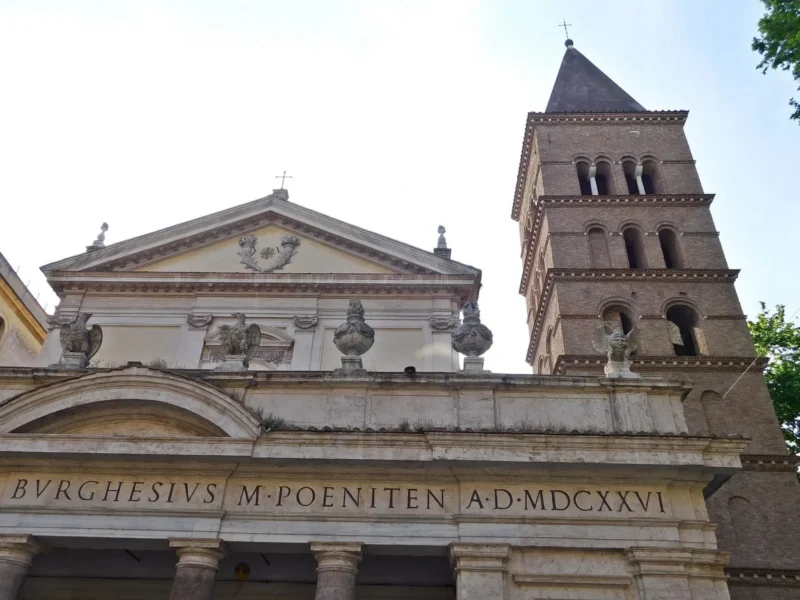
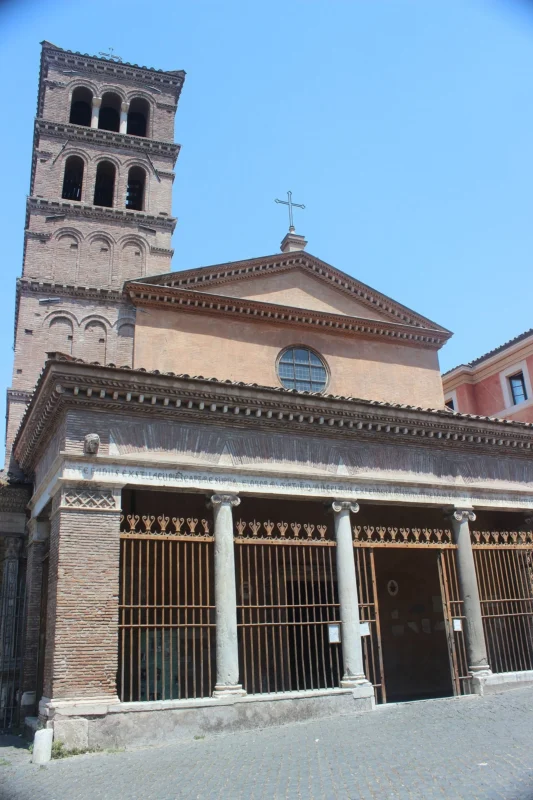
The Basilica of San Saba presents a facade of exposed brick preceded by a portico, topped by an arcaded loggia that Cardinal Francesco Todeschini Piccolomini had built in 1463. It is an unusual sequence for Rome: first the courtyard, then the portico, then the loggia, then the basilica interior. Each layer belongs to a different century, and the church makes no attempt to hide it.
The courtyard and the portico
The courtyard in front of the church serves the function that the atrium had in early Christian basilicas, and today it still keeps a conventual character, with trees and a silence you don't find with the same intensity in the rest of the neighborhood. The portico that opens at the back is now marked by pillars, the result of an 18th-century rebuilding. The sources agree in saying that the original ancient columns, among them two of imperial porphyry and others of colored marbles, were removed and replaced by the pillars you see now. On how and when, the versions differ in the details, and the exact number of original columns varies slightly from one description to another. Whoever tells the story with a precise number does so by choosing among different reconstructions, not by reporting an indisputable fact.
The signed and dated portal
Under the portico opens the marble portal of the church, framed by a band of mosaic decoration of the Cosmatesque school that bears an inscribed signature and a date. The signature is that of Jacopo di Lorenzo, a member of the family of Roman marble workers from which all Cosmatesque art takes its name, and the year is 1205. It is a precious piece of data because it anchors to a certain date work that would otherwise only be attributable by stylistic comparison. In 1205 the basilica received a coherent package of marble work, which includes the portal and, in all likelihood, the floor of the nave.
The sarcophagus and the relief of the horseman
In the portico, a few finds recovered during excavations and restorations are walled in or set against the walls. They include a small early Christian sarcophagus, described as strigilated, that is, decorated with the characteristic S-shaped grooves of late antique production, and a relief of a horseman carrying a falcon, dated to the eighth century. The sarcophagus is described by some sources as bearing a scene linked to the wedding rite, while others stress above all its strigilated decoration. The two readings don't exclude each other, because strigilated sarcophagi often keep figured scenes at the center or at the ends, but it is worth knowing that the available descriptions do not fully overlap.
The loggia of 1463
Above the portico runs the loggia built by Cardinal Francesco Todeschini Piccolomini in 1463, with small columns topped by smooth-leaf capitals holding up a series of round arches. The cardinal, a nephew of Pius II, would later become pope himself under the name Pius III, for a very brief pontificate in 1503. The loggia has an important effect on how the building is perceived: it hides the original medieval facade, and whoever arrives for the first time sees first a Renaissance element and only afterward, on entering, the Romanesque church that this element covers.
The three-aisle interior
The interior of the Basilica of San Saba is divided into three aisles by 14 ancient reused columns, coming from older Roman buildings and different from one another in material and capital, and it ends in three apses. It is the typical layout of medieval Roman basilicas, the same one found in Santa Maria in Cosmedin and, with very different proportions, in Santa Sabina: a taller central nave, lit by a row of windows on each side, and a roof of exposed wooden trusses.
The Cosmatesque floor
The Cosmatesque floor of the Basilica of San Saba is dated to the early 13th century, and the date usually given is 1205, the same as the portal signed by Jacopo di Lorenzo. The design is built around five large discs of different marbles aligned along the axis of the central nave, connected to each other by interlaced ribbons and surrounded by geometric fields of polychrome tesserae. It is the classic scheme of medieval Roman opus sectile, the one seen in its most famous version in the floor of Santa Maria in Cosmedin and in many other churches of the city.
An important clarification, in the interest of honesty: the floor you walk on today is not exactly the one the marble workers left in the 1200s. During work carried out in the early 1900s the floor was taken apart and laid again, and on that occasion the tomb slabs that had been inserted into the medieval fabric over time were removed. The result is a coherent and readable floor, but partly recomposed. Whoever looks at it is looking at a 13th-century original that has been through a restoration of reordering, not a marble carpet left intact for eight centuries.
The paintings of the apse
The apse basin and the back wall of the Basilica of San Saba are decorated with a cycle of frescoes arranged in stacked registers, dated to the second half of the 1500s and linked to the Jubilee of 1575. The scenes include Christ between Saints Andrew and Saba, the Lamb with the apostles, the Madonna enthroned with the 12 apostles and a scene with Pope Gregory XIII among saints. It is a decoration that belongs to the Jesuit phase of the church and that tells, much more than the guidebooks do, how the Counter-Reformation reinterpreted the spaces of medieval basilicas without demolishing them: not a total Baroque rebuilding, as happened to dozens of Roman churches, but a layer of painting laid over a structure left intact.
The origins: the Eastern monks who fled Palestine
The Basilica of San Saba began as a settlement of Eastern monks who came to Rome from Palestine around the middle of the seventh century, and the date most often given by historical reconstructions is about 645. They came from the monastery of Mar Saba, the great laura founded in the Judean desert by Sabas of Cappadocia, and they left their land following the invasions that in those decades overwhelmed the Byzantine Near East. On which invasion drove them to flee, modern sources do not agree perfectly. Some reconstructions speak of the Persian invasion of the early decades of the century, others of the Islamic expansion of the 630s and 640s. Both readings circulate in popular accounts and in studies, and whoever picks only one is simplifying a picture that in reality was made of successive waves.
Who Sabas of Cappadocia was
Sabas, born in Cappadocia in the fifth century, was one of the great organizers of Palestinian monasticism. The monastery he founded in the Kidron valley, south of Jerusalem, is still today one of the oldest monastic settlements in the world in continuous operation, and in the Eastern tradition the name of Sabas is tied to the codification of a liturgical rule that has influenced the prayer of the Churches of the Byzantine rite for centuries. People who visit the Roman basilica rarely know that the patron saint is not a martyr of ancient Rome but an abbot of the Judean desert. It is perhaps the most disorienting fact in the whole story of this church.
The Cella Nova
Medieval sources call the Roman settlement of the Sabaite monks cella nova, or cellae novae, that is, new cells, a name that says well what kind of operation it was: not the founding of a great abbey, but the re-creation in exile of a community that had lost its home. The monks settled on the ruins of a pre-existing Roman building and made an oratory there, which is the nucleus around which the present basilica would grow, century after century.
A monastery with a diplomatic role
Between the eighth and ninth centuries San Saba was considered one of the most important monasteries in Rome, and its abbots had a role we would call diplomatic today in relations between the Church of Rome and Constantinople, appearing among the representatives of the Roman Church at Eastern council assemblies starting from the last decades of the seventh century. It is a detail that explains a lot. A community of Greek language and culture installed in Rome was, in an age of constant theological tension between East and West, a precious resource for the papacy, which in this way had interlocutors able to move naturally between the two worlds.
The layering: from the oratory to the present basilica
The Basilica of San Saba is the result of at least five overlapping building phases, from the Roman building it started with to the 20th-century restorations, and it is this very overlap that makes it a more interesting case study than many better-known Roman churches. The point is that none of the phases completely erased the previous one: the early medieval oratory went underground instead of vanishing, the Romanesque church absorbed what it found, and the 15th-century portico covered the facade without demolishing it.
The Roman phase under the floor
The Roman structures identified under the basilica have been interpreted in two different ways. One reading identifies them with the barracks, in Latin statio, of the fourth cohort of the vigiles, the body of firefighters and night watchmen that Augustus organized by dividing the city into sectors. Another reading, supported by observing the quality and richness of the marble remains found, judged too luxurious for a barracks, leans toward a patrician domus. The two hypotheses coexist in the literature and neither can be called conclusively proven, also because the underground area, larger than the church above it, has never been fully excavated and published.
The tradition of the house of Saint Silvia
Alongside this archaeological discussion stands a devotional tradition that links the site to the house of Saint Silvia, mother of Pope Gregory the Great. An inscription kept in the complex recalls the story that from that house the mother sent every day to her son, who lived in the monastery on the Clivus Scauri on the Caelian, a bowl of legumes. It must be said clearly that we are in the field of hagiographic tradition and not archaeological documentation. The story is old and significant for understanding how medieval Romans read their own territory, but it is not proof that Silvia's house really stood here.
From the Eastern monks to the Benedictines
Around the 10th century the Greek-speaking community was replaced by Benedictine monks from Montecassino, and from that moment the building began to take the basilica form it keeps. The transition falls within the broader framework of the progressive Latinization of Rome's Eastern foundations, a long process that sped up in the decades around the schism between Rome and Constantinople in the middle of the 11th century. The original oratory, by now insufficient and superseded by the new construction, ended up being used as a burial space for the monks and then was gradually filled in.
The Cluniacs and the building site of the 1200s
In 1144 the monastery passed to the Cluniacs, and the sources place around the middle of the 12th century, during the pontificate of Lucius II, a rebuilding in Romanesque forms that gave the church its three-aisle layout. The best-documented building campaign, though, is that of 1205, under the pontificate of Innocent III, when the Roman marble workers made the signed portal and the Cosmatesque floor. On the passage to the Cluniacs, the proposed dates vary by a year or two among the different sources, with both 1144 and 1145 cited. It is a minimal difference, but it is worth pointing out rather than passing off one of the two as certain.
Cistercians, canons and Jesuits
After the Cluniacs the complex passed to the canons regular and then, in 1503, to the Cistercians. In 1573 Pope Gregory XIII assigned the church to the Collegium Germanicum et Hungaricum, the Jesuit institution founded to train clergy for the Central European territories hit by the Protestant Reformation. From that moment the history of San Saba is tied permanently to the Society of Jesus, which still has charge of it today, and the 16th-century decoration of the apse is explained in exactly this context.
The excavations and restorations of the 1900s
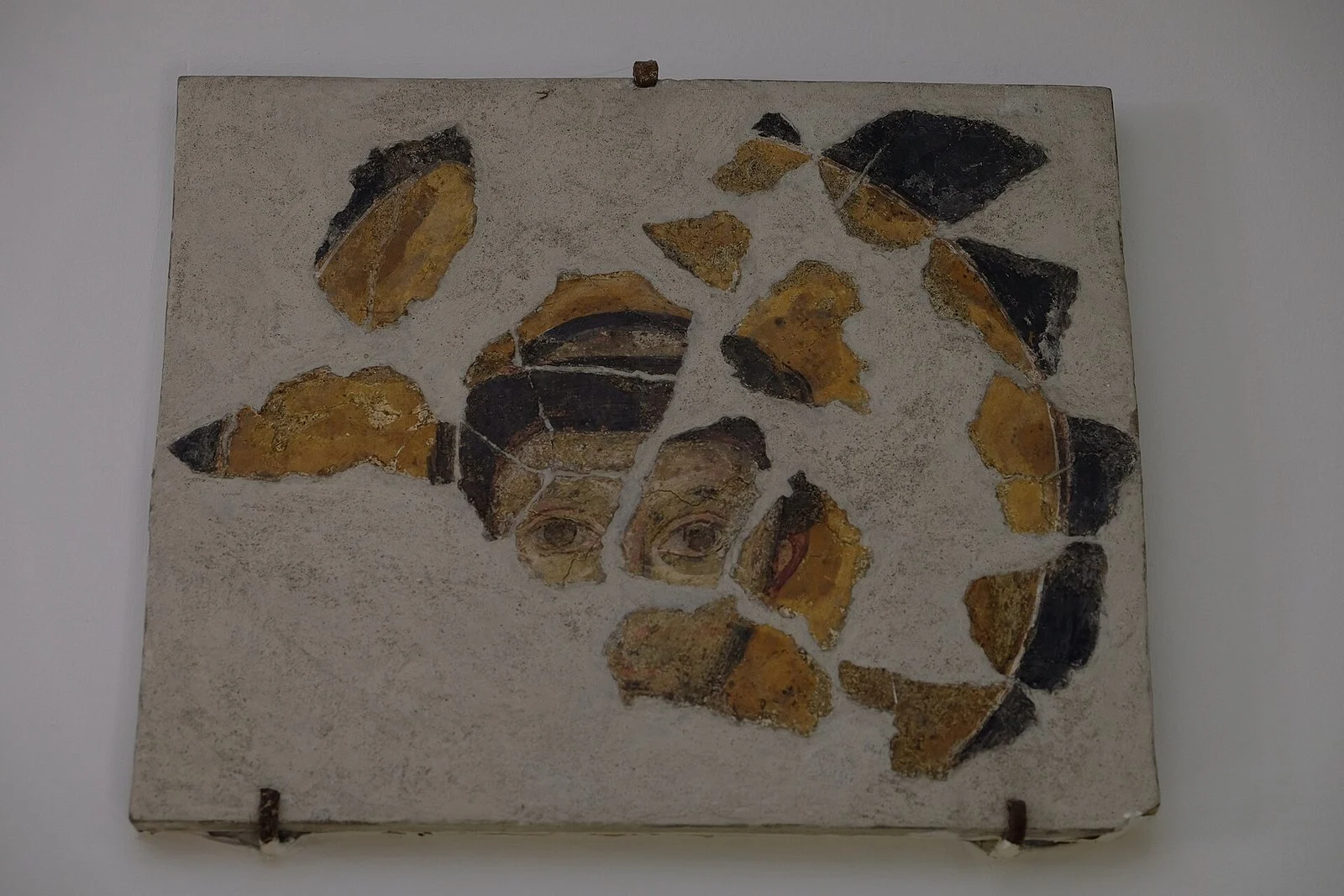
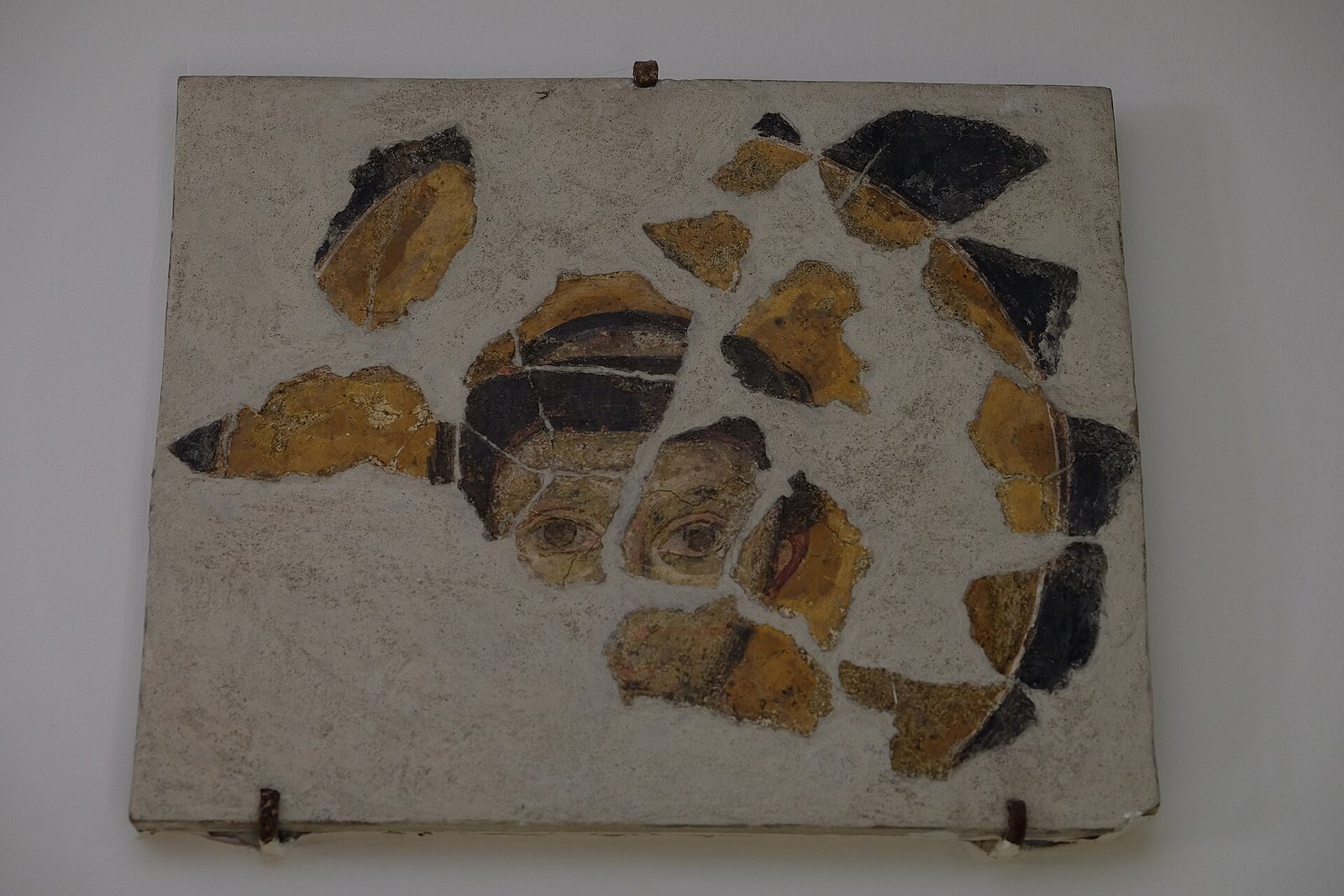
Between 1900 and 1901 restoration work was carried out that also led to the dismantling and relaying of the Cosmatesque floor, while in the first years of the century excavations began in the underground levels, which brought to light an apsed room linked to the ancient oratory, with a considerable number of early medieval frescoes. Many of these paintings were detached for conservation reasons and placed elsewhere, in particular in the sacristy. A second round of work falls in the early 1930s, with work around 1932 and 1933, and a further restoration is recorded in 1943. The church was raised to a parish on December 5, 1931.
The fact that stands out most, and that is worth knowing before you arrive, is that the underground levels are larger than the church that covers them and remain closed to the public. Anyone who arrives hoping to go down under the floor, as happens at Porta Maggiore or in some early Christian basilicas, will be disappointed: the visit takes place entirely at the level of the medieval church.
The fourth aisle and the frescoes of the Master of San Saba
On the left side of the Basilica of San Saba opens a space that shouldn't be there: a fourth aisle, added to a basilica layout that calls for three. It is the most anomalous element of the building and at the same time the one that holds the most important medieval paintings.
What the fourth aisle really is
The fourth aisle of the Basilica of San Saba was not born as an aisle but, according to the most widespread reading, as a connecting portico between the church and the monastery rooms, with walls dated to the 11th century. When at a later time the arches of the portico were walled up, that is, closed with solid walls, the space became in effect a longitudinal body alongside the left side aisle, and it was on those infills that the frescoes you see today were painted. The paintings are dated to the 13th century, and some reconstructions propose a very precise date around 1296, while other sources place the cycle between the end of the 1200s and the start of the 1300s.
The Master of San Saba
The frescoes are attributed to an anonymous painter whom art historians conventionally call the Master of San Saba, precisely from the name of this cycle. On the identification there are different positions. The most cautious reading describes him as an artist close to the circle of Jacopo Torriti, the mosaicist and painter active in Rome and Assisi at the end of the 1200s, while some reconstructions go so far as to identify the Master directly with Torriti himself. Calling the author by name, in this case, means choosing among hypotheses, not reporting an established fact.
The three main scenes
The surviving compositions of the fourth aisle are essentially three: a Madonna and Child between Saints Sabas and Andrew, a Saint Gregory the Great enthroned between two saints, and the scene in which Saint Nicholas of Bari provides the dowry for three poor girls. The three paintings, taken together, tell well the iconographic program of a Roman monastery of the late 1200s, where the Eastern patron saint, the great pope tied to the site by local tradition and a saint of enormous popularity throughout Europe live side by side.
Saint Nicholas and the three girls
The best-known scene is the one devoted to the charity of Saint Nicholas. The episode, handed down by the lives of the saint and then spread throughout Europe, tells of a father who had fallen into poverty and could not put together the dowry for his three daughters, destining them to a shameful future, and of Bishop Nicholas, who intervened in secret by having the necessary money delivered three times. It is the story from which, through a very long chain of transformations, the modern image of the night-time giver of gifts descends.
Here, though, an honest clarification is needed, because a lot of approximation circulates on this detail. It is true that the scene painted in the fourth aisle of San Saba is one of the oldest surviving examples in Rome of this subject, and several sources list it among the first depictions of Nicholas's charity in Western painting. It is not correct, however, to say that it is the oldest depiction in absolute terms in history. The episode was already depicted in Byzantine art and in Italy before the end of the 1200s, and international iconographic catalogs record many medieval examples of this subject without giving San Saba an absolute primacy. The correct formulation, the one that stands up to checking, is that San Saba preserves one of the oldest Roman testimonies of an image destined to become hugely popular.
From the dowry to the hanging stockings
The passage from Nicholas of Myra to Santa Claus is a documentable chain, and it is worth reconstructing it without shortcuts. Bishop Nicholas, who lived between the third and fourth century in Lycia, in what is now southern Turkey, became one of the most venerated saints of Christendom. His relics were taken to Bari in 1087, hence the Italian name San Nicola di Bari. His feast day, December 6, became tied in northern Europe to the custom of giving gifts to children, and the figure of the gift-giving saint crossed the Atlantic with the Dutch colonists, who called him Sinterklaas. From that name, adapted to English phonetics, comes the Anglo-Saxon Santa Claus, which in turn is the origin of the Babbo Natale we know. The modern visual version, with the red suit and white beard, was fixed in the 1800s and early 1900s through illustration and advertising.
A curiosity about the Basilica of San Saba
The most surprising curiosity of the Basilica of San Saba concerns its patron: the saint to whom the church is dedicated never set foot in Rome, is not a Roman martyr and does not belong to the history of the Western Church. Sabas was a Cappadocian abbot who lived in the fifth century and spent his life in the Judean desert, and he reached Rome only as a memory carried in the cultural baggage of a group of refugee monks.
This makes San Saba one of the few Roman churches whose name tells of a migration instead of a local cult. The city is full of basilicas dedicated to martyrs buried on the spot, to popes, to Roman saints, and the mechanism is almost always the same: the place generates the cult. Here the opposite happened. The cult arrived from outside, along with those who practiced it, and took possession of a piece of hill that had no relationship with Palestine. In a certain sense, the Basilica of San Saba is the oldest Roman monument to a community of refugees.
Something nobody tells you about the Basilica of San Saba
The thing almost no guide tells you is that under the floor of the Basilica of San Saba there is a second complex, larger than the visible church, excavated in stages starting from the early 1900s and never opened to the public. The excavations identified an apsed room linked to the monks' original oratory and a notable quantity of early medieval frescoes, many of which were detached for conservation reasons and moved elsewhere.
A buried level bigger than the church
The disproportion is what stands out: the underground structures exceed in extent the building that covers them, which means that the medieval basilica occupies only a portion of the area built in the Roman and early medieval periods. Whoever enters the church is walking above a buried neighborhood, of which they see only the lid. It is a frequent situation in Rome, but rarely with this scale ratio between what you visit and what stays invisible.
The early medieval frescoes and the oldest blue
Among the paintings recovered in the lower levels, cycles dated to the first half of the eighth century are noted, which some studies point to as particularly significant for two reasons. On one side is the appearance of a Marian subject not attested earlier in any church of Western Europe, on the other the use of lapis lazuli as a blue pigment, which according to the analyses carried out would be the oldest known case in Western painting. These are strong claims, which circulate in the specialist literature and in popular summaries, and which must be reported as the scholars' theses: a primacy of this kind is by definition provisional, because a new analysis on another site can reopen it.
Why the underground levels stay closed
The reason for the closure is the same one that holds for dozens of Roman archaeological sites under places of worship: the safety routes, ventilation, lighting and staff needed for regular use are missing, and the fragility of the painted surfaces makes exposure to the passage of visitors problematic. Anyone with a specific interest can look for extraordinary openings promoted by cultural associations, which from time to time organize guided visits to the complex. It is the only realistic way to see anything of the lower level, and it has to be checked case by case because there is no stable calendar.
My advice for visiting the Basilica of San Saba
According to the hours published by the parish, the Basilica of San Saba is open Monday to Saturday from 08:00 to 12:00 and from 16:00 to 19:30, and on Sundays and solemn feast days from 09:00 to 13:00 and from 16:00 to 19:30. Some tourist sources report slightly different hours, with the Sunday morning opening moved earlier to 09:30 or a slightly earlier evening closing on weekdays. The discrepancy is small but real, and the golden rule remains to check the parish website or call before setting out, especially if you arrive close to the midday break.
What to look at, in the right order
My advice is to follow a precise order instead of wandering at random. First the courtyard and the portico, stopping at the sarcophagus and at the relief of the horseman with the falcon. Then the portal, looking for the inscription with the signature and the date of 1205. Then the interior, looking at the columns one by one to recognize the different marbles. Then the floor, picking out the five large discs lined up along the nave. Then the apse with the 16th-century frescoes. And only at the end the fourth aisle on the left, which is the showpiece and should be savored once you have understood the history of the building. In all it takes 40 minutes, an hour if you really stop to look.
Pairing the visit with the neighborhood
The second piece of advice is about the outside. It would be a mistake to visit the basilica and leave: the district around it is one of the few successful experiments in garden city design in Rome, and it can be walked in 20 minutes. If you arrive in mid-morning, you can see the church, go around the neighborhood and finish with a coffee on Piazza Bernini before heading down toward Piramide or back up toward Caracalla. It is a walking itinerary that fits comfortably in half a day.
Accessibility and practical notes
Entrance to the Basilica of San Saba is free, as in almost all Roman parish churches, and no ticket is required. On accessibility for people with limited mobility it is best to be explicit: the complex is reached through a courtyard and has level changes and steps between the different spaces, and the public information available does not allow a precise description of ramps or alternative routes. Anyone with specific needs would do well to contact the parish directly to ask how access is organized.
Another well-known fact, yet rarely mentioned
The fact is this: the Basilica of San Saba is not just any church but a minor basilica and at the same time a titular church, that is, one of those Roman churches assigned as a title to cardinals, who formally become their honorary pastors. The cardinal title of San Saba was established by Pope John XXIII on December 2, 1959, and is therefore a relatively recent creation in the very long history of the building.
What it means to be a titular church
The system of cardinal titles has its roots in the organization of the Roman Church of the first centuries, when the presbyters of Rome were tied to a specific church, their titulus. Over time the link became symbolic: the cardinal receives a church of Rome as a sign of belonging to the clergy of the city, which is the formal reason why cardinals elect the bishop of Rome. He has no governing powers over the parish, which remains entrusted to the pastor, but his name appears in the official lists and his coat of arms may appear in the church.
The San Saba district: the garden city of Rome
The San Saba district is the 21st rione of Rome, established in 1921 by separation from the territory of Ripa, and it owes its present form to a public housing project designed by Quadrio Pirani for the Istituto per le Case Popolari and built in the decade following 1907. It is one of the very rare places in Rome where a European urban planning idea, that of the garden city, was applied seriously and not just cited.
Quadrio Pirani's project
Between 1907 and the years immediately after, the popularly oriented city administration of Rome promoted, through the Istituto per le Case Popolari, the construction of a series of residential lots on the land between the church and the Aurelian Walls. The sources point to about 10 lots built in the first phase, between 1907 and 1914, and to the completion of the layout in the following decade. The specialist literature fixes the overall span of the project between 1906 and 1923. Quadrio Pirani, an engineer and architect tied to the Istituto, was its main designer and gave the district a unified character that is still recognizable.
Villini, courtyards, streets that lead nowhere
The result is an urban fabric of low houses, rarely above three or four floors, arranged around tree-lined inner courts, with small private gardens, low walls, pitched roofs and a use of exposed brick that deliberately talks to the medieval facade of the basilica. The streets are narrow and largely free of through traffic, because the neighborhood is an urban island closed on three sides and nobody passes through unless they have to go there. It is the exact opposite of the public housing districts built in Rome in the following decades, and whoever arrives for the first time almost always has the same reaction: the feeling of no longer being in Rome.
The streets named after architects
A detail that reveals the designer's hand is the street naming. The streets of the district carry the names of the great Italian architects, from Gian Lorenzo Bernini, after whom the piazza in front of the basilica is named, to Borromini, Palladio, Bramante and Pirro Ligorio. It is not a neutral choice. It is the programmatic statement of a neighborhood designed by architects who meant to claim cultural dignity for public housing, at a time when homes for workers were generally built with no formal ambition at all.
What to see while strolling
The tour of the neighborhood takes 20 or 30 minutes and doesn't need a map. You just leave the basilica, walk along Via di San Saba in both directions and slip into the side streets. It is worth looking into the inner courtyards, where the greenery is thicker and the noise of the city disappears completely, and going all the way to the edge of the district toward the Aurelian Walls, where the residential fabric stops abruptly against the ancient wall. On the opposite side, toward Viale Aventino, the neighborhood looks out over the valley that separates it from the greater Aventine and from the Roseto di Roma.
The right photo to take at the Basilica of San Saba
The photograph that tells the story of the Basilica of San Saba best is not the frontal one of the facade, but the one taken from the courtyard at a slight diagonal, so as to keep in the frame the portico, the 15th-century loggia above it and at least one branch of the courtyard trees. It is the image that conveys the secluded character of the building, which no close-up shot manages to render.
The portal and the signature of 1205
The second shot not to miss is the detail of the mosaic frame of the portal, where the inscription with Jacopo di Lorenzo's signature and the date runs. You need a lens that can zoom in and side light, because under the portico the half-light is almost constant. Late afternoon, when the sun comes in low from the west, is the best time. A readable photograph of the inscription is worth more than 10 overall shots, because it documents the only dated and signed piece of data in the whole complex.
The fresco of Saint Nicholas
In the fourth aisle, the subject is obviously the scene of Saint Nicholas with the three girls. The difficulty is the light: the space is narrow, the wall is close and the surfaces are matte. It is best to give up the flash, which flattens the painted material and which is forbidden in many churches, and to work by resting the camera or phone on a stable surface. The photograph will be technically imperfect, but it will render the real texture of the fresco better than a shot lit artificially.
Rules to follow
In the Basilica of San Saba, as in all Roman parish churches, amateur photography without flash and without a tripod is normally tolerated, but it must be suspended during services and avoided if a sign or an attendant says otherwise. Among the public information available there are no specific photography bans for this church. When in doubt, ask in the sacristy, which remains the quickest and politest method.
Some important events that happened here in history
The chronology of the Basilica of San Saba is marked by a series of handovers between different religious communities, each of which left a physical mark on the building: the arrival of the Sabaite monks around 645, the replacement by the Benedictines in the 10th century, the entry of the Cluniacs in 1144, the Cosmatesque building site of 1205, the passage to the Cistercians in 1503 and the assignment to the Collegium Germanicum et Hungaricum in 1573.
The seventh century: the flight and the founding
The founding event is the arrival in Rome of the monks from the laura of Mar Saba, placed by the reconstructions around the middle of the seventh century. It was not an isolated episode. In those decades the pressure of the conquests on the Byzantine Near East pushed a considerable number of Eastern clergy westward, and Rome became one of the main points of landing. The presence of these groups is also reflected in the makeup of the Roman clergy of the following decades, which includes popes of Greek and Syrian origin.
1205: the marble workers' building site
The date of 1205, carved on the portal together with the signature of Jacopo di Lorenzo, is the only certain chronological anchor of the whole building. It falls under the pontificate of Innocent III, at a moment of great building activity for Roman churches, and it is to this season that the Cosmatesque floor with the five discs belongs.
1463: Cardinal Piccolomini's loggia
In 1463 Cardinal Francesco Todeschini Piccolomini promoted the rebuilding of the front of the church, with the portico and the upper loggia that still hide the medieval facade today. The Annunciation of the triumphal arch is dated to the same season. 40 years later, in 1503, the same cardinal would be elected pope under the name Pius III, for a pontificate of a few weeks.
The 1900s: excavations, restorations, parish
The last century is the one in which the basilica is rediscovered as a monument. The restorations of 1900 and 1901 reorder the floor, the excavations of the early years of the century bring to light the buried oratory and its frescoes, a new work site intervenes in 1932 and 1933 under the direction of Andrea Busiri Vici and a further restoration is recorded in 1943. In the meantime, on December 5, 1931, the church becomes a parish seat, and in 1959 John XXIII establishes the cardinal title.
Who passed through the Basilica of San Saba
Those who passed through the Basilica of San Saba, before anyone else, are the Sabaite monks of the seventh century, men who had crossed the Mediterranean leaving the Judean desert behind them and who rebuilt here, on a half-abandoned Roman hill, a reduced version of their community of origin. Their individual biographies are lost, but their collective imprint is the only reason this church exists.
Abbots, popes and cardinals
After them came the abbots who represented the Roman Church at Eastern council assemblies, the Benedictines of Montecassino, the Cluniacs, the canons regular and the Cistercians. Among the documented names that cross the history of the building are popes who marked its building phases: Lucius II, associated with the Romanesque rebuilding of the mid-12th century, Innocent III, under whose pontificate the building site of 1205 falls, Gregory XIII, who in 1573 entrusted the church to the Jesuits and who appears portrayed in the apse frescoes, and John XXIII, who in 1959 raised it to a cardinal title.
The cardinal who became pope for 26 days
Among them all, the most singular figure is Francesco Todeschini Piccolomini, the cardinal who had the loggia built in 1463. A nephew of Pius II, whose surname he had taken, he was elected pope in September 1503 under the name Pius III and died a few weeks later, leaving one of the shortest pontificates in the history of the Church. The loggia of San Saba is, in a certain sense, the most lasting monument he left.
Saint Silvia and the Gregorian tradition
On the level of tradition, the most recurrent name is that of Saint Silvia, mother of Gregory the Great, who according to the story handed down by the inscription kept in the complex would have lived in this place and from here would have sent her son a bowl of legumes every day. It is a tradition, not a documented fact, but it has had concrete consequences: the presence of Saint Gregory the Great among the frescoes of the fourth aisle is explained precisely by this devotional link between the site and the pope's family.
What to see nearby
The Basilica of San Saba sits at the center of one of the areas of Rome with the highest concentration of sites that can be visited on foot, between the Aventine, the Caelian and Via Ostiense. The Baths of Caracalla are a few minutes away, and remain the best-preserved imperial bath complex in the city. Climbing toward the greater Aventine you reach Santa Sabina, the Orange Garden and the Villa del Priorato di Malta with its famous keyhole.
Toward Piramide and Testaccio
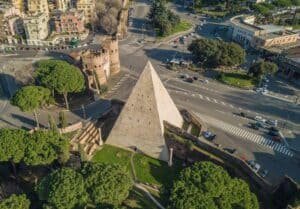
Going down toward the south you reach in a few minutes the Pyramid of Cestius and the Non-Catholic Cemetery, and from there you enter the Testaccio district, with Monte dei Cocci and the Nuovo Mercato Testaccio. It is the route that links the conventual silence of the Little Aventine to the noisiest and most working-class district of late 19th-century Rome, and the contrast between the two worlds can be felt within the space of a kilometer.
Toward the Circus Maximus and the ancient center
On the opposite side, the Circus Maximus opens the way toward the Forum Boarium, with the Mouth of Truth and Santa Maria in Cosmedin, and further on toward the Theater of Marcellus and the Colosseum. Anyone who prefers to stay on the southern side can follow the Aurelian Walls to the Museum of the Walls at Porta San Sebastiano, where the Appian Way begins, along with the system of the Catacombs of San Callisto.
Frequently asked questions about the Basilica of San Saba
Where is the Basilica of San Saba?
The Basilica of San Saba stands on the Little Aventine, in Rome, with its main entrance on Via di San Saba and a rear access at Piazza Gian Lorenzo Bernini 20, between the Baths of Caracalla and the Aurelian Walls. The most convenient metro stop is Circo Massimo, on line B, from which you reach it on foot in about 10 minutes of walking.
How much is the ticket for the Basilica of San Saba?
Entrance to the Basilica of San Saba is free, because it is an active parish church and not a paid museum site. No ticket or reservation is required, and the visit takes place freely during the church's opening hours, with the only obligation of respecting the quiet and suspending the visit during liturgical services.
What are the opening hours of the Basilica of San Saba?
According to the hours published by the parish, the Basilica of San Saba is open Monday to Saturday from 08:00 to 12:00 and from 16:00 to 19:30, while on Sundays and solemn feast days it opens from 09:00 to 13:00 and from 16:00 to 19:30. Some tourist sources report slightly different hours, so it is best to check with the parish before the visit, especially around the midday break.
How long does it take to visit the Basilica of San Saba?
To visit the Basilica of San Saba at a relaxed pace, 40 minutes is enough, which becomes a full hour if you stop to look in detail at the Cosmatesque floor, the portal of 1205 and the frescoes of the fourth aisle. Adding a walk in the garden city neighborhood around it, the overall time rises to about an hour and a half.
Can you visit the underground levels of the Basilica of San Saba?
The underground levels of the Basilica of San Saba are not open to the public, even though they are larger than the church that covers them and even though they preserve the apsed room of the ancient oratory and remains of early medieval frescoes. Some cultural associations organize extraordinary openings from time to time, but there is no stable calendar and it has to be checked case by case.
Why does the Basilica of San Saba have four aisles?
The Basilica of San Saba has three aisles plus an anomalous fourth on the left side, which according to the most widespread reading was not born as an aisle but as a connecting portico between the church and the monastery, with walls dated to the 11th century. When the arches were walled up, the space became a closed body and the 13th-century frescoes were painted on those infills.
Is it true that San Saba has one of the oldest images linked to Santa Claus?
In the fourth aisle of the Basilica of San Saba there is a late 13th-century fresco of Saint Nicholas of Bari providing the dowry for three poor girls, the episode from which the modern figure of Babbo Natale derives, through the Dutch Sinterklaas and the Anglo-Saxon Santa Claus. It is one of the oldest Roman testimonies of this subject, but not the oldest depiction in absolute terms: earlier images are known in Byzantine and Italian art.
Is the Basilica of San Saba suitable for children?
The Basilica of San Saba is suitable for children, because the visit is short, free, entirely indoors and without lines, and the tree-lined courtyard in front of the church offers a space where you can stop without disturbing anyone. The story of the fresco of Saint Nicholas and the three dowries works very well as a tale for the little ones, especially if you explain the link with Babbo Natale.
What is the San Saba district?
The San Saba district is the 21st rione of Rome, established in 1921 by separation from Ripa and built around the basilica as a garden city of public housing designed by Quadrio Pirani for the Istituto per le Case Popolari, with the first lots built between 1907 and 1914. It is made up of low brick houses, tree-lined courts and streets named after the great Italian architects.
One last tip for anyone planning the itinerary
The Basilica of San Saba works better as a stop on a route than as an isolated destination. If you have only a few days in Rome, you'll do well to fit it into a morning that starts from the Circus Maximus, touches the Baths of Caracalla, climbs to the Little Aventine for the church and the neighborhood, and goes down toward Piramide and Testaccio for lunch. It is an itinerary that makes sense geographically and above all historically, because in a few hours it crosses imperial Rome, early medieval monastic Rome, the medieval Rome of the marble workers and the working-class Rome of the early 1900s.
Anyone planning a broader itinerary between the Aventine, Caracalla and Via Ostiense, combining this stop with other stops in the southern quadrant of the city, can find useful planning tools on Tour Leader Pro, while Italy Planner is a good resource for a broader picture of transportation and destinations in Lazio.
Contact Information
Nearby
 Via Ostiense Museum400 m
- Porta San Paolo400 m
- Pyramid of Cestius400 m
- Basilica of Santa Prisca and Mithraeum500 m
- Non-Catholic Cemetery in Rome600 m
- Baths of Caracalla700 m

Upcoming events nearby
- Special opening of the Presidential Room at Roma Ostiense station, November 14 and 15, 2026600 m
- Frank Horvat at the Baths of Caracalla, until January 10, 2027600 m
- We Run Rome 2026 at the Baths of Caracalla, December 31, 2026600 m
- A Night for Horace Silver, Blue Monday Trio600 m