Aventine: Things to See, from the Orange Garden to the Keyhole
In short. The Aventine is the hill of Rome where the noise stops. You climb about 100 meters from the Circus Maximus or from the lungotevere, and within five minutes the traffic of the lower city is behind you.
The Aventine is the hill of Rome where the noise stops. You climb about 100 meters from the Circus Maximus or from the lungotevere, and within five minutes the traffic of the lower city is behind you. Above, there are garden walls, early Christian basilicas and streets with no shops. The hill can be visited entirely on foot, it costs nothing at its main stops, and it takes half a day. It has one drawback you should know about: almost everything has a tight schedule, a specific season or a required reservation, and if you arrive without checking, you may find three of the four gates closed. The Roseto di Roma opens only when the roses are in bloom, the Giardino degli Aranci changes its hours four times a year, the Mithraeum of Santa Prisca has its visits suspended, and the garden of the Villa del Priorato di Malta can only be seen on a guided tour. What follows is the verified overview of what is on the Aventine, when it is actually open, and how to put the stops together into a route that works.
What the Aventine is and why it's different from the other hills
The Aventine is one of Rome's seven historic hills, and at its highest point, in front of the Basilica of Saints Boniface and Alexius, it reaches 46.6 meters above sea level.
Two hills, not one
When people say Aventine, they mean two distinct rises, separated by the cut of viale Aventino. The first, the Aventino maggiore, is the one with the basilicas and gardens: Santa Sabina, the Giardino degli Aranci, piazza dei Cavalieri di Malta, Sant'Anselmo. The second, the Piccolo Aventino, corresponds to the current rione San Saba, established as an independent rione in 1921, and is home to the Basilica of San Saba and Santa Balbina. The side facing the river still belongs to the historic rione of Ripa. The two hills can't be seen on the same walk without allowing for a descent and a climb back up.
A hill without mass tourism, with two exceptions
The Aventine has no paid museums, ticket offices or organized lines. It does have two places where all the tourist pressure on the hill concentrates: the viewpoint at the Giardino degli Aranci at sunset, and the gate on piazza dei Cavalieri di Malta. A few meters from both, the streets empty out almost immediately, and this coexistence is a good description of the hill: a viral attraction 20 steps away from a residential street where you won't meet anyone.
What's not on the Aventine
On the Aventine there are no bars or restaurants on the main street, except in a very few spots on the edge of the hill and in the hotels. If you climb at lunchtime without planning ahead, you'll end up heading down toward Testaccio or viale Aventino to eat. There are also no shops, newsstands or widely available public toilets: the hill is residential and monastic, and its quiet depends on this lack of commercial businesses.
Image: the central avenue of the Giardino degli Aranci leading to the viewpoint, with bitter orange trees in a double row and the dome of St. Peter's in the background.
How to get to the Aventine and where it's best to start climbing
The reference stop for the Aventine is Circo Massimo, on metro line B, from which you can reach the Giardino degli Aranci in about 10 minutes on foot, uphill. It's the simplest starting point for anyone arriving from Termini, from the Colosseum or from the EUR, because the same line connects all of these points without transfers.
The three possible climbs
The hill can be approached from three directions, and the choice changes the effort and the type of walk. The Clivo dei Publicii climbs from via del Circo Massimo along the side of the valley: it's the drivable road with a sidewalk, the most regular, and it brings you to the entrance of the Roseto and then to the Giardino degli Aranci. The Clivo di Rocca Savella is a pedestrian ramp that starts from the lungotevere Aventino: the most atmospheric and the steepest. Via di Santa Sabina from the Testaccio side is the longest climb but the most gradual.
By public transport
Besides metro B, the hill is served at the bottom by several surface lines that run along viale Aventino, via Marmorata and the lungotevere, and by the tram that links the Piramide area with Trastevere. However, no bus goes up to the top of the hill: the last stretch is always on foot, uphill. To find your way around lines, tickets and apps, our guide on how to get around Rome is useful.
By car, by bicycle, with a stroller
Driving up is possible but not very useful: streets are narrow, parking is almost all reserved for residents or paid during daytime hours, and there is no free parking near the basilicas. By bicycle the climb is demanding from every side, and the Clivo di Rocca Savella cannot be cycled up. With a stroller the route is doable if you choose the Clivo dei Publicii and stay on paved streets, while some churches have steps. Those traveling with small children will find more suggestions in the guide to Rome with Children.
How much time you really need
For the Aventine alone, meaning the Giardino, Santa Sabina, Sant'Alessio, Piazza dei Cavalieri di Malta and Sant'Anselmo, plan on two to three hours of relaxed walking, not counting lines. With the Rose Garden open, it stretches to three and a half hours. Extending the visit to the Piccolo Aventino or heading down toward the Pyramid makes it a full day. If you have only a few hours, you'll find reasoned alternatives in the itinerary Rome in a Day.
The Giardino degli Aranci, Officially the Parco Savello
The Giardino degli Aranci is officially called the Parco Savello. It covers 7,800 square meters on the edge of the Aventine overlooking the Tiber, admission is free, and its hours change four times a year: from October to February, 7:00 to 18:00. In March and September, 7:00 to 20:00. From April to August, 7:00 to 21:00. These are the hours published by the Sovrintendenza Capitolina, which manages the park, and it is worth double-checking them before going up at sunset on a day that sits on the border between two seasons.
What you see from the lookout
The central avenue, aligned with the entrance, leads to a terrace overlooking the bend of the Tiber: from there you can read the river, the rooftops of Trastevere, the Janiculum on the opposite bank and, to the right, the dome of St. Peter's. It is a lookout facing west, and that explains the evening crowds. The downside is that at midday the view is backlit and photos come out flat, while early in the morning, with the sun behind you, you get better colors and an empty park.
The park isn't ancient, but the site is
The current garden was built in 1932 to a design by Raffaele De Vico, and its strictly symmetrical layout, with a double row of bitter orange trees, is a 20th-century creation meant to become a public lookout. The area, however, has a longer history: the Savelli fortress stood here, built between 1285 and 1287, and before the park the space was cultivated as a vegetable garden by the Dominicans of Santa Sabina. The crenellated perimeter belongs to that fortified phase, not to a garden stage set.
The oranges: what they are and why you don't eat them
The park's trees are bitter oranges, not sweet table oranges. The fruit stays on the branches for much of the winter and visibly ripens between November and March, so if you want to see the garden in its most recognizable form, come in winter, not summer. The flowering, white and very fragrant, happens in spring. Picking the fruit is not allowed.
When it's crowded and when it's not
The critical window is the hour and a half before sunset, all year round, with peaks on spring weekends and summer evenings: at those moments you stand in several rows along the lookout wall. The first hour after opening, at 7:00 in the morning, is the exact opposite, even in high season. Other free viewpoints are collected in the guide to Rome for Free, while for evening hours the reference is Rome by Night. The page dedicated to the park is the one for the Orange Garden.
Santa Sabina and the 5th-Century Wooden Door
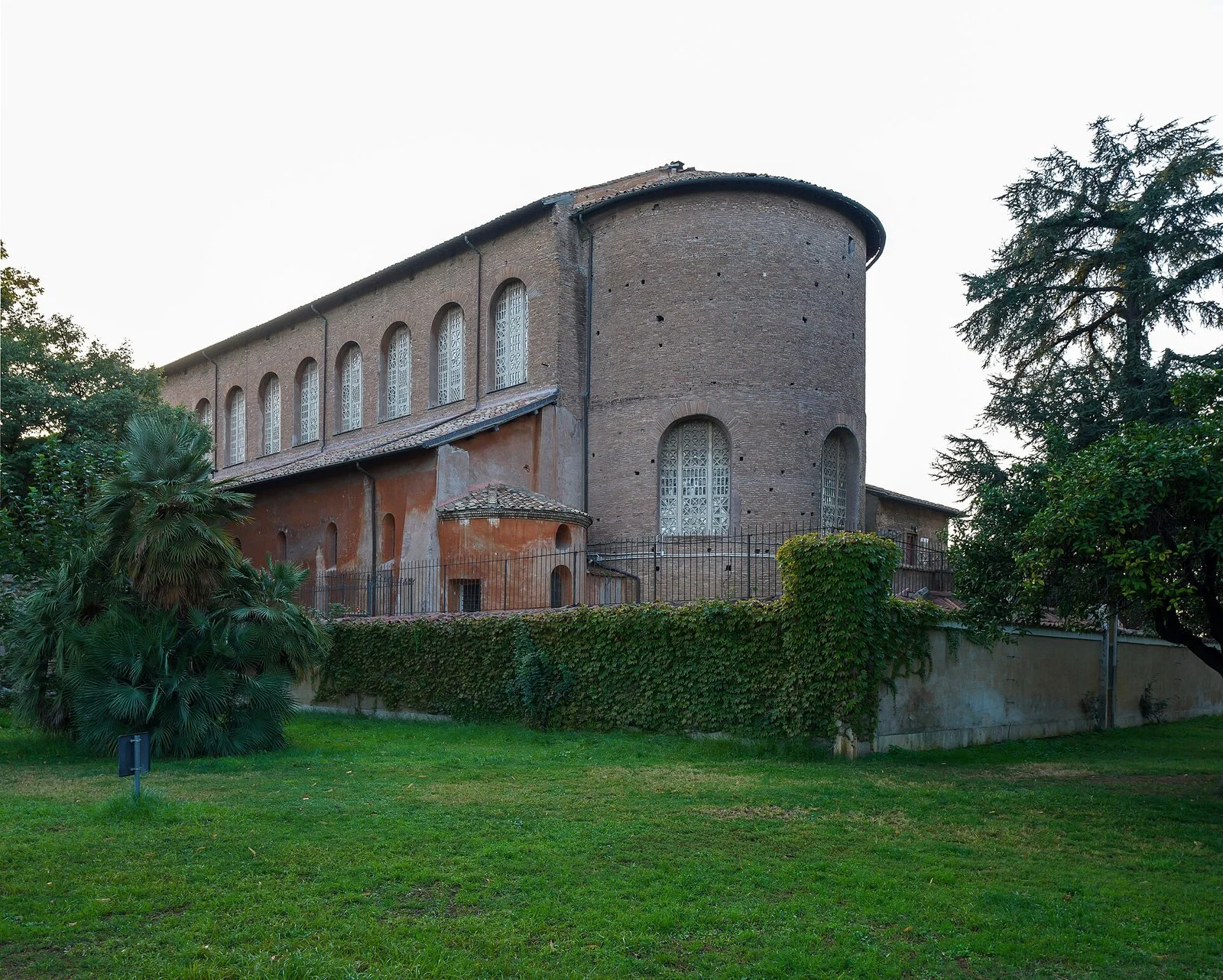
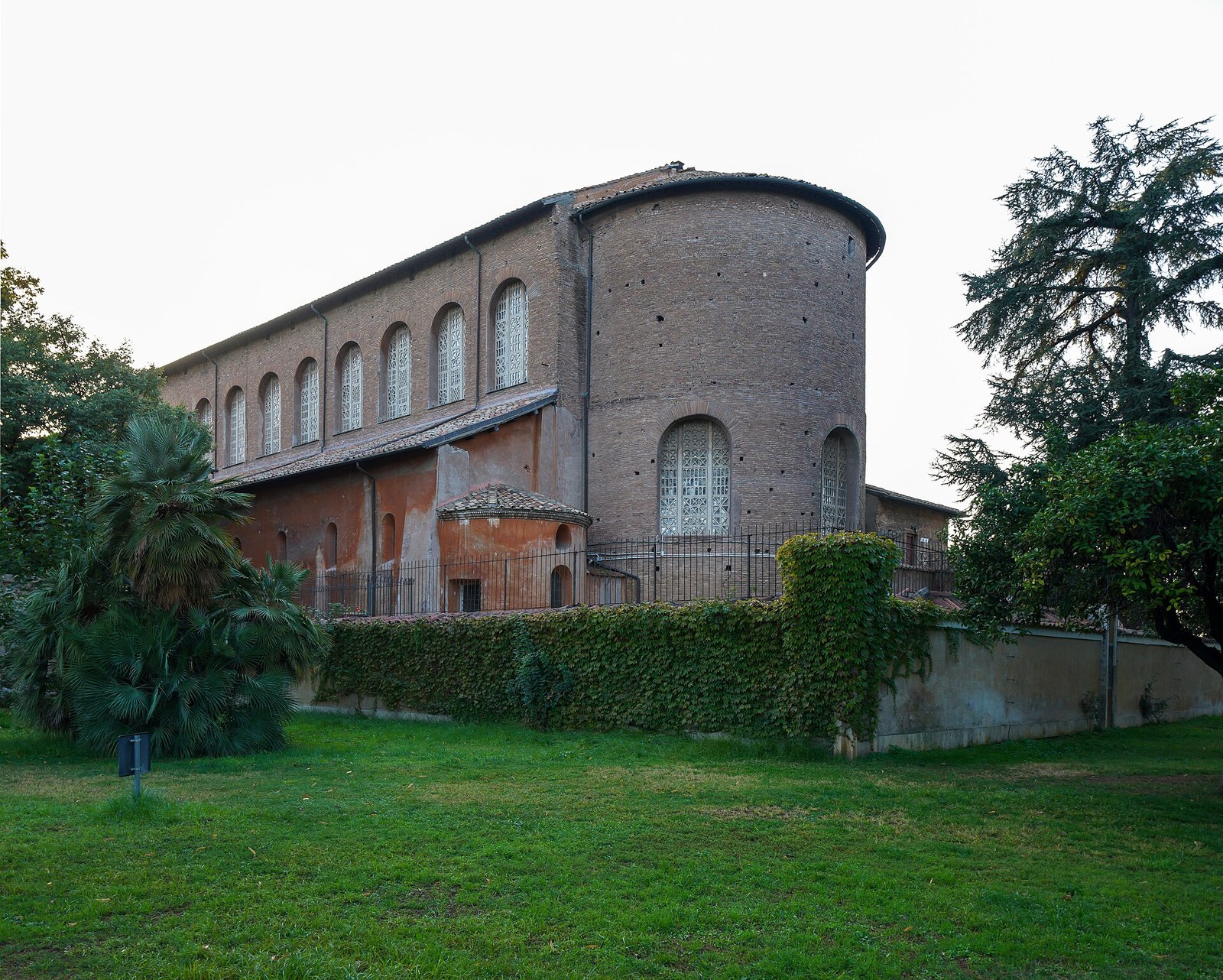
The basilica of Santa Sabina on the Aventine, at Piazza Pietro d'Illiria 1, was built between 422 and 432 under the pontificate of Celestine I at the initiative of the presbyter Peter of Illyria. Its present look, bare and luminous, with the nave of reused Corinthian columns, comes from the restorations directed by Antonio Muñoz between 1914 and 1919 and resumed in 1936, which removed the Baroque overlays. It is the building that, more than any other, explains why it is worth climbing this hill.
The cypress door: what to look at
Under the side portico, to the left of the entrance, is the 5th-century wooden door: it is the oldest surviving example of early Christian wood carving and originally had 28 panels, of which 18 remain. Among them is the oldest known depiction of the Crucifixion, at the top left, a small panel in which the three figures are carved without a visible cross. Many visitors miss it because the door is in shadow and no sign points it out: look for it starting from the upper left corner of the left leaf.
San Domenico, the orange tree and the devil's stone
In 1219 Pope Honorius III entrusted the basilica to Dominic de Guzmán and his order, and Santa Sabina is still the Dominicans' church in Rome. To tradition, and only to tradition, belong two stories that every guide repeats: that of the orange tree planted by Dominic in the cloister in 1220, indicated as the oldest tree in Rome, and that of the dark stone set on a twisted little column near the entrance, hurled according to legend by the devil at the saint in prayer. They are devotional narratives of popular tradition, not documented facts. The cloister, among other things, belongs to the convent and is not part of the free visiting route.
Hours: the Delicate Point
The hours of Santa Sabina are those of a basilica with services and vary with the liturgical calendar: the Rome Capital tourism portal reports for holidays an opening from 12 to 19, masses at 8 and 11 on Sunday and at 7.15 on weekdays, specifying that they may change and that it is best to contact the basilica. We don't publish a complete weekday schedule because the available sources don't agree: if you have only one day, call the rectory, and in any case avoid the middle of the early afternoon, when closure is most likely. The dedicated entry is the one for the Basilica of Santa Sabina on the Aventine.
Santi Bonifacio e Alessio, the Basilica Next Door
Less than 200 meters from Santa Sabina, along the same Via di Santa Sabina, opens the courtyard of the Basilica of Santi Bonifacio e Alessio, recognizable by its Romanesque bell tower and the 18th-century facade redesigned by Tommaso De Marchis. It is the highest point of the hill, 46.6 meters, and also the most neglected: almost all visitors walk past the gate on their way to Piazza dei Cavalieri di Malta without going in.
What Is Inside
The building preserves layers from very different eras under an 18th-century covering: a Romanesque crypt consecrated in 1218 with medieval frescoes, a Marian icon datable between the 12th and 13th century, the so-called Madonna of the Intercession, and in the bell tower a fresco datable around 1100 that re-emerged during works in June 2019. Under the high altar, devotion preserves what popular tradition identifies as the staircase under which the saint is said to have lived unrecognized in his father's house. It is a medieval hagiographic tale and should be read as such.
The Monastery and the Eastern History of the Hill
The complex was born as a monastery in the tenth century and for centuries housed a community that kept together monks of the Greek rite and of the Latin rite, one of the rare documented Roman cases of coexistence between the two traditions. It helps in understanding the medieval Aventine: not a residential neighborhood, but a row of fortified monasteries that shared out the hill, with the Savelli as the lay power above all. A parallel case are the Roman houses of the Caelian and the Basilica of Santi Giovanni e Paolo, on the other hill overlooking the Circus Maximus.
Hours and Access
The basilica follows the hours of a church with services, with the usual break in the middle hours of the afternoon, and we did not find an official schedule for it published in a stable and verifiable way: we don't report it so as not to give a figure that risks being wrong. The crypt is not always accessible and may require asking in the sacristy. Admission is free.
The Keyhole: What It Is, What You See, Why There's a Line
The keyhole of the Aventine is the keyhole of the monumental door of the Villa del Priorato di Malta, in Piazza dei Cavalieri di Malta: looking through it you see an avenue of hedges that frames exactly, at the end, the dome of Saint Peter's. You look from the street, free of charge, at any hour of the day and night, with no ticket and no reservation. The line, however, is by now a daily and constant presence, and there is no way to reserve it or skip it.
Why It Works
It is not a lucky accident. The square and the portal were designed by Giovanni Battista Piranesi around 1765 on commission from Cardinal Giovanni Battista Rezzonico, and it is the only square the engraver ever realized as a built work. The avenue of hedges in the garden behind is cut on axis with the keyhole and with the Vatican basilica, more than two kilometers away: the effect is a forced perspective, a vegetal telescope that compresses space.
A Recent Change in the View
Since 2025 the view through the keyhole is no longer the one handed down by photographs from 10 years ago: in the garden, in line with the lock, a bronze sculpture depicting a lion has been placed, a work by the artist Davide Rivalta, as part of an exhibition project promoted by the Grand Master Fra' John T. Dunlap with the Order's embassy to the Holy See and the National Gallery of Modern Art. Since it is an installation tied to an exhibition project, you should allow for the view to change again.
The Line: How It Really Works
The problem is structural and can't be solved with a trick. There is only one keyhole, you look into it one at a time, each person takes a few seconds to focus and then another 20 or 30 to take a photo. With 30 people in line the wait easily exceeds a quarter of an hour. On spring weekends and summer afternoons the line takes up one side of the square. The two time slots that work are the early morning hours, before 8:00, and late evening, when the dome remains visible thanks to the basilica's lighting. The square is small and surrounded by homes, so keep your voice down.
The Villa of the Priory of Malta and Santa Maria del Priorato
The garden and the church behind the portal can't be visited freely. The whole complex is property of the Sovereign Military Order of Malta, enjoys extraterritoriality and can be seen only with organized visits. The complex has a dedicated page on the site, the one for the Villa of the Priory of Malta, which also includes the church of Santa Maria del Priorato. Here we limit ourselves to framing the relationship with the rest of the hill and the access conditions.
How to Get In
Access is by reservation, through the Order of Malta's visitor center or through authorized cultural operators who organize guided visits with a permit. The sources consulted indicate a calendar of openings concentrated on some days of the week, a duration of around two hours, an entrance contribution per person and closure in the month of August. But the terms and fees change over time and we publish here neither a fixed schedule nor a price. The correct reference is the Order's visitor center, to be contacted well in advance because places are limited and the dates are not daily.
What's Inside
The core of the complex is the church of Santa Maria del Priorato, renovated by Piranesi between 1764 and 1765 over an early medieval Benedictine monastery, later passed to the Templars and finally to the Hospitaller Knights. The interior, with a single nave and barrel vault, is an exercise in stucco decoration that mixes symbols of the Order, references to the Rezzonico and archaeological repertoire. In the second niche on the right is the funerary monument of Piranesi himself, made in 1780 by the sculptor Giuseppe Angelini: the architect is buried in his only built work. The garden preserves monumental trees and the perspective avenue that points at St. Peter's.
Sant'Anselmo, the Benedictines and Gregorian Chant
Sant'Anselmo on the Aventine is a neo-Romanesque complex built between 1892 and 1900 at the will of Pope Leo XIII, who in 1887 had formally ordered the refounding of an international Benedictine college in Rome. Today it houses the Pontifical Athenaeum Sant'Anselmo, a Benedictine university with faculties of philosophy, theology and liturgy, and it is the residence of the Abbot Primate of the Benedictine Confederation.
The Sung Vespers
The reason many Romans climb up here is the Gregorian chant performed by the monks during the celebration of vespers, in particular in the Sunday liturgies: one of the very few occasions in the city to hear Gregorian chant sung by a monastic community in its liturgical function and not in concert. On the precise time the sources consulted do not agree and it changes with the liturgical calendar, so we don't report it so as not to mislead. The thing to verify, on the abbey's website or by phone, is the time of vespers on the day you choose. Entrance is free and the celebration is not a show: no applause and no photos.
The Rome Rose Garden: When It Opens, and Why It Has the Shape It Has
The Rome Rose Garden, on Via di Valle Murcia, opens to the public only during the blooming periods. For 2026 the spring opening ran from Saturday, April 11 to Sunday, June 14, every day from 8:30 to 19:30, with free admission, according to the calendar of Roma Capitale, which manages the garden. For the rest of the year the gates stay closed, with the exception of an autumn reopening of about two weeks between October and November, dedicated to the repeat-blooming varieties, whose dates are announced year by year and should be checked before heading up.
The Two Sections and the Two Opening Dates
The garden is divided into two parts facing the same valley. The collection part, the larger one, opens at the beginning of the season. The part devoted to the competition, where the new varieties entered in the Premio Roma are grown, opens later, in mid-May, because the plants in contention have to reach the right point of bloom for the jury. In 2026 this second section opened on May 18 and the public awarding of the new varieties was held on May 17. Anyone who wants to see both sections should therefore come in the second half of May, not in April.
The Premio Roma
The international competition for new rose varieties was born in May 1933 and is the second oldest in the world after the one at Bagatelle, in Paris, established in 1907. The new cultivars sent by breeders from around the world stay in cultivation at the Rose Garden for two years before being judged: the competition section is not a temporary setup but a permanent experimental nursery.
The Jewish Cemetery That Was There Before
From 1645 to 1934 the area of the rose garden housed the Jewish cemetery of Rome, later moved to the Verano. When in 1950 the rose garden, born in 1931 on the Colle Oppio and destroyed during the war, was relocated here, the choice was accompanied by an agreement with the Jewish community and by the decision to make the memory of the place legible: the paths were designed so as to compose the shape of a menorah and at the entrance stelae with the Tablets of the Law were placed, to a design by the architect Angelo Di Castro.
Numbers and View
The garden covers about 10,000 square meters and holds more than 1,000 varieties of old, botanical and modern roses, arranged so as to tell the evolution of the species. The position on the flank of the Valle Murcia means that from the flower beds you look into the Circus Maximus and toward the ruins of the Palatine Hill: it is probably the point in Rome where a botanical garden and an ancient monument can be seen in the same frame. The dedicated entry is the one for the Rose Garden of Rome.
Santa Prisca and the Mithraeum: Mind the Status of Visits
The Mithraeum of Santa Prisca, under the basilica of the same name on Via di Santa Prisca, appears with visits suspended and the site temporarily closed according to the Special Superintendency of Archaeology, Fine Arts and Landscape of Rome, which manages it. Anyone planning to visit must check the status of access with the Superintendency before organizing anything, and not take reopening for granted.
What the Mithraeum of Santa Prisca Is
The sanctuary was carved out inside a private building whose brick stamps indicate a construction around AD 95 or shortly after, and it was adapted to the cult of Mithras in the course of the second century. The main hall measured 11.25 meters by 4.20 and preserved an exceptional fresco cycle: the procession of the seven initiatory grades of Mithraism, corax, nymphus, miles, leo, perses, heliodromus and pater, each associated with a planetary deity. A graffito records the ritual rebirth of an initiate with a precise date, November 21, 202. Around 400 the building was violently destroyed, in all likelihood in connection with the construction of the Christian church above it. The Mithraeum was identified starting in 1934 and excavated by a Dutch mission.
What You Can Still See
The church of Santa Prisca remains a place of worship with services and is visited at the hours of a parish, to be checked on site. Anyone interested in Roman Mithraism who wants to see a sanctuary that is actually accessible has two alternatives in the city: the Mithraeum Barberini and the Mithraeum of the Circus Maximus, which the Capitoline Superintendency includes among the monuments open to visit with limited entries. Both must be reserved and neither is free to enter. The site entry dedicated to the basilica and its underground level is Basilica of Santa Prisca and Mithraeum: that is where we update the status of visits.
The Clivo di Rocca Savella: the Most Beautiful Climb on the Hill
The Clivo di Rocca Savella is a pedestrian ramp that connects the Lungotevere Aventino to the Parco Savello, running between two high walls where you see only the sky and, up above, the crenellation of the Savelli wall. It is the historic access route to the fortress, and remains the most evocative way to go up the Aventine, as well as the most direct for those arriving from the river or from Ponte Sublicio.
What the Route Is Like
The surface is uneven, partly cobbled and partly ramps with steps, the slope is constant and there are no benches along the way. You walk it in five or six minutes at a normal pace, fewer than 10 even going slowly, but it is not suitable for strollers, wheelchairs or wheeled suitcases, and with the wrong shoes it gets slippery after rain. On the other hand it is the only point on the hill where you walk inside a stretch of fortified medieval city without modern mediation.
What Remains of the Rocca dei Savelli
The Savelli, a family that gave the Church two popes, fortified the Aventine between 1285 and 1287, reusing an earlier fortification. Of that complex remain the crenellated perimeter that encloses Parco Savello, some stretches of wall along the clivo and the general layout of the area: there is no castle you can visit, there is an enclosure where orange trees grow today. It's the same logic that in Rome turned the Arch of Janus into a tower and the Forum Boarium into a fortified quarter.
The Servian Walls and the ancient boundary of the hill
The Servian Walls are Rome's republican circuit wall, rebuilt in the 4th century BC after the Gallic sack of 390: Livy places the start of the works in 378 BC under the censors Spurio Servilio Prisco and Quinto Clelio Siculo, and the work dragged on for over 25 years. They were about 11 kilometers long, around 10 meters high and four meters thick, built with blocks of tuff quarried from the Grotta Oscura quarries, available only after the conquest of Veii in 396 BC: it is this geological fact, more than the tradition that attributes them to King Servius Tullius, that fixes their dating.
Where to see them on the Aventine
More stretches survive here than anywhere else in the city, because the flank of the Aventine has been less reworked than the rest of the center. Remains are documented along via di Sant'Anselmo and via dei Decii, in the area of viale Aventino, in the courtyard of Santa Balbina and in the basements of the Sant'Anselmo complex. Some are incorporated into private buildings and can't be seen from the street: it's worth slowing down at the intersection of via di Sant'Anselmo and via dei Decii to recognize the large squared blocks of yellowish tuff.
Don't confuse them with the Aurelian Walls
The Servian Walls are republican, in tuff blocks, and enclosed a much smaller city, the Aurelian Walls are imperial, from the 3rd century AD, in brick, and run much further out. At the foot of the Aventine the two circuits are relatively close, which adds to the confusion: the Pyramid of Cestius, for example, is incorporated into the Aurelian Walls, not the Servian ones. Anyone who wants to understand the imperial defensive system can visit the Museum of the Walls at Porta San Sebastiano.
The Piccolo Aventino: San Saba and Santa Balbina
Beyond viale Aventino begins the Piccolo Aventino, today the San Saba neighborhood, a district built largely in the early 20th century with small villas and public housing laid out on a regular plan, which preserves two churches of great interest and no lines.
San Saba
The basilica of San Saba has a portico, a Cosmatesque pavement and a history linked to the Eastern monastic communities that settled in Rome in the early Middle Ages. It can be reached in about 10 minutes on foot from the Giardino degli Aranci, going down and back up, and it has the advantage of being inside a quiet residential neighborhood, with tree-lined little squares where you can sit.
Santa Balbina
Santa Balbina is one of the cardinal tituli of Rome's first ecclesiastical organization, documented as early as a synod of 595. The building rose inside a noble domus that the brick stamps allow to be identified with the one donated by Septimius Severus to the prefect Lucius Fabius Cilo at the start of the 3rd century: a clear case of a late antique aristocratic house turned into a church, the same process readable under Santa Prisca. The interior is a single nave without columns, with alternating rectangular and semicircular chapels, a Cosmatesque episcopal chair in the apse and a fresco by Anastasio Fontebuoni from 1600. The convent next door now houses a care facility, and the church has no continuous opening: finding it closed is the most likely outcome of a visit that was not arranged.
Why it's worth coming down here
The Piccolo Aventino restores a dimension that the larger Aventine has lost, that of an inhabited neighborhood where monuments stand inside daily life instead of being surrounded by convent walls. It is also the natural link toward the Baths of Caracalla, a quarter hour on foot away, and from there toward the Appia Antica Park.
At the foot of the hill: Pyramid, Cimitero Acattolico, Testaccio
The southern side of the Aventine descends onto one of the densest junctions in Rome: within a radius of 300 meters there are a Roman funerary pyramid, a monumental cemetery, a gate of the Aurelian Walls and the entrance to the rione Testaccio.
The Pyramid of Cestius
The Pyramid of Cestius is the tomb of Gaius Cestius, built in the Augustan age and later incorporated into the Aurelian Walls, which is why it has survived intact. The exterior can always be seen from the square, free of charge. The interior, meaning the burial chamber, is open only on scheduled occasions and with mandatory booking: in 2026 the Soprintendenza Speciale di Roma organized a series of free visits between September 4 and October 31, with guided evening sessions and self-guided afternoon sessions. These calendars are repeated by season and are not a permanent schedule.
The Non-Catholic Cemetery
The Non-Catholic Cemetery in Rome, at Via Caio Cestio 6, is open Monday to Saturday from 9 to 17, last entry at 16:30, and Sunday and holidays from 9 to 13, last entry at 12:30. It is closed on January 1 and 6, for two weeks in mid-August, and on December 8, 24, 25, 26, and 31. Hours are reduced to 13:00 at Easter, on April 25, on May 1, and on June 2 and 29. It is a cemetery still in use, so the behavior expected is that of a place of mourning, and the uneven ground makes comfortable shoes useful. John Keats and Percy Bysshe Shelley are buried here, and the connection is completed by the Keats-Shelley House.
Testaccio
On the other side of Via Marmorata begins Testaccio, which shares a border with the Aventine and very little else: the hill is quiet and monastic, while the neighborhood below is working-class and focused on food. Here you'll find the Nuovo Mercato Testaccio, the Ex Mattatoio, the Monte dei cocci made of broken amphorae, and the Museo diffuso del rione Testaccio. The combination works in one direction only: the Aventine in the morning and Testaccio from lunch onward, because at night the hill offers nothing and the neighborhood does. Along Via Ostiense you'll also find the Centrale Montemartini and the Via Ostiense Museum.
The history of the Aventine: the plebs, the warehouses, the villas
For centuries the Aventine was the excluded hill. It remained outside the pomerium, the sacred boundary of the city, until the age of Claudius, and this institutional exclusion explains almost everything that happened there: foreign cults, the plebs, and the port warehouses.
The plebeian secession: what really happened and where
Two things that are often confused need to be separated here. The first plebeian secession, the one of 494 BC, took place according to tradition on the Monte Sacro along the Aniene, not on the Aventine. The secession on the Aventine is the one of 449 BC, linked to the crisis of the decemvirate. Between the two stands a decisive measure, the lex Icilia de Aventino publicando of 456 BC, by which the hill was assigned to the plebeians so they could build their homes there. This is why the Aventine became the plebeian hill par excellence. These events are handed down by sources that are much later and heavily reworked: they should be taken as ancient historiographical tradition, not as chronicle.
The horrea and the port
In the imperial age the side facing the river became the city's logistics area. Here stood the Emporium, the great river port, and the row of warehouses that supplied Rome, the Horrea Galbana, Lolliana, Aniciana, Seiana, and Fabaria. The Monte dei cocci in Testaccio, the artificial hill made of crushed olive oil amphorae, is a by-product of this system.
The late antique domus
Between the 3rd and 4th centuries AD the Aventine became one of Rome's wealthiest residential districts. Traces of it remain under the churches: the domus under Santa Prisca, the one identified under Santa Balbina and attributed to Lucius Fabius Cilo, and the remains under Santa Sabina. The sack of Alaric in 410 hit this sector hard, and with it the aristocratic phase of the hill came to an end.
From the Middle Ages to today
In the Middle Ages the Aventine was reduced to an island of monasteries and fortifications, with the Savelli controlling it from above, and for centuries it remained almost countryside inside the walls, covered in vineyards and vegetable gardens. Urbanization came only in the late 19th and early 20th centuries, with Sant'Anselmo, the villini, and the regular streets we see now, along with the 20th-century layout of the Parco Savello. The hill's current silence is not an ancient leftover: it is the result of a recent urban planning choice.
A walking itinerary that works
The order in which you tackle the stops changes the quality of the day a great deal, because light, opening hours, and crowds are not spread out at random. This is the schedule we recommend, with the variant for those who have half a day.
In the morning, if you want the hill empty
You set off from the Circo Massimo metro stop at 8 and climb up Clivo dei Publicii. First stop is the Giardino degli Aranci, open from 7 and practically deserted at that hour, with the light from the east lighting up the view instead of controlling it. From there, 200 meters along via di Santa Sabina to the basilica, then to the Santi Bonifacio e Alessio, then to piazza dei Cavalieri di Malta, where the line at 9 is still short. Sant’Anselmo closes the loop of the greater Aventine. It takes about two and a half hours, all on foot, with modest elevation changes after the initial climb.
In the afternoon, if you're aiming for sunset
Reversing the order, you start at the Piccolo Aventino in early afternoon, San Saba and Santa Balbina, head back up toward Sant’Anselmo and the churches, and save the Giardino degli Aranci for last. It's the most photogenic version and also the most crowded: at the belvedere it's best to arrive at least 40 minutes before sunset to get a spot on the low wall. After sunset, the natural way down is toward via Marmorata and Testaccio for dinner.
In spring, with the Roseto open
Between mid-April and mid-June the itinerary changes: the Roseto fits in at the start, right after the climb up Clivo dei Publicii, because it comes before Parco Savello along the same road. It takes a full hour if you want to see both sections, and on Sundays in May turnout is high even in the morning.
Half a day, if time is short
Anyone with only two hours should do the Giardino degli Aranci, Santa Sabina and buco della serratura, in that order, and skip the rest: these are the three stops that lie within 400 meters of each other and that give you the sense of the hill. The rest takes time and, above all, requires the doors to be open. To fit the Aventine into a broader program, the itineraries for a weekend in Rome and three days in Rome are useful.
What connects well, just below
On the Circo Massimo side, the Aventine borders the Foro Boario and the piazza of the Mouth of Truth, where you find Santa Maria in Cosmedin and the Republican temples: it's 10 minutes downhill. From there you continue toward the Tiber Island and the Ghetto, or you head back up toward the Capitoline Hill and the Roman Forum.
When to go: seasons, light, crowds
The Aventine is the only hill in Rome where the season decides what you can see, because two of its main attractions, the Roseto and the orange trees, follow biological rather than commercial calendars.
Spring
From mid-April to mid-June the hill is at its best: Roseto open, garden scented with orange blossom, temperatures that make the walk up pleasant. It's also the busiest period, especially on weekends and at sunset.
Summer
July and August are demanding: the Roseto is closed, the climb is done in the heat, and the Giardino degli Aranci has little shade in the central stretch. Parco Savello, however, closes at 21, which makes a long evening walk possible. In August many religious sites reduce their activity, and the Priorato di Malta complex stays closed.
Autumn
October and November are the underrated season: a brief reopening of the Roseto for the repeat bloomers, the heat is over, the low afternoon light is the best of the year for the view, and crowds are thinner at the belvedere because sunset comes early. Be careful about the park's schedule change: from October, closing time moves to 18.
Winter
It's the season when the Giardino degli Aranci is most recognizable, with ripe fruit on the branches between November and March, and when the hill is at its emptiest. The park closes at 18, so sunset and closing time nearly coincide: it's the only period of the year when the belvedere and the opening hours work together. The churches are cold and have tighter hours.
A note on days of the week
For the churches on the hill, the worst day is Sunday morning, when services limit visits, and the best is a weekday late morning. For the belvedere and the keyhole, the exact opposite is true on weekends. None of the Aventine basilicas is included in the free-admission initiatives listed in musei gratis a Roma and in the Domenica al Museo, simply because they already have free entry all year round.
Frequently asked questions about the Aventine
How much does it cost to visit the Aventine?
Visiting the Aventine is free at all its main stops: the Giardino degli Aranci, the Roseto di Roma during its opening periods, the basilica of Santa Sabina, Santi Bonifacio e Alessio, Sant'Anselmo and the keyhole in Piazza dei Cavalieri di Malta have no entrance fee. You only pay to enter the garden and church of the Villa del Priorato di Malta, which are accessible by reservation with a guided visit, and for booked visits to the burial chamber of the Piramide Cestia when they are scheduled.
When does the Roseto Comunale di Roma open?
The Roseto di Roma opens to the public only during the blooming season. In 2026, the spring opening ran from April 11 to June 14, every day from 8:30 to 19:30, with free entry. The section dedicated to the Premio Roma competition opened later, on May 18. The rest of the year the garden stays closed, except for an autumn reopening of about two weeks between October and November for the repeat-blooming varieties, with dates announced each year by Roma Capitale.
What are the opening hours of the Giardino degli Aranci?
The Giardino degli Aranci, officially Parco Savello, has seasonal hours with free entry: from October to February, 7:00 to 18:00, in March and September, 7:00 to 20:00, from April to August, 7:00 to 21:00. These are the hours set by the Sovrintendenza Capitolina, which manages it. It's worth checking them during the transition periods between seasons, because the change doesn't always fall on the first day of the month, and the gate is locked on time.
Can you visit the Mithraeum of Santa Prisca?
The Mithraeum of Santa Prisca currently has visits suspended, and the site is temporarily closed according to the Soprintendenza Speciale di Roma, which manages it. Many pages online still list the hours and fees from the period when it could be visited by reservation two Sundays a month. That information is not up to date. Before planning a visit, you need to check the status of access with the Soprintendenza, and don't take a reopening for granted.
How do you visit the garden behind the keyhole?
The garden of the Villa del Priorato di Malta, behind the keyhole door, can only be visited by reservation, through the visitor center of the Sovereign Military Order of Malta or authorized cultural operators. The area enjoys extraterritoriality and is not part of the Italian museum circuits. Openings are concentrated over a few days, spaces are limited, and the complex stays closed in August. Anyone who shows up at the door without a reservation can only look through the keyhole, which remains free and open to everyone.
What time is there less of a line at the Aventine keyhole?
The line at the Aventine keyhole gets shorter in the early morning, roughly before 8:00, and late in the evening after sunset, when the dome of Saint Peter's stays visible thanks to the basilica's lighting. The worst times are weekend afternoons and late summer afternoons. There are no reservations, priority tickets or reserved entries: there is only one keyhole, and you look through it one at a time.
How much time do you need to visit the Aventine?
To visit the main Aventine, that is, the Giardino degli Aranci, Santa Sabina, Santi Bonifacio e Alessio, Piazza dei Cavalieri di Malta and Sant'Anselmo, you need two to three hours walking at a relaxed pace, not counting queues. With the Roseto open, it comes to three and a half hours. If you extend the visit to the Piccolo Aventino with San Saba and Santa Balbina, or head down toward the Piramide Cestia and the Cimitero acattolico, you can comfortably fill a full day.
Is the Aventine accessible with strollers or wheelchairs?
The Aventine is partly accessible. The Clivo dei Publicii is a paved road with a sidewalk, and the Giardino degli Aranci has wide paths that are largely flat, so the main route is manageable with a stroller. The Clivo di Rocca Savella, on the other hand, is a ramp with an uneven surface and steps, and it is not passable with wheels. Some churches have steps at the entrance, and crypts that can only be reached by stairs.
Can you take photos in the churches of the Aventine?
In the churches of the Aventine, photography without flash and without a tripod is generally tolerated outside of services, but each rectory sets the rule, and it can change without notice. No photos are taken during Masses and vespers. At the keyhole, taking photos is allowed, but the very strong contrast between the door in shadow and the illuminated dome almost always makes it necessary to manually lock the focus and the exposure on the background.
Who wrote this page
This page is curated by the editorial team of Tour Leader Pro, the Roman project office that designs and coordinates tours, itineraries and cultural events in Rome and Lazio. The hours, fees and access conditions reported here were verified on the publication date against the official sources cited in the text. Before you go, it's worth rechecking them, because they change often. If you find information that isn't up to date, let us know.
Anyone building a Roman itinerary that ties the Aventine to the other stops of the Historic Center, crossing church hours, seasonal garden openings and walking times, can find planning tools and operational support at Tour Leader Pro, which handles the organizational side of visits and groups in Rome and Lazio.
For a broader picture of transport, connections and destinations in Lazio beyond the center of Rome, from archaeological areas to villages reachable in a day, Italy Planner is a good resource, especially useful for those organizing a multi-day trip who need to fit the city together with out-of-town excursions.