Keats-Shelley House
In short. The Keats-Shelley House occupies the second floor of the building at number 26 Piazza di Spagna, the building set against the right side of the staircase that climbs toward Trinità dei Monti, as you look at the church from below.
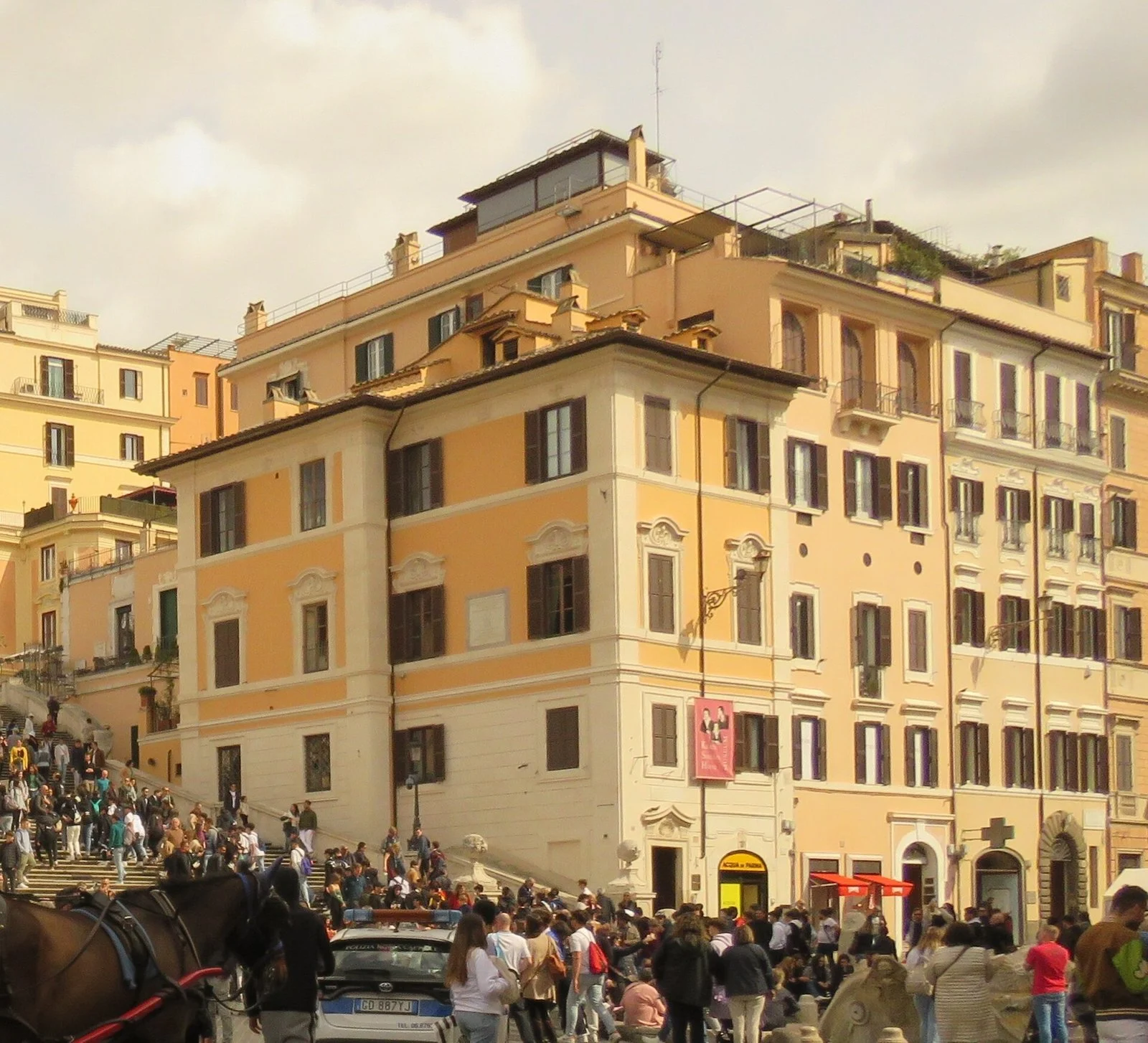
The Keats-Shelley House occupies the second floor of the building at number 26 Piazza di Spagna, the building set against the right side of the staircase that climbs toward Trinità dei Monti, as you look at the church from below. It is a small house museum, five rooms in all, dedicated to the English Romantic poets who had something to do with Rome, and in particular to John Keats, who died of tuberculosis in one of those rooms on the evening of February 23, 1821, at the age of 25, attended by the painter Joseph Severn. The museum has existed since 1909 and came out of an Anglo-American initiative, not an Italian one: a group of writers and diplomats who in the early 1900s found the apartment reduced to rented rooms and decided to buy it to save it. Today it holds one of the richest libraries of Romantic literature in Europe, hundreds of autograph manuscripts, portraits, masks and personal objects, and the strongest link with the rest of the city runs through the Non-Catholic Cemetery in Testaccio, where Keats is buried and where the ashes of Percy Bysshe Shelley were also brought. The lines that follow tell what you really see inside the house, how to get there, how much it costs, what happened in those rooms in the winter between 1820 and 1821 and why that story has left such a lasting mark on European literary memory.
Where the Keats-Shelley House is and how to get there
The Keats-Shelley House is at Piazza di Spagna 26, immediately to the right of the Trinità dei Monti staircase as you look at it from the square, and the entrance is a narrow door that almost everyone walks past without noticing as they climb the steps. It is one of the most photographed addresses in Rome and at the same time one of the least visited museums in the historic center: the disproportion between the number of people who sit on the steps a few meters from the door every day and the number who go in is one of the most obvious oddities of the area.
The visual landmark so you don't get the wrong door
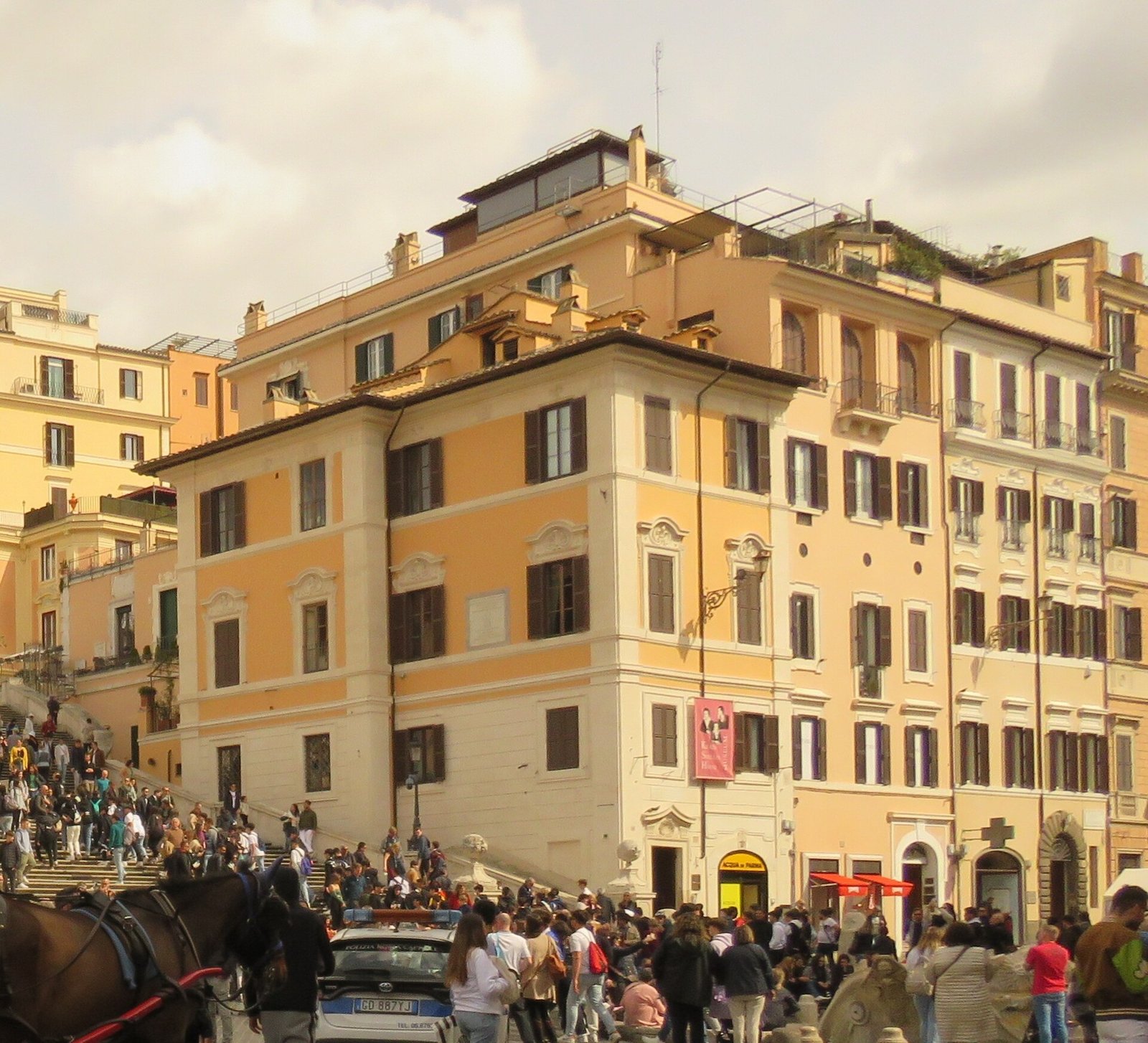
If you arrive from the square, look at the reddish building that closes the right side of the staircase, the one with windows that face directly onto the first steps and the fountain. On the facade there are commemorative plaques recalling the poet's death, and this is the most reliable sign: the museum's door is on the ground floor of that building, while the exhibition rooms are on the upper floor, reachable only by stairs. In the city the building is also known as the Casina Rossa, for the color of the plaster that sets it apart from the neighboring buildings.
By metro and bus
The most convenient stop is Spagna, on metro Line A, two minutes' walk from the entrance: the station exit comes out in the square itself, so there is practically nothing to walk. If you arrive from Termini, take Line A in the direction of Battistini and get off at the second stop after Repubblica. Alternatively, the Flaminio stop, also on Line A, lets you get off on the side of Piazza del Popolo and reach Piazza di Spagna with a 10-minute walk along Via del Babuino, which is also the most beautiful way to approach the museum, because it crosses the heart of the neighborhood where English-speaking foreigners lived in the 19th century.
The surface buses that serve the area generally stop along Via del Tritone, in Largo Chigi or on the Lungotevere, because Piazza di Spagna and the surrounding streets are pedestrian or heavily restricted to traffic. If you arrive by car, keep in mind that there is no free parking in the area and that the nearest garages, in the Villa Borghese area and Via Ludovisi, still require a walk: the simplest solution remains the metro, especially in high season, when traffic around the Tridente is slow at any hour.
On foot from other points in the center
From the Trevi Fountain you get there in about 10 minutes going up Via del Lavatore and Via di Propaganda. From the Pincio and from Villa Borghese you come down directly by the staircase, and in this case you meet the museum at the end of the descent, on the left. From Piazza del Popolo the distance is about a kilometer along Via del Babuino. If you also plan to see Villa Medici, you'll find the house museum exactly at the foot of the climb that leads to the French Academy, which makes it natural to combine the two visits in the same morning.
The stairs and accessibility
The museum is on the second floor and to reach it you have to climb a flight of stairs: the practical information published by the museum and repeated by guidebooks speaks of 39 steps, with no elevator. The staff are available to assist those with mobility difficulties with the flight, and once on the floor the rooms can also be navigated in a wheelchair, but this is a solution that has to be arranged in advance by contacting the museum, not automatic accessibility. It is the most important thing to check before leaving for anyone traveling with elderly people or people with walking problems, because the internal staircase is steep and narrow as in many historic buildings in the center.
Hours, tickets and organizing the visit
According to the information published by the museum, the Keats-Shelley House is open Monday to Saturday from 10:00 to 13:00 and from 14:00 to 18:00, with last entry at 17:45 and closed on Sundays. It is a schedule split by the lunch break, a detail that catches off guard many visitors used to the continuous hours of the big state museums and that has to be kept in mind when building the day's program: showing up at 13:15 means finding the door closed for almost an hour.
How much the ticket costs
On the ticket price the sources don't agree perfectly, and it's best to say so clearly. The information published by the museum indicates a full ticket of around €6 and a reduced ticket of €5 for under 18s, over 65s, students with ID and members of some cultural associations such as Touring Club, FAI and ICOM. Admission is listed as free for children under 6 and for visitors with disabilities. Some third-party sources instead report a full price of €7, probably because of a later adjustment of the fare. Since it is a private museum run by an association, the fare can be updated without much publicity: it's best to check the current price on the official website before going, and to allow for a difference of €1 from what you read around.
Booking, duration and practical rules
Booking is possible but not required: the small size of the rooms means that at peak hours the visit is more pleasant if you arrive just after opening or in the early afternoon, when school groups are rarer. The average duration of an attentive visit is about an hour, which can stretch toward two hours for those who stop to read the captions, watch the introductory film and go through the letters on display. Photographs are allowed without flash, while bulky bags have to be left at the entrance: the museum has tight spaces and the staff are strict on this point, for conservation reasons as well as safety.
The cross discount with the Casa di Goethe
A little-known detail that is worth a few euros: between the Keats-Shelley House and the Casa di Goethe on Via del Corso there is an agreement that lets you get a reduction on the second museum's ticket by keeping the receipt from the first, within a limited number of days. The two house museums tell the same phenomenon from two different sides, the German one of the Grand Tour of the late 18th century and the English one of early 19th-century Romanticism, and visiting them on the same trip gives a depth that neither of the two, on its own, manages to deliver. Here too the general rule applies: the agreement and its conditions can change, and it's best to ask the ticket office for confirmation.
The Casina Rossa: the building before the museum
The building that houses the Keats-Shelley House is a palace of 17th-century origin, with its facade reworked in the 1720s, when the construction of the Trinità dei Monti staircase designed by Francesco De Sanctis, built between 1723 and 1726, completely redrew the layout of this corner of the square. The house thus found itself wedged against the right flank of the new monumental staircase, in a position that made it one of the most sought-after addresses in the area.
From religious property to rentals for foreigners
Before the suppressions of the late 18th century the property was tied to a religious order's holdings, and then passed into private hands in the context of the changes in property ownership of those years. At the beginning of the 19th century the building was already what today we would call a short-term rental building: apartments and rooms that a landlady rented to foreigners passing through, in a square that had meanwhile become the absolute center of Rome's English and northern European colony. In 1820 the landlady was a widow named Anna Angeletti, who rented rooms to tenants among whom was also a Scottish doctor, James Clark, who lived in the same square and who would play a decisive role in the story we are telling.
Why the English were all here
The concentration of foreigners in this part of the city was no accident. Piazza di Spagna was the square of the embassies and the inns, the arrival point of the carriages coming down from the north and the neighborhood where the bankers, coachmen, money changers and the models who posed for artists were found. The whole system of services that made the Grand Tour possible revolved around the square, and the presence of a British community so large that the Romans, with some irony, called it the English ghetto, explains why a sick young poet, arrived from London in search of a milder climate, ended up taking lodging exactly here and not elsewhere.
John Keats in Rome: the journey, the illness, the end
John Keats arrived in Rome on November 15, 1820 together with the painter Joseph Severn, and took lodging on the second floor of the house at Piazza di Spagna 26, where he would die three months and eight days later. He was 24 on arrival and had turned 25 the previous October 31, during the journey: he was sick with pulmonary tuberculosis, a disease that in his family had already killed his mother and his younger brother Tom, and that he himself, having studied medicine and practiced as an apprentice surgeon, had recognized in himself with terrible lucidity when in February 1820 he had seen the color of the blood he had coughed onto the sheet.
The journey to Italy
The departure from England took place in September 1820 on a small merchant sailing ship bound for Naples. The journey was long and exhausting, with bad weather and forced stops along the English coast, and on arrival in the Gulf of Naples the passengers were held for a health quarantine on board, imposed by the Neapolitan authorities for fear of contagion from England: weeks of confinement in a cramped space that seriously worsened the sick man's condition even before he set foot in Italy. From Naples the group continued overland to Rome, a journey of several days by carriage along roads that then crossed the Pontine plain and the mountains, in the cold of late autumn.
Joseph Severn, the friend who accompanied him
Joseph Severn, born in 1793, was a young painter who had won a gold medal from the Royal Academy the year before and who knew Keats only superficially when he agreed to accompany him to Italy. He was not a longtime friend or a relative: he was simply the only one available to leave, at a time when the people closest to the poet could not or would not do so. He thus found himself, at 26, acting as a full-time nurse to a man dying slowly in a foreign city whose language he didn't speak, with limited financial resources and without any preparation. The letters he wrote in those months to friends in England are the most direct document we have on those weeks, and they are also the reason the second-floor room in Piazza di Spagna entered the history of literature instead of vanishing into the anonymity of a thousand other rented rooms.
Dr. James Clark and the wrong treatments
The doctor who treated Keats in Rome was James Clark, a Scot living in the same square, passionate about literature and sincerely fond of his patient. Clark cared for him with dedication, but his initial diagnosis was that the poet's main problem was digestive and nervous rather than pulmonary, and the treatments he prescribed were those that the medicine of the time considered appropriate: repeated bloodletting to lower blood pressure and a very harsh diet, reduced according to witnesses to little more than an anchovy and a piece of bread a day. For a patient with advanced tuberculosis, this meant further weakening a body already at the limit. In the first phase Clark also encouraged physical exercise, in contrast to the absolute rest prescribed in London, and Keats was at first able to go out of the house, walk on the Pincio and hire horses for a few rides along Via Flaminia.
There is no sense in judging Clark by the yardstick of contemporary medicine: the bacillus responsible for tuberculosis would be identified by Robert Koch only in 1882, 61 years after that death, and no effective therapy existed. It should rather be said that the treatments then available almost certainly accelerated an outcome that no one could have avoided, and that Clark was among the few who understood from the start the real seriousness of the situation, as emerges from his communications to the poet's family and friends.
The hemorrhage of December 1820
On December 10, 1820 Keats had a severe pulmonary hemorrhage, and from that moment he never left the room again. The following two and a half months were a continuous decline, marked by fever, coughing, hemorrhages, bloodletting, intestinal troubles and an equally acute psychological suffering: the conviction of having failed as a poet, after the harsh reviews that had greeted some of his works in England, and the final separation from Fanny Brawne, the woman he was engaged to and whom he would never see again. Severn, exhausted by sleepless nights, at one point obtained the help of an English nurse who let him sleep a few hours.
February 23, 1821
John Keats died on the evening of February 23, 1821, around 11 at night, in the room that looks onto the Trinità dei Monti steps, with Severn beside him. He was 25. He was buried two days later in the cemetery for non-Catholic foreigners near the Pyramid of Cestius, the one that was then called the English cemetery and is now called the Non-Catholic Cemetery. He had left precise instructions about his own gravestone, and a not small part of his posthumous fame was built on those instructions, as discussed further on.
A curiosity about the Keats-Shelley House
After Keats's death, in application of the health regulations in force in the Papal States, everything in the room was burned and the walls were scraped and repainted. It is a documented fact and reported consistently by the sources: the bed, the mattresses, the sheets, the furniture, the wallpaper, the personal objects that had been in contact with the sick man, everything ended up destroyed, by order of the authorities and under the supervision of the attending doctor himself, because consumption was considered contagious and the practice required complete disinfection of the room.
Why everything was burned
It's worth understanding the logic of that order, because at first sight it looks like a gratuitous cruelty inflicted on the memory of a man just dead. The medicine of the early 19th century oscillated between two explanations of consumption, the contagionist one and the one that held it to be constitutional and hereditary, but the health authorities of the Italian states, and in particular the Roman and Neapolitan ones, had long applied a protocol of destroying the sick person's materials that derived from centuries of experience with plague epidemics. It was not a measure devised for Keats: it was the ordinary rule, applied to anyone who died of consumption in a rented room, and the owner of the building indeed had every interest in having it enforced, since she then had to rent those rooms again. The sources also show that the widow Angeletti submitted a bill for the damage suffered, a list of expenses that in its accounting coldness says a lot about how such a death was perceived at the time: an economic nuisance before a literary tragedy.
What is authentic in the room
The direct consequence of that bonfire is that almost nothing of what you see today in Keats's room is the original object that stood there in February 1821. The bed on display is a walnut boat bed of a consistent period, a piece from the era chosen to restore the look of the lost furnishing, not the bed on which the poet died. The wallpaper is a reconstruction based on descriptions. The truly authentic and structural element is the fireplace, the one in front of which Severn warmed food and kept watch, together of course with the walls, the floor, the ceiling and the window: that is, the space itself, its proportions, the light that enters it and the view from that window. Knowing this takes nothing away from the emotion of the visit, in fact it makes it more precise: you enter an authentic volume of air filled with evocative objects, not an intact stage set, and the difference is exactly the fire lit in 1821 by order of a health authority.
One thing nobody tells you about the Keats-Shelley House
The museum was not founded by the English but, originally, on the initiative of an American, and this is the part of the story that almost no guide tells. In 1903 the American poet and magazine editor Robert Underwood Johnson, passing through Rome, went to see the house where Keats had died and found it in desolate condition, reduced to rented apartments and occupied, among others, by American writers living in the city. He decided that the place had to be saved and set about organizing the operation with the methods of a journalist and a cultural promoter, not of an archaeologist or a civil servant.
The meeting of 1903
Johnson called together in the capital a group made up of a dozen American intellectuals living in Rome, a prominent Englishman and their respective spouses. The meeting was chaired by the British diplomat Rennell Rodd, and those who took part included figures well known in the Anglo-Saxon literary world of the time, among them the essayist Agnes Repplier and the journalist Norman Hapgood. Edith Wharton backed the initiative though she could not be present. From that meeting came the plan to raise the necessary funds through three distinct national committees, one in the United States led by Johnson himself, one in the United Kingdom led by Rennell Rodd and one in Italy entrusted to the American scholar H. Nelson Gay, who lived in Rome and was a specialist in the history of the Risorgimento.
The patronage of a king and a president
The fundraising won the public support of two heads of state, the president of the United States Theodore Roosevelt and the king of the United Kingdom Edward VII, a detail that explains a lot about the scale of the operation: it was not a private initiative of enthusiasts, but an international campaign with backing at the highest institutional levels of two powers. The purchase of the building was concluded on December 30, 1906, at a cost that the association's sources put at 14,000 dollars of the time plus a possible mortgage of 8,000 dollars.
The inauguration of 1909
After three years of restoration, the house was officially inaugurated on April 3, 1909 in the presence of the king of Italy Victor Emmanuel III. Among the guests were descendants of the poets, the American ambassador Lloyd Griscom, Rennell Rodd himself and the writer Rudyard Kipling. It is a scene worth imagining: the king of Italy inaugurating, in the very center of Rome, a museum dedicated to two English poets, financed by Americans and Britons, in a house that a century earlier had simply been a boarding house for foreigners. Since then its management has been entrusted to the Keats-Shelley Memorial Association, which remains a private body under non-Italian law, which is why the museum is not part of the civic or state museum circuits and does not take part in the free Sundays or in the city's cumulative cards.
The two crates taken to Montecassino
There is a second, little-told chapter, and it is that of the Second World War. With Italy at war against the United Kingdom and the United States, a museum owned by Anglo-Americans in the center of Rome became enemy property at risk of seizure and dispersal. The most precious material in the collection was hidden, and two small crates containing the most important pieces were entrusted in December 1942 to the abbey of Montecassino, then considered the safest place. Inside were, among other things, Severn's last drawing showing the dying Keats, first editions of the poet's collections, locks of hair of Keats and Shelley and autograph letters of Shelley, Byron and Mary Shelley. The crates returned to Rome in June 1944, after the arrival of the Allies, and their contents were safe: the abbey where they had been hidden had, in the meantime, been razed to the ground by the bombing of February 1944.
The rooms of the museum and what they contain
The museum unfolds across five main rooms on the second floor, with coffered ceilings, dark wood paneling and an atmosphere that recalls an English private library more than an Italian museum. The windows face on one side the staircase and on the other Piazza di Spagna, and this double view is an integral part of the experience: you look at the square from the same height and the same angle from which a sick man confined to bed looked at it in the winter of 1820.
The Severn room
The first room is dedicated to Joseph Severn and displays his paintings tied to the poet and the Romantic circle: portraits of Keats and his brothers, images of Fanny Brawne, portraits of Leigh Hunt and William Wordsworth. Here too is a life mask of Keats, that is, a cast taken from the poet's face while he was still alive, made in London some years before the journey to Italy, and a series of first editions of his works. The room serves as an introduction because it tells the world of relationships in which Keats lived before he fell ill, an environment of painters, publishers, journalists and poets who supported one another and whom the critics of the time often treated with contempt.
Keats's room
The room where Keats died is the space almost everyone comes to see, and it is also the smallest and the quietest. You walk in and immediately grasp the real scale of the story: a modest bedroom, a ceiling with rosettes, a window, a fireplace. On the walnut boat bed and the objects on display, including the poet's death mask, what was already said about the bonfire of 1821 applies. What strikes you most, however, is not the objects but the window: from there you see the first steps of the staircase and the Barcaccia Fountain, and the sound of the water coming in through the window is the same one the sick man heard in the weeks when he could no longer get up. Whoever is looking for the most direct and least mediated point of contact with that story finds it here, and not in a display case.
The salon
The main room, the salon, holds the largest part of the collection: manuscripts, drawings, first editions and a series of objects that tell the literary cult that grew up around the two poets over the 19th and 20th centuries. Among the pieces visitors remember longest are a sonnet dedicated to Keats written in Oscar Wilde's own hand, an autograph text by Walt Whitman, a letter by Elizabeth Barrett Browning and a carnival mask that, according to the tradition kept by the museum, was worn by Lord Byron in Venice. They are objects that at first sight may seem eccentric for the subject, and that instead tell precisely how the memory of the Romantics was built over time by their later admirers.
The Romantic library
The library of the Keats-Shelley House is considered one of the most important collections of Romantic literature in Europe. The figures reported by the museum and by guidebooks speak of a holding on the order of thousands of volumes, with estimates that hover around 8,000 titles in some sources and exceed 10,000 in others, including first editions and rare works, plus a collection of about 400 autograph manuscripts among letters and documents of the Romantic circle. The discrepancy between the figures probably depends on counting criteria and on later acquisitions. In any case it is a specialist collection of international standing, available to scholars on request, and not simply a decorative set piece.
The objects that throw you
Among the pieces kept there is one that tests the sensibilities of visitors: a container that, according to the collection's tradition, holds a bone fragment attributed to Shelley, recovered after the cremation of the body on the Tuscan beach in 1822. Next to it, locks of the poets' hair kept as relics. It is an aspect of Romantic and Victorian culture that today seems morbid and that back then was absolutely normal: the hair and body fragments of the great departed circulated as objects of lay devotion, exchanged among friends and collectors exactly like autographs. Seeing these objects in a display case is the most effective way to understand what the cult of the poets meant in the 19th century, and it is also a good reason to accompany younger visitors with a few words of explanation.
My advice for visiting the Keats-Shelley House
The most useful advice concerns the order of the day: visit the house first and then, the same day or the next, the Non-Catholic Cemetery in Testaccio. Reversing the order works much less well. The house tells of the illness and death, the cemetery tells what remains of it, and going through the two places in the right chronological sequence turns two separate visits into a single coherent experience, which lasts half a day and is worth far more than the sum of its parts.
The right time to go in
Keats's room gets light from the window that looks onto the staircase, and in the middle hours of the day it is brighter and warmer. At the same time, Piazza di Spagna in the middle hours is extremely crowded and the climb to the museum's door becomes a small exercise in patience. The best compromise is to go in shortly after the morning opening, when the square is still passable, or in the first half hour of the afternoon right after the reopening at 14:00. In both cases you find an almost empty museum, which is the condition in which this place works best, because the rooms are small and 10 people are enough to fill them.
Read something before you go in
The second piece of advice is to arrive having at least an idea of what Keats had written. You don't need specialist preparation: it's enough to know that his poetic output is concentrated in a span of very few years, that it includes a youthful poem with a Greek mythological setting, a series of odes composed in 1819 that are considered among the absolute peaks of English poetry and a collection published in 1820 that contains his most celebrated narrative texts, and that all this was written by a man who died before turning 26. With this frame in your head, the display cases in the salon stop being a row of yellowed documents and become readable. Without it, the risk is coming out with the impression of having seen a sad room and nothing more.
Combining the visit with the rest of the neighborhood
The museum lends itself perfectly to being slotted into a broader walk in the Tridente, and is in fact one of the few indoor places in the area that holds up well as a stop on a rainy day or in excessive heat. A route that works starts from Piazza del Popolo, goes down Via del Babuino, arrives at Piazza di Spagna, goes into the Keats-Shelley House, continues with a stop at the Antico Caffè Greco on Via Condotti and ends by climbing the staircase to Trinità dei Monti and the Pincio for sunset. In two and a half hours you cross the entire neighborhood of Rome's foreigners, the one that between the 18th and 19th centuries hosted practically all the northern European artists and writers who passed through the city.
Another well-known fact, yet rarely cited
Two poets appear in the museum's name, but only one of the two actually lived in this house. Percy Bysshe Shelley never set foot in this apartment as a resident: he stayed in Rome in 1819, two years before Keats's death, and the link that justifies his presence in the institution's name is of another kind, made up of a work written in memory of the other, a symmetrical early death and a burial in the same cemetery.
Shelley in Rome in 1819
Shelley lived in Rome in the spring of 1819 with his wife Mary, the author of Frankenstein, and it was in the city that he carried forward the writing of his great lyrical drama dedicated to the myth of Prometheus, working, by his own account, among the overgrown ruins of the Baths of Caracalla, which were then an enormous ruin overrun by vegetation and visited by few travelers. The Shelleys' Roman stay ended in tragedy, however: in June 1819 their son William, aged three, died in Rome and was buried in the same cemetery for non-Catholic foreigners that two years later would receive Keats. The two bereavements are tied to the same city and the same enclosure of cypresses, a very short time apart.
The elegy for Keats
On hearing of Keats's death, Shelley composed in 1821 a long pastoral elegy in his memory, published that same year in Pisa. It is a text that mourns the departed poet, harshly attacks English literary criticism, holding it partly responsible for his end, and builds around the figure of Keats the image of the young genius destroyed by the obtuseness of his time. That image, more than the clinical reality of tuberculosis, is what shaped Keats's posthumous fame throughout the 19th century, and the fact that in the same elegy Shelley imagines the Roman cemetery as a burial place is a coincidence that becomes almost premonitory, considering what would happen to him the following year.
Shelley's death in 1822
Percy Bysshe Shelley died on July 8, 1822, aged 29, when the small boat he was sailing in sank in a squall off the Tuscan coast, between Livorno and the Gulf of La Spezia. The body was found on the beach days later and, in application of the Tuscan health rules on the quarantine of bodies returned by the sea, it was cremated in the open on the shore near Viareggio, in the presence of Byron and the adventurer Edward Trelawny. The ashes were brought to Rome and buried in the Non-Catholic Cemetery. It is the second bonfire in this story, 17 months after the first, and the second too was imposed by a health rule.
And Byron?
Lord Byron, the third great name you meet in the museum's display cases, did not die in Italy but in Greece in 1824, at Missolonghi, where he had gone to support the Greek war of independence against the Ottomans. He therefore has no residential link with this house, and his presence in the collection is explained by the biographical and literary entanglement that bound him to Shelley, with whom he shared the Italian years between Venice, Ravenna and Pisa, and by the very logic of the institution, which gathers evidence of the entire English Romantic generation that passed through Italy. The Byronic objects kept here, from the autograph correspondence to the Venetian mask, fall within this broader frame.
The right photo to take at the Keats-Shelley House
The photo that really tells the story of this museum is not the one of the facade from the square, which is the postcard everyone has already seen, but the one taken from the inside looking out: the window of Keats's room with the staircase and the Barcaccia in the background, that is, exactly the view that a man who could no longer get out of bed had before his eyes. It's an image you can take without flash, calmly, and that holds in a single shot the inside and the outside, the museum and the city.
The facade from the middle of the staircase
For the exterior, the best spot is not the square but the fifth or sixth step of the staircase, going up on the right side: from there you frame the reddish facade at an angle, with the museum's windows and the railing, and avoid the perspective distortion you get shooting from below. In the early morning hours the light hits the facade at a low angle and the color of the plaster comes out much better than at noon, when the sun directly overhead flattens it.
Some important events that happened here in history
The chronology of this house centers on very few dates, but they are weighty dates. On November 15, 1820 Keats and Severn took lodging here. On December 10 of the same year the pulmonary hemorrhage marked the end of any hope. On February 23, 1821 the poet died here. In the following days the contents of the room were burned by health order and the walls were scraped and repainted. After that, for more than 80 years, nothing documentable happened: the apartment went back to being what it had always been, a rented lodging in a crowded square.
1903, 1906, 1909: the birth of the museum
The second series of dates is that of the founding: Robert Underwood Johnson's survey and the founding meeting of 1903, the purchase of the building on December 30, 1906, the three years of restoration and the official inauguration of April 3, 1909 in the presence of Victor Emmanuel III. In six years a run-down rental house became an international museum, at a time when the very idea of a literary house museum was still a novelty in Europe.
The war and the rescue of the collection
The third crucial date is December 1942, when two crates with the most precious pieces left Rome for the abbey of Montecassino, and June 1944, when they returned intact after the liberation of the city. In between is the destruction of the abbey under the bombing of February 1944: the material had already been moved elsewhere together with the rest of the goods kept in the monastery, and this allowed the collection to survive one of the most dramatic episodes of the war in Italy.
The 20th century and the bicentenary of 2021
In the postwar period the museum continued its activity as a private institution, expanding the library, hosting scholars and building a program of cultural events. February 2021 marked the exact bicentenary of Keats's death, marked in Rome and Great Britain with initiatives, readings and publications, in a period when the health restrictions tied to the pandemic, however, heavily limited public participation: a bitter coincidence for an anniversary tied to the death of a sick man.
Who has passed through the Keats-Shelley House
The first name, the one without whom none of this would exist, is Joseph Severn. He was not only Keats's companion: he stayed in Rome almost all his life, built a career as a painter here, was among the promoters of the British art academy in the city, and in 1861 was appointed British consul in Rome right in the hot years of the Italian unification process, a post he held until 1872. He died in Rome on August 3, 1879, aged 85, and was buried in the Non-Catholic Cemetery next to Keats: 58 years after that death, the man who had been beside him came back to be beside him forever. His last drawing of the dying poet, kept in the museum, remains the best-known image of the scene.
Oscar Wilde and the literary pilgrims
Throughout the 19th and 20th centuries Keats's house and tomb have been the goal of a continuous literary pilgrimage. Oscar Wilde came to Rome very young and dedicated to Keats a sonnet written before his tomb, whose autograph is now displayed in the museum's salon: it is one of the most significant pieces in the collection, because it documents the passing of the baton between Romanticism and the aestheticism of the end of the century. The same logic explains the autographs of Walt Whitman and Elizabeth Barrett Browning kept here: not objects that belonged to Keats, but traces of the cult that formed around him.
The founders and the guests of 1909
Among those who have crossed this threshold, the protagonists of the founding should be remembered: Robert Underwood Johnson, Rennell Rodd, H. Nelson Gay, Agnes Repplier, Norman Hapgood, as well as Rudyard Kipling and the American ambassador Lloyd Griscom, present at the inauguration of 1909 together with the king of Italy. It's a list that says well how much the house had become, in a few years, a place of international cultural representation and not just a literary relic.
The link with the Non-Catholic Cemetery
A visit to the Keats-Shelley House remains incomplete without the Non-Catholic Cemetery of Rome, in the Testaccio district, set against the Pyramid of Cestius and the Aurelian Walls. It is there that Keats was buried two days after his death, in the oldest part of the enclosure, a meadow of grass and daisies among the cypresses that has remained one of the quietest corners of Rome despite the traffic running a few tens of meters away.
Keats's tomb and its inscription
Keats's gravestone was engraved by Joseph Severn and Charles Armitage Brown following the instructions left by the poet himself, who had asked that his name not appear on the stone but only a phrase, later become very famous, about the transience of his own fame. It is probably the most quoted epitaph in all of English literature, and it ended up producing the opposite effect of what it declared. Next to the tomb, a plaque added later by the poet's friends takes a stand against the literary criticism that had savaged him, and reading the two inscriptions one after the other is the best way to understand how much that story had wounded those who had been close to him.
Severn, Shelley and the others
Joseph Severn rests next to Keats, buried there in 1879, and not far away is the tomb of his son, who died at a tender age. The ashes of Percy Bysshe Shelley are buried in the new part of the cemetery, in a raised position against the walls, under a gravestone with a Latin inscription that calls him heart of hearts. In the same enclosure also rest little William Shelley, who died in Rome in 1819, and, in more recent times, figures of Italian culture such as Antonio Gramsci, Carlo Emilio Gadda and Andrea Camilleri: it is one of the places densest with European cultural history that exist in the city, and also one of the least crowded.
How to get to the cemetery from the house museum
From the museum the quickest way to reach Testaccio is the metro: take Line A at Spagna, change at Termini to Line B and get off at Piramide, from which the cemetery entrance on Via Caio Cestio is reached on foot in a few minutes. The cemetery is open almost every day with hours that vary between weekdays and holidays and asks for a voluntary contribution at the entrance: the exact hours and the amount of the suggested contribution should be checked on the cemetery's website before going, because they change over time and the afternoon closing is earlier than that of many other places in the city. Around the cemetery, the Testaccio district offers a Rome completely different from that of Piazza di Spagna, and those with time can continue toward Monte dei Cocci, the artificial hill formed by the fragments of amphorae from the ancient river port.
Frequently asked questions about the Keats-Shelley House
What is the Keats-Shelley House in Rome?
The Keats-Shelley House is the house museum at Piazza di Spagna 26, in Rome, dedicated to the English Romantic poets John Keats and Percy Bysshe Shelley. It occupies the second floor of the building set against the Trinità dei Monti staircase, that is, the apartment where Keats died of tuberculosis on February 23, 1821, and it holds manuscripts, first editions, portraits and a large library of Romantic literature.
How much does a ticket to the Keats-Shelley House cost?
According to the museum's information, a ticket to the Keats-Shelley House costs about €6 for full price and €5 for the reduced rate, reserved for under 18s, over 65s, students with ID and members of some cultural associations, with free admission for children under 6 and for visitors with disabilities. Some third-party sources give a full price of €7: it's best to check the current fare on the official website before the visit.
What are the opening hours of the Keats-Shelley House?
The Keats-Shelley House is open Monday to Saturday from 10:00 to 13:00 and from 14:00 to 18:00, with last entry at 17:45 and closed on Sunday. The schedule is split by the midday break, so showing up between 13:00 and 14:00 means finding it closed. Being a private museum, the calendar may change and there may be extraordinary closures during holidays: it's best to check before leaving.
How do you get to the Keats-Shelley House by public transport?
The Keats-Shelley House is reached by the Spagna stop on metro Line A, about two minutes' walk from the entrance, because the station exit comes out in the square itself. Alternatively you can get off at Flaminio, also on Line A, and walk for 10 minutes along Via del Babuino. Surface buses stop along Via del Tritone, since the square is pedestrian.
How long does it take to visit the Keats-Shelley House?
To visit the Keats-Shelley House about 60 minutes is enough, which becomes two hours for those who read the captions carefully, watch the introductory film and linger over the documents on display in the salon. The museum is made up of five rooms on the second floor, so the route is short, but the density of the material kept rewards a slow visit more than its floor area would suggest.
Is the Keats-Shelley House accessible to people with mobility difficulties?
The Keats-Shelley House is on the second floor and to reach it you have to climb a flight of about 39 steps with no elevator. The staff offer assistance with the stairs and once on the floor the rooms can also be navigated in a wheelchair, but the visit has to be arranged in advance by contacting the museum. Admission is listed as free for visitors with disabilities.
Can you take photographs inside the Keats-Shelley House?
At the Keats-Shelley House photographs are allowed without flash, for reasons of conservation of the documents and materials on display. Bulky bags have to be left at the entrance and a tripod is in practice unworkable because of the small size of the rooms. The most interesting shot is the one from the window of Keats's room toward the staircase and the Barcaccia Fountain.
Where is John Keats buried in Rome?
John Keats is buried in the Non-Catholic Cemetery of Rome, in the Testaccio district, next to the Pyramid of Cestius, where he was brought two days after his death in Piazza di Spagna on February 23, 1821. In the same enclosure rest Joseph Severn, the painter friend who attended him to the end, and the ashes of Percy Bysshe Shelley, drowned off the Tuscan coast in 1822 and cremated on the beach.
Is the Keats-Shelley House suitable for children?
The Keats-Shelley House is not a museum designed for small children, because it has no interactive routes, the spaces are narrow and the central theme is the death of a young sick man, with some objects in display cases that need an explanation. It works very well instead with high school students studying English literature, for whom Keats's room has an impact that no textbook manages to produce.
One last piece of advice for anyone planning the itinerary
The Keats-Shelley House gives the most if you don't treat it as an isolated stop but as the first chapter of a route that ends in Testaccio, before two gravestones under the cypresses. It's a half day that requires no complicated reservations or lines, costs very little and gives back a Rome different from that of the big monuments: the city of the foreigners who came looking for something, health, light, poetry, and who in some cases stayed forever.
If you are building a broader itinerary in the historic center, crossing this stop with the other stops of the Tridente and the Villa Borghese area, you may find useful planning tools on Tour Leader Pro, while for a broader picture of transport and destinations in Lazio Italy Planner is a good resource.