Antico Caffè Greco
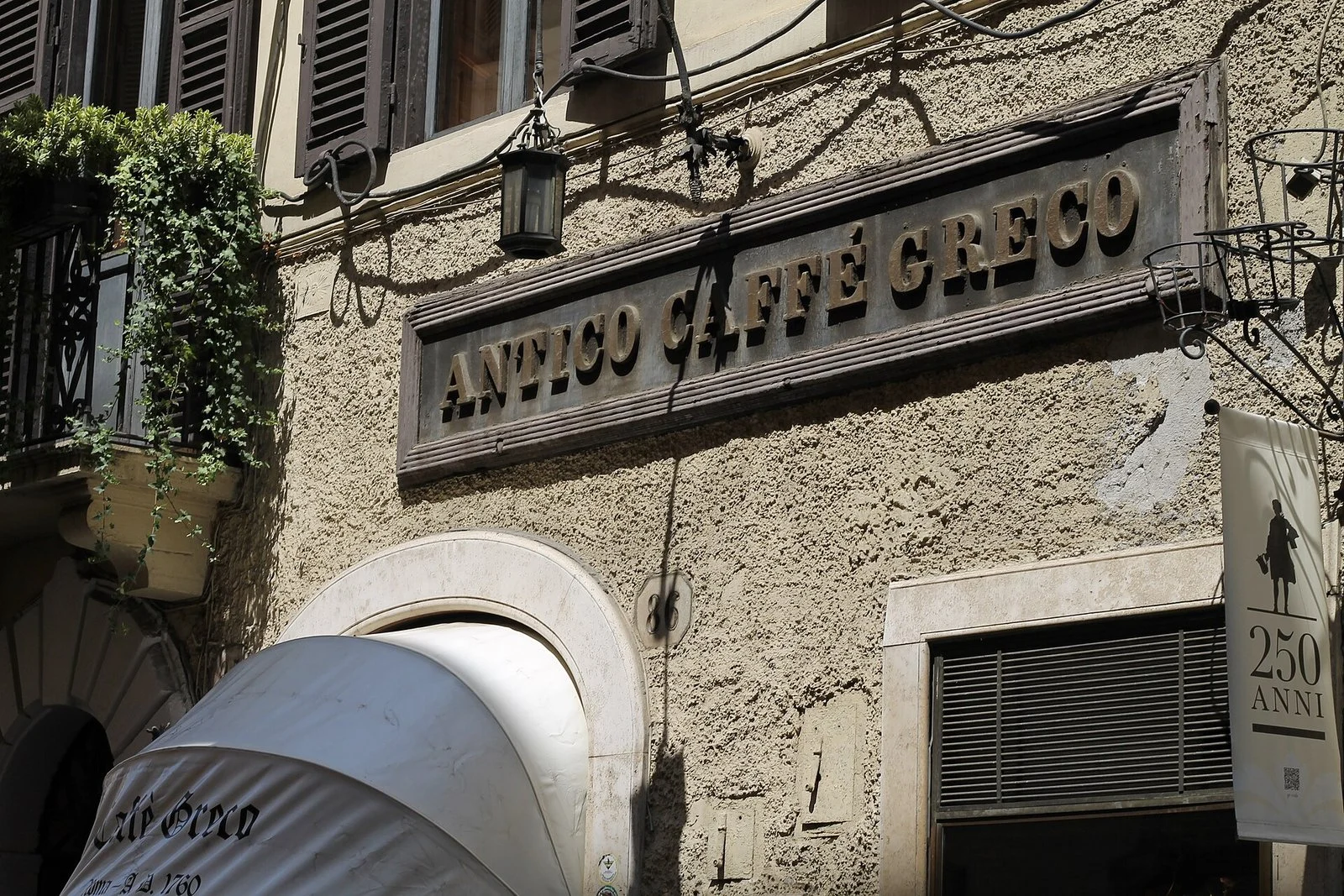
The Antico Caffè Greco is at Via dei Condotti 86, in Rome, a few dozen meters from the intersection with Via del Corso and a short walk from Piazza di Spagna. It is the oldest historic café in the capital, opened in 1760, and for two and a half centuries it was the international salon through which writers, painters, musicians and sovereigns visiting Rome passed: Goethe, Stendhal, Byron, Casanova and Gogol are only the most cited names in a very long list, reconstructed in detail further down this page. On the affair that in recent years has involved the ownership of the venue, the Ospedale Israelitico di Roma, and the management that occupied it until the eviction, the available sources agree on some dated facts and on one fixed point, namely that as of September 17, 2026 the venue was closed pending assignment to a new operator. The detail is reconstructed further down this page, with the exact dates. For the urban and historical context around the Caffè Greco, the pages dedicated to Via del Corso and Trinità dei Monti are also useful.
Where the Antico Caffè Greco Is and How to Get There
The location of the Caffè Greco is among the most central in all of Rome, in the heart of the so-called tridente, the radiating urban design that opens from Piazza del Popolo toward Via del Corso, Via del Babuino and Via di Ripetta. Via dei Condotti cuts through this sector from east to west, connecting Via del Corso to the Trinità dei Monti staircase, and the Caffè Greco occupies the initial stretch of the street, on the right side going up from Via del Corso toward Piazza di Spagna, almost at the end of the pedestrian route that leads to the steps designed by Francesco de Sanctis in the 18th century.
On foot from Piazza di Spagna and from the metro
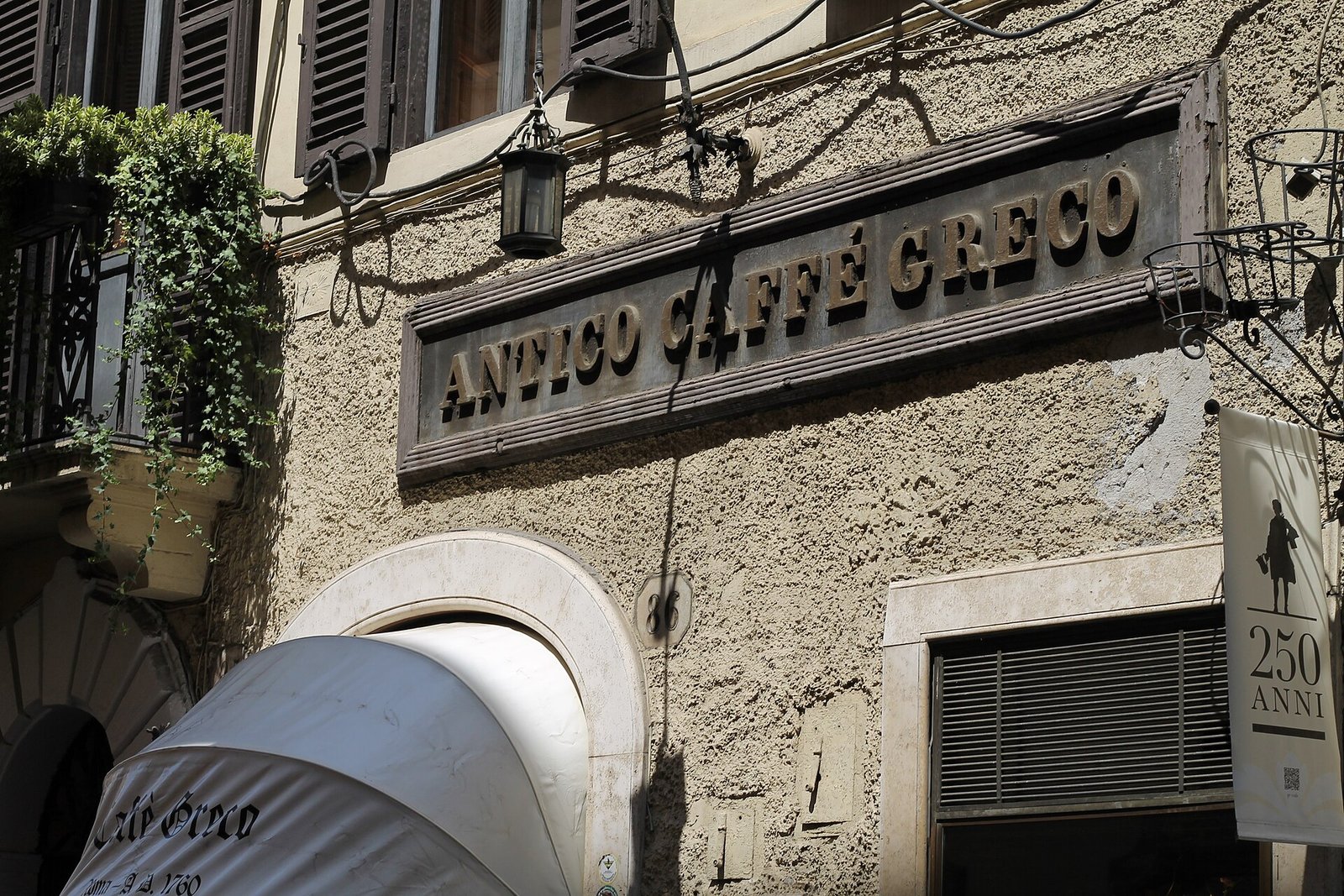
The simplest way to get there remains on foot. From the Spagna metro station, on line A, you exit onto Piazza di Spagna and take Via dei Condotti toward Via del Corso: the Caffè Greco is about 200 meters away, on the left side of the street. If you arrive instead from Via del Corso, perhaps after a walk from Piazza Venezia or Piazza del Popolo, you find the entrance on Via dei Condotti almost immediately after the intersection, recognizable by the historic sign and by the windows with the marble tables visible from outside.
By bus, taxi and on foot from the historic center
The area is served by several bus lines that pass along Via del Corso and the nearby streets, but the historic center of Rome in this sector is meant to be crossed on foot: the distances between Piazza di Spagna, the Pantheon and Piazza Navona are measured in tens of minutes, not in bus stops. If you are staying in the Termini or Trastevere area, you can comfortably arrive by taxi in about 10 minutes outside rush hours. Our opinion: Via dei Condotti should be experienced at a slow pace, as a street to walk along and not only to cross, because the windows of the fashion houses and the 19th-century architecture deserve a second look.
Parking and the limited traffic zone
The whole tridente area, Via dei Condotti included, falls inside the limited traffic zone of the historic center of Rome, active during daytime hours on weekdays and, in some periods of the year, on weekends too: access with unauthorized private cars brings a fine recorded by the cameras at the gates. If you arrive by car, you do well to leave the vehicle in one of the paid parking lots outside the limited zone, for example toward Piazza del Popolo or along the Lungotevere, and continue on foot or by taxi. It is a precaution that holds for any visit to the neighborhood, not only for those looking for the Caffè Greco, and it is the reason this part of the day is best planned as a pedestrian walk and not as a stop by car.
The Tridente and Via dei Condotti: The Street That Hosts the Caffè Greco
To understand why a café opened in 1760 is on this very street, you have to look at the urban design of the whole district. The tridente is the name for the fan of three streets, Via del Babuino, Via del Corso and Via di Ripetta, that open out from Piazza del Popolo toward the heart of Rome: a Renaissance and Baroque urban layout designed to welcome those entering the city through the Porta del Popolo, the most important gate for those arriving from the north. Via dei Condotti joins this design as a cross street connecting Via del Corso, the central axis of the tridente, to the foot of the Pincio hill, where Trinità dei Monti closes the vista with its facade and twin bell towers.
The street's name and the Vergine aqueduct
The name Via dei Condotti comes from the water conduits that once crossed the area, connected to the course of the Acqua Vergine, the ancient Roman aqueduct still working today that feeds, among others, the Trevi Fountain. The street already existed in the Renaissance as a minor connection, but it acquired its current look and importance mainly from the 18th and 19th centuries, when the tridente district became the reference area for foreigners living in Rome, first as the site of artists' studios and cheap inns, then, in the 20th century, as the heart of the city's luxury trade. The Caffè Greco went through both phases while always staying in the same spot, which makes it a privileged observatory on how the district has changed over two and a half centuries: from a street of penniless artists to the address of the big international fashion houses.
The Caffè Greco was born in 1760, opened by a man of Greek origin remembered in the sources as Nicola della Maddalena: hence the name by which the venue has been known for more than two and a half centuries, a name that stayed unchanged even when, over the following decades, management passed to owners and administrators of different backgrounds. In Italy only the Caffè Florian in Venice, founded in 1720, can claim a longer history, and this places the Antico Caffè Greco among the oldest historic cafés in Europe still existing as a recognizable physical structure, with furnishings and rooms that passed almost unchanged through the 18th, the 19th and much of the 20th century.
The precise moment when the Caffè Greco becomes something more than a simple refreshment venue coincides with the arrival in Rome of the great waves of Grand Tour travelers, the educational journey that brought aristocrats, artists and intellectuals from Northern Europe to spend months or years in Italy to complete their classical education. Rome was the most coveted stop of the Grand Tour, and Via dei Condotti, right next to Piazza di Spagna, became the district where the inns, lodgings and studios of passing foreign artists were concentrated: English, Germans, French, Russians and Scandinavians found here a network of compatriots, postal couriers, booksellers and, precisely, a café where they could meet every day.
For historical completeness, a detail concerning Goethe himself should be clarified: the German writer stayed in Rome starting in 1786, that is 26 years after the venue opened in 1760, so the link between Goethe and the Caffè Greco should be understood as that of one of the most illustrious patrons of an already mature phase of the venue's history, and not as that of a customer from the very first hour. It is a useful clarification because it helps to grasp the real time scale of the Caffè Greco's history: an arc of two and a half centuries in which figures who arrived in different eras, separated even by one or two centuries, sat at the same tables and looked at the same walls.
The salon of foreign artists in Rome
Throughout the 19th century the Caffè Greco worked as a sort of informal consulate of the foreign artistic communities present in Rome. The German painters had their own regular table, as did the Scandinavians and the Russians. The walls filled over time with paintings, drawings and portraits left or donated by the patrons themselves, a custom that over two centuries has turned the venue into a true art collection spread among the tables and rooms. It was not a café for passing tourists, it was the place where those who lived in Rome as foreigners for months or years felt at home, read the mail that had come from their own country and discussed art at a marble table.
The link between the Caffè Greco and the Scandinavian artists is among the best documented. The Danish sculptor Bertel Thorvaldsen, who lived in Rome from 1797 to 1838, was an almost daily customer of the venue and often celebrated there the anniversary of his arrival in the city. A bronze sculpture and a medallion with his profile are still on display today among the works of the Caffè. An entire circle of compatriots gravitated around him: the writers Henrik Hertz and Carsten Hauch, the artists Hermann Ernst Freund, Jørgen V. Sonne and Albert Küchler, and the actress Johanne Luise Heiberg. It was a Danish community that found in the Caffè Greco its daily meeting point in Rome, in the same way that English, Germans and Russians had their own regular tables.
A less well-known function, but documented precisely by historians, is that of an informal post office. Foreign artists living in Rome for long periods had their correspondence delivered directly to the Caffè Greco, which kept the pending letters in a lead box set on the counter: a custom immortalized in the painting that the artist Ludwig Passini made in 1856, today among the most cited images to illustrate the 19th-century interior of the venue. Thorvaldsen himself received his mail at the Caffè for a long time, including letters from his father and correspondence with the Danish consul in Rome, before preferring, after 1804, the address of his private home. The German painter Ludwig Richter recalled in his memoirs that customers were so used to using the venue as a mailing address that they had even letters with bills of exchange sent there, a detail that says how much the Caffè Greco was, more than a simple bar, a true hub of daily life for the foreign community in Rome. This informal postal function was not a marginal detail in the Rome of the late 18th and early 19th centuries, when international postal services were slow, irregular and entrusted to private couriers: knowing that a letter addressed to the Caffè Greco would be kept with care, waiting for the recipient to come pick it up, gave hundreds of foreign artists a fixed point in a city where everything else, lodging, commissions, contacts, kept changing.
The Rooms and Art Collection of the Antico Caffè Greco
The interior of the Caffè Greco still keeps its 19th-century look: a succession of small connected rooms, with wine-red wall coverings, small sofas and armchairs upholstered in velvet, round antique marble tables, stucco, mirrors, glass doors and walls covered up to the ceiling with paintings, medallions, busts and statuettes. The historians who cataloged the permanent collection speak of about 150 works made by some 60 different artists, an ensemble that the German scholar Friedrich Noack described, in an expression that later became recurrent, as a true temple of art. To this historic core of displayed works must be added the wider set of furnishings, relics and antiques that make up the venue's overall heritage: the most recent reports, linked to the judicial affair described further down, estimated the inventory subject to seizure at about 300 pieces and a value of around 8 million euros, and confirmed that both the works and the historic furnishings are under protective restriction by the competent Soprintendenza.
The Sala Omnibus, the heart of the Caffè Greco
The most important room of the venue has an unusual name, Sala Omnibus, and it is the one that for more than two centuries hosted the most diverse artistic and literary circles. The walls are entirely covered with paintings, medallions and portraits of the most illustrious patrons, with the upper part of the room dedicated to the commemorative medallions and the lower band to a sequence of rural landscapes. Here, every first Wednesday of the month, the so-called Gruppo dei Romanisti, an association of scholars and enthusiasts of Roman history and traditions, has met for decades. In the Sala Omnibus in 1948 a famous photograph was taken, titled Parnaso contemporaneo, showing together the composer Goffredo Petrassi, the painter Mario Mafai, the writer Ennio Flaiano and the actor and director Orson Welles: a snapshot that tells well how, even in the postwar period, the Caffè Greco kept being the meeting point of cultural Rome, not only a place of 19th-century memory. The very name of the room, Omnibus, evokes the idea of a space open to all, without distinction of origin, language or artistic discipline, and it is probably this vocation that explains why, over two centuries, the same room could host without interruption German Romantic painters, Russian writers, philosophers, composers and, in the 20th century, directors and film people.
The historic restriction and the protection of the interior heritage
The very richness of this heritage is at the center of the most recent judicial affair. The works and furnishings of the Caffè Greco are under a protection regime that restricts their movement: any transfer of paintings, sculptures or historic furniture requires authorization from the Ministry of Culture, precisely because they are not simple furnishings but a heritage recognized as part of Rome's cultural history. It is a point to keep in mind to understand why, as the following chapter tells, the transfer of part of these goods to two outside warehouses became the subject of a criminal proceeding.
A Curiosity About Antico Caffè Greco
Among the many anecdotes circulating about the Caffè Greco, one of the most curious concerns a legend born around a pope. A letter dated 1910, attributed to Count Ludovico Pecci, nephew of Pope Leo XIII, recalls that the future pontiff, as a young man, used to frequent the venue. From this anecdote a popular saying arose over time, passed on more as a game than as a conviction, according to which a cardinal who sat at a table at the Caffè Greco would have good chances of becoming pope. It is not a tradition documented as an established historical fact, but it is one of those tales that the venue's long-serving waiters liked to tell to foreign customers, and it has entered firmly into the anecdotal repertoire of the Rome of historic cafés.
Another lesser-known curiosity concerns animals. Arthur Schopenhauer, the German philosopher, frequented the Caffè Greco bringing with him a white poodle to which he had given the Sanskrit name Atman, the principle of the soul in Hindu philosophy: a detail that says a lot about the character of the man, able to bring his Orientalist erudition even into the dog's name, and about the cosmopolitan climate of a venue where a German philosopher obsessed with Indian thought could sit next to a Roman painter without anyone finding it strange.
Casanova, the Castrati and the Rome of 18th-Century Cafés
The anecdote tied to Giacomo Casanova, mentioned at the opening of this page, should be placed in the social context of 18th-century Rome in which the Caffè Greco was born and grew. In the Rome of the popes, theater and music were among the few tolerated public pastimes, and the castrato singers, trained from childhood to keep a soprano or contralto voice as adults, were among the real celebrities of entertainment: figures admired, courted and often made up and dressed in such a way as to make their gender anything but obvious to a passing observer. It is in this context that the episode belongs in which Casanova, invited by Cardinal Gama to a table at the Caffè, mistook the singer Giuseppe Ricciarelli for a woman.
The café as a social institution was relatively young when the Caffè Greco opened in 1760: the drink had spread across Europe in the 17th century, reaching Rome through commercial contacts with the Ottoman Empire and the eastern Mediterranean, and the first Roman coffeehouses had been born precisely in the preceding decades as places for conversation, newspaper reading and mixing among different classes, in a city where theaters were often closed by papal decree and lay public life had few other legitimate spaces. The Caffè Greco fit into this fabric with a characteristic that would make it unique: its international vocation, due to the concentration of foreign travelers in the nearby Piazza di Spagna district, which in those years was informally called the English ghetto for the high concentration of British visitors and residents.
Something Nobody Tells You About Antico Caffè Greco
What many tourist guides don't tell clearly is the judicial affair that in recent years has involved the ownership of the building and the management of the venue, and that is the reason why, as of the most recent date on which the affair is documented, the Caffè Greco was not open to the public in its usual form. It is worth reconstructing precisely, because it is a story that concerns commercial law as much as the protection of cultural heritage.
The owner of the building at Via dei Condotti 86 is the Ospedale Israelitico di Roma, an institution that over the years has carried on a long dispute with the company running the venue over the renewal and the terms of the lease. The dispute, according to press reconstructions, dragged on for about a decade, amid postponements, appeals and judicial suspensions, until an enforceable eviction order. The dated sources agree in indicating that the eviction was carried out in early October 2025, with the keys and the premises handed back to the lawful owner, and that the venue was closed as of November 2, 2025, when the extraordinary commissioner of the Ospedale Israelitico, Antonio Maria Leozappa, declared that the reopening of the Caffè Greco remained a primary commitment of the institution.
The transfer of the works and the criminal proceeding
Before the eviction took effect, a significant part of the venue's furnishings and works of art, period paintings, historic tables, velvet armchairs and other furnishings restricted by the Soprintendenza, was removed and transferred to two warehouses, on Via della Mercede and Via Otranto, without the necessary authorization of the Ministry of Culture. On September 17, 2025, a judge ordered the preventive seizure of the transferred goods, described in the reports as a heritage of about 300 pieces with an estimated value of around 8 million euros. The administrator of the company that ran the Caffè Greco, Carlo Pellegrini, was indicted for removing protected cultural goods without authorization, an offense provided for by Article 169 of the cultural heritage code, Legislative Decree 42 of 2004. As of September 17, 2026, the most recent reports available noted a hearing set for January 21 before the Rome court and confirmed that the venue was still waiting to be assigned to a new management, through a public selection procedure launched by the Ospedale Israelitico.
As to how the reopening procedure and the outcome of the criminal proceeding have actually turned out, the most up-to-date sources describe a path still under way and not a final epilogue. Before organizing a visit, it is always best to check the latest news or contact the venue directly, because an affair of this complexity, with a lease, a judicial seizure and a criminal proceeding intertwined, can evolve quickly.
It is worth adding a legal detail reported in the news: at one stage of the dispute, a ruling by the regional administrative court had recognized the goods inside the venue as immovable, confirming how much the protective restriction on the historic furnishings was a central, and not incidental, element of the whole affair. It is the proof that what was at issue here was not only an expired lease, but the compatibility between an ordinary commercial dispute and the protection of a cultural heritage that Italian law considers, to all effects, of public interest.
The Advice I Give You for Visiting Antico Caffè Greco
The most useful advice I can give concerns the premise of the previous paragraph: before including the Caffè Greco in an itinerary, check if it is open, because the legal affair told above has made the situation less stable than that of a normal historic venue. If the venue is open, the best time to visit is early morning, just after opening, when the rooms are still quiet and you can look calmly at the Sala Omnibus and the walls covered with paintings without the crush of passing tourists in the middle of the day.
Those who sit at a table, and not simply at the counter, must expect a higher price than at an ordinary bar. It is the rule of every historic café in the center of Rome, from Florence to Venice, and it reflects the cost of preserving rooms, furnishings and protected works of art on one of the most expensive streets in the city. Our opinion: it's worth going in at least once, not so much for the coffee itself as for the atmosphere of the rooms, which tell two and a half centuries of history better than many museum display cases. If budget or time are limited, even a short stop at the counter lets you see the entrance and the first room, where the best-known paintings are visible anyway.
A second piece of advice, less obvious, concerns the attitude with which to enter: don't rush through the rooms as if it were a museum hall in itself. The Caffè Greco works, when it is open, as a venue in every respect, with waiters serving the tables and a circulation of real customers, not only touring visitors. Moving with respect, without getting in the way of those seated to have a coffee or read the newspaper, is as much a part of the experience as looking at the paintings on the walls. It is advice that holds for any historic café in Europe, from the Florian in Venice to the Central in Vienna, but here, in a physically small space dense with works, it counts even more.
What to see even if the venue were not accessible
Even in periods when access to the Caffè Greco is limited for the reasons described above, the street where it stands remains one of the most elegant views in the center of Rome. Via dei Condotti, with its high-fashion windows and the perspective that closes on the Trinità dei Monti staircase, deserves a walk of its own, and nearby Piazza di Spagna offers in any case one of the most photographed panoramas in the city. Those who want to better understand the historical and cultural context in which the Caffè Greco was born can visit the Casa di Goethe, not far away on Via del Corso, dedicated to the Roman stay of the German writer who was among the most assiduous patrons of the venue in his Italian years.
Another Well-Known Fact, Yet Rarely Mentioned
That the Caffè Greco was a gathering place for artists and writers is known by everyone who arrives in Rome with a guidebook in hand. What is cited less often is the structural reason why this happened here and not elsewhere: the function of literary cafés in 18th- and 19th-century Europe as social infrastructure for foreign communities in a city. It was not an isolated Roman phenomenon. The Florian in Venice, opened in 1720, played a similar role for the cosmopolitan community that gravitated around Piazza San Marco. The Café de Flore and the Café des Deux Magots in Paris, later, would repeat the same pattern for French and European intellectuals of the 20th century. The Café Central in Vienna was the salon of an entire generation of Central European writers. The Caffè Greco belongs to this same family of places, with one difference: its specific function was that of a reference point for the foreign artists of the Grand Tour, that is for a community that had no roots in Rome but only a temporary stay, often of years, and that needed a place to find compatriots, news from home and a sense of belonging. It is worth recalling, for completeness, that the absolute primacy in Europe belongs to the Café Procope in Paris, opened in 1686 and considered the oldest café in the world still active as a brand: a fact that places the Caffè Greco not first overall, but still in a very small circle of historic venues that survived almost unchanged for over two centuries.
The second rarely cited element concerns geography. The tridente district, with Piazza di Spagna as its fulcrum, was not by chance the area of foreign artists: it was the area where the cheap inns, the low-cost artists' studios and the offices of the postal couriers connecting Rome with London, Paris and the German cities were concentrated. The Caffè Greco was born and thrived inside this network of services for foreigners, not alongside it. Understanding this helps to read the rest of the district differently too: Via dei Condotti, today a synonym for luxury fashion, was for a good century and a half first of all the street of artists away from home.
A third element rarely told concerns the material survival of the place. Many of the great European literary cafés born between the 18th and 19th centuries no longer exist in their original form, or were rebuilt after demolitions and relocations. The café as a physical institution, with the same tables, the same walls and the same small sofas sat on by generations of patrons from different eras and nations, is an exception more than a rule in the European landscape. The fact that the Caffè Greco has kept until today the furnishings, the paintings and even the layout of the 19th-century rooms is the reason the venue is considered a cultural asset in every respect, and not just a commercial business with an interesting history behind it. It is also the reason the recent judicial affair, with the seizure of works and furnishings, has had an echo that goes beyond the news of a dispute between a real estate owner and a commercial operator.
The Right Photo to Take at Antico Caffè Greco
The photograph that best captures this place is not the outside sign, however elegant, but the shot from inside the Sala Omnibus, with the walls covered to the ceiling with paintings, medallions and portraits following one another without a break. It is a hard subject to render with a standard lens, because the room is narrow and the density of the works on the walls risks looking confused in a photo taken in a hurry. It's best to work with a moderate wide-angle, staying low relative to the level of the tables, so as to include in the same frame both the red velvet small sofas and the upper band of the walls with the medallions.
A second interesting image, less obvious, is that of an antique marble table shot up close, with the surface worn by two and a half centuries of elbows and set-down cups: a detail that conveys the passing of time better than any caption. The third photograph, for those who stop even for a moment in front of the entrance, is the historic sign on Via dei Condotti together with the perspective of the street climbing toward Trinità dei Monti: a frame that holds together the venue and the district that made it possible. A fourth possibility, for those who like detail photography more than setting shots, is the frame of a single portrait medallion hanging on the wall of the Sala Omnibus: isolated from the context, it shows by itself the density of this collection, accumulated donation after donation by generations of artists who wanted to leave a mark of their passage.
Some Important Events That Happened Here in History
The first great moment is of course the opening, in 1760, when Nicola della Maddalena opened on Via dei Condotti the venue that would become, within a few decades, the reference point of the cosmopolitan Rome of the Grand Tour. From that moment the Caffè Greco began a trajectory that would make it, for two and a half centuries, one of the very few physical places in Rome able to pass almost unscathed through the end of the Papal States, the Unification of Italy, two world wars and the birth of the Republic, keeping substantially the same look and the same function.
The second significant moment concerns the arrival in Rome of Johann Wolfgang von Goethe, who stayed in the city starting in 1786 and who, according to the sources that have reconstructed the venue's history, contributed decisively to the fame of the Caffè Greco among the German community and, more generally, among travelers from Northern Europe. From then on the venue became an almost obligatory stop for anyone coming to Rome from the Germanic world looking for a cultural reference point.
The third moment is the passage of Nikolai Gogol, who arrived in Rome in 1837: the sources attribute to the tables of the Caffè Greco part of the writing of Dead Souls, the novel the Russian writer composed precisely during his long Italian stay. It is an episode to be told with the caution due to any literary anecdote of this kind, that is as an established tradition more than a line-by-line verifiable fact, but which in any case testifies to how much the venue had become, in the 19th century, a place of work as well as a gathering place for foreign writers in Rome.
The fourth moment is the 1948 photograph taken in the Sala Omnibus, with Goffredo Petrassi, Mario Mafai, Ennio Flaiano and Orson Welles pictured together under the title Parnaso contemporaneo: proof that, even in the postwar 20th century, the Caffè Greco kept being frequented by the personalities who were redrawing Italian and European culture.
The fifth moment, much more recent and of the opposite sign, is the sequence of events between 2025 and 2026 tied to the dispute between ownership and management: the preventive seizure of the works transferred without authorization, ordered on September 17, 2025. The carrying out of the eviction in early October 2025, with the return of the venue to the Ospedale Israelitico. And the indictment, reported in the news of September 17, 2026, of the administrator of the previous management company for the unauthorized removal of the protected cultural goods. It is a chapter of recent history that, for the first time in two and a half centuries, has called into question the physical continuity of the venue as visitors knew it.
A sixth moment, less dramatic but useful to complete the picture, concerns the middle of the 20th century: from the 1920s to the 1960s the Caffè Greco passed through Fascism, the war and the reconstruction while keeping its function as a salon for artists and intellectuals, as the 1948 photograph already mentioned shows. It is the period when the surrounding district began its transformation toward the commercial and fashion vocation we know today, without the venue losing, at least until the recent judicial affair, its role as a fixed point in the city's cultural geography.
Who Has Passed Through Antico Caffè Greco
The list of documented patrons of the Caffè Greco is one of the longest among all European historic venues, and it is the main reason the venue is considered a place of cultural interest as well as a gastronomic one. Johann Wolfgang von Goethe is probably the most cited name: he stayed in Rome starting in 1786, and the link between the German writer and the city is today also remembered by the nearby Casa di Goethe, the museum that occupies the Roman apartment where he lived. Next to him should be remembered the writers of English Romanticism, Lord Byron, John Keats and Percy Bysshe Shelley, who found in Rome one of the centers of their Italian experience, and the French writer Stendhal, who wrote memorable pages about Rome in his travel diaries.
Giacomo Casanova appears in a specific anecdote tied to the venue: strolling along the street he was invited by Cardinal Gama to a table at the Caffè, where, according to the handed-down account, he mistook the castrato singer Giuseppe Ricciarelli, seated at the same table, for a woman. It is an episode to be read in the context of 18th-century Roman custom, when castrato singers were among the most famous and admired figures of the musical scene, often made up and dressed in a way that confused even a savvy observer like Casanova.
Nikolai Gogol represents the Russian side of this story: arriving in Rome in 1837, according to tradition he composed at the tables of the Caffè Greco part of Dead Souls, and his presence testifies to how much the Russian community in Rome in the 19th century was an integral part of the venue's life, on a par with the German and the English. The philosopher Arthur Schopenhauer frequented the Caffè with his white poodle Atman, and the chronicles of the time also recall an episode of tension with a group of German painters, a sign that the climate of the venue, however elegant, was not always free of friction among artists of strong temperament.
Around the Danish sculptor Bertel Thorvaldsen, an almost daily presence from 1797 to 1838, moved an entire circle of compatriots and artists from Northern Europe: the German painter Joseph Anton Koch, the poet Heinrich Heine and the composer Felix Mendelssohn-Bartholdy are all remembered among the regular patrons of the venue in these decades. Hans Christian Andersen, besides frequenting the Caffè, lived for a period in the rooms above the venue, and in 1835 dedicated to this Roman experience a nostalgic composition titled Una piccola fuga a Roma, in which he described the cosmopolitan atmosphere of the district: a text worth citing for its documentary value, without however reproducing its verses, because it tells precisely the spirit of a Rome inhabited by foreign artists who had arranged to meet on a single street and in a single café.
The world of music is also represented by Richard Wagner, Franz Liszt and the Norwegian composer Edvard Grieg, while the 20th century brings different personalities to the Caffè Greco: the painter Giorgio de Chirico was at home there for his cappuccino, while the 1948 photograph in the Sala Omnibus links the venue to Goffredo Petrassi, Mario Mafai, Ennio Flaiano and Orson Welles. Among the Italian figures recalled by the sources is also the writer and statesman Massimo D'Azeglio, while among the sovereigns and public figures passing through are cited Louis of Bavaria and even Buffalo Bill, the famous American showman, who arrived in Rome with his Wild West Show toward the end of the 19th century. A list so broad, gathered in a single venue of a few rooms, explains by itself why the Caffè Greco is considered one of the symbolic places of the cosmopolitan Rome of the last two and a half centuries.
Among the Romans themselves should be recalled the dialect poet Cesare Pascarella, who dedicated to the Caffè Greco pages of his work devoted precisely to the atmosphere of the venue and the characters one met there: a sign that the Caffè Greco was not only a refuge for foreigners, but also a privileged vantage point for those who, Roman by birth, wanted to tell their city through the eyes of those who visited it. Reading those pages today, even just in outline, helps to understand how the venue was perceived by a cultured Roman of the late 19th century: not a simple fashionable bar, but a small world inside the city, populated by characters who spoke different languages and discussed art, politics and literature at the same small tables where a moment earlier a German painter or an English poet might have sat.
When to Go and What to Know Before You Leave
For a historic venue like the Caffè Greco, the season matters less than for a beach or a park: the rooms are indoors and the visit makes sense all year. What really matters, in light of the judicial affair described above, is checking if it is open before organizing the visit, especially if the Caffè Greco is the main reason for a stop on Via dei Condotti. The procedure of reassigning the management, launched by the Ospedale Israelitico after regaining possession of the building, involves timelines that the available sources do not allow us to anticipate with certainty.
Anyone who happens to pass through Piazza di Spagna can always enjoy the district regardless of the state of the venue: the Trinità dei Monti staircase, the windows of Via dei Condotti and the perspective onto Via del Corso remain among the most photographed views of Rome in every season of the year, with the only caution of avoiding the central hours of summer weekends, when tourist crowds in the district reach the highest levels of the whole season.
A practical note that holds in every season: the Christmas period transforms Via dei Condotti and the nearby streets with lights signed by the big fashion houses, a scenic display that every year attracts many visitors in the evening hours. If the goal is to see the district calmly, without the crowd of lights and Christmas shopping, January, February and the first weeks of March remain the quietest, with a mild climate anyway and days already long enough for an afternoon walk between Piazza di Spagna and Via del Corso.
Accessibility
Via dei Condotti is a pedestrian street, level and free of steps along its main stretch, which makes it easy for those moving with strollers or with mild mobility difficulties. Interior access to the historic rooms of a venue like the Caffè Greco, when open, depends however on the configuration of the spaces, of limited size and organized in several connected rooms according to the 19th-century layout. Anyone with specific accessibility needs does well to inquire in advance, contacting the venue or the managing body directly. The same goes for those moving with a stroller: the narrow rooms and close-set tables make maneuvering more complicated than in a modern venue, so at busy times it's best to allow a few extra minutes of waiting.
What's Around the Antico Caffè Greco
The district surrounding the Caffè Greco is probably the densest in points of interest of all tourist Rome, and it is one of those rare corners of the city where you can alternate, within an hour, a walk among high-fashion windows, a panoramic climb up one of the most photographed staircases in the world and a stop in a museum dedicated to one of the greatest European writers. A short walk away opens Piazza di Spagna, with the Barcaccia fountain attributed to Pietro Bernini and the staircase climbing to the church of Trinità dei Monti, one of the most famous viewpoints over the city. Walking along Via dei Condotti toward the east you reach in a few minutes Via del Corso, the main axis of Roman shopping that connects Piazza del Popolo to Piazza Venezia and that, together with Via dei Condotti and nearby streets like Via Frattina and Via Borgognona, forms the so-called fashion quadrilateral.
Not far away, on Via del Corso, is also the Casa di Goethe, the museum set up in the apartment where the German writer lived during his Roman stay: a natural stop for those who have just discovered, visiting the Caffè Greco, how close the link was between Goethe and the cosmopolitan Rome of the 18th century. From Piazza di Spagna, in about 10 minutes on foot, you can also reach the Trevi Fountain and the Pantheon, which makes this corner of Rome an ideal starting point for a whole day of walking visits in the historic center.
Those who want to follow more closely in the footsteps of the English Romantic writers can continue to the foot of the Trinità dei Monti staircase, where the house in which John Keats died stands, today home to a museum dedicated to the poet and the circle of English Romantics in Rome. It is an itinerary that, together with the Caffè Greco, gives a complete picture of how the Rome of the early 19th century was inhabited, read and described by writers and artists who came from all over Europe, and that can be done entirely on foot in a morning, with no need for transport.
Frequently Asked Questions About Antico Caffè Greco
Where is the Antico Caffè Greco?
The Antico Caffè Greco is at Via dei Condotti 86, in Rome, a short distance from Piazza di Spagna and from the intersection with Via del Corso, in the heart of the tridente district that also hosts Rome's fashion quadrilateral.
When did the Antico Caffè Greco open?
The Antico Caffè Greco was opened in 1760 by a man of Greek origin remembered as Nicola della Maddalena, and it is the oldest historic café in Rome. In Italy only the Florian in Venice, from 1720, has a longer history.
Who frequented the Antico Caffè Greco?
Over two and a half centuries the Antico Caffè Greco hosted writers, artists and musicians such as Goethe, Stendhal, Byron, Keats, Shelley, Casanova, Gogol, Schopenhauer, Wagner, Liszt, Andersen and, in the 20th century, Giorgio de Chirico and Orson Welles.
Is the Antico Caffè Greco open now?
The Antico Caffè Greco has been at the center of a dispute between the owner, the Ospedale Israelitico di Roma, and the previous management, ending in an eviction carried out in early October 2025. As of September 17, 2026, the available sources indicated the venue was still waiting to be assigned to a new operator, so it is advisable to check if it is open before organizing a visit.
What is the Sala Omnibus of the Caffè Greco?
The Sala Omnibus of the Antico Caffè Greco is the main room of the venue, with walls covered by paintings, medallions and portraits of its historic patrons. It has hosted the monthly meetings of the Gruppo dei Romanisti for decades, and in 1948 the famous photograph Parnaso contemporaneo was taken there.
Why does the ownership of the Antico Caffè Greco have a lawsuit behind it?
The Antico Caffè Greco was the subject of a dispute lasting about a decade between the Ospedale Israelitico di Roma, owner of the building, and the company that ran it, culminating in the enforceable eviction of early October 2025 and in a criminal proceeding tied to the unauthorized transfer of protected works of art.
What works of art are in the Antico Caffè Greco?
The Antico Caffè Greco holds more than 300 works of art and historic relics accumulated over two and a half centuries of activity, a heritage estimated by the judicial reports at around 8 million euros and subject to a protective restriction by the competent Soprintendenza.
What is there to see near the Antico Caffè Greco?
Near the Antico Caffè Greco are Piazza di Spagna with the Trinità dei Monti staircase, Via del Corso with the fashion quadrilateral and, not far away, the Casa di Goethe: a walk of a few minutes that touches some of the most representative places of the Rome of the Grand Tour.
Who was Bertel Thorvaldsen and what is his link to the Antico Caffè Greco?
Bertel Thorvaldsen was a Danish sculptor who lived in Rome from 1797 to 1838 and was an almost daily customer of the Antico Caffè Greco, where he also received his mail. A bronze sculpture and a medallion with his profile remain among the works on display in the venue today.
Article written by the editorial team of TourLeaderPro, contact them for Private/Corporate/V.I.P. Tours and Experiences. For a guided walk around Piazza di Spagna and Via dei Condotti, with a licensed tour escort, start from the TourLeaderPro contact page. Tour operators building literary and cultural itineraries in Rome will find the consulting service in the section dedicated to tour operators. A licensed tour escort can include the Caffè Greco, when the situation allows, in a walking itinerary that also touches Piazza di Spagna, Trinità dei Monti and the Casa di Goethe, telling on site the anecdotes and events this page has reconstructed with their dates.
Planning a trip to Rome? The guides in English for visiting the city, designed for those organizing their stay from outside Italy, are collected on ItalyPlanner.com. For those who want to organize a day between Piazza di Spagna and the historic center there is the guide to the best day trips from Rome, useful for understanding how to fit a stop like the Caffè Greco into a wider itinerary in the heart of the capital.