Rome in one day: the itinerary if you only have 24 hours
In short. Rome in one day can be done, but only by accepting a sacrifice: either the Colosseum with the central archaeological area, or the Vatican Museums with the Sistine Chapel and St.
Rome in one day can be done, but only by accepting a sacrifice: either the Colosseum with the central archaeological area, or the Vatican Museums with the Sistine Chapel and St. Peter's Basilica. Not both. Anyone who tries to squeeze them into the same day walks 14 kilometers and sees both badly: it's arithmetic, and we show it further on hour by hour. Here you'll find the itinerary we recommend to anyone with 24 actual hours in Rome, with walking times measured on the real route, the tickets to buy beforehand, the points where the day jams up and three variants for those who don't start from the center: Termini, Civitavecchia, a layover at Fiumicino. Hours and prices are verified on the official sources named each time. Where an official source could not be consulted, we say so.
What you can really see in one day, and what you can't
In a full day in Rome, from eight in the morning to 10 at night, you can visit well one big paid entrance and eight or nine places that don't require a ticket. That's the real ceiling, and knowing it before you leave lets you choose instead of putting up with it.
The count of hours, done honestly
A tourist day in Rome lasts between 12 and 14 hours, and at least three go to getting around, lines, checks and meals: that leaves nine or 10 useful hours. The Colosseum with the Roman Forum and Palatine takes up three to four of them if you visit without rushing, the Vatican Museums with the Sistine Chapel just as many, and St. Peter's Basilica with its checks asks for another. The two blocks together exceed eight hours of entry alone, not counting the good 40 minutes that separate the Colosseum from St. Peter's Square by public transit.
The rule of the big entrance and the small entrance
The most effective way to build a single day is to give it just one big entrance, which requires a reservation and three hours, and at most one small entrance of an hour in the late afternoon. The rest is built on free or nearly free places: the Pantheon, Piazza Navona, Campo de' Fiori, the Capitoline, Piazza di Spagna, the Pincio, the churches of the center. This is the part of Rome that best withstands a compressed visit, because it's consumed by walking and doesn't require appointments.
What stays out, without beating around the bush
In one day, what almost always stays out is the Galleria Borghese, which binds you to a two-hour slot to be booked weeks in advance, Palazzo Massimo alle Terme, Palazzo Barberini, the Baths of Caracalla, the Appia Antica park, Ostia Antica, the Domus Aurea, Testaccio with the Non-Catholic Cemetery and the Villa Farnesina. The slow evening in a rione also stays out. Anyone with more time will find the extended itinerary on the site: the weekend in Rome adds the second block of the city and a real evening, while the three-day itinerary holds together ancient Rome, the Baroque center and the Vatican without sacrifices. A single day is a well-built taste, not a complete visit.
Image: schematic map of the center of Rome with the two alternative one-day itineraries, the archaeological one and the Vatican one, traced in different colors.
The forced choice: Colosseum or Vatican
The Colosseum and the Vatican Museums are about five and a half kilometers apart and are two three-hour visits: putting them in the same day means seven hours among rooms and lines plus two of transfers, and by 16:00 you haven't seen a single square. The choice has to be made before buying any ticket.
Why both don't fit
The Vatican Museums open at 8:00 and the minimum route to the Sistine Chapel takes at least an hour and a half, three with a minimum of breathing room. St. Peter's Basilica is free but has security checks that in the middle hours mean long waits. The Colosseum opens at 8:30 and the ordinary route takes between 40 minutes and an hour, while Forum and Palatine ask for another good two. Anyone who tries both has to leave the Vatican by 11:30 and take a Colosseum slot at 13:00, with 40°C in summer and the amphitheater at the moment of peak crush: technically possible, operationally wrong.
When to choose the Colosseum
We recommend the archaeological block to first-time visitors, to those traveling with kids and to those who arrive when the Vatican Museums are closed. The advantage is that the day unfolds within a radius of two kilometers: from the Colosseum you can walk to the Forum Boarium, the Capitoline, the Pantheon and the Trevi Fountain without ever using transit. The ordinary ticket of the Colosseum Archaeological Park costs €18, is valid for 24 hours and includes one entry to the Colosseum and one to the Roman Forum and Palatine area.
When to choose the Vatican
We recommend the Vatican block to those who have already seen the archaeological area, to those who come for the Sistine Chapel or for a religious reason, and to those who arrive on a Monday, when several state museums close while the Vatican stays open. The Vatican Museums, St. Peter's Basilica, the Vatican obelisk and Castel Sant'Angelo are all within a kilometer, and Vatican City can be crossed on foot from one end to the other. The drawback is that the historic center has to be made up in the afternoon, with a transfer.
The day of the week often decides for you
The Vatican Museums are closed every Sunday except the last of the month, when they open from 9:00 to 14:00 with last entry at 12:30 and free admission, according to the official site. Anyone arriving on a Sunday doesn't make the choice: they do the archaeological day, unless it's the last Sunday of the month, in which case they have to allow for a very long line because the free entry can't be booked. The Colosseum Archaeological Park, on the other hand, is open every day except December 25 and January 1, and is free on the first Sunday of the month, April 25, June 2 and November 4: saving €18 costs, however, the booking of the time slot and a much more crowded visit. The fixed closures of the Vatican Museums in 2026 include, from the official calendar, January 1 and 6, February 11, March 19, May 1, June 29, August 15, December 8, 25 and 26.
What you absolutely book before leaving
On a single day the entries to book before leaving are two: the Colosseum, where the time slot is mandatory and sales open 30 days ahead, and the Vatican Museums, where the €5 booking fee avoids a line that in high season runs over an hour. The rest gets solved on the spot.
Colosseum: name, time slot, 30 days
The Park's ordinary ticket, valid 24 hours for one entry to the Colosseum (first and second level, panoramic terraces, Colosseum Museum) and one to the Roman Forum and Palatine, costs €18 full price and €2 reduced for European citizens from 18 until they turn 25. The Park warns that it is named for all types and that at the entrances an ID matching the name on the booking must be kept in view. Sales, with mandatory booking of the time slot, open 30 days ahead: in high season the first morning slots sell out quickly. The official ticket office is ticketing.colosseo.it. The Park also offers the free MyColosseum app, with audio guides in Italian and English.
Vatican Museums: €20, plus €5 to skip the line
The full ticket for the Vatican Museums costs €20 without online booking and €20 plus a €5 booking fee on the official site. The reduced ticket is €10, which becomes €10 plus €5 with the skip-the-line booking. The Museums are open from 8:00 to 20:00 with last entry at 18:00. The extended opening into the evening changes the logic of the day compared with a few years ago: anyone who chooses the Vatican isn't forced to burn the whole morning and can also consider an afternoon slot. The official channel is tickets.museivaticani.va, and the Museums urge distrust of similar domains that resell at inflated prices.
Trevi Fountain: €2 since February 2, 2026
Since February 2, 2026 access to the inner perimeter of the Trevi Fountain costs €2 for anyone who isn't a resident of Rome and the Metropolitan City. The figure is confirmed by the official tourist portal of Roma Capitale and by the dedicated site fontanaditrevi.roma.it, which also publishes the hours: on Monday and Friday access opens at 11:30, on other days at 9:00, with closing always at 22:00 and last entry at 21:00. After visiting hours the fountain remains visible for free, which is why on a single day we recommend placing it late at night. The fee also applies on the first Sunday of the month. Residents, children up to age five and people with disabilities and a companion are exempt. Those who already have a ticket or the right to free admission, and those with the MIC Card, enter from a dedicated line. The ticket is bought online, at the Musei Civici, at the Tourist Info Points and at affiliated sales points, or at the entrance by card only. On some days opening slips to 14:00 for maintenance.
Pantheon: hours verified, amount to check
The Pantheon has been accessible only with a paid ticket since July 3, 2023 and keeps hours from 9:00 to 19:00 with last entry at 18:30, as shown on the official portal pantheonroma.com. For the ticket price the check has to be made on the Musei Italiani portal or at the ticket office: the fare was revised in 2026 and does not appear to be published in an official form that can be consulted, so we prefer not to give a figure. What can be said with operational certainty is that the line at the box office moves, because there is no strict cap as at the Colosseum: booking saves 10 minutes, not two hours.
What you don't need to book
St. Peter's Basilica has free admission: what you buy online is a time-slot reservation with audio guide, not an entry ticket. No reservations are needed for churches, free even when they hold masterpieces: San Luigi dei Francesi with the three Caravaggios of the Contarelli chapel, Santa Maria del Popolo with the Cerasi chapel and the Chigi chapel, Sant'Ignazio di Loyola with Andrea Pozzo's vault, San Pietro in Vincoli with Michelangelo's Moses, Santa Maria sopra Minerva, Santa Maria Maggiore and St. John Lateran. You don't book squares, fountains and viewpoints, with the sole recent exception of the Trevi Fountain. On channels the rule always holds: official site first, and only if it's sold out an alternative, knowing you will pay more.
The itinerary hour by hour: the archaeological day
The archaeological day is built around the first Colosseum slot, which opens at 8:30, and covers on foot a little over two kilometers among the Colosseum, Roman Forum, Palatine, Imperial Forums, Capitoline, Pantheon and Trevi Fountain. You walk between nine and 11 kilometers over a lot of uneven ancient ground: closed shoes, not sandals.
8:15 - 9:30, the Colosseum
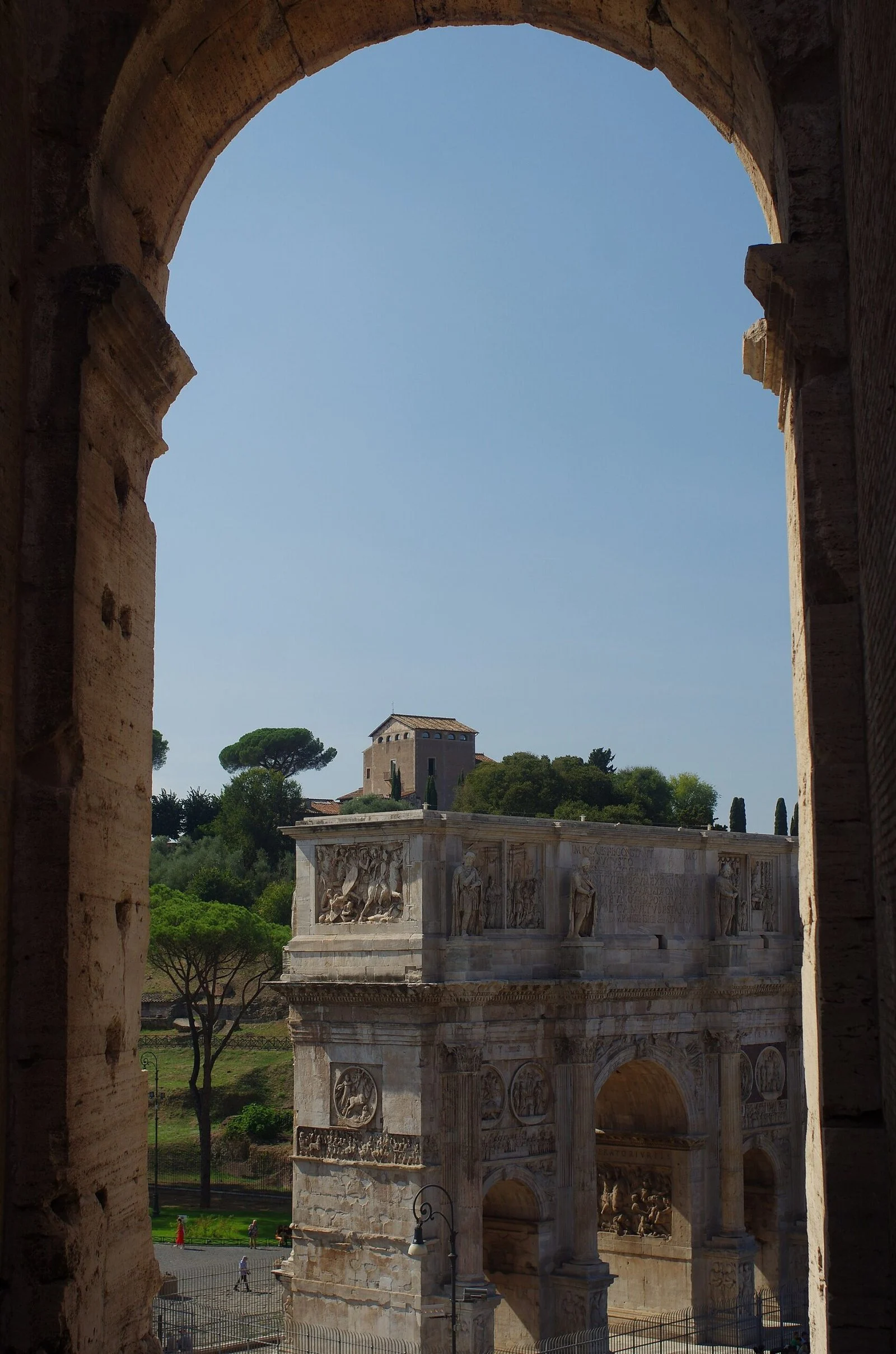
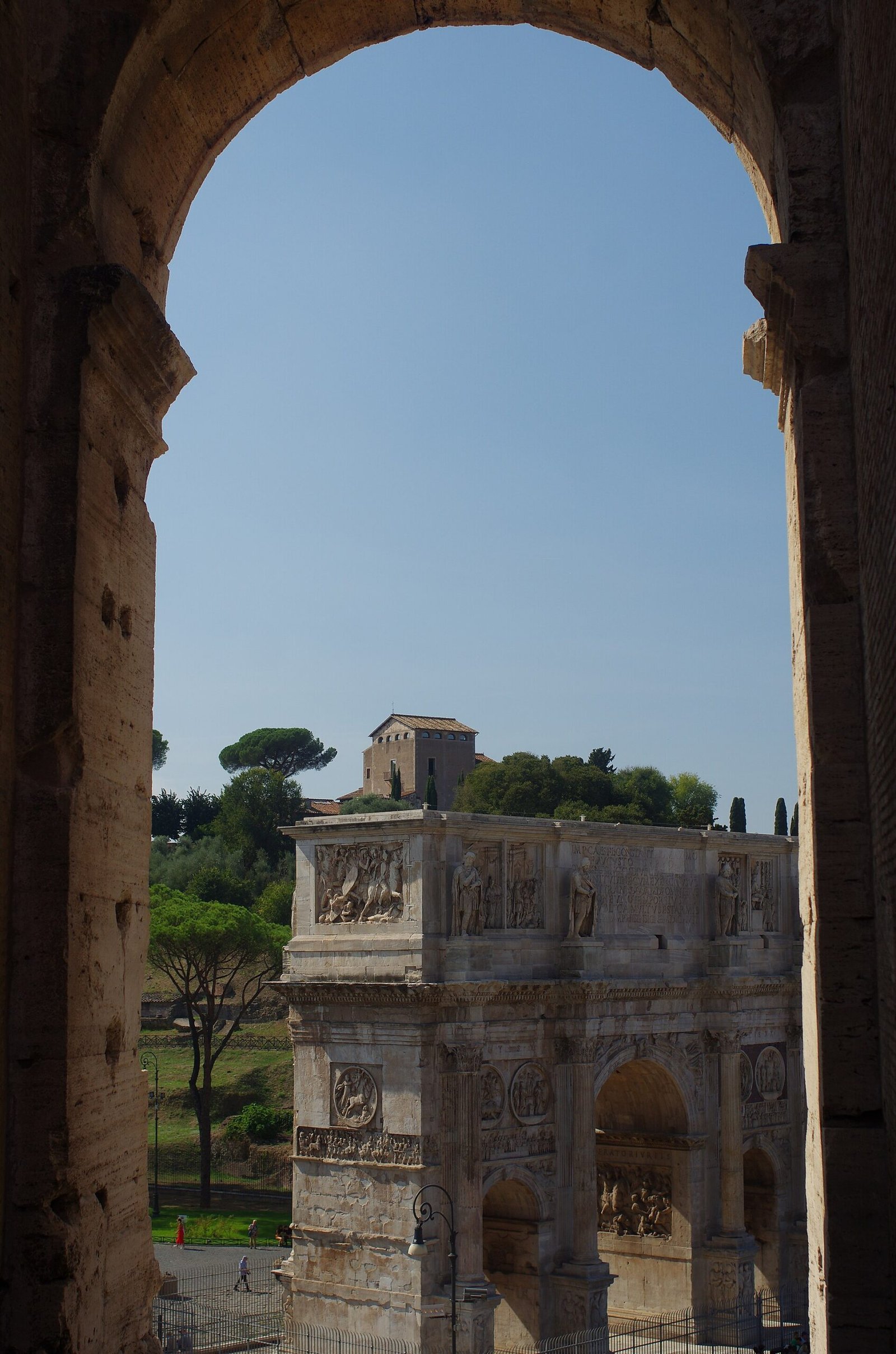
Being at the gates at 8:15 with the ticket on your phone and ID in hand means entering among the first and having the amphitheater almost empty for about 40 minutes. Entering at 11 means finding thousands of people inside and, from June to September, over 35°C in the exposed arena. The ordinary route includes the first and second level with the panoramic terraces and the Colosseum Museum, and takes between 40 minutes and an hour. It does not include the arena, underground and attic, which are special routes with separate tickets and limited availability: if you haven't booked them a month ahead it's not worth chasing them. On exiting, the Arch of Constantine is 50 meters away, requires no ticket and deserves the five minutes it takes to walk around it.
9:40 - 11:45, Roman Forum and Palatine
The Roman Forum and Palatine form a single fenced area with several gates, included in the Colosseum ticket, which allows only one entry: leaving and re-entering is not possible. The area opens at 9:00. The best order on a compressed day is to enter from the gate closest to the Colosseum, walk Via Sacra toward the Capitoline, climb the Palatine in the final stretch and exit toward Largo della Salara Vecchia. Anyone short of breath should go straight up the Palatine, where the view from above over the Forum and the Circus Maximus serves as a mental map for everything else.
The seasonal hours, which change three times a year
The hours published on the Park's official site are these: from March 29 to September 30, 2026 the Colosseum opens at 8:30, last entry is at 18:15 and the Park closes at 19:15. From October 1 to 24, 2026 last entry drops to 17:30 with closing at 18:30. From October 25, 2026 to February 28, 2027 last entry is at 15:30 and closing at 16:30. The late-October jump is abrupt: a winter day loses almost three hours of archaeological area compared with a September one.
12:00 - 13:15, lunch (not in front of the Colosseum)
The area around Piazza del Colosseo is, for the density of places built on passing trade, the worst place to sit down. The solution costs 10 minutes of walking: go up into the rione Monti, between Via Urbana, Via del Boschetto and the side streets around Piazza della Madonna dei Monti. Anyone who wants to save time eats standing: a supplì, pizza al taglio by weight or a bakery sandwich cost a fraction of a seated first course and free up 40 minutes, which on a single day are the Trevi Fountain or they aren't.
13:20 - 14:00, Imperial Forums and Trajan's Column
From Monti you go down onto Via dei Fori Imperiali as far as Piazza Venezia. Much of the Forums can be seen from the street, without a ticket: the Forum of Caesar, the Forum of Augustus with its peperino wall and above all Trajan's Column, which is the most important figured document on the Roman army and is read from below with binoculars or with your phone's zoom. Behind rise the Markets of Trajan, home of the Imperial Forums Museum: in a single day the entry stays out, but the brick mass seen from the street explains by itself how an imperial commercial complex worked.
14:00 - 15:00, Capitoline
From the Vittoriano you climb to the Capitoline by Michelangelo's cordonata, which is a ramp and not a staircase. At the top, the square with its star-pattern paving and the equestrian copy of Marcus Aurelius. On the right the Capitoline Museums, the oldest public museum in the world, which on a single day are the entry to skip reluctantly. Anyone who gives up the museum has two free things that are worth the climb: the terrace over the Roman Forum, behind Palazzo Senatorio, and the view over Piazza Venezia and the Altar of the Fatherland.
15:15 - 16:30, Pantheon and surroundings
From Piazza Venezia to the Pantheon is a 12-minute walk. The Pantheon is the best-preserved Roman monument in the world, with the concrete dome 43 meters in diameter and the oculus open in the center, and is visited in half an hour: verified hours 9:00-19:00, last entry 18:30. 50 meters away Santa Maria sopra Minerva, the only Gothic church in the center, is free and contains Michelangelo's Christ Carrying the Cross. A little farther, Sant'Ignazio di Loyola is worth the 10 minutes to stand on the marble disk in the center of the nave and look at the fake dome painted by Andrea Pozzo.
16:30 - 17:30, Piazza Navona and Campo de' Fiori
From the Pantheon to Piazza Navona is five minutes: the square has the shape of the Stadium of Domitian, whose underground remains can be visited with a separate ticket, and in the center has Bernini's Fountain of the Four Rivers. Five minutes of side streets lead to Campo de' Fiori, with the market in the morning, and another five to the sacred area of Largo Argentina, where the four Republican temples can also be seen from the balustrade on the street. Anyone with energy goes down toward the Theater of Marcellus and the Turtle Fountain in Piazza Mattei.
17:45 - 19:00, Piazza di Spagna and the Pincio
From the Pantheon to Trevi is 10 minutes, and from Trevi to Piazza di Spagna another eight. In the square are the Barcaccia, the 135-step staircase up to Trinità dei Monti and the Keats-Shelley House, where John Keats died in 1821. Since 2019 a city ordinance has banned sitting on the steps and eating or drinking there, with fines, and it is a rule that is enforced. At the top, 10 minutes lead to the Pincio terrace overlooking Piazza del Popolo, which at sunset is the most convenient and free viewpoint in the center. Anyone who goes down into the square finds Santa Maria del Popolo, free, with the two Caravaggios of the Cerasi chapel, and heads back along Via del Corso.
After 22:00, the Trevi Fountain without a ticket
The closing we recommend is the Trevi Fountain after 22:00, when access to the inner perimeter is no longer capped and you don't pay: it's lit and the square has emptied by two thirds compared with the afternoon. The gesture of tossing a coin with the right hand over the left shoulder is a 20th-century custom spread by the movies, not an ancient rite: a recent popular tradition, and that's how we tell it.
Image: Via Sacra in the Roman Forum in the early morning hours, with long shadows and very few people on the field.
The itinerary hour by hour: the Vatican day
The Vatican day is built around the opening of the Vatican Museums at 8:00 and holds together the Museums, Sistine Chapel, St. Peter's Basilica and Castel Sant'Angelo within a radius of a kilometer, leaving the afternoon free for the historic center. You walk less, between seven and nine kilometers, but spend more time standing in line.
7:45 - 11:00, Vatican Museums and Sistine Chapel
The entrance is on Viale Vaticano, on the opposite side from St. Peter's Square: if you arrive by metro, get off at Cipro on line A, closer than Ottaviano. With the skip-the-line booking you enter through a dedicated gate. Without it, you join the line along the wall, which in high season runs over an hour. Three hours is the right measure for a route that doesn't rush: Cortile della Pigna, Museo Pio Clementino with the Laocoön and the Apollo Belvedere, Galleries of the Candelabra, the Tapestries and the Maps, Raphael Rooms, Sistine Chapel. The route is one-way and very long, over seven kilometers of rooms in the full version: you can't go back. In the Sistine Chapel photography and talking are forbidden, and the staff enforces it. The Museums open from 8:00 to 20:00 with last entry at 18:00 and exit from the rooms 30 minutes earlier. Extraordinary closures tied to celebrations and audiences should be rechecked on museivaticani.va.
11:15 - 12:30, St. Peter's Basilica
From the Museums' exit you follow the Vatican wall to St. Peter's Square in about 10 minutes. The basilica has free admission: what you buy online is a reservation with audio guide that lets you get ahead of the checks. The real line is the metal detectors at the mouth of the square, which in the middle hours can absorb a good 40 minutes. Inside, the minimum is an hour: Michelangelo's Pietà immediately on the right behind glass, Bernini's baldacchino over the papal altar, the cathedra in the apse. The climb to the dome, paid, takes another good hour between line and steps: on a single day it is the first thing to sacrifice. The dress code is not negotiable: shoulders and knees covered, for everyone.
12:45 - 15:30, lunch in Prati and Castel Sant'Angelo
Via della Conciliazione and the streets of Borgo are the area with the highest density of passing-trade places in the Vatican quadrant: 10 minutes beyond Piazza Risorgimento, toward Via Cola di Rienzo, you enter Prati, a residential neighborhood with normal prices and local clientele. Then, from St. Peter's Square to Castel Sant'Angelo it's a 10-minute walk along Via della Conciliazione. The monument began as Hadrian's mausoleum and later became fortress, prison and papal residence connected to the Vatican by the Passetto di Borgo: here the Roman layering is physically crossed, climbing the ancient helicoidal ramp to the Renaissance rooms and the terrace, which is the best viewpoint over St. Peter's. On exiting, Ponte Sant'Angelo with the angels to Bernini's design leads toward the historic center.
15:45 - 19:00, the historic center in half a day
From the bridge you reach Piazza Navona in 15 minutes, and the afternoon repeats the archaeological day in compressed form: Fountain of the Four Rivers, the Pantheon by the last entry at 18:30, San Luigi dei Francesi with the Caravaggios of the Contarelli chapel, then Trevi and Piazza di Spagna. Anyone who prefers the river to the crowd should cross toward Trastevere, where the Basilica of Santa Maria in Trastevere has the 12th-century apse mosaics and those of Pietro Cavallini, and where the Basilica of Santa Cecilia is one of the quietest places in the center. With an hour of light left there are two free climbs: the Janiculum, 20 minutes from Trastevere, and the Orange Garden on the Aventine next to the Basilica of Santa Sabina.
Walking times, measured
In the center of Rome the distances between the main points are almost always under 20 minutes on foot, and the historic center has no metro: for this reason a one-day itinerary is built by walking. The following estimates are measured on the real route, traffic lights included, at tourist pace.
The distances that matter, in minutes
From the Colosseum to Piazza Venezia 20 minutes along Via dei Fori Imperiali. From Piazza Venezia to the Pantheon 12. From the Pantheon to Piazza Navona five, to Campo de' Fiori another five, to the Trevi Fountain 10. From Trevi to Piazza di Spagna eight, and from Piazza di Spagna to Piazza del Popolo 15 along Via del Babuino. From Piazza Venezia to the Theater of Marcellus and the Portico d'Ottavia area 10. From the Colosseum to the Basilica of San Clemente five, to San Pietro in Vincoli 10 uphill. From St. Peter's Square to Castel Sant'Angelo 10, and from there to Piazza Navona another 15 crossing Ponte Sant'Angelo. From Trastevere to the Portico d'Ottavia 10, passing by the Tiber Island. From the Circus Maximus to the Mouth of Truth and the Foro Boario five. Anyone with joint problems, anyone pushing a stroller and anyone walking with small children should add 20 to 30 percent to every estimate, because the cobblestones make every trip tiring. On the archaeological day the ground of the Forum and Palatine is ancient, uneven and partly gravel, which is why we put it in the morning.
The two metro lines that really serve you
Line A serves the Vatican with Ottaviano and Cipro, Piazza di Spagna, Barberini five minutes from Trevi and Flaminio for Piazza del Popolo. Line B serves the Colosseum, the Circus Maximus and Piramide, where you get off for Testaccio and the Pyramid of Cestius. The two lines cross at Termini, the hub of trains from the airports. The heart of the Baroque center, in between, is reached only on foot, by bus or by taxi. On a single day the metro transfer that makes sense is one: the one between the Vatican quadrant and the historic center.
Transit tickets and what pays off
The ordinary integrated Metrebus ticket, the BIT, costs €1.50 and is valid for 100 minutes on bus and tram with a single entry to the metro. Time-based passes cost €8.50 for 24 hours, €15 for 48 and €22 for 72 from first validation, and the weekly CIS card €29. Contactless is also available at the turnstiles and on board, with a charge of €1.50 per trip and automatic switch to the €8.50 daily fare at the sixth trip within 24 hours. For a day on foot like this, two or three BITs are enough: the daily pass breaks even only if you use transit six times. Fares should be rechecked on atac.roma.it.
Where time gets lost and how to avoid it
On a single day in Rome you lose on average two hours at four predictable points: the line without a reservation, the luggage carried around, the seated lunch in the wrong place and the transfer by the wrong means. All of them are eliminated with decisions made the night before.
Lines, luggage and the wrong order
You avoid entirely the Colosseum ticket-office line by buying online 30 days ahead, Viale Vaticano line by paying the €5 booking fee, and the line at the Trevi Fountain cash desk by going after 22:00. You don't avoid the metal detectors of St. Peter's Square and the gates of the Colosseum Archaeological Park, because they are security checks and not ticket offices: the only countermeasure is the time, before opening or after 16:30. Suitcases and bulky backpacks are not allowed in the Colosseum Archaeological Park or in the Vatican Museums, which have a cloakroom for small items but not for trolleys: luggage should be left in storage as soon as you arrive, at Termini or in the center, and picked up at the end. Open-top tourist buses lengthen rather than shorten: 40 minutes for trips that take 15 on foot. A taxi makes sense only for the station and airport with luggage and for the late-evening return, while in the daytime inside the center it is slower than walking because of the restricted traffic zones. The most frequent ordering mistake is to put the big museum in the afternoon and the squares in the morning: the squares stay accessible all day, the museum at 11 is at its worst moment, and the inversion is worth an hour and a half.
Where to eat without burning an hour
On a single day in Rome a seated lunch costs on average an hour and a half between waiting, service and the check, while a well-chosen standing one costs 25 minutes: it is the item where you recover the most time without losing quality.
The two-block rule
The quality of food drops as you get closer to a heavily visited monument and climbs back sharply after two or three blocks: it's an effect of the clientele, because a place that serves only passersby has no interest in making them come back. Three indicators verifiable in 10 seconds. Who is inside at 13:30 on a weekday, because if there are people speaking Italian and eating alone the place holds up. The menu translated into six languages with photographs of the dishes, to be avoided. The check, where the coperto is allowed if clearly stated on the menu, generally between €1 and €3 per person, while unannounced percentages are not legitimate. Fish and meat sold by weight must be weighed in front of the customer or indicated per kilo.
Area by area, where to move 10 minutes away
Around the Colosseum, go up to Monti. Around the Vatican, beyond Piazza Risorgimento toward Prati. Around Piazza Navona, Via del Governo Vecchio and the side streets toward Ponte Sant'Angelo, or the Portico d'Ottavia area, where Judeo-Roman cooking has a tradition documented over centuries and is largely closed on Saturday for Shabbat. In Trastevere the stretch between Piazza Santa Maria and Piazza Trilussa is by now almost entirely touristy, while beyond Viale Trastevere neighborhood osterie remain. Anyone who touches the south finds the Nuovo Mercato Testaccio, covered and open in the morning, where you eat lunch well for little money, next to the Monte dei cocci. A broader overview is on the page on the markets of Rome. For dinner it's best to stay near the point where the itinerary ends: a 40-minute transfer after 11 hours of walking ruins the final part of the day.
Variant 1: arriving by train at Termini
Anyone arriving at Roma Termini has the most favorable variant: the station is at the crossing point of metro lines A and B and is four stops from the Colosseum and seven from the Vatican. With a train arriving at 8:00 and one leaving at 21:00 the day is almost identical to that of someone sleeping in the center.
The first 20 minutes, which decide the day
The correct sequence on arrival is: luggage storage, transit ticket, metro. The Termini storage is on the lower level and applies hourly rates. Outside the station there are private storages with daily rates, often more convenient. Then line B toward Laurentina, stop Colosseo, four stops and about eight minutes, for the archaeological day. Line A toward Battistini, stop Cipro, for the Vatican one. For the evening train we recommend being at the station 40 minutes ahead if you have to pick up luggage: the bottleneck is the line at the storage, not the metro.
What's within walking distance of Termini, for those with less than an hour
Anyone with only an hour between two trains should not cross the city: 10 minutes from the station are Santa Maria Maggiore, with the early Christian mosaics of the nave, and Palazzo Massimo alle Terme, which holds the frescoes of the villa of Livia. At 15 minutes there is the Crypta Balbi, seat of the Museo Nazionale Romano that tells the urban layering between the Roman age and the Middle Ages. None of the three requires booking.
Variant 2: arriving on a cruise at Civitavecchia
Anyone getting off a ship at Civitavecchia has less time than the port-call schedule suggests: between the transfer from the terminal to the station and the train trip, round trip, between three and a half and four and a half hours go. On a port call from 7:00 to 19:00, seven or eight useful hours remain in Rome, less than a full day.
From the ship to the station: the real times
The port and the railway station are two separate things and the distance is not negligible. According to Port Mobility, which runs the port services, the station is about a kilometer from Forte Michelangelo and a kilometer and a half from Largo della Pace, with a walking time given as between 10 and 20 minutes: from Forte Michelangelo you exit at Varco Fortezza and take Via Giuseppe Garibaldi. You have to add the time to leave the quay, which for cruise passengers almost always means a shuttle inside the port, because the docking quays can't be reached on foot.
The shuttle dedicated to cruise passengers
A special public transport line connects the Civitavecchia railway station with the cruise ships, reserved for cruise passengers. Port Mobility indicates a cost of €6 per leg, ticket on board, and an indicative schedule from 7:00 or 7:30 until 18:30 or 19:00, only on the days ships arrive and depart. The time band depends on the calendar of ships at the quay and should be verified before disembarking.
The train to Rome: three options and three times
From Civitavecchia station a train for Rome leaves about every 30 minutes. According to Port Mobility the regional is the most frequent and the cheapest: the kilometric one-way ticket to Roma San Pietro costs €4.60 (€9.20 round trip) and the one to Roma Termini €5.00 (€10.00 round trip). The BIRG daily ticket, at €12, is valid round trip on the same day and includes unlimited use of urban transit in Rome: almost always the most convenient ticket. The Intercity to Roma Termini costs €11 in second class and €15 in first and takes 50 minutes with the sole stop of Roma Ostiense. The Frecce make no intermediate stops, at the highest price. On the regional's travel time we give no figure because it varies a lot from train to train.
Which station to choose in Rome
It's the decision that saves the most time. Anyone going to the Vatican should get off at Roma San Pietro, which also costs less: from there you reach St. Peter's Square in about 15 minutes on foot. Anyone going to the archaeological area should get off at Roma Ostiense, where metro B is a few steps away at Piramide station, or at Termini. Getting off at Termini to go to the Vatican, which is the most frequent mistake, adds 40 minutes each way.
What really fits in seven hours, and the return margin
With seven useful hours we recommend a single big entrance: Vatican Museums at opening, St. Peter's, lunch in Prati, Castel Sant'Angelo, return. Or the Colosseum with a booked slot, Forum and Palatine, lunch in Monti, Capitoline and Pantheon, return. Cruise lines set an on-board return time between 30 and 60 minutes before departure, and a ship that leaves without a passenger does not turn back. The return has to be built backward: on-board return time, minus the shuttle inside the port, minus the 10 or 20 minutes from the station, minus the train trip, minus a margin of at least an hour for the next train in case of delay. On a ship that closes boarding at 18:30 the last train to take in Rome is the one at about 16:00. For passengers with reduced mobility, Civitavecchia station offers free assistance on request, to be booked at least an hour ahead at the numbers 800 90 60 60 or 02 32 32 32, active from 6:45 to 21:30.
Variant 3: an afternoon layover at Fiumicino
Anyone with a layover at Fiumicino can leave the airport only with at least six hours between one flight and the other: below that threshold the time is eaten up by checks, transfers and early return. With six hours, about an hour and a half or two actual hours remain in the city. With eight, a real afternoon.
The calculation, done backward
The count has to be done before buying any ticket. From landing to exit from the arrivals area, with passport control and baggage claim, between 30 minutes and an hour. Then the Leonardo Express to Termini, 32 minutes according to Trenitalia, plus the wait. The return: same trip plus check-in, which for an international flight means being at the airport at least two hours ahead and for an intercontinental one three. On an eight-hour layover, between three and a half and four hours remain in the city. On a six-hour one, less than two.
The Leonardo Express and the alternatives
The Leonardo Express connects Fiumicino Airport and Roma Termini in 32 minutes with no intermediate stops, according to Trenitalia. On the price we give no figure because the updated fare could not be consulted on the official source: it should be verified on trenitalia.com or at the machines in the airport. There is also the regional on line FL1, which doesn't reach Termini but serves, among others, Roma Trastevere, Roma Ostiense and Roma Tiburtina at a lower fare: hours and fares should be verified. There are also buses to Termini, cheaper and slower, and the taxi with a fixed fare to and from the historic center within the Aurelian Walls, whose amount should be verified because it is subject to revision by Roma Capitale.
What fits in a layover afternoon
With three actual hours we recommend a single walk in the historic center, without timed tickets and without museums: from Termini metro A to Barberini, descent toward the Trevi Fountain, then Pantheon, Piazza Navona and Campo de' Fiori, return to Termini by bus or on foot in 30 minutes. About four kilometers on the flat and five places with no reservation or line. We don't recommend the Colosseum on a layover: the ticket has a time slot booked in advance and a delayed flight makes it lapse without refund. Anyone with more time can consider Ostia Antica, reachable from Ostiense by the urban railway, which however requires at least three hours plus transfers. Luggage shouldn't be taken to the center: anyone with a connecting flight can often leave it checked through to the final destination.
With children, with reduced mobility, on a small budget
A day in Rome changes shape depending on who walks it, and the three situations that most often call for a different itinerary are the visit with small children, the one with walking difficulties and the one with a limited budget: in all three cases you don't compress the same itinerary, you replace pieces of it.
With children
With children under 10 the Colosseum works much better than the Vatican Museums, a long and crowded one-way route. We recommend reducing the archaeological area to the amphitheater alone with the Arch of Constantine, replacing Forum and Palatine with the Circus Maximus, an open space where you can run, and adding in the afternoon the Bocca della Verità, where the line for the photograph can however be long, and the cat sanctuary of Largo Argentina. For European citizens the free admission to state museums under 18 noticeably reduces the cost of the day.
With walking difficulties
The Roman Forum and Palatine have uneven ground, gravel and slopes, and are not the best choice for those with mobility problems. The Colosseum has elevators and the area of St. Peter's Basilica is flat. For a single day we therefore recommend the Vatican itinerary, which takes place almost entirely on flat, concentrated surfaces, supplemented in the afternoon with the stretch between Piazza Navona and the Pantheon, also flat even if on cobblestones. Access conditions and assistance services should be verified in advance on the official sites of the individual places.
On a small budget
A completely free day in Rome is possible and is not second-rate. Free are all the churches, including those with the Caravaggios and Michelangelo's Moses, Piazza Navona, Campo de' Fiori, the staircase of Trinità dei Monti, the Pincio, the Janiculum, the Giardino degli Aranci, Largo Argentina from the balustrade, the Imperial Forums and Trajan's Column from the street, the Arch of Constantine, the Capitoline with the terrace over the Forum, the Trevi Fountain after 22:00 and the Foro Boario. The only expenses are transit and lunch.
Image: the Pincio terrace at sunset, with Piazza del Popolo below and the domes of the historic center in the background.
Frequently asked questions about Rome in one day
Is it possible to see Rome in one day?
Rome in one day can be seen only in part: in a full 12-hour day you can visit well one big paid site and eight or nine free places in the center. The forced choice is between the Colosseum with Roman Forum and Palatine, which takes three to four hours, and the Vatican Museums with the Sistine Chapel and St. Peter's Basilica, which take just as many: together you see both badly.
Colosseum or Vatican Museums if I have only one day?
With only one day in Rome we recommend the Colosseum to first-time visitors traveling with kids, because the day stays within a radius of two kilometers on foot, and the Vatican Museums to those who have already seen the archaeological area or are coming for the Sistine Chapel. The day of the week often decides: the Vatican Museums are closed every Sunday except the last of the month.
How much does the Colosseum ticket cost and when should it be booked?
The ordinary ticket of the Colosseum Archaeological Park costs €18 full price, with a reduced €2 for European citizens from 18 to 24, is valid for 24 hours and includes one entry to the Colosseum and one to the Roman Forum and Palatine. Sales with mandatory booking of the time slot open 30 days ahead on the ticketing.colosseo.it portal. The ticket is named and an ID must be shown at entry.
How much do the Vatican Museums cost and what are the hours?
The Vatican Museums cost €20 for the full ticket, which becomes €25 with the €5 booking fee on the official site tickets.museivaticani.va, and are open from 8:00 to 20:00 with last entry at 18:00. They are closed every Sunday except the last of the month, when they open from 9:00 to 14:00 with last entry at 12:30 and free admission that can't be booked.
Do you pay to see the Trevi Fountain?
Since February 2, 2026 access to the inner perimeter of the Trevi Fountain costs €2 for those who don't reside in Rome and the Metropolitan City, according to the official site fontanaditrevi.roma.it. The hours are 9:00-22:00, with delayed opening at 11:30 on Monday and Friday and last entry at 21:00. After the capped access closes the fountain remains visible for free and much less crowded.
How long does it take from the port of Civitavecchia to Rome?
From the port of Civitavecchia to Rome you need between an hour and three quarters and two and a half hours each way, counting everything. The station is 10 to 20 minutes on foot from the port gates, or is reached with the cruise-passenger shuttle at €6 per leg. The train leaves about every 30 minutes and the Intercity reaches Roma Termini in 50 minutes, while the regional costs €5.00 for Termini.
How long does it take from Fiumicino to central Rome?
From Fiumicino Airport to Roma Termini the Leonardo Express takes 32 minutes with no intermediate stops, according to Trenitalia, plus the wait for the train and the time to leave the arrivals area: between landing and the historic center it takes from an hour to an hour and a half. To leave the airport during a layover we recommend at least six hours of margin between one flight and the other.
How much do you walk in a day in Rome?
In a single well-built day in Rome you walk between nine and 11 kilometers on the archaeological itinerary and between seven and nine on the Vatican one. The historic center has no metro and almost all the distances between the main places are under 20 minutes on foot: anyone with joint difficulties or pushing a stroller should add 20 to 30 percent to every estimate.
Is it worth buying the Roma Pass for just one day?
For just one day in Rome the Roma Pass rarely pays for itself: it is sold in 48- and 72-hour versions, does not include the Vatican Museums and pays off only for those who enter several paid museums. On a day with a single big entrance, the €1.50 transit ticket bought as needed or contactless at the turnstiles is a better deal. Prices and contents on the official site.
Who wrote this page
This page is curated by the editorial team of Tour Leader Pro, the Roman project office that designs and coordinates visits, itineraries and cultural events in Rome and Lazio. Hours, fares and access conditions given here are verified as of the publication date on the official sources named in the text: it's best to recheck them before leaving, because they change often. If you find an out-of-date figure, let us know.
Anyone with more than 24 hours who wants a route that sacrifices neither ancient Rome nor the Vatican will find planning tools and coordinated itineraries on Tour Leader Pro, where the logic of timing fits and reservations is the same applied here on a longer scale.
For a broader picture of rail and airport connections and of the Lazio destinations reachable in a day from Rome, from Ostia Antica to Tivoli, Italy Planner is a good resource.