Obelisco Vaticano
In short. The Vatican Obelisk is the red granite monolith set in the middle of St.
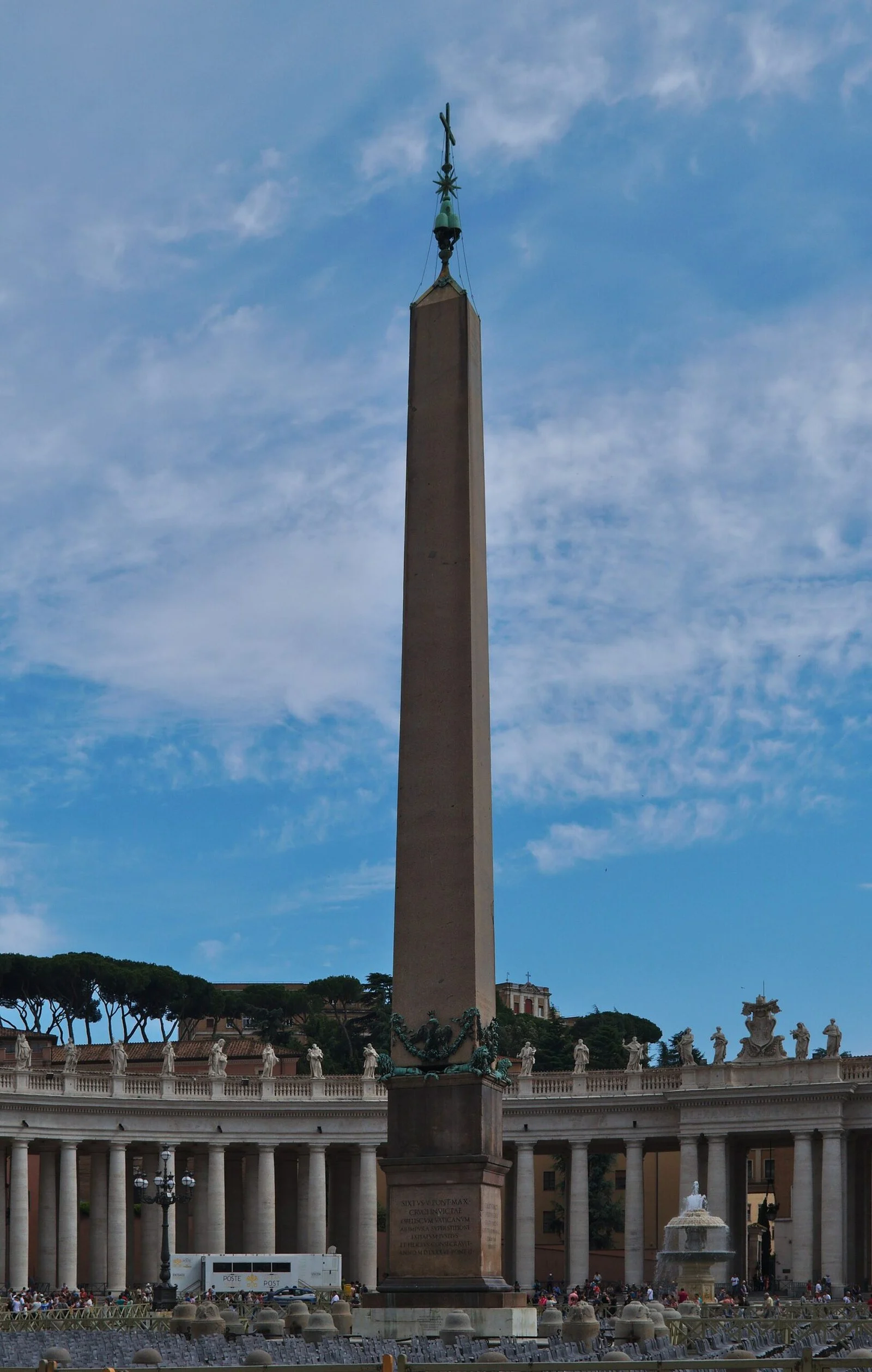
The Vatican Obelisk is the red granite monolith set in the middle of St. Peter's Square, in front of the facade of St. Peter's Basilica, in the heart of Vatican City. Among the 13 ancient obelisks left in Rome, it holds the most unusual record: it's the only one that has never fallen. All the others, sooner or later, ended up on the ground, broken and buried, and were dug up in pieces over the centuries. Not this one. Since Caligula had it brought from Alexandria in Egypt and set up on the spina of the imperial circus that occupied the Vatican valley, the shaft has stood upright without interruption: it has seen the circus disappear, a necropolis grow, the Constantinian basilica rise and then fall, and in 1586 it moved a few hundred meters while staying on its feet almost the whole time. It's also an anomalous obelisk for another reason: it has no hieroglyphs. Not one. The pages that follow tell where it comes from, why it's mute, what was really inside the bronze globe that topped it, how it was moved, what is anecdote in the most famous story about it, and why the square today uses it as the needle of a sundial.
Where the Vatican Obelisk is and how to get there
The Vatican Obelisk stands exactly in the middle of the oval of St. Peter's Square, the large space enclosed by Gian Lorenzo Bernini's colonnade, on the territory of Vatican City but freely open to the public and, by express provision of Article 3 of the 1929 Lateran Treaty, subject to the police powers of the Italian authorities up to the foot of the basilica's steps. In practice you reach its bronze lions without a ticket, without a reservation and without crossing a border in the ordinary sense: you walk along Via della Conciliazione and you're inside.
On foot from the center of Rome
The classic route is along Via della Conciliazione, opened between 1936 and 1950 by demolishing the so-called spina di Borgo: from Castel Sant'Angelo it takes just under 10 minutes, with the obelisk in line between the buildings well before the facade. If you start from Piazza Navona, you cross Ponte Sant'Angelo and it takes about 20 minutes. From the Pantheon the walk is a little longer. Entering on axis is not the only way in, nor the most interesting: coming from Via di Porta Angelica, on the north side, you enter the oval at an angle and the obelisk suddenly appears against the colonnade, with a scenic effect very different from the frontal one.
By public transport
The closest metro stop is Ottaviano, on line A, from which you walk for about 10 minutes along Via Ottaviano to Piazza del Risorgimento and then to Via di Porta Angelica. The Roma San Pietro railway station, on the regional network, is on the opposite side of the hill. Several city bus lines drop you a few hundred meters from the square. If you're coming from Termini, you can take metro A toward Battistini and get off at Ottaviano: it's the most predictable solution on days of heavy crowds, when surface buses are the first to be rerouted.
The checks at the entrance to the square
To enter the oval of St. Peter's Square you go through gates with security checks, which may be active on some or all of the entrances depending on the day and the celebrations under way. On ordinary days the transit is quick. On days of the general audience, on major solemnities and in Jubilee periods the lines can grow considerably long, and the square is sometimes closed to free passage for liturgical or public order reasons. There is no ticket to stand in the square and look at the obelisk: a ticket is needed, if anything, for the basilica's dome, for the necropolis under the central nave and for the Vatican Museums, which have their entrance somewhere else entirely, on Viale Vaticano.
If you're arriving by car, you'd do well to give it up: the area is heavily regulated and parking is scarce and expensive. On days of papal celebrations it's wise to find out in advance about the closing times of the gates, because the square can be fenced off several hours before the event.
What the Vatican Obelisk is: size, material, weight
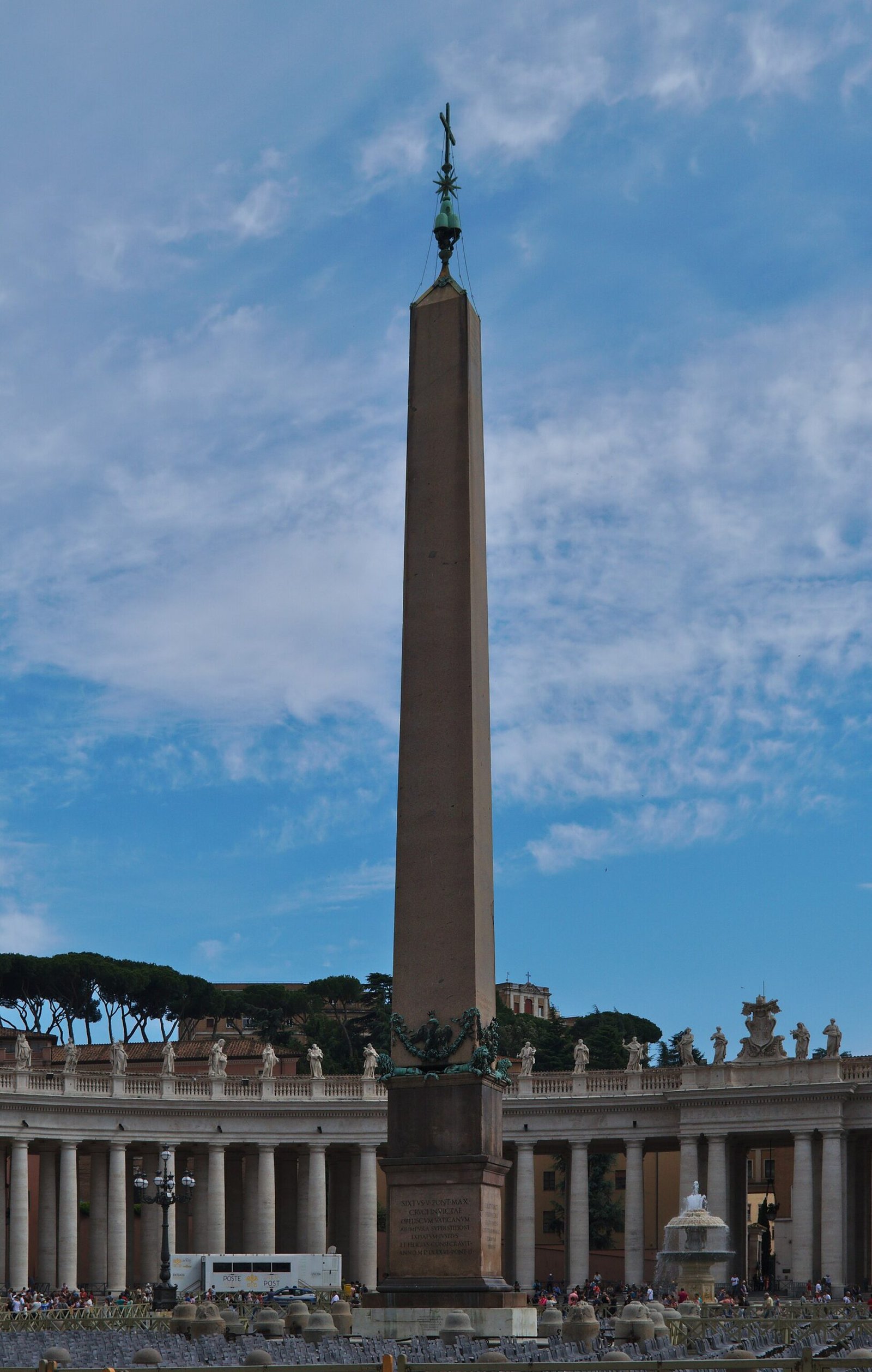
The Vatican Obelisk is a red granite monolith about 25.3 meters high in the shaft alone, which with the base and the cross on top reaches just over 40 meters in all. Sources differ by a few centimeters on the shaft (25.3 or 25.37 meters depending on the survey) and give a total height of almost 40 meters, with a precise value of 40.28 meters reported by some entries. The weight of the shaft alone is estimated at just over 320 tons. The figure that recurs most in Italian sources is 327 tons, while other publications round to 330 or even 350. When you read different figures, it's worth remembering that nobody has ever put the obelisk on a scale. They are all estimates worked out from the volume and the density of granite.
The base, the lions and the cross
The shaft rests on a base obtained by separating the stone from the pedestal by means of four bronze lions, the work of the sculptor Prospero Antichi, which serve as supports at the corners. The lions are not neutral decoration: the lion is the heraldic emblem of Sixtus V, the pope who wanted the move, and their presence amounts to a signature. At the top, in place of the ancient bronze sphere, a large bronze cross rises with the symbols of the papal family. The pedestal bears four Latin inscriptions composed by Cardinal Silvio Antoniano that comment theologically on the operation, and lower down, in smaller letters, an acknowledgment of Domenico Fontana's role.
The modern inscriptions
On the side facing east you read ECCE CRVX DOMINI FVGITE PARTES ADVERSAE VICIT LEO DE TRIBV IVDA, that is, "behold the cross of the Lord, flee, hostile parties, the lion of the tribe of Judah has conquered". It's the most quoted formula and the one visitors photograph most often. On the opposite side runs the acclamation CHRISTVS VINCIT CHRISTVS REGNAT CHRISTVS IMPERAT. The other two faces record that Sixtus V transported the obelisk, "dedicated in impious worship to the gods of the nations", to the threshold of the Apostles and consecrated it to the unconquered cross, in the year 1586, the second of his pontificate. It's an explicit polemical program: the obelisk is declared purified of an impure superstition and reconsecrated.
The only obelisk in Rome that has never fallen
The Vatican Obelisk is the only one among Rome's ancient obelisks that has never collapsed to the ground. It has stood upright from the moment it was raised in the Vatican valley, in the age of Caligula, until today, with the sole interruption of the weeks in 1586 when it was deliberately lowered, transported and raised again. The difference from the others is not a detail for record collectors: it's the reason this monolith has a continuous and verifiable biography, while the others have long gaps of centuries in which nobody knows where they were.
What happened to the others
Rome's obelisks almost all have the same trajectory: raised between Augustus and the Severans, toppled between late antiquity and the early Middle Ages, buried under debris, found in pieces between the Renaissance and the 1800s and raised again with modern additions. The monolith that today dominates Piazza del Popolo lay on the ground for centuries in the Circus Maximus before being put back on its feet, precisely under Sixtus V. The Lateran one, the tallest of all, was found broken into three pieces. Even the obelisks of Villa Torlonia, which are 19th-century and not ancient, show how long the Roman taste for obelisks survived the disappearance of the real ones.
The Egyptian origin and the case of the anepigraphic obelisk
The Vatican Obelisk is anepigraphic, that is, without hieroglyphs on all four faces. It's the only Egyptian obelisk in Rome that carries no pharaonic inscription, and this absence is its real enigma. An Egyptian obelisk without text is a contradiction in terms, because the text was the obelisk: the vertical columns of hieroglyphs declared the name of the ruler who had offered the monolith to the sun god and fixed his memory forever. A mute monolith is a monolith with no patron and no date.
Why it's a special case
The question scholars ask is twofold: did the obelisk never have inscriptions, or did it have them and were they erased? Both hypotheses are on the table and neither has been proven. The first imagines a monolith quarried and raised without ever being completed with the text. The second imagines a shaving of the faces, carried out in Egypt in the Ptolemaic or Roman age, to reuse the piece in a new context. A third line of reading suggests that the monolith is not a pharaonic obelisk at all but a late work made on Roman commission in Egypt, where the workshops and quarries were still active. In that case the absence of hieroglyphs would not be a loss but a choice, consistent with a monument designed from the start for an audience that read Latin.
What the ancient sources say
Pliny the Elder, who in the 36th book of the Naturalis Historia devotes a fundamental discussion to obelisks, gives Heliopolis as the origin of this monolith, the great city of the solar cult in the Nile delta. Before reaching Rome the monolith was set up in the Forum Iulii of Alexandria in Egypt, the monumental complex dedicated to the memory of Caesar that the Romans built in the port city. Some reconstructions add that the original project provided for a much taller shaft, perhaps around 45 meters, and that the monolith fractured during the first installation in Alexandria. It's a hypothesis that would explain the stocky proportions compared with the canonical pharaonic obelisks, but it isn't confirmed by direct testimony and should be taken for what it is, a modern reconstruction.
The only ancient inscription it really carries
Mute in Egyptian, the monolith speaks instead in Latin. At the base of the shaft two Roman inscriptions survive that record its original dedication: DIVO CAESARI DIVI F AVGVSTO TI CAESARI DIVI AVGVSTI F AVGVSTO SACRVM, that is, "sacred to the divine Caesar Augustus, son of the divine, and to Tiberius Caesar Augustus, son of the divine Augustus". It's a dedication to the first deified emperor and to his successor, and it places the monument in a precise Julio-Claudian political horizon. The paradox is worth savoring: the most famous obelisk of Christendom carries not a single word of Egyptian but preserves, carved a couple of steps from the lions of Sixtus V, the consecration to two deified Roman emperors.
Caligula's ship: how a 300-ton monolith crossed the Mediterranean
The Vatican Obelisk reached Rome by sea on a ship built specially, which ancient sources describe as the largest ever seen on the Mediterranean up to that time. The date of arrival varies in the sources between 37 and 40 AD. The year 37 is when Caligula became emperor and had the circus started in the horti inherited from his mother Agrippina the Elder, and several entries link the arrival of the monolith to that initial construction site. Other sources, including the most consulted Italian encyclopedia entry, give 40. Since there is no document that settles the question, both dates should be reported.
Lentils as ballast
Pliny the Elder, in the 16th book of the Naturalis Historia, reports a detail that made this voyage famous: the ship carrying the obelisk had as ballast 120,000 modii of lentils. The reason is technically elegant. A dry, granular cargo that could be spread evenly in the hold served to stabilize the hull around an enormous, concentrated weight, and could be shifted or lightened with relative ease during the voyage and on arrival. It wasn't a whim. It was the way the trim was controlled on a ship built for a single voyage and a single cargo.
What became of the ship
The ship stayed at Ostia as a curiosity, and occupied a considerable portion of the harbor basin. Then it had a second life, or rather a second death. Pliny and Suetonius tell that the emperor Claudius, busy building the great artificial harbor at the mouth of the Tiber, had that very ship sunk by filling it with concrete, fixed it with piles and built on top of it a very tall tower modeled on the lighthouse of Alexandria, meant to guide sailors at night. It's one of the best documented cases of monumental reuse of a hull in antiquity: the same wood that carried the obelisk to Rome ended up under the foundations of the lighthouse of Portus.
The circus of Caligula and Nero, where the obelisk lived its first 15 centuries
The Vatican Obelisk was raised on the spina of the private circus that Caligula had built starting in 37 AD inside the Horti Agrippinae, the gardens inherited from his mother, and that Nero reorganized and used in turn. The structure, known in the sources as the circus Gai et Neronis, measured about 540 meters in length by around a hundred in width and occupied the valley between the Vatican hill and the Tiber, in the area now covered by the basilica and the buildings behind it.
What the spina was and why it needed an obelisk
The spina was the low, elongated wall that ran down the middle of the track and around which the chariots turned. On it were placed basins, statues, markers for counting the laps and, when the emperor could afford it, an obelisk. It wasn't gratuitous ornament: the monolith served as a visual reference and as a symbolic element that tied the chariot race to the course of the sun, an association also clearly visible in the Circus Maximus, where Augustus had placed an obelisk brought from Egypt after the conquest.
The tradition of Peter's martyrdom
A clear warning is needed here, because this is the point where tradition is most often confused with history. That executions of Christians took place in the area of the Vatican circus after the great fire of 64 AD rests on an ancient text. Tacitus, in the 15th book of the Annales, describes harshly the executions ordered by Nero: men covered in skins and torn apart by dogs, the crucified, the condemned burned like torches to light up the night. He adds that Nero offered his own gardens for the spectacle and put on circus games there. But Tacitus doesn't name Peter and doesn't name the obelisk. The idea that the monolith witnessed the apostle's martyrdom, and that having stayed upright makes it the last eyewitness of that day, is an ancient and tenacious Christian tradition, not an established fact. The oldest testimony on Peter's burial in the Vatican is that of the presbyter Gaius, who lived between the 2nd and 3rd centuries, reported by Eusebius of Caesarea, who speaks of trophies of the apostles in the Vatican and on Via Ostiense. Saying "the obelisk saw Peter die" is a beautiful sentence and should be left with its status: it's tradition, not certainty.
Where exactly it stood
Until 1586 the obelisk stayed where it had been set up, on the southern flank of the old basilica, next to the rotunda of Sant'Andrea, a circular building of the Roman age reused as a chapel and known as Santa Maria della Febbre. You can see it in this position in 16th-century views, including the drawings of Maarten van Heemskerck: the monolith appears isolated, next to buildings that no longer exist today.
A curiosity about the Vatican Obelisk
For over a thousand years the Romans believed that the bronze globe placed on top of the Vatican Obelisk held the ashes of Julius Caesar, and when in 1586 the sphere was lowered to the ground and opened, it turned out to contain nothing. It was the collapse of one of the longest-lived beliefs in Roman topography, and it happened before the eyes of a crowd that had gathered for the purpose.
A deeply rooted medieval conviction
The legend circulated in medieval guides for pilgrims and in the Mirabilia Urbis Romae. According to some versions the sphere kept the ashes of Caesar, according to others those of Trajan, and in the devotional versions those of St. Peter, and the monument was commonly called the needle of Caesar. From this tangle would derive, according to a folk etymology that is still widespread, the term aguglia used for obelisks, later turned into guglia. The most solid linguistic hypothesis, however, traces the word to the Latin acucula, little needle, and the connection with the imperial eagle should be considered a false etymology.
What happened when they opened it
In 1586, during the moving operations, the sphere was removed from the top and checked. It was empty. Sixtus V gave it to the city of Rome, and from that moment the globe began a small urban pilgrimage of its own. It was placed first near the fountain of Marforio, in 1692 on the balustrade of the square on the Capitoline Hill, and finally, in the first half of the 1800s, brought inside the Palazzo dei Conservatori, where it is still kept today in the Capitoline Museums collections together with the finial that supported it. Sources differ on the exact year it entered the palace, given now as 1848 and now as 1850.
Something nobody tells you about the Vatican Obelisk
The Vatican Obelisk isn't on the axis of St. Peter's Basilica. It's offset by about a meter and a half to the north from the axis of the present building, a gap measured at 1.56 meters that no guide mentions and that almost no visitor notices with the naked eye. The most symmetrical square in the world has, at its exact center, an error.
Why it happened
The explanation is chronological before it is technical. In 1586 the new basilica didn't yet exist in its present form: the construction site had been moving ahead for decades starting from the apse area, and the old Constantinian basilica was still standing and in use in the western portion. Fontana took as his reference what he could see, that is, the axis of the ancient building, and placed the obelisk accordingly. 20 years later, when Carlo Maderno lengthened the church toward the east and built the facade on it, the final axis of the building turned out slightly different and the monolith found itself off center. There was also a practical reason not to correct it: moving the obelisk onto the new axis would have brought it too close to the blocks that then closed off the square to the south, whose demolition was decided only much later.
How Bernini solved the problem
When 70 years later Bernini had to give shape to the square, he found himself with an obelisk already planted, immobile and off axis, and with a wide, low facade that he himself called squat. The solution was to accept the constraint and rotate the major axis of the oval to make it parallel to the facade, unloading the residual deformation onto the trapezoidal part. It's a textbook example of what Bernini himself formulated as a principle: an architect's skill is known above all in converting the defects of a site into beauty. The defect, in this case, was a 300-ton monolith that nobody intended to move a second time.
The 1586 move and Domenico Fontana's machine
On September 10, 1586 the Vatican Obelisk was raised in the middle of St. Peter's Square after being transported about 250 or 260 meters from its original position. It was the first ancient obelisk to be put back on its feet in the modern era, and the feat made Domenico Fontana the most famous architect in Europe within a single season.
The idea came from far back
Sixtus V wasn't the first to think of it. The idea of moving the monolith in front of the basilica had already circulated under Nicholas V, in the 1400s, within an overall plan to reorganize the Vatican area that went nowhere. In the following decades the question came back to the table several times, always with the same obstacle: nobody knew how it was done, and the ancient skills had been lost. When Felice Peretti became pope in 1585 with the name of Sixtus V, the project fit into an urban plan that redrew Rome with straight streets, aqueducts and obelisks placed as visual signals in front of the great basilicas, from Santa Maria Maggiore to St. John Lateran.
The machine: the timber castle
The device designed by Fontana, which his contemporaries called the castle, was a tower of massive wooden beams bound with iron hoops, assembled around the obelisk and able to support its weight while it was lifted from the ancient pedestal. The monolith was wrapped in mats and planks, harnessed with ropes that passed through dozens of pulley blocks, lifted, lowered onto a horizontal scaffold and dragged on rollers along an inclined plane to the new pedestal, where the maneuver was repeated in reverse. The system was an orderly multiplication of simple machines: winches, levers, pulleys and inclined planes, the same tools the Egyptians and Romans had. Fontana's novelty was organizational as much as mechanical: the synchronization of hundreds of men on dozens of winches, each with a codified task and a command signal.
The numbers, and why they don't match
The figures vary depending on the source, and it's worth reporting them all. The most widespread Italian tradition speaks of 13 months of preparatory work, 900 men, 75 horses and 40 winches. The English encyclopedia entry gives 800 men, 160 horses and 45 winches. Other publications report 800 workers and 140 horses. The divergence comes from the fact that the figures that circulated over the centuries derive from later rereadings of the original account and don't always distinguish between the men employed on the single day of the lifting and those involved in the whole construction site. On one point the sources agree: the lowering, the transport and the raising again took up the whole season, while the final erection was completed in a single day, September 10.
The book that made Fontana famous
In 1590 Domenico Fontana published in Rome, from the presses of Domenico Basa, the volume Della trasportatione dell'obelisco Vaticano et delle fabriche di Nostro Signore papa Sisto V, with large engraved plates illustrating step by step the castle, the harnesses, the inclined plane and the layout of the winches. It's one of the first modern treatises of illustrated engineering, today fully digitized by several libraries. After the Vatican success Fontana was entrusted with the moving of three other Roman obelisks.
Water to the ropes: how the most famous story should be told
The episode of "water to the ropes" is the most repeated anecdote about the Vatican Obelisk and should be presented for what it is: a popular tradition with no contemporary documentary support, not an established fact. The current version tells that during the lifting on September 10, 1586 an absolute obligation of silence was in force, with the death penalty for anyone who shouted. The hemp ropes began to heat up and give way. A Ligurian sailor, Benedetto Bresca, from Bordighera or Sanremo depending on the variants, shouted in his own dialect to wet the ropes, saving the operation. Arrested and then pardoned, he would have obtained for himself and his descendants the privilege of supplying the Vatican with the palms for Palm Sunday. The privilege of the palms for Ligurian families is real and documented. That its origin is the obelisk is the handed-down explanation, not verified news.
What holds up and what doesn't
The physical basis is sound: wet hemp contracts, and wetting ropes under tension is sensible seamen's practice. What's missing is documentation of the episode at the time it would have happened: the very detailed account that Fontana published four years later, which describes every phase of the construction site with the precision of someone who wants to prove his competence, contains nothing of the kind. The story appears in later publications and gets enriched with details that change from version to version: the sailor's town of origin, the exact words of the shout, the presence or absence of the executioner.
The cross of Sixtus V and the question of the relics
On top of the Vatican Obelisk, in place of the ancient bronze sphere, Sixtus V had a large bronze cross placed in 1586, and the story of the relics that were supposedly inserted in it is more complicated than it is usually summarized. Replacing the globe with the cross was the symbolic heart of the whole operation: a pagan monument wasn't destroyed but reversed in meaning, and the Christian sign physically took the place of the imperial sign.
The indulgence and the deduction
Sixtus V granted an indulgence to anyone who, in front of the obelisk, venerated the cross of Christ by reciting a Pater and an Ave. The sources speak of 10 years and as many quarantines. The very existence of this indulgence led to the deduction that a particle of the True Cross had been inserted in the bronze cross, on September 26, 1586. It's a deduction, not direct news: nobody had documented the insertion, and the conclusion was that a relic must be there because otherwise the indulgence couldn't be explained.
The restoration that found nothing
When the cross underwent restoration, the relic was not found. The fact is reported consistently by the Italian and English encyclopedia entries and is one of those details that rarely reach the public, because they take apart a neat story. The reasonable conclusion is that the 1586 indulgence concerned the veneration of the cross as a sign, and not the cult of a relic contained inside it.
The relic of 1740
A relic of the True Cross was placed in the cross at the top on April 12, 1740, taken from a reliquary of St. Peter's Basilica that in turn came from that of Santa Croce in Gerusalemme. The news is reported by Gaetano Moroni's Dizionario di erudizione storico-ecclesiastica, the imposing 19th-century reference work that remains one of the main sources for the small-scale history of Vatican matters. So, to sum up: the relic in the cross is there today, but it arrived in the 1700s, not with Sixtus V.
Image: the top of the obelisk with the bronze cross, seen from below against the light, with the granite pyramidion tapering upward.
The sundial of St. Peter's Square: the obelisk as gnomon
The Vatican Obelisk works as the gnomon, that is, the shadow-casting needle, of a sundial laid out in the paving of St. Peter's Square in 1817 by the astronomer Monsignor Filippo Luigi Gilii during the pontificate of Pius VII. According to the description given by the Holy See's own official website, it is one of the largest sundials ever made.
How it's made
The sundial consists of a straight line of gray granite set in the paving, which starts from the base of the obelisk and runs toward the colonnade, interspersed with marble discs. The two end discs mark the solstices of June 22 and December 22, when the shadow is respectively the shortest and the longest. Five other discs mark the passage of the sun through the pairs of zodiac signs: Leo and Gemini, Virgo and Taurus, Libra and Aries, Scorpio and Pisces, Sagittarius and Aquarius. The pairing works because the sun crosses the same declination twice a year, rising and falling, and the same disc serves for two different moments of the calendar. The discs have been replaced several times, with documented interventions in 1852, between 1878 and 1880 and in 1924: the ones visible today are not all original from 1817.
How to read it
The thing to watch is not the shadow of the shaft but that of the cross on top, the highest end. At true local noon the shadow of the cross falls on the granite line and its length indicates the solar declination, and so the season. True noon almost never coincides with noon on your wristwatch, because the equation of time, the time zone and daylight saving time come into play: in summer the gap can exceed an hour and a half.
My advice for visiting the Vatican Obelisk
The best moment to see the Vatican Obelisk is early on a weekday morning, between the opening of the gates and 9:00, when the square is almost empty, the low light brings out the granite and you can walk to the base without going around groups. In the middle hours, and on any day of a general audience or celebration, the square changes nature completely and the obelisk becomes a landmark in the middle of the crowd instead of a monument to look at.
The discs at the center of the colonnade
Between the obelisk and each of the two fountains, set in the paving, there are two stone discs that mark the construction centers of Bernini's oval. If you stand exactly on one of them and look toward the colonnade, the four rows of columns line up perfectly and you see a single row instead of four. It's the square's most famous perspective trick and it's free: it only costs the patience to find the disc and to wait for someone to move. From there, turning toward the obelisk, you also get the best overall shot with the dome in the background.
How to fit it into a day
The obelisk doesn't take a lot of time. It takes the right time. The square is flat and wheelchair accessible, with paving of sampietrini and slabs, but it doesn't offer a meter of shade outside the colonnade: in July and August standing around in the middle of the day is tiring, and it's wise to bring water and a hat. If you've booked the Vatican Museums for the morning, you'd do well to stop by the square first, because the exit from the museums is at a completely different point and going back means a considerable walk around the walls. If you're heading for the Sistine Chapel in the afternoon, you can keep the square for sunset. The climb to the dome, the Vatican necropolis or the basilica's treasury requires tickets and, in some cases, reservation well in advance. The hours change with the season and with the liturgical calendar, and it's wise to check them directly with the Fabbrica di San Pietro before planning the day.
What you see here and what elsewhere
The site already has a page dedicated to St. Peter's Basilica, which goes deeper into the interior, the dome and the works. Here the focus stays on the obelisk alone and the square around it. It's worth remembering that the Vatican tradition on the place of Peter's martyrdom has a historical rival, the one that places it on the Janiculum hill, where the Tempietto del Bramante stands. The two have coexisted for centuries and neither has been proven.
Another well-known fact, yet rarely cited
Bernini's square was built around the Vatican Obelisk and not the other way around. When the architect received the commission from Alexander VII, in 1656, the monolith had already been in place for 70 years and was a non-negotiable constraint, so much so that the whole geometric layout of the oval had to be calibrated on it.
The round oval and not the ellipse
The figure Bernini chose is not an ellipse but a round oval, that is, the union of two semicircles that intersect at their respective centers, joined by two circular arcs. It wasn't an academic choice: the round oval is drawn with a cord and stakes and is passed on to the master builder without ambiguity, while a true ellipse would have been harder to lay out on the ground and unusual in the sacred architecture of the time. And it is precisely the geometry of the round oval that generates those two construction centers marked by the discs in the paving.
The figures of the square
The colonnade is made up of 284 columns 16 meters high arranged in four rows, according to the data provided by the basilica's official website, topped by 140 statues of saints more than three meters high. Other sources, counting also the sculptures of the connecting arms, reach 162. The two parts of the square measure about 12,300 square meters for the trapezoid in front of the facade and about 35,300 square meters for the oval, and the complex was completed in 1667. Bernini also lowered the ground level in front of the basilica to reduce the difference in height with the base of the obelisk: the final difference in elevation is about 6 meters over a distance of 200, that is, a slope of 3 percent, enough to drain rainwater without steps.
The cross, the dome and the alignment
There is an alignment that visitors almost never notice. The statue of Christ crowning the facade, a work of Bernini among those of the apostles, has its cross on the same vertical line that connects the cross of the dome behind and the cross of the obelisk in front. Three crosses on a single axis, at very different distances, read as a single sign by someone looking from the right spot in the square: a visual direction that holds together the work of Michelangelo, that of Maderno, that of Bernini and a 2,000-year-old Egyptian monolith.
The right photo to take of the Vatican Obelisk
The best photograph of the Vatican Obelisk is not the frontal one from the center of the square, but the one taken from one of the two discs that mark the centers of the oval, where the four rows of columns line up into one and the monolith enters the frame from the side. It's the only point where you photograph at the same time Bernini's perspective trick and the oldest element of the square.
Time and light
The basilica's facade faces east and catches the sun in the morning: in the early hours the stone lights up and the red granite shows its color, while in the afternoon the facade goes into shadow and the contrast flattens. For a silhouette of the cross on top you need late afternoon, on the western side, against the low sun. At night, with the basilica lit, a long exposure works well with the camera resting on a parapet, since tripods in the square aren't always allowed.
Framing the details
Three details work better than an overall view: the bronze lions at the base, photographed from below at three quarters to show their function as supports. The ancient inscription at the base of the shaft, the dedication to Augustus and Tiberius, readable with a moderate telephoto lens and low light. The marble disc of the sundial with the gray granite line, shot from above with a shoe or a hand in the frame to give the scale.
Some important events that took place here in history
The Vatican Obelisk stayed in the same spot in the Vatican valley for over 1,500 years and then in the middle of St. Peter's Square for another 440. Around its base some of the most photographed events of recent history have taken place.
Antiquity and the Middle Ages
Between 37 and 40 AD the monolith is raised on the spina of the imperial circus. In 64, according to Tacitus's account, the area of the Neronian gardens is the scene of the executions of Christians accused of the fire of Rome. Around the middle of the 2nd century the circus is abandoned and the area is divided into lots for burials. In the 4th century Constantine has the great basilica built over the memory of the apostle's tomb, burying the necropolis and creating the esplanade called platea Sancti Petri. Throughout the Middle Ages the obelisk is a landmark for pilgrims and feeds the legend of the imperial ashes.
The 1500s
In 1500, for the Jubilee, Alexander VI has Via Alessandrina opened between Ponte Sant'Angelo and the Vatican palace, the first modern straight road in Rome, demolishing for it the Meta Romuli, a monumental pyramid-shaped tomb. In 1586 the obelisk is moved: the globe is lowered and found empty, the monolith is raised again on September 10, the cross takes the place of the sphere and the inscriptions of Sixtus V reconsecrate the monument.
The 1600s and the birth of the square
Between 1656 and 1667 Bernini builds the colonnade and the oval, giving the square the form we know and taking the obelisk as its geometric center. In the 1700s, on April 12, 1740, the relic of the True Cross is placed in the cross on top. In 1817 Filippo Luigi Gilii lays out the sundial that uses the obelisk as gnomon.
The 1900s
In 1929 the Lateran Pacts establish the special status of the square, which is part of Vatican City but remains open to the public and subject to Italian police powers up to the foot of the steps. Between 1936 and 1950 the demolition of the spina di Borgo opens Via della Conciliazione and erases the Alexandrine axis. Between 1939 and 1949 the excavations under the basilica take place that bring the Vatican necropolis back to light. On May 13, 1981, during a general audience, John Paul II is wounded by gunshots a few meters from the obelisk. The custom of the Christmas tree next to the nativity scene dates from 1982. In April 2005 the funeral of John Paul II fills the square and the surrounding streets. On March 27, 2020, in the middle of the pandemic, the empty square in the rain during the extraordinary Urbi et Orbi blessing produces one of the most widely circulated images of the century, in that case too with the obelisk at the center of the frame.
Who has passed by the Vatican Obelisk
In front of the Vatican Obelisk have passed, in order, Roman emperors, medieval pilgrims, Renaissance architects, Grand Tour travelers and 20th-century heads of state. It's probably the single point in Rome in front of which the greatest number of people documented by name in European history have passed.
The ancients
Caligula had it brought and raised. Nero raced around it with chariots in the family circus. Pliny the Elder recorded its origin and voyage in the Naturalis Historia, and his testimony remains the main ancient source. Claudius reused its ship for the harbor lighthouse. Constantine decided to build the basilica next to the monolith rather than move it, and with that choice he handed it down to the following centuries.
Artists and architects
Maarten van Heemskerck drew it in 1532 in its original position, next to the rotunda of Sant'Andrea and the construction site of the new basilica, leaving one of the most precious visual testimonies of the look of the area before the move. Domenico Fontana moved it and made a book of it. Gian Lorenzo Bernini built the square around it, accepting its off-axis position. Giovanni Battista Piranesi engraved it in his 18th-century views of St. Peter's Square, helping to fix its image in the European imagination. Prospero Antichi sculpted its lions, Cardinal Silvio Antoniano wrote its inscriptions, Ignazio Danti assisted Fontana with the astronomical and measuring side.
The popes
Nicholas V was the first to imagine moving it. Sixtus V carried it out and made it the manifesto of his pontificate. Alexander VII commissioned from Bernini the square that surrounds it. Pius VII authorized the sundial. Pius XI and Pius XII signed and saw applied the Pacts that defined its legal status. John Paul II, Benedict XVI and Francis had it behind or in front of them in thousands of audiences and celebrations.
Travelers and writers
The Grand Tour made St. Peter's Square a required stop, and the obelisk appears in the notebooks of generations of northern European travelers. Goethe, who lived in Rome between 1786 and 1788 and whose Roman residence is now a museum, devoted pages of his Italian Journey to the basilica and the square. Stendhal, Dickens and Henry James all described, with very different judgments, the effect of arriving in the oval.
Frequently asked questions about the Vatican Obelisk
How much does it cost to see the Vatican Obelisk?
Seeing the Vatican Obelisk is completely free: the monument is in the middle of St. Peter's Square, which is freely open to the public and requires neither a ticket nor a reservation. You do pay for the climb to the basilica's dome, for the visit to the Vatican necropolis and for the Vatican Museums, which have a separate entrance on Viale Vaticano. Access to the square is through gates with security checks.
How tall is the Vatican Obelisk?
The Vatican Obelisk measures about 25.3 meters in the granite shaft alone and reaches just over 40 meters counting the base with the bronze lions and the cross on top. Some surveys give 25.37 meters for the shaft and 40.28 meters for the total height. The weight of the monolith is estimated at just over 320 tons, with figures that in different sources range between 327 and 350 tons.
Why doesn't the Vatican Obelisk have hieroglyphs?
The Vatican Obelisk is anepigraphic, that is, without hieroglyphic inscriptions on all four faces, and it is the only Egyptian obelisk in Rome in this condition. It isn't known if the monolith never had inscriptions or if they were erased before the transfer to Rome. It does carry a Latin dedication to the divine Augustus and to Tiberius, carved at the base of the shaft in the Roman age.
Is it true that the Vatican Obelisk has never fallen?
Yes, the Vatican Obelisk is the only one among Rome's ancient obelisks that has never collapsed. It has stood upright from the age of Caligula until today, with the sole exception of the weeks in 1586 when it was deliberately lowered to be transported to the middle of the square. All the other Roman obelisks fell between late antiquity and the Middle Ages and were found and raised again in later periods.
What was in the bronze globe of the Vatican Obelisk?
The bronze globe that topped the Vatican Obelisk was empty: when it was lowered to the ground in 1586, during the move, it turned out to contain nothing, disproving the medieval belief that it kept the ashes of Julius Caesar or, in other versions, of Trajan or St. Peter. The sphere is now on display at the Capitoline Museums, in the Palazzo dei Conservatori, together with the finial that supported it.
Who moved the Vatican Obelisk to the middle of the square?
The Vatican Obelisk was moved to the middle of St. Peter's Square in 1586 by the architect Domenico Fontana at the will of Pope Sixtus V, with a transfer of about 250 meters from the original position next to the old basilica. The final erection took place on September 10, 1586. Sources differ on the numbers employed: they speak of 800 or 900 men, of 75, 140 or 160 horses and of 40 or 45 winches.
Is the episode of the water on the ropes true?
The episode of the water on the ropes linked to the Vatican Obelisk should be considered a popular tradition and not a historically established fact: the story of the Ligurian sailor who supposedly shouted to wet the ropes, breaking the obligation of silence, doesn't appear in the detailed account that Domenico Fontana published in 1590. The physical principle is sound, but the scene consolidated in the publications of the following centuries.
What is the marble line on the ground near the Vatican Obelisk?
The line of gray granite with marble discs that starts from the base of the Vatican Obelisk is a sundial laid out in 1817 by the astronomer Filippo Luigi Gilii, which uses the obelisk as gnomon. The two end discs mark the solstices of June 22 and December 22, while five others indicate the passage of the sun through the pairs of zodiac signs. The reference to watch is the shadow of the cross on top.
Is the Vatican Obelisk accessible to people with disabilities?
The square that hosts the Vatican Obelisk is flat and wheelchair accessible, with an overall slope of about 3 percent between the base of the monolith and the basilica's steps. The paving of sampietrini and slabs can be uncomfortable. There are no areas of shade in the oval, so on summer days it's best to plan the visit for the early morning hours or late afternoon.
One last tip for those planning the itinerary
The Vatican Obelisk is the monument almost everyone walks past and almost nobody looks at: you arrive in the square aiming for the basilica or the museums, you pass three meters from a 2,000-year-old Egyptian monolith and you don't register it. Anyone who gives it 10 minutes, reading the inscriptions and looking for the sundial before going into the basilica, takes home a different idea of the whole complex: the square was built around that granite and not the other way around. In the plan of a Roman day it works well early in the morning, linked to Castel Sant'Angelo and the lungotevere, or at sunset as the close of a route coming from the historic center.
If you're organizing a broader itinerary, combining the Vatican with the stops in the historic center and with destinations outside Rome, you may find useful planning tools on Tour Leader Pro, while for an overall picture of transport, regional travel and destinations in Lazio, Italy Planner is a good resource.