A Weekend in Rome: What to See in Two Days
In short. A weekend in Rome is, in practice, two full days and two half evenings: if you arrive on Friday evening and leave on Sunday evening you have about 28 hours of useful city ahead of you, because the time lost to lines, transfers and meals…
A weekend in Rome is, in practice, two full days and two half evenings: if you arrive on Friday evening and leave on Sunday evening you have about 28 hours of useful city ahead of you, because the time lost to lines, transfers and meals weighs as much as the time spent inside the monuments. In two days you can see two blocks well: ancient Rome between the Colosseum, the Roman Forum and the Capitoline Hill, and the Baroque Historic Center between the Pantheon, Piazza Navona and the Trevi Fountain. The Vatican is a third block that fits only by sacrificing something. The calendar matters more than the season, because the Vatican Museums are closed every Sunday except the last of the month and the Galleria Borghese is closed on Monday: a two-day itinerary that ignores these two facts breaks at the first reservation. If you have one more day, you'll find the route laid out in the guide to three days in Rome.
What you can really see in two days, and what you can't
A weekend in Rome can hold two big visits a day plus the neighborhoods explored on foot: if you try to do four, you run around without remembering anything. The measure comes from the real length of the visits. The Colosseum with the Roman Forum and the Palatine Hill takes between three and a half and four and a half hours with the lines. The Vatican Museums with the Sistine Chapel don't go under three hours, and with St. Peter's Basilica right after you get to five. That leaves, for each day, three or four hours to spend between a long walk, a sit-down lunch and a small museum.
The two-visits-a-day rule
Two visits means two paid admissions with a ticket, not two places. Squares, fountains, churches and bridges don't count, because they have no threshold and no line: crossing Piazza Navona, going into San Luigi dei Francesi for the Caravaggios and going up to the Pincio all fit in the same afternoon together with a museum. Adding up the Capitoline Museums, Castel Sant'Angelo and the Galleria Borghese in the same day instead means watching the clock inside all three.
What stays out, and why that's fine
In two days what almost always stays out is the Appia Antica Park with the Catacombs of San Callisto, Ostia Antica, Hadrian's Villa in Tivoli, Palazzo Massimo alle Terme and the Aqueducts Park: they belong to a stay of four or five days. St. John Lateran and Santa Maria Maggiore can instead be recovered in a one-hour detour.
If the days become three
The difference between two and three days is not a third more city: it's the possibility of devoting a morning to the Vatican without squeezing the rest and a whole afternoon to an area far from the center. If you have the third day, you'll find the route already laid out in the guide to three days in Rome, where the Vatican day has its own space. The two guides are read together: here things are compressed, there they are stretched out.
What to book before leaving and what not to
In a weekend in Rome the reservations that are really necessary are two, the Colosseum and the Vatican Museums, to which the Galleria Borghese is added only for those who decide to include it, because there reservation is mandatory due to capacity. Everything else, including the Capitoline Museums, Castel Sant’Angelo, the Pantheon and St. Peter's Basilica, is handled on the same day. Confusing the two categories is the most common way to pay useless fees and at the same time to miss out on what matters.
The reservations you can't skip
For the Colosseum, reserving the time slot is mandatory and sales open 30 days ahead on the official portal of the Archaeological Park. The ticket is named for all types and an ID must be shown at the entrance: if you buy in someone else's name, you don't get in. In high season the standard slots for Saturday morning sell out within a few hours of sales opening, those for the arena and underground in a few minutes. The price of the standard ticket, which includes the Colosseum, Roman Forum and Palatine Hill, was set at €18 in the rates in force in recent years: it's worth rechecking it on the official portal, which doesn't show it on the hours page.
For the Vatican Museums reservation is not formally mandatory, but buying one is the only way to avoid a line that on spring and fall mornings exceeds an hour and a half along Viale Vaticano. The official price list distinguishes the two cases: the full price costs €20 without online reservation and €25 with the reservation, that is with the €5 of the service that lets you show up at the chosen time. The reduced price is €10 without and €15 with. The only official purchase site is tickets.museivaticani.va.
What you do on the spot without losing time
The Pantheon has had a paid admission since 2023 and from July 1, 2026 the full ticket went from €5 to €7, based on the agreement signed on April 10, 2026 between the Ministry of Culture and the Diocese of Rome. The reduced price for ages 18-25 is €2 and residents of Rome get in free. Reserving saves you 10 minutes, not two hours. The same reasoning goes for the Capitoline Museums, Castel Sant’Angelo, the Ara Pacis and the Baths of Caracalla: you buy them at the entrance without risk, with the only exception of the free-admission days.
Where you don't need to book anything
St. Peter's Basilica is free to enter and doesn't require a ticket: what you buy online is a time-slot reservation with an audio guide, which serves to skip the line at the checks, not to get in. The churches in the center are free and none is reserved: San Luigi dei Francesi with the three Caravaggios of the Contarelli Chapel, Santa Maria del Popolo, Sant’Ignazio di Loyola, San Pietro in Vincoli with Michelangelo's Moses. Squares, fountains and viewpoints are not reserved, with the only recent exception of the Trevi Fountain.
Official sites and resellers: how not to pay double
Between the official price and that of third-party resellers the difference is substantial. The rule is just one: the official channel first (the portal of the Colosseum Archaeological Park, tickets.museivaticani.va, museiitaliani.it for state museums), and only if it is sold out do you consider a reseller, knowing you pay a margin. In April 2025 the Competition Authority intervened with sanctions for hoarding of Colosseum tickets against the then ticketing operator and several tour operators: this is the reason the slots disappear quickly.
What's closed on Sunday and what on Monday
In Rome the day of the week you arrive changes the itinerary more than the season does: the Vatican Museums are closed every Sunday except the last of the month, the Galleria Borghese on Monday, Castel Sant’Angelo on Monday except for special openings. A Saturday and Sunday weekend therefore has a constraint you can't get around: the Vatican, if you want it, has to go on Saturday.
Sunday, and why the Vatican fits in badly
The Vatican Museums are open Monday to Saturday from 8:00 to 20:00 with last entry at 18:00, and are closed every Sunday except the last of each month, when the hours are 9:00-14:00 with last entry at 12:30 and admission is free. It's the most insidious trap in the Roman calendar, because that free admission sounds like an opportunity and in practice it's the worst time of the month: it can't be reserved, the line along Viale Vaticano starts forming at dawn and the rooms are as crowded as on no other day. If you happen to be in town on the last weekend of the month you have a clear choice between paying and visiting calmly on Saturday or accepting two hours of waiting on Sunday: in most cases it's better to pay. The free opening can also be skipped when it coincides with a Vatican holiday, and the Museums' official calendar is the only document to rely on.
Open as usual on Sunday are the Colosseum, Roman Forum and Palatine Hill, the Pantheon, the Capitoline Museums, the Ara Pacis, the Galleria Borghese and all the churches, which on Sunday actually have more Masses and therefore time slots in which a tourist visit is not possible. St. Peter's Basilica on Sunday morning is affected by the Angelus in the square, normally at noon when the Pope is in the Vatican: the square fills up, the checks slow down and the basilica stays closed to visits for the duration of the service. If you want to see St. Peter's on Sunday, go very early or in the early afternoon.
Monday, if the weekend is long
If you extend the weekend to Monday, you should know that on that day the Galleria Borghese and, normally, Castel Sant’Angelo close, while the Colosseum, Forum and Palatine Hill, Vatican Museums, Pantheon, Capitoline Museums and Ara Pacis stay open. A Monday in Rome is not a lost day: it's a day when you don't go to the Galleria Borghese. Several sites have activated special Monday openings, so the closure should be rechecked on the site's website before giving it up.
The first Sunday of the month and the other free days
On the first Sunday of every month state museums and archaeological parks are free to enter, and in Rome the measure covers, among others, the Colosseum with the Forum and Palatine Hill, the Pantheon, Castel Sant’Angelo, Palazzo Massimo and the Galleria Borghese. The arrangements are not uniform, though, and it's the detail that makes you lose days: at the Colosseum Archaeological Park no reservation is provided and the free ticket is picked up on site with a single line for everyone, while the Galleria Borghese and Palazzo Barberini require reservation even on the free day, with spots that sell out in a few hours. The Colosseum Archaeological Park is also free on April 25, June 2 and November 4, and closes only on December 25 and January 1.
Roma Capitale's new fee system
From February 1, 2026 Roma Capitale introduced a new fee system that makes the city museums and municipal monuments free for residents of the Metropolitan City and establishes a paid admission of €2 to the Trevi Fountain for tourists and non-residents. Among the sites that became free for residents are the Capitoline Museums, Trajan's Markets, the Ara Pacis, Centrale Montemartini and the sacred area of Largo Argentina, while five sites that had been free until now became paid for non-residents. For those coming from outside the consequence is just one: the city museums stay paid and the prices need to be checked on the Musei in Comune portal, because the price list was recently reshuffled.
Saturday: ancient Rome, from the Colosseum to the Capitoline Hill
The first day of a weekend in Rome should be devoted to the central archaeological area, which from March 29 to September 30 opens at 8:30 for the Colosseum and at 9:00 for the Roman Forum and Palatine Hill, with last entry at 18:15 and closing at 19:15. It's the most tiring block, with elevation changes, uneven ground and little shade, and it needs to be tackled with the fresh legs of the first day.
8:30, the Colosseum right at opening
Arriving at opening is not a generic recommendation: at 8:30 the amphitheater is almost empty, the light comes in low through the arches on the east side and the first two rings can be walked without stopping at the bottlenecks that block the flow at 11. Visiting the standard levels takes between an hour and an hour and a half. If you've booked a special route (arena, underground or attic), show up at the meeting point 15 minutes early, because the groups leave on time and can't be caught up with.
On the way out, on the side toward the Caelian Hill, you meet the Arch of Constantine, the best-preserved triumphal arch in Rome, and a little farther on the remains of the Ludus Magnus, the gladiators' barracks connected to the amphitheater by an underground passage: you look down at it from Via Labicana, with no ticket and in five minutes. 10 minutes uphill is San Pietro in Vincoli with Michelangelo's Moses, free, and five minutes along Via Labicana the Basilica of San Clemente, with three superimposed levels down to a second-century Mithraeum.
Roman Forum and Palatine Hill: the order that works
The standard ticket covers the Colosseum, Roman Forum and Palatine Hill and is valid for 24 hours from the first entry, with a single access to each site: you can't leave and re-enter. The order that works best is to enter the Forum from Largo della Salara Vecchia, walk Via Sacra uphill to the Palatine Hill and exit toward the Circus Maximus: you climb once instead of twice, and the view from the Farnese Gardens comes halfway through the route. The Forum and Palatine Hill take a good two hours at a calm pace, an hour and a half aiming for the main pieces.
Two things to put in the suitcase: water and a hat. Shade on Via Sacra is scarce even in September and the heat is the number one reason the Palatine Hill gets abandoned halfway. The nasoni, the public drinking fountains, are present inside the archaeological area and the water is drinkable.
Lunch: Monti, not Piazza del Colosseo
The strip of places that look directly at the amphitheater is the most expensive and the least good in Rome, for a structural reason: none of those customers will come back a second time, so the markup has no reputational cost. Seven or eight minutes on foot to the north, past Via Cavour, are enough to enter the Monti district, where the trattorias also work with the people who live there: Via del Boschetto, Via dei Serpenti, Via Urbana, Via Panisperna.
Afternoon: Imperial Forums, Capitoline Hill, Capitoline Museums
From Monti you come down onto Via dei Fori Imperiali, which you walk with the Trajan's Forum and Trajan's Column on your right: the forums of Caesar, Augustus, Nerva and Trajan can be seen very well from street level, for free, and if you want to enter you'll find access from Trajan's Markets. From the Colosseum to Piazza Venezia it's about a kilometer, 20 minutes at a tourist pace.
Going up to the Capitoline Hill by Michelangelo's cordonata brings you to a square that is open and free day and night, with the copy of the equestrian statue of Marcus Aurelius in the middle. The Capitoline Museums keep the Capitoline Wolf, the Dying Gaul, the colossal head of Constantine and above all the terrace of the Tabularium overlooking the Roman Forum: it's the only point in the city from which you look at the whole Forum without being in it, and by itself it's worth the ticket. The full visit takes two hours, the selective one an hour and a quarter.
Evening: Monti or Testaccio
The Monti district in the evening is the most convenient neighborhood for those who spent the day in the archaeological area, 10 minutes on foot away: Piazza della Madonna dei Monti is where people sit on the steps. Testaccio, between Monte dei Cocci and the former Slaughterhouse, is the alternative for traditional Roman cooking where it was born: metro line B from Colosseo to Piramide, seven minutes plus 10 on foot.
The real timing of Saturday
A Saturday built like this takes from 8:15 to about 18:30, with eight or nine kilometers walked and about 250 meters of total elevation. The time slots: 8:30-10:00 Colosseum, 10:15-12:30 Forum and Palatine Hill, 12:45-14:00 lunch in Monti, 14:15-15:00 Imperial Forums on foot, 15:00-17:00 Capitoline Hill and Capitoline Museums, 17:00-18:30 descent toward the Theater of Marcellus and the Ghetto. If you walk with difficulty, add 20 to 30 percent to every item and take out a stop.
Sunday: the Historic Center on foot, from the Pantheon to Trevi
The second day is done entirely on foot, because the Historic Center between the Pantheon, Piazza Navona, the Trevi Fountain and Piazza di Spagna has no metro and the main points are less than 15 minutes' walk from one another. It's also the area with the highest tourist density in the city, and here the hour you arrive matters more than any other choice.
Early morning: the Pantheon and the churches around it
The Pantheon opens at 9:00 and closes at 19:00, with last entry at 18:30 and the ticket office closed at 18:00, and stays closed on December 25 and January 1. Showing up at 9:00 means getting in within 10 minutes: by 11 the line wraps around the fountain. It's also a church with services, dedicated to Santa Maria ad Martyres, and during Masses the tourist visit is interrupted. The dome, with its 43.3-meter diameter, remains the largest unreinforced concrete dome ever built, and the nine-meter oculus is the only source of light: when it rains, the water drains through the holes in the ancient floor.
Within five minutes of the Pantheon is concentrated a quantity of art that elsewhere would fill a museum, all of it free. San Luigi dei Francesi keeps Caravaggio's cycle on Saint Matthew, three canvases painted between 1599 and 1602. Santa Maria sopra Minerva, the only Gothic church in the center, has Michelangelo's Christ the Redeemer and in front of it the Bernini elephant. Sant’Ignazio di Loyola has on its ceiling Andrea Pozzo's fake dome, with a marble disc on the floor that marks the spot from which the illusion works. The church of the Gesù has Baciccio's Triumph of the Name of Jesus.
Piazza Navona and what's underneath
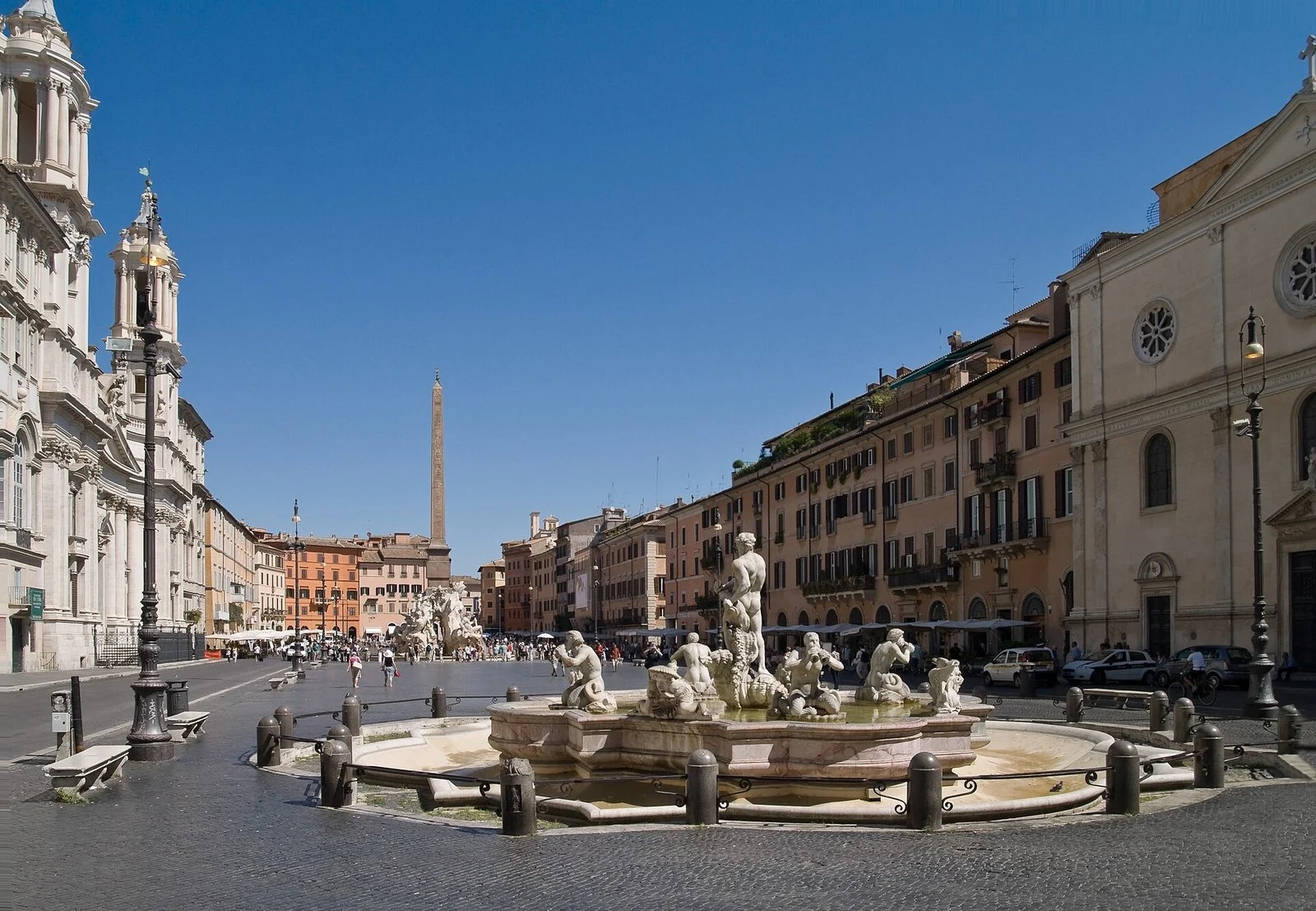
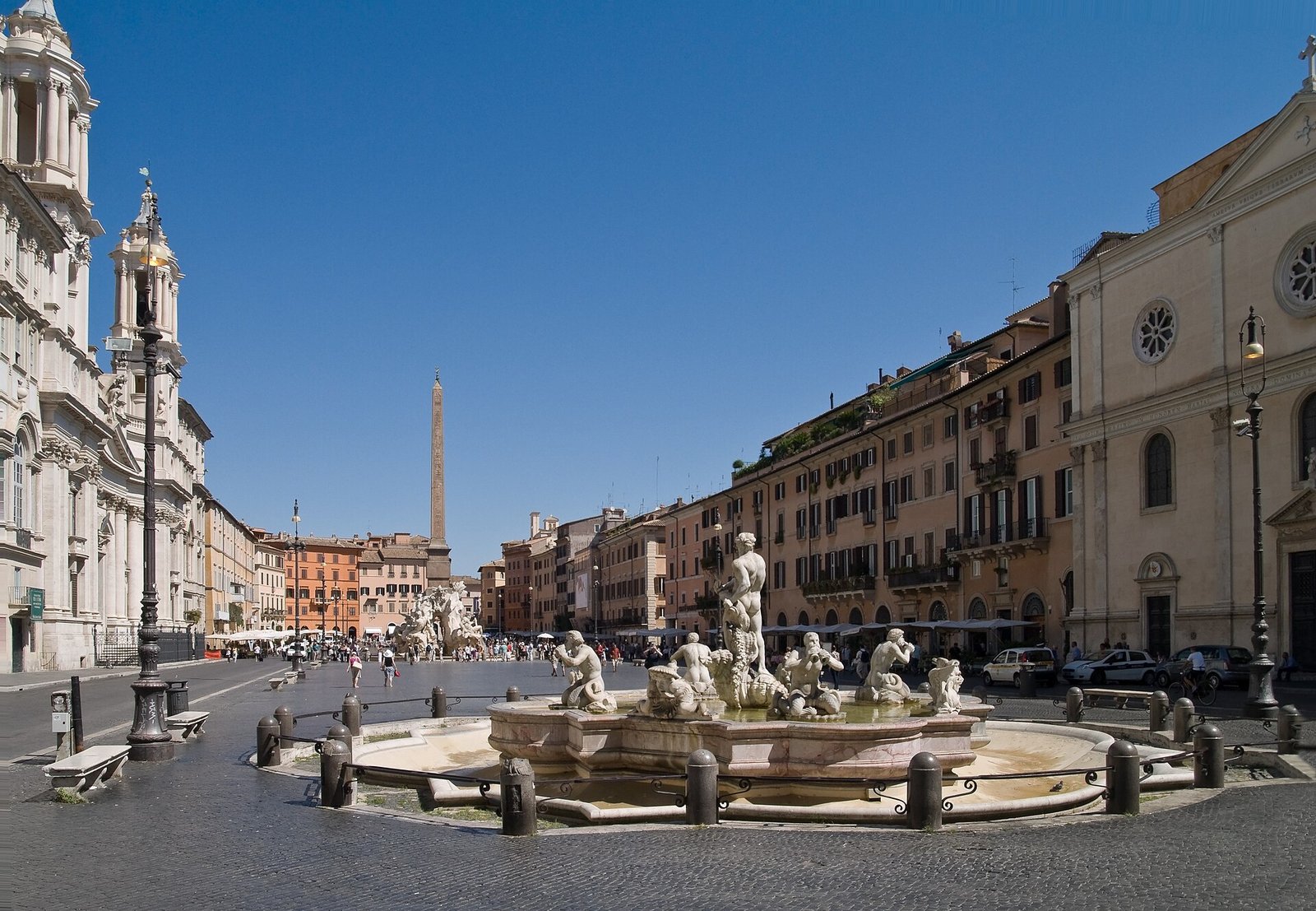
Piazza Navona has its elongated shape because it is built over the Stadium of Domitian, inaugurated in AD 86 for athletic competitions: the houses that enclose the square rest on the ancient stands and the perimeter you walk today is that of the arena. In the middle is Bernini's Fountain of the Four Rivers, from 1651, with the Nile, Ganges, Danube and Rio de la Plata around an Egyptian obelisk. The story that the Rio de la Plata covers its eyes so as not to see the facade of Sant’Agnese in Agone by his rival Borromini is popular tradition, not historical fact: the fountain was finished before the facade.
The remains of the Stadium of Domitian can be visited below street level, with entrance from Via di Tor Sanguigna, in about 40 minutes and generally with no line. A short walk from Trevi, the Vicus Caprarius, the City of Water, shows a stretch of the Aqua Virgo, the aqueduct that still feeds the fountain today.
Lunch: between Navona, the Ghetto and Campo de’ Fiori
Piazza Navona and Campo de’ Fiori are the two places where it's not worth sitting down: they have the highest markup in the center and the lowest average quality. Two or three streets are enough for everything to change, and the useful directions are three: to the west the streets around Via del Governo Vecchio, to the south the Ghetto along Via del Portico d’Ottavia with Jewish-Roman cuisine and the Jewish-style artichoke, to the east the side streets between the Pantheon and Via del Corso. In the Ghetto it's worth stopping by anyway for the Theater of Marcellus, the Turtle Fountain and the Jewish Museum. On Saturday the Ghetto observes Shabbat and many businesses are closed, on Sunday almost all of them are open.
Afternoon: the Trevi Fountain, which now has a ticket
Since February 2, 2026 access to the inner perimeter of the Trevi Fountain costs €2 for tourists and non-residents. The hours announced by the City are from 9 to 22 every day except Monday and Friday, when opening slides to 11:30 for the collection of the coins and the cleaning of the basin. Last entry is at 21:00, and after 22:00 the fountain remains visible for free. The fee also applies on the first Sunday of the month. Exempt are residents of Rome and the Metropolitan City with ID, MIC Card holders, people with disabilities and one companion, children under six and tour guides. The ticket is bought online on the City's dedicated site, at the Civic Museums, at the Tourist Info Points and at authorized sales points. The hours may vary on individual days for maintenance or events.
The figure that makes the measure understandable: the fountain records an average of 30,000 visitors a day with peaks of 70,000, for over 9 million visitors a year. The basin is now crossed in a regulated flow, with separate entrance and exit, and the best time remains the first hour of the morning or the one after 22:00, when access is free again and the fountain is lit.
Piazza di Spagna, the Tridente and sunset at the Pincio
From Trevi to Piazza di Spagna it's eight minutes on foot. The staircase of Trinità dei Monti, 135 steps built between 1723 and 1726, can be walked freely, but since 2019 sitting on the steps is forbidden and the rule is enforced with fines. At the bottom the Barcaccia, attributed to Pietro Bernini with the collaboration of his son Gian Lorenzo, and on the right the Keats-Shelley House, the house where the English poet died in 1821.
From here you close the day in two ways. The first is to climb the staircase and continue toward the Pincio, the terrace overlooking Piazza del Popolo that at sunset looks at the domes of the center: it's the most convenient viewpoint and costs nothing. The second is to go down Via del Babuino and enter Santa Maria del Popolo for the Cerasi Chapel with the two Caravaggios and Raphael's Chigi Chapel, coming back along Via del Corso. If you want one more museum, add the Ara Pacis, next to the Mausoleum of Augustus.
The real timing of Sunday
Sunday in the Historic Center takes from 8:45 to 19:30 with about seven kilometers walked and almost no elevation, except the Trinità dei Monti staircase. The time slots: 9:00-9:45 Pantheon, 9:45-11:00 churches around it, 11:00-12:00 Piazza Navona and the stadium underground, 12:15-13:45 lunch in the Ghetto, 14:00-15:00 Campo de’ Fiori and Largo Argentina, 15:00-16:00 Trevi Fountain, 16:15-17:30 Piazza di Spagna, 17:30-19:00 Pincio and Piazza del Popolo. If you have a return flight in the afternoon, finish at the Trevi Fountain, moved up to right after lunch.
How to fit the Vatican Museums and the Colosseum together without losing half a day in line
In a Saturday and Sunday weekend the Vatican Museums fit only on Saturday, because on Sunday they are closed except the last of the month: if you want them, you have to move ancient Rome to Sunday and accept an entirely Vatican Saturday. It's the heaviest decision of the itinerary and needs to be made before buying any ticket, because it also affects the Colosseum slot.
The three time windows that matter
There are three moments in Rome when you get in without a line and they are always the same. The first is opening: 8:00 at the Vatican Museums, 8:30 at the Colosseum, 9:00 at the Pantheon and the Forum. The second is the window between 15:00 and 16:30, when the organized groups have finished their shift: at the Vatican Museums, which close at 20:00 with last entry at 18:00, it's the least used and most convenient solution. The third is the evening, after 21:00, when around the Pantheon, Navona and Trevi the pressure collapses. Outdoor monuments in the early hours and in the evening, indoor museums in the middle window.
The Vatican Saturday, if you choose it
The Vatican morning requires four to five real hours including the lines. The Vatican Museums are open Monday to Saturday at 8:00 and close at 20:00, with last entry at 18:00. The set route goes through the Pigna Courtyard, the Pio Clementino Museum, the Gallery of Maps, the Raphael Rooms and finally the Sistine Chapel: even skipping whole sections you don't go under two and a half hours. In the Sistine photographing and talking are forbidden: if you want to see it with fewer people, you go in at opening and head straight there, reversing the usual order.
A clarification that saves an hour: from the Sistine Chapel there is a direct passage to St. Peter's Basilica reserved for groups accompanied by a guide. Those visiting on their own leave by the Museums' ordinary exit and must re-enter St. Peter's Square from the colonnade, going through the security checks again.
St. Peter's, which is a separate line
Admission to St. Peter's Basilica is free and requires no ticket: you only go through the security check on the right arm of the colonnade, which between 10 and 13 generates lines of 40 minutes and more. The dress code (shoulders covered, pants or skirt below the knee) is strictly enforced for men and women, with no exceptions. The climb up the dome is paid separately, with different rates for the elevator and the stairs, and the updated prices should be read at the ticket office in the portico. The Vatican Grottoes are free to enter. The Necropolis with the tomb of Peter only by reservation at the Excavations Office.
The tally of a Vatican Saturday
A complete Vatican Saturday takes from 7:45 to about 14:30: three and a half hours of Museums, half an hour between transfer and checks, an hour of basilica. Lunch should be had in Prati and not in Borgo. The free afternoon is well spent at Castel Sant’Angelo, 10 minutes on foot: Hadrian's mausoleum turned papal fortress is walked in a single ascending order up to the terrace of the angel, in about an hour and a half, and it closes on Monday. The Janiculum is the free panoramic alternative, with the cannon that fires at noon in a tradition in force since 1847.
Four variants of the same weekend
The scheme described above is the basic one: ancient Rome on the first day, the Historic Center on the second. The four variants that follow modify it without dismantling it, changing one or two stops per day depending on who is traveling.
First time in Rome
If you've never been to Rome, you have to resist the temptation to add: the difference between a good first trip and a bad one is the time spent standing still looking, not the number of places passed through. The basic scheme is fine as it is, with a single addition: on Saturday evening, after dinner, a walk among Piazza Navona, the Pantheon and the Trevi Fountain, lit up and half empty, which lasts 40 minutes and counts as a visit in itself.
If you've already been to Rome
If you've already seen the Colosseum and the Trevi Fountain, you can build a weekend without redoing them. The first day becomes layered Rome: San Clemente with its three levels, the Domus Aurea by reservation, the Crypta Balbi. The second is that of the less-visited museums: Palazzo Doria Pamphilj with Velázquez's portrait of Innocent X, Palazzo Barberini with the Fornarina, the Villa Farnesina with Raphael's Loggias, Centrale Montemartini where ancient statues live alongside the engines of a power plant. In the evening the Aventine with the Orange Garden.
With children
With children the constraint is not distance but succession: two museums in a row don't hold up under age 10, and the scheme that works alternates an hour indoors and an hour outdoors. The Colosseum almost always goes over well, the Forum much less because it requires imagination and has no shade: better to replace it with the Circus Maximus, which is an enormous lawn where you can run, and with the Ludus Magnus seen from above. The second day is won by moving the afternoon to Villa Borghese, with the boats on the little lake and the Bioparco. The other two cards are Explora, which works in shifts that can be reserved, and Luneur Park at EUR. The Mouth of Truth in Santa Maria in Cosmedin is free but has a half-hour line for a photograph.
On a small budget
A weekend in Rome can be done spending very little on admissions, because the outdoor part of the city is free and it is not the secondary one. Free and always accessible are Piazza Navona, Piazza di Spagna, Piazza del Popolo, the Capitoline Hill, the Pincio, the Janiculum, Villa Borghese, the sacred area of Largo Argentina seen from the balustrade, the Imperial Forums and Trajan's Column seen from the street, the Arch of Constantine. All the churches are free, including those with the Caravaggios, and the great basilicas. On the first Sunday of the month state museums are free. On food the biggest saving comes from lunch: a supplì, pizza by the slice sold by weight or a sandwich from a bakery cost a fraction of a sit-down first course.
Real walking times and public transit
In a weekend built like this you walk between seven and nine kilometers a day and use public transit three or four times in all: the Historic Center of Rome has no metro, and the distances between the main points are almost always under 20 minutes on foot. The estimates that follow are measured on the real route, traffic lights included, at a tourist pace.
The distances that matter, in minutes
From the Colosseum to Piazza Venezia 20 minutes along Via dei Fori Imperiali. From Piazza Venezia to the Pantheon 12. From the Pantheon to Piazza Navona five, to Campo de’ Fiori another five, to the Trevi Fountain 10. From Trevi to Piazza di Spagna eight, and from there to Piazza del Popolo 15 along Via del Babuino. From Piazza Venezia to the Ghetto and the Theater of Marcellus 10. From the Colosseum to San Clemente five, to San Pietro in Vincoli 10 uphill. From St. Peter's Square to Castel Sant’Angelo 10, and from there to Piazza Navona another 15 crossing Ponte Sant’Angelo. From Trastevere to the Ghetto 10 passing by the Tiber Island. If you have joint problems or are pushing a stroller, add 20 to 30 percent, and keep in mind that the cobblestones make every trip tiring.
The two metro lines you really need
Line A serves the Vatican (Ottaviano and Cipro stops), Piazza di Spagna, Barberini five minutes from the Trevi Fountain and Flaminio for Piazza del Popolo. Line B serves the Colosseum, the Circus Maximus and Piramide for Testaccio. The two lines cross at Termini, the hub for trains from the airports. Everything in between, that is the heart of the Baroque center, can be reached only on foot, by bus or by taxi: this is why the second day is a continuous walk.
Tickets, passes and what it costs to get around
The standard ATAC ticket, the BIT, costs €1.50 and is valid for 100 minutes on buses and trams with a single entry to the metro. The timed tickets cost €8.50 for 24 hours, €15 for 48 hours and €22 for 72 hours from first validation. The weekly CIS pass costs €29. For a weekend on foot like this one the 48-hour ticket breaks even only by using transit at least 10 times: usually the BIT bought as you go is better, or contactless payment at the turnstiles. Open-top tourist buses are not needed here: they take 40 minutes for trips that take 15 on foot. The Roma Pass, in the 48- and 72-hour versions, does not include the Vatican Museums and with only two paid museums it rarely pays for itself: prices and contents need to be checked on the official website.
Where to eat by area without falling into traps
The rule that holds all over Rome is geographic before it is gastronomic: the quality of the food drops the closer you get to a heavily visited monument and climbs back up sharply after two or three blocks. It's not a moral judgment, it's an effect of the clientele: a place that serves only passersby has no interest in making them come back.
The three rules that hold everywhere
The first: look at who is inside at 13:30 on a weekday, because if there are people speaking Italian and eating alone, the place holds up. The second: be wary of the menu translated into six languages with photos of the dishes and touts inviting you in from the door. The third: read the bill. The cover charge is allowed if clearly indicated on the menu, generally between €1 and €3 per person. It's not legitimate, though, to add unannounced percentages or service as a separate item if not declared beforehand. Fish and meat sold by weight must be weighed in front of the customer or indicated per kilo on the menu.
Historic Center, Ghetto and Campo de’ Fiori
Sitting in Piazza Navona or Campo de’ Fiori costs double and gives you half. The three directions that work are Via del Governo Vecchio and the side streets toward Ponte Sant’Angelo, the streets between the Pantheon and Via del Corso, and above all the Ghetto around Via del Portico d’Ottavia, where Jewish-Roman cuisine has a tradition documented over centuries: Jewish-style artichoke, anchovies with endive, fried vegetables, and the pastry shop with ricotta and sour cherry tart. The Ghetto on Saturday is largely closed for Shabbat and on Sunday it's open: for a weekend this is why it's worth planning it for Sunday.
Vatican, Prati and Trastevere
Via della Conciliazione and the streets of Borgo are the area with the highest density of traps in the Vatican quadrant. Prati, which begins beyond Piazza Risorgimento toward Via Cola di Rienzo, is a residential and office neighborhood with normal prices: 10 minutes on foot from the Vatican Museums completely changes lunch. Trastevere is more complicated than it looks, because the part between Piazza Santa Maria and Piazza Trilussa is by now almost entirely touristy, while beyond Viale Trastevere, toward Piazza San Cosimato and Santa Cecilia, neighborhood osterias survive.
Testaccio, the food neighborhood
Testaccio is the neighborhood where modern Roman cooking took shape, around the former slaughterhouse: cacio e pepe, gricia, amatriciana, carbonara and the fifth-quarter repertoire have their reference versions here. The covered New Testaccio Market is open in the morning and also works as a place to have an inexpensive lunch. A short walk away the Non-Catholic Cemetery, where Keats, Shelley and Gramsci are buried, is one of the quietest places in the city.
Frequently asked questions about a weekend in Rome
Are two days in Rome enough to see the main things?
Two days in Rome are enough to see two blocks of the city well: the central archaeological area with the Colosseum, Roman Forum, Palatine Hill and Capitoline Hill, and the Baroque Historic Center between the Pantheon, Piazza Navona, the Trevi Fountain and Piazza di Spagna. The Vatican fits only by sacrificing one of the two, because the Vatican Museums alone take half a day. The practical rule is two paid admissions a day plus the neighborhoods explored on foot.
Are the Vatican Museums open on Sunday?
The Vatican Museums are closed every Sunday except the last of each month, when they open from 9:00 to 14:00 with last entry at 12:30 and free admission. On other days, Monday to Saturday, the hours are 8:00-20:00 with last entry at 18:00. The free opening on the last Sunday can't be reserved and generates very long lines along Viale Vaticano: in a two-day weekend it's almost always better to pay and go on Saturday.
How much does the Vatican Museums ticket cost?
The full ticket for the Vatican Museums costs €20 without online reservation and €25 with online reservation, which includes the €5 for the time-slot access service. The reduced price is €10 and €15 respectively. The only official sales site is tickets.museivaticani.va, and the Museums themselves urge you to be wary of similar domains that resell at inflated prices. The ticket includes the Sistine Chapel, which is the last stop of the route.
How much does it cost to enter the Trevi Fountain?
Since February 2, 2026 access to the inner perimeter of the Trevi Fountain costs €2 for tourists and non-residents. The hours announced by the City are from 9 to 22 with last entry at 21:00, except Monday and Friday when it starts at 11:30 for the cleaning of the basin. After 22:00 the fountain is visible for free again. Exempt are residents of Rome and the Metropolitan City, MIC Card holders, people with disabilities and one companion, children under six and tour guides.
Does the Colosseum need to be reserved and how much does it cost?
The Colosseum ticket requires mandatory reservation of the time slot and sales open 30 days ahead on the official portal of the Archaeological Park. The ticket is named for all types and an ID is needed at the entrance. The standard ticket also includes the Roman Forum and Palatine Hill and is valid for 24 hours from the first entry, with a single access per site. The price, indicated at €18 in the rates of recent years, should be rechecked on the official portal before buying.
How much do you walk in a weekend in Rome?
In a weekend in Rome built on two full days you walk between seven and nine kilometers a day, with about 250 meters of total elevation on the first day between the Palatine Hill, the Capitoline Hill and the climbs of Monti, and almost none on the second. The cobblestones of the Historic Center make every trip more tiring than the distance suggests: you need closed, flat shoes. If you have difficulty getting around, add 20 to 30 percent to the times and take out a stop per day.
What is closed on Monday in Rome?
On Monday in Rome the Galleria Borghese and, normally, Castel Sant’Angelo close, while the Colosseum, Roman Forum and Palatine Hill, Vatican Museums, Pantheon, Capitoline Museums and Ara Pacis stay open. A Monday is therefore not a lost day: it's a day when you don't go to the Galleria Borghese. Some sites activate special Monday openings, so the closure should always be rechecked on the site's website before giving up the visit.
Is a weekend in Rome suitable for children?
A weekend in Rome works with children if you alternate an hour indoors and an hour outdoors and give up two museums in a row. The Colosseum and the Circus Maximus hold up well, the Roman Forum much less because it requires imagination and has little shade. Villa Borghese with the little lake, the Bioparco, Explora near Piazzale Flaminio and Luneur Park at EUR are the backup cards for the afternoons. The line at the Mouth of Truth, which reaches half an hour, is not worth it with tired children.
Is it worth buying the Roma Pass for two days?
The Roma Pass, which exists in 48- and 72-hour versions and includes unlimited public transit and free or reduced admissions, rarely pays for itself over a two-day weekend, because a compact itinerary like this one has two or three paid admissions and three or four transit rides a day. It also doesn't include the Vatican Museums, which belong to another State. Prices and contents change from year to year and should be checked on the official website before buying.
If you organize trips for others, as a guide, escort or tour leader, on tourleaderpro.com you'll find the professional side of this same work: group management, relations with suppliers, technical entry times for limited-capacity sites, documents and insurance. A two-day itinerary like the one described here, replicated for a group of 25 people, requires different margins from those of a single traveler, and those differences are exactly the trade.
If instead you are building a longer trip in Italy, of which this Roman weekend is only one stop, on italyplanner.com you'll find the tools to fit the cities together: real train times, seasonality, closing days region by region and the logic for deciding where to sleep when you change base every two nights. Rome in two days works well as the start or end of a broader route, much less as an intermediate stop squeezed between two long transfers.