Ludus Magnus
In short. The Ludus Magnus is the largest of the gladiator barracks-schools of ancient Rome, and the only one of which anything visible remains: it stands 200 meters from the Colosseum, in the block between Via Labicana and Via di San Giovanni in…
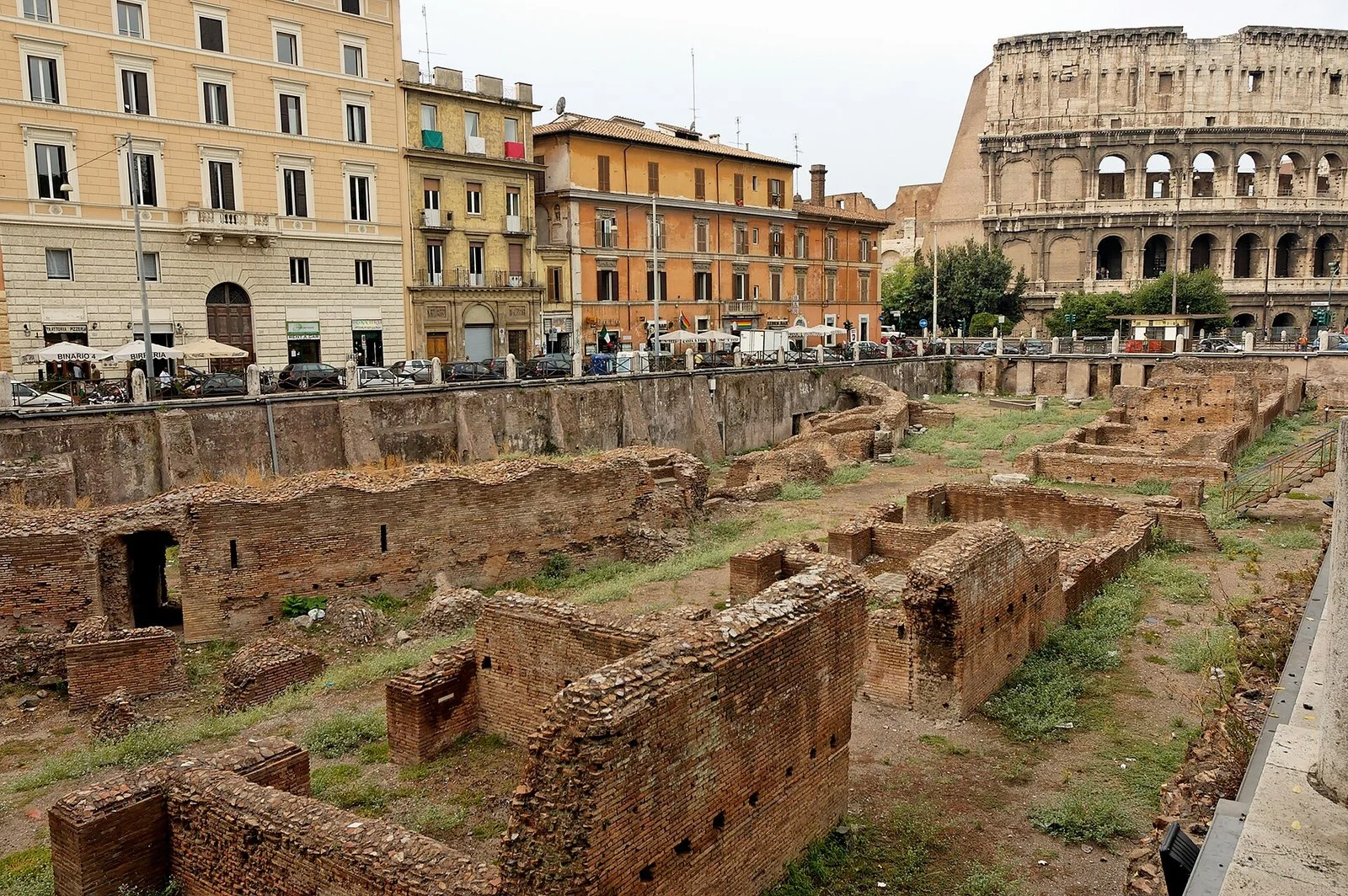
The Ludus Magnus is the largest of the gladiator barracks-schools of ancient Rome, and the only one of which anything visible remains: it stands 200 meters from the Colosseum, in the block between Via Labicana and Via di San Giovanni in Laterano, inside a large archaeological pit discovered by chance in 1937 during the digging of the foundations of a modern building. People walking from Piazza del Colosseo toward San Clemente almost always pass right by it without noticing: the monument is below street level, surrounded by a railing, and you can only read it if you stop at the parapet and look down. What you see is the northern half of a quadrilateral with a portico and, at the center, an elliptical arena in miniature, where the gladiators trained in front of a small audience, and a row of little rooms facing the portico that archaeologists interpret as the fighters' quarters. The other half, the southern part, has never been excavated: it still lies under the asphalt of Via di San Giovanni in Laterano and under the buildings that flank it. The Ludus Magnus was built by Domitian, emperor between 81 and 96 AD, as part of the system of support structures that revolved around the Flavian Amphitheater, and it was then deeply reworked by Trajan and touched up again in the following centuries: what emerges today belongs overwhelmingly to the Trajanic phase, not the original one. The lines that follow tell how this building was made, what we really know about the life of those who lived in it, how much of the current story about gladiators holds up against the sources and how much is modern invention, and how you can see it today.
Where the Ludus Magnus is and how to get there
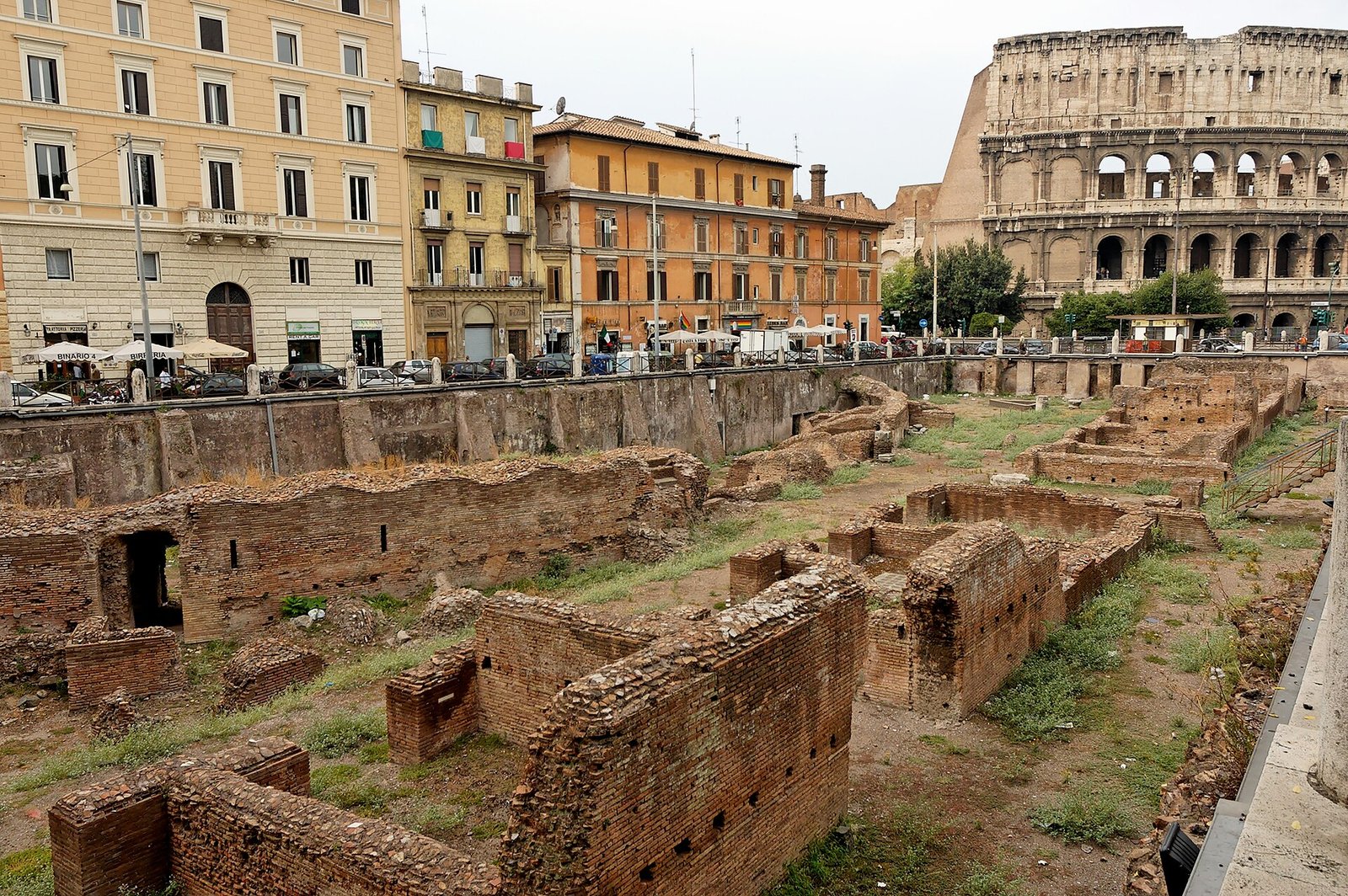
The Ludus Magnus occupies the block between Via Labicana, Via di San Giovanni in Laterano and Piazza del Colosseo, in the Monti rione, about 200 meters as the crow flies from the amphitheater. The archaeological area is a rectangle sunk a few meters below the current street level, bordered on three sides by a metal railing and on the fourth by modern buildings: coming from the Colosseum, you find it on the left as you turn onto Via Labicana, just after the bus stop.
By public transport
The subway stop closest to the Ludus Magnus is Colosseo, on line B, from which it's less than five minutes on foot. Several surface lines run along Via Labicana and the bus stop is literally in front of the entrance to the archaeological area, so much so that the official record of the Sovrintendenza Capitolina gives the address as Via Labicana with no street number, entrance in front of the public transport stop. Tram 3 and tram 8 don't come all the way here, but line 3 touches the Celio and the Colosseum a little farther on: it's still best to check the updated routes before leaving, because surface lines in the center of Rome are rerouted fairly often for construction and events.
What the Ludus Magnus is: a barracks, not a stadium
The Ludus Magnus was a barracks-school, that is, both permanent lodging and a training ground for the gladiators owned by the emperor, built by Domitian between 81 and 96 AD in the valley between the Esquiline and the Celio, right up against the amphitheater his family had just completed. It was not a show building open to the city, and it was not a prison in the modern sense either: it was a support structure of the Colosseum, with a precise technical function, keeping a large group of professional fighters in shape and available.
What ludus means
The Latin word ludus covers a much wider field than our “game”: it also meant the school, the place of exercise and training, and in this sense it applied as much to the elementary school as to the gladiator school. Ludus Magnus therefore means, literally, “the great school,” and the name is not a modern nickname but the official designation attested by ancient sources, in particular the Regionary Catalogues, the late antique lists of Rome's notable buildings, neighborhood by neighborhood, where the Ludus Magnus appears in the third region. The adjective magnus distinguished this structure from the city's other three gladiator schools, all smaller or in any case specialized.
Who built it and when
The construction is due to Domitian, the last emperor of the Flavian dynasty, within the functional completion of the Flavian Amphitheater inaugurated by his brother Titus in 80. The ground was not virgin: excavations have identified underneath the remains of a late Republican domus and of an insula, that is, a rental apartment block, destroyed in the great fire of 64 AD, the same one that had cleared the valley floor where the Colosseum would later rise. The area, put differently, was carved out of a piece of city that had burned and was never rebuilt in its earlier form, following a logic of reusing urban space that the Flavians applied systematically throughout this sector of Rome, starting with the demolition of the structures of Nero's Domus Aurea.
What you see today and what you don't
Of the ancient complex only the northern half is visible, and not even that entirely. You can recognize: a curved stretch of the elliptical arena with the steps of the small cavea, the northern arm of the portico with a few travertine columns, a series of quadrangular rooms lined up on the portico, a triangular fountain at the northwest corner and the spine walls that divided the rooms. The southern half, which remains under Via di San Giovanni in Laterano, is not visible. The upper floors, collapsed or demolished, are not visible. The underground passage toward the Colosseum, which we'll come to later, can no longer be walked. Anyone who arrives expecting a standing building will be disappointed: the Ludus Magnus is a site to read, not to admire, and its interest lies entirely in understanding how it worked.
The structure of the Ludus Magnus: arena, cavea, four-sided portico and cells
The Ludus Magnus was laid out as a four-sided portico about 100 meters on a side, with an elliptical arena in the middle of the courtyard, steps around the arena and a ring of rooms facing the four arms of the portico. It's the classic scheme of the Roman barracks, that of the castra, applied to a particular function: lodging for the bodies around a maneuvering space.
The arena: the measurements and a ratio that doesn't add up
The elliptical arena of the Ludus Magnus measured about 62 to 63 meters on the major axis and 42 to 45 meters on the minor axis, according to the measurements that circulate in the popular literature and in the records of specialized sites. That is a surface on the order of 2,000 square meters. Here a very widespread inaccuracy has to be flagged: several records, even authoritative ones, repeat that the arena was “a reduced-scale copy of that of the Colosseum in a ratio of 1 to 2.5,” and some report a surface of 200 square meters. The two figures don't hold together, and they don't hold together with the measurements of the axes either: the arena of the Colosseum measures roughly 76 by 44 meters, so the linear ratio with an ellipse of 62 by 44 is close to 4 to 5, not 1 to 2.5, and the surface of an ellipse of those dimensions is around 2,000 square meters, not 200. The figure of 200 square meters is quite obviously a typo that spread from one record to the next. The solid datum, agreed on by the sources, is another: the arena of the Ludus Magnus was noticeably smaller than that of the Colosseum but not enormously smaller, and it served precisely to let gladiators train on a space of proportions similar to the one in which they would later fight.
The cavea and the audience at training sessions
Around the arena ran a small cavea, that is, a set of steps, whose lower wall was faced with marble slabs and which, according to the Sovrintendenza Capitolina, could hold up to 3,000 spectators. Other, more cautious reconstructions speak of about 1,200 actual seats. Both estimates have to be reported because they depend on how the development of the steps is reconstructed in the unexcavated part, and there is no direct archaeological count. The structure of the cavea, as far as is preserved, provided for nine tiers of gradus set on concrete vaults with brick facing, raised about 2.75 meters above the level of the arena: enough to keep a spectator from ending up on the field and to keep the audience at a safe distance from the weapons.
The four-sided portico and the triangular fountains
The courtyard was surrounded by a portico with travertine columns, and at the intersections of the portico arms four small triangular fountains were placed, of which only one is still recognizable today, at the northwest corner of the excavated area. They're a minimal but telling detail: running water in quantity, distributed at the points of passage, in a building where dozens of men trained every day under the Roman sun. The presence of fountains at the crossings of the portico says that the design took into account the daily functioning of the structure, not just its appearance.
The gladiators' cells
On the four sides of the portico opened rooms uniform in structure and size, not communicating with one another: 14 have been excavated on the northern side, each of about 20 square meters. The Sovrintendenza's description insists on this uniformity and on the absence of direct communication between one room and the next, which is exactly what you would expect from a controlled collective lodging. Current estimates assign two gladiators to each cell and, projecting the figure over the entire surface of the complex, arrive at a capacity on the order of a thousand men. It's an estimate, not a census: no ancient source tells us how many gladiators the Ludus Magnus housed, and the number of 1,000 should be taken as an order of magnitude derived from the plan, not as an archival datum.
The upper floors and the problem of the beds
The building rose over at least two floors, and according to several reconstructions three: on the ground floor the services and representation spaces, on the upper floors the actual quarters, now completely gone. A detail that strikes anyone reading the excavation reports is that no trace of beds has been found in the cells: no recesses in the walls, no bases, no seats for beams. This doesn't necessarily mean the gladiators slept on the floor, because a wooden bed resting on the floor leaves no traces, but it's one of those archaeological silences that is best reported as it is, without filling it with imagination.
The tunnel toward the Colosseum: documented, not hypothesized
The underground passage that connected the Ludus Magnus to the substructures of the Colosseum is archaeologically documented: it was identified in 1939, during the investigations that followed the discovery of 1937, and it ran under the paved space that separated the two buildings. It is therefore not a legend or a simple deduction, as happens with many supposed Roman tunnels: here the corridor was found, measured and described. What is no longer possible is walking it.
What was found in 1939
The investigations carried out after the chance find of 1937 brought to light a hypogeal corridor that headed from the west side of the Ludus Magnus toward the amphitheater, with a width on the order of two meters, and that made it possible to reach the level of the Colosseum's substructures without going through the street. The reconstruction of the phases attributes the laying out of the underpass to Domitian, its completion to Trajan and the finishing touches to Hadrian: a construction project lasting decades, which says how important the connection was considered. The investigations were interrupted by the war and resumed only after it.
Why the connection is interrupted today
The corridor can't be walked because in the 1800s the construction of the large sewer collector serving the Esquiline district, then in full expansion after the capital's arrival in Rome, cut through the ancient route. The Colosseum Archaeological Park says so explicitly in the documentation of the exhibition devoted to this very theme: the construction of the collector irreparably interrupted the connection between the Colosseum and its training ground. It's one of the cases where 19th-century urban planning destroyed, without knowing it and without meaning to, a piece of archaeology that today would be among the most visited things in the city.
The eastern cryptoporticus of the Colosseum
On the amphitheater side, the terminus of this system is the so-called eastern cryptoporticus, that is, the covered corridor that opened from the Colosseum's substructures toward the area of the training grounds. In 2023 the Colosseum Archaeological Park staged there the exhibition “Gladiatori nell'Arena. Tra Colosseo e Ludus Magnus,” open from July 21, 2023 to January 7, 2024, with philological reproductions of armor and original finds from Naples and Aquileia devoted to three pairs of fighters, murmillo against thraex, retiarius against secutor, murmillo against hoplomachus. Anyone who visits the Colosseum's substructures with the dedicated routes passes through that sector: it's the most direct way to see from the opposite side the same story you read by leaning over the parapet on Via Labicana.
Not to be confused with the passage of Commodus
A useful clarification, because the confusion is frequent even in guides. The tunnel toward the Ludus Magnus is not the so-called “passage of Commodus,” which is another underground corridor of the Colosseum, on the southern side, interpreted as an access reserved for the emperor and his court and tied by tradition to the famous attempt on the life of Commodus. They are two distinct structures with different functions: one served to bring into the amphitheater those who fought, the other to bring those who watched. The first is the gladiators' corridor, the second is the corridor of the imperial box.
The discovery and the excavations: 1937, then 1957 to 1961
The Ludus Magnus was discovered by chance in 1937, during the digging for the construction of a new building between Via di San Giovanni in Laterano and Via Labicana: nobody was looking for the gladiators' barracks, and the remains came out under the bulldozer. It's one of the many Roman archaeological discoveries due to a building site, and like many of those it has a complicated history of interruptions, restarts and compromises with the modern city.
1937 and the recognition thanks to the Forma Urbis
The identification of the remains with the Ludus Magnus was not immediate but was made possible by an extraordinary document: the Forma Urbis Severiana, the great marble plan of Rome engraved between 203 and 211 AD and posted in a hall of the Forum of Peace, of which hundreds of fragments remain. One of these fragments shows a rectangular courtyard surrounded by small rooms and containing an elliptical enclosure: the correspondence between the Severan drawing and the remains brought to light left no room for doubt. Platner and Ashby, in their topographical dictionary of 1929, had already recorded the fragment and the dimensions that can be derived from it, on the order of 60 by 90 meters. It's a textbook case of archaeology: an ancient plan that makes it possible to put a name to a ruin.
The postwar excavations and the publication by Colini and Cozza
After the wartime interruption, the systematic excavation of the area took place between 1957 and 1961, on the occasion of the work connected with the rearrangement of the block and in the climate of urban renewal that accompanied the Rome Olympics of 1960. The monument was then regularized and made readable in the form it still has today. The reference study remains the volume “Ludus Magnus” published in 1962 by Antonio Maria Colini and Lucos Cozza, two of the greatest topographers of ancient Rome of the 20th century, to whom the same years also owe the edition of unpublished inscriptions found in the area. The sources consulted don't agree perfectly on the dates of this campaign, which are given now as 1957 to 1960, now as 1957 to 1961, now as 1959 to 1961: the range is a couple of years and probably concerns the actual start of work compared with its formal conclusion.
The half that remains under the street
The southern part of the complex has never been excavated and lies under Via di San Giovanni in Laterano. This is not an oversight: digging it up would mean interrupting one of the connecting arteries between the Colosseum and the Lateran, and the choice to leave it where it is was a conscious one. The result is that the Ludus Magnus is, literally, a half monument, and that the estimates of its capacity and of the number of cells are necessarily projections made on the known half. Anyone leaning over the parapet is looking at a missing symmetry: the arena stops against the retaining wall of the street, and the rest of the ellipse has to be imagined.
A curiosity about the Ludus Magnus
The most surprising curiosity about the Ludus Magnus is that the gladiators' training had a grandstand: around the elliptical arena run the steps of a small cavea, with seats estimated between 1,200 and 3,000, and this means that in Rome people went to watch the training sessions the way today people go to watch a final warm-up before the match.
Why a training ground needed spectators
The reason is both commercial and political. The munera, that is, the fights, were offered to the people by an editor, the patron who bore the costs and collected the favor in return: showing the merchandise in advance served to build anticipation, to circulate the fighters' names, to create preferences and bets. A known gladiator was worth more than an unknown one, and the cheapest way to make him known was to let a few hundred Romans watch him train. The small cavea of the Ludus Magnus is the architectural translation of this logic.
Something nobody tells you about the Ludus Magnus
Almost everything you see today at the Ludus Magnus is not Domitian's building but its Trajanic reconstruction: the reading of the masonry shows that under Trajan demolitions and rebuilding were carried out for structural reasons, and that the surviving structures belong largely to that second phase.
A construction site that went through three emperors
The sequence reconstructed by scholars is clear in its general lines: Domitian lays out the complex and starts the underpass toward the amphitheater, Trajan rebuilds large portions of the building and completes the passage, Hadrian looks after the finishing touches. In late antiquity, patches and radial walls in opus listatum are added. A service building, in short, on which four centuries of emperors kept putting their hands, which says how indispensable it was considered for the functioning of the Colosseum.
1,000 gladiators is an estimate, not a datum
The number of 1,000 gladiators that the Ludus Magnus could house, repeated almost everywhere, is a projection: you multiply the hypothesized capacity of one cell by the number of cells presumed to have existed around the entire perimeter, including the half never excavated. No ancient source provides a figure. It's worth knowing because it's an exemplary case of how a reasonable number, born as an order of magnitude, hardens in popular writing until it seems like a census.
The real life of gladiators: valuable property, not cannon fodder
A trained gladiator was an expensive asset, and this economic fact explains better than any other how they were treated: fed regularly, looked after by doctors, trained for years. An investment that dies in the first fight is a bad investment, and the Romans knew that very well.
The oath and the contract
Whoever entered a ludus swore an oath, the sacramentum gladiatorium, whose formula has been handed down by Latin literary sources: to accept being burned, bound, beaten and killed by the sword. It sounds like a sentence and in a certain sense it was, but it was also a contract: the free man who enlisted voluntarily, the auctoratus, received a sum on signing and accepted for a set time a legal condition similar to servitude. At the end he went free again, often with a capital he would hardly have accumulated otherwise. The familia gladiatoria was the whole staff of the school, over whom the owner exercised practically absolute power.
Half volunteers
One of the facts that overturn the current image concerns precisely the volunteers: according to the specialist literature, already at the end of the Republican age the auctorati could make up roughly half of the gladiators, and perhaps the better half. Not everyone who went down into the arena was a slave or a prisoner of war: a substantial part were free men who had chosen that trade for money, for fame or out of economic desperation. It's an important correction to the Hollywood story of the slave torn from his family and thrown into the arena.
Food: hordearii and the ash drink
Gladiators were nicknamed hordearii, that is, “barley eaters,” and the isotopic analyses carried out on the burials of the gladiator cemetery discovered at Ephesus in 1993, dated to the second and third centuries AD, confirmed a diet overwhelmingly plant-based, built on cereals and legumes, not too different from that of the contemporary population. The study, published in 2014 by a group that included Sandra Lösch, Negahnaz Moghaddam, Karl Grossschmidt, Daniele Risser and Fabian Kanz, also found a strontium-to-calcium ratio compatible with the intake of a drink made from plant ashes, a practice that ancient literature attributed precisely to gladiators as a tonic. It's a rare case in which an anecdote handed down by Latin authors finds a chemical confirmation in the bones.
The doctors and the maintenance of bodies
Gladiator schools had medical staff, and the most famous testimony is that of Galen, the greatest physician of antiquity, who early in his career was a doctor to the gladiators at Pergamum and who declared he had learned there a good part of what he knew about anatomy and trauma care. It's a detail that on its own is enough to dismantle the idea of the gladiator as expendable material: you don't assign a doctor to expendable material, and you don't entrust a career to it.
The palus and the training
Training began against a wooden post six Roman feet tall, the palus, against which the novice practiced strikes with wooden weapons heavier than the real ones, before being admitted to edged weapons. The instructors were the doctores, usually freed former gladiators who at the end of their career had received the rudis, the wooden sword symbol of discharge. Whoever taught, in short, had survived: another indirect indication that surviving was possible and indeed normal.
Who commanded in the ludus
In the Republican age the schools were private businesses and the owner was the lanista, a socially despised and at the same time necessary figure, who rented out his men to those who organized the shows. With the empire Rome's big schools passed under public control and were run by imperial procurators of equestrian rank: the Ludus Magnus was a structure of the State, not a company. The private lanista survived for a long time in the provinces, where the imperial monopoly did not reach.
What the sources say about gladiators and what they don't say
Around the gladiatorial world there circulates more modern imagination than ancient documentation, and the distinction between the two levels is sharper than people think: the organization of the schools, contracts, prices and careers are attested by inscriptions and legal texts, while some of the most famous details of the current story have no support in the sources.
The pollice verso: what we really know
Latin sources do speak of a thumb gesture used to express judgment on the defeated fighter, and they use expressions like pollice verso, that is, “with the thumb turned,” in Juvenal, and converso pollice in Prudentius. The problem is that none of these expressions describes the gesture in a way that can be reconstructed: we don't know if the thumb was raised, lowered, held horizontal or hidden in the fist, nor which position meant mercy and which death. The most discussed interpretation, that of the philologist Anthony Corbeill, even proposes the opposite of what you see in the movies, with the raised thumb as the signal for execution and the closed fist with the thumb wrapped inside as the signal for clemency. The image of the thumb pointing down that we all have in mind doesn't come from antiquity: it comes from a 19th-century painting, the “Pollice Verso” by Jean-Léon Gérôme, and from the movies that copied it. It has to be said clearly: it's modern iconography, not an ancient document.
“Ave Caesar, morituri te salutant”
The most famous phrase attributed to gladiators appears in the ancient sources only once, and it doesn't concern gladiators. Suetonius reports it in the life of Claudius in connection with the naumachia, that is, the naval battle, staged in 52 AD on Lake Fucino to celebrate the drainage works: it was spoken by men condemned to death and destined for that spectacle, not by professional gladiators in an amphitheater, and the formula handed down is “Have imperator, morituri te salutant.” There is no testimony that the gladiators of the Colosseum greeted the emperor this way before fighting. It's a true phrase, said once, on a different occasion, which tradition turned into a daily ritual that never existed.
Fights were not always deadly
Gladiatorial combat did not as a rule end with the death of one of the two. The defeated man could ask for the missio, that is, discharge, and the decision lay with the editor, the patron of the show, who took the mood of the crowd into account. Under Augustus fights sine missione, those in which mercy was excluded from the start, were officially banned. The most cited quantitative estimates are those of the French historian Georges Ville, who, working on the funerary inscriptions of first-century gladiators, calculated an average age at death of around 27 and a mortality of about 19 out of 100 among all those who entered the arena, with a risk for the defeated man that went, between the first century and later ones, from about one in five to about one in four. These are dramatic numbers, but they are very far from the systematic slaughter of the popular story: most gladiators came out alive from most fights.
Funerary inscriptions: the case of Flamma
The funerary inscriptions of gladiators are the most valuable source because they record numbers: how many times a man had fought, how many he had won, how many times he had been spared. The best-known example is the epitaph of the secutor Flamma, Syrian by origin, preserved in Sicily: he lived 30 years, fought 34 times, won 21, left the field standing in nine cases with neither victory nor defeat, and was spared four times. The count says it all: 34 fights in a career, and death at 30. Inscriptions like this are the documentary counterweight to the mass scenes of the movies, and have to be read for what they are, the professional record of a man who lived by that trade for years.
The advice I give you for visiting the Ludus Magnus
The most useful advice is not to treat the Ludus Magnus as a stop in its own right but as the first 10 minutes of the visit to the Colosseum, done before you enter the amphitheater: you see it for free from the parapet on Via Labicana, it requires no ticket or reservation, and it completely changes the way you look at the arena afterward.
See it before, not after
Whoever enters the Colosseum without knowing what was around it comes out with the idea of an isolated monument. Whoever looks over the Ludus Magnus first understands that the amphitheater was the terminus of a machine made of barracks, weapon depots, infirmaries, storehouses for scenery and underground corridors, and that the fighters arrived in there from a building 200 meters away, by a route that didn't go through the street. 10 minutes at the parapet are worth more than an hour of audio guide.
What to do if the inner area is closed
Since access inside the archaeological area is subject to scheduled openings and to periods of closure for work, it's wise to allow for the visit being limited to the parapet. It's no small fallback: from above you read the plan much better than you do from inside, because the shape of the ellipse and the relationship between arena, portico and cells can only be understood by looking from above. If you still want to go underground on the same day, you can fall back on the substructures of the Basilica of San Clemente, 300 meters farther on, where you go down three levels to a mithraeum of the second century.
The relationship with the museum dedicated to gladiators
Rome also has a Museo dei Gladiatori, which is a different thing and shouldn't be confused with it: that is an exhibition route with reconstructions of weapons and armor, this is the original archaeological site where the gladiators lived. If you want to see the objects, go to the museum. If you want to see the place, lean over from Via Labicana. The two visits complement each other and don't replace each other.
Another well-known fact, yet rarely cited
The Ludus Magnus was not Rome's only gladiator school: Domitian had four built, and of the other three, the Ludus Matutinus, the Ludus Dacicus and the Ludus Gallicus, practically nothing visible remains. They are known only through the Regionary Catalogues and a few inscriptions.
The Ludus Matutinus
The Ludus Matutinus takes its name from the morning, matutinum, because it was meant for the bestiarii and the venatores, that is, the fighters against animals, whose performances opened the day of shows. The Catalogues place it in the third region, probably along Via Labicana not far from the Colosseum, and it is the one for which the most inscriptions exist: Platner and Ashby list several in the Corpus Inscriptionum Latinarum, plus a Greek testimony. Of standing structures, nothing.
The Ludus Dacicus and the Ludus Gallicus
The Ludus Dacicus is the most enigmatic: the two editions of the Catalogues place it in different regions, the Notitia in the third and the Curiosum in the second, and the name has been linked to the Dacian prisoners of Domitian's wars, but this is a hypothesis, not a documented fact. The Ludus Gallicus is listed in the second region, also near the Colosseum, and perhaps a single inscription is attributed to it. Both are names on a list: their precise location remains unknown.
Why nothing remains of these buildings
The reason is mundane and holds for a good part of minor ancient Rome: they were service buildings, with no spectacular marble to reuse and no religious function to guarantee their survival as a church. When the munera ended, at the start of the fifth century, these barracks lost all reason to exist, were stripped, filled with earth and ended up below the level of the medieval city. The Ludus Magnus was saved by chance and by half, because in 1937 a bulldozer met it before an apartment building was put up on top.
The Colosseum's other support structures
Around the amphitheater stood a whole group of functional buildings, handed down by the Catalogues and the sources: the armamentarium, weapons depot and workshop. The saniarium, where the wounded were treated. The spoliarium, where the bodies of those who died in the arena were taken. The summum choragium, storehouse of machinery and scenery. And the Castra Misenatium, the quarters of the sailors of the fleet of Misenum assigned to operating the velarium, the great awning that shaded the seating. Of none of these buildings does anything readable remain on the surface today.
The right photo to take at the Ludus Magnus
The photograph that really captures the Ludus Magnus is the one taken from the parapet on Via Labicana with the semicircle of the arena in the foreground and the bulk of the Colosseum closing the frame in the background: it's the only image that explains in one go what this place was and why it stood exactly there.
The framing with the amphitheater in the background
You need to stand on the western side of the railing, looking toward Piazza del Colosseo, and lower the lens almost to the handrail, so as to keep the cars out of the frame. With a moderate wide-angle you take in the whole curve of the arena. With a longer focal length you compress the distance and the Colosseum seems to lean on the edge of the training ground, which is in fact the right impression. Late winter afternoons, with the low sun behind the amphitheater, give the best backlight.
The detail of the cells and the portico
The second image to take home is a close one: the row of rooms lined up on the northern arm of the portico, with the parallel dividing walls repeating as in a forced perspective, and the travertine columns set upright again. It's a geometric photograph, which works better vertically and with side light. Unlike the first, it doesn't need the Colosseum and stands on its own.
Some important events that happened here in history
The history of the Ludus Magnus boils down to a few decisive moments: the fire of 64 that clears the area, the Domitianic construction between 81 and 96, the Trajanic reconstruction, the late antique abandonment, the cutting of the sewer collector in the 1800s, the chance rediscovery of 1937 and the big restoration project funded with PNRR money.
From imperial restorations to the 19th-century cut
A few decades after construction, under Trajan, the complex was partly demolished and rebuilt for structural reasons and the underpass toward the amphitheater was completed, with the finishing touches due to Hadrian. In the 1800s, instead, the urbanization of the Esquiline that followed the proclamation of Rome as capital led to the sewer collector that cut that corridor.
The PNRR project and the closure since 2024
The Ludus Magnus has been closed to the public since August 1, 2024 for work funded under the Caput Mundi program of the PNRR, for an amount of more than €3.5 million, promoted by the Sovrintendenza Capitolina ai Beni Culturali. The project includes new archaeological and geognostic surveys, cleaning of the remains, architectural lighting, barrier-free accessible routes, walkways and viewing points, a ticket office at the entrance and a multimedia apparatus, with the stated goal of moving from the system of visits by reservation to regular opening. The conclusion of the work was announced for March 2026, but the official page of the Sovrintendenza continues to list the Ludus Magnus among the sites temporarily closed for PNRR work: reopening should therefore be verified at 060608 before you plan the visit.
Who passed through the Ludus Magnus
Through this building passed emperors, thousands of fighters whose names we almost never know and, in modern times, the archaeologists who brought it back to light: the most striking name is that of Commodus, the emperor who personally went down into the arena.
Domitian and the Flavians
Domitian is the patron: the barracks was born as the functional completion of the amphitheater inaugurated by his brother Titus in 80 and begun by his father Vespasian. His reign, between 81 and 96, is the moment when the entire entertainment district takes the form it will keep for centuries.
Commodus
Commodus, emperor from 180 to 192, is the figure who most ties his image to this place: passionate about combat, he performed armed as a secutor both in the Colosseum and in the Ludus Magnus, as the documentation of the Colosseum Archaeological Park recalls. The ancient sources that speak of him, Cassius Dio first of all, are hostile and have to be read with caution, but the substance, an emperor who fought in front of the people, is not contested. It's also the reason his name ends up in movies, with all the usual liberties.
The emperors who put it back on its feet
Trajan, Hadrian and later Caracalla appear in the reconstructions of the building phases as authors of rebuilding and restoration: three emperors more than a century apart, all engaged in keeping a barracks in operation. Caracalla, moreover, was known for his personal passion for gladiatorial training.
Who never passed through: Spartacus
It has to be said because the confusion is widespread: Spartacus never set foot in the Ludus Magnus. The revolt started in 73 BC from a gladiator school in Capua, and the Ludus Magnus was built more than 150 years later. Associating the two names is a chronological error, not a simplification.
Access, visits and costs of the Ludus Magnus
The Ludus Magnus can be seen for free and at any time from above, from the sidewalk of Via Labicana and Via di San Giovanni in Laterano, while entry inside the archaeological area has always been reserved for scheduled openings with mandatory reservation, and since August 1, 2024 it has been suspended because of the restoration work.
From above: free, no ticket, always
There is no ticket to look at the site from the railing, there are no hours and no need to reserve: the perimeter is a public street. This is how almost all visitors see it, and it's also the way the plan reads best.
Inside: scheduled openings and reservation
When the site is accessible, the Sovrintendenza Capitolina regulates entry with visits by reservation at 060608, active every day from 9:00 to 19:00, with a cap stated at 30 visitors per turn. The records of past openings report guided visits lasting about an hour and even smaller groups. The rate indicated for entry to the monument is €4 full price and €3 reduced, with free entry for Rome residents and for holders of the MIC card. Since the restoration project includes the installation of a ticket office and the move to regular opening, these conditions could change at reopening: they should be checked at the time of the visit.
Accessibility
To enter the archaeological area you go down two flights of stairs, and the records of the scheduled openings expressly advised against the visit for people with mobility difficulties. The PNRR project explicitly provides for accessible, barrier-free routes and walkways, so the situation should improve once the work is finished. The view from above, in any case, is accessible to everyone because it takes place from the sidewalk.
What to see around the Ludus Magnus
The Ludus Magnus sits at the point of greatest archaeological density in Rome: within 500 meters there are the Colosseum, the Arch of Constantine, the Domus Aurea, San Clemente and the slopes of the Celio.
The Colosseum and the Arch of Constantine
The Colosseum is a short walk away and is the natural complement to the visit: whoever goes into the substructures sees from the inside the system of corridors into which the passage from the Ludus opened. A little farther on, on the axis of the triumphal road, is the Arch of Constantine. On the Colosseum the site also hosts a chapter devoted to the legends that surround it, useful precisely for those who arrive here: many of those legends concern gladiators and find here, in the pages devoted to their barracks, the documentary counterweight they need.
San Clemente, Domus Aurea and Colle Oppio
Going up Via di San Giovanni in Laterano you reach in a few minutes the Basilica of San Clemente, with its three superimposed levels. On the opposite side, on the Colle Oppio, you can visit the Domus Aurea, Nero's palace over which the Flavians built the new entertainment district. Toward the Lateran you reach the Basilica of San Giovanni in Laterano.
The Celio and the Palatine
On the opposite side of Via Labicana begins the Celio, with the Case Romane del Celio, Santo Stefano Rotondo and Villa Celimontana. From the other side of the amphitheater you climb to the Palatine and go down to the Roman Forum, while continuing south you reach the Circus Maximus and, farther away, the Baths of Caracalla. If you want to see sculptures and finds from the imperial age, you'll find at the Capitoline Museums and at Palazzo Massimo alle Terme the museum context that is missing on the street.
Frequently asked questions about the Ludus Magnus
What is the Ludus Magnus?
The Ludus Magnus was the largest barracks-school for gladiators in ancient Rome, built by Domitian between 81 and 96 AD, 200 meters from the Colosseum. It included an elliptical training arena with seating for an audience, a four-sided portico about 100 meters on a side and a ring of rooms interpreted as the fighters' quarters, laid out over at least two floors.
How much does it cost to visit the Ludus Magnus?
The Ludus Magnus can be seen for free from above, from the sidewalk of Via Labicana, with no ticket and no reservation. For entry inside the archaeological area, when it is allowed, the Sovrintendenza Capitolina indicates a rate of €4 full price and €3 reduced, free for Rome residents and for holders of the MIC card, with mandatory reservation at 060608.
Is the Ludus Magnus open to the public?
The Ludus Magnus is visible from outside every day and at any hour, while the inner area has been closed since August 1, 2024 for the restoration work funded by the PNRR in the Caput Mundi program. The conclusion of the work was announced for March 2026, but at the time of writing the Sovrintendenza page still lists the site among those temporarily closed: it's best to call 060608 before going.
How do you get to the Ludus Magnus by public transport?
You get to the Ludus Magnus by getting off at the Colosseo stop of subway line B and walking less than five minutes along Via Labicana. Several bus lines stop right in front of the archaeological area, which the official record gives as Via Labicana with no street number, entrance opposite the transport stop. The routes of surface lines in the center of Rome change often and should be checked before leaving.
How much time do you need to see the Ludus Magnus?
To see the Ludus Magnus from the parapet, 10 or 15 minutes are enough, and that's the time almost all visitors spend. Guided visits inside the archaeological area, when scheduled, have a stated duration of about an hour. It's best to fit it in as a short stop before or after the visit to the Colosseum, not as the goal of a whole morning.
Does the tunnel between the Ludus Magnus and the Colosseum really exist?
The tunnel between the Ludus Magnus and the Colosseum exists and is documented: it was identified in 1939 and connected the barracks to the substructures of the amphitheater, passing under the paved space between the two buildings. It cannot be walked, however, because in the 1800s the construction of the Esquiline sewer collector irreparably interrupted its route.
Did gladiators die in every fight?
No, gladiators did not die in every fight, and the Ludus Magnus served precisely to keep them in shape because they were expensive assets. The defeated man could obtain the missio, discharge, and Augustus banned the fights in which mercy was excluded from the start. Georges Ville's estimates from first-century inscriptions indicate a mortality of around 19 percent among those who entered the arena.
Is the Ludus Magnus suitable for kids?
The Ludus Magnus seen from the parapet is suitable for everyone, kids included, because you look at it from above in complete safety and the story of the gladiators works very well as a tale. For the inner entrance, the warning about the two flights of stairs to go down applies. Educational activities devoted specifically to children have been organized at this site in the past.
One last piece of advice for those planning the itinerary
The Ludus Magnus works as a key to reading the Colosseum more than as a stand-alone stop: five minutes at the parapet before entering the amphitheater explain the entertainment district better than any reconstruction, and naturally link the visit to San Clemente, the Domus Aurea and the Celio, all reachable on foot. If you have only one day in the central archaeological zone, you'll do well to include it in the route instead of looking for it separately.
If you're putting together a wider itinerary among the Colosseum, the Celio and the Esquiline, crossing hours, reservations and walking distances, you can find useful planning tools on Tour Leader Pro, while for a more general picture of transport and destinations in Lazio, Italy Planner is a good resource.