Gladiator Museum
In short. The Gladiator Museum is located at Piazza Navona 90, 00186 Rome, in the underground rooms that open onto the western flank of the square.

The Gladiator Museum is located at Piazza Navona 90, 00186 Rome, in the underground rooms that open onto the western flank of the square. The phone number is 06 68891777, the email info@gladiatormuseum.com. A warning worth reading before you set out: the official tourism portal of Roma Capitale lists it as temporarily closed, and the museum's website announces a new location without giving a date, neighborhood or address. Anyone arriving at Piazza Navona today intending to go in will not find an open ticket window. When the underground site was operating, the stated hours were every day from 10:00 to 19:30 and the ticket cost 12 euros full price and 10 euros reduced for ages 6 to 15. Those are the rates the museum still publishes on its website, and they will need to be rechecked when the collection reopens elsewhere. No need to book, no line, nothing to buy in advance.
Getting there is easy anyway, because Piazza Navona is one of the few points in Rome reachable from half the city without changing transit. Bus lines 30, 70, 81, 87, 492 and 628 all stop at Senato and at Rinascimento, two adjoining stops on Corso del Rinascimento, the street that runs parallel to the square along its eastern long side: from there it's barely a minute to the entrance. Tram 8 arrives at Piazza Venezia, 850 meters away, a 10 minute walk passing by the Gesù and Corso Vittorio Emanuele II. The metro serves this part of the historic center poorly: the closest station is Barberini on line A, a kilometer and a half away, an 18 minute downhill walk through Via del Tritone and Piazza di Pietra. Anyone arriving by train at Termini gets there faster with the direct 70 than with any metro combination. You can't arrive by car: the area is a limited traffic zone of the historic center and the nearest parking is the one on the Janiculum, which still means a 20 minute walk and the climb back.
If you're building a Roman itinerary around antiquity, the tourist attractions page collects the places worth combining with this theme, from the Colosseum to the Baths of Caracalla.

What the Gladiator Museum Is and Why It Matters
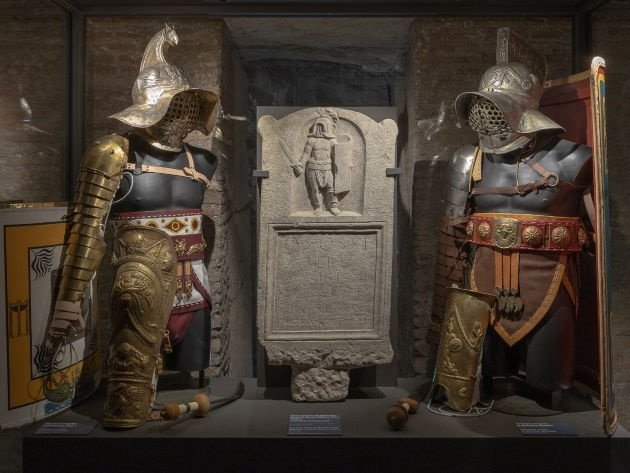
Let's clear up a misunderstanding right away, one that generates disappointment and sour reviews. This is not an archaeological museum: in the display cases there are no helmets pulled out of a Campanian necropolis, no original swords seized from a tomb robber. It is a museum of reconstructions, and its collection exceeds 500 pieces among armor, helmets, swords, shields, greaves and harnesses, covering a span that runs from the 7th century BC to the 4th century AD. The reproductions were made by studying the originals held in the great European and American archaeological museums, and rebuilt with ancient casting and metalworking techniques. Put bluntly: it is a museum of philology applied to metal.
This choice, which to a strict-school archaeologist may seem a compromise, in fact has an enormous and little-recognized advantage. An authentic Montefortino helmet, today, is a shell of green bronze, dented, often missing its cheek guards, almost always missing its crest. Anyone looking at it in a display case in Naples or Vienna sees an archaeological object and understands nothing about how it worked on a man's head. The philological reconstruction restores the weight, the shine of freshly worked bronze, the real bulk, the dyed horsehair, the leather straps. In front of the display cases of national museums, understanding almost always comes from a reconstructed piece, not from the original fragment. In our view a museum like this is worth more as a teaching tool than many academics are willing to admit, provided the visitor knows from the start what they are looking at.
Piazza Navona exhibit was spread over two levels. The upper level held the chronological sequence of armor and helmets. The lower level, going down, put you in contact with authentic columns belonging to the Stadium of Domitian, the structure of AD 86 that gave Piazza Navona its elongated form and its rounded sides. Also on the lower level, a gladiator's cell had been reconstructed, where the public could have their picture taken. One more element that set the museum apart from state institutions: here the objects could be touched, and touching an armor changes the way you understand it.
Where the Gladiator Museum Is Today and What Has Changed
Piazza Navona site operated until 2019. Since then the more than 500 reproductions have been awaiting a move: the museum's website speaks openly of a new location coming, without adding anything else, and the Roma Capitale portal records the status of temporary closure. In the meantime the archaeological area of the Stadium of Domitian, that is the adjoining underground complex that made that site unique, is also closed to the public by order of the Capitoline Superintendency for Cultural Heritage. The two fates are intertwined: that subsoil is a single organism of vaulted rooms, corridors and Flavian-age masonry, and any intervention on one portion affects access to the others.
It's worth understanding why the matter is not trivial. The rooms in question are not 19th-century cellars: they are the remains of the ambulatory and the supporting structures of the cavea of the stadium built by Domitian for athletic contests on the Greek model, the building that later dictated the plan of the square above. A private museum occupying protected archaeological spaces lives in a permanent balance between the economic sustainability of the rent, the protection constraints and the conservation condition of the masonry. When that balance breaks, the collection moves and the walls stay. It has happened many times in Rome, and almost always the outcome has been the same: years of waiting.
The practical advice for anyone organizing a Roman day on a gladiator theme: don't build the itinerary around this museum until there is a new, verifiable address. Build it around the Colosseum, the Ludus Magnus seen from above and the Museum of the Roman Legionary on the Appian Way, and keep the Gladiator Museum as a surprise to catch up with on your next trip. Rome is a city where patience always pays off.

How to Get to the Gladiator Museum and How to Get Around the Area
The Buses That Serve the Gladiator Museum
The useful stops are two and they have names that confuse even Romans: Senato and Rinascimento. Both are on Corso del Rinascimento, the roadway that separates Piazza Navona from Palazzo Madama, seat of the Senate of the Republic. The 30, 70, 81, 87, 492 and 628 pass through. The 30 and 492 come from the north and east and are the most convenient for those staying toward Prati or the Tiburtina station. The 70 connects directly to Termini crossing Via Nazionale and Largo di Torre Argentina. The 81 comes from the Vatican via Risorgimento. The 87 and 628 serve the axis toward the Colosseum and the southern Lungotevere. At rush hour the stretch between Largo Argentina and Corso del Rinascimento is slow: if you have less than 10 minutes of margin, get off at Argentina and walk the 400 meters, you'll arrive sooner.
Metro, Tram and on Foot
Line A stops at Barberini and Spagna, both about 20 minutes' walk away. Line B does not serve this area. Tram 8 terminates at Piazza Venezia. Anyone coming from the Vatican does well to walk: from Ponte Sant'Angelo to the square it's 600 meters along Via dei Coronari, one of the most beautiful streets in the rione Ponte, and the route is worth the time spent by itself. Anyone coming from the Colosseum can take the 87 or walk for 25 minutes passing through the Forum Boarium and the Ghetto: it's an itinerary that ties together the place where in 264 BC the first documented gladiatorial munus in Rome was fought and the place where, almost two millennia later, someone tried to tell the story of their weapons.
Accessibility and Barriers
The sore point of every museum carved out of a Roman archaeological subsoil is the level. Piazza Navona site spread over two levels connected by stairs, and the lower level, the one with the columns of the stadium, involved a descent. Anyone traveling with a wheelchair, a rigid stroller or mobility difficulties must consider this fact structural and not a detail: in the basements of the historic center an elevator is almost always impossible to install for protection reasons. Before planning the visit, when the museum reopens, it's best to ask the staff directly what the situation is at the new site. On this I accept no optimism: better one question too many than a staircase found suddenly.
What You See in the Gladiator Museum: The Route Room by Room
The route, at the historic site, was built as a timeline of weaponry. It wasn't a thematic museum of islands: it was a chronology, and this choice is its greatest merit. Anyone who followed it understood something no school textbook manages to get across, namely that the Roman army never had fixed equipment, but changed it continuously, almost always by copying the enemies it had just defeated.
The Sequence of Helmets at the Gladiator Museum
It began with the oldest helmets, of Corinthian and Etruscan derivation. The Corinthian helmet is the one everyone has in mind when thinking of Greece: a single cap of beaten bronze that covers the whole face leaving open only a T-shaped slit for eyes, nose and mouth. It protects exceptionally well and leaves you deaf and half blind, which is why the Greeks ended up wearing it pushed back on the forehead except at the moment of combat. The Etruscan and Italic versions lighten it, open up the face, add movable cheek guards.
Then came the Montefortino, and with it Republican Rome. It takes its name from the Gallic necropolis of Montefortino di Arcevia, in the Marche, where examples were found during the excavations of the 1800s: the form is that of a conical cap of cast bronze, with a small apical button that served to fasten the crest and with a short neck guard projecting backward. It is a Celtic helmet that the Romans adopted wholesale, and that equipped the legions for over three centuries, from the Second Punic War to the Augustan age. Seeing it reconstructed, polished, with its horsehair crest, completely changes the perception: it looks like a modern object, almost a sporting one.
From the Montefortino the route climbed toward the more complex forms of the imperial age: the Coolus type, still in bronze, with a widened neck guard and shield-shaped ear guards. Then the Gallic types in iron, which specialists call Imperial Gallic, with the cap reinforced by ribs, the wide, sloping neck guard, the large shaped cheek guards and the characteristic brow-shaped reinforcement on the front. It is the helmet of the legionary everyone has in mind for the age of Trajan, and it is, from a technical point of view, one of the best combat headgear ever produced before the 1900s: it protects the nape without preventing you from hearing orders, which the Corinthian helmet did not allow.
Body Armor at the Gladiator Museum: From the Breastplate to the Lorica
The second sequence concerned the defense of the torso, and followed the same logic: from the simple plate that protects the heart to the articulated systems of the empire. The starting point is the quadrangular breastplate, a bronze plate 20 centimeters on a side held by crossed straps, which the Republican foot soldier of modest means wore over his tunic. It's little, but it covers the organ that counts.
From there the museum showed the ring mail, the lorica hamata, another Celtic invention adopted by the Romans: tens of thousands of little iron rings, alternating rows of riveted rings and rows of punched rings, sewn onto a backing and reinforced on the shoulders by a double cape. It weighs between 10 and 15 kilos, distributed over the shoulders and hips by a belt that relieves the weight: that is why the Roman military balteus is not an ornament but a load-bearing element. Next to it, the lorica squamata, with overlapping metal scales sewn onto leather or cloth, showier and less flexible.
The piece that always draws visitors is the lorica segmentata, the one with horizontal metal bands that the movies have made the symbol of the legionary. It's worth knowing that the name is modern, coined by 16th-century scholars, that the ancient sources never use it and that the Roman name of the object remains unknown to us. The armor is documented from the beginning of the common era until at least the middle of the 3rd century AD, and specialists classify it by types named after the sites where they were found: Dangstetten, Kalkriese and Vindonissa for the earliest phase, between 9 BC and AD 43. Corbridge and Carnuntum for the years between 69 and 100. Newstead for the period between 164 and 180. Not all legionaries wore it and in many provinces ring mail continued to be used. The museum also displayed the anatomical cuirasses of the Hellenistic type, those with the muscular torso embossed in bronze, which in imperial Rome are above all parade dress and honorary-statue dress: the cuirass you see on the Augustus of Prima Porta is a political manifesto, not a garment for the battlefield.
Cavalry Helmets and the Hippika Gymnasia
The final part of the military section passed from the infantry to the cavalry, and here the museum played its most spectacular card. The helmets of Roman horsemen have more enveloping caps, cheek guards that close under the chin and often an embossed decoration representing hair, crowns, plant motifs. But the peak is something else: the helmets with a face mask, used in the equestrian tournaments that the sources call hippika gymnasia, literally horse exercises.
They were skill competitions in which cavalry units faced each other in maneuvers, throwing blunted javelins and mock charges, in front of the commander and sometimes the emperor. The riders wore masks of bronze or silvered iron with idealized faces, sometimes female, sometimes with Amazonian features, and carried decorated shields and colored saddle cloths. They were training exercises turned into spectacle, with winners and prizes. The one who tells us about them is Arrian, governor of Cappadocia under Hadrian and military writer, who describes how soldiers of high rank or particular skill were authorized to wear these helmets in cavalry tournaments. The most famous example is the Ribchester helmet, from Lancashire, a ceremonial bronze datable between the end of the 1st and the beginning of the 2nd century AD, found in 1796 at a depth of three meters by a boy and now displayed at the British Museum. Reconstructed and lined up in a display case, these metal faces produce an effect no photograph conveys: a platoon of men without faces. It was the piece that struck visitors most, and rightly so.

The Panels and Captions of the Gladiator Museum
Each group of objects was accompanied by panels and drawings that indicated the period of use of the weaponry, the archaeological context the model comes from, the way the object was used in combat and the museum in the world where the original is kept. This last piece of information is the most valuable and the rarest: it means that the visitor could leave with a list of verifiable references, and that the reconstruction declared its own source. A museum of replicas that doesn't declare its sources is a theme park. A museum of replicas that does is a study tool. The difference is all there.
The Lower Level and the Columns of the Stadium of Domitian
Going down, the register changed. The lower floor put the visitor in contact with authentic masonry and columns belonging to the Stadium of Domitian, the building for Greek contests inaugurated in AD 86 and able to hold, according to the late-antique regionary catalogs, about 30,000 spectators. The plan of the stadium, more than 270 meters long and about 66 wide, survived in the shape of the modern square because the medieval houses and Renaissance palaces leaned against the ancient structures instead of demolishing them. Walking among those columns after looking at 200 helmets has a precise effect: it shifts the discourse from the display case to the city.
Careful with a distinction many people confuse. The Stadium of Domitian was not an amphitheater and did not host gladiators: it was intended for athletic contests on the Greek model, running, wrestling, boxing, pankration, in a four-year program that the emperor had established on the model of the Olympic games. That a gladiator museum should sit inside its foundations is a topographical coincidence, not a historical continuity. It needs saying because improvised guides tell the opposite, and because an error repeated long enough becomes common sense.
The Gladiator's Cell
On the lower level a gladiator's cell had been reconstructed, with the possibility for the public to enter it and have their picture taken. It's worth explaining what it really was, because the cell is one of the points where the movie vulgate has done the most damage. In the best-preserved gladiator barracks, like the barracks of Pompeii in the quadriporticus of the theaters, the quarters were rooms of about four meters by four, arranged on two floors around a porticoed courtyard, shared by two or three men. They were not damp dungeons: they were dormitories. Gladiators ate plenty and regularly, received good medical care and were worth a capital sum. No owner lets an investment rot.
The Classes of Gladiators as Told by the Gladiator Museum
The second soul of the museum was gladiatorship, and here the discussion gets serious. Gladiators were divided into classes, we know 16 of them, defined by the ethnic origin of the type, the weapons, the costume and the fighting technique. They were not men who entered the arena to swing blows at random: they were specialists in a codified system of fencing, with referees, with rules, with fixed pairings. The logic that governs the whole system is just one, and it's the reason gladiatorship lasted seven centuries: heavy against light, protected against fast, big shield against small shield. A balanced show, not a slaughter.
The Murmillo
The murmillo is the heavy gladiator par excellence. He carries the scutum, the big rectangular, curved shield of veneered wood and canvas, about a meter tall, the same one the legionary used. He wields the gladius, the short broad-bladed sword. His right arm is wrapped in the sleeve, a padded protection reinforced with plates, and he wears a single low greave on the left leg, the one forward behind the shield. The helmet is wide-brimmed, with a high, honeycombed crest. The name derives in all likelihood from the Greek mormyros, a sea fish, and ancient tradition links the type to a fish-shaped crest. The murmillo fights covered: he advances behind the shield, absorbs, waits for the mistake. His is a fencing of waiting and of occupying space.
The Thraex
The thraex is his historic opponent, and his technical opposite. He has the parmula, a small shield, quadrangular and slightly curved, which covers little and allows a lot of movement. He wields the sica, the curved or angled sword of Balkan derivation, made to strike past the opponent's shield and wound him in the back or the nape. He wears two high greaves, reaching above the knee, because bare legs are the natural target of anyone fighting against a big shield. The helmet is wide-brimmed with a curved crest topped by a griffin's head, the animal that in the mythological repertoire accompanies Nemesis, the goddess of just measure. The thraex embodies the eastern component of the empire. His is a fencing of movement: he circles, looks for the angle, strikes with the edge.
The Retiarius
The retiarius is the most recognizable and the most misunderstood. He fights without a helmet, bare-faced, with only the protection of the sleeve on the left arm and of the galerus, the metal shoulder guard that projects above the left shoulder and serves to shelter the head when he ducks. His weapons are three: the throwing net, the fishing trident the Latins call fuscina, and the dagger. No shield. In the Roman value system he was the socially lowest type, because he fought almost naked and because he used fishermen's tools instead of military weapons: the satirical sources treat him with contempt. But technically he is the hardest to play, because he has to keep the distance with the trident and can't afford a single mistake. A retiarius who loses the net has lost half his trade.
The Secutor
The secutor, literally the pursuer, exists only in relation to the retiarius. He is armed like a murmillo, scutum and gladius, right sleeve and left greave, but his helmet is an object designed at the drawing board for a specific problem: smooth surface, very low continuous crest, no brim, just two tiny eye holes. All to offer no hold to the net. The price is very high: inside that helmet you see very little, you breathe worse, and the heat becomes unbearable within a few minutes. The retiarius versus secutor duel is therefore a race against time: the secutor has to close the distance fast, the retiarius has to tire him out. It is the most depicted combat in ancient iconography, and not by chance: it was the most readable from the stands.
The Hoplomachus
The hoplomachus takes his name from the Greek hoplite. He carries a small round bronze shield, two high greaves, the sleeve on the right arm, a wide-brimmed helmet with a crest and two large side feathers. His weapons are two: a spear, which he throws or holds pointed at a distance, and a short dagger for close combat. He fights as a rule against the murmillo, and the pair works because it puts together a man with a long weapon and small shield against a man with a short weapon and big shield. In the figurative grammar of the games he represents the Hellenic component, the echo of the Homeric duels that every cultured Roman spectator recognized.
The Provocator
The provocator is the only gladiatorial type who wears the cardiophylax, the crescent-shaped or rectangular metal breastplate that protects the sternum. He has the scutum, the gladius, the right sleeve, a left greave and a helmet without a wide brim, with a visor and cheek guards. He fights only against another provocator, never against different types. He is the gladiator closest in appearance to the Republican Roman soldier, and for that very reason the most loaded with political meaning: in the arena the image of the armed citizen could not be humiliated by a thraex or a retiarius. The provocator expresses the properly Roman and divine component of the spectacle. When the pair of provocatores entered the field, the public knew they were watching something that resembled themselves.
The Other Types and the Fixed Pairings
Besides the six major types the repertoire includes the eques, who opens the program fighting on horseback in a tunic and with a lance against another eques. The essedarius, who fights from the Celtic war chariot. The dimachaerus, armed with two swords and without a shield. The sagittarius, an archer. The gallus and the samnis, archaic types tied to the Italic and transalpine enemies of the Republic, later absorbed into the imperial categories. And rare figures like the scissor and the laquearius. The canonical pairings remain few and recurring: thraex against murmillo, retiarius against secutor, hoplomachus against murmillo, provocator against provocator. An editor of the games who had put a retiarius against a thraex would have been taken for incompetent, like an organizer today who had a light heavyweight box a flyweight.
Weapons, Color, Plumage
One aspect the museum stressed strongly, and which school books ignore, is the aesthetic care of the weaponry. The helmets were covered with feathers, on the sides and on the crest. The tunics and subligacula were colored. The leg and arm wraps were showy. The metal was polished or silvered. In 65 BC Julius Caesar, already heavily in debt, put 320 pairs of gladiators into the field with silvered armor, and the Senate reacted by setting a cap at precisely 320 pairs per citizen in Rome. Gladiatorial weaponry was designed to be seen from 70 meters away by a spectator in the last tier. It was not functional for war: it was functional for the legibility of the spectacle. This is the key to understanding why a gladiator's helmet weighs twice as much as a legionary's helmet and protects the face in a way no soldier would ever accept in battle.

What a Munus Really Was: Religion, Politics, Blood
The Funerary Origin
The word munus means gift, obligation, service owed. It does not mean spectacle. Ancient tradition places the first gladiatorial combat in Rome in 264 BC, at the Forum Boarium, where the sons of Decimus Junius Brutus Pera had three pairs of gladiators fight on the occasion of their father's funeral. Three pairs: six men. It was not a mass event, it was a private rite. The blood spilled was the offering owed to the Manes of the deceased, the spirits of the ancestors, and the combat was the way of delivering it.
This is the point that the Gladiator Museum brought into focus better than much popularization: the gladiators were a sort of priests delegated by a divinity who exalted a blood sacrifice through combat, and the gift was normally dedicated to the salvation of an important person. The blood that came out of the wounds, or the very death of the gladiator, became redemptive matter for the soul of the deceased to whom the munus was dedicated. Anyone who reads the games as pure sadistic entertainment doesn't understand why they lasted 700 years and why they were practiced by a legally sophisticated civilization. They were a religious act before being a spectacle, and remained a religious act even when they became a political machine.
From Private Rite to Imperial Machine
During the Republic the munus moves away from the tomb and closer to the ballot box. Whoever aspires to a magistracy offers games, and whoever offers bigger games gets more votes. Caesar's 320 pairs are not a whim: they are an election campaign. Augustus closes this phase by taking control of the games to the emperor and turning their provision into a regulated civic and religious duty, with spending caps and frequency rules. From that moment the munus becomes an instrument of central power: whoever offers it in Rome is the emperor, and whoever offers it in the provinces does so with his permission.
The figures of the imperial age are on another scale. Between 108 and 109 AD Trajan celebrated the Dacian victories with games that the sources quantify at 10,000 gladiators and 11,000 animals spread over 123 days. Numbers of this kind required an industrial logistics: schools, breeding farms, supply routes from Africa and the East, an imperial administrative apparatus with dedicated procurators. Gladiatorship was not a marginal phenomenon of antiquity: it was an economic sector.
The Day of the Games
The program of a day followed a rigid order. The evening before, the gladiators received a public dinner, the cena libera, which the public could attend: a way of looking in the face the men who would fight the next day. The morning opened with the venationes, the hunts and the combats against animals. At midday, in the interval, the executions of the condemned took place: it was the moment when the serious public went to eat, and the literary sources tell it with annoyance. The afternoon was reserved for the munera proper.
Before the duels the pompa took place, the entrance procession, opened by the lictors and followed by trumpeters and by the images of the gods carried in procession. Then came the probatio armorum, the weapons check, in which the weapons were sharpened and verified in front of the public and the editor. On the field were the referees: the summa rudis and his assistant, recognizable in the mosaics because they wear a light tunic and carry a long staff, the rudis precisely, with which they separated the fighters, stopped the action, called out fouls. The fact that professional referees existed says everything about the regulated nature of these combats.
Missio, Sine Missione, Rudis
A duel almost never ended with automatic death. The gladiator who recognized he was beaten raised a finger and asked for the missio, the discharge, that is, mercy. The formal decision belonged to the editor of the games, who took the mood of the public into account. A combat could end with the victory of one of the two, with the stans missus, that is the discharge of both still standing after a draw, or, in exceptional and conspicuously advertised cases, sine missione, with no possibility of mercy. This last formula was rare and considered in bad taste under many principates.
The reason was economic before it was humanitarian. A trained gladiator cost money, his owner had to be compensated if he died, and a top-class man was worth as much as a small estate. Modern estimates based on inscriptions indicate per-fight mortality rates very far from the popular imagination: in the early empire, one duel in eight to 10 ended in a death, and in most cases death came from infection or hemorrhage in the following days, not on the spot. Whoever survived a long time could receive the rudis, the wooden sword that sanctioned definitive discharge from the arena and, for slaves, often freedom.

The Ludus: How One Became a Gladiator
The Sacramentum Gladiatorium
Anyone who entered a gladiatorial familia, slave, convict or free man, took a sacred oath, the sacramentum gladiatorium. The formula is preserved for us by Petronius in the Satyricon, chapter 117: he swore to endure being burned, bound, beaten and killed by the sword. It's a terrible formula and has to be read for what it is: the contractual renunciation of one's own physical integrity, that is, the renunciation of what made a man legally free in Rome.
The detail that astonishes most is that free men took it voluntarily. They were called auctorati, they sold themselves for an engagement, and the sources record many of them: desperate debtors, ex-soldiers, adventurers, sons of good families at odds with their fathers. They signed a fixed-term contract, collected an advance sum and for the duration of the engagement lost the status of free men. In AD 19 a senatus consultum issued at Larinum, and known from a bronze inscription found in Molise, reaffirmed the bans already introduced by Augustus to stop members of the senatorial and equestrian classes from stepping into the arena. If a law is needed to forbid it, it means it was happening.
Training and the Palus
The day in a ludus was that of a professional athlete under armed guard. They fought against a wooden post planted in the ground, the palus, with wooden weapons twice as heavy as the real ones: repeated blows for hours, under the direction of the doctores, instructors specialized by individual gladiatorial type, often discharged ex-gladiators. There was a doctor for the thraeces, one for the retiarii, one for the murmillones: the specialization was total.
The internal hierarchical scale also derives from the name of the post. A gladiator was classified by palus: the primus palus was the highest rank of the school, followed by the secundus and so on downward. The newcomer was called a tiro, and his first appearance, the tirocinium, was announced as such on the posters. Whoever survived became a veteranus. Above all stood the lanista, the owner and entrepreneur of the gladiatorial familia, a socially despised and very rich figure: an infamous trade that paid very well, as often happens.
Doctors, Diet, Bodies
The ludus had medical staff, and the best proof has a famous name. In AD 157 Galen, 28 years old, returned to Pergamon as physician to the gladiators of the high priest of Asia and kept the post for four years. He called the wounds of gladiators windows into the body, and from that vantage point he drew his expertise on diet, exercise, hygiene, living anatomy and the treatment of fractures. The figure that strikes most is another one: under his care five gladiators died, against the 60 recorded under his predecessor. One man alone, with better clinical criteria, cut mortality by an order of magnitude. Anyone who imagines the ludi as slaughterhouses indifferent to the fate of the fighters should pause on this number.
Diet was part of the system. The ancient sources call gladiators hordearii, barley eaters, and the diet was predominantly vegetable, built on cereals and legumes. The layer of subcutaneous fat that this regimen produced was not an aesthetic defect but a technical advantage: it protected vessels and nerves from superficial cuts and allowed wounds that were very bloody and very visible without permanent damage. The gladiator's body was designed for the spectacle as much as his helmet was.
The Ludus Magnus, the Gladiators' Barracks Next to the Colosseum
If the Gladiator Museum tells of the weapons, the Ludus Magnus is the place where those weapons were used every day. It stands on Via Labicana, in the valley between the Oppian Hill and the Caelian, about a hundred meters east of the Flavian amphitheater, and you look at it from above, from a balcony on the sidewalk: anyone walking toward San Clemente walks over it without noticing.
Domitian, Trajan and the Measurements
It was built by Domitian between AD 81 and 96, together with three other gladiatorial schools: the Ludus Dacicus, the Ludus Gallicus and the Ludus Matutinus, the latter intended for the men who fought against wild beasts in the morning session. The Magnus was the main one and could house around a thousand gladiators. The building is organized as a porticoed courtyard, with travertine columns and small triangular-plan fountains, and at the center a small elliptical arena for training, about 63 meters long and about 42 wide: just slightly smaller than the Colosseum's arena, which means the gladiators trained on a surface practically identical to the one on which they would fight. Around the arena ran a cavea able to hold about 3,000 spectators, with boxes for the authorities at the minor axes. Under Trajan the floor level was raised by 1.4 meters, and this is the phase you see today.
Let's pause for a moment on those 3,000 seats, because the figure is more eloquent than it seems. A training school with a stand for the public is not a gym: it's a rehearsal theater. The training sessions were a spectacle in themselves, and the Roman aristocracy went to watch the gladiators work the way people today go to the open practices of a soccer team. The machinery of the games produced anticipation and a market even before the day of the munera.
The Underground Corridor to the Colosseum
Below street level ran an underground passage that connected the school to the Flavian amphitheater, with a sizable entrance, a little under seven meters wide. The gladiators reached the arena without going out into the street and without crossing the crowd. It was a choice of security and of staging together: the appearance of the fighters had to happen inside the amphitheater, not outside. That corridor was at the center of the exhibition the Colosseum Archaeological Park devoted to the theme between July 21, 2023 and January 7, 2024, titled Gladiators in the Arena, between the Colosseum and the Ludus Magnus, with philological reproductions of armor made by Silvano Mattesini alongside original finds from the National Archaeological Museums of Naples and Aquileia.
The 1937 Discovery and How to Visit Today
Until 1937 the precise position of the great training ground was unknown: it emerged by chance during work to build a new building. Excavations began that same year and were completed between 1957 and 1960, bringing to light the northern half of the monument. The other half remains under the houses and under the street. The Capitoline Superintendency manages access by reservation through the single Roma Capitale number, with groups of no more than 30 people, rates of 4 euros full price and 3 euros reduced and free entry for residents of Rome and holders of the city museum card. Since August 1, 2024, however, the site is listed as temporarily closed to the public for the start of works funded by the national recovery and resilience plan, and the Superintendency's official page continues to flag it. Anyone passing by should therefore look from the balcony: you can see the ellipse of the arena, the paving stones and the remains of the structures very well, and the view with the Colosseum behind it is worth the stop.
The Pollice Verso: What the Ancient Sources Really Say
This is the point on which I get the most questions of all, and also the one on which popularization has been wrong the longest. The gesture of the thumb up to save and down to kill has no basis in the ancient sources. It's a 19th-century invention, and it has a date and an author: the painting Pollice Verso that Jean-Léon Gérôme painted in 1872, where a crowd of Vestals stretches out their thumbs downward while a secutor awaits the order over his fallen opponent. That painting shaped the visual imagination of all the cinema that followed, from the Italian silent films to the contemporary blockbusters.
What the texts really say. Juvenal, in the third satire, uses the expression verso pollice, that is, turned thumb, and the exact meaning remains obscure because the poet doesn't explain in which direction. Prudentius, in his reply to Symmachus, speaks of converso pollice with regard to a Vestal virgin who enjoys the slaughter. Quintilian uses the expression infesto pollice, hostile thumb. Pliny the Elder, on the other hand, speaks of pollices premere, pressing the thumbs, in a context of favor. These are four different formulas, all allusive, none descriptive.
The most solid reconstruction available today is that of the Latinist Anthony Corbeill, who has studied Roman gesture systematically: according to his reading the raised and extended thumb meant killing, while the gesture of mercy consisted of pressing the thumb against the index finger inside a closed fist, that is, hiding it. The extracted, pointed thumb imitates the blade, the folded thumb imitates the sheathed sword. It's an elegant reading and consistent with the Plinian expression. It must be said honestly that the consensus is not total and that the exact gesture remains uncertain: the sources don't clarify whether the thumb was turned up, down, sideways or hidden.
Anyone who tells you with confidence that the thumb down meant death is selling you a 19th-century French painting passed off as archaeology. And the funny thing is that, if Corbeill is right, the gesture we use today to say all is well was exactly the one that condemned a man.
Female Gladiators: What We Know for Certain
That women also fought in the Roman arena is documented, and it is not a marginal curiosity. The evidence is of three kinds: literary, epigraphic and figurative, and together they draw a real but limited phenomenon, tolerated and periodically repressed.
On the literary side, in AD 66 Nero had Ethiopian women, men and children fight in a munus staged to impress Tiridates I, king of Armenia, visiting Rome. A munus of AD 89, under Domitian, presented a combat between female gladiators described as Amazons. The senatus consultum of Larinum of AD 19, which reaffirms the Augustan bans on members of the upper classes stepping into the arena, explicitly also concerns women of rank: once again, what is happening is what gets forbidden.
On the figurative side there is a document that is worth the whole discussion by itself: a marble relief of the Roman age, 1st or 2nd century AD, from Halicarnassus and kept in the British Museum under inventory number 1847,0424.19. It measures 65.6 centimeters in height by 77.5 in width and depicts two female gladiators armed with sword and shield, in an attacking position on a platform, with the heads of spectators below. The two fighters have an engraved name: Amazon and Achillia, that is stage names built on the Greek heroic imagination, the Amazon and the feminine of Achilles. The inscription commemorates their discharge from service or the conclusion of the duel in a draw. They didn't die: they walked out standing, and someone paid for a marble to remember it.
The end of the phenomenon also has a date. Septimius Severus, around AD 200, probably tried to offer Rome a dignified exhibition of women's athletics on the model of the games of Antioch. The crowd responded with obscene songs and whistles, and in all likelihood it was that reaction that pushed him to ban the use of female gladiators. I find it instructive that the ban came not out of moral modesty but because of a problem of public order and of the decorum of the spectacle. Rome, on these matters, has always been more pragmatic than moralistic.

Graffiti and Inscriptions: The Voices of the Gladiators
The Graffito on the Colosseum Step
Among the materials displayed in the Colosseum Archaeological Park exhibition was a step of the amphitheater's cavea with an incised graffito depicting the combat between a retiarius and a secutor, datable between the 2nd and 3rd century AD. It's worth dwelling on what this means. Someone, seated in the stands, with the point of a nail or a little knife, started drawing on the seat the scene in front of him. Not a court artist: a bored or enthusiastic spectator. That graffito is the closest thing to an amateur photograph that antiquity has left us of the games, and it is a first-hand iconographic source precisely because it is badly drawn.
The Walls of Pompeii
The Pompeian graffiti give back the popular dimension of gladiatorship with an immediacy no literary text achieves. Celadus the thraex appears there described as the sigh of the girls and the glory of the girls. Next to names you find the palmares, the count of fights and victories, the predictions, the insults to fans of rival schools. They were sports champions in every respect, with a public that followed them, bet on them and insulted them. Gladiatorship, before being a moral problem for us, was for them a championship.
The Funerary Inscriptions
The tombstones are the most valuable source because they contain numbers. One epitaph remembers Flamma, secutor, dead at 30, 34 fights, 21 victories, nine draws, four defeats, of Syrian origin. Let's stay on the numbers: 34 duels and four defeats he came out of alive, which confirms that losing was not the same as dying. Another tombstone remembers Nicephorus son of Sinetus, a Lacedaemonian, and Narcissus secutor, with the monument placed at his own expense by Titus Flavius Satyrus. A third says simply that the familia placed it in memory of Saturnilus: the schoolmates chipped in for the funeral of the dead man, like a trade confraternity.
This is the material that makes gladiatorship a human story and not a collection of anecdotes. Men with a name, an origin, a recorded career and colleagues who paid for the marble. The Gladiator Museum, by showing the weaponry next to panels explaining where each model comes from, was doing an operation of the same kind: it gave gladiators a technical context instead of a myth.
The Gladiator Museum and the Museum of the Roman Legionary: The Differences
The two institutions are constantly confused, and the confusion has a real basis, because both work on reconstructions. The differences, however, matter.
The Historical Educational Museum of the Roman Legionary is at Via Appia Antica 18, telephone 06 87645457, and is run by the Gruppo Storico Romano, a nonprofit cultural association founded in 1994 and recognized as one of the leading Roman reenactment groups in Italy and in the world. The association is divided into sections: Legion, Praetorian Guard, Gladiators, Senate, Vestals. It practices what it calls experimental archaeology, that is, the field testing of reconstruction hypotheses through the real use of the objects. Its annual event is the celebration of the Birth of Rome, on April 21, which has received seven medals from the President of the Republic and the support of the Ministry of Culture and the regional institutions. The office hours are normally Monday to Friday, from 9:30 to 16:00, and it's best to phone before showing up. Guided visits have a dedicated contact, 338 2436678.
The Gladiator Museum, by contrast, was a private enterprise with an exhibition vocation, focused on weaponry and set up in the very heart of the historic center. The first is a museum you also visit to see people wearing the reconstructions. The second was a museum of display cases, with the possibility of touching the pieces. If I had to choose for a family with children between the ages of eight and 14, today, I would point without hesitation to the Appian Way: contact with the reenactors works better than any caption. If I had an adult military history enthusiast in front of me, I would tell him to wait for the new site of the Gladiator Museum, because nobody else in Rome reconstructs the complete chronological sequence of the weaponry.
The Gladiator Museum and the Colosseum: How They Fit Together
The Colosseum is the container, the Gladiator Museum was the content. Whoever visits the Flavian amphitheater sees an extraordinary architectural machine and sees almost nothing of what happened in it: the arena is uncovered, the underground is a labyrinth of masonry, and the objects that tell the story of the spectacle are elsewhere, mostly in Naples, where the gladiatorial material from Pompeii ended up. The ideal order of visit, when the museum reopens, is weapons first and then the building: you enter the Colosseum knowing what the man going down onto the sand had in his hands.
On the practical side, the Colosseum Archaeological Park requires mandatory online booking with a time slot for entrance to the amphitheater, tickets are named and must be shown with an ID, and bookings open 30 days before the visit date. The Colosseum's opening time begins at 8:30, while the area of the Roman Forum and the Palatine opens at 9:00. Last entry and closing vary by seasonal bands, with last entry at 18:15 in the spring and summer band, at 17:30 in the first part of October and at 15:30 in the winter period. Rates and ticket types can be checked on the official site of the Colosseum Archaeological Park, which also manages the special entrances to the underground and the arena.
Reenactments, Workshops and Gladiator School
The question always comes: can you try fighting? Yes, and the serious route goes through the Gruppo Storico Romano on the Appian Way, which alongside the museum organizes educational activities and training sessions with practice weapons. The Gladiator Museum, at Piazza Navona site, offered educational activity but was not a combat school: its experiential part was contact with the objects and the cell reconstructed for photographs.
A warning from a professional. Around the gladiator theme, in Rome, an underbrush of improvised offerings has formed, with elastic hours, venues that change and instructors with no historical training. Before enrolling a child in a course, ask who teaches the class, how long the organization has been operating and on what sources the reconstruction of the weaponry is based. An association that answers these three questions precisely is worth twice the price. One that takes offense is worth nothing. The historical organizations recognized by the city's institutions exist and can be counted on the fingers of one hand.
The Gladiator Museum With Children
The gladiator theme works very well with children from age seven up, on one condition: that someone explains the difference between regulated sporting combat and massacre. If the story stops at violence, you get an excited and misinformed child. If you explain that there were referees, rules, weight and weapon categories, doctors, contracts and pensions, you get a child who has understood something about how a society works.
Piazza Navona site had two elements that worked with little ones: the chance to touch the objects and the gladiator's cell for photographs. They are very effective levers. The limit was the underground setting, with stairs and tight spaces, not well suited to strollers. The right length of visit for a family was around 40 minutes, 60 for those who read the panels. Beyond that, children get tired and the technical panels on the evolution of helmets don't hold them.
A suggestion: after a museum of weapons take the children to see the real space, the Ludus Magnus from the balcony on Via Labicana or the ring of the Circus Maximus. The passage from the small object to the urban dimension is what fixes the memory. A helmet in a display case is forgotten in a week. The ellipse of an arena seen from above stays for years.
A Curiosity About the Gladiator Museum
The nicest curiosity concerns the floor beneath which the museum had been carved out, and nobody tells it to visitors. Piazza Navona has the shape it has because it follows the arena of the Stadium of Domitian, inaugurated in AD 86 for athletic contests on the Greek model. But the detail almost everyone ignores is that this stadium, in Latin, was not called a stadium: the sources call it Circus agonalis, and from agonalis, through popular deformation into nagone and then navone, comes the modern name of the square. Navona has nothing to do with ships, even though Romans have believed the opposite for centuries because of the summer flooding of the square that was practiced until 1866. The name comes from the agones, that is, the contests.
A second, more technical curiosity follows. The gladiator museum had its lower hall in contact with the columns of the athletes' stadium. That is: a collection devoted to gladiatorship, the most typically Roman form of spectacle, was housed inside the building that Domitian had built to import Greek gymnastics into Rome, the activity that conservative Romans considered immoral because it was practiced naked. The two ideas of public spectacle, the Greek one of the athlete and the Roman one of the gladiator, found themselves in the same subsoil 15 centuries removed from their ideological coexistence. It's one of those overlaps that happen continually in Rome and that almost nobody comments on.
I'll add a third detail concerning the collection. The more than 500 reproductions were not mass-produced: each comes from the study of an original kept in an identified museum, and the panels declared it. It means that the catalog of that museum is, in fact, an archaeological bibliography disguised as an armory. For an enthusiast it's valuable material, and for a teacher of ancient history it's a teaching tool worth more than 20 illustrated textbooks. It's also the reason why its prolonged closure is a real loss for the city, and not simply the disappearance of a tourist attraction.
Something Nobody Tells You About the Gladiator Museum
Nobody will tell you that the most famous phrase of the gladiatorial imagination was never spoken by a gladiator. Ave Caesar, morituri te salutant appears only once in ancient literature: Suetonius reports it in the Life of Claudius, at chapter 21, and puts it in the mouths of the naumachiarii, that is the condemned men destined for the simulated naval battle that Claudius staged on Lake Fucinus in AD 52. They were not gladiators, it wasn't an amphitheater, it wasn't a munus. Cassius Dio tells the same episode in the 60th book of his history. Tacitus, in the Annals, describes the event without quoting the phrase. The scholar H. J. Leon was already writing in 1939: there is no other ancient reference to a gladiators' salute, and that was an isolated desperate invocation, not a ritual formula.
The second thing nobody says concerns this very museum: its Piazza Navona site was neither the place where gladiators trained nor where they fought. The Stadium of Domitian hosted running, wrestling, boxing and pankration, and was intended for athletes. There is no functional continuity between that subsoil and gladiatorship, other than the one created by the exhibit. Saying so takes nothing away from the museum: it takes away a false aura and gives back the real merit, which is the quality of the reconstruction of the objects.
Third thing. Gladiators were not all slaves. A substantial part, in the imperial age, was made up of free men who had sold themselves voluntarily by signing a fixed-term contract, the auctorati. Some were ex-soldiers looking for an engagement, others debtors. And the best earned notable sums: the inscriptions preserve careers dozens of fights long, and the structure by rank inside the schools, with the primus palus at the top, worked like a sports ranking. Anyone who imagines the arena as a place where people were sent to die at random has never read a gladiator's tombstone.
My Advice for Visiting the Gladiator Museum
The first piece of advice is to check the opening status before leaving home. With Piazza Navona site closed and the new site announced but not yet indicated, the only sensible way to proceed is to contact the museum at 06 68891777 or write to info@gladiatormuseum.com, or consult the site of the Gladiator Museum. The city's tourism portal lists it as temporarily closed. Don't trust hours copied onto travel aggregators: information from the underground site is still circulating as if nothing had happened.
The second piece of advice concerns how to visit a museum of reconstructions, when it reopens. Don't look at the objects one by one: look at the sequence. The value of that collection is in the chronological succession, that is, in being able to see in 20 meters of route how you go from the closed Corinthian helmet to the Celtic Montefortino, from the Montefortino to the Imperial Gallic in iron, from the quadrangular breastplate to the ring mail and then to the banded lorica. If you follow the timeline you understand the mechanism that governs the whole Roman army: adopt, adapt, standardize. If you jump from one display case to the next, all you keep in mind is some nice pieces of polished metal.
The third piece of advice is to touch, where it's allowed. It's a very rare possibility in Italian museums and should be taken advantage of. Pick up a helmet in your hands and you'll understand why the secutor had to finish the fight quickly. Try the weight of a scutum and you'll understand why the murmillo fought by waiting. Tactile knowledge of a weapon explains tactics better than any drawing.
The fourth is to schedule the visit to the Gladiator Museum as the opening of the day and not the close. Seeing the weapons first and the Colosseum afterward works. The reverse order wastes the museum, because you will arrive at Piazza Navona already saturated. And if the museum is still closed, replace it with the balcony of the Ludus Magnus on Via Labicana, which costs nothing and is always open.
Another Well-Known Fact, Yet Rarely Cited
Everybody knows that the gladiatorial games ended with Christianity. Almost nobody knows that they ended slowly, in a muddled way, and that the animal hunts went on for a long time after the duels had stopped. Constantine, between 315 and 337, forbade forcing convicts to fight to the death, but the measure was not applied uniformly. Honorius ended gladiatorial combat by law in 399 and again in 404, clear proof that the first law had not been enough. Tradition ties that second ban to the martyrdom of the monk Telemachus, killed by the spectators while he tried to separate two fighters. I should say clearly that this is a hagiographic tradition, not a fact documented with the same solidity as the laws. The venationes, on the other hand, meaning the shows with animals, continued past 536.
The second fact, very well known and badly told, concerns blood. People keep repeating that the games were a continuous bloodbath. The epigraphic record says otherwise: in the majority of fights of the early empire death was the exception, mercy was the norm, and long careers were common. The gladiator was an expensive investment, his owner had to be compensated if he died, and a top-ranking man was worth as much as a house. The brutality of the arena was concentrated elsewhere: in the midday executions, where the condemned were killed without any sporting rules. That moment, which the refined public skipped to go to lunch, was the real violence of the amphitheater. Confusing the two is the most widespread misunderstanding on the whole subject.
Third fact, well known and underrated: gladiatorial combat was not born in Rome. The earliest depictions of funerary combats between pairs come from southern Italy, from the Campanian and Lucanian world, and ancient tradition attributes the origin to the Campanians or the Etruscans. Rome imported it in the 3rd century BC and turned it into a phenomenon of imperial scale, as it did with Greek architecture, with coinage, with the fleet. The Roman talent was not inventing. It was industrializing.
The Right Photo to Take at the Museo Dei Gladiatori - Gladiator Museum
With the underground venue closed, the right photograph today is not inside the museum. It is the sign and the stairway down on the western side of Piazza Navona, shot from the middle of the square with Bernini's Fountain of the Four Rivers to one side and the facade of Sant'Agnese in Agone behind you. It is a photograph that documents a situation, a museum waiting for a home, and in a few years it will be worth far more than a selfie in a helmet.
When the venue was open, there was only one photograph to take and almost everyone got it wrong. Not the portrait in the gladiator's cell, which is a theme park pose, but the lower hall with the helmet display cases lined up in front of the authentic columns of the Stadium of Domitian. That framing puts the reconstructed metal and the real stone together, which is exactly what that museum was: a dialogue between an openly declared copy and the original. You shot without flash, resting your elbow on a ledge because the light was low, exposing for the metal and letting the masonry fall into shadow.
One technical recommendation that holds for any armor museum: polished helmets are mirror surfaces, and a frontal flash ruins them. If you want a good result, stand at a three-quarter angle to the case, not head-on, and use the exhibit lighting. And photograph the label together with the object: in six months you won't remember if that helmet was a Coolus or an imperial Gallic one, and the caption in the same image will save you.
For the photo of the day, if the museum is closed, move on to the Ludus Magnus. From the balcony on Via Labicana, with the late afternoon sun coming in from the west, you get the ellipse of the arena in the foreground and the Colosseum in the background. It is the only frame in Rome that holds the school and the theater together, the training and the show. It's worth the detour.
Some Important Events That Happened Here in History
The place that housed the Museo Dei Gladiatori has a stratigraphy of events that few addresses in the world can claim, and it makes sense to go through it in order.
In 86 AD Domitian inaugurated the stadium for athletic contests on this spot, a building more than 270 meters long, able to hold tens of thousands of spectators, built to host the four-yearly certamina on the Greek model that the emperor had established. It was the first masonry building for athletics ever built in Rome, and its foundation marks the attempt, largely unsuccessful, to acclimatize Hellenic athletic culture in the city.
Between the 3rd and 4th centuries the building underwent restorations, and hagiographic tradition places the martyrdom of Agnes in the rooms beneath the square, the young Roman woman exposed naked to public mockery in a brothel carved out of the spaces of the stadium. This should be treated for what it is, a tradition and not a documented fact. But it is the reason the church of Sant'Agnese in Agone stands exactly there and has, once again, the word agone in its name.
In the Middle Ages the arches of the stadium were occupied by houses, workshops and family fortifications. That is the mechanism that saved the shape of the square. In 1477 Sixtus IV moved the city market here from the Capitoline, and for almost four centuries Piazza Navona was the market of Rome. In the 17th century the Pamphilj family, with Innocent X, turned the area into its own dynastic theater: Bernini's Fountain of the Four Rivers dates from 1651, and the church of Sant'Agnese in Agone is the work of Girolamo and Carlo Rainaldi and Francesco Borromini. Until 1866 the square was flooded on weekends in August, with the drains closed and the water covering the paving stones. The nobility crossed the artificial lake in carriages while the common people jumped right in. The market was moved to Campo de' Fiori in 1869.
In the 20th century the subsoil of the stadium was the subject of archaeological investigations that freed up rooms and walls, giving back the stretch of the monument that is visible today. In this context, in recent years, came the opening of the museum dedicated to gladiators, active until 2019 and then suspended pending a new venue. It is the last chapter of a 2,000-year story in which this address has continued, in different forms, to deal with spectacle and the human body.

Who Has Passed Through the Museo Dei Gladiatori - Gladiator Museum
The question deserves two answers, because the place has two layers and in both of them people moved who left a name behind.
The first to pass through here, in the most literal sense, is Domitian, the emperor who built the stadium in 86 AD and who personally presided over his certamina wearing, the sources say, a Greek cloak and a golden crown with the images of Jupiter, Juno and Minerva. Domitian is also the emperor who built the Ludus Magnus and the other three gladiatorial schools next to the Colosseum, and who in 89 AD had female gladiators fight, described as Amazons. No other prince tied his name so closely to both Greek athletics and Roman gladiatorial combat.
After him, the list of those who have trodden this address is the list of the history of Rome. Sixtus IV in 1477, when he moved the market here. Innocent X Pamphilj, who in the mid 17th century made the square the drawing room of his own family. Gian Lorenzo Bernini, who in 1651 placed the Fountain of the Four Rivers here with travertine from the Tivoli quarry and the four colossal river gods. Francesco Borromini, who redesigned the facade of Sant'Agnese in Agone. In the 19th and 20th centuries came the passage of Grand Tour travelers, view painters, film directors: Italian cinema has shot in this square since the silent era, and anyone who has made a film set in Baroque Rome has passed through it.
On the subject of gladiatorial combat, the name to remember in connection with this museum and this city is Silvano Mattesini, author of the philologically accurate reproductions of armor shown in the exhibition Gladiatori nell'arena, curated by the Colosseum Archaeological Park between 2023 and 2024, alongside original finds from the National Archaeological Museums of Naples and Aquileia. It is a sign that the philological reconstruction of Roman weaponry, in Italy, has reached a level recognized by state institutions.
And then there are the people who passed through as visitors: school groups, military history enthusiasts, reenactors who came from half of Europe, families looking for an hour indoors on a rainy day. A small museum in an enormous square, which for a few years did something no big Roman institution did: it put the real weight of a helmet into a kid's hands.
How Much the Museo Dei Gladiatori Costs and How Long the Visit Takes
The fares published by the museum for Piazza Navona venue were 12 euros for the full price, from age 15 up, and 10 euros for the reduced fare for ages 6-15. The stated hours were every day from 10:00 to 19:30. These figures refer to the underground venue and need to be rechecked when the collection reopens elsewhere: a change of venue almost always changes floor space, staff and running costs, and the fare adjusts. The museum named an authorized reseller on its website for buying tickets in advance. For an institution of this size, advance booking was never necessary.
The realistic length of the visit was 40 minutes for someone who just looks, an hour and a quarter for someone who reads the panels, 2 hours for a military history enthusiast who wants to note down where the originals come from. It's not a half-day museum, and that's fine: its role is as a support and a preparation, not as the single destination.
On value for money I'll say something unpopular. 12 euros for a museum of replicas seems like a lot compared with the 4 euros of the Ludus Magnus or the free admission of many archaeological areas. But a private institution with no public funding, renting space in the heart of the historic center, with 500 handmade objects, can't cost less. The right question is not if 12 euros is a lot, but if that hour taught you something you didn't know.
What Is Around the Museo Dei Gladiatori Within a 10-Minute Walk
This is the real asset of the location, and it is worth using anyway, even with the museum closed. 100 meters away, on the northern side of the square, is the entrance to the archaeological area of the Stadium of Domitian, which lets you go down to the ancient structures when it is accessible. On the southern side, at Palazzo Braschi, is the Museo di Roma, with the collections on the city from the Middle Ages to the 19th century. Five minutes east, in Piazza Sant'Apollinare, Palazzo Altemps holds the ancient sculpture of the great Roman collections, from the Suicidal Gaul to the Ludovisi Throne. If the theme is antiquity, that is the visit that best completes the day.
A little farther, eight minutes to the south, the Crypta Balbi tells the urban layering of a Roman city block from the Augustan age to the Middle Ages, and it is the museum that explains better than any other how the subsoil of this city works. The Pantheon is 400 meters to the east, Campo de' Fiori 300 meters to the south, the Tiber 200 meters to the west. Anyone with energy left can cross the bridge and climb the Janiculum, or head back up toward the Vatican along Via dei Coronari.
My advice: don't try to fit Piazza Navona and the Colosseum into the same morning, and not Piazza Navona and the Vatican Museums either. They are two distant worlds and every attempt to squeeze them together produces a day of rushing and heat. The Baroque center around Piazza Navona can carry a full half day on its own, and carries it well.

When to Go and When to Avoid the Area
Piazza Navona has two good times and one terrible one. The two good ones are first thing in the morning, between seven and nine, when the square belongs to the people who live there and you can hear the fountains, and late in the evening in winter, when the little tables empty out. The terrible time is the stretch between 11 and 16 from April to October, when the square becomes a funnel of organized groups and vendors. An underground museum, in this respect, has an advantage: indoors and underground the temperature stays acceptable even in July.
December deserves a separate mention. The Christmas market of Piazza Navona, heir to a 19th century tradition tied to the Befana, occupies the square from late November to Epiphany and turns it into a corridor of stalls. Anyone looking for atmosphere finds it. Anyone looking for archaeology would do better to pick another month. November and February are better: few tourists, low slanting light, reasonable lodging prices, and all the museums open with full hours.
Where to See Gladiators in Rome While the Museo Dei Gladiatori Is Between Venues
A concrete list is needed, because the question comes up every week. The Colosseum remains the obligatory starting point, with the entrance booked online and, if possible, the underground and arena floor added. The Ludus Magnus can be viewed for free from the balcony on Via Labicana. The Roman Legionary Museum on the Appian Way offers reconstructions and reenactors. The Appian Way Park and the Villa of the Quintilii give the context of suburban Rome. The Baths of Caracalla show the scale of imperial public building. The Circus Maximus explains the other great Roman spectacle, chariot racing, which for the ancient public counted for even more. The Domus Aurea tells the flip side, the private luxury that generated the Flavian reaction and the construction of the amphitheater where Nero's lake used to be.
For the real objects, the truth has to be told plainly: the best preserved original gladiatorial armor in the world comes from the gladiators' barracks of Pompeii and is in the National Archaeological Museum of Naples. Anyone who wants to see authentic gladiator helmets, with mythological reliefs embossed on the brim, has to take a train. In Rome, original Roman weaponry is scattered across different collections and there is no unified route. That is exactly the gap the Museo Dei Gladiatori filled, and it is the reason its reopening matters to the city and not only to tourists.
Quick Questions About the Museo Dei Gladiatori - Gladiator Museum
Is the Museo Dei Gladiatori open today?
No. The official tourism portal of Roma Capitale lists it as temporarily closed, and the museum announces a new venue without giving its address. Before planning the visit, write to info@gladiatormuseum.com or call 06 68891777.
Where is the Museo Dei Gladiatori?
The historic address is Piazza Navona 90, 00186 Rome, in the underground rooms on the western side of the square, over the structures of the Stadium of Domitian. The collection is waiting to move to a new venue.
How much is a ticket to the Museo Dei Gladiatori?
The published fares for Piazza Navona venue are 12 euros full price, from age 15 up, and 10 euros reduced for ages 6-15. They need to be rechecked when it reopens.
What were the opening hours of the Museo Dei Gladiatori?
Every day from 10:00 to 19:30, according to what the museum states on its website for the underground venue.
Do you need to book for the Museo Dei Gladiatori?
No. The size of the institution doesn't require it and no lines form. The museum pointed to an authorized reseller for buying in advance, but walking in has always been the simplest solution.
How long does a visit to the Museo Dei Gladiatori take?
Between 40 minutes and an hour and a quarter. A military history enthusiast who notes down where the originals come from can take up to 2 hours.
Does the Museo Dei Gladiatori display original artifacts?
No, and it's good to know that from the start. It displays more than 500 reproductions made by studying the originals kept in the main European and American archaeological museums and rebuilt with ancient techniques of casting and metalworking. The ancient elements in the venue were the walls and columns of the Stadium of Domitian.
Can you touch the objects at the Museo Dei Gladiatori?
At Piazza Navona venue, yes, and it was one of the most appreciated features. In Italian state museums it is an almost nonexistent possibility.
Can you take photographs at the Museo Dei Gladiatori?
Yes, and there was even a gladiator's cell rebuilt specially for having your picture taken. Avoid the flash: shiny metal surfaces reflect and ruin the shot.
Is the Museo Dei Gladiatori suitable for children?
Yes, from age seven up, as long as someone explains the difference between regulated combat and violence. Touching the objects and the photo cell work very well with kids.
Is the Museo Dei Gladiatori wheelchair accessible?
Piazza Navona venue was spread over two levels connected by stairs, in protected underground rooms. Anyone with accessibility needs should ask the museum directly for confirmation about the new venue.
What is the difference between the Museo Dei Gladiatori and the Museo del Legionario Romano?
The first is a private armor museum set up in the center, built around display cases and a chronological sequence. The second, at Via Appia Antica 18, is run by the Gruppo Storico Romano, a reenactment association founded in 1994, and alongside the museum it offers experimental archaeology and activities with reenactors.
Is the Museo Dei Gladiatori in the Stadium of Domitian?
The venue occupied underground rooms in contact with the structures of the stadium and showed some of its authentic columns. But note: the Stadium of Domitian was meant for Greek athletic contests, not for gladiatorial combat. The link is topographical, not functional.
What is the relationship between the Museo Dei Gladiatori and the Colosseum?
No administrative relationship. They are different institutions, 2.5 kilometers apart. The relationship is one of content: the museum shows the weapons, the Colosseum is where they were used. The best order of visit is the museum first and then the amphitheater.
How many classes of gladiators were there?
16 are known, distinguished by origin of the type, armament, costume and fighting technique. The main ones are murmillo, thraex, retiarius, secutor, hoplomachus and provocator, to which are added eques, essedarius, dimachaerus, sagittarius and other minor figures.
Why did the retiarius and the secutor always fight together?
Because the gladiatorial system paired by contrast: a light, fast man with a long weapon against a heavy, protected man with a short weapon. The smooth, almost blind helmet of the secutor was designed specifically to offer no hold to the retiarius's net.
Did thumbs down really mean death?
No, or at least we don't know. The gesture is a 19th century invention tied to the painting Pollice Verso by Jean Leon Gerome from 1872. Ancient sources speak of verso pollice in Juvenal, converso pollice in Prudentius, infesto pollice in Quintilian and pollices premere in Pliny, without describing the gesture. Anthony Corbeill's reading suggests that the raised thumb indicated killing and the thumb pressed inside the closed fist indicated mercy.
Did female gladiators really exist?
Yes. The evidence includes the fights staged by Nero in 66 and by Domitian in 89 AD, the senatus consultum of Larinum of 19 AD and above all the Halicarnassus relief in the British Museum, inventory 1847,0424.19, with the names Amazon and Achillia. Septimius Severus banned their use around 200 AD.
Can you visit the Ludus Magnus?
The area is run by the Sovrintendenza Capitolina, with visits by reservation through the single city phone number, groups of up to 30 people, 4 euros full price and 3 euros reduced. As of August 1, 2024 it is listed as temporarily closed for the start of works under the national recovery and resilience plan. From the outside, from the balcony on Via Labicana, you can see it very well and for free.
Where can you see original gladiatorial armor?
The most famous pieces come from the gladiators' barracks of Pompeii and are kept in the National Archaeological Museum of Naples. In Rome there is no unified route on ancient weaponry, and that is the gap the Museo Dei Gladiatori filled.
How do you get to the Museo Dei Gladiatori by public transport?
Buses 30, 70, 81, 87, 492 and 628, stops Senato or Rinascimento on Corso del Rinascimento, one minute from the square. Tram 8 to Piazza Venezia and a 10-minute walk. Metro line A, Barberini station, about 18 minutes on foot.
Can you park near the Museo Dei Gladiatori?
Practically no. The area is inside the limited traffic zone of the historic center. The most convenient parking is the Janiculum one, a 20-minute walk away, with an uphill climb on the way back.
Is there a coat check at the Museo Dei Gladiatori?
The underground spaces of Piazza Navona venue were compact and had no proper luggage storage. Anyone arriving with a rolling suitcase would do well to leave it at the hotel.
How long is the wait in line at the Museo Dei Gladiatori?
None. It has never been a museum with line-forming crowds, and that is one of the reasons it was worth visiting on a high-season day.
Is the Museo Dei Gladiatori worth visiting?
For anyone with a real interest in the Roman army and in gladiatorial combat, yes, without a doubt: the chronological sequence of weaponry can't be found anywhere else in Rome. For anyone looking for original artifacts or a spectacular experience, it's better to head for the Colosseum with the underground or for the reenactments on the Appian Way.
Does the Museo Dei Gladiatori run educational workshops?
Piazza Navona venue offered educational activities. For actual training, with practice weapons, the Roman reference is the Gruppo Storico Romano on the Appian Way.
What does the word munus mean?
Gift, obligation, duty owed. It indicates the offering of gladiatorial combat owed to the dead, and later to the community by those who held or aspired to an office. It doesn't mean spectacle, and it is the key to understanding the religious and political nature of the institution.
To finish, the one thing that really matters. A museum of reconstructions is judged by the seriousness with which it declares its sources, and this one did: every piece named the original and the museum in the world where it is kept. For years it was the only place in Rome where a kid could pick up a helmet and understand why a man, inside that iron shell, had to finish the fight quickly. That a collection like this has been waiting for a venue for several years, in a city that lives off Roman antiquity, is a dropped opportunity. If you pass through Piazza Navona, take five minutes to look at the stairway on the western side and think about what is underneath: a Greek stadium built by a Roman emperor and 500 suits of armor waiting for an address. Then go to the Ludus Magnus and look at the ellipse from the balcony. The lesson, that one, is free and never closes.
Article written by the editorial team of TourLeaderPro, contact them for Private/Corporate/V.I.P. Tours and Experiences.
Planning a trip to Rome? The English guides for visiting the city are on ItalyPlanner.com.