Roman Legionary Museum
In short. The Museo del Legionario Romano is at Via Appia Antica 18, in Rome, a few hundred meters past Porta San Sebastiano, and it occupies a floor of a building that the Gruppo Storico Romano has used as its headquarters since 1994.
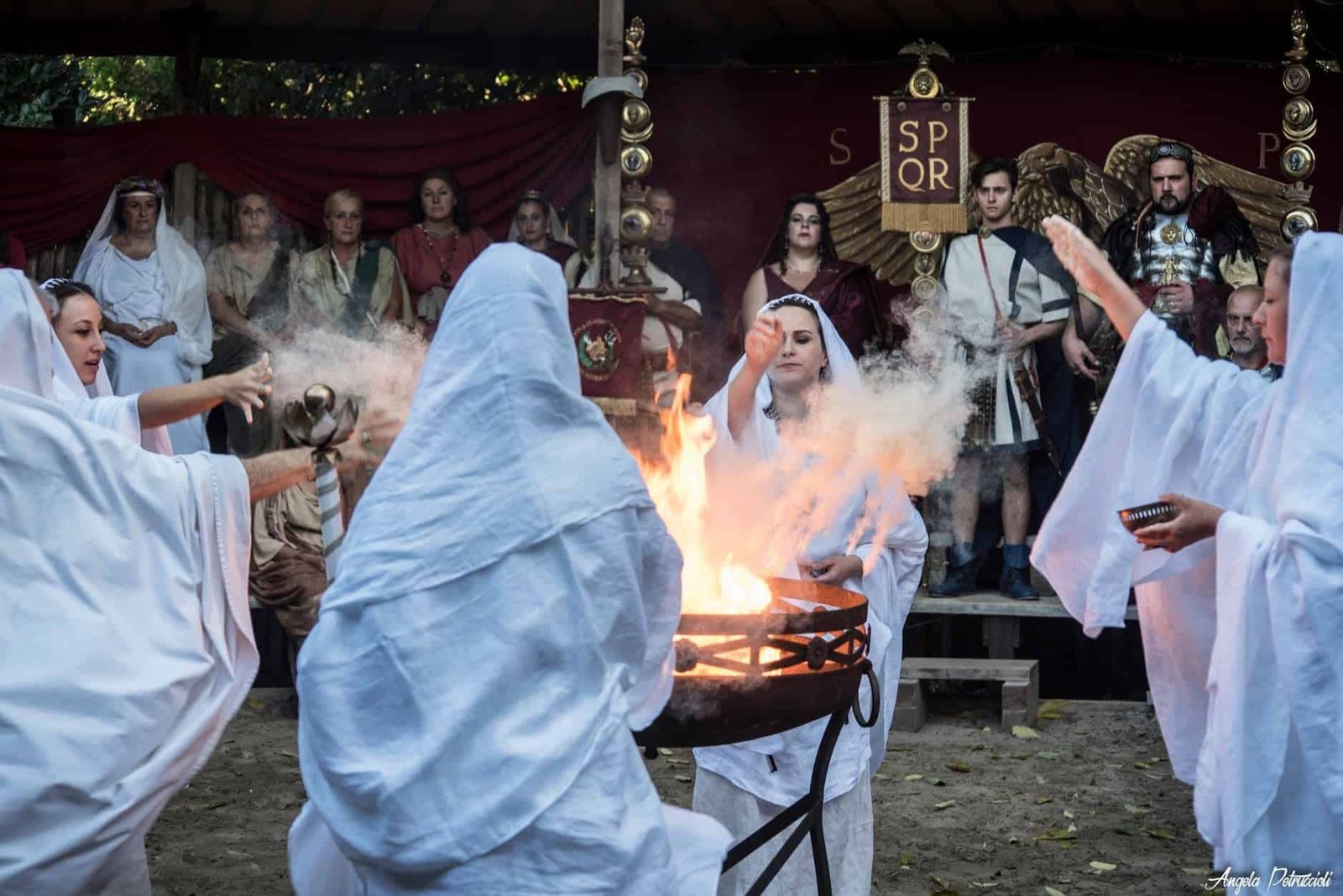
The Museo del Legionario Romano is at Via Appia Antica 18, in Rome, a few hundred meters past Porta San Sebastiano, and it occupies a floor of a building that the Gruppo Storico Romano has used as its headquarters since 1994. Admission is free. You arrange the visit in advance with the association's office, which normally answers Monday to Friday between 9:30 and 16:00 at 06 87645457 and 338 2436678, or at info@gruppostoricoromano.it. The calendar depends on reenactments and educational commitments, so a phone call before setting out saves you from finding the gate closed. You get there by bus 118, which runs along Via Appia Antica and connects the Appia/Villa dei Quintili terminus to the Colosseum and Piazza Venezia. By metro you get off at Circo Massimo, on line B, and continue by bus or on foot along Viale delle Terme di Caracalla, a good kilometer and a half to the gate. There are no ticket offices, no turnstiles and no line. There's an intercom and an office that waits for you at the agreed time. Hours, special openings and reenactment days should be confirmed on the official website of the Gruppo Storico Romano.
If you're building a whole day on this side of the city, the page on the Appia Antica Park gathers the context the museum sits in, and the one on Porta San Sebastiano explains the threshold through which you enter the first mile.
What the Museo del Legionario Romano really is
Let's say it right away, because it's the thing that generates the most misunderstandings: in here there isn't a single ancient artifact. Not even a nail. Everything you see is reconstructed, and for part of the public this is a two-second disappointment and for another part it's exactly the reason the trip is worth it. A 1st-century helmet kept in an archaeological museum is a dead object, immobilized inside a climate-controlled case, that you can't touch, can't wear and above all can't understand. You don't know how much it weighs, you don't know how it squeezes your temples, you don't know that the neck guard stops you from lifting your head and that in battle this mattered more than the decoration. Here they put the helmet in your hands. And in a quarter of an hour you understand more about the Roman army than you did in three visits to the Forums.
The Museo del Legionario Romano was born as a teaching tool, and this origin shows in every display case. It was conceived and set up by the Gruppo Storico Romano, a nonprofit cultural association founded in 1994, and in 2005 it was renovated and expanded precisely to make it better suited to school groups. The collection lines up the weapons and armor of legionaries, praetorians and gladiators, war machines in model and full-scale versions, and a section devoted to everyday civilian life, with particular attention to the world of women. The objects were reconstructed on the basis of targeted research and reproduce the equipment of the early empire, that is, the first and second centuries AD. It's a precise chronological choice, not a generic Roman costume, and it's worth keeping in mind because it explains why in these rooms you won't find either legionaries in Republican chain mail or late-antique soldiers in trousers.
Our opinion: the Museo del Legionario Romano is one of the very few places in the city where experimental archaeology is put in the visitor's hands instead of being narrated. It's a small, handmade museum, without a layout signed by an architecture firm, and whoever is looking for a polished museum experience will do well to go elsewhere. Whoever wants to understand how an army worked, on the other hand, finds here what the big museums don't give.
A museum of reconstructions, not of artifacts
The difference between artifact and reconstruction is the key to reading the whole visit, and it's worth spending two minutes on it. An artifact is an object that survived: almost always fragmentary, oxidized, deformed, missing the organic parts that gave it meaning. Of the Roman legionary, what has come down to us is mostly the metal parts, and not even whole. The wood of the shields has rotted, the leather of the belts has vanished, the wool of the tunics has dissolved, the colors have faded. A philological reconstruction tries to put that puzzle back together using three sources: metal finds, ancient iconography (the soldiers' funerary stelae, the reliefs of Trajan's Column and the Column of Antoninus, the triumphal arches) and texts.
The result always remains a reasoned hypothesis, never a truth, and hypotheses get updated. Whoever takes you through the Museo del Legionario Romano, if they're good, tells you so: this piece is documented, this other one is reconstructed by analogy, this other one is a choice that in 20 years might change. It's exactly the correct way to tell about the ancient world, and you will almost never hear it in a state museum, where the label gives two dates and says nothing about the rest.
The castrum and the arena at the headquarters of the Museo del Legionario Romano
The headquarters at Via Appia Antica 18 is not just exhibition rooms. Inside the structure the Gruppo Storico Romano has reconstructed a small castrum with an arena, that is, a military camp to scale and a space where people really fight, with training weapons, in front of those watching. This is where the events, the gladiator demonstrations, the weapons lessons and the shooting practice take place. There are also educational and recreational areas and spaces reserved for members' activities. The place lives as a club, and this should be understood before arriving, because it conditions the way you visit.
The arena is the reason a child remembers this day years later. Seeing two gladiators face each other two meters from you, with the real sound of wood on metal, has nothing to do with a documentary. And the sound is the part that surprises adults: the idea we have of ancient combat comes from the movies, where editing cuts the dead time. Live, the dead time is there, the fighters study each other, stop, breathe. It lasts a short time and is very tiring. That's already a history lesson.
Who is behind the Museo del Legionario Romano
The Gruppo Storico Romano was born in 1994 from the initiative of a group of friends united by a passion for ancient Rome, and it chose April 21, the day of the city's birth, as its founding date. It's not a folkloric detail. That date has become the pivot of all the association's activity, which every year organizes the celebrations of the Birthday of Rome. Today the group is recognized as one of the main players in historical reenactment of ancient Rome in Italy and abroad.
The statutory aims are declared and can be seen at work: to study and spread the customs and habits of the ancient Romans, in particular those of the first two centuries of the empire. To faithfully reconstruct costumes, weapons, armor and objects on the basis of research. To reconstruct military and gladiatorial activities, rites, ceremonies and historical events. To take part in social and charity events, which is why the association is registered in the Lazio Regional Register as a social promotion association under regional law 22/99. To organize educational meetings, on site and off site, with Italian and foreign students of every school level. To organize meetings with the senior centers of the Municipality of Rome. The association also publishes a bimonthly magazine of culture and historical reenactment called ACTA BIMESTRIA POPVLI ROMANI, distributed free of charge and sponsored by the Department of Cultural Policies and Historic Center and by the Libraries of Roma Capitale. Finally, it manages the opening of the Ludus Magnus, the gladiators' gym right next to the Colosseum, for guided visits and short gladiator demonstrations.
The recognitions are not few: among them the gold medal of the President of the Italian Republic awarded on the occasion of the Birthday of Rome celebrations of 2009, 2010, 2011 and 2012, and sponsorships from the Presidency of the Council of Ministers, the Lazio Region, the Province of Rome and Roma Capitale. The interactive museum opened in 2005, with free admission, was sponsored by the Department of Cultural Policies and Historic Center of Roma Capitale and awarded a silver medal of the President of the Italian Republic. Every year about 10,000 Italian and foreign students visit it, plus an unspecified number of tourists and enthusiasts. 10,000 students a year means, on average, about 40 kids a day throughout the school year: a state museum with those numbers would issue a press release.
The reenactment sections that revolve around the Museo del Legionario Romano
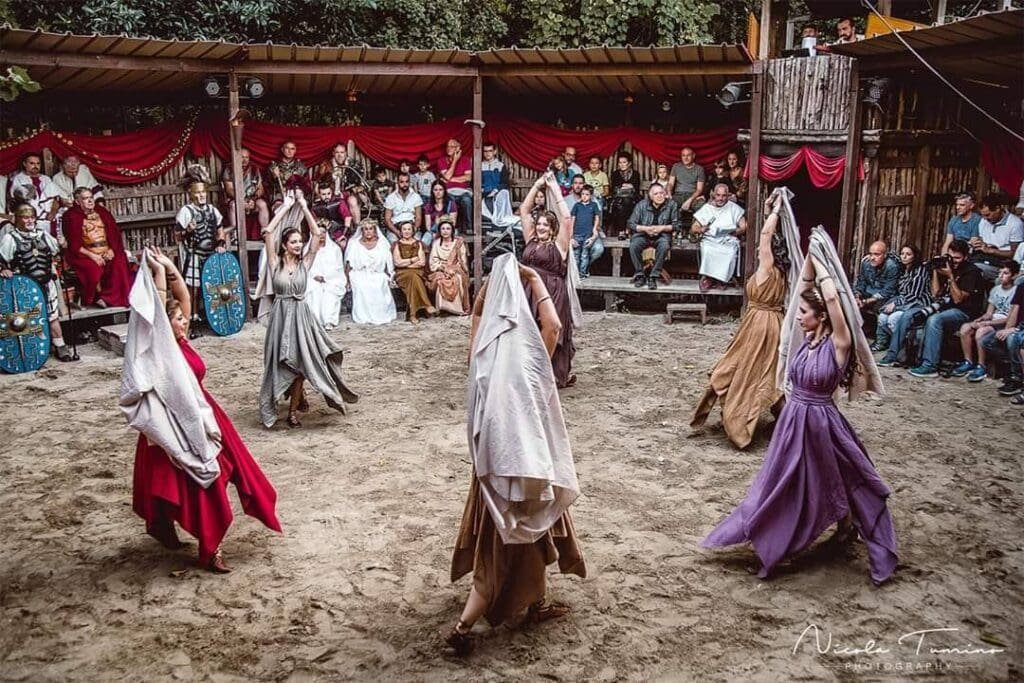
Within the association there are different sections, each with its own field of study: legionaries, praetorians, gladiators, vestals, senators, the people, dancers, pankration. Each section explores its own theme and, together, the general theme of ancient Rome. This internal structure explains the variety of what you see at the headquarters. It's not only the soldier, it's the city the soldier defended, with its magistracies, its cults, its shows and its women.
In support of the research, besides the study of historical sources (inscriptions, literary works, iconography), there is intense activity in experimental archaeology, based on reconstructing slices of civilian and military life through direct experience. On the civilian side, this line includes the study of the Roman female world, from makeup to perfumes, from hairstyles to clothing, which has produced cultural meetings with the public even off site, for example at the Markets of Trajan. On the military side, the reconstructions of the castrum legionis stand out, in which all aspects of the legionary's life inside the camp are reproposed, from food to training.
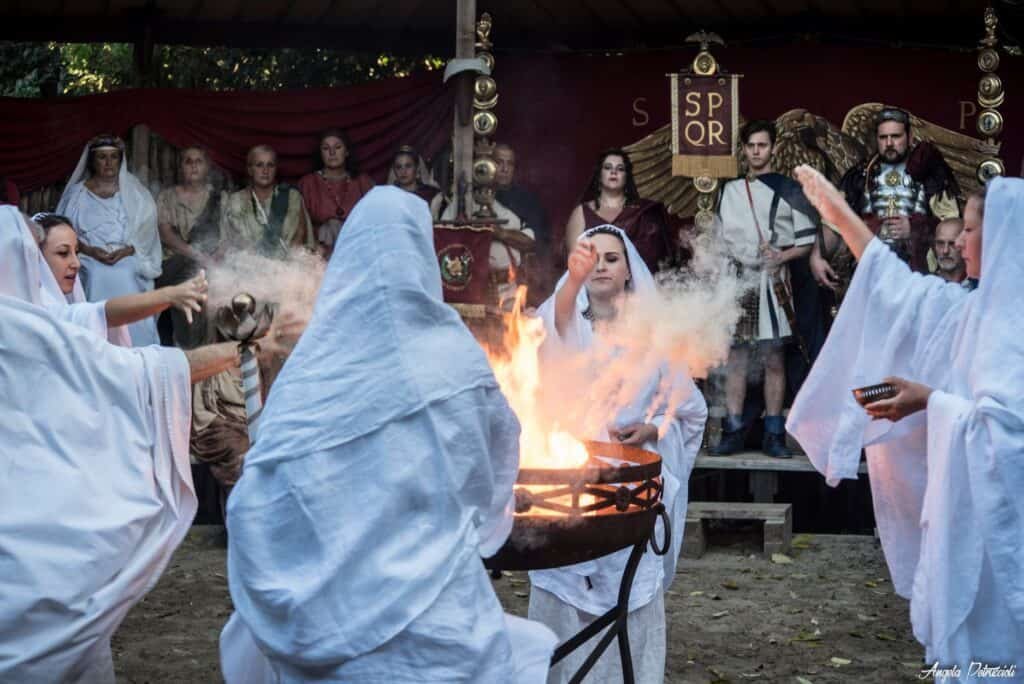
Among the rites and ceremonies reconstructed by the group, at least the following should be mentioned: the Captio Virginis, that is, the appointment of a new vestal. The Testamentum Augusti, the delivery and custody of Augustus's will at the atrium Vestae. The conspiracy of Catiline. The Confarreatio, the most solemn form of Roman religious marriage. The Palilia, a ceremony celebrating the founding of Rome. The Ignis Vestae renovatio, the annual lighting of Vesta's sacred fire. The Honesta Missio, the discharge of the praetorian. These are reconstructions that require months of study of the sources and that, once seen, change the way you read an ancient relief.
Where the Museo del Legionario Romano is and how to get there
The address is Via Appia Antica 18, 00179 Rome. The street number is low because we're at the beginning of the road. Once you've come out of Porta San Sebastiano, Via Appia Antica starts counting from there, and number 18 comes after a few hundred meters, on a stretch that's still narrow, lined with walls and cypresses, before the fork with Via Ardeatina where the church of Domine Quo Vadis stands. It's the first mile of the regina viarum, and this location is no accident: a museum devoted to the Roman army located on the military road par excellence, the one the legionaries built and walked for centuries.
By bus 118 to the Museo del Legionario Romano
Line 118 is the natural choice. It has its terminus at Appia/Villa dei Quintili, on Via Appia Nuova at the height of the villa, and from there it goes up along Via Appia Pignatelli and Via Appia Antica, touches Viale di Porta Ardeatina and Largo delle Terme di Caracalla, Piazza di Porta Capena, Viale Aventino, Via del Circo Massimo, Piazza della Bocca della Verità, Via del Teatro di Marcello, Piazza Venezia, Via dei Fori Imperiali and Piazza del Colosseo, then returns along the same route. The first runs leave around 5:30 and the last around 23:00, with frequencies that on weekdays hover around 15 or 20 minutes and lengthen on holidays. On holidays and on the last Saturday of the month, when Via dei Fori Imperiali is pedestrianized, the line follows a detoured route.
In practical terms: from the historic center you take the 118 and get off on Via Appia Antica, shortly after the gate. My advice is to check the return schedule before getting off, because on this line a pointless wait is what ruins days. On rainy days, what's more, there's no shelter at the stop.
By metro and on foot to the Museo del Legionario Romano
The useful metro station is Circo Massimo, on line B. From there you can take the 118 or set out on foot along Viale delle Terme di Caracalla, passing in front of the Baths of Caracalla, and continue to Porta San Sebastiano. It's about 25 minutes of walking on wide, shaded sidewalks, one of the most beautiful stretches you can do in the city without meeting a shop window. Once past the gate, another five minutes along Via Appia Antica and you've arrived. In summer, at one in the afternoon, that avenue is an oven: do it early in the morning or give it up.
If you're arriving from Termini station you can take the metro to Circo Massimo on line B, changing at Termini itself. If you're staying on the Aventine or in Testaccio you have the advantage of the short distance and of the 118 passing in both directions.
By car, by bicycle, by taxi
By car it's possible, but the first mile of the Appia is narrow, two-way in some stretches, with walls flush against the roadway and no convenient parking. If you come by car, plan to leave it before the gate, in the Baths of Caracalla area, and do the last stretch on foot. A taxi solves it, and from the center it costs a reasonable amount.
The bicycle is the best choice for those who want to combine the museum with a day on the Appia. The initial stretch, up to Domine Quo Vadis, requires attention because cars pass. From the fork on, the road becomes progressively quieter and, on holidays, the central stretch is closed to private traffic. The ancient paving, where it re-emerges, is uncomfortable for thin tires: bring a bike with generous tires, not a racing bike.
The stretch of the Appia where the Museo del Legionario Romano is
It's worth knowing where you're putting your feet. Behind you are the Aurelian Walls and the Museo delle Mura, housed inside Porta San Sebastiano, which is the largest and most imposing gate of the whole circuit. A little before, on the road of Porta San Sebastiano, opens the area of the Parco degli Scipioni, with the tomb of the great aristocratic family that gave Rome the victors over Carthage. Ahead of you, beyond the museum, the road leads to the church of Domine Quo Vadis, the Catacombs of San Callisto, the Catacombs of San Sebastiano, the Villa of Maxentius with its circus, the mausoleum of Cecilia Metella and, much further on, the Villa dei Quintili.
In July 2024 Via Appia was added to the UNESCO World Heritage List under the name Via Appia. Regina Viarum, inscribed under the third, fourth and sixth criteria, with 19 components spread over more than 800 kilometers of route. The Museo del Legionario Romano sits within this context, at the beginning of that road, and the coincidence between the theme of the museum and the place that hosts it is the smartest thing about the whole operation.
A curiosity about the Museo del Legionario Romano
The object that gives this museum its identity, the armor made of metal bands that everyone calls lorica segmentata and that has become the very image of the Roman legionary in the collective imagination, was not called that in Latin. The name lorica segmentata is modern: scholars coined it starting from the Renaissance, because in the Latin literary sources no explicit reference has been found to a model of armor that can be traced to those of iron bands. The Romans used it for 2 centuries and didn't leave us in writing what they called it. It's one of the most beautiful ironies of military archaeology: the most recognizable piece of the best-documented army of antiquity carries a name invented many centuries later.
There's more, and it directly concerns how the replicas you see at the Museo del Legionario Romano are made. Until the 1960s nobody really knew how that armor was assembled. People knew that a banded armor existed, they saw it depicted on Trajan's Column, but the internal mechanism, the system of straps and buckles, the order of the plates and the way the shoulder guards articulated remained a hypothesis. The turning point came in 1964 with the Corbridge hoard, in the north of England, south of Hadrian's Wall. Inside a buried wooden chest came out six upper sections and six lower sections of banded armor, together with bundles of spearheads still tied with rope, artillery bolts, a sword scabbard, tools, fragments of papyrus and wax tablets. Charles Daniels and Henry Russell Robinson worked on those materials and reconstructed for the first time in a correct way the assembly of the armor.
Which means one precise thing: the image of the Roman legionary you have in your head, the one from movies and school books, is less than 60 years old. Before 1964 the reconstructions were approximate and often wrong. Every modern replica, including the ones they put on you at Via Appia Antica, descends in a direct line from that find and from the work of two scholars on 12 heaps of oxidized iron. When you pick up a lorica in this museum, you're touching the result of 60 years of research, not a costume.
One last note, for those who love numbers: experimental archaeology has estimated for the banded lorica a total weight of around 10 to 13 kilograms, against 12 to 15 for the lorica hamata, the chain mail. The banded armor was therefore lighter than mail, as well as more protective against thrusts. But it was also more delicate: the hinges break, the internal straps wear out, and armor of this kind requires continuous maintenance. Ask your guide how many times a year a reenactor puts his hand to his own lorica again. The answer will tell you more than a thousand pages on the logistics of the Roman army.
The Roman legion explained properly, from the contubernium to the legion
The problem with almost all school visits to ancient Rome is that people talk about legions without ever saying how a legion was made. Here instead it's the heart of the discussion, and we tackle it from the bottom, from the smallest unit, which is also the one that best explains the mindset of the Roman army.
The contubernium: eight men, one tent, one millstone
The basic unit is the contubernium: eight soldiers, led by a decanus. Eight men who slept in the same tent, cooked together, ate together, shared the common load (the leather tent, the hand mill for grain, the digging tools) and answered for one another. Eight is a considered number: small enough that no one can hide, large enough that the group can bear the loss of a man. Anyone who has done military service or worked in a team recognizes the logic immediately.
The contubernium is the reason the Roman army held discipline even when the campaign was going badly. The most feared punishment was shame in front of the other seven, more than the whip. And decimation, the famous and in reality very rare one, struck exactly that bond, forcing comrades to kill the one picked by lot. When at the Museo del Legionario Romano they show you the reconstructed tent and make you go in, look at the space: eight people in there, with their equipment, in winter, on the Danube. Then talk about it again.
The century and the centurion
10 contubernia form a century: 80 men, commanded by a centurion. The name is misleading, because there aren't 100 of them: the century of the imperial age counts 80 armed men plus service personnel. The centurion is the key figure of the Roman army and also the most misunderstood. He is a career officer, not a noncommissioned officer: often he has 20 years of service behind him, commands on the front line, strikes and decides. His most visible badge of rank is the vine staff, the vitis, with which he kept discipline. He also wore the gladius on the opposite side from the ordinary legionary, and this detail, which seems like a whim, is one of the criteria by which scholars identify centurions on funerary stelae.
In a legion there are 59 centurions: 54 in cohorts two through 10 and five in the first. Among them there is an extremely rigid internal hierarchy, which culminates in the primus pilus, the senior centurion of the first cohort, the man who in practice runs the machine. A legionary could dream of becoming a centurion. Becoming primus pilus meant entering the equestrian order and changing social class. For centuries the Roman army was the most efficient social elevator in the Mediterranean.
The maniple and the cohort
Two centuries form a maniple, 160 men. Three maniples, that is six centuries, form a cohort of 480 armed men. The cohort is the tactical unit of the imperial army: it moves, deploys and fights as an autonomous block, and its adoption in place of the old maniple formation is one of the reasons for Roman flexibility on the field. A cohort could be detached, sent to guard a pass, dispatched to build a bridge, without taking the legion apart.
The legion: 5,000 men and a first cohort different from the others
10 cohorts form the legion, for a total that the sources place at around 5,000 effectives. But the cohorts are not all equal. The first is a milliary cohort, organized into five centuries of 160 armed men each, 800 legionaries in all, and the legion's eagle was entrusted to it. It's not an honorary promotion: the first cohort gathers the most experienced soldiers, occupies the place of honor in the battle line and guards the object the legion was willing to die for.
A small legionary cavalry is added to the infantry, reintroduced by Augustus after its abolition in the Marian period: just 120 horsemen, commanded by centurions and not by decurions, used for reconnaissance, escort and carrying orders, not as a striking force. The real cavalry, in the imperial army, was supplied by the auxilia, the auxiliary units recruited among noncitizens.
The command is articulated: above the centurions there are the tribunes, one laticlavius (young, of senatorial rank, often on a first posting) and five angusticlavii of equestrian rank. There is the praefectus castrorum, the officer who handles the camp and logistics and is almost always a former primus pilus, that is, a man who rose from the ranks. And there is the legatus legionis, the commander. Look closely at this structure: a general from a senatorial family, a head of logistics who came up from the troops, and in between a young aristocrat in training. It's the balance that held an empire together.
Legionaries, praetorians, auxiliaries: why at the Museo del Legionario Romano they are seen separately
In the display cases you find the armor of legionaries, praetorians and gladiators placed side by side, and the juxtaposition is educational. The legionary is the Roman citizen under arms, long-term service, stationed on the frontiers. The praetorian belongs to the imperial guard, stationed in Rome, with higher pay, shorter service and a political role that, over the course of the first and second centuries, becomes very heavy: the praetorian cohorts make and unmake emperors. The auxiliary is the noncitizen who serves in specialized units and obtains citizenship on discharge, with a bronze diploma in two copies, one of which was filed in Rome. The gladiator, finally, is a professional of spectacle and not a soldier: often a slave or a convict, sometimes a hired free man, trained in a school, with weapons designed for the arena and not for war.
Confusing these categories is the most common mistake, and the Museo del Legionario Romano does a good job of keeping them distinct. If you bring middle schoolers, insist on this point: the gladiator did not defend the empire, the legionary did not fight in the amphitheater. They are two worlds that the movies have mashed together and that here are separated.
The legionary's equipment at the Museo del Legionario Romano
This is the part you come for. Display case after display case, you review the complete kit of the soldier of the imperial age, and every piece has a technical story that is worth having told to you instead of reading the label.
The lorica segmentata and the other armors
The banded armor we described above comes in several variants, which scholars have named after the places where they were found. The Corbridge type is the oldest and is the one placed between the first century and the first decades of the second. The Newstead type is later and simplified, in use from the second century onward, with fewer internal straps and larger plates. Scholars also discuss a Kalkriese type, tied to materials from the site of the Teutoburg defeat. The armor remains in use, with archaeological evidence that extends its life well beyond the second century.
Alongside the banded armor, the museum shows the lorica hamata, the chain mail, made of tens of thousands of interlinked iron rings, closed with rivets or welded: heavy, flexible, extraordinarily effective against cuts and much less so against the point. It's the most widespread armor in the Roman army throughout its history, while the banded one is more limited in time and probably reserved for part of the units. Whoever imagines whole legions entirely dressed in plates has Trajan's Column in mind, which is a precious iconographic source and also a simplification: on the monument the legionaries wear bands and the auxiliaries mail, a distinction so clear-cut that it looks like a sculptor's convention more than a photograph of reality.
Then there is the lorica squamata, with metal scales sewn onto a support of fabric or leather, which gives that pinecone effect you see on many stelae. It's beautiful, shiny, relatively cheap to produce and repair, and for that reason common among standard-bearers and in certain units. Ask to lift the three armors one after the other: the difference in weight and rigidity is felt immediately, and no book can convey it to you.
The gladius: the weapon that made the empire
The gladius is a short sword, and its size answers a precise tactical choice. The types recognized by scholars start from the gladius hispaniensis, adopted by the Romans on the Iberian model and in use from the 3rd century BC, with an overall length of around 75 to 85 centimeters and a blade of 60 to 68, a weight of around a kilogram and the characteristic elongated leaf shape. With the early empire the Mainz type appears, shorter, 65 to 70 centimeters overall with a blade of 50 to 55 and a weight of about 800 grams, with a more triangular point and a blade still slightly narrowing. After the middle of the first century the Pompeii type spreads, the shortest of all, 60 to 65 centimeters with a blade of 45 to 50 and a weight of around 700 grams, with parallel sides and a short point. Between the two sits the Fulham type, attested after AD 43, an intermediate solution.
The progressive reduction of the blade tells of a change of doctrine. The gladius is for use inside the tight formation, where there is no room for swinging cuts: you fight with the point, protected by the shield, striking in the gaps. Vegetius, who writes in the late 4th century gathering the Roman military tradition, insists on this: the thrust wound, even if it penetrates only a few fingers, is generally mortal, while the cut meets bone and armor and often does not kill. Legionaries were nevertheless taught cutting techniques, for example the blow to the knees under the wall of shields.
The ordinary legionary wore the gladius on his right side, hung from the balteus or the cingulum. It seems awkward and instead it's logical: with the shield held on the left, drawing from the right is the only possible way without exposing yourself, and on a short blade the move works. The centurion wore it on the left, as a sign of rank. If they put a gladius in your hand, try the draw with the shield on your arm: in three seconds you'll understand something that no caption explains.
The pilum, the javelin that ruined the enemy shield
The pilum is the legionary's smartest weapon. About two meters long overall, with a wooden shaft and a long iron shank (about 60 centimeters, with a diameter of just seven millimeters) ending in a pyramidal point that can reach almost 30 centimeters. The weight ranges between one and two and a half kilos, with Republican examples generally heavier than imperial ones. The legionary carried two, sometimes of different weight, to hurl shortly before the impact.
On how the pilum behaved on impact the discussion is still open, and whoever tells it to you as a certainty is simplifying. The traditional version holds that the soft iron shank bent after piercing the opponent's shield, making the weapon unusable for the enemy and at the same time turning the shield into dead weight to be abandoned. More recent studies instead maintain that the pilum was designed to break rather than to bend, and that the bending observed on finds may derive from attempts at extraction. Experimental tests give a maximum range of around 33 meters, with real effectiveness between 15 and 20. The ancient reference sources are Polybius, who gives the first detailed description, and again Vegetius.
15 to 20 meters is very little. It's the distance of a big room. Which means that the throwing of the pila happened right up against contact, at a moment of extreme tension, and that immediately afterward the gladius was drawn and they went in on top of the enemy. Try to imagine the noise of 480 pila thrown together. At the Museo del Legionario Romano they let you understand this by putting the shaft in your hand: it weighs more than you expect, and the balance is all shifted forward.
The scutum and the case of Dura Europos
The rectangular, curved shield of the imperial age measures between 94 and 107 centimeters in height and between 61 and 84 in width. It's a layered artifact, not a simple wooden board. Strips of wood from 30 to 80 millimeters wide and a millimeter and a half or two thick were glued in three crossed layers, for an overall thickness between 4.5 and six millimeters, then covered with canvas and leather and finished at the edges. At the center is an iron umbo, the boss that protects the hand and deflects heavy blows, stones included. The overall weight is around 10 kilograms.
The best-preserved example in the world comes from Dura Europos, in Syria, and it is the reason we know today how a scutum was really made: it measures 105.5 centimeters in height, 41 in width and 30 in depth of curvature. Here too, as with the lorica, our image of the legionary depends on a single lucky find. Without Dura Europos we would still be arguing about the thickness of Roman plywood.
The curvature is what strikes whoever holds a replica. The scutum is not flat: it wraps around the body, and in formation it creates a continuous wall. The grip is horizontal, behind the umbo, with a closed fist: you hold it like a suitcase, not like a door. This changes everything, because it means the weight works on the wrist and forearm and that the shield is also used as a striking weapon, pushing with the umbo. Children love it, and adults start to doubt they understood the movies right.
The helmet, the cingulum, the caligae
The imperial helmet, which scholars classify into the Imperial Gallic and Imperial Italic types, has an iron or bronze bowl, a wide projecting neck guard that protects the nape and shoulders, two hinged side cheek pieces, and a frontal reinforcement against blows from above. Try it on. The first thing you'll notice is that you can't raise your gaze beyond a certain angle: the neck guard blocks you. The second is that you hear very little. The third is that after 10 minutes your neck hurts. From here you understand why orders in battle passed by trumpets and standards, and not by voice.
The military cingulum, the belt, is the soldier's identity object: metal plates applied to the leather, often with metal pendants in front that jingled as he walked. It didn't serve to protect the lower abdomen, as you read now and then. It served to be recognized and to be heard. A unit that marches with pendants is a unit that announces itself. The cingulum was so much a mark of identity that taking it away from a soldier amounted to demoting him.
The caligae, finally. They are the legionary's hobnailed sandals, made from a single piece of good-quality cowhide, with an open, perforated upper, a middle sole and an outer sole fixed with clinched nails, almost always iron and sometimes bronze, arranged to offer grip and support exactly as the studding of a sports shoe does today. The open structure is not carelessness: it served to keep the foot cooler during the march compared with closed footwear, an obvious advantage in Mediterranean climates, and to let water and mud out. And if someone asks you why the emperor Gaius was nicknamed Caligula, the answer is here: as a child, in his father Germanicus's camp, he went around dressed as a miniature soldier, caligae included, and the legionaries called him little boot.
The sarcina: how much a legionary's day really weighed
The legionary on the march carried the sarcina on his shoulders, his personal pack, hung from a T-shaped pole that allowed him to shift the weight onto one shoulder and drop it in an instant in case of alarm. Ancient tradition attributes to Gaius Marius the tightening of this practice, so much so that the soldiers were nicknamed Marius's mules. Inside the pack: grain rations for several days, the mess tin, the pot, the cloak, digging tools, the stakes for the camp's palisade, personal effects.
Vegetius, who collects a tradition older than his own time, prescribes that recruits learn to cover 20 Roman miles in five hours of summer marching at military pace, and 24 at full pace, carrying loads that the sources quantify in tens of pounds. 20 Roman miles are almost 30 kilometers. 30 kilometers in five hours, wearing armor, helmet, shield, two pila, gladius, dagger and a pack. Then, on arrival, they dug the ditch and set up the camp. So: when at the Museo del Legionario Romano they have you put on the full equipment and you try to walk for 20 meters in the courtyard, that is the lesson. Nothing else is needed.
Something nobody tells you about the Museo del Legionario Romano
That it's not a museum in the sense you mean. There are no opening hours posted on the gate valid all year round, there's no ticket seller, there's no route marked by arrows that you can do on your own in 35 minutes. The Museo del Legionario Romano is the exhibition floor of an association headquarters that runs on volunteers: it opens when the members are there, and the members are people who do something else for a living. Whoever arrives at Via Appia Antica 18 at three on a Tuesday without calling risks finding the gate closed and blaming the museum. The blame falls on whoever didn't call, not on the museum.
This association nature has a wonderful flip side. Since there's no automatic route, the visit is almost always accompanied by someone who builds and wears those armors. In front of you is a reenactor, not a guide with a memorized script: he tells you why he chose a certain type of hinge, how long it took him to hammer the plates, where he went wrong the first time. In no state museum in Italy will something like this happen to you. The price to pay is the rigidity of the calendar. The gain is enormous.
Second thing nobody tells you, and it concerns the war machines. In the museum you see and in some cases operate throwing machines, among them the onager, the single-arm catapult that hurls projectiles with a kicking motion, hence the name, which in Latin means the wild ass. Good. The onager as we know it is a machine described mainly by Ammianus Marcellinus, an author of the 4th century, and it is a late-antique solution. The legion of Trajan, the one of the first and second centuries that the museum reconstructs, mostly used two-armed torsion machines, the ballista and the scorpio, with far greater accuracy and range. When you release the arm of the onager you are having an authentic physical experience and at the same time making a small chronological leap. Knowing this, the thing becomes more interesting, not less.
Third. Free admission doesn't mean the place maintains itself. The Gruppo Storico Romano lives on membership fees, educational activities, courses and publications. If you liked the visit, the most useful thing you can do is sign up for an activity, buy the association's publications, bring a school class. Cultural volunteering in Rome is kept going by a few dozen stubborn people, and this museum is one of the cases where you can see it with the naked eye.
Fourth, and I say it out loud because it's the advice that saves days: if you can choose, go on an event day. The Museo del Legionario Romano visited on any ordinary weekday is a nice collection of replicas. The Museo del Legionario Romano visited while they fight in the arena and a fire is lit in the courtyard is something else: it's the difference between reading a score and hearing the orchestra.
How a philological replica is born
It's worth understanding how what you're looking at is built, because it's the real trade of this association and because nobody ever explains it to you.
First the sources, then the hammer
You start from three bodies of evidence. The first is archaeological: the metal finds published from excavations, measured, drawn, dated. The second is iconographic: the soldiers' funerary stelae, which often show the deceased in arms with notarial precision because they were made to be recognized by his comrades. The reliefs of Trajan's Column, which tell the Dacian wars in a continuous band over 200 meters long. The reliefs of the Column of Antoninus. The arches and the provincial trophies. The third is literary and epigraphic: Polybius for the structure of the Republican army, Caesar for tactical use, Josephus for the description of the imperial army in action in Judea, Vegetius for the technical tradition, and then thousands of military inscriptions that give us back names, ranks, units, years of service.
Only afterward do you go to the workshop. The armor plates are cut from iron sheet, shaped, punched, riveted. The hinges are hammered hot. The internal straps are cut from leather and sewn. The buckles are cast in bronze. A helmet requires the bowl to be raised, that is, the deformation of a metal disc until it takes on a hemispherical shape, an operation that by hand takes days and thousands of calibrated blows. A chain mail shirt can contain tens of thousands of rings, each closed with a rivet. The calculation of the work hours is startling, and it is the reason why in antiquity a suit of armor cost as much as many months of pay.
Where philology ends and compromise begins
Every replica contains compromises, and serious reenactors declare them. Ancient dyes were obtained from madder, woad, weld. Today modern dyes that imitate the result are often used. Ancient iron was different from our mild steel in composition and working. Some details, such as the exact way certain straps were fastened, remain hypotheses. And then there's safety: in training weapons the points are blunted, the edges not sharpened, because a demonstration fight with real weapons would be a murder announced in advance.
The value of experimental archaeology, though, goes beyond the object. Building and using a replica answers questions that no text solves: how long it takes to pitch a tent with eight people, how hot a lorica gets in the July sun, how much noise a century makes marching with the pendants of the cingulum, in how many seconds a line manages to go from open formation to the testudo. These are real data, obtained by doing, and they are the reason serious archaeologists stopped looking down on reenactors a long time ago.
My advice for visiting the Museo del Legionario Romano
Call. It's not a trivial piece of advice and it's first because it decides if the day works out: call the office, explain who you are, how many of you there are and what interests you, and ask if on the date you have in mind there's an event, a demonstration or a school class visiting. If there's an event, change your plans and go that day. If there's a school class, ask if you can tag along. Often you can, and hearing how they tell the story of the Roman army to a group of 12-year-olds is a lesson in popularization for anyone.
Second piece of advice: go in the morning. Not for the museum, which is indoors, but for everything else. A well-built day on the Appia starts at 9:30 at Porta San Sebastiano, continues at the Museo del Legionario Romano around 10:30, and at noon leaves you free for the catacombs, which fill up with tour groups in the afternoon. The reverse doesn't work: arriving here at four in the afternoon means finding you tired and them tired.
Third: dress so you can try things. Closed shoes, no tight skirts, no enormous bags. If they offer to let you wear the helmet, the lorica or to hold the scutum, accept even if you feel ridiculous: you're there for that, and the memory you'll take home won't be a display case but the weight on your shoulders. It goes for children and even more for adults, who are embarrassed and then are the first not to want to take the armor off.
Fourth: ask technical questions. Ask why the gladius is worn on the right, ask how much that lorica weighs compared with chain mail, ask how the hinges were reconstructed, ask which type of helmet you're wearing and which years it corresponds to. Whoever takes you around is waiting for exactly those questions and the level of the visit rises at once. Generic questions produce generic answers.
Fifth, and here I give a firm opinion: don't make the museum your only stop of the day. On its own, for an interested adult, it takes between 40 minutes and an hour and a half depending on how much you chat. It's perfect as the first half of a morning on the Appia, it's disappointing as the sole destination of a crossing of the city. Build the catacombs around it, the gate with its museum, a long lunch along the pedestrian stretch.
Sixth: if you come in winter, find out about the heating of the spaces and bring a jacket. Many activities take place in the courtyard and in the arena, and in January, with the wind coming down from the countryside, you feel it. In summer, conversely, the problem is shade during the demonstrations: hat and water.
Training and the soldier's daily life
The part of the story that works best with an adult audience at the Museo del Legionario Romano is the one about the legionary's 24 hours, because it dismantles the idea that Roman military life was a succession of battles. Battles are the exception. The rule is work.
Drills were bloodless battles
Josephus, who saw the Roman army operate in Judea from both sides and wrote about it in The Jewish War, sums up the matter with a formula that has endured: their drills are bloodless battles and their battles are bloody drills. It's not rhetoric. Roman training involved the use of practice weapons deliberately heavier than the real ones, so that the real weapon would feel light. The repeated blows against the post planted in the ground, the palus, against which the recruit practiced thrust and cut for hours. Marching under load. Swimming. Jumping. Javelin throwing. The formation maneuver repeated until automatic.
Repetition is the point. An army that can change formation without thinking about it wins against a larger army that has to decide. The testudo, the formation with shields joined over the heads and along the flanks that you see on Trajan's Column, is a trained movement that lets you approach a wall under fire. At the museum they let you try it, and trying it with 10 people who don't know each other is the quickest way to understand how much training it took.
The camp, the ditch, the palisade
Every evening, on the march, the Roman army built a fortified camp: ditch, rampart, palisade with the stakes carried on the soldiers' backs, four gates, orthogonal internal streets (the military cardo and decumanus), the praetorium in the center, the tents laid out according to a fixed scheme in which everyone knew where he slept. Every evening. Even in friendly territory. Even when there was no danger.
It is this habit, more than the gladius, that built the empire. An army that fortifies itself every night cannot be surprised, and an army that digs every night is an army that knows how to dig: the same arms that raise a rampart raise a bridge, a road, an aqueduct. The castrum reconstructed at the headquarters of the Gruppo Storico Romano serves precisely to make this mental scheme visible. Look at it with an urban planner's eyes: many European cities, from Turin to Cologne to Chester, preserve in the plan of their historic centers the grid of a Roman camp.
What a legionary ate
The basis of the diet was grain, distributed as a ration and ground by the soldiers themselves with the contubernium's hand mill, then cooked as flatbread or as spelt porridge. Around this core revolved legumes, lard, cheese, salt, vinegar diluted in water (posca, the soldier's drink), oil, and meat, present more than older historiography admitted, as shown by the animal bones found in military camps. The Vindolanda tablets, from the Roman fort in the north of England, have given us back supply lists and private letters that tell of the everyday life of a garrison with impressive detail, wool socks and underpants included.
The legionary, in short, was a man who was paid, fed, housed and insured, in a world where almost nobody was. That is why people enlisted, and it's worth saying so to kids when they romanticize ancient military life: you joined for the pay, for citizenship, for land at discharge. Glory was a side effect.
Pay, service, discharge
The legionary's term of service in the imperial age was very long, 20 years under the standards plus an additional period among the veterans. At discharge, the honesta missio, he was owed a cash bonus or a plot of land, and for auxiliaries Roman citizenship, certified by a bronze diploma. The praetorian's discharge is one of the ceremonies that the Gruppo Storico Romano has reconstructed and stages. It seems an antiquarian detail, and instead it's the moment when you see the pact between empire and soldier, that is, the mechanism that held the frontiers together for three centuries.
Within the legion there also worked dozens of specialists exempted from heavy labor, the immunes: doctors, veterinarians, armorers, smiths, carpenters, surveyors, scribes, trumpeters. A legionary camp was a small productive city. In the museum, this dimension emerges from the tools and everyday objects, which the distracted public skips and which instead tell the story of the army better than the swords.
The war machines of the Museo del Legionario Romano
The machines are the surprise of the visit, because almost nobody arrives knowing that the Roman army had an organic artillery, permanently in service, with men specialized in operating it. You see scale models and full-size reconstructions, and on some occasions they are operated.
The ballista and the scorpio
The heart of Roman artillery in the imperial age is the two-armed torsion machines. The principle is simple and brilliant: two skeins of animal sinew or horsehair, stretched and twisted inside a frame, store elastic energy. The arms inserted in the skeins are pulled back by the cord and released suddenly. The scorpio is the light version, which throws bolts, and it served as a precision weapon against individual targets at considerable distances: the sources credit it with aimed fire of several dozen meters and a power of penetration able to pierce a shield. The ballista is the heavy version, which throws stone projectiles.
What strikes you, and what at the Museo del Legionario Romano you can touch with your hands, is the mechanical sophistication: adjustment screws to calibrate the tension of the skeins, slides, stop teeth, aiming systems. We're not talking about roughly hewn timber. We're talking about precision engineering made without structural steel and without modern technical drawing. The artillery bolts found in the Corbridge hoard, together with the armor, are the material proof that this equipment traveled with the units.
The onager and the leap of centuries
The onager is the machine visitors remember, because it's the one that makes the most show: a single arm, a single skein, a kicking motion that slams against a padded crossbeam and hurls the projectile. The name comes from the wild ass that kicks. The most detailed description we have is that of Ammianus Marcellinus, an author of the 4th century, and the machine belongs to the late phase of the Roman army. In the first and second centuries, the period this museum reconstructs, artillery was mostly two-armed. It's one of those nuances that popularizers skip and that instead makes the story honest: the history of the Roman army is eight centuries long, and eight centuries don't go in the same display case without saying so.
The ram, the towers, the siege
The ram is the oldest and simplest machine: a beam suspended from a frame, with a metal head, that rhythmically strikes the same section of wall until it gives way. It seems rudimentary and instead it requires protection, because the men who operate it stay still under the walls for hours: hence the coverings of wicker and wet hides against fire, and the siege testudines. At the museum the ram is operated, and it's the moment when kids grasp the difference between pushing and swinging.
Around these machines revolved the whole repertoire of the Roman siege: earth ramps, mine galleries, mobile towers, the total blockade of supply routes. Josephus left us the description of the siege of Iotapata and then of Jerusalem in AD 70, and whoever reads those pages after seeing the machines up close never forgets them. It's exactly the reason a museum of replicas works: first you touch, then you read, and the text lights up.
Another well-known fact, yet rarely mentioned
That the Romans built excellent roads everyone knows. What gets mentioned far less is who built them: the army built them. The legionary is first of all a skilled laborer, and the road you walk to get to the museum is the product of the same organization that produced the legions. Via Appia begins in 312 BC on the initiative of the censor Appius Claudius Caecus, and it was born as a military work: it served to move men and supplies toward the southern front of the war against the Samnites. Only afterward did it become the great commercial and cultural artery that takes Rome as far as Brindisi and, from there, to the East.
The construction technique is what nobody tells and what is instead the real marvel. A first-class Roman road is a stratigraphy: you dig a trench down to solid ground, lay a layer of large stones (statumen), over it a layer of smaller rubble bound with mortar or clay (rudus), over that a layer of compacted gravel and lime (nucleus), and finally the walking surface, which in the case of the Appia is the famous paving of leucitic lava from the Alban Hills, polygonal blocks fitted dry with a precision that still leaves you speechless today. The surface is slightly convex to drain water to the sides, where there are gutters and sidewalks, the crepidines. At the edges, the milestones count the miles from Rome.
You have the result under your feet: 2,300 years later, on some stretches of the Appia you still walk on the original paving stones. No modern infrastructure stands up to the comparison, and it would be honest to remember it every time we talk about durability. In July 2024 UNESCO inscribed Via Appia on the World Heritage List under the name Via Appia. Regina Viarum, under the third, fourth and sixth criteria, recognizing 19 components along more than 800 kilometers of route: the road rewarded as a work of engineering, as a territorial system and as a vehicle of cultural and religious exchange.
That's why the Museo del Legionario Romano is in the right spot in the city. The legionary you put on in effigy inside those rooms is the same man who squared the paving stones, dug the foundations, planted the milestones. The sword is the small part of the story. The pickaxe is the big part.
The standards, the eagle and the bearers
In the rooms you see the standards, and they deserve more than a distracted glance, because they are the nervous system of the Roman army.
The legion's eagle
According to Pliny the Elder, who speaks of it in the 10th book of the Naturalis Historia, the ancient Roman military signs were five: the eagle, the wolf, the minotaur, the horse and the boar. It was Gaius Marius, in the context of the crisis that followed the defeat at Arausio in 105 BC against the Cimbri and Teutones, who eliminated the other four and left the legion with the eagle alone. From that moment the eagle is the legion: a bird of prey with spread wings, in silver or bronze, of modest size, mounted on a pole and entrusted to the aquilifer, the bearer, one of the most trusted and best paid soldiers of the unit.
Losing the eagle was the worst of disasters, a shame that fell on the entire unit. In the defeat at Teutoburg, in AD 9, three annihilated legions lost their eagles. Two were recovered by Germanicus in the campaigns of 15 and 16, the third only in 41, by Publius Gabinius Secundus. 30 years to recover a standard. Try explaining this obsession to a teenager and then ask him how much he cares about his team's jersey: he'll get it right away.
Signiferi, imaginiferi, vexillarii
Next to the eagle are the lesser standards. Every century has its signum, a pole loaded with metal discs, crowns and hands, carried by the signifer, who in administrative practice also acted as the unit's cashier and kept the soldiers' savings. There is the imaginifer, who carries the emperor's image, an object of cult and oath. There is the vexillarius, who carries the vexillum, the square cloth hung from a crossbar, from which comes the word vexillum for banner and, by extension, the term vexillatio, the detachment. Many standard-bearers wear an animal skin over the helmet, bear or wolf or lion, which makes them immediately recognizable in the melee.
Recognizable is the key word. In an ancient battle, in the dust and the din, you hear nothing and see almost nothing. The standards serve to tell you where you are and where you must go. They are the signage of an army that fights blind. At the Museo del Legionario Romano, if you happen to catch a demonstration, stand at the back and watch only the standards: you'll understand how the maneuver worked.
The right photo to take at the Museo del Legionario Romano
The wrong photo is the one everybody takes: the visitor standing, facing the camera, with the helmet crooked and a thumbs up, under a neon light that kills the metal. You go home and what's left on your phone is an extra from a B movie. The right photo, in this museum, is a different one and takes three seconds of thought.
First shot: the detail, not the whole. Get close to the hobnailed sole of a caliga, to the rivets of a lorica, to the rings of a chain mail shirt, to the adjustment screw of a throwing machine. Fill the frame with a single object and photograph it edge-on, with the raking light bringing out the relief of the metal. A photograph of 60 rings riveted by hand tells the story of the Roman army better than a wide shot of the room. If you have a phone, use macro mode and keep your elbows against your body so you don't move.
Second shot: the low point of view. If you have a child with a helmet on his head, kneel down and photograph him from below, with the neck guard backlit. The perspective from below gives back the imposing presence the armor had on the field, and at the same time the look of the child who feels enormous. Avoid direct flash on the metal, which produces a white blotch and wipes out the shape: turn so the light comes from the side.
Third shot: the hands. The best photo you take away from here is the one of two hands holding something, the closed fist behind the umbo of the scutum, a reenactor's fingers fastening a strap, the palm bearing the weight of a helmet. Hands give the scale, give the gesture and give the effort. There's no need to frame the face.
Fourth, if you're there on an event day: photograph in the arena, not in the room, and look for the moment between one attack and the next, when the two fighters stop and breathe. It's all there, the tension and the fatigue. And always ask permission before photographing people: reenactors are kind and almost always say yes, but good manners have never ruined a shot. For video and for public use of images, the association has its own rules: you ask at the office and respect the answer.
One last thing worth stealing outside: on the way out, turn left and take a photograph of the road toward Porta San Sebastiano, with the tuff walls and the cypresses squeezing the roadway. It's the first mile of Via Appia, and in the same frame you'll have the legionaries' road and the museum that tells its story. That photo, as a caption, writes itself.
The civilian section of the Museo del Legionario Romano
It would be a mistake to reduce this museum to weapons. An important part of the exhibition concerns the everyday civilian life of ancient Rome, with particular attention to the world of Roman women: toilet implements, ointment containers, jewelry, mirrors, hairstyles, fabrics, clothing. It's a sector born from the study of the ancient female world carried out by the association, which has produced public meetings even off site, like those hosted at the Markets of Trajan.
Makeup, perfumes, hairstyles
Roman cosmetics is a serious and surprising field of research. The literary sources and the archaeological finds document powders based on white lead, that is, lead carbonate, toxic and widely used to lighten the skin. Mineral eyeshadows. Lipsticks based on ocher and wine lees. Kohl for the eyes. Scented ointments stored in glass and alabaster flasks, with essences imported from the East that were worth enormous sums. The women's hairstyles of the Flavian age, the tower of curls you see in sculpted portraits, required hours of work and specialized hands, often slaves, the ornatrices, and in many cases hairpieces.
Telling all this next to the armor is the smartest educational choice of the Museo del Legionario Romano. Because the army existed to protect a world, and that world had a face, a home, a trousseau. Visiting classes always split in two, those who run to the swords and those who stop at the mirrors, and in the end they leave with the idea that ancient Rome was not a perpetual camp.
The home, the table, everyday objects
Then there are the common objects: oil lamps, pottery, loom weights, styluses for writing on wax tablets, coins, keys, games. They are the things found in excavations in thousands of examples and that in archaeological museums end up in anonymous display cases, and that here instead are explained because they are replicas and can be handled. A lit oil lamp tells you how much light a Roman room really had in the evening: very little. A loom weight tells you how many hours of women's work went into a tunic. A pair of dice tells you that the Romans gambled like us and that laws against gambling were ignored then as now.
The gladiator school and the reenactments of the Gruppo Storico Romano
At the same headquarters at Via Appia Antica 18 operates the Scuola Gladiatori Roma, a real school, which you enroll in to learn gladiator fighting techniques. It's not a theme park attraction. It's an educational path that starts from history and goes through practice, with training weapons and instructors who study those weapons.
The gladiator for a day course
The format most requested by visitors, Italian and foreign, is the gladiator for a day: about two intense hours that begin with an introduction to the history of ancient Rome and continue with practical training. It's the activity that every year brings here hundreds of people who had no intention of visiting a museum and who leave having understood what a rudis is, what distinguishes a murmillo from a retiarius, why a fight between gladiators almost never ended with the death of one of the two. The same activity can now also be booked at the Ludus Magnus.
On the gladiator categories it's worth arriving prepared, because it's the field where the movies have done the most damage. The gladiator doesn't fight like a soldier. He fights according to a codified armamentum that pairs him with a complementary opponent. The retiarius, with net, trident and no helmet, is fast and exposed. He faces the secutor, armored, with a smooth helmet with two small holes designed specifically so the net won't catch on it. The murmillo, with crested helmet, large shield and gladius, opposes the thraex, with small shield and curved sword. These are pairs designed to create a balanced spectacle between different weapons. The logic is that of a sport, not of a battle.
Reenactments and Living History
The Gruppo Storico Romano takes its reconstructions inside and outside its headquarters: events in the castrum arena, educational demonstrations, performances at archaeological sites, reconstructions of rites and ceremonies. We have already mentioned the Captio Virginis, the Testamentum Augusti, the conspiracy of Catiline, the Confarreatio, the Palilia, the Ignis Vestae renovatio and the Honesta Missio. Each of these reconstructions comes out of work on the sources that lasts months, and the result is a documentary theater that has nothing of the village fair about it.
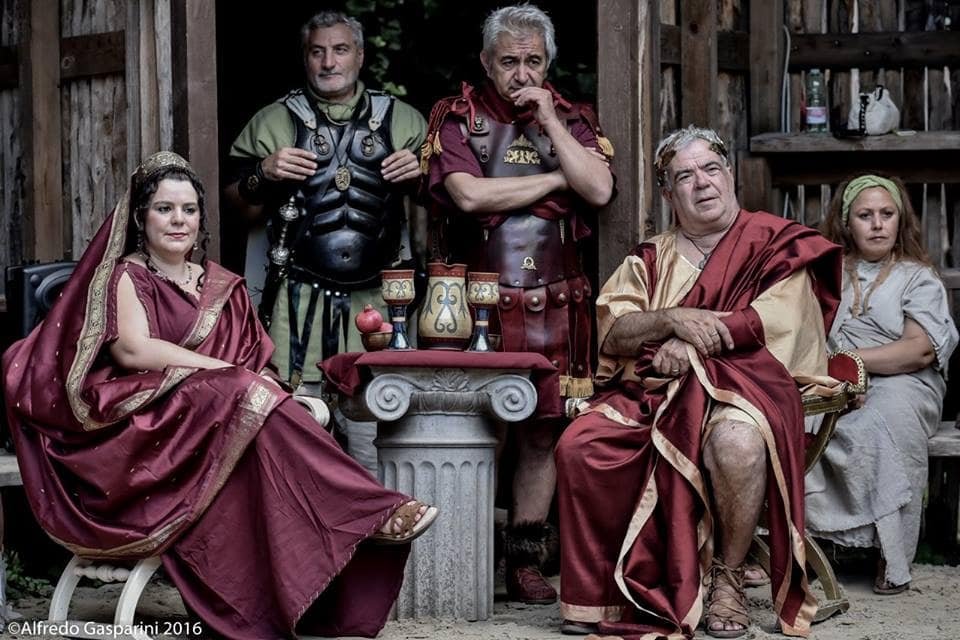
A personal judgment, after having seen quite a few reenactments around Italy: the level of the material produced here is high, and the difference shows in the details the distracted public doesn't notice, the stitching, the colors of the wools, the chronological consistency of the equipment within the same group. A badly done reenactment mixes a Trajanic helmet, a late-antique sword and a pair of Viking boots. Here this doesn't happen, and it's no small merit.
The Ludus Magnus, the gladiators' gym next to the Colosseum
The association manages the opening of the Ludus Magnus for guided visits and short gladiator demonstrations. The Ludus Magnus is the largest of the four gladiator barracks that Domitian had built in Rome, along with the Ludus Gallicus, the Ludus Matutinus and the Ludus Dacicus, and it stands in the valley between the Esquiline and the Caelian, a few steps from the Colosseum. The remains re-emerged in 1937 during construction work and were arranged between 1957 and 1961. At the center was an arena that reproduced that of the Flavian amphitheater on a reduced scale, in a ratio of about one to two and a half, surrounded by a cavea able to hold several thousand spectators who watched the training.
The detail that strikes you most is the underpass identified in 1939, which connected the barracks directly to the underground chambers of the Colosseum: begun by Domitian, completed and inaugurated by Trajan, finished by Hadrian. The gladiators reached the amphitheater without going through the street. Today the Ludus Magnus is the only one of the four Domitianic barracks still partly visible, and the northern half is preserved in the archaeological area next to the Colosseum. Whoever has visited the Museo del Legionario Romano and wants to close the circle finds the natural sequel here, and the page on the gladiator museum goes along the same thematic line too.
The Birthday of Rome, April 21
April 21 is the city's birth date according to tradition: the day on which Romulus is said to have traced the founding furrow on the Palatine, coinciding with the Palilia or Parilia, the ancient pastoral festival in honor of the deity Pales. The Gruppo Storico Romano chose that day as the date of its founding in 1994 and since then has made it the center of its public activity: the celebrations of the Birthday of Rome are the association's most important event.
In 2026 the 26th edition took place, from April 17 to 21, with more than 1,300 reenactors who came from 16 different countries, between Circo Massimo and Via dei Fori Imperiali, with free and open access. The program included the renewal of the sacred fire and the crowning of the goddess Roma on Friday. A day of historic encampments, educational stands, gladiator fights, ancient dances, a parade of costumes and a concert on Saturday. The great historic procession along Via dei Fori Imperiali on Sunday, with reenactments and the reconstruction of the battle of the Campi Raudii. A conference on Monday. And on April 21 the ceremony of the furrow and the rites of the Palilia, hosted at the Baths of Diocletian.
Watch out for a common misunderstanding, worth clarifying before booking a trip: the historic procession doesn't necessarily fall on April 21. The 21st is the city's birthday and hosts the founding rites, while the great parade is held on the Sunday of the event, which in 2026 fell on the 19th. Whoever wants to see thousands of reenactors marching must look at the edition's calendar, not at the number on the civil calendar.
A piece of advice, if you happen to be in Rome in those days: the procession along the Forums draws a huge crowd, and to photograph it you have to arrive at least an hour early and take a spot where the sun isn't against you. But the part I really recommend is the encampment at the Circus Maximus: there you walk among the tents, talk with the reenactors, see the workshops, watch the children handling the shields. It's the same spirit as the Museo del Legionario Romano, multiplied by a thousand and in the open air.
Some important events that happened here in history
The museum is recent, the place is not. The first mile of Via Appia, where the Museo del Legionario Romano stands, has seen some of the decisive events of Roman history go by, and it's worth listing them with the right distinction between what is documented and what belongs to tradition.
312 BC: the road is born
The censor Appius Claudius Caecus starts the construction of Via Appia, meant to connect Rome to Capua and then, in later phases, to Benevento, Taranto and Brindisi. It's a military work that changes the scale of Roman power: from that moment armies move on a stable surface and in every season, and control of the South becomes a matter of days of marching instead of weeks. The very figure of Appius Claudius, censor, also builder of the first Roman aqueduct, orator and jurist, sums up the Roman idea of power as infrastructure.
71 BC: the end of Spartacus's revolt
Appian recounts that, after the final defeat of the slave army, Marcus Licinius Crassus had 6,000 prisoners crucified along the road from Capua to Rome. If the account is accurate, the line of crosses reached almost to the gates of the city, that is, to this stretch. It's one of the hardest pages of Roman history and it's useful to remember it precisely in a place that celebrates the army: the same military machine that built roads and aqueducts was also an instrument of ruthless repression. Telling ancient Rome without this part means telling half of it.
The first century: arrivals and departures
Whoever entered Rome from the south entered from here. The Acts of the Apostles recount that Paul, brought as a prisoner toward Rome, was welcomed by some brothers who came to meet him at the Forum Appii and at the Tres Tabernae, two post stations along the Appia. The last stretch of his journey is the road that passes in front of this museum. The same goes for goods, embassies, returning armies. The first mile of the Appia was, in practice, the empire's service entrance.
Between the second and fourth centuries: the catacombs
A little further on, on both sides of the road, the great underground cemetery complexes develop: the Catacombs of San Callisto, with the crypt of the popes, and the Catacombs of San Sebastiano, whose name gave rise to the very word catacomb, from the Greek place name that indicated the depression in the ground at that point. Roman law forbade burials within the pomerium, the sacred boundary of the city, and this rule explains why all the great consular roads are lined with tombs. In Christian tradition this stretch is tied to the episode of the Domine Quo Vadis, the meeting between Peter in flight and Christ, narrated in apocryphal texts and not in the canonical Gospels. It's tradition, and should be called that, and it has nonetheless generated a church and a cult that have lasted for centuries.
The third century: Aurelian closes the city
Between 271 and 275 Rome equips itself with a new circuit of walls, the Aurelian Walls, and on the Appia opens the gate we now call Porta San Sebastiano, the largest and most scenic of the whole circuit, later reinforced by Honorius at the beginning of the fifth century. It's the threshold you cross to get to the museum. Inside the gate today is housed the Museo delle Mura, and from there you climb to the patrol walkway: one of the least crowded and most instructive walks in Rome.
1994, 2005 and the present
On April 21, 1994 the Gruppo Storico Romano is born. In 2005 the interactive museum is inaugurated at the headquarters at Via Appia Antica 18, which in the same year is renovated and expanded for education. Since then the activity has grown to the current 10,000 students a year, the institutional recognitions, the management of the openings of the Ludus Magnus and the editions of the Birthday of Rome with over 1,000 reenactors from all over Europe. In July 2024, finally, the road the museum faces enters the UNESCO World Heritage List. It doesn't often happen that a small neighborhood museum finds its own address inside a World Heritage site.
Who has passed through the Museo del Legionario Romano
Let's begin with the living, because they're the most concrete part. Every year about 10,000 Italian and foreign students pass through these rooms, joined by tourists, enthusiasts, groups of seniors from Rome's municipal centers, researchers and the curious. In a city that measures everything in millions of visitors, 10,000 kids guided one by one is a number worth much more than it seems. Reenactors also pass through: at the Birthday of Rome celebrations organized by the association, in the 2026 edition, more than 1,300 people in armor and period dress from 16 countries took part. Many of them, before or after the parade, came to Via Appia Antica.
Institutions pass through too. The association received the gold medal of the President of the Italian Republic on the occasion of the Birthday of Rome celebrations of 2009, 2010, 2011 and 2012, and the museum was awarded a silver medal of the President of the Republic. It has obtained sponsorships from the Presidency of the Council of Ministers, the Lazio Region, the Province of Rome and Roma Capitale, and the association's magazine is sponsored by the Department of Cultural Policies and Historic Center and by the Libraries of Roma Capitale.
Then there's the road, and the road has a list of passages that no museum in Rome can claim. Horace passed through here, who in the fifth satire of the first book recounts the journey from Rome to Brindisi along the Appia with its load of mosquitoes, frogs and dishonest innkeepers: it's the first travel report of Western literature, and it starts exactly from this stretch. Paul of Tarsus passed from here, according to the account in the Acts of the Apostles, on the last stretch of the journey that brought him to Rome as a prisoner. Armies returning from the South and the East passed from here, medieval pilgrims bound for the Holy Land who took the Appia toward the Apulian ports, Grand Tour travelers who came to draw the tombs among the cypresses.
And music has passed from here: in the fourth movement of the Pines of Rome, composed by Ottorino Respighi and first performed in 1924, the pines of Via Appia accompany the imaginary advance of an army climbing toward the Capitoline Hill in the mist of dawn, with the orchestra growing until it becomes deafening. If you have that piece in your headphones while you walk from the museum toward Porta San Sebastiano, the day goes up a level. It's the most effective trick for making a group understand what a consular road was.
The Museo del Legionario Romano with children
No beating around the bush: the Museo del Legionario Romano is one of the very few museums in Rome where children really have fun. They don't politely get bored, they don't pretend. They have fun. And the reason is simple, almost elementary. In every other museum in the city the implicit message is don't touch. Here the message is try.
An eight-year-old in front of a case of ancient helmets lasts four minutes. The same child, with a helmet on his head and a shield on his arm, lasts an hour and in the end doesn't want to leave. The difference isn't in the content, it's in the body: children learn with their hands, and this museum is built on that premise. Putting on the armor, operating the ram, releasing the arm of the onager, holding the pilum, lining up and trying the testudo are activities that turn a notion into a physical memory.
What age it works best for
The golden range runs from 7 to 13 years, that is, from the second year of elementary school to the third year of middle school. Under six it works all the same, but in a different register: the little child has fun with the costume, the noise, the play, and doesn't care at all about the structure of the legion. That's perfectly fine, and it's best to keep the visit short. From 14 years up the museum holds if whoever is guiding raises the technical level: kids of that age immediately smell a simplified story and tune out, while they react very well to real discussions, for example on the still-open debate about how the pilum behaved on impact.
What to bring and what to expect
Closed shoes for everyone, including little girls in summer sandals, because in the courtyard and the arena you walk on dirt and gravel. Water. A change of T-shirt if it's July, because under a lorica you sweat in three minutes. No need for cash for admission, which is free, but a bill in your pocket for the association's publications is a good idea, and illustrated books on the Roman army are the smartest gift to bring back for a kid who has just put a helmet on his head.
On duration: with children count an hour and a half, two if there's a demonstration. Not more. A classic mistake of enthusiastic parents is stretching the visit until attention runs out: you leave with a tired child and the memory spoils. Better to leave while he's asking to stay.
An honest comparison with the other children's museums in Rome
In Rome there's no shortage of offerings for families with small children, and the best known is Explora, the children's museum of Rome, which is designed for the preschool age and the first years of elementary school, with an interactive and modern layout. The Museo del Legionario Romano plays in a different league: it's not a museum for children, it's a museum of military history that children can go through with their hands. If your son is six and loves dressing up, go to both. If he's 10 and in the phase where he devours books on the Romans, come here first.
The school workshops at the Museo del Legionario Romano
Educational activity is the place's reason for being, and it should be said clearly to the teachers who are reading. The Gruppo Storico Romano organizes educational meetings both at its headquarters and off site, with students of all grades, Italian and foreign, and in 2005 the museum was renovated and expanded precisely to better serve school classes. The number of students who come through here every year, about 10,000, says the machine works.
How to organize a class visit
The procedure is that of any serious association: you contact the office in advance, agree on the date, declare the number of pupils, their age and school level, and ask which route is available that day. Spring dates are the most contested, because they coincide with the season of school outings and with the period of the Birthday of Rome: whoever moves in March for April risks finding no room. The advice to teachers is to book at the start of the school year.
A few operational precautions that hold for any class. Split the group if it exceeds 25 people, because the space in the rooms is that of an association headquarters and not of a gallery. Prepare the kids with a preliminary lesson on the structure of the legion, so that when they hear the word contubernium they know what it's about. Assign each of them an observation task, for example counting the types of armor on display or noting three differences between gladiator arms and legionary arms. And leave time for the practical part, which is the one that sticks.
What the kids take home
If the visit is done well, three things. The first is the weight: the physical awareness of what it meant to march dressed like that, a fact no textbook conveys. The second is the structure: eight men, 80, 480, 5,000, a hierarchy you can draw on the blackboard and that explains how an organization manages to move tens of thousands of people. The third, the most precious, is the method: understanding that what they see is a reconstruction, that reconstructions are based on evidence, and that evidence is debated. A kid who leaves here knowing how to tell documented from hypothesized has learned more history than one who memorized three dates.
The Museo del Legionario Romano, the catacombs and half a day on the Appia
The museum works best inside an itinerary. Here is a proposal, with real timings.
The classic morning, from 9:00 to 13:00
At 9:30 at Porta San Sebastiano: you visit the Museum of the Walls inside the gate and climb onto the walkway, 40 minutes. At 10:30 at the Museo del Legionario Romano, where the visit takes a good hour. Shortly before noon you take the road again toward the fork with Via Ardeatina, step for a moment into the church of Domine Quo Vadis, and from there go down to the catacombs: San Callisto or San Sebastiano, depending on the opening hours that day and on which of the two is less crowded. In the afternoon, for those with legs, continue toward the Villa of Maxentius and the mausoleum of Cecilia Metella.
A practical warning worth more than any description: the two great catacomb complexes of the Appia have different weekly closing days, and they change over the course of the year. Check beforehand. Too many groups get to the end of the road and find the door barred.
The long variant, with the Caffarella
Whoever has a whole day and trained legs can extend toward the Caffarella Valley, the great green wedge between the Appia Antica and the Appia Nuova, with the nymphaeum of Egeria, the so-called temple of the God Rediculus and flocks grazing three kilometers from the Colosseum. It's the best way to understand why the Appia Antica Park is considered one of the most important archaeological landscapes in Europe, and to digest calmly what you saw in the morning.
The military variant, for those who have really got a taste for it
Finally there is a thematic itinerary that I recommend to enthusiasts, and that no agency offers. You begin at the Museo del Legionario Romano with the equipment. You continue to the Baths of Caracalla to understand what a soldier on leave did in the city. You go up to the Ludus Magnus and the Colosseum for the gladiator part. You end at Trajan's Column, in the center, looking at the reliefs with the eyes of someone who has just held a lorica in his hands. At that moment the Column stops being a monument and becomes an illustrated manual. A day like this is worth 10 audio guides.
When to go to the Museo del Legionario Romano and when to avoid it
The best period is spring, between March and May, when the Appia is green and the days are long. The most intense period is the week of the Birthday of Rome, around April 21, with the warning that in those days the association is extremely busy with the celebrations and availability at the headquarters can be reduced: call well in advance. Autumn, between October and November, is the most underrated season: very low light, few visitors, perfect temperatures for walking.
The times to avoid, and I say them frankly: weekday mornings in April and May, when school classes fill the spaces (unless you are a school class yourselves). Days of heavy rain, because part of the experience takes place outdoors and without the courtyard the museum loses half its interest. The height of August, when many Roman cultural associations reduce their activity and the heat on the Appia is unbearable between 11 and 5 o'clock. If August is your only window, call and ask openly if it's worth coming: they will answer you honestly.
Accessibility, services and practical matters
The headquarters is an association facility and not a state museum with standard equipment: before planning a visit with people in wheelchairs or with mobility difficulties, it's best to phone the office and ask in detail about level changes, thresholds and restrooms. The same recommendation holds for groups with particular needs, for visitors with sensory disabilities and for those who need to sit often. The association works constantly with classes and groups and knows how to answer precisely.
On the rest: there's no ticket office because admission is free. There's no cloakroom in the museum sense of the term, so it's best to arrive light. Personal photographs are normally allowed, but for filming and for public uses of images you ask at the office. For restrooms and for the possibility of leaving backpacks you ask on arrival. There's no bar or refreshment at the headquarters: the nearest options are along Via Appia Antica after the fork with Via Ardeatina, and in any case it's best to bring a bottle of water.
One last logistical note, which concerns the whole first mile of the Appia: the sidewalks here are narrow or absent and cars pass close. With small children hold their hand, walk facing the traffic and don't assume that drivers see you. It's the only unpleasant aspect of an otherwise marvelous road.
What there is around the Museo del Legionario Romano
Within 10 minutes on foot, in the direction of the city, there are Porta San Sebastiano with the Museo delle Mura, the best-preserved stretch of the Aurelian Walls, the Arch of Drusus right before the gate and, a little further back, the area of the Parco degli Scipioni with the tomb of the family that gave Rome the victors of the Punic Wars. A quarter of an hour's walk toward the center brings you to the Baths of Caracalla, the best-preserved bath complex of antiquity and, in summer, one of the most beautiful open-air stages in Europe.
In the opposite direction, toward the countryside, the road leads to Domine Quo Vadis, to the catacombs, to the Villa of Maxentius with the best-preserved circus of the Roman world and the Mausoleum of Romulus, to the mausoleum of Cecilia Metella, and finally, beyond the fifth mile, to the Villa of the Quintilii, the largest private residence on the Roman outskirts, confiscated by Commodus from its owners after he had them killed. All this lies along a single road, which is why the Appia is considered the most extraordinary linear museum in existence.
Quick questions about the Museo del Legionario Romano
How much is a ticket to the Museo del Legionario Romano?
Nothing: admission to the museum is free. It's an interactive museum with free access, set up and maintained by the Gruppo Storico Romano. If you want to support it, you can do so by joining the association's activities or buying its publications.
Where exactly is the Museo del Legionario Romano?
At Via Appia Antica 18, 00179 Rome, a few hundred meters past Porta San Sebastiano, on the first mile of Via Appia, before the fork with Via Ardeatina and the church of Domine Quo Vadis.
Do you need to book to visit the Museo del Legionario Romano?
Yes, and it's the most important thing of all. The headquarters is an association facility and openings depend on the calendar of activities. You phone the office, agree on day and time, and arrive on time. Showing up without notice is the surest way to find it closed.
What are the opening hours of the Museo del Legionario Romano?
The association's office normally answers Monday to Friday between 9:30 and 16:00, but museum openings follow the calendar of educational activities and events. Updated hours, special openings and reenactment days should be confirmed on the official website of the Gruppo Storico Romano or directly by phone.
What is the phone number of the Museo del Legionario Romano?
The contacts given for the headquarters at Via Appia Antica 18 are 06 87645457 for the office and 338 2436678 for guided visits. The email address is info@gruppostoricoromano.it. If one line doesn't answer, try the other: this is an association of volunteers, not a call center.
How long does the visit to the Museo del Legionario Romano take?
Between 40 minutes and an hour and a half for an interested adult. With children and with a demonstration in the arena it easily reaches two hours. It's not a half-day museum. It's the first half of a morning on the Appia.
Is the Museo del Legionario Romano suitable for children?
It's one of the few museums in Rome where children really have fun, and I don't mean that as a figure of speech. You can wear helmets and armor, operate the ram, make throws with the onager, hold the shield. The age range that gets the most out of it is 7 to 13 years, but it also works before and after, in different registers.
Can you touch the objects on display at the Museo del Legionario Romano?
Many, yes, and it's the very point of the museum: the objects are modern replicas built to be used. Of course you touch what the staff points out, and you don't handle anything without asking. The training weapons are blunted.
Are there original archaeological artifacts at the Museo del Legionario Romano?
No. Everything you see is reconstructed on the basis of historical and iconographic research, with reference to the weaponry of the first and second centuries AD. Whoever is looking for ancient artifacts must turn to the archaeological museums. Whoever wants to understand how those objects worked finds here what archaeological museums cannot give.
How do you get to the Museo del Legionario Romano by public transport?
By bus 118, which runs along Via Appia Antica and connects the Appia/Villa dei Quintili terminus to the Colosseum and Piazza Venezia. Alternatively, metro line B to Circo Massimo and then a bus, or 25 minutes on foot along Viale delle Terme di Caracalla to Porta San Sebastiano.
Can you get to the Museo del Legionario Romano by car?
You can, but the first stretch of Via Appia Antica is narrow and short on parking. It's best to leave the car in the Baths of Caracalla area and do the last stretch on foot, or arrive by taxi.
Is the Museo del Legionario Romano wheelchair accessible?
Since it's an association headquarters and not a museum with standard facilities, the right thing to do is to phone beforehand and ask in detail about thresholds, level changes and restrooms. At the office they know the building and answer precisely.
Can you take photographs at the Museo del Legionario Romano?
Personal photographs are normally allowed. For video recording and for any public use of images, including those showing the reenactors, you ask permission at the office.
What is the difference between the Museo del Legionario Romano and an archaeological museum?
The difference is the same as between a score and a concert. The archaeological museum preserves the original and forbids contact with it. This museum exhibits faithful replicas and encourages their use. They are two complementary functions: the first preserves the evidence, the second gives back the experience.
Does the Museo del Legionario Romano have anything to do with the gladiator school?
Yes, the Scuola Gladiatori Roma operates at the same headquarters at Via Appia Antica 18 and is run by the Gruppo Storico Romano. The most requested course is the gladiator for a day, about two hours of historical introduction and practical training, now also bookable at the Ludus Magnus.
What is the Ludus Magnus and how does it connect to the Museo del Legionario Romano?
It's the largest of the four gladiator barracks built by Domitian, in the valley between the Esquiline and the Caelian, next to the Colosseum, connected to the amphitheater by an underpass identified in 1939. The association that created the museum manages its opening for guided visits and short gladiator demonstrations.
When and where is the Birthday of Rome celebrated?
On April 21, the traditional date of the city's founding. The celebrations organized by the Gruppo Storico Romano span several days: in 2026 the 26th edition took place from April 17 to 21 between Circo Massimo and Via dei Fori Imperiali, with over 1,300 reenactors from 16 countries and free and open access. The great historic procession falls on the Sunday of the event, not necessarily on the 21st.
How many students visit the Museo del Legionario Romano every year?
About 10,000, Italian and foreign, joined by an unspecified number of tourists and enthusiasts. It's the free interactive museum most visited by school classes in this quadrant of the city.
What exactly do you see in the rooms of the Museo del Legionario Romano?
Weapons and armor of legionaries, praetorians and gladiators. War machines in model and full-scale versions, among them the onager and the ram. Objects of the everyday civilian life of ancient Rome, with a section devoted to the female world. A small reconstructed castrum with an arena. Educational and recreational areas.
Can the Museo del Legionario Romano be combined with the catacombs?
It's the natural pairing, because the Catacombs of San Callisto and those of San Sebastiano are a little further along the same road. Watch out for the weekly closing days, which differ between the two complexes and change over the course of the year.
What is the best time to visit the Museo del Legionario Romano?
Spring, for the climate and the green of the Appia, and autumn between October and November, which is the most underrated season in Rome. In August the heat on Via Appia is heavy and association activities thin out.
How long do you wait in line at the Museo del Legionario Romano?
Zero. There are no lines, because there are no ticket offices: the visit is arranged in advance and you enter at the agreed time. It's perhaps the only museum in Rome of which you can say something like that.
Is the Museo del Legionario Romano covered by free museum initiatives?
It doesn't need them, because admission is free all year round. Free Sundays and other institutional initiatives concern state and civic museums, not association headquarters like this one.
What distinguishes a legionary from a praetorian and a gladiator?
The legionary is a Roman citizen enlisted for a very long term of service and stationed on the frontiers. The praetorian belongs to the imperial guard stationed in Rome, with higher pay and enormous political weight. The gladiator is not a military man, he is a professional of spectacle with codified weaponry and a competitive function. The Museo del Legionario Romano keeps the three figures clearly distinct, and it is one of its greatest merits.
Is it worth coming from far away just for the Museo del Legionario Romano?
On its own, no. Within a morning on the Appia that includes Porta San Sebastiano, the museum, Domine Quo Vadis and one of the two great catacombs, yes, without hesitation. It's the best way I know to make anyone understand, in half a day, what Rome really was.
To close, an image. A 10-year-old boy, with the helmet pulled down almost to his nose and the scutum weighing on his arm, tries to take three steps and realizes he can't look up. He raises his head, hits the neck guard, stops. At that moment, on his face, you see something no lesson produces: he understands. He understands that those men were not cardboard heroes but people inside an uncomfortable, heavy, hot piece of kit, and that they walked like that from England to the Euphrates. Bring your children, phone first, and don't be afraid of looking ridiculous when they offer you a helmet: put it on. History is understood with the shoulders, not with the eyes.
Article written by the editorial team of TourLeaderPro, contact them for Private/Corporate/V.I.P. Tours and Experiences.
Planning a trip to Rome? The English-language guides for visiting the city are on ItalyPlanner.com.