Parco degli Scipioni
In short. At the Parco degli Scipioni, it's best to forget the idea of a monumental, fenced-in park.
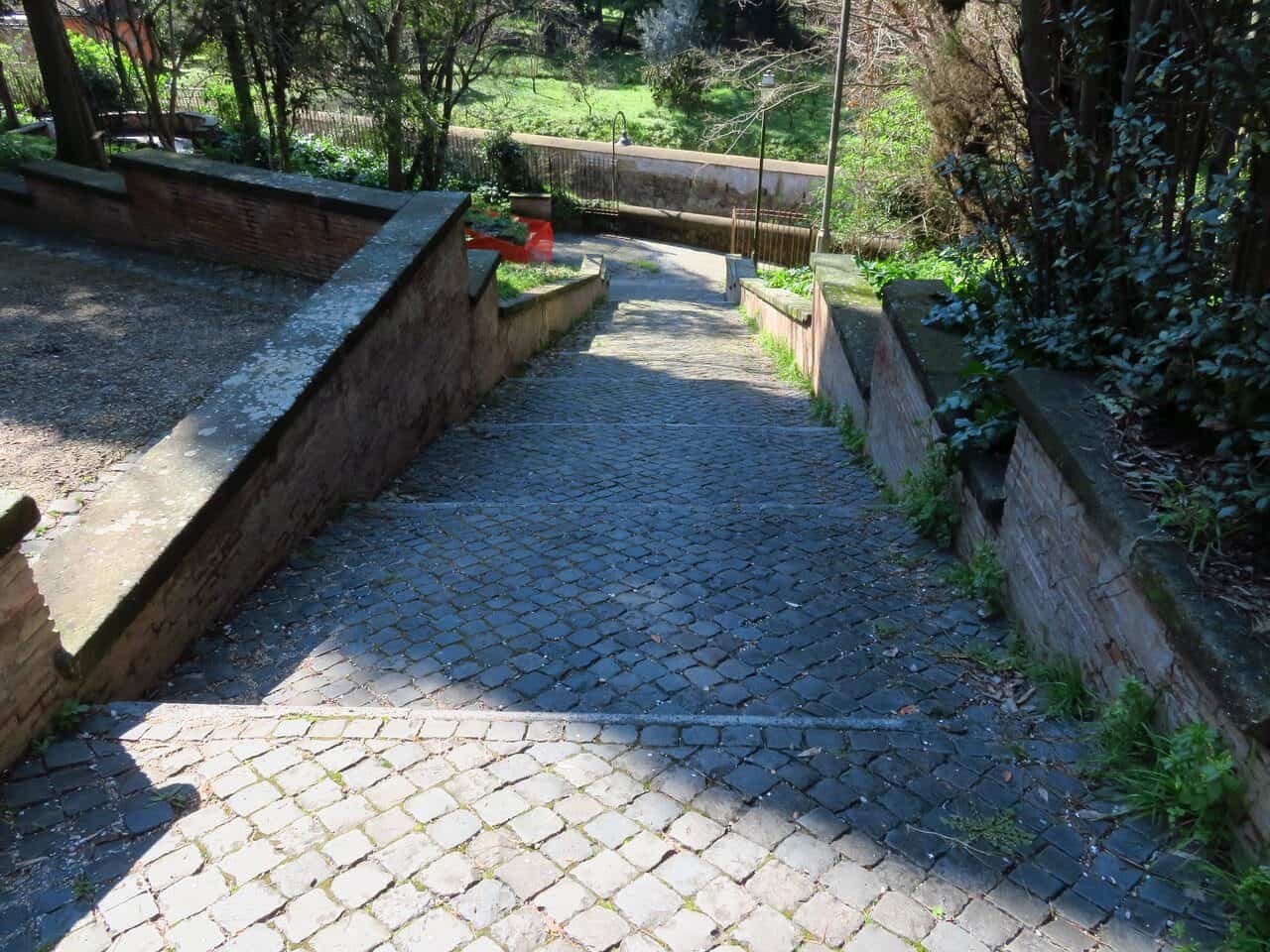
What the Parco degli Scipioni really is
At the Parco degli Scipioni, it's best to forget the idea of a monumental, fenced-in park. There is no solemn gate, no ticket office, no mandatory route. The Parco degli Scipioni is a public neighborhood garden, wedged between Via di Porta Latina and Via di Porta San Sebastiano, in the Celio rione, a step from the Aurelian Walls. You walk in the way you walk into any city garden: strolling, with a stroller, with the dog on a leash, with the groceries in your hand. And yet under those pines and those barely tended lawns runs one of the densest archaeological stratifications in Rome, and the name it bears is anything but a toponymic whim.
The Parco degli Scipioni takes its name from the Tomb of the Scipios, the funerary monument of the gens Cornelia Scipionum that stands exactly here, at number 9 Via di Porta San Sebastiano, in what was the immediate outskirts of Republican Rome along the first stretch of the Appian Way. That is why the neighborhood greenery and the tomb of one of the most famous families in Roman history share the same name and the same strip of land. The park, to be clear, is the frame. The tomb is the archaeological jewel that the frame has guarded for more than two millennia.
This double nature deserves attention because it's the key to understanding the Parco degli Scipioni. On one side it is the big park of a heavily populated part of the city, with its paths, its benches and its playground for kids. On the other it is the vestibule of an ancient landscape that includes, besides the tomb, the Columbarium of Pomponius Hylas, the remains of other columbaria, the Arch of Drusus, the Porta Latina, the church of San Giovanni a Porta Latina and the little oratory of San Giovanni in Oleo. No other neighborhood garden in Rome packs so much history into so few hectares.
Where the Parco degli Scipioni is and how it's laid out
Geographically, the Parco degli Scipioni occupies the triangle between Via di Porta Latina to the north, Via di Porta San Sebastiano to the east and the slopes toward the Almone and the neighborhood to the west. We are just inside the Aurelian Walls, in the southeastern sector of the historic city, in that cushion of green that accompanies the 3rd-century AD city wall before the countryside of the Appia Antica decisively takes over. If you come from the center along the valley between the Celio and the Aventine, you feel as you approach that the density of buildings eases and the air changes: it's the sign that the Parco degli Scipioni is near.
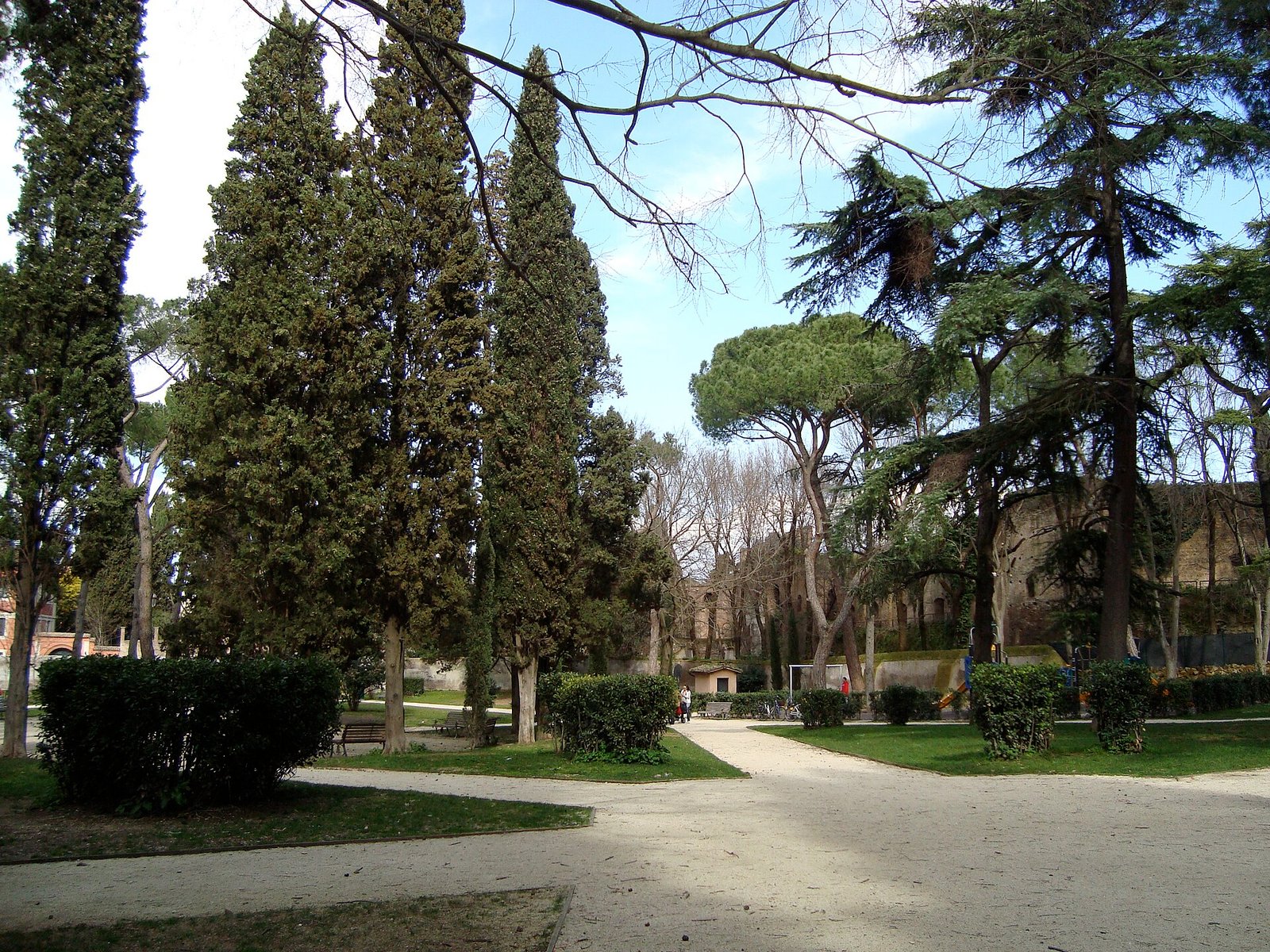
The layout of the park is simple and honest. Paths of packed earth and light asphalt branch out between tree-covered lawns, with vegetation dominated by stone pines, which here, as in this whole belt of Rome, draw their dark umbrellas against the sky. There are holm oaks, laurels, a few cypresses marking the old fences, laurel bushes and low hedges. It is not an Italian garden with geometric parterres. It's more of an urban natural park, where the greenery serves as a backdrop and a place to rest, and where the ancient monuments emerge from the lawn almost by chance.
The total area is small, in the order of a few hectares, and this makes the Parco degli Scipioni a place on a human scale: you cross it in a few minutes, but you can stay for hours. The difference in height between the upper paths toward Via di Porta Latina and the lower areas toward the interior creates small natural terraces from which, in certain spots, you can glimpse the pines of the nearby Appia and the curtains of the Aurelian Walls. It's a park that doesn't amaze you at first glance, but wins you over when you understand what you're walking on.
Why the Parco degli Scipioni bears a family's name
The name Parco degli Scipioni doesn't come from a 19th-century architect or from a municipal resolution in search of prestige: it comes from the ground. Right at this spot, along the road that left the city toward the south, the gens Cornelia, in the Scipio branch, chose to place its family tomb between the end of the 4th and the beginning of the 3rd century BC. For the Romans of the Republican age it was a gesture full of meaning: the tomb along the consular road was the way a family went on speaking to the living, reminding passersby of its name, its offices and its victories.
The Scipios were not just any family. From this branch of the Cornelii came some of the men who decided Rome's fate in the Mediterranean: Publius Cornelius Scipio, known as Africanus, the victor over Hannibal at Zama in 202 BC, and later Publius Cornelius Scipio Aemilianus, the destroyer of Carthage in 146 BC. That the Parco degli Scipioni bears this name today means that the neighborhood and the city wanted to keep the link between a piece of modern green space and the memory of one of the lineages that made the Republic.
I think it's right that the name stayed attached to the place even now that the tomb is visible and open to visitors again. Walking in the Parco degli Scipioni with this link in mind, the lawn stops being just a lawn: it becomes the front yard of a family that crossed history, and the pines become silent guardians of a name carved in tuff more than 2,000 years ago.
The Tomb of the Scipios next to the Parco degli Scipioni
The monument that gives meaning to everything is the Tomb of the Scipios, the hypogeum dug into the tuff bank that opens right behind the Parco degli Scipioni, with its entrance on Via di Porta San Sebastiano. It was rediscovered in 1780, when the Sassi brothers, who owned the land, stumbled on the underground galleries while working the vineyard. That discovery had an enormous echo in the learned Rome of the late 18th century, because it brought back to light nothing less than the tomb of the Scipios, a name every cultured person of the time knew from the pages of Livy and Polybius.
The tomb is a hypogeum, that is, a tomb dug into the rock, organized in galleries that cross at right angles and along which the sarcophagi and urns of the family members were placed. The monumental facade that closed the hypogeum toward the street, with columns and niches for statues, was added in the 2nd century BC to give the complex an appearance worthy of the gens. Anyone who visits the Tomb of the Scipios today enters this maze of dug corridors, where the damp tuff still preserves the imprint of the loculi and sarcophagi.
It's important that anyone who visits the Parco degli Scipioni keep the two things separate: the park is free and open to all, while the Tomb of the Scipios is an archaeological site with a separate entrance, run by the Capitoline Superintendency, which you visit with a ticket and generally by reservation, often as a guided visit precisely because of the delicacy of the underground spaces. Walking in the park does not automatically give you access to the tomb: they are two different experiences that coexist in the same place.
The sarcophagus of Scipio Barbatus, the piece that is no longer here
The most famous find to come out of the Tomb of the Scipios is the sarcophagus of Lucius Cornelius Scipio Barbatus, consul in 298 BC and illustrious founder of the branch buried here. It is a block of peperino, the gray volcanic stone of the Alban Hills, worked with sober elegance: on the lid run moldings inspired by the Greek world, while on the chest is carved the inscription, the elogium, which recalls in Saturnian verse the virtues and offices of the deceased. It is one of the oldest epigraphic documents in Latin that we have, and for scholars of language it has an almost incalculable value.
Here comes the part that always throws off anyone who arrives at the Parco degli Scipioni thinking they'll find the sarcophagus on site: the original is no longer in the tomb. It was moved already at the end of the 18th century and today it is in the Vatican Museums, in the room that gathers the epigraphic monuments, while in the tomb stands a copy that reproduces its form and position. It's a classic example of the fate of the great Roman finds, taken to safety in museums while the original setting remains to tell the story of the space.
I love to tell this story of dispersal because it teaches you to read the Parco degli Scipioni for what it is: a place of layered memory, where the original, the copy, the void and the remembrance coexist. Anyone who wants to see Barbatus in person has to go up to the Vatican. Anyone who wants to understand where Barbatus rested has to come here, among the pines of the park, and look into the hypogeum. The two visits complete each other, and neither of them alone tells the whole story. It's a lesson that holds for very many Roman finds, today divided between the museum that keeps them and the place that produced them, and at the Parco degli Scipioni it appears in an especially clear and emblematic form.
The Columbarium of Pomponius Hylas inside the Parco degli Scipioni
A few steps from the tomb, still in the area of the Parco degli Scipioni, hides one of the most delicate jewels of underground Rome: the Columbarium of Pomponius Hylas. A columbarium is a collective tomb, so called because the walls are dug with regular niches, the ollae or loculi for the cinerary urns, which recall the cells of a dovecote. In the imperial age they were the burial solution for freedmen, slaves and families not rich enough to afford an individual tomb, and also for guilds and associations that bought the space together.
The Columbarium of Pomponius Hylas was discovered in 1831 and takes its name from the owner couple, Gnaeus Pomponius Hylas and his wife Pomponia Vitalinis, whose name stands out in a mosaic inscription above the entrance stairs. It can be dated to the early imperial age, between the time of Tiberius and that of the Flavians, and it amazes with the state of preservation of its decorations: stuccoes, paintings, mosaics and miniature landscapes cover the walls of the underground room with a freshness that seems impossible for a 2,000-year-old underground place.
The Columbarium of Pomponius Hylas too, like the Tomb of the Scipios, is visited separately from the Parco degli Scipioni, with dedicated procedures and limited entries to protect the plaster from damp and crowds. Anyone lucky enough to go down that little staircase enters a small funerary chapel decorated like a living room, with deities, garlands and painted false pergolas, and understands that under the lawn of the park beats a city of the dead as refined as the city of the living.
The Aurelian Walls that close off the Parco degli Scipioni
The eastern edge of the area is marked by the Aurelian Walls, the great defensive circuit that Emperor Aurelian had built starting in 271 AD to protect Rome from the threat of invasions. The Parco degli Scipioni lives just inside this line, and to understand the place you have to keep in mind that everything ancient here, from the tomb to the columbaria, was born outside the Republican walls, in a funerary area along the consular roads, and only in the 3rd century found itself enclosed within the new urban perimeter.
The Aurelian Walls are, with their kilometers of brick curtain wall, their towers at regular intervals and their monumental gates, one of the best-preserved ancient defensive systems in Europe. In this stretch they ran following the course of the roads and enclosing existing structures, so much so that some older monuments were literally incorporated into the masonry. Walking from the edges of the Parco degli Scipioni toward Via di Porta San Sebastiano, you sense their imposing presence, the warm color of the brick and the military logic that governs them.
I find that the walls give the Parco degli Scipioni its measure as a frontier. Here the ancient city ended and the landscape of the tombs began. Here, centuries later, the modern city starts again with its Umbertine buildings and its 20th-century apartment blocks. Being in the park means standing exactly on this boundary line, redrawn many times, and the Aurelian Walls are the most legible sign of that margin which has never stopped separating inside from outside.
Porta Latina and the Arch of Drusus near the Parco degli Scipioni
Leaving the Parco degli Scipioni toward the south you meet the Porta Latina, one of the best-preserved gates of the whole Aurelian circuit. From here left Via Latina, the ancient road that linked Rome to inland Campania, parallel to and an alternative to the more famous Appian Way. The gate, with its single archway framed by two semicircular towers and a facing of travertine blocks in the lower part, still keeps the solemn look it had when travelers passed through it to leave the city or enter it.
Just before the gate, along the route that links the Parco degli Scipioni to the city wall, you come to the Arch of Drusus, a monumental arch that tradition has tied to the name of Drusus the Elder but that in reality had a hydraulic function: it carried a branch of the Antonine aqueduct that fed the nearby Baths of Caracalla. It is a travertine arch with composite columns, today a bit out of scale with the traffic that flows beside it, but precious because it shows how dense the ancient infrastructure was in this sector of the city.
It's worth reading Porta Latina and the Arch of Drusus as an integral part of the Parco degli Scipioni experience. The park is not an island: it is the center of a system of monuments that together tell the story of the road, of death and of water. In a few minutes on foot you go from the tomb of a Republican family to the gate of a consular road to the arch of an imperial aqueduct, and this concentration is what makes the area so extraordinary. It's hard to find elsewhere in Rome, in so small a space, such a coexistence of ancient functions: burial, transit, water supply, defense, and later Christian worship, all legible a few steps from one another around the Parco degli Scipioni.
San Giovanni a Porta Latina and the oratory of San Giovanni in Oleo
Next to the gate, in a setting of great quiet that is a natural extension of the Parco degli Scipioni, stands the basilica of San Giovanni a Porta Latina, one of the most fascinating and least visited medieval churches in Rome. Its origins go back to the 5th century, with important reworkings in the following centuries. It keeps a Romanesque bell tower, a portico in front and, inside, a cycle of 12th-century frescoes that covers the walls with biblical scenes of rare completeness. It's the kind of place you enter by chance and leave changed.
In front of the basilica is the small oratory of San Giovanni in Oleo, a little octagonal temple tied to the tradition that the apostle John was plunged into a cauldron of boiling oil right at this spot, coming out unharmed. The present building dates from the early 16th century, and its elegant little dome with a lantern is a delightful example of Renaissance architecture, a miniature jewel a short distance from the lawns of the Parco degli Scipioni.
I suggest always including these two Christian presences in your visit to the Parco degli Scipioni, because they complete the stratigraphy of the place. After the pagan funerary world of the Scipios and the columbaria, the basilica and the oratory tell the story of the Christian and medieval Rome that settled along the same roads, reusing spaces and memories. It's the best way to understand how Rome never erases its past, but continues it layer after layer. Within a few hundred meters around the Parco degli Scipioni you thus cross 15 centuries of religious and civic history, from the pagan funeral rites of the gens Cornelia to the medieval and Renaissance devotion of the two churches of St. John, in a continuity that is the unmistakable signature of this city.
The Appian Way and Via Latina that frame the Parco degli Scipioni
To really understand the Parco degli Scipioni you have to look up at the two great consular roads that pass on either side of it. To the east runs the start of the Appian Way, the regina viarum opened in 312 BC by the censor Appius Claudius Caecus, the road that led to Capua and then all the way to Brindisi, that is, toward the East. To the south opens Via Latina, older and more inland, which linked Rome to Campania through the Apennine valleys. The park lies exactly in the wedge between these two routes.
It's no accident that so many funerary monuments are concentrated right here, in this wedge. For the Roman mentality the consular road was the natural place for burial: along the road, outside the sacred pomerium of the city, families placed their tombs so that travelers would see them. The Tomb of the Scipios, the columbaria and the other tombs that surface in the Parco degli Scipioni are all children of this logic of the roadside tomb, and the park is today its green memory.
Walking here it's worth imagining the noise of those roads 2,000 years ago: the carts, the pilgrims, the merchants, the funeral processions headed to the tombs. The Parco degli Scipioni is silent and shady today, but its reason for being lies entirely in that ancient movement along the Appia and the Latina. Understanding this means ceasing to see the park as a simple garden and beginning to see it as a surviving fragment of Roman roadside landscape. In the end that is just what the Parco degli Scipioni is: a piece of consular road frozen in time, where in place of the noise of carts what remains is the silence of the pines and the memory of names carved in tuff.
The Appio-Latino neighborhood around the Parco degli Scipioni
The Parco degli Scipioni doesn't float in a void: it is set in a very specific neighborhood, the Appio-Latino, one of the modern rioni born outside the walls between the end of the 19th century and the first decades of the 20th, when Rome as capital began to expand along the lines of the old consular roads. It's a middle-class residential neighborhood, with early-century apartment buildings, tree-lined avenues, local shops and a community life that finds one of its reference points in the park.
The people who use the Parco degli Scipioni every day are those of the neighborhood: families with kids, elderly people who come to read the paper on the benches, teenagers studying in the shade of the pines, morning runners, dog owners. It is a green space close to home in the fullest sense of the term, a place where monumental Rome and everyday Rome touch with no break between them. And this is perhaps its most precious quality: history here isn't put under glass, but breathed together with the life of every day.
Around the Parco degli Scipioni the urban fabric offers everything you need: bars for a coffee, bakeries, small neighborhood trattorias, services. It's a Rome far from the crush of the historic center and the big tourist flows, where you can live the authentic rhythm of the city. Anyone looking for a corner of real Rome, not packaged for tourism, finds it naturally in the neighborhood around the park.
The Parco degli Scipioni today, between lawns and playgrounds
Beyond its extraordinary stratigraphy, the Parco degli Scipioni is first of all a working public garden, and as such it should be lived. The lawns are equipped for resting, with benches spread along the paths and in the shade of the big trees. There is a playground for kids, simple but well used, which in the late afternoon fills up with neighborhood families. There's no lack of drinking fountains, the famous Roman nasoni, where you can fill your bottle with the fresh water of the aqueduct.
The vegetation, as I said, is dominated by stone pines, with their umbrella canopy that gives summer shade and draws the typical profile of this southern Rome. There are evergreen holm oaks, fragrant laurels, bushes and hedges that give structure to the greenery. In spring the lawns light up with new grass and a few wild blooms. In autumn the low light filtering between the pines creates atmospheres that invite you to stop. It's a park for every season, each with its own character.
It has to be said honestly that the Parco degli Scipioni is not a monumental garden kept up to the last detail like a historic villa: it is neighborhood greenery, with the ordinary maintenance of Rome's public parks, its moments of neglect and its slightly disheveled beauty. But precisely this modest side makes it authentic and alive. Anyone looking for postcard perfection will be thrown off. Anyone looking for a corner of real Rome to rest among ancient memories will come away won over. It's the same difference as between a lived-in city and a city on display: the Parco degli Scipioni belongs without doubt to the first category, and in this lies a large part of its value for those who want to know the real Rome.
How to get to the Parco degli Scipioni
Reaching the Parco degli Scipioni is simpler than its secluded air suggests. The most convenient reference by public transport is the Circo Massimo metro station, on line B, from which a walk of about 10 minutes along the valley and then toward the walls brings you to the area. From there you follow the route that leads to Via di Porta San Sebastiano and you naturally find yourself at the edge of the park and the entrances to the monuments.
Alternatively you can get off at the San Giovanni station, served by both line A and line C of the metro, and continue southwest through the Appio-Latino neighborhood until you reach the Parco degli Scipioni with a walk of 15 or 20 minutes. Several surface bus lines also connect the area with the center and the neighboring districts, stopping along the main roads that bound the park.
Anyone who likes to walk can fit the Parco degli Scipioni into a wider itinerary that starts from the Circus Maximus, touches the Baths of Caracalla, and continues along Via di Porta San Sebastiano to the gate of the same name and the start of the Appia Antica. It's one of the most beautiful and least trodden walking itineraries in Rome, and the park is a natural stop on it, where you can pause in the shade before tackling the next stretch toward the Roman countryside.
When to visit the Parco degli Scipioni
The Parco degli Scipioni, being a public garden, follows the opening hours of Rome's municipal parks, which vary with the seasons and generally follow the daylight hours, opening in the morning and closing toward evening. Since there is no ticket office and no checks, access is free during opening hours, and this gives great flexibility to anyone who wants to enjoy the green space without booking constraints.
The time I prefer for the Parco degli Scipioni is early morning, when the light comes in low between the pines and the park is still inhabited only by residents and a few runners. At that hour the atmosphere is intimate and silent, ideal for grasping the link between the greenery and the ancient memories that surface in it. Late afternoon, by contrast, has a more social character, with families at the playground and neighborhood life animating the paths.
Anyone who wants to combine the walk with a visit to the Tomb of the Scipios or the Columbarium of Pomponius Hylas has to proceed differently, finding out in advance the hours and visiting rules of these archaeological sites, which are limited in numbers and often by reservation. In that case it pays to plan: devoting the morning to the guided visit of the hypogea and leaving the afternoon for a free walk in the park is a formula that always works.
What you see and what you don't see in the Parco degli Scipioni
I want to be clear on a point that often causes misunderstandings: walking freely in the Parco degli Scipioni you do not see the inside of the hypogea. The park is the surface level, with its lawns, its pines and the traces visible from outside. The Tomb of the Scipios and the Columbarium of Pomponius Hylas are closed underground rooms, which open only for the visits run by the Capitoline Superintendency. From the park you sense their presence, but to go underground you need the proper access.
This doesn't mean that the walk in the Parco degli Scipioni has no visible archaeology. Remains of ancient structures, walls, traces of burials, surface from the lawn, elements that tell how densely occupied this ground was in Roman times. With a trained eye and a minimum of reading you can recognize the evidence of a funerary landscape that goes well beyond the two main monuments, in a continuity that runs from the park to the Aurelian Walls.
My advice is to experience the Parco degli Scipioni on two levels. On the surface, as a garden to enjoy freely, aware of what lies beneath and around. In depth, by booking when possible the descent into the hypogea, to complete the picture. The two experiences together give back the full sense of the place. Taken separately they offer only half of it, still fascinating but incomplete.
The Parco degli Scipioni and the 18th-century discovery
The modern history of the Parco degli Scipioni begins ideally in 1780, the year in which the Sassi brothers, farming the vineyard they owned on this stretch of the Appian Way, discovered the galleries of the Tomb of the Scipios. It was an event that shook the Roman and European culture of the time, in the full neoclassical season, when Republican antiquity was regarded with veneration. The tomb of the Scipios was no ordinary discovery: it was the physical finding of names that were read in history books.
In the following years the site was studied, the main finds were removed and taken to the Vatican collections, and the area went through the typical events of Roman suburban land, between vineyards, private properties and progressive urbanization. Only with the growth of Rome as capital and with the growing attention to archaeological protection did the area gradually take on the look of a public park, until it became the Parco degli Scipioni we know, where the greenery protects and enhances the surviving monuments.
Retracing this story is essential to appreciate the Parco degli Scipioni. That lawn we walk on so lightly today has been a vineyard, an excavation site, an object of study, contested land, and finally a public garden. Each phase left a trace, and today's park is the synthesis of them all: a place where Republican antiquity, 18th-century erudition and 20th-century neighborhood life have settled one on top of the other.
The value of silence at the Parco degli Scipioni
There is a quality of the Parco degli Scipioni that no printed guide manages to convey fully: the silence. Even though it is inside Rome, a step from busy arteries, the park keeps a surprising quiet, filtered by the vegetation and by its somewhat out-of-the-way position relative to the big flows. It's a silence that is not the absence of life but a suspension: that of places where time runs slower and the city seems to step back.
This silence has a particular value in relation to the funerary nature of the place. Walking in a park that began as a necropolis, above the tombs of a Republican family and of whole communities of freedmen, and doing so in the silence of the pines, creates an atmosphere of recollection that you feel in few other corners of Rome. It's not sadness: it's rather a serene awareness of the continuity between the living and the dead, which is after all the heart of ancient Roman sensibility.
I advise anyone visiting the Parco degli Scipioni to allow a few minutes of silent rest on a bench, in no hurry to see anything else. In those minutes the park speaks: the rustle of the pines, the distant noise of the city, the changing light. That's where you understand why this place, among the many gardens of Rome, has a unique character, suspended between neighborhood life and the memory of 2,000 years. Few other city parks offer such a density of silence and history together, and anyone who learns to allow themselves this pause discovers that the Parco degli Scipioni is not really visited with the feet but with patience: it is by stopping, more than by walking, that the place hands over its secret to those with the sensitivity to listen.
The Parco degli Scipioni for those traveling with kids
Anyone visiting Rome with kids finds in the Parco degli Scipioni a precious and often underrated resource. After hours of monuments, churches and museums, a garden where they can run freely on the lawns and play in the equipped area is just what you need to put the little ones back in a good mood. The park offers open spaces, plenty of shade, drinking fountains and a family-sized scale that makes it suited to a restorative break in the middle of a Roman day.
At the same time the Parco degli Scipioni lends itself to a little story for older kids, curious about stories. Explaining that under those lawns rests the family of the general who defeated Hannibal, that there is a tomb dug into the rock with names from 2,000 years ago, that the nearby walls served to defend Rome from the barbarians, turns the stop into an adventure. A story told on the spot, with the places before their eyes, stays with them much more than any page of a book.
Of course the visit to the hypogea of the Tomb of the Scipios and the Columbarium of Pomponius Hylas requires care with the little ones, because of the underground and narrow nature of the rooms. But the park on the surface is perfectly suited to all ages. Alternating running on the lawns of the Parco degli Scipioni with telling ancient stories is the best way to make even the youngest travelers love Rome. A child who has run under the pines of this park, listening to the story of Scipio and Hannibal with the walls and the tomb before their eyes, will keep a vivid and personal memory of Rome, much stronger than the one left by a museum room crossed at a run. This is how the love of history is born, from childhood: not from books, but from places lived with the body and with wonder.
The Parco degli Scipioni on the Appia Antica itinerary
Anyone planning to walk the Appia Antica, the most famous of the Roman roads, should consider the Parco degli Scipioni as the ideal gateway to that experience. It is right from this sector, inside the Aurelian Walls, that the Appia begins its journey south, and the park with its funerary monuments anticipates the theme that will dominate the whole road: the tombs along the way, the sepulchers of families, the memory of the dead entrusted to the passing of travelers.
Starting from the Parco degli Scipioni to take on the Appia means understanding from the beginning the logic of that road. The tomb of the Scipios is, in a sense, the first chapter of a story that continues with the most famous tombs of the suburban stretch, the mausoleums, the columbaria, all the way to the great tombs of the Roman countryside. There is a continuity of meaning between what you see here and what you will meet walking south, and grasping it greatly enriches both experiences.
I therefore suggest not treating the Parco degli Scipioni as an isolated stop, but as the opening of a wider itinerary devoted to the consular roads and the Roman funerary landscape. The park, the walls, the Porta Latina, the Porta San Sebastiano and then the Appia Antica form a coherent and very powerful route, one of the finest that Rome can offer to those who love walking through history with their feet firmly on the ground.
Why I love taking people to the Parco degli Scipioni
The Parco degli Scipioni is one of the best places for anyone who wants to know the real Rome, the one just outside the big circuits. It's not a place that imposes itself with grandiloquence: it's a place that reveals itself through knowledge. And anyone who arrives expecting an ordinary garden discovers they are walking above the tomb of the Scipios.
At the Parco degli Scipioni you touch with your hand the deepest lesson of Rome: that the past is not elsewhere, closed in a museum, but under our feet, mixed with the life of every day. The families bringing their kids to play, the elderly on the benches, the runners at dawn share the space with a Republican necropolis without even knowing it, and this unaware coexistence is the real magic of the place. It's the same naturalness with which, in this city, a bus turns beside a temple or a market sets up in front of an imperial column: in Rome the ancient is not a solemn exception but the ordinary backdrop of existence, and the park shows it better than many museums.
For this reason, off the usual routes, the Parco degli Scipioni is a safe tip. It's free, it's quiet, it's dense with history and greenery, and it's about as far from postcard Rome as you can imagine. Anyone who goes with the right spirit and a minimum of preparation comes back with the feeling of having understood something essential about the eternal city.
I'll add that the Parco degli Scipioni is also a school of seeing. It teaches you not to stop at the surface of things, to ask what lies under a lawn, behind a wall, inside a name. Anyone who learns to read this place learns to read all of Rome with different eyes, recognizing everywhere that stratification of eras that here is particularly legible. It's a training in depth that is worth far more than the single visit, and that I always carry with me as one of the finest gifts this secluded corner of the city gives to those who frequent it with attention and respect.
The Roman funerary landscape around the Parco degli Scipioni
To fully appreciate the Parco degli Scipioni you have to make an effort to imagine how this stretch of road looked in antiquity, when neither the park nor the neighborhood existed, but only the suburban countryside dotted with tombs. Leaving by the Porta Capena of the Republican walls and taking the Appia or the Latina, the Roman traveler met, on both sides of the road, an unbroken series of tombs: aedicula monuments, altars, columbaria, funerary enclosures, each with its inscriptions addressed to those passing by. It was a landscape dense with names and memories, a real open-air museum of Roman family memory, and the Tomb of the Scipios was one of its most illustrious episodes.
This logic of the roadside tomb came from a precise rule: Roman law forbade burials within the pomerium, the sacred boundary of the city, for religious and hygienic reasons. The dead had to stay outside, and the consular road, traveled by thousands of people, was the ideal place for the memory of the deceased to stay alive. Placing your tomb where the Parco degli Scipioni stands today meant, for a family, making sure that its name would keep being read and spoken by travelers for generations. The tomb was not a place of oblivion, but of continual communication with the living.
Over the centuries this funerary landscape has been largely wiped out by urbanization, but in the area of the Parco degli Scipioni a precious fragment of it survives, protected precisely by its nature as a park. The Tomb of the Scipios, the Columbarium of Pomponius Hylas, the remains of other columbaria and the traces of minor structures that surface from the lawn together make up a sample of that vanished world. Walking here, with an eye trained to recognize these signs, you can still read the stratification of a suburban necropolis, something now impossible in almost all the other sectors of the city.
I find that this dimension is the real hidden wealth of the Parco degli Scipioni. It's not a park that happens to host a few ruins, but the tangible remnant of a whole system of relations between the city of the living and the city of the dead, between the road and the tomb, between the name and the memory. Anyone who visits it with this awareness no longer sees only pines and lawns, but the ghost of an ancient road lined with tombs, where the act of remembering the dead was an integral part of daily life and of Roman civic identity. That is why I consider the Parco degli Scipioni one of the best keys to understanding the Romans' funerary mentality: they did not hide the dead, they put them along the busiest road, so they would go on living in the memory of those passing by, exactly as still happens today, in a new form, to anyone who crosses this park knowing its history.
Materials and techniques of the Tomb of the Scipios
An aspect rarely told to those who visit the Parco degli Scipioni concerns the materials with which the monuments found here were made, because part of the story is written in those materials. The Tomb of the Scipios is a hypogeum dug directly into the tuff bank, the soft and porous volcanic stone that forms the subsoil of much of Rome. Tuff can be worked with relative ease and lets you carve out galleries and niches without building walls, and that is why so many Roman tombs, catacombs included, are hypogea in tuff.
The sarcophagus of Scipio Barbatus, the most famous piece, is instead made of peperino, a different volcanic stone from the Alban Hills, more compact and suited to being worked and carved. The choice of peperino is no accident: it was a noble and durable material, able to hold the carving of the elogium and the Greek-style moldings of the lid. The combination of the dug tuff of the hypogeum and the worked peperino of the sarcophagi tells of the technical sophistication of the Romans already in the Republican age, when stoneworking and epigraphy reached notable levels.
The monumental facade added in the 2nd century BC, with its columns and the niches meant to hold statues, introduced instead the language of architecture, turning a simple hypogeum into a true monument visible from the road. It's a sign of how the Scipios, at the height of their glory after the Punic Wars, felt the need to give their family memory an appearance worthy of their rank, in dialogue with the Hellenistic fashions that in those years were conquering Rome along with the spoils of the eastern conquests.
The Columbarium of Pomponius Hylas too tells a lot through its decorative techniques: modeled stuccoes, wall paintings, mosaics, miniature landscapes executed with a mastery surprising for a funerary space commissioned by non-aristocratic clients. It is proof that care for decoration, the search for beauty and the taste for color were not reserved for the elites, but belonged also to freedmen and middle-class families who entrusted their memory to these spaces. The Parco degli Scipioni thus keeps in its hypogea a small encyclopedia of Roman funerary techniques.
The Parco degli Scipioni in the different seasons
At the Parco degli Scipioni each season gives a different character, and choosing one rather than another noticeably changes the experience. In spring the park is at its gentlest: the lawns renew themselves in tender green, the air is mild, the days grow longer and the light has a clear quality that invites long stops on the benches. It's perhaps the ideal season for a first visit, when the Roman climate is at its best before the heat.
Summer brings to the Parco degli Scipioni the great gift of the shade of the stone pines, precious on the scorching days of July and August. While the historic center turns into a furnace of reverberating stone, here the canopy of the trees creates pockets of coolness where you can take refuge, and the nasoni offer plenty of fresh water. It's the refuge I recommend to anyone visiting Rome in summer and looking for a break from the relentless sun, a green corner to recover your strength in the shade of centuries-old trees.
Autumn is the most beautiful season for the Parco degli Scipioni. The light lowers, turns golden and slanting, filters between the pine trunks creating atmospheres of great poetry, and the lower crowds give the park back all its intimate quiet. It's the perfect moment to catch the deep link between the greenery and the funerary memory of the place, when the sweet melancholy of the Roman autumn seems made for a garden born on top of a necropolis.
Winter has its appeal at the Parco degli Scipioni too: clear, cold days bring a crisp light and skies of an intense blue against which the pines stand out sharply, and the almost deserted park becomes a place of contemplative solitude. Rome in winter is mild, rarely harsh, and a morning walk here, perhaps combined with a visit to the hypogea sheltered from the cold, is an experience few travelers know and one that gives an intimate, silent version of the city.
Practical tips and services at the Parco degli Scipioni
On the practical side, the Parco degli Scipioni is an easy place to enjoy precisely because it's a free public garden with no entry formalities. There's no ticket office, no checks, no need to book to get to the greenery: you walk in freely during opening hours, which follow the daylight hours and vary with the seasons. This makes it a perfect place for an improvised stop, with no planning, to fit flexibly into a Roman day that's already full.
Inside the Parco degli Scipioni you find the essential services of a neighborhood garden: benches along the paths, a playground for kids, drinking-water fountains, plenty of shade. Don't expect bars or kiosks inside the park, but all around, in the Appio-Latino neighborhood, there's no shortage of cafés, bakeries and small trattorias where you can stop before or after the visit. It's a well-served residential area, where finding a good coffee or a simple lunch is never a problem.
For those who want to combine the walk with a visit to the monuments, the practical advice is to organize ahead: the Tomb of the Scipios and the Columbarium of Pomponius Hylas are run by the Capitoline Superintendency and are visited with a separate entrance, often by reservation and with limited numbers to protect the underground spaces. The Columbarium of Pomponius Hylas, however, according to the Capitoline Superintendency has been closed since August 1, 2024 for works funded by the PNRR. Finding out in advance about opening days and hours avoids disappointment and lets you plan the day by combining the underground guided visit with the free walk on the surface.
One last practical tip concerns clothing and footwear: if you plan to continue from the Parco degli Scipioni toward Porta Latina, the Arch of Drusus, the Porta San Sebastiano and the start of the Appia Antica, expect a walk on uneven ground and bring comfortable shoes, water and, in summer, a hat. The area lends itself wonderfully to exploring on foot, but it requires the disposition of someone who likes to walk. It does reward you, though, with one of the most authentic and least crowded itineraries Rome can offer to anyone who wants to discover it for real, far from the crowd and at the slow pace of someone who knows how to wait.
A curiosity about the Parco degli Scipioni
The curiosity that surprises most people arriving at the Parco degli Scipioni is that the symbolic find of the place, the sarcophagus of Scipio Barbatus, is not here but in the Vatican Museums, while in the tomb a copy stands. In few other cases is the relation between original and setting so conspicuously unstitched: the name gives the park its title, the deceased rested in this tuff, but the stone monument that commemorates him was taken elsewhere more than two centuries ago. It's a small riddle that tells the collecting history of Rome.
Then there is a linguistic detail that fascinates enthusiasts: the inscription on the sarcophagus of Barbatus is in Saturnian verse, a very ancient Latin meter that predates the introduction of Greek models, and it is one of the oldest literary texts in Latin that we have. Anyone who visits the Parco degli Scipioni is therefore walking over the very roots of the Latin language, at a point where archaeology and philology shake hands.
Another curiosity few people know concerns the discovery itself in 1780: it was the Sassi brothers, simple winegrowers, who stumbled by chance on the galleries while working the land, and not a team of archaeologists. Many of the great Roman finds came about this way, from the plow or the hoe striking the buried past, and it's fascinating to think that the Parco degli Scipioni owes its identity to a lucky stroke of the spade in a suburban vineyard. It's a reminder of how, under the surface of Rome, the past still surfaces everywhere, waiting to be recognized.
Something nobody tells you about the Parco degli Scipioni
What guides rarely explain is that the Parco degli Scipioni is not a park born to be beautiful, but a park born to protect. Its existence as a public garden is, first of all, a way of safeguarding and enhancing the funerary monuments that surface there, putting a green buffer between the ancient tombs and the building pressure of the Appio-Latino neighborhood that grew up all around. Put another way, the greenery here serves the memory, not the other way around.
This also explains the somewhat modest, not very monumental character of the Parco degli Scipioni compared with Rome's great historic villas. You won't find Baroque fountains, perspective avenues or stage sets: you'll find neighborhood greenery with the discreet task of guarding what lies beneath and around. Once you understand this, the park stops looking modest and begins to reveal itself for what it is, that is, an intelligent conservation outpost disguised as a garden.
There is a second aspect that almost everyone misses: the true continuity of the Parco degli Scipioni is not that of the monuments but that of the funerary use of the ground. From Republican necropolis along the road, to suburban area enclosed in the walls, to vineyard, to private property, to public park, this strip of land has changed function a thousand times without ever completely erasing the previous one. Walking on it means crossing, in a few steps, more than 2,000 years of history of the relationship between the Romans and this exact piece of ground, and it's a density no sign can really communicate.
The advice I give for visiting the Parco degli Scipioni
The most important advice I give for the Parco degli Scipioni is to separate the two experiences in your mind and plan them accordingly. The walk in the park is free, costs nothing and has no constraints: you can do it at any time, preferably early in the morning for the light and the quiet. The visit to the hypogea, on the other hand, that is, to the Tomb of the Scipios and the Columbarium of Pomponius Hylas, requires finding out in advance about hours and procedures, because these are archaeological sites with limited entry, often by reservation.
The second piece of advice is not to come in a hurry. The Parco degli Scipioni is not a place to tick off a list: it's a place to experience slowly, sitting, looking, imagining. Bring a bottle to fill at the nasoni, a good pair of shoes to continue, if you like, toward Porta Latina, San Giovanni in Oleo and the start of the Appia, and the right frame of mind to let the place itself tell you its story.
Third piece of advice: pair the park with its context. On its own, the Parco degli Scipioni risks looking like very little to anyone who doesn't know its history. Set within an itinerary that includes the Aurelian Walls, the Porta Latina, the Arch of Drusus and the consular roads, it becomes one of the most intense and authentic experiences in Rome. Preparation, here more than elsewhere, makes all the difference between a banal walk and a memorable discovery.
Another well-known fact that is rarely mentioned
It's well known that the Tomb of the Scipios was discovered in 1780, but few remember that this discovery fits into a precise season of Roman cultural history, that of the neoclassical late 18th century, when enthusiasm for Republican antiquity was at its peak. The finding of the tomb of a family known from ancient texts had an enormous impact on the cultured imagination of the time, feeding the veneration for the virtues of Republican Rome that would run through all of European culture up to the Napoleonic age.
Just as rarely mentioned is the fact that the transfer of the main finds from the Tomb of the Scipios to the Vatican collections was part of a widespread practice of the time, which favored museum conservation over keeping things on site. The Parco degli Scipioni is therefore also a monument to a way of understanding protection that is now outdated, and walking in it you reflect, almost without realizing, on how the relationship between find and setting, between museum and territory, has changed over the centuries.
It's worth recalling, still on the subject of things well known but little said, that the Tomb of the Scipios did not hold a single sarcophagus but a whole family laid to rest over generations, with many inscriptions recalling their offices and virtues. The elogium of Barbatus is the most famous, but not the only one: the hypogeum was a stone archive of the gens Cornelia, a place where the memory of individuals added up to compose the continuous story of a lineage. It is this collective and dynastic dimension, even more than the single famous piece, that gives the Parco degli Scipioni its historical depth.
The right photo to take at the Parco degli Scipioni
The right photo at the Parco degli Scipioni is not the close-up of a monument, because the most famous pieces are underground or in the Vatican. It's rather the image that captures the relationship between the greenery and the ancient memory. Look for the framing in which the stone pines, with their umbrella canopy, stand out against the sky above the lawns, perhaps with the warm curtain of the Aurelian Walls in the background. It's the image that tells the soul of the place: a neighborhood park spread over a Republican necropolis.
The best time for this photograph is the light of early morning or the golden light of late afternoon, when the low rays filter between the pine trunks and lengthen the shadows on the lawns. At those hours the Parco degli Scipioni takes on a warm, suspended tone that enhances its character. Full midday, with its vertical, harsh light, is instead the least favorable moment for anyone looking for an atmospheric image.
Those who also visit the hypogea can try, where permitted and without flash so as not to damage the decorations, to photograph the dug corridors of the Tomb of the Scipios or the stuccoes of the Columbarium of Pomponius Hylas: rare images that few people have. But the real identity photo of the Parco degli Scipioni remains the one on the surface, the dialogue between the pines, the lawn and the walls, which says in a single shot what it means to walk in a layered Rome.
Some important events that happened here in history
The first great event tied to the site of the Parco degli Scipioni is the very placing of the family tomb, between the end of the 4th and the beginning of the 3rd century BC, when the gens Cornelia Scipionum chose this stretch of the road for its memory. From then on, for generations, the members of the family were laid to rest here, and the tomb was made monumental with the columned facade in the 2nd century BC, in the years when the Scipios were at the height of their power after the victories over Carthage.
The second great event is the building of the Aurelian Walls starting in 271 AD: Aurelian's circuit redrew the boundary of the city and enclosed within the urban perimeter this formerly suburban area, changing forever the relationship between the tomb, the roads and the city. From a funerary area outside the walls, the site of the future Parco degli Scipioni became a strip inside the new fortified Rome, with all the transformations this entailed.
The third decisive event is the rediscovery of 1780, with the exploration of the Tomb of the Scipios by the Sassi brothers and the later transfer of the finds. To this is added, in 1831, the discovery of the Columbarium of Pomponius Hylas, and finally, in the 20th century, the gradual transformation of the area into a public park with the growth of the Appio-Latino neighborhood. Each of these moments left its mark, and today's Parco degli Scipioni is the sum of them all.
Who has passed through the Parco degli Scipioni
Through this place, even before it was the Parco degli Scipioni, passed the members of one of the most illustrious families in Roman history: the Cornelii Scipiones. Here rested Lucius Cornelius Scipio Barbatus, consul in 298 BC, whose sarcophagus with its very ancient inscription in Saturnian verse is today in the Vatican Museums. And on the horizon of this family loom the names of Publius Cornelius Scipio Africanus, the victor over Hannibal at Zama, and of Scipio Aemilianus, the destroyer of Carthage: men who decided the fate of the ancient Mediterranean.
In the following centuries, the site of the Parco degli Scipioni was crossed by generations of travelers, pilgrims and merchants who walked the Appian Way and Via Latina leaving and entering Rome. And with the 18th-century rediscovery came scholars, antiquarians and students who rushed from all over Europe to see with their own eyes the tomb of a family they knew only from the books of Livy and Polybius, in a season of authentic veneration for Republican antiquity.
To these are added, in the long history of the place, the scholars and artists who between the 18th and 19th centuries made the area a stop in their Roman apprenticeship, drawing the ruins, studying the inscriptions, imagining ancient Rome among the suburban vineyards. The appeal of this sector of the city, with its tombs, its walls and its consular roads, nourished European figurative and literary culture for centuries, and the Tomb of the Scipios was one of the names that fed that passion for the ancient.
Today the residents of the Appio-Latino neighborhood pass through here every day, families with kids, students, runners, curious travelers looking for a different Rome. This unbroken continuity of presences, from Republican consuls to today's residents, is perhaps the most moving thing about the Parco degli Scipioni: a place that has never stopped being crossed by life, layer after layer, for more than 2,000 years.
Quick questions about Parco degli Scipioni
Where is the Parco degli Scipioni
The Parco degli Scipioni is between Via di Porta Latina and Via di Porta San Sebastiano, just inside the Aurelian Walls, in the southeastern sector of the historic city. It's a public garden of a few hectares, with paths, stone pines and benches. It takes its name from the Tomb of the Scipios, whose entrance is at number 9 Via di Porta San Sebastiano, along the first stretch of the Appian Way.
Do you pay to enter the Parco degli Scipioni
No, the park is free: there's no ticket office, no checks and no need to book. You walk in freely during the opening hours of the municipal parks, which follow the daylight hours and change with the seasons. It's different for the Tomb of the Scipios and the Columbarium of Pomponius Hylas, which are archaeological sites of the Capitoline Superintendency with a separate entrance and ticket.
How do you visit the Tomb of the Scipios
The tomb is visited separately from the park, with a ticket and generally by reservation, often as a guided visit because of the delicacy of the underground spaces. Find out beforehand about days and hours, because entries are limited. Inside you find the galleries dug in the tuff and a copy of the sarcophagus of Scipio Barbatus: the original is in the Vatican Museums. Walking in the park does not give access to the tomb.
Is the Columbarium of Pomponius Hylas open
According to the Capitoline Superintendency, the Columbarium of Pomponius Hylas has been closed since August 1, 2024 for works funded by the PNRR. Before you put the visit on your schedule, check the updated situation. When it can be visited, you enter with dedicated procedures and limited entries, to protect the stuccoes, paintings and mosaics from damp and crowds. It's a few steps from the tomb, in the area of the park.
How do you get to the Parco degli Scipioni
The most convenient reference is the Circo Massimo metro station, line B: from there it's about 10 minutes on foot toward the walls and Via di Porta San Sebastiano. Alternatively get off at San Giovanni, served by lines A and C, and walk 15 or 20 minutes through the Appio-Latino neighborhood. There are also several bus lines that stop along the streets around the park.
Is the Parco degli Scipioni suitable for kids
Yes. There are lawns to run on, a simple but well-used playground, plenty of shade under the pines and fountains to fill your bottle. Inside the park you won't find bars or kiosks, but in the surrounding neighborhood there are cafés, bakeries and small trattorias. The hypogea need more care with the little ones, because the spaces are underground and narrow. In the late afternoon the playground fills up with families.
Article written by the editorial team of TourLeaderPro, contact them for Private/Corporate/V.I.P. Tours and Experiences.
Planning a trip to Rome? The English guides to visiting the city are on ItalyPlanner.com.