Vicus Caprarius, the City of Water
In short. The Vicus Caprarius, the City of Water, is an underground archaeological area covering about 350 square meters, nine meters below street level, less than 100 meters from the Trevi Fountain.
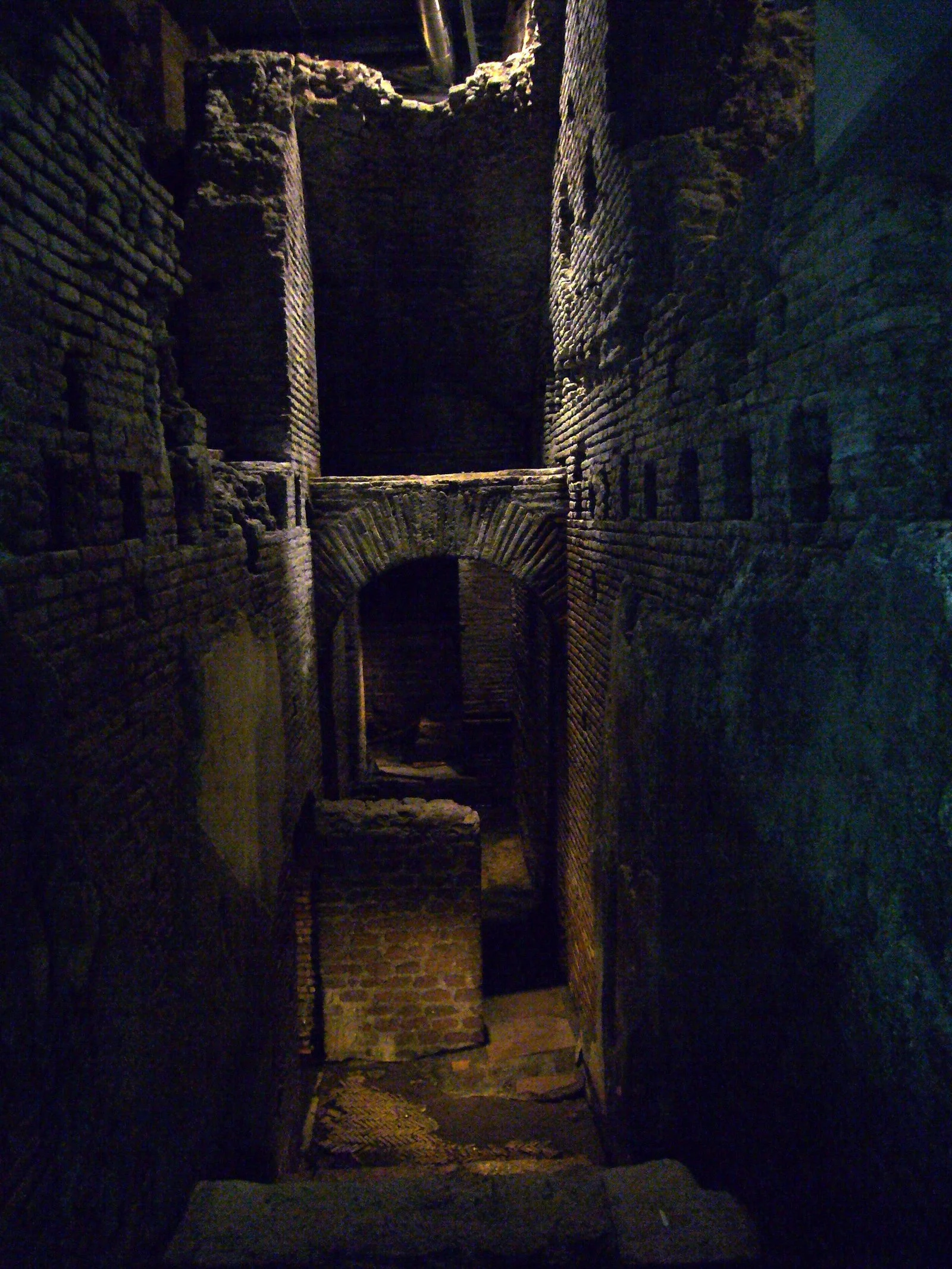
The Vicus Caprarius, the City of Water, is an underground archaeological area covering about 350 square meters, nine meters below street level, less than 100 meters from the Trevi Fountain. It came to light between 1999 and 2001 during the renovation of the former Cinema Trevi, on Vicolo del Puttarello, and since then it has preserved two things that are almost never seen together in Rome: a block of Roman houses that survives to a height of several meters, and the large distribution tank of the Vergine aqueduct, the castellum aquae, still crossed by the water that feeds the fountains of the center. This is the point that makes the visit different from any other urban excavation: those who come down here are not just looking at ancient walls, they also hear the sound of the water that a few dozen meters away comes out of Nicola Salvi's display and ends up in the photographs of half the world. The lines that follow tell what you actually see down there, how the block was transformed over the centuries from a working-class tenement into a noble residence, why the link with the Acqua Vergine is not a decorative detail but the very reason for the site, and how to organize a visit to a museum that is private, small and has its own hours.
Where Vicus Caprarius is and how to get there
The entrance to the archaeological area is at Vicolo del Puttarello 25, a side lane that opens between Via di San Vincenzo and Via delle Muratte, in the Trevi district. The site is also registered under the address Via di San Vincenzo 9, because the excavation occupies the subsoil between the two streets. If you arrive from the square with the fountain, turn your back on the cascade and take one of the little streets that climb toward Via del Corso. It takes two minutes on foot, but it is a stretch where it is very easy to walk past without noticing anything, because the access is a door flush with the wall, with no monumental facade to mark it.
On foot from the Trevi Fountain
From the basin of the fountain, go along the side of Palazzo Poli, the building that serves as the architectural backdrop of the water display, turn into Via di San Vincenzo and continue for about 50 meters. Vicolo del Puttarello opens on the right, narrow and slightly downhill. Alternatively you can go by Via delle Muratte, the street that links the square to Via del Corso and that in summer is one of the most crowded bottlenecks in the center. The route is very short either way, but in the middle hours of the day the crush around the fountain slows you down quite a bit, so allow a few extra minutes beyond the real distance.
By public transport
The nearest metro stop is Barberini, on Line A, from which you walk down Via del Tritone and turn toward the fountain square in about 10 minutes on foot. The alternative is the Spagna stop, also on Line A, slightly farther but handy if you want to combine the visit with a walk from Piazza di Spagna. As for buses, the lines that run along Via del Corso and Via del Tritone all drop you a few minutes from the entrance. If you are coming from Termini, you can choose either Metro A toward Battistini, getting off at Barberini, or one of the buses heading down to the historic center. The times are similar, and at rush hour the surface transport is almost always the slower of the two.
There is no useful parking nearby. The whole block around the fountain falls within the limited traffic zone, street parking is almost nonexistent and the few spaces available are paid during the daytime hours. If you arrive by car from outside Rome, it is a good idea to leave the vehicle in a park-and-ride lot connected to the metro and complete the trip by public transport, a solution that is faster and much cheaper than trying to get close to the Trevi district by car.
The entrance almost nobody finds
It is worth insisting on this point, because it is the reason many visitors arrive late or give up: the archaeological area has no monumental sign and no ticket office facing a square. If you are looking for something like the entrance of a state museum, you will not find it. The reference to keep in mind is the street number of the lane and the name of the former cinema, because the memory of Cinema Trevi in this corner of the district is still alive among Romans and asking for directions by mentioning it works better than naming the vicus. Once you cross the threshold you go down, and the modern street level is left behind in a few steps.
What you see below: a Roman block nine meters deep
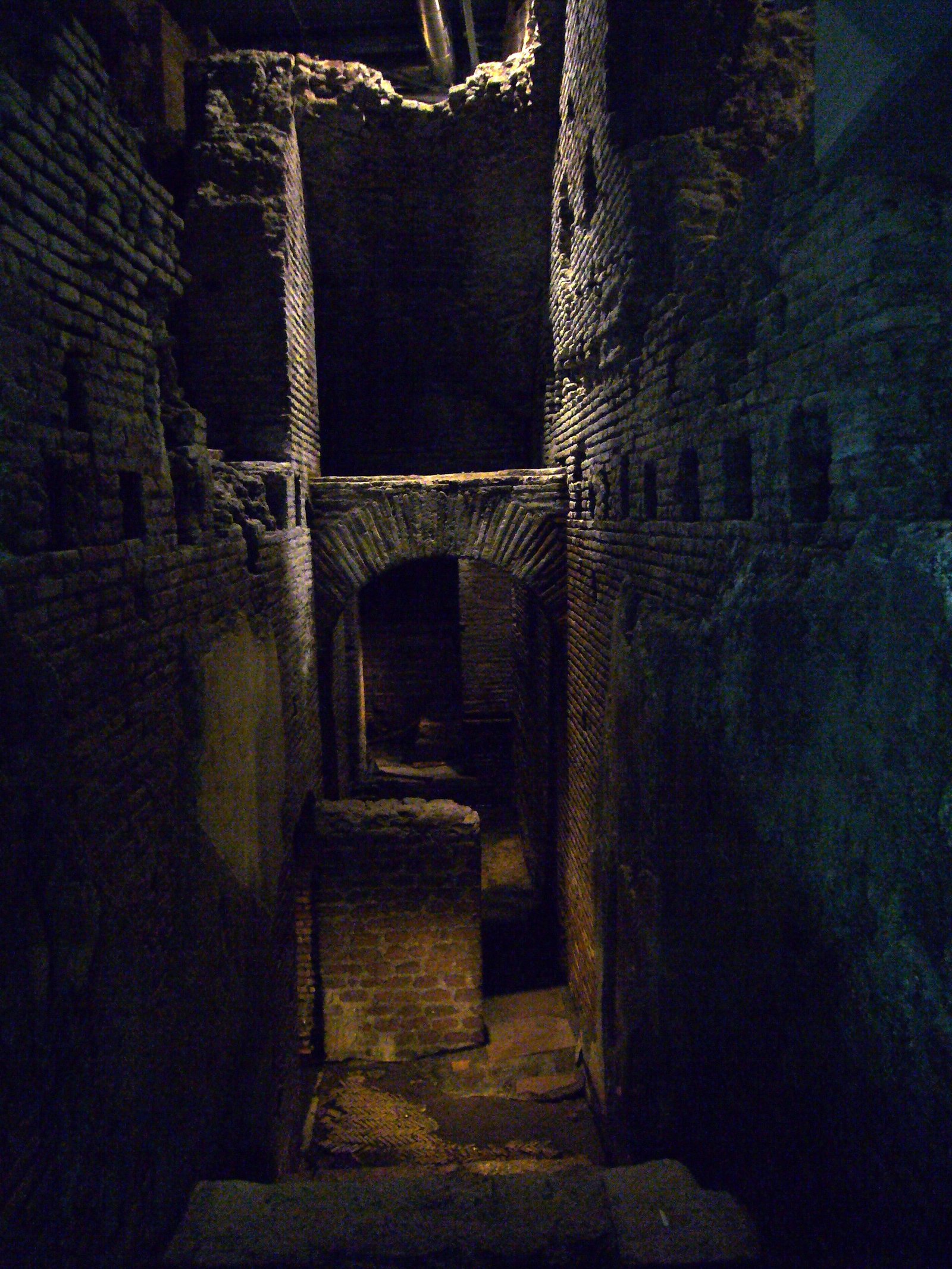
The archaeological area of the Vicus Caprarius extends over about 350 square meters and reaches a maximum depth of eight or nine meters below the current street level, with wall structures preserved in elevation to heights that in some places come close to eight meters. It is a measurement worth keeping in mind, because it explains better than any description what the word stratification means when applied to Rome: above the visitor's head are nine meters of city grown by accumulation, made of rubble, fill, cellars, Renaissance foundations and contemporary asphalt.
Two distinct buildings, not a single monument
The excavation has brought to light two separate constructions, facing an ancient lane and belonging to two different functional worlds. The northern building is a residential complex of the intensive type, that is, an insula: a tenement of at least three floors with shops on the ground floor, very similar in layout to those you see at ancient Ostia and of which very few readable examples remain in Rome. The southern building, by contrast, was organized into large rooms covered by barrel vaults, and in a later phase was converted into the water tank that gives its name to the entire visitor route. The distinction between the two blocks is the first fact to fix in mind, because the whole rest of the site's history descends from there.
The antiquarium
Part of the area is occupied by a small antiquarium, that is, an exhibition space where the materials recovered during the excavation are gathered. It is not a collection assembled elsewhere and brought here for decoration: these are objects that came out of these very layers, and this coincidence between the place of discovery and the place of display is one of the least advertised merits of the site. Anyone looking at a fragment of marble or a coin does so a few meters from the spot where it lay buried for a millennium and a half.
The castellum aquae of the Acqua Vergine, the heart of the site
The castellum aquae of the Vicus Caprarius is a large distribution tank of the Vergine aqueduct created in the Hadrianic period by merging two pre-existing vaulted rooms, and it is the reason the archaeological area took the name City of Water. The walls were reinforced and lined with hydraulic plaster, the vaulted roof made it possible to withstand the thrust of the liquid, and the result was a high-capacity basin placed at a strategic point of the water network of the eastern Campus Martius.
What a castellum aquae is
In the technical vocabulary of the Romans, the term indicates the structure in which the water of an aqueduct was collected, settled and then divided among several outgoing pipes. It was not a simple storage tank: it was the node where it was decided how much water went to the public fountains, how much to the baths, how much to the private users who had obtained a concession. Whoever controlled a castellum effectively controlled the distribution in an entire sector of the city, and for this reason the maintenance of these systems was entrusted to a specialized public administration, with staff, registers and written rules. Seeing one of these nodes in person, and not the stretch of channel everyone imagines when talking about aqueducts, is a rare opportunity even for those who know ancient Rome well.
The Hadrianic transformation
Archaeologists place the conversion of the vaulted rooms into a tank in the 2nd century AD, in the Hadrianic period, that is, in the decades after about 120. It is a dating that makes sense in the general picture of the work on the urban water network in that period, when the growth of the city and the multiplication of bathing complexes made it necessary to strengthen storage capacity along the existing lines. Some popular reconstructions attribute to the basin a capacity on the order of 150,000 liters. It is an estimate that circulates online and should be taken as such, not as a measured figure published in definitive form, and whoever cites it would do well to say so.
The water that still flows
The detail that strikes visitors most when they come down here is that the water is not a memory. Running water is present on the site, coming from the same vein that feeds the Vergine aqueduct, and the visitor route shows it as it passes through the ancient rooms. It is a sensory experience before it is an archaeological one: the sound, the humidity of the air, the lower temperature compared with the street. In a Roman summer, coming down here in the middle of the afternoon also means going in a few seconds from 35 degrees on the asphalt to a decidedly cooler setting, and that is no small thing for anyone visiting the city in July or August.
Why in this exact spot
The location of the tank is no accident. The Vergine aqueduct reached the city from the northeast, entered the eastern Campus Martius sector and from there served the Baths of Agrippa, the gardens and the users of the flat area. A distribution node placed at the height of today's Trevi district stood exactly on the line of that route, at the point where the channel came out of the slope of the Quirinal and opened onto the plain. 2,000 years later, the last stretch of the same pipeline ends in the basin of the Trevi Fountain: the ancient tank and the Baroque fountain belong to the same infrastructure, separated only by time.
Image: the wall lined with hydraulic plaster of the large tank, with the barrel vault and the reflection of the water on the walking surface.
From insula to domus: four centuries of transformations
The insula of the Vicus Caprarius dates to the Neronian period and is indicated by scholars as one of the oldest known rental buildings in Rome, before being transformed around the middle of the 4th century into a noble domus with polychrome marble facings. This sequence, from working-class tenement to luxury residence, is the real story of the site and is worth following phase by phase, because it is the same fate that befell many blocks of central Rome between the 1st and the 4th century, but here you read it on the walls instead of in books.
The Neronian-period insula
The original construction is placed in the period immediately after the great fire of AD 64, when the center of Rome was largely rebuilt according to new criteria, with wider streets, height limits and fire-safety rules. The building rose over at least three floors, with shops open to the street on the ground floor and apartments on the upper levels, following the classic scheme of Roman intensive housing. The surviving structures reach a height of several meters, which makes this block one of the very few cases in Rome where you can look an insula in the face instead of imagining it.
One fact worth remembering: in Rome insulae were the norm and domus the exception. The late antique Regionary Catalogues, the lists that surveyed the buildings of the city region by region, record many thousands of insulae against a few hundred single-family houses. And yet very few readable traces of that widespread building stock remain, because ordinary buildings are precisely the ones that get demolished, reused and erased first. It is this scarcity that makes the northern building of the Vicus Caprarius so valuable.
The noble domus of the mid-4th century
Around the middle of the 4th century the tenement was upgraded and transformed into a noble residence: wall facings in polychrome marble appear, along with fine flooring and refined decoration. It is a well-documented phenomenon in late antique Rome, when the senatorial class reorganized its presence in the city and absorbed portions of intensive housing to turn them into private showpiece homes. The change also marks a drop in housing density: where dozens of families once lived in minimal apartments, now a single household resides with its own servants. The ancient city, in those decades, is emptying out and at the same time becoming more polarized.
537 and the end of the tank
The water tank stopped working around 537, when the Goths cut the aqueducts during the siege of Rome in the course of the Gothic War. It is one of the most consequential episodes in the urban history of the city: deprived of running water, Rome gradually abandoned the high areas and concentrated in the bend of the Tiber, where the river and the wells guaranteed the supply. The castellum of the Vicus Caprarius was thus stripped of its function overnight, and the structures began to fill with earth and rubble.
A curiosity about Vicus Caprarius, the City of Water
In the excavation of the Vicus Caprarius a small hoard of more than 800 small-denomination bronze coins was recovered, datable between the 4th and 5th century, which archaeologists interpret as the savings accumulated by people of modest means, probably attendants or members of the domus servant staff. It is not gold, it is not silver, it is not the nest egg of a rich person: it is small change, the kind of coin used for daily shopping, put aside piece by piece and hidden in a corner of the house.
Why a hoard of poor coins is worth more than a gold one
From the point of view of historical research, an accumulation of low-value coins is often more eloquent than a hoard of precious ones. Gold hoards tell of the great crises and the movements of wealth of the elites. Bronze nest eggs, on the other hand, tell what was really passing through the hands of ordinary people, which mints supplied the local market, how long old pieces stayed in circulation. A set of more than 800 coins of this kind, recovered in a well-dated residential context, is a document of everyday economy that is hard to replace with any written source.
What the act of hiding tells us
Then there is the human meaning of the find, and it is the part that strikes those who visit the antiquarium. A hoard that was hidden and never recovered almost always means that whoever buried it never came back to retrieve it. In the context of 5th-century Rome, amid sacks, fires and recurring crises, that failure to return has a precise ring. It must be said clearly that this is a reasonable reading and not a certainty: the reasons why a nest egg stays underground can be many, and archaeology records the fact without being able to trace the personal story.
The relationship with the Trevi Fountain: the same aqueduct, 2,000 years later
The Trevi Fountain and the castellum aquae of the Vicus Caprarius are fed by the same aqueduct, the Acqua Vergine, inaugurated by Marcus Vipsanius Agrippa in 19 BC and the only one among the great pipelines of ancient Rome that never completely stopped working. This is why the visit to the underground site makes the most sense right after you have looked in on the fountain: these are not two monuments that happen to be close by, but two points of the same hydraulic infrastructure, one at the beginning of its story and one at the end.
The Acqua Vergine from 19 BC to today
The aqueduct collects its waters in the area of the ancient Lucullan estate, at the eighth mile of Via Collatina, in the zone now known as Salone, and reaches the center of Rome by a route of more than 20 kilometers, almost entirely underground. It is precisely this development in tunnel that is the technical reason for its extraordinary survival: while the aqueducts on arches were the first to be cut, damaged and then dismantled, a pipeline running underground is much harder to interrupt and much easier to repair. The Sovrintendenza Capitolina defines it as the only one of the 11 main aqueducts of ancient Rome to have remained in uninterrupted operation to the present day, and anyone who wants to look further into the route and history of the pipeline will find a detailed picture in the page devoted to the Vergine aqueduct.
The legend of the maiden and the name of the aqueduct
About the name, the story has always circulated of the young virgin who supposedly pointed out the hidden spring to thirsty soldiers, an episode said to be the origin of the name Virgo and which also appears in the figurative program of the Baroque fountain. It is a tradition reported by ancient sources and taken up without interruption by later literature, but it remains an etiological tale, that is, an explanation constructed after the fact to justify a name. It should be presented as tradition, not as a chronicle of something that happened. The same caution applies to the many variants that enrich it with details in tourist guides.
Why it pays to visit the site right after the fountain
The sequence of fountain first, then underground works for a precise reason: in front of the water display you see the scenic effect, the triumphal arrival of the jet, the part that the Baroque city wanted to make spectacular. Going down into the Vicus Caprarius, instead, you see the hydraulics, that is, the technical reason why that water is there: the tank, the distribution, the channel. They are the two ends of the same thread, and visiting them in the right order turns a crowded tourist stop into a real understanding of how the city works. If you have time you can complete the picture with a stop at the Barcaccia Fountain at the foot of the Spanish Steps, also fed by the same pipeline.
The new regulated access to the fountain
A recent change should be noted that directly affects the planning of your visit: since 2026 access to the area of the basin of the Trevi Fountain has been limited, with a maximum number of people admitted at the same time in the space in front of the monument and with a token-price ticket for non-residents. News reports give the threshold as 400 simultaneous visitors, a ticket of 2 euros, free entry for residents of Rome and differentiated time slots on the days devoted to collecting the coins and cleaning the basin. The news outlets do not agree on the exact start date, placed between the end of January and February 2, 2026, and the rules may have been updated after the introduction. Before leaving, it is a good idea to check the current rules on the channels of Roma Capitale, because they affect how long you will spend in the square and therefore the time at which you reach the entrance of the archaeological site.
One thing nobody tells you about Vicus Caprarius, the City of Water
The Vicus Caprarius is not a civic museum or a state site: it is an archaeological area run privately, with its own hours, reduced capacity and a modest entrance ticket, and this changes quite a few things in the practice of the visit. It does not appear in the passes and circuits that are valid for the municipal museums, it does not follow the calendar of free openings, and its access conditions can change without any institutional portal noticing in real time.
The name of the site and the aedicula Capraria
The name Vicus Caprarius is not a modern invention: it indicates the stretch of ancient road that corresponded roughly to today's Via di San Vincenzo and Via dei Lucchesi, and the name is linked to the presence of an aedicula Capraria, a small place of worship in the area. The explanation that ties it directly to the caprarii, that is, the goat herders who supposedly frequented the road, is the one that circulates most easily in guides, but it is a simplified reading: the firmest reference points to the shrine, not to the trade. I point out the difference because it is exactly the kind of detail that gets flattened in quick descriptions.
A small site, and you should know that beforehand
There is also a question of expectations. 350 square meters is little, and anyone arriving and imagining an underground route of a size comparable to the Domus Aurea or to the lower levels of a great basilica will be thrown off. The value of the Vicus Caprarius is not in its scale but in the density and clarity of the stratigraphic sequence, as well as in the presence of living water. Knowing this in advance avoids disappointment and lets you give the visit the right amount of time, which is that of a thorough stop and not of a whole morning.
Image: the inside of the antiquarium with the display cases of finds and, in the background, the brick walls of the Roman insula.
The advice I give you for visiting Vicus Caprarius, the City of Water
The most useful advice for visiting the Vicus Caprarius is to call ahead, even on weekdays, and show up at an agreed time: the venue states it is open Tuesday to Sunday from 11:00 to 17:00, closed Monday, with limited capacity and mandatory booking on weekends and holidays. A small site with short hours and limited space is exactly the kind of place where showing up unannounced in high season can mean being left outside.
The right order of stops
The route that works best in a morning starts from the fountain square in the early hours, when the crowd is still bearable, continues with the underground visit mid-morning and ends by heading back up toward Via del Corso. This way you see the scenic effect first and then the hydraulic machine that makes it possible, and you avoid arriving at the archaeological site already worn out by the crush. If you prefer the afternoon, keep in mind that the 17:00 closing is early compared with the hours of the big Roman museums, and that the last useful entry should be checked when you book.
How much time you really need
For a self-guided, attentive visit, 30 to 40 minutes are enough, counting the walk along the walkways and the stop in the antiquarium. With a visit led by an archaeologist, which the venue offers by reservation at a stated rate of 8 euros, the time stretches considerably and your understanding of the site changes in quality, because reading the masonry requires a guide. If you have only a quarter of an hour, you would do better to put it off to another day.
Stairs, accessibility and environmental conditions
The site lies nine meters below street level and is reached by going down. The official pages consulted carry no explicit statement about elevators or alternative routes for people with mobility difficulties, so anyone with specific needs should ask the venue directly before showing up, without trusting third-party accounts. The management does state that video guides in Italian Sign Language are available via QR code, which is a rare accessibility service in archaeological sites of this size. As for conditions, the air is cool and damp all year round: in summer it is a relief, in winter it is wise to keep a light jacket on even if the sun is beating down outside.
To combine in the same outing
The location lets you build a dense itinerary within a radius of a few minutes on foot: the Galleria Sciarra with its Liberty-style courtyard is around the corner and entry is free during the courtyard's opening hours, the Church of Sant'Ignazio di Loyola with the fake dome painted by Andrea Pozzo is five minutes away, and the Column of Marcus Aurelius in Piazza Colonna is reached by crossing Via del Corso. If you want to stay on the theme of the underground, you can continue another day with the Domus Romane di Palazzo Valentini or with the underground of the Stadium of Domitian beneath Piazza Navona.
The finds on display in the antiquarium
The antiquarium of the Vicus Caprarius displays materials coming exclusively from the excavation of the site: polychrome marble facings, fragments of statuary, African amphorae for transporting oil, objects of domestic use and the hoard of more than 800 bronze coins. It is a small, coherent collection, whose interest comes from its direct link with the layers you walk through.
The head attributed to Alexander Helios
The best-known piece is a marble head that the site's presentations identify as a depiction of Alexander Helios, that is, Alexander in the guise of the sun god, an iconography widespread in the Hellenistic world and taken up in the Roman period. It is best to use the right word, though: this is an iconographic attribution, not an identification documented by an inscription. Marble heads without their original context and without epigraphic elements are recognized by stylistic comparison, and stylistic comparison is by its nature open to debate. The site's information sheet and the popular literature routinely speak of Alexander Helios, and it is right to report it, as long as it stays clear that the name comes from the reading of scholars and not from a signature on the marble.
The polychrome marbles and the decorations of the domus
The fragments of wall and floor facing in polychrome marble belong to the phase of the 4th-century domus and give a concrete idea of the decorative level reached by the residence: thin slabs of colored stone of different origins, mounted to form geometric fields, according to a taste that in late antique Rome was an unmistakable sign of status. Seen up close, these fragments explain better than any graphic reconstruction why the transformation of the insula into a domus was a leap in social scale and not a simple restoration.
The African oil amphorae
Among the materials on display are African amphorae of the type called spatheion, slender containers used for transporting oil in late antiquity. They are objects that tell of Mediterranean trade in those centuries: the oil came from proconsular Africa, went up the Tiber to the urban warehouses and ended up in the pantries of Roman homes. A container of this type, found in a residential context in the center, is material proof that the city's supply network was still working, in reduced form, in an era we are used to imagining only as decline.
Everyday objects and pottery
The excavation also yielded a very large quantity of pottery fragments, on the order of a few thousand pieces according to the site's popular presentations, as well as objects of domestic use that document the different phases of occupation. Common pottery is the least showy material and at the same time the most useful to the archaeologist, because shapes change quickly over time and make it possible to date the layers with a precision that masonry alone does not allow. It is the potsherds, and not the marbles, that fixed the chronology of the site.
Another well-known fact, yet rarely cited
The Acqua Vergine is the only one of the 11 main aqueducts of ancient Rome to have remained in uninterrupted operation to this day. It is a fact everyone has heard at least once, but almost no one links it to the practical consequence that follows from it, namely that the water you see flowing in the Vicus Caprarius belongs to a system in service, not to an archaeological find. The archaeological site coexists with a living infrastructure, and this is a rare case even in the Roman landscape.
Why an underground aqueduct survives and one on arches does not
The survival of the Acqua Vergine has a simple technical explanation. The aqueducts that crossed the countryside on long rows of arches, like those you can still admire today at the Aqueducts Park, were extremely vulnerable: demolishing a few arches was enough to interrupt the flow, and the repair required massive works. A pipeline running in a tunnel below ground level, by contrast, stays protected from military action and can be maintained in short stretches, entering through the inspection shafts. This is why the Vergine passed through the Gothic wars, the Middle Ages and the sackings and remained, even if with reduced flow and interruptions, essentially operational.
The missing limescale and the identification of the tank
There is a technical detail worth telling because it shows how archaeology works: one of the arguments used to recognize the large basin of the Vicus Caprarius as the castellum of the Vergine aqueduct is the scarcity of limestone deposits on the walls. The waters of the Vergine are low in carbonates compared with those of other Roman pipelines, and therefore leave much thinner encrustations. Finding in an ancient tank a lining without the thick concretions typical of systems fed by hard water is a strong clue to the source aqueduct. It remains, however, an attribution based on converging clues, so much so that the official presentations themselves use the adverb probably.
The right photo to take at Vicus Caprarius, the City of Water
The photograph that best captures the Vicus Caprarius is the one that holds the ancient masonry and the running water in the same frame, because that is exactly the combination that makes the site unique: where there is only the wall, the photo looks like a thousand other urban excavations. Where there is also the reflection or the flow, you immediately understand what place it is. Before shooting, though, ask at the ticket office about the rules in force on photography, flash and tripods, because in privately run sites the conditions vary and can change over time.
The front of the large tank
The main shot is the one that takes the wall of the castellum head-on with the barrel vault, keeping the walking line low in the frame to leave room for the height of the space. The artificial light along the route is warm and raking, and draws out the texture of the brick well: it is best to rest the camera or phone on a railing to compensate for long exposure times, instead of raising the sensitivity and ending up with a noisy image.
The detail of the water
The second shot is a close-up, on the thread of water and on the reflection of the masonry on its surface. It works better without flash, which flattens everything and wipes out the very reflection you want to capture. If you have a recent phone you can try night mode, which in these spaces gives surprising results. The sound of the water is the one thing the photograph cannot bring home, and it is worth recording a few seconds of video just for the audio.
Daily life in a Roman block of the Trevi district
The insula of the Vicus Caprarius housed shops on the ground floor and apartments on the upper floors, following the scheme of Roman intensive housing: a housing model that concerned the great majority of the urban population and of which very few visitable examples remain in Rome. Walking here means crossing the level of the city where ordinary people lived, not that of the great aristocratic residences.
The shops on the ground floor
The rooms open to the street on the lower level were tabernae, that is, shops, often fitted with a mezzanine where the shopkeeper slept. They sold groceries, wine, ready-to-eat food, everyday objects, and they made up the dense commercial fabric of the ancient city, the one that made it possible to live in apartments without a kitchen. The street they faced was the vicus that gives the area its name, a secondary neighborhood axis and not a major artery: traffic was on foot and by small carts, and life took place in large part outdoors.
Water at home was a privilege
And here the site shows its most interesting paradox: a block built a few meters from the great tank of the aqueduct did not at all mean running water for everyone. In ancient Rome a private connection to a public pipeline was a costly concession, reserved for those who could afford it, while ordinary people drew from the public neighborhood fountains. Only with the transformation into a noble domus, in the 4th century, did water truly enter the building, feeding the basins and systems of the residence through lead pipes. The physical distance from the tank was minimal, the social distance enormous.
The surrounding neighborhood
The sector corresponded to the seventh Augustan region, Via Lata, and belonged to the connecting band between the flat Campus Martius and the slopes of the Quirinal. It was a mixed residential area, without the great monumental complexes that characterized the political center of the city: nothing like the scenery of the forums, much more like the fabric of houses, shops and little streets that you can sense when visiting the Crypta Balbi, the museum that in Rome best tells the transformation of the urban fabric between antiquity and the Middle Ages.
Some important events that happened here in history
The historical sequence of the Vicus Caprarius covers 20 centuries and is read in the excavation as a succession of dated events: the arrival of the aqueduct in 19 BC, the reconstruction after the fire of AD 64, the conversion into a tank in the Hadrianic period, the late antique luxury of the domus, the fire of the 5th century, the cutting of the aqueducts in 537, the medieval resettlement and finally the rediscovery between 1999 and 2001.
19 BC: the Acqua Vergine arrives
The inauguration of the aqueduct commissioned by Agrippa changes the fate of the entire sector. Bringing water in quantity to the Campus Martius means making possible the baths, the gardens, the fountains and a housing density that would otherwise be unthinkable. Without that work, the whole later history of this block would not exist.
AD 64: the fire and the reconstruction
The great fire that devastated Rome under Nero is the reference point for dating the insula, built in the reconstruction phase that followed. The building rules introduced on that occasion, with wider streets and height limits, explain the regular layout of the building and the quality of its masonry, higher than what you would expect from a working-class tenement.
Hadrianic period: the tank is born
During the 2nd century two vaulted rooms of the southern building are merged and transformed into the large water basin. It is the intervention that gives the site its identity and that makes it, today, the City of Water.
Mid-4th century: the domus
The upgrading of the insula into a noble residence marks the moment of greatest splendor of the complex, with polychrome marbles on the walls and floors. It is also the sign of a changing city: fewer inhabitants, more concentration of wealth, public buildings passing into private hands.
Around 455: the fire
A violent fire destroys the ground floor of the domus. The chronological coincidence with the Vandal sack under Genseric has led more than one reading to connect the two events, but the link remains an archaeological hypothesis and not an established fact.
537: the Goths cut the aqueducts
During the siege of Rome in the Gothic War the aqueducts are interrupted and the tank goes out of service. It is the date that closes the ancient life of the site and that, on the urban scale, marks the beginning of the depopulation of the high areas of the city.
Between the 11th and 13th century: the inhabitants return
The area is built up again at a level about five meters higher than the Roman ground level, with more modest construction. The stratification will keep growing in the following centuries, until it brings the modern street level to nine meters above the ancient structures.
1999 and 2001: the rediscovery
The archaeological investigations carried out during the renovation of the former Cinema Trevi bring the entire complex back to light. The scientific direction is entrusted to Claudio Mocchegiani Carpano, with Antonio Insalaco in charge of the fieldwork. The area is then fitted out and opened to the public in 2004 under the name City of Water.
Who passed through Vicus Caprarius, the City of Water
The story of the Vicus Caprarius is not tied to a famous figure but to three categories of people: the anonymous inhabitants of the block between the 1st and the 5th century, the archaeologists who between 1999 and 2001 recognized its sequence, and the visitors who since 2004 have come down here right after seeing the fountain. It is a site with no illustrious names on the walls, and precisely for this reason it tells the story of the city better than many famous monuments.
Agrippa, at the origin of everything
Marcus Vipsanius Agrippa, son-in-law of Augustus and architect of the transformation of the Campus Martius, never set foot in this block for the simple reason that in 19 BC the building did not exist. And yet his work is the premise of everything you see here: the aqueduct that carries his project still crosses, 20 centuries later, the rooms of the excavation. Anyone who visits the Pantheon, the other great legacy of Agrippa in the Campus Martius, and then goes down into the Vicus Caprarius, touches the two ends of the same urban enterprise.
The archaeologists of the excavation
Claudio Mocchegiani Carpano, an archaeologist with long experience in the urban and underwater excavations of Rome, held the scientific direction of the investigations carried out by the Soprintendenza between 1999 and 2001, while the direction of the fieldwork was in the hands of Antonio Insalaco, to whom the publications and popularization of the site are also owed. The main merit of that work was not stopping at the recovery of materials but reading the whole stratigraphic sequence, from the Neronian phase to the medieval one, and making that reading understandable to visitors.
The Cinema Trevi and the memory of the district
Before the excavation, this address was for Romans only a movie theater. The renovation of the building is the origin of the discovery, following a recurring script in the archaeological history of Rome: the great urban acquisitions almost always come from a building site and not from a planned research campaign. The same happened, in other forms, for the Case Romane del Celio and for many of the underground complexes opened to the public in recent decades.
What to see nearby, beyond the fountain
The Vicus Caprarius is in the heart of the Trevi district, a few minutes on foot from some of the most visited places and from others almost ignored by passing tourism. If you are organizing your day, you can build a continuous route without ever taking a vehicle.
Palazzo Poli and the backdrop of the fountain
The building that serves as the background of the water display is Palazzo Poli, home of the Istituto centrale per la grafica. Seen from the square it seems only the backdrop of the fountain, but it is a palace in its own right with a history of its own and exhibition spaces that deserve a stop.
Galleria Sciarra and the hidden Liberty style
Just steps away, behind a door on Via Marco Minghetti, the Galleria Sciarra keeps a courtyard entirely frescoed in the late 1800s and devoted to feminine virtues: it is one of the corners most photographed by Romans and one of the least known to foreign visitors.
Frequently asked questions about Vicus Caprarius, the City of Water
What is the Vicus Caprarius, the City of Water?
The Vicus Caprarius, the City of Water, is an underground archaeological area of about 350 square meters located a few steps from the Trevi Fountain, nine meters below street level. It preserves a Roman insula of the Neronian period transformed in the 4th century into a noble domus and the large distribution tank of the Vergine aqueduct, the castellum aquae, still crossed by water.
How much does a ticket to the Vicus Caprarius cost?
The full ticket for the Vicus Caprarius costs 4 euros according to the rates published by the management, with a reduced price of 2.50 euros for Roma Pass holders, European Union university students between 18 and 25, teachers, journalists and law enforcement, and 1 euro for ages between 14 and 17. Entry is free under 14. The audioguide is listed at 3.50 euros and the guided visit at 8 euros. Rates may change, so it is best to confirm them when you book.
What are the opening hours of the Vicus Caprarius and when is it closed?
The Vicus Caprarius is open Tuesday to Sunday from 11:00 to 17:00, with its weekly closing on Monday, according to the management's official site. The telephone line for information and bookings is listed as active Tuesday to Sunday from 10:00 to 16:00. Special openings on different days and at different times are possible for groups on request, and during the holiday periods the calendar may change and should be checked directly.
Do you need to book to visit the Vicus Caprarius?
Booking at the Vicus Caprarius is listed as mandatory on weekends and holidays and as recommended on other days, because the site is underground and capacity is limited. The fastest channel is the telephone, which can also be used through messaging, during the hours stated by the management. In high season, showing up without a booking means risking a wait or not getting in at all.
Where exactly is the entrance of the Vicus Caprarius?
The entrance of the Vicus Caprarius is at Vicolo del Puttarello 25, in the Trevi district, less than 100 meters from the Trevi Fountain. The site is also listed under the address Via di San Vincenzo 9, because the excavation occupies the subsoil between the two streets. It has no monumental facade and is easily found by asking for the former Cinema Trevi.
How long does it take to visit the Vicus Caprarius?
To visit the Vicus Caprarius on your own, 30 to 40 minutes are enough, including the route on the walkways above the Roman structures and the stop in the antiquarium with the finds. With a guided visit led by an archaeologist the time stretches and the understanding of the building phases improves considerably, because reading the masonry requires an explanation.
Is the Vicus Caprarius suitable for children?
The Vicus Caprarius is suitable for children, and the management states free entry under 14, as well as educational programs dedicated to schools. The element that most captures the attention of the little ones is the running water that crosses the ancient rooms. The route runs on raised walkways and requires attention, and bulky strollers are awkward in such a confined space.
Is the Vicus Caprarius accessible to people with mobility difficulties?
The Vicus Caprarius lies nine meters below street level and is reached by going down, so anyone with mobility difficulties should inquire with the venue beforehand. The official pages consulted do not explicitly state the presence of elevators or alternative routes. The management does report video guides in Italian Sign Language available via QR code, a service that is rare in sites of this size.
What is the relationship between the Vicus Caprarius and the Trevi Fountain?
The Vicus Caprarius and the Trevi Fountain are fed by the same aqueduct, the Acqua Vergine, inaugurated by Agrippa in 19 BC and the only ancient pipeline of Rome never to have gone definitively out of service. The underground site preserves the Roman distribution tank, and the fountain is the monumental terminal, from the 1700s, of the same network. They are two points of the same infrastructure.
One last piece of advice for planning your itinerary
The Vicus Caprarius works better as a stop set into a route through the Trevi district than as the sole goal of a day: half an hour underground, right after the stop at the fountain, is worth much more than a visit scheduled on its own at another time. The practical rule is simple: you book, you reach the square with the margin needed for the new regulated access, and you go down with the fountain still in your eyes, because it is precisely the immediate contrast between the Baroque scenery and the Roman hydraulic machine that makes the visit memorable.
If you are building a broader itinerary in the historic center, combining this stop with the other stops in the Trevi district and the Campus Martius, you can find useful planning tools at Tour Leader Pro, while for a more general picture of transport and destinations in Lazio, Italy Planner is a good resource.