Barberini Mithraeum
In short. The Barberini Mithraeum is one of the best-preserved Mithraic sanctuaries in Rome and, together with the Mithraeum of Santa Prisca on the Aventine, the only one in the city that preserves painted decoration.
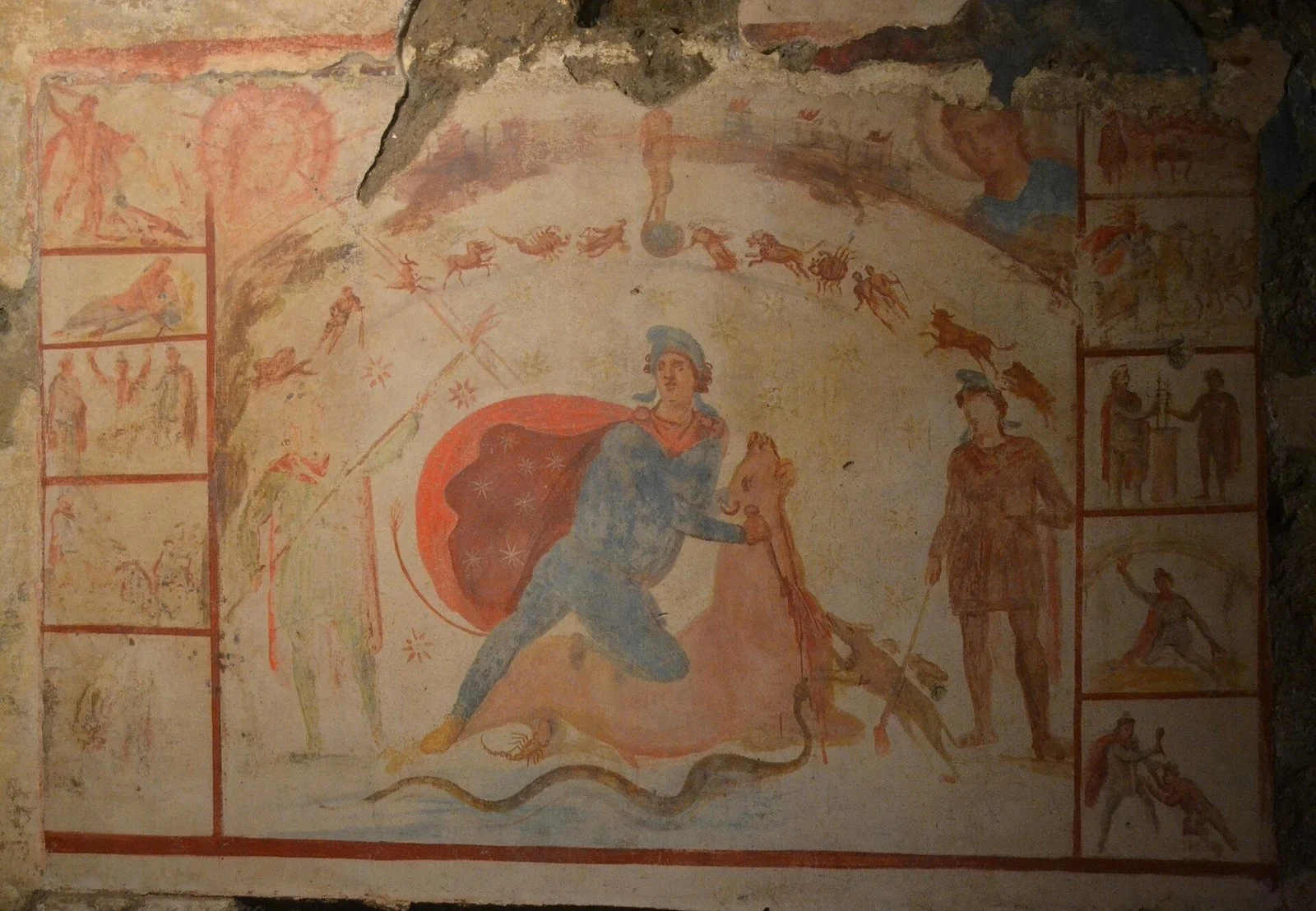
The Barberini Mithraeum is one of the best-preserved Mithraic sanctuaries in Rome and, together with the Mithraeum of Santa Prisca on the Aventine, the only one in the city that preserves painted decoration. It lies under a 20th-century building put up in what was the garden of Palazzo Barberini, between Via delle Quattro Fontane and Via San Nicola da Tolentino, a few minutes from the Barberini stop of metro line A. It came to light by chance in 1936, during the foundation excavations of a new building, and since then it has given scholars the most complete image we have of the mythical story of Mithras: a large fresco on the back wall, with the tauroctony at the center and 10 side panels that tell, one after another, the episodes of the god's sacred story. It is a place that almost no visitor to Rome sees, because it is not part of the route of the Galleria Nazionale d'Arte Antica and has no museum entrance: you enter only on extraordinary openings or on guided visits by reservation, and the calendar has changed several times in recent years. The lines that follow tell what this room was, how it was found, what exactly its fresco shows, what that fresco really tells us about the cult of Mithras and, above all, what it does not tell us, because about Mithraism we know a great deal about the images and almost nothing about the doctrine.
Where the Barberini Mithraeum is and how to get there
The Barberini Mithraeum is in the basement of the Palazzina Savorgnan di Brazzà, the building constructed in 1936 in the corner of the Barberini garden between Via delle Quattro Fontane, Via XX Settembre and the Salita di San Nicola da Tolentino, in the Trevi rione. The address that appears on the institutional portals of Roma Capitale is Via delle Quattro Fontane 13, the same street number as Palazzo Barberini, because the building is part of the same cadastral complex. The entrances used for the guided visits organized by the Special Superintendency of Rome, however, have been indicated on Via XX Settembre, at number 2. Whoever looks for the mithraeum thinking they will find it inside the museum will not find it: they are two distinct things, in two different portions of the same block, with two different managements.
By subway
The reference stop is Barberini, on metro line A, which is at Piazza Barberini, a few dozen meters from the start of Via delle Quattro Fontane. From the square you go up the street on a slight slope, leave on your right the monumental front of Palazzo Barberini with its 19th-century fence and the telamones, and continue toward the Quattro Fontane intersection. The building that covers the mithraeum is on the upper stretch of the street, on the garden side. Whoever arrives from Termini can take metro A toward Battistini and get off at the second stop, or reach the area on foot in about 15 minutes along Via Nazionale and climbing toward the Quirinale.
On foot from the center
The area is one of the most walkable nodes in Rome. From the Trevi Fountain you get there in about 10 minutes going up toward the Quirinale and turning into Via delle Quattro Fontane. From the Quirinal Palace the walk is even shorter: you take Via del Quirinale, pass the church of Sant'Andrea al Quirinale and then the church of San Carlo alle Quattro Fontane, and you find yourself at the intersection of the four fountains, a step from the Barberini garden. From Via Veneto it is five minutes downhill to Piazza Barberini, where Bernini's Triton Fountain marks the center of the widening.
What a mithraeum is and why this one is special
A mithraeum is the meeting place of a community of initiates into the mysteries of Mithras, almost always a rectangular, dark room without windows, designed to look like a cave, with two side benches on which the faithful reclined for the ritual banquet and, at the back, the image of the god killing the bull. The dimensions were modest because the communities were modest: a few dozen people for each sanctuary, never a crowd. The Barberini Mithraeum fits this scheme perfectly, but in a particularly large and, above all, painted version.
The room: measures and shape
The room measures 11.85 meters in length by 6.25 in width, is covered by a barrel vault and preserves the two sloping side benches on which the initiates took their places during the rites. The free central corridor between the two benches is just under two meters wide, and the height of the room exceeds four meters: these are data that Mithraic reference works report in substantially the same way, with differences of a few centimeters between one measurement and another. It is a surface of about 70 square meters, so a large mithraeum compared to the average, but still a room that would have struggled to hold more than a few dozen people reclining.
The back niche disguised as a cave
The most eloquent detail of the sanctuary is not a statue but a scenic device: on the back, and partly on the walls, the builders applied shells, pumice and calcareous concretions to imitate the irregular surface of a natural rock. The cult niche on the back wall is over two meters high and about one meter deep, and its fake-rock decoration served to transform a brick room, under a city house, into the cosmic cave in which the myth places the killing of the bull. Next to the fresco a stretch of wall covered with calcareous concretions is still visible, which supported a low small vault whose springing can be recognized.
Why a painted mithraeum is rare
Most Roman mithraea preserve sculptures, marble reliefs, mosaics, inscriptions: painting, being the most fragile material, has almost always vanished. In Rome only two mithraea with recognizable pictorial decoration remain, the Barberini one and the one at Santa Prisca. Outside Rome the most cited comparisons are the mithraeum of Marino, in the Castelli, and the one at Santa Maria Capua Vetere. They are very few cases, and on these few cases depends much of what we can say about the way the Mithraists told the story of their god in images. This is exactly why the Barberini Mithraeum, though a small and almost invisible place, weighs so much in scholarship.
The 1936 discovery: a mithraeum found by chance under a building site
The Barberini Mithraeum was discovered in 1936 during the foundation excavations of the Palazzina Savorgnan di Brazzà, the building designed by Gustavo Giovannoni and Marcello Piacentini in the area of the garden of Palazzo Barberini that in those years was being progressively divided into lots. It was therefore not the result of a planned archaeological campaign, but the classic find from a construction site, the same mechanism that in Rome has brought to light a good part of the known mithraea.
What was there before the building
The excavations brought to light the remains of a building of the second century AD, articulated in several communicating rooms, whose westernmost part was transformed into a mithraeum during the third century. The original purpose of the building was that of a private construction of the imperial age, consistent with the residential character of the upper Quirinal: popular sources often speak of a domus, and the definition is reasonable, even if the excavated portion is too limited to reconstruct the plan and the ownership of the whole complex. On this it is worth being precise: we know that the Mithraic room was carved out inside a preexisting building of the previous century, we do not know who owned it or if the mithraeum served the household of the house, a group of freedmen, a professional association or a neighborhood community.
The dating of the Mithraic phase
The transformation into a sanctuary is placed by scholarship in the third century, and Mithraic reference works narrow it more precisely to the second quarter of the century, so roughly to the years between 225 and 250 AD. It is the moment of the cult's widest diffusion in the empire, when mithraea multiplied in cities, in ports and along the frontiers. The range is not as narrow as that of a monument dated by an inscription, and whoever cites a precise year for the Barberini Mithraeum is picking a point inside an interval, not reporting a certain datum.
Why the Barberini garden was no longer a garden
To understand how it is possible that a Roman sanctuary ended up under a building of the 1930s, one must remember what happened to the garden of Palazzo Barberini after the unification of Italy. That garden was a real park, extending to the Strada Pia, the present Via XX Settembre, populated in the Baroque age even by exotic animals. With the construction of Rome as capital, the ministries lining up along Via XX Settembre began to nibble at its edges. In 1814 a ball court had already been built there, later demolished. From 1881 the division into lots became systematic, and in the 1930s both the Beni Stabili building on Via delle Quattro Fontane and, behind the old cork casina, the Palazzina Savorgnan di Brazzà were built. The mithraeum emerged exactly in that passage: the last layer of Baroque greenery giving way to 20th-century construction gave back a Roman layer that had remained buried for 16 centuries.
The fresco: the best-preserved tauroctony in Rome
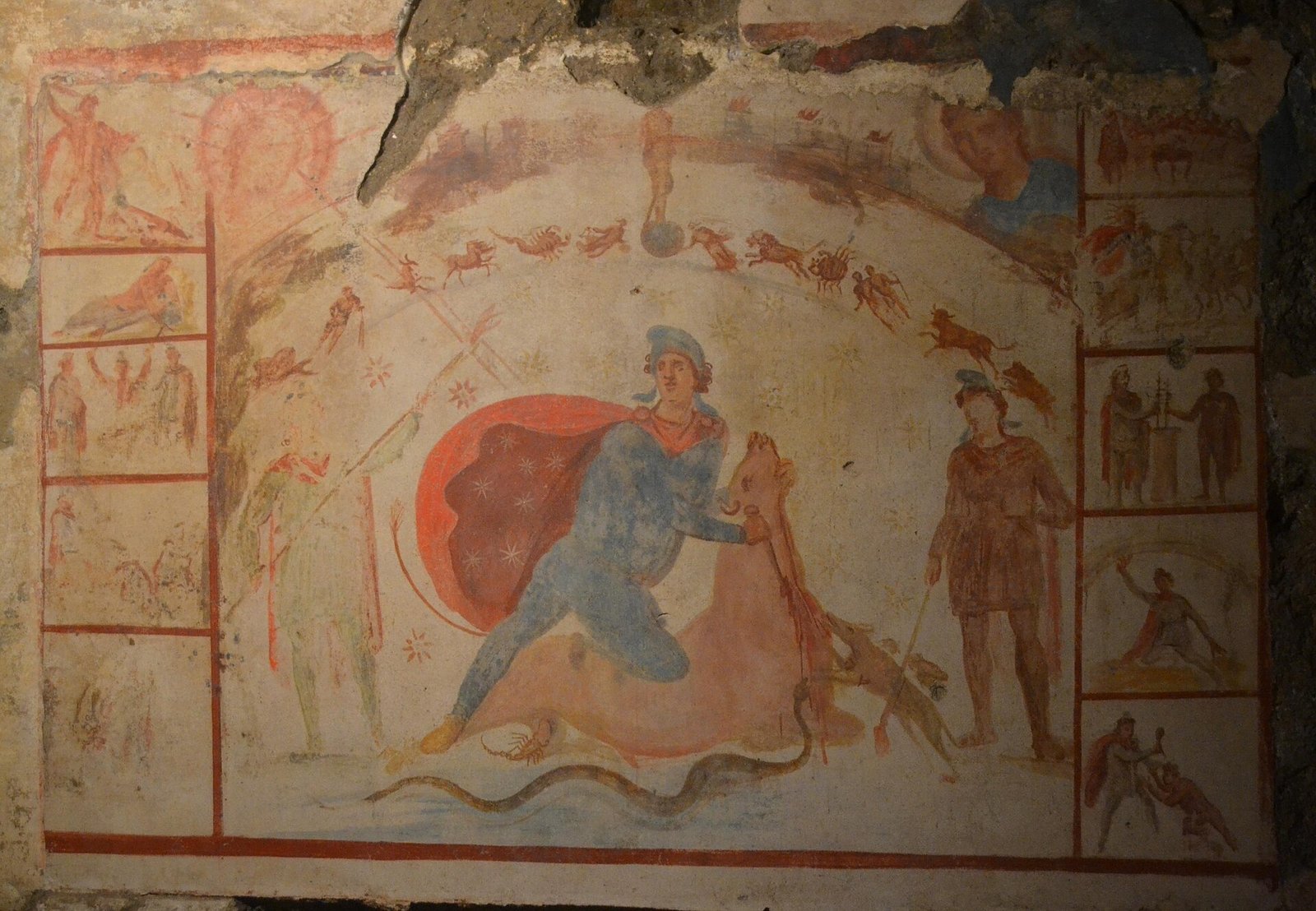
The element that makes the Barberini Mithraeum famous is the large painting on the back wall, organized around a central panel with the tauroctony, that is the scene in which Mithras kills the bull. It is the standard image of all the mithraea of the empire, repeated with few variants from Rome to Britannia, but here it is preserved painted, in color, and not translated into marble: a difference that completely changes what can be read.
The central scene, element by element
At the center Mithras, in Eastern dress and Phrygian cap, holds the bull still and drives the blade into its flank. Around the group are arranged the figures that always accompany the scene: a dog leaping to drink the blood gushing from the wound, a snake doing the same crawling on the ground, a scorpion stinging the animal's testicles. At the sides stand the two dadophors, Cautes and Cautopates, the torchbearers who witness the scene, one with the torch raised and one with the torch lowered. In the upper corners appear the Sun and the Moon. At the top two curved lines delimit the celestial vault, and inside that band the zodiac signs are represented.
The god with the lion's head
At the center of the celestial band, above the tauroctony, you recognize a figure that appears often in mithraea but which the visitor almost never knows how to interpret: a deity with a human body and a lion's head, standing on a globe and wrapped in the coils of a snake. The coils wrapping the body are read as a figuration of time coiling on itself, so of eternity. The globe under the feet refers to the cosmos. Scholars have proposed many names for this figure, from Aion to Arimanius to Chronos, without arriving at a shared identification. Here the rule that accompanies all of Mithraism applies: the figure is there, its symbolic function is clear only in broad outline, its name is a matter of debate.
The 10 side scenes: the mythical cycle almost in full
On the flanks of the tauroctony are arranged 10 panels of varying size, on two vertical bands, which tell the sacred story of Mithras episode by episode: it is this sequence, even more than the central scene, that makes the Barberini Mithraeum one of the most complete testimonies of the Mithraic cycle to have come down to us. The panels are read starting from the left band, from top to bottom, and then continuing with the right one.
The left band
The sequence opens with Zeus striking the Giants with lightning, that is with a scene of ordering the world that precedes the entrance of Mithras, and continues with a figure of Saturn. Then come the birth of Mithras from the rock, the episode known as petra genitrix, in which the god emerges already adolescent from the stone. Then Mithras striking a rock with an arrow and making water gush from it, the so-called miracle of water. Finally Mithras carrying the bull, the episode scholars call transitus, in which the god carries the captured animal on his shoulders.
The right band
On the other side the narrative continues with the mystic banquet, the scene in which Mithras and the Sun eat together reclining on the bull's hide, which is the divine model of the ritual meal eaten by the initiates on the benches of the room. Then come Mithras climbing onto the chariot of the Sun, the pact of alliance between Mithras and the Sun, Mithras kneeling between two trees and, as the last panel, a scene in which Mithras touches with a bull's leg the god Sun kneeling before him: the latter is interpreted as a scene of initiation or investiture, and for its value in the reconstruction of Mithraic rites it is one of the most cited panels in the whole corpus.
Why the sequence is worth more than the sum of its parts
Many mithraea give back an isolated episode, maybe two, carved at the sides of a relief. The value of the Barberini cycle is that the 10 panels appear together, in the same room, arranged in an order the community itself had chosen. This allows scholars to check if there was a canonical sequence of the story or if each community composed its own, and to compare the Roman order with that of Marino, of Capua and of the Rhenish and Danubian reliefs that present narrative frames. It is first-hand material, not a summary: for this reason the Quirinal sanctuary appears in every manual of Mithraism.
How to visit the Barberini Mithraeum today: the question of access
The Barberini Mithraeum is not a museum and has no ordinary access: it is visited only on extraordinary openings or guided visits by reservation, organized by the Special Superintendency of Archaeology, Fine Arts and Landscape of Rome, which has authority over the site, in agreement with the Officers' Club of the Armed Forces of Italy, which occupies the building above the sanctuary. This is the decisive information for whoever plans a trip, and it is best written without circumlocutions: there is no ticket to buy on the spot, there is no daily schedule, and showing up at the door hoping to get in is of no use.
The reopening calendar and the current situation
The sanctuary was reopened to the public on November 13, 2021, with a calendar of guided visits set on the second and fourth Saturday of each month and with mandatory reservation through CoopCulture, the services concessionaire. The official tourist portal of Roma Capitale reports for the Barberini Mithraeum the same scheme, second and fourth Saturday of the month with hours 10:00-11:30, but accompanies it with the explicit note that visits are temporarily suspended. On the channels of the Special Superintendency of Rome and of the concessionaire there is no active calendar of visits on sale: whoever wants to get in must therefore contact the Special Superintendency of Rome directly or write to the reservation address indicated by the Roma Capitale portal, and check if and when openings resume. Anyone who promises guaranteed entry without indicating a precise date and an official reservation channel is saying something the public sources do not confirm.
The extraordinary openings
Besides the ordinary calendar, the mithraeum has been opened several times on special days. On October 2, 2022, for example, the Special Superintendency of Rome organized free guided visits with entrance from Via XX Settembre 2, from 9:30 to 12:30, with departures at one-hour intervals and mandatory reservation through an online form, accompanied by the Superintendency's archaeologist. It is the typical format in which this place opens: announcement at short notice, limited places, reservation that sells out fast. Whoever really cares about seeing it does well to follow the channels of the Special Superintendency of Rome and to seize the chance when it comes, because the windows are narrow and do not recur regularly.
Accessibility and photographs: what is not confirmed
On accessibility for those with mobility difficulties, no official statement from the Superintendency is published: the mithraeum is in a basement room, reached by stairs, and there are no public indications on elevators or alternative routes, so whoever has specific needs must ask for confirmation when booking and take nothing for granted. The same goes for photographs: since it is an ancient fresco inside a property that hosts an Armed Forces club, the rules can be decided opening by opening, flash on painted surfaces is normally excluded and the right thing is to ask at the entrance before raising the camera.
A curiosity about the Barberini Mithraeum
The tastiest curiosity of this place concerns the coincidence of dates between the ancient sanctuary and the recent history of the palace above it. The mithraeum was found in 1936, during the excavations for the Palazzina Savorgnan di Brazzà. Just two years earlier, in 1934, the Barberini had leased a sizable portion of their palace to the Officers' Club of the Armed Forces, with a contract set to expire in 1953. That contract gave rise to one of the longest real estate sagas of 20th-century Rome: the State wanted the whole palace to enlarge the Galleria Nazionale d'Arte Antica, the Club did not move, the lease was extended to 1965, and at expiry the Club stayed anyway. This led to a tug-of-war between ministries that dragged on for decades, until the 1997 memorandum of understanding in view of the Jubilee, which identified as the new seat for the officers precisely the Palazzina Savorgnan di Brazzà and other dependencies of the complex.
The result is a small topographical irony: the Officers' Club, which for decades had occupied the Baroque rooms of Palazzo Barberini, preventing the Gallery from displaying more than 20 percent of its collections, was finally relocated to the building under which, in 1936, a sanctuary had emerged dedicated to a god who in the Roman empire was venerated above all by soldiers. Mithras was the god of pacts and sworn loyalty, the deity the soldier invoked. Among the seven grades of initiation there was one called Miles, the soldier. That the Italian officers' club ended up exactly above a third-century mithraeum is a pure administrative accident, but it is the kind of accident a guide does not forget to tell, and the Gallery obtained the whole palace only in 2006.
One thing nobody tells you about the Barberini Mithraeum
The thing almost no popular description says is that this mithraeum, celebrated as one of the most complete in the Roman world, lets us reconstruct almost nothing of what the initiates believed. We have in front of us 10 scenes and a tauroctony, that is a story in images very clear in its sequence, and we do not have a single line written by the Mithraists explaining what they meant. Mithraism left no sacred scriptures, no catechism, no commentaries. What we know of its doctrinal content comes from three indirect sources: the images, a few dedicatory inscriptions usually very short, and the testimonies of Christian or pagan authors outside the cult.
What we really know from the written sources
The most useful written notices are surprisingly thin. Saint Jerome, in a letter from the early fifth century, lists the seven grades of Mithraic initiation. Tertullian reports that the initiate was marked on the forehead as a soldier of Mithras and that purifying ablutions were prescribed for the adepts. Porphyry says that the cave of the mithraea was an image of the cosmos. Plutarch mentions Mithraic rites practiced by the pirates of Cilicia. They are fragments, often written by opponents of the cult or by authors who spoke of it from hearsay, and put together they do not make a doctrine. All the rest, from the meaning of the tauroctony to the nature of the salvation promised to the initiates, is modern reconstruction from the figures.
Why this has to be said and not sidestepped
The temptation to fill the void is very strong, and popular writing almost always indulges it: you read that the Mithraists believed in the ascent of the soul through the seven planetary spheres, that the killing of the bull represented the regeneration of the cosmos, that the banquet was a communion. These are all plausible readings and all inferences, built by looking at the same frescoes you see in this room. Whoever visits the Barberini Mithraeum does well to keep the distinction in mind: what you see on the wall is a datum, what you are told about its meaning is, in most cases, a reasoned interpretation. The same criterion applies to the mithraeum of Santa Prisca and to the mithraeum of the Circus Maximus, and it applies to any mithraeum you visit in Italy or in Europe.
The advice I give you for visiting the Barberini Mithraeum
The most useful practical advice for the Barberini Mithraeum is not to organize a trip around this visit, but to keep an eye on the channels of the Special Superintendency of Rome and to book as soon as a date appears, because openings are rare, places few and notice short. And, if you can't manage to fix the visit, to replace it without regret with the mithraeum of Santa Prisca, which on the Aventine can be visited by reservation with greater regularity and which lets you see a painted Mithraic sanctuary, with its procession of initiates frescoed on the side walls.
Preparing before going in
A mithraeum is a place that rewards those who arrive prepared. The room is dark, the painting has gaps, and without knowing what you are looking at the risk is to leave with the impression of having seen a ruined wall. It is worth arriving knowing at least three things: the structure of the tauroctony with its four animals, the direction of reading of the 10 side panels, and the meaning of the two dadophors with opposite torches. With these three footholds, the back wall reads itself and the half hour in front of the fresco becomes something else.
How to build the half day around the visit
The neighborhood offers a compact and very high-quality itinerary. In the same morning you can see the Galleria Nazionale d'Arte Antica in Palazzo Barberini, with the great hall frescoed by Pietro da Cortona. Borromini's church of San Carlo alle Quattro Fontane and Bernini's church of Sant'Andrea al Quirinale, which face each other a few dozen meters apart along the street. And the church of Santa Maria della Vittoria, a little further on Via XX Settembre, with the Ecstasy of Saint Teresa. Whoever has a free afternoon can continue toward Palazzo Massimo alle Terme, where Roman painting is displayed in a quantity no other museum in the world offers, and understand better which figurative tradition the mithraeum fresco belongs to.
Another well-known fact, yet rarely cited
The fact is this: Rome is the city with the greatest concentration of Mithraic evidence in the ancient world, and yet almost none of its mithraea can be visited with an ordinary ticket. The censuses speak of a very high number of Mithraic sanctuaries identified in the city and the suburbs, of more than 70 sculptures and about 100 known Mithraic inscriptions. Ostia, which was a much smaller center, preserves about 20 excavated. Of all this heritage, the average visitor to Rome sees practically nothing, because mithraea are almost always in cellars, under churches, under private buildings, inside properties with uses other than museum ones.
Where you can see a mithraeum in Rome without waiting for an extraordinary opening
The simplest cases are two. The first is the mithraeum under the Basilica of San Clemente, included in the basilica's underground route, which is visited with a ticket during the complex's opening hours: it is the mithraeum almost every tourist in Rome ends up seeing, often without realizing they have seen it. The second is the mithraeum of Santa Prisca on the Aventine, which is visited by reservation and is the one that lends itself best to a direct comparison with the Quirinal sanctuary. At Ostia Antica, finally, several mithraea are crossed in the open air during the normal visit of the archaeological area, with the famous mosaic of the seven initiatory grades in the Mithraeum of Felicissimus.
Why so many mithraea stay closed
The reason is structural and concerns the very way the cult settled. A mithraeum occupied a preexisting room, often underground, inside a private building or a repurposed public facility. When that building was replaced, its low rooms survived under the later constructions, and today they are under houses, churches, offices, barracks, apartment blocks. Opening them to the public means crossing private properties, guaranteeing safety exits, managing delicate microclimates for fragile paintings: costs and complications that most owners and bodies are not in a position to sustain continuously. The Barberini Mithraeum is the perfect example of this condition: it is protected, it is studied, it is famous in scholarship, and it stays closed almost always.
The right photo to take at the Barberini Mithraeum
The honest premise is that at the Barberini Mithraeum the right photo may not be allowed. The rules on filming in a frescoed room inside a property of the Officers' Club are set by the organizers of each opening, flash on painted surfaces is normally excluded and the correct answer is the one you get at the moment of entry. For this reason the photographic advice starts from outside, where no permission is needed, and continues inside only if the guide allows it.
Outside: the Quattro Fontane intersection
A few dozen meters from the sanctuary is one of the most characteristic shooting points in Rome: the intersection between Via delle Quattro Fontane and Via del Quirinale, where at the four corners open as many fountains set against the buildings and where, lining up at the center of the roadway, you frame in perspective three distant obelisks, the one at the Quirinal, the one at Trinità dei Monti and the one at Santa Maria Maggiore. It is a photograph that requires attention to traffic and patience for the traffic light, and that comes out much better in low light, early in the morning or in the hour before sunset, when the facades take on color.
Inside: the whole back wall
If filming is allowed, the framing that counts is the frontal one of the back wall taken from the central corridor, with the tauroctony at the center and the two bands of panels at the sides in the same image: it is the only way to convey the logic of the cycle, which is lost in the details. You need a wide lens, a steady hand and a long exposure, because the lighting is necessarily low and flash is excluded. Resting the camera on a stable surface helps more than any setting, and a tripod in a narrow room with shifts is not realistic.
Some important events that happened here in history
The history of this corner of the Quirinal can be told through successive layers, and each layer corresponds to a change in the use of the ground: a Roman house of the second century, a Mithraic sanctuary of the third, centuries of countryside and vineyards, the great Baroque garden of the Barberini, the division into lots of Rome as capital, the 1936 building site that brings the first layer back to light.
The third century: the conversion into a sanctuary
The founding event is the transformation of a portion of the second-century building into a mithraeum, during the third. It is a gesture that repeats across Rome in the same decades and marks the moment of the cult's widest diffusion: under Commodus, who according to the sources took part in the mysteries, and then throughout the third century, the followers of Mithras are found in every social class, and in 307 Diocletian dedicates an altar to the deity. In 308, at Carnuntum, the emperors set up a tablet to the god Sol Invictus Mithras, choosing for a political meeting at the highest level the god of loyalty to pacts. The Quirinal mithraeum is born exactly within this season.
The end of the cult
The conclusion of the story is known and concerns all the mithraea of the empire: the decrees of Theodosius of 391, which banned non-Christian cults, closed the public history of Mithraism, and the sanctuaries were abandoned, walled up or destroyed. In the case of Santa Prisca the building was violently demolished around 400, probably by those building the church above. For the Barberini Mithraeum we do not have an equally precise account of how it was abandoned, and on this it is better to stop rather than imagine scenes of destruction the sources do not document.
1936: the discovery
The second decisive event is the discovery of 1936, during the foundation excavations of the building designed by Giovannoni and Piacentini. It is a date that places the discovery in the middle of the great season of urban transformation of Rome in the 1930s, the one that opened Via dell'Impero and gutted entire neighborhoods, and which precisely because of the quantity of excavations produced an exceptional harvest of finds. In the same few years the mithraeum of the Circus Maximus had been excavated, which came to light in 1931 during works for a warehouse of sets and costumes of the Teatro dell'Opera, and the one at Santa Prisca, investigated by Dutch scholars starting in 1934. Three fundamental Roman mithraea, all discovered within a span of six years.
2021: the reopening to the public
The most recent event is the reopening to the public on November 13, 2021, with a calendar of guided visits on the second and fourth Saturday of the month managed by reservation by the services concessionaire. It was news welcomed with enthusiasm by fans of underground Rome, because it gave back to the city a place that for decades had been accessible almost only to scholars and insiders. The enthusiasm must however be accompanied by the current datum: the tourist portal of Roma Capitale reports the visits as temporarily suspended, and an active calendar is not published at the time these lines are written.
Who passed through the Barberini Mithraeum
Answering this question for a mithraeum means coming to terms with an almost total documentary void. Of those who frequented this sanctuary in the third century we know practically nothing: no list of members, no register, no portrait. What we can say is drawn from the few inscriptions and from comparison with the other mithraea of Rome, and must be said with the conditionals it deserves.
The initiates of the third century
From the Roman mithraea in general a recurring social profile emerges: soldiers, freedmen, officials, merchants, men of middle or upper-middle condition but rarely belonging to the highest senatorial aristocracy, at least in the first phase. At the mithraeum of the Circus Maximus, for example, the known inscriptions all bear the names of freedmen, and the main relief carries the dedication of a Tiberius Claudius Hermes to the god Sol Invictus Mithras. In the case of the Barberini Mithraeum the Mithraic reference works report a marble slab inscribed with the name of the dedicator, a figure with an Eastern-sounding name: a datum cited by specialist literature that is not confirmed by an institutional source, and which is therefore reported as a note and not as a certainty.
The seven grades and who held them
We know from the letter of Saint Jerome that the initiates were ordered in seven grades, each placed under the protection of a celestial body: Corax the raven, Nymphus the bridegroom, Miles the soldier, Leo the lion, Perses the Persian, Heliodromus the courier of the sun, Pater the father. The sequence is found illustrated in the mosaic of the Mithraeum of Felicissimus at Ostia and in the painted inscriptions of the mithraeum of Santa Prisca, where next to the figures of the faithful in procession appear formulas like nama militibus, tutela Martis, that is the ritual greeting addressed to the members of a grade and the indication of the protecting planet. There are no analogous inscriptions in the Quirinal sanctuary that would allow painted faces to be associated with precise grades.
The archaeologists and scholars
Those who passed through here with certainty, and in a documented way, are scholars. The sanctuary quickly entered the international Mithraic bibliography and appears in the great catalog of Mithraic monuments compiled by Maarten Vermaseren, where it carries number 389: it is the reference with which anyone working on Mithraism cites this place. In Italian literature it is found in the Guida archeologica di Roma by Filippo Coarelli and in the reference works dedicated to Roman mithraea, and the guided visits of the extraordinary openings have been led by archaeologists of the Special Superintendency of Rome.
What we know and what we don't know about Mithraism
The criterion to hold firm is simple: of Mithraism we know the images and the places very well, and we know the ideas very badly. We have hundreds of excavated mithraea, thousands of reliefs and statues, an iconographic repertoire repeated with surprising stability from Syria to Britannia. We do not have a single text written by the initiates telling us what that repertoire meant to them.
The legacy of Franz Cumont and its revision
For the whole first half of the 20th century the accepted reconstruction was that of Franz Cumont, the Belgian scholar who between 1896 and 1899 published the two volumes on the texts and monuments relating to the mysteries of Mithras and who read Roman Mithraism as a Western form of the Iranian cult of Mithra, in direct continuity with Zoroastrianism. In that picture the tauroctony was the primordial sacrifice from which plants and animals are born, and the snake and the scorpion were sent by Ahriman, the principle of evil, to oppose the life being born from the bull. It is the version still read in very many guides and educational signs.
Starting in the 1970s, with the international congresses of Mithraic studies and the work of a new generation of specialists, that reconstruction has been largely revised. The main problem is that in the Persian texts there is no story at all of Mithras killing a bull: the central element of Roman iconography finds no match in the Iranian tradition, and this makes it hard to explain Roman Mithraism as a simple import. Today the prevailing tendency is to consider it a creation of the Roman world, which used an Eastern name and aura for a symbolic system built elsewhere.
The astronomical hypothesis
Among the alternative readings the most discussed is the astronomical one proposed by David Ulansey, who observed how each figure in the tauroctony corresponds to a constellation: the bull to Taurus, the dog to Canis Minor, the snake to Hydra, the scorpion to Scorpio, the raven to Corvus, and Mithras himself to Perseus, whose constellation lies above that of Taurus. In this reading the scene would represent the shift of the equinoctial point from Taurus to Aries due to the precession of the equinoxes, discovered by Hipparchus in the second century BC, and Mithras would be the supracosmic deity able to move the sphere of the fixed stars. It is an elegant theory, widely cited and far from unanimously accepted: other scholars judge it an overinterpretation, and the debate remains open.
What the images allow us to say
There are things that archaeology establishes with certainty, and it is worth separating them from the rest. We know the cult excluded women. We know the groups were small and that the architecture of mithraea was designed for a reclining banquet. We know the initiation proceeded by grades and that the grades were associated with the planets. We know water had a role, because the sanctuaries almost always have a spring or a basin nearby, and basins are documented in the Barberini Mithraeum. We know the cult was particularly widespread among soldiers and in the frontier provinces. All this is founded on material evidence. The theology, instead, remains a working hypothesis.
The other mithraea of Rome and how they compare with this one
The Barberini Mithraeum is better understood if lined up with the other Mithraic sanctuaries of the city, because each preserves something the others have lost and together they form a picture none of them would give alone.
Santa Prisca, the painted twin
The obligatory comparison is with the mithraeum of Santa Prisca on the Aventine, under the church of the same name, excavated starting in 1934 by Dutch scholars. There too the room was carved out inside a private house, there too there is painting, but the decorative logic is different: the tauroctony occupies a niche on the back wall, while the side walls above the benches are covered by a procession of initiates accompanied by painted inscriptions naming the grades and their protecting planets. A graffito carries a date corresponding to November 21 of the year 202, understood as a rebirth after initiation, and proves that the sanctuary already existed then. Where the Barberini preserves the mythical story, Santa Prisca preserves the community: whoever wants to understand Mithraism should see both, and the page dedicated to Santa Prisca and its mithraeum gathers the practical information on that visit, which has its own rules and reservations.
The mithraeum of the Circus Maximus
The third great Roman mithraeum is at the end of the Circus Maximus toward the Tiber, under a building on Via dell'Ara Massima, and was discovered in 1931 during works for a warehouse of the Teatro dell'Opera. It is a large mithraeum, articulated in several rooms, with niches for the statues of the dadophors, benches, reused marble floors and a buried amphora at the center that probably collected ritual liquids. There the story is entrusted to reliefs and inscriptions, not to painting: the main relief carries the dedication to the god Sol Invictus Mithras by a freedman. The comparison with the Barberini is instructive because it shows two different solutions for the same purpose, carved images and painted images, inside very different architectures.
The neighborhood around the mithraeum: Quirinal, Quattro Fontane, Barberini
The Barberini Mithraeum is in one of the densest sectors of Rome from an artistic point of view, and it is useful to know what surrounds it, both to plan the day and to understand the layering of the place.
Palazzo Barberini and the Galleria Nazionale
A few steps away is the palace that gives the mithraeum its name, built between 1625 and 1633 to a design by Carlo Maderno with the collaboration of Francesco Borromini and, from 1629, under the direction of Gian Lorenzo Bernini. Inside it, Bernini's square staircase and Borromini's helical staircase face each other, and the hall of the main floor is covered by the Triumph of Divine Providence by Pietro da Cortona. Today the palace hosts part of the Galleria Nazionale d'Arte Antica, which displays paintings from the Middle Ages to the 18th century. The visit to the museum and the one to the mithraeum are two distinct experiences, with separate tickets, entrances and managements: the page on the palace gathers the practical information on visiting the Baroque complex, while these lines concern only the Roman sanctuary under the garden building.
Frequently asked questions about the Barberini Mithraeum
What is the Barberini Mithraeum?
The Barberini Mithraeum is a Mithraic sanctuary of the third century AD located under a 20th-century building put up in the garden of Palazzo Barberini, in Rome. It preserves on the back wall a large fresco with the tauroctony, that is Mithras killing the bull, surrounded by 10 panels that tell the episodes of the myth, and together with the mithraeum of Santa Prisca it is the only painted mithraeum in the city.
Can you visit the Barberini Mithraeum?
The Barberini Mithraeum is visited only on extraordinary openings or guided visits by reservation, never as part of an ordinary museum route. The calendar set at the 2021 reopening provided for the second and fourth Saturday of the month, but the tourist portal of Roma Capitale reports the visits as temporarily suspended: it's best to contact the Special Superintendency of Rome or the reservation channel indicated before planning any trip.
Is the Barberini Mithraeum inside the Galleria Nazionale d'Arte Antica?
No, the Barberini Mithraeum is not part of the route of the Galleria Nazionale d'Arte Antica and cannot be reached from the museum's halls. It is in the basement of the Palazzina Savorgnan di Brazzà, built in 1936 in a corner of the old Barberini garden and today occupied by the Officers' Club of the Armed Forces: the museum ticket therefore gives no right of access to the sanctuary.
How much does it cost to visit the Barberini Mithraeum?
For the Barberini Mithraeum there is no ordinary ticket on sale: the extraordinary openings organized by the Special Superintendency of Rome have been free of charge with mandatory reservation, while the guided visits of the calendar launched in 2021 were managed by the services concessionaire. Since the arrangement changes from opening to opening, the cost should be verified each time on the official announcement of the single initiative.
How do you get to the Barberini Mithraeum by public transport?
The Barberini Mithraeum is reached by metro line A, Barberini stop, a few minutes on foot along Via delle Quattro Fontane. The address given by the Roma Capitale portals is Via delle Quattro Fontane 13, while the entrances used for the guided visits have been indicated on Via XX Settembre 2: it's best to check on the visit announcement which of the two entrances is used.
How long does it take to visit the Barberini Mithraeum?
For the Barberini Mithraeum about an hour is enough, which is the typical length of the guided visits organized so far, with a slot of an hour and a half in the 2021 reopening calendar. It is a single room of about 70 square meters with one frescoed wall, so the visit fits easily into a morning also dedicated to Palazzo Barberini and the churches of the Quattro Fontane.
Can you take photographs in the Barberini Mithraeum?
The rules on photographs in the Barberini Mithraeum are set by the organizers of each opening and are not published in a stable way: since it is an ancient fresco inside a property that hosts the Officers' Club of the Armed Forces, the right thing is to ask at the entrance. In any case flash on painted surfaces is normally excluded, because direct light damages the ancient pigments.
Is the Barberini Mithraeum accessible to people with mobility difficulties?
On the accessibility of the Barberini Mithraeum no official statement is published: the sanctuary is in a basement room reached by stairs, and no alternative routes or elevators are documented. Those with specific needs must report them when booking and ask the organizers of the visit for confirmation, without taking for granted the presence of dedicated solutions.
What is the difference between the Barberini Mithraeum and the mithraeum of Santa Prisca?
The Barberini Mithraeum and the mithraeum of Santa Prisca are the only two painted mithraea in Rome, but they preserve different things. The first, on the Quirinal, has on the back wall the narrative cycle of the myth in 10 panels around the tauroctony. The second, on the Aventine under the church of the same name, preserves on the side walls the procession of the initiates with the painted inscriptions naming the seven grades and their protecting planets.
One last piece of advice for whoever is organizing the itinerary
The Barberini Mithraeum is a stop to grab on the fly when it comes up, not a destination on which to build a trip: whoever has a few days in Rome will do well to consider it a bonus and to build the morning around Palazzo Barberini, the two churches of the Quattro Fontane and the climb to the Quirinal, keeping the Mithraic sanctuary as a possible surprise to book if the calendar allows. Whoever instead really wants to devote themselves to Roman Mithraism can line up San Clemente, Santa Prisca and, on a separate day, the mithraea of Ostia Antica: it is the best way to understand a cult that in Rome is everywhere and almost never visible.
Anyone organizing a broader itinerary in the center of Rome, crossing this stop with the other stops of the Trevi rione and the Quirinal Hill, may find useful planning tools on Tour Leader Pro, while for a broader picture of transport and destinations in Lazio a good resource is Italy Planner.