The Jewish Ghetto of Rome: What to See and What to Know
In short. The Jewish Ghetto of Rome occupies the Sant'Angelo rione, the smallest of the historic rioni of the city, in a quadrilateral bounded by the Tiber, the Teatro di Marcello, via Arenula and the lungotevere de' Cenci.
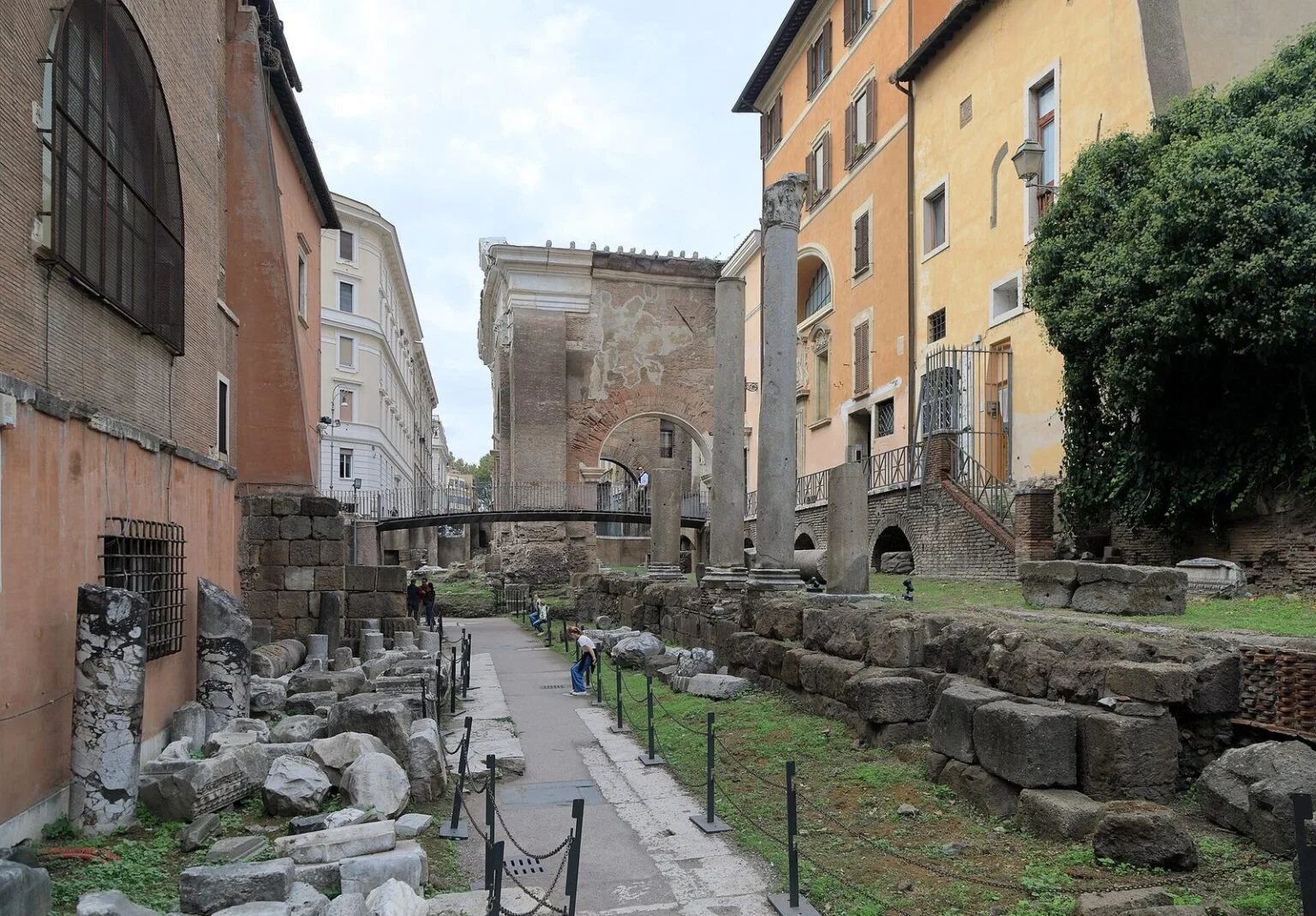
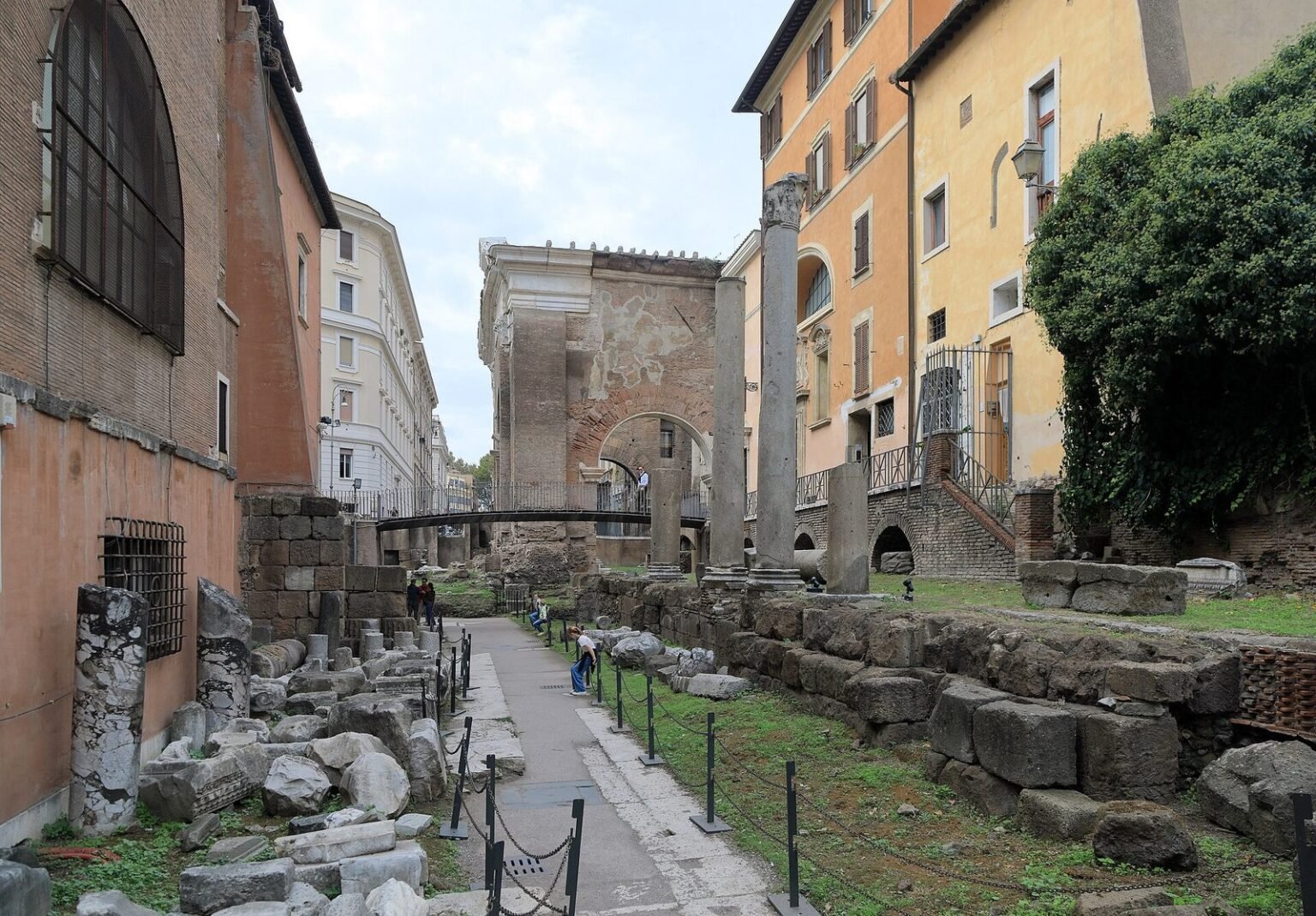
The Jewish Ghetto of Rome occupies the Sant'Angelo rione, the smallest of the historic rioni of the city, in a quadrilateral bounded by the Tiber, the Theater of Marcellus, via Arenula and the lungotevere de' Cenci. Here lives and works the oldest Jewish community in the Western diaspora: a presence documented in Rome at least from the 2nd century BC, without interruption, from the Republican age to today. The name everyone uses for the neighborhood, however, refers to something specific, namely the closed enclosure set up by Pope Paul IV in 1555 with the bull Cum nimis absurdum and in operation until 1870. The Ghetto is not a pretty neighborhood: it is at once a place of residence and living worship, an archaeological site, and the site of the roundup of October 16, 1943, the largest deportation of Jews ever carried out in Italy. The following sections lay out what you can see, what happened here with the documented numbers, and what you need to know before arriving: why the Synagogue and the Jewish Museum of Rome are closed on Saturday, why entry involves security checks, and why the calendar of Jewish holidays can close everything even on weekdays.
Where the Jewish Ghetto of Rome is and how to get there
The Ghetto extends into the Sant'Angelo rione, which takes its name from the church of Sant'Angelo in Pescheria and is the least extensive rione in Rome. The main axis is via del Portico d'Ottavia, which connects the lungotevere de' Cenci to the ruins of the ancient portico. The perimeter recognizable today does not coincide with that of the papal enclosure: the neighborhood you walk through is largely the result of the demolitions of the late 19th century, and the only stretch that keeps the building density of the old serraglio is via della Reginella.
The neighborhood's boundaries
Four landmarks visible to the eye are enough to get your bearings: to the south the Theater of Marcellus, to the west the river, with the Ponte Fabricio leading to the Tiber Island and the basilica of San Bartolomeo all'Isola, to the north Largo di Torre Argentina with the sacred area, to the east via Arenula, which separates Sant'Angelo from the Regola rione. Anyone coming from Trastevere crosses Tiber Island in two minutes and ends up on the lungotevere de' Cenci, right next to the Synagogue.
By public transport
There is no metro stop inside the Ghetto. The nearest useful station is Colosseo on line B, from which you walk for about 20 minutes along via dei Fori Imperiali and via del Teatro di Marcello. The most convenient option is surface transport: the lines running along via Arenula and largo di Torre Argentina stop a few minutes from via del Portico d'Ottavia, and the same goes for the tram network on viale Trastevere, from which you cross the river on foot. Anyone getting off at largo di Torre Argentina has barely five minutes ahead, with the option of a stop at the cat sanctuary and the Crypta Balbi museum, which tells the urban layering of this part of Campo Marzio.
By car, by taxi, on foot
The Ghetto is in a limited traffic zone and has no dedicated parking: anyone arriving by car from outside the city would do well to leave it in a park-and-ride lot on the metro. Taxis stop on the lungotevere and in via Arenula, not always inside the neighborhood. The most sensible way to arrive is still on foot: from the Capitoline Hill you go down in less than 10 minutes along the Teatro di Marcello, from Campo de' Fiori it takes only seven minutes via via dei Giubbonari and via Arenula, and from the Pantheon about a quarter of an hour.
2,000 years before the Ghetto: Jews in Rome from the 2nd century BC
The Jewish community of Rome documents its presence in the city from 161 BC, when, according to the official history of the Jewish Community of Rome, the ambassadors Eupolemus and Jason were sent to the Roman Senate to forge an alliance with Judas Maccabeus. This is why the Roman community is called the oldest in the Western diaspora: not a celebratory formula, but a continuous settlement that predates the birth of Christianity by centuries and has had no interruptions up to today. The most substantial archaeological evidence from this early phase is not in the Ghetto but in the Jewish catacombs of Vigna Randanini on the Appia and Villa Torlonia on the Nomentana, which are distinct from the Christian catacombs in chronology and iconography and are not open to the public with the same consistency.
From the Empire to the Middle Ages
The presence consolidates with Pompey's campaigns in the East and grows after the destruction of the Temple of Jerusalem in 70 AD: for the imperial age, at least 12 synagogues are documented in Rome, and the main settlement is on the right bank of the Tiber, not in the Sant'Angelo rione. Around 1165, the traveler Benjamin of Tudela describes in Rome a community of about 200 Jewish households, treated with respect and not subject to tribute. It was in the Middle Ages that the settlement moved from Trastevere to the left bank, around the Portico of Octavia and the Pescheria. When in 1555 the Pope decided to confine the Jews, he chose precisely the area where a large part of the community already lived: a low-lying zone, exposed to Tiber floods and among the least healthy in the city.
The Bull Cum nimis absurdum and the Establishment of the Serraglio in 1555
The Ghetto of Rome was born with the bull Cum nimis absurdum of Pope Paul IV, Gian Pietro Carafa, issued in July 1555. The date most widely cited in sources, including the official history of the Jewish Community of Rome, is July 14, 1555. Some Italian encyclopedia entries, however, give July 12. The decree revoked en bloc the rights recognized for Roman Jews and imposed mandatory residence in an enclosed area closed off by gates, which period sources call the serraglio degli Ebrei or claustro degli Ebrei. The term ghetto, of Venetian origin, took hold in Rome only toward the end of the sixteenth century.
What the bull established
The provisions covered every aspect of life. Mandatory residence within the enclosure, with the gates locked from sunset to sunrise. Mandatory distinguishing sign: a cap for men and a similar sign for women, yellow in the most widespread versions of the text, described as glauco, meaning sky blue tending toward green, in other transcriptions. A ban on owning real estate and an obligation to sell property already owned. Jobs limited to dealing in rags and used clothing, pawn lending, and fish sales. A ban on practicing medicine on Christians, on employing Christian domestic staff, and on trading in essential goods. Only one synagogue per territory, a rule that had a specific architectural consequence in Rome and explains the existence of the Cinque Scole.
The size of the enclosure
The area enclosed in 1555 measured about three hectares and had a trapezoidal plan, with the longer sides of about 270 meters toward the Tiber and 180 meters on the opposite side. The gates were initially two, then three in the sixteenth century, five after the expansion wanted by Sixtus V in 1586, and finally eight in the nineteenth century. The residents at the founding numbered about 2,000, rising to about 3,500 by the late 1580s and to about 4,000 by the mid-seventeenth century. In the nineteenth century, estimates put the population at times close to 10,000 people in three hectares: a density that alone explains the neighborhood's hygiene conditions.
Why here
The choice of site was neither random nor neutral. The area between the Portico of Octavia and the river was the lowest point of that stretch of the city, flooded by Tiber floods until the construction of the embankments approved by Parliament in 1875, and for this reason associated with malaria, cholera and recurring fevers. Confining a growing population here, banning it from buying property and therefore from building outward, produced the only workable solution: growth upward, with continual added floors on buildings not designed to bear them. Photographs and engravings from the late nineteenth century show very tall houses and alleys less than two meters wide.
Three centuries inside the enclosure: forced sermons, trades, floods
The Ghetto of Rome remained in operation for 315 years, from 1555 to 1870, with only two interruptions: the Roman Republic of 1798, which proclaimed equal rights, and that of 1849. In both cases the return of papal power brought the reintroduction of the restrictions, fully so in 1814 under Pius VII.
The forced sermons
Among the obligations imposed on the Jews of Rome, the best known is the forced sermon. The apostolic constitution Sancta Mater Ecclesia, issued by Gregory XIII on September 1, 1584, established that conversion sermons were to be held wherever a synagogue existed, and that a third of the ghetto's inhabitants would take turns attending. In Rome the sermons took place in churches adjacent to the district, including the Santissima Trinità dei Pellegrini, Santa Maria del Pianto and Sant'Angelo in Pescheria. The obligation was abolished by Pius IX: the sources give 1847 or 1848, and the post of official in charge of preaching to the Jews still appears in the 1860 Pontifical Yearbook.
The Cinque Scole
The rule that barred more than one synagogue per city produced a unique solution in Rome: five distinct congregations gathered in a single building, on the square that still today is called Piazza delle Cinque Scole. They were the Scola Tempio and the Scola Nova, of Jewish families already Roman. The Scola Catalana and the Scola Castigliana, of exiles from Spain after 1492. And the Scola Siciliana. Each congregation kept its own rite, furnishings and traditions. The building no longer exists: it was decommissioned and demolished in the urban renewal works straddling the 19th and 20th centuries, and the sources give different dates both for the fire that damaged it and for its demolition, so we don't give one here. The surviving furnishings, textiles and marbles are today preserved in the Jewish Museum and in the Spanish Temple.
1870, Emancipation and the Demolition of the District
The Roman Ghetto was de facto abolished with the taking of Rome on September 20, 1870 and the city's annexation to the Kingdom of Italy, which extended to the Jews of Rome the equal rights already recognized in the rest of the country. The walls had already been torn down for the first time on April 17, 1848 by order of Pius IX, but segregation had then been de facto reinstated: only 1870 definitively closes the legal chapter.
What was demolished, and when
The end of segregation did not save the district. Starting in 1888, under the master plan for the new capital and the construction of the Tiber embankments, nearly all of the historic urban fabric was torn down: Via della Scuola Catalana, Vicolo Capocciuto, Via della Rua and dozens of other alleys disappeared, along with the raised houses and courtyards. In their place rose the 19th- and 20th-century blocks you see today, with wide streets and regular facades. The district you walk through is therefore not the papal ghetto: it is the city that replaced it. The only street that keeps the dimension of the enclosure is Via della Reginella, the narrow lane between Piazza Mattei and Via del Portico d'Ottavia, absorbed into the ghetto during the 19th-century expansion under Leo XII. Walking it is the most direct way to understand what three hectares meant for several thousand people.
The Tempio Maggiore, the Synagogue of Rome
The Tempio Maggiore of Rome was built between 1901 and 1904 on the Lungotevere de' Cenci, designed by the architects Osvaldo Armanni and Vincenzo Costa, winners of the competition. The first stone was laid on July 20, 1901. The inauguration took place in July 1904, with a visit from King Victor Emmanuel III on July 2 and the consecration led by the chief rabbi Vittorio Castiglioni, for which the sources give July 27 or 29. The building of the synagogue was a deliberately visible act: after three centuries of hidden worship inside an anonymous building, the community wanted a monumental temple overlooking the river, recognizable from the entire city.
The architecture and the square dome
The style is eclectic, drawing on Assyrian, Egyptian and Greek elements, in a 19th-century attempt to evoke ancient Israel while avoiding both the neo-Gothic and the Roman neoclassical. The most recognizable feature is the square-plan dome: in a city of round domes, the synagogue stands out from the Janiculum and the bridges precisely because of that plan. Inside, the Tempio Maggiore follows the Italian rite, the oldest of the European Jewish rites.
The Spanish Temple and Largo Stefano Gaj Taché
In the basement of the same complex is a second synagogue, the Spanish Temple or Scoletta, active since 1932 and following the Spanish rite: it holds furnishings from the demolished Cinque Scole and is the place where material continuity with the ghetto is most direct. The square in front of the synagogue has been named after Stefano Gaj Taché since 2012, the two-year-old boy killed in the attack of October 9, 1982. This is the official address the Jewish Community of Rome gives for the synagogue, while some maps show Via Catalana, which is the museum's entrance.
The Jewish Museum of Rome: Hours, Tickets, What to See
The Jewish Museum of Rome is inside the monumental complex of the Tempio Maggiore, entered from Via Catalana, and it is closed on Saturdays and on Jewish holidays. It has been operating since 1960. The current display was inaugurated in 2005 and is laid out in seven thematic rooms. On surface area the sources differ slightly: the museum's website gives about 700 square meters, while the Ministry of Culture's listing gives about 600.
The collections
The museum holds silverware, textiles, marble pieces, manuscripts, incunabula and archival documents, largely from the period of the ghetto and the Cinque Scole building. The ministry's catalog entry lists about 400 pieces of silverware, 900 textiles and 100 marble works. The textile collections are the most important core, with parochot, mantles for the Torah scrolls and embroidered vestments. The route also includes a gallery of ancient marbles and the garden.
Opening Hours and Tickets
The opening hours published by the museum are as follows. In winter, roughly October to March, it is open Sunday to Thursday from 10 to 17 (last entry 16.15) and on Friday from 9 to 14 (last entry 13.15). In summer, April to September, it is open Sunday to Thursday from 10 to 18 (last entry 17.15) and on Friday from 10 to 16 (last entry 15.15). Tickets are €12 full price, €10 reduced, €6 for students under 25, and free for children under 10. The ticket includes the museum with a downloadable audio guide and entry to the Tempio Maggiore with a guided tour. Booking online includes a €1 booking fee and requires booking a few days in advance. These details change often and should be confirmed on the official website before you go. The most important practical point is another one: the museum and the Synagogue are closed every Saturday and on all Jewish holidays. These holidays follow the lunisolar calendar and fall on different dates each year, including on weekdays, and closures can last multiple consecutive days. The museum publishes an updated calendar every year.
October 16, 1943: The Roundup of the Ghetto
On October 16, 1943, at dawn, the SS surrounded the Portico d'Ottavia neighborhood and arrested Roman Jews house by house. It is the largest operation to capture Jews ever carried out in Italy, and it goes down in the city's memory as Black Saturday. The operation, led by the security police command under SS Lieutenant Colonel Herbert Kappler, was not limited to the Ghetto but affected several neighborhoods of the city.
The Gold of September 1943
The roundup was preceded by blackmail. At the end of September 1943, Kappler summoned the community's leaders and demanded that 50 kilograms of gold be handed over within 36 hours, later extended by a few hours, threatening the deportation of 200 people if he did not get it. The community collected the gold from its own members and from non-Jewish citizens, and handed it over on September 28, 1943. It was slightly more than was requested: reconstructions put it at 50.3 kilograms. The handover prevented nothing. A few weeks later, the community's membership lists, seized along with the archive and library, were used to organize the arrests.
The Numbers of the Roundup
The figures most often cited in the historical literature, taken from the Italian encyclopedia entry based on the studies of Robert Katz, put the number arrested on October 16 at 1,259 people, including 689 women, 363 men and 207 children. The detainees were gathered at the Collegio Militare at Palazzo Salviati, on Via della Lungara. In the hours that followed, people recognized as foreign citizens, belonging to mixed unions, or not Jewish were released. Reconstructions indicate 236 or 237 releases. On October 18, the train left from Tiburtina station. Sources differ by only a few on the number deported, and the difference should be stated: 1,023 according to Katz's reconstruction, cited in the encyclopedia entry, 1,022 according to the official history published by the Jewish Community of Rome, and 1,007 according to the report Kappler drew up after the releases. None of these figures should be rounded.
Auschwitz and the 16
The train arrived at Auschwitz on October 22, 1943, late in the evening. At selection, 201 people, 154 men and 47 women, were judged fit for work. All the others were killed in the gas chambers immediately after arrival. Of those deported on October 16, 16 people came back: 15 men and one woman, Settimia Spizzichino, born in Rome on April 15, 1921 and died on July 3, 2000. She also survived Bergen-Belsen and devoted the last decades of her life to bearing witness. 16 survivors out of more than 1,000 deportees: that is the figure that sums up the day.
What Happened Afterward
The roundup of October 16 did not end the persecution in Rome. Arrests of Jews continued until the city was liberated on June 4, 1944, carried out also by Italian units and with the use of paid informers. Many Roman Jews were hidden in convents, religious institutes, hospitals and private homes. Historians have documented both cases of rescue and cases of betrayal, and on this subject research continues to work from archival sources. At the national level, the statistics compiled by the CDEC from Liliana Picciotto's Libro della Memoria count 6,806 Jews arrested and deported from Italy, 5,969 dead in deportation, 837 survivors, and 322 people arrested and killed in Italy, for an identified total of 7,579 victims. The CDEC itself considers this figure an underestimate, which brings the total to at least 8,529 when undocumented arrests are included.
Le Fosse Ardeatine and the Postwar Period
On March 24, 1944, the SS killed 335 people in the pozzolana quarries along Via Ardeatina, in reprisal for the partisan attack on Via Rasella the day before, in which 33 German soldiers of the Bozen regiment died (32 on the spot and one the following day), applying the criterion of 10 Italians killed for every German soldier. At least 75 of the 335 victims were Jews arrested on racial grounds. It is the largest killing of Jews carried out on Italian soil during the Shoah.
The Mausoleum
The site of the massacre is today the Ardeatine Caves Mausoleum, a national shrine with free admission, where the 335 tombs are lined up under a large concrete slab. It is not in the Ghetto and requires a trip out toward Via Appia, but it is a necessary complement to the route of Rome's memory. Together with the mausoleum, the other two civic sites from the postwar period are the Museo storico della Liberazione on Via Tasso, housed in the rooms that were the prison of the German police command, and the Casa della Memoria e della Storia in Trastevere, which holds the archives of the Resistance and deportation associations.
The community after 1945
Rome's Jewish community rebuilt itself in the same neighborhood, which was never abandoned: the Tempio Maggiore resumed its function, community institutions were re-established, and the Jewish school went back to operating. The Community is today the largest in Italy and is governed by a council of 27 members elected every four years, with a president and a board of nine members. The chief rabbi is rav Riccardo Shemuel Di Segni, in office since November 2001. The Community does not publish an up-to-date official figure for the exact number of members, and the numbers that circulate should be taken as estimates. Three popes have entered the Tempio Maggiore: John Paul II on April 13, 1986, the first documented papal visit to a synagogue, Benedict XVI on January 17, 2010, and Francis on January 17, 2016.
The Synagogue Attack of October 9, 1982
On October 9, 1982, at around 11.55, an armed commando attacked worshippers leaving the Tempio Maggiore with hand grenades and automatic weapons. It was Saturday, and Shabbat, Sheminì Atzeret and the bar mitzvahs of many boys were being celebrated together, and about 300 people were in the synagogue, including many children. The attack lasted a few minutes. Stefano Gaj Taché, two years old, was fatally struck by a fragment. The number of injured was 37 according to some sources and 40 according to others: the discrepancy is well established and no single figure exists.
The attribution and consequences
The attack was attributed to the Palestinian group led by Abu Nidal. The Italian judicial proceedings led to convictions, but the full identification of the perpetrators took decades and remains a subject of research. The security checks at the entrance to the Synagogue, the surveillance in the square and the request for a document are not bureaucratic formalities: they are the direct consequence of that October 9.
The Portico d’Ottavia and Sant’Angelo in Pescheria
The Portico d’Ottavia is the ancient monument around which the neighborhood took shape: a large colonnaded enclosure originally built by Quintus Caecilius Metellus Macedonicus in the 2nd century BC and rebuilt by Octavian between 27 and 23 BC, who dedicated it in the name of his sister Octavia. It enclosed two temples: that of Juno Regina, dedicated in 179 BC, and that of Jupiter Stator, described by Vitruvius as the first sacred building built entirely of marble in Rome.
The propylaeum and the Severan inscription
What you see today from Via del Portico d’Ottavia is the propylaeum, the monumental entrance, with columns and pediment rebuilt after the fire of 80 AD and then again with the intervention of Septimius Severus and Caracalla in 203, as recorded by the inscription that is still legible. An earthquake in 442 caused further damage, repaired with a brick arch that replaces two lost columns: the overlap between ancient marble and Late Antique brick is visible with the naked eye, and it is one of the few places in Rome where the history of the restorations can be read without explanations.
The Fish Market
For the entire Middle Ages and until 1885, the portico housed Rome’s fish market, the forum piscium that gives its name to the church and the rione. On the wall next to the church is set a plaque stating that the heads of fish above a certain length belonged to the conservatori, the civic magistrates: a medieval tax rule that Roman folklore later turned into an anecdote. The church of Sant’Angelo in Pescheria was founded next to the propylaeum around 770 and incorporates part of the ancient walls into its structure.
Forced Sermons at Sant’Angelo
Sant’Angelo in Pescheria is one of the churches where the forced sermons imposed on the Jews of the ghetto after 1584 were held, and it stands a few meters from the old entrance to the enclosure. The closeness was not accidental, because the obligation required a third of the residents to attend in turn. It is the place in the Ghetto where the religious coercion of the papal centuries can be pinned down most concretely.
Other Places in the Neighborhood
The Ghetto packs monuments from very different eras into a few hundred meters. A well-planned walk covers the 2nd century BC through the 20th century without leaving Via del Portico d’Ottavia.
The Theater of Marcellus
The Theater of Marcellus was begun by Julius Caesar, completed by Augustus probably already in 17 BC, and dedicated to his nephew Marcellus in 13 or 11 BC. It had a diameter of about 130 meters and a capacity estimated at around 15,000 seats, expandable to 20,000. Two of its three original orders survive, with arches on piers and Doric and Ionic half-columns. Converted into a fortress by the Pierleoni and then the Savelli, it received in the 16th century the palazzo that still rises above it, a work by Baldassarre Peruzzi, which later passed to the Orsini. The Roman section was acquired by the Comune in the 1930s, excavated and restored. The archaeological area can be visited freely and at no cost, with an indicative schedule from 9 to 19 during daylight saving time and from 9 to 18 during standard time. The palazzo above the arches is a private residence and cannot be visited.
The Fountain of the Turtles
The Fountain of the Turtles, in Piazza Mattei, was built between 1581 and 1588 to a design by Giacomo della Porta, with sculptures by Taddeo Landini, and is fed by the Acqua Vergine. The four bronze youths who hold up the dolphins were planned in marble, but were made in bronze during the work. The turtles that give the fountain its name are not part of the original design. They were added during the 1658-1659 restoration under Alexander VII, and tradition attributes them to Gian Lorenzo Bernini. The Sovrintendenza Capitolina records list this attribution as traditional, not certain. The fountain was restored in 2005-2006 and again in 2025 as part of the Caput Mundi program. Other references are in the itinerary on Bernini in Rome and in the one dedicated to Baroque Rome.
The House of Lorenzo Manilio
At numbers one and two on Via del Portico d’Ottavia stands the house that Lorenzo Manilio had built in 1468, one of the rare examples of Renaissance residential architecture preserved in this part of Rome. The façade bears a long Latin inscription that dates the construction not by the Christian year but ab urbe condita. The year given is 2221, which corresponds to 1468 once the conventional 753 years from the founding of Rome are subtracted. The text also states the age of the client, 50 years, 3 months and 2 days, and the date of the foundation stone, the 11th day before the Kalends of August, that is, July 22, 1468. Fragments of ancient reliefs are embedded in the façade, following the fifteenth-century practice of collecting spolia. The inscription places the site ad forum Iudeorum, near the forum of the Jews, a detail that documents the Jewish presence in the area 87 years before the ghetto was established.
Tiber Island and the Bridges
From the Ghetto, the Ponte Fabricio, built in 62 BC and the oldest bridge in Rome still in use in its original structure, leads to Tiber Island and to the basilica of San Bartolomeo all’Isola, which has been a memorial to the new martyrs of the 20th century since 2002. The bridge is also called the Quattro Capi, after the four-faced herms at its ends. From the tip of the island you can see the Ponte Rotto. Those who continue past the river enter Trastevere, where the Jewish community had its main settlement in the imperial era.
Toward the Forum Boarium and the Capitoline Hill
On the opposite side, past the Theater of Marcellus, in a few minutes you reach the Forum Boarium with its Republican temples, the basilica of Santa Maria in Cosmedin and the Mouth of Truth, and from there the Circus Maximus. Going back up toward the north instead you arrive at the Cordonata, the Capitoline Hill with the Capitoline Museums and the basilica of Santa Maria in Aracoeli, as well as Palazzo Venezia and the Altar of the Fatherland. That is the reason the Ghetto works well as a hinge between two different itineraries and not as an isolated stop.
The Stumbling Stones and the Casina dei Vallati
The stumbling stones (pietre d'inciampo) are brass-covered cobblestones, 10 by 10 centimeters, set in the pavement in front of the last freely chosen residence of a victim of Nazi-Fascist persecution, with the name engraved, the date of birth, the place and date of deportation and, when known, the fate. They are a diffuse work by the German artist Gunter Demnig, presented in Rome for the first time in 2010 and expanded every year since with new locations. In the Ghetto you come across many on Via del Portico d'Ottavia, on Via della Reginella and in the adjacent streets. The logic of the work is anti-monumental: not a central memorial, but individual names in front of doorways still lived in, and the gesture the author imagined is to stop and read the name. The total number of stones laid in Rome grows with each annual edition and the updated figure can be found on the Rome Capital website.
The Casina dei Vallati
The Casina dei Vallati, at Via del Portico d'Ottavia 29, is a 13th-century building with 16th-century additions, which emerged from the demolitions of the 1920s around the Theater of Marcellus and is named for the family of merchants that owned property in the district between the 13th and 14th century. Since 2015 it has been the exhibition venue of the Fondazione Museo della Shoah, with hours given as Sunday to Thursday from 10 to 18 and Friday from 10 to 13, closed on Saturday and on Jewish holidays. Many exhibitions are free to enter, but it is best to check the conditions of the individual exhibition. Among the permanent tools is an interactive map of the arrests and deportations of October 16, 1943, built on documents and testimonies. A new and larger museum venue next to Villa Torlonia is in the works: the opening date is not defined as of today, so it is best to consider the Casina dei Vallati an active venue and not take for granted the dates announced by the press.
Judeo-Roman Cuisine: What It Is and Why It Is the Way It Is
Judeo-Roman cuisine is the repertoire developed by the Jewish community of Rome over the centuries of the ghetto, and its structural characteristic is the poverty of the ingredients combined with the complexity of the techniques. It comes from the crossing of two constraints: the Jewish dietary rules, the kashrut, which separates meat and milk and forbids whole groups of foods, and the economic restrictions of segregation. The bull of 1555 limited trades to the dealing of rags and used clothes, pawn lending and the sale of fish: from there comes the systematic use of seasonal vegetables, offal, blue fish and preservation techniques. The result entered the common Roman repertoire to the point that many Romans no longer know its origin.
Carciofi alla Giudia
The best-known dish uses the Roman artichoke, in particular the cimarolo, the main head of the plant, round and without inner thorns. The artichoke is trimmed of its outer leaves, opened like a flower and fried, with a second frying at a higher temperature that makes the leaves crisp while leaving the heart soft. It is a seasonal preparation, because the Roman artichoke is found roughly between late winter and spring. In 2018 the Rabbinate of Israel called into question the kashrut of the carciofo alla giudia, arguing that the heart could not be inspected enough to rule out the presence of insects. The Jewish Community of Rome publicly rejected that reading, claiming five centuries of tradition and local rabbinical supervision.
La Concia
The concia is a preparation of zucchini cut in thin slices, fried and then marinated in layers with vinegar, garlic and Roman mint. It was born as a preservation technique in the absence of refrigeration and is a dish that improves after a few hours of rest. The same method is applied to other vegetables. It is one of the clearest cases in which a practical necessity produced a preparation that entered Roman taste for good.
Aliciotti with Endive
Aliciotti with endive are a dish of fresh anchovies and curly endive baked in layers, without cheese, because kashrut forbids combining fish and dairy in the same preparation according to common practice. They are a direct example of the link between the Ghetto and the fish market of the Portico of Octavia, which was a few meters from the gates of the enclosure and supplied the less prized fish, that is, the accessible kind.
Desserts: ricotta and visciole tart, pizza ebraica
Ricotta and visciole tart is a double-crust tart with a ricotta filling covered by sour cherry jam, baked so that the ricotta stays hidden under the pastry. Local tradition links this closed form to a period when the sale of dairy products to Jews was restricted, and it says the covering was meant to hide what was inside. It is an explanation passed down orally, not a documented fact, and we report it as such. The other typical dessert is pizza ebraica, also known as pizza de beridde, a dry, compact dough with raisins, almonds, pine nuts and candied fruit. For those who want to explore the history of Roman cooking from a museum perspective, there is a reference to the museo della cucina Garum.
Kosher and non-kosher
In the Ghetto, kosher-certified establishments under rabbinical supervision coexist with ones that are not. The distinction is not always clear from the sign, and anyone who needs to observe kashrut must check the certification, which the Jewish Community of Rome updates. Certified establishments also follow the Jewish calendar and stay closed on Shabbat and on holidays. We don't name specific restaurants: the choice changes quickly, and certification is the only criterion that matters for those who need it.
Shabbat, holidays and visiting rules
Shabbat runs from sunset on Friday until the first stars appear on Saturday evening, and in the Ghetto it has immediate practical consequences: the Synagogue and the Jewish Museum are not visited, kosher establishments are closed, and the community's commercial activity stops. It is the operational fact that most often ruins a poorly planned visit, because Saturday is exactly the day many tourists choose to devote to the central neighborhoods.
What can still be visited on Saturday
On Saturday the neighborhood can be walked through freely: the Portico of Octavia, piazza Mattei with the Fontana delle Tartarughe, via della Reginella, the facade of the Casa di Lorenzo Manilio, the stumbling stones and the archaeological area of the Theater of Marcellus are public spaces or free admission. The Synagogue, the Jewish Museum and the Casina dei Vallati remain closed. A Saturday in the Ghetto therefore makes sense as an outdoor stroll, not as a museum visit: anyone who wants to see the interiors should choose a day between Sunday and Friday, keeping in mind that on Friday the hours are shorter because everything closes before Shabbat begins.
Rules for entering the Synagogue
Access to the Tempio Maggiore is through security checks and requires a valid identity document. The Jewish Community of Rome specifies a dress code: head covered and long pants for men, shoulders covered for women, avoiding low necklines and short skirts. Kippot, scarves and long pants are provided to anyone who lacks them. Anyone who wants to take part in the prayers, and not only visit the monument, must register in advance, and for Shabbat services registration must be completed by 14:00 on Friday. On the use of cameras inside, the Community does not publish a detailed regulation: as a precaution, we suggest assuming filming is not allowed and asking for confirmation when you book, as you would at any active place of worship.
The right tone
The Ghetto is a residential neighborhood, not a museum area: families live on its streets, a school operates here, along with welfare institutions and places of worship, and in front of many doorways there are stumbling stones bearing the names of those who lived behind them. Photographing people without consent, raising your voice in front of the Synagogue, or treating the memory of October 16 as an attraction are behaviors that weigh more heavily here than elsewhere. In this neighborhood, the first requirement is tone.
How to organize the visit: timing, route, seasons
The Jewish Ghetto of Rome can be walked on foot in just under an hour if you limit yourself to the exteriors, and it takes between two and three hours including the Jewish Museum with the guided visit to the Tempio Maggiore: a contained extent, which makes the neighborhood suitable to be included in a larger day.
A route that works
A well-ordered itinerary starts at the lungotevere de’ Cenci with the Synagogue and the Jewish Museum, continues along Via del Portico d’Ottavia to the House of Lorenzo Manilio, the Casina dei Vallati, the Portico d’Ottavia and Sant’Angelo in Pescheria, detours into Via della Reginella toward Piazza Mattei and the Fontana delle Tartarughe, returns to the Theater of Marcellus and ends on ponte Fabricio with the Tiber Island. Those with more time can continue toward the Forum Boarium or head up to the Capitoline Hill. Those who want to complete the path of memory can add the Ardeatine Caves Mausoleum and the Museo storico della Liberazione at a later stage, but these are not in the area and require independent travel.
Light, seasons, crowds
The Portico d’Ottavia gets its best light early in the morning and late in the afternoon, at midday the high sun flattens the pediment and the late-antique bricks. Via del Portico d’Ottavia is very busy at mealtimes and on weekends, while early morning on weekdays is the best window. In summer the area has little shade, so the walk should be planned early or after 18:00. The neighborhood is flat and suitable for strollers and people with mobility difficulties, with the usual caution about the sampietrini, and the Jewish Museum is listed as accessible to people with disabilities according to the official ministry listing. For groups the museum offers guided tours by reservation, booked a few days in advance. On October 16 the neighborhood hosts the commemorations of the roundup: it is a day when tourist presence is out of place unless accompanied by awareness of what one is walking through.
Where to fit it into a Rome itinerary
For those with little time, the Ghetto pairs well with the Capitoline Hill and Campo de’ Fiori in a half day. Those planning a longer stay will find guidance in the itineraries on Rome in a day, a weekend in Rome, three days in Rome and a week in Rome. Those who prefer to plan by neighborhood can pair the Ghetto with the guides on rione Monti, Trastevere and Testaccio. Among the free stops, many of those mentioned here also appear in the guide to Rome for free.
Frequently asked questions about the Jewish Ghetto of Rome
What is the Jewish Ghetto of Rome?
The Jewish Ghetto of Rome is the neighborhood in the rione Sant’Angelo where Pope Paul IV in 1555 imposed mandatory residence on Roman Jews in a closed enclosure, which remained in use until 1870. Today it is an inhabited neighborhood that houses the Synagogue, the Jewish Museum and the institutions of the Jewish community, the oldest in the Western diaspora, documented in Rome from the II century BCE.
How much does it cost to visit the Synagogue and the Jewish Museum of Rome?
The ticket for the Jewish Museum of Rome also includes the guided visit to the Tempio Maggiore and costs €12 full price, €10 reduced and €6 for students under 25, free under 10, with a €1 presale fee on online purchases. Prices change fairly often, so it's best to check them on the museum's official website before you go.
Is the Jewish Ghetto of Rome open on Saturdays?
The streets of the Jewish Ghetto of Rome can be walked freely every day, but on Saturday the Synagogue, the Jewish Museum and the Casina dei Vallati stay closed for Shabbat, along with the kosher-certified businesses. The closure also applies to all Jewish holidays, which follow the lunisolar calendar and fall on different dates each year, including weekdays.
What happened on October 16, 1943, in the Rome Ghetto?
On October 16, 1943, the SS rounded up the Portico d’Ottavia neighborhood and other areas of Rome, arresting 1,259 people according to the most widely accepted historical reconstruction. After the release of over 200 detainees, the deportees who left for Auschwitz on October 18 numbered 1,023 according to Robert Katz and 1,022 according to the Jewish Community of Rome. 16 came back, 15 men and one woman.
How long does it take to visit the Jewish Ghetto of Rome?
To visit the Jewish Ghetto of Rome, 60 minutes is enough if you limit yourself to the exteriors: Portico of Octavia, via della Reginella, piazza Mattei, Casa di Lorenzo Manilio and Theater of Marcellus. Plan for two to three hours if you include the Jewish Museum with the guided tour of the Synagogue. The neighborhood is compact and combines well with the Capitoline Hill or Tiber Island in the same half day.
How do you get to the Jewish Ghetto of Rome by public transport?
The Jewish Ghetto of Rome doesn't have a metro stop. The nearest useful station is Colosseo on Line B, about 20 minutes on foot. In practice, you get there by bus, on the routes that run along via Arenula and largo di Torre Argentina, 5 minutes on foot from via del Portico d'Ottavia. Or you can take the tram to viale Trastevere and then cross Tiber Island.
Are photographs allowed in the Synagogue of Rome?
Inside the Tempio Maggiore di Roma, it's best to assume that photographs are not allowed, as in many places of worship in active use, and to ask for confirmation when you book. The Jewish Community of Rome does not publish a detailed photography policy online. Entry includes security checks, a valid identity document, head covered and long trousers for men, and shoulders covered for women.
Who wrote this page
This page is edited by the editorial team of Tour Leader Pro, the Rome-based project office that designs and coordinates tours, itineraries and cultural events in Rome and Lazio. Hours, fees and access conditions listed here were checked on the publication date against the official sources cited in the text. Before you set out, it's best to double-check them, because they change often. If you find outdated information, let us know.
Anyone building a Roman itinerary that combines the archaeology of Portico of Octavia, places of memory and stops in the Historic Center, and who needs to coordinate timing, bookings and accompaniment, will find planning tools and operational support at Tour Leader Pro.
To place the Ghetto visit in a wider trip, with connections, transport and destinations in Lazio and the rest of Italy, a useful planning resource is Italy Planner.