Bernini in Rome: an itinerary through his works
In short. Gian Lorenzo Bernini worked in Rome for almost 60 years, under eight popes, and the result is that today there is no honest way of crossing the center of the city without running into him.
Gian Lorenzo Bernini worked in Rome for almost 60 years, under eight popes, and the result is that today there is no honest way of crossing the center of the city without running into him. He is in the colonnade that embraces St. Peter's Square, in the fountain in the middle of Piazza Navona, in the four sculptures of the Galleria Borghese that any art history textbook uses to explain what the Baroque is, and in dozens of minor details that almost nobody connects with his name. Born in Naples on December 7, 1598 and died in Rome on November 28, 1680, Bernini was a sculptor, architect, stage designer, urban planner and occasionally a playwright, and he shaped the image of modern Rome more than anyone else after antiquity.
Who Gian Lorenzo Bernini was and why Rome is his city
Gian Lorenzo Bernini was born in Naples in 1598 to Pietro Bernini, a Tuscan sculptor of good repute, and arrived in Rome as a child, around 1606, following his father, who had been called to work on the papal building sites. He was not, then, an artist who conquered the city from outside. He grew up inside the Roman building sites, learned the trade in his father's workshop and at a little over 20 was already the man to whom the most powerful cardinals entrusted the most delicate commissions.
The pope who made him Bernini
The turning point came in 1623 with the election of Maffeo Barberini to the papal throne as Urban VIII. The new pope had known Bernini for years and gave him what amounted to a monopoly on the great papal building sites, starting with the baldachin of St. Peter's. For two decades Bernini was the official artist of Rome, with a power over the building sites that no colleague could hope to contest, and the Barberini family let him sign, besides the sacred works, their own heraldic symbols scattered around the city. The bees you find on the Triton Fountain and on the nearby Fountain of the Bees are the coat of arms of that family.
The fall, the bell towers of St. Peter's and the rebirth
When Urban VIII died, in 1644, Bernini's fortunes turned upside down all at once. The next pope, Innocent X Pamphilj, came from a family hostile to the Barberini and found in the instability of the bell towers designed by Bernini for the facade of St. Peter's the pretext to set him aside. The southern bell tower, built on inadequate foundations inherited from the earlier building site, developed alarming cracks and was demolished in 1646, in a technical and political process that risked sweeping away the architect. These were the years in which Bernini, with no public commissions, created for a private Venetian patron the Cornaro chapel in Santa Maria della Vittoria, one of his most celebrated works of all.
Galleria Borghese: the four sculptures that invent the Baroque
The Galleria Borghese keeps in its ground-floor rooms the core of the early sculptures that Bernini made between 1618 and 1625 for Cardinal Scipione Borghese, nephew of Pope Paul V and a voracious collector: four large marble groups that are visited on the same route, in the building for which they were conceived, something extremely rare for works of this importance. It is the point from which any Bernini itinerary should start, because here you see the artist before he became an institution.
Aeneas, Anchises and Ascanius: the debut, with his father behind him
The group of Aeneas, Anchises and Ascanius, datable to 1618 and 1619, shows the Trojan hero fleeing burning Troy carrying on his shoulders his elderly father, who in turn clutches the statuettes of the Penates, while the child son follows them holding the sacred fire. It is the work in which the hand of Pietro Bernini, the father, can still be sensed according to a large part of the critics, and in which the young Gian Lorenzo is still working inside a late Mannerist tradition. The three generations stacked vertically form a composition that is read from a privileged viewpoint, not yet from all sides.
The Rape of Proserpina: marble that becomes flesh
The Rape of Proserpina, from 1621 and 1622, is the work of the famous detail everyone photographs: Pluto's fingers sinking into Proserpina's thigh, deforming the surface of the marble as if it were a living body. It's a technical virtuosity that no contemporary of Bernini could achieve, and it has to be looked at by walking around the group, because the sculpture is built to tell three different moments depending on where you stand: the arrival of the god, the struggle, the cry of the abducted girl.
Apollo and Daphne: the exact moment of the metamorphosis
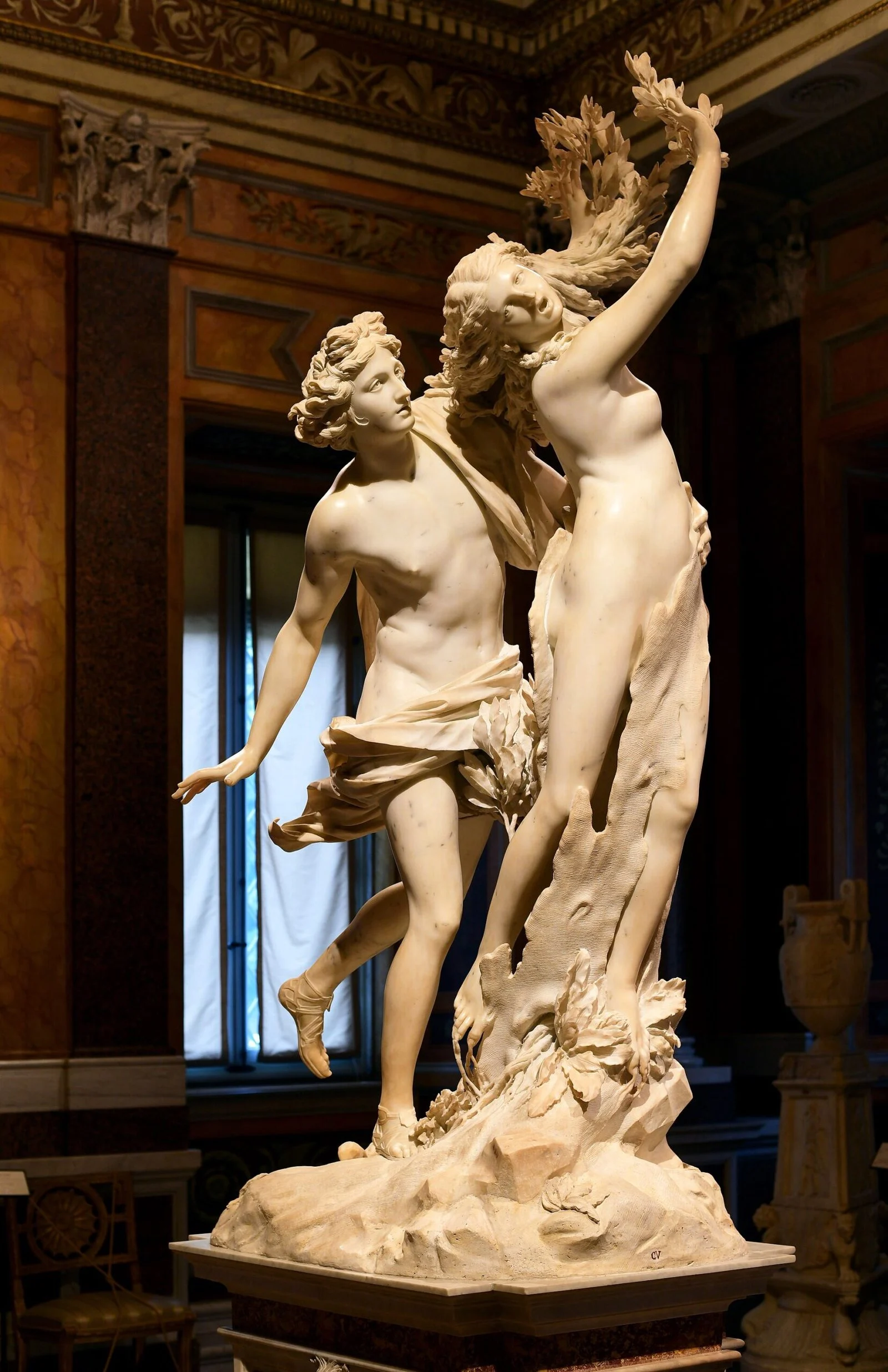
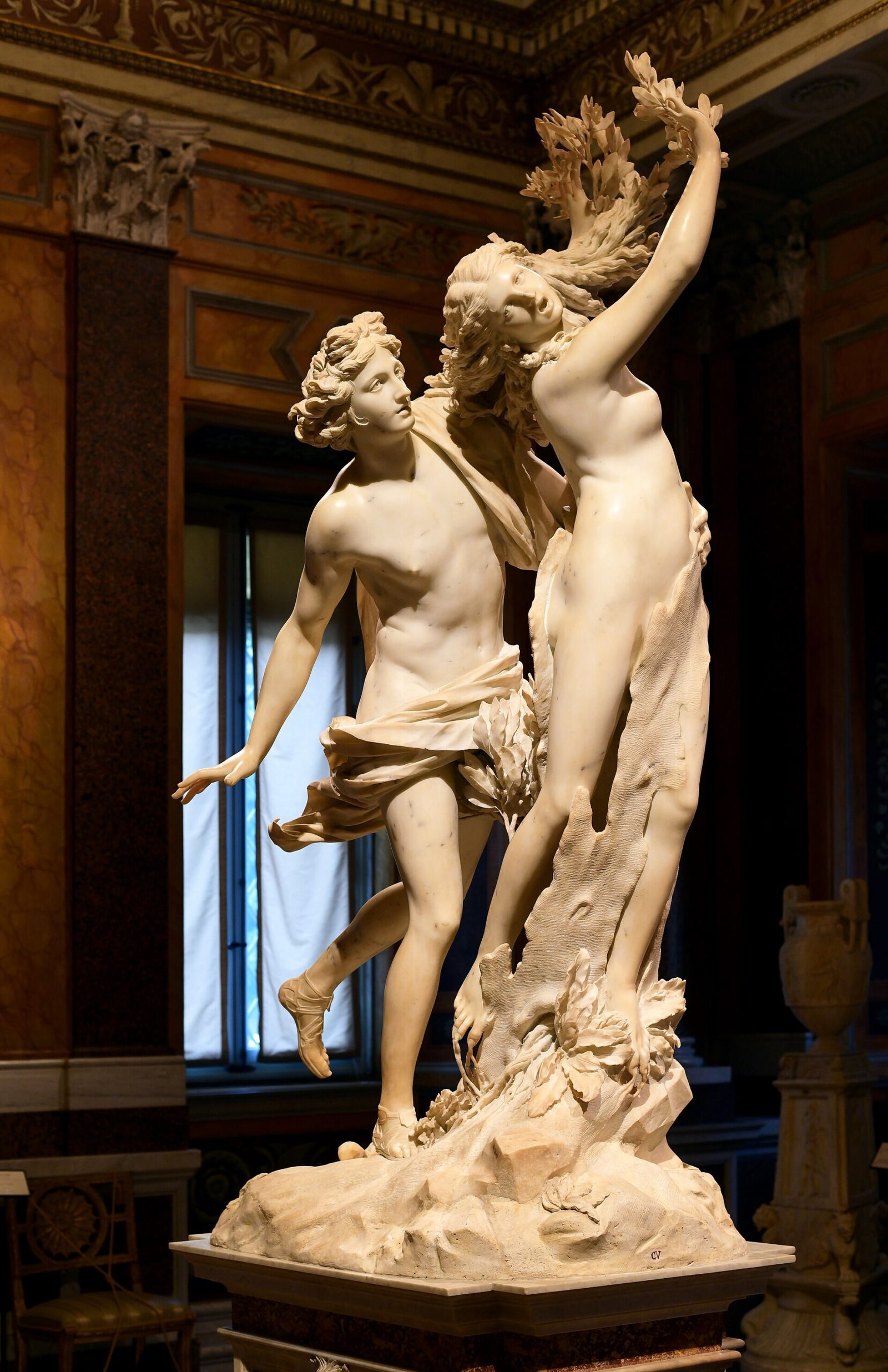
Apollo and Daphne, made between 1622 and 1625, is probably the most photographed sculpture in the Galleria Borghese and stages the line of Ovid in which the nymph, chased by the god, turns into a laurel. Fingers become branches, hair becomes leaves, feet become roots biting into the ground. The technical point is that the marble is worked down to extremely thin thicknesses, almost translucent, in the leaves and the fingertips, a feat of the chisel that makes the statue fragile and explains why it is treated with so much caution.
The David: a portrait in action
The David of 1623 and 1624 breaks with the whole earlier tradition for a simple reason. While the David of Michelangelo and that of Donatello show the moment before or after the throw, Bernini's captures the instant of the twist, with the body wound up, the lip bitten and the sling taut. The consequence is that the statue is not self-sufficient. It presupposes Goliath, who isn't there, and so it involves the space of the room and whoever looks at it, putting that person in effect in the giant's position. An old tradition, reported by the 1600s biographers and repeated by all the guides, holds that David's face is a self-portrait of the young Bernini, who supposedly looked at himself in a mirror while working, with Cardinal Barberini personally holding the mirror for him. It is an anecdote handed down by 1600s biographies, so it should be treated as a tale of the period more than an established fact.
How to visit: mandatory reservation and timed slots
The Galleria Borghese can be visited only with a mandatory reservation, for all types of ticket, including reduced and free ones. The museum is open Tuesday to Sunday from 9:00 to 19:00, with last entry at 17:45, and is closed on December 25 and January 1. Entries are in time slots that start on the hour and last two hours, with a maximum of 180 people per slot. The full ticket costs 16 euros, with a last time band at 11 euros, the reduction for ages 18 to 25 is 2 euros and the mandatory reservation fee is 2 euros. On the free Sundays and the other free-admission days the reservation is still required and cannot be made on site. In 2026 the gallery is also hosting the exhibition devoted to Ovid and the arts, extended to October 11, which may change the layout of some rooms. It's best to check the official website in the days before your visit.
St. Peter's: the colonnade, the baldacchino and the Chair
In St. Peter's in the Vatican Bernini worked for over 50 years, and the basilica as we see it today, from the embrace of the square to the back of the apse, is in large measure his work. It is the part of the itinerary that demands the most logistical patience, because the basilica has security checks and lines that in high season run over an hour, but also the part that best conveys what it meant, in the 1600s, to design a space meant to move crowds.
The colonnade: 284 columns and 140 statues
The colonnade of St. Peter's Square was begun in 1656 on the commission of Alexander VII and completed in 1667. It includes 284 columns arranged in four rows and 16 meters high, topped by a balustrade on which 140 statues of saints more than three meters tall line up, and it bounds a three-centered oval space of about 196 meters by 149. Bernini himself explained the image he had in mind: two maternal arms that welcome and embrace the faithful, Catholics to confirm them in the faith, the others to invite them in. The best-known practical consequence is the optical game of the two porphyry discs set in the pavement of the square, on either side of the obelisk. Anyone who stands exactly on one of the two discs, which mark the centers of the two semicircles, sees the four rows of columns line up perfectly and vanish one behind the other, as if the colonnade had a single row.
The obelisk Bernini found already there
The Vatican obelisk in the middle of the square is not Bernini's work. It comes from Egypt, arrived in Rome in the imperial age and adorned the circus that stood in this area, then was moved to the center of the square in 1586, under Sixtus V, in the engineering feat directed by Domenico Fontana, a good 70 years before Bernini designed the colonnade. Bernini therefore found it already in position and built the piazza around it, adopting it as the geometric pivot of the whole layout.
The Baldacchino: bronze, twisted columns and a restoration just completed
The Baldacchino above the papal altar, made between 1623 and 1634 for Urban VIII, is about 29 meters tall, as high as a nine-story building, and remains one of the largest bronze objects ever cast. The four twisted columns take up the form of the columns of the ancient Constantinian basilica, which tradition held came from the Temple of Solomon, and are covered with laurel branches and Barberini bees. Between January and October 2024 the Baldacchino underwent a complete restoration ahead of the Jubilee of 2025. The scaffolding was removed on October 27, 2024 and the work is now visible clean, with a gilding and a color contrast that for decades had been covered by deposits. The Chair was restored in the same building site as well.
The Chair of St. Peter and the alabaster window
The Chair of St. Peter, in the apse, was made between 1657 and 1666 and works like a sacred theater: a great bronze throne held up by four statues of Doctors of the Church, above which a glory of angels and clouds converges on a yellow alabaster window with the dove of the Holy Spirit at the center. Inside the bronze throne is kept an ancient wooden chair, which tradition identified as the seat of the apostle Peter and which scholars place in the Carolingian age. The window works like a skylight: the natural light filtered through the alabaster changes over the course of the day.
How to visit the basilica
Entry to St. Peter's Basilica is free, while the climb to the dome and the visit to the Grottoes and the Necropolis are paid, with different procedures. The Vatican Museums, by contrast, have an entrance, ticket office and route separate from the basilica, and must be booked separately. To enter there is a dress code that excludes bare shoulders and knees, strictly enforced at the checks. The hours of the basilica and any closures for ceremonies change over the year, in particular during the Wednesday morning audiences in the square, and should be checked on the official website before you show up. Anyone who wants to avoid the longest lines finds less crowding in the first hour after opening or in the late afternoon. If you're moving around the area you can combine the visit with a walk toward Castel Sant'Angelo, which you reach in a few minutes on foot along Via della Conciliazione, or with a stop in Vatican City proper.
The Ecstasy of Saint Teresa in Santa Maria della Vittoria
The Cornaro chapel, in the left transept of the church of Santa Maria della Vittoria on Via XX Settembre, was made between 1647 and 1652 on the commission of the Venetian cardinal Federico Cornaro and contains the Ecstasy of Saint Teresa of Avila, the marble group most often used to explain what contemporaries meant when they said that Bernini made sculpture into a work of theater. It is also the work that came about in the years when Bernini was temporarily out of papal favor, and which therefore shows how intact his reputation with private patrons had remained.
The transverberation, that is, what is happening
The scene comes from a passage in the autobiography of Teresa of Avila, a Spanish mystic of the 1500s canonized in 1622, in which the saint recounts seeing an angel who repeatedly pierced her heart with a fiery golden dart, leaving her in a state of pain and at the same time of extreme sweetness. Bernini chooses the moment immediately before the blow: the angel smiles and raises the dart, Teresa is thrown back on a cloud, her mouth slightly open, her bare foot hanging limp, her robes crumpling into a violently agitated drapery.
The boxes with the Cornaro family
The detail many visitors miss, because they look only at the altar, is the two small boxes carved into the side walls of the chapel, on the right and on the left, where eight members of the Cornaro family are sculpted in half-length, among them several cardinals and a doge. They are not praying and not all of them are looking at the altar. Some are talking among themselves, one is reading, another is leaning out. They are spectators in a theater box, and the chapel is conceived as a hall in which the altar is the stage and whoever comes in finds themselves in the stalls.
The window you can't see
Above the sculptural group descend rays of gilded bronze, and above the rays Bernini had a window opened that is hidden from the view of anyone entering, screened by yellow glass and cut out behind the pediment of the altar. The natural daylight comes in from there, strikes the marble from above and seems to come from the golden rays themselves. The effect changes radically with the hour and the weather, which is why it's best to visit the chapel on a sunny day and if possible in the middle hours, when the light entering through the window is strongest.
How to get there and what to know
The church is at the intersection of Via XX Settembre and Largo Santa Susanna, a few steps from the Repubblica stop of metro line A and about 10 minutes on foot from Termini. Entry is free, but since it's a church in use, the hours follow those of the services, with the usual closure in the middle hours of the afternoon. It's best to check them on site or by phone before planning a visit in a tight time slot, because they can vary. The Triton Fountain in Piazza Barberini, five minutes away, fits well into the same walk, as does the Barberini Mithraeum, which can be visited only by reservation and with a guided tour.
Bernini's fountains: Four Rivers, Triton, Bees and the Barcaccia case
The fountains are the part of the itinerary you visit for free, at any hour, with no tickets or lines, and it is also the part where Bernini's invention is best measured. Bernini was the first to treat a fountain not as a decorated container of water but as a scene in motion in which the water is one of the actors.
The Fountain of the Four Rivers in Piazza Navona
The Fountain of the Four Rivers was built between 1648 and 1651 for Innocent X, who wanted to give monumental form to the piazza in front of the family palace. At the center rises the obelisk known as the Agonale, found in 1647 along Via Appia, where it adorned the Circus of Maxentius, and beneath it four marble colossi represent the rivers that allude to the four continents then known: the Nile for Africa, the Danube for Europe, the Ganges for Asia and the Rio de la Plata for the Americas. The four statues were sculpted on Bernini's models by as many collaborators: the Nile by Giacomo Antonio Fancelli, the Danube by Antonio Raggi, the Ganges by Claude Poussin and the Rio de la Plata by Francesco Baratta. Bernini designed the whole, modeled the sketches and oversaw the central rockwork, but the four giants are not by his hand. It's a clarification that holds for almost all the great Roman fountains of the 1600s.
The legend of the rivalry with Borromini, which is a legend
The most told story about Piazza Navona holds that the statue of the Rio de la Plata raises its arm to protect itself from the imminent collapse of the facade of the church of Sant'Agnese in Agone, the work of the rival Francesco Borromini, and that the Nile covers its head with a cloth so as not to see it. It's a pleasant tale and completely untenable on chronological grounds. The fountain was finished in 1651, while construction of the church began the following year, in 1652, and Borromini took over its direction only in 1653. Bernini could not mock a facade that did not yet exist. The veil on the Nile's head has a banal and ancient iconographic explanation: it alluded to the fact that the sources of the river were then unknown. The rivalry between the two architects was real and documented, but this anecdotal material belongs to Roman popular tradition and should be told as such. Anyone who wants to explore the same piazza further can go down below street level to the Stadium of Domitian, whose remains explain the elongated shape of the piazza better than any sign.
The Triton Fountain in Piazza Barberini
The Triton Fountain, made between 1642 and 1643 for Urban VIII, is the first fountain entirely conceived and executed by Bernini and breaks with every earlier scheme. Four dolphins, with their tails raised, hold up an open bivalve shell on which kneels a triton blowing into a conch, from which the jet of water comes out. There is no architectural basin, no niche. The fountain is an autonomous sculptural group planted in the middle of the piazza, and the papal keys and the Barberini bees between the dolphins' tails sign the commission.
The Fountain of the Bees: how much of it is original
A few meters away, at the corner with Via Vittorio Veneto, is the Fountain of the Bees, designed by Bernini in 1644 as a public utility fountain, that is, a monumental drinking trough wanted by Urban VIII shortly before he died. Its story is more eventful than it looks. The fountain originally stood at the corner of Palazzo Soderini, between Piazza Barberini and Via Sistina. It was taken apart in 1865 for traffic reasons and kept in municipal warehouses, then reassembled between 1915 and 1916 in its present isolated position. According to the Sovrintendenza Capitolina the only surviving original elements are fragments of the central bee and a portion of the shell half. Everything else is a 1900s reconstruction. Anyone looking at it today is therefore looking at a reconstruction with 1600s inserts, not the work as it left Bernini's building site. The head of one bee was also replaced after an act of vandalism in 2004.
The Barcaccia: a fountain that isn't by Gian Lorenzo
The Barcaccia Fountain at the foot of the steps of Piazza di Spagna is attributed to Gian Lorenzo Bernini by very many guides, and it is the most widespread error in the whole Roman Bernini itinerary. The commission came from Urban VIII and the fountain was made between 1627 and 1629 by Pietro Bernini, the father, with a possible contribution from the son Gian Lorenzo that scholars have long debated and that becomes more probable for the final phases, given that Pietro died on August 29, 1629. The more correct formula is therefore attribution to Pietro Bernini, with possible intervention by Gian Lorenzo. Anyone who presents it as the work of Gian Lorenzo alone is simplifying a fact the sources do not authorize. The shape of a half-sunken boat answers, besides a possible memory of the Tiber flood of 1598, to a concrete problem: at that point the pressure of the Acqua Vergine was too low to feed high jets, and a fountain at ground level was the only possible solution.
Bernini as architect of churches: Sant'Andrea al Quirinale and Santa Bibiana
Bernini designed very few churches from scratch, and two of them are in Rome. They are small works, almost domestic compared with the scale of St. Peter's, and for that very reason they show his architectural thinking in its most concentrated form.
Sant'Andrea al Quirinale, the transverse ellipse
The church of Sant'Andrea al Quirinale was built between 1658 and 1670 for the Jesuit novitiate, on the commission of Cardinal Camillo Pamphilj, nephew of Innocent X. The decisive invention concerns the plan. The hall is an oval whose major axis is set transversely to the entrance, so that whoever enters finds themselves immediately in front of the altar, with no route to travel, in a space that widens at the sides instead of lengthening in depth. Above the altar the altarpiece of the martyrdom of Saint Andrew is by Guillaume Courtois, and above the broken pediment the statue of the saint rises toward the lantern, with the light coming down from the dome serving as the link.
The comparison with San Carlino, 200 meters away
On the same Via del Quirinale, a few dozen meters away, stands San Carlo alle Quattro Fontane by Francesco Borromini, built in the same decades and also on an oval plan. Seeing them one after the other, in the same half hour, is the most direct way Rome offers to understand the difference between the two greatest architects of the Baroque. Bernini works with large surfaces, polychrome marbles, gold and sculpture, with a clear and theatrical space. Borromini works with geometry, white stucco, concave and convex curves that chase one another, with a space that seems to breathe. Both churches can be visited for free. Sant'Andrea al Quirinale is open Tuesday to Sunday from 9:00 to 12:00 and from 15:00 to 18:00, and is closed on Monday. In the same complex you can visit, in their own way, the rooms of Saint Stanislaus Kostka, the Jesuit novice who died here in 1568.
Santa Bibiana, the first architectural building site
The church of Santa Bibiana, on Via Giovanni Giolitti, right up against Termini station and today squeezed between the tracks and modern roads, holds the first facade designed by Bernini, from 1624, and the marble statue of the saint sculpted between 1624 and 1626. The facade is still a sober exercise, in two orders, with a projecting central body, and bears the inscription recalling Urban VIII and the year 1624. The statue, placed in the niche above the high altar, is the first case in which Bernini uses a sacred figure as an apparition framed by the architecture, an idea that 30 years later would become the Saint Teresa. In the left aisle are the early frescoes by Pietro da Cortona, on the right those by Agostino Ciampelli. The church ceased to be a parish in 2020 and is today a subsidiary church entrusted to a religious congregation. Opening hours are limited and irregular, and it's best to contact the church before showing up, because the risk of finding the door closed is real.
Ponte Sant'Angelo: 10 angels, two autographs, and where the originals went
The bridge that links the historic center to Castel Sant'Angelo was built by the emperor Hadrian between 121 and 134 AD to connect his mausoleum to the left bank of the Tiber, and for 15 centuries it was the obligatory passage for pilgrims heading to St. Peter's. In 1667 Pope Clement IX entrusted Bernini with the remaking of the bridge's furnishings, and the artist, by then 70 years old, turned it into an open-air Way of the Cross: 10 statues of angels, five per side, each holding an instrument of the Passion, who accompany whoever walks toward the basilica.
The 10 angels and who sculpted them
The 10 statues were commissioned in 1667 and placed on the bridge in 1670. Bernini supplied the drawings and models and directed the building site, but the physical execution was entrusted to his workshop and to his best pupils. Antonio Raggi sculpted the Angel with the Column, Lazzaro Morelli the one with the Scourges, Cosimo Fancelli the one with the Veil, Paolo Naldini the one with the Garment and Dice, Girolamo Lucenti the one with the Nails, Ercole Ferrata the one with the Cross, Antonio Giorgetti the one with the Sponge and Domenico Guidi the one with the Lance.
The two autographs and the pope who kept them
Bernini sculpted with his own hand, with the help of his son Paolo, only two angels: the Angel with the Crown of Thorns and the Angel with the Scroll, the one bearing the inscription INRI, both datable to 1668 and 1669. Clement IX judged them too precious to be exposed to the weather and decided not to place them on the bridge. In their place two substitutes were set up: the copy of the Angel with the Crown of Thorns was sculpted by Paolo Naldini, while the second version of the Angel with the Scroll was executed by Bernini himself with the help of his pupil Giulio Cartari. It follows that on the bridge, strictly speaking, neither of the two original marbles is to be found, but one of the two statues present is nevertheless the product of a second direct intervention by Bernini.
Where the originals are today
The two autograph angels stayed in Bernini's studio and then with his heirs, who in 1729 donated them to the church of Sant'Andrea delle Fratte, on Via di Sant'Andrea delle Fratte, a few steps from Piazza di Spagna. They are there today, on either side of the presbytery, visible for free during the church's opening hours. It is one of the most underrated stops on the Roman Bernini itinerary.
The bridge today
The construction of the Tiber embankment walls, at the end of the 1800s, radically changed the bridge. The old humpback profile was lowered, the ramps were rebuilt and the statues were all brought to the same level, losing the original progression Bernini had planned for those climbing toward the crest. The statues underwent a restoration in 2024 under national funding programs, with cleaning and protective treatments. The bridge is pedestrian, always accessible and free, and the best moment to walk it is sunset, when the low light brings out the drapery and the dome of St. Peter's closes the perspective at the far end.
Image: Ponte Sant'Angelo at sunset, with the silhouettes of the angels backlit and the bulk of Castel Sant'Angelo in the background.
The palaces: Barberini, Montecitorio and the facades never built
Bernini as a civil architect almost always worked in a team or on buildings already begun by others, and his two most important Roman palaces are both multi-handed works in which recognizing his contribution takes a few pointers.
Palazzo Barberini: three architects, two staircases
Palazzo Barberini, on Via delle Quattro Fontane, was begun in 1627 by Carlo Maderno for the family of the reigning pope. When Maderno died, in 1629, direction passed to Bernini, who had as collaborator the young Francesco Borromini, Maderno's own nephew. The building site is therefore the place where the two future rivals worked side by side, and where their divergence can be read physically in the two opposing monumental staircases. The square staircase on the left, with its regular succession of ramps and columns, is Bernini's. The helical staircase on the right, which climbs in a spiral on paired Doric columns, is Borromini's.
The palace today houses part of the Gallerie Nazionali di Arte Antica, with Raphael's Fornarina, Caravaggio's Judith and the ceiling frescoed by Pietro da Cortona with the Triumph of Divine Providence, one of the most spectacular vaults of Baroque Rome. The museum is open Tuesday to Sunday from 10:00 to 19:00 and is closed on Monday. There is a combined ticket with the Palazzo Corsini site in Trastevere, and prices and conditions should be checked on the official website, because they are subject to change. In the same area, below street level, is the Barberini Mithraeum, which can be visited only by reservation.
Montecitorio: a curved facade on an artificial hill
Palazzo Montecitorio was commissioned from Bernini by Innocent X as a residence for the Ludovisi family, related to the pope. Bernini exploited the natural convexity of the terrain by designing a facade articulated in a flat central body and two slightly rotated side wings, as if the building bent to follow the rise. It's a solution with no parallel in the civil architecture of Rome of the time and it can be grasped only by looking at the palace obliquely, from one side of the piazza, not head-on.
The Montecitorio obelisk in the middle of the piazza is not part of Bernini's design. It is an Egyptian monolith brought to Rome by Augustus and used as the gnomon of the great sundial of the Campus Martius, then found in fragments and repositioned here at the end of the 1700s. The palace can be visited on the public openings organized by the Chamber of Deputies, which take place roughly monthly between October and June and require online reservation. The calendar of dates and the registration procedure should be checked on the Chamber's institutional website, because they change from year to year and the openings may be suspended because of parliamentary business.
The Elefantino della Minerva: who really sculpted it
In the center of Piazza della Minerva, in front of the basilica of Santa Maria sopra Minerva and a stone's throw from the Pantheon, a small marble elephant carries an Egyptian obelisk on its back. Romans call it the Pulcin della Minerva, and almost all the guides present it as Bernini's work. The truth is more complicated and deserves to be told in full, because it is one of the cases where the distinction between design and execution really changes the attribution.
The obelisk found in the Dominicans' garden
In 1665 excavations in the garden of the Dominican convent attached to the basilica brought to light a small Egyptian obelisk, a little over five and a half meters tall, of the Saite period, probably from the sanctuary of Isis that stood in this part of the Campus Martius. Alexander VII Chigi, a pope passionate about antiquities and Egyptology, wanted it set upright in the piazza and entrusted its arrangement to Bernini, who proposed the solution visible today: not an architectural base, but a living animal carrying the monolith like a load.
The design is Bernini's, the sculpture is not
The monument was inaugurated in 1667. The design and the invention are by Gian Lorenzo Bernini, but the marble elephant was physically sculpted by Ercole Ferrata, one of the most skilled collaborators of the workshop, following the master's models. Calling the little elephant Bernini's work is therefore not wrong in the current sense of the term, but it is imprecise if you mean the hand. The man who sculpted that marble was named Ercole Ferrata, and the same holds, not by chance, for the Angel with the Cross on Ponte Sant'Angelo. The Minerva obelisk looks better when you know this.
The broken tusk, a recurring problem
The elephant's right tusk is the weak point of the sculpture and has been damaged more than once: in 2016 and again in February 2026, when a fragment was found on the ground and handed over to the authorities, with the Sovrintendenza Capitolina announcing a quick restoration and investigations under way into the causes, between hypotheses of accidental impact and of deterioration due to climatic conditions. Anyone visiting the piazza may therefore find the work fenced off or under repair. It's best to allow for this possibility and check the state of the work before counting on the perfect photograph.
The works almost nobody visits: Ludovica Albertoni and the Fonseca bust
The two sculptures that follow are works of Bernini's old age, are found in neighborhood churches far from the tourist routes, and can be visited for free, with only the limits of the service hours.
The Blessed Ludovica Albertoni at San Francesco a Ripa
In the church of San Francesco a Ripa, in Trastevere, the Altieri chapel holds the Ecstasy of the Blessed Ludovica Albertoni, made between 1671 and 1674 for Cardinal Paluzzo Paluzzi Altieri, nephew by adoption of Clement X. Ludovica Albertoni was a Roman noblewoman of the 1400s, a Franciscan tertiary, beatified in precisely those years. Bernini portrays her stretched out on a marble mattress, in the instant of ecstatic death, with her hands pressed to her chest and her body crossed by a drapery that still seems to be moving. It is in essence a second Saint Teresa, sculpted 20 years later, but barer, more dramatic and more concentrated. Here there are no angels or spectators, only a woman dying in a light that descends at an angle from hidden side windows. In this case too the staging of the light is part of the work, and the statue should be viewed from the front, standing in the middle of the chapel, not from the side.
The church is in Piazza San Francesco d'Assisi, in the southern part of Trastevere, a 15-minute walk from Santa Maria in Trastevere and near Santa Cecilia. Entry is free and the hours follow those of the services, with the usual afternoon closure of Roman churches. Since it's a church in use and not a museum, the hours may vary and should be checked before planning the visit.
The bust of Gabriele Fonseca at San Lorenzo in Lucina
In the basilica of San Lorenzo in Lucina, a stone's throw from Piazza Colonna and Parliament, the Fonseca chapel holds the bust of Gabriele Fonseca, personal physician of Innocent X, sculpted by Bernini between 1668 and about 1674. It is not a commemorative portrait in the usual sense. The subject leans out of the niche clutching his rosary, mouth half open, gaze fixed on the altar in an expression of religious rapture that Bernini normally reserved for sacred figures, not for patrons. It is probably the most intense portrait of his late output, and almost nobody stops for it. Entry is free and the hours are those of the services.
Other Bernini traces scattered around the center
The itinerary can be extended at will. In the Church of the Gesù and in the basilica of Sant'Andrea della Valle you gauge the context in which Bernini worked, that is, the great season of the Jesuit and Theatine churches. In the church of Sant'Ivo alla Sapienza you see the most radical Borromini, useful for comparison. At the Capitoline Museums and the Galleria Colonna you meet works and portraits from Bernini's century.
Bernini's tomb in Santa Maria Maggiore
Gian Lorenzo Bernini died in Rome on November 28, 1680, at almost 82, after serving eight popes, and is buried in the basilica of Santa Maria Maggiore, in the right side aisle, under a simple slab with a Latin inscription. There is no funerary monument, no statues, no polychrome marble. The man who filled Rome with monumental tombs, from the papal tombs of St. Peter's to the portraits of cardinals, rests under a stone that most visitors walk over without noticing. The slab is in the floor of the right aisle, toward the presbytery, and is so discreet that it's best to ask the basilica staff for directions. Entry is free and the dress code of the papal basilicas applies.
How to organize the Bernini itinerary
All the works on this route are in the center of Rome and in the quadrant between the Tiber and Termini station, but lining them up in a single day makes no sense. The Galleria Borghese alone requires a two-hour slot booked days in advance, and St. Peter's can take up a whole morning. The options that follow are built on realistic times.
Half a day: the free Bernini of the center
Anyone with a few hours and no reservation can build an entirely free route that starts from Piazza Navona with the Fountain of the Four Rivers, continues to Piazza della Minerva for the Elefantino and the Pantheon, goes down to San Lorenzo in Lucina for the Fonseca bust, touches Montecitorio from the outside and ends at Ponte Sant'Angelo. It's about three hours walking at an easy pace, all stops with free entry, with the sole unknown being the church hours.
A whole day: Borghese in the morning, the center in the afternoon
The most efficient formula has the opening slot at the Galleria Borghese at 9:00, booked in advance, two hours of visit, then a walk down toward Piazza Barberini for the Triton Fountain and the Fountain of the Bees, a quick lunch, Santa Maria della Vittoria with the Ecstasy of Saint Teresa, then back up to the Quirinal for Sant'Andrea al Quirinale and San Carlo alle Quattro Fontane in the afternoon, keeping in mind that Sant'Andrea reopens at 15:00. It's a full but sustainable day, almost all on foot, with modest changes in elevation. Anyone with a second day devotes it to the Vatican, entering St. Peter's in the first hour after opening, and then crosses the Tiber toward Trastevere for the Blessed Ludovica Albertoni.
How much it costs and what to book
The paid part of the itinerary is small: the Galleria Borghese with a full ticket and mandatory reservation, and Palazzo Barberini if you want to see the two staircases and the Galleria Nazionale. Everything else, that is, fountains, bridge, St. Peter's Square and the interior of the basilica, the churches of Santa Maria della Vittoria, Sant'Andrea al Quirinale, San Francesco a Ripa, San Lorenzo in Lucina, Santa Maria del Popolo and Santa Maria Maggiore, is visited for free.
With children and with mobility difficulties
The itinerary works well with children if you focus on the fountains, the little elephant and the angels of the bridge, all immediately readable elements, while the two hours of the Galleria Borghese may feel long to the youngest. Admission is free for under 18s, but still requires a reservation. On accessibility, fountains, bridge and St. Peter's Square are on flat, paved routes, though with sampietrini. The Galleria Borghese, Palazzo Barberini and St. Peter's Basilica have accessible routes, while some minor churches have steps at the entrance and narrow spaces. It's best to ask case by case at the individual site.
Frequently asked questions about Bernini in Rome
Which works by Bernini are an absolute must to see in Rome?
The essential works by Bernini in Rome are the four early sculptures of the Galleria Borghese, that is, Apollo and Daphne, the Rape of Proserpina, the David and Aeneas with Anchises, the colonnade and the Baldacchino of St. Peter's, the Ecstasy of Saint Teresa in Santa Maria della Vittoria and the Fountain of the Four Rivers in Piazza Navona. With one more day you add Ponte Sant'Angelo, Sant'Andrea al Quirinale and the Blessed Ludovica Albertoni in Trastevere.
Do I need to reserve the Galleria Borghese to see Bernini's sculptures?
Yes, the Galleria Borghese can be visited only with a mandatory reservation, for every type of ticket, including reduced fares and free admissions. The museum is open Tuesday to Sunday from 9:00 to 19:00 with entries in two-hour slots that start on the hour, a maximum of 180 people per slot and last entry at 17:45. The full ticket costs 16 euros plus a 2 euro reservation fee.
Are the angels of Ponte Sant'Angelo really by Bernini?
The angels of Ponte Sant'Angelo were designed by Bernini but sculpted almost entirely by his pupils between 1667 and 1670. Bernini personally executed only two, the Angel with the Crown of Thorns and the Angel with the Scroll, which Clement IX wanted to shield from the weather. Since 1729 they have been in the church of Sant'Andrea delle Fratte, while on the bridge there are a copy by Paolo Naldini and a second version made by Bernini with Giulio Cartari.
Was the Elefantino della Minerva sculpted by Bernini?
The Elefantino della Minerva was designed by Gian Lorenzo Bernini in 1667 on the commission of Alexander VII, but the marble sculpture was physically executed by Ercole Ferrata, a collaborator from his workshop, following the master's models. The obelisk the elephant carries is an Egyptian original of the Saite period, found in 1665 in the excavations of the garden of the Dominican convent next to the basilica.
Is the Barcaccia Fountain by Gian Lorenzo Bernini?
The Barcaccia Fountain in Piazza di Spagna is attributed mainly to Pietro Bernini, Gian Lorenzo's father, and was made between 1627 and 1629 on the commission of Urban VIII. The participation of his son Gian Lorenzo is debated among scholars and is considered more probable for the final phases of the work, given that Pietro died on August 29, 1629. Presenting it as the work of Gian Lorenzo alone is imprecise.
How much time do you need for a Bernini itinerary in Rome?
For a complete Bernini itinerary in Rome you need two days: one devoted to the Galleria Borghese in the morning and to the area between Barberini and the Quirinal in the afternoon, the other to St. Peter's and Trastevere. Anyone with only half a day can build a free route among Piazza Navona, the Elefantino della Minerva, San Lorenzo in Lucina and Ponte Sant'Angelo, in about three hours of walking.
Is it true that the Fountain of the Four Rivers mocks Borromini's church?
No, the legend that the statues of the Fountain of the Four Rivers mock the facade of Sant’Agnese in Agone is chronologically impossible. The fountain was completed in 1651, while construction of the church began in 1652 and Borromini took over its direction in 1653. The veil over the Nile’s head simply alludes to the fact that the sources of the river were unknown at the time.
Where is Gian Lorenzo Bernini buried?
Gian Lorenzo Bernini is buried in the basilica of Santa Maria Maggiore in Rome, in the right aisle, under a simple floor slab with a Latin inscription, together with his father Pietro. There is no monumental tomb: the artist who designed the most spectacular papal tombs of the 1600s wanted a sober burial for himself. Entrance to the basilica is free.
One last note for anyone building an itinerary
The best way to move through Bernini’s Rome is to stop treating it as a collection of stops and start reading it as a system: the colonnade, the fountain in Piazza Navona, the Cornaro Chapel and the little elephant of the Minerva are all pieces of the same idea, that of an urban space that speaks to the people walking through it and that uses light, water and marble as tools of persuasion. Anyone who keeps this thread in mind notices that the itinerary does not end with the last stop on the list, but continues in every corner of the historic center, often where no guide points it out.
If you are building a multi-day itinerary for Rome that combines these stops with the rest of the historic center, with museum hours and with getting around on foot, you can find useful planning tools on Tour Leader Pro, while for a broader picture of transportation, destinations in Lazio and how to organize a trip to Italy, Italy Planner is a good resource.