Basilica of San Bartolomeo all’Isola
In short. The Basilica of San Bartolomeo all’Isola stands on the Tiber Island, in the Ripa district, and is the only monumental church in Rome built in the middle of a river.
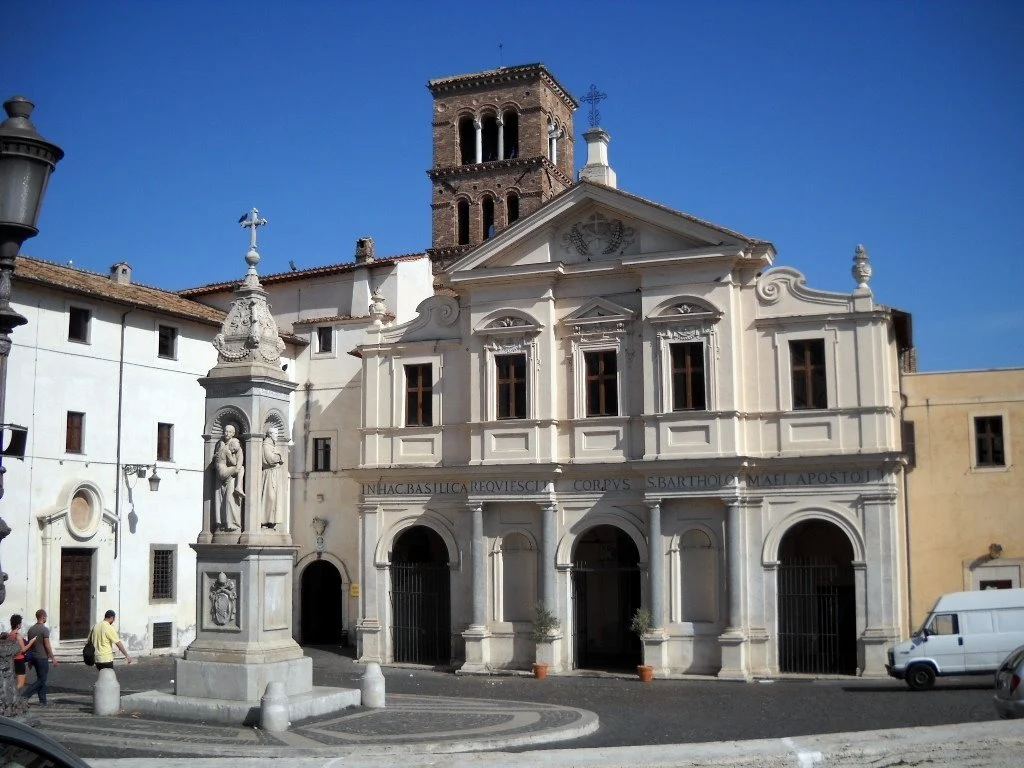
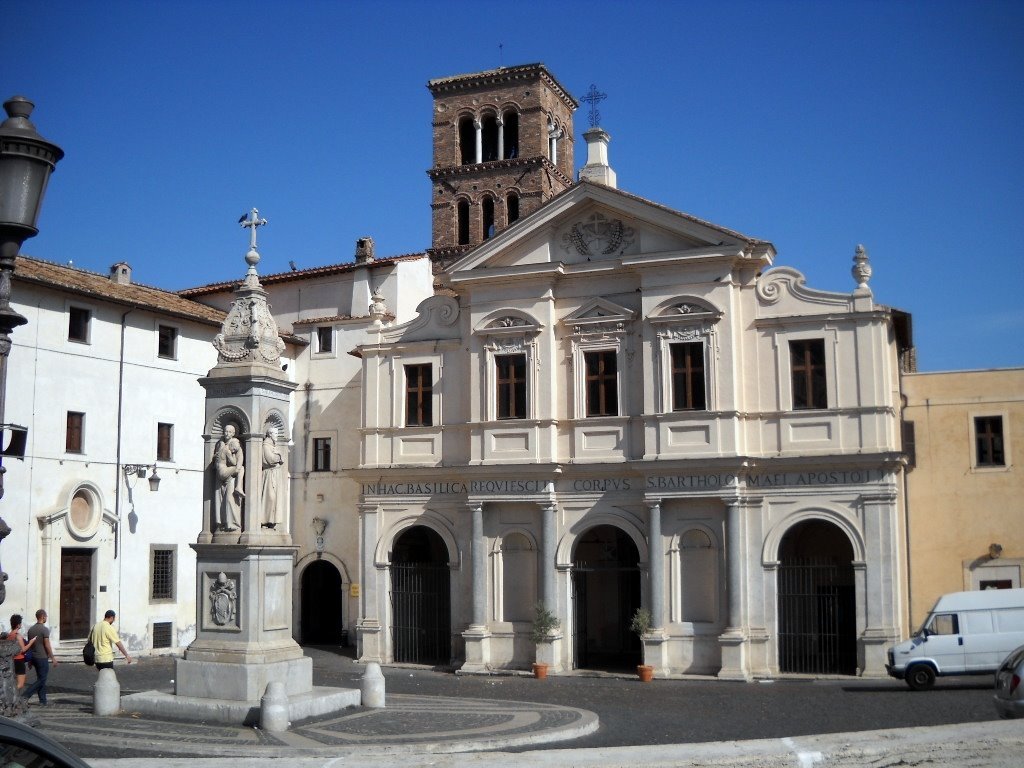
The Basilica of San Bartolomeo all’Isola stands on the Tiber Island, in the Ripa district, and is the only monumental church in Rome built in the middle of a river. It was founded at the end of the 10th century at the wish of Emperor Otto III on top of the ruins of the sanctuary of Aesculapius, the Greek god of medicine whose cult had arrived in Rome in the 290s BC. Entrance is free and you don't need to book to go into the church. The visit is short, a bit under half an hour if you stick to the nave, a full hour if you take your time with the wellhead carved on the altar steps and the Memorial of the New Martyrs of the 20th and 21st centuries, which since 2000 has made this church a place of contemporary memory and not only a medieval monument.
Whoever arrives from the Ghetto or from Trastevere sees first the Romanesque brick bell tower poking up above the low roofs of the island, then the cream-colored Baroque facade facing a tiny little square, and finally notices that next to the church is the entrance of a hospital still in full operation. It is a coincidence worth the trip: the sick have been treated here for 25 centuries, first in the name of a pagan god and then in that of an apostle. The lines that follow tell how the basilica came to be, what it really contains, what the sources say and don't say about its most famous piece, and how to visit it today. The page devoted to the Tiber Island instead tells the story of the island as a whole, with the bridges, the travertine prow, the serpent of Aesculapius and the summer evenings. Here we only go inside the church.
Where the Basilica of San Bartolomeo all’Isola is and how to get there
The Basilica of San Bartolomeo all’Isola faces the central little square of the Tiber Island, at the point where the island widens between the two ancient bridges, and the address that appears on official documents is Piazza San Bartolomeo all’Isola, with street number 22 referring to the island itself. There is no convenient way to get there by car, and no need to look for one either: the island is reached on foot from both banks of the Tiber over two pedestrian bridges, Ponte Fabricio from the Ghetto side and Ponte Cestio from the Trastevere side.
On foot from the historic center
From the Ghetto the route is a bit under five minutes. You pass under the Portico d’Ottavia, come out onto Lungotevere de’ Cenci and cross Ponte Fabricio, which is the oldest Roman bridge in the city still in use with its original structure. From Santa Maria in Trastevere it takes about 10 minutes going down toward the river and taking Ponte Cestio. From Santa Maria in Cosmedin and the Mouth of Truth you go up Lungotevere dei Pierleoni for a good five minutes keeping the river on your left, and the facade of the basilica appears suddenly just after you pass Ponte Fabricio. Anyone coming down from the Capitoline Hill passes in front of the Theater of Marcellus and San Nicola in Carcere and reaches the island in a quarter of an hour without ever losing sight of the river.
By public transportation
There is no metro stop on the island or in the immediate vicinity, and this is the first practical fact to keep in mind. The bus lines that run along the Lungotevere and Piazza Sonnino area stop a few minutes' walk from the two bridges, while on the Trastevere side tram 8, which starts from Piazza Venezia, drops you a short distance from Ponte Cestio. Line numbers and routes change with periodic revisions of the service and with construction sites in the historic center, so the practical advice is to check the route on the official Rome public transportation app on the day of the visit, instead of trusting lists of lines copied from years-old guides.
Hours, entrance and rules for visiting the Basilica of San Bartolomeo all’Isola
Entrance to the Basilica of San Bartolomeo all’Isola is free and no reservation is required to visit the church. The hours given by the sanctuary's official website provide for opening Monday to Saturday in the morning and in the late afternoon, with a break in the middle of the day, and reduced hours on Sunday. The Memorial of the New Martyrs, set up in the crypt, has a different rule from the rest of the church, with public opening on Saturday and access by reservation on the other weekdays.
What the sources say about the hours
The hours published by the sanctuary and those reported by the guides generally indicate the same structure, morning from 09:30 to 13:30 and afternoon from 15:30 to 17:30, with Sunday morning closing earlier. These hours change with the seasons, with the liturgical calendar and with the ecumenical events the basilica hosts. There is only one sensible rule: call or write to the basilica the day before, or check the hours page on the sanctuary's official website. This goes double for the Memorial in the crypt, which doesn't follow the church's schedule.
Otto III's church: why a German emperor built a basilica on the Tiber
The Basilica of San Bartolomeo all’Isola was built in the year 998 at the wish of Otto III of Saxony, emperor of the Holy Roman Empire, on top of the ruins of the temple of Aesculapius that occupied the downstream tip of the Tiber Island. This is the date that appears in most modern sources. Some 19th-century scholars, Ferdinand Gregorovius among them, gave 997, so whoever writes about this church finds both figures depending on the text consulted. In any case we are at the end of the 10th century, at the moment when a 20-year-old emperor raised between Germany and Byzantium had decided to make Rome the real and not symbolic center of his empire.
Saint Adalbert of Prague, the murdered friend
The original dedication was not to Saint Bartholomew. The basilica was founded dedicated to Saint Adalbert of Prague, a Bohemian missionary bishop and personal friend of the emperor, killed in 997 during his mission among the Baltic peoples. Building a church in Rome for a friend just martyred was, for a 20-year-old emperor, at once an affectionate gesture and a political operation: it meant inscribing the still very young Christianity of Central Europe within the sacred topography of the capital of Christendom. Some sources recall that the dedication also included Saint Paulinus of Nola, and the name of Adalbert remains carved, according to the most widespread reading, on one of the four figures of the wellhead found on the altar steps.
The relics of Saint Bartholomew and the doubt that goes with them
The relics that give the Basilica of San Bartolomeo all’Isola its name are kept under the high altar inside a basin of imperial red porphyry, an ancient tub decorated with lion masks and ring handles carved in relief, topped by a bronze plaque with the inscription Corpus Sancti Bartholomaei Apostoli. It is one of the most singular objects in all the Roman churches, because the basin is materially a Roman artifact reused as a sacred sarcophagus, in a stone that came from a single quarry in the world, in the Egyptian eastern desert.
The journey of the relics: Lipari, Benevento, Rome
Tradition says that the body of the apostle Bartholomew, martyred according to the hagiographic sources by flaying, reached the West passing through the island of Lipari and then, in 838, through Benevento. From Benevento it would have been transferred to Rome at the end of the 10th century. Some sources attribute the operation to Otto II and date it to 983, others attribute it to Otto III and link it to the siege of Benevento against Pandulf II. The scholarly community has never reached agreement on which of the two emperors obtained the relics, nor on which portion of the body actually reached the Tiber. Medieval sources add that in one of those negotiations the Romans were handed, by deception, in place of the apostle's body, that of Saint Paulinus, bishop of Nola, who stayed here for centuries and was returned to Nola only at the start of the 1900s. What exactly the porphyry basin contains therefore remains an open question.
A curiosity about the Basilica of San Bartolomeo all’Isola
On the steps that rise to the high altar of the Basilica of San Bartolomeo all’Isola, exactly on the axis of the central nave, stands a marble wellhead made from the drum of an ancient column and carved with four figures in as many small niches. It is the most extraordinary object in the church and, according to tradition, it covers the ancient spring of the sanctuary of Aesculapius. No other Roman basilica has a well placed in such a solemn position, at the center of the presbytery, in the spot normally reserved for the altar and the liturgy.
The four carved figures and what they tell
The four figures carved on the wellhead can still be read well, even though the centuries and the hands of the faithful have worn them down. The readings the sources agree on indicate: Christ with the open book. A bishop, identified by some as Saint Adalbert of Prague and by others as Saint Paulinus of Nola. Emperor Otto III, recognizable by his Germanic mustache, holding a model of the original church. And Saint Bartholomew with the knife of his martyrdom. Along the rim runs a Latin inscription, given in the transcriptions as OS PUTEI SANCTI CIRCUMDANT ORBE ROTANTI, that is, the saints surround the mouth of the well in a rotating circle. It is an extremely compact iconographic program: in a bit under a meter of marble there are the founder, the patron, the original dedicatee and Christ, arranged in a circle around a hole in the ground.
The dating: the sources don't agree
Here something has to be said honestly, because the guides almost always skip it. On the dating of the wellhead the sources diverge substantially. One part of the studies places it in the 11th century and links it to the first phase of the Ottonian basilica, tentatively putting forward the name of the marble worker Niccolò di Angelo. Other sources, among them reference works from church circles, date it to the 13th century and attribute it on stylistic grounds to the circle of Nicola d'Angelo or Pietro Vassalletto, the two great workshops of Roman marble workers of the time. Still others trace it back even to the foundation of the church, that is, the end of the 10th century, precisely because of the portrait of Otto III. Whoever approaches it, then, is not looking at an object with a certain date: they are looking at an artifact that scholars place within a range of two or three centuries, and the honest thing is to say so instead of picking the figure that sounds best.
The well under the wellhead and the spring of Aesculapius
Under the carved wellhead there is the well proper, and here the discussion becomes more interesting than the sculpture. The technical descriptions of the site speak of a structure in opus quadratum, that is, in squared blocks of the Republican age, about 10 meters deep: a construction that predates the church by more than 1,000 years. Tradition, and with it much of the popular literature, identifies this well with the spring that fed the therapeutic practices of the sanctuary of Aesculapius, where water had a central role in purification rites and cures. The sanctuary was abandoned during the fifth century, but the well continued to be used, and when the Christian church was built over the pagan complex the well was not closed: it was incorporated, decorated and put at the center.
Why this detail matters more than it seems
The reason it is worth stopping for two minutes in front of this object is that it tells, in a meter of marble, something that history of religions textbooks explain in 50 pages. A pagan sanctuary where people went to be healed is replaced by a Christian church. The new building could have erased every trace of the previous one, and instead it keeps the physical element around which the ancient cult revolved, that is, the water, and signs it with the faces of its own founders. It is not syncretism: it is continuity of function. Local tradition adds that the bones of the martyrs Exuperantius and Marcellus were found in the waters of the well, and that is a devotional tale, not an archaeological fact. The verifiable fact is plainer and stronger: a few meters from this wellhead, still today, there is a hospital that admits patients.
How to look at it without disturbing anyone
The wellhead sits in a delicate spot, on the steps of the presbytery, and it is not an object to touch or step over. It is seen well from the back of the central nave in the morning light, when the sun comes in through the windows and strikes the marble at an angle, bringing out the carved figures that get lost in flat light. If a service is under way in the church, you don't approach the presbytery: you look from a distance and come back later. Anyone who wants to understand the four figures well can ask the basilica staff, who know the object far better than any sign.
Something nobody tells you about the Basilica of San Bartolomeo all’Isola
The Basilica of San Bartolomeo all’Isola is not only a medieval church: since 2000 it has been the sanctuary of the New Martyrs, that is, the place where the Catholic Church chose to gather the memory of Christians killed in the 1900s and in our own century, with objects that really belonged to them kept in the six side chapels and, since 2023, in a route set up in the medieval crypt. Almost no visitor who comes in here for the Romanesque bell tower knows they are inside a material archive of the violence of the last 100 years.
How it came about: the commission of 1999 and the Jubilee
The starting point is the Great Jubilee of 2000. In preparation for the Holy Year, in 1999 John Paul II set up a commission tasked with gathering testimonies about Christians killed for their faith during the 20th century. The commission worked for about two years in the very rooms of this basilica, and the documentation collected reached an order of magnitude of around 12,000 or 13,000 dossiers, a figure the sources report with variations because the count has grown over time. On May 7, 2000, an ecumenical commemoration presided over by the pope at the Colosseum served as the public act of that survey, and from there came the idea of giving the memory a permanent place.
The icon of 2002 and the six chapels
In October 2002 a large icon dedicated to the witnesses of the faith of the 20th century was placed on the high altar, in an ecumenical celebration that brought together Cardinals Camillo Ruini, Walter Kasper and Francis George and the Romanian Orthodox patriarch Teoctist. The presence of representatives of different Christian denominations was not a protocol detail: a large part of the people remembered here were not Catholic, and the choice to gather them in the same space is the fact that gives this basilica its character. Since then the six side chapels of the church, three per side, have each been dedicated to a different historical or geographic context: Africa and Madagascar, Spain and Mexico, the victims of Nazism, Asia and Oceania with the Near East, Latin America, the victims of communist regimes.
The objects: what you really see
What makes this memorial different from a monument is that it contains not symbols but things. Among the objects the sources document as kept here are the missal and chasuble of Óscar Arnulfo Romero, archbishop of San Salvador killed while celebrating Mass in 1980. The prayer book and a lock of the beard of Maximilian Kolbe, who died at Auschwitz. The stole and cross of Father Pino Puglisi, killed in Palermo in 1993. The chalice and paten of Father Andrea Santoro, a Roman priest killed in Trabzon in 2006. The Bible of Shahbaz Bhatti, the Pakistani minister assassinated in 2011. The Bible of Floribert Bwana Chui, a young Congolese man killed in 2007. The cross of Sister Leonella Sgorbati, killed in Mogadishu. A letter from Father Christian de Chergé, prior of the monks of Tibhirine. Letters from Paul Schneider, an evangelical pastor who died at Buchenwald, and from Franz Jägerstätter, an Austrian farmer beheaded for conscientious objection. The crozier of Cardinal Juan Jesús Posadas Ocampo, killed at the Guadalajara airport. And, among the most cited objects, the stone used in 1984 to kill the Polish priest Jerzy Popiełuszko.
The Memorial in the crypt, since 2023
On March 23, 2023, an actual exhibition route was inaugurated in the basilica's medieval crypt, restored for the occasion. It was curated by the Community of Sant’Egidio with the contribution of the Archdiocese of Chicago, whose archbishop is the cardinal titular of this basilica. The space is organized in rooms by geographic area: the first is devoted to the martyrs of the Middle East and keeps the stoles of Father Andrea Santoro and of Ragheed Ganni, the miter of Bishop Luigi Padovese and the cassock of Archbishop Faraj Rahho. Other rooms collect objects of European, American and African witnesses, among them the trowel of Charles de Foucauld, and one section is devoted to the victims of Nazi and communist persecution. The Memorial has its own hours, more limited than those of the church, and on other days it is visited by reservation.
What it feels like inside this place
It is worth saying what to expect, because it is a visit that asks for a particular frame of mind. There is nothing spectacular and nothing gruesome. They are everyday objects, a breviary, a stole, a letter, in sober cases with short captions, and the effect is strong for exactly that reason. The people remembered here belong to different denominations and were killed in contexts very far from one another, from Nazism to the communist regimes of Eastern Europe, from Latin American dictatorships to African wars, from terrorism to organized crime. The memorial does not enter into the political merits of those contexts and does not make a single discourse of them: it exhibits the material fact that those people were killed and keeps one object that belonged to each. Anyone visiting the basilica with children can stick to the nave. The crypt route works better with older kids, and it is not a stop to rush through.
My advice for visiting the Basilica of San Bartolomeo all’Isola
The practical tip that counts above all others is this: the Basilica of San Bartolomeo all’Isola should be visited early in the morning, just after opening, because it is the only moment when the light comes in through the high windows and crosses the nave at an angle, lighting up the wellhead on the steps of the presbytery and the colored marbles of the 14 ancient columns. In the afternoon the church is still beautiful but becomes dark, and the very details that make it worth coming here flatten out.
The time of day and of the week
Saturday morning is the best day by far, because it is the day when the Memorial in the crypt is open to the public without reservation, according to what the sanctuary states. On Sunday the church has reduced hours and is taken up by services. On weekdays the basilica is very quiet, often empty, and it is one of the few churches in the historic center where you can stay 20 minutes without running into an organized group. In summer, with the Isola del Cinema running in the evening, the island changes atmosphere after sunset: it is best to keep that walk separate from the visit to the church.
Pairing it with the rest of the island and the neighborhood
The visit is worth much more if placed in a short, coherent loop instead of as an isolated stop. A well-built half day starts from the Ghetto, goes down to the Portico d’Ottavia, crosses Ponte Fabricio, spends an hour on the basilica and a tour of the island with the travertine prow and the view of the Ponte Rotto, leaves by Ponte Cestio toward Trastevere and ends at Santa Cecilia in Trastevere, which is 10 minutes away. Alternatively, anyone coming from the Forum Boarium can tie the church to the Arch of Janus and Santa Maria in Cosmedin in a route that always stays along the river.
The 14 reused columns: the piece of antiquity inside the church
The nave of the Basilica of San Bartolomeo all’Isola is divided into three parts by two rows of seven ancient columns, 14 in all, of different materials and origins and generically datable to the first and second centuries AD. They are spolia columns, that is, recovered from earlier Roman buildings and re-erected here. Local tradition links them to the portico of the sanctuary of Aesculapius that occupied the area, but the more cautious sources speak of material coming from the sacred complex of the island in a broad sense, without being able to name the exact building.
How to spot the differences
You only need to walk slowly along the nave to notice that they are not all alike. Most are in red granite, the stone of the Aswan quarries in Egypt, with shades that vary from shaft to shaft. Two columns, according to detailed descriptions of the monument, are in green marble, and one in alabaster. The heights and bases don't match, and the medieval builders filled the differences with mortar, as was done everywhere when ancient material was reused. The composite capitals seen today are a rebuilding from modern restoration campaigns, in stucco, and do not belong to the original shafts. It is a detail that explains why the whole looks more uniform than it really is.
What a reused column means
Reuse was not only poverty. In medieval Rome, re-erecting ancient columns inside a new church was a deliberate gesture of continuity, and in a basilica founded by an emperor who wanted to refound the Roman empire it carries extra weight. Anyone who wants to see the same logic on a monumental scale finds it at San Nicola in Carcere, where a medieval church has absorbed three Republican temples, and at Santa Sabina on the Aventine, where 24 reused Corinthian columns hold up one of the most harmonious naves in Rome.
The Romanesque bell tower, the island's silhouette against the sky
The bell tower of the Basilica of San Bartolomeo all’Isola is one of the most beautiful of the Roman Romanesque ones and dates, according to the most widespread dating, to 1113, as part of the work promoted by Pope Paschal II. Some technical descriptions give 1118, and the difference of a few years depends on which phase of the building site is considered finished. It is of brick, square in plan, and rises in stacked levels lightened by two-light windows in the lower part and three-light windows in the upper one.
How it is made and where it is best seen from
Above the line of the nave roof three visible levels can be counted: the first with two arched openings per face, the second with three arches, the third with a three-light arcade on marble columns with block impost capitals. A sawtooth and small-bracket decoration runs along the cornices, and the faces are dotted with circular tiles, mostly in green marble and partly in ceramic. These are the so-called bacini, an element typical of Roman Romanesque bell towers, used to give color to the brick surface. The best spot to see it whole is Ponte Cestio, from the Trastevere side, toward late afternoon, when the low sun lights up the brick. The second best spot is the Lungotevere de’ Cenci embankment, from which the tower lines up with the Torre dei Caetani.
Another well-known fact, yet rarely mentioned
Everyone knows the Tiber Island is surrounded by water, and almost no one connects that fact to the material condition of the basilica: the Basilica of San Bartolomeo all’Isola has been flooded, damaged and rebuilt more than once by the Tiber's floods, and the church you visit today is the result of those rebuildings far more than of the original Ottonian design. The flood of 1557 was the decisive one: it carried away part of the structures, brought down the crypt and destroyed the decorations, and from it comes the Baroque look of the building.
The calendar of floods
The documented floods that marked this church are several. The 1557 one is the most cited: the descriptions speak of the loss of the outer wall on the right side and the ruin of the facade mosaics through damp, besides the collapse of the crypt. A new serious flood followed at the end of the 1500s, and others during the 1800s, among them the famous one of 1870, the last great flood before the building of the embankment walls changed forever the relationship between Rome and its river. The last one recorded by the basilica's plaques is that of 1937. Anyone who goes in under the portico finds the marble slabs marking the levels reached: it is the chronology of this building's fragility, written on the wall.
What the rebuildings produced
Every disaster left a piece of the present church. After 1557 came the great building campaign of the 1600s: in 1624 the basilica was modernized and given the two-story Baroque facade with the portico you see today, a work attributed by most sources to Orazio Torriani, while others bring in Martino Longhi the Younger as the architect of the overall restoration campaign, and some move the dating of the facade alone to 1639. Along the architrave runs the inscription IN HAC BASILICA REQUIESCIT CORPUS S. BARTHOLOMAEI APOSTOLI. In 1852 there was another restoration campaign, and the painted ceiling also belongs to the 1800s. The crypt, collapsed in the 1500s, was rearranged in the modern age and restored again in 1975, before the Memorial was set up in 2023.
The cream-colored facade and the red of before
A detail that throws off anyone coming back to Rome after many years is the color. The facade you see today is plastered in a light, cream tint, the result of the restoration done around the Holy Year of 2000. Before, it was a rust red that appears in very many photographs of the 1900s. Behind the Baroque plaster, though, the medieval facade still exists: the 1600s absorbed it instead of demolishing it, as happened in dozens of Roman churches. That is why the portico joins the body of the church a little irregularly, and why the interior keeps a plan much older than the facade lets you guess.
The right photo to take at the Basilica of San Bartolomeo all’Isola
The photograph that tells the story of the Basilica of San Bartolomeo all’Isola best is not the frontal one of the facade, which is squashed by a little square too narrow to step back from, but the one taken from Ponte Cestio or from the Trastevere embankment, with the Romanesque bell tower rising above the low roofs of the island and the river in the foreground. It is the only framing that renders the central fact of this building, that it stands in the middle of the water.
The three framings that work
The first is the one just described, from the outside, with the bell tower and the river. You shoot it at sunset, when the raking light sets the brick aglow. The second is from the inside, from the back of the central nave, with the two rows of columns leading the eye toward the altar and the wellhead in the middle of the staircase. You shoot it in the morning, when the light comes in through the high windows, and it is best to lean on a pillar instead of using the flash. The third is the hardest and the most interesting, the close-up detail of one of the four figures carved on the wellhead, which in side light emerges from the worn marble and in flat light disappears.
Some important events that happened here in history
The history of the Basilica of San Bartolomeo all’Isola can be told by dates, and they are dates that cover exactly 1,000 years, from the imperial founding of 998 to the inauguration of the Memorial in the crypt in 2023. Between these two extremes there are a provisional cathedral, a bell tower, three serious floods, a cannonball, a theft of sacred art and a jubilee.
998: Otto III founds the basilica
The founding, dated by most sources to 998 and by some to 997, is the act that creates the building and also the first great symbolic gesture of its history: an emperor of the Holy Roman Empire builds in Rome, on top of a pagan sanctuary, a church dedicated to a Bohemian bishop martyred the year before in the Baltic. The basilica takes the dedication to Saint Bartholomew with the arrival of the apostle's relics.
1018, 1113 and 1180: cathedral, bell tower, restoration
With the bull Quoties illa of Pope Benedict VIII, in 1018, the cathedral and the episcopal seat of the bishops of Porto are transferred to this church, a situation that lasts until 1124 and makes a small building in the middle of the river the mother church of a suburbicarian diocese. In 1113, under Pope Paschal II, the building of the Romanesque bell tower and a campaign of renewal take place. In 1157 the first documented inspection of the relics is recorded. Around 1180, under Pope Alexander III, the great medieval restoration is completed, the arrangement that the later floods would largely wipe out.
1557: the flood that changes the church
The great Tiber flood of 1557 devastates the basilica: the crypt collapses, part of the structure on the right side is lost, damp destroys the facade mosaics. It is the event that opens the season of modern rebuildings and that leads, in the 1600s, to the Baroque facade and the portico that welcome the visitor today.
1849: the cannonball
During the French siege that ended the Roman Republic, in 1849, an artillery shell hit the basilica, went through the outer wall of a chapel and stopped on the altar without exploding. The ball, of iron, is still kept in the church with a stone tablet that tells the episode in a devotional key. It remains an object that brings the history of the Roman Risorgimento in here: in those weeks the island, with its hospitals, treated the wounded from the fighting on the Janiculum, the story that the Museum of the Roman Republic and of Garibaldian Memory tells at length.
2000, 2002, 2023: the sanctuary of the New Martyrs
In 2000, within the Great Jubilee, John Paul II dedicates the basilica to the memory of the Christian martyrs of the 20th and 21st centuries. In October 2002 the icon of the witnesses of the faith is placed on the high altar, in an ecumenical celebration with the participation of the Romanian Orthodox patriarch Teoctist. On April 22, 2017, Pope Francis visits the basilica and the memorial. On March 23, 2023, the exhibition route in the restored medieval crypt is inaugurated.
Who passed through the Basilica of San Bartolomeo all’Isola
Through this church, in 1,000 years, have passed an emperor of the Holy Roman Empire, a dozen popes, the marble workers who gave shape to the Roman Middle Ages, the millers who had their floating mills on the Tiber and, in our time, representatives of almost all the Christian denominations. It is a short list but a very mixed one, and it says a good deal about the anomalous role this building has had.
The popes who put a hand to the building
Benedict VIII transferred the cathedral of the bishops of Porto here in 1018. Paschal II promoted around 1113 the campaign to which the bell tower is due. Alexander III completed around 1180 the great medieval restoration. Leo X, on July 6, 1517, raised the church to a cardinal title. John Paul II made it in 2000 the sanctuary of contemporary martyrs, and Pope Francis visited it on April 22, 2017.
The marble workers and the artists
On the wellhead the sources put forward, tentatively and with conflicting dates, the names of Niccolò di Angelo and Pietro Vassalletto, the heads of the workshops of marble workers who in the Middle Ages produced cloisters, paschal candlesticks and liturgical furnishings recognizable in half of Rome. For the modern age the most significant name is that of Antonio Carracci, who between 1608 and 1621 frescoed several side chapels, while the 1600s facade and portico are attributed to Orazio Torriani, with Martino Longhi the Younger brought in for the overall restoration campaign. In the chapel of Saint Francis there is a canvas of the saint's stigmata attributed to Alberico Carlini da Vellano, a guest of the convent, datable to the 1730s.
The millers, the confreres and the titular cardinals
One of the chapels was for centuries the chapel of the Molinari, that is, of the guild of millers who worked on the floating mills anchored in the Tiber around the island, and it remained so until 1846. The brotherhood of the Sacconi Rossi is also tied to the basilica. From the 1700s it had its underground rooms here, and every November 2 it goes down in procession onto the island to remember those drowned in the river. Among the titular cardinals, the title has existed since 1517 and the series includes names of European importance, from the Fleming Antoine Perrenot de Granvelle to the Belgian Engelbert Sterckx, up to the archbishops of Chicago Francis George and Blase Cupich, the latter titular since November 19, 2016.
The witnesses remembered in the Memorial
Finally there is a list of people who did not pass through this church alive, and who are nevertheless the reason many visitors come: Óscar Romero, Maximilian Kolbe, Jerzy Popiełuszko, Pino Puglisi, Andrea Santoro, Shahbaz Bhatti, Christian de Chergé, Leonella Sgorbati, Floribert Bwana Chui, Franz Jägerstätter, Paul Schneider, Juan Jesús Posadas Ocampo and many others, Catholics, Orthodox and Protestants. Their stories belong to different countries and decades, and this basilica holds them together without merging them into a single discourse.
The Fatebenefratelli and the island that has healed for 25 centuries
A few meters from the basilica, on the other side of the little square, is the entrance of the hospital that Romans have always called Fatebenefratelli and that since September 1, 2022 has taken the name Ospedale Isola Tiberina Gemelli Isola, after the passage from the Hospitaller Order of Saint John of God to a company set up by the Fondazione Policlinico Universitario Agostino Gemelli. It is the element that makes this visit different from any other Roman church: here the past and the present of care occupy the same block.
How the Fatebenefratelli came to the island
The order was born from the followers of John of God, the Portuguese John Ciudad, who had opened in Granada in 1537 a hospital of 46 beds and who begged for alms in the streets with the phrase from which the order's popular name derives. The friars arrived in Rome in 1570 and obtained pontifical recognition with the bull Licet ex debito of Pius V in 1572. Pietro Soriano founded in 1571 the order's first Italian hospital at Piazza di Pietra and in 1584 bought on the island the monastery with the church of San Giovanni Calibita, moving the hospital there, completed in 1591. Some popular sources date the founding of the hospital on the island to 1583, others to 1584: the difference depends on which act is considered decisive. During the plague of 1656 the whole island was turned into a lazaretto, and in 1930 the western side was occupied by the single block of building designed by Cesare Bazzani, the one you see today.
K Syndrome, 1943
The best-known episode of the island's contemporary history concerns the autumn of 1943. After the roundup of the Rome ghetto on October 16, 1943, some people on the run found refuge at the island's hospital, where the chief physician Giovanni Borromeo had medical charts filled in with the diagnosis of a nonexistent illness, called K Syndrome and described as extremely contagious, so as to discourage German checks on the ward. The Jewish doctor Vittorio Emanuele Sacerdoti also worked in the hospital under a false name, and the name of Adriano Ossicini is tied to the story. In 2004 Yad Vashem recognized Giovanni Borromeo as Righteous Among the Nations. It must be said that historiography debates the precise outlines of the episode: the testimony Sacerdoti gave in 1998 to the Shoah Foundation speaks of patients indicated as Kesselring patients, and the story in the form most widespread today consolidated above all from the book published in 2007 by Borromeo's son. That some people were hidden and saved in that hospital is not in question. The details and the numbers are. The Synagogue of Rome, a few minutes' walk away on the other side of Ponte Fabricio, keeps in its museum the memory of that day.
25 centuries without interruption
Lined up, the sequence is impressive: the sanctuary of Aesculapius, with the sick sleeping in the portico from the third century BC. Christian incubation between the fourth and sixth centuries. Care around the Ottonian basilica from the year 1000. The Fatebenefratelli hospital from the end of the 1500s. A hospital in full operation today, with an emergency room and a maternity ward where Romans are born every year in the thousands. The page on the Tiber Island tells at length the ancient side of this story, from the serpent that came from Epidaurus to the travertine prow. What matters here is the point where that story physically touches the church, that is, the well under the altar.
Inside the church: the chapels, the Madonna of the Lamp and the objects to look for
The interior of the Basilica of San Bartolomeo all’Isola has three aisles with a raised transept and presbytery, six side chapels carved out by breaking through the perimeter walls and an apse behind the high altar. The measurements reported by the sources don't match and range between 45 and 51 meters in length by 20 or 22 in width. In any case it is a church of modest size, which you cross in a few steps. The six side chapels, three per side, keep the Baroque decoration with the frescoes that the sources attribute to Antonio Carracci and other painters of the 1600s, and one of them was the millers' chapel until 1846, when the floating mills on the Tiber were still a productive reality of the city. Today each also houses the memorials of the New Martyrs of a geographic area, and this double layering is the signature of the building. Above the portico there is a room called the mosaic room, formerly the convent choir, with a 12th-century mosaic fragment depicting Christ, and in the crypt the capitals carry the carved imperial eagle of Otto III.
The Madonna of the Lamp and the cannonball
Two devotional objects to look for. The first is the image of the Madonna of the Lamp, a fresco the sources date to the 13th century. Popular tradition has it that during one of the great Tiber floods the lamp lit in front of the image kept burning even though submerged, and from that comes the name. It is a devotional tale, not a documented fact, and should be taken as such. The second is the cannonball of 1849, of iron, kept with the stone tablet that recalls the episode. The church also keeps a fresco of the Virgin enthroned with the Child among figures at prayer, of Byzantine art with Romanesque influences, which re-emerged above a side altar and is dated to the 12th century.
What to see around the Basilica of San Bartolomeo all’Isola
Around the Basilica of San Bartolomeo all’Isola there is a concentration of monuments all reachable on foot in less than a quarter of an hour, and this makes the church an ideal stop within a longer route instead of a destination of its own. On the island itself are the church of San Giovanni Calibita, the Torre dei Caetani and the travertine prow. On the Ghetto side, the Portico d’Ottavia and the Synagogue of Rome. Going up toward the center, the Theater of Marcellus, San Nicola in Carcere and the Crypta Balbi. Going down along the river, the Forum Boarium with the Arch of Janus, Santa Maria in Cosmedin and the Circus Maximus. Toward Trastevere, Santa Cecilia.
With children, short on time and in a wheelchair
Small children find the church of little interest and the Memorial is not suited to them. What works is the surroundings: the tour of the island in 10 minutes, the travertine prow from the downstream tip and the Ponte Rotto standing alone in the current. Inside the church, the right hooks are the well on the altar steps and the columns, all different, to count one by one. With 20 minutes available you go in, walk the nave, look at the wellhead and leave. Anyone in a wheelchair will find the island flat but the paving stones uneven and a few steps at the entrance, and the crypt of the Memorial is reached by stairs, so it is best to contact the basilica before the visit.
Frequently asked questions about the Basilica of San Bartolomeo all’Isola
How much does it cost to enter the Basilica of San Bartolomeo all’Isola?
Entrance to the Basilica of San Bartolomeo all’Isola is free and no ticket is required to visit the church. You don't need to book for the nave and the side chapels. The exception is the Memorial of the New Martyrs set up in the crypt, which has its own hours, generally on Saturday, and which on the other weekdays is visited by reservation by contacting the sanctuary.
What are the opening hours of the Basilica of San Bartolomeo all’Isola?
The Basilica of San Bartolomeo all’Isola generally opens in the morning and in the late afternoon, with a break in the middle of the day and reduced hours on Sunday. The sanctuary's indications give the slot from 09:30 to 13:30 and the one from 15:30 to 17:30. The hours change with the seasons and with services, so it is best to check them on the official website or by phone before going.
How do you get to the Basilica of San Bartolomeo all’Isola by public transportation?
You reach the Basilica of San Bartolomeo all’Isola on foot over Ponte Fabricio from the Ghetto side or Ponte Cestio from the Trastevere side, because there is no metro stop on the island. The bus lines of the Lungotevere and of Piazza Sonnino area stop a few minutes away, and tram 8 from Piazza Venezia drops you near Ponte Cestio. It is best to check lines and routes on the public transportation app on the same day.
How long does it take to visit the Basilica of San Bartolomeo all’Isola?
To visit the Basilica of San Bartolomeo all’Isola, 20 minutes is enough if you stick to the nave, while you need at least 40 to look at your leisure at the wellhead on the altar steps, the porphyry basin with the relics and the six chapels with the memorials of contemporary martyrs. Anyone who also visits the Memorial in the crypt should allow a full hour, because it is a route with texts to read.
What is the well in front of the altar?
The well of the Basilica of San Bartolomeo all’Isola is a marble wellhead made from a drum of an ancient column, placed on the steps of the presbytery and carved with four figures: Christ, a bishop identified as Saint Adalbert or Saint Paulinus, Emperor Otto III with the model of the church and Saint Bartholomew with the knife. According to tradition it covers the spring of the sanctuary of Aesculapius. The dating is debated: the sources range between the end of the 10th, the 11th and the 13th century.
What is the Memorial of the New Martyrs?
The Memorial of the New Martyrs of the Basilica of San Bartolomeo all’Isola is the collection of objects that belonged to Christians killed in the 20th and 21st centuries, wanted by John Paul II within the Jubilee of 2000 and curated by the Community of Sant’Egidio. The memorials are distributed in the six side chapels by geographic area, and since March 23, 2023 an exhibition route is in the restored medieval crypt. It concerns Christians of different denominations, Catholics, Orthodox and Protestants.
Can you take photographs in the Basilica of San Bartolomeo all’Isola?
In the Basilica of San Bartolomeo all’Isola photographs without flash are generally tolerated in the nave, but no photographs are taken during services. In the Memorial of the New Martyrs it is best to ask the staff first, because these are personal objects that belonged to people who were killed, displayed in a setting of quiet reflection. The rules can change, and the indication of the basilica's staff always takes precedence.
Is the Basilica of San Bartolomeo all’Isola wheelchair accessible?
The Tiber Island on which the Basilica of San Bartolomeo all’Isola stands is flat and is reached from both banks without stairs, but the paving stones are uneven and at the church entrance there are a few steps. The crypt of the Memorial is reached by stairs. Anyone with mobility difficulties should contact the basilica before the visit to check the actual access, because the situation of these historic buildings can't be summed up in a general rule.
What is the difference between this page and the one on the Tiber Island?
The page on the Tiber Island tells the story of the island as a whole: the ship shape, the travertine prow with the serpent of Aesculapius, the Fabricio and Cestio bridges, the hospitals, the Torre dei Caetani and the Isola del Cinema. This page instead goes only inside the Basilica of San Bartolomeo all’Isola, with the wellhead, the reused columns, the bell tower and the Memorial of the New Martyrs. The two read well one after the other.
Anyone building a Roman itinerary that joins the island, the Ghetto and Trastevere in half a day, combining this stop with other stops along the river such as Largo Argentina and the Forum Boarium, will find useful planning tools on Tour Leader Pro, while Italy Planner is a good resource for a broader picture of transportation and destinations in Lazio.