Basilica of San Nicola in Carcere
In short. The Basilica of San Nicola in Carcere is on Via del Teatro di Marcello, in the Sant'Angelo district, a stone's throw from the Theater of Marcellus, the Mouth of Truth and the Capitoline Hill.
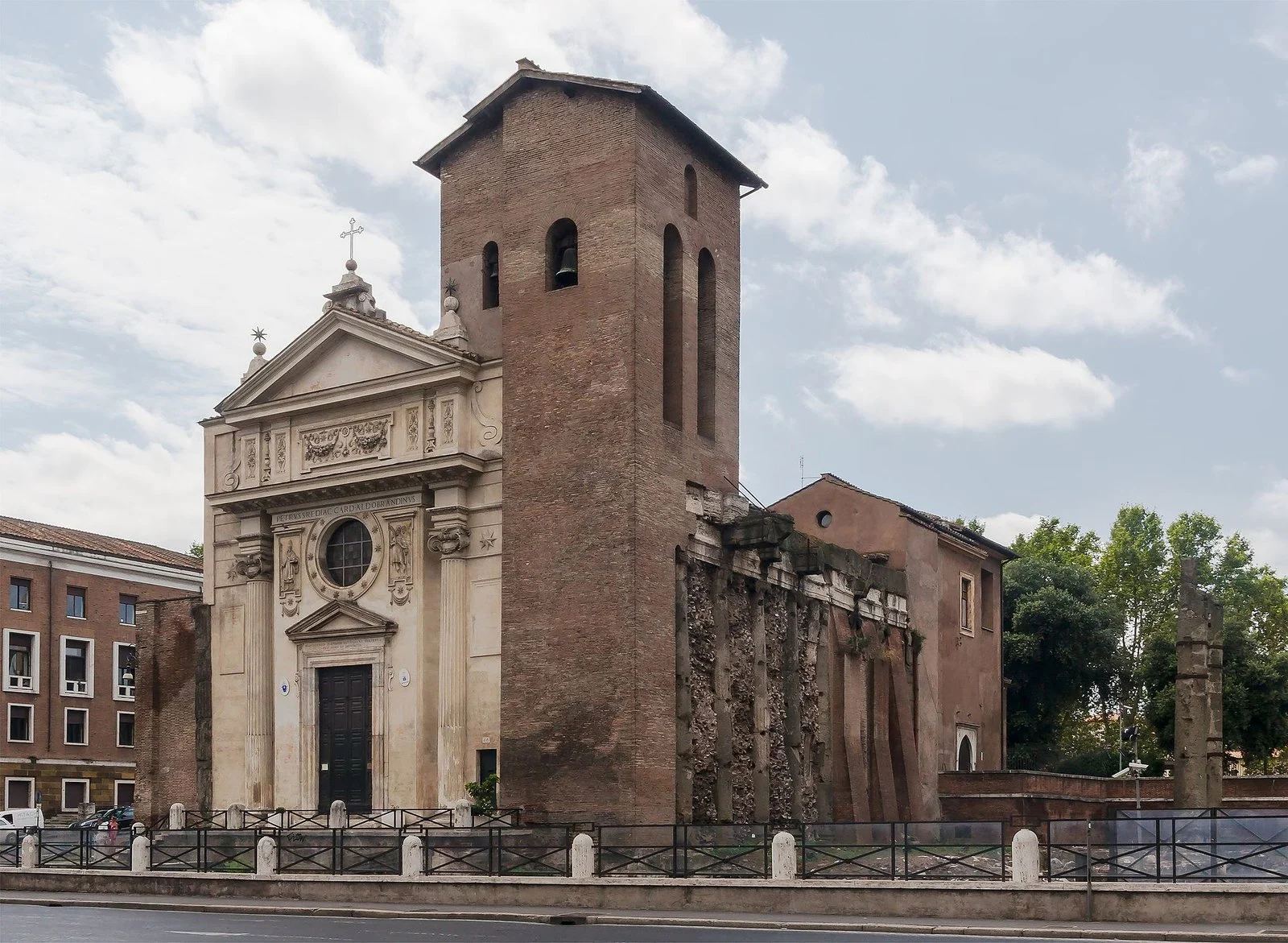
The Basilica of San Nicola in Carcere is on Via del Teatro di Marcello, in the Sant'Angelo district, a stone's throw from the Theater of Marcellus, the Mouth of Truth and the Capitoline Hill. It is a church in use, with regular masses and liturgical events, built over the remains of three Republican temples of the Forum Holitorium, the ancient market of vegetables and oil that stood between the Tiber and the Capitoline Hill. The ancient columns still emerge in the outer walls, the medieval bell tower grows out of a defensive tower of the Pierleoni family, and under the floor of the church you descend to the podia of the three temples, to the alleys that separated them and to the shops of the money changers who worked there when this was a market and river port area. The facade you see today is the work of Giacomo Della Porta, from 1599.
What makes this address special is not only the sum of the eras, Republican, late antique, medieval and Baroque, but the fact that none of these eras ever truly erased the previous one. In Rome you often visit an isolated ancient monument, fenced off, turned into an archaeological area separate from the daily life of the city. Here instead the Roman temples are still the load-bearing structure of a building where mass is celebrated on Sundays. Whoever enters this basilica is not visiting a museum devoted to the past: they are entering a place that has kept functioning, changing function and face, for more than 2,000 uninterrupted years, from the vegetable market of the Forum Holitorium to today's parish.
Where the Basilica of San Nicola in Carcere is and how to get there
The address is Via del Teatro di Marcello 46, on the side facing the Tiber, on a stretch of street that in antiquity was the heart of the Forum Holitorium and today is one of the most walked axes of the historic center. On one side is the Theater of Marcellus with its exedra-shaped front, on the other the Capitoline Hill and the Vittoriano, and a few minutes' walk away are the Portico of Octavia, the Jewish Ghetto and Tiber Island. It is an almost obligatory passing point for those walking between the Capitoline Hill and Trastevere, which explains why so many visitors arrive by chance, often without knowing that behind that 17th-century facade three Roman temples are hidden.
On foot, by bus and by taxi
From the Capitoline Hill it takes less than 10 minutes on foot going down Via del Teatro di Marcello. From Piazza Venezia the route is just as short, skirting the side of the Vittoriano complex. Several surface bus lines pass along this axis and the nearby Via Petroselli, so the most convenient stop should be checked on the Roma Servizi per la Mobilità site the same day, because routes are changed fairly often for works or events in the center. The nearest metro stop is Colosseo, on Line B, from which you walk about a quarter of an hour past the Imperial Forums and the Capitoline Hill: a walk worth the detour, because it passes in sequence some of the most photographed monuments of Rome. Those arriving by taxi can be dropped directly on Via del Teatro di Marcello, where however stopping is regulated by limited traffic zones and cameras: better to let passengers off and move on, without stopping double-parked.
By car and nearby parking
The area between the Capitoline Hill, the Theater of Marcellus and the Circus Maximus falls within the limited traffic zone of the historic center, active during daytime hours on weekdays: those without a permit risk a fine, and the recommendation, valid for anyone planning a day around here, is to leave the car in one of the paid parking lots outside the ZTL, for example toward the Circus Maximus or the Aventine, and continue on foot or by public transportation. The basilica has no parking of its own and the surrounding streets, narrow and one-way, offer no convenient stops even outside ZTL hours.
An easy landmark to spot
Those who don't yet know the center of Rome well can orient themselves with a simple trick: the basilica stands exactly where Via del Teatro di Marcello curves following the outline of the Roman theater, at a point where the modern road axis follows almost literally the ancient road layout of the Forum Holitorium. From the Capitoline Hill you just go down toward the river with the Vittoriano behind you: the shape of the theater, with its superimposed arches, appears almost immediately on the right, and the facade of the basilica faces onto the opposite side of the same street, a few meters away. You don't need a detailed map: just follow the outline of the Roman theater to get there without mistakes.
The Sant'Angelo district, the urban setting of the basilica
The Basilica of San Nicola in Carcere stands in the Sant'Angelo district, one of the smallest districts by extent in the whole of historic Rome, wedged between the Capitoline Hill, the Tiber and the Portico of Octavia. Despite its small size, it is one of the stretches of the city with the highest concentration of ancient monuments per square meter: in the same district, besides the basilica with its three temples, are the Theater of Marcellus, the Portico of Octavia, the church of Sant'Angelo in Pescheria and a good part of the Jewish Ghetto. The name of the district derives precisely from this last church, dedicated to the Archangel Michael, which stands inside what remains of the ancient Augustan portico.
A history of overlapping markets
What strikes you, walking the district, is the continuity of the commercial vocation of the place across the centuries. Where in antiquity stood the vegetable market of the Forum Holitorium, in the Middle Ages the fish market settled inside the Portico of Octavia, and even today the district keeps food shops, restaurants and neighborhood markets that make it one of the liveliest quarters from the gastronomic point of view in the whole historic center. The Basilica of San Nicola in Carcere, with its temples originally dedicated to an ancient market, thus fits into a line of continuity that runs through 2,200 years without ever breaking entirely.
What the Basilica of San Nicola in Carcere is today
Before going down into the underground, it's worth pausing a moment in front of the facade, because it already tells on its own the layering of the place. The basilica is one of the oldest diaconiae of Rome, documented as an institution already in the 6th century, when diaconiae were centers of assistance to the poor run by the Church in the working-class districts of late antique Rome. A plaque dated 1128 attests the rebuilding of the church under Pope Honorius II and its dedication to Saint Nicholas of Bari, wanted by the Greek community that then lived in large numbers in this part of Rome, close to the river port and the markets. In the 11th century the building was also known as the church of Petrus Leonis, from the name of the powerful Pierleoni family, which had one of its urban fortifications here: the bell tower you see today, in brick, with mullioned windows and little arches, was born precisely as a defensive tower of the house, later adapted into a bell tower.
The Pierleoni tower and the struggles of medieval Rome
In the 11th century Rome was not yet the city unified under a single power that it would later become: it was broken up among the great baronial families, who controlled whole districts by turning churches, bridges and ancient buildings into private fortresses linked to each other by walls and towers. The Pierleoni, one of the most powerful houses, of Jewish origin converted to Christianity, controlled precisely this area near the Tiber and the river port, strategic for the control of commercial traffic and for its proximity to Tiber Island, which the Pierleoni dominated together with the bridge that connected it to Trastevere. The tower erected over the remains of the temple of Janus, later turned into the bell tower of the basilica, was part of this family defensive system, designed to withstand the sieges of rival families during the frequent struggles for control of the city and, in some cases, for the very election of the pope.
The facade by Giacomo Della Porta
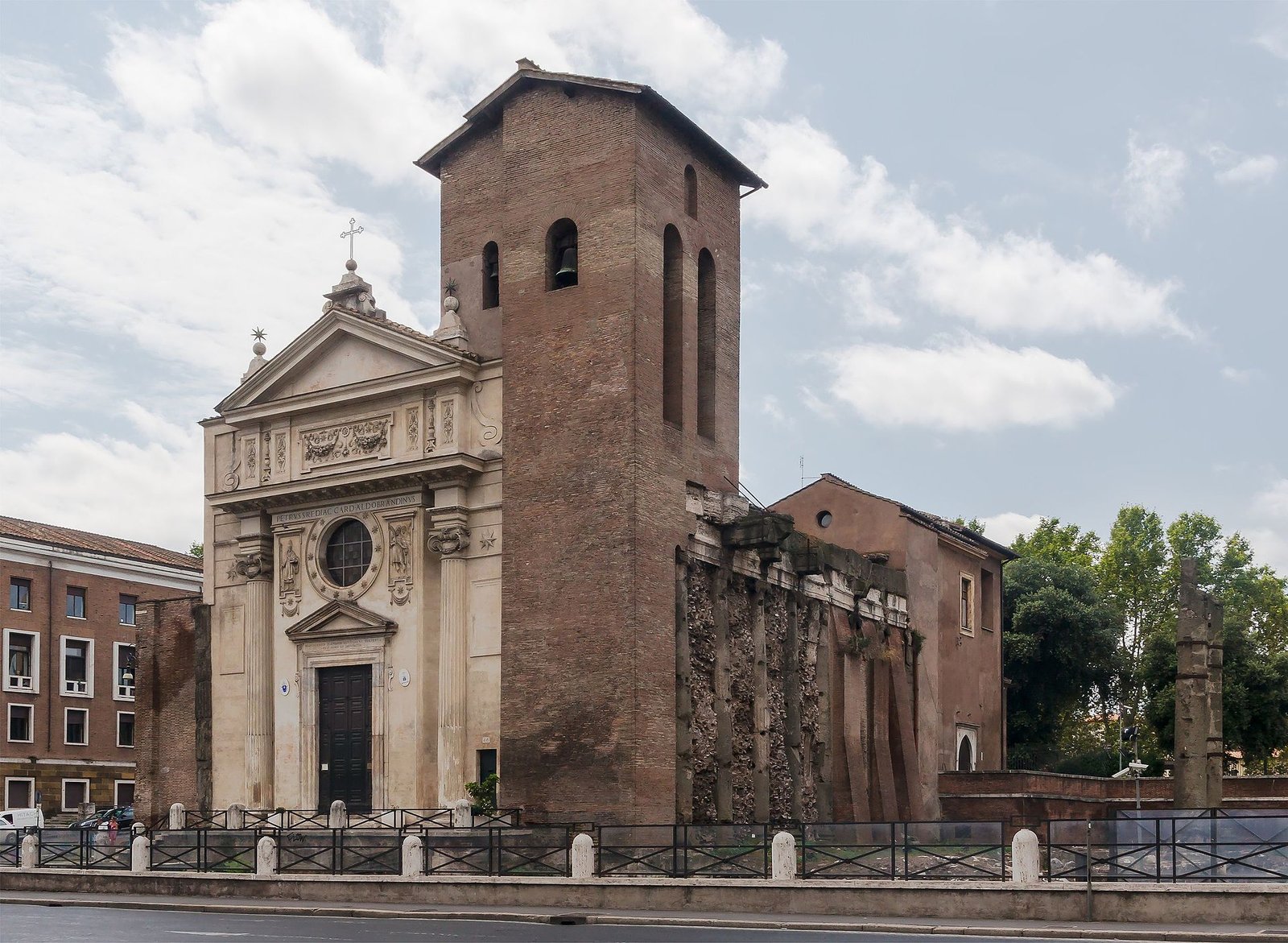
The present appearance of the facade dates to 1599, when the church was redone on commission of Cardinal Pietro Aldobrandini to a design attributed to Giacomo Della Porta, the same architect who left his mark on dozens of Roman facades between the late 16th and early 17th century. The solution is sober, in line with the taste of the Counter-Reformation: a simple architectural order, a triangular pediment, few decorations. What surprises, and it is the reason it is worth slowing down instead of rushing past, are the three fluted column drums set into the right side wall, survivors of the northernmost of the three temples: ancient stone walled into a Baroque facade, without anyone having hidden it.
The interior and the works preserved
Inside, with three aisles, the ceiling is of wooden coffers and on the high altar is preserved a canvas by Guercino with the Trinity and the angels. Under the same high altar is kept an ancient basalt basin, reused as a reliquary for the remains of some martyrs: an object that, like the columns in the facade, has been part of the masonry for centuries and not a museum piece added afterward. The basilica also houses a copy of Our Lady of Pompeii and a painting of Our Lady of Guadalupe, sent from Mexico City in 1773, evidence of the ties between this parish and the Marian devotions of the Spanish-speaking world. Since 1931 the parish in the administrative sense has been suppressed, but the church remains entrusted to the Clerics Regular of the Mother of God, who celebrate the services there, and it figures among the Lenten station churches, that is, among those in which the Roman tradition provides for a dedicated liturgy during Lent.
The three aisles are marked by reused ancient columns, coming in part from the very temples of the Forum Holitorium on which the church is built: a detail that the most attentive visitors notice when they observe how the shafts differ slightly in material and diameter from one column to another, a sign that they were gathered from different buildings and readapted to a new structural function when the basilica took its definitive form. It is a practice common to many Roman churches built between late antiquity and the early Middle Ages, when quarrying new marble was a luxury almost nobody could afford and reusing the columns of temples fallen into disuse was the most rational choice, as well as the cheapest.
The three Republican temples of the Forum Holitorium under the basilica
The Forum Holitorium was the Roman market for vegetables and oil, located just outside the ancient Servian Walls, near the river port on the Tiber where the boats supplying the city with foodstuffs docked. Between the 3rd and 2nd century BC, in this mercantile square, the Romans raised three temples side by side, today incorporated into the structure of the basilica: their podia are in the underground and some of their columns remain visible, walled in, in the outer flanks of the building. It is one of the clearest cases in Rome of continuous layering between the Republican era, late antiquity and the Middle Ages, all concentrated in a single block.
The attributions, a point on which the sources don't agree
On which temple was dedicated to which deity scholars have never reached a unanimous agreement, and honesty requires that this be said clearly instead of picking a version at random. The northernmost temple, the best preserved of the three, with a nearly intact podium and a triple colonnade of the Ionic order, is attributed with relative agreement to the god Janus: it would have been built by the consul Gaius Duilius after the naval victory of Milazzo, in the First Punic War, around 260 BC, and restored later under Tiberius. On the two southern temples, instead, the sources openly diverge: one part of the tradition attributes the southernmost podium, the smallest, of the Doric order and in travertine, to the goddess Juno Sospita, while placing in the center the temple of Spes, the personification of Hope. Another part reverses the attribution, placing Spes to the south and Juno Sospita in the center, precisely at the point on which the medieval basilica was built. The temple of Spes, according to ancient literary sources, was erected during the First Punic War by the consul Atilius Calatinus, then restored in 212 BC and again by Germanicus in AD 17. That of Juno Sospita is dated between 197 and 194 BC, on the initiative of the consul Gaius Cornelius Cethegus. Whoever goes down into the underground can verify for themselves how close together the space between the three podia is, and it is precisely this physical closeness that has made it difficult, over the centuries, to tell one temple from another with certainty.
What you see in the underground
The stairs under the high altar go down to the level of the ancient podia. You walk between the retaining walls of the three temples, in the narrow corridors that were once alleys of the Forum Holitorium market, with remains of what the archaeological sources describe as money changers' shops, that is, of the operators who exchanged coin for the market's merchants. In some stretches traces of later burials remain, because the underground was also used as a place of interment in late antique and early medieval times, when the commercial function of the area had long since ended and the Christian church had already settled over the ruins.
The Forum Holitorium, the market that preceded the basilica
To understand fully what lies hidden under the Basilica of San Nicola in Carcere you have to widen your gaze beyond the three podia and reconstruct what the whole square in which they stood was like. The Forum Holitorium occupied the flat space between the Capitoline Hill and the Tiber, just outside the line of the Servian Walls, the ancient defensive circuit built in the 6th century BC and traditionally attributed to King Servius Tullius. The name derives from the Latin holera, that is, vegetables: it was the market where the city was supplied with greens, legumes and oil, a role complementary to that of the nearby Forum Boarium, devoted instead to the cattle trade, and located a few steps farther south, where Piazza della Bocca della Verità is today.
A river port at the city gates
The position was not accidental. The Forum Holitorium stood right beside the river port on the Tiber, the point where boats coming from the Latium hinterland and from the sea went up the river to unload goods destined for the capital. Grain, oil, wine and agricultural products arrived by water and were sorted precisely in this square, before being distributed in the districts of the city. The three temples were built in this strongly commercial context, not in an isolated sacred area like the nearby Capitoline Hill: they were market temples, dedicated for the most part to deities linked to military victories and civic virtues, visible to anyone passing through on business along the road skirting the river.
The 19th-century excavations that brought the temples back to light
For centuries, after the construction of the medieval church, the remains of the temples were simply incorporated into the masonry, without anyone having full archaeological awareness of them: they were reused ancient stones, not a site to be excavated. The scientific rediscovery of the area took place mainly between the end of the 19th and the early 20th century, as part of the great season of studies on ancient Rome that also involved other monuments of the historic center brought to light in that period. The excavations made it possible to isolate the three podia, to document the columns walled into the flanks of the building and to reconstruct, on the basis of ancient literary sources, the chronological sequence of the constructions and of the later restorations. It is from that work of excavation and reading of the sources, carried out by several generations of archaeologists, that a good part of what is told today to visitors in the underground derives.
A curiosity about the Basilica of San Nicola in Carcere
The very name of the basilica is a small historical misunderstanding that became tradition. Starting in the 14th century popular memory identified the place with the Tullianum Prison, the famous Mamertine Prison at the foot of the Capitoline Hill where, according to Christian tradition, Saint Peter was imprisoned. In reality a different prison stood here, of the Byzantine era, recorded by the sources as Carcer ad Elephantum, probably because it was near a place where elephants destined for spectacles were kept. Neither structure has anything to do with Saint Peter: the overlap between the real Mamertine Prison, a few hundred meters away, and this building is a medieval misunderstanding that nevertheless remained carved forever in the name of the church.
There is then a second lead, less known and equally interesting, linked precisely to the underground spaces: some scholars have proposed that the vaulted rooms discovered under the church, those mistaken for prison cells, were actually the shops of the market's money changers, that is, commercial offices and not places of confinement. If this reading is correct, the name in Carcere would arise from a double misunderstanding overlaid across the centuries: first a commercial space mistaken for a prison, then a minor Byzantine prison mistaken for the famous Mamertine Prison of Saint Peter.
Something nobody tells you about the Basilica of San Nicola in Carcere
What is rarely told to passing visitors is that the Basilica of San Nicola in Carcere was, for centuries, the titular seat of some of the most powerful figures in the history of the Church, even before they became popes. Among the titular cardinals of this church are Giovanni Gaetano Orsini, who would later become pope with the name Nicholas III between 1277 and 1280, and Rodrigo Borgia, titular cardinal here before being elected pope in 1492 with the name Alexander VI, one of the most debated pontiffs of the Renaissance. A small neighborhood church, wedged between a Roman theater and a medieval market, thus served as a stage in the ecclesiastical career of two of the best-known pontiffs in Roman history, well before they wore the triple tiara.
There is then a second little-told element, and it is the story of the legend of the Roman Pietà, which popular tradition has tied to this place though concerning, according to ancient sources, a wider area of the Forum Holitorium and the nearby Porta Carmentalis. According to the account handed down by Valerius Maximus and taken up by Pliny the Elder and by Festus, a man condemned to die of hunger in prison survived because his daughter visited him every day and, having just given birth, secretly nursed him with her own milk. Once the act was discovered, the Roman magistrates, struck by the woman's filial piety, pardoned the prisoner and had a temple dedicated to Piety erected on the spot. Pliny reports a variant in which the nursed prisoner was the mother and not the father. The story, known as Roman Charity, has run through centuries of art: Caravaggio painted it in Naples in the Seven Works of Mercy, and the Dutch painter Ferdinand Bol, a pupil of Rembrandt, left a version of it kept at Palazzo Corsini in Rome. In the 19th century Roman women kept alive the memory of this charity by coming to nurse, right at this basilica, abandoned children who were not their own: a gesture of continuity between an ancient myth and a very concrete practice of assistance.
The advice I give you for visiting the Basilica of San Nicola in Carcere
Entering the church is open and free, as for the great majority of Roman churches open for worship, but the underground with the three temples is not visited simply by pushing a door: access is regulated and takes place through guided tours organized by cultural associations specialized in underground Rome, generally by reservation and for a fee. Before planning the day, the most useful advice that can be given is to check in advance the calendar and availability of the tours, because there is no fixed continuous opening time for the underground comparable to that of a museum, and it happens that you find the door that goes down to the temples closed if you haven't booked a few days ahead. The guided tours generally last an hour, are held in small groups so as not to crowd the narrow spaces of the underground, and are led by guides who explain both the archaeological layering and the history of the basilica above.
What to allow for before going down
The underground spaces are narrow, with low ceilings in some stretches and uneven paving: it is not a route designed for those with significant mobility difficulties, and those who suffer from claustrophobia should know before booking. No particular clothing is required, but a pair of comfortable shoes helps, because the difference in level between the nave of the church and the podia of the temples is covered by narrow and not always regular steps. The practical advice is to pair the basilica with a wider walk in the Sant'Angelo district: you go down to the temples, come out, and in a few minutes on foot you reach the Portico of Octavia, the Jewish Ghetto with its typical cuisine and Tiber Island, so as to fill a whole morning without needing to move by car or public transportation.
When to go to avoid the crowd
Via del Teatro di Marcello is one of the most traveled streets of the historic center, because it links two of the most visited points of Rome, the Capitoline Hill and the Circus Maximus area, and in the middle hours of the day the flow of tourists heading to the Theater of Marcellus or the Mouth of Truth is constant. The basilica, precisely because it is less known, almost always stays quieter than the nearby monuments: early morning, just after opening, and late afternoon are the moments when you most easily find yourself almost alone in front of the facade and, if the visit is booked, also in the underground. Another practical piece of advice concerns booking the guided tour: the associations that organize access to the temples often work with limited groups for safety reasons in the narrow spaces, so booking a few days ahead, especially on weekends and in the months of high tourist season, avoids finding the places already sold out.
Another well-known fact, yet rarely mentioned
Those who study the ancient topography of Rome know well that the Forum Holitorium was not just any place: it was one of the most important markets of the city, together with the nearby Forum Boarium devoted to cattle, and its position, right beside the river port on the Tiber and the Servian Walls, made it an obligatory crossroads for those transporting goods from the hinterland and the river toward the urban center. The less repeated fact, however, is how long this commercial vocation survived even after the fall of the empire: the money changers who according to some reconstructions worked in the corridors now interpreted as the basilica's underground confirm that the area continued to be a place of economic exchange well beyond the era of the temples, in a phase when a good part of the rest of the Roman Forum was already reduced to pasture. The continuity between ancient market and medieval commerce, in this corner of Rome, never truly broke: it only transformed, passing from grain and oil to money and currency exchange.
A second little-told aspect concerns the material survival of the three temples. They are not isolated ruins, fenced off and turned into an archaeological park separate from the urban context, as happened with other Roman temples: they have literally become the foundations and load-bearing walls of a building in continuous use for 15 centuries. The columns of the temple of Janus, walled into the flank of the church and into the masonry of the bell tower, are not a fragment displayed for tourists, but a structural part of a building that continues to hold up a roof and to host religious services every week. Few places in Rome show with this physical evidence the principle according to which the ancient city did not disappear beneath the modern one, but was reused, stone on stone, to build the one that followed.
A third element, even less cited in generic tourist guides, concerns the relationship between the basilica and the Forum Boarium a little farther south, where two other Republican temples stand, that of Hercules Victor and that of Fortuna Virilis, today known as the temple of Portunus. The two groups of temples, those of the Forum Holitorium incorporated into San Nicola in Carcere and those of the Forum Boarium near the Mouth of Truth, belong to the same construction season and the same Republican architectural language, and yet they have had opposite fates: the temples of the Forum Boarium survived isolated and visible in plan, while those of the Forum Holitorium survived hidden inside the masonry of a church. Comparing the two sites, which are a few minutes apart, offers a rare case study on two different ways in which Rome has preserved, by pure accident of history, its Republican past.
The right photo to take at the Basilica of San Nicola in Carcere
The most effective photograph is not the frontal one of Della Porta's facade, which is elegant all the same, but the one taken from the side, on the right flank of the building along the sidewalk of Via del Teatro di Marcello, framing together the 17th-century Baroque masonry and the three fluted column drums of the temple of Janus that emerge from it without any mediation. In a few centimeters of frame 2,200 years of Roman history are compressed, and it is an image far more eloquent than any caption. The best light is that of late afternoon, when the low raking sun lights the flutes of the columns from the side and accentuates their relief against the smooth wall around them.
Those who manage to book the visit to the underground find a second equally strong subject: the shot that catches, in the same frame, the tuff-block podium of one of the Republican temples and, right above, the medieval masonry vaults that support the floor of the modern church. It is the most direct image of Roman layering that can be found in the center, and precisely for this reason, in the narrow spaces of the underground, it is best to let the rest of the group go ahead to have a few extra seconds without people in the frame.
A third option, less obvious but just as effective, is the photo taken from the opposite sidewalk, the one skirting the Theater of Marcellus, framing in a single plane the bulk of the Roman theater in the foreground and, in the background, the Baroque facade of the basilica with the medieval bell tower peeking out beside it. In few points of Rome can four eras so far apart be compressed into a single shot, from the Augustan age of the theater to the 17th century of the facade, passing through the Middle Ages of the Pierleoni tower. Those with a wide-angle lens find here one of the densest framings in history of the whole Sant'Angelo district.
Some important events that happened here in history
The sequence of events tied to this place covers an exceptionally long time span for a single Roman block. In the 3rd century BC, during the First Punic War, the consul Gaius Duilius had the temple dedicated to Janus erected after the naval victory of Milazzo over the Carthaginian fleet, one of the first great Roman successes at sea. In the same period, still in the context of the war against Carthage, the consul Atilius Calatinus promoted the construction of the temple of Spes. Between 197 and 194 BC the consul Gaius Cornelius Cethegus had the third temple raised, dedicated according to the most widespread tradition to Juno Sospita. In 212 BC and then in AD 17, under Germanicus, the temple of Spes was restored after damage suffered over time. The temple of Janus too was restored in the imperial era, under Tiberius. These imperial-era restorations show that the temples of the Forum Holitorium were by no means secondary structures forgotten after their construction, but buildings that the emperors still deemed worthy of maintenance centuries after the original foundation, a sign of the prestige that the market and its sacred area continued to hold in the religious topography of the city even in the full imperial age.
From temple to church
With the gradual abandonment of pagan worship between late antiquity and the early Middle Ages, the Forum Holitorium area lost its original function and the temples, by now in ruins, became building material for new buildings. Already in the 6th century a Christian diaconia existed here, that is, a center of assistance to the city's poor, the embryo of the future basilica. In 1128, under Pope Honorius II, the church was rebuilt and dedicated to Saint Nicholas at the prompting of the local Greek community: it is the act that marks, with a certain date written on a plaque still legible, the definitive passage of the place from a pagan temple area to a stable Christian building. In the 11th century the Pierleoni family had already installed one of its fortified towers there, later turned into the bell tower still seen today, a sign of how this point of the city, near the river and the commercial traffic, was strategic also in the struggles among the great families of medieval Rome. In 1599, under Cardinal Pietro Aldobrandini, the facade took on its present appearance thanks to the project attributed to Giacomo Della Porta. In 1931 the parish was suppressed in the administrative sense, though the church remained active and entrusted to the Clerics Regular of the Mother of God, who still look after its services.
Who has passed through the Basilica of San Nicola in Carcere
Among the figures tied permanently to this church, even before they wore the papal tiara, are at least two leading names in the history of the Catholic Church. Giovanni Gaetano Orsini was titular cardinal of San Nicola in Carcere before becoming Pope Nicholas III, pontiff from 1277 to 1280, belonging to one of the most powerful baronial families of Rome in the 13th century. Rodrigo Borgia held the same cardinalitial title before his election, in 1492, with the name of Pope Alexander VI, a central and controversial figure of the Renaissance papacy. Among the most recent titular cardinals is Silvano Maria Tomasi, named titular of the church in 2020.
On the artistic side, the strongest link with the basilica's international fame comes not so much from a work preserved inside it as from the legend that popular tradition has attributed to it: the story of Roman Charity, painted by Caravaggio in Naples in the great canvas of the Seven Works of Mercy, and taken up by the Dutch painter Ferdinand Bol, a direct pupil of Rembrandt, in a work now kept at Palazzo Corsini, a few minutes from here on the other bank of the Tiber. Whoever visits the basilica and then crosses the river toward Trastevere can thus find again, in another historic building of the city, the same legend told in the language of Baroque painting.
The Theater of Marcellus and the Portico of Octavia, the neighbors that explain the district
Nobody can truly understand the context of the Basilica of San Nicola in Carcere without taking into account the two ancient monuments that frame it immediately. The Theater of Marcellus, just to the north along the same street, was built by Augustus and dedicated to the memory of his nephew Marcus Claudius Marcellus, who died very young. With its front of two superimposed orders, Doric and Ionic, it is the model that a few decades later partly inspired the construction of the Colosseum, and for centuries, in the Middle Ages and the Renaissance, its structure was reused as a fortress and then as the base for a noble palace, the Orsini first and the Savelli afterward, before being returned, in modern times, to a use closer to the original one of a building for spectacles.
The Portico of Octavia and the entrance to the ghetto
A little farther on, past the flank of the basilica in the direction of the river, opens the Portico of Octavia, the great monumental enclosure built by Augustus and dedicated to his sister Octavia, which in the medieval era became the seat of a fish market, so that even today in the area there is a church named Sant'Angelo in Pescheria right inside what remains of the portico. From here begins the Jewish Ghetto of Rome, the district in which the Roman Jewish community, one of the oldest in Europe with a presence documented already in the Republican era, was forced to live enclosed from 1555 to 1870 by papal will, and which today is one of the places densest in history, traditional cuisine and memory in the city. Walking from San Nicola in Carcere to the heart of the ghetto takes a few minutes, and it is probably the quickest transition one can make in Rome between a Catholic place of worship and one of the symbolic neighborhoods of Roman Judaism.
What to see around the Basilica of San Nicola in Carcere
The position of the basilica, right between the Capitoline Hill and Tiber Island, makes it a natural starting point for a walk in the ancient heart of Rome. A few steps away is the Theater of Marcellus, the great Roman theater built by Augustus, whose exedra-shaped front closely recalls, on a reduced scale, the Colosseum of a few decades later. Continuing along the river you reach the square of the Mouth of Truth, with the famous marble mask and the Republican temples of the Forum Boarium, the ideal sister of the Forum Holitorium.
In the opposite direction, past the flank of the basilica, you enter the Portico of Octavia and the heart of Rome's Jewish Ghetto, one of the districts densest in history and traditional cuisine in the city, and from there in a few minutes you reach Tiber Island, with its two ancient bridges and the Fatebenefratelli hospital. Going up instead toward the hill you arrive at the Capitoline Hill, with the square designed by Michelangelo and the Capitoline Museums, the first public museum of the modern age. Those with a whole morning available can link all these places on foot, never moving more than a quarter of an hour from the basilica: it is probably the most efficient way to cross 2,700 years of Roman history in a space of a few hundred meters.
A half-day itinerary in the Sant'Angelo district
For those who want to organize their time efficiently, a reasonable order is this: you start from the Capitoline Hill in late morning, go down to San Nicola in Carcere and, if booked, take the visit to the underground. You come out and skirt the Theater of Marcellus to the Portico of Octavia. You cross the Jewish Ghetto, stopping for lunch at one of the historic trattorias of the area, known for Roman Jewish cuisine. In early afternoon you reach Tiber Island by crossing Fabricius Bridge, the oldest pedestrian bridge in Rome still in its original form. Finally, for those who still have energy, you end the day by crossing the river toward Trastevere. In practice it's a route that measures a little over a kilometer and a half on foot, but covers in sequence the Republican, imperial, medieval, Renaissance and contemporary eras without a break.
Beyond the district: Circus Maximus, Aventine and Trastevere
Those with more than half a day can widen the radius of the itinerary well beyond the Sant'Angelo district. South of the basilica, past Piazza della Bocca della Verità, opens the long expanse of the Circus Maximus, the ancient circus for chariot races that in its original form could hold tens of thousands of spectators: today it is a public park, open and free, a reference point for those looking for a moment of green respite in the heart of the ancient city. Going up from the Circus Maximus toward the adjacent hill you reach the Aventine, one of the quietest and most elegant residential neighborhoods of Rome, with its panoramic gardens overlooking the city and the famous view through the keyhole of the Priory of Malta, framed so as to show the dome of St. Peter's in the distance.
Crossing instead the Tiber at Tiber Island, with a walk of a few minutes over one of the oldest bridges of the city, you enter Trastevere, the quintessential working-class neighborhood of Rome, with its cobbled streets, Baroque churches and an evening scene among the most intense in the capital. The combination of San Nicola in Carcere, Tiber Island and Trastevere is one of the most balanced itineraries you can build in a single Roman afternoon, because it joins Republican archaeology, riverside Middle Ages and contemporary neighborhood life without ever requiring a trip by car or metro.
The Basilica of San Nicola in Carcere as a living church today
It's important to remember before planning the visit: San Nicola in Carcere is not an archaeological site disguised as a church, but a historic parish where masses, weddings, baptisms and the other ordinary functions of Catholic liturgical life are celebrated. The times of services follow the calendar set by the Clerics Regular of the Mother of God, who look after the community, and can vary between ordinary periods, holidays and Lent, when the basilica takes on the role of station church in the Roman tradition of the Lenten stations. Those planning a tourist visit should take this into account with respect, avoiding entering or walking around with a camera during religious services and reserving the in-depth visit, especially the one to the underground, for the times dedicated to guided tours.
The liturgical calendar and special occasions
Besides the ordinary celebrations of the week, the Basilica of San Nicola in Carcere follows the calendar of the main feasts of the Roman rite, with particular prominence in the period of Lent, when the church is included among the stops of the Lenten stations, a tradition dating back to the early centuries of Roman Christianity that provided for a stational procession of the faithful, led by the pope or his representative, toward a different church of the city every day of the penitential period. Still receiving this role today means that the basilica is not perceived, in the pastoral practice of the diocese of Rome, as a simple secondary tourist stop, but as one of the historic nodes of the network of churches that make up the religious identity of the city for more than 1,500 years.
A place of popular devotion still today
The presence of the copy of Our Lady of Pompeii and the painting of Our Lady of Guadalupe are not simple historical furnishings: around these images a living devotion still gathers, fed also by the Spanish-speaking and Latin American community that attends the basilica. It's a trait shared by many churches of Rome's historic center, often perceived by visitors as pure artistic stops, but in reality still fully active as places of daily faith for those who attend them continuously, beyond the flow of tourists that crosses their nave during the day.
The judgment with which it's best to close this account is simple: the Basilica of San Nicola in Carcere remains, despite its very central position between the Capitoline Hill and Tiber Island, one of the least crowded and most underrated places in the ancient heart of Rome, and precisely for this reason it is one of the stops I recommend most convincingly to those who have already seen the great classic attractions and are looking for something that adds depth to their understanding of the city. You don't need a whole day to appreciate it: one hour of visit is enough, perhaps with the booking for the underground, to understand how three temples from 2,200 years ago literally continue to hold up the roof of a church in which, every week, mass is still celebrated.
Frequently asked questions about the Basilica of San Nicola in Carcere
Where exactly is the Basilica of San Nicola in Carcere?
The Basilica of San Nicola in Carcere is at Via del Teatro di Marcello 46, in the small Sant'Angelo district, between the Capitoline Hill and Tiber Island, a few steps on foot from the Theater of Marcellus, the Portico of Octavia and the entrance to Rome's Jewish Ghetto, in one of the stretches densest in ancient monuments of the whole historic center.
Is it free to enter the church?
Yes, entrance to the Basilica of San Nicola in Carcere is open and free during the hours of opening for worship, as is the case for the great majority of Roman churches. Payment applies only to the guided visit to the underground with the three Republican temples, not to the nave of the church.
How much does it cost to go down into the underground?
The Basilica of San Nicola in Carcere organizes access to the underground through paid guided tours run by cultural associations, generally by reservation. The exact fee and available dates should be checked directly with the association that runs the chosen tour, because they can change during the year.
Are there stairs?
Yes, to reach the temples under the Basilica of San Nicola in Carcere you go down narrow and not always regular steps, into spaces with low ceilings in some stretches. The route is not suitable for those with significant mobility difficulties or who use a wheelchair.
Why is it called in Carcere?
The name of the Basilica of San Nicola in Carcere derives from a medieval misunderstanding: starting in the 14th century popular tradition identified the place with the famous Mamertine Prison linked to Saint Peter, whereas in reality a minor prison of the Byzantine era stood here, recorded by the sources as Carcer ad Elephantum.
Who were the gods of the three temples under the basilica?
Under the Basilica of San Nicola in Carcere are three Republican temples of the Forum Holitorium: the best preserved, to the north, is attributed with relative agreement to the god Janus, while on the other two, generally referred to Juno Sospita and the goddess Spes, the ancient sources and modern scholars do not agree on which is which.
How long does the visit to the underground last?
The guided tours of the underground of the Basilica of San Nicola in Carcere generally last about an hour and are held in small groups, to respect the narrow spaces of the ancient corridors between the podia of the three Republican temples, with stops dedicated to each of the three sacred buildings and to the history of the Byzantine prison from which the church takes its name.
Can you visit the basilica together with the Theater of Marcellus and the Mouth of Truth?
Yes, the Basilica of San Nicola in Carcere is a few minutes' walk from both the Theater of Marcellus and Piazza della Bocca della Verità, and it is possible to combine the three stops in a single morning walk in the Sant'Angelo district.
Is it true that two popes were titular cardinals of this church?
Yes, the Basilica of San Nicola in Carcere had as titular cardinals Giovanni Gaetano Orsini, later Pope Nicholas III, and Rodrigo Borgia, later Pope Alexander VI, both tied to this cardinalitial title before their election to the papal throne.
Article written by the editorial team of TourLeaderPro, contact them for Private/Corporate/V.I.P. Tours and Experiences. For a guided walk in the Sant'Angelo district, among the Forum Holitorium, the Jewish Ghetto and Tiber Island, with a licensed tour leader, start from the TourLeaderPro contact page.
Planning a trip to Rome? The English guides for visiting the city are on ItalyPlanner.com, which also devotes a section to the lesser-known churches and monuments of the historic center besides the great classic stops.