Piazza di Santa Maria in Trastevere
In short. Piazza di Santa Maria in Trastevere is the central square of Rione XIII, an irregular open space in front of the basilica of the same name, with an octagonal fountain raised on steps in the middle and no cars.
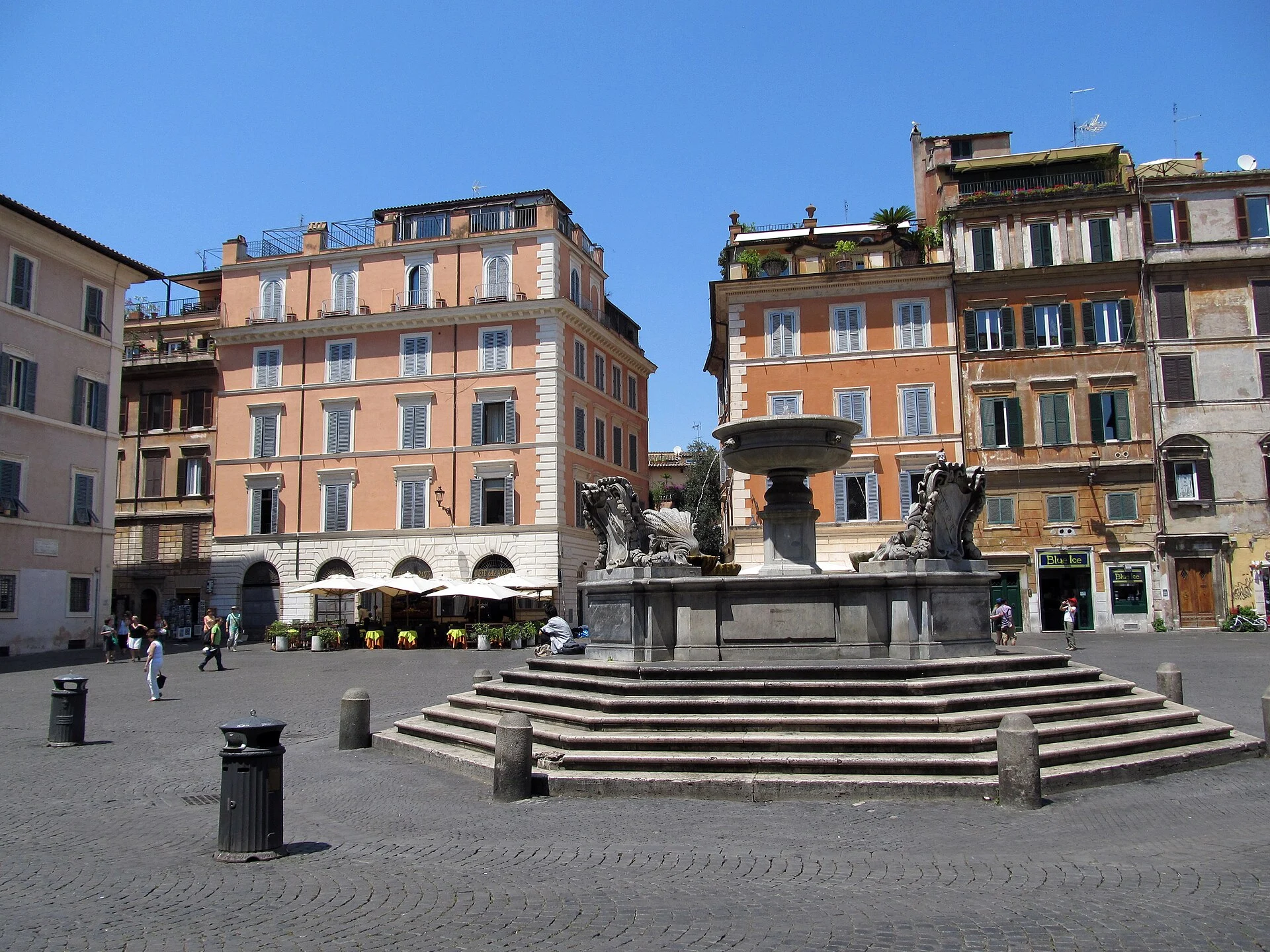
Piazza di Santa Maria in Trastevere is the central square of Rione XIII, an irregular open space in front of the basilica of the same name, with an octagonal fountain raised on steps in the middle and no cars. If you come from the avenue you find it after three minutes of alleys. Those who live here cross it four times a day. It is the point where Trastevere looks at itself in the mirror, and today the mirror gives back a very different image from the one of 30 years ago.
The square works for a physical reason before a historical one: it is closed on all sides, it has a single direction of visual escape (the Romanesque bell tower and the facade mosaic), and its only furnishing is a fountain with steps. An accidental amphitheater. That is why people sit, and why the square holds up even when it is full.
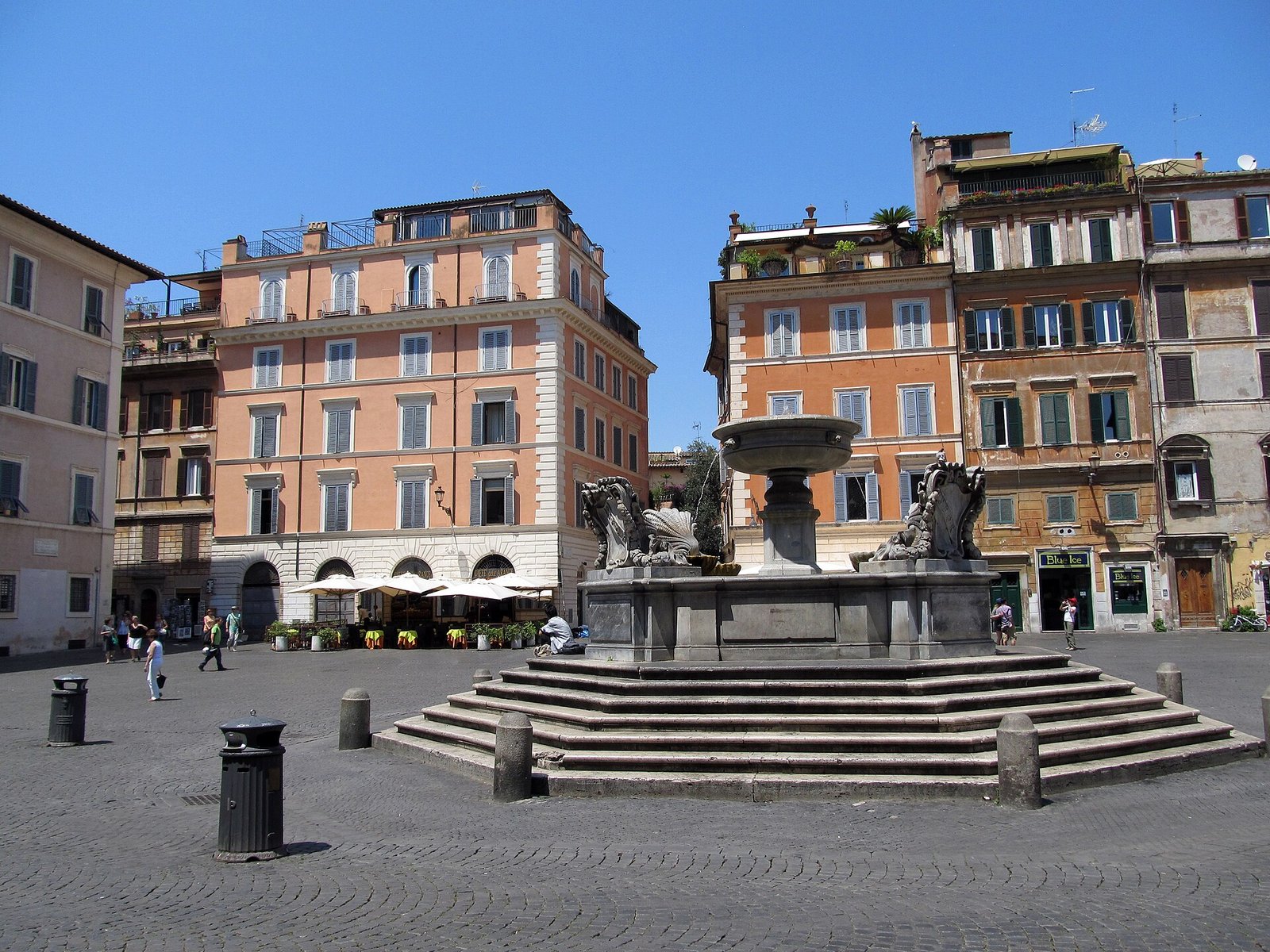
What You See Standing Still in the Middle
Turning around in the middle of the square you count four fronts, different in era and function. To the north the basilica with the 1700s portico and the 1200s mosaics on the facade. To the left of the church the Palazzo di San Callisto, Holy See territory. To the right the Canons' house. On the other sides small palazzi and altered row houses, with ground-floor shops almost all converted to restaurants.
The facade mosaic is the thing almost nobody looks at properly, because people go into the church without raising their eyes. It depicts the Virgin enthroned with the Child and a procession of female figures with lamps. By day against the light it is hard to read. The good light comes in the late afternoon, when the sun passes over the roofs on the opposite side and hits the facade full on.
The bell tower is Romanesque and carries high up, inside a niche, a small mosaic of the Madonna and Child. It is visible to the naked eye only if you move away to the south side of the square and look up: from the church threshold the niche stays out of the field of view. Opera glasses, in this case, are truly useful.
The paving is sanpietrini, with the ground sloping slightly toward Via della Paglia side. A practical detail, not an aesthetic one: when it rains the water collects in some hollows of the paving and the fountain's steps become slippery. With a group, after a storm, it's better to stand on the dry side instead of seating 20 people on wet travertine.
Where It Is and How You Really Get There
Piazza di Santa Maria in Trastevere opens in Rione XIII Trastevere, a few hundred meters from the Tiber, between Viale di Trastevere and the climb toward the Janiculum. The coordinates given by the Roma Capitale tourism portal are 41°53’21.76” N, 12°28’12.66” E. The square has no street number of its own: the addresses of the individual buildings are numbered on the square itself and on the streets that flow into it.
The rail option is the tram. On Viale di Trastevere run lines 8 (Casaletto, Venezia) and 3, and the useful stops are Trastevere/Ministero P. Istruzione and Trastevere/Mastai. From there you enter the alleys and in four or five minutes on foot you arrive at the square. Data checked against the available sources on September 28, 2026.
On tram 8 a concrete warning is needed. During 2026 the line was out of service for a long time for track works, with replacement bus shuttles, and the city press reported the return to regular service on September 21, 2026. Before counting on the tram for a timed transfer, it's best to recheck the status of the service on the transport company's site, because these suspensions repeat.
The buses that serve the Trastevere/Mastai stop, according to the schedules published on the infomobility services, are lines 23, 44, 75, 115, 280 and H, plus the night lines N3D, N3S and N8. The 23 and the 280 run on the lungotevere, so they leave you five or six minutes' walk away. The H and the 8 are the most direct for those coming from the center.
Inside the district the capillary service no longer exists: the electric minibuses that ran through the alleys have been permanently suspended since 2016. This means the last stretch is done on foot, always, and that for anyone with mobility difficulties the route from the stop to the square is all on uneven sanpietrini. It should be factored in when planning a visit with elderly people.
On foot from the historic center it is quicker than it seems. From Campo de’ Fiori you cross Ponte Sisto and in 12 minutes you are in the square. From Piazza Navona you need a good 20. From the Tiber Island, passing by Ponte Cestio, barely 10 minutes.
The Roma Trastevere railway station is not as close as the name leads you to believe. It is on the opposite side of the district, beyond Viale di Trastevere, and on foot it is a good 20 minutes uphill and downhill. Anyone arriving by train gets there faster by taking tram 8 to Mastai, as long as the tram is running. It is the most common planning mistake I see people make.
A Curiosity About Piazza di Santa Maria in Trastevere
The fountain in the middle was moved. It wasn't always there. In the arrangement described by the 1600s sources the basin was brought to the center of the square and raised on steps during the pontificate of Alexander VII Chigi, with the intervention attributed to Gian Lorenzo Bernini. Before then the fountain occupied a different position, and the square had a different center of gravity from the one we see today.
The move changed the social function of the open space. A fountain set against one side is a service point: you go, you take water, you go back. A fountain in the center with steps is a place where you stay. The circular stairway that today hosts guitarists, groups of friends and people eating gelato is the product of an urban planning choice of the 1600s, not of a spontaneous custom.
The four travertine shells that protrude from the basin are the detail that tells of two different hands. The first ones, double, belong to the Bernini arrangement. The current ones, larger and with upright valves, were replaced by Carlo Fontana toward the end of the 1600s. Anyone who looks at them in profile sees the difference in scale compared to the earlier layout, documented by prints of the period.
A curiosity within the curiosity: Carlo Fontana also worked on the church that stands opposite. The portico and facade of the basilica were redone in 1702 under Clement XI to his design. The same architect, therefore, signs the water point in the center and the monumental front to the north. The square that everybody photographs is, in its current form, largely a composition by that architect.
The Fountain: What the Sources Really Say, and Where They Diverge
Caution is needed here, because the sources don't tell the same story. The Sovrintendenza Capitolina sets the first certain fact at 1471: the fountain appears in Pietro del Massaio's map of Rome, with two basins of different sizes in the middle of a polygonal basin. Before that date the documentation becomes indirect and must be handled with care.
The chronology circulating online and in part of the popular literature starts much earlier. It speaks of an installation from the Augustan age fed by the Aqua Alsietina, the aqueduct built in 2 BC for the naumachia of Trastevere, and of an intervention by Pope Adrian I at the end of the 8th century. The weak point is the source: that report is documented by chronicles of the 1600s, not by contemporary testimony.
On the 1400s the versions still divide. One reconstruction attributes to Nicholas V, for the Jubilee of 1450, a square basin on steps with two circular basins on a pedestal. The Sovrintendenza's entry doesn't take up this phase and starts from the map of 1471. Anyone who writes about this fountain should state which of the two reconstructions they are following, which almost nobody does.
The Bramante Knot
The attribution to Bramante is the most cited and the least solid. Several popular sources date to 1496-1501 a restoration by Bramante that would have eliminated one of the two basins and decorated the surviving one with the wolf heads from which the water comes out. The Sovrintendenza Capitolina's entry places the same intervention in the pontificate of Alexander VI Borgia, commissioned by Cardinal Giovanni of Valencia, and does not name Bramante.
The two versions describe the same work, the elimination of the second basin and wolf-head spouts, and attribute it to different patrons and hands. There is not, in the current state of the accessible sources, a public document that settles the question in favor of Bramante. Anyone who guides groups would do well to say that the attribution circulates, and that the municipal body in charge of the fountain doesn't endorse it.
1604, Della Porta or Rainaldi
The year 1604 appears in all the reconstructions, but with different names. The Sovrintendenza indicates works by Girolamo Rainaldi, plausibly tied to the arrival of the Acqua Felice in Trastevere. Other sources name Giacomo della Porta, sometimes together with Rainaldi. The municipal tourism portal speaks, for the same year, of a restoration ordered by Clement VIII without naming the architect.
The reason for the intervention, and the sources agree on this, is hydraulic before it is aesthetic. The Aqua Alsietina, the ancient water supply of the area, was poor-quality water and by then inadequate. The arrival of the Acqua Felice, and later the better supply from the Traiano-Paolo aqueduct, put the fountain back under pressure. Without water there is no fountain, and the history of Roman fountains is first of all a history of aqueducts.
Bernini and Carlo Fontana: the dates wobble here too
For Bernini's intervention the Superintendency generically gives the pontificate of Alexander VII, that is, the years 1655-1667. Other reconstructions say 1658, the city's official portal 1659. The content of the intervention is agreed: moving it to the center of the square, raising it on steps, four double shells, a better water supply from the Traiano-Paolo.
For Carlo Fontana the range is between 1692 and 1694. The Superintendency and the city's tourism portal give 1692, under Innocent XII Pignatelli. Other sources say 1694. The work is the same: enlarging the travertine basin and replacing Bernini's shells with larger ones, with the valve upright. Two years of difference on a date that should be documented: it tells you how fragile the current literature is.
What is ancient and what is not
The detail that cools the enthusiasm dates to 1873. That year the city rebuilt the fountain following the 1692 model, but in gray bardiglio. The main basin you touch with your hands today is therefore a nineteenth-century reconstruction on a seventeenth-century design. A further restoration is recorded in 1984. Overall materials: marble, travertine and bronze.
The latest works closed in 2025, within the Caput Mundi program financed by the PNRR. Those who saw the fountain in the years immediately before remember it darker, with the limescale deposits plainly visible. Four inscriptions run around the basin, recalling restorations between the late fifteenth and the nineteenth century: you read them by walking around, with patience and the right light.
Something nobody tells you about Piazza di Santa Maria in Trastevere
The line you will hear repeated is that this is the oldest fountain in Rome still working. It is a contested claim, and whoever says it rarely explains what it rests on. It rests on the presumed Augustan origin and on the intervention of Hadrian I in the 8th century, that is, on the two least documented items in the whole chronology.
The problem is not only one of sources. It is also one of definition. If by fountain you mean the visible object, the current one dates to 1873 on the 1692 model, and the claim to being first falls at once. If you mean the water point, that is, the continuity of a tap at that spot, the argument holds up better but becomes impossible to prove with documents.
My position is simple: it is perhaps the oldest fountain in Rome still working, and that "perhaps" is necessary. A guide who declares an uncertainty gains credibility on everything else in the story. A guide who fires off the superlative loses it at the first hard question.
Then there is a detail that almost always gets missed. The wolf-head spouts are not a generic ornament. The she-wolf is the sign of the city, and putting her to pour public water in a district that historically considered itself something other than Rome, with its own festival and its own dialect, is a political statement disguised as sculpture. Fifteenth-century Rome worked this way.
The Palazzo di San Callisto and the other buildings on the square
On the southern side of the square, to the left as you face the basilica, stretches the Palazzo di San Callisto. It is an extraterritorial zone of the Holy See in Italy under the Lateran Treaty: whoever enters is, legally, no longer on Italian territory. From the outside you would never say so, because the front is sober and has no flags or monumental display.
The history of the building is long and layered. It was the residence of the cardinals titular of Santa Maria in Trastevere. The sources say it already existed in the fourteenth century, with renovations under Eugene IV in 1434 and a sixteenth-century renewal linked to Cardinal Giovanni Gerolamo Morone. Paul V granted it to the Benedictine monks displaced by the enlargement of the Quirinale, and between 1610 and 1618 the church and convent were renovated.
In 1936 the architect Giuseppe Momo, the same name that recurs in other twentieth-century Vatican building sites, designed the construction of a new wing. The palazzo housed the Vicariate of Rome until 1967. Today it is the seat of many bodies of the Holy See, among them Caritas Internationalis, the Dicastery for Laity and Family and the Pontifical Academy of Latinity.
In the courtyard of the palazzo, according to tradition, is the well where Pope Callixtus I was martyred, the pope to whom the founding of the basilica in the 3rd century is traced. The courtyard is not open to the public and there is no ordinary visiting route. Those who get in do so for work reasons with the offices based there.
On the other side of the church, on the right, stands the house of the Canons. Local sources say it was built by Gregory IV in 828 for the canons of the basilica, with a Baroque remodeling in the seventeenth century that erased almost every external trace of that date. Walking past it looks like just another small palazzo: it is one of the buildings with the longest history on the square.
The rest of the perimeter is residential building reworked over the centuries, with the ground floors almost entirely taken up by food and drink businesses. It is the most visible change of the last 40 years and it does not concern only this square: craft workshops and neighborhood shops have given way to tables and outdoor seating, in a conversion that is almost total in the alleys around.
My advice for visiting Piazza di Santa Maria in Trastevere
Go at half past seven in the morning. It is not textbook advice, it is the result of quite a few years of trying. At that hour the outdoor seating is not yet set up, the delivery vans are done, the light comes in low from the east and hits the facade of the basilica. The square belongs to the people who live there: two or three people at the café, someone walking the dog, the shutters going up.
The second good window is around 16:30 in the cold months, when the low sun lights the facade mosaic and the square is not yet full. In summer that slot is unusable: it is hot, the square is saturated and the fountain steps are taken from early afternoon.
From 21:00 on the character changes completely. The square becomes the gathering point of the district's nightlife, with live music improvised on the steps, large groups and a noise level that makes it hard to talk. It is not dangerous, it is crowded. Whoever looks for the square of the photographs at that hour ends up disappointed, and rightly so.
For the basilica, the opening hours do not appear to be published in a stable and uniform form in the official sources one can consult, and they change with the celebrations. The practical rule: avoid Mass times, do not go in with bare shoulders, and consider that during services the visit to the apse area may be suspended. Asking in the sacristy costs 30 seconds and saves you embarrassment.
The Museo di Roma in Trastevere is a short walk away, in Piazza Sant'Egidio, and works as a plan B when it rains or when the square is impassable. Hours and fares change with the temporary exhibitions: check the civic museums' website before setting out, because closing days are not the same all year.
I advise against the classic mistake of treating the square as a 10-minute stop between two monuments. It works the other way around: you arrive, sit down, watch the square fill and empty. 20 minutes standing still teach more than a quick loop. If you have only one morning, cut something else and leave the time here.
The fountain steps: who sits, when, and the rules nobody reads
The circular steps are the only public furniture in the square. There are no benches, no greenery, no fixed shade. That is why the steps fill up: it is the only place to lean back without buying anything. Over the course of the day different crowds take turns, and whoever watches for an hour understands the sociology of the district better than by reading an essay.
In the early morning the steps are empty or nearly so. Mid-morning the first groups with a guide appear and use them as a lecture bleacher. In the afternoon come students, families with children, people waiting for someone. In the evening everything changes: knots of people, guitars, bottles, and the fountain becomes the center of a square that works like a provincial square in August.
On alcohol consumption and sitting in monumental areas the City of Rome periodically adopts seasonal ordinances, with bans that change from year to year and different time slots. There is no permanent rule valid at all times: the text in force has to be looked up case by case on the official website. The municipal police regulation in any case forbids climbing and sitting on monuments and basins.
The distinction that matters in practice is between the steps and the basin. Sitting on the edge of the basin, putting your feet in the water or climbing on the shells exposes you to a fine. The outer steps are tolerated and used by everyone. The municipal police pass mostly on summer evenings and step in on glass bottles more than on people sitting.
Operational advice for those who lead groups: the steps cannot hold more than 15 people sitting without blocking the way, and in high season they are almost always occupied. Better to plan the talking stop on the west side of the square, where there is more free space, and use the steps only as a visual reference while you tell the story of the fountain.
Another well-known fact, yet rarely cited
Everyone knows the basilica is very old. Few connect that age to the shape of the square. The church, in its present layout, is the reconstruction ordered by Innocent II starting in 1138, made with salvaged material taken from the Baths of Caracalla. The columns you see inside come from an imperial bath building, dismantled and reused.
The reuse is not a scholarly detail: it explains why the columns of the nave differ from each other in material and size. Medieval Rome built this way, taking where it found. The square in front formed as the forecourt of that church, and its irregular shape is the negative of the buildings that grew around it over the centuries, not a unified design.
Inside the basilica the apse mosaics with the Stories of the Virgin are by Pietro Cavallini and are dated to 1291. They are one of the key passages of Roman painting before Giotto, with a new attention to the plasticity of the figures. They can only be seen well with the light on: often the lighting has to be switched on with coins, and without coins you see little or nothing.
The tradition of the Fons Olei, the oil said to have gushed from the ground at the site of the foundation, is pointed out inside the church and is tied to the oldest title, the Titulus Calixti. A tradition, not an established fact. The same caveat as for the fountain applies: telling it as a legend works, passing it off as chronicle does not.
How mass tourism has changed the square, and a contrarian position
The visible change concerns the ground floors. The neighborhood shops have almost disappeared from the perimeter of the square and from the alleys immediately around, replaced by restaurants and by businesses aimed at tourist foot traffic. Those who live in the area do their shopping elsewhere. This is an observable fact, not an opinion: just count the signs on a full loop of the square.
The second change concerns the homes. The conversion of apartments into short-term tourist rentals has reduced the residential supply in the central districts, Trastevere included, and has been the subject of public debate in Rome for years, with calls for a moratorium and announcements of municipal regulation. The estimates in circulation vary quite a lot depending on the source and the method, so precise figures should be taken with caution.
The third change is about sound and hours. The square has stopped having a quiet night. The conflict between residents and nightlife is permanent and produces ordinances, complaints and periodic crackdowns on opening hours. Anyone looking for lodging overlooking the square needs to know this: noise until late at night is the rule, not the exception, and in the warm months it gets worse.
The contrarian position
Now the unpopular part. The dominant story says Trastevere was authentic and tourism ruined it. The historical reconstruction does not hold up. The district had already been upended twice before mass tourism existed: with the building of the Tiber embankment walls in the late nineteenth century, which erased the relationship between the district and the river, and with the demolition to open Viale del Re, today Viale di Trastevere.
The third transformation, the one that changed the social makeup, dates to the 1970s and 1980s and was done by Italians, not by foreigners. Professionals, artists, journalists and politicians bought homes at prices the district's working-class families could no longer afford. The turnover of residents begins there. Tourism arrives later and speeds up a process already under way.
The practical consequence of this reading is that blaming the individual visitor does little. The crux is the permitted use of properties and regulation, not the number of people sitting on the steps. Boycotting Trastevere gives no one a home back. Changing the rules on short-term rentals, possibly yes.
There is also an unpopular part on the other side: whoever says Trastevere is by now lost and it is better to go elsewhere gets the method wrong. It is not lost, it is crowded at certain times. At half past seven in the morning that square is still a Roman place, with Romans in it. The difference between a dead district and a crowded district is enormous, and worth holding on to.
Those who want to understand the district as a whole, and not just the square, will find the full picture on the page about Trastevere, while the history of the church is in the dedicated page on the Basilica of Santa Maria in Trastevere. The two pages cover what is only touched on here.
The right photo to take at Piazza di Santa Maria in Trastevere
The photograph everyone takes is a frontal one of the basilica with the fountain in the foreground, shot from the middle of the square. It always comes out the same, with the front in shadow for half the day and the outdoor seating in the frame. It works as a record, not as an image. If you want that one, take it and move on.
The photograph I recommend is a different one: stand on the south side, low, at the height of the steps, and frame the fountain backlit with the facade blurred behind. In the early morning, with the sun low from the east, the water coming out of the wolf-head spouts lights up and the jet reads as a white line. You need a short exposure time and patience.
For the facade mosaic you need a telephoto lens or at least a decent zoom, and you need late afternoon. From the ground, with a wide angle, the figures become unreadable and the perspective distorts them. If you only have your phone, take two separate shots, one for the square and one tight on the mosaic, instead of trying to keep everything in the same frame.
The bell tower with the mosaic niche can only be photographed from far away, from the opposite side of the square, accepting that the rest of the facade will come in crooked. It is one of those situations where perspective correction in post-production really matters. Those who shoot vertically and straighten afterwards get the best result.
A detail often ignored: the four inscriptions on the basin. Photographed in side light, when the incised letters take shadow, they tell the story of the restorations better than any caption. In the middle of the day, with flat light, they disappear completely. It is a photo to take early in the morning or in the last hour of sun.
A last recommendation, not very romantic: no tripod in the middle of the square at peak hours. You take up space in a place crossed by thousands of people, and you risk complaints. If you need stability, lean on the parapet of the steps or bring a tabletop tripod and use the edge of the fountain without climbing on it.
Some important events that happened here in history
The reconstruction of the basilica begun by Innocent II starting in 1138 is the event that gives the square the shape that still governs it today. Before that building site the open space existed, but the north front was different. From that moment the whole square orients itself toward the facade of the church, and every later intervention works inside that scheme.
The Jubilee of 1450 appears in the reconstructions as the occasion for a rearrangement of the fountain ordered by Nicholas V. The report is not repeated by all the sources, and the Superintendency's entry starts from 1471. It remains significant, anyway, that Jubilee years have set the rhythm of the interventions on the square for five centuries, exactly as happened with the restoration concluded in 2025.
The arrival of the Acqua Felice in Trastevere, at the start of the seventeenth century, is the infrastructure event that saves the fountain. Until then the area depended on the Aqua Alsietina, poor-quality water brought in the Augustan age for the naumachia. With the new supply, and then with the Traiano-Paolo tied to the Acqua Paola Fountain, the square changes water regime.
The moving of the fountain to the center under Alexander VII, in the years between 1655 and 1667, is the moment when the square becomes the one we know. Before, it was a transit space with a water point on the side. Afterwards it becomes a space with a center, and the center is a flight of steps. All the social life that follows descends from that decision.
The city's 1873 rebuilding falls in the first years of Rome as capital, when the Italian administration begins to intervene on the papal heritage. The choice to reproduce the 1692 model in gray bardiglio, instead of designing something new, shows a conservative attitude that in those same years was by no means the rule elsewhere in the city.
The passage of the Palazzo di San Callisto to extraterritorial status with the Lateran Treaty of 1929 changes the legal geography of the square. From that moment one of the four sides is no longer Italian territory. The construction of the new wing designed by Giuseppe Momo in 1936 and the transfer of the Vicariate, which stayed there until 1967, belong to that same season.
The restoration concluded in 2025 within the Caput Mundi program, financed by the PNRR, is the latest chapter. It gave back a clean basin and brought the inscriptions back into view. Anyone with photographs of the square taken in the five preceding years holds a document: the before and after comparison reads above all in the color of the bardiglio and in the limescale deposits.
Who passed through Piazza di Santa Maria in Trastevere
Pietro Cavallini worked here around 1291, and his building site in the apse of the basilica is one of the decisive moments of thirteenth-century Roman painting. Not an occasional passage: months of work on scaffolding, inside a church open for worship, in a district that was then working-class and productive. His Stories of the Virgin remain the main reason to go in.
Gian Lorenzo Bernini worked on the fountain in the years of the Chigi pontificate. It is the only case, in this square, in which a first-rank name of the Roman Baroque works on minor urban furnishing rather than on a monumental machine. The comparison with what he was doing in those same years in Piazza Navona is instructive.
Carlo Fontana is the real director of the square as we see it. His is the arrangement of the fountain at the end of the seventeenth century, his the design of the portico and facade of the basilica carried out in 1702 under Clement XI. Two interventions 20 years apart on the same space, by the same architect, are a rare thing in Rome.
Girolamo Rainaldi appears in the Superintendency's entry for the works of 1604. Giacomo della Porta appears in other reconstructions for the same year. One of the two, perhaps both, put his hands on this basin when the Acqua Felice arrived. The sources do not allow a certain choice, and it would be wrong to pretend otherwise.
Bramante is the name most often spoken in the square by guides and the least supported by public documents. That he worked in Rome in those years is certain, and his Tempietto is up above here, at San Pietro in Montorio, a 10-minute climb away. That he put a hand to this fountain is an attribution, not an established fact.
Giuseppe Momo, architect of the twentieth-century Vatican, signs the 1936 wing of the Palazzo di San Callisto. Cardinal Giovanni Gerolamo Morone, a leading figure of sixteenth-century church history, is linked to the sixteenth-century renewal of the same palazzo. These are names nobody says in the square and that explain more than half of the built perimeter.
What to put around it, if you have half a day
The square alone takes half an hour, basilica included. To build a coherent morning the recommended route starts from Ponte Sisto, crosses Piazza Trilussa, enters the alleys as far as Santa Maria della Scala, arrives in the square and continues toward Santa Cecilia on the other side of the avenue.
Those with more time and good legs climb to the Janiculum Hill for the view over the city, passing by San Pietro in Montorio and the Tempietto del Bramante. The climb is short but steep, and in summer it should be done early. At the top there is also Sant'Onofrio al Gianicolo, which almost nobody visits.
On the river side, a few minutes away, are the Botanical Garden, Villa Farnesina with Raphael's frescoes and the Galleria Corsini. Three visits that differ in nature and pace, all reachable on foot from the square in less than 10 minutes along Via della Lungara.
To the south the district continues with San Crisogono on Piazza Sonnino, San Francesco a Ripa with the Blessed Ludovica Albertoni, San Benedetto in Piscinula and Sant'Agata. On Sunday morning, for those who can stand the crowd, there is Porta Portese.
On the other side of the river, within 10 minutes' walk, open up Tiber Island with Ponte Fabricio and Ponte Cestio, the Ghetto and the Forum Boarium. From there, passing Ponte Palatino, you also see the stump of the Ponte Rotto.
For a full day and a sharp contrast, after Trastevere it pays to cross toward Testaccio via Ponte Garibaldi and the Lungotevere. The Monte dei Cocci and the Nuovo Mercato tell of a working-class Rome that in Trastevere has largely disappeared.
If instead time is short and the day is already set on the ancient center, the square fits well with Campo de' Fiori, Via Giulia and Piazza Navona. Those aiming instead for the big names, Colosseum, Circus Maximus, Capitoline Hill, Trevi Fountain, must allow for the tram or a long walk.
Two destinations tied to the name of the palazzo's titular saint are elsewhere, and it helps to know this to avoid confusion: the Catacombs of San Callisto are on the Appian Way, several kilometers from here. Those arriving from St. Peter's can walk down to Trastevere from St. Peter's Basilica in 20 minutes, passing by Castel Sant'Angelo.
Eating in the area without getting fleeced
This is the part of Rome where the density of tourist traps reaches the city's maximum, and the signals are always the same. The first: the menu with photographs of the dishes displayed at the entrance. Where they really cook there is no need to show the picture of a carbonara, because whoever walks in already knows what they are ordering and the dish looks different every day.
Second signal: the lady rolling out fresh pasta in the window or at a little table on the sidewalk. It is a stage lure built for the photograph, not a clue about the kitchen. A kitchen that really produces does it in the back, away from the dust of the street. If the scene faces the passersby instead of the dining room, you know who it is meant for.
Third signal, the most reliable of all: the person at the entrance who invites you to sit, in three languages, menu in hand. A place that has to stop people in the street is a place with no regular customers. In the alleys around the square this practice is systematic, and by itself it is enough to rule out half the signs.
Fourth signal: the kitchen open without a break from morning to late at night. Roman restaurants have two services and a pause between the two, because between one and the other you prepare. Whoever serves first courses at 16:30 is reheating them, not cooking. It is not a question of purism, it is what physically happens in the kitchen.
Fifth signal, typical of the tables facing famous monuments: the price that adjusts to the customer. Items without a price on the menu, fish or meat by weight with no clear indication, different price lists between the indoor room and the outdoor tables, cover charges and service fees that show up only on the bill. Asking the price before ordering is not rudeness, it is self-defense.
On the chains with repeated signs that you meet all over the center, and here too, one thing has to be said without snobbery. They work as tourist attractions: they are part of the experience many visitors look for, they are predictable and for those traveling with children that has value. Romans, however, do not go there, and whoever looks for the city's cooking in those places will come away empty-handed.
The single criterion is trivial and infallible: look at who is sitting and in what language they order. If at 13:30 on a Tuesday the tables hold people speaking Italian with a Roman accent, the place holds up. If at 19:00 the room is full of foreigners at dinner, you are in a place calibrated for tourism.
I will add a corrective, because the criterion has a limit. In the alleys right next to the square Romans are by now few in absolute terms, so the signal weakens. It pays to widen the radius: go down toward Via della Luce, toward Piazza dei Mercanti or past Viale di Trastevere, where the residential fabric still has some outposts and prices drop by a third.
For those who want an already filtered selection instead of going by trial and error, Daniele keeps a public list on Google Maps with the places where he eats, updated in the field: Daniele's list on Google Maps. No business is named on this page on purpose, so as not to turn it into advertising.
Frequently asked questions
Is the fountain in Piazza di Santa Maria in Trastevere really the oldest in Rome?
It is a contested claim. It rests on a presumed origin in the Augustan age and on an intervention by Hadrian I in the 8th century, a report documented, however, only by seventeenth-century chronicles. The Capitoline Superintendency starts the certain history from 1471, when the fountain appears in the map by Pietro del Massaio. The object visible today is a 1873 reconstruction on the 1692 model.
Who designed the fountain?
Nobody alone. The sources agree on a sequence of interventions and diverge on the names. Attributions circulate to Bramante for the late fifteenth-century restoration, to Girolamo Rainaldi or Giacomo della Porta for 1604, to Gian Lorenzo Bernini for the move to the center under Alexander VII and to Carlo Fontana for the 1692 enlargement, dated by other sources to 1694.
How much does it cost to see the square and the basilica?
The square is open public space and free, always accessible. For the basilica no admission ticket appears to be published: access to the place of worship is free, with the limitations tied to the celebrations. The lighting of the apse mosaics often works with coins, so a few coins in your pocket noticeably change the quality of the visit.
What is the best time to go?
Half past seven in the morning, no argument. The square is empty, the light comes in low from the east and the outdoor seating is not set up. The second good window is late afternoon in the cold months, when the low sun lights the facade mosaic. From 21:00 on the square becomes the center of the district's nightlife and changes character completely.
Can you sit on the fountain steps?
The outer steps are used by everyone and in practice tolerated. Climbing into the basin, sitting on the edge or putting your feet in the water instead exposes you to a fine, because the municipal police regulation forbids climbing on monuments. On drinking alcohol in the street the City adopts seasonal ordinances that change from year to year: the text in force has to be checked case by case.
How do you get there by public transport?
By tram 8 or 3 on Viale di Trastevere, getting off at Trastevere/Ministero P. Istruzione or at Trastevere/Mastai, then four or five minutes on foot through the alleys. Bus lines 23, 44, 75, 115, 280 and H also stop at the same stop. In 2026 tram 8 was suspended for a long time for works: it is worth rechecking the state of the service before leaving.
What is the palazzo to the left of the basilica?
It is the Palazzo di San Callisto, an extraterritorial zone of the Holy See in Italy under the Lateran Treaty. It houses Vatican offices and bodies, among them Caritas Internationalis and the Dicastery for Laity and Family. It cannot be visited: in the courtyard, according to tradition, is the well of the martyrdom of Pope Callixtus I, but there is no visiting route open to the public.
Is the square suitable for children?
Yes, with some caution. No cars pass, there is plenty of room to move and the fountain attracts them. The cobblestones make a stroller tiring and wet steps are slippery. In the evening the crowding makes it hard to manage with small children. The Museo di Roma in Trastevere, a short walk away, works well as an indoor alternative.
Is it worth sleeping on the square?
It depends on how much sleep you need. The location is very convenient and the view of the basilica is what it is. The night noise, however, goes on until late every day in the warm months, and the conflict between residents and nightlife in this square is permanent. Light sleepers should sleep two or three alleys away and walk five minutes more.
Who wrote this page
The page is edited by the team at Tour Leader Pro, the Rome-based project office that designs visits, itineraries and cultural events in Rome and Lazio. The information on hours, fares and access conditions given here was checked on September 28, 2026 against the sources named in the text. It changes often: recheck it before heading out. Tell us about any data you find outdated.
Those who need to build a Roman itinerary that holds together churches run by religious communities and not by tourist bodies, tram lines suspended for building works, squares that change character from hour to hour and walking distances that look short on paper, for themselves or for a group, will find working tools at Tour Leader Pro, designed both for those who lead and for those who organize on their own.
For the wider picture, rail connections, rentals, airports and Lazio destinations outside the center of Rome, from the Castelli to the lakes to the coast, a useful resource is Italy Planner.
Sources consulted
The historical information on the fountain and the square was checked against the entry of the Capitoline Superintendency of Cultural Heritage and the entry of the Turismo Roma portal of Roma Capitale. The divergences in attribution and date flagged in the text come from comparing these sources with the current popular literature.