Church of Santa Maria della Scala
In short. The Church of Santa Maria della Scala stands in Piazza della Scala, in the heart of Trastevere, a few dozen meters from the Basilica of Santa Maria in Trastevere and on the route that leads toward Porta Settimiana and the Janiculum.
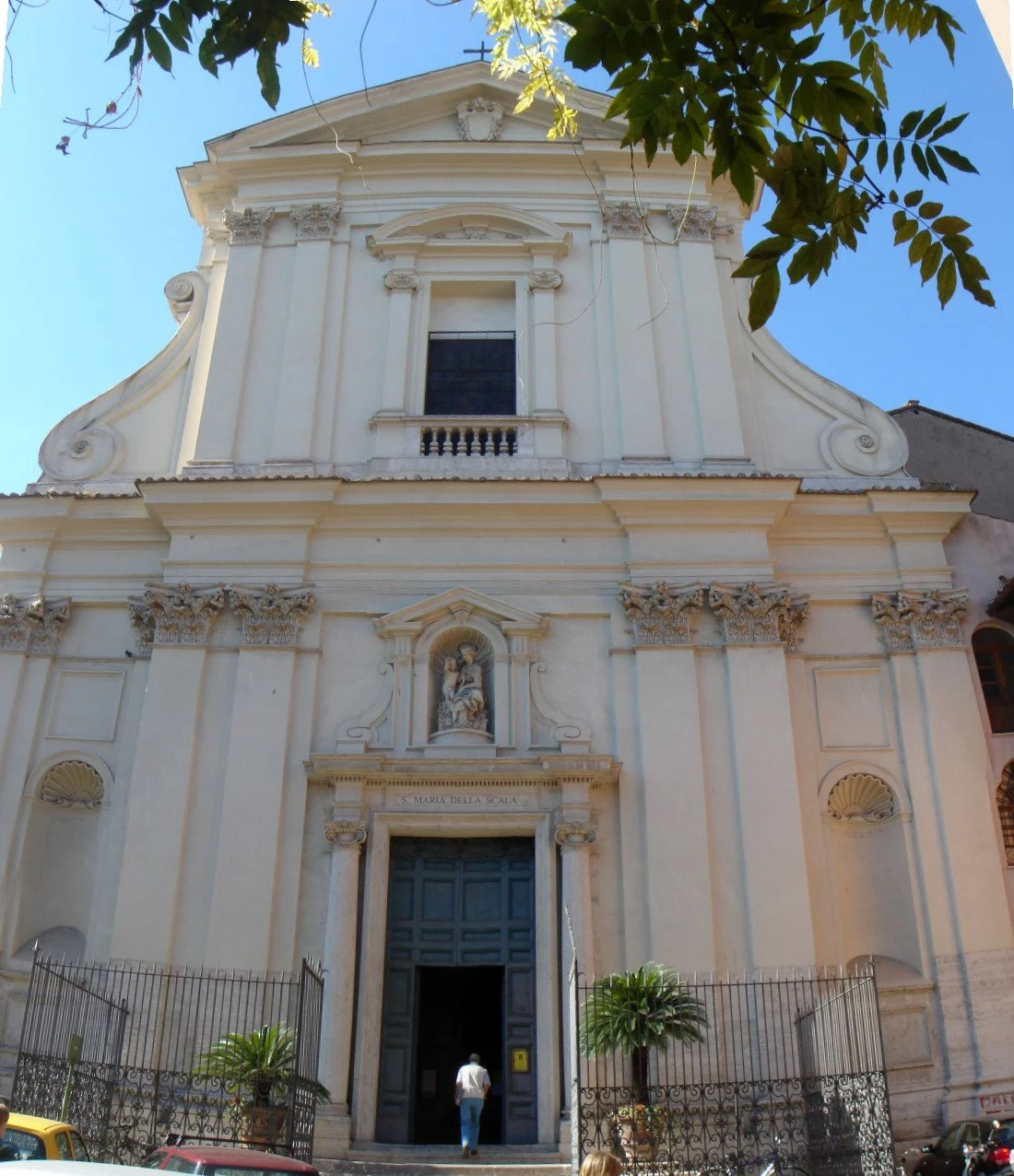
The Church of Santa Maria della Scala stands in Piazza della Scala, in the heart of Trastevere, a few dozen meters from the Basilica of Santa Maria in Trastevere and on the route that leads toward Porta Settimiana and the Janiculum. It's a late sixteenth-century church of the Discalced Carmelites, born from an image of the Madonna painted on the wall under a staircase and considered miraculous at the end of the sixteenth century: the name comes from that staircase, not from a monumental flight of steps as many expect when arriving in the square. Inside is a Baroque interior that few visitors expect to find in a Trastevere alley, with a high altar ciborium designed by Carlo Rainaldi, alabaster, jasper and colored marbles, and the relic of the right foot of Saint Teresa of Avila. But the reason this church appears in every history of European art is a painting that is no longer there: Caravaggio's Death of the Virgin, painted for the second chapel on the left, removed by the friars because it was judged indecorous, bought on Rubens's recommendation by the Duke of Mantua and ended up, through three centuries of changes of ownership, in the Louvre Museum. On the upper floor of the convent, finally, the Antica Spezieria dei Carmelitani survives, the friars' historic pharmacy, one of the best-preserved eighteenth-century rooms in Rome and also the slipperiest point of the whole visit, because its opening regime changes and does not match that of the church. The lines that follow tell where this church comes from, what you see today on entering, what really happened with Caravaggio's painting and how to organize a visit without wasting the trip.
Where the Church of Santa Maria della Scala is and how to get there
The Church of Santa Maria della Scala is at Piazza della Scala 23, in the Trastevere district, and faces an irregular little square that opens along Via della Scala, the street connecting Piazza Sant'Egidio to Porta Settimiana. It's one of those places you reach without noticing: whoever walks from Piazza Santa Maria in Trastevere toward the Lungotevere passes almost necessarily through here, and the light, tall travertine facade suddenly comes into view, squeezed between residential buildings, with no perspective space to announce it from afar.
On foot from the center of Trastevere
From Piazza Santa Maria in Trastevere, the center of gravity of the district, it takes three or four minutes on foot: you take Via della Paglia or skirt the basilica to Piazza Sant'Egidio, where the Museo di Roma in Trastevere is, and from there continue straight along Via della Scala. Whoever arrives instead from the Lungotevere and Ponte Sisto enters the district from Via di Ponte Sisto and Piazza Trilussa and in a little under five minutes is in Piazza della Scala, having crossed one of the busiest stretches of Roman nightlife. From Porta Settimiana, that is, from the side of the Villa Farnesina and the Rome Botanical Garden, the church is two minutes away going up Via della Scala in the opposite direction.
By public transport
Trastevere has no metro station inside the district: the nearest metro stop is on the other bank of the Tiber, and the most convenient connection remains the surface one. The tram that goes up Viale di Trastevere and the buses that run along the Lungotevere leave you at a distance of between five and 10 minutes on foot from the square. If you arrive from Roma Trastevere station, served by regional trains and by the connection with Fiumicino airport, you have a walk of about 20 minutes along Viale di Trastevere or a short tram ride. Schedules and routes of the lines change with some frequency because of roadworks and detours, and it's always best to check them the same day on the transport company's app before setting out.
The origin: an image of the Madonna painted under a staircase
The name of the Church of Santa Maria della Scala does not derive from a monumental flight of steps but from a domestic staircase: the image of the Madonna venerated here was painted on a wall under the outside stairs of a small house that stood in this stretch of Trastevere, and took its name from the banal architectural element under which it was found. It's one of the many devotional street images that dotted late medieval and Renaissance Rome, and it would have remained one among hundreds had it not been struck, at the end of the sixteenth century, by a story of healing that turned it into a pilgrimage destination within a few months.
The healing that started it all
Tradition, gathered from local sources and repeated by later devotional literature, tells of a woman of the district, identified in some versions as a midwife named Cornelia, who prayed before the image for her mute daughter, or according to other versions for a deformed child, and obtained a healing. It must be said clearly that this is devotional tradition and not a historically ascertained fact: the historically solid datum is the effect, that is, the sudden influx of pilgrims in front of that wall and the decision of the ecclesiastical authorities to give that spontaneous cult a stable and controlled home. On the date of the prodigy the sources do not agree: most indicate 1592, but some local reconstructions go back as far as 1582, and whoever writes a single date is choosing among alternative versions, not reporting an unambiguous document.
The fresco today: where it is inside the church
The image that gave everything its name and origin is not on the high altar, as many visitors expect, but in the chapel of the left transept, where it was moved and placed in a solemn architectural frame with red marble columns. Anyone who walks in and heads straight for the presbytery risks leaving without having seen it: it's one of the most common routing mistakes in this church. In the seventeenth century the image received the honor of coronation by the Vatican Chapter, a formal recognition that was granted to Marian images of proven devotion and that definitively sanctioned their public status.
The late sixteenth-century construction and the architecture
The Church of Santa Maria della Scala was built between the last years of the sixteenth century and 1610, with the facade completed only in 1624. It is therefore a building born in the full Counter-Reformation climate that reaches completion already in the early seventeenth century, when the Roman Baroque language was taking shape. The patron of the first phase is indicated by the sources as Cardinal Tolomeo Gallio, and the decisive impulse came from Pope Clement VIII, who in 1597, with the bull Sacrarum Religionum, entrusted the church to the Discalced Carmelites.
Francesco Capriani da Volterra, the first architect
The initial design is due to Francesco Capriani, known as Francesco da Volterra, a very active architect in late sixteenth-century Rome and a transitional figure between late Mannerism and early Baroque. Capriani died in 1594, when the construction site had just started, and his death opened a succession of directors that explains well why the building has a composite look. Girolamo Rainaldi was called to complete the works, and brought the interior to completion around 1610: the same Girolamo Rainaldi who decades later would work, with his son Carlo, on some of the best-known architectural undertakings of Baroque Rome, including Piazza Navona construction site.
The facade and the question of attribution
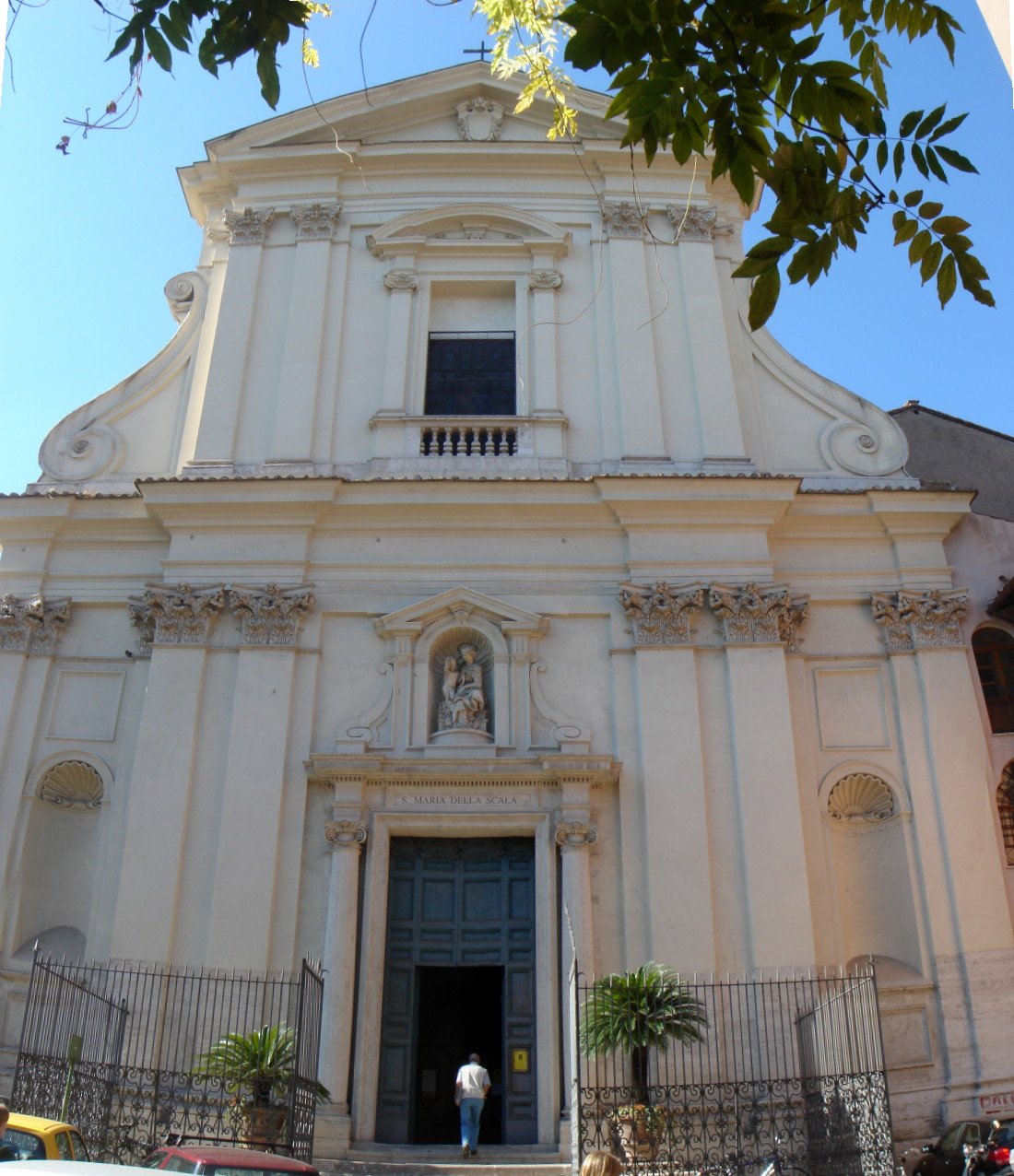
The travertine facade, completed in 1624, has two orders marked by pilasters with Corinthian capitals, linked by side volutes and topped by a triangular pediment, according to a scheme that in Rome was by then a codified model for the churches of religious orders. On the attribution of the facade the sources diverge: some refer it to the continuity of Francesco da Volterra's design carried forward by his successors, others assign it to Ottaviano Mascherino, an architect also very active in the Rome of those years. Here the general rule applies: there is no publicly known document that closes the question definitively, and whoever names a single name is choosing among competing hypotheses.
The plan: Latin cross, single nave, six chapels
The interior has a Latin cross plan with a single nave flanked by three chapels per side, plus the two major chapels in the arms of the transept. It is the typical layout of Counter-Reformation churches: a clear nave that channels the gaze toward the altar, side chapels intended for the patronage of families and confraternities, no colonnades obstructing view and hearing of the preaching. A structure designed, literally, so that everyone sees the altar and hears the preacher, in sharp break with the great multi-aisle basilicas of the medieval past. The current floor, rich in burial slabs, dates from an eighteenth-century renovation dated by the sources to 1739.
The Baroque interior: what you see on entering
The interior of the Church of Santa Maria della Scala surprises almost everyone, because the sobriety of the travertine facade does not lead you to expect the richness of colored marbles, alabasters and gilded bronzes found just past the door. It's a mature Baroque interior, layered in several decorative campaigns running from the early seventeenth century to the mid-eighteenth, where each chapel tells a different commission and devotion. Anyone who thinks of Carmelite churches as places of absolute austerity faces an interesting case: here the order of the Teresian reform, born under the sign of poverty and bare feet, runs a Roman showpiece church, rich and ornate, because in Rome the order's poverty was shown in the life of the friars and not in the nakedness of the altars.
The high altar and Carlo Rainaldi's ciborium
The element that strikes most in the presbytery is the ciborium of the high altar, attributed by the sources to Carlo Rainaldi and dated around 1650: a small temple held up by 16 little Corinthian columns in alabaster, with bands and capitals in gilded bronze, which works like a small building inside the building. The alabaster used is what Roman sources call alabastro a pecorella, for the cloudy veining that recalls a flock seen from afar, a stone that by candlelight produced an effect of warm transparency that is hard to imagine today under electric lighting. The altarpiece of the high altar depicts the Madonna del Carmine and is the work of Giuseppe Peroni, dated by the sources to 1737. The altar was reconsecrated in 1725 in the course of a papal ceremony.
The chapels on the right side
The first chapel on the right is dedicated to Saint John the Baptist and holds a Beheading of Saint John the Baptist attributed to Gerrit van Honthorst, the painter from Utrecht whom the Romans called Gherardo delle Notti for his fondness for scenes lit by artificial light sources. On the dating of the painting, popular sources give mutually incompatible indications, and some cite a year that precedes the artist's own birth. The plausible placement is in the years of Honthorst's Roman stay, that is, in the second decade of the seventeenth century, but anyone looking for a precise date would do well to verify it on a catalog entry and not on a popular page. The altar is adorned with black marble columns and with inlays of alabaster, Sicilian jasper and Siena yellow.
The second chapel on the right is dedicated to Saint Hyacinth and preserves a canvas by Antiveduto Gramatica with the Virgin between Saint Hyacinth and Saint Catherine of Siena, attributed to the very early years of the seventeenth century. The altar has shafts of red marble from Cottanello, a stone from the Sabine quarries that appears in a great many Roman churches of the seventeenth century. The third chapel is dedicated to Saint Joseph and collects an altarpiece of the Holy Family, a Dream of Joseph by Giovanni Odazzi and a Marriage of the Virgin by Lodovico Antonio David, as well as a copy after Pompeo Batoni of the Sacred Heart of Jesus placed in the 1780s.
The chapels on the left side
The first chapel on the left is dedicated to the Madonna del Carmine and has as its altarpiece a painting by Cristoforo Roncalli with the Virgin handing the scapular to Saint Simon Stock in the presence of the prophet Elijah. It is the founding image of Carmelite devotion, which ties the order to the Old Testament figure of Elijah on Mount Carmel and to the handing over of the scapular as a sign of belonging. Since the early twentieth century a wooden sculpture of the Madonna del Carmine with the Child, dressed in embroidered garments according to a devotional custom very widespread in Roman churches, has also been venerated there.
The second chapel on the left, dedicated to the Assumption and designed by Girolamo Rainaldi, is the chapel that interests more than any other those who come here for art history reasons: it is the Cherubini chapel, the one for which Caravaggio painted the Death of the Virgin. In place of Caravaggio's painting you see today a Death of the Virgin by Carlo Saraceni, painted on the same subject in an avowedly more reassuring version. The third chapel on the left is dedicated to the Crucifix and preserves a painted wooden crucifix together with a marble group with Saint John of the Cross by Pietro Papaleo, made after the canonization of the Carmelite saint in 1726.
The left transept and the venerated image
In the left arm of the transept is the chapel that holds the fresco of the Madonna della Scala, framed by four Corinthian columns in red marble from Verona. Around the altar are arranged the funerary monuments of the Santacroce family, including a cenotaph attributed to Alessandro Algardi and a tomb attributed to Domenico Guidi: two leading names of Roman Baroque sculpture, working here on an intimate scale very different from the great undertakings of St. Peter's. It's the chapel where the church goes back to being what it was at the origin, that is, a neighborhood Marian sanctuary, and where today you still find ex-votos and signs of continuous popular devotion.
The right transept and the relic of Saint Teresa of Avila
In the right arm of the transept opens the chapel dedicated to Saint Teresa of Avila, the Spanish reformer from whom the whole Discalced branch of Carmel arises. The architectural structure of the chapel is attributed to Giovanni Paolo Pannini, with four twisted columns in verde antico, and the altarpiece with the saint's ecstasy is the work of Francesco Mancini. The marble high reliefs are attributed to Michel-Ange Slodtz and to Filippo della Valle. Here is kept, since 1617 according to the sources, the relic of Saint Teresa's right foot, one of the most important Teresian relics outside Spain. Anyone who knows Bernini's Ecstasy of Saint Teresa in the Church of Santa Maria della Vittoria finds an instructive comparison here: two Roman Carmelite churches, two opposite ways of representing the same saint, one theatrical and scenographic, the other more composed and devotional.
Caravaggio's Death of the Virgin: the painting the Carmelites rejected
Caravaggio's Death of the Virgin was painted for the second chapel on the left of the Church of Santa Maria della Scala, was removed by the Discalced Carmelites because it was judged lacking the due decorum, and today is in the Louvre Museum in Paris. It's an enormous canvas, about 369 centimeters by 245, and its removal from this church is one of the most documented and most discussed episodes in the history of Italian art. It's worth telling it precisely, because it's a story that circulates in dozens of romanticized versions and that in fact is more interesting than any invented anecdote.
The commission: Laerzio Cherubini, June 14, 1601
The patron was not the Carmelite order but a private individual: Laerzio Cherubini, jurist and consistorial lawyer, who held the patronage of the chapel of the Assumption. The contract, preserved in the Archivio di Stato di Roma among the acts of the notaries of the Auditor Camerae, bears the date of June 14, 1601, provided for an advance and set a delivery deadline of a year, with the obligation for the painter to submit a sketch beforehand. Caravaggio, as regularly happened in his career, did not meet the deadline: on the actual date of execution scholars' reconstructions range between 1602 and 1606, and there is no full consensus. The historically firm point is another, and it's a letter.
Giulio Mancini's letter of October 14, 1606
The oldest and clearest testimony on the rejection is a letter that the physician and art connoisseur Giulio Mancini wrote to his brother Deifebo on October 14, 1606, in which he pointed out the availability on the market of an altarpiece with the death of the Madonna, destined for the Madonna della Scala in Trastevere and removed by the Discalced friar because it was judged disproportionate in terms of lasciviousness and decorum. It's a private document, written by a well-informed contemporary a few months after the events, and for this reason historians treat it as the primary source for the entire affair: from it we learn that the painting had been placed in the church and then removed, and that the decision came from the friars.
What exactly they didn't like
The seventeenth-century sources that tell of the rejection converge on one precise point: the Virgin was not represented as a serene sleeper, wrapped in light and transfigured, but as a real corpse. Giovanni Baglione, in his Vite of 1642, wrote that Caravaggio had made the Madonna swollen and with her legs uncovered, and that for this reason the canvas was taken away. Giovan Pietro Bellori, in 1672, said that it was removed for having imitated too closely a swollen dead woman. The stretched-out body, the limp arm, the earthy complexion, the bare feet to the ankle in the foreground: in an era when displaying the bare feet of a female sacred figure was already in itself a disturbing element, the whole was unacceptable on an altar for the religious patrons.
The question of the model: what the sources really say
The version most widespread in popular accounts says that Caravaggio used as a model the corpse of a prostitute drowned in the Tiber. Precision is needed here, because the story circulates as if it were a documented fact and documented it is not. Giulio Mancini, in his biographies written years after the letter, states that the painting was removed because in the person of the Madonna the painter had portrayed a courtesan: he speaks, then, of a recognizable woman, not of a corpse fished out of the river. The drowned-woman variant is a later addition, for which there is no confirmation in the seventeenth-century sources closest to the events. Some recent studies have proposed identifying the model with Fillide Melandroni, a Roman courtesan whom Caravaggio portrayed several times, and have read the rejection as a reaction to the public recognition of a known face under the Virgin's robes, something that the post-Tridentine norms on sacred images expressly disapproved of. It remains a hypothesis, however well argued, and must be presented as such.
Rubens, the Duke of Mantua and the public display of 1607
The rejected painting did not end up in a storeroom. Peter Paul Rubens, then in Rome and in the service of Vincenzo Gonzaga, Duke of Mantua, judged it one of Caravaggio's best works and advised the duke to buy it, who proceeded through his own envoy in Rome. Before the canvas left the city, in April 1607, it was publicly displayed for a few days, and the sources report that the request for that display came from the Roman artists, eager to see a work that was talked about a great deal and that had been withdrawn from public view. It's an important detail, because it shows that the judgment of the specialists and that of the religious patrons were sharply divergent: what for the friars was indecorous, for the painters was a masterpiece to study.
From Mantua to Paris: three centuries of changes of hands
The canvas's later path is the one, typical of the great European collections, of dynastic upheavals. The financial collapse of the Gonzagas led to the sale of a large part of the Mantuan collection to Charles I of England in the 1620s. After the king's execution, in 1649, the English royal collection was put up for sale by the republican government, and the Death of the Virgin was bought by the Parisian banker Everhard Jabach, who in turn sold it to Louis XIV of France. From the French royal collections the painting then flowed into the Louvre, where it is today. Anyone who wants to see the painting for which this chapel was built must therefore go to Paris: in the Trastevere church the chapel remains, empty of its painting, which on reflection is itself a piece of history to look at.
Carlo Saraceni and the replacement altarpiece
In place of Caravaggio, the chapel received a Death of the Virgin painted by Carlo Saraceni, a Venetian artist active in Rome and one of the painters most attentive to the Caravaggesque lesson. Saraceni painted the same subject in a reassuring key: a composed, transfigured Virgin, free of any allusion to the physical corruption of the body. Mentally comparing the two versions, the one you see here and the one reproduced in any textbook, is the most direct way to understand what was at stake in the dispute over the decorum of sacred images after the Council of Trent. It was not a question of taste: it was a question of what could be shown to a believer kneeling before an altar.
Why the story matters more than the anecdote
Told this way, the story of the Death of the Virgin stops being yet another anecdote about the cursed painter and becomes the textbook case of how the art system worked in Rome in the early seventeenth century: a private patron who orders a work for his own chapel, a religious order that has the right of veto over what sits above an altar of its own church, an international market ready to absorb immediately what ecclesiastical patronage discards, and a community of artists who mobilize to see a work before it leaves the city. All these players cross paths inside a Trastevere chapel over the span of six years. Anyone who wants to extend the Caravaggio trail in Rome finds the other two fundamental nuclei in the Contarelli Chapel inside the Church of San Luigi dei Francesi and in the Cerasi chapel in Santa Maria del Popolo, both with the canvases still in their place.
A curiosity about the Church of Santa Maria della Scala
The most useful curiosity concerns the name itself, because almost everyone interprets it wrongly. There is no monumental staircase, no holy staircase, no reference to the Holy Stairs of the Lateran, with which the confusion is very frequent among those searching on a map. The staircase of the title is a house staircase: an outside flight, of the kind that in the Rome of that time led to the first floor of working-class dwellings, and under which someone had painted an image of the Madonna, as was done in hundreds of corners of the city.
Why the confusion with the Scala Santa is so common
Whoever types the name into a search engine almost always also meets the Scala Santa of the Lateran complex, which is a completely different place, lies at the other end of the city, has another history and another devotion, tied to the staircase that tradition holds came from Pilate's praetorium. The two things have nothing in common except the word staircase. It's worth knowing before you leave, because every year someone arrives in Piazza della Scala in Trastevere looking for the staircase you climb on your knees and stands puzzled before a Baroque facade without any flight of steps.
Something nobody tells you about the Church of Santa Maria della Scala
What almost no guide explains is that the left chapel where you look today at Carlo Saraceni's painting is not just any chapel with a good seventeenth-century altarpiece: it's the physical place where one of the most famous rejections in the history of Western art took place, and the painting that occupies it is there precisely as a substitute. Saraceni was not chosen by chance: he painted a version of the very same subject, with the same format and the same destination, deliberately corrected with respect to what had been judged unacceptable.
A church that lost its most famous piece and almost nobody knows it
There is a second aspect that slips by: the Church of Santa Maria della Scala is probably the only church in Rome known all over the world for a work it does not contain. Anyone who studies art history meets the name of this church in the catalog entry of a painting in the Louvre, and very many meet it only there, never realizing that the building still exists, is open for worship, stands in a square where in the evening people drink outdoors and can be visited free of charge. It's a rare case of a place famous by subtraction, and understanding this also helps explain why it's so little visited compared with the neighboring churches.
The advice I give you for visiting the Church of Santa Maria della Scala
The most important practical advice is to separate sharply two things that most people confuse: the church and the Spezieria are not the same place, they don't have the same entrance and they don't have the same opening regime. The church is a place of worship run by the Discalced Carmelites and is visited freely, without a ticket, during the hours it is open for worship, with the usual midday break typical of Roman churches. The historic Spezieria is instead a room of the convent on the upper floor, is not a museum with free access and is not visited by entering the church. Whoever arrives thinking to see both with a single entrance regularly finds a closed door.
Check the hours before setting out
The opening hours of Roman churches run by religious communities change with the seasons, with the liturgical calendar and with the availability of the friars, and there is no stable schedule that can be reported here with certainty. The parish has a phone contact and an email address, and a call or a message the day before is the most reliable way to know when the church will be open and if celebrations are under way. On feast days and during Mass hours access for visitors remains possible, but the visit must be conducted in silence and without wandering among the chapels during the celebration: it's a living church, not a museum.
Pairing it with the rest of Trastevere
This church works very well as a stop within a walking route through the district and much less as an isolated destination. The itinerary I recommend most often starts from Ponte Sisto, touches Piazza Trilussa, climbs to Piazza Sant'Egidio with the Museo di Roma in Trastevere, enters Santa Maria della Scala, continues toward the Basilica of Santa Maria in Trastevere and ends, for those with breath to spare, with the climb toward the Tempietto del Bramante and the Church of San Pietro in Montorio. In three hours you cross the whole upper district and see much more than almost all the visitors who stop in Piazza Santa Maria see.
The Antica Spezieria of Santa Maria della Scala: the popes' pharmacy
On the upper floor of the convent of the Discalced Carmelites, with the entrance from Piazza della Scala 23, is preserved the Antica Spezieria of Santa Maria della Scala, one of the oldest historic pharmacies in Europe, with furnishings, jars and instruments remaining essentially unchanged since the eighteenth century. It's the reason many people come all the way here, and it's also the point on which it's easiest to get the plan wrong, because it is not a civic museum with fixed hours but a convent room whose access depends on the religious community and on the operators who organize the visits.
What it is and where it comes from
The pharmacy was born in the second half of the sixteenth century as an internal laboratory of the convent, intended to treat the friars with preparations made from herbs cultivated by the order, and opened to the public toward the end of the seventeenth century, when its fame had already spread in the Rome of the cardinals' courts. The custom of supplying the papal court and the families of the Roman aristocracy earned it the nickname of the popes' pharmacy, under which it is still presented today. Among the preparations that made it famous the sources recall theriac, the compound antidote of very ancient origin that European pharmacies continued to produce well into the twentieth century, and the Acqua della Scala, a house remedy used for respiratory ailments and rheumatic pains.
Friar Basilio della Concezione
The figure most tied to the history of the Spezieria is that of Friar Basilio della Concezione, a Carmelite who lived in the eighteenth century, whose expertise in medicinal substances was such as to justify the opening, in the convent, of a course of teaching also open to laypeople. In the pharmacy is preserved a painting depicting him teaching his disciples, and his name remains associated with the remedies that came out of this laboratory. It's an aspect of the history of religious orders that tends to be forgotten: for centuries convents were also centers of pharmaceutical production and of transmission of herbal knowledge, at a time when the distinction between pharmacy, botany and medicine was much less sharp than today.
How to visit it today: the point to check before leaving
Maximum clarity is needed here, because it's the detail that makes you lose the trip. The Antica Spezieria is not visited freely: access is by appointment and, as a rule, through guided visits organized on set dates by cultural associations and licensed guides, with mandatory booking and an entrance contribution. To complicate matters, the historic Spezieria went through a period of closure for restoration work, begun after the autumn of 2024, during which visits were suspended and some operators published closure notices on their own websites. It's not possible to say with certainty, without direct verification, if and since when visits have resumed on a regular basis: before organizing a trip specifically for it, it's best to contact the convent directly at the church's contacts or the organizer of the visit, and ask for confirmation of the date.
The pharmacy on the ground floor is not the historic Spezieria
A very common misunderstanding, and the main source of disappointments, concerns the commercial pharmacy active on the ground floor of the same complex. After the friars' galenic activity ended, which according to the sources happened in the mid-1950s, the pharmacy business moved to street level and passed into private management: it's a working pharmacy, with its commercial hours, and whoever walks in finds a shop, not the eighteenth-century room with carved shelves, majolica jars and alembics. Several tourist listings give as the Spezieria's hours those of the commercial business on the ground floor, and it's precisely from that overlap that much of the fruitless arrivals come. The rule to keep in mind is simple: ground floor equals modern pharmacy with free access, upper floor equals historic Spezieria by appointment only.
A dedicated entry on the site
Since the Spezieria is an autonomous room with its own history and visiting regime, the site already has an entry dedicated only to it, with the detail of the rooms, the preparations and the figures who worked there. Anyone mainly interested in the historic pharmacy finds the full picture there and can use this page for the church and the context, without having to look for the two things in a single text. The dedicated entry is the one on the Antica Spezieria di Santa Maria alla Scala.
Another well-known fact, yet rarely cited
In 1849, during the months of the Roman Republic, the Church of Santa Maria della Scala and the attached convent were used as a hospital for the wounded of the defense of Rome against the French expeditionary corps. It's a fact reported by all local sources and essentially absent from general guides, which of this church tell almost only the Caravaggio story.
The wounded of the Janiculum treated here
Geography explains everything: the hardest fighting of the republican defense took place on the heights of the Janiculum and along the Janiculum walls, that is, immediately above Trastevere, and the wounded were carried downhill to the nearest available facilities. Convents and churches of the district became emergency hospitals within a few hours, in an improvised health organization in which women volunteers from the neighborhood also took part. Here, according to local sources, some of the most remembered names of that season died, among them Andrea Aguyar, the fighter of South American origin who served among the Garibaldians, and according to other reconstructions also the Lombard officer Luciano Manara, fallen in the final fighting at the end of June. Anyone who wants to reconstruct that whole season finds the overall picture at the Museum of the Roman Republic and Garibaldian Memory, on the Janiculum, about 20 minutes' climb from Piazza della Scala.
The right photo to take at the Church of Santa Maria della Scala
The photo that best conveys this church is not the frontal one of the facade, which in Piazza della Scala you almost never manage to frame in full because the space in front is too narrow, but the diagonal one from the mouth of Via della Scala, which lets you fit into the same frame the travertine front and the cut of the alley. It's the image that tells the real condition of this building: a monumental church wedged into a tiny urban fabric, without the perspective breathing room that Roman showpiece churches almost always have.
Inside: the ciborium of the high altar
Inside, the most photogenic subject is the alabaster and gilded bronze ciborium of the high altar, which with its crown of slender little columns lends itself to a tight frontal shot. The difficulty is the light: the interior is dark and flash is almost always forbidden, as well as useless on shiny surfaces. Anyone who wants a good result must rest the camera or phone on a stable surface, raise the sensitivity and accept long exposures, avoiding any bulky equipment. Before photographing, it's best in any case to check on the spot if there are posted bans, and never to photograph during celebrations.
Caravaggio's empty chapel
Finally there's a conceptual shot worth more than many others: the second chapel on the left taken as a whole, with Saraceni's altarpiece in place of the removed painting. It's not a spectacular photo, but it's the only image you can take home from this church that really tells its most important story, that is, the absence. Whoever accompanies the photo with the explanation of what that chapel contained and where the painting ended up gets, from a modest image, a story that no framing of the facade could give.
Some important events that happened here in history
The history of the Church of Santa Maria della Scala is concentrated in a few very dense episodes, spread over a little more than two and a half centuries, to which is added the Risorgimento parenthesis of the nineteenth century. Putting them in line helps understand how a street shrine became in a few years one of the most discussed churches in Europe.
The seventeenth and eighteenth centuries: furnishings, relic, coronation
The rest of the seventeenth century is the season of building the church's public image: the facade is completed in 1624, the statue by Francesco di Cusart arrives in 1633, the Marian image receives the coronation by the Vatican Chapter at mid-century, Carlo Rainaldi's ciborium is made around 1650 and in 1664 Pope Alexander VII raises the church to the seat of a cardinal title. The eighteenth century brings the redoing of the floor in 1739, the choir lofts of 1756, the chapel of Saint Teresa and the sculptural group of Saint John of the Cross made after the canonization of 1726. The relic of Saint Teresa of Avila's right foot is recorded in the church already from 1617.
Who has passed through the Church of Santa Maria della Scala
Through this church have passed, in a little over four centuries, figures belonging to very different stories: painters, popes, architects, convent pharmacists, Risorgimento fighters and generations of residents of the district. Reconstructing the list helps understand how much an apparently minor building can have been crossed by very broad lines of history.
Caravaggio, Rubens and Saraceni
The heaviest name is obviously that of Michelangelo Merisi da Caravaggio, who worked for this chapel and was rejected by this chapel. Next to him must be put Peter Paul Rubens, who in Rome in those years worked for the court of Mantua and who with his judgment determined the fate of the rejected painting. And Carlo Saraceni must be added, the Venetian painter called to put things right, who found himself in the very uncomfortable position of having to paint the same subject knowing exactly what he must not do. Three trajectories that cross in a chapel four meters by five.
The artists who worked here
The list of artists who left a work in this church is long and spans a century and a half: Gerrit van Honthorst, the Dutch master of artificial light whom the Romans renamed Gherardo delle Notti. Antiveduto Gramatica, a painter tied to the first Caravaggesque circle. Cristoforo Roncalli, known as il Pomarancio. The architects Francesco da Volterra, Girolamo Rainaldi and Carlo Rainaldi. The sculptors Alessandro Algardi, Domenico Guidi, Pietro Papaleo and Francesco di Cusart. And in the eighteenth century Francesco Mancini, Giuseppe Peroni, Giovanni Odazzi, Michel-Ange Slodtz and Filippo della Valle. Many of these names are found in the city's great Baroque undertakings, from Piazza Navona to the major basilicas, but here they work on a reduced scale, on commissions from families and religious orders.
The fighters of 1849 and the residents of the district
In June 1849 the wounded of the defense of the Janiculum came through these doors, along with the doctors and women volunteers who tended them, and some of the men who have become the symbol of that defense. But the largest category of visitors, over four centuries, remains the least documented one: the residents of Trastevere who came to pray before the image of the Madonna della Scala, left ex-votos, were married and were buried under the slabs of the floor. A neighborhood church remains first of all this, even when art history remembers it for a painting that went to Paris.
What to see around the church
The other churches of Trastevere
A few minutes on foot away are some of the most important churches in Rome: the Basilica of Santa Maria in Trastevere, with its medieval apse mosaics and gilded front. The Basilica of Santa Cecilia in Trastevere, with Stefano Maderno's sculpture and the underground levels. The Church of San Francesco a Ripa, with Bernini's Blessed Ludovica Albertoni. And the small Church of Sant'Agata in Trastevere. A route that touches even just three of these churches in half a day gives a much more complete idea of the district than any stroll among the alleys.
Villas, gardens and views
Going up toward Porta Settimiana you reach in a few minutes the Villa Farnesina with the frescoes of Raphael and his workshop, and the Orto Botanico di Roma, which occupies the slope of the Janiculum behind the district. Climbing further you reach the Tempietto del Bramante and the Janiculum terrace, which offers the widest panorama over the historic city.
Frequently asked questions about the Church of Santa Maria della Scala
Where is the Church of Santa Maria della Scala?
The Church of Santa Maria della Scala is at Piazza della Scala 23, in the Trastevere district of Rome, along Via della Scala between Piazza Sant'Egidio and Porta Settimiana. You reach it on foot in three or four minutes from Piazza Santa Maria in Trastevere and in five minutes from Ponte Sisto, while by car the area is a limited traffic zone with no parking.
Do you pay a ticket to enter the Church of Santa Maria della Scala?
Entrance to the Church of Santa Maria della Scala is free, as in almost all churches of Rome open for worship. A ticket is instead needed for the guided visits to the Antica Spezieria on the upper floor of the convent, which are paid, by booking and organized on set dates, with an entrance contribution that varies depending on the operator.
Is the Caravaggio still in the Church of Santa Maria della Scala?
No, in the Church of Santa Maria della Scala the Caravaggio is no longer there: the Death of the Virgin, painted for the second chapel on the left on commission from Laerzio Cherubini, was removed by the Discalced Carmelites in 1606 and today is in the Louvre Museum in Paris. In its place you see a Death of the Virgin by Carlo Saraceni, painted as a replacement on the same subject.
Why did the Carmelites reject Caravaggio's Death of the Virgin?
The Discalced Carmelites of Santa Maria della Scala rejected the Death of the Virgin because they judged it lacking the decorum due to an altar image. Seventeenth-century sources speak of a swollen Madonna, with her legs and feet uncovered, painted like a real corpse. Giulio Mancini added that the painter would have used as a model a recognizable courtesan, a detail that later literature has expanded without documentary confirmation.
Can you visit the Antica Spezieria di Santa Maria della Scala?
The Antica Spezieria di Santa Maria della Scala is visited only by appointment, through paid guided visits organized on set dates, and not by entering the church. The historic pharmacy has also gone through a period of closure for restoration starting from the autumn of 2024: before planning the visit you need to ask the convent or the organizer for confirmation, because the dates are not continuous.
How much time do you need to visit the Church of Santa Maria della Scala?
To visit the Church of Santa Maria della Scala 20 to 40 minutes are enough, sufficient for the six side chapels, the two chapels of the transept and the presbytery with the alabaster ciborium. Whoever adds the guided visit to the Antica Spezieria must count about 90 more minutes, which is the duration declared by the organizers of the visits.
Is the Church of Santa Maria della Scala suitable for children?
The Church of Santa Maria della Scala is suitable for children for a short visit, because it is of modest size, can be walked through in a few minutes and requires no queues or tiring routes. Since it is a place of worship in use, the little ones should be asked to stay quiet, especially during celebrations. The nearby Piazza Santa Maria in Trastevere then offers an open space for a break.
Can you take photos inside the Church of Santa Maria della Scala?
In the Church of Santa Maria della Scala photographs without flash and without a tripod are normally tolerated as in most Roman churches, but there is no uniform rule and the decision belongs to the religious community. It's best to check the signs at the entrance, avoid photographing entirely during Masses and ask the friars in case of doubt.
What's the difference between Santa Maria della Scala and Santa Maria in Trastevere?
Santa Maria della Scala and Santa Maria in Trastevere are two different churches three minutes apart: the first is a late sixteenth-century Carmelite church with a Baroque interior, born from a miraculous image. The second is a basilica of early Christian origin, rebuilt in the twelfth century, famous for the medieval apse mosaics and for the large facade mosaic.
One last piece of advice for those planning the itinerary
The Church of Santa Maria della Scala gives its best as a stop on a Trastevere route and not as the isolated destination of a morning: it's small, free, visited in half an hour and sits exactly on the line connecting Ponte Sisto to Porta Settimiana and the Janiculum. If you have little time in Rome, put it between the Basilica of Santa Maria in Trastevere and the climb toward the Tempietto del Bramante. If you have more time, use it as a starting point to understand, before going elsewhere, what it meant to paint for a Roman altar in the early seventeenth century.
Anyone building a wider itinerary among Trastevere, the Janiculum and the historic center, crossing this stop with the other stops in the district and with the city's Caravaggesque churches, can find useful planning tools on Tour Leader Pro, while for a broader picture of transport and destinations in Lazio Italy Planner is a good resource.