Ponte Fabricio
In short. Ponte Fabricio connects the left bank of the Tiber, at the level of the Jewish Ghetto, to the northern tip of Tiber Island, and it is the best-preserved Roman bridge in the city: two arches of about 24.5 meters span each, a central pier…
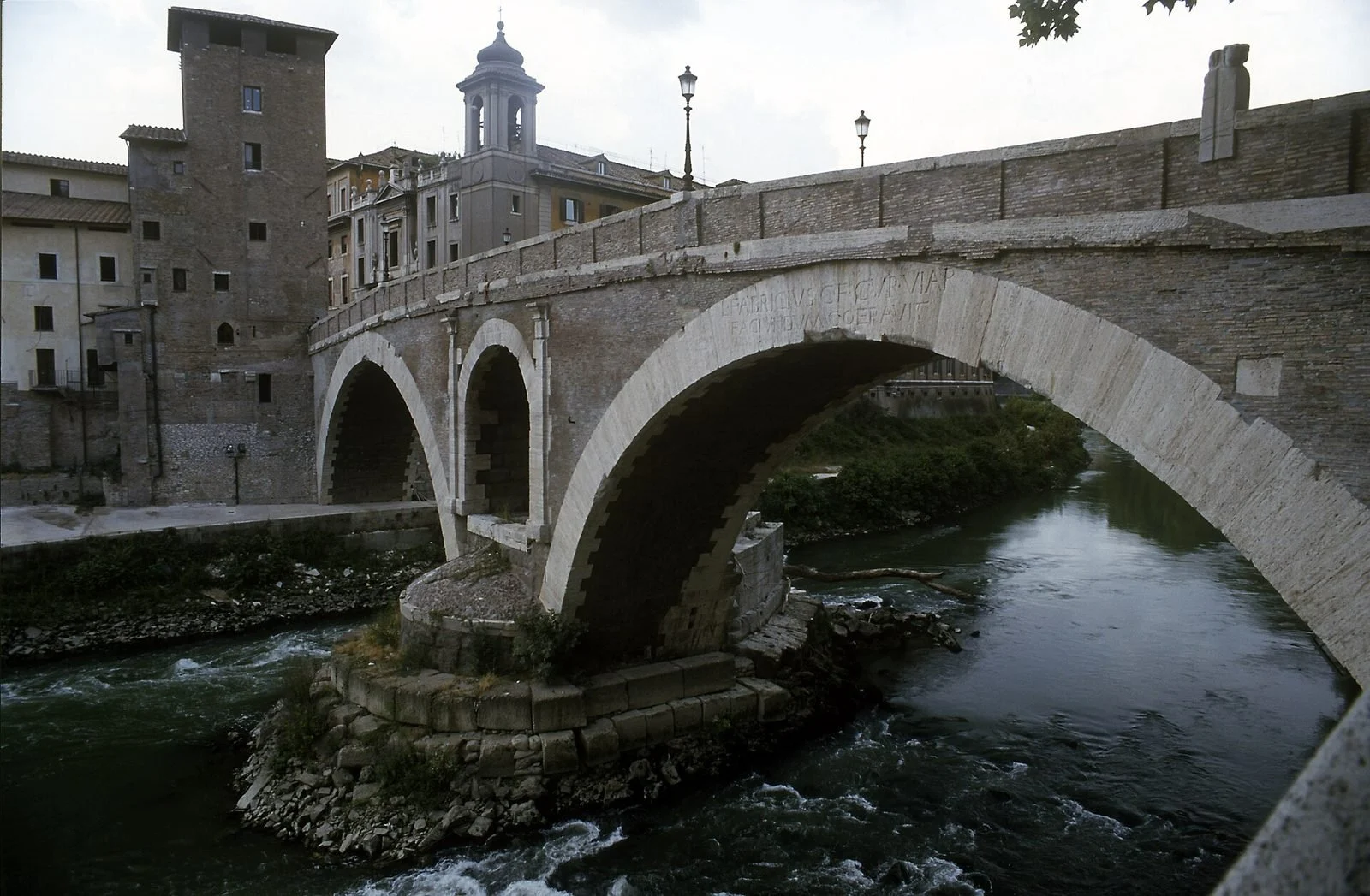
Ponte Fabricio connects the left bank of the Tiber, at the level of the Jewish Ghetto, to the northern tip of Tiber Island, and it is the best-preserved Roman bridge in the city: two arches of about 24.5 meters span each, a central pier with a flood arch for high water, and an inscription that repeats four times the name of the man who had it built in 62 BC, Lucius Fabricius, curator of the roads. You cross it on foot in less than a minute, for free, at any hour of the day or night. Most people who walk it do so to reach the island or to cut toward Trastevere, without realizing they are walking on the only bridge in Rome that has carried foot traffic on the same load-bearing structure for over 2,000 years.
The lines that follow set in order what we know for certain, what the sources report in conflicting ways and what belongs to Roman oral tradition. These are three different levels, and for a monument like this they are often confused: the popular name of the bridge of the Four Heads, for example, is explained around town with a story of beheaded architects that doesn't hold up to a check of the dates. We indicate each time which level we are on.
Where Ponte Fabricio is and how to get there
Ponte Fabricio starts from Lungotevere dei Pierleoni, below Piazza Monte Savello, and arrives on Tiber Island: its city-side entrance is less than 200 meters from the Synagogue of Rome and about 300 from the Theater of Marcellus. It is a pedestrian bridge: vehicles headed to the hospital enter the island from the other end, from Ponte Cestio, on the Trastevere side.
On foot from the Ghetto, the Capitoline Hill and the Circus Maximus
From the Ghetto it takes barely 5 minutes: you go down from Via del Portico d'Ottavia toward the river, follow Lungotevere de' Cenci and turn in front of the bulk of the Synagogue. If you are coming from the Capitoline Hill, you go down Via del Teatro di Marcello and turn onto Via di Monte Savello: a good 10 minutes, downhill, with the side of the ancient theater on your right. From the Circus Maximus it takes 15 minutes along Via dei Cerchi and Via Petroselli, passing the Mouth of Truth and the Arch of Janus, that is, crossing what in Roman times was the Forum Boarium. From Trastevere the natural route is the reverse: you enter the island from Ponte Cestio and leave on the Ghetto side right by Ponte Fabricio.
By public transport
The Isola Tiberina hospital lists buses 23, 63, 280 and H and tram 8 as the reference lines for the island, and they are the same ones that serve anyone coming for the bridge. The 23 and the 280 run along the lungotevere on the right bank, and tram 8 stops at Belli, right after Ponte Garibaldi, 7 or 8 minutes on foot. The nearest metro stop is Circo Massimo, on line B, which is still a quarter of an hour's walk away: if you are coming from Termini it's quicker to take metro B to Circo Massimo and then walk, or a surface bus that heads down toward the Theater of Marcellus. Surface lines in Rome change route often because of roadworks and detours, so it's worth rechecking the route the same day on the transport company's app. For a broader discussion of getting around the city, see our page on how to get around Rome. If you are arriving from another Italian city and need to fit together trains and transfers, you'll find real travel times on Italy Planner.
By car, scooter, bicycle
You can't reach the bridge by car, and you can't even get comfortably close: the whole strip between the Ghetto and the lungotevere is a limited traffic zone during the active hours of the historic center ZTL, and street parking, where it exists, is paid. The paid car parks most often cited by the island's own hospital are those of the Circus Maximus, Lungotevere degli Anguillara, Via dei Cerchi, Piazza Cenci and Via dell'Arco de' Tolomei. If you are coming from outside Rome it's quicker to leave the car in a park-and-ride on metro B and get off at Circo Massimo. On a bicycle you cross the bridge walking the bike: the paving is uneven in several places and the passage is narrow.
Accessibility: what to really expect
The surface of the bridge is sampietrini and irregular slabs, with a slight slope toward the center of the ancient roadway. There are no steps on the bridge, but the connections with the lungotevere and with the island have level differences and curbs: a wheelchair gets through, with some jolting, while a light stroller struggles with the surface. People with mobility difficulties will find the easiest access to the island on the Ponte Cestio side, where the street level is more regular. On the island there are 10 parking spaces reserved for people with disabilities, managed by the hospital and meant for patients in treatment, so they shouldn't be considered public parking.
What Ponte Fabricio is: two arches, one pier, a flood arch
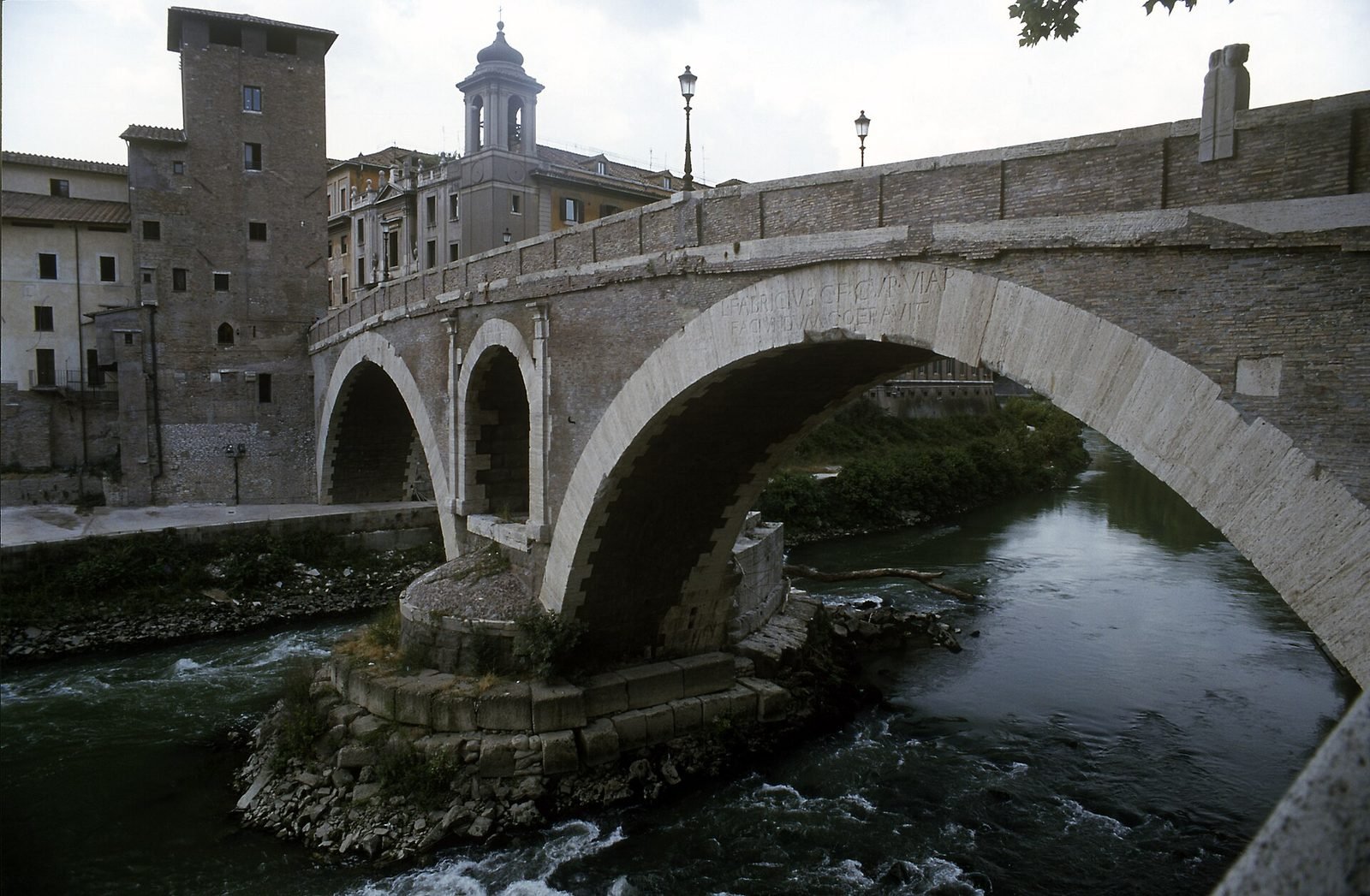
Ponte Fabricio measures about 62 meters in length and a little over 5 meters in width, with two main arches of about 24.5 meters span that rest on a central pier. The sources differ slightly on the width: the most widely used Italian entry gives 6 meters, while other entries, including those of the archives dedicated to the Tiber, stop at 5.5. The difference depends on where you measure, at the line of the current parapets or at the ancient roadbed, and it doesn't change the substance: it is a narrow bridge by modern standards and a wide one by the standards of the late Roman republic.
The relieving arch on the pier, which is not a decorative whim
The circular opening above the central pier, of about 6 meters, has a precise hydraulic function. During floods the Tiber reached and exceeded the springing of the arches: without that opening, the pier would have acted like a dam, accumulating thrust and debris until it compromised the structure. The flood arch lets water pass above the pier and reduces the pressure. It is the same principle found in Roman bridges across half of Europe, and the reason Ponte Fabricio is still standing while the Ponte Rotto, 200 meters downstream, is reduced to a single isolated arch in the middle of the current.
Lowered arches: a technical detail that specialists notice
The two arches are not round, meaning they don't trace an exact semicircle, but are slightly lowered. Some historical reconstructions of Roman building technique point to this bridge as one of the first documented cases of non-semicircular arches on a Roman bridge. The claim circulates widely in popular literature in English and should be taken as an indication of a probable first, not as a definitive fact: the chronology of lost Roman bridges makes it hard to establish a true absolute first. What you can see by eye, in any case, is that the arch looks flattened compared to a semicircle, and that the curve returns almost immediately toward the horizontal.
What it is made of
The load-bearing structure is concrete conglomerate with facings of tuff and Gabine stone. The original cladding was travertine, a material that in Rome always signals a public work of some weight. The brick you see today on large portions of the bridge doesn't belong to the construction site of 62 BC: it comes from the 17th-century restoration, when the ancient cladding was partly replaced. Anyone looking at the bridge from the quay can easily tell the two textures apart, the pale, compact travertine at the base of the arches and the warmer, more regular brick in the upper parts.
The ramps buried under the lungotevere
The ancient bridge didn't end where it ends today. At the ends ran access ramps supported by smaller arches, of about 3.5 meters, now buried under the street level of the lungotevere: the Sovrintendenza Capitolina notes that stretches of them are preserved and visible in some underground rooms along the river. It is the most evident legacy of the 19th-century embankment walls, which raised the banks and drowned the ancient level. Anyone leaning on the parapet and trying to imagine the bridge as it was has to mentally add these ramps and remove the travertine embankments: the Tiber of that time ran wider, lower and much closer to the houses.
The date of 62 BC and the inscription repeated four times
Ponte Fabricio is dated to 62 BC on the basis of its own inscription, carved into the archivolts of the arches and repeated four times, an abundance that in the Roman epigraphic world is almost an author's signature. The text, in the form handed down, is this: L. FABRICIVS C. F. CVR. VIAR. FACIVNDVM COERAVIT IDEMQVE PROBAVIT. Translated without embellishment: Lucius Fabricius, son of Gaius, curator of the roads, saw to it that it was made and he himself approved it.
Why four times
The inscriptions run on the fronts of the two arches, on both sides of the bridge, so that anyone arriving from the river or walking on the quays could read the name of the person responsible for the work. On the central arch appears the formula idemque probavit, meaning the final approval. It isn't modesty, and it wasn't even considered boasting: in republican Rome the magistrate who signed a public work took on the political and financial responsibility for it, and the repetition served to make the attribution impossible to erase. Over 2,000 years later, the strategy worked: we know the name of the builder of this bridge and we don't know that of dozens of more famous monuments.
Who Lucius Fabricius was
Of Lucius Fabricius we know what the stone says and almost nothing else: he was the son of Gaius and held the office of curator viarum, superintendent of the roads. The curatorship of the roads involved the maintenance of public roads and related works, bridges included, and it was a minor but visible magistracy, well suited to building a reputation in the city. About his later career the sources are silent. The reconstructions that place him in a specific political faction of the time are hypotheses of modern historians, not handed-down facts: it is worth being clear on this, because more than one romanticized biography circulates online.
Cassius Dio and 62 BC
The external confirmation of the date comes from historiography: Cassius Dio, in book 37 of his Roman history, records the construction of the stone bridge to the island in his account of the events of that year. 62 BC is the year immediately after the conspiracy of Catiline and Cicero's consulship: Rome was coming out of months of trials, executions and political tension. A public construction site on the Tiber, at that moment, was also a message of regained administrative normality. The wooden structure the bridge replaced dated back to at least 192 BC according to the reconstruction of the Sovrintendenza Capitolina, and had been destroyed, according to some sources, by a fire.
The restoration of 21 BC and the second inscription
Ponte Fabricio carries a second pair of ancient inscriptions, which records a restoration carried out by two consuls, Marcus Lollius and Quintus Aemilius Lepidus, after the damage of the floods of 23 and 22 BC. The Sovrintendenza Capitolina dates the work to 21 BC, that is, to the year of the two men's consulship. Other popular entries place the restoration generically in 23 BC, confusing the year of the flood with that of the works. The epigraphic formula records an approval ex senatus consulto, that is, an inspection carried out by decision of the senate.
40 years later, and it already needed a restoration
That a stone bridge built a little over 40 years earlier needed repairs says a lot about the Tiber before the embankments. The river, uncontained, changed level by several meters between low water and flood, carried whole tree trunks and debris and struck the piers with a violence that 19th-century photographs of the floods render well. The floods of 23 and 22 BC are remembered as serious episodes, with flooding in the lower city. The pier of the bridge, with its cutwater facing upstream, was the most exposed part, and indeed it is the one on which interventions have concentrated in every era.
A bridge that was born already inside a system
Ponte Fabricio is not an isolated work: it forms a pair with Ponte Cestio, which from the other end of the island leads to the right bank, toward present-day Trastevere. Together they form a crossing in two stages, resting on Tiber Island as on a natural pier. They are the only two bridges in Rome that don't directly connect one bank to the other. Ponte Cestio, however, met a different fate: it was dismantled and almost entirely rebuilt between 1888 and 1892 to widen the roadway during the work on the embankments, and it preserves much less of the ancient bridge.
Why it is called the bridge of the Four Heads
The popular name of the bridge of the Four Heads comes from the two four-faced marble herms that decorate the parapet at the city-side entrance: small carved pillars with faces on four sides, of the quadrifrons Janus type, which originally served as supports for a balustrade, according to more than one reconstruction in bronze. From there comes the name under which the bridge appears in Roman guides since at least the 16th century, and by which the Romans of this area still call it today, who rarely use the official name.
The count that doesn't add up
The surviving herms are two and each has four faces: the heads, strictly speaking, would be eight. The simplest explanation concerns the way they are counted from the street: of each herm, walking on the bridge, you see two faces, and the visible total makes four. Others have thought of a different original arrangement, with a larger number of small pillars later reduced. There is no documented answer, and it is one of those cases where popular place-naming simply photographed what you saw as you passed.
Where the herms come from, and when
On the origin and date of the herms the sources don't agree. Some entries trace them to an ancient placement, consistent with a furnishing of the Roman bridge. Others, including the most widely used English-language entry, maintain that the small pillars were brought here in the 14th century from the nearby church of San Gregorio, the one facing the Monte Savello side. The archaizing style of the faces doesn't help to decide, because that type of rendering was reproduced in the imperial age and again in the modern age. We report the divergence as it is: the function as a support for a balustrade is widely accepted, the date and origin are not.
The legend of the four architects, which is popular tradition
The story you hear most often about the bridge is this: a pope supposedly entrusted the restoration to four architects, who quarreled until they came to blows. The pope had them beheaded and placed on the bridge a marble with four heads in remembrance. It must be said clearly that this is popular tradition, not history. The tale is attributed from time to time to Sixtus V, pope between 1585 and 1590, while the documented modern restoration of the bridge dates to 1679, under Innocent XI, almost a century later. The herms, moreover, are ancient or archaizing marbles and not a 17th-century commemorative monument. The legend explains a name that already existed, and this is the mechanism by which almost all stories of this kind are born. Anyone with a taste for Roman narratives of this kind will find a reasoned collection on our page about the ghosts of Rome, where each tale is labeled for what it is.
A curiosity about Ponte Fabricio
The most solid curiosity concerns a detail almost nobody looks at: the bridge is the only monument in Rome that declares in writing, on its own structure, that it has been inspected and approved. The formula idemque probavit, repeated in the inscription, means exactly this: the same Lucius Fabricius who oversaw its construction approved the result. In Roman administrative law the probatio was a formal act, the moment when the work passed from the contractor to the community and the magistrate took on the guarantee for it.
An approval that has lasted 2,000 years
There is a sort of historical irony in that line. The bridge has withstood catastrophic floods, the Middle Ages of the fortified barons, the papal construction sites, the demolition of the surrounding neighborhood, and the automobile traffic of the 20th century, before it was closed to cars. No one, in 21 centuries, has had to contradict Fabricius's approval. If you are looking for a fact that gives the measure of the difference between Roman construction and almost everything that came after it, this inscription is worth more than any figure on dimensions.
Where to read the inscription
The inscriptions are not very easy to spot for anyone who doesn't know where to look, because they run on the archivolts of the arches, that is, on the curved band that borders the arch, and they are read from the river or from the quay, not from the deck of the bridge. The best spot is the quay of the lungotevere on the downstream side, going down the ramp that leads to the water level: from there, with side light, the carved letters take shadow and can be made out even with the naked eye. With a modest telephoto lens they can be read without effort.
The bridge of the Jews: the Ghetto, the church and the compulsory sermons
For centuries Ponte Fabricio was called pons Iudaeorum, the bridge of the Jews, because its city-side entrance opened right next to the area where the Roman Jewish community lived and where, from 1555, the bull of Paul IV established the closed enclosure of the Ghetto. The name appears in medieval sources and remains in use throughout the modern age, alongside that of the bridge of the Four Heads. The place-name alone tells the social function of the bridge better than any architectural description.
The church at the entrance to the bridge
On the city side, right at the start of the bridge, stands the church of San Gregorio della Divina Pietà, which in ancient documents bears the name San Gregorio a Ponte Quattro Capi. On the facade, added during a restoration in the mid 19th century, runs a bilingual inscription in Latin and Hebrew with a passage from the book of Isaiah, chapter 65, which rebukes the obstinacy of the people. Until 1870, in front of that facade, the Jews of the Ghetto were required to attend the conversion sermons imposed by the papal authority. It is a piece of Roman history that doesn't appear on tourist routes and that is read on a wall, for free, 30 seconds from the bridge.
What remains of the old Ghetto
The Ghetto you crossed to reach the bridge hardly exists any more in its physical form: the enclosure was abolished in 1870 and the block was demolished between the late 19th and early 20th centuries, in an urban planning intervention that erased the fabric of alleys and courtyards. In its place rose the lungotevere and the regular blocks you see today, and in 1904 the Tempio Maggiore was inaugurated. Anyone who wants to understand the earlier topography will find the reconstruction on our page about the Jewish Ghetto of Rome and the documentation held at the Jewish Museum of Rome, which occupies the rooms under the Synagogue.
October 16, 1943
The roundup of the Ghetto on October 16, 1943 took place in the streets that start from the end of the bridge: over 1,000 people were captured and deported, and the survivors were a handful. The bridge was one of the escape routes for those who managed to flee toward the island and toward Trastevere in the hours of the roundup. On this aspect the community's oral memory is richer than the written sources, and it should be treated with the respect and caution it deserves: we collect the documented reconstructions on the page about the places of memory in Rome. Anyone crossing the bridge should look at the brass stumbling stones in the pavement of the nearby streets: each plaque corresponds to a person who lived a few meters from here.
One thing nobody tells you about Ponte Fabricio
What almost no guide explains is that the reddish brick covering much of the bridge is not a patina of time, but the result of a construction choice from 1679: the restoration ordered by Innocent XI replaced large portions of the travertine cladding with brick and rebuilt the parapets, according to several sources eliminating the metal balustrade that the herms supported. The bridge we photograph as an emblem of republican Romanness therefore has, on the surface, a baroque skin.
The 1679 construction site
The pontificate of Innocent XI, Benedetto Odescalchi, is remembered for administrative rigor and for putting the finances of the Papal States back in order more than for great building projects. The restoration of the bridge fits that logic: maintenance of what exists, consolidation, limited expense. A plaque set into the wing wall records the work. It was not the first papal intervention on the bridge: in 1447 Eugene IV had the deck repaved with travertine slabs.
How to tell old from modern, by eye
The practical rule is simple. Travertine, pale and in large blocks with thin joints, broadly belongs to the ancient structure and its most careful repairs. Brick, laid in regular courses with visible mortar joints, belongs to the modern phases, first of all the 17th-century one. Tuff appears where the facing has fallen and the core is visible. Looking at the bridge side-on, from the quay, these three materials read in sequence like the pages of a construction ledger. Anyone who wants to train the eye on a similar case can compare with the Arch of Septimius Severus in the Roman Forum, where the stratigraphy of the restorations is just as readable.
The thing nobody says, in one line
The oldest bridge in Rome still in use looks the way a 17th-century pope made it look. The structure underneath is from 62 BC, and it holds. The face is 400 years old. Keeping the two things separate is the only way to really understand what you are looking at.
The advice I give you for visiting Ponte Fabricio
The practical advice is just one, and it matters more than any other indication: don't look at Ponte Fabricio from the bridge. Walking on it you see the 17th-century parapets and the paving, which is the least interesting part. The monument is understood from the quay of the Tiber, 40 seconds of stairs lower down, or from Ponte Palatino, 200 meters downstream, from which you take in Ponte Fabricio, the island and the Ponte Rotto in a single frame.
Going down to the quay: when you can and when you can't
The quays of the Tiber are open and walkable under normal conditions of river flow, with access ramps along the embankment walls. After heavy rain and during periods of flood they are closed and the water level covers the walkway: it is a safety closure that kicks in quickly and without notice. In summer, during events that occupy the quays, access may be limited to the hours of the event. Before planning the descent it's worth looking at the water level from the parapet: if the ramps are wet or covered in silt, the flood passed recently and the surface is slippery.
The visiting order we recommend
A half hour well spent is organized like this: you start from the city end, read the bilingual inscription on the facade of the church, look at the two herms on the parapet, cross the bridge to the island, go down to the quay of the island on the downstream side to see the arches from below, come back up and leave by Ponte Cestio toward Trastevere. If you prefer to be accompanied by a guide who knows the area and the real hours of the places, you can contact Tour Leader Pro. If you have an hour more, add the basilica of San Bartolomeo all'Isola, which closes off the central small square, and the view of the Ponte Rotto from the downstream tip of the island.
A verdict, since one is needed
The overrated stretch of this walk is the small square of the island on summer evenings, when temporary setups cover the facades and the passage clogs up. The underrated stretch is the quay under the bridge in the early morning hours, where there is nobody and you see the whole monument. If you have to choose just one moment, choose that one.
Another well-known fact, yet rarely cited
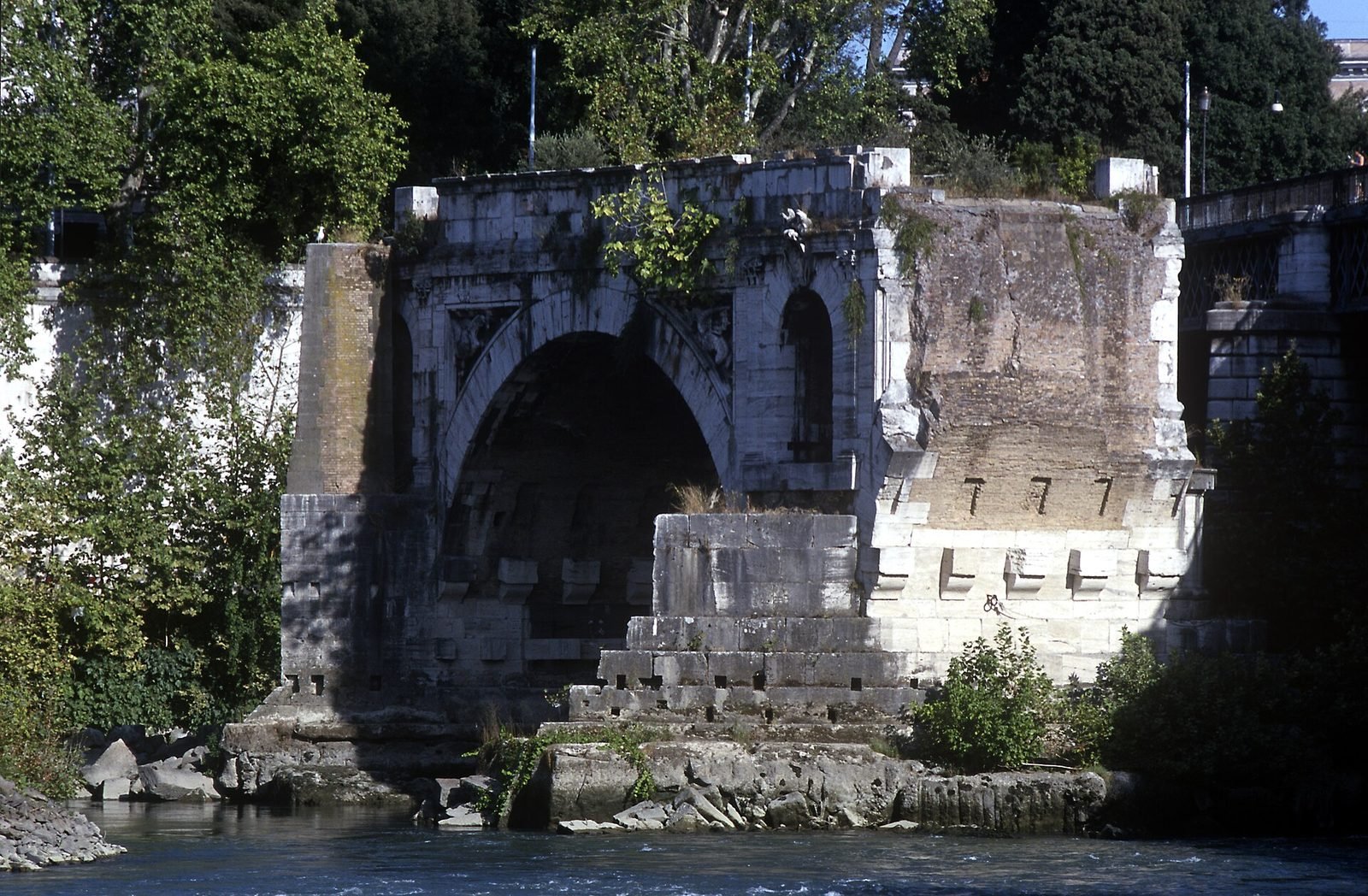
Ponte Fabricio is the oldest bridge in Rome preserved in its original structure and still in use, and this formula has to be read word by word, because every piece excludes something. Milvian Bridge has an older origin as a stone crossing, but it has been rebuilt several times, reconstructed by Giuseppe Valadier at the beginning of the 19th century and repaired after a span was blown up in 1849. The ancient Ponte Sublicio, the oldest of all according to tradition, no longer exists: the one that bears that name today is a 20th-century work. The Ponte Rotto is a ruin in the middle of the river.
The Roman bridges of Rome, set in a row
On the urban Tiber today you can count several crossings with an ancient origin or an ancient name, and almost all have undergone radical rebuilding. Ponte Sant'Angelo, the ancient pons Aelius of 134 AD, preserves the Roman central arches, while the side arches were rebuilt at the end of the 19th century during the work on the embankments, and the parapet carries the baroque statues designed by Bernini for his workshop. Ponte Sisto is 15th-century and rests on ancient structures. Ponte della Musica dates to 2011 and is an example of the other chronological extreme. On this scale, Ponte Fabricio occupies the place that no other can occupy: ancient structure, function never interrupted.
What never interrupted means
It means that people have walked on that roadway continuously from 62 BC to today, through the late empire, the Middle Ages, the age of the popes, unified Italy, two world wars. No prolonged closure of the bridge is known, and no structural collapse of the arches is recorded. It is the only Roman infrastructure in the city of which something like this can be said, and almost nobody says it, because the bridge is too small and too much a working piece of infrastructure to make it onto the lists of monuments to see.
The right photo to take at Ponte Fabricio
The photograph that does justice to Ponte Fabricio is taken from downstream, from the left quay of the Tiber or from Ponte Palatino, with the low late-afternoon sun lighting the southern front of the arches from the side: from there the two openings, the flood arch on the pier, the profile of the island and, in the background, the bulk of the Synagogue enter the frame. From the deck of the bridge, on the other hand, you get almost nothing.
The right hours
The bank on which the bridge runs faces north, so in the middle hours of the day the front toward the Ghetto stays in shadow and the contrast becomes harsh. The two good windows are the first hour after dawn, with raking light from the east that lights up the travertine and the surface of the water, and the hour before sunset, when the 17th-century brick turns toward orange. In winter the sun is low enough to work even in the middle of the morning. In summer, between 11:00 and 16:00, better to give up.
Three frames that work
The first, from Ponte Palatino, upstream side: Ponte Fabricio in the background and the Ponte Rotto in the foreground, two eras in the same frame. The second, from the quay below Lungotevere dei Pierleoni: wide-angle lens, the bridge cutting the image horizontally and the flood arch exactly in the center. The third, the most difficult and the most interesting, is the detail of the four-faced herm on the parapet, shot up close with the bridge blurred behind it: it needs diffused light, so an overcast day or the shade of early morning.
Some important events that happened here in history
Ponte Fabricio appears in Roman chronicles at least 5 times in a documented way: the construction of 62 BC, the consular restoration of 21 BC, the paving ordered by Eugene IV in 1447, the consolidation by Innocent XI in 1679 and the work on the banks at the end of the 19th century, which changed its context forever. In between, centuries in which the bridge was simply the road to the island.
62 BC: the construction site
The stone bridge replaces a wooden structure attested from at least 192 BC. The city, in that year, is coming out of the crisis of the conspiracy of Catiline. The new crossing serves to connect the island permanently with the lowland district, where warehouses, markets and river-related activities were concentrated.
21 BC: after the floods
The floods of 23 and 22 BC damage the bridge. The consuls Marcus Lollius and Quintus Aemilius Lepidus step in and leave their inscription, with the approval decided by the senate. It is the first documented extraordinary maintenance of a work that will have at least 4 more over the centuries.
The Middle Ages of the Pierleoni
Between the 11th and 12th centuries the Pierleoni family controls Tiber Island and the stretch of river, fortifying its ends. The lungotevere that leads to the bridge preserves their name. On the island remains the tower known as the Torre dei Caetani, which passed to the Caetani after the Pierleoni, with the female relief set into the wall that Roman tradition calls the Pulzella: the identification of the face is unknown and the explanations that circulate belong to folklore.
1447 and 1679: the two papal construction sites
Eugene IV has the deck repaved with travertine slabs. Two and a half centuries later, Innocent XI consolidates the structure, rebuilds the parapets and partly replaces the ancient cladding with brick. They are the two interventions that give the bridge its present look.
1870 and the embankment walls
The flood of December 1870, the first of Rome as capital of Italy, convinces the administration to build masonry embankments along the whole urban stretch. The works, begun in the following years, raise the banks by several meters, erase the low shores and bury the ancient ramps of the bridge. At the same time Ponte Cestio is dismantled and rebuilt, while Ponte Fabricio is spared: it is the decision to which we owe its intact survival.
The 20th century and pedestrianization
During the 20th century the bridge also bore vehicle traffic, in a city that had not yet developed a policy of protection for ancient infrastructure. Today it is pedestrian and vehicle access to the island is from Ponte Cestio. It is a choice of conservation as well as safety: the dynamic weight of vehicles on an ancient structure is the main factor of decay.
Who has passed over Ponte Fabricio
The first name tied to the bridge is that of its builder, Lucius Fabricius, and the second is that of Cassius Dio, the historian of the Severan age who records its construction. Then comes a sequence of people who told the story of the bridge, drew it, crossed it out of obligation or for work, and who make up a social history more interesting than any list of celebrities.
Horace, perhaps
In Horace's Satires, in book 2, the character Damasippus tells of having been on the point of throwing himself from a bridge before a philosopher stopped him. Ancient commentators identify that bridge with the Fabricio, and since then the identification has circulated throughout the scholarly literature. It should be taken for what it is: an attribution by scholiasts, not an indication by the author. Horace writes of the bridge in a generic way.
The sick of the island
Since antiquity Tiber Island has hosted healthcare functions: first the sanctuary of Aesculapius, god of medicine, then, in the modern age, the Fatebenefratelli hospital, still active. It means that for 20 centuries the sick, stretcher-bearers, doctors, clergy and waiting relatives have passed over this bridge.
The inhabitants of the Ghetto
From 1555 to 1870 the Roman Jewish population was forced to live in the enclosure that opened a few meters from the bridge, with bans on trades, obligations to wear a distinctive sign and conversion sermons. The bridge was one of the daily exits toward the island and toward the river. Calling it the bridge of the Jews, as was done for centuries, was both a geographical description and a social label.
Piranesi and the view painters
Giovanni Battista Piranesi engraved a view of the bridge, titled in his graphic production as a view of the Ponte Fabrizio, today called Quattro Capi: the plate is preserved in the collections of the national calcografia. Before and after him, generations of view painters drew this stretch of river, which offered in a single frame water, ancient ruin and inhabited houses. Those prints are today the best source for understanding how the bridge looked before the embankment walls.
The popes, the Romans, everyone else
Eugene IV and Innocent XI left their mark with their construction sites. The Romans, for their part, have always crossed it to walk from one district to another: it is one of the few ancient monuments in the city that keeps doing exactly the job it was built for, with no tickets, no turnstiles and no guard.
What is around Ponte Fabricio
Ponte Fabricio sits at the center of an area where, within a radius of 500 meters, you find an island with two churches and a hospital, the ruin of a republican bridge, an ancient theater of the 1st century BC, a Jewish quarter with its synagogue and one of the commercial forums of ancient Rome. You walk everywhere, no vehicle is needed.
On the island
Once across the bridge you enter Tiber Island, a little over 200 meters wide, where the basilica of San Bartolomeo all'Isola, built over the area of the sanctuary of Aesculapius, the church of San Giovanni Calibita and the Fatebenefratelli hospital face onto it. At the downstream tip, where the island narrows like a prow, a stretch of ancient travertine cladding remains that made the island resemble a ship: you can see it from the quay, when the river is low.
Just downstream
200 meters further down, isolated in the middle of the current, is the only surviving arch of the Ponte Rotto, that is, of Ponte Emilio, the first masonry bridge in Rome. The comparison with Ponte Fabricio is the quickest way to understand how much position matters: one rests on a pier protected by the island, the other crossed the river at the point where the current bends and gave way several times until it was abandoned.
On the city side
Going back up toward the interior you come to the Theater of Marcellus, with the modern apartments carved out above the ancient arches, the Ghetto with the Portico d'Ottavia and its shops, the Turtle Fountain in Piazza Mattei, and the Synagogue with the Jewish Museum. A little further on you reach the Crypta Balbi, which tells the urban stratification of this sector better than any outdoor panel, and Largo di Torre Argentina with the republican sacred area. Climbing toward the Capitoline Hill you reach the Cordonata and the Capitoline Museums.
Toward the Forum Boarium and the Aventine
Walking upstream along the river you reach in 10 minutes the Forum Boarium, with the two republican temples, the Arch of Janus, the basilica of Santa Maria in Cosmedin and the Bocca della Verità. From there you climb to the Aventine, where the basilica of Santa Sabina and the Orange Garden offer the view from above of the same stretch of river you have just crossed.
On the other bank
Leaving the island by Ponte Cestio you enter Trastevere: a few minutes away are the basilica of Santa Cecilia, the basilica of Santa Maria in Trastevere and the Museo di Roma in Trastevere, which preserves the 19th-century photographic documentation of the vanished city, including the river districts before the embankments. Going up you reach the Botanical Garden, the Villa Farnesina and, with a serious climb, the Janiculum.
When to go, how much time you need, what changes with the seasons
Ponte Fabricio is accessible at all times, with no ticket and no opening hours, and the visit proper takes 20 minutes, 40 if you go down to the quay. What changes with the seasons is the surroundings: from June to September the quays of the Tiber host events with stalls and temporary venues, while in winter the river is higher and the ramps may be closed.
Summer on the river
The summer event that occupies the quays of the urban stretch is covered on our page dedicated to Lungo il Tevere Roma, which deals with the program and dates of the current edition, while this page stays on the monument. If you are planning an Italian week around this stop, you'll find itineraries and connections on Italy Planner. In the months of the setups, access to the quay follows the hours of the event and the passage under the arches may be occupied by temporary structures: anyone coming for the bridge, in that period, is better off moving to Ponte Palatino. For the general picture of the city's summer events, the reference page is the one on Estate Romana.
Winter and floods
Between November and March the Tiber can rise quickly after rain in the Apennines. In substantial floods the water rises until it touches the springing of the arches and the flood arch really comes into play, something rarely seen and worth the detour if it happens: the safe observation point is the parapet of the lungotevere or Ponte Palatino, never the quay, which is closed during those hours. The bridge itself does not close.
How much time to allow
For the bridge alone, 20 minutes is enough. For the bridge, the island and the basilica of San Bartolomeo, count 40 or 50. A loop that includes the Ghetto, the Synagogue seen from outside, the Theater of Marcellus and the descent to the quay takes half a day, and with a visit to the Jewish Museum you easily reach 5 hours. If you are putting together a one-day itinerary along the river, you can link this stretch to Castel Sant'Angelo upstream and to the Pyramid of Cestius downstream, always staying on the banks.
Eating and drinking around the bridge, without falling into traps
The area between the Ghetto, the island and Trastevere is one of the most exposed in Rome to passing tourism, and the level of the places swings enormously within 50 meters. We don't name venues, by choice: a list gets old in a few months and doesn't help. We give instead the criteria we use in the field, which stay valid even when places change management.
The signs we recognize as a trap
The menu with photographs of the dishes is the first. The woman rolling fresh pasta in the window or on the sidewalk is a scenic lure, not a sign of the cooking. The person inviting you to sit down from the doorway is the third sign, and on its own it is enough for us to keep walking. The place open from morning to late at night without a kitchen break works on a continuous cycle that has little to do with Roman cooking. Finally the tables placed in front of a famous monument: there the price tends to follow the type of customer passing by, with unpriced items on the chalkboard or different price lists between the dining room and the outdoor seating.
The chains of the center
In recent years the historic center has seen a multiplication of outlets of chains with the same sign repeated in several corners of the city, identical menu and a queue with a ticket number. They are operations built on tourist flow. Romans don't go, and that is already all you need to know.
The simplest criterion
Look at who is sitting and in what language they order, before going in. In this area it works particularly well, because the Ghetto still has a regular local clientele and the difference between a neighborhood table and a passing-through table shows in 3 seconds. If you want a ready-made selection, you can consult Daniele Dezi's personal list on Google Maps, curated and not sponsored. For a longer discussion of the subject we have a dedicated page on where to eat in Rome and one on historic cafes and shops, useful for a quick stop before or after the bridge.
Frequently asked questions about Ponte Fabricio
How much does it cost to visit Ponte Fabricio?
Ponte Fabricio is a public bridge and is crossed for free, with no ticket, no reservation and no checks. There are no ticket offices, turnstiles or paid visits run by any body for the bridge itself. Anyone offering a ticket for Ponte Fabricio is selling something else, usually a guided tour of the area that also includes Tiber Island and the Ghetto.
What are the opening hours of Ponte Fabricio?
Ponte Fabricio is open 24 hours a day, every day of the year, because it is a public pedestrian street. What can close is the Tiber quay below, which is off limits during floods and which in the summer months follows the hours of the events set up along the river. The deck of the bridge remains walkable even on those occasions.
How do you get to Ponte Fabricio by public transport?
You reach Ponte Fabricio with buses 23, 63, 280 and H and with tram 8, which are the lines indicated by the hospital of Tiber Island as the reference for the island. The nearest metro stop is Circo Massimo on line B, about 15 minutes on foot. Surface lines often change route because of roadworks: it's best to recheck them the same day.
Is Ponte Fabricio pedestrian or do cars use it?
Ponte Fabricio is exclusively pedestrian. Vehicle access to Tiber Island, including those headed to the emergency room, is from the opposite side, from Ponte Cestio, on the Trastevere bank. Bicycles must be walked, because the surface is uneven and the passage is narrow at the busiest times.
Why is Ponte Fabricio called the bridge of the Four Heads?
Ponte Fabricio is called the bridge of the Four Heads for the two four-faced marble herms set into the parapet, small carved pillars with faces on four sides that originally supported a balustrade. The story of the four architects beheaded by a pope is popular tradition: the date of the modern restoration, 1679 under Innocent XI, does not coincide with the pontificate to which the tale is attributed.
How old is Ponte Fabricio and who built it?
Ponte Fabricio was built in 62 BC by Lucius Fabricius, curator of the roads, as declared by the inscription repeated four times on the archivolts of the arches. It replaced a wooden structure attested from at least 192 BC. The construction is also recorded by Cassius Dio in his account of the events of that year, which makes the dating one of the most solid among the Roman monuments of the city.
Is Ponte Fabricio the oldest bridge in Rome?
Ponte Fabricio is the oldest bridge in Rome preserved in its original structure and still in use. Ponte Milvio has an earlier origin as a stone crossing but has been rebuilt several times, the ancient Ponte Sublicio no longer exists and the Ponte Rotto is reduced to a single isolated arch in the river. On this formulation the sources agree.
How long does it take to visit Ponte Fabricio?
For Ponte Fabricio 20 minutes is enough, which becomes 40 if you go down to the quay to see the arches and the inscriptions from below. Adding Tiber Island and the basilica of San Bartolomeo brings you to an hour. A loop that also includes the Ghetto, the Synagogue and the Theater of Marcellus takes half a day.
Is Ponte Fabricio accessible with a stroller or wheelchair?
Ponte Fabricio has no steps and can be crossed in a wheelchair, but the surface of sampietrini and irregular slabs makes the passage uncomfortable and the connections with the lungotevere have curbs and level differences. People with accessibility needs will find the entrance to the island more regular from the Ponte Cestio side. The quays on the river can only be reached by stairs or steep ramps.
Who wrote this page
This page is edited by the team of Tour Leader Pro, the Roman project office that designs and coordinates visits, itineraries and cultural events in Rome and Lazio. Hours, prices and access conditions reported here are verified as of the publication date against the official sources indicated in the text: before leaving it's worth rechecking them, because they change often. If you find outdated information, let us know.
If you are building a Roman itinerary that holds together the Tiber, the Ghetto, Tiber Island and Trastevere, and want to do it with realistic travel times and with a guide who knows the real hours of the places, you'll find planning tools and operational support at Tour Leader Pro, which works with groups, schools and corporate clients in Rome and Lazio.
For a broader picture on transport, travel times between Italian cities and destinations to pair with a stop in Rome, a good planning resource is Italy Planner.