Places of Memory in Rome: Resistance, Deportation, Stumbling Stones
In short. The places of memory in Rome are the sites, now open to visitors, where the nine months between September 1943 and June 1944 were decided: the prison of the German security police on Via Tasso, the pozzolana quarries on Via Ardeatina…
The places of memory in Rome are the sites, now open to visitors, where the nine months between September 1943 and June 1944 were decided: the prison of the German security police on Via Tasso, the pozzolana quarries on Via Ardeatina where on March 24, 1944 335 people were killed, the street of the Portico of Octavia from which on October 16, 1943 over 1,000 deportees set out, the raided borgate, the forts where executions were carried out. They are not attractions and are not described with adjectives: they are places of mourning, many of which still host civil ceremonies today and the presence of victims' relatives. Rome was occupied by German forces after the fighting of September 8, 9 and 10, 1943 and liberated by the Allies on June 4, 1944. In between are the dates this page lines up and the places that still bear them. Here you find what can be visited and with what hours, which figures are established and which remain disputed among historians, how to read a stumbling stone and how to put together three or four stops in a day.
What the places of memory in Rome are
The Roman places of memory tied to the war and the occupation divide into four categories, different in nature and in access rules: museums with hours and staff, national shrines entrusted to the Ministry of Defense, urban sites marked only by a plaque or a cippus, and the widespread network of stumbling stones set into the sidewalks. Telling them apart is the first step for anyone planning a route: each asks for different times and behavior.
The nine months that hold the map together
The minimal chronology is this. On July 19, 1943 an Allied bombing hits the San Lorenzo rail yard and the neighborhoods around it. On September 8, 1943 the armistice signed at Cassibile is made public. Between September 8 and 10 Italian units and civilians try to stop the German advance toward the center, and on September 10 the surrender hands the city to the occupier. On October 16, 1943 the German security police raid the Jewish quarter. On March 23, 1944 a device placed by a patriotic action group explodes on Via Rasella. On March 24, 335 people are killed at the Fosse Ardeatine. On April 17, 1944 it is the Quadraro's turn. On June 4, 1944 Allied troops enter Rome.
Museums, shrines, plaques, stones: four different ways to visit
The Historical Museum of the Liberation is a free state museum with continuous hours. The Mausoleum of the Fosse Ardeatine is a national shrine, with more limited hours and a rule that forbids filming in the burial hall. Via Rasella, the Portico of Octavia and Porta San Paolo are open and free urban places, where memory relies on plaques and tablets that you have to look for. The stumbling stones have no custodians: they are on the sidewalk in front of the doorways, and their effectiveness depends on the fact that you meet them while going out to do the shopping.
The Historical Museum of the Liberation on Via Tasso
The Historical Museum of the Liberation occupies, at Via Tasso 145, the same building that between September 1943 and June 1944 housed the headquarters of the German security police in Rome and the attached prison: admission is free and the museum is open every day from 09:00 to 19:00, holidays included, with only the closures indicated on the institution's website. It is the natural starting point of any itinerary on the Rome of 1943-1944, because here passed, interrogated and detained, many of the people who are later found engraved on the slabs of the Fosse Ardeatine. In the restored cells silence is kept: it is an explicit request of the staff, not a formality.
What the building was before 1943
The building was constructed in the 1930s on the initiative of the Ruspoli family and rented to the German embassy, which placed there its cultural office and the military and police attachés. After September 8, 1943 the function changed radically: the apartments became offices of the command headed by Herbert Kappler, the windows of some rooms were walled up and the rooms turned into cells. In 1950 the owner donated four apartments to the State. The first museum nucleus was inaugurated on June 4, 1955, the anniversary of the liberation of Rome, and in 1957 the museum was recognized as a public body.
The cells, the graffiti, the large room
The part that can be visited is spread over several floors, with the restored cells on the second and third. They are small rooms with walled-up windows, with the original furnishings and above all with the graffiti traced by the prisoners on the walls: names, dates, counts of days, messages left before a transfer. Next to the isolation cells is the large collective room, where many antifascists were locked up, some of whom were later killed at the Fosse Ardeatine. The exhibition rooms gather archive documents, photographs, posters and original records, and one section is devoted to the persecution of Roman Jews.
Hours, admission and how to get there
Admission is free and a voluntary donation is accepted. Reservation is required only for groups above a certain number of participants, with a notice of a few weeks, while individuals and small groups enter without formalities. The museum is just under a block from the basilica of San Giovanni in Laterano: the most convenient metro stop is San Giovanni on line A, from which you walk a few minutes, and the area is also served by tram and several surface lines. To get oriented on the urban transport system and tickets, our page on getting around Rome is useful.
Via Rasella, March 23, 1944
Via Rasella is an uphill street between Via del Traforo and Via delle Quattro Fontane, a few steps from Palazzo Barberini, where on March 23, 1944, around 15:50, a device placed in a street-cleaning cart by a patriotic action group of central Rome struck a column on the march of the Polizeiregiment Bozen. The street has no museum and no opening hour: you cross it, read the plaques and move on.
What happened that afternoon
The column hit belonged to the 11th company of the 3rd battalion of the Bozen police regiment, a unit of the Ordnungspolizei made up mostly of recruits from South Tyrol, and numbered about 150 men. The action was decided and carried out by the patriotic action groups of the center: among the participants, the best-known names are Rosario Bentivegna and Carla Capponi, with the coordination of Carlo Salinari. The explosive consisted of a few kilograms of TNT placed in a metal container, with an additional charge beside it.
The victims of the attack
The soldiers of the Bozen regiment killed were 33: some died on the spot, the others in the hours and days that followed. Six Italian civilians also died, two as a direct effect of the explosion, among them 12-year-old Piero Zuccheretti and Antonio Chiaretti, and the others under the fire opened by the German soldiers immediately afterward. In the following hours the residents of the buildings on the street were made to come out and lined up against the railings of Palazzo Barberini: a plaque on Via Rasella today recalls those rounded up.
What you see today on Via Rasella
On the walls of some buildings the marks left by bullets and shrapnel are still legible, and the street preserves more than one plaque. The visit lasts a few minutes and makes sense only if linked to the Fosse Ardeatine, because the attack and the reprisal can only be explained together. From the bottom of Via Rasella you are a few minutes on foot from the Trevi Fountain and from the monumental quadrant of the center.
A note on sources
Around Via Rasella, mutually incompatible reconstructions have circulated for decades, in particular on the existence of an alleged German notice that would have invited the attackers to turn themselves in to avoid the reprisal: the rulings of the Italian judiciary and academic historiography have ruled out that any such notice was ever circulated. We recommend sticking to the trial records and to the scholarly literature.
The Fosse Ardeatine and the Mausoleum
The Mausoleum of the Fosse Ardeatine stands at Via Ardeatina 174, at the spot where on March 24, 1944 335 people were killed inside a pozzolana quarry later blown up with charges: admission is free and the hours given by the managing body are from 08:15 to 15:15 Monday to Friday and from 08:15 to 16:45 on Saturday and Sunday, with a check recommended before leaving because ceremonies can change access.
The reprisal of March 24, 1944
The reprisal was ordered according to the ratio of 10 killed for every German soldier dead on Via Rasella. The list was put together in a few hours drawing on the prisoners of Via Tasso and of the German wing of the Regina Coeli prison, on people already sentenced or awaiting trial, on police detainees and on Jews held as such. The operation was directed on the spot by Herbert Kappler and Erich Priebke, both later tried and convicted by Italian justice.
Who the 335 victims were
The victims were 335, one more than the number set by the order. The composition of the group is documented: 75 belonged to the Roman Jewish community, others were prisoners at the disposal of the German command, 23 awaiting judgment by the German military tribunal, 16 already sentenced, about 50 detained by the police headquarters for political or public security reasons, 10 arrested near Via Rasella. Seven victims have not been identified and their slabs bear the notation of unknown. Among the fallen are officers, workers, lawyers, students, a priest, boys barely adolescents and men over 70.
The Mausoleum: competition, design, form
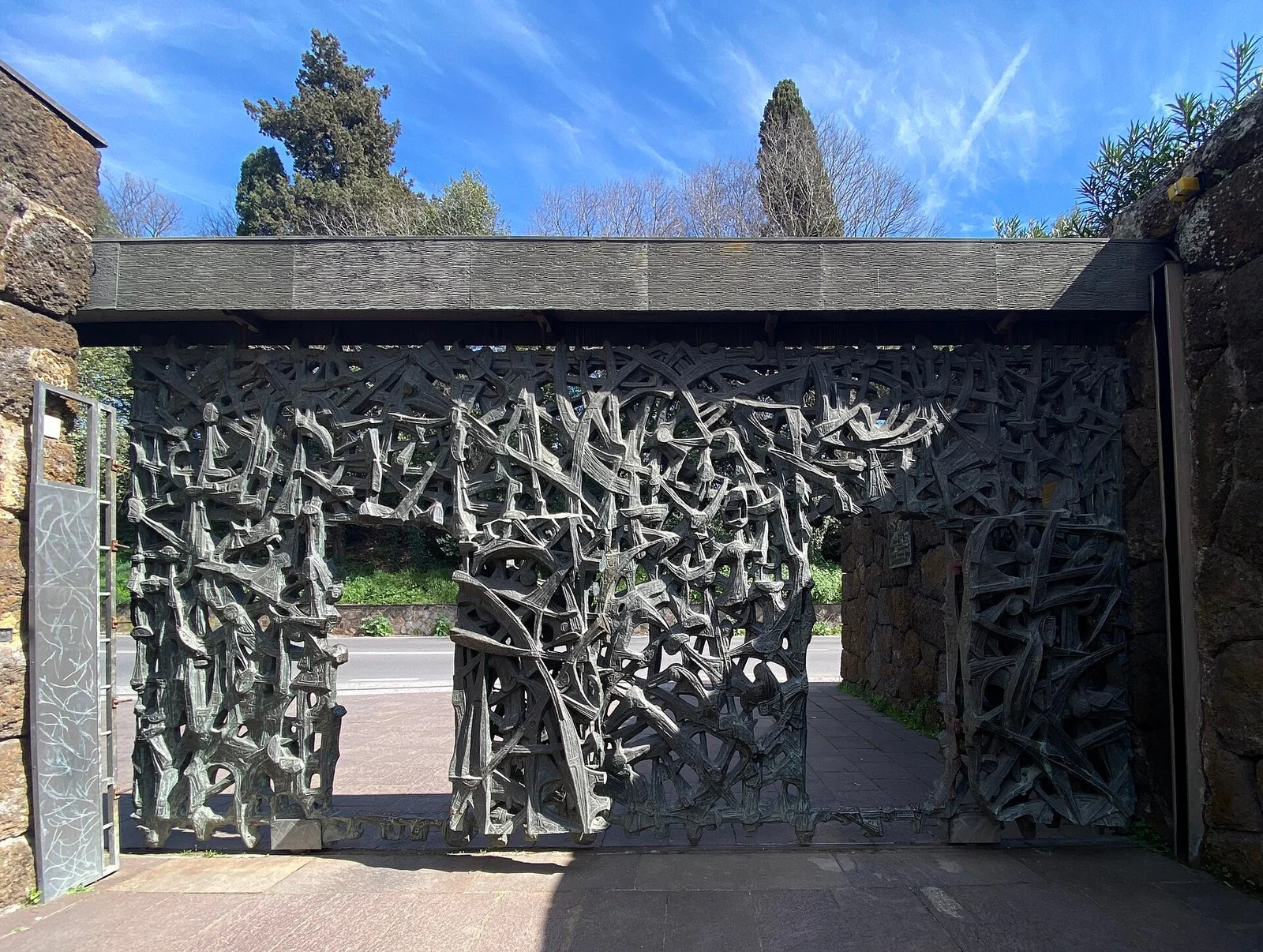
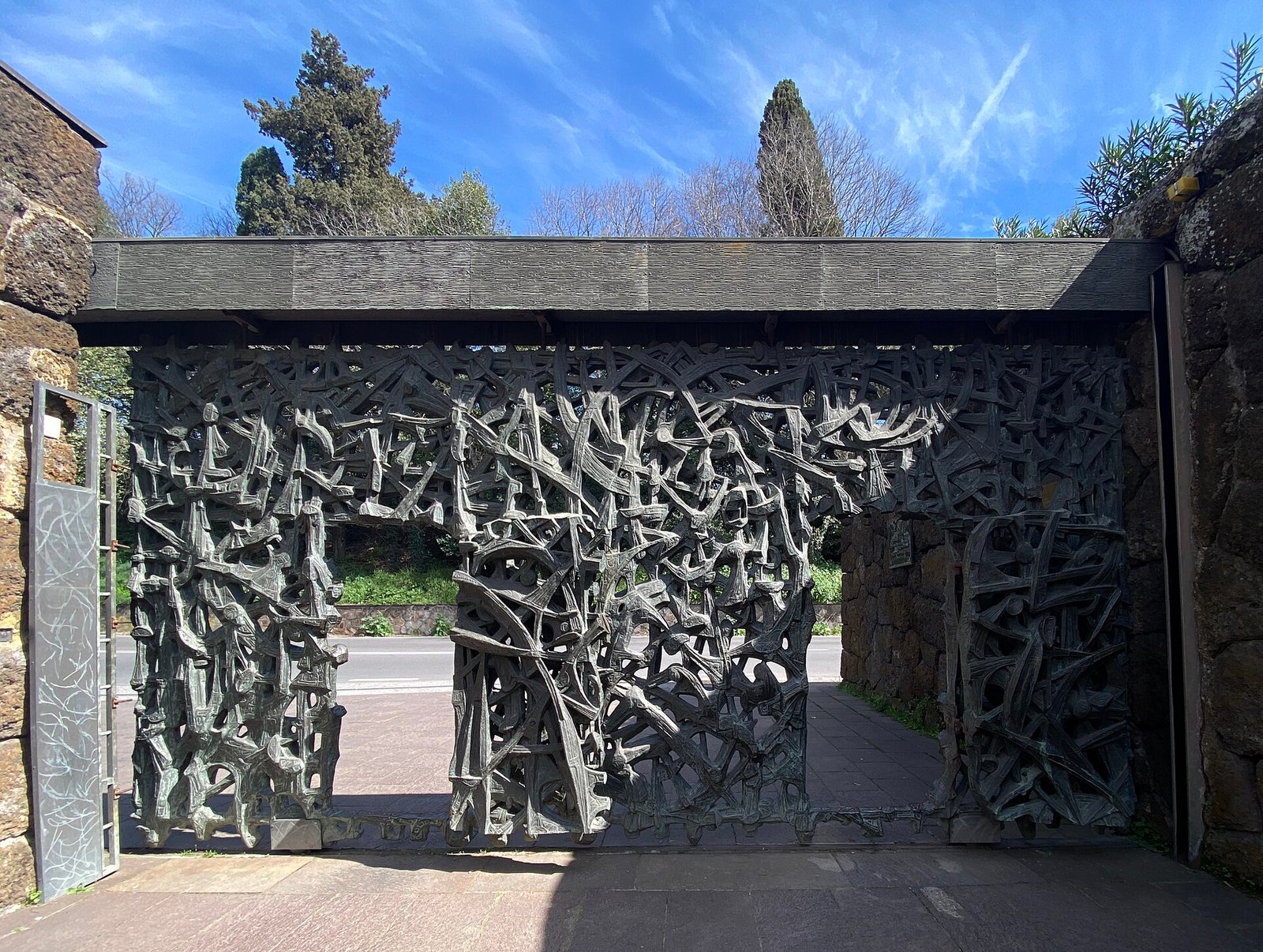
The competition for the monument was announced in January 1945, a few months after the events, and ended in 1946 with the joint victory of two groups, later merged: Nello Aprile, Cino Calcaprina, Aldo Cardelli, Mario Fiorentino and the sculptor Francesco Coccia on one side, Giuseppe Perugini and Uga de Plaisant on the other. The shrine was inaugurated on March 24, 1949, on the fifth anniversary. The covering is a hollow monolith in reinforced concrete, resting on hidden supports so that between the perimeter and the ground a slit of light remains: the effect is that of a slab suspended above the 335 aligned tombs. The bronze gate is the work of Mirko Basaldella, the travertine sculptural group is by Francesco Coccia.
Hours, access and how to get there
The complex includes the quarry galleries, the burial hall and a museum route. Guided visits and reservations for groups and schools are handled by the association of the martyrs' families. Admission is free. The site is reached by bus from the San Paolo area and from the Ardeatina. Anyone arriving by car finds parking along the road, but the area is not served by the metro. Anyone combining the visit with the Catacombs of Domitilla or the Catacombs of San Callisto, which are in the same quadrant between the Ardeatina and the Appia, must allow for short transfers but with infrequent transport.
The Portico of Octavia and October 16, 1943
The roundup of October 16, 1943 was the operation in which the German security police arrested in a few hours 1,259 people in the Jewish quarter of Rome and in other parts of the city, deporting 1,023 of them to Auschwitz-Birkenau: 16 came back. The street that carries its memory is Via del Portico d'Ottavia, inside the Jewish Ghetto of Rome, and it can be walked freely at any time. The district is lived in and is not a museum area: the plaques are on the walls of houses where people live.
The hours of the roundup
The operation began at dawn on a Saturday, a day of rest, with the squads entering the doorways with lists already compiled. Those arrested were taken to the Military College on Via della Lungara, a short distance from the Regina Coeli prison and a stone's throw from the Janiculum and from the embankment of Trastevere. During the day and the following day about 230 people were released: foreign citizens, spouses in mixed marriages and people not recognized as Jewish. The rest were loaded onto 28 cattle cars at Tiburtina station.
The figures and the sources
The figures most widespread in the literature are 1,259 arrested and 1,023 deported, with a breakdown of those arrested indicating 689 women, 363 men and 207 girls and boys. The report drawn up by the German command speaks instead of 1,007 people remaining after the civil-status checks, and some reconstructions report 1,022 or 1,024 departing. The difference depends on the moment at which the count is made: at the arrest, after the releases, at the departure of the convoy. The train left Tiburtina station on October 18, 1943 and reached Auschwitz on October 22. On arrival about 820 people were sent immediately to the gas chambers and a little over 200 were selected for labor. The survivors were 16, 15 men and a single woman, Settimia Spizzichino.
The places to cross
The minimal route includes Via del Portico d'Ottavia with its plaques, Largo 16 Ottobre 1943, the stumbling stones in front of the doorways and the stretch of embankment toward Tiber Island and the Theater of Marcellus. The Military College on Via della Lungara, today a military site, cannot be visited: you read the outside plaque. Tiburtina station, the third place in the story, in turn preserves a plaque in the area of the tracks from which the convoys departed.
The Jewish Museum and the Tempio Maggiore
The Jewish Museum of Rome, set up in the basement of the Great Synagogue, displays silverwork, textiles and documents of the community and devotes a section to persecution and deportation. The visit to the synagogue is done with an escort included in the museum ticket, in several languages and at fixed times. The museum is closed on Saturday and on Jewish holidays, and the hours change several times during the year according to a seasonal calendar published by the institution: it is best to consult it before showing up, because the winter hours close as early as 16:00. Security checks are in place at the entrance. Photographs inside are subject to limitations.
The Casina dei Vallati and the Shoah Museum Foundation
The Casina dei Vallati, at Via del Portico d'Ottavia 29, is the exhibition venue of the Shoah Museum Foundation of Rome and hosts temporary exhibitions devoted to persecution and deportation. The hours given by the foundation are Sunday to Thursday from 10:00 to 18:00 and Friday from 10:00 to 13:00, closed on Saturday and on Jewish holidays. Since it is a venue with a changing program, it is best to check on the foundation's website which exhibition is on before going.
What you visit at the Casina dei Vallati
The building is a reworked medieval palazzetto, restored and entrusted to the foundation by the City. It is not a permanent museum: it hosts rotating installations, often built on archival collections and on testimonies, and over the years has hosted exhibitions on the racial laws of 1938, on the liberation of the camps and on the roundup of October 16. Meetings, presentations and educational activities are also held there. The visit generally lasts less than an hour and combines naturally with the Jewish Museum, which is a few dozen meters away.
The Shoah Museum under construction at Villa Torlonia
The National Shoah Museum of Rome is planned on an area adjacent to Villa Torlonia, on Via Alessandro Torlonia side: the project dates from 2005, obtained municipal approval in 2012 and restarted after the state funding decided between 2023 and 2024. The construction site has suffered interruptions and appeals, with a suspension tied to geotechnical checks later overcome: for this reason we do not give an opening date, because the forecasts have been revised several times and no deadline appears confirmed in definitive form. Updated information is found on the institutional channels of Roma Capitale and of the foundation.
Why Villa Torlonia in particular
The choice of site is not neutral: Villa Torlonia was the private residence of Benito Mussolini from 1925 to 1943, rented from the Torlonia family, and in the subsoil of the park are the air-raid shelters and the bunker dug between 1940 and 1943. The park today hosts the civic museums of the Casino Nobile, the Casina delle Civette and the Casino dei Principi, and visits to the bunker and the shelters are organized periodically. In the subsoil there are also Jewish catacombs of the Roman age, not open to the public. The obelisks of the villa are also part of the 19th-century complex.
The stumbling stones and how to read them
The stumbling stones of Rome are small blocks 10 centimeters by 10, covered with an engraved brass plate, laid in the paving in front of the last home freely chosen by a victim of Nazi-Fascist persecution. In Rome the first laying dates to 2010 and at the end of 2025 there were just under 500, spread across almost all the municipi. The project is by the German artist Gunter Demnig and in Rome is run by the association Arte in Memoria, with Adachiara Zevi.
How the project began
Demnig started the initiative in Germany in the early 1990s. The idea is that the monument should not be a place you go to, but an object you stumble on while doing something else. The installation always takes place in the presence of whoever asked for the stone, that is, generally relatives, building residents, schools or associations, and in Rome it is concentrated in the days around January 27, with a public laying announced street by street. Each stone is dedicated to a single person.
How to read a stone
The text follows a fixed scheme. The first line indicates the relationship with the place: lived here, worked here, found refuge here. Next come first and last name, the year of birth, the date and place of arrest, the destination of the deportation, and finally the date and place of death when known. If they are not, only the name of the camp is read. The Roman stones do not commemorate only deported Jews: there are soldiers interned in Germany after September 8, partisans, political opponents, civilians killed at the Fosse Ardeatine, people persecuted for sexual orientation.
Where they are and how to look for them
The greatest concentration is in the historic center, in the Sant'Angelo district and in the streets around Largo di Torre Argentina, but large groups are also found in the neighborhoods outside the walls: the municipio with the most after the center is the one that includes Nomentano, Trieste and Salario. The City publishes the list of layings by edition, with the exact address, and the curating association keeps a map. Anyone walking in the Monti district or on the streets of the Aventine meets them without looking.
The Quadraro and the roundup of April 1944
The roundup of the Quadraro took place on April 17, 1944 under the code name Unternehmen Walfisch, translated into Italian as Operation Whale: the neighborhood was surrounded during the night, men between 19 and 50 were gathered and some of them were deported to Germany. The Quadraro lies between Via Tuscolana and Via Casilina, in the southeast quadrant, and is today an inhabited neighborhood that has no dedicated museum but preserves plaques, murals and a place-name geography of memory.
Operation Whale
The operation was decided by the police command headed by Herbert Kappler, who considered the zone a refuge for draft evaders, soldiers adrift after September 8, partisans and wanted men. In the German papers the neighborhood is described as a wasps' nest, an expression attributed to the German consul Eitel Friedrich Moellhausen and later become the way the Quadraro itself tells its own story. The men detained were taken first to the neighborhood cinema for registration, then to the Cinecittà studios, used as a collection and selection camp, and from there sent north.
The figures and the divergences among sources
On the number of those detained and of those deported the sources do not agree and it is best to say so clearly. Those detained are given as about 2,000. For the deported there are three different figures: 683, which is the total of the nominal list compiled by the parish priest don Gioacchino Rey and considered the most reliable because it is built on names and not on estimates, about 740 in other reconstructions, and 947 in the figure reported by part of the popular literature and by several association sources. Anyone who cites a number without saying which count they are using gives incomplete information. Many of the deportees were put to forced labor in Germany. Some did not return.
What you see today at the Quadraro
The neighborhood preserves a plaque dedicated to the deportees, installed for the 80th anniversary together with a public appeal to complete the identification of the names, and a street-art route that includes works dedicated to the roundup. In 2004, on the 60th anniversary, the municipio it belongs to was awarded the gold medal for civil valor for the events of 1944. The commemoration is held every year on April 17. The visit is a street walk, with no tickets: you arrive by metro line A, stops Porta Furba Quadraro or Numidio Quadrato. A short distance away are the Aqueducts Park and, along the consular road, the Villa of the Quintilii.
Porta San Paolo and the defense of Rome in September 1943
Porta San Paolo, the gate of the Aurelian Walls next to the Pyramid of Cestius, is the symbolic place of the fighting of September 8, 9 and 10, 1943, when units of the Italian army and groups of civilians tried to stop the German advance toward the center of Rome. You cross it freely: memory is entrusted to the plaques on the flanks of the gate and to the monument in the adjacent area.
Three days of fighting
After the announcement of the armistice, on the evening of September 8, the German units moved toward Rome from the south. The main clashes took place at the Magliana bridge, at the Montagnola, in the EUR area and at the Cecchignola, with the Grenadiers of Sardinia division engaged first. On September 10 the front fell back to the walls and the battle concentrated on Porta San Paolo, where civilians, political militants and volunteers joined the regular units. The surrender was signed on the afternoon of September 10, but the fighting continued in the center until evening.
The losses: figures that do not match
Here too the figures vary according to the criterion of calculation. The widest estimates indicate about 1,167 military dead, other reconstructions stop at 414 soldiers. For civilians the recurring number is 183, of whom 27 women. The difference depends on the geographic and temporal perimeter considered, that is, if you count only the urban clashes or the whole deployment around the city, and on if or not you include the wounded who died in the following days. We report both ranges because neither can be given as definitive.
What you see today
On the spot are plaques dedicated to the fallen and to the Resistance, and the square hosts every year the institutional commemoration of September 10. Not far away, at Porta San Sebastiano, you enter the Museum of the Walls, housed in the walkways of the walls, which lets you walk a stretch of the circuit at height and understand how the defensive circuit worked. Just outside are the Museum of Via Ostiense and, a few steps away, the Non-Catholic Cemetery, where civilian fallen of those months are also buried. The neighborhood behind is Testaccio, with the Monte dei Cocci and the former Slaughterhouse.
Forte Bravetta and the places of execution
Forte Bravetta, in the western quadrant of Rome, was the city's main place of capital execution between the 1930s and 1944: documented reconstructions count about 130 shot in all, of whom some 50 sentenced by the Fascist Special Tribunal before September 8, 1943, some 70 during the nine months of German occupation and about 10 after the Liberation. The monument visible today at the entrance of the public park recalls the names of 77 patriots.
The fort and the shootings
The fort is part of the entrenched camp built around Rome at the end of the 19th century, the same series to which Forte Antenne belongs, and was reused as a shooting range for executions. During the occupation, partisans, soldiers and civilians sentenced by German military tribunals were shot there: the best-known case is that of don Giuseppe Morosini, chaplain of partisan formations, arrested on January 4, 1944, sentenced to death on February 22 and shot on April 3, 1944, awarded the gold medal for military valor in February 1945. Six men were killed on June 3, 1944, a few hours before the arrival of the Allies.
The Forte Bravetta Martyrs' Park
The area around the fort is today the Parco dei Martiri di Forte Bravetta, with entrance from Via di Bravetta, open from morning to sunset and equipped as a neighborhood park. The commemorative monument is at the entrance. The structure of the fort is not freely accessible: opening depends on guided visits organized periodically and must be checked in advance, because there is no ordinary calendar. On this point, and on any seasonal program, our page on Estate Romana gathers the special openings when they are announced.
The other places of executions and massacres
Forte Bravetta was not the only site. Other massacres are tied to La Storta, on Via Cassia, where on June 4, 1944 14 prisoners taken from Regina Coeli were killed, among them the trade unionist Bruno Buozzi, and to Pietralata, where on October 23, 1943 10 men captured after a clash were shot. Forte Boccea too, still a military site today and not open to visits, was used for executions. In these places memory is entrusted to a cippus that can be reached on foot but is not signposted.
San Lorenzo and the bombing of July 19, 1943
The bombing of July 19, 1943 was the first Allied air attack on Rome and struck the San Lorenzo rail yard and the surrounding neighborhoods, with about 1,000 tons of bombs dropped in two waves: overall estimates for the city hover around 3,000 dead, of whom about 1,500 in the San Lorenzo neighborhood alone. The neighborhood is visited by walking: there are no tickets, but there are precise signs to look for.
What happened that day
The attack began in the morning with a few hundred heavy bombers and continued in the afternoon with medium bombers. The declared targets were rail facilities and airfields, but the high-altitude bombing hit the built-up area squarely. Besides San Lorenzo, the Tiburtina, Prenestina, Casilina, Labicana, Tuscolana and Nomentana zones were damaged. Pope Pius XII went to the site in the afternoon and his presence in the square of the Verano is one of the most photographed episodes of the day.
Estimates of the victims
The figures vary according to the source and the perimeter: for the whole city values around 3,000 dead and 11,000 wounded are found, for the San Lorenzo neighborhood alone about 1,500 dead and 4,000 wounded, while the reconstructions that count only the bodies identified in the following days fall below these thresholds. There is no single figure recognized by all sources: we recommend citing the range and not a round number.
The signs in the neighborhood today
The basilica of San Lorenzo fuori le Mura was gravely damaged and its postwar restoration can still be read in the rebuilt facade and portico. The Verano Cemetery, immediately adjacent, preserves the damage and the burials of those days. In the neighborhood remain plaques set into buildings, condominium tablets and a monument to the victims. San Lorenzo is today a university neighborhood much frequented in the evening: anyone looking for the signs of 1943 should make the round by day.
The Casa della Memoria e della Storia
The Casa della Memoria e della Storia, at Via di San Francesco di Sales 5 in Trastevere, is the municipal center that brings together the associations of the Resistance and of the deportation and hosts a library specialized in the 20th century: it was inaugurated on March 24, 2006, on the anniversary of the Fosse Ardeatine. Access to the library and to the meetings is free. The hours follow those of Rome's library system and should be checked, because they change with the seasons and with the program.
What it hosts
In the same venue there is room, among others, for the national partisans' association, the association of former deportees in the Nazi camps, that of former internees, the association of anti-Fascist political persecutees, the Italian federation of partisan associations, the Roman institute for the history of Italy from Fascism to the Resistance and the Circolo Gianni Bosio, which works on oral sources and social song. It is the place where you find the archives, the journals and the interlocutors, more than displayed objects.
Cippi, plaques and widespread memory
Beyond the museums and shrines, Rome preserves several hundred plaques, tablets and cippi dedicated to the events of 1943-1944, set into buildings or placed at the edges of streets: they are the most extensive and least visited part of the city's memory, because they appear in no circuit and are noticed only if you know they are there. They have no hours, no custodians and in most cases not even a sign pointing them out.
How to read a postwar plaque
The Roman plaques laid between 1944 and the early 1950s follow recurring formulas: the place of the event, the date, the list of names or the number of the fallen, the signature of the body that wanted it, from the City to a veterans' association, to a union, to the residents of the building. The formula says a lot about the context in which it was born: a plaque of 1945 signed by a liberation committee has a different language from a municipal tablet of the 2000s. The engraved dates should be taken as a starting point and not as definitive truth, because in more than one case local memory fixed a date slightly different from the one later established.
Where you meet them most often
The greatest concentrations are along the walls between Porta San Paolo and Porta San Sebastiano, in the districts of the center, on the streets of the Jewish quarter, at San Lorenzo, at the Quadraro, at the Tiburtino and in general in the borgate that were the scene of roundups. In the monumental center some are also found in unexpected spots: around the Colosseum, along the streets that climb to the Capitoline Hill, near the Altar of the Fatherland and in the neighborhood behind the Baths of Caracalla. Anyone walking between the Roman Forum and the Circus Maximus crosses about 10 without detouring.
How to build an itinerary in one day
A day among the places of memory in Rome holds three stops, four at most: two sites with opening hours and one or two outdoor stops in the city, keeping in mind that the Fosse Ardeatine Mausoleum closes in the early afternoon on weekdays and that the Jewish Museum is closed on Saturday. Below you'll find three combinations built on real travel times, not on straight-line distances.
Option A: the center, from Portico d’Ottavia to Via Rasella
Morning at the Jewish Museum and the Great Synagogue, with the guided visit of the synagogue. Next comes the street of Portico d’Ottavia, Largo 16 Ottobre 1943, the stumbling stones of the district and the Casina dei Vallati. In the afternoon, go on foot or by bus toward Via Rasella and Palazzo Barberini, and finish at the Central Museum of the Risorgimento if you want to add the nineteenth-century context of national memory. It's the most compact option: you walk little and never leave the area between the Tiber and the Quirinale, the one of the Crypta Balbi and of Largo di Torre Argentina.
Option B: Via Tasso and the Fosse Ardeatine
Start at the Museo storico della Liberazione just as it opens, when the museum is empty. Then transfer toward Via Ardeatina, which takes a bus and about half an hour, to reach the Mausoleum before the end of the morning on weekdays. In the afternoon you can head back up toward the Appia and add the Catacombs of San Sebastiano or the Basilica of San Sebastiano fuori le mura, or return to the center. It's the most demanding itinerary from an emotional point of view, and we advise against weighing it down with other stops.
Option C: memory outside the center
Metro line A toward Quadraro in the morning, with the walk along the plaques and the murals. Return toward San Lorenzo in the afternoon, with the basilica, the Verano Cemetery and the neighborhood's memorial plaques. If you have time and a car, you can add the Parco dei Martiri di Forte Bravetta, which however is on the opposite side of the city. It's the least visited option and the most useful for understanding that the occupation did not affect only the historic center.
Times, transport and practical notes
The sites on this route are free except for the Jewish Museum. The free-entry Sundays at state and city museums are collected on the page about free museums in Rome. Transfers between the center and Via Ardeatina, and between the center and Bravetta, are made by surface bus. We recommend counting on at least 40 minutes per transfer. For tickets, passes and lines, we refer you again to the page on getting around Rome. On commemoration days, and in particular March 24, April 25 and October 16, the areas involved are closed to traffic and ordinary visits are canceled.
Where to eat along the route
On this point we give a criterion, not a list of signs, because signs change management and the advice goes stale in a few months. The warning signs to stay away from are always the same: the woman rolling fresh pasta in the window or on the sidewalk, which is a lure for passersby and not a sign of good cooking. The menu with photographs of the dishes. The person inviting you to sit down from the doorway. The place open from morning to late at night with no kitchen break. And the tables set in front of the most photographed monuments, where the price tends to follow the tourist in front of you, with unpriced items and different price lists inside and outside. The chains with the same sign repeated in several spots in the center, the identical menu and the queue with a ticket number are a phenomenon to know about and to avoid: Romans don't go there. The simplest criterion remains looking at who is sitting at the tables and in what language they order. For those who still want a personal reference, openly not sponsored, there is Daniele Dezi's personal list on Google Maps. For the general picture, we refer you to our page on where to eat in Rome.
The dates of the civic calendar
Four dates organize the Roman civic calendar tied to these places: January 27, March 24, April 25 and October 16. In Rome, September 10 for the defense of the city and June 4 for the Liberation are added to them. On these days many of the places described change function: they become ceremony venues, with limited access and with authorities and family members present.
January 27, Holocaust Remembrance Day
Established by an act of the State in 2000, it remembers the Shoah on the anniversary of the opening of the gates of Auschwitz in 1945. In Rome it is the week when new stumbling stones are laid, generally in the days immediately before or after, with public ceremonies street by street. The Casa della Memoria e della Storia, the Jewish Museum and the Casina dei Vallati concentrate meetings and special openings in these days. Schools crowd the museum venues, so if you're visiting on your own, choose another time of year.
March 24, anniversary of the Fosse Ardeatine
The official commemoration takes place at the Mausoleum with the participation of State officials and the families of the victims. Access to the shrine on that day is regulated and it is not a suitable date for an individual visit. The evening before, March 23, events are held in Via Rasella and at the associations' venues.
April 25 and June 4
April 25 is the national Liberation holiday, celebrated in Rome with the laying of a wreath at the Altar of the Fatherland and with the march that traditionally arrives at Porta San Paolo. June 4, the anniversary of the Allies' entry into the city in 1944, is above all a Roman occasion, and it is the date on which the first core of Via Tasso museum was inaugurated in 1955. In the weeks around April 25, guided visits and events multiply, many of them free. We list them on the Estate Romana page when they are part of the city calendar.
October 16, anniversary of the roundup
The commemoration is held in the largo named after the date, in front of Portico d’Ottavia, generally in the late afternoon, and includes the reading of the names. It is a ceremony attended by the community and by the city. If you attend, do so without photographing those present and without taking the seats reserved for family members.
September 10, the defense of Rome
The date is remembered at Porta San Paolo with an institutional ceremony that in recent years has seen the presence of the President of the Republic. In the same days the city museums offer documentary exhibitions on the defense of the city, often hosted at the Capitoline Museums or at the Museo di Roma at Palazzo Braschi.
Frequently asked questions about the places of memory in Rome
How much does it cost to visit the places of memory in Rome?
Almost all the places of memory in Rome are free: the Museo storico della Liberazione in Via Tasso, the Fosse Ardeatine Mausoleum, the Casa della Memoria e della Storia, the Parco dei Martiri di Forte Bravetta and all the outdoor stops, from Via Rasella to Porta San Paolo, have no ticket. The only paid site on the route is the Jewish Museum of Rome, whose ticket includes the guided visit of the Great Synagogue.
Is the Museo storico della Liberazione in Via Tasso open every day?
The Museo storico della Liberazione in Via Tasso is open every day from 9:00 to 19:00, Sundays and holidays included, with free entry and closures limited to a few days at Christmas, New Year's, Easter and mid-August. Reservations are required only for large groups, several weeks ahead, while individual visitors walk in without formalities. Hours should still be rechecked on the museum's website before you go.
What are the hours of the Fosse Ardeatine Mausoleum?
The Fosse Ardeatine Mausoleum, at Via Ardeatina 174, lists hours from 8:15 to 15:15 Monday to Friday and from 8:15 to 16:45 on Saturday and Sunday, with free entry. On ceremony days, in particular March 24, access is regulated and an individual visit is not possible. Guided visits and reservations for schools are handled by the association of the martyrs' families.
Can you take photographs at the places of memory in Rome?
At the places of memory in Rome, photography is allowed outdoors but restricted inside the shrines and some museum venues: at the Fosse Ardeatine you don't photograph the tombs, at the Jewish Museum and in the synagogue the restrictions posted at the entrance apply, and in the cells of Via Tasso discreet use is required. You can photograph the stumbling stones, but without posing on them or next to them for portraits.
How much time do you need to visit the places of memory in Rome?
For the places of memory in Rome, a full day holds three stops, four at most: about an hour and a half for Via Tasso museum, an hour and a half for the Fosse Ardeatine including the tunnels, an hour and a half for the Jewish Museum and the synagogue, plus the outdoor stops that take a few minutes each. Add at least 40 minutes for each transfer between the center and the outskirts.
Are the places of memory in Rome suitable for children?
The places of memory in Rome have no softened routes for small children: the cells of Via Tasso and the burial chamber of the Fosse Ardeatine are real places and not educational displays. Above age 12 the visit works if prepared beforehand, and secondary schools do it regularly with accompaniment. For the youngest we recommend limiting yourself to the outdoor stops, the stumbling stones and the reading of the plaques.
Where are the stumbling stones in Rome and how many are there?
The stumbling stones in Rome number just under 500, laid from 2010 to the end of 2025, and they are found on the sidewalk in front of the last free home of the people remembered. The greatest concentration is in the historic center and in the district of the Jewish quarter, followed by the area between Nomentano, Trieste and Salario. The City of Rome publishes the lists with the exact addresses, edition by edition.
Are the places of memory in Rome accessible with a mobility disability?
Among the places of memory in Rome, the Museo storico della Liberazione is listed as wheelchair accessible and the Fosse Ardeatine Mausoleum has level paths in the burial chamber, while the quarry tunnels have an uneven floor. Via Rasella is uphill and the Jewish district has long stretches of sampietrini. We recommend contacting each site in advance.
Who wrote this page
This page is edited by the staff of Tour Leader Pro, the Rome-based project office that designs and coordinates visits, itineraries and cultural events in Rome and Lazio. The hours, fares and access conditions listed here were checked on the date of publication against the official sources named in the text. It's worth rechecking them before you go, because they change often. If you find outdated information, let us know.
If you're building a multi-day route on these themes, combining the sites in the center with the stops outside the walls and with the dates of the civic calendar, you'll find planning tools at Tour Leader Pro, which regularly works with schools, institutes and organized groups on itineraries of this kind.
If you're coming from outside the region and need to fit Rome in with other Italian stops, from trains to the real distances between one city and another, a useful resource is Italy Planner.