Ponte Sant’Angelo
In short. Ponte Sant’Angelo is the pedestrian bridge that connects the rione Ponte to Castel Sant’Angelo, built by the emperor Hadrian and inaugurated in 134 AD under the name pons Aelius, and today carries on its parapets 10 statues of angels…
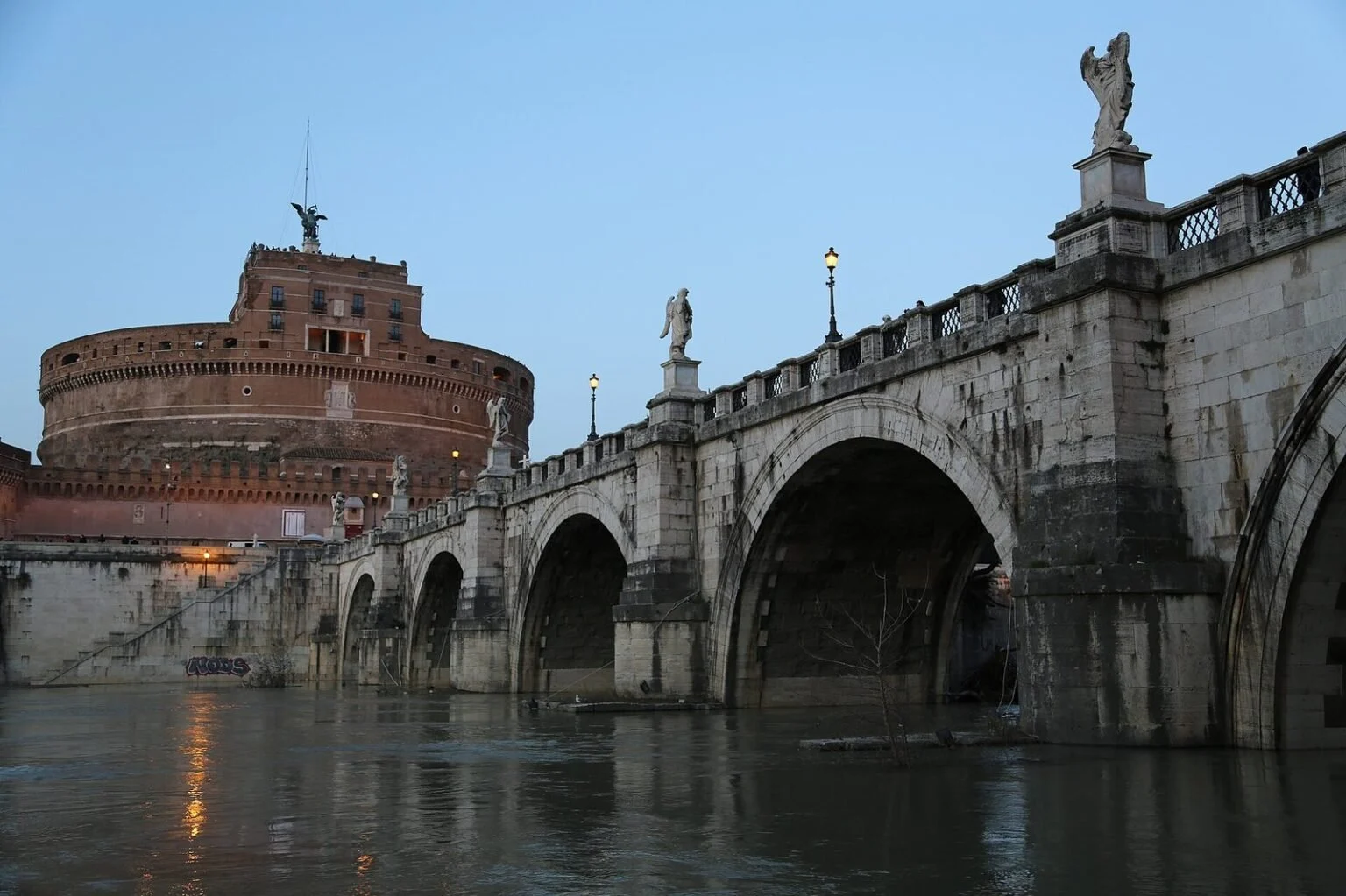
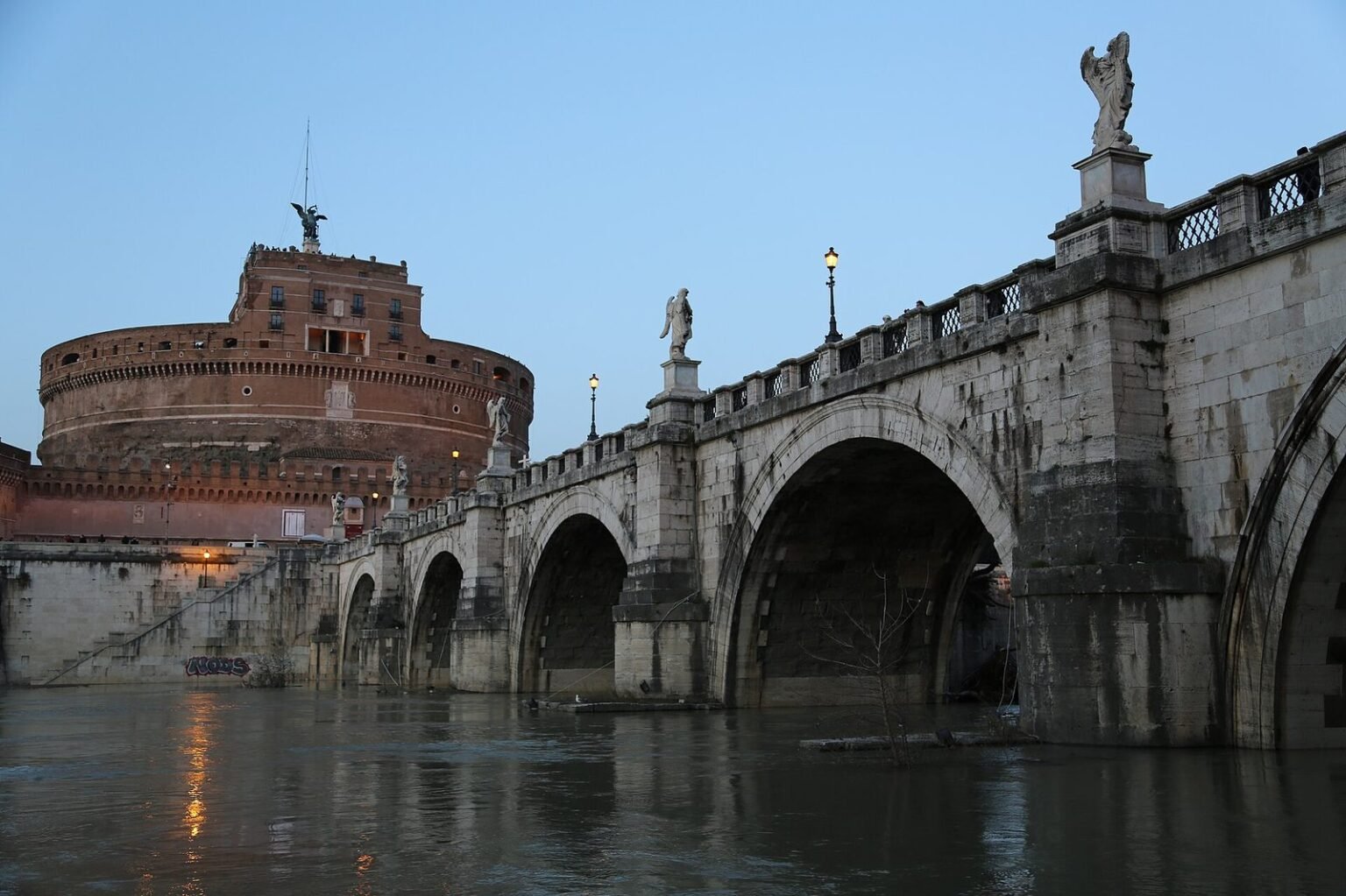
Ponte Sant’Angelo is the pedestrian bridge that connects the rione Ponte to Castel Sant’Angelo, built by the emperor Hadrian and inaugurated in 134 AD under the name pons Aelius, and today carries on its parapets 10 statues of angels with the instruments of the Passion designed by Gian Lorenzo Bernini between 1667 and 1669. It is the most photographed bridge in Rome and at the same time one of the least understood: almost everyone thinks they are looking at five Roman arches, when the ancient arches are three, and almost everyone thinks they are seeing two angels sculpted by Bernini in person, when the two autographs are not here but inside a church near Piazza di Spagna. In the lines that follow you'll find what is truly ancient and what is 19th-century, who sculpted each of the 10 angels, what happened on December 19, 1450 when the parapets gave way under the crush of pilgrims, why for three centuries this was the place of capital executions in Rome, and how to visit it today after the restoration of the statues completed at the end of 2024.
Where Ponte Sant’Angelo is and how to get there
Ponte Sant’Angelo crosses the Tiber between Lungotevere Tor di Nona and Lungotevere Castello, joining the rione Ponte on the left bank to the rione Borgo on the right, exactly in front of the bulk of Castel Sant'Angelo. It is an entirely pedestrian bridge: no cars, scooters or buses pass, and this makes it the most convenient river crossing for those walking between the historic center and the Vatican. Access is free, costs nothing and is possible at any hour of the day and night: there are no tickets, turnstiles, opening hours or reservations.
On foot from the historic center
From Piazza Navona you get there in eight or 10 minutes at most by taking Via di Tor Millina, then Via dei Coronari, the street of the antique dealers that in an almost straight line leads to the mouth of the bridge: it is the historic route of the pilgrims, the one that in the Renaissance was called Via Recta. From Campo de’ Fiori the time rises to a quarter of an hour via Via del Pellegrino and Via del Banco di Santo Spirito. From the Pantheon it takes about 12 minutes. Anyone coming instead from St. Peter's Basilica walks down Via della Conciliazione in 10 minutes and comes out directly on the Castel Sant’Angelo side, that is, at the right end of the bridge.
By public transport
The most convenient stop is the bus stop on Lungotevere Vaticano and in Piazza Pia, on the Borgo side, served by the lines connecting Termini and the center with the Vatican. On the opposite side, on Corso Vittorio Emanuele II, stop the lines that cross the historic center from east to west: from the Corso Vittorio Emanuele / Sant’Andrea della Valle stop you walk for about seven minutes along Via del Banco di Santo Spirito. The nearest metro station is Lepanto, on line A, from which it takes roughly 15 minutes on foot across the Prati neighborhood. Alternatively you get off at Ottaviano, also line A, and reach the bridge via Via della Conciliazione, with a similar travel time. It's worth remembering that on days of heavy flow to the Vatican, that is, the Wednesday of the general audience and Sunday at noon, the surface lines in the Borgo area suffer detours and slowdowns: on foot you often arrive sooner.
The pons Aelius: the bridge Hadrian built for his own mausoleum
The bridge was built at the will of the emperor Publius Aelius Traianus Hadrianus and inaugurated in 134 AD, with the name pons Aelius derived from the emperor's own family name. The Sovrintendenza Capitolina places the building site between 121 and 134, that is, over a span of a dozen years that coincides with the period in which Hadrian had his dynastic mausoleum built on the right bank, the enormous cylindrical drum that in the following centuries would become Castel Sant’Angelo. Some sources attribute the design to an architect named Demetrianus, but this is an attribution handed down by the scholarly tradition and not confirmed by an inscription: we report it for completeness, noting that it does not have the same degree of certainty as the dating.
A bridge born as access to a tomb
The reason the bridge exists is simple and should be said right away, because it explains its apparently off-center position relative to the ancient city: in the second century the right bank of the Tiber along this stretch was not an inhabited neighborhood but a zone of gardens and tombs, the horti Domitiae, and Hadrian's mausoleum stood there isolated. To connect it to the Campo Marzio, that is, to the built-up and busy Rome, a new bridge was needed: the pons Aelius was born as a monumental access ramp to the emperor's tomb, not as an urban link between two neighborhoods. Its function was ceremonial even before practical, and this explains the architectural care and the travertine facing on a structure that could have been much plainer. The most immediate comparison is with the Mausoleum of Augustus, the other great imperial tomb of the Campo Marzio, which however stood on the left bank and never needed a dedicated bridge.
The materials: peperino inside, travertine outside
The load-bearing structure is peperino, the gray volcanic stone of the Alban Hills widely used in Roman building for sturdy and inexpensive facings, while the visible facing was travertine, the white limestone from Tivoli that gives all Roman architecture its characteristic color. It is the same building logic that holds up the Colosseum: cheap material for the mass of the wall, noble stone for what is seen. On the surviving central arches this facing is still legible, despite 19 centuries of floods, frosts and restorations.
How many arches Ponte Sant’Angelo has: three ancient and two from the 1800s
Ponte Sant’Angelo today shows five arches of uniform look, but only the three central ones are Roman: the two side ones were built between 1892 and 1894, during the works on the Tiber embankment walls, replacing the ancient ramps. It is the fact that changes the reading of the monument most and that almost no quick guide reports, because the 19th-century builders imitated the profile of the Roman arches so well that to the naked eye the difference isn't noticed.
What the Roman bridge was like
In its original configuration the pons Aelius had three large arches over the riverbed and was reached, from both banks, by masonry ramps themselves supported by smaller arches: three on the left bank and two on the right bank, according to the most accredited reconstruction. The total thus came to eight openings in the complex, of which only three actually spanned the water. The ramps served to overcome the difference in level between the street level of the two banks and the height of the deck, which was noticeably higher: the ancient bridge had the classic humpback profile, that is, it rose toward the center and came back down, a shape that can be seen well in the engraved views of the 1600s and 1700s and that today has disappeared.
The embankment works and the loss of the ramps
After the flood of December 1870, the same one that flooded half of Rome a few weeks after the breach of Porta Pia, the Italian government decided to give the Tiber continuous artificial banks, the embankment walls, to protect the city from floods. The building site, begun in the 1870s and continued for decades, changed irreversibly the relationship between Rome and its river: the river ports, the stairways down to the water, the floating mills and the houses that faced directly onto the current disappeared. At Ponte Sant’Angelo the new profile of the banks made the ancient ramps unusable, because they would have stayed buried inside the walls or hanging at the wrong height. Between 1892 and 1894 the ramps and the smaller arches were therefore demolished and in their place two large arches were built, sized and shaped like the Roman ones, so as to obtain the continuous sequence of five arches seen today.
What was lost and what was gained
The gain was practical and visual: the bridge became flat, therefore more convenient, and acquired the regular silhouette that has made it one of the most recognizable profiles in Rome. The loss was one of archaeological substance, because stretches of authentic Hadrianic masonry disappeared and along with them the humpback profile that the bridge had kept for 17 centuries. Some technical reports also note that the 19th-century intervention produced cracks in the ancient central arches, stressed by a new structural arrangement: it is one of the reasons why the bridge has been the object of consolidation works in the 1900s, including a structural restoration in the 1990s that included waterproofing the extrados and sealing the loose joints.
The pilgrims' bridge: from the pons Sancti Petri to the jubilees
Throughout the Middle Ages and until the opening of other crossings in the modern age, Ponte Sant’Angelo was the only practicable passage for anyone who from the center of Rome wanted to reach the basilica of St. Peter's, and this monopoly condition explains almost everything that happened to it. The bridge of Nero, a little upstream, was already in ruins in the early Middle Ages: pilgrims had no alternatives.
From pons Aelius to the bridge of St. Peter
Once the memory of the ancient name was lost, the structure was simply called pons Sancti Petri, the bridge of St. Peter, because it was the one that led to the apostle's tomb. The current name comes from the castle: when Hadrian's mausoleum took the name Castel Sant’Angelo, the bridge followed, becoming Ponte Sant’Angelo and, in the current usage of the Romans, also ponte di Castello. Popular tradition, which should be labeled as such and not as historical fact, ties the castle's name to an angelic apparition during the pontificate of Gregory the Great, at the end of the sixth century, that supposedly announced the end of a plague epidemic. A third name, ponte degli Angeli, took hold only after 1669 and refers to the 17th-century statues, not to the medieval legend.
The jubilee of 1300 and Dante's two lanes
The first jubilee in history, proclaimed by Boniface VIII in 1300, brought to Rome a crowd that the city's facilities were not equipped to handle, and the bottleneck was precisely this bridge. Dante Alighieri, in the eighteenth canto of the Inferno, describes how the Romans had organized the crossing by dividing the deck into two separate lanes, one for those going toward St. Peter's and one for those coming back toward the center, taking the castle and the hill as reference points. It is a precious testimony for two reasons: because it documents that Dante saw the bridge with his own eyes, and because it describes what is probably the first regulated one-way system known in Europe, adopted for a public order problem on a day of crowds.
The toll and who collected it
For centuries the bridge was a toll bridge, and the money collected on the crossing became a significant budget item for the Apostolic Camera. The fact has a concrete consequence that comes back later on this page: in 1535 Pope Clement VII assigned the very proceeds of the bridge toll to the making of the statues of Saint Peter and Saint Paul that still watch over the end toward the center today. The monument, in essence, paid for its own decoration with the money of those who crossed it.
How much this bridge counted in the system of Roman bridges
To understand its importance it is enough to compare it with the other historic crossings: Milvian Bridge served Via Flaminia and was outside the city, the bridges of the Tiber Island led to Trastevere and not to the Vatican, the Ponte Rotto gave way several times until its final abandonment. None of these was on the pilgrimage route. Ponte Sant’Angelo was, and this is why devotional traffic, commerce, police power and, as we will see, the scaffold all concentrated on it at once.
A curiosity about Ponte Sant’Angelo
The curiosity that seems most useful to tell concerns the name the Romans gave it in everyday use, and which almost never appears in guidebooks: ponte di Castello. For centuries, in city speech, the bridge was neither the pons Aelius nor the ponte degli Angeli, but simply the bridge that led to the Castello, that is, to the papal fortress. The rione that occupies the left bank in front of the bridge, for that matter, is still called rione Ponte, with a capital letter and without further specification: it was so much the bridge par excellence that the proper name was not needed.
The collapse of the parapets on December 19, 1450
On December 19, 1450, during the jubilee proclaimed by Pope Nicholas V, the parapets of Ponte Sant’Angelo gave way under the pressure of the crowd of pilgrims and a large number of people died, crushed in the throng or drowned in the Tiber. It is the most serious mass accident documented in the history of the Roman jubilees and, as far as we know, the reason the bridge changed its look in the following decades.
What happened that day
The dynamics reconstructed from the chronicles are those of a blocked crowd. Pilgrims were returning en masse from the basilica of St. Peter's after the display of the relic of the Holy Face, and the outgoing flow collided with the one still coming in on the only crossing available. On the bridge, which was then barely wider than the Roman roadway and cluttered with stalls and pack animals, the pressure grew until the parapets gave way. Those at the sides fell into the river, those in the middle were trampled. The bottleneck at the ends, where the bridge opened out between crowded-in houses and an ancient arch, kept anyone from getting out of the crush.
How many victims: the sources do not agree
On the number of dead the sources diverge and we think it right to report both. The most precise and most cited figure is 172 victims: it goes back to the 15th-century Roman chronicles, in particular the Diario della città di Roma by Stefano Infessura, and is the one taken up by Italian encyclopedia entries and by part of the textbook literature. Other reconstructions, among them that of local Roman sources of popular history, speak instead of about 200 pilgrims dead in the throng, while the entry of the Sovrintendenza Capitolina limits itself to saying that hundreds of pilgrims lost their lives, without giving a figure. The English-language versions of the episode, more cautious, report generically many drowned. Anyone looking for a single, certain number won't find it: the figure of 172 is the most solidly anchored to a contemporary source, but it is not the only one in circulation, and the gap with the estimate of about 200 almost certainly depends on how the chroniclers counted the bodies recovered in the following days.
Nicholas V's two expiatory chapels
Nicholas V's response was twofold: on one side a religious gesture, on the other an urban planning intervention. The pope had two circular chapels erected at the end toward the center, dedicated one to Saint Mary Magdalene and the other to the Holy Innocents, serving as memorial and expiation for the dead. On the other side he ordered the demolition of some houses that obstructed the mouth of the bridge and, according to the sources, also of a Roman triumphal arch that narrowed the passage, to widen the pilgrims' route and avoid a repeat of the funnel. It is an early and very clear case of safety planning for crowd flows in a historic city: the idea that a crowd is answered by widening spaces and not only by praying for the victims.
Something nobody tells you about Ponte Sant’Angelo
The two angels personally sculpted by Gian Lorenzo Bernini are not on Ponte Sant’Angelo: they are in the church of Sant’Andrea delle Fratte, near Piazza di Spagna, since 1729. On the bridge, in their place, there are a copy and a second version. It is the information that is most often missing from quick presentations of the monument, and that completely changes the way you look at the sequence of the 10 statues.
How things really went
Pope Clement IX entrusted Bernini with the overall design of the bridge's new decoration between 1667 and 1669, replacing the stucco angels that Raffaello da Montelupo had made a century earlier for Paul III and that the river's damp had left in bad shape. Bernini, then in his seventies and at the last of his great Roman undertakings, designed the whole iconographic program, distributed the 10 statues among his collaborators and sculpted two with his own hand: the Angel with the Crown of Thorns and the Angel with the Scroll, the one holding the tablet with the INRI inscription. Those two marbles were never installed. The sources explain this in two ways, and the result is the same: according to one version Clement IX kept them for himself, according to another they were judged too precious to be exposed to the weather and were given to the sculptor. In any case they stayed in the Bernini house, and in 1729 the artist's heirs, who lived nearby, donated them to the church of Sant’Andrea delle Fratte, where they still are.
What you therefore see on the bridge
In place of the Angel with the Crown of Thorns, on the bridge there is a copy made by Paolo Naldini, a collaborator of Bernini. In place of the Angel with the Scroll there is instead a second version of the same subject, sculpted by Bernini with the collaboration of Giulio Cartari: not a workshop copy, therefore, but a new work that came out of the master's studio. Some sources attribute the collaboration on these marbles to Paolo Valentino Bernini, the sculptor's son, rather than to Cartari, and others cite both: the question of attribution remains debated among specialists and there is no single answer. What is certain is that the hand of Gian Lorenzo Bernini is present on the bridge in the second version of the Scroll, while in the Angel with the Crown of Thorns it is present only in the design.
Where to see the originals
Sant’Andrea delle Fratte is on Via di Sant’Andrea delle Fratte, a few minutes' walk from Piazza di Spagna and from the Trevi Fountain. The two angels are placed in the presbytery area, one on each side, and are seen without a ticket because the church is a place of worship with free access. The opening hours follow those of the services and it's best to check them before showing up, because they vary during the year. The comparison is worth the trip: in front of the originals you understand how much of the Bernini quality, in the bridge's copies, was lost in the handover and how much, instead, remains the merit of the compositional layout. If you want to build a complete route on the artist you can rely on our itinerary on Bernini in Rome, which lays out the sculptor's main works in the city.
The 10 angels of Ponte Sant’Angelo: who sculpted what
The 10 statues of angels that adorn the parapets of Ponte Sant’Angelo were made between 1667 and 1669 to a design by Gian Lorenzo Bernini by eight different sculptors of his circle, five per side, and each holds an instrument of Christ's Passion accompanied by a Latin inscription taken almost always from the Psalms or the prophets. It is not an ornamental decoration: it is a devotional route built like a via crucis in marble, designed so that the pilgrim crossing the bridge toward St. Peter's would mentally retrace the Passion before arriving at the apostle's tomb.
The complete list, statue by statue
The Angel with the Column is the work of Antonio Raggi and bears the inscription Tronus meus in columna. The Angel with the Scourges is by Lazzaro Morelli, with the phrase In flagella paratus sum. The Angel with the Crown of Thorns, as said, is Paolo Naldini's copy of the Bernini original, and bears In aerumna mea dum configitur spina. The Angel with the Shroud, that is, with Veronica's veil, is by Cosimo Fancelli and carries Respice faciem Christi tui. The Angel with the Garment and Dice is again by Paolo Naldini, this time to his own invention, with Super vestimentum meum miserunt sortem. The Angel with the Nails is by Girolamo Lucenti, with Aspicient ad me quem confixerunt. The Angel with the Cross is by Ercole Ferrata, with Cuius principatus super humerum eius. The Angel with the Scroll, the one with the INRI inscription, is the second version that came out of Bernini's studio with Giulio Cartari, and carries Regnavit a ligno deus. The Angel with the Sponge is by Antonio Giorgetti, with Potaverunt me aceto. The Angel with the Lance, finally, is by Domenico Guidi, with Vulnerasti cor meum.
Who these sculptors were
They are not minor names, and it is worth recognizing them because their works are met all over Rome. Antonio Raggi was one of Bernini's closest collaborators and worked with him in Sant’Andrea al Quirinale and on the decoration of the Gesù. Ercole Ferrata, Lombard-trained, was the other great sculptor of mid-1600s Rome and also worked for a long time for Pietro da Cortona. Cosimo Fancelli was active on Bernini and Cortona building sites, including Santa Maria della Pace. Domenico Guidi, a pupil of Alessandro Algardi, was the main rival of the Bernini workshop and after Bernini's death inherited a large part of his Roman commissions. Girolamo Lucenti was also a founder and worked on the bronzes of St. Peter's. Lazzaro Morelli, Antonio Giorgetti and Paolo Naldini complete a team that represents, in practice, the whole of Roman sculpture of that generation: the bridge is the place where you see it all together.
How to read the sequence
The arrangement follows the narrative order of the Passion: it begins with the instruments of the scourging and the mockery and arrives at those of the crucifixion and death. Anyone crossing the bridge from the center toward the castle walks the sequence in the direction intended by the design, that is, that of the pilgrim headed for St. Peter's. The inscriptions are not captions but quotations: almost all come from the Psalter in the Latin Vulgate version, and their intended effect was that the faithful, reading them in a row while walking, would reassemble a continuous text. Anyone who doesn't read Latin can still recognize the instruments at sight, because they are rendered very literally: the column, the scourges, the crown, the veil, the garment with the dice, the nails, the cross, the scroll, the sponge on the pole, the lance.
The statues of Saint Peter and Saint Paul at the head of the bridge
At the mouth of the bridge on the historic center side two statues face each other that are more than a century older than the angels: Saint Peter and Saint Paul, placed in 1534 in place of Nicholas V's chapels and financed, as said, with the proceeds of the bridge toll by order of Clement VII.
Authors and dates: what the sources say
The Saint Peter, holding the keys and a book, is attributed to Lorenzetto, that is, Lorenzo Lotti, sculptor and architect of the Raphael circle. The Saint Paul, with the broken sword and the book, is the work of Paolo Romano, also known as Paolo Taccone. On the dates the sources do not coincide: for the Saint Paul there are indications between 1463 and 1464, that is, a 15th-century sculpture already existing and reused in the new arrangement, while for the Saint Peter the proposed dates range between 1534 and 1536. The placement on the bridge is in any case agreed to be in the 1530s. We report the range instead of choosing a single date, because the discrepancy between institutional entries and popular literature is real and cannot be resolved from here.
The statues that are no longer there
Between the 1500s and 1600s the bridge also hosted other sculptures, no longer in place today: eight stucco figures made by Raffaello da Montelupo around 1536 on commission from Paul III, depicting the four evangelists and four patriarchs of the Old Testament, among them Adam, Noah, Abraham and Moses. Stucco, a material poorly suited to being exposed over a river, deteriorated quickly: by the mid-1600s those figures were in bad shape, and it is exactly to replace them that Clement IX called Bernini. Anyone looking at the bridge today therefore sees the third decorative apparatus of its modern history, not the first. On the same deck there thus coexist the mature Renaissance of the two apostolic statues, built on compact volumes and a solemn frontality, and the full Baroque of the angels, all twists and drapery: it is one of the few places in Rome where the passage between the two languages can be read in a few meters and without entering a museum, and anyone following our itinerary on Baroque Rome finds here the most direct comparison, while those following the thread of the 1500s can continue toward the works gathered in the itinerary on Michelangelo in Rome.
The advice I give you for visiting Ponte Sant’Angelo
The practical advice is just one and concerns the time: Ponte Sant’Angelo should be crossed in the first hour after dawn or in the half hour after sunset, and should be avoided between 11:00 and 17:00, when the flow of groups headed to the Vatican makes it impossible to stop in front of the statues without being pushed. Since the bridge is always open and free, the hour is the only variable you really control.
The first hour of the morning
At dawn the bridge is practically empty, the light comes in raking from upstream and lights the statues from the side, bringing out the drapery that at noon looks flat. It is also the only moment when you can walk around each angel and read the inscriptions on the bases without getting in anyone's way. If you plan a visit to Castel Sant’Angelo you can fit the two together: the bridge early, then entry to the castle at opening.
The evening and the lighting
After sunset the bridge is lit by street lamps and by light fixtures that highlight the statues from below, and the view toward the dome of St. Peter's in the background is the one that made the vantage point famous. The evening is still busy, but the foot traffic is different: not groups on the march but slow strolling, so you can stop. It must be said that Rome's public lighting is subject to maintenance and variations in intensity and that, in some periods, individual fixtures may be off: it is not something to rely on absolutely for a planned photograph.
Another well-known fact, yet rarely cited
For more than three centuries Ponte Sant’Angelo was the scaffold of Rome: the capital executions of the Papal State took place in the square in front of the left end, called Piazza di Ponte, and the bodies or heads of the executed were displayed on the bridge parapets as a public warning. The custom is documented from the Holy Year of 1500 and continues, with interruptions, into the 1800s. The choice of the place was not random: Piazza di Ponte was the obligatory funnel for anyone entering or leaving the Vatican, therefore the point of maximum visibility in the city, and it was a few dozen meters from the cells of Castel Sant’Angelo, which was both fortress and prison. The contiguity of prison, scaffold and place of display made the whole sequence quick and, from the point of view of power, exemplary.
The executioner of Rome
The figure who left the most traces in this story is Giovanni Battista Bugatti, to the Romans Mastro Titta, executioner of the Papal State from 1796 to 1864. The number of executions he carried out is reported by the sources with slightly different figures, generally 514 or 516, depending on the count adopted. The Italian encyclopedia entry gives 516. Bugatti lived in Trastevere and crossed the bridge only on working days: hence the Roman saying that Mastro Titta crossed the bridge, used in the city to announce an imminent execution. The chronicles also report that those executed were assisted by the confraternity of San Giovanni Decollato, whose church, the church of San Giovanni Decollato, still keeps the memory of that task.
Beatrice Cenci
The most remembered execution that took place here is that of Beatrice Cenci, executed at dawn on September 11, 1599 together with her stepmother Lucrezia Petroni and her brother Giacomo, convicted of the killing of her father Francesco Cenci. Beatrice and Lucrezia were beheaded, Giacomo killed with a mallet and then quartered. The younger brother Bernardo, still a boy, was spared but forced to watch. The sentence was confirmed by Pope Clement VIII. Beatrice was buried in the church of San Pietro in Montorio, on the Janiculum. Around the story one of Rome's best-known popular traditions has formed, according to which every year, on the night before the anniversary, the young woman returns to the bridge with her head in her hands: it must be said clearly that this is city folklore and not fact, and that what is historically established is only the trial, the sentence and the execution.
The right photo to take at Ponte Sant’Angelo
The most successful photograph of Ponte Sant’Angelo is not taken from the bridge but from the Lungotevere embankment on the left bank, a little downstream, from where you frame in a single shot the five arches reflected in the water, the row of angels in profile and the bulk of Castel Sant’Angelo in the background. It is the vantage point from which almost all the famous images of the monument derive.
From the embankment, with the reflection
You go down to the embankment from the pedestrian ramps of the Lungotevere, where they are open and usable: access depends on the state of maintenance and the level of the river, and in flood periods the embankments are closed. From there, with the river calm, the reflection doubles the arches and creates the composition of circles seen on all the postcards. You need a moderately wide-angle lens and, in the blue hours, a stable support, because exposure times lengthen.
From the bridge, the sequence of angels
On the bridge the framing to look for is the one on axis, staying in the center of the deck and compressing the perspective with a moderate telephoto lens: the angels overlap and form a continuous row, with the dome of St. Peter's closing the background if you look west. It is a photo that works only when the bridge is empty, so at dawn.
Some important events that happened here in history
Ponte Sant’Angelo has been crossed by almost all the decisive moments in Rome's history from the second century to today, because for almost 1,800 years anyone who wanted to reach the Vatican had to pass this way. Below are the facts that left a material or documentary trace on the monument.
From antiquity to the Middle Ages
In 134 the bridge is inaugurated as access to Hadrian's mausoleum. In 271, with the construction of the Aurelian walls, the mausoleum enters the city's defensive system and the bridge becomes a militarily sensitive point. In 537, during the Gothic War, the castle withstands the siege of Vitiges and its defense involves control of the bridge. In 1300 Boniface VIII's jubilee produces the overcrowding described by Dante and the adoption of the two separate lanes.
From the 1400s to the 1600s
On December 19, 1450 the parapets give way under the crush and, according to the most cited figure, 172 people die. In 1527, during the Sack of Rome, the bridge is the route the imperial troops try to force to reach the castle where Clement VII has taken refuge, arriving there by the Passetto di Borgo. In 1534 Nicholas V's chapels are demolished and replaced by the apostolic statues. In 1536 Raffaello da Montelupo makes the eight stuccoes later lost. Between 1667 and 1669 Clement IX entrusts Bernini with the new decoration and the 10 angels are born. In 1599 there had been the execution of Beatrice Cenci, one of the many public punishments of Piazza di Ponte.
From the 1800s to today
In 1729 Bernini's heirs donate the two autograph angels to Sant’Andrea delle Fratte. In December 1870, a few weeks after the taking of Rome, a devastating flood pushes the new Italian State to plan the embankment walls. Between 1892 and 1894 the ancient ramps are demolished and replaced by the two present arches. In the 1990s a structural intervention consolidates the bridge and waterproofs its extrados. In 2000, for the great jubilee, the stretch of Lungotevere between the bridge and the castle on the right bank becomes a pedestrian area. In 2024 the restoration of the 10 statues is completed under the Caput Mundi program financed with European funds.
Who passed through Ponte Sant’Angelo
The list of people documented on this bridge is as long as the history of the city, and includes popes, emperors, artists, people sentenced to death and millions of anonymous pilgrims. We limit ourselves to those who left a verifiable testimony or a work tied to the place.
Who told about it
Dante Alighieri is the first literary witness: his description of the two lanes in the 18th canto of the Inferno presupposes that he saw the bridge during the jubilee of 1300. In the centuries that followed, the bridge became a fixed subject of the Roman view: Giovanni Battista Piranesi etches it in his 18th-century views, recording the appearance it had before the 19th-century works, and generations of foreign view painters paint it from the same embankment from which it is photographed today. For anyone studying the monument, Piranesi's etchings are the most useful iconographic source for understanding how the demolished ramps were made.
Who worked on it
Gian Lorenzo Bernini carried out his last great urban undertaking here, at the age of 70, after the colonnade of St. Peter's and the fountains of Piazza Navona, including the Fountain of the Four Rivers. Working with him were Antonio Raggi, Ercole Ferrata, Cosimo Fancelli, Domenico Guidi, Girolamo Lucenti, Lazzaro Morelli, Antonio Giorgetti, Paolo Naldini and Giulio Cartari. A century earlier, Lorenzetto and Paolo Romano had worked here on the apostolic statues and Raffaello da Montelupo on the lost stuccoes.
Who died here
Piazza di Ponte saw the executions of hundreds of people condemned by the Papal State, including Beatrice Cenci in 1599 and the family members executed with her. From 1796 to 1864 Giovanni Battista Bugatti, known as Mastro Titta, worked here. To these we add the victims of 1450, who died not by sentence but in the crush: they are probably the people who left the deepest mark on the very shape of the bridge, because their deaths led to the demolitions that widened its approaches.
The current state: the restoration of the statues and what you see today
The restoration of the 10 statues of Ponte Sant'Angelo ended in late 2024, after 208 days of work against the 231 set by the contract, at a cost of around 960,000 euros. The work was designed and directed by the Sovrintendenza Capitolina ai Beni Culturali as part of the Caput Mundi program of the National Recovery and Resilience Plan. At the time of publication the bridge is entirely free of scaffolding and barriers and can be walked across its full width.
What was done to the statues
The documented work includes the temporary filling of cracks, the consolidation of the marble surfaces, the mechanical removal of deposits and encrustations, disinfection against biological colonization, and the application of protective products. The visible result is that the statues have gone from a uniform gray, produced by decades of particulate and black crusts, to the white of the marble. Scientific responsibility for the work lay with the Sovrintendenza Capitolina, which included the site in the program of restorations carried out ahead of the 2025 jubilee.
What's worth checking before you go
The bridge has no ticket office and no opening hours, so there is nothing to book. The variables that really change the experience are others, and it's worth checking them on the day: the level of the Tiber, because in case of a flood the embankments are closed and the best spot for photos becomes unreachable, the crowd-management ordinances in the Vatican area during large celebrations, which can mean temporary barriers at the bridge approaches, and the state of the works along the lungotevere, where the interventions linked to Piazza Pia and the underpass have changed the pedestrian approach routes several times. This information can be found on the official channels of Roma Capitale and the Sovrintendenza, and it changes from one week to the next.
What's around, on foot
Within a 10-minute walk of the two ends you'll find Castel Sant'Angelo, St. Peter's Basilica with the Vatican Obelisk in the middle of the square, the entrance to the Vatican Museums a little farther on, the Basilica of San Giovanni dei Fiorentini at the start of Via Giulia, the Museo di Roma at Palazzo Braschi and the churches of the center with the paintings gathered in our itinerary on Caravaggio in Rome. Anyone going up the river reaches the Ara Pacis in a quarter of an hour. Anyone going down it arrives at the Tiber Island and, a little farther, the Forum Boarium. On the side of jubilee devotion, the church of Santissima Trinità dei Pellegrini preserves the memory of the welcome given to the pilgrims who crossed this bridge, while from the Janiculum you get the overall view of the bend in the river.
Frequently asked questions about Ponte Sant'Angelo
How much does it cost to visit Ponte Sant'Angelo?
Ponte Sant'Angelo is a public pedestrian bridge and visiting is completely free: there are no tickets, reservations or admission fees. You only pay to enter Castel Sant'Angelo, which is a state museum and has its own ticket office, with fares and hours updated on the official website. Guided tours departing from the bridge also have a cost, but that covers the guide's service, not access to the monument.
What time does Ponte Sant'Angelo open and close?
Ponte Sant'Angelo has no opening hours: being a public pedestrian street, it can be walked 24 hours a day, every day of the year. The only closures are temporary and tied to events, high-attendance Vatican celebrations, construction sites or Tiber floods, and they are ordered by Roma Capitale. For the riverside paths below, which do close when the river is high, it's best to check the situation on the day.
How do you get to Ponte Sant'Angelo by public transport?
You reach Ponte Sant'Angelo by metro, getting off at Lepanto or Ottaviano on line A and walking for about 15 minutes, or by buses that stop in Piazza Pia and on lungotevere Vaticano on the Borgo side and on Corso Vittorio Emanuele II on the historic center side. There are no stops directly on the bridge, because the deck is entirely pedestrian and closed to vehicle traffic.
How much time do you need to visit Ponte Sant'Angelo?
Crossing Ponte Sant'Angelo takes only three or four minutes, but to really look at the 10 statues, read the Latin inscriptions and lean over the parapets you need 20 to 30 minutes. If you include it in an itinerary that also covers Castel Sant'Angelo, count half an hour for the bridge and at least two hours for the castle, which has a long interior route on several levels.
Are the angels of Ponte Sant'Angelo original Bernini?
The statues you see on Ponte Sant'Angelo were designed by Gian Lorenzo Bernini but carried out almost entirely by his collaborators between 1667 and 1669. The two marbles Bernini sculpted himself, the Angel with the Crown of Thorns and the Angel with the Scroll, were never placed on the bridge and since 1729 have been in the church of Sant'Andrea delle Fratte: on the bridge there are a copy by Paolo Naldini and a second version that came out of the master's studio with Giulio Cartari.
Is Ponte Sant'Angelo accessible with a wheelchair or stroller?
Ponte Sant'Angelo is flat and has no steps on the deck, so it can be walked with a wheelchair or a stroller, with the caveat that the paving is uneven sampietrini and is uncomfortable. The biggest difficulties are at the approaches, where the connection with the lungotevere sidewalks involves street crossings and curbs: Piazza Pia side, recently reorganized, offers the most regular approach route.
Can you take photos of Ponte Sant'Angelo?
Photographing Ponte Sant'Angelo is free for personal use, since it is an open public space with no filming restrictions. Authorizations are required, however, for professional shoots with bulky equipment, crews or sets, which must be requested from Roma Capitale in advance. Drones are subject to the rules of the national civil aviation authority and to the airspace limitations near Vatican City, which in this area are particularly strict.
How many people died in the 1450 collapse at Ponte Sant'Angelo?
For the collapse of the parapets of Ponte Sant'Angelo on December 19, 1450, the sources give different figures: the most cited is 172 victims, going back to the 15th-century Roman chronicles and in particular to the Diary of Stefano Infessura, while other reconstructions speak of about 200 dead and the entry from the Sovrintendenza Capitolina limits itself to saying hundreds of victims. We report both figures because there is no single, verifiable number.
Is Ponte Sant'Angelo suitable for children?
Ponte Sant'Angelo is suitable for families: it's pedestrian, flat, free and can be walked in a few minutes, and the statues with the instruments of the Passion offer a narrative thread that is easy to follow even with the little ones. The parapets are high but climbable, so keep an eye on the children, and in the middle hours of the day the crush of groups headed to the Vatican makes it hard to stop: early morning is better.
Who wrote this page
This page is curated by the editorial team of Tour Leader Pro, the Roman project office that designs and coordinates visits, itineraries and cultural events in Rome and Lazio. Hours, fares and access conditions given here were verified at the date of publication against the official sources indicated in the text: it's worth rechecking them before you leave, because they change often. If you find outdated information, let us know.
If you're building a Roman itinerary that ties together the bridge, the castle and the Vatican, or if you need a guided visit with a guide who knows the real walking times and the less crowded time windows, the operational reference is Tour Leader Pro, which designs and coordinates visits, itineraries and cultural events in Rome and Lazio for groups, schools and companies.
If instead the trip is broader and Rome is just one stop, planning the whole Italian itinerary, with transfers, timing and seasonality, can be found on ItalyPlanner, which collects guides and tools for organizing a trip to Italy without surprises in hours, lines and transfers.