Michelangelo in Rome: Where to See His Works
In short. Michelangelo Buonarroti spent almost 40 years of his life in Rome and died here, on February 18, 1564, in a house that no longer exists.
Michelangelo Buonarroti spent almost 40 years of his life in Rome and died here, on February 18, 1564, in a house that no longer exists. Rome is therefore the city where his work is best seen, but also the one where you risk looking for it the wrong way: here Michelangelo is almost never a statue inside a display case, but a sculpture on the altar it was carved for, a ceiling you look at with your neck bent, a piazza under your feet, a dome seen from two kilometers away, a cornice nobody raises their eyes to look at. The pages that follow line up the places in Rome where you can see something of his, distinguish what is autograph from what others built or completed after 1564, say how much it costs to get in and when you can, and flag the cases in which the average tourist guide tells something the documents don't confirm.
What you see of Michelangelo in Rome, and how it divides
In Rome today you can see three autograph sculptures by Michelangelo, two cycles of frescoes of which only one can be visited, and at least six works of architecture designed by him and largely executed by others after his death. It's a geography to understand before setting out, because the places that hold these works operate by opposite rules: some are free churches open every day, one is the most expensive museum in the city, one is a foreign embassy that can only be visited by reservation.
The three sculptures, all still in their place
The autograph sculptures visible in Rome are three: the Pietà in St. Peter's Basilica in the Vatican, the Moses with Leah and Rachel in the monument to Julius II in San Pietro in Vincoli, and the Christ Carrying the Cross, known as the Christ of the Minerva, in the Basilica of Santa Maria sopra Minerva. All three are inside churches, can be seen without a ticket, and are still in the location they were intended for or very near it: a rare condition, given that in Florence Michelangelo's sculptures are almost all in museums.
The painting: two cycles, one visitable and one not
The surfaces painted by Michelangelo in Rome are two and only one can be seen. The Sistine Chapel is reached with the ticket of the Vatican Museums, at the end of the museum route. The Pauline Chapel, a few dozen meters away inside the Apostolic Palace, holds the last two paintings of his life and is not open to the public: it is a papal chapel in use, not a museum space. Anyone who promises it within an ordinary tour of the Vatican Museums is promising something the route doesn't include.
The architecture, that is, the biggest part and the least recognized
The largest share of the Roman Michelangelo is architecture, the kind visitors walk through without realizing: the piazza of the Capitoline Hill with its Cordonata, the dome of St. Peter's, the Basilica of Santa Maria degli Angeli e dei Martiri carved out inside the Baths of Diocletian, Porta Pia, the Sforza chapel in Santa Maria Maggiore, the cornice and the upper courtyard of Palazzo Farnese. Here a rule applies that should be kept in mind for the whole route: almost none of these works was finished by him. He took over the direction of the works at St. Peter's at 71, in 1546, and accepted his last commissions at 85. In the last 20 years he designed a great deal and personally built little, and the hand you see on the building sites is often that of Giacomo Della Porta, Giacomo Del Duca, Tiberio Calcagni, Domenico Fontana.
Free, paid, by reservation
The places divide into three clear groups. Free and without reservation: St. Peter's in the Vatican, San Pietro in Vincoli, the Minerva, Santa Maria degli Angeli, Santa Maria Maggiore, the piazza of the Campidoglio, Porta Pia seen from the square. Paid: the Vatican Museums for the Sistine, the climb to the dome, the National Roman Museum for the large cloister, the Capitoline Museums for the original of the Marcus Aurelius. By reservation and with limited numbers: Palazzo Farnese, today the French embassy, a step from Campo de' Fiori. Closed to the public: the Pauline Chapel. Excluding the Vatican, everything else is spread along an arc of three kilometers between the Campidoglio and piazza della Repubblica.
The Pietà in St. Peter's: the first Roman work and the only signed one
Michelangelo's Pietà, sculpted between 1498 and 1499 in Carrara marble and 174 centimeters tall by 195 wide, is in the first chapel of the right aisle of St. Peter's Basilica, behind bulletproof glass, and can be seen for free after passing only the security check. The glass has been there since 1972, when a man attacked it with a hammer, damaging the face and arm of the Virgin. The restoration by the Vatican laboratories reintegrated the original fragments, and the protection, replaced and updated in November 2024, is the permanent price of that attack. It is the only work Michelangelo ever signed and it's the first thing almost everyone meets on entering, about 30 meters past the door, on the right. The commission came from the French cardinal Jean de Bilhères, ambassador of the King of France to the Holy See: Michelangelo was 23 when he finished it and had been in Rome for barely two years, having arrived for the first time in June 1496.
The signature on the band, and how to tell it
On the band crossing the Virgin's chest runs the inscription MICHAELANGELVS BONAROTVS FLORENTINVS FACIEBAT. The story according to which Michelangelo, hearing the group attributed to a Lombard sculptor, shut himself in the chapel at night to carve it comes from Giorgio Vasari: an authoritative 16th-century source but not a record of proceedings, and as a Vasarian tradition it should be reported as such. The indisputable fact is that the signature exists and is the only one in all of Michelangelo's work.
Hours, entrance and the timing trick
Entrance to St. Peter's Basilica is free and requires no ticket or reservation. The 2026 schedule starts at 7:00 in the morning, with closing at 19:00 in the winter months and at 20:00 from June 1. On days of papal celebrations and on Wednesday mornings, for the general audience, access is limited or moved. The advice worth more than any skip-the-line pass is to show up at opening: at 7:00 the queue at the metal detectors doesn't exist, the light enters raking from the eastern windows and in front of the Pietà you can stop as long as you like. At 11:00 the same chapel is a wall of backs. Dress code: shoulders and knees covered, with no exceptions at the checkpoint.
The Moses of San Pietro in Vincoli and the tomb that was never finished
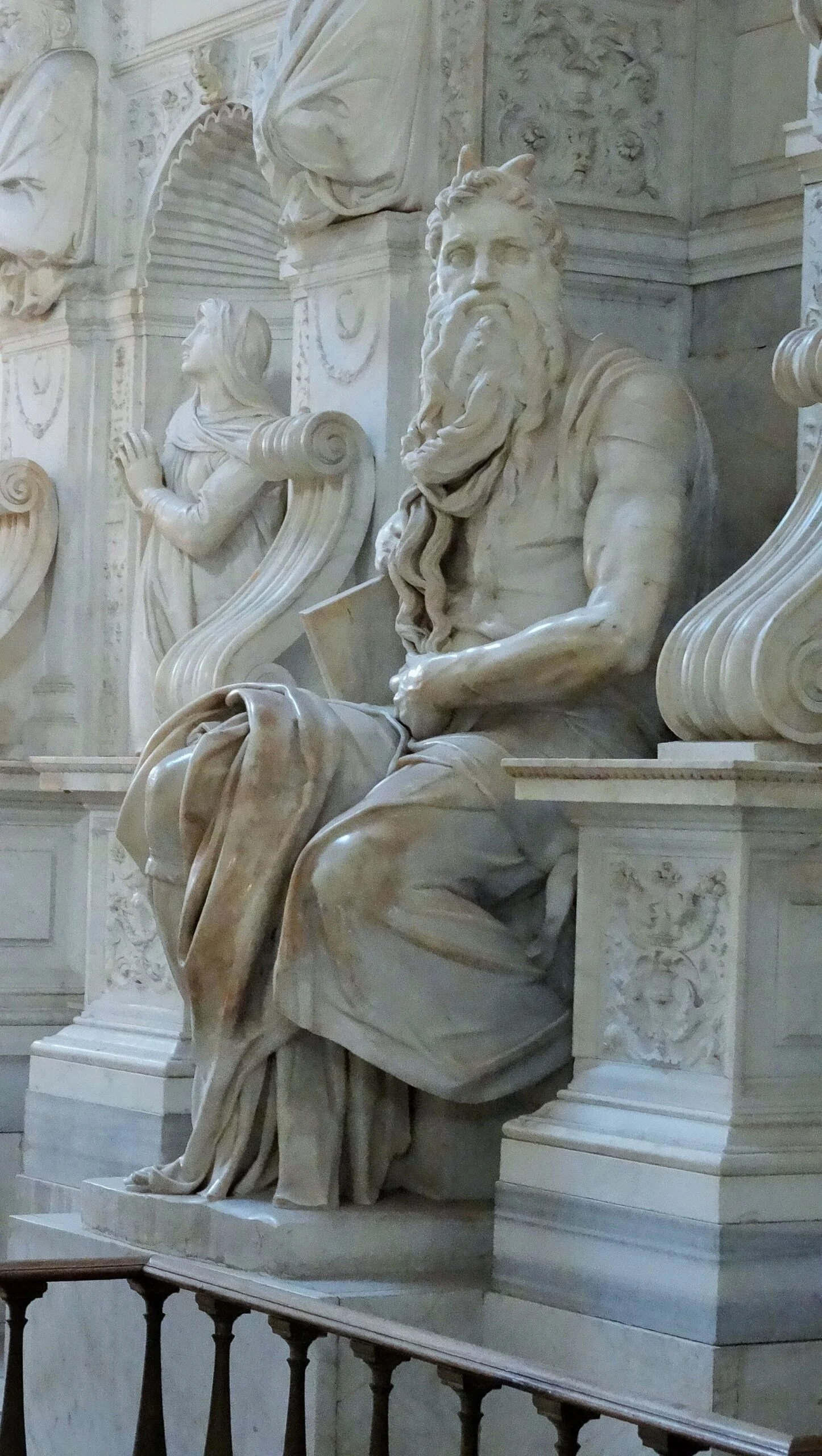
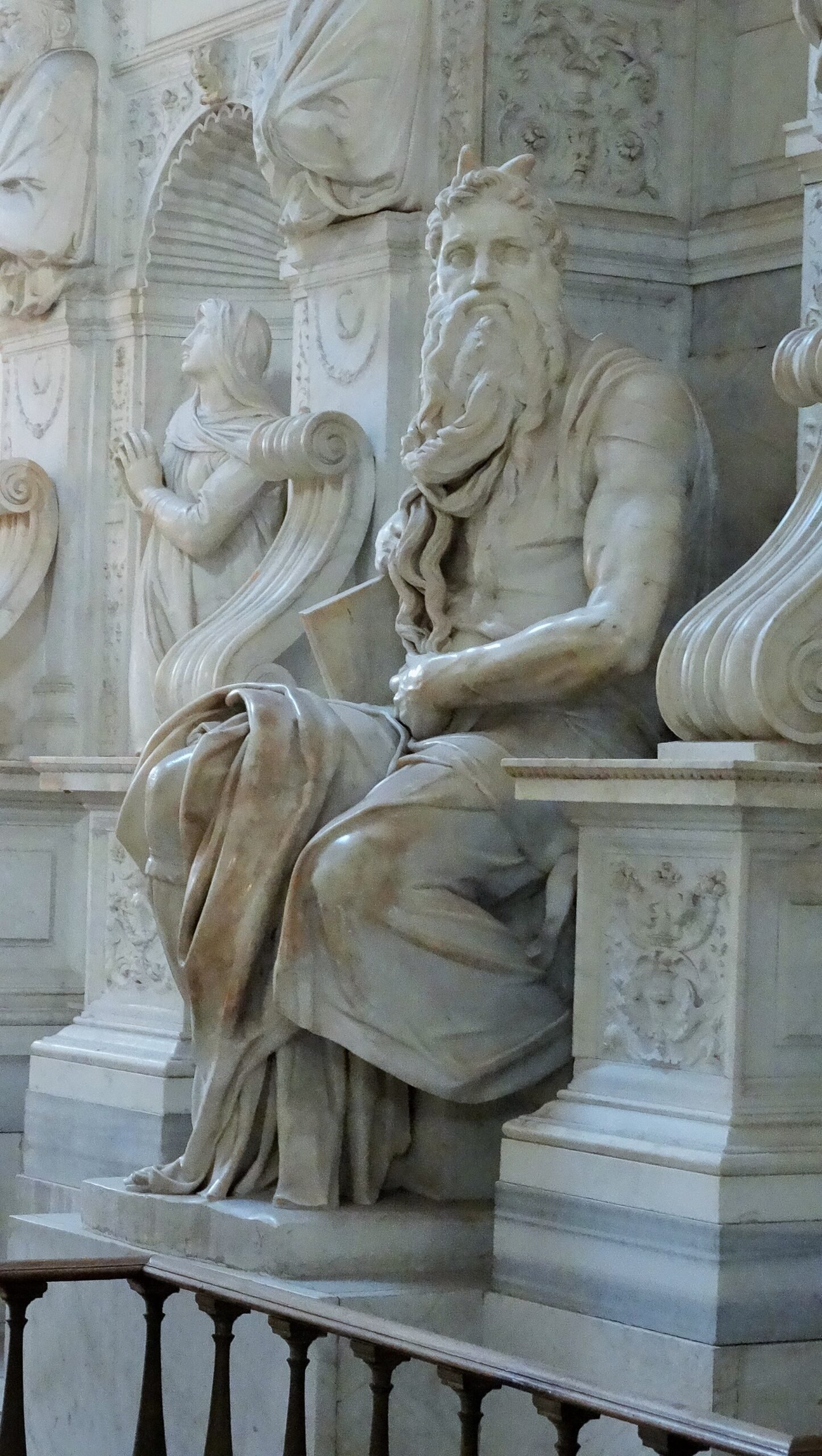
The Moses is in the funerary monument of Pope Julius II, set against the right wall of the transept of the Basilica of San Pietro in Vincoli, and entrance to the church is free. The monument you see today is the reduced remnant of a project that occupied Michelangelo for 40 years and that he himself called the tragedy of the tomb.
40 years, five contracts, one outcome
It all begins in 1505, when Julius II calls Michelangelo to Rome for a colossal mausoleum, planned as a freestanding structure with dozens of statues. The project is scaled down, resumed after the pope's death in 1513, reduced again in 1516, then with a fourth contract in 1532 and a final one in 1542. The monument is completed in 1545 as a wall tomb. The detail almost no guide tells is that Julius II is not buried there: his remains rest in St. Peter's in the Vatican, under the floor behind the altar. It is, literally, a tomb without the dead man.
What is by Michelangelo's hand and what is not
Here it's best to be precise, because the monument is described as a work by Michelangelo while it is only in part. Three figures are autograph: the Moses at the center of the lower order and the two female statues flanking him, Leah and Rachel, allegories of the active and the contemplative life. Everything else is by collaborators: the Madonna and Child, the Prophet and the Sibyl of the upper order are by Raffaello da Montelupo, the reclining figure of the pontiff is by Tommaso Boscoli, and on the architectural parts worked, among others, Giovanni di Marchesi, Francesco da Urbino, Donato Benti and Jacopo Del Duca. The difference in quality between the Moses and the statues above it is visible to the naked eye: it isn't conservation, it's a difference of hand.
The horns, which aren't horns
The two protuberances on the forehead derive from a passage of the Vulgate, the Latin translation of the Bible, which on the return from Sinai describes the face of Moses with a verb interpreted in the sense of horned rather than radiant: Michelangelo was following an iconography established in the Middle Ages, and the version that attributes them to a whim of his is a legend of the hurried guide. In 2021 the statue was cleaned by the restorer Antonio Forcellino under the supervision of the Special Superintendency of Rome, and on that occasion the Ministry of Culture documented a light effect on the face in the days around the spring equinox, which some scholars consider designed and others accidental.
Conflicting hours: a phone call is needed here
On the hours of San Pietro in Vincoli the official sources don't agree with each other, and the fact should be stated rather than choosing the most convenient version: the website of the rectory of the Canons Regular of the Lateran gives a morning opening at 7:00, the accessibility page of the Italian Union of the Blind of Rome gives another at 8:00, and they also differ on the evening closing and on the phone numbers. It's therefore best to phone before climbing the staircase from via Cavour, especially during the midday break or on a holiday. The church is reached from the Cavour metro station on Line B or in a 10-minute climb from the Colosseum.
Image: Moses seen in three-quarter view from below, with the side light picking out the drapery of the robe.
The Christ of the Minerva: a statue that is actually two
The Christ Carrying the Cross in Santa Maria sopra Minerva, 205 centimeters tall, stands to the left of the high altar and is the third and last autograph sculpture by Michelangelo visible in Rome, with free admission. It is also the case in which current popularization goes wrong most often, because there are two versions of this Christ and only one is in Rome.
The first version, abandoned and found again
In 1514 four Roman patrons, among them Metello Vari, commissioned from Michelangelo a risen Christ with the cross. He began to carve it and abandoned it when a black vein emerged in the marble on the face, an incurable defect for an altar piece. That first example remained unidentified for centuries, until in the early 2000s it was recognized in the church of the monastery of San Vincenzo at Bassano Romano, in the Viterbo area: the cleaning brought out the dark veining described by the 16th-century sources. Anyone who writes that the Risen Christ and the Christ of the Minerva are two different works both in Rome is confusing two versions of the same statue, and one of the two is 70 kilometers from the city.
The second version and the bronze cloth
Michelangelo resumed work on a second block, brought it to a good point by 1518 or shortly after and sent it to Rome in March 1520. The finishing on site was entrusted to his assistant Pietro Urbano, who worked so badly that he was replaced by Federico Frizzi, and the result never satisfied the author. The statue was placed in the basilica on December 27, 1521. The bronze drapery that now covers the hips is not his: it was added after the Council of Trent to bring the work in line with the rules on decorum. The right foot too bears a metal protection applied later, to defend the marble from contact with the faithful. Mentally subtracting those two additions leaves the figure Michelangelo had conceived: a nude, standing Christ, holding the cross like an ordinary object.
The basilica is a building site, and that should be said
Santa Maria sopra Minerva is affected by restoration work not yet concluded. The page of the Special Superintendency of Rome lists among the works in progress the restoration of the choir lofts, the apse and the Altieri chapel and the securing of the side aisles, funded by the Fondo Edifici di Culto. The statue can be seen, but you may find scaffolding or reduced access elsewhere. On hours the available sources don't coincide, and the most reliable indication remains the one tied to the Mass times. In the square, in front of the church, there is the Minerva obelisk on Bernini's little elephant, and 50 meters away the Pantheon.
The Sistine Chapel: the ceiling, the Judgment and how to get in without ruining your day
The Sistine Chapel has no entrance of its own and is reached only with the ticket of the Vatican Museums, on viale Vaticano, hard against the walls of Vatican City: €20 full price, €10 reduced, plus €5 for online booking on the official portal. Inside there are two distinct interventions 25 years apart, and the best way to look at them is to keep them separate.
The ceiling, 1508-1512
Julius II entrusted Michelangelo with the decoration of the ceiling in 1508 and the work ended in 1512. Michelangelo, who considered himself a sculptor and not a painter, turned a commission he hadn't sought into a painted architectural system: nine stories from Genesis at the center, from the Separation of Light from Darkness to the Drunkenness of Noah, framed by a fictive structure of cornices and pilasters, with prophets and sibyls on the pendentives, the Ancestors of Christ in the lunettes and the ignudi seated at the corners of the panels. On the latter the debate has never closed: wingless angels, geniuses of Neoplatonic ancestry, or the human body as the measure of the divine.
The Last Judgment, 1536-1541
The end wall is a work 25 years later: Michelangelo painted it between 1536 and October 1541, on a commission begun by Clement VII and continued by Paul III, in an entirely different cultural climate. This is the Michelangelo after the Sack of Rome in 1527 and inside the European religious crisis: a mass of bodies without orderly perspective, a beardless Christ the judge in the act of raising his arm, no architectural frame to hold the scene together. The breeches painted over the nudes were added later, in several rounds, in application of the Tridentine rules: the 1989-1994 restoration removed some of them, keeping the 16th-century ones because they are by now part of the material history of the work.
The 20th-century restoration and today's maintenance
The great building site began in 1979 and proceeded in phases: the lunettes from June 1980 to October 1984, the ceiling from 1984 to 1989, the Judgment from 1989 to 1994, and finally the 15th-century frescoes of the walls. The operational direction was Gianluigi Colalucci's, and the funding came from the Nippon Television Network Corporation in exchange for filming rights. The bright color seen today is the result of that cleaning and was debated for years. The prevailing position is that it corresponds to the Michelangelo described by his contemporaries. About 30 years later the Vatican Museums began an extraordinary maintenance of the Judgment, a cleaning of microparticle deposits.
Prices, hours and days to avoid
The Vatican Museums are open Monday to Saturday from 8:00 to 19:00 with last entry at 17:00. On Sunday they are closed, except the last Sunday of the month, when admission is free from 9:00 to 14:00 with last entry at 12:30. The reduced ticket at €10 applies to young people between 7 and 18 and to students up to 25 with ID. It's free under 7 and for people with certified disabilities with a companion. Online booking adds €5 and assigns a time slot: it skips the ticket-office queue, not the checks. In 2026 the communicated holiday closures are January 1 and 6, February 11, March 19, April 6, May 1, June 29, August 14 and 15, December 8, 25 and 26, and the calendar should be rechecked before fixing the date. The advice that works: first slot of the morning, galleries at a brisk pace, Sistine by 9:00. Inside the chapel photographs are forbidden, for the protection of the frescoes and because of a restriction on reproduction rights tied to the funding of the restoration.
Image: the interior of the Sistine Chapel backlit, with the line of visitors along the walls and the ceiling in half-light.
The Pauline Chapel: Michelangelo's last paintings, which can't be seen
The Pauline Chapel, inside the Vatican Apostolic Palace a short distance from the Sistine, holds Michelangelo's last two pictorial works and is not open to the public nor included in the Vatican Museums route. It's worth knowing before leaving: it is the only serious gap in any Michelangelo itinerary in Rome, and no operator can fill it.
Two frescoes, eight years, then never again
Paul III commissioned the decoration from him right after the Last Judgment. The Conversion of Saul was painted between 1542 and 1545, the Crucifixion of Saint Peter between 1546 and 1550: Michelangelo was 75 when he closed the site and never painted again. They are difficult works, with disorienting compositions and a use of the figure that anticipates much later outcomes, and critics reassessed them late. The chapel stays closed because it is in liturgical use for the celebrations of the Papal Household, more than for conservation reasons. A restoration carried out in the first decade of the 2000s, scientifically directed by Arnold Nesselrath, recovered its original colors.
The dome of St. Peter's: designed by Michelangelo, built by others
The dome of St. Peter's, with an internal diameter of about 42 meters and an overall height of more than 130 meters up to the lantern, was designed by Michelangelo, named architect of the works in 1546 on the death of Antonio da Sangallo the Younger, but built between 1588 and 1590 by Giacomo Della Porta and Domenico Fontana, 24 years after his death. Michelangelo refused payment, declaring he accepted out of devotion, and dismantled a good part of his predecessor's project to return to a central plan closer to Bramante's idea: the building site, begun in 1506, continued for a century after him, and Maderno's facade, Bernini's colonnade and the internal marble cladding belong to later seasons. It is his most-seen work in the world and the one over which he had the least control.
The wooden model and the change of profile
Between 1557 and 1558 Michelangelo had a wooden model of the dome built, preceded by a clay study of 1556, with a drum marked by trabeated windows: that model is still kept in the Vatican and is the decisive document for understanding what he had in mind. Della Porta and Fontana, when it came to building, changed its profile by making a shell with a raised arch, that is, more slender and pointed than the more hemispherical one of the model, both to increase its visibility from the city and to reduce the lateral thrusts. The dome you see from piazza Navona or from the Janiculum Hill is therefore Michelangelesque in layout and late 16th-century in profile: a distinction no plaque explains. To catch it from below it's best to step back in St. Peter's Square toward the Vatican obelisk, from where the colonnade stops hiding it.
Going up: steps, ticket, hours
The climb is made from inside the basilica, with a separate ticket and an assigned time, which can be bought on the official ticket office of the Fabbrica di San Pietro or, depending on availability, at three points of sale on site. There are 551 steps for those who climb entirely on foot. With the elevator up to the terrace, 320 remain, in the helical corridor between the two shells, narrow and progressively inclined. The hours are 7:30-17:00 in winter and 7:00-18:00 in summer. The price differs between stairs and elevator and is around €10: the exact price list is published only by the official ticket office, and tickets are neither changeable nor refundable. Anyone who suffers from claustrophobia or vertigo should take the elevator and stop at the terrace: it's a shorter visit and anything but wasted.
The Campidoglio: the piazza Michelangelo never saw finished
Piazza del Campidoglio was designed by Michelangelo starting in 1538-1539 on commission from Paul III, and at his death it was built only in a minimal part: what you walk on today is the result of four centuries of execution of his design, with the last piece laid in 1940. Access is free and open at any hour.
A piazza born as the base of a statue
In January 1538 Paul III had the bronze equestrian statue of Marcus Aurelius moved from the Lateran to the Campidoglio. The following year he entrusted Michelangelo with the rearrangement of the area, then an irregular open space between medieval buildings facing the Roman Forum. Michelangelo makes the gesture that changes the history of European urban planning: he turns the piazza 180 degrees toward the modern city and toward St. Peter's, closes it on three sides and opens it on the fourth toward the Cordonata. The most harmonious piazza in Europe was thus born as the urban pedestal of a statue: the opposite of what the modern eye assumes.
What he saw and what he didn't
Before dying he saw completed the double access staircase to the Senatorial Palace and the placement of the river statues of the Nile and the Tiber. The facade of the Palazzo dei Conservatori was brought to completion by Guido Guidetti and then by Giacomo Della Porta, who finished in 1568 remaining faithful to the master's drawings. The Palazzo Nuovo, the third side of the piazza, was completed only in 1654. The giant order of the pilasters, which embraces two floors with a single architectural order, is the invention that appears here for the first time in a piazza. The 12-pointed oval design of the pavement, instead, was executed in 1940 by Antonio Muñoz on the basis of Michelangelo's project known from engravings: for four centuries it had remained on paper.
The Marcus Aurelius: the original is inside
The equestrian statue you see in the piazza is a copy, placed in 1997. The original in gilded bronze is indoors in the Exedra of Marcus Aurelius of the Capitoline Museums. The travertine base, that yes, was designed by Michelangelo. The ticket of the Capitoline Museums, with the price list in force since May 13, 2026, costs €15 full price and €9.50 reduced for the permanent collection alone, and rises to €20.50 full and €15 reduced with exhibitions in progress. The hours are every day from 9:30 to 19:30, last entry 18:30, with annual closure only on May 1 and December 25. Since February 2026 admission is free for residents of Rome and the Metropolitan City with an identity card.
Two free viewpoints
To understand the piazza you need two free looks. The first is from halfway up the Cordonata, where the oblique scenography of the palaces gradually opens: it is exactly the effect it was designed for. The second is from the Terrazza Caffarelli, above the Palazzo dei Conservatori, with external access from the staircase beside it and no museum ticket. A few steps away are Santa Maria in Aracoeli with its very steep staircase, the Altar of the Fatherland and, on the opposite slope of the hill, the Trajan's Markets and the Forum of Trajan with Trajan's Column.
Santa Maria degli Angeli and the great cloister: the last building site
The Basilica of Santa Maria degli Angeli e dei Martiri was carved out by Michelangelo inside the halls of the Baths of Diocletian starting in 1562, on commission from Pius IV, and entrance is free every day. It's the building site that best explains the Michelangelo of the last years, because the intervention consists above all in an act of reading: not raising new walls, but recognizing that a Roman bath hall was already a church.
The bull of 1561 and the works of 1562
With a brief dated July 27, 1561, Pius IV ordered that a church dedicated to the Virgin and to the Christian martyrs be made inside the baths, together with a Carthusian monastery. The excavations began the following year and the project went to Michelangelo, 86 years old and at the same time busy with St. Peter's and Porta Pia. The large space that today forms the transept corresponds to the frigidarium, the cold hall of the baths, with the monolithic red granite columns still in place: they are ancient, not Renaissance.
Vanvitelli, 1749: the church we see is not Michelangelo's
The entrance Michelangelo wanted was not on the axis of the great exedra that now faces piazza della Repubblica: it was lateral and set back. In 1749, in view of the Jubilee and by decision of the Carthusian monks themselves, Luigi Vanvitelli turned the orientation of the church by 90 degrees, opening the current entrance in the calidarium and reorganizing the interior. Anyone entering today by the portal on the piazza walks a short curved corridor before emerging into the enormous transept: that sequence is 18th-century, and Michelangelo is in the proportions and in the ancient structures preserved, not in the decorative surface. In the floor of the transept runs the Meridiana Clementina, a bronze line about 45 meters long built in 1702 by Francesco Bianchini on commission from Clement XI: it would not have been possible without the space of Michelangelo's transept.
The great cloister and an attribution to handle with caution
The great cloister of the charterhouse, today called the Michelangelo's Cloister and visitable from inside the National Roman Museum at the Baths of Diocletian, is one of the largest in Italy: four wings of 100 meters marked by 100 monolithic travertine columns, with a garden in the middle where there are seven colossal animal heads found in 1586 in the area around Trajan's Column. On the name, however, it's best to be precise. The date carved on the first corner pillar indicates that construction began in 1565, that is, a year after Michelangelo's death, and the first floor was finished only in 1676. The sources indicate it was probably built on a design of his, or on a layout suggested by him, but the execution is not his and the authorship remains a traditional attribution, not a documented fact as for the basilica.
Tickets of the National Roman Museum
The cloister is visited with the ticket of the Baths of Diocletian: €15 full price and €2 reduced under the conditions set for state cultural sites, hours from 9:30 to 19:00 and closed Monday. That ticket is not valid for a single venue: it is the National Roman Museum's and allows one entry to each venue of the circuit within a week of the first validation, that is, the Baths of Diocletian, Palazzo Massimo alle Terme, Palazzo Altemps, Crypta Balbi and the Aula Ottagona. It should be flagged, though, that the Crypta Balbi is temporarily closed and that at the Baths the natatio, Hall VIII and the Museum of the Protohistory of the Latin Peoples do not appear to be accessible: it's best to check the opening status before building a day around it.
Image: the great cloister of the Baths of Diocletian with the travertine columns, the sarcophagi along the wings and the cypresses in the middle of the garden.
Porta Pia: the last project, and the facade that isn't his
Porta Pia was built between 1561 and 1565 on a design by Michelangelo at the wish of Pius IV, and it was the last architectural commission of his life: he was 85 when he presented the drawings and died in February 1564 with the site still open. It can be seen freely and for free from the square, which is public and crossed by traffic.
Which facade is Michelangelo's
This is the most widespread mistake about Porta Pia, and it reverses the photograph everyone takes. The facade facing the outside of the city, the one you frame arriving from via Nomentana, is not Michelangelo's: it was completed in neoclassical forms by Virginio Vespignani in the 19th century, after lightning had damaged the attic, on the basis of a 16th-century engraving thought to be close to the original project. Michelangelo is in the inner front, the one toward the city, which you look at standing in via XX Settembre with your back to the center: a scenographic backdrop with a single large arch and grotesque details. Michelangelo presented three projects and, according to Vasari, the pope chose the cheapest one. The placement is the other singular choice: the gate is not aligned with the curtain of the Aurelian Walls but set slightly back toward the inside, because the interest went to the theatrical and perspective appearance much more than to the defensive function. The building site was materially run by Giacomo Del Duca, the same one from the story of Santa Maria degli Angeli.
1870 and the museum inside the gate
In Italian memory the name Porta Pia means September 20, 1870, not Michelangelo. The breach, however, was not opened on the gate, but in a stretch of the curtain of the Aurelian Walls about 50 meters away, at the level of villa Bonaparte: the opening was walled up again already in 1871 and the spot is marked by a marble monument with plaques and by a column with a winged Victory. In the buildings joining the two facades, where the customs office was, the Bersaglieri Historical Museum has been based since September 18, 1932. On hours and access arrangements it is not possible to give a reliable fact: since it is a military museum in a state-owned building, access most probably takes place in limited slots and may require a reservation, and should be confirmed with the museum or with the Italian Army.
The Sforza chapel in Santa Maria Maggiore: the most radical project and the least visited
The Sforza chapel, in the left aisle of the Basilica of Santa Maria Maggiore, was designed by Michelangelo in the very last years of his life and built after his death: it is visited for free together with the rest of the basilica, open every day from 7:00 to 19:00 according to the available sources. It is his least-looked-at Roman work and, paradoxically, one of the boldest.
What is special about it, and who built it
It is a centrally planned space in which the side walls curve outward into two diagonal apses, supported by free-standing columns that don't lean against the wall but advance into the space. The result is a room that seems to expand as you look at it: the most experimental Michelangelo as architect, the one who dismantles the classical rules from within using the same elements, and it has been studied as one of the direct antecedents of Roman baroque. As with the Campidoglio and Porta Pia, the project is his and the execution is later: the work was carried out by Tiberio Calcagni, a close collaborator of the last years, and continued by Giacomo Della Porta in the second half of the 16th century.
How to see it, and the rest of the basilica
The chapel is reached by walking the left aisle and no ticket is needed. The light is scarce, and the shape of the space is better read by stopping a few minutes on the threshold instead of going in right away. The paid route of the Liberian Museum Complex, which includes the museum, the Loggia of the Blessings, the Hall of the Popes, Bernini's Staircase and the excavations, is another thing and does not concern the Sforza chapel: the sources indicate opening Monday to Saturday roughly from 9:30 to 18:00 and do not publish a clear fixed price, so it's best to write to the basilica's ticket office before going. At 200 meters there is the Esquiline obelisk, and in 10 minutes on foot you go down to San Pietro in Vincoli.
Palazzo Farnese: the cornice nobody looks at
At Palazzo Farnese, today the seat of the French embassy in Italy, Michelangelo intervened after the death of Antonio da Sangallo the Younger in 1546, designing the great cornice that closes the facade at the top, the balcony above the central portal with the coat of arms and a good part of the completion of the inner courtyard. A visit is possible only by reservation, on terms set by the embassy.
The cornice, and why it is a piece of architectural history
It is one of those elements that passersby cross without seeing and that architects have studied for five centuries. Sangallo had designed a more restrained crowning. Michelangelo replaced it with a much more projecting and heavy band, out of proportion with the rules of the treatise and perfect with respect to the mass of the building. The quarrel between the two is documented by contemporary sources and is one of the moments in which the distance between Sangallo's regulated classicism and Michelangelo's way of treating the architectural order as plastic material is best seen. In the courtyard the intervention mainly concerns the upper levels. The palace was then completed by Giacomo Della Porta, who built the rear block and the front toward the Tiber, finished in 1589.
How to visit, without inventing anything
Visits are managed by compulsory reservation, well in advance, with limited numbers and an obligation to present an identity document, according to the terms published by the French embassy: days, fee and minimum age change over time and must be checked on the official channel, because no third-party operator can guarantee entry outside of it. Anyone who can't book should look at the facade from piazza Farnese toward evening, when the raking light makes the cornice work.
The places of his Roman life, including the vanished ones
Michelangelo arrived in Rome for the first time on June 25, 1496, returned in March 1505 called by Julius II and settled here permanently in the 1530s: the last 30 years of his life are Roman. Some of the places he frequented still exist, others have been demolished, and about one of them a misunderstanding has circulated for a century that is worth clearing up.
The house where he died, at Macel de' Corvi
Michelangelo died on February 18, 1564 in his house at Macel de' Corvi, the district that occupied the area between the Campidoglio, Trajan's Column and today's piazza Venezia. It was a modest dwelling, with two rooms, a workshop on the ground floor, a dining room and a cellar, in the area of via dei Fornari. It no longer exists: it was demolished between the end of the 19th century and the early 20th, in the gutting that created the space for the monument to Vittorio Emanuele II and for the arrangement of piazza Venezia. Anyone who today climbs the Cordonata or passes in front of Palazzo Venezia is walking a few dozen meters from the spot where Michelangelo died, without anything on site saying so clearly. The body was taken to Florence and buried in Santa Croce: in Rome there is no tomb of his.
The house on the Gianicolo, which is not his house
On the Gianicolo promenade there is a Renaissance facade commonly called Michelangelo's house: it is not the house where he lived and died. It is a facade taken down from a building at Macel de' Corvi demolished in 1874 during road works, recovered and reassembled elsewhere, and moved again in 1941 to hide the aqueduct tank on the hill. The identification of that building as Michelangelo's dwelling is doubtful already in the 19th-century sources and scholars consider it unestablished: before Macel de' Corvi, Michelangelo's documented Roman houses were in the rioni Parione and Borgo. It's worth going anyway, because the Gianicolo is one of the best points from which to understand the dome of St. Peter's, but knowing what you are looking at.
Missed projects and works that left Rome
For the Basilica of San Giovanni Battista dei Fiorentini, the church of the Florentine community on the Tiber, Michelangelo worked out in the 1550s a centrally planned project that was never executed: the church you see is by another hand. Vasari also tells that he was entrusted with an intervention on the Santa Maria bridge, the ancient bridge now reduced to the stump known as the Ponte Rotto, and that the job then passed to others with disastrous results: it's a Vasarian tale, that is, a partisan source. Three sculptures, finally, were made in Rome and are no longer there: the Bacchus, now in the Bargello in Florence. The first Christ of the Minerva, at Bassano Romano. And the Rondanini Pietà, the last sculpture he worked on until a few days before his death precisely in the house at Macel de' Corvi, now in the Castello Sforzesco in Milan. Anyone who wants to see the Michelangelo of the very last years, the one who removes material until he makes the figure a shadow, won't find him in Rome.
Itineraries: one day, two days, what it costs
A single day is enough to see the three autograph sculptures and the architecture of the center, but not enough to add the Sistine Chapel, because the Vatican Museums alone take half a day and are on the opposite side of the city. Anyone with one day chooses between two blocks. Anyone with two does both, divided by geography and not by chronology.
One day, historic center version
You start from Santa Maria Maggiore at opening, for the Sforza chapel with the basilica still empty, and walk down to San Pietro in Vincoli, 10 minutes downhill, for the Moses. Then the Campidoglio, climbing up from the Cordonata, and anyone who wants the original of the Marcus Aurelius goes into the Capitoline Museums. In the afternoon the Minerva for the Christ, a step from the Pantheon, and finish at piazza Farnese in front of the cornice. Cost: zero, apart from the ticket of the Capitoline Museums.
One day, Vatican version
The alternative is built in reverse: online booking for the first slot of the Vatican Museums at 8:00, museum route at a brisk pace to the Sistine by 9:00, then St. Peter's Basilica with the Pietà and the climb to the dome at the assigned time. In one morning you see the ceiling, the Judgment, the Pietà and the dome, and keep the afternoon free. The bill: €20 for the ticket plus €5 for booking, plus the roughly €10 for the dome, with the basilica free.
Two days, and the constraint that decides the order
With two days you see all the accessible Roman Michelangelo: the first day the Vatican block, adding if time remains the Vatican Grottoes, free via the signposted route, and a climb to the Gianicolo in the afternoon. The second day the center, with Santa Maria Maggiore, San Pietro in Vincoli, Campidoglio, Minerva and, at the end, piazza della Repubblica for Santa Maria degli Angeli and the great cloister, with Porta Pia a kilometer and a half farther north along via XX Settembre. The only rigid constraint is the booked time slot at the Vatican Museums: the rest is flexible, because the churches are free and the Capitoline Museums open every day, Monday included. Monday, the worst day for Rome's state museums, is here almost an advantage: the Baths of Diocletian close, but not the rest. Anyone who wants to widen the route to other artists will find a similar itinerary dedicated to Caravaggio in Rome, which covers churches and museums that are largely different.
Frequently asked questions about Michelangelo in Rome
How many works by Michelangelo can you see in Rome?
In Rome you can see three autograph sculptures by Michelangelo, the Pietà in St. Peter's, the Moses with Leah and Rachel in San Pietro in Vincoli and the Christ Carrying the Cross at the Minerva, plus two painting cycles of which only one can be visited, the Sistine Chapel, and at least six works of architecture designed by him. The count changes depending on if you include the works built by others after his death, which are the majority of the architectural part.
How much does it cost to see all the works of Michelangelo in Rome?
Seeing Michelangelo's works in Rome costs a little over €50 per person, because almost everything is free. The paid items are the Vatican Museums ticket for the Sistine Chapel, €20 plus €5 for online booking, the climb to the dome of St. Peter's at around €10, the Capitoline Museums from €15 to €20.50 and the National Roman Museum at €15 for the great cloister. All the churches have free admission.
Where is Michelangelo's Moses in Rome?
Michelangelo's Moses is in the basilica of San Pietro in Vincoli, on the Oppian Hill, inside the funerary monument of Pope Julius II set against the right wall of the transept, and can be seen for free. You get there from the Cavour metro station on Line B or in a 10-minute climb from the Colosseum. Watch the hours: the basilica's official sources don't agree with each other, so it's best to phone before climbing the staircase.
Can you visit the Sistine Chapel without doing all the Vatican Museums?
The Sistine Chapel has no independent entrance and is reached only through the route of the Vatican Museums, with a ticket of €20 full price or €10 reduced, plus €5 when booking online. There is no separate ticket for the chapel alone, but the route can be shortened: anyone who enters at the first slot at 8:00 and crosses the galleries without stopping reaches the chapel by 9:00, when it is still practicable.
Are the Christ of the Minerva and Michelangelo's Risen Christ two different statues?
The Christ of the Minerva and Michelangelo's Risen Christ are the same work in two successive versions, not two distinct works. The first, begun in 1514, was abandoned because of a black vein that emerged in the marble and is today in the church of the monastery of San Vincenzo at Bassano Romano, in the Viterbo area, where it was recognized in the early 2000s. The second, placed in the basilica in December 1521, is the one visible in Rome.
Is the dome of St. Peter's really Michelangelo's?
The dome of St. Peter's is Michelangelo's in design but not in execution: it was built between 1588 and 1590 by Giacomo Della Porta and Domenico Fontana, 24 years after his death, and the two changed its profile, making it a raised arch compared with the wooden model of 1557-1558. The layout, the drum and the system of ribs remain Michelangelesque. The pointed silhouette you see from afar is not.
Can you take photographs of Michelangelo's works in Rome?
Photographs of Michelangelo's works in Rome are allowed almost everywhere except in the Sistine Chapel, where they are forbidden for the protection of the frescoes and because of a restriction on reproduction rights tied to the funding of the restoration. In St. Peter's you can photograph freely, keeping in mind that the Pietà is behind bulletproof glass that reflects the flash. In churches avoid flash and tripods during services.
Can you visit the house where Michelangelo died in Rome?
The house where Michelangelo died on February 18, 1564, in the Macel de' Corvi district between the Campidoglio and today's piazza Venezia, no longer exists: it was demolished between the late 19th and early 20th century to build the monument to Vittorio Emanuele II and arrange the area. The facade that on the Gianicolo promenade is called Michelangelo's house comes from another building in that district and the identification is not established.
How much time do you need to see Michelangelo's works in Rome?
To see all of Michelangelo's accessible works in Rome you need two full days, divided by geography: one in the Vatican among the Vatican Museums, the Sistine Chapel, St. Peter's Basilica and the dome, and one in the center among Santa Maria Maggiore, San Pietro in Vincoli, the Campidoglio, the Minerva, Santa Maria degli Angeli and Porta Pia. In a single day you choose between the two blocks, without trying to combine them.
A final recommendation
The Michelangelo route in Rome works if treated as a biography and not as a collection. Between the Pietà of 1499 and Porta Pia of 1564 pass 65 years, and in between there is a man who at 25 sculpted the smoothest marble of the Renaissance and at 86 drew city gates with deliberately ungrammatical details. If only one stop had to remain, let it be the Campidoglio at sunset, free, with the Cordonata behind you.
If you want to turn these stops into a wider itinerary in the center of Rome, crossing them with the basilicas, piazzas and museums of Monti, the Campus Martius and the Vatican, you'll find planning tools on Tour Leader Pro, while for a general picture of transport, connections and destinations in Lazio, including Bassano Romano where the first version of the Christ of the Minerva is, Italy Planner is a good resource.