Basilica of Santa Maria degli Angeli e dei Martiri
In short. The Basilica of Santa Maria degli Angeli e dei Martiri occupies the northern flank of Piazza della Repubblica, inside the great enclosure of the Baths of Diocletian.
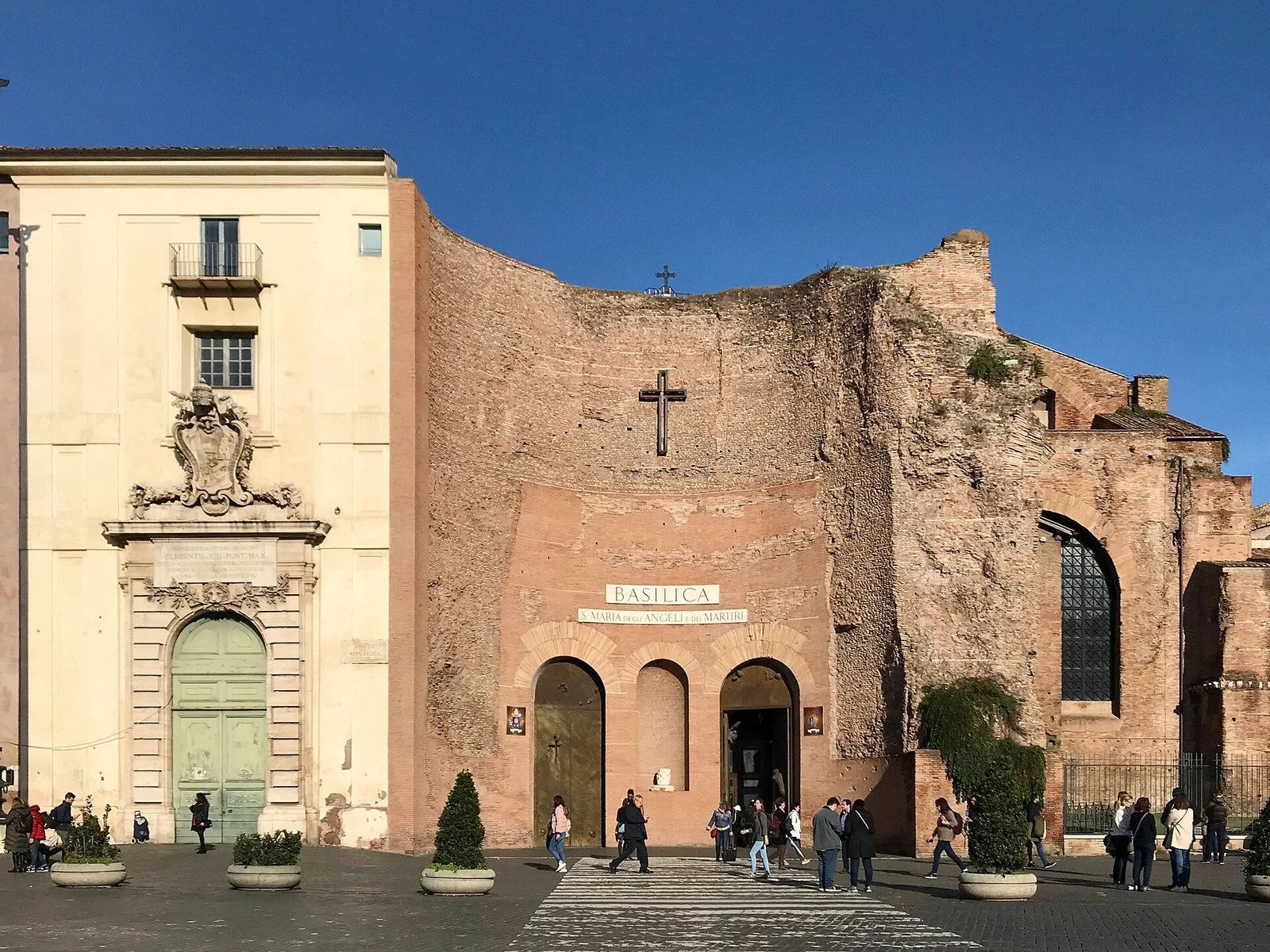
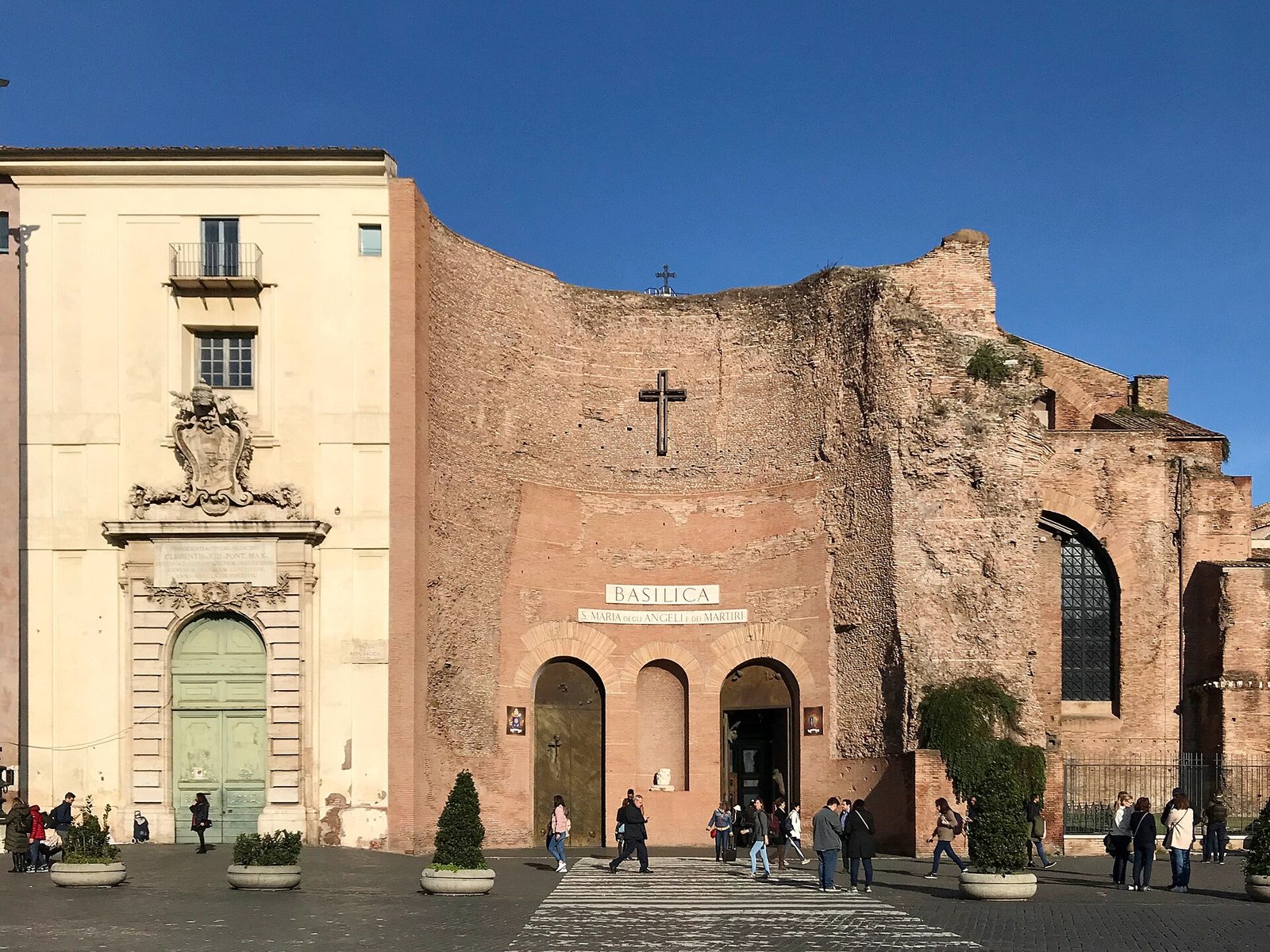
The Basilica of Santa Maria degli Angeli e dei Martiri occupies the northern flank of Piazza della Repubblica, inside the great enclosure of the Baths of Diocletian. The curved facade, which echoes the exedra of the ancient bath complex, is the one everyone sees when passing in front of the Fontana delle Naiadi, but few go in knowing that behind that wall of Roman brick opens one of the largest and least theatrical interiors in Rome, designed by Michelangelo Buonarroti in the last years of his life. You get there on foot from Termini station in under 10 minutes, with Metro A stopping right at Repubblica, and you walk in free, every day, to a building that is at once an active church, a state monument and a scientific instrument. In the floor of the transept runs the meridian line of Francesco Bianchini, 45 meters of bronze set into the marble that for three centuries has measured the true noon of Rome. Anyone looking only for a postcard image will be thrown by the sobriety of the exposed brick. Anyone with a few extra minutes finds here one of the most layered stories in the city, from the imperial baths of the 3rd century to the state ceremonies of the Italian Republic. The complex stands in close dialogue with the Museo Nazionale Romano at Palazzo Massimo and with the Octagonal Hall of the Baths of Diocletian, both a few minutes away on foot.
Where the Basilica of Santa Maria degli Angeli e dei Martiri Is and How to Get There
The main entrance of the basilica opens onto Piazza della Repubblica, at the address that Romans still call by the old name of Piazza Esedra, in the heart of the Castro Pretorio rione, straddling the Sallustiano rione. The curve of the square is not a 19th-century urban whim. It follows exactly the perimeter of the southern exedra of the Baths of Diocletian, the great colonnaded semicircle that closed off the ancient bath area to the south. Understanding this helps with orientation across the whole zone, because Piazza della Repubblica, the basilica, the Fontana delle Naiadi in the middle of the square and the Baths of Diocletian complex are, in urban planning terms, the same thing seen from different angles.
By Metro: the Repubblica Stop and Termini Station
The simplest way to get there is Metro line A, Repubblica stop, which comes out exactly on the square a few steps from the church entrance. If you arrive on line B, or on a regional train, or on the Leonardo Express airport link from Fiumicino, you get off at Termini instead and walk about 10 minutes along Via Cernaia or through the garden of Piazza dei Cinquecento. The route runs along the outer flank of the Baths of Diocletian and already gives you an idea of the size of the complex before you even enter the basilica. The Termini hub also offers the whole surface network, buses and trams, for those arriving from other neighborhoods.
It is worth remembering that the Repubblica stop is not just the closest to the basilica in absolute terms. It is also one of the easiest Rome metro exits to spot for someone who doesn't know the city, because it comes out directly onto the square, in view of both the fountain and the curved facade of the church, without the long and unintuitive underpasses that characterize other stations in the center. For those arriving with heavy luggage, perhaps just off a train at Termini, this practical detail makes a real difference compared with more tortuous routes to other basilicas in the historic center.
On Foot from Termini and the Rest of the Center
From the main front of Termini station, in Piazza dei Cinquecento, the basilica can be reached in about 10 minutes on foot following Via Giovanni Giolitti or crossing the forecourt toward Via Cernaia. It's an easy walk, almost all flat, that takes you alongside the brick perimeter wall of the Baths of Diocletian for a good stretch before coming out on the curve of Piazza della Repubblica. Those arriving on foot from Repubblica along Via Nazionale or from Via Vittorio Emanuele Orlando find the church entrance right across from the fountain, on the opposite side of the square from the 19th-century arcades.
By Car and Bus
Piazza della Repubblica area is served by several urban bus lines that converge on Termini, and on-street parking in the area is paid during weekday daytime hours, with guarded car parks in the nearby streets for those who prefer not to circle for long looking for a spot. As for the whole historic center, getting around by public transport or on foot remains the quickest solution. The area falls within Rome's limited traffic zone during the hours set by the Comune, and the rules should always be checked before entering by car, because they change periodically.
From Fiumicino and Ciampino
Those arriving from outside Rome find in the basilica one of the most convenient destinations in the whole city, precisely because of its closeness to Termini. From Leonardo da Vinci airport in Fiumicino the most direct link is the Leonardo Express train, which reaches Termini in about 32 minutes and then leaves a short walk to Piazza della Repubblica. Alternatively the FL1 regional trains stop at more urban stations, with slightly longer times but lower fares. From Ciampino the simplest link is a bus toward Termini or toward the Metro A stop Anagnina, from where you continue by metro to Repubblica, changing if necessary to line B. Anyone landing on a morning flight with only a few free hours before continuing the trip can reasonably fit the basilica and the Baths of Diocletian into a compact tour, without ever straying too far from the rail axis that leads to the airport.
The Baths of Diocletian: the Complex That Houses the Basilica
To truly understand the Basilica of Santa Maria degli Angeli e dei Martiri you have to step back more than 1,200 years before Michelangelo, to the emperor Diocletian, who between the end of the 3rd and the beginning of the 4th century AD had built in this area the largest bath complex ever built in Rome. The Baths of Diocletian occupied an area of more than 13 hectares, able to hold thousands of people at once among hot, warm and cold baths, gyms, libraries, gardens and porticoes. It was a complex designed not only for hygiene but as a place of public socializing on a colossal scale, open free of charge to Roman citizens of every condition.
A Complex Built in a Few Years
Work was started under Maximian, Diocletian's colleague in the tetrarchy, and completed quickly by the standards of the time, between 298 and 306 AD. That is a few years for a building site of that size, made possible by the huge workforce provided by the imperial state. The complex remained in operation for more than two centuries, until, in 537, during the Gothic War, the cutting of the aqueducts that supplied Rome caused its definitive closure. Without running water, a bath building simply loses its reason for being. From that moment the great complex entered a long decline, stripped over the centuries of marbles and materials reused elsewhere in the city, until it became, in the Middle Ages and the early Renaissance, little more than a field of ruins inhabited by vineyards and vegetable gardens inside the by then much reduced urban perimeter of post-ancient Rome.
From Ruin to Christian Rebirth with Pius IV
It is within this scenario of centuries-long abandonment that Pope Pius IV's decision fits. The same 1561 document by which the pontiff entrusted Michelangelo with the design of the basilica also provided for the settlement, next to the new church, of a community of Carthusian monks, who were assigned the surviving rooms of the baths to make into a monastery. It was an operation of reuse on an enormous scale, not too different in spirit from what we would today call an industrial archaeology recovery. Instead of demolishing to build new, the choice was to graft contemporary functions, religious and later museum ones too, into an ancient shell that nobody in the 1500s would have had the resources to rebuild from scratch. This same logic of reuse is what makes it possible today to visit, a few steps from the basilica, the Museo Nazionale Romano at the Baths of Diocletian, set up inside the surviving bath and convent rooms, and the Octagonal Hall, another room of the original complex that has survived to this day.
The Natatio and the Origin of the Exedra Square
One of the most characteristic rooms of the ancient baths was the natatio, the large open-air pool meant for free swimming, placed in front of the main bath hall on which the basilica was later built. That open space, bounded on the south by a large curved portico in the shape of an exedra, is the same perimeter that corresponds today to Piazza della Repubblica. When in the 1800s the new capital of the Kingdom of Italy decided to give a monumental face to this area, it did not invent a new urban form but literally traced the ancient curve, building the two semicircles of arcaded buildings that still shape the square today. This is why Piazza della Repubblica has that unusual shape, with the two curved arms opening symmetrically. It is not a 19th-century whim but the survival, in the modern city plan, of a geometry drawn by Diocletian's engineers more than 1,700 years ago.
From Bath Hall to Basilica: Michelangelo's Design
The history of the basilica begins with a precise document: a brief of Pope Pius IV dated July 27, 1561, by which the pontiff ordered a church dedicated to the Virgin and the Christian martyrs to be carved out of the ruins of the Baths of Diocletian. The work of excavating and freeing the ancient structures started the following year, in 1562, and the architectural design was entrusted to Michelangelo Buonarroti, who was then 86 years old and was still, at the same time, busy with the building site of St. Peter's Basilica in the Vatican.
Michelangelo's stroke of genius was the choice not to build a new church but to recognize in the existing bath halls the plan of a Christian basilica. The sources on the archaeology of the complex indicate that the main room, the one that now forms the transept, corresponded to the great frigidarium of the baths, the cold, unheated hall, once covered by three cross vaults resting on columns, and was flanked by the tepidarium, the intermediate-temperature passage hall, which Michelangelo turned into the side entrance vestibule of the church. On this point the popular sources do not always agree on terminology, and you can find one hall or the other labeled differently depending on the text. What matters, and what all of them confirm, is that Michelangelo did not raise new walls where they were not needed, but inserted the liturgical function inside a Roman shell more than 1,200 years old, leaving the bricks exposed and giving up any decorative plaster.
The Transept and the Eight Red Granite Columns
The heart of Michelangelo's work is the transept, which corresponds to the ancient main bath hall: a space covered by cross vaults that reach almost 29 meters in height, one of the best-preserved ancient covered spaces in Rome along with the Pantheon. The space is marked by eight original columns of red Egyptian granite, a little over 17 meters tall including base and capital, with a diameter of about 1.60 meters. They are the same columns raised by Diocletian's builders at the beginning of the 4th century, never moved, never replaced, only cleaned and reintegrated into the new Christian layout. Standing under those vaults, with the light filtering in through the original bath windows, gives the real measure of the Baths of Diocletian better than any plan on an information panel.
After Michelangelo: Giacomo Del Duca and the 16th-Century Completion
Michelangelo died in 1564, just two years after the work began, without seeing the church completed. The direction of the site passed to his pupil Giacomo Del Duca, who finished the layout following, in broad lines, the master's approach, while introducing some variations of his own in the apse area and in the finishes. For two centuries the basilica stayed in a rather bare form compared with the decorative standards of the great Baroque churches of Rome, consistent with the austere spirit of the original design and with its nature as a church attached to a Carthusian monastery.
A Curiosity About the Basilica of Santa Maria degli Angeli e dei Martiri
Not everyone knows that for centuries the basilica did not have a main entrance in the sense we understand it today. The historic access that Michelangelo wanted was not on the axis of the great exedra that now faces Piazza della Repubblica, but on one side, through what remained of the smallest bath hall: an out-of-the-way, almost hidden entrance, meant for those who already knew where they were going. It was only with the works of the 1700s that the basilica received a front more readable from the square, and still today, anyone entering through the portal on Piazza della Repubblica walks along a short curved corridor before suddenly emerging into the enormous volume of the transept. It is an effect of architectural surprise that Michelangelo already had in mind when he decided not to tear down the ancient bath walls but to slip the new religious function inside them.
A second curiosity concerns the materials: the eight red granite columns of the transept were not quarried in Rome or in Italy. The granite comes from Egypt, from the quarries of the Aswan area, and was transported by sea and then up the Tiber to the city, at a time when moving a single column shaft of those dimensions was a logistical feat comparable, in relative complexity, to those of the great modern building sites. Looking at those columns today, resting on a floor of 18th-century Baroque marbles, means having before your eyes a piece of Roman Egypt that has stood in the same spot for more than 1,600 years.
Something Nobody Tells You About the Basilica of Santa Maria degli Angeli e dei Martiri
The tourist plaque tells of Michelangelo, the meridian line, the canvases from St. Peter's. What is rarely said is that the basilica was born as the church of an active Carthusian monastery, the Certosa di Santa Maria degli Angeli, and not as a simple place of public worship. The Carthusian monks lived and prayed in that complex until well into the 1800s, under a regime of enclosure that for centuries kept the monastic part separate from the part open to the faithful. The great cloister of the Certosa, now known as the Michelangelo Cloister and reachable from inside the Museo Nazionale Romano at the Baths of Diocletian, was part of the same convent complex as the basilica, even though today the two structures are visited separately, with distinct entrances and tickets: one free because it is a church, the other paid because it is a state museum.
Then there is a detail that almost everyone misses: the 18th-century works of Luigi Vanvitelli, the ones that gave the basilica its current look, were not wanted by the pope or by the State but decided by the Carthusian monks themselves, with a view to the Jubilee of 1750, with the stated aim of making the church better suited to receiving the flow of pilgrims expected for the holy year. It was a building site of a religious community, not a papal project handed down from above. It is a particular that changes the meaning of many decorative choices still visible today, designed to orient the faithful in the space more than to amaze visitors.
A third little-told detail concerns the relationship between the basilica and the Fontana delle Naiadi in the square in front. The four female bronze figures surrounding the central basin, added at the beginning of the 1900s, each depict a different water deity, paired with a specific natural element, the lake, the river, the ocean and the underground spring. It is a small coherent iconographic program, originally meant to dialogue visually with the water that once fed the baths right behind the basilica. Today almost no one connects the 19th-century fountain with the ancient Baths of Diocletian anymore, and yet the conceptual link between the two, water as the urban theme of the whole square, remains intact, even if the fountain visible today has no direct hydraulic relationship with the ancient bath complex.
The Meridiana Clementina of Francesco Bianchini
In the floor of the transept, set into a band of white and yellow marble, runs a bronze line about 45 meters long. It is the Meridiana Clementina, built in 1702 on commission from Pope Clement XI and signed by the Veronese astronomer and historian Francesco Bianchini. It is not a simple decorative sundial but a working scientific instrument, designed for a very concrete purpose: to verify in the field the correctness of the Gregorian calendar, introduced barely a century and 22 years earlier, in 1582, and still a subject of discussion in European astronomy.
How It Works: the Gnomon Hole and the Passage of the Sun
The principle is that of the camera obscura meridian line, the same adopted in those same years in the Basilica of San Petronio in Bologna. A small hole made high up in the southern wall of the basilica lets through a ray of sunlight that every day, around true solar noon, touches a precise point on the bronze line set into the floor. The point where the light falls moves along the line according to the season: farther from the hole in winter, when the sun is low on the horizon, closer in summer. Along the way the symbols of the zodiac signs are inlaid in the marble, so that the position of the point of light also indicates which sign the sun is in at that moment of the year, from the winter solstice in Capricorn to the summer solstice in Cancer.
Why It Was Built Here and Not Elsewhere
The choice of the basilica was not random. The large size of Michelangelo's transept, the height of the ancient vaults and the orientation of the structure offered Bianchini an ideal space to lay out a meridian line long enough to guarantee a measurement precision unthinkable on a wall dial a few meters across. The longer the line, the smaller the relative error in reading the position of the sun. It is the same geometric principle exploited by the great historic Italian meridian lines, and the Meridiana Clementina remains, by extension, one of the longest ever made inside a building. Besides its calendar function, the instrument was used in the following decades for other astronomical observations too, including checks on the precession of the equinoxes, confirming the role of the basilica as a true scientific observatory as well as a place of worship. The line was restored in 2002, on the occasion of the third centenary of its creation, and is still working today. On sunny days, anyone who comes in at the right time can still see the point of light move slowly across the marble.
A Comparison with the Other Great Italian Meridian Lines
The Meridiana Clementina of Rome was not born in isolation. It is part of a small family of great camera obscura meridian lines built between the 1600s and 1700s in the main Italian cities, designed for the same purpose of scientific checking of the calendar. The most famous and the oldest is that of the Basilica of San Petronio in Bologna, laid out by Gian Domenico Cassini in 1655 and studied many times as a reference by later astronomers, Bianchini included. Similar meridian lines, though smaller, were also made in Palermo, in the cathedral, and in other cities. What distinguishes the Roman line is its scale: the 45-meter length, made possible by the exceptional size of Michelangelo's transept, makes it one of the longest among those still existing and working, and the fact that it is housed inside an ancient Roman space, rather than in a Gothic or Renaissance cathedral, makes it a case more than rare in the landscape of European historic gnomonics. Bianchini himself, moreover, had already collaborated with Cassini in astronomy and brought to Rome a technical skill matured precisely by comparing himself with the Bologna experience, adapting it to the far more generous dimensions offered by Michelangelo's transept.
The Equation of Time, Briefly Explained
The reason why the time of the sun's passage over the meridian line is not always the same, day after day, has a precise astronomical explanation: it is called the equation of time and it is the difference, variable over the course of the year, between true solar noon, the one marked by the actual passage of the sun over the local meridian, and the noon of our clock, calculated on a mean sun that moves at constant speed. This difference depends on the eccentricity of the Earth's orbit and the tilt of the planet's axis, and over the year it swings by several minutes in one direction or the other. It is exactly the phenomenon that meridian lines like the one in the basilica made it possible to measure and verify empirically, centuries before sufficiently precise mechanical clocks made direct observation of the sun less indispensable for daily life.
My Advice for Visiting the Basilica of Santa Maria degli Angeli e dei Martiri
The first piece of advice, almost banal but decisive, is to arrive around solar noon on a sunny day, to have a real chance of seeing the meridian line in action. The exact time changes with the seasons, because of the equation of time, so it's best to find out on site or from the basilica's website the time of the solar transit for that day, rather than always showing up at 12:00 sharp thinking that is always the right time.
The second piece of advice concerns respecting worship hours. The basilica is an active church, with daily masses, and not a museum. During services the tourist visit has to be suspended or limited to the peripheral areas of the nave, with a low voice and no flash. Anyone who wants to see the transept, the columns and the meridian line calmly without the interference of religious services does well to avoid late Sunday morning and the evening, when several masses follow close together, and to prefer instead the early afternoon on weekdays.
The third piece of advice, the one I always give to people visiting the area for the first time, is to combine the basilica with at least one of the nearby museum sites in the same morning: the Octagonal Hall, which has its own entrance a few steps from the square, or the large museum of the Baths of Diocletian with its cloister. You can see the basilica in a good half hour, but the full sense of the place, that the convent cloister and the museum bath halls are the same area the church partly occupies, is understood only by visiting both in the same round.
Another Well-Known Fact, Yet Rarely Cited
Almost all guides to Rome mention that the Basilica of Santa Maria degli Angeli e dei Martiri was the state church of the Kingdom of Italy from 1870 to 1946, and that it continues to be used by the Italian Republic for official ceremonies. Much less often is it explained why this church was chosen, and not one of the great papal basilicas of the city. The reason has to do with its position: the basilica stands next to Termini, that is, next to the main rail hub of the unified capital, in an area that in the post-unification 1800s became the focus of secular and institutional Rome, far from the Vatican heart and from the great papal basilicas of the historic center. A church not tied to a specific Roman dynasty, carved out of an ancient monument and not from a recent papal commission, was better suited to become the place for the ceremonies of a new State that wanted to mark a symbolic break with papal Rome while staying within the Christian tradition of the city.
The formal recognition came from the Church all the same: on July 20, 1920, Pope Benedict XV raised the basilica to the rank of minor basilica, a title that still confirms its particular status among Roman churches and that coexists, without contradiction, with the role of basilica of State ceremonies that the Republic inherited from the Kingdom.
Vanvitelli's Intervention and the Canvases from St. Peter's
Between 1749 and 1750, in view of the Jubilee, the architect Luigi Vanvitelli, by then already established in papal Rome and destined shortly after for the Reggia di Caserta, intervened on commission from the Carthusian community to make the interior of the basilica more coherent and better suited to receiving the faithful. His intervention did not upend Michelangelo's layout but enriched it: he redefined the axis of movement of the nave, arranged the side altars inside regular niches carved between the ancient bath walls, and coordinated the arrival of an important group of large altarpieces from St. Peter's Basilica in the Vatican.
Why the Altarpieces Come from St. Peter's
During the 1700s, the Vatican basilica gradually replaced many of its painted altarpieces with copies executed in mosaic, more resistant to the humidity and long exposure typical of an enormous, cold building like St. Peter's. The painted originals, instead of being dispersed, were in several cases assigned to other important Roman churches, and Santa Maria degli Angeli e dei Martiri was one of the main recipients, precisely on the occasion of Vanvitelli's works. Among the works that arrived this way are the Martyrdom of St. Sebastian by Domenichino, the Fall of Simon Magus by Pompeo Batoni, the Baptism of Christ by Carlo Maratta and the Mass of St. Basil by Pierre Subleyras, along with other canvases by artists active in the 1600s and 1700s on the Vatican building site. The result is a basilica of austere, Roman architecture, with inside it a painting cycle of museum level that would normally be associated with a far more theatrical Baroque church. It is a contrast worth the visit on its own, and it is the reason why many art historians consider this interior one of the least known picture galleries of Rome.
The Burials of Artists and Men of Science
Besides the great altarpieces, the basilica also holds some burials of figures tied to the history of Roman art and culture. Among them is remembered the painter Salvator Rosa, a protagonist of Roman Baroque painting of the 1600s for his dramatic landscapes and battle scenes, and Carlo Maratta, the author of one of the altarpieces that arrived from St. Peter's, a central figure of Roman painting between the late 1600s and the early 1700s. The presence of these tombs, little signposted compared with the great state funerary monuments of the 1900s, adds a further layer to the stratification of the basilica. Here rest together, in the same building, popes who wanted the work, artists who decorated it and generals whom the unified State chose to honor centuries later.
The Right Photo to Take at the Basilica of Santa Maria degli Angeli e dei Martiri
The photo that really conveys the place is not taken from the main nave, but by stopping in the center of the transept, with your gaze turned upward along the axis of the cross vaults. From that point you see together the eight red granite columns, the dizzying height of the ancient roof and, if the day is sunny and the time is right, the reflection of light on the bronze line of the meridian at your feet. It is the only framing that manages to communicate, in a single image, all three levels of the history of the place: the Roman structure, Michelangelo's design and the 18th-century scientific instrument.
A second interesting photo, less obvious, is taken from the outside: standing on the opposite side of Piazza della Repubblica, near the Fontana delle Naiadi, and framing the curved facade of the basilica together with the semicircle of 19th-century arcades that frame it. It is the image that explains better than any description how square, fountain and basilica were born from the same ancient geometry, that of the exedra of the Baths of Diocletian, and it is worth taking both by day and after sunset, when the lighting of the fountain and that of the facade completely change the tone of the scene. Always remember, in both cases: inside the church no flash and no tripods, and during liturgical celebrations it is good practice not to photograph at all.
Some Important Events That Happened Here in History
The basilica enters the history of the Italian State very early, just a few years after the Breach of Porta Pia and the end of the temporal power of the popes: it became in fact the reference church for the official celebrations of the royal family and the institutions of the Kingdom of Italy, a role that no other great Roman basilica, all more tied to the papal tradition, could take on in the same way. On July 20, 1920, as said, Pope Benedict XV raised it to minor basilica, formalizing a prestige that in the practice of State ceremonies had already been acquired for decades.
The 1900s of State Ceremonies
Over the 1900s the basilica repeatedly hosted state funerals and ceremonies in memory of leading figures of the Italian military institutions, in particular tied to the First World War. Remembered here, among others, are protagonists of the supreme command and of the Navy of those years, with commemorative plaques and memorial stones that you still meet today walking along the side aisles. The basilica has kept this role up to the present, remaining the venue chosen for the solemn funerals of soldiers fallen on missions abroad and for other official ceremonies of the Republic, in direct continuity with the function inherited from the Kingdom of Italy.
The Third Centenary of the Meridian Line, 2002
An event less known to the general public, but important for the scientific community, was the restoration of the Meridiana Clementina completed in 2002, on the occasion of exactly 300 years since its construction. The work made it possible to keep using the instrument for the same astronomical observations for which it was designed at the beginning of the 1700s, making the basilica one of the very rare places in the world where a Baroque scientific instrument still works, in the same building where it was installed, in front of anyone who comes in on a sunny day.
The Proclamation of the Kingdom and the Following Decades
One further step should be remembered, often overlooked in the shorter summaries: the choice of the basilica as the reference church of the institutions was not a single, immediate act of 1870, but a process that consolidated over a few decades, while the unified State looked in Rome for its own symbolic places in a city still marked by the papal presence in almost every other great religious building. The ceremonies of the Savoy royal family, the state funerals for high military offices and gradually the official commemorations ended up concentrating here precisely because the basilica, while being a Catholic place of worship in every respect, did not carry with it the same symbolic weight as the great patriarchal basilicas of Rome, all more directly tied to the papal and Vatican tradition.
Who Has Passed Through the Basilica of Santa Maria degli Angeli e dei Martiri
The name most naturally tied to the place is that of Michelangelo Buonarroti, who designed the transformation of the bath halls into a church in the very last years of his life, when he was already the most authoritative architect in Europe and was working at the same time on the St. Peter's building site. The original idea is due to him, and the completion of the layout after the master's death in 1564 to his pupil Giacomo Del Duca.
A century and a half later, Francesco Bianchini passed through here, a Veronese astronomer, historian and archaeologist, a leading figure of Roman science in the early 1700s, who chose the basilica as a laboratory under a roof for his meridian line and made it, in effect, a permanent public observatory. In the mid-1700s it was the turn of Luigi Vanvitelli, who signed here one of his Roman works before the great season of the Reggia di Caserta, bringing with him the altarpieces by authors such as Domenichino, Pompeo Batoni, Carlo Maratta and Pierre Subleyras, whose presence in the basilica tells an important part of the history of Vatican painting collecting in the 1700s.
In the 1900s the basilica became a place of passage for the Italian State as a whole: heads of government, high military offices and representatives of the institutions took part here, over the decades, in official ceremonies, state funerals and commemorations, in a continuity that very few other religious buildings in the city can claim in the same way, precisely because of the particular status of basilica of the State inherited from the Kingdom of Italy.
Piazza della Repubblica, the Fontana delle Naiadi and the Rione Around the Basilica
Coming out of the basilica you find yourself immersed in one of the most photographed urban spaces in Rome: Piazza della Repubblica, with its double semicircle of 19th-century arcades built following the curve of the ancient bath exedra, and in the center the Fontana delle Naiadi, added to the square between the end of the 1800s and the early 1900s, with four female bronze figures representing the water nymphs. At the time of its inauguration the work stirred more than one city controversy over the boldness of the poses. The square has borne its current name since 1946, coinciding with the birth of the Italian Republic, but for generations of Romans it is still, colloquially, Piazza Esedra: a name that, as we have seen, tells the ancient origin of the place better than many others.
The Castro Pretorio Rione and Its Closeness to Termini
The area around the basilica belongs to the Castro Pretorio rione, one of the youngest rioni of Rome in its current urban form, developed largely after the Unification of Italy around the new Termini rail terminal and the nearby barracks of the ancient praetorians from which the rione takes its name. It is a mixed-use zone, among hotels, offices, shops and homes, very busy at rush hour because of the station, but around the basilica and the square it keeps a monumental breadth rare elsewhere in the city, with arcades that offer shade on hot days and benches for those who simply want to stop and watch the scene.
The name of the rione, Castro Pretorio, derives from the Castra Praetoria, the fortified camp of the praetorian guards built by the emperor Tiberius in the 1st century AD a little to the northeast of the baths area, whose masonry remains are still visible along some streets of the neighborhood and partly incorporated into the Aurelian Walls. It is one of the many coincidences of this part of Rome: within a few blocks live side by side the remains of an imperial military camp, the largest bath complex ever built in ancient Rome, a Renaissance basilica carved out of its ruins and, finally, the main rail terminal of the modern city. Few areas of Rome concentrate in so small a space 2,000 years of different public functions, from ancient leisure at the baths to contemporary rail transport.
What to See in the Immediate Surroundings
A few minutes on foot away, on the opposite side of the Baths of Diocletian from the basilica, is the main entrance of the Museo Nazionale Romano at the Baths of Diocletian, with the large cloister attributed to Michelangelo and the epigraphic and protohistoric collections. Not far, toward Termini, you meet the Octagonal Hall, another surviving bath room now set up as an exhibition space, and a little farther the Palazzo Massimo alle Terme, which holds some of the most important sculptural and pictorial masterpieces of the entire collection of the Museo Nazionale Romano. They are all stops reached on foot in a few minutes from one another, and which together tell, better than any single monument, what the Baths of Diocletian really were in the imperial Rome of the 4th century.
Accessibility and Services for Visitors to the Basilica
The entrance on Piazza della Repubblica is level with the square, with no significant steps to climb, which makes the basilica one of the easiest Roman churches to reach for anyone using a wheelchair or a stroller. That is far from a given in a city where very many historic churches keep steep staircases in front of the portal. Inside, the floor is continuous and free of significant level changes along the main route that crosses the transept, over the meridian line itself. Not all ancillary services, such as public restrooms, are guaranteed inside the religious building. Those who need them can count on those available in the nearby Termini station or in the businesses on the square.
Access with animals is not allowed, except guide dogs for people with visual disabilities, and as in every Roman church open to the public you can't enter in swimwear, bare-chested or with clothing judged disrespectful of the place of worship. The staff in charge of supervision, often made up of volunteers as well as clergy, is generally available to give basic information on the history of the basilica and on the time the sun crosses the meridian line, and is the most reliable source for up-to-date information on the day of the visit.
Hours, Entrance and Visiting Rules
The Basilica of Santa Maria degli Angeli e dei Martiri is an active church and entrance is free, without a ticket, throughout the year. The liturgical celebrations follow a fixed weekly calendar, with masses on weekdays in the late afternoon and more services on Sunday, including a mass in Spanish. The precise times of the celebrations, as well as the opening and closing times of the doors to the public on weekdays, should always be checked on site or by phone before the visit, because as in every active church they can change for holidays, restorations or special events.
During religious services the tourist visit is suspended in the central areas of the basilica. Anyone who only wants to see the architecture, the columns and the meridian line without overlapping with a celebration does well to choose the middle hours of the day on weekdays. Inside, the behavior required in every place of worship applies: appropriate clothing, shoulders and knees covered, low voice, no food or drink, photos without flash and without disturbing those who are praying.
From the basilica you can also reach on foot in a few minutes the Basilica of Santa Maria Maggiore, another great Roman church built on a nearby hill and not far from Termini. Anyone with a whole morning available can easily fit both stops into a single walking itinerary, without needing public transport, moving between two of the most different religious architectures that Rome offers at such close distance, one bare and Roman, the other golden and early Christian.
Frequently Asked Questions About the Basilica of Santa Maria degli Angeli e dei Martiri
Is entrance to the Basilica of Santa Maria degli Angeli e dei Martiri free?
Yes, the Basilica of Santa Maria degli Angeli e dei Martiri is an active church and entrance is always free, with no ticket or reservation. The attached cloister of the Museo Nazionale Romano, on the other hand, is visited separately and for a fee, with a distinct entrance from inside the museum complex of the Baths of Diocletian.
What time does the sun cross the basilica's meridian line?
The Meridiana Clementina of the Basilica of Santa Maria degli Angeli e dei Martiri is crossed by the ray of sunlight around true solar noon, at a time that varies slightly from day to day because of the equation of time and because of the difference between standard time and daylight saving time. To be sure, it's best to find out on site or check the basilica's indications on the time of the transit on the chosen day.
Can you take photos inside the basilica?
Yes, inside the Basilica of Santa Maria degli Angeli e dei Martiri you can take photographs for personal use, but without flash, without tripods and always with discretion. During liturgical celebrations it is good practice to refrain completely from photographing, out of respect for those taking part in the service.
Why did Michelangelo design this basilica inside the ancient baths?
Michelangelo received the commission from Pope Pius IV in 1561 with the aim of carving out a Christian place of worship dedicated to the Virgin and the martyrs inside the still imposing ruins of the Baths of Diocletian, without demolishing the ancient structures but readapting them to a basilica plan. It was one of his last works, completed after his death in 1564 by his pupil Giacomo Del Duca.
What is the Meridiana Clementina and what was it really for?
The Meridiana Clementina is the bronze line about 45 meters long set into the floor of the transept of the Basilica of Santa Maria degli Angeli e dei Martiri, built in 1702 by the astronomer Francesco Bianchini on commission from Pope Clement XI. It served to verify empirically the correctness of the Gregorian calendar and to make astronomical observations on the movement of the sun over the course of the year.
Where do the paintings seen on the basilica's altars come from?
A large part of the great altarpieces of the Basilica of Santa Maria degli Angeli e dei Martiri comes from St. Peter's Basilica in the Vatican, from which they were transferred in the 1700s, on the occasion of the works directed by Luigi Vanvitelli, when the painted Vatican originals were gradually replaced by more resistant mosaic copies. Among the artists present are Domenichino, Pompeo Batoni, Carlo Maratta and Pierre Subleyras.
Is the basilica still used for state ceremonies today?
Yes, the Basilica of Santa Maria degli Angeli e dei Martiri still holds the role of reference basilica for some official ceremonies of the Italian Republic, a role inherited from the Kingdom of Italy, which chose it as the state church starting in 1870. Solemn funerals and commemorations tied to the military institutions are still held there today.
How long does it take to visit the basilica?
A visit to the Basilica of Santa Maria degli Angeli e dei Martiri takes roughly half an hour, the time to walk the transept and look at the granite columns, the meridian line and the main altarpieces. Anyone who wants to combine the visit with the nearby Museo Nazionale Romano at the Baths of Diocletian must allow at least an additional hour for the museum complex.
Is the basilica accessible to wheelchair users?
Yes, the Basilica of Santa Maria degli Angeli e dei Martiri has a step-free entrance on Piazza della Repubblica and a continuous interior floor along the main route of the transept, conditions that make it accessible to those who move with a wheelchair or a stroller. Some ancillary services, such as public restrooms, are not guaranteed inside and must be sought in the nearby Termini station.
To organize your Roman days well among historic sites and lesser-known monuments, it can be useful to look at the proposals of Tour Leader Pro, while anyone planning the whole trip to Italy, transfers and itineraries included, will find useful material at Italy Planner.