Chiesa della Santissima Trinità dei Pellegrini
In short. The Chiesa della Santissima Trinità dei Pellegrini is in the rione Regola, at the corner of Via dei Pettinari and the piazza that bears its name, a few steps from Campo de’ Fiori and the Tiber.
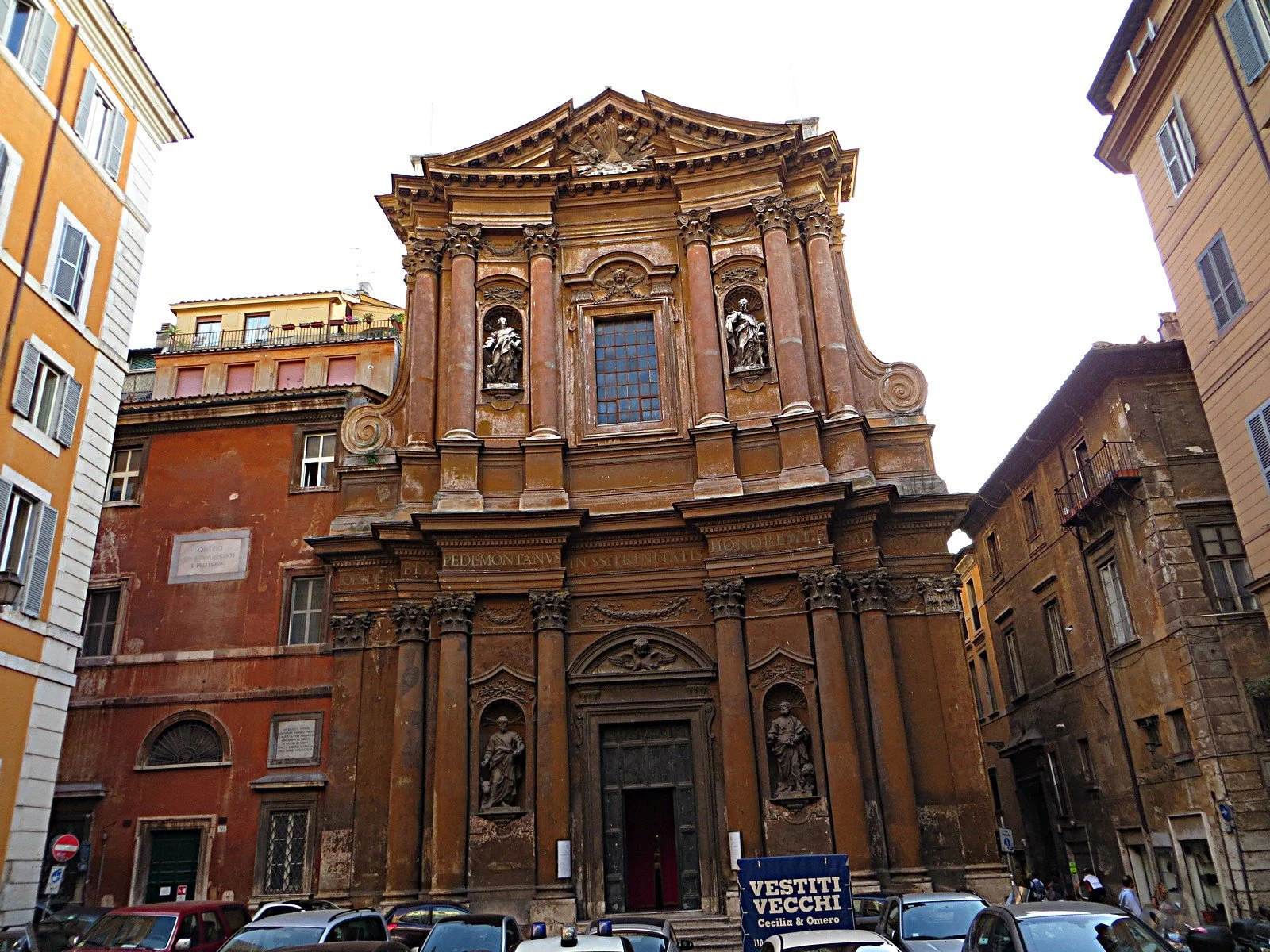
The Chiesa della Santissima Trinità dei Pellegrini is in the rione Regola, at the corner of Via dei Pettinari and the piazza that bears its name, a few steps from Campo de’ Fiori and the Tiber. It's a church that almost nobody visits for the architecture, and that nonetheless deserves to be known for a much bigger reason: for over three centuries this was the point where Rome materially welcomed the pilgrims arriving for the Holy Years, giving them a bed, a meal and someone to wash their feet after weeks of walking. The institution that did it, the Archconfraternity of the Most Holy Trinity of the Pilgrims and Convalescents, was born around the figure of Philip Neri and turned a block of the rione Regola into the largest machine of mass hospitality that pre-industrial Europe has known. Inside the church, above the high altar, is one of Guido Reni's most famous canvases, a Trinity painted in Bologna in less than a month and brought to Rome in the summer of 1625. Since 2008 the church has been a personal parish entrusted to the Priestly Fraternity of St. Peter, which celebrates there according to the old rite. The lines that follow tell what you see here today, how to get there, and above all how the welcoming of pilgrims actually worked, day by day, in a Rome without hotels.
Where the Chiesa della Santissima Trinità dei Pellegrini is and how to get there
The church faces Piazza della Trinità dei Pellegrini, in the rione Regola, with the main entrance at the intersection with Via dei Pettinari, the street that runs down from Via del Monte della Farina toward Ponte Sisto. It's a point of passage more than a destination: anyone walking from Campo de’ Fiori toward Trastevere passes in front of it almost inevitably, often without raising their eyes to the 1700s travertine facade.
The rione Regola in a few words
Regola is the seventh rione of Rome and its name has nothing to do with a rule or a religious order: it comes from renula, that is the fine sand that the Tiber deposited on the bank at every flood, a term that also survived in the name of the modern Via Arenula. It was the lowest and most flood-exposed zone of the historic center, and this explains many things: the working-class character of the neighborhood, the presence of trades tied to the river, and the fact that the construction of the Tiber embankment walls, begun in 1875, wiped out whole pieces of the building fabric that had grown up for centuries right against the water. The Santissima Trinità dei Pellegrini is one of the churches that went through that transformation staying in its place.
On foot from the historic center
From Campo de’ Fiori it takes just under five minutes going down toward the river. From Piazza Farnese and the Galleria Spada the time is practically identical. Anyone coming from Trastevere crosses Ponte Sisto and finds the church on the right after about 100 meters of Via dei Pettinari. From the Tempio Maggiore and the Portico d’Ottavia the route goes by Via Arenula and Piazza Cairoli, a good quarter of an hour's walk, while from Largo di Torre Argentina you go down in 10 minutes by Via dei Barbieri and Via del Monte della Farina.
By public transport
The most convenient surface stops are those on Via Arenula and Lungotevere dei Vallati, served by the lines connecting Piazza Venezia to Trastevere and to Trastevere station. The tram running along Viale Trastevere leaves you a few minutes' walk from the other end of Ponte Sisto. No metro station is really close: the most usable remains Colosseo on line B, from which, however, a good 20 minutes of walking or a change to a surface bus is needed. Anyone arriving from Termini gets there faster with a bus heading to Largo Argentina than with the metro.
The 1700s facade and the exterior
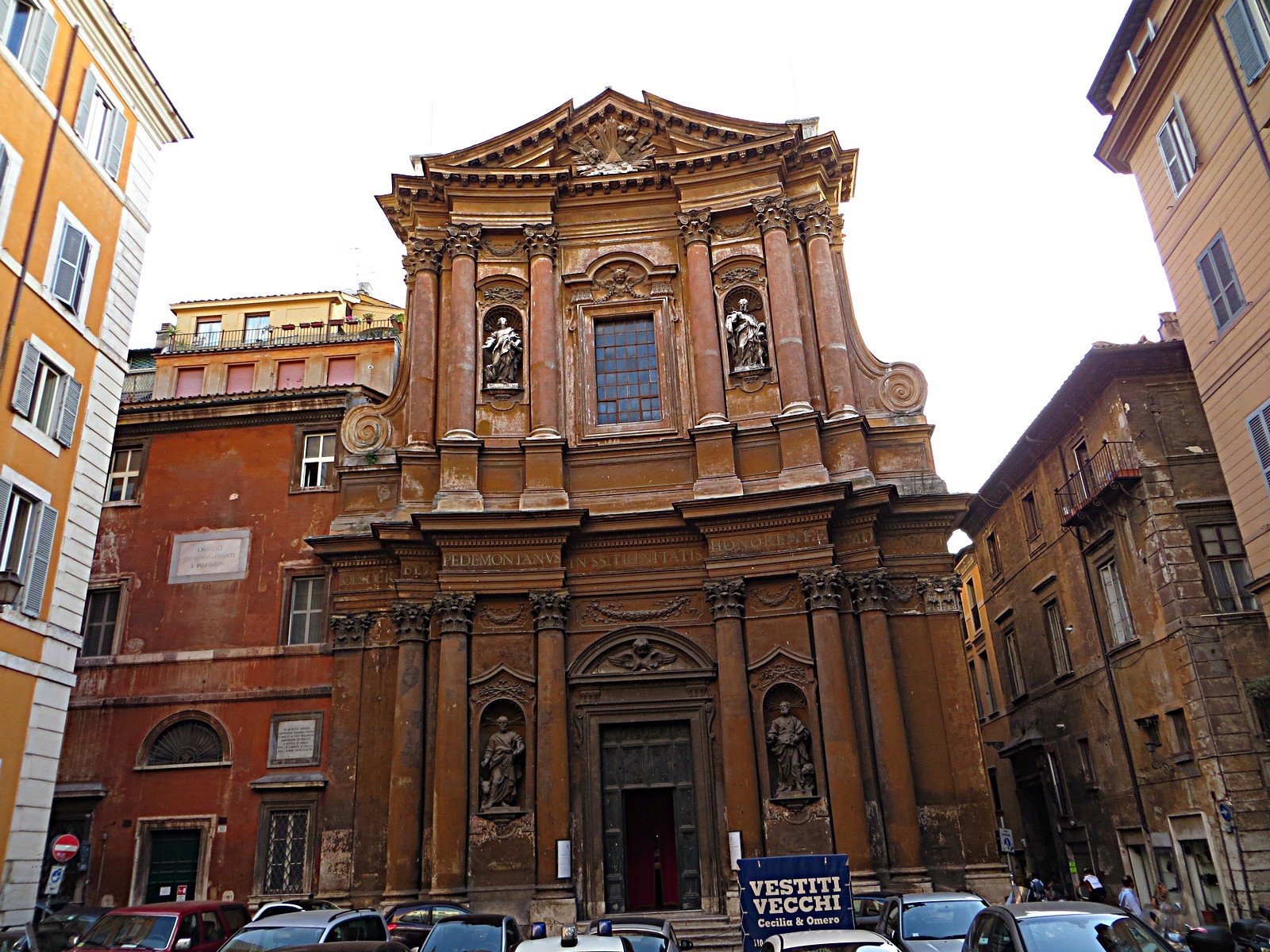
The facade of the Chiesa della Santissima Trinità dei Pellegrini dates to 1722 and was paid for by a private individual: the Piedmontese merchant Giovan Battista De Rossi, who financed the work and entrusted its execution to Giuseppe Sardi to a design by Francesco De Sanctis, the same architect responsible for the Trinità dei Monti staircase. The work was completed in June 1723.
The design of the front
The front is entirely in travertine, slightly inflected, that is barely concave, and divided into two orders by a continuous entablature. The element that stands out most is the number of free columns, 12, which by detaching from the wall create a play of deep shadows very effective in the hours when the sun turns onto Via dei Pettinari. The travertine portal is preceded by five steps, and in the tympanum appears the Trinitarian triangle in stucco surrounded by a sunburst and putti: an immediate indication of the church's dedication, legible even to those passing without stopping.
The Archconfraternity of the Most Holy Trinity of the Pilgrims and Convalescents
The Archconfraternity of the Most Holy Trinity of the Pilgrims and Convalescents was born in Rome around the mid-1500s as an association of lay people devoted to assistance, and owes its existence to the spiritual circle that revolved around Philip Neri. It is the very reason this church exists: the building was born to give a stable seat to a work of charity that had already been in full activity for decades.
The founding date: two versions
On the exact date the sources don't agree. One tradition, taken up by part of the literature, places the origin of the brotherhood in 1540, when a group of lay people supposedly gathered at the church of San Girolamo della Carità for exercises of piety and charitable works, then obtaining from Pope Paul III recognition as the Confraternity of the Most Holy Trinity of the Sussidio. Another reconstruction, equally widespread, fixes the actual foundation in 1548, on the advice of Persiano Rosa, Philip Neri's spiritual father, with an initial core of 15 men who met at the church of San Salvatore in Campo. The two versions are not necessarily in contradiction, because they probably describe two different moments of the same path: the formation of an informal group and its structuring into a recognized confraternity. On this page both are reported, without choosing one: anyone looking for a single, certain date will not find it in the available sources.
Philip Neri, founder and not parish priest
One point that causes confusion needs clarifying: Philip Neri, a Florentine born in 1515, who arrived in Rome in 1534 and was ordained a priest in 1551, was at the origin of this confraternity but was never the parish priest of this church, which was moreover built many decades later. His name remains tied to the Congregation of the Oratory, established by Gregory XIII in 1575 and installed at Santa Maria in Vallicella, the Chiesa Nuova, where today you can see the famous motorized painting by Rubens. Philip Neri died in 1595 and was canonized in 1622. At the Trinità dei Pellegrini what remain are his original impulse, a chapel dedicated to him and some of the oldest images that portray him.
The 1550 jubilee as a birth certificate
The Holy Year of 1550 was the moment when the confraternity understood what it would become. The brothers organized to assist the pilgrims flocking to Rome, and the house they occupied immediately proved insufficient: that year a larger one was rented. From that experience the brotherhood received the nickname that stuck, of the pilgrims, to which was later added that of the convalescents, for its commitment to assisting poor sick people discharged from hospitals when they were not yet able to return to work.
The convalescents: a modern insight
The second part of the name deserves attention, because it describes a health-care insight that today we would call intermediate care. In the Roman hospitals of the 1500s, which were enormous and chronically overcrowded structures like the nearby complex of Santo Spirito in Sassia, the patient was discharged as soon as the immediate danger ended. The problem was that a poor person discharged in those conditions, without a home, without food and without rest, fell ill again within a few days and returned to the ward, often in worse condition. The Archconfraternity slotted into exactly that gap: it hosted the convalescents for the time needed to get them back on their feet, with food and rest, before returning them to the city. It was assistance, certainly, but it was also a rudimentary and effective form of public health.
From the church of San Benedetto in Arenula to the current church
In 1558 Pope Paul IV granted the confraternity the use of the church of San Benedetto in Arenula, a building already mentioned in a bull of 1186 by Pope Urban III and by then in poor condition. The following year, in 1559, the brotherhood bought an adjacent house and turned it into a hospital and hospice: it's the act that fixes in this block of the rione Regola the whole machine of hospitality. In 1579 Gregory XIII definitively donated the church to the confraternity, which decided to tear it down and rebuild it in forms suited to its growth.
The dates of construction
The first stone of the current church was laid on February 26, 1587, and the solemn consecration took place on June 12, 1616, with the title of Most Holy Trinity and St. Benedict: 29 years of construction, a completely normal time for a building of this scale in late 1500s Rome. In 1601 the parish of San Benedetto was suppressed, following disputes with the parish priest, and the territory merged into the jurisdiction of San Lorenzo in Damaso. The church therefore remained for over four centuries a confraternity building and not a parish one, until 2008.
The jubilee seen from below: where the pilgrims really slept
During the Holy Year of 1575, the Archconfraternity of the Santissima Trinità dei Pellegrini hosted more than 180,000 people in its buildings. It's the figure the sources agree on most, and by itself it's enough to shift the whole story of the jubilee from the level of papal ceremonies to the much more concrete one of how a crowd far larger than the city's permanent population was fed and given a place to sleep. This is the chapter that makes it worth coming in here.
How Many People Really Came
To gauge the scale of the problem you need a point of comparison. Rome at the end of the 16th century had roughly 100,000 inhabitants, with fluctuations depending on the estimates and the years. A jubilee therefore meant that in a few months a number of people equal to or greater than the city's entire population passed through it, concentrated over a few weeks and all headed to the same places. The sources indicate that in the jubilees after 1575, and up to 1825, the Archconfraternity's hospitality alone reached 400,000 people: a figure to be taken as an overall order of magnitude and not as the count of a single Holy Year, because the old confraternity registers used counting criteria that are not always comparable with one another and sometimes added pilgrims and convalescents together. The point, however you read it, doesn't change: we're talking about hundreds of thousands of people who passed through this block.
Why There Were No Hotels
The question that comes naturally to anyone traveling today is where all these people slept. The answer is that, apart from a well-off minority, they didn't sleep in paid accommodations, because those simply didn't exist in the form we know. Rome had inns and taverns, concentrated mostly along the roads arriving from the north, but they were few, expensive and made for merchants and travelers with money, not for a pilgrim who had walked for weeks with what he had on his back. Mass pilgrimage was by definition a phenomenon of the poor: the system that made it possible was organized charity, not the market.
The Hospice Dormitories
The Trinità hospice occupied the complex of buildings acquired starting in 1559 and progressively expanded in the following decades, built up against the church along present-day Via dei Pettinari and toward the river. The structure was organized in large dormitories with rows of beds, separated between men and women, with shared facilities for handing out meals and washing feet. It wasn't a shelter in the modern sense: it was a setup designed to move thousands of bodies through in a few weeks, with shifts, registers and a division of labor among the brothers that looked more like military logistics than small-scale charity.
The Three-Day Rule
The mechanism that made all this sustainable was the limit on length of stay. The Archconfraternity's hospitality was by its nature very short, traditionally given as three nights for Italian pilgrims and a slightly longer period for those from beyond the Alps, who had faced a harder journey and needed more time to recover before leaving again. The sources one can consult don't allow the figures to be fixed with absolute precision for every period, because the constitutions of the brotherhood were reformed several times over the centuries: the general criterion, however, is documented and consistent, and it's what explains the numbers. Only a very fast turnover allowed a few hundred beds to serve hundreds of thousands of people over the course of a Holy Year.
The Math That Works
It's worth doing the calculation, because it makes the scale of the operation obvious. If a bed is freed up every three nights, in a jubilee year of 12 months the same bed can in theory take in more than 100 different people. Even allowing for dead periods, illness, days when the facility wasn't full, a few thousand effective beds were enough to reach overall numbers in the order of hundreds of thousands. It's exactly this arithmetic, not an improbable instantaneous capacity to house 100,000 people, that explains the figures handed down by the registers.
Who Received Them
The service was done by the brothers in person, and this is the point that made the Archconfraternity different from an ordinary charitable institution. The members of the brotherhood included craftsmen and shopkeepers of the rione, but also prelates, princes and cardinals, and all were required to do hands-on service: carrying the basins, serving at the refectory tables, accompanying pilgrims to their beds. Some canvases kept in the sacristy depict exactly this, with cardinals and nobles serving the meal to the pilgrims. It wasn't devotional pretense: it was the rule.
The Pilgrim as a Social Figure
One element that the tourist telling of the jubilees tends to lose is who the pilgrim concretely was. Almost never a cultured traveler looking for art: he was a peasant, a craftsman, a widow, often illiterate, who had covered hundreds or thousands of kilometers on foot with a staff, a satchel and a safe-conduct, sleeping along the way in the hospices that dotted the routes to Rome. He arrived with wrecked feet, torn clothes and very little money. The whole organization of the Trinità hospice was calibrated to this figure, and the washing of the feet, before being a Gospel symbol, answered an immediate physical need.
The Pilgrimage Sites
The pilgrim who slept here had a precise route ahead of him: the visit to the major basilicas, namely St. Peter's Basilica, the Basilica of St. John Lateran, the Basilica of Santa Maria Maggiore and the Basilica of St. Paul Outside the Walls, to which the traditional visits added other destinations such as San Lorenzo and San Sebastiano. The Holy Stairs at the Lateran was an almost obligatory stop, to be climbed on one's knees. From the Trinità dei Pellegrini the route to St. Peter's went over Ponte Sisto or Ponte Sant'Angelo at the foot of Castel Sant'Angelo, and from there toward Vatican City: that meant tens of kilometers on foot spread over a few days, to be covered after weeks of travel and before leaving again.
Why Right Here
The hospice's location was no accident. The Regola rione sat on the line that led from the built-up center to the Tiber and the bridges toward the Vatican, in a working-class area with low rents and available space, close enough to the heart of the city to be reachable and out of the way enough to house a bulky, noisy facility without disturbing the noble palaces. Next to it already stood a fabric of working-class housing and craft workshops, and a short distance away the Monte di Pietà, another institution born to respond to urban poverty. The Trinità dei Pellegrini was born in exactly this environment, and its monumental architecture is a superstructure that came later.
What Remains Today of That System
Less of the hospice buildings has survived than one would like: the 19th-century urban transformations, the construction of the Tiber embankment walls from 1875 and the later reorganizations profoundly altered the block. The church remains the most readable document of that era, and it is so above all through the images kept in the sacristy and the adjoining rooms, where the theme of the washing of the feet and of service to pilgrims recurs in several canvases. Someone who enters knowing what to look for sees a different church from someone who enters without knowing.
Washing the Feet: The Gesture That Made This Church Famous
Washing the pilgrims' feet is the gesture that identifies the Archconfraternity of the Santissima Trinità dei Pellegrini and that recurs in almost all the images kept in the church: the brothers, including the highest-ranking members, personally washed the feet of those who arrived after weeks of walking, before accompanying them to the refectory and the dormitory. Philip Neri practiced it in person, and the memory of that gesture has stayed attached to the place more than any work of art.
From Gospel Rite to Practical Necessity
The reference is obviously to the Gospel account of the Last Supper, and in Catholic liturgy the washing of the feet is a Holy Thursday rite. What happened here, though, was something different and at the same time more literal: not a symbolic annual rite on 12 chosen people, but a daily operation on hundreds of real feet, cracked from walking, often infected. The hygienic and health component wasn't incidental, it was the first medical treatment a pilgrim received on arrival, and it also made it possible to spot right away the cases that needed the hospital.
Nobles and Cardinals in Aprons
What struck contemporaries, and still strikes people today, is who physically performed the gesture. In the canvases kept in the sacristy and the adjoining rooms, cardinals, prelates and nobles appear in procession serving food to the pilgrims or bending down to wash feet. In a rigidly hierarchical society, the reversal of roles had enormous demonstrative value, and this is precisely what made the Archconfraternity one of the most prestigious institutions of Counter-Reformation Rome: belonging to it meant having the public opportunity to perform that gesture.
The Panel Painted While the Saint Was Alive
Between the chapel of St. Philip Neri and that of St. John Baptist de Rossi is kept a poplar wood panel, with a carved frame, depicting Philip Neri in an apron washing the feet of pilgrims. According to the tradition preserved by the church, it was painted by a painter who was a guest of the hospice against the explicit will of the saint, who refused to be portrayed, and it would hold the distinction of being the only image made while Philip Neri was still alive. It's an attribution handed down by the institution and not a documentary certainty, and it should be read as such, but even only as testimony to how central the gesture was to the identity of the place, it's worth looking for.
The Cycle in the Chapel of St. Philip Neri
The second chapel on the right, today dedicated to St. Philip Neri, was originally dedicated to St. Francis of Assisi and was completely renovated in 1852. The paintings are by Filippo Bigioli, a painter from San Severino who lived between 1798 and 1878 and was tied to the Accademia di San Luca. The cycle tells the whole activity of the confraternity: the altarpiece shows the saint in ecstasy during Mass, while the side scenes depict the welcoming of the pilgrims, the preaching to the convalescents, the washing of the feet, the distribution of meals and the final apotheosis. In the lunette appears the death of the saint, who receives the viaticum from Cardinal Federico Borromeo assisted by Cesare Baronio and Giovanni Giovenale Ancina. On the arch runs the inscription DILECTVS DEO ET HOMINIBVS, accompanied by the allegories of Charity and the burning heart, a recurring iconographic attribute of Philip Neri.
Guido Reni's Trinity on the High Altar
The altarpiece on the high altar of the Church of the Santissima Trinità dei Pellegrini is a Trinity by Guido Reni, commissioned by Cardinal Ludovico Ludovisi, nephew of Pope Gregory XV and protector of the Archconfraternity: it was painted in Bologna in 27 days, transported to Rome in the summer of 1625 and the artist was paid 800 scudi the following year. It's the main reason art historians come into this church.
27 Days
The figure of 27 days of execution, handed down by the sources on the work, says a lot about Reni's way of working in his maturity: a large-format painting resolved with a speed that contemporaries considered almost prodigious, made possible by an organized workshop and a compositional approach by then perfectly mastered. The fee of 800 scudi places the work in the upper range of Roman commissions of the period, consistent with the rank of the patron.
What's Under the Floor
In the floor of the presbytery opens the trapdoor of a common grave, and there are the stone slabs of Cardinal Pietro Francesco Galleffi, protector of the Archconfraternity, and of Don Persiano Rosa, confessor and spiritual director of Philip Neri, that is the man who according to one of the two versions suggested the very founding of the brotherhood. Under the altar rests, since 1644, the body of St. Anthony the martyr, who according to tradition suffered martyrdom with 21 companions under Emperor Valerian: the tomb slab is visible behind the altar.
The Dome and the Structure of the Interior
The interior of the Church of the Santissima Trinità dei Pellegrini has a Latin cross plan, with six symmetrical rectangular chapels covered by barrel vaults that open on the sides and two altars in the transept, under a large dome set on a drum. The interior layout was carried out between 1587 and 1616 by Martino Longhi the Elder and Giovan Paolo Maggi.
The Dome of 1612
The dome was built in 1612, during the building work directed by Giovan Paolo Maggi. To the Roman architect Giovan Battista Contini are due four reinforcing counter-arches, supported by eight giant-order travertine columns, covered in red scagliola during the 19th-century embellishments. It's a structural intervention that left a very visible mark on the interior space: those columns, which to an untrained eye seem a decorative choice, are actually the solution to a structural problem.
The Chapels, One by One
The chapels of the Church of the Santissima Trinità dei Pellegrini are eight, six side chapels plus the two transept altars, and span a chronological arc from the early 17th century to the second half of the 19th century. Anyone short on time can focus on three: that of St. Matthew, that of Saints Augustine and Francis and that of Our Lady of the Rosary.
The Right Transept Altar, with the Rejected St. Matthew
Here is one of the most curious pieces in all of Rome. The marble sculptural group of St. Matthew and the Angel is by the Flemish artist Jacob Cornelisz Cobaert, who lived from 1535 to 1615, and was commissioned in 1587 for the Contarelli Chapel in San Luigi dei Francesi. Delivered in 1602 after 15 years of work, it was rejected by Cardinal Matthieu Cointrel two weeks after delivery, and the commission passed to Caravaggio, who produced the very famous St. Matthew and the Angel. The discarded sculpture was bought by the Archconfraternity of the Trinità, which in 1615 had the angel added by Pompeo Ferrucci. In practice, this church holds the work that made one of Caravaggio's masterpieces possible.
The First Chapel on the Left, of Our Lady of the Rosary
Commissioned in 1677 by the surgeon Domenico Altimani da Vignola, as the inscription on the left wall recalls. The altarpiece is by Guillaume Courtois, known as il Borgognone, and shows Our Lady of the Rosary offering the crown to St. Charles Borromeo, St. Dominic de Guzman, St. Philip Neri and St. Felix of Cantalice. The wall paintings are by Giovan Battista Ferretti and again take up the theme of hospitality and charity. The columns are of Sicilian jasper, the balustrade of white marble and verde antico. An oval canvas depicts St. Joseph Calasanz, who was a member of the Archconfraternity.
The Second Chapel on the Left, of Saints Augustine and Francis
Funded in 1602 by the brothers Agostino and Francesco Radice, who are buried under the floor. The altarpiece is by Giuseppe Cesari, the Cavalier d'Arpino, and depicts the Virgin and Child between Saints Augustine and Francis of Assisi: it is considered among the most valuable works in the church, second only to Reni's altarpiece. The frescoes are by the Bolognese Mannerist Baldassarre Croce, with the Assumption in the vault and the four doctors of the Western Church on the soffit. There are also two 19th-century funerary monuments of the Radice family, including that of a 20-year-old papal soldier.
The Third Chapel on the Left, of St. Gregory the Great
The altar was declared privileged in 1573 by Pope Gregory XIII, with the right to free one person condemned to death each year: it's a privilege that links this chapel to a legal and devotional practice that in Rome had other famous seats, among them the confraternity that operated at San Giovanni Decollato. The altarpiece and frescoes are by Baldassarre Croce, who lived from 1558 to 1628, and depict St. Gregory interceding for the souls in Purgatory, the distribution of food to 12 poor people and the encounter with the angel.
The Fourth Chapel on the Left, with the 14th-Century Fresco
It preserves the memory of the vanished church of San Benedetto in Arenula. The altarpiece by Giovanni Battista Ricci da Novara, executed between 1613 and 1618, encloses a 14th-century fresco of the Madonna nursing the Child, coming from an outdoor votive shrine of Palazzo Capranica della Valle: considered miraculous, it was moved by Paul IV in 1562 to San Benedetto in Arenula and placed here in 1613. In 1654 the Chapter of St. Peter's solemnly crowned it with a gold crown, later confiscated in the Napoleonic era by the French Republic. Today the fresco is protected by an oil panel by Giovanni Battista Salvi called Sassoferrato, and in the liturgical seasons of penance the picture is hidden by a silk curtain that rises and falls thanks to a Baroque machine of rollers and ropes placed behind the altarpiece: a mechanism that closely recalls that of the motorized picture in the Chiesa Nuova.
The Sacristy and Iacopo Zucchi's Mass of St. Gregory
The sacristy, built in 1616 once the church was finished, holds the oil panel with the Mass of St. Gregory the Great by Iacopo Zucchi, commissioned by Cardinal Ferdinando de' Medici in 1572 and coming from the vanished Oratory of Via delle Zoccolette. The scene is set in an imaginary St. Peter's Basilica, with the works not yet finished, and the face of St. Gregory is that of the reigning pope Gregory XIII. Around him appear real portraits: the commissioning Cardinal Ferdinando de' Medici, the cardinal nephew Filippo Boncompagni, Cardinals Gerolamo Morone, Filippo Guastavillani, Andrea d'Asburgo and Alessandro Farnese the Younger, Giacomo Boncompagni natural son of the pope, Marcantonio II Colonna and, in the choir loft, the composer Giovanni Pierluigi da Palestrina. For the quality of the portraits it's considered among the most distinguished works of the church.
The Church Today: Personal Parish and the Old Rite
Since Easter Sunday, March 23, 2008, the Church of the Santissima Trinità dei Pellegrini has been a personal parish, established at the wish of Pope Benedict XVI and Cardinal Vicar Camillo Ruini and entrusted to the Priestly Fraternity of St. Peter for the spiritual care of the faithful of the Diocese of Rome who follow the Mass and the sacraments according to the Tridentine rite. It's an organizational fact, and it's reported here as such: whoever comes in finds a liturgy in Latin, with the high altar used in the old arrangement.
Mass Times
According to the parish, Sunday and holy day Masses are at 9:00, at 11:00 in solemn form, with a Low Mass in August, and at 18:30. Monday through Saturday, Masses are at 7:15 and 18:30. The times may change on particular holidays and in the summer periods, and it's best to check them on the parish website before showing up, especially if the goal is to visit the church and not to attend the liturgy.
A Curiosity About the Church of the Santissima Trinità dei Pellegrini
The most surprising curiosity about the Church of the Santissima Trinità dei Pellegrini is that it holds the rejected sculpture that made a Caravaggio masterpiece possible: Jacob Cornelisz Cobaert's St. Matthew and the Angel, commissioned in 1587 for the Contarelli Chapel in San Luigi dei Francesi and rejected by the patron in 1602, just two weeks after delivery.
How It Ended Up Here
The Archconfraternity of the Trinità bought the rejected group and in 1615 commissioned Pompeo Ferrucci to add the figure of the angel, who advances on clouds holding out the inkwell. The result can be seen today in the right transept altar, with two columns of bigio morato marble at the sides and an altar frontal with an alabaster inset. It's a dignified work, and the only reason it ended up being considered a failure is the name of the artist who was called in its place.
Something Nobody Tells You About the Church of the Santissima Trinità dei Pellegrini
The thing nobody tells you about the Church of the Santissima Trinità dei Pellegrini is that the 19th-century frescoes by Raffaele Ferrara on the vault, which depicted in images the entire history of the Confraternity and its work of hospitality, were erased in the 1960s and no longer exist.
A Loss That Changes How You Read the Church
If that cycle were still in place, a visitor coming in today would understand immediately what this building was, without needing explanations. The vault told of the pilgrimage, the hospitality, the washing of the feet, the convalescents. Without those images the church appears to be what it is not, that is just any beautiful Roman Baroque church, and its historical meaning remains invisible to anyone who isn't looking for it.
The Advice I Give You for Visiting the Church of the Santissima Trinità dei Pellegrini
The best advice for visiting the Church of the Santissima Trinità dei Pellegrini is to arrive mid-morning on a weekday, that is after the 7:15 Mass and well before the 18:30 one, avoiding showing up during a service: it's the only window in which you can wander among the chapels calmly and without disturbing anyone.
To Pair in the Same Morning
A route that works well starts from Campo de' Fiori early in the morning with the market, continues toward the Galleria Spada and Borromini's perspective, goes down to the Trinità dei Pellegrini, and continues toward Ponte Sisto and Santa Maria in Trastevere for lunch. It's a dense half day and almost entirely in shade in the hot months, which is no minor detail in Rome in summer.
Another Well-Known Fact, Yet Rarely Mentioned
A fact known to historians of the Risorgimento but rarely cited in guidebooks is that the hospital of the Santissima Trinità dei Pellegrini treated more than 1500 wounded during the French siege of the Roman Republic in 1849, and that among them was Goffredo Mameli, the author of the words of the Italian national anthem.
The Timeline of the Wounding
Mameli was wounded in the left leg on June 3, 1849 during the fighting for Villa Corsini on the Janiculum. There are two versions of the circumstances: according to one he was accidentally struck by the bayonet of a comrade, according to the other, today considered more likely, by a French rifle shot. He was taken to the hospital of the Trinità dei Pellegrini, where he was treated by the physician Pietro Maestri.
Why It Happened Here
That the institution born to host pilgrims found itself treating the wounded of a European civil war is not a contradiction but the natural continuation of its function. The Archconfraternity's hospital was one of the operating health facilities of the historic center, close to the Janiculum front and equipped to take in large numbers of people in a short time: exactly the capacity that three centuries of jubilees had built.
The Right Photo to Take at the Church of the Santissima Trinità dei Pellegrini
The right photo at the Church of the Santissima Trinità dei Pellegrini is the travertine façade shot from the opposite sidewalk of Via dei Pettinari in the late afternoon, when the raking light separates the 12 free-standing columns from the background and restores the depth that the front completely loses in the middle hours.
Inside
Inside, the most effective subject is the dome seen from the center of the crossing, with Contini's four counter-arches and the eight giant-order columns converging toward the lantern. You need a steady hand or a support, because the light is poor and a tripod in an active parish church is out of the question. For Guido Reni's altarpiece the difficulty is the reflection: it's better to move off to the side of the central axis rather than shooting it straight on.
Some Important Events That Happened Here in History
The decisive events in the history of the Church of the Santissima Trinità dei Pellegrini are five: the grant of San Benedetto in Arenula in 1558, the laying of the first stone of the present church on February 26, 1587, the consecration of June 12, 1616, the arrival of Guido Reni's altarpiece in the summer of 1625 and the establishment as a personal parish on March 23, 2008.
1575: The Jubilee of the Numbers
In the Holy Year of 1575, more than 180,000 people were hosted in the confraternity's facilities. It's the figure that makes the Archconfraternity an institution of European importance and that justifies, four years later, Gregory XIII's definitive donation of the church.
1625: Guido Reni Arrives
The Trinity commissioned by Cardinal Ludovico Ludovisi is painted in Bologna in 27 days and brought to Rome in the summer of 1625. The following year Reni collects 800 scudi. The church thus enters, rightfully, the artistic geography of 17th-century Rome.
2008 and Beyond
On Easter Sunday, March 23, 2008, the church becomes a personal parish entrusted to the Priestly Fraternity of St. Peter. There follow the restoration of several works, the baptismal font placed in 2019, the recovery of the canvas of Jesus the Nazarene displayed again in 2021 and the restoration of the façade completed in 2024 with the repositioning of the wrought-iron cross.
Who Has Passed Through the Church of the Santissima Trinità dei Pellegrini
Through this place have passed Philip Neri, who was the inspirer of the work, Benedict Joseph Labre and Joseph Calasanz, Goffredo Mameli who died there in 1849, and then tens of thousands of anonymous pilgrims whose names have not survived: it's the latter, not the former, who are the real story of the building.
Benedict Joseph Labre
The French pilgrim who died in Rome in 1783, patron saint of the homeless, was a guest of the old Trinità hospice. An oval canvas in the chapel of St. Philip Neri commemorates him. He is perhaps the figure who best embodies the human type this institution was addressed to.
The Patrons and the Artists
On the artistic side, those who passed through here include Guido Reni, Giuseppe Cesari known as the Cavalier d'Arpino, Guillaume Courtois, Baldassarre Croce, Giovanni Battista Ricci da Novara, Iacopo Zucchi, Jacob Cornelisz Cobaert and, by attribution, Andrea Pozzo. Among the patrons are Cardinals Ludovico Ludovisi and Alessandro Damasceni Peretti, as well as surgeons, merchants and families of the rione: a mixed patronage that reflects exactly the social makeup of the confraternity.
The Regola Rione Around the Church
The Regola rione, the seventh of Rome's historic rioni, is the only context in which the Santissima Trinità dei Pellegrini is truly understood: a low-lying neighborhood, exposed to Tiber floods until the construction of the embankment walls begun in 1875, working-class, dense with trades and charitable institutions.
The Other Churches of the Rione
It's worth listing the neighbors: the Oratorio del Gonfalone with its cycle of Mannerist frescoes, the church of Sant'Eligio degli Orefici, the church of Santa Maria dell'Orazione e Morte with its hypogeum, and a bit farther the basilica of Sant'Andrea della Valle. Whoever wants a comparison with great Jesuit architecture also finds the Church of the Gesù a short distance away.
The River and the Bridges
Ponte Sisto, a few steps from the church, was the direct link with Trastevere and one of the obligatory passages for those heading on foot to the Vatican. Going upstream you reach the Tiber Island, itself a historic site of a hospital, while going downstream you meet the area of San Nicola in Carcere and the Forum Boarium. The geography of Roman charity follows the river with a regularity that is no accident: water was useful, and low ground cost less.
Frequently Asked Questions About the Church of the Santissima Trinità dei Pellegrini
Where Is the Church of the Santissima Trinità dei Pellegrini?
The Church of the Santissima Trinità dei Pellegrini is in Rome's Regola rione, on Piazza della Trinità dei Pellegrini at the corner with Via dei Pettinari, between Campo de' Fiori and Ponte Sisto. The most convenient surface stops are those on Via Arenula and Lungotevere dei Vallati: no metro station is really close.
How Much Is a Ticket to the Church of the Santissima Trinità dei Pellegrini?
Admission to the Church of the Santissima Trinità dei Pellegrini is free and there is no ticket office, because it's a parish church in liturgical use and not a museum. There are no guided tours on a fixed schedule: access to the confraternity spaces, sacristy included, would have to be arranged with the parish if at all.
What Are the Hours of the Church of the Santissima Trinità dei Pellegrini?
The Church of the Santissima Trinità dei Pellegrini follows the parish's hours, which list Masses at 9:00, 11:00 and 18:30 on Sundays and holy days, and at 7:15 and 18:30 Monday through Saturday. Opening outside Mass times isn't guaranteed and changes in the summer and holiday periods: it's best to check the parish website before going.
Who Painted the High Altar Altarpiece of the Trinità dei Pellegrini?
The high altar altarpiece of the Church of the Santissima Trinità dei Pellegrini is a Trinity by Guido Reni, commissioned by Cardinal Ludovico Ludovisi. It was painted in Bologna in 27 days, brought to Rome in the summer of 1625 and paid 800 scudi the following year. The same artist is also credited with the fresco of God the Father in the dome's lantern.
How Many Pilgrims Did the Archconfraternity of the Santissima Trinità dei Pellegrini Host?
During the jubilee of 1575 the Archconfraternity of the Santissima Trinità dei Pellegrini hosted more than 180,000 people in its facilities, the most solid figure among those handed down. For the later jubilees, up to 1825, the sources give figures reaching 400,000 people: they should be taken as an overall order of magnitude, because the old confraternity registers used counting criteria that are not always comparable.
Can You Take Photos Inside the Church of the Santissima Trinità dei Pellegrini?
Taking photos inside the Church of the Santissima Trinità dei Pellegrini is generally tolerated without flash and without a tripod, outside the times of services. Since it's an active parish with a recollected community, discretion is the rule: no photos during Mass, and when worshippers are praying it's best to give up or wait.
Is the Church of the Santissima Trinità dei Pellegrini Accessible to People with Disabilities?
The main entrance of the Church of the Santissima Trinità dei Pellegrini is preceded by five travertine steps, which make independent access difficult for wheelchair users. No information has been published on ramps or alternative entrances: anyone with accessibility needs should contact the parish before the visit to check the current situation.
Why Is the Mass at the Trinità dei Pellegrini in Latin?
At the Church of the Santissima Trinità dei Pellegrini Mass is celebrated in Latin because since March 23, 2008 it has been a personal parish entrusted to the Priestly Fraternity of St. Peter, established at the wish of Pope Benedict XVI and Cardinal Vicar Camillo Ruini. A personal parish has no territory, but a community defined by liturgical form: the faithful come here from all over Rome.
How Long Does It Take to Visit the Church of the Santissima Trinità dei Pellegrini?
To visit the Church of the Santissima Trinità dei Pellegrini 20 or 25 minutes are enough, enough to see Guido Reni's altarpiece, the dome and the eight chapels. Whoever wants to linger over Cobaert's St. Matthew and the 19th-century cycle in the chapel of St. Philip Neri can easily go up to 40 minutes.
One Last Note for Anyone Building the Itinerary
This church works best as a stop within a walking route of the Regola rione, not as an isolated destination: half an hour here, fitted between Campo de' Fiori, Via Giulia and Ponte Sisto, is worth much more than a visit scheduled on its own. And it's probably the most honest way of doing it justice, because even the pilgrims it was built for passed through in transit, headed elsewhere.
Anyone organizing a walking itinerary in Rome's historic center, combining this stop with the other churches and palaces of the Regola rione, can find useful planning tools at Tour Leader Pro, while for a broader picture of transport, destinations in Lazio and organizing a trip to Italy, Italy Planner is a good resource.