Oratorio del Gonfalone
In short. The Oratorio del Gonfalone, the name by which Romans know the church of Santa Maria Annunziata del Gonfalone, is at Via del Gonfalone 32/a, on the corner with Vicolo della Scimia, a few steps from Campo de' Fiori and the Renaissance stretch of Via Giulia.
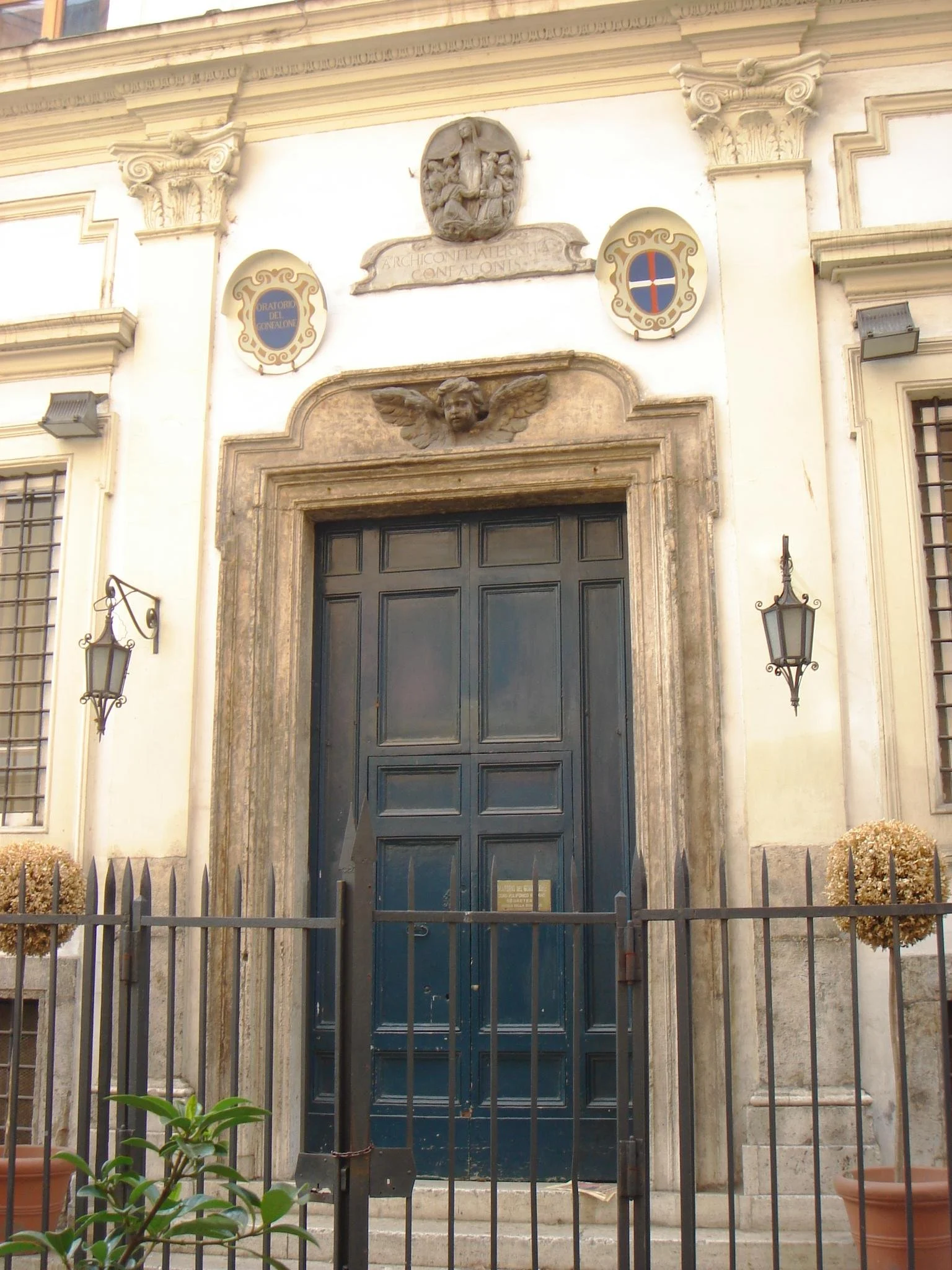
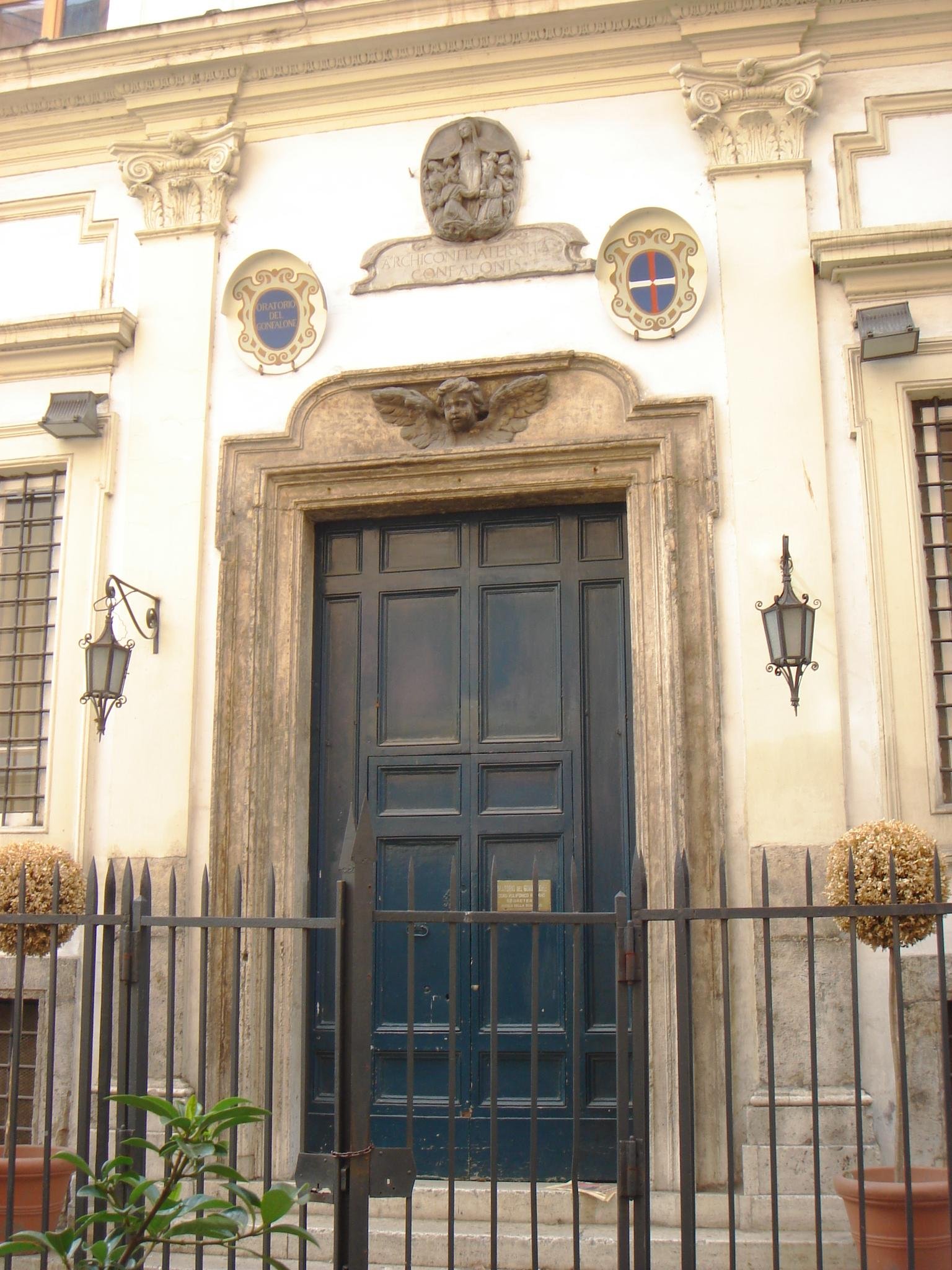
The Oratorio del Gonfalone, the name by which Romans know the church of Santa Maria Annunziata del Gonfalone, is at Via del Gonfalone 32/a, on the corner with Vicolo della Scimia, a few steps from Campo de' Fiori and the Renaissance stretch of Via Giulia. The building dates from the mid-1500s as the seat of the Arciconfraternita del Gonfalone, one of the oldest and most powerful lay companies in Rome, and inside it keeps a cycle of 12 frescoes on the Passion of Christ painted between 1569 and 1576 by a group of leading Mannerist painters, plus a carved and gilded wooden ceiling that alone is worth the visit. The sobriety of the facade, almost anonymous next to the grand Baroque fronts of Rome's better-known churches, is part of the reason this oratorio is still little visited compared with its real artistic value: those who don't know what to look for walk past without suspecting what lies behind that doorway. Since 1960 the hall has hosted a season of early music and Baroque concerts that has made the Gonfalone one of the best-loved concert spaces in the historic center, with an acoustic that musicians describe as among the best in Rome. Anyone walking between Piazza Navona and Castel Sant'Angelo almost always passes a block away from this oratorio without knowing it, because the modest facade and the secluded position in the rione Ponte keep it off the most beaten itineraries.
Where the Oratorio del Gonfalone is and how to get there
The official address for concerts is Via del Gonfalone 32/a, while the management and offices of the music association are a few meters further on, at Vicolo della Scimia 1b. We are in the heart of the rione Ponte, bordering the rione Regola, in that mesh of narrow lanes between Via Giulia, Lungotevere dei Tebaldi and Via dei Banchi Vecchi that in the 1500s housed the workshops of artisans, money changers and the seats of many Roman confraternities. It is not a neighborhood of grand squares: it is a network of streets born in the Renaissance, when Pope Julius II had Via Giulia laid out as the first great modern urban axis of Rome, and the minor streets alongside it have kept to this day the pedestrian scale of the time.
Before the 19th-century demolitions that rebuilt the lungotevere to protect Rome from the river's floods, this stretch of the city lived in close contact with the water: the lanes that ran down toward the Tiber housed landing places, wash houses and small docks, and the closeness to the river was both an economic resource and a constant risk of flooding. The great embankment works completed between the end of the 1800s and the first years of the 1900s physically separated the urban fabric from the river, raising the walls we know today, but the memory of that direct relationship with the river remains legible in the place names and in the very layout of the streets of the rione Ponte, which all converge, sooner or later, toward the embankment.
On foot from the historic center
The most natural way to reach the Oratorio del Gonfalone is on foot. From Campo de' Fiori it is a five-minute walk toward the Tiber, taking Via dei Baullari or Via del Pellegrino and then going down toward Via Giulia. From Piazza Navona the route takes a little over 10 minutes, crossing Corso Vittorio Emanuele II at Via dei Banchi Nuovi. Coming from Castel Sant'Angelo and the Borgo, you can cross the Tiber on Ponte Sant'Angelo or on Ponte Vittorio Emanuele II and find yourself in the rione Ponte in less than a quarter of an hour. It is a route worth letting the streets tell you on your own, without a map, because Via del Gonfalone and Vicolo della Scimia are two of the streets that best give back the atmosphere of the Rome of the rioni before the great 19th- and 20th-century demolitions.
By bus and public transportation
The area is not served by metro lines: the nearest stop is on line A at Ottaviano or Spagna, both still about 20 minutes on foot, so it is better to rely on surface buses. Several ATAC lines that run along Corso Vittorio Emanuele II and Via Arenula stop a few hundred meters away, with terminals and intermediate stops that change periodically: the most reliable solution is to check the updated route on the official ATAC app the same day, because in this part of the historic center detours for roadworks and occasional traffic closures are not rare. From Termini you can also get off at Piazza Venezia and continue on foot along Corso Vittorio Emanuele II, a route of about 25 minutes that crosses the heart of the historic center.
By car and parking
The rione Ponte is part of the limited traffic zone of Rome's historic center, with electronic gates active during daytime hours on weekdays: if you don't have a permit you risk a fine by entering with a car during the restricted hours. The simplest solution is to leave the car in one of the paid car parks outside the ZTL, for example toward the lungotevere or near Castel Sant'Angelo, and finish the trip on foot. For anyone attending an evening concert, when the historic center ZTL is generally less strict, it is still worth checking the updated hours on the Roma Servizi per la Mobilità website before leaving, because the evening activation windows apply only in some zones and on some evenings of the week.
What the Oratorio del Gonfalone is: the Archconfraternity and the 16th-century church
To understand the Oratorio del Gonfalone you have to start with who wanted it, because the building was not born as just any parish church, but as the representative seat of one of the most influential lay confraternities of papal Rome. Understanding this also helps in reading the grandeur of the cycle of frescoes that covers the walls: such a rich confraternity, so close to papal power, could afford to commission a painting project of the highest level, entrusted not to a single master but to a group of artists among the most in demand in Rome in the second half of the 1500s.
The 13th-century origins of the Compagnia del Gonfalone
The confraternity dates back to the 1200s, when a group of Roman faithful formed as the Compagnia dei Raccomandati di Santa Maria at the basilica of Santa Maria in Aracoeli, on the Capitoline Hill. Pope Clement IV officially recognized the society in 1267. The members wore a white habit with a pointed blue hood during public processions, a uniform that made them recognizable at the city's great religious ceremonies. Over the centuries the company devoted itself to several activities: the organization of the sacred representations of the Passion, staged with great scenic apparatus even at the Colosseum in the 1500s, assistance to prisoners and, between 1581 and 1765, the ransom of Christians reduced to slavery in Muslim and Slavic territories, a charitable activity that earned the society prestige and papal privileges, including the gift of the Golden Rose in 1526. In 1579 Pope Gregory XIII raised the company to the rank of archconfraternity, a recognition that consecrated its primacy among Rome's lay societies. The archconfraternity was suppressed in 1890, under the suppression laws that dissolved many Roman confraternities after the unification of Italy, but the oratory it had built remained standing, along with its artistic heritage.
The construction of the oratory on the ruins of Santa Lucia Vecchia
The current building was begun around 1544 and completed by 1580, built on the foundations of an older church, Santa Lucia in Xenodochio, also known as Santa Lucia Vecchia, which already stood in this stretch of the city in the Middle Ages. The two-order facade, sober and marked by pilasters, was designed only a few decades later by the architect Domenico Castelli, the same one who in the 1600s also worked on the building's interior layout. On the ground floor opens the decorated entrance portal, while the upper level is marked by three framed windows. It is a front that does not seek the scenographic effect of the great Roman churches of the 1600s: the sobriety of the facade is part of the logic of confraternity seats, designed not to compete in ostentation with the great basilicas, and for that very reason the interior surprises even more anyone entering for the first time.
The interior is a single large rectangular hall, without side aisles and without columns to break the visual continuity of the walls: an architectural choice that answers a precise need, that of offering a continuous, uninterrupted surface on which to distribute the future cycle of frescoes. This spatial layout was probably agreed from the start between patrons and designers, precisely with a view to the painted decoration that would cover the space some 20 years after the completion of the masonry structure. The result is a hall that today works equally well as a place of worship, as an exhibition space and as a concert hall, without any of these functions prevailing over the others.
The rione Ponte, the Tiber and the confraternities of Via Giulia
To fully appreciate the Oratorio del Gonfalone it helps to widen the view to the urban context in which it stands, because its history cannot be explained without the rione in which it was born. The rione Ponte, together with the neighboring rione Regola, formed in the 1500s one of the most densely populated and richest districts of Rome, crossed every day by merchants, bankers and pilgrims headed to St. Peter's across Ponte Sant'Angelo, the only crossing of the Tiber that was truly passable for centuries in this part of the city.
Via Giulia, the Renaissance axis that changed the neighborhood
Via Giulia, laid out starting in 1508 on the commission of Pope Julius II and designed, according to some sources, with the contribution of Donato Bramante, represents one of the first examples in Europe of an urban street conceived on a unified regular design, meant to connect Ponte Sisto in a straight line with the Vatican area and to house the courts, banks and offices of the papal curia. Its construction radically transformed the area, attracting noble families, Florentine and Genoese bankers, and naturally also religious confraternities, which found a prestigious address there a short walk from power. The Oratorio del Gonfalone, although it does not face directly onto Via Giulia, belongs fully to this urban system: its site was chosen precisely for the proximity to that axis, at a time when being close to Via Giulia meant being close to the administrative heart of papal Rome.
A neighborhood of confraternities, not just palaces
What today looks like an elegant district of Renaissance palaces was, between the 1500s and the 1600s, also a very dense religious district, dotted with oratories and confraternity churches similar to that of the Gonfalone. Every community of foreigners resident in Rome, from the Florentines to the Genoese to the Lombards, had its own national church here. Every trade had its own devotional company. And several archconfraternities, like that of the Gonfalone, took care of specific works of mercy, from assisting prisoners to accompanying the condemned to the gallows. This dense network of religious societies has left traces still legible in the urban fabric, even though many of the original seats were deconsecrated, converted or simply absorbed into residential buildings over the following centuries.
The rione Regola, the invisible boundary
The boundary between the rione Ponte and the rione Regola has never been marked by visible physical barriers, but by an administrative line that in everyday practice Romans have always perceived as thin: anyone walking today between Via del Gonfalone, Via dei Banchi Vecchi and Via Giulia crosses two different rioni without noticing, each with its own history of urban development, but with the same character of a close-knit neighborhood, grown by successive additions around a network of medieval streets later partly regularized in the Renaissance. It is on this invisible boundary between two rioni that the Oratorio del Gonfalone found, five centuries ago, its natural place.
The cycle of frescoes on the Passion of Christ
The interior of the Oratorio del Gonfalone is entirely covered by a pictorial cycle that art historians consider among the most important of Roman Mannerism of the late 1500s, to the point that the art historian Claudio Strinati called it the Sistine Chapel of the Counter-Reformation. The project was promoted starting in 1569 with the support of Cardinal Alessandro Farnese, a central figure of Roman patronage in those years, and completed by 1576: seven intense years of work that saw some of the most established painters of post-Tridentine Rome take turns on the scaffolding.
12 episodes, from the entry into Jerusalem to the Resurrection
The painted narrative unfolds in 12 large panels arranged along the walls, framed by twisted columns that recall those of the Constantinian basilica of St. Peter's, with prophets and sibyls painted above each scene in a layout typical of Counter-Reformation painting. The narrative sequence begins with Christ's entry into Jerusalem and proceeds through the Last Supper, the prayer in the garden of olives, the arrest, the flagellation, the crowning with thorns, the Ecce Homo, the ascent to Calvary, the crucifixion, the deposition, ending with the Resurrection. It is a cycle designed to be read as a continuous path, suited as much to the meditation of the brothers as, later, to listening to music in a space that surrounds the viewer on all sides.
The artists of the project and the disputed attributions
Among the names the sources associate with the project are Jacopo Zanguidi, called il Bertoja, who according to several studies coordinated the general layout of the project, Federico Zuccari, Livio Agresti, Cesare Nebbia, Raffaellino Motta da Reggio, Marco Pino and Marcantonio del Forno, plus other collaborators active in the workshop run by the main masters. It must be said honestly that the attribution of individual scenes to individual authors is not entirely settled: the specialist studies published in recent decades, including those devoted specifically to the chronology of the project, report differences of reading from source to source on who exactly painted which panel, a problem common to the great collective projects of the late 1500s in Rome, where several hands worked side by side under the direction of a unified plan and the archive papers are not always enough to resolve every doubt. What is solid, and on which the sources agree, is the list of protagonists and the chronological span of the project, 1569-1576, as well as the overall quality of the whole, which makes the Gonfalone one of the very rare Roman places where you can admire an entire Mannerist corpus preserved almost intact in its original context.
The value of this project also lies in its collective nature. Unlike the great commissions entrusted to a single master, as happened in earlier decades with Michelangelo or Raphael, religious painting in the second half of the 1500s in Rome was increasingly organized by teams of coordinated artists, able to work in parallel on different portions of the same building while respecting a common stylistic language. The Gonfalone is one of the most successful examples of this production model: despite the different hands, the cycle reads as a coherent whole, thanks to a unified preparatory design that must have guided each individual artist in the choice of colors, proportions and layout of the scenes.
The religious historical context in which this project was born should also be remembered. We are in the years immediately after the Council of Trent, which ended in 1563, when the Catholic Church precisely redefined the rules of sacred art in light of the Counter-Reformation: images must be clear, edifying, able to arouse devotion without doctrinal ambiguity. The Passion cycle of the Gonfalone answers perfectly to these indications, with scenes readable at a glance even by those who cannot read, designed for an audience of brothers and faithful who had to be able to follow the whole Gospel narrative simply by turning their gaze along the walls of the hall.
The gilded wooden ceiling by Ambrogio Bonazzini
Above visitors' heads runs a carved and partly gilded coffered ceiling, made in 1568 by Ambrogio Bonazzini, with the Virgin between Saints Peter and Paul at the center and the coat of arms of the Farnese family, recalling the role of Cardinal Alessandro Farnese in promoting the project. It is an element that often takes second place to the frescoes, but in candlelight during evening concerts it gives off a warm glow that completes the scenographic effect of the whole. The frescoes were restored between 1999 and 2000, an intervention that gave back legibility to the original colors after centuries of darkening caused by candle smoke and lighting.
Seen up close, the ceiling reveals a level of carved detail that can only be appreciated slowly: foliage, rosettes and molded frames surround the figured panels, in carving work that must have kept workshop and craftsmen busy for months. It is a type of wooden decoration that in Rome of the second half of the 1500s is found mostly in noble palaces and in the representative seats of the great families, not in minor churches, and is a further sign of how high the artistic ambition was behind the archconfraternity's commission.
A curiosity about the Oratorio del Gonfalone
Few people know that the Arciconfraternita del Gonfalone did not limit itself to commissioning works of art: it staged real theatrical performances of the Passion of Christ, with costumes, movable sets and a cast of brothers playing the parts of the Gospel characters. In the course of the 1500s these sacred representations were held in places of great symbolic effect, including the Colosseum, by then already a ruin but charged with meaning for the memory of the Christian martyrs. Imagining the confraternity setting up a theatrical stage inside the Flavian Amphitheater, a few decades after the end of pagan worship, gives the measure of how much religious staging was an integral part of the public life of Rome at the time, not a niche event reserved for a few devotees.
The second curiosity concerns the name of the confraternity itself. The term gonfalone means in Italian a banner, a processional standard: the company had chosen it because from its 13th-century origins it had been charged with carrying the papal insignia in procession at solemn moments, a role that over the centuries gradually expanded until it made it one of the most prestigious archconfraternities of Rome, with the right of precedence in many public ceremonies ahead of religious companies older than it.
A third curiosity concerns the confraternity habit. The white habit and the pointed blue hood worn by the brothers during processions were not a mere ceremonial costume: they also served to erase social differences among the members of the company, which included both nobles and artisans, making them all equal under the same habit at the moment of public devotion. This egalitarian approach, common to many confraternities of the time, deliberately contrasted with the extremely rigid hierarchy of the Roman society of the era, and for this reason lay confraternities like the Gonfalone enjoyed a popular consensus that the official ecclesiastical institutions did not always manage to obtain.
One thing nobody tells you about the Oratorio del Gonfalone
What is rarely said clearly is that the Oratorio del Gonfalone is not a museum with continuous hours: it is a living space, run by a music association that uses it mainly for its concert season, and a visit to the cycle of frescoes almost always goes through a concert or a guided visit by reservation, not through free museum admission. Anyone who shows up at the door hoping to walk in as they would in any church in the historic center risks finding it closed, because opening hours depend on the calendar of events and must be checked by contacting the association directly, by phone or email, before organizing the day around this stop.
The second thing few people tell you is that the acoustics of the hall, often cited as one of the reasons musicians love to play here, are no chance accident: the rectangular plan, the high ceilings, the compact walls without large openings and the stone and wood materials of the space create a reverberation particularly favorable to early and Baroque music, often performed on historical instruments with low sound projection. It is the same reason why many churches and oratories of the Roman historic center, born for liturgy and meditation, turned over the course of the 1900s into sought-after concert halls: architecture designed for religious recollection also works very well for live music.
Then there is a third detail that is rarely told to visitors: the capacity of the hall is small compared with a normal auditorium, which means that seats for each concert are limited and that on the most in-demand evenings, particularly for opening or closing concerts of the season, tickets can sell out weeks in advance. Anyone who plans the visit at the last minute therefore risks a double disappointment, finding the oratory closed because there is no concert scheduled or finding it open but with the hall already full. The combination of these two factors, limited turnout and a changing calendar, explains why the Oratorio del Gonfalone remains, despite its artistic value recognized for decades, one of the least crowded places in the historic center of Rome.
The advice I give you for visiting the Oratorio del Gonfalone
The most useful advice is just one: before heading to Via del Gonfalone, contact the association that runs the space, by phone or email, and ask if on the days you want to come there is a concert scheduled, a guided visit organized or neither of the two. The Oratorio del Gonfalone is among the destinations of the less crowded Rome with the most unpredictable visiting offer: unlike a state museum with fixed hours, here public opening follows the calendar of a concert season that changes every year, with dozens of events between October and June, and summer periods when activity is considerably reduced. Booking ahead is not a whim, it is the only way to be sure of finding the door open.
Anyone who manages to combine the visit with an evening concert gets the fullest experience: arriving half an hour before the start, when the ticket office opens, lets you observe the frescoes calmly in still full light and then hear them again, so to speak, changed by the light of candles and stage lamps during the musical performance. The Oratorio del Gonfalone should be treated as an appointment to plan weeks in advance, not as an improvised stop inside a walking itinerary through the historic center: anyone who treats it that way almost always ends up outside the door.
A second practical piece of advice concerns clothing and behavior: since it is a sacred space that still has a religious function as well as a concert one, the same rules of modesty apply as in any Roman church, shoulders and knees covered included, and during musical performances silence is as obligatory as in a theater.
A third piece of advice, less obvious but just as useful: if the concert you choose is part of a Baroque music series, arrive with a few more minutes of margin than usual, because setting up the historical instruments, often bulky ones like harpsichords and portable positive organs, takes time that can push back the opening of the hall doors slightly from the time stated at the ticket office. Anyone who arrives calmly finds a seat without rushing and has the chance to look at the frescoes more attentively before the lights go down for the performance.
Another well-known fact that is rarely mentioned
That Rome was for centuries the city of lay confraternities is known to anyone who has studied the history of the capital, but what tends to be forgotten is how much these companies physically shaped the urban fabric of the historic center. Around the Gonfalone, within a radius of a few hundred meters between Via Giulia and the Tiber, once stood the seats of many other confraternities, each tied to a trade, to a community of foreigners resident in Rome or to a specific work of charity: from the confraternity of the Florentines to that of the Genoese, to the companies dedicated to assisting pilgrims and the condemned to death. Via Giulia itself, laid out by Julius II in the early 1500s as the first great regular axis of modern Rome, was also conceived to house papal courts and offices, and the confraternities settled there in large numbers precisely because of the proximity to civil and ecclesiastical power.
The rarely mentioned fact is that this density of religious societies, almost invisible today to anyone strolling absentmindedly along Via Giulia admiring the Renaissance palaces, explains why the rione Ponte and the rione Regola still preserve a concentration of oratories, small churches and confraternity chapels greater than that of almost any other area of the historic center. The Oratorio del Gonfalone is not an isolated case: it is the best-preserved survivor, and for that reason the most famous, of an urban system made up of dozens of similar seats, many of them now deconsecrated, turned into private homes or simply lost.
A second fact, just as well known to scholars but little explained to the general public, concerns the relationship between Mannerism and the Counter-Reformation. Mannerism tends to be thought of as a purely decorative style, all elongated figures and compositional artifice, but the Gonfalone cycle shows how this language could be effectively bent to the didactic and devotional purposes required by the post-Tridentine Church. The elaborate poses and scenographic richness of the individual scenes take nothing away from the narrative clarity of the whole: on the contrary, they amplify it, turning each panel into a small painted theater able to strike the viewer with the same force as the sacred representations the confraternity staged live.
The right photo to take at the Oratorio del Gonfalone
The photograph that best captures this place is not a head-on shot of the facade, which remains deliberately sober and not very photogenic compared with what is inside. Much better is a frame from the back of the hall toward the altar, which holds together in a single field of view the sequence of frescoes along the side walls, the painted twisted columns that frame them and, above, the gilded wooden ceiling: these are the three decorative levels that together tell the unified design of the 16th-century project, and only a wide frame manages to make them speak to each other in the same shot.
On concert days, the light of candles and stage lights adds an element that is missing by day: the golden warmth reflected on the carved ceiling and on the frames of the frescoes creates an evocative contrast with the darkness of the hall, very different from the flat, uniform light of a daytime visit. Anyone bringing a camera should check in advance if photos are allowed during the musical performance, because in many Italian concert halls, the Oratorio del Gonfalone included, photographic shooting during the pieces is restricted so as not to disturb musicians and audience: the simplest solution is to ask the organization before the concert starts.
Another shot worth trying, for those with time to linger, is the close-up detail of a single scene, isolated from the rest of the cycle: the painted twisted columns, the drapery of the garments, the faces of the secondary figures at the edges of the composition. These details, often overlooked by those looking only for the overall frame, tell better than any description the technical quality of the project and the variety of hands that worked on it, from softer, more blended brushstrokes to crisper, more graphic ones, an indirect but effective way of sensing visually that very plurality of authors mentioned in connection with the disputed attributions.
Some important events that happened here in history
The first great event is the very promotion of the painted cycle, begun in 1569 with the support of Cardinal Alessandro Farnese: a decision that turned a confraternity oratory of modest size into one of the most coordinated painting projects of post-Tridentine Rome, able to bring together in one project painters who normally worked for different patrons and in separate settings. Seven years later, in 1576, the cycle was complete: a relatively short time for the scale of the undertaking, a sign of a well-organized project and of a patron determined to see the work finished.
The second event concerns the papal recognition of the confraternity: in 1579 Pope Gregory XIII raised the Compagnia del Gonfalone to the rank of archconfraternity, officially consecrating its primacy among Rome's lay societies, just three years after the completion of the cycle of frescoes. The third significant moment covers almost two centuries, from 1581 to 1765, a period in which the archconfraternity devoted itself systematically to ransoming Christians taken prisoner in Muslim and Slavic territories, an activity that consolidated its civic as well as religious prestige.
The fourth event is the suppression of 1890, when the suppression laws of the new unified state dissolved the archconfraternity along with many other Roman religious companies: the building survived the dissolution of the body that had built it, but for decades its future as a public space remained uncertain. The fifth event, decisive for the recent history of the place, is 1960, when the oratory was entrusted to the Coro Polifonico Romano, which has organized regular concert seasons there ever since, giving a living function back to a space that otherwise risked abandonment. The sixth, more recent, is the restoration campaign of the frescoes carried out between 1999 and 2000, which made it possible to recover the original chromatic legibility of the cycle after centuries of darkening.
To these six moments a seventh can be added, less documented but no less important for the daily life of the building: the long season, lasting centuries, in which the oratory was the stage of the ordinary meetings of the brothers, of the company's internal elections and of the admission ceremonies for new members. It is a history made of gestures repeated year after year, less spectacular than events with a precise date, but it explains why a building born for a specific use, that of a confraternity seat, was able to withstand the passing of the centuries without losing its identity, even after the 19th-century suppression of the body that had built it.
Who has passed through the Oratorio del Gonfalone
The most important name tied to this place, more than that of any single illustrious visitor, is that of Cardinal Alessandro Farnese, a leading figure in the artistic patronage of Rome in the second half of the 1500s, who promoted the decoration of the painted cycle and whose coat of arms still appears today on the wooden ceiling carved by Ambrogio Bonazzini. Around the project revolved some of the most in-demand painters of post-Tridentine Rome, from Federico Zuccari, absolute protagonist of late 16th-century Mannerism in Rome and Florence, to Cesare Nebbia, long active also on the Vatican projects, to Jacopo Zanguidi called il Bertoja, an artist of Parma origin who brought to Rome the painterly lesson of Emilia.
In the 1900s the place returned to the spotlight thanks to music: the art historian Claudio Strinati, among the most authoritative scholars of Roman heritage, helped make its value known by calling it the Sistine Chapel of the Counter-Reformation, a definition that has accompanied every presentation of the oratory since. From 1960 onward, on the stage set up under the frescoes, conductors, choirs and orchestras specialized in early and Baroque repertoire have followed one another, in a continuity that has made the Gonfalone one of the reference addresses in Rome for those who love music performed on historical instruments in an architectural setting consistent with the repertoire on the program.
Over the decades, many scholars and art historians have also passed under these frescoes and helped reconstruct the chronology and attributions of the painted cycle, work that is still the subject of specialist academic publications. It is not a marginal detail: every new piece of research on this project, carried out by comparing archive documents with direct stylistic analysis of the walls, adds a piece to the understanding of a crucial moment in Roman painting, the one in which late 16th-century Mannerism prepares to give way to the novelties of the early 1600s.
Music at the Oratorio del Gonfalone today: concerts, tickets and how to visit
Since 1960 the Oratorio del Gonfalone has been home to a continuous music season, now organized by a music association with artistic direction entrusted to maestro Romolo Balzani. The program runs from October to June with dozens of events devoted mainly to the Baroque and classical repertoire, performed by specialized ensembles and guest groups, choirs included, some from outside Rome. The 2026-2027 season, to give an example of the typical calendar, includes about 28 concerts spread between October 1, 2026 and June 10, 2027, with the opening concert entrusted to the Orchestra da Camera del Gonfalone.
How to buy tickets
Tickets are bought online on the affiliated presale platforms or directly on site, with a ticket office that generally opens half an hour before the start of each concert. The price of the single ticket and the packages that include a guided visit to the cycle of frescoes before the musical performance change from one concert to another and from one season to another, so it is always best to check the current cost on the association's official website or by calling the office before booking. Anyone who wants to visit the oratory without attending a concert can ask for information about any special openings or dedicated guided visits, which are organized periodically but not on a fixed schedule: here too, booking by phone or email remains the necessary step.
A place that works as theater, church and museum all at once
What makes the experience at the Gonfalone special is the overlap of functions rarely found in a single space: you enter a building that is still a consecrated church, that has kept its function as a concert hall since 1960, and that at the same time guards a painted heritage of museum level. It is not an isolated case in the Rome of the rioni, where many minor churches have found a second life in music, but few other places manage to hold together with this coherence art, faith and live performance in an environment that has remained substantially intact since the 1500s.
The repertoire and the guest ensembles
The musical programming of the Oratorio del Gonfalone favors the Baroque and classical repertoire, with particular attention to music performed on historical instruments or on philologically accurate copies of the originals, a choice that naturally dialogues with the era in which the building was built and decorated. Alongside the concerts produced directly by the music association, the season regularly hosts outside groups, polyphonic choirs, small chamber orchestras and ensembles specialized in early music, often coming from Italian and foreign conservatories: it is a programming model that keeps alive the place's original vocation as the seat of several artistic companies, just as happened centuries ago with the different painters called to work side by side on the same walls.
What is around the Oratorio del Gonfalone
Within a few minutes' walk is concentrated one of the densest areas of history in the center of Rome. Via Giulia runs parallel to the Tiber a few tens of meters away, with its Renaissance and Baroque palaces, the old seats of confraternities and institutions, and the famous arch that spans it at Via del Mascherone, a work attributed to Michelangelo. Going down toward the river you reach the lungotevere and the stretch leading to Ponte Sisto, one of the most evocative pedestrian links between the historic center and Trastevere, built in the 1400s on the remains of a Roman bridge and for centuries an obligatory crossing point for anyone crossing the Tiber on foot in this part of the city.
To the east, past Via dei Banchi Vecchi, you reach Campo de' Fiori in a few minutes, with its morning market and the evening life that animates the square until late at night, and continuing you reach Piazza Navona, the Baroque heart of the Roman historic center. Not far away, along Via Giulia, you also meet the imposing bulk of Palazzo Farnese, historic seat of the family of Cardinal Alessandro Farnese who promoted the Gonfalone fresco cycle: a direct link between two places a few minutes' walk from each other, both tied to the same patron's name.
To the north, crossing the Tiber, is Castel Sant'Angelo, with its monumental bridge and open view of the dome of St. Peter's. To the south, past Ponte Sisto, you enter the heart of Trastevere, with its Romanesque churches, its sampietrino-paved lanes and the evening life that animates the rione from sunset. It is an area that lends itself to being explored on foot at leisure, alternating the great well-known destinations with lesser glimpses such as that of the Oratorio del Gonfalone, which stay off the most frequented itineraries precisely because they require one more booking than a simple free-entry visit.
Anyone with a whole day can build an itinerary in stages that starts at Campo de' Fiori in the morning, continues along Via Giulia to the Oratorio del Gonfalone, crosses the Tiber on Ponte Sisto for lunch in Trastevere and ends the day with an evening walk toward Castel Sant'Angelo, perhaps crowned by a concert right inside the oratory, if the calendar allows. It is one of the densest ways, historically and artistically, to cross the center of Rome without ever straying too far from the river.
Frequently asked questions about the Oratorio del Gonfalone
Where exactly is the Oratorio del Gonfalone?
The Oratorio del Gonfalone is at Via del Gonfalone 32/a, in the rione Ponte of Rome's historic center, a few steps from Via Giulia and Campo de' Fiori. The administrative seat and offices of the music association are instead at Vicolo della Scimia 1b, a few meters away.
How do you get into the Oratorio del Gonfalone?
Entry to the Oratorio del Gonfalone is mainly on the occasion of the music season's concerts, with the ticket office open about half an hour before each event, or through guided visits by reservation organized periodically by the association. It is always best to contact the office in advance to find out which openings are scheduled on the days you want.
Are there concerts at the Oratorio del Gonfalone?
Yes, since 1960 the Oratorio del Gonfalone has hosted a continuous music season devoted mainly to the Baroque and classical repertoire, with dozens of events spread between October and June. The updated program, with dates and guest groups, can be found on the official website of the music association that runs the space.
How much does it cost to visit the Oratorio del Gonfalone?
The cost of attending a concert at the Oratorio del Gonfalone varies from one event to another, with packages that may also include a guided visit to the cycle of frescoes before the musical performance. The current price should always be checked on the official website or by calling the office, because it changes from season to season.
Who painted the frescoes of the Oratorio del Gonfalone?
The frescoes of the Oratorio del Gonfalone were made between 1569 and 1576 by a group of Mannerist painters that includes Federico Zuccari, Livio Agresti, Cesare Nebbia, Raffaellino da Reggio, Marco Pino and Jacopo Zanguidi called il Bertoja. The attribution of individual scenes to individual authors remains partly disputed among scholars.
What do the frescoes depict?
The frescoes of the Oratorio del Gonfalone tell the Passion of Christ in 12 episodes, from the entry into Jerusalem to the Resurrection, framed by painted twisted columns and topped by prophets and sibyls. The cycle covers the walls of the hall entirely, together with a gilded wooden ceiling made in 1568 by Ambrogio Bonazzini.
Who was the Archconfraternity of the Gonfalone?
The Archconfraternity of the Gonfalone was a Roman lay company born in the 1200s at Santa Maria in Aracoeli and recognized by Pope Clement IV in 1267. Over the centuries it organized sacred representations of the Passion, assisted prisoners and devoted itself to ransoming Christian captives, until it was raised to the rank of archconfraternity in 1579 and suppressed in 1890.
Is the Oratorio del Gonfalone near Via Giulia?
Yes, the Oratorio del Gonfalone is a very short distance from Via Giulia, the famous Renaissance street laid out by Pope Julius II in the early 1500s, in the same network of lanes of the rione Ponte between Via Giulia and the Tiber.
How long does a visit to the Oratorio del Gonfalone take?
A visit to the cycle of frescoes of the Oratorio del Gonfalone, when combined with a guided visit, generally takes between 30 and 45 minutes, enough time to calmly observe the 12 panels of the Passion and the wooden ceiling. Anyone who also attends the concert must add the length of the musical performance, generally around an hour and a half.
In our view the Oratorio del Gonfalone deserves a bit more organizational effort than any ordinary church in the historic center, and that effort is amply repaid: few places in Rome let you see an entire Mannerist project preserved as a whole, under a gilded ceiling, and perhaps accompanied live by the same early music for which the oratory's architecture seems made on purpose.
Article written by the editorial team of TourLeaderPro, contact them for Private/Corporate/V.I.P. Tours and Experiences. For a guided visit of the historic center of Rome, with a licensed tour leader, start from the TourLeaderPro contact page. Tour operators building itineraries between art and music in Rome will instead find the consulting service in the section dedicated to tour operators.
Planning a trip to Rome? The guides in English for visiting the city are on ItalyPlanner.com. For those who want to discover other lesser-known corners of the historic center there is the guide to the best day trips from Rome, while those who love live music during their stay will find the guide to festivals and concerts in Italy useful.