Church of San Giovanni Decollato – Church of the Damned
In short. The Church of San Giovanni Decollato is at Via di San Giovanni Decollato 22, in Rione Ripa, in that stretch of Rome that descends from the southern flank of the Campidoglio toward the Foro Boario and the Tiber.

The Church of San Giovanni Decollato is at Via di San Giovanni Decollato 22, in Rione Ripa, in that stretch of Rome that descends from the southern flank of the Campidoglio toward the Foro Boario and the Tiber. It's an address almost nobody looks for and that very many people walk past without noticing: the street runs narrow between the wall of the Capitoline rock and the low houses facing the Arch of Janus, and the brick facade that lines it does nothing to get noticed. You get there on foot from Piazza Bocca della Verità in five minutes, from the Capitoline Hill in three, from the Circo Massimo stop on metro B in a bit under 10. The buses that run along Via del Teatro di Marcello and the lungotevere all drop you a few steps away. Whoever arrives from the Circus Maximus going up the Valle Murcia finds the building in front of them almost by chance, on the right, after the bulk of the church of Santa Maria della Consolazione.
It's worth saying right away, honestly, because it's the first thing anyone who wants to come here must know: this complex is not a museum with a ticket window and a printed schedule. It's the seat of an archconfraternity that still exists, and public openings are extremely rare. Historically the door opens wide around the feasts of the patron, the Nativity of the Baptist, on June 24, and the Beheading, on August 29, and on the occasion of guided visits organized with the archconfraternity or within city initiatives such as heritage days. There are no fixed hours to report, there is no ordinary ticket to cite, and anyone who promises you guaranteed entry on any random Tuesday is telling you a story. The serious way to proceed is to write or phone the archconfraternity and ask about the calendar for the period.
That said, and setting aside the disappointment of those who hoped for an always-open door, the fact remains that inside these walls is one of the densest places in Rome. Not the most beautiful, not the biggest: the densest. Because here the artistic masterpiece and the memory of capital punishment live in the same courtyard, and there is no way to look at the frescoes without knowing for whom they were intended.
Where the Church of San Giovanni Decollato Is and How to Get Your Bearings in the Neighborhood
Rione Ripa, at this point, is a palimpsest. Via di San Giovanni Decollato slides below the Capitoline hill where in antiquity stood the Asylum, the Tabularium and, according to the most accredited topography, that Tarpeian Rock from which archaic Rome hurled traitors. It's not a decorative detail: the street that hosts the confraternity of those condemned to death passes exactly under the place that the city's memory has always associated with capital execution. Rome is full of these overlaps, and this is among the most impressive.
Going down a few meters you enter the area of the Foro Boario, the cattle market of ancient Rome, today recognizable by the two surviving republican temples in Piazza Bocca della Verità and by the four-fronted Arch of Janus. On the right opens the Velabro with the church of San Giorgio, on the left rises the bulk of the Teatro di Marcello with the palaces grafted onto it. Behind, the Mouth of Truth gathers every day a line that, a few dozen meters away, completely ignores the existence of the most important Mannerist oratory in Rome. I find that this asymmetry says a lot about how tourism works in this city.
The Stretch of Street and Its Neighbors
On the same street, a few steps away, faces the small church of Sant'Eligio de' Ferrari, erected in 1513 by the university of the ferrari, the guild of blacksmiths, on the ruins of an older hospice of San Giacomo d'Altopascio. Looking at the facade you find the marble coat of arms of the guild, with hammer and anvil, and the inscription "Universitas Fabrorum". It's a useful reminder: this piece of the city was a neighborhood of trades, not a neighborhood of palaces. Guilds and foreign nations bought themselves a church the way today you buy a registered office, and the church said who you were.
At number 20 survives a fragment of the house of the Pierleoni, the only testimony left in the area of the medieval holdings of that Roman family of Jewish origin which in the 11th and 12th centuries controlled the Tiber front as far as the Island. The building was dismantled in 1938 to make room for Via del Mare and then reassembled stone on stone, with its tuff blocks and the original two-light and three-light windows. Whoever expects an intact palace will be disappointed: it's a recomposed fragment. But it's also an excellent example of how the pickax of the 1930s reshaped this whole strip of the city, moving what it considered salvageable and erasing the rest.
A Detail You Notice Only by Walking
I advise you to walk the street twice, downhill and uphill. Downhill, coming from the Campidoglio, you see the street as the confraternity members saw it when they went out at night: a dark gut leading toward the river. Uphill, coming from the Foro Boario, you see what the Romans saw when the procession passed. They are two different points of view on the same brick wall, and I assure you the second is the one that stays in the mind.
Church of San Giovanni Decollato - Church of the Damned: Why This Name
The nickname by which the complex entered Roman common parlance, Church of San Giovanni Decollato - Church of the Damned, is a journalistic formula, not an official title, and it must be handled with care. "Damned" here does not mean lost or condemned to hell. It means, in the literal and legal sense, "condemned": from the Latin damnati, past participle of damnare, which in the vocabulary of Roman law and then of the curia indicates someone who has received a sentence. The damnati ad mortem were those condemned to capital punishment. The church of the dannati is the church of the condemned.
The distinction is not pedantry. The whole theological sense of the archconfraternity's work lies exactly in reversing the meaning we give today to the word: the members took care of the condemned precisely because they did not consider them damned. Their task was to bring to the man who would die the next morning the concrete possibility of reconciliation, and therefore of salvation. Calling this place "church of the damned" and meaning "church of the lost" means turning upside down precisely what was done here for almost four centuries.
A Name the Neighborhood Coined Itself
The popular name arises in any case from something real: from the perception the Romans had of this building. A church from which, in the evening, men hooded in black came out. A church where the bells tolled for the dead to announce an execution. A church in whose courtyard, under marble slabs, bodies ended up. No neighborhood could have looked at it with indifference. That legends were added to this, old gossips coming in the dead of night to ask the souls of the executed for lottery numbers being one of the most persistent, was inevitable.
I prefer to call it by its full name, San Giovanni Battista Decollato, because the patron explains everything: the Baptist is the beheaded man par excellence of sacred history, killed for a court's whim and for a dance, without a trial worthy of the name. Making him the titular of the church that assists the condemned is not an obvious association of ideas. It's a declaration: the man we assist is in the company of an innocent who was killed.
The Archconfraternity of San Giovanni Battista Decollato of the Florentine Nation
The body that owns and administers the complex is called, in full, Arciconfraternita di San Giovanni Battista Decollato della Nazione Fiorentina, and it was born on May 8, 1488 on the initiative of a group of Florentines living in Rome. Pope Innocent VIII approved its establishment, a recognition that the sources place between 1488 and 1490, and assigned to it the small church of Santa Maria de Fovea, which already stood on this spot. The sodality is therefore contemporary, almost to the month, with the great Florentine season of Rome: these are the years when the Tuscan colony in the city is the most powerful of the foreign nations, the one that lends money to popes, that contracts the tolls, that within a generation will give the Church Leo X and Clement VII.
The Florentine origin is not a matter of color. It determines everything: the artistic taste of the complex, which is Tuscan and not Roman. The network of patrons and painters who work here, almost all Florentines or drawn into the Florentine orbit. Even the internal organization, modeled on that of the lay companies of the city of origin, where the practice of comforting the condemned already had a consolidated tradition. In Florence there was the Compagnia dei Neri, devoted to the same office. The Florentines of Rome imported a practice from home and gave it, in the capital of the Papal State, an institutional dimension that it had never had in Florence.
Who the Confraternity Members Were
They were not friars and they were not priests. They were laymen: merchants, bankers, notaries, artisans, doctors, curia officials. They served on an absolutely voluntary basis and without any advantage, and by statute they operated covered, with the black habit and hood that made them indistinguishable from one another. The anonymity was not theater: it served to prevent the condemned man from recognizing in whoever comforted him a notable, a creditor, an enemy, and it served to prevent the member from turning the office into an occasion for personal prestige.
Over the centuries the sodality counted members of every level. The sources agree in citing Michelangelo Buonarroti and Giorgio Vasari among the members, together with cardinals and pontiffs, Clement VIII, Urban VIII, Clement XII, all three of Florentine family, and Cardinal Roberto Bellarmino. That Michelangelo was enrolled in a company that accompanied condemned Romans to the scaffold is one of those details that bring the whole Renaissance back into focus: the men who painted the vaults also did this.
A Body That Still Exists
The archconfraternity is not a historical remnant dissolved with the end of the Papal State. It survives as a body and continues to look after the church, oratory, cloister, archive and historical room. It's this continuity that explains why the complex is not a state museum: it was never taken over, and the property remained with the sodality. This continuity has a cost, the limited openings, the slow restorations, but it also has an enormous merit, namely that the whole has reached us coherent, with the objects in their place and the papers in their order.
1488 and the Bull of Innocent VIII: The Birth of the Church of San Giovanni Decollato
In 1488 the reigning pope was Giovanni Battista Cybo, Innocent VIII, a Genoese, a pontiff whom historiography remembers above all for his political weakness and his generosity in granting privileges. The grant to the Florentines of Rome falls within this logic: a rich and influential nation asks for recognition of a devout company and the availability of a little-used small church, and the pope grants it. Nobody, that day, could have foreseen that from that act would be born the most complete archive in Europe on the death penalty in the modern age.
The church granted, Santa Maria de Fovea, carried the topography of the place in its name: fovea means pit, and the reference is in all likelihood to a depression in the ground on this stretch at the foot of the Campidoglio, where the hill descends toward the Velabro. That the word "pit" is already in the name of the earlier building is one of those coincidences that the Romans have always found irresistible, and that serious historians limit themselves to recording without building theories on it.
From the Grant to the Construction Site
Between the grant and the church we see today, decades pass. The sources indicate the start of works in the early 16th century, around 1504, and a completion that drags on until the end of the century. A decisive renovation is traced to a design by Battista da Sangallo, called il Gobbo, of 1534. Later restorations are documented in 1727 and 1888. It's the normal rhythm of a confraternity construction site: you build when there are bequests, you stop when they run out, you resume when a wealthy member dies and remembers the company in his will.
It's worth keeping in mind when you enter: the unevenness of some parts is not carelessness, it's the sign of a building financed over 100 years by hundreds of small donors, not by a single munificent patron. In a city where almost everything was paid for by a pope or a cardinal, this church was paid for by a collective of merchants.
The Complex, Not Just the Church
A common mistake is to consider San Giovanni Decollato just a church. It's actually a small lay convent divided into four bodies: the church, open for worship. The oratory, reserved for the company's meetings. The cloister with its underground spaces. And the service rooms, which include the archive and what is today called the Camera Storica. Each of these bodies has a precise function in the mechanism of assistance to the condemned, and to understand the place you have to look at them as a single organism, not as four distinct attractions.
The Facade and Exterior of the Church of San Giovanni Decollato
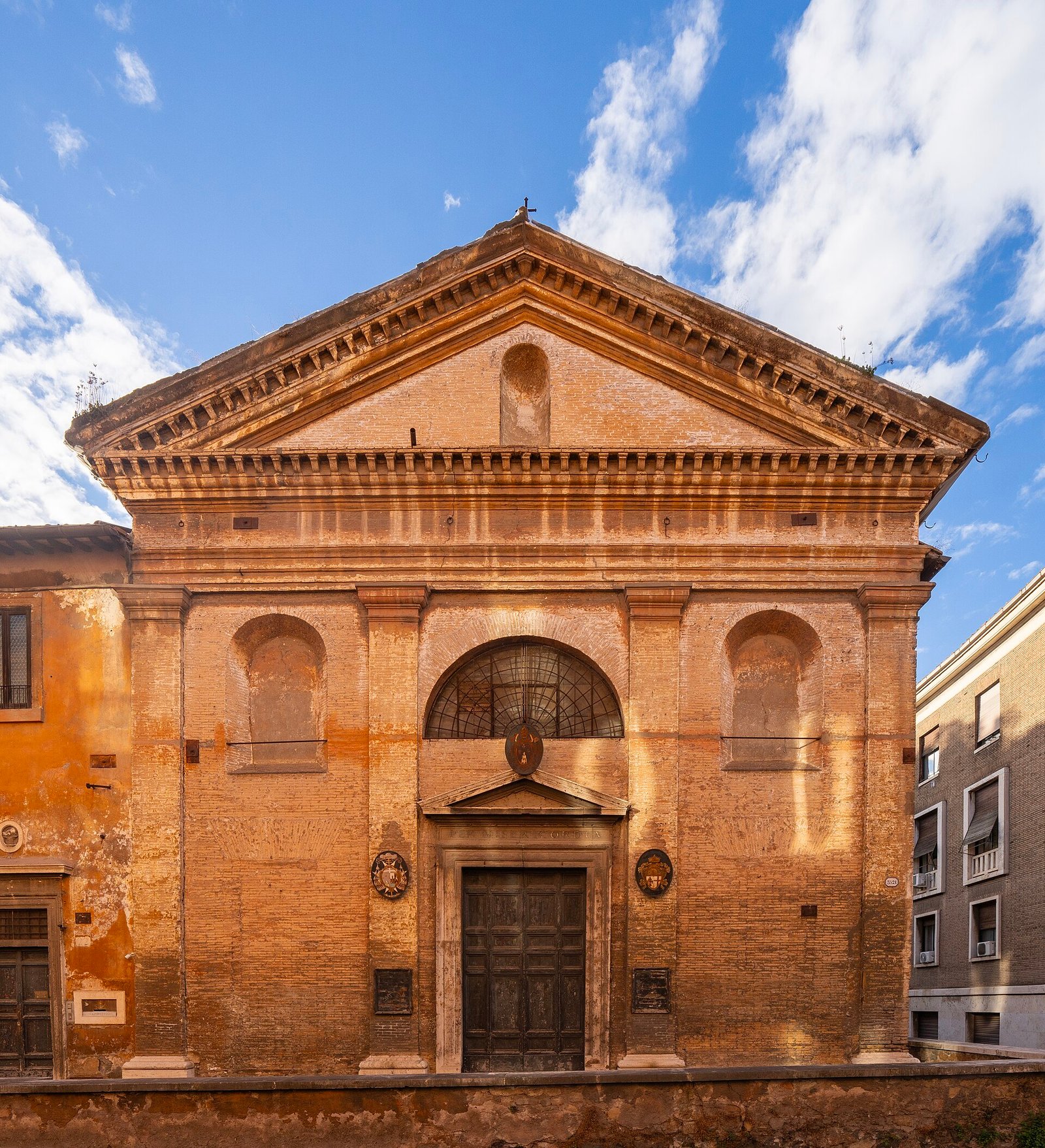
From the outside, the building practices reticence. The facade is in brick, marked by four Doric pilasters that support a tall pediment, and has neither marbles nor statues nor showy coats of arms. Anyone arriving from a day spent among the baroque facades of the center struggles to consider it a church: it looks rather like the seat of a guild, which is exactly what it is. Above the entrance runs the inscription "Per misericordia", two words that sum up the statute better than any treatise.
This sobriety is a choice and not a fallback. The confraternities that dealt with corporal works of mercy, burying the dead, visiting prisoners, avoided exterior magnificence on principle: the money had to be seen inside, where it served worship and the devotion of the members, not outside, where it would have served only the vanity of the company. It's the same reasoning we find in dozens of Italian confraternity oratories, and in Rome it's found again, for example, in the seats of the minor nations.
The Portal and What Passed Through It
Looking at that portal it's worth remembering that from there, for centuries, the company's processions went out at night and the stretchers came back in at dawn. The complex worked like a one-way machine: the comforters out, the bodies in. No threshold in Rome has seen a more constant and more silent traffic than this one, and none declares it less.
The Bell Tower and the Bells
The church's bell had a precise and terrible function: it announced to the city that an execution had been set. The death knell started from here and ran through the rione, and the Romans knew how to read it without need of proclamations. In a city that communicated by bells, for feast, for alarm, for the dead, this was the toll nobody wanted to hear, and which nevertheless punctually drew a crowd.
The Interior of the Church of San Giovanni Decollato: Nave, Ceiling and Altars
The interior is a single nave, with three altar niches per side, according to a dry, symmetrical Renaissance layout that can be read in a single glance. There are no deep side chapels, no transepts: the hall is a rectangle that leads the eye to the high altar, and the choice is consistent with the function, because a lay company needs a space where the members all see one another and all see the same thing.
The ceiling is the piece that surprises whoever enters. It's a coffered wooden ceiling painted in blue and gold, with the coffers occupied by crosses and Florentine lilies and, in the center, the head of the Baptist. I don't know many ceilings in Rome that declare with as much frankness where the person who paid comes from: the lily is the emblem of Florence, the cross is that of the Florentine people, and the severed head is the patron. In three symbols there is the complete identity of the body. Raising your eyes here is like reading an identity card.
The Side Altars and the Figures of Saints
The niches host paintings and frescoes by Tuscan artists active in Rome in the late 16th century, with figures of saints accompanying the worshipper along the nave. It's a second-tier decoration compared with the masterpieces of the oratory, and for that very reason interesting: it shows how the average workshop of Roman Mannerism worked when it had to supply a coherent devotional cycle at contained cost, without the intellectual acrobatics reserved for the major undertakings.
The Virgo Lactans and the Memory of the Earlier Church
Among the preserved works appears a fragment of a nursing Madonna, a Virgo lactans of late medieval taste, coming from the church that stood here before, that Santa Maria de Fovea that the Florentines had received in grant. It's the only piece of the whole that doesn't speak Mannerist, and it's worth a long stop: in the middle of a building that is a manifesto of 16th-century Tuscan culture, that fragment is the tenacious residue of another world, older and humbler, which the new company chose not to throw away. Confraternities kept venerated images even when they changed everything else, because they knew that popular devotion is attached to images, not to styles.
The Beheading of the Baptist by Giorgio Vasari
On the high altar, set between columns of green breccia, stands the Beheading of Saint John the Baptist by Giorgio Vasari, executed around the middle of the 16th century, the sources oscillating between 1551 and 1553. It's the work that gives the church its title and that governs the whole experience of whoever enters, because it's the first thing you see and the last you remember.
Vasari is a painter whom critics have often mistreated, preferring by far the Vasari who wrote the Lives. Here, though, he works for a company of which he is a member, in a church of his fellow countrymen, on a subject that is at once the patron and the program of the body. The result is measured, theatrical in the good sense of the term, built so that the scene works at a distance from the nave: the body of the Baptist, the gesture of the executioner, the basin. There is no complacency in the blood, and there could not be: before this altarpiece gathered men who the next day would accompany a flesh-and-blood person to the scaffold.
Why the Subject Is a Program, Not a Decoration
The iconographic choice must be read as a discourse addressed to the condemned. The Baptist is killed by decapitation, the same penalty reserved for nobles and, in many cases, for condemned Romans. He dies by the arbitrary will of a power that wants to keep faith with a rash promise. He has committed no crime. Whoever looked at this altarpiece in the hours preceding their own execution did not see a biblical episode: they saw themselves, promoted to companion of a saint. This was exactly the consoling mechanism the company put to work, and art was the main instrument with which it did so.
The Marble and the Frame
The columns of green breccia that frame the altarpiece deserve attention even on their own. The reuse of ancient marbles in Roman churches is the norm, and in an area like this, two steps from the Foro Boario and from the slopes of the Campidoglio, the material was not lacking. The contrast between the glossy coldness of the stone and the drama of the painted scene is calculated: the frame cools, the picture burns.
Jacopo Zucchi, Naldini, Pomarancio: The Other Paintings of the Church of San Giovanni Decollato
Besides the Vasari altarpiece, the church preserves a small sampling of Tuscan and Tuscan-style painting active in Rome in the second half of the 16th century. To Jacopo Zucchi, pupil and collaborator of Vasari, is owed the Nativity of the Baptist. To him or his circle is also traced the Visitation, which part of the bibliography assigns instead to Pomarancio. Giovanni Battista Naldini signs the canvas with Saint John the Evangelist immersed in boiling oil before the Porta Latina, an episode that in Roman tradition has its own dedicated church on the Appia.
I point out the discrepancy on the attributions because it's typical of this complex: the bibliography is not unanimous, the restorations have clarified some things and complicated others, and whoever gives you a perfectly clean list is simplifying. In a collection formed by gifts and bequests over the span of a century, attributional uncertainty is the rule.
Zucchi, a Florentine in Rome
Jacopo Zucchi is a figure worth knowing: a Florentine, trained alongside Vasari, he arrives in Rome in the retinue of Cardinal Ferdinando de' Medici and becomes in practice the official painter of the Tuscan colony in the city. Finding him here is not a surprise, it's a consequence. In the Rome of the late 16th century whoever was Florentine worked for the Florentines, and the Florentines had two reference addresses: San Giovanni dei Fiorentini, on the Tiber, for representation, and San Giovanni Decollato, under the Campidoglio, for conscience.
A Reading Tip for the Eye
If you're lucky enough to get in, don't treat these paintings as background. Look at them knowing that they were seen in conditions very different from ours: candles, not spotlights. Hooded men, not visitors. And the thought of the next day, not curiosity. Late 16th-century devotional painting is built to be effective in half-light and under emotional pressure, and in full light, with a calm mind, it risks seeming cold. It was not.
The Oratory of the Church of San Giovanni Decollato: The Construction Site of Roman Mannerism
The oratory opens to the left of the church facade and contains, without exaggeration, one of the most important decorative cycles of the Italian 16th century. Antonio Paolucci defined it as the most significant collective artistic manifestation of its era in Rome, and the judgment is not promotional hyperbole: between 1537 and 1553 in this hall Jacopino del Conte, Francesco Salviati, Battista Franco and Pirro Ligorio found themselves working side by side, under the coordination of Giorgio Vasari. A Tuscan-Roman Florentine, an extremely elegant Florentine, a Michelangelesque Venetian and an antiquarian Neapolitan: four different grammars in the same room.
You have to understand the historical moment to understand the importance of the construction site. The Sack of Rome of 1527 had dispersed the Raphaelesque school and interrupted the great season of papal projects. The city of the 1530s and 1540s is a city that rebuilds itself, artistically even before materially, and in which private and confraternity commissions count more than pontifical ones. It's in this vacuum that the oratory of San Giovanni Decollato becomes, for 15 years, the laboratory where it is defined what Roman painting will be after Raphael and after Michelangelo.
The Cycle of the Stories of the Baptist, Work by Work
The walls tell the life of Saint John the Baptist in a sequence of episodes. The Announcement to Zechariah is by Jacopino del Conte, placed around 1536. The Visitation is by Francesco Salviati, dated 1538. The Preaching of the Baptist is again by Jacopino, from the same 1538. The Baptism of Christ, also by Jacopino, is from about 1541. The Capture of the Baptist is owed to Battista Franco, around 1541. The Dance of Salome and the scene of the Beheading are traced to Pirro Ligorio. The Birth of the Baptist is by Salviati, from 1551. And the altarpiece with the Deposition from the Cross is by Jacopino del Conte, around 1551-1552.
Eight episodes, four hands, 15 years. The cycle is not homogeneous and didn't want to be: each artist worked in his own language, and the result is a sort of critical anthology painted on the walls. Whoever studies Roman Mannerism comes here the way a philologist goes to consult the best codex.
Why the Baptist, and Why These Scenes
The selection of episodes is not random. The cycle begins with an announcement inside the Temple, continues with a birth, a preaching, a baptism, and then plunges: capture, court dance, decapitation. It's the parabola of an innocent who passes from light to prison and from prison to death, told to men who were about to take exactly the same path. I don't know many painted cycles so brutally consistent with the function of the room they decorate.
Jacopino del Conte and the Deposition of the Oratory
Jacopino del Conte, a Florentine, is the protagonist of the oratory for the quantity of works and for quality. His Deposition from the Cross, altarpiece of the cycle, is unanimously considered the peak of the complex. Paolucci defines it as tragic and great, built on tones of dark on dark lit by acid and unreal colors, and traces that timbre back to the lesson of early Florentine Mannerism, that of Pontormo and Rosso Fiorentino.
It's worth explaining what "dark on dark with acid colors" means in concrete terms. It means a gloomy ground from which the figures emerge by minimal contrast of values, and on this ground flashes of cold pink, unripe green, sulfur yellow: colors that in nature are not found in human flesh or in common fabrics. It's a deliberately anti-naturalistic chromatic vocabulary, which declares to the worshipper that they are in front of an event outside the order of the world. Applied to a Deposition, that is to the dead body of Christ lowered from the cross, this vocabulary produces an image that does not console by softening but by elevation.
What the Condemned Man Saw
And it's here that the stylistic analysis meets social history. Before this altarpiece the comforters led the man destined for the scaffold. The message was explicit and needed no explaining: Christ's body too was deposed after a capital execution decided by a tribunal. He too was executed by sentence. He too was gathered by pitying hands and buried. Painting did what no sermon could do in a few hours: it placed the condemned man inside an image in which the condemned is God.
Jacopino, Portraitist of Himself and of Others
Jacopino del Conte was also one of the finest portraitists of mid-century Rome, and his skill with the individual face spills into the cycle: the figures crowding the scenes are not generic extras, they have precise physiognomies. Local tradition holds that in one of the frescoes appears the portrait of Michelangelo, enrolled in the company. It's one of those identifications handed down for centuries that nobody has ever been able to prove definitively, but which tell well how much the construction site was perceived as a family matter.
Francesco Salviati in the Oratory of the Church of San Giovanni Decollato
If Jacopino is the tragic one, Francesco Salviati is the elegant one. Also a Florentine, trained alongside Vasari, Salviati is the most intelligently decorative painter of his generation, the one who knows how to build a scene the way an architect builds a facade: axes, symmetries, correspondences, and above all this a virtuosity of drapery and poses that leaves the viewer admiring and slightly uneasy.
In the Visitation of 1538 he brings into play an imposing painted architecture and a very calibrated direction of gestures. In the Birth of the Baptist of 1551, returning to the same hall 13 years later, he offers a crowded and complex scene, with that watchful measure that Paolucci described as carefully balanced elegance. Between the two works lies the entire career of a man who in the meantime had worked in Florence, in Venice, in France, and who returned to Rome as an established master.
The Painted Shutter and the New World
To Salviati is also traced a window shutter painted with plant motifs, in which the literature has recognized plants from the recently discovered Americas. If the identification holds, we are in front of one of those minimal and precious testimonies of how the discovery of the American continent entered the European visual imagination even before political awareness: not with a manifesto, but with a leaf painted on the back of a shutter, in a Roman oratory frequented by Florentine merchants who had business dealings with those routes.
How to Look at a Salviati
The practical advice before a Salviati is to stop looking for emotion and start looking for construction. Identify the main vertical axis, follow the diagonal that leads from the foreground to the background, count the planes of depth. Salviati designs the viewer's eye the way an engineer designs a route, and when you notice the design the pleasure doubles. It's an intellectual pleasure, not a sentimental one, and there's nothing wrong with admitting it.
Pirro Ligorio and Battista Franco: The Other Two of the Oratory
Pirro Ligorio is, among the four, the least painter and the most interesting as a character. A Neapolitan, architect, archaeologist, tireless draftsman of antiquities, author of a monumental collection of studies on the ancient world that is at once a mine of information and a minefield of inventions, Ligorio is the man who will design Villa d'Este in Tivoli and the Casino of Pius IV in the Vatican. In the oratory he is credited with the Dance of Salome and the scene of the decapitation, and he brings what is his own: a theatrical and antiquarian taste, settings in the ancient style, an idea of background that counts as much as the figures.
Battista Franco, Venetian by birth and Michelangelesque by choice, signs instead the Capture of the Baptist around 1541. His Michelangelism is emphatic, muscular, and critics have often judged it severely. But in the economy of the cycle his presence is precious precisely because it represents the most literal path to the legacy of the Sistine, the one that many walked and few knew how to make personal.
Four Ways of Being Mannerist in the Same Room
The documentary value of the oratory lies exactly in this coexistence. In the same room, a few meters apart, you can compare: the gloomy drama of Jacopino, the constructive elegance of Salviati, the archaeological stage design of Ligorio, the muscularity of Franco. There is no other place in Rome, as far as I know, where the four main roads of Roman Mannerism can be read side by side at a glance. Whoever studies this period spends a morning here and comes out with clearer ideas than they would have gotten from a month of books.
The Role of Vasari, Director of the Construction Site
Above them all, the coordination of Vasari. He did not paint every scene, but he held the project together, called the artists, managed relations with the company. It's a role we would today call curatorial, and Vasari exercised it here even before the great Medici projects in Florence. Whoever loves art history as the history of the organization of work, and I love it that way, finds in this hall an exemplary case study: the first modern art historian staging, live, his own idea of a school.
The Cloister of the Church of San Giovanni Decollato and the Seven Trapdoors
Behind the oratory opens the cloister, and it's the point at which the visit changes register. Architecturally it's a porticoed courtyard of Tuscan Renaissance taste, with three sides of arcades on columns. Local tradition holds that some of those columns come from the Domus Aurea, a piece of news that has circulated for centuries and should be reported for what it is, namely a tradition. The chronology oscillates in the sources: some place the construction between the 1530s and the 1550s, others indicate 1600 and the pontificate of Clement VIII as the moment of completion and final arrangement. The two pieces of information don't exclude each other: the courtyard takes shape in the middle of the century and is regularized and assigned its funerary function around the Holy Year of 1600.
The funerary function is the reason this cloister looks like no other Roman cloister. In the floor open seven trapdoors closed by marble slabs. Through those openings the members lowered the bodies of the executed into the underground spaces. Six trapdoors were for men, one for women. On each runs the same inscription: DOMINE CVM VENERIS IVDICARE NOLI NOS CONDEMNARE, "Lord, when you come to judge, do not condemn us".
An Inscription to Read Twice
That sentence is the theological summary of the entire complex, and deserves to be weighed word by word. Whoever pronounces it does not ask for absolution from guilt: they ask not to be condemned a second time. The condemned has already been judged by a human tribunal and has already paid with his life. The prayer carved in the marble asks that the divine tribunal not repeat the sentence. It's an idea that in the 16th century had enormous force, because it answered the most concrete anguish of whoever climbed to the scaffold: not the fear of death, but the fear of dying damned.
And note the plural. Not "do not condemn him", but "do not condemn us". The members put themselves in the same sentence as the buried. It's the most radical gesture of the whole place, and it's engraved on a slab nobody looks at.
The Underground Cemetery
Beneath the cloister floor extend the spaces in which the bodies were laid. They were not individual tombs with name and headstone: they were common graves, the burial due to those who had neither a family willing to claim them nor money for a decent burial. From 1600 onward this was the ordinary fate of executed Romans who had reconciled with the Church. In the archconfraternity's registers, however, each of them has a name, a date, often a trade and the charge. The paradox of this place is all here: anonymous in the earth, named on paper.
The Silence of an Ordinary Courtyard
Whoever enters the cloister without knowing what they are walking on simply sees a beautiful 16th-century courtyard, shady, with a few plants and the muffled acoustics of the porticoes. This is exactly the reason I find the cloister the strongest point of the visit. There is no theatricality, no gloomy apparatus, no concession to a taste for the macabre: there is an orderly and civil courtyard, beneath which lie the bodies of several thousand people. The disproportion between the calm of the surface and what lies beneath is more eloquent than any staging.
The Camera Storica: The Museum of the Archconfraternity
The complex preserves a room called the Camera Storica that functions as the archconfraternity's museum. It's not a museum in the current sense: it's a room in which the sodality has gathered and kept the material instruments of its office, and the difference can be felt. There are no captions of a temporary exhibition and no thematic routes. There are objects that were used.
Among what the institutional sources document as preserved are: the basket meant to collect the head of the beheaded. The processional crucifix that was carried in front of the condemned along the route. The stretcher with which the members transported the bodies. The painted tavolette used in the comfort and in the processions. And the death sentence of Giordano Bruno, kept as a document. There is also a kneeler that the body's tradition links to Beatrice Cenci and her last night.
Why a Basket Impresses More Than a Scaffold
Whoever enters expects instruments of torture and finds instead household objects: a basket, a stretcher, a little bench for praying. It's the most instructive discovery of the place. The machinery of capital punishment in the Papal State didn't need fanciful irons. It needed an executioner, an ax or a noose, and then a charitable organization that gathered what remained. The objects of the Camera Storica all belong to the second half of this mechanism: they are the tools of those who came afterward.
A Museum That Doesn't Seek the Public
It must be said clearly: the Camera Storica is not freely accessible and visits depend on the archconfraternity's calendar and on any restoration work, which in recent years has affected the complex several times. Whoever cares must inquire directly. It's not a place you win with an online ticket: it's a place you obtain with a request.
The Tavolucci and the Tavolette of Consolation
Among the preserved objects, the most singular and least known are the painted tavolette that the comforters used in assisting the condemned. They are small-format images, painted on panel, often fitted with a handle, and they are one of the most refined instruments ever devised by Italian lay piety.
The mechanism was this: in the hours before the execution, and then along the whole route to the scaffold, the comforter held the tavoletta in front of the condemned man's eyes, as close as possible to his face, so as to completely occupy his field of vision. On the tavoletta was painted a sacred scene, very often a crucifixion, a deposition, a beheading of the Baptist, a martyrdom. The purpose was twofold and declared: to prevent the condemned from seeing the crowd, the scaffold and the executioner, and to replace those images with an image of salvation.
The Term "Tavolucci" and Its History
In the confraternity papers these objects appear under different names depending on the era and the compiler: tavolette, tavolucci, tavolette della consolazione. The diminutive already says the function: they are handy objects, designed to fit in one hand while the other supports a man walking toward death. Those who have seen them up close say that many have the back painted with a different scene, so that the comforter could change the image without putting the object down.
An Invention of Great Psychological Intelligence
I find that these objects deserve to be considered for what they are: one of the most sophisticated psychological instruments devised by the devotional culture of the early modern period. The principle, saturating the field of vision to govern the emotional state, anticipates by four centuries insights we find today in manuals of acute anxiety management. That it was devised by a company of 16th-century Florentine merchants, to accompany men to their death, is a fact that rarely enters art histories and that should.
The Link with the Oratory Frescoes
The tavolette also explain, retrospectively, the sense of the cycle painted in the oratory. The same strategy, showing the condemned an executed innocent, operates on two scales: monumental on the walls, portable in the hand of the comforter. It's the reason it makes no sense to visit this complex separating the history of art from the history of capital punishment. Here they are the same thing.
The Confortorio: What Happened on the Night Before the Execution
The heart of the archconfraternity's activity was called the confortorio, and the members assigned to it were called comforters. It was the most demanding and delicate part of the service, the one for which there existed manuals, written instructions and a practice codified down to the smallest details.
The procedure, reconstructible from the statutes and registers, followed a precise order. Once the sentence was communicated, the company was notified. The church bell rang. The members gathered, put on the black habit with the hood and went out in procession toward the prison, reciting prayers. There they spent the entire night with the condemned man, in the chapel or in the cell. They were not confessors, that was the priest's task, but they had the role, in a certain sense more difficult, of keeping the man in a condition to listen: speaking to him, praying with him, showing him the tavolette, gathering his last wishes, taking note of what he wanted his family to know.
The "Comforted Death"
The concept the company introduced and spread in Rome is that of the comforted death: the idea that nobody should die in despair, and that despair is the real danger, because it prevents repentance and therefore salvation. In a culture that literally believed in hell, this was a practical concern, not a metaphorical one. The whole apparatus, the vigils, the images, the prayers, the physical presence of a man beside you through the whole night, served a single technical purpose: to bring the condemned to the scaffold in a state of reconciliation.
It's not for me to judge that system with today's categories, and it would also be dishonest to do so. Two things stand out, though. The first is that this piety coexisted, without perceived contradiction, with the full acceptance of the death penalty: the comforters did not ask for the abolition of the scaffold, they asked that whoever climbed it should not climb it alone. The second is that, within that system, the members were the only ones with nothing to gain: unpaid, unrecognizable, unapplauded.
The Condemned Man's Will
One of the comforters' duties was collecting last wills. In the archive of the archconfraternity there are volumes entirely devoted to the testaments of the executed. They are extraordinary documents, and few people consult them. They contain debts to settle, restitutions to make, pardons to ask, and in many cases the few lines that an ordinary man, with no schooling, wanted to leave to the world. Anyone looking for the direct voice of Rome's working classes in the early modern period has in these papers one of the most direct sources that exist.
The Return
Once the sentence was carried out, the company collected the body, carried it on a stretcher to its own headquarters, celebrated the suffrages and proceeded to the burial in the pits of the cloister. The cycle ended where it had begun. This was the part of the service that the city saw nothing of and that the brothers did not talk about, and perhaps for this reason it is the part that impresses most today whoever comes in here for the first time.
The Privilege of Pardon: One Condemned Man Freed Every Year
In 1540 Pope Paul III granted the archconfraternity a privilege that was destined to become the most famous feature of its history: the right to free one man condemned to death every year, on the occasion of the feast of its patron. This is the famous right of pardon, and it needs to be explained precisely, because quite a lot of legend has built up around it.
The privilege was neither an amnesty nor a judicial power. It was a sovereign concession of the pope, delegated to a lay body, that allowed one person a year to be spared the death penalty. The choice of whom to free belonged to the company, following internal procedures. The sources report a draw made with white and black beans, a drawing system typical of Italian lay companies, in which the white bean meant life. The same sources place the ceremony on the day of the feast. Some indicate June 24, the Nativity of the Baptist, others August 29, the day of the Beheading. Both dates are feasts of the patron, and the discrepancy depends on the periods and on the sources. On this point caution is required.
What It Really Meant, That Day
Try to imagine the scene without rhetoric. A group of hooded men, in a room of this complex, draws beans from a container. On that draw depends on if a man shut up in prison will live or die. No lawyer, no review of the trial, no assessment of merit: chance. It is a mechanism that today we would find intolerable, and that in the 16th century instead appeared deeply just, because it took the decision away from human arbitrariness and entrusted it to what was then called Providence.
The Privilege as an Instrument of Prestige
The less edifying side has to be mentioned too: the right of pardon made the archconfraternity extraordinarily powerful. A lay body able to snatch a man from death once a year wielded an influence that no other Roman company possessed, and it is one of the reasons why membership in the brotherhood was sought after by cardinals, bankers and popes. Mercy, in Rome of the early modern period, was also political capital. Recognizing this takes nothing away from the value of what was done here. It only helps to understand why it could be done for almost four centuries without interruption.
Beatrice Cenci and the Church of San Giovanni Decollato
No Roman story is tied to this place as much as that of Beatrice Cenci. Born in 1577 into a family of the Roman aristocracy, daughter of Francesco Cenci, a violent man who was repeatedly in conflict with papal justice, Beatrice was involved, together with her stepmother Lucrezia Petroni and her brother Giacomo, in the killing of her father, which took place in 1598 in the family fortress at Petrella Salto, in Abruzzo. The trial that followed ended with a death sentence, and the execution took place on September 11, 1599 in front of Ponte Sant'Angelo, under the walls of Castel Sant'Angelo, in the presence of an enormous crowd.
Beatrice was beheaded. Lucrezia suffered the same fate. Giacomo was executed by a much more brutal procedure. Beatrice's body was then buried in San Pietro in Montorio, on the Janiculum. The archconfraternity of San Giovanni Decollato assisted the condemned according to its office, and in the Camera Storica is kept the kneeler that the tradition of the body associates with her last night.
Why This Story Became a Myth
The Cenci case ran through three centuries of European literature. Stendhal drew one of his Italian Chronicles from it, Shelley made a tragedy in verse of it, and the supposed portrait of Beatrice attributed to Guido Reni (an attribution widely disputed today and in all likelihood unfounded) has become one of the most reproduced images of Grand Tour Rome. Nathaniel Hawthorne spoke of it as the most enigmatic face he had ever seen.
The reason for the myth is simple. The story brings together all the elements that European romanticism would go looking for with greed: a young noblewoman, a monstrous father, a crime in a mountain castle, a trial, a public beheading and an inflexible pope, Clement VIII, of whom it was said that he had refused the pardon also so as not to give up the confiscation of the estate. How much of this is history and how much is a 19th-century construction is a matter that historians still debate, and the construction part is substantial.
How to Tell It Without Sliding into Melodrama
When the name of Beatrice Cenci comes up in this area, it is best to bring the conversation back to a single point: that this 22-year-old girl, before being a literary myth, was a person assisted by this company on one specific night of September 1599, and that of that night a documentary trace exists. That is the difference between legend and history, and this place, for once, lets you stand on the side of the second.
Giordano Bruno, Pietro Carnesecchi and the Registers of the Church of San Giovanni Decollato
On February 17, 1600, in Campo de' Fiori, Giordano Bruno was burned alive after a trial for heresy that lasted years. In that case too the archconfraternity took part, and in the archive of the brotherhood the record of the execution is kept, together with that of Pietro Carnesecchi, apostolic protonotary and leading figure of Italian evangelism, beheaded and then burned in 1567. In the Camera Storica is kept Bruno's death sentence.
These documents have a value that goes well beyond curiosity. In a good share of cases they are the only testimony independent of the judicial apparatus about what really happened in the last hours of condemned people, famous and not famous. The court recorded the sentence. The confraternity recorded the man. They are two different perspectives on the same fact, and the second is the one that is usually missing in European archives.
What the Registers Contain
The so-called journals of the executed note down, with bureaucratic regularity, the name of the condemned, the date, the place of execution, the crime, the way the condemned faced death, if he confessed, if he took communion, if he forgave, what he said. Taken together they make up a documentary series of exceptional breadth on capital punishment in the Papal State from the end of the 15th century to the 19th.
For the social historian it is a mine. From these papers one gets data on the geographic origin of the condemned, on their trades, their ages, and the crimes for which people really died in Rome. The answer, for anyone expecting who knows what atrocious crimes, is often disappointing and instructive: murder, yes, but also aggravated theft, banditry, counterfeiting, and crimes against authority.
The Bruno Case and the Refusal of Comfort
On Giordano Bruno the confraternity's documentation has a particular specific weight, because it records the condemned man's attitude in the final hours. The historiographical tradition recalls that Bruno refused the crucifix that was presented to him. Anyone who has understood how the confortorio worked grasps the scope of that gesture. It was not a theatrical provocation, it was the conscious refusal of the only device that that culture offered so as not to die in despair. Bruno chose to die outside the system that was offered to him, and the comforters, who embodied that system, took note of it.
Mastro Titta, the Popes' Executioner
This place cannot be talked about without naming the technical counterpart of the brothers' work. The most famous executioner in Roman history was called Giovanni Battista Bugatti, born in 1779 and died in 1869, and he has gone down in the city's memory as Mastro Titta, a Roman distortion of "maestro di giustizia" crossed with his baptismal name.
Bugatti entered service very young. His first execution is dated March 22, 1796, in Foligno, of Nicola Gentilucci, guilty of killing a priest and two friars. He stayed in office for almost 70 years, until 1864, and by his own counts he carried out about 514 sentences, a little over seven a year on average. At 85 he was retired by Pius IX with a pension of 30 scudi a month and replaced by Vincenzo Balducci.
"Mastro Titta Crosses the Bridge"
The most famous Roman saying tied to capital punishment comes from a practical rule. Bugatti lived in Borgo, on the right bank of the Tiber, and as a rule he was forbidden to cross the river toward the center. The exception came when he had to work. Then he crossed Ponte Sant'Angelo, and the Romans, seeing him, knew that that day there would be an execution. "Mastro Titta passa ponte" meant, in the city's vocabulary, that someone was about to die. It entered the sonnets of Giuseppe Gioachino Belli, who devoted verses of documentary rawness to the subject.
The Audience at Executions
It is worth recalling that Charles Dickens attended a Roman execution during his journey in Italy and left a description of it in his travel account. They are cold and pitiless pages, among the most effective ever written on the subject, in which the writer's attention goes less to the condemned man and more to the crowd, to its indifference, to the street vendors. It is a useful reminder against the temptation to romanticize: capital punishment in the early modern period was also an urban spectacle, with its audience and its trade.
Bugatti's scarlet cloak is kept in Rome, in the collections of the Museo Criminologico. I should point out that that museum has gone through long closures and reorganizations, so whoever wants to see it would do well to check if it is open before showing up.
Where Executions Were Carried Out in Rome
To understand the geography of the brothers' work you have to know where they went. The places of Roman capital executions between the 16th century and 1870 were several and changed over time, and each one has left a trace in the city's topography.
Piazza del Ponte, that is the open space in front of Ponte Sant'Angelo, was for centuries the place par excellence. Beatrice Cenci died there, and the largest crowds gathered there. Campo de' Fiori hosted executions for heresy, and the burning of Giordano Bruno is the best-known example. Today the 19th-century statue by Ettore Ferrari recalls the event amid the market stalls. Piazza del Popolo became in the early modern period another recurring stage, above all for mass executions. Via dei Cerchi too, along the Circus Maximus, appears among the documented places.
A City That Brought Executions into the Square
The distribution is not random. People died where there was room for the crowd and where the scene was visible, that is in the squares people passed through and on the bridges. Public execution had a declaredly pedagogical function, and topography served that function. Walking through the center of Rome today you pass through these places dozens of times without realizing it. They have become market squares, aperitivo squares, tourist squares. I don't find that a bad thing, but I do find it worth knowing.
The Route from Prison to Scaffold
The route that the condemned took, from the prisons of Corte Savella first and Via Giulia later, to the place of execution, was itself part of the rite. The brothers accompanied them, with the crucifix in front and the tablets held at face level, and the population crowded along the route. Anyone who knows these streets can still walk them again. They are the same, and the distances are short. Rome, in its ancient core, is a small city, and this makes it, for those who know how to read, extraordinarily eloquent.
The Pit of the Executed and Those Left Outside the Cloister
Not all the executed ended up in the pits of the cloister. Burial in consecrated ground, and in a place guarded by a devout company, was for those who had reconciled with the Church, for those who had accepted comfort, had confessed, had received the sacraments. Those who refused, and in particular those who died as unrepentant heretics or excommunicates, stayed excluded from it.
For them the destination was different: common graves outside the consecrated circuit, and in particular the area near the Muro Torto, the stretch of Aurelian wall leaning under the Pincio that Roman popular memory has for centuries associated with the burial of the excluded: suicides, excommunicates, prostitutes, executed men who had not reconciled. Around that place a flourishing of legends has layered up, from devils to ghosts, which counts as an anthropological clue more than as historical information.
Two Cemeteries, Two Theologies
The contrast between the cloister and the Muro Torto is the topographical translation of a doctrine. On one side an orderly courtyard, with inscribed slabs and prayers of suffrage, under the custody of a company that every year commemorated its buried. On the other an anonymous embankment at the edge of the walls. The physical distance between the two places is about three kilometers. The conceptual distance is the one between hope and exclusion.
A Fact That Straightens Out Perspectives
This explains why the comforters' work was not perceived as a merely consoling gesture, but as a decisive matter. Obtaining the condemned man's repentance meant, in very concrete terms, changing his burial and, in the logic of the time, his eternal destiny. No brother, leaving this church at night, thought he was going to keep someone company. He thought he was going to gamble for a soul, with a few hours at his disposal.
The Archconfraternity's Archive and Written Memory
The part of the complex that no visitor will ever see is also the one that has changed the most the way we know early modern Rome today. The historical archive of the confraternity was deposited with the Archivio di Stato di Roma on November 23, 1891, after negotiations that were not simple between the brotherhood and the authorities of the Kingdom of Italy. The company wanted to set limits on consultation and publication, the state administration wanted to apply the ordinary regulation, and in the end the latter prevailed.
The collection includes 19 folders, 29 volumes titled "giustizie", seven volumes of testaments of the executed and further miscellaneous material. The extreme dates run from 1484 to the second half of the 19th century, with documented gaps, between 1522 and 1555, between 1594 and 1598, and in other minor periods. There is also an alphabetical index of the executed for the years 1499-1784, a valuable tool for anyone looking for a specific name.
Why Those Gaps Matter
Archival voids are not neutral. The hole between 1522 and 1555 runs through the Sack of Rome of 1527, an event that destroyed or scattered archives in quantity in Rome. The one between 1594 and 1598 comes immediately before the years of the most famous executions, those of the Cenci and of Bruno. Anyone who works on these papers learns quickly that the absence of a register is as much a historical fact as its presence, and that the complete stories one reads in certain popularizations are often built precisely on top of the voids.
A Heritage Still to Be Read
Despite its recognized importance, this documentation remains less studied than it deserves. The research carried out has concerned mostly the famous cases, while the mass of anonymous condemned (artisans, peasants who had moved to the city, bandits of the Roman countryside, soldiers) still awaits systematic work. Anyone looking for a thesis topic in early modern history will find here, and in the study room of the Archivio di Stato, material for several years of work.
Michelangelo, Vasari and the Illustrious Brothers
The list of members of the brotherhood over the centuries gives a surprising snapshot of Roman society. Michelangelo Buonarroti and Giorgio Vasari, as has been said. Cardinal Roberto Bellarmino, a leading theologian of the Counter-Reformation. Three popes of Tuscan family: Clement VIII Aldobrandini, Urban VIII Barberini, Clement XII Corsini. And then dozens of cardinals, bankers, notaries, merchants.
The membership of figures of this level in a company that dealt with people condemned to death tells us something important about the culture of the time. In Rome of the early modern period, charity toward the executed was not a niche of specialists in horror. It was one of the most prestigious works of mercy, because it touched the point where temporal power showed its hardest face and the Church could show its most clement. Joining here meant placing oneself at that point.
Michelangelo as a Brother
On Michelangelo, a Florentine in Rome from 1534 until his death in 1564, the membership is consistent with everything we know of his last 30 years: his frequenting of circles of spiritual reform, the relationship with Vittoria Colonna, the poems on death and judgment, the Christs and Pietàs that he sculpted for himself and not for a patron. The man who painted the Last Judgment enrolled in the company that asked God not to condemn the executed is not a contradiction. It is almost an explanation.
Vasari, Brother and Director
Vasari was at once a member, coordinator of the oratory's building site and author of the church's main altarpiece. His role here is the most complete one can imagine: indirect patron, organizer, executor. Anyone who knows the Lives knows how much Vasari cared about the idea that artists made up a community with a history and a dignity. In this complex you see that community at work on a theme that concerned everyone, artists and merchants, cardinals and condemned.
Visiting the Church of San Giovanni Decollato: What You Really Need to Know
I come to the point that matters most to whoever reads a page like this: can you go in? The honest answer is: rarely, and never by chance. The complex belongs to the archconfraternity, it is not a museum with opening hours, and it stays closed for most of the year. In recent years there have also been restoration works that have meant prolonged closures.
The recurring occasions for opening are tied to the feasts of the patron, June 24, the Nativity of Saint John the Baptist, and August 29, the Beheading, and to guided visits arranged with the archconfraternity or organized as part of city initiatives devoted to heritage. I don't give hours or rates because there is no stable calendar to give, and be wary of anyone who gives you one with confidence: the information published here and there online goes out of date within a season. The right way to proceed is to contact the archconfraternity directly, which has its own contact details, and ask about the period you are interested in.
How to Organize Yourself If You Really Care
My practical advice, matured in the field, is this. First: put the two feast dates in your calendar and check a couple of weeks ahead. Second: keep an eye on the city programs that open places normally closed, because San Giovanni Decollato appears in them fairly often and the reservations sell out in a few hours. Third: if you are part of a cultural group, an association or a school, try the route of the formal request, which is the one through which historically more doors have opened in this city.
What to Do If You Find It Closed
Finding it closed is the most likely outcome, and it is not a wasted day. You can still walk Via di San Giovanni Decollato. You can look at the facade. The inscription "Per misericordia" can be read from the street. And above all, everything around it (the Foro Boario, the Velabro, the Capitoline Hill, the cliff) can be visited freely and tells half the story. Let's say that this is one of those pages that is as useful to whoever will go in as to whoever will walk past knowing what is next to them.
Accessibility and Good Manners
When visits are held, they take place in historic spaces not equipped like a modern museum: thresholds, steps, original floors. Anyone with mobility needs would do well to ask in advance. And a recommendation I shouldn't even have to make: here you are a guest of a body that looks after a cemetery. Low voice, no selfies on top of the cloister slabs, respect for the instructions of whoever is leading. It is not prudishness, it is manners.
What to See Around the Church of San Giovanni Decollato
The advantage of this address is that it sits at the point of greatest archaeological and medieval concentration in the low part of the city. Within a radius of 300 meters there are more centuries than in entire neighborhoods.
Going down toward the river you enter the area of the Foro Boario, with the two best-preserved Republican temples in Rome (the so-called Temple of Portunus, rectangular, and the round Temple of Hercules Victor) and with the church of Santa Maria in Cosmedin, whose portico houses the Mouth of Truth. A little farther on opens the Arch of Janus, a massive late antique four-faced arch, and next to it the church of San Giorgio in Velabro with the Arch of the Argentarii, erected by the bankers and the cattle merchants in honor of Septimius Severus. On the lungotevere, the Casa dei Crescenzi keeps one of the most curious medieval facades in Europe, studded with reused ancient fragments.
Uphill: The Capitoline Hill
Going up, in a few minutes you reach the square of the Capitoline Hill designed by Michelangelo and the Capitoline Museums, the oldest public museum in the world. The best route is not the cordonata, which everyone takes, but the side climb that runs along the cliff. You pass under the flank of the hill, you see the large tuff blocks of the ancient substructures and you arrive in the square from the right side. It is also the best way to understand the position of the church, tucked under the hill.
Toward the Theater of Marcellus and the Island
In the opposite direction, the Theater of Marcellus with its arcades topped by the Orsini palace leads into the area of the Portico d'Ottavia and the Ghetto. From there you reach the Tiber Island in a few minutes. It is an itinerary I recommend often because it lines up, in under a kilometer, the ancient, the medieval, the Renaissance and the Rome of the communities: the Florentine nation of San Giovanni Decollato, the Jewish community of the Ghetto, the hospital of the Island.
A Half-Day Itinerary That Works
If I had to build a morning around this page, I would do it like this: start from Piazza Bocca della Verità with the two temples. Arch of Janus and San Giorgio in Velabro. Back up Via di San Giovanni Decollato with a stop in front of the facade and at Sant'Eligio de' Ferrari. Climb to the Campidoglio from the flank of the cliff. Look out over the Roman Forum from the terrace of the Tabularium. And finish at the Capitoline Museums. Four full hours, a single ticket to buy, and a common thread, the relationship between power and punishment, that holds everything together.
Frequently Asked Questions about the Church of San Giovanni Decollato
Can you visit the Church of San Giovanni Decollato every day?
No. The complex belongs to the archconfraternity and has no ordinary opening hours. The recurring occasions are tied to the feasts of the patron, June 24 and August 29, and to guided visits arranged with the body or included in city programs. It is always best to check in advance, also because the complex has been affected by restoration works.
Why is it called the church of the damned?
Because "damned" is to be understood in the sense of condemned, from the Latin damnati: the company that assisted the people condemned to death by the Papal State operated here. The nickname is popular and journalistic, not official, and it risks suggesting the opposite of what was done here, that is offering the condemned the possibility of reconciliation.
Who painted the frescoes of the oratory?
The cycle with the Stories of the Baptist is due to Jacopino del Conte, Francesco Salviati, Battista Franco and Pirro Ligorio, with the coordination of Giorgio Vasari, between 1537 and about 1553. The altarpiece of the oratory, with the Deposition, is by Jacopino del Conte and is considered the masterpiece of the whole.
What is kept in the Camera Storica?
Objects tied to the activity of the archconfraternity: the basket for the head of the beheaded, the processional crucifix, the stretcher for transporting bodies, the painted tablets used in the comforting, the death sentence of Giordano Bruno and a kneeler that the body's tradition links to Beatrice Cenci.
Is it true that there are burials under the cloister?
Yes. In the floor of the cloister there are seven trapdoors closed by marble slabs, six for men and one for women, through which the bodies of the executed were lowered into the underground rooms. Each slab bears the inscription DOMINE CVM VENERIS IVDICARE NOLI NOS CONDEMNARE.
What was the archconfraternity's right of pardon?
A privilege granted by Paul III in 1540 that allowed the company to free one man condemned to death every year on the occasion of the feast of the patron. The choice was made following internal procedures, and the sources report a draw with white and black beans.
Where is Beatrice Cenci buried?
The sources indicate her as buried in San Pietro in Montorio, on the Janiculum. She was executed on September 11, 1599 in front of Ponte Sant'Angelo, together with her stepmother Lucrezia Petroni and her brother Giacomo, and assisted by the comforters of the archconfraternity.
How much time does the visit take?
When opening is possible, church, oratory and cloister can be visited in about an hour, an hour and a half if the guide goes into detail on the painted cycle. It is a small and dense complex: the time is for the explanation, not for the square meters.
Is it suitable for children?
It depends on how you tell it. The place has nothing sensationalist about it and does not display bloody images, but the theme is the death penalty and the burial of the executed. With high school students it can become a lesson in history and civic education that is hard to forget. With small children it is best to concentrate on the frescoes and the cloister.
Does the archconfraternity still exist?
Yes. The Arciconfraternita di San Giovanni Battista Decollato della Nazione Fiorentina exists as a body and looks after the church, oratory, cloister, library and Camera Storica. The historical archive, instead, has been deposited since 1891 with the Archivio di Stato di Roma.
A Curiosity about the Church of San Giovanni Decollato - Church of the Damned
The curiosity I most like to tell is about the ceiling. Raising your eyes in the nave you meet a coffered ceiling painted in blue and gold, and in the coffers two symbols alternate: the cross of the Florentine people and the lily of Florence. At the center, the severed head of the Baptist. It is not a generic decoration. It is a signature. In a city where every church declares its patron through papal and cardinalitial coats of arms (the bees of the Barberini, the stars of the Aldobrandini, the mounts of the Chigi), here the patron is not a man, it is a foreign community, and it says so through the emblems of a city located 300 kilometers away.
The detail becomes more interesting if you think about who looked at that ceiling. In the nave gathered the Florentines of Rome: bankers who kept the popes' accounts, silk merchants, notaries, goldsmiths. Above them, the lily of the city they had left. In front of them, on the altar, the beheading of the saint whom the Florentines had chosen as patron since the Middle Ages and whose image was stamped on the gold coins of the Republic. This church is, among other things, a piece of Florence wedged under the Campidoglio, and the ceiling is the part that declares it most openly.
Then there is an angle that I consider the real core of the curiosity. The gold florin, the most reliable coin in Europe for two centuries, bore stamped on one side the lily and on the other precisely Saint John the Baptist. The same pair of images that is found on this ceiling was, in the same decades, in the pockets of half a continent. The merchants who gathered here knew it better than anyone else: it was their trade. And they had carried it above the heads of the condemned they assisted. I don't know many overlaps more eloquent between devotion, civic identity and money than the one you read, in silence, by looking up in this nave.
Something Nobody Tells You about the Church of San Giovanni Decollato - Church of the Damned
What almost nobody says is that this complex is not only a place of memory of capital punishment. It is the seat in which the most important European archive on the subject was born, in effect. The guides talk about the cloister and the trapdoors, which strike the imagination. Much less often do they say that for almost four centuries, every time someone was executed in Rome, a brother came back here and wrote. Name, date, place, crime, behavior in the last hours. Line after line, register after register.
The result is a documentary series with extreme dates from 1484 to the 19th century, organized in 29 volumes of "giustizie", seven volumes of testaments of the condemned and an alphabetical index of the executed covering the years from 1499 to 1784. In 1891 all of this was deposited with the Archivio di Stato di Roma. It means that any scholar, today, can search by name for a person executed in Rome in the 16th century and find them. It is a possibility that for most of Europe simply does not exist, because elsewhere the papers have been scattered, and that exists here because a company of laymen judged that each of those people deserved at least to be recorded.
And there is a second level, told even less. Those registers do not note down only the personal and judicial data. They note the demeanor. If the condemned wept or kept silent, if he forgave, if he refused the crucifix, what he said to the crowd. They are, in essence, thousands of micro-biographies of the last hours of people whom no other source would ever have named: day laborers, errand boys, soldiers, bandits of the Roman countryside. In the history of European written culture, the poor appear almost always as tax numbers or as an anonymous mass. Here they appear with a name and a sentence. That this happened in order to assist them at death is a very harsh contradiction to handle, and precisely for this reason it is worth handling it instead of ignoring it.
The Advice I Give You for Visiting the Church of San Giovanni Decollato - Church of the Damned
The first piece of advice is practical and allows no shortcuts: don't come here hoping for a stroke of luck. The complex is closed for much of the year and belongs to a body, not to a museum circuit. Note down the two dates of the patron's feasts, June 24 and August 29, and check a few weeks ahead by contacting the archconfraternity directly. Keep an eye on the city programs that open to the public places normally inaccessible, because this address appears in them with a certain regularity and the places sell out in a few hours. If you belong to a cultural group or a school, the formal request is the route that has historically worked best.
The second piece of advice concerns the order of the visit, and on this I am categorical: don't go into the oratory first. If you start with the frescoes, your brain switches to art history mode, and from that moment on the cloister becomes a curious appendix. Do the opposite. Go into the church, look at Vasari's altarpiece and the ceiling, then go out into the cloister and stay there in silence for at least five minutes, reading the inscription on the slabs. Only after that go into the oratory. In this order, Jacopino del Conte's Deposition stops being a masterpiece of Mannerism and becomes what it always was: the image that was shown to a man the night before his execution.
The third piece of advice is of a different kind. Take a quarter of an hour, before or after, for the stretch of road that links this address to the Campidoglio passing under the cliff. Walk it slowly. It is the best way to understand the physical position of the complex, squeezed under the hill of the city's power, a step from the place that tradition identifies with the Tarpeian Rock, and to realize that in Rome topography is never neutral. Whoever chose to put the company of the condemned here, be it by chance or because a building was available, placed mercy exactly under justice. And if you really find it closed, as is likely, this walk remains anyway: it brings you home half the story, and that is not little.
Another Well-Known Fact, Yet Rarely Cited
The fact is this: in 1540 Pope Paul III granted the archconfraternity the privilege of freeing one man condemned to death every year. It is a piece of information that appears in any page on the complex, and in this sense it is well known. Almost nobody, however, dwells on what that privilege meant from the institutional point of view, and that is where the interest lies.
A State (because the Papal State was a State in every respect, with courts, prisons and an executioner) delegated to a private association of laymen the power to annul a capital sentence. Not to ask for its review, not to file a petition: to annul it. Once a year, the will of a confraternity of merchants prevailed over that of a court. In terms of the theory of the State it is a remarkable anomaly, and it would be unthinkable in any contemporary legal system. In the logic of the early modern period, instead, it was perfectly coherent: sovereignty was not yet a monopoly, the intermediate bodies (guilds, confraternities, nations, universities) held real shares of public power, and pardon was by definition a sovereign act that the sovereign could delegate to whomever he wanted.
Then there is the detail of the draw, and here the well-known fact becomes frankly disconcerting. The sources report that the choice of the pardoned man was made by drawing, with white and black beans: the white bean meant life. No assessment of merit, no re-examination of the evidence, no consideration of repentance. Chance. To us it appears arbitrary to the point of cruelty. To contemporaries it was the opposite, because it took the decision away from the fallible and partial judgment of men and entrusted it to what they called Providence. I find it worth keeping this scene in mind (a group of hooded men drawing a bean, and a life depending on that bean) every time one is tempted to believe that the past reasoned like us in a different wardrobe.
The Right Photo to Take at the Church of San Giovanni Decollato - Church of the Damned
I start with the photo that almost everyone tries to take and that almost always doesn't work: the frontal facade. Via di San Giovanni Decollato is narrow, there is no sufficient setback, and the result is a flattened brick wall with no depth. If you want the facade, the only decent way is to stand three-quarters on from the side that climbs toward the Campidoglio, with the street running off diagonally in the frame. That way the context reads, the wall of the cliff on the right, the facade on the left, the lane that goes down toward the river, and the photograph tells something instead of just documenting.
The truly right photo, though, when opening allows it, is another one, and it is in the cloister. Not the portico, not the columns: the floor. A marble slab with the inscription DOMINE CVM VENERIS IVDICARE NOLI NOS CONDEMNARE, shot from above, with raking light coming in under the arcades and making the carved letters stand out. It is a very simple image, with no need for effects, and it contains the whole meaning of the place in one line of Latin. My technical recommendation, if needed, is to frame tight but leaving a bit of floor around: the isolated slab loses its nature as a trapdoor, and the trapdoor is the point.
On the oratory, instead, an honest warning. The frescoes are very difficult to photograph well: poor light, large surfaces, reflections, and often, rightly, restrictions on shooting. Don't be stubborn. The room works with the eyes, not with the lens, and professional reproductions of the cycle already exist and are better than any shot you could bring home. My advice is to give up from the start and use those minutes to look at Jacopino del Conte's Deposition up close and then from far away, which is the only thing no photograph will ever give back to you. And whatever shot you take in the cloister, do it without posing on top of the slabs: under those stones there are people, and there are rules of common sense that don't need to be written on a sign.
Some Important Events That Happened Here in History
The first event is the founding itself: on May 8, 1488 a group of Florentines living in Rome gave life to the company. Innocent VIII approved its establishment (the sources place the recognition between 1488 and 1490) and assigned to it the already existing small church of Santa Maria de Fovea. From that date begins the documentary recording of Roman executions, which the archive traces back to 1484 and which would continue, with gaps, until the 19th century. In 1504 the building site of the new church opened, and it dragged on for much of the century. In 1534 a project by Battista da Sangallo, called il Gobbo, defined its arrangement.
The second event is the privilege of pardon, granted by Paul III in 1540. It is the moment in which the company passes from a devotional body to a subject endowed with an effective public power, and begins to attract the membership of cardinals and popes.
The third is the oratory's building site, between 1537 and about 1553: Jacopino del Conte, Francesco Salviati, Battista Franco and Pirro Ligorio work in the same space under the coordination of Giorgio Vasari, and produce what critics consider the most important collective artistic manifestation of mid-16th-century Rome. In the same years Vasari paints for the main altar the Beheading of the Baptist, placed between 1551 and 1553.
The fourth and fifth events are two executions that marked European memory. On September 11, 1599 Beatrice Cenci is executed in front of Ponte Sant'Angelo together with her stepmother and her brother. On February 17, 1600 Giordano Bruno is burned in Campo de' Fiori. In both cases the company carries out its office, and in both cases the documentation kept by the body has remained a reference source. Of Bruno's sentence a copy is kept in the Camera Storica, and of the record of his execution and of that of Pietro Carnesecchi, executed in 1567, the papers remain in the archive.
The sixth event is the arrangement of the cloister and its burials around 1600, under Clement VIII, with the seven marble trapdoors meant to receive the bodies. The seventh is the deposit of the historical archive with the Archivio di Stato di Roma on November 23, 1891, an act that closes the era of the Papal State also from the documentary point of view and opens that of historical study. In between, the restorations of 1727 and 1888 and, in recent times, new campaigns of work on the complex.
Who Has Passed through the Church of San Giovanni Decollato - Church of the Damned
First of all, artists passed through here. Giorgio Vasari, who was a brother, coordinator of the oratory's building site and author of the main altarpiece. Jacopino del Conte, who left here the Deposition considered the peak of the whole, and Francesco Salviati, who came back after 13 years as an established master. Battista Franco, a Venetian follower of Michelangelo, and Pirro Ligorio, the antiquarian architect who would later design Villa d'Este at Tivoli. And, according to all the sources, Michelangelo Buonarroti, enrolled in the company: local tradition even holds that his portrait appears in one of the frescoes of the oratory, an identification never proven but handed down for centuries.
The powerful passed through. Three popes of Tuscan family, Clement VIII, Urban VIII, Clement XII, figure among the members, together with Cardinal Roberto Bellarmino and a remarkable number of purple-robed prelates, bankers and notaries. The company was, for three centuries, one of the places in which the Roman ruling class of Florentine origin recognized itself, and membership in a body that dealt with people condemned to death was considered as honorable as, and more than, commissioning a chapel.
And then they passed through, the ones who are the reason this place exists. Thousands of people whose names the registers keep and whom no other source would ever have named: artisans, peasants who had moved to the city, soldiers, bandits of the Roman countryside, counterfeiters, thieves, murderers, heretics. Among them, some names that history has held on to (Beatrice Cenci, 22 years old, executed in 1599 and buried at San Pietro in Montorio. Pietro Carnesecchi, apostolic protonotary, in 1567. Giordano Bruno, in 1600) and thousands of others that history has forgotten but that here, in the papers, remain legible with name, trade and date.
I add a figure who passed through here in a different sense: Giovanni Battista Bugatti, Mastro Titta, executor of justice from 1796 to 1864. He was not a brother and did not share the company's office. He was, literally, its operational counterpart. For almost 70 years the comforters of this complex and that man found themselves on the same scaffold, with opposite and complementary tasks. Anyone who really wants to understand the machine of capital punishment in the Papal State has to keep both together, the executioner and the comforters, without staging the one as a monster and the others as saints. They were two functions of the same city.
This is, in our judgment, the most difficult and most necessary address in Rome. Difficult because it is almost always closed and because the theme allows no brilliant shortcuts. Necessary because in no other place in the city do the absolute masterpiece and the memory of the death penalty live together in the same courtyard, three meters apart. If you happen to go in, stay in silence in the cloister before going to see the frescoes: you will understand why they were painted. And if you find it closed, stop anyway in front of the brick facade, read those two words above the entrance, "Per misericordia", and consider that they were written there to be read by whoever passed by chance. Like you.
Article written by the editorial team of TourLeaderPro, contact them for Private/Corporate/V.I.P. Tours and Experiences.
Planning a trip to Rome? The English guides to visit the city are on ItalyPlanner.com.