Arch of Septimius Severus
In short. The Arch of Septimius Severus closes off the Roman Forum on the Capitoline side, at the northwest corner of the forum square.
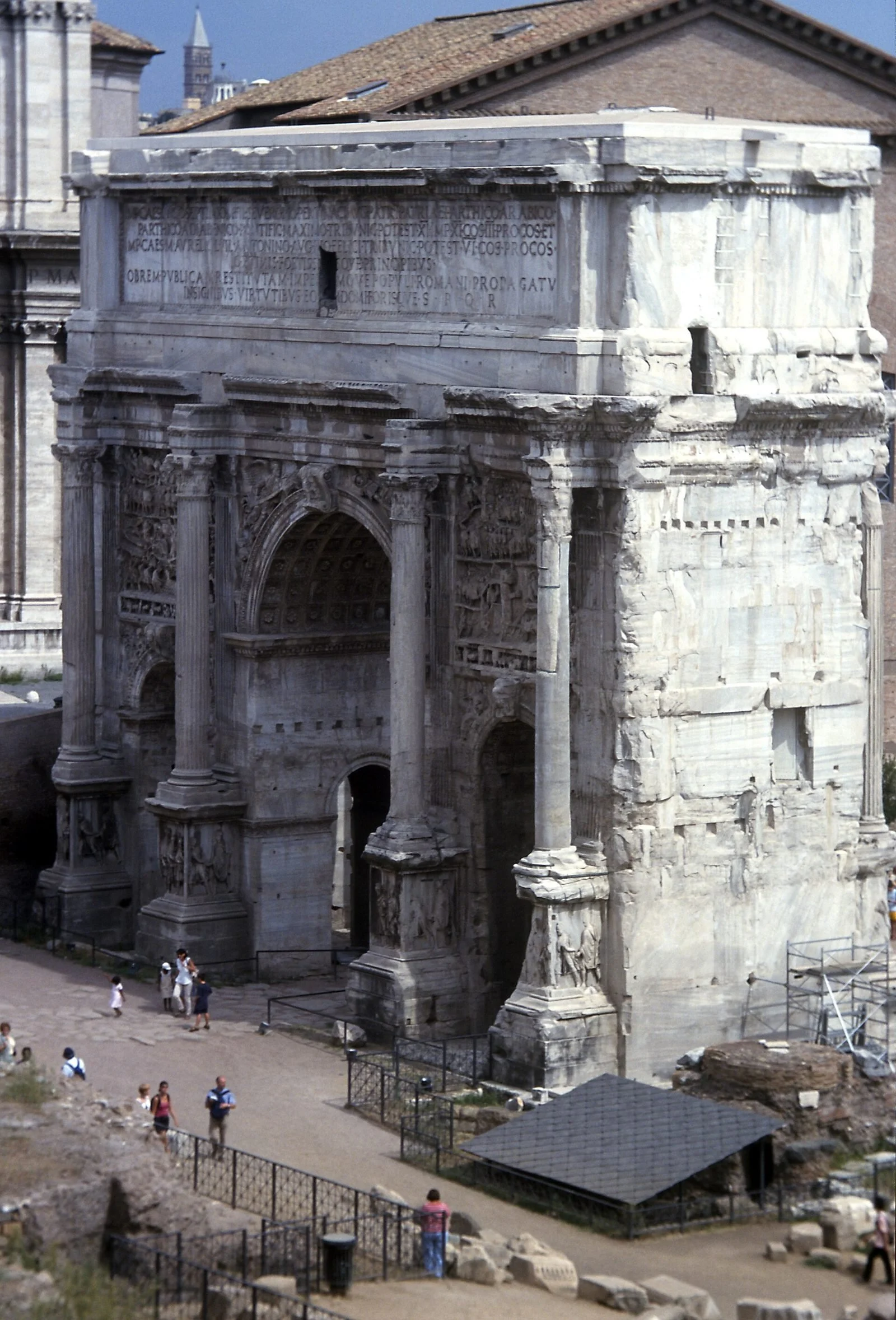
The Arch of Septimius Severus closes off the Roman Forum on the Capitoline side, at the northwest corner of the forum square. It was dedicated in AD 203 by the Senate and People of Rome to Septimius Severus and his sons Caracalla and Geta, for the victories over the Parthians won in two campaigns that ended in 195 and between 197 and 198. It is an arch with three openings, faced in marble, with four free-standing columns on each facade. In 211 Caracalla had his brother Geta killed and decreed his damnatio memoriae: the name was scraped off the attic inscription and replaced with a generic formula. The erasure is still visible, and so are the holes where the gilded bronze letters were fixed. Here you'll find what is carved on the arch, what the inscription says, how the erasure reads today, what happened to the monument in the Middle Ages and how to visit it now, with tickets and hours checked on the website of the Colosseum Archaeological Park.
Where the Arch of Septimius Severus is and how to get there
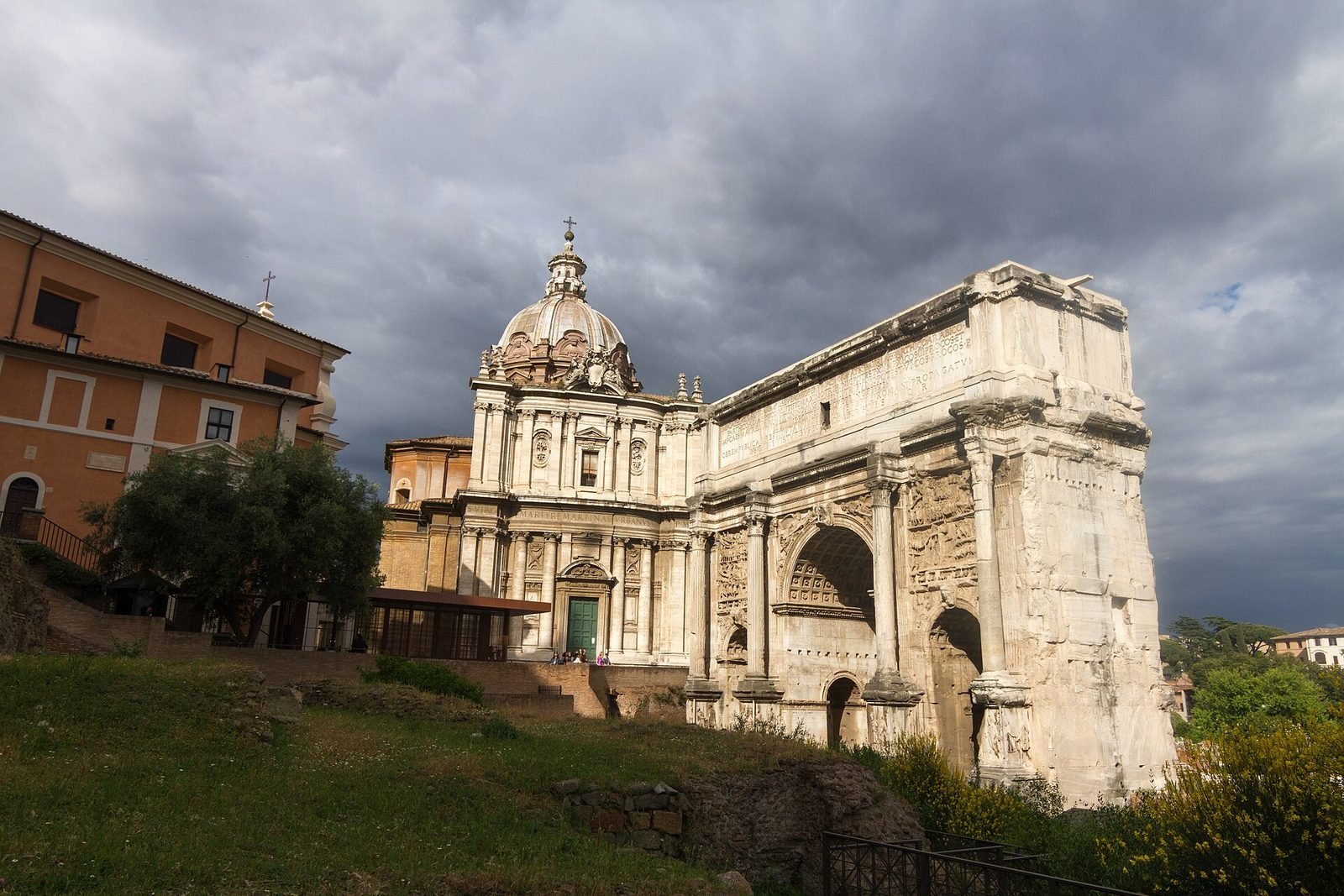
The arch stands at the northwest end of the square of the Roman Forum, set against the flank of the Capitoline Hill, between the Curia and the area of the Rostra. Anyone looking at the Forum from the top of the Capitoline Hill has it right below. Anyone walking Via Sacra from the Colosseum finds it at the end, as the last backdrop before the climb to the Tabularium.
The entrances to the archaeological area
To get under the arch you have to enter the archaeological area of the Roman Forum and Palatine Hill, which is fenced and ticketed. The entrances indicated by the Park are Largo della Salara Vecchia on Via dei Fori Imperiali, Via della Salara Vecchia toward Via del Tulliano, the Arch of Titus and Via di San Gregorio, which mainly serves the Palatine Hill. The gate on Via della Salara Vecchia, near the Mamertine Prison, leads first of all to the arch zone. The active entrances change with the season and with construction work. Check the entrances page on the official website the day before.
By metro and surface transport
The most convenient stop is Colosseo, on line B, from which you walk up Via dei Fori Imperiali for five or six minutes to Largo della Salara Vecchia. From Termini take line B toward Laurentina and get off at the second stop. The Cavour stop, also on line B, leaves you inside the Monti district and lets you go down to the Forums along Via Cavour and the Salita dei Borgia, a longer and much more beautiful route.
On the surface the hub is Piazza Venezia. From there you walk along Via dei Fori Imperiali past the Forum of Trajan and Trajan's Column. On the other side of the same street are the Markets of Trajan with the Museum of the Imperial Forums. Via dei Fori Imperiali is closed to private traffic and the whole area falls within the limited traffic zone of the historic center. Taxis get as far as Piazza del Colosseo or Piazza Venezia at most, and there is no parking in the area.
Seeing the arch without a ticket
There is a free way to see it up close: the terrace on Via del Campidoglio, behind Palazzo Senatorio, overlooks the Forum from a height that puts the arch almost in the foreground. You get there by climbing the Capitoline Cordonata and turning around the side of the city hall, and access is free. From up there you read the position of the arch relative to the forum square better than standing among the ruins. For people short on time we recommend going up here first and going down afterward: you understand where you're headed.

Tickets, hours and access to the archaeological area
The Arch of Septimius Severus has no ticket of its own: you see it by entering the archaeological area of the Roman Forum and Palatine Hill, run by the Colosseum Archaeological Park, and the ticket costs 18 euros at the full rate. The data that follow come from the Park's official pages as of the publication date, and they change often. Before leaving, open colosseo.it and ticketing.colosseo.it again.
Which ticket makes sense
There are two options that include the Forum. The Colosseum, Roman Forum, Palatine ticket costs 18 euros full and 2 euros reduced for European Union citizens between 18 and 24, is valid for 24 hours with a single entry per site and includes the first and second ring of the Colosseum, the museums, the Forum and the Palatine. Time inside the Colosseum with this ticket is limited to 75 minutes. The Forum Pass SUPER also costs 18 euros full and 2 euros reduced for Europeans 18-24, is valid for one day and gives a single entry to the Roman Forum, Palatine, and Imperial Forums, current exhibitions and SUPER sites included, but does not include the Colosseum.
The practical difference is simple. Whoever wants to see the Colosseum too takes the first. Whoever aims to spend the day among the Forum, Palatine and Imperial Forums, including limited-capacity sites like Santa Maria Antiqua, takes the second: for the same price it gives much more visiting time. The Forum Pass SUPER cannot be used on the first Sunday of the month, and access to SUPER sites is allowed from 9.30 until one hour before closing, within capacity limits.
Reductions, free entry and booking
Entry is free for under 18s of any nationality, upon collecting the free ticket. On the Colosseum, Roman Forum, Palatine ticket the Park lists 11.50 euros for Roma Pass holders and 14 euros for holders of the R.A.P. card and of partner museum cards. Entry is free for everyone on the first Sunday of every month, April 25, June 2 and November 4. The ticket is named for all types and an ID is asked for at the entrance. Sales open 30 days before. For the ticket that includes the Colosseum, booking the time slot at the Colosseum is mandatory, while the Forum and Palatine can be visited in the 24 hours before or after. For the Forum Pass SUPER you don't need to book a time.
Opening hours
In the calendar published by the Park for 2026, from March 29 to September 30 the area of the Roman Forum and Palatine opens at 9.00, with last entry at 18.15 and closing at 19.15. From October 1 to 24 last entry is at 17.30 and closing at 18.30. From October 25 to February 28 last entry is at 15.30 and closing at 16.30. The Colosseum opens half an hour earlier, at 8.30, in the long season. Fully closed on December 25 and January 1. The intermediate time bands of early spring can vary: it is the datum most subject to updates of everything on this page.
What the Arch of Septimius Severus is: structure and measurements
The Arch of Septimius Severus is an honorary arch with three openings erected between AD 202 and 203 and dedicated in 203, with a larger central opening and two smaller side ones connected to the central one by two small arched passages inside. It rests on a travertine base, has a core of brick and concrete and is entirely faced in white marble. Sources differ on where the marbles came from: Proconnesian is cited for the columns, Pentelic for the facing and Luna marble for some elements.
The free-standing columns, a novelty in Rome
Four fluted columns of the Composite order frame the openings on each facade, on tall sculpted plinths. They are not half-engaged to the piers as in earlier arches. They are detached, fully in the round, and support an entablature that projects above each one. It is the solution that the Arch of Constantine would take up a century later, and that appears here for the first time in a surviving Roman arch. The result is a play of deep vertical shadows that breaks up the facade.
The measurements: the sources don't agree
On dimensions the reference works give different numbers, and we report them all instead of choosing one. The series most common in Italian literature gives 20.88 meters in height, 23.27 in width and 11.20 in depth. Platner and Ashby instead give 23 meters in height, 25 in width and 11.85 in depth, with the central opening 12 meters by 7 in span and the side ones 7.80 by 3. A third figure, 26.42 meters in height, circulates on some online sheets. The differences depend on where the zero point is taken, because the travertine base complicates the count. The substance, for whoever is looking, is that the arch is as tall as a seven-story building and wider than it is tall. Unlike the Arch of Constantine, which is a collage of reused pieces, this one comes from a single building project with a figurative program designed for the occasion.
The Parthian campaigns the arch celebrates
The two Parthian wars celebrated by the arch ended in 195 and between 197 and 198, and brought Septimius Severus the titles of Parthicus Arabicus and Parthicus Adiabenicus, both in the attic inscription. The first campaign struck the vassal kingdoms of northern Mesopotamia that had backed the rival Pescennius Niger. The second pushed the army as far as Ctesiphon, the capital of the Parthians, which was taken and sacked.
An arch for a triumph never held
One detail makes the arch a curious case among Roman triumphal monuments: the triumph that was supposed to accompany it never took place. Herodian, a contemporary Greek historian, relates that Septimius Severus gave it up, and tradition links the decision to his health, which kept him from standing on the chariot for the whole procession. The arch therefore celebrates a victory whose public rite was skipped, and the reliefs took the place of the procession.
The paintings sent from the front
Again Herodian reports that paintings narrating the phases of the war were sent to Rome from Mesopotamia, to be shown to the Senate in preparation for the triumph. Scholars believe that those pictures, lost like all Roman triumphal painting, served as the model for the four sculpted panels. It is a reconstructive hypothesis, not an epigraphic fact. It does explain the layout in bands and certain compositional solutions that look anomalous in stone and would be normal in painting.
The four large relief panels, register by register
The four panels occupy the space above the side openings, two per facade, and each measures around five meters by four. They tell the Parthian campaigns in stacked horizontal bands, to be read from bottom to top, as in triumphal painting and as already on Trajan's Column and the Column of Marcus Aurelius. Originally they were almost certainly painted, with pigments now gone, which is why certain carving choices on the gray stone are hard to read.
First panel, southeast side: the war of 195
Lower register, troops leaving the camp. Middle register, clash between Romans and Parthians. Top right, the liberation of Nisibis with the flight of the Parthian king Vologases. Top left, the adlocutio, the emperor's address to the army from the platform, together with his sons and senior officers.
Second panel, northeast side: the surrender of Edessa
At the bottom the army sets out with siege machines, among them a large battering ram protected by a testudo, toward Edessa, which opens its gates and sends out dignitaries and standards to submit. In the center the submission of the king of Osroene, Abgar, whose army mingles with the Roman one and is then addressed by the emperor. Top right, an imperial council inside a camp. Top left, the profectio, the departure toward enemy territory.
Third panel, northwest side: Seleucia
At the bottom the Romans approach Seleucia on the Tigris, with the Parthians fleeing on horseback. In the center the Parthians surrender on their knees before Severus. At the top the emperor enters the conquered city. Here hints of a river landscape appear, obtained by pitting the marble surface with the drill.
Fourth panel, southwest side: the siege of Ctesiphon
The best known of the four. In the center the siege of the Parthian capital with war machines, and at bottom right the flight on foot of King Vologases. Top right, a scene not identified with certainty, which some scholars read as the elevation of Caracalla to the title of Augustus, which happened on that very occasion. In the top center another adlocutio. In the top left corner a horseman alluding to the return from the expedition. On this panel the use of the drill creates deep shadows alternating with lit surfaces, an almost painterly effect that is the signature of Severan sculpture.
The rest of the carved surface
On the sides of the central opening Victories fly with trophies, above small genii personifying the four seasons. On the minor openings similar figures, but the personifications are rivers. In the keystones of the arches, deities: Mars, Hercules, Liber, perhaps Virtus and Fortuna. Above the side openings runs a frieze in very high relief with the triumphal procession. On the column plinths, Roman soldiers escorting Parthian prisoners. The central vault is coffered in marble with rosettes.
The new way of telling a story, the one that announces late antiquity
This arch appears in all the textbooks of Roman art history not for its size but for the way the reliefs organize the narrative. On the spiral columns of Trajan and Marcus Aurelius the narration runs along a continuous spiral. Here it is compressed inside a frame and broken into stacked bands, like pages to be read going up.
Flattened figures, mass scenes
Inside those bands the human figure changes status. The masses of soldiers become surfaces of heads and shields, the people lose the plastic relief that the art of Greek tradition gave to the isolated body, and the outline detaches from the background with sharp undercuts dug with the drill. Art historians read the turn as the point where the forms of provincial and popular art enter the official art of the State. Septimius Severus was born in Leptis Magna, in Africa. His wife Julia Domna came from Emesa, in Syria. The court was the most provincial Rome had had up to then.
The emperor who rises above the crowd
In the adlocutio scenes the emperor already appears on a raised level compared with the mass of soldiers. The hierarchical enlargement is still missing that in the fourth century would make the imperial figure larger than the others by pure convention, as on the Constantinian reliefs of the Arch of Constantine. The direction, though, is that one. Seeing the Severan arch in the Forum and the Constantinian one next to the Colosseum in sequence shows the same process 110 years apart, in two different stages. It is one of the most useful reading exercises you can do in Rome in a morning.
The attic inscription: text, translation and bronze letters
The inscription of the Arch of Septimius Severus, cataloged as CIL VI 1033, runs identical on the two faces of the attic over six lines of very large letters, and the letters were not carved in full but applied: bronze elements, almost certainly gilded, fixed inside recesses cut in the marble. The bronze has been gone for centuries, melted down or carried off. What remains are the letters incised in negative and the holes of the pins that held them in place.
The Latin text as it reads today
In the surviving version, with the punctuation resolved: IMP CAES LVCIO SEPTIMIO M FIL SEVERO PIO PERTINACI AVG PATRI PATRIAE PARTHICO ARABICO ET PARTHICO ADIABENICO PONTIFIC MAXIMO TRIBVNIC POTEST XI IMP XI COS III PROCOS ET IMP CAES M AVRELIO L FIL ANTONINO AVG PIO FELICI TRIBVNIC POTEST VI COS PROCOS P P OPTIMIS FORTISSIMISQVE PRINCIPIBVS OB REM PVBLICAM RESTITVTAM IMPERIVMQVE POPVLI ROMANI PROPAGATVM INSIGNIBVS VIRTVTIBVS EORVM DOMI FORISQVE S P Q R.
The translation
In English: to the emperor Caesar Lucius Septimius Severus, son of Marcus, Pius, Pertinax, Augustus, father of the fatherland, Parthicus Arabicus and Parthicus Adiabenicus, supreme pontiff, holder of the tribunician power for the 11th time, acclaimed emperor for the 11th time, consul for the third time, proconsul. And to the emperor Caesar Marcus Aurelius Antoninus, son of Lucius, Augustus, Pius, Felix, holder of the tribunician power for the sixth time, consul, proconsul, father of the fatherland, best and bravest of princes, for having restored the State and extended the dominion of the Roman people and for their distinguished virtues at home and abroad, the Senate and People of Rome.
Marcus Aurelius Antoninus is Caracalla. That was the official name, and Caracalla remains a nickname that came from the Gallic cloak he liked to wear. Severus's 11th tribunician power dates the monument to 202 or 203, because those offices were counted year by year. And Geta is missing: in his place, on line four, is the formula optimis fortissimisque principibus.
A curiosity about the Arch of Septimius Severus
Above the attic, where there is nothing today, stood a bronze group that we know only through the Severan coins minted for the occasion. The coins show a chariot drawn by horses with imperial figures, and here modern sources diverge. The Italian tradition speaks of a quadriga, a four-horse chariot, with statue groups of Severus and his sons. Part of the English-language literature instead reads a six-horse chariot, a seiugis, with two figures on the chariot and others at the sides with trophies. The reason for the divergence is mundane: the coins are small, the dies wear out, and counting the horses on a worn reverse gives different results to different eyes. No ancient source describes the group and no fragment has survived: bronze was the first material to vanish from an abandoned monument. Whoever entered the Forum from the Clivus Capitolinus saw that gilded chariot against the sky first of all, and only afterward the reliefs.
The damnatio memoriae of Geta in 211 and how the erasure reads today
Septimius Severus died at Eburacum, today's York, in February 211, leaving the empire to his two sons as co-rulers. The joint rule lasted a few months. At the end of 211, according to the dating that gathers the widest consensus, Caracalla had Geta killed by some centurions during a meeting organized by their mother Julia Domna under the pretext of a reconciliation. Immediately afterward he had the damnatio memoriae decreed against his brother, the official erasure of name and image from monuments and public records.
What was carved in place of Geta's name
On the arch the line dedicated to Geta was erased, that is, the marble surface was cleaned of the recesses and pins that held the bronze letters, and a new text was prepared above it. In place of the dedication to the brother appeared the words optimis fortissimisque principibus, best and bravest of princes, with the abbreviation P P for patri patriae referring to Caracalla: generic titles that filled the empty space. The number of letters served to cover the footprint of the original line, and it is the detail that let epigraphers work backward.
How the erased text is reconstructed
The pins of the bronze letters left holes of set position and depth in the marble. Those holes survive even when the text is scraped away, because they are dug into the mass of the stone and not on the surface. By studying the distribution of the remaining holes on the erased line, scholars reconstructed the original text as ET P SEPTIMIO L FIL GETAE NOBILISS CAESARI, that is, "and to Publius Septimius Geta, son of Lucius, most noble Caesar." The reconstruction is reported as established by the sheet of the Colosseum Archaeological Park and by current literature, and it remains a reading based on material traces, not a text legible to the naked eye.
What you actually see from below
Let's be honest on the practical point. From the Forum square, at around 15 meters and with the inscription many meters up, the erasure doesn't look like an obvious deletion. It is perceived as a difference of texture on the line concerned, more regular and less dotted with holes than the others. With binoculars the comparison becomes clear. With the naked eye the method is to look at the intact lines, count the dark holes inside the incised letters, then move your gaze to line four.
Erasing to make it seen
A frequent misunderstanding concerns the nature of the operation. Roman damnatio memoriae did not aim to make people forget. It aimed to make the condemnation visible: the hole in the text was part of the message, and whoever passed in front of the arch saw that something had been removed. Cassius Dio, a senator contemporary with Caracalla, relates that the erasure was followed by a purge of Geta's supporters, with a number of victims he puts at around 20,000 people between killed and proscribed. The figure should be taken with the caution applied to all the numbers of ancient historians.
The other erasures of Geta in the city
The arch in the Forum is not the only place in Rome where you see the hand of Caracalla's stonecutters. On the Arch of the Argentarii, erected in 204 by the bankers and cattle merchants of the Forum Boarium next to the Arch of Janus, both the figure of Geta and that of Fulvia Plautilla, Caracalla's repudiated wife, were chiseled away, leaving smooth surfaces on the stone in place of the bodies. In Rome's archaeological collections, from the Capitoline Museums onward, the surviving marble portraits of Geta can be counted on the fingers, while coins with his effigy remain relatively common: withdrawing already minted money from circulation was an operation no ancient administration could carry out.
One thing nobody tells you about the Arch of Septimius Severus
Under the Arch of Septimius Severus no carts passed, and the triumphal procession never passed there. The arch rests on a travertine base and was accessible only by steps placed under the openings, which made the passage of any wheeled vehicle impossible. The fact can be checked on the structure and is reported by the topographical literature. It overturns the idea almost everyone has in mind when they hear the words "triumphal arch".
So what was it?
It was a monumental pedestrian access to the forum square. The Forum proper, between the Rostra and the Temple of Caesar, had four entrances of this kind in the imperial age: the arch of Augustus, the arch of Tiberius, the portico of Gaius and Lucius Caesar and, from 203, this one. They were thresholds. The Severan arch was placed as a counterpoint to that of Augustus, which also celebrated a Parthian victory, the diplomatic one of 20 BC. The choice of theme and position was a political message, and in the senatorial Rome of 203 everyone knew how to read it.
When a road finally passed through
The passage for vehicles under the central opening came only in late antiquity. With the rise of the Forum's level, around the fourth century the steps ended up buried and for the first time a road crossed the arch. The building born to prevent the passage of wheels becomes a road passage, and it becomes one not by anyone's decision but because the ground had risen.
The advice I give you for visiting the Arch of Septimius Severus
The most useful practical advice concerns the entry time and the direction of travel. The Forum area opens at 9.00 in the long season, and organized groups arriving from the Colosseum reach the arch zone between 10.30 and 12.30. Entering at opening from Largo della Salara Vecchia, the entrance closest to the Capitoline Hill, means finding yourself in front of the arch while on the other side of the valley they are still sorting tickets. The first half hour is the only time this part of the Forum looks like a place and not a line.
The right direction for the route
Almost all guided visits start at the Colosseum and end at the Capitoline Hill. To people going on their own we recommend the opposite: enter from the Capitoline side, see the arch and the Curia right away, then go back up Via Sacra toward the Temple of Antoninus and Faustina and the Basilica of Maxentius, and exit toward the Colosseum. You go against the main flow, you reach the important things before the crowd and you end where there are metro and buses.
How much time you need and what to bring
For the arch itself 10 or 15 minutes are enough. For the Forum and Palatine together you need from two and a half to three and a half hours. In under two hours you see only Via Sacra. A light pair of binoculars changes the visit, because everything that matters on this monument is several meters up. In the Forum shade is scarce and in summer the ancient ground reflects the heat: water, a hat and shoes with a sole that holds up on the uneven paving stones.
Another well-known fact, yet rarely cited
The Arch of Septimius Severus has come down to us almost intact for a not very noble reason: in the Middle Ages they built on top of it and inside it, and this made it a building in use instead of a marble quarry. In 1199 Pope Innocent III granted it to the nearby church of Santi Sergio e Bacco, which was built up against it to the point of having the bell tower built on the arch.
Half the arch to the church, half to a family
The property was divided: half stayed with the church, the other half passed to the Cimini family, who built a tower and a fortified enclosure known as the claustrum Cimini. Other sources link a tower built against the arch to the Bracci family. This is the Rome of the baronial towers: the whole area between the Forum and the Palatine was part of the Frangipane defensive system, and that sector was called Campo Torrecchiano for the number of towers. The fortifications were dismantled centuries ago and the church was demolished at the beginning of the 16th century, but the result remains: while other monuments of the Forum were being stripped of marble and metal clamps, this one was somebody's home.
The barber's shop
The detail that strikes most concerns the central opening. With the arch by then buried for a good part of its height, the middle arcade, reduced to a low, ruined space, was occupied by a barber's shop. The report comes from the topographical literature on the area and describes a normal condition for medieval and modern Rome, in which ancient structures became warehouses, stables and workshops. Under the inscription that celebrated the conquest of Ctesiphon, for a few centuries, people got shaves and haircuts.
Why this matters
The lesson is that the state of preservation of Roman monuments depends far less on their importance than on their reuse. The Pantheon survived because it became a church. The Theater of Marcellus because it became a noble palace. The Arch of Septimius Severus because it became half church and half fortress, with a barber on the ground floor.
The buried arch and the 1800s excavations
Until the 1700s the arch was buried for about a third of its height, as the engravings of Giovanni Battista Piranesi and the 18th-century views document. The painting Canaletto made in 1742, now in the British Royal Collection, shows the monument with only its upper half emerging from the ground, amid a landscape of pastures. It was the Campo Vaccino, the name Romans used for the Forum when they took animals there to graze among the columns.
The excavation of Pius VII
The freeing of the monument began in 1803 on the initiative of Pope Pius VII, and the work site is linked to the activity of Carlo Fea, papal commissioner of antiquities. The arch was brought fully to light, according to the chronicles of the time, in 1804. On the dates the sources vary between start and completion, and some report that the clearing of the surrounding area dragged on until the end of the 1800s. The two pieces of information don't contradict each other, because discovering the monument is one thing and lowering the whole valley to the ancient level is another. The excavation also returned the sculpted plinths of the columns, with the soldiers and Parthian prisoners.
The restorations of the 1900s and the recent ones
The monument has had major restoration campaigns between the 1980s and 1990s, and the Colosseum Archaeological Park carried out extraordinary maintenance between 2020 and 2021, with cleaning of the surfaces and checks on the condition of the reliefs. The marble of the Forum suffers from pollution and black crusts: work on this arch returns regularly, and scaffolding is possible at any time of year. If you're going with a precise photographic purpose, check on the Park's website if works are underway.
The context: Rostra, Umbilicus Urbis and the political heart of Rome
The arch is part of a compact group of monuments that occupy the western end of the Forum and that together formed the symbolic and administrative center of the empire. A few steps away, toward the square, runs the platform of the Rostra, the tribune from which orators spoke to the people, so called from the rostra of the ships captured at Antium in the fourth century BC.
The Umbilicus Urbis Romae
Next to the Rostra, on the side of the arch, remains the brick core of a circular structure identified with the Umbilicus Urbis Romae, the navel of the city: the conventional point that marked the ideal center of Rome. Today it is a brick cylinder without its marble facing, a couple of meters high, that goes unnoticed by anyone who doesn't know what it is. Nearby, or according to some scholars identical in function, stood the Golden Milestone, the gilded column erected by Augustus in 20 BC from which the distances of the consular roads were conventionally calculated.
The Curia Julia and the Comitium
On the other side of the arch, toward the north, the brick mass of the Curia Julia closes the square: the seat of the Senate in the form wanted by Caesar and completed by Augustus, rebuilt by Diocletian after the fire of 283 and surviving because it was turned into a church in the seventh century. Between the Curia and the arch stretched the Comitium, the space of the Republican assemblies, where the Lapis Niger is found, the black stone enclosure that covers one of the oldest known texts in the Latin language. On estateromana.com there is no standalone page on the Curia Julia for now: we cover it within the page on the Roman Forum.
The Temple of Saturn and the Clivus Capitolinus
Behind the arch, on the flank of the hill, the eight surviving columns of the Temple of Saturn mark the spot where the treasury of the Roman State was kept. From there started the Clivus Capitolinus, which climbed to the temple of Jupiter Optimus Maximus on the top of the Capitoline Hill: the only route for vehicles between the Forum and the summit, and the final stretch of the triumphal processions. Above, the front of the Tabularium, the Republican state archive, now incorporated into the Capitoline Museums and visitable from their internal route, with a direct view onto the arch.
The right photo to take of the Arch of Septimius Severus
The photograph that best renders the Arch of Septimius Severus is not taken from inside the archaeological area but from the terrace on Via del Campidoglio, behind Palazzo Senatorio, where access is free. From there the arch appears in the foreground slightly from above, with the mass of the Curia behind it, the Basilica of Maxentius on the left and the Colosseum at the end of the valley. It is the framing that puts the arch and its context together in a single shot, without a ticket.
The time and the light
From that terrace the morning sun comes from the left and lights at a slant the facade facing the Capitoline Hill. In the late afternoon the same facade flattens, but the valley behind takes a warm light that helps depth. The half hour after sunset, in the months when the Forum closes early and the terrace stays accessible, gives a blue light against which the artificial lighting stands out well: it is the shot that works best in winter. From inside the archaeological area the best position is on the side of the forum square, backing toward the Rostra with a moderate wide-angle lens. The mistake to avoid is the low-angle framing right up against the monument, which makes the verticals converge. Photography for personal use is allowed. Tripods, professional shoots, commercial use of the images and drones require authorizations, and the conditions are published by the Park.
The detail worth more than the whole
The photo that tells something, though, is another one: a telephoto lens pointed at the attic inscription, framing together two intact lines and line four, the erased one. In the same image you see the pin holes of the bronze letters where the text is original and the reworked surface where Geta's name was removed. You need a focal length of around 200 millimeters and side light, so early morning or late afternoon depending on the side. It is a photograph nobody takes and it explains the monument better than 10 wide shots.
Some important events that happened here in history
On the corner of the Forum occupied by the arch, in a millennium and a half, some of the densest episodes of Roman history have clustered. In 203 the Senate and People of Rome dedicate the monument to Septimius Severus and his sons, on the tenth anniversary of his rise to power. The rest follows.
211: the murder of Geta and the erasure
After the death of Septimius Severus at York in February 211, the brothers rule together for a few months. At the end of the same year Caracalla has Geta killed. The precise date is debated among modern historians: Timothy Barnes has argued for December 26, 211, others have proposed December 19 or 25, and some move the episode to February 212. The damnatio memoriae and the erasure of the inscription follow.
Who has passed by the Arch of Septimius Severus
Through this corner of the Forum have passed, in order, the Severan court, the Roman barons of the Middle Ages, the view painters of the Grand Tour, who between the 1600s and 1800s made the Campo Vaccino a fixed stop of the trip to Italy, and the archaeologists who invented the stratigraphic method.
Septimius Severus, Caracalla, Geta and Julia Domna
The imperial family for whom the monument was built. Septimius Severus, born in Leptis Magna in 145 and died in York in 211, was the first emperor of African origin. Julia Domna came from Emesa, in Syria, and was one of the most influential political figures of her time. Caracalla ruled alone from 211 to 217, and his best-known act remains the Constitutio Antoniniana of 212, which extended Roman citizenship to almost all the free inhabitants of the empire. Geta has left more traces in the holes of epigraphy than in books. To the same dynasty we owe the Baths of Caracalla, begun under Severus and inaugurated in 216.
Carlo Fea and Giacomo Boni
Fea, a lawyer and scholar, commissioner of antiquities of the Papal State, presides over the season of Roman excavations of the early 1800s, the one that frees the arch from the fill under Pius VII. His work marks the passage from antiquarian collecting to public protection. Boni, a Venetian, an architect by training, from 1898 directs the excavations of the Forum, introducing excavation by successive layers documented with precision. To him we owe the discovery of the Lapis Niger, a few meters from the arch, and the garden layout of some parts of the area. He is buried on the Palatine Hill, in the Farnese Gardens, by his own wish.
What to see in the same half day
The Arch of Septimius Severus is a 10-minute monument inside a zone that asks for at least five hours. Here is how we organize them with a group.
Inside the archaeological area
With the same ticket you see Via Sacra, the Temple of Antoninus and Faustina with the Baroque church wedged inside the ancient pronaos, the Basilica of Maxentius with its three surviving vaults, Santa Maria Antiqua with its early medieval frescoes, the church of Santa Francesca Romana and the climb to the Palatine Hill with the Palatine Museum. The complex of Santi Cosma e Damiano, with its sixth-century apse mosaics, opens on the side of the Imperial Forums and has its own entrance.
Around, with separate tickets or none
A few meters from the entrance on Via della Salara Vecchia is the Mamertine Prison, with its own entry ticket. Above it, the church of Santi Luca e Martina by Pietro da Cortona, built over the Secretarium Senatus. Climbing the Capitoline Hill you reach the Capitoline Museums, the Palazzo dei Conservatori and the Basilica of Santa Maria in Aracoeli, which can also be reached by the steep staircase on Piazza d'Aracoeli. A little farther on, Piazza Venezia with the Altar of the Fatherland.
If there's time left
Going down toward the Tiber you reach in 20 minutes on foot the Forum Boarium, with the Arch of Janus, the Arch of the Argentarii and its erasures of Geta and Plautilla, the Basilica of Santa Maria in Cosmedin with the Mouth of Truth, and farther on the Circus Maximus and the Theater of Marcellus. Toward the Colosseum, instead, the Ludus Magnus and the Domus Aurea on the Oppian Hill, the latter visitable only by reservation and on limited days, with the Basilica of San Clemente and its three stacked levels a bit farther along. Whoever prefers to stay at a higher elevation should choose the Monti district, where you eat much better than in the trattorias facing the archaeological area.
A judgment, because it's needed
Our opinion, argued: of the four ancient arches still standing in Rome, this is the one that repays a slow look the most and the one visitors look at for the least time. The Arch of Constantine intercepts everyone because it is on the mandatory route of the Colosseum, but its best reliefs are reused pieces from earlier monuments. Here the reliefs are original, they tell a story you follow scene by scene, and on the attic there is a political erasure still legible on the stone. 10 more minutes in front of this arch are worth more than half an hour of queuing elsewhere.
Frequently asked questions about the Arch of Septimius Severus
How much does it cost to see the Arch of Septimius Severus?
The Arch of Septimius Severus is inside the archaeological area of the Roman Forum, which requires a ticket of 18 euros at the full rate. The two options that include the Forum are the Colosseum, Roman Forum, Palatine ticket, valid for 24 hours, and the Forum Pass SUPER, valid for one day and also including the Imperial Forums but not the Colosseum. Both cost 18 euros full and 2 euros reduced for European citizens between 18 and 24. Under 18s get in free.
Can you see the Arch of Septimius Severus for free?
The Arch of Septimius Severus can be seen for free from above, from the panoramic terrace on Via del Campidoglio behind Palazzo Senatorio, where access is free. From there the monument appears in the foreground, with the Curia behind it and the Forum valley in the background. To see it up close, at the ancient level, you need the ticket. Entry to the archaeological area is free for everyone on the first Sunday of every month and on April 25, June 2 and November 4.
What are the Roman Forum's hours for seeing the arch?
The Roman Forum and Palatine open at 9.00 and, from March 29 to September 30, close at 19.15 with last entry at 18.15. From October 1 to 24 the last entry is at 17.30 and closing at 18.30. From October 25 to February 28 the last entry drops to 15.30 and closing to 16.30. The annual closures are December 25 and January 1. The intermediate spring hours can vary: the reference is the hours page of the colosseo.it website.
Why was Geta's name erased from the Arch of Septimius Severus?
Geta's name was erased from the Arch of Septimius Severus after his brother Caracalla had him murdered, at the end of 211, and decreed his damnatio memoriae. On the attic inscription the line dedicated to Geta was erased and replaced with the formula optimis fortissimisque principibus, best and bravest of princes, together with the abbreviation P P referring to Caracalla. Epigraphers reconstructed the original text from the pin holes of the bronze letters: ET P SEPTIMIO L FIL GETAE NOBILISS CAESARI.
Can you really see the erasure on the inscription?
The erasure on the Arch of Septimius Severus is perceptible, but not as a clean deletion: from the Forum square, with the inscription several meters up, you notice a difference in the texture of the surface on the line concerned compared with the others, less dotted with the holes of the bronze pins. With binoculars or a telephoto lens of at least 200 millimeters the comparison between the lines becomes obvious. The raking light of early morning or late afternoon helps much more than midday light.
How much time do you need to visit the Arch of Septimius Severus and the Roman Forum?
For the Arch of Septimius Severus 10 or 15 minutes are enough, the time to walk around it and read the four relief panels. For the Roman Forum and Palatine together you need from two and a half to three and a half hours walking at an easy pace. In under two hours you cover only Via Sacra. Whoever has the ticket that also includes the Colosseum should consider that time spent at the Colosseum with that ticket is limited to 75 minutes.
Can you walk under the Arch of Septimius Severus?
The ordinary visiting route of the Roman Forum passes beside the Arch of Septimius Severus and not under its openings, which are cordoned off for conservation reasons. The situation can change during works or special openings, so the thing to do is ask the security staff once inside. In Roman times, for that matter, not even carts passed under the arch: steps under the arcades blocked the passage of wheels.
Is the area of the Arch of Septimius Severus accessible to people with mobility difficulties?
The archaeological area of the Roman Forum where the Arch of Septimius Severus stands has partly accessible routes, with equipped stretches and others on uneven, sloping ancient paving stones. The Colosseum Archaeological Park publishes on its website maps and updated information on the accessible routes and dedicated services, with a contact for assistance. Whoever has specific needs should write to the Park before the visit, because passability changes according to works in progress.
Is the Arch of Septimius Severus suitable for a visit with children?
The Arch of Septimius Severus works with children if you tell the story of the erasure of Geta's name, a tale understandable at any age that turns a Latin inscription into a mystery to solve by looking at the holes in the marble. The Forum as a whole, though, asks for two or three hours of walking on uneven ground with little shade: in summer it's best to enter at the 9.00 opening and bring water. Under 18s get in free.
Who wrote this page
This page is edited by the editorial team of Tour Leader Pro, the Rome-based project office that designs and coordinates visits, itineraries and cultural events in Rome and Lazio. The hours, rates and access conditions reported here were checked at the publication date against the official sources indicated in the text. Before leaving it's best to recheck them, because they change often. If you find an outdated piece of data, let us know.
If you're building a Roman itinerary that holds together the Roman Forum, Palatine Hill and Capitoline Hill in a single day, and you want a guided visit or a route designed around your group, the reference is Tour Leader Pro, which in Rome and Lazio designs and coordinates visits, itineraries and cultural events with licensed guides and with the handling of reservations for limited-capacity sites.
If instead the trip is wider and includes other Italian cities, with transfers, timings and access to fit together, the planning tool we recommend is ItalyPlanner, which helps build a complete Italian itinerary taking into account real distances, museum closing days and actual visiting times.