Church of Santa Maria Antiqua
In short. The Church of Santa Maria Antiqua is inside the Roman Forum, on the northern slopes of the Palatine, and it has no address of its own: you reach it through the gates of the Colosseum Archaeological Park, that is Largo della Salara…

The Church of Santa Maria Antiqua is inside the Roman Forum, on the northern slopes of the Palatine, and it has no address of its own: you reach it through the gates of the Colosseum Archaeological Park, that is Largo della Salara Vecchia 5/6, Via Sacra near the Arch of Titus and Via di San Gregorio 30 for those entering from the Palatine side. The useful metro stop is Colosseum on line B, to which Colosseo-Fori Imperiali on line C has been added. The surface lines the Park indicates for the Roman Forum are 51, 75, 81, 85, 87 and 118, and tram 3 serves the Colosseum front. The ordinary ticket for the Colosseum-Roman Forum-Palatine circuit is published by the Ministry of Culture at €18 full price and €2 reduced for citizens of the European Union aged 18 to 24 inclusive, with daily opening from 8.30 to 19.15 in the long season and last entry at 18.00. But pay attention to the point that matters: the Church of Santa Maria Antiqua is not included in the basic ticket. It is one of the Park's reserved-route sites, those that open with formulas of the Forum Pass SUPER and Full Experience type, and its opening is at alternating periods: some months you can enter every day, other months only on certain days, and in some seasons with a surcharge and a cap on entries. Before setting out, availability must be checked on the official website of the Colosseum Archaeological Park, because the calendar of rotating sites changes several times a year. Booking the time slot is always recommended and in high season it is in practice necessary.
Having said the bare minimum so you don't show up at the gate for nothing, here is the interior. Because the Church of Santa Maria Antiqua is, without rhetorical exaggeration, the oldest and most important Christian monument in the Roman Forum, and one of the three or four places in the world where you can still see with your own eyes what sacred painting was before Byzantine iconoclasm erased it. 250 square meters of frescoes dating between the middle of the 6th century and the 9th, that survived because the church was buried by a landslide and forgotten for a thousand years. A curious paradox: this place reached us precisely because nobody looked after it anymore. If they had restored it continuously, as happened to all the other churches of Rome, today we would have some beautiful Baroque stuccoes and no 6th-century Annunciation. If you want to put it in context, you should also read the page on the Palatine Hill and the one on the Colosseum, because the ticket is the same and the visit is organized together.
Where exactly the Church of Santa Maria Antiqua is
Anyone who enters through the gate at Largo della Salara Vecchia walks along the axis of Via Sacra keeping the Palatine on the right, passes the Temple of Antoninus and Faustina, the Basilica of Maxentius stays farther ahead on the left, and at the level of the Temple of Castor and Pollux has to look for, backed against the wall of the hill, a low and apparently anonymous structure, covered by a modern roof. That's it. The Church of Santa Maria Antiqua has no facade, no bell tower, nothing that shouts "church" at the distracted passerby: it's a block of Roman masonry sunk under the Domus Tiberiana, and for 99 visitors out of 100 in the Roman Forum it's simply one more building among the ruins.
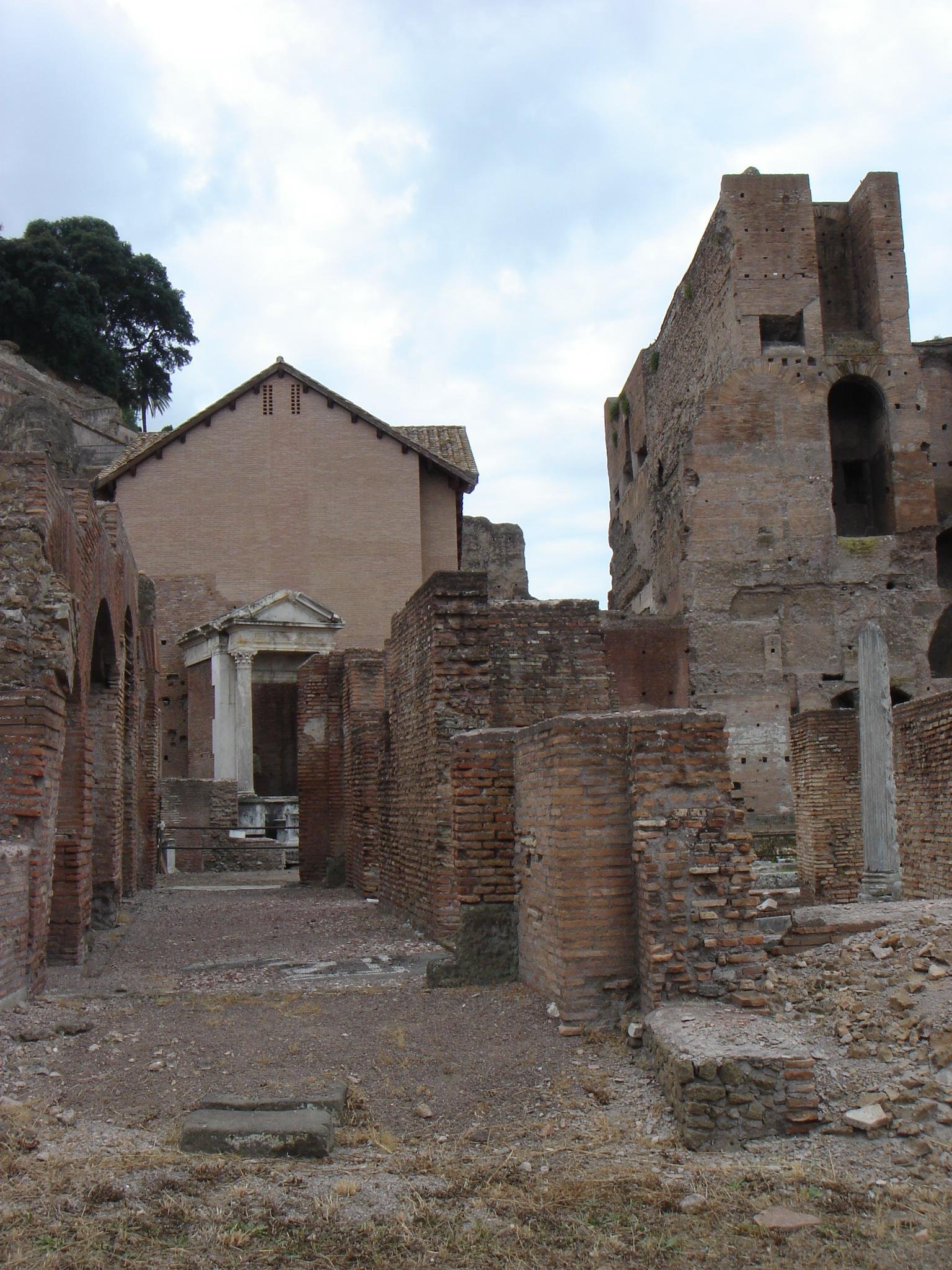
This invisibility has a precise topographical reason. The building was born to be a passage, not a monument: it connected the level of the Forum with the imperial palaces that stood about 30 meters higher. Those who went through it were not supposed to stop and admire it, they were supposed to climb. The church settled inside a monumental corridor, and this explains its strange plan, its compression against the hill, the absence of a front toward the square. When the Palatine then collapsed onto it, in 847, the structure disappeared under a hill of debris that nobody removed again until the 1900s.
The most convenient Roman Forum entrances for the Church of Santa Maria Antiqua
If your main goal is the Church of Santa Maria Antiqua, the most rational gate is the one at Largo della Salara Vecchia 5/6, on Via dei Fori Imperiali side: from there you go straight down into the Forum square and the walk is seven or eight minutes of slow walking. The gate on Via Sacra near the Arch of Titus, on Piazza di Santa Maria Nova, is convenient for those coming from the Colosseum, but it means crossing the whole Forum downhill. It's the right choice if you also want the Palatine in the same round. The gate at Via di San Gregorio 30 instead opens onto the southern slopes of the Palatine and is the most inconvenient of all for this destination: you would have to climb the hill and come back down the other side.
A practical warning that no official site will ever write with this frankness: the Roman Forum is visited one way only on many stretches, and in the months of peak crowds the staff channels the flow. If you enter at 11 on a Saturday in May through the Arch of Titus gate with the idea of reaching the church quickly, you'll find yourself in line behind 30 groups. Entering early and from the right side is not fussiness: it's the difference between having 20 minutes of quiet in front of the palimpsest wall and having four minutes amid the chatter.
How to get to the Church of Santa Maria Antiqua by public transport
The metro is the best way. Line B has the Colosseum stop right in front of the Flavian Amphitheater, and from there you climb Via Sacra or walk along Via dei Fori Imperiali to the Salara Vecchia gate. Line C, which entered service on the central stretch with the Colosseo-Fori Imperiali station, offers a second access to the same hub. The bus lines the Archaeological Park indicates for the Roman Forum are the 51, the 75, the 81, the 85, the 87 and the 118. Tram 3 arrives at the Colosseum front. If you come from Termini station, line B is direct and takes a few minutes.
A car is no use and complicates things: the whole area is in a limited traffic zone, there is no surface parking nearby, and the closest garages cost sums that make the taxi cheaper. If you arrive by taxi, get off in front of the Colosseum or at Piazza Venezia and walk: it's 10 minutes either way.
Walking to the Church of Santa Maria Antiqua from the historic center
From Piazza Venezia it's about 10 minutes along Via dei Fori Imperiali, a stretch I always walk gladly because it lets you look down on the Imperial Forums and Trajan's Markets before descending into the Republican Forum. From the Capitoline Hill you can use the terrace of the Tabularium for an overall view and then come back down: it's the best way to understand the geography of the Forum before entering it. From Circus Maximus it's a good 20 minutes, uphill in the final part.
Tickets for the Church of Santa Maria Antiqua and how access works
Here we have to be clear, because it's the point where visitors most often go wrong. The ordinary ticket of the Colosseum Archaeological Park gives access to the Colosseum, the Roman Forum and the Palatine. The Church of Santa Maria Antiqua instead belongs to the group of reserved-route monuments, those the Park opens with titles of the Forum Pass SUPER and Full Experience type, and which rotate according to a seasonal calendar. Translated: you can enter the Forum with the basic ticket, pass 10 meters from the church and find the gate closed, without anyone having warned you.
The SUPER circuit and the Church of Santa Maria Antiqua
The reserved circuit includes, depending on the period, the Aula Isiaca with the Loggia Mattei, the House of Augustus, the House of Livia, the Neronian Cryptoporticus, the Palatine Museum, the Temple of Romulus, the Domitian Ramp and the Church of Santa Maria Antiqua with the Oratory of the 40 Martyrs. They are not all open at the same time and they are not all open all year: the Park publishes a calendar that indicates which sites of the circuit can be visited in each period. In some phases the church has been accessible with capped visits at fixed times, in others with free entry within the time slot of the ticket, in others still with a dedicated surcharge. There is no stable rule and anyone who promises you otherwise is telling you a convenience.
The practical recommendation is brutal in its simplicity: check the official page of the Colosseum Archaeological Park the day before, not a week before, and if the calendar indicates the opening, buy the time slot right away. The spots for the reserved sites are few in number compared with the general Forum tickets and sell out early, especially on weekends and long weekends.
Discounts, free admission and combined tickets
The Ministry of Culture publishes for the ordinary circuit a full price of 18 euro and a reduced price of 2 euro reserved for citizens of the European Union aged 18 to 24 inclusive. Under 18 you enter free, on showing an ID. Free admission by law remains valid for people with disabilities and one companion, for licensed tour guides in the exercise of their profession, for teachers and university students in the fields indicated by the ministerial decree, for journalists and for ICOM members. On reserved-route tickets the fare picture may differ and should be checked at the time of purchase on the official channel, because the Park sometimes applies an additional fee there.
The free-admission Sundays at state museums apply to the ordinary circuit and generate a considerable crowd. They are the worst day to plan a visit to the Church of Santa Maria Antiqua, both because the Forum becomes impassable and because the reserved routes on those days often have different management than usual.
Booking the visit to the Church of Santa Maria Antiqua
Booking is done on the ticketing system authorized by the Park, indicated on the institutional website. I don't name resellers: the Park authorizes a single concessionaire and every other channel resells at a markup. The ticket is named, must be shown together with an ID, and the time slot refers to entry, not to length of stay. If you book an entry at 9.30 and want to devote time to the church, arrive at the gate 20 minutes earlier: security checks, in high season, take longer than expected.
Why I call the Church of Santa Maria Antiqua the Sistine Chapel of the early Middle Ages
The expression has circulated for years among art historians, but it's worth explaining it rather than repeating it. The Sistine Chapel is the place where, on a single continuous surface, you read a decisive moment of Western painting. The Church of Santa Maria Antiqua does the same thing for a decisive and much less known moment: the passage from late antique Roman painting to medieval painting, with the grafting of Byzantine Hellenism. Only here there is no single artist and no single campaign: there are at least five successive campaigns, spread over two and a half centuries, and at one point of the apse wall they overlap one on top of the other like the sheets of a notebook.
There's more, and it's the argument that makes this building unrepeatable. In 726 Emperor Leo III launched the iconoclast policy, and in the territories of the Eastern empire sacred images were systematically destroyed. Of all the Byzantine pictorial production before that date, almost nothing survived in the East. In Rome, which remained faithful to images and which hosted a conspicuous Greek community, that painting continued to exist. And in a single place it has been preserved in quantity and in sequence. That place is the Church of Santa Maria Antiqua. Whoever studies pre-iconoclastic Byzantine painting passes through here out of necessity, not curiosity.
In our judgment it's the most underrated monument in Rome in relation to its importance. Millions of visitors a year enter the Colosseum. At the Church of Santa Maria Antiqua, when it's open, several thousand people enter. It's an asymmetry that says a lot about how cultural tourism works and very little about the value of things.
What was there before the Church of Santa Maria Antiqua: the Domitianic complex
For a long time 19th-century archaeology identified this sector with the Temple of the Deified Augustus, and the name still appears in out-of-date guides. More recent studies have shifted the reading: the complex belongs to the age of Domitian, who ruled from 81 to 96 AD, and takes up earlier structures traceable to the expansion of the Domus Tiberiana ordered by Caligula. Its function was one of connection and representation: here the Forum ended and the palace began.
The western hall, the quadriporticus and the southern rooms
The complex included four connecting spaces. A large western hall, the one that would become the body of the church, wide and rectangular, with a layout that some scholars have read as sacred and others as serving the palace. A smaller eastern hall, for which use as a library has been proposed. A vaulted quadriporticus with an open courtyard in the center and an impluvium to collect rainwater, which in the Christian phase would work as an atrium. And three southern rooms backed against the hill. To the east, the system ended with the ramp that climbed to the Palatine.
The proportions of the whole can still be read well, and the overall size of the church that settled there is about 30 meters by 20. It's not a small building: it's a building that looks small because it's squeezed between the hill and the square, and because it has lost its roof. Try to imagine it with the vaults intact and with the quadriporticus covered: the scale changes radically.
The courtyard niches and the Caligulan impluvium
In the square courtyard that served as a vestibule, the remains of the impluvium dating to the time of Caligula are preserved, and along the walls open niches that, according to the most widespread hypothesis, housed imperial statues. On those same walls, traces of frescoes from the time of Pope Hadrian I have been identified, that is, from the last quarter of the eighth century: an excellent demonstration of how, in this building, every surface tells at least two overlapping stories. The niches for the emperors and the painting of the Carolingian pope are seven centuries apart, and they touch.
The Praetorian Guard and the Filtering Function
The most widespread reading holds that a detachment of the Praetorian Guard was stationed in these rooms, with the job of controlling access to the palace. It is a reasonable hypothesis and consistent with the topography: anyone who wanted to climb the Palatine had to pass through here, and an obligatory passage is by definition a point to guard. Notice that the first job of this building was the filter: separating those who could go up from those who had to stay below. Five centuries later it will keep doing the same work, but the threshold will be the one between the sacred and the profane.
From Imperial Atrium to the Church of Santa Maria Antiqua
The transformation happened over the course of the sixth century, in a historical context that is worth reconstructing because it explains everything else. Rome, after the Greek-Gothic War, was retaken by the Byzantines in 552. The sources say that imperial power then restored the urban infrastructure, walls and aqueducts, and put the old palaces of the Palatine back in working order, which again became the representative seat of Byzantine authority in the West. In that setting, the rectangular hall and the quadriportico in front of it were adapted as a place of worship dedicated to the Virgin: a sort of palatine chapel, the palace church.
Justin's Coins Under the Column Base
The dating is not an invention of art historians: during the archaeological investigations, coins of Emperor Justin, who reigned from 518 to 527, were found under the base of a column. It is the kind of document archaeologists love, because it provides a concrete chronological limit for the setting up of the church structure. On this basis, and on the analysis of the oldest painted layers, scholars place the founding of the church between the early and the full sixth century, with the Byzantine intervention of the middle of the century as a moment of consolidation.
Why the Church of Santa Maria Antiqua Is Called That
The adjective "Antiqua" is not as old as the church: it was given to it when other Marian churches rose in the Forum and a way to tell it apart was needed. In particular, after Pope Leo IV, in the ninth century, transferred the title to a church built from scratch not far away, the new one took the name Santa Maria Nova and this one, by contrast, remained the "old" one. That the new church is today the basilica of Santa Francesca Romana, and that the old one stayed buried for a millennium, is one of those symmetries that the history of Rome produces effortlessly.
A Revolution in the Geography of the Sacred
There is a detail that deserves more attention than it usually gets. Before this foundation, the churches inside the walls of Rome normally bore the names of the former owners of the houses in which they had been set up: the tituli, the neighborhood churches born inside private homes. The new churches, instead, rose outside the walls, as places of worship over the tombs of the martyrs. Establishing a church dedicated to the Virgin inside the monumental heart of the ancient city, in the Forum, backed against the palace of the emperors, was a gesture of enormous symbolic weight. Christianity was ceasing to occupy the margins and was taking possession of the center.
The Legend of the Dragon and Pope Sylvester at the Church of Santa Maria Antiqua
Tradition says that in this place Pope Sylvester I, the pontiff of the Constantinian age, is said to have killed a dragon. It is a legend, and as such it must be presented: no historical source supports it. But legends are documents of what a society thought, and this one is particularly eloquent. The current interpretation sees in the dragon an allusion to the cult of Vesta, whose image was accompanied by a serpent or dragon in the adjoining temple, a few steps from here. The founding of the church at this spot would thus also have had the value of a topographical exorcism: the place where paganism had its most conservative stronghold is christianized.
The legend had a long life and left toponymic traces. The medieval church that rose later on the ruins carried the name of San Silvestro in lacu, for its supposed proximity to the Lacus Curtius, and local tradition went on telling of a demon nesting in that area, defeated by the pope. From there, through an understandable lexical drift, it arrived at the title of Santa Maria Liberatrice: liberator, precisely, from the dragon and its effects. In this chain there is a notable detail: a legend of the 4th century determined the name of a 17th-century church and still determines the name of a parish in Testaccio in the 21st. Few things are as resilient as a well-told story.
The Temple of Vesta, with its perpetual hearth and its priestesses, was closed at the end of the 4th century by imperial order. That the first great Marian church of the Forum rose a handful of meters from the House of the Vestals is certainly no accident: the Virgin replaces the virgin, the perpetual fire gives way to the sanctuary lamp, and the continuity of the sacred in the same place is stronger than the change of religion. If you visit the Forum slowly, take these 50 steps in a row: from the precinct of Vesta to the threshold of the church. They are the 50 densest steps in Roman archaeology.
The plan of the Church of Santa Maria Antiqua, space by space
Now let's go in. The description that follows follows the order in which you meet things, which is also the order in which it's best to look at them.
The atrium and courtyard of the Church of Santa Maria Antiqua
You enter from the Roman quadriporticus converted into an atrium. It's the space where the Caligulan impluvium and the niches on the walls are found. In the Christian age this courtyard took on the classic function of the early Christian atrium: a place of waiting and pause for those not yet admitted to the mysteries, and later a burial area. The excavations in fact identified there a large cemetery zone with many burials datable to the 8th and 9th centuries, which says that the church was recognized as having great funerary prestige: people were buried here because here the Virgin was near.
The three aisles of the Church of Santa Maria Antiqua
The Roman hall was divided into three aisles by two rows of supports: arcades set on reused granite columns, as was customary in an age that had an immense warehouse of ancient material at its disposal and no active quarry. The side aisles are narrower than the central one, following the basilica scheme, and on their walls is preserved the most legible part of the painted program of the 8th century. The columns themselves were frescoed: in the Church of Santa Maria Antiqua even the shafts carry images of saints, and it's a detail that always surprises whoever notices it for the first time, because we are used to thinking of the column as a structural element and not as a painting support.
The presbytery, the apse and the ciborium
In the thickness of the back wall a small apse was carved out, an economical and intelligent solution that avoided breaking through the Roman structure. The presbytery was raised and paved in opus alexandrinum, the floor of white and black marble inlays with inserts of porphyry and serpentine that would later become the signature of the Cosmati. Of the liturgical furnishings remarkable fragments survive: a ciborium arch of the middle of the 8th century and a 9th-century pluteus with knotted interlace and zoomorphic motifs, that is the early medieval decorative repertoire in its most typical form.
The schola cantorum and the ambo
The central aisle preserved the enclosure of the schola cantorum, the space reserved for the singing clergy, with a polygonal platform for the ambo. It's an element that helps to imagine the liturgy: the church was not an empty container in which you stood looking at the frescoes, it was a liturgical machine with enclosures, steps, railings, separate paths for the clergy and for the faithful. When you look at the plan, try to put these partitions back in their place in your mind: you'll understand why certain frescoes are in apparently awkward positions. They were visible to those who needed to see them.
The side chapels of the Church of Santa Maria Antiqua
On either side of the presbytery open two chapels. The one on the left is the famous Chapel of Theodotus, the best preserved of the whole building. The one on the right is dedicated to the Holy Physicians, Cosmas and Damian, and its establishment is traced to the campaign of Pope John VII. They are small spaces, almost boxes, and their very smallness favored preservation: less exposed surface, less washout, fewer collapses.
The ramp that climbs to the Palatine
To the left of the church a ramp climbs to the Palatine. It's the Domitianic imperial ramp, which I'll discuss later because it deserves a chapter of its own: it's one of the most impressive architectural objects in the Forum and for decades it could not be visited.
The frescoes of the Church of Santa Maria Antiqua: what survives
Inside, about 250 square meters of frescoes are still visible out of the roughly 1,000 that are estimated to have covered the building, painted between the middle of the 6th century and the 9th. A quarter of the original program, then: a lot in absolute terms, little compared with what there was. The painted surfaces involve the presbytery, the chapels, the left aisle, the columns and the pillars. Whoever enters expecting a fully colored interior will be disappointed. Whoever enters knowing they will find fragments, and knowing that every fragment is a unicum, will leave with a full head.
How the frescoes of the Church of Santa Maria Antiqua are dated
The dating of these paintings is unusually precise for the early Middle Ages, and the reason is twofold. First: some figures hold scrolls with texts that refer to datable events, such as councils. Second, and more fascinating: the convention of the nimbus. The square blue nimbus marks people still living at the time the fresco was executed. The round nimbus, yellow and gold, is reserved for saints and martyrs, that is for those who have already passed to the other side. It follows that when a pope with a square nimbus appears in a fresco, that fresco can be dated precisely to his pontificate, which in the case of 8th-century popes means a window of a few years.
It's a device to look for, because it transforms the visit. You are not looking generically at "medieval art": you are looking at a portrait executed while the subject was breathing, and you know it because the painter flagged it for you with a code. In the early Middle Ages the portrait from life is extremely rare. The Church of Santa Maria Antiqua preserves more than one.
Why these frescoes matter for the history of world art
The cycle is a fundamental document for the knowledge of Byzantine painting, and not for parochial reasons. After the iconoclastic crisis begun in 726 and the council of Hieria in 754, in the East sacred images were destroyed methodically: of the earlier production practically nothing survived. Rome did not adhere to iconoclasm, indeed it openly contested it, and in the Church of Santa Maria Antiqua a sequence of painting of Eastern taste and hand is preserved that elsewhere is lost. Whoever wants to know what a Constantinopolitan icon of the 6th or 7th century looked like has to come, in large part, to this building site under the Palatine.
There you also recognize the modes of Christian-Roman painting at the moment of greatest influence of Greco-Coptic art, that is the meeting between the Hellenistic tradition of Alexandrian matrix, Eastern linearism and Roman plastic solidity. On the same wall you can pass from a figure modeled with almost Impressionistic strokes of light to a figure built with sharp outlines and flat fields of color, and the distance between the two is not one of quality: it is one of culture.
The palimpsest wall of the Church of Santa Maria Antiqua
If I had to point to a single thing to look at, I'd point to this: the wall to the right of the apse, the one scholars call the palimpsest wall. A palimpsest, in the vocabulary of manuscripts, is a parchment scraped and rewritten, in which the erased text resurfaces under the new one. Here the same thing happens with the plaster: successive painting campaigns have overlapped, and the losses and detachments have left different layers visible at the same time. The result is a unique stratigraphic object, in which you read vertically what is usually read only horizontally, leafing through books.
Four readable phases, six identified layers
The most widespread reading distinguishes four successive painting phases. The most recent investigations, conducted on the occasion of the restorations and presented in the scientific campaign that accompanied the reopening, identify up to six layers of paint, between the 4th-5th century and the 8th: the deepest correspond to the decoration of the still secular building, with painted plasters of late antique taste, and above them the Christian images are grafted. The two figures do not contradict each other: four are the phases with recognizable figuration, six are the distinguishable material layers. The right image is that of the notebook: four written pages, six sheets.
The first layer: the Madonna and Child and the angel
The oldest figured layer can be dated to the period immediately after the Byzantine liberation from the Goths and depicts the Madonna and Child and an angel. The Virgin is dressed as a Byzantine empress: it's the iconographic type that art historians call Maria Regina, and I discuss it at length later because it is probably the most important image preserved in this church. The style is severe, late antique, with a frontality that imposes distance.
The second layer: the Annunciation and the Beautiful Angel
To the second phase belongs an Annunciation of which the face of the Virgin and the figure that went down in history as the Beautiful Angel survive, datable according to the current reading between 565 and 578. It is the absolute masterpiece of the complex and one of the most famous faces of early medieval European art. I talk about it in a separate chapter, because it deserves to be looked at on its own.
The Third Layer: Basil and John Chrysostom
The third moment is represented by the figures of the saints Basil and John Chrysostom, made around the middle of the seventh century. They hold scrolls with references to the Lateran Council convened by Pope Martin I, and this anchors the layer to his pontificate, between 649 and 653. They are the two great Fathers of the Greek Church: their presence, in a church of Rome, with inscriptions in Greek, is the most direct proof that here the liturgy and the culture were bilingual.
The Fourth Layer: Saint Gregory of Nazianzus
The last layer dates to the pontificate of John VII, between 705 and 707, and depicts Saint Gregory of Nazianzus, third of the great Cappadocians. The sequence of the four layers thus covers about a century and a half, from the full sixth century to the early eighth, and in that century and a half you can see painting change its skin: from the luminous and almost vibrating modeling of the Beautiful Angel to the more graphic and symbolic construction of the eighth century.
How to Look at the Palimpsest Wall of the Church of Santa Maria Antiqua
A practical piece of advice that is worth more than a lecture: don't try to see everything at once. First pick out the face of the Angel, which is the most legible thing. Then widen your gaze to the figure of the Virgin as empress. Then look for the two Greek Fathers with the scrolls. Finally, and only finally, try to make out the edges of the plasters, the sharp margins where one layer ends and the one beneath begins. Those margins are the real marvel. And if your visit coincides with one of the phases in which the Park turns on the dedicated lighting, wait for it to come around: raking light separates the layers better than any verbal explanation.
The Maria Regina of the Church of Santa Maria Antiqua
The fresco is reduced to a fragment and demands attention, but what it represents is a turning point in the history of the Christian image. The Virgin sits on a throne encrusted with gems, wears Byzantine court dress, and has the Child on her knees in imperial robes. She is not the humble Madonna of the later popular devotion: she is a sovereign, with the visual vocabulary of the basileia of Constantinople. It is one of the oldest known depictions of the Madonna enthroned, and age here is not a statistical fact but a theological question.
In fact, we need to remember that the Council of Ephesus in 431 had proclaimed Mary Theotokos, mother of God. From that moment Marian iconography had to invent a language equal to the title, and the language available was that of imperial power: throne, gems, crown, chlamys, angelic guard. The Maria Regina of the Church of Santa Maria Antiqua is one of the first places where that visual translation is accomplished and legible. From here descends, through streams and transformations, the whole iconography of the Madonna in majesty that will run through the Middle Ages to Cimabue and Giotto.
The type also returns in the Chapel of Theodotus, where the enthroned Virgin receives the model of the church from the hands of the patron. The repetition of the motif in the same building, two centuries apart, shows that the image was perceived as the identity of the place: the Queen was the lady of the house, and whoever wanted to be portrayed here had himself portrayed before her.
The Beautiful Angel of the Church of Santa Maria Antiqua
He has been called that for more than a century, since the excavators saw him emerge from the earth, and no one has ever felt like changing his name. He is the angel of the Annunciation of the second layer of the palimpsest, datable between 565 and 578, and of him essentially the head and part of the bust remain. The quality is such that anyone who works on late antique painting knows him by heart.
What makes him extraordinary. The hair is rendered with quick touches of white lead on a brown ground, as a Hellenistic painter of Pompeii would do. The complexion is built with glazes and not with outlines. The gaze has a direction, it is not frontal and hypnotic as the later icon will be. The mouth has a hint of volume. In a word: ancient naturalism is still there, and the new sacredness is already there. It is the exact point where Roman painting becomes Byzantine painting, and luck has it that this point survived in a piece of plaster half a square meter in size under the Palatine.
No hedging: if you go to the Church of Santa Maria Antiqua and don't look at the Beautiful Angel for at least five consecutive minutes, you have wasted your ticket. It is not hyperbole. It is a face that stands up to anything European art will produce in the next 1,000 years, and it does so starting from a disastrous state of preservation. The natural comparison is with the Fayyum portraits: the same painted flesh, the same ability to look back at you.
The Popes Who Decorated the Church of Santa Maria Antiqua
Five pontiffs, in a little over a century and a half, left their painted signature here: Martin I, John VII, Zachary, Paul I and Hadrian I. It's not the story of one decoration, it's the story of five overlapping decorations, each with a political and theological agenda of its own. They are worth taking one by one, because in the Church of Santa Maria Antiqua painting is always also an argument.
Pope Martin I and the Lateran Council of 649
Martin I, pontiff between 649 and 653, is responsible for the first organic campaign in the presbytery and the central aisle. His pontificate was dramatic: he convened the Lateran Council of 649 to condemn Monothelitism, the doctrine supported by the emperor of Constantinople according to which there was only one will in Christ. It was an act of resounding insubordination toward imperial authority. The consequences matched the audacity: Martin was arrested on the order of Emperor Constans II, taken to Constantinople, tried, publicly humiliated and exiled to Crimea, where he died in 655. He is the last pope venerated as a martyr.
Now go back to the scrolls of the saints Basil and John Chrysostom on the palimpsest wall, which refer precisely to the Lateran Council. They are not decoration: they are a manifesto. The pope has painted, in the church that stands under the palace of Byzantine authority in Rome, the two greatest Fathers of the Greek Church holding the texts of the council with which he has just contradicted the emperor. It's like pinning your own press release on the barracks door. This is the reason I insist that the frescoes here must be read, not just looked at.
Pope John VII, the Greek pope of the Church of Santa Maria Antiqua
John VII is the decisive figure of this story. Elected on March 1, 705, died on October 18, 707, the 86th pontiff, he was originally from Rossano, in Calabria, a land of Greek language and rite. His father Plato was a high Byzantine official with the post of curator palatii urbis Romae, that is superintendent of the imperial palace on the Palatine. John VII was therefore the first pope who was the son of a Byzantine official, and above all the first pope raised literally inside the palace that towers over this church.
He made an unprecedented choice: he moved his residence from the Lateran to the Palatine, and elected the Church of Santa Maria Antiqua as his private chapel. For two years, then, this building was the personal church of the pope of Rome. He launched a massive decorative campaign that reshaped the whole interior, established the Chapel of the Holy Physicians, and had painted on the triumphal arch a monumental Crucifixion with the Virgin and Saint John the Evangelist on either side, adoring seraphim and archangels in the upper register, and below the ranks of the blessed awaiting judgment.
He was also the first pontiff to have reliable portraits of himself made while he was alive, with the square nimbus that certifies his condition as a living person. It's a fact that says a lot about his culture: he came from a world, the Byzantine one, in which the image of power was an instrument of government, and he applied it to the papacy. Outside the Forum, his best-known work is the oratory with the great Marian mosaic that he had built in the old basilica of St. Peter's, where he was buried and whose fragments are today scattered among several European museums.
On the political level John VII was prudent to the point of timidity. When Emperor Justinian II sent him the acts of the Quinisext Council for approval, he took no position and sent the matter back to Constantinople: the sources, with a harshness that surprises, attribute a human weakness to him. He had excellent relations, instead, with the Lombards, and King Aripert II returned to the Church the estates of the Cottian Alps that had been taken away centuries earlier. A pope cautious in politics and unscrupulous in matters of images: the combination produced what we see on these walls.
Pope Zachary and the season of the Chapel of Theodotus
Zachary, pontiff from 741 to 752, the last pope of Greek origin in history, born in Calabria, is the indirect patron of the best preserved phase of the building: the Chapel of Theodotus. His portrait appears with the square nimbus, and therefore the chapel is dated to his pontificate. Zachary is remembered by general history for far more resounding reasons: it was he who gave the green light to the rise of the Carolingians, in effect authorizing the deposition of the last Merovingian king and the coronation of Pepin the Short. The pope who approved the birth of Carolingian Europe is painted in a chapel measuring 3 meters by 3 in the Roman Forum.
Pope Paul I and the last great campaign
Paul I, pontiff from 757 to 767, signed the last campaign of great scope: the definitive decoration of the apse with a Christ enthroned among the tetramorph, that is among the four symbols of the evangelists, and the Old Testament and New Testament cycles on the walls of the side aisles, with the Fathers of the Church of the East and the West in the lower register. It is the most systematic program and also the most "medieval" in the full sense: no longer single icons set side by side, but a theological discourse ordered in registers, from top to bottom, from heaven to earth.
Pope Hadrian I, the last brush
Hadrian I, who reigned from 772 to 795, is the author of the last painted interventions. Traces dating to his time also appear on the walls of the atrium, above the Roman niches. His pontificate was very long and coincided with the rise of Charlemagne: the Church of Santa Maria Antiqua stops being painted precisely at the moment when the political center of gravity of the West shifts definitively from the Byzantine Mediterranean to Frankish Europe. It's no accident, and it's a very concrete way of seeing the end of an era: the walls stop receiving color.
The Chapel of Theodotus in the Church of Santa Maria Antiqua
It's the chapel to the left of the presbytery and it is, beyond discussion, the best preserved space of the whole complex. The cycle that decorates it almost completely can be dated to the pontificate of Pope Zachary, 741-752, and its preservation allows what elsewhere in the church is impossible: reading a complete painted program, from ceiling to baseboard, as the person who commissioned it saw it.
Who Theodotus was
Theodotus was a high official of the Roman curia, primicerius defensorum, that is head of the corps of defenders, the officials in charge of property administration and assistance. He also held the post of steward of the diaconia of Santa Maria Antiqua. Tradition identifies him as the uncle of Pope Hadrian I, which places the family in the top Roman aristocracy. He had himself portrayed in the chapel, identified by an inscription, in the company of his wife and children: a family portrait of the 8th century, an event as rare as an eclipse.
The dedication panel: Theodotus offers the model
The dedication panel shows Theodotus kneeling, offering the enthroned Virgin the model of the church, the conventional gesture of the patron that will last a thousand years in the history of art. He has the square nimbus, like his family members and like the pope: they were all alive. They are not portraits in the modern sense, but they are not generic types either: there is a will to individualize, and the very fact that a layman and his family occupy a wall next to the saints signals a society in which private patronage claims visibility inside sacred space.
The cycle of Saint Quiricus and Saint Julitta
The chapel preserves the cycle of the martyrdom of the saints Quiricus, or Cyricus, and his mother Julitta. The story, handed down by the passio, places the martyrdom in the Diocletian era: Julitta, a noblewoman of Iconium who fled to Tarsus with her three-year-old son, was recognized as a Christian and tortured. The child, according to the account, declared his own faith in turn and was killed in front of her, and she suffered the same fate shortly afterward. It's a narrative cycle, with distinct scenes and captions: the painting tells a story, and tells it to those who entered the chapel in the 8th century. The sequence is among the best preserved of early medieval painting in the West.
The Crucifixion with the colobium
In the chapel there is also the Crucifixion that I consider the densest image in the whole church after the Beautiful Angel. Christ is shown clothed, with a long gray-blue colobium, the sleeveless tunic of the first monks, and with his feet not overlapping, that is nailed separately. The eyes are open: it is the living and reigning Christ on the cross, not the dying Christ of Gothic piety. Frontal, motionless, hierarchically larger than the other figures.
But around this Byzantine setup a new and more popular language peeks out, and it is the details that give it away: the stakes driven in at the base of the cross to prop it up, as on a real building site. The ground on which Mary and John set their feet, which is earth and not a gold background. The dynamism of the two Roman soldiers, Longinus with the lance and the other with the sponge soaked in vinegar on a reed. The painting lowers itself toward the viewer, seeks his everyday experience. In the 8th century, in Rome, this is something new.
A detail that visitors appreciate: the clothed Christ is the norm in early iconography, and the naked Christ with a loincloth, the one we all have in mind, only became established later. If it seems strange to you to see a crucifix in a tunic, it's not the fresco that is strange: it's we who have eyes calibrated on a thousand years of later images.
The left aisle of the Church of Santa Maria Antiqua
The left aisle preserves two overlapping bands of frescoes, and their logic is that of a page written on two lines. At the top run the Old Testament scenes, today very damaged: the only sequence still clearly legible is the story of Joseph, the son of Jacob sold by his brothers. Below unfolds the band with Christ enthroned among a row of saints, popes and martyrs, lined up in procession toward the center.
Why the story of Joseph
The choice is not random. Joseph sold, unjustly imprisoned and finally raised to the government of Egypt is one of the most solid Christological prefigurations of the exegetical tradition: the betrayed just man who saves his people. Placing it in the upper register, above the row of saints, means building a vertical argument: above the promise, below the fulfillment. With kids it's worth looking for this story, because it's the most narrative and the easiest to follow even in difficult conditions of preservation.
The row of saints and the double language
The procession of saints, popes and martyrs converging on Christ enthroned is the ideological heart of the 8th-century program. The names are written next to the figures, and here comes the point: the inscriptions are partly in Greek and partly in Latin. It is not a scholarly affectation, but the reflection of a truly bilingual community. In the aisle the saints of the Greek Church file by next to the saints of the Latin Church, with Christ at the center holding together the two halves of the Christian world that would soon begin to separate.
The Greek and Latin Fathers of the Church in the Church of Santa Maria Antiqua
The lower register of the side aisles hosts, in the campaign of Paul I, the sequence of the Fathers of the Church of the East and the West. It's a learned iconography: each holds a scroll with a passage from his own writings, each is identified by name. In the high Middle Ages this scheme would become usual. Here it is still experimental, and it has a specific political value. Rome is saying, through images, that the Christian tradition is one and that she is its legitimate custodian, while the East is torn apart by the controversy over images.
Identifying the figures takes patience and, frankly, binoculars or a good photograph to look at afterward. But the recurring names are the ones you would expect: the Cappadocians, Basil and the two Gregorys. John Chrysostom. Athanasius. And on the Latin side Ambrose, Augustine, Jerome, Leo the Great. The feeling you get seeing them lined up is that of entering a painted library.
The Chapel of the Holy Physicians and the other devotional images
The chapel to the right of the presbytery is dedicated to the Holy Physicians, Cosmas and Damian, the two martyr brothers of Syrian origin who practiced medicine without asking for payment, for which Greek tradition calls them anargyroi, that is without silver. Their cult in Rome was well rooted and already had a monumental seat in the Forum, in the basilica that occupies the hall of the Severan age facing Via Sacra. The founding of the chapel is traced to the campaign of John VII, and the link with his Greek culture is evident.
The votive panels and the patron who steps onto the scene
From the 7th century on, alongside the apse and programmatic decoration, there appear in the Church of Santa Maria Antiqua the votive panels: images commissioned by individuals, placed where there was space, often superimposed on earlier decorations. It is the phenomenon that materially generates the palimpsest. Among the subjects you recognize biblical episodes such as Solomon and the mother of the Maccabees, with a volumetric treatment of the bodies that still shows a strong classical memory.
This practice tells something that no general guide says: in the Church of Santa Maria Antiqua the wall was not considered untouchable. Whoever had the means bought a piece of wall and had their own devotion painted there, covering what was there. It's an idea of monument radically different from ours. Preservation, for them, was not a value. Presence was.
The Three Holy Mothers of the Church of Santa Maria Antiqua
Among the most cited images of the complex is the one known as "The Three Holy Mothers": Mary with the Child inscribed in an oval, Saint Anne holding the infant Mary, Saint Elizabeth holding the infant Saint John. Three generations and three maternities lined up, an iconographic idea of great theological intelligence and rare visual effectiveness.
The Child enclosed in a luminous oval on the mother's chest is the type that Eastern iconography calls Platytera or of the Virgin of the Sign: the Virgin wider than the heavens, who contains the uncontainable. Seeing it flanked by Anne and Elizabeth means seeing maternity presented as a chain, as transmission, as a history of salvation passing from womb to womb. In the 7th-8th century it was not an obvious idea, and its formulation here is extremely early.
The Church of Santa Maria Antiqua and the iconoclast crisis
In 726 Emperor Leo III the Isaurian launched the policy of destroying sacred images, which the Council of Hieria in 754 would raise to official doctrine. The reasons were theological, political and military all at once: the defeat against the Arabs was read as divine punishment for idolatry, and images were the most convenient defendant. Rome reacted sharply, the popes condemned iconoclasm and the question contributed decisively to the progressive split between the papacy and Constantinople.
The Church of Santa Maria Antiqua is the material proof of that position. While in the East faces were being chiseled off, here they kept on painting, and painting with workers of Eastern training. Many of those workers had probably arrived in Rome precisely in flight from persecution: Greek monks and artists who brought with them a technical and iconographic heritage that had become illegal at home. If looking at these frescoes you have the impression of being in an Eastern church, you're not mistaken. The Rome of the 8th century was, in a considerable part, a Greek city.
The Greeks in Rome and the Church of Santa Maria Antiqua
Between the 7th and the 8th century Rome hosted a large and influential Eastern community: Greek, Syriac and Armenian monks, Byzantine officials, merchants. The neighborhood around the Foro Boario preserves a memory of it in the very name of Santa Maria in Cosmedin, whose name refers to the Constantinopolitan district of Kosmidion and which was entrusted to a Greek community. In the same period, 11 popes out of about 30 were of Greek, Syriac or in any case Eastern origin.
The Church of Santa Maria Antiqua is the most eloquent monument of that season. The bilingual inscriptions, the Eastern saints, the Constantinopolitan iconography, the patronage of two Greek popes such as John VII and Zachary make up a coherent picture. Rome was not a Latin periphery receiving Eastern influences: it was a capital of the Byzantine Mediterranean, with a mixed population and a ruling class that spoke Greek. When the Roman Middle Ages are told as a long night between the fall of the empire and the year 1000, this good century of highly refined culture is forgotten, and the Church of Santa Maria Antiqua serves to remind us of it.
The earthquake of 847 and the abandonment of the Church of Santa Maria Antiqua
In 847 an earthquake struck Rome. On the Palatine it caused the collapse of part of the structures of the imperial palaces above, and the landslide hit the church below, burying it. The damage was such as to make recovery unthinkable: the church was abandoned.
The consequent decision was made by Pope Leo IV, the pontiff of the Leonine Walls, who transferred the title to a church built from scratch not far away, Santa Maria Nova, on the area of the Temple of Venus and Roma. That church still exists and is today called the basilica of Santa Francesca Romana, from the name of the Roman saint who is buried there and who founded her congregation there in the 15th century. The Romanesque bell tower that pops up next to the Arch of Titus, the one everybody photographs from the Colosseum without knowing what it is, belongs to her.
The transfer of the title is a legal act, not a sentimental one: the community, the revenues, the clergy, the relics and the name move, and the old building ceases to exist as an institution. From that moment the Church of Santa Maria Antiqua is no longer a church: it is a heap of rubble under a hill of fallen earth. And in that condition it will remain for more than a thousand years.
The paradox that saved the frescoes
And this is where the story becomes fascinating. The landslide that killed the church saved its painting. Buried under meters of debris, the frescoes found themselves in an environment relatively stable in temperature and humidity, sheltered from light, rain, frost, pigeons, candle smoke and above all from people. They did not undergo Baroque repainting, they were not detached to be sold, they were not covered by altars, they were not "improved" by any 19th-century restorer.
Try the comparison with any other Roman church of early medieval foundation: Santa Prassede, San Clemente, Santa Maria in Cosmedin. All magnificent, all layered, all deeply transformed by a thousand years of continuous use. The Church of Santa Maria Antiqua is the only one that stopped in 847 and received nothing more. It is a freeze-frame, and that is why it is worth it.
Santa Maria Liberatrice, the church that stood above the Church of Santa Maria Antiqua
On the buried ruins, in the 13th century, a small church was built. It carried the name San Silvestro in lacu, for its supposed proximity to the Lacus Curtius and for the legend of the dragon, and later it took the title of Santa Maria Liberatrice. In 1617 it was entirely rebuilt on a design by Onorio Longhi, a Milanese architect active in Rome, father of Martino Longhi the Younger and son of Martino Longhi the Elder: a dynasty of builders who left many signatures in the city.
Longhi's intervention had a consequence that nobody in the 1600s perceived as such: it definitively erased every visible trace of the ancient church. The foundations were set into the body of the buried building, the masonry was cut, and the memory of what lay beneath was almost entirely lost. Almost: because in the 1700s some chance excavations brought to light traces of ancient frescoes, which were documented, and in the 1800s more targeted investigations began to formulate the correct hypothesis.
The demolition of 1900
At the beginning of the 1900s the decision was made: the Longhi church, to which the criticism of the time recognized no particular artistic merit, would be demolished to bring the early medieval basilica back to light. The demolition was carried out as part of the excavations of the Roman Forum and was completed by February 1900. The name, the title and the icons were transferred to a new church, built in the Testaccio district and still dedicated to Santa Maria Liberatrice: the transfer of the title was finalized in 1909, and polychrome marbles and stuccoes from the demolished building ended up in the new church.
It's an episode that deserves to be told without pretense, because it holds all the ambiguity of modern archaeology. To bring a monument of the 6th century back to light, a monument of the 17th was destroyed. Nobody today would make a similar decision with as much ease, and current sensibility considers every historical phase worthy of protection. But it is also true that without that demolition the Church of Santa Maria Antiqua would not exist for us, and that the Beautiful Angel would still be under a Baroque floor. The balance, in our judgment, is largely positive, and whoever judges that choice by today's criteria should at least have the honesty to say what would have been lost in exchange.
Giacomo Boni and the rediscovery of the Church of Santa Maria Antiqua
Giacomo Boni, a Venetian, trained as a stonecutter on the restoration site of the Doge's Palace, a brilliant self-taught man and one of the inventors of stratigraphic archaeology in Italy, took over the direction of the Roman Forum excavations at the end of the 1800s and turned them into a methodological laboratory. Before him people dug to find objects. With him people begin to dig to read sequences. He applied to the Forum the principle that levels must be removed one by one and documented, used photography systematically, even used the balloon for shots from above.
The dates of the discovery
The chronology of the undertaking is known precisely. Boni began the excavations in this area on January 8, 1900, with the demolition of Santa Maria Liberatrice. On March 22 he located the Oratory of the 40 Martyrs. Then he brought back to light the apse wall with the Adoration of the Cross. On August 5 he reached the palimpsest wall, the object that would make the monument famous in European scientific literature. The frescoes were overall discovered during 1901, and the news made the rounds of the archaeology and art history journals of the continent.
The 18th-century watercolors that showed the way
There is a detail I particularly love. Boni did not dig at random: he made use of the graphic documentation produced in the 1700s, when chance excavations had intercepted fragments of frescoes and someone had had the good idea of copying them in watercolor. Those plates, drawn up by scholars who could not know what they were documenting, showed the archaeologist where to look. It's an exemplary case of how documentation, even when it seems useless, is the real capital of archaeology. Whoever copied those fragments with a brush in the 1700s worked, without knowing it, for a man who would be born a century later.
The necropolis and the other discoveries
The investigations in the area also produced the finding of a large cemetery zone with many burials datable to the 8th and 9th centuries, distributed in the atrium and the neighboring spaces, and of materials of great interest. Among these a sarcophagus of the second half of the 3rd century with the figures of a sage and an orant, the baptism of Jesus in the Jordan and the stories of the prophet Jonah: it is considered one of the first sarcophagi to host biblical scenes and therefore explicitly Christian, an important piece for the history of early Christian iconography.
Boni, who had an almost mystical relationship with the Forum, asked to be buried there, and was granted it: his tomb is on the Palatine, in the Farnese Gardens. Few other times has an archaeologist obtained to remain inside his own excavation. At the Palatine Hill it's worth pausing a moment in front of that slab: it's a footnote to this story, and worth the detour.
A century of restorations at the Church of Santa Maria Antiqua
The rediscovery immediately created a problem that nobody at the time knew how to solve. Frescoes that had remained a thousand years in burial conditions, brought abruptly into the air, the light and the temperature swings of an open-air site, begin to degrade rapidly. Throughout the 1900s the church alternated temporary coverings, consolidation work, prolonged closures and partial reopenings.
The great restoration campaign
Since the 1980s the building was closed for a systematic campaign. A comprehensive project begun in the early 2000s, financed with state resources and with the decisive contribution of the World Monuments Fund and of foundations based in New York and Oslo, tackled all fronts: structural consolidation of the masonry, protection of the painted surfaces, recovery of the floors, microclimate control. It was not an aesthetic restoration: it was, first of all, a work of conservation engineering.
The church was briefly opened to the public during 2004, with the work still under way, in a form that could be called a preview. Since November 2012 it has been accessible continuously as part of the Park's reserved routes. Whoever tells you it has always been open, or has always been closed, is simplifying a story made of intermittent openings, exactly as today.
The 2016 reopening and the video mapping in the Church of Santa Maria Antiqua
The moment of greatest visibility arrived with the exhibition "Santa Maria Antiqua tra Roma e Bisanzio", set up in the church itself from March 17 to September 11, 2016, curated by Maria Andaloro, Giulia Bordi and Giuseppe Morganti, with an Electa catalog. It was the occasion on which the general public discovered the existence of this place, and it coincided with the introduction of technologies that had never been used in the Roman Forum before.
The light mapping on the palimpsest wall
The most effective idea was the application of light mapping to the palimpsest wall: calibrated light projections that progressively isolate the individual painted layers, giving the viewer back the chronological sequence as a succession of images. Whoever attended that projection understood in three minutes what an art historian explains in an hour. Video mapping was also used to virtually reconstruct the lost portions of the decoration, giving the idea of the whole without touching the original.
On this kind of solution the judgment is precise and not entirely conformist: technology in a monument is almost always a nuisance, except when it solves a problem the eye cannot solve alone. Here it solves it. Distinguishing six layers of plaster with the naked eye, in half-light, is objectively impossible for an untrained visitor. The calibrated light doesn't add spectacle: it takes away difficulty. The installations are not permanent and their presence varies with the Park's exhibition cycles: if they are active when you visit, consider yourself lucky.
The Oratory of the 40 Martyrs next to the Church of Santa Maria Antiqua
Adjacent to the entrance of the church is a quadrangular space that owes its name to the apse fresco, datable to the 8th century, with the 40 Martyrs of Sebaste. It is most likely the entrance hall of the imperial ramp, transformed into an oratory in the Middle Ages: another case of reuse, another passage from the profane to the sacred in the same square meter.
The story of the 40 Martyrs of Sebaste
The account is one of the most impressive of ancient hagiography, and I find it perfect for conveying what persecution meant. They were 40 Roman soldiers of the Legio XII Fulminata, stationed at Melitene, arrested for their faith during the persecutions unleashed by Emperor Licinius beginning in 316. The martyrdom is placed in 320, near Sebaste, in Lesser Armenia. They refused to renounce and the prefect condemned them to a punishment designed to wear them down slowly: to be exposed naked on a frozen pond, on a winter night, with a hot bath lit on the shore available to anyone who wanted to recant.
Only one gave in, named Melezio according to tradition: he reached the hot baths and died there instantly from the thermal shock. The other 39 held out. The main source is a homily by Basil of Caesarea, bishop from 370 to 379, delivered around 372, that is about 50 years after the events, and the feast was already then older than his episcopate: a sign of a cult rooted early.
That this Eastern account is painted in an oratory of the Roman Forum in the 8th century is, again, proof of the Greek presence in Rome. The 40 Martyrs are very popular saints in the East and almost unknown to medieval Latin devotion: if you find them here, it's because here there were people who prayed to them in their own language.
What you see in the Oratory
Besides the apse fresco, on the right wall an image of Saint Anthony the Abbot is preserved, the Egyptian hermit father of monasticism, another figure with a strong Eastern connotation. Fragments of the medieval marble floor are also visible. The space is small and visiting it takes a few minutes, but it should not be skipped: it is the natural complement of the church and shares its logic of reuse.
The Domitian Ramp next to the Church of Santa Maria Antiqua
The imperial ramp is the most surprising object of the whole complex, and it is not a fresco: it is a piece of engineering. Built in the second half of the 1st century AD under Domitian, it connected the level of the Forum with the imperial palace on the Palatine, overcoming a drop of about 35 meters, the equivalent of more than 10 floors, with seven switchback ramps covered by vaults.
How it worked
Imagine an uphill corridor, wide, vaulted, lit by skylights, folding back on itself seven times inside the flank of the hill. Not a staircase: a ramp of constant slope, passable in a litter, perhaps on horseback. It was the official link between the city and power, and its monumentality was itself a message: the entrance to the palace was not a door, it was a long, controlled path, dark and then suddenly bright, which psychologically prepared whoever climbed for the meeting with the emperor. The solemn entrance can most likely be identified in the hall that in the Middle Ages became the Oratory of the 40 Martyrs.
The reopening and what you see today
The structure was located and excavated by Giacomo Boni at the beginning of the 1900s, and then remained inaccessible for decades. After a long restoration it was reopened to the public on October 21, 2015, with an exhibition of finds that accompanied the reopening until the following January. Of the seven original ramps, four can be walked by the public. The route ends with a view over the Roman Forum unlike any other, because you earn it after having climbed inside the hill rather than over it. The Ramp too belongs to the routes the Park opens on rotation: check its status before counting on it.
How to really visit the Church of Santa Maria Antiqua
Let's move on to practical things, the ones that decide whether the visit will be memorable or frustrating.
How much time to devote to the Church of Santa Maria Antiqua
The minimum useful time is 30 minutes. Below that threshold you look without seeing. One hour is the right length for an attentive visit that includes the atrium, the aisles, the presbytery, the palimpsest wall and the Chapel of Theodotus. With the Oratory of the 40 Martyrs it comes to an hour and a quarter. If the Park has activated the Domitian Ramp, add another 30 or 40 minutes. And keep in mind that, in certain phases, the time spent inside the church is capped by the staff for conservation reasons: in those cases the time is decided by the custodian, not by you, and it's best to go in already knowing what to look for.
What to bring and what to leave at home
Bring a headlamp turned off only if you are in the habit of using one and you know it is not allowed to turn it on over painted surfaces. Actually the sensible advice is another: bring the right glasses. Many visitors discover here that they cannot focus at medium distance in half-light. Small theater binoculars, 8x, are the tool that radically changes the visit, because they let you read the faces in the upper part of the walls. Leave the big backpack at home: the entrance checks at the Forum are strict and the permitted dimensions are limited.
Closed, grippy-soled shoes: the route inside the Forum is on ancient ground, uneven, with basoli and gravel, and in the rainy season it becomes slippery. Water yes, and plenty: in the Forum there are drinking fountains but not everywhere, and in summer the basin of the Forum is an oven.
With a guide or on your own
I'll say what I think: this is one of the very few monuments in Rome where a well-prepared guide makes a substantial difference. Not because the place is complicated to reach, but because without a key to reading it you see patches of color on a wall. The distinction among the four layers, the meaning of the square nimbus, the link between the scrolls and the council of 649 are not things you deduce by looking. Alternatively, arrive informed: read up on the sequence of the popes before going in and know already what to look for on each wall.
Photography inside the Church of Santa Maria Antiqua
The general rule in the sites of the Colosseum Archaeological Park allows photography for personal use without flash, without a tripod and without selfie sticks. Professional shooting requires authorization. The flash ban, in the Church of Santa Maria Antiqua, is not a bureaucratic formality: the painted surfaces are extremely fragile and repeated intense light is a documented factor of degradation. Set the sensor sensitivity higher and lean against a modern wall to steady yourself. Always check the notices posted at the entrance, because for temporary exhibitions they can be more restrictive.
The Church of Santa Maria Antiqua with kids
The honest answer is: it depends on age and method. Under seven, a dimly lit space with fragmentary paintings doesn't work on its own. From eight up it works very well, on one condition: tell stories instead of describing styles.
Stories abound here. The pope who kills the dragon where the Vestals kept the fire. The 40 soldiers on the frozen lake and the companion who gives in and dies in the hot tub. The three-year-old who declares himself a Christian in front of the judge. The pope who goes to live in the emperor's palace. The archaeologist who demolishes one church to find another and then has himself buried in the excavation. A kid to whom you tell these five things leaves the Forum with the idea that archaeology is an adventurous trade, which is exactly the effect you want.
The game I recommend, and which always works: the hunt for the square nimbus. Explain the rule, round halo for the holy dead, square blue halo for the living, and let them find them. They become archaeologists in five minutes. Watch out for the tiredness factor though: the Church of Santa Maria Antiqua is inside the Roman Forum, and to get there a child has already walked quite a bit in the sun. Put it at the start of the round, not at the end.
Accessibility of the Church of Santa Maria Antiqua
The Colosseum Archaeological Park has worked a lot in recent years on accessible routes and has created facilitated itineraries in the Roman Forum, but we have to be realistic: the Forum is an archaeological site on ancient ground, with changes in level, uneven surfaces and sloping stretches. The route to the Church of Santa Maria Antiqua and the entrance to the building present difficulties that vary with the setup of the moment and with the condition of the ground.
Anyone who uses a wheelchair, has mobility difficulties or accompanies an elderly person should contact the Park beforehand to check feasibility on the chosen day and to be told which gate is most suitable: it is information the staff provides and that can change from one season to another. It's the kind of check that saves an afternoon gone bad. I also remind you that admission is free for people with disabilities and one companion.
When to go to the Church of Santa Maria Antiqua
If I can choose, I choose a November or February morning, a weekday, first entry. The reasons are three. The first is the crowd: the Forum in the low-season months is a different place, you walk, you hear the silence, you can stand in front of a wall without being pushed. The second is the light: the low winter sun enters the Forum at an angle that brings out the volumes of the ruins and doesn't burn out photographs. The third is the heat, or rather its absence: the basin of the Forum in summer, between noon and four, is unbearable and there is no shade.
The worst period, beyond discussion, is the interval between mid-April and mid-June in the central hours, when school groups, cruise passengers and individual tourists all add up. In those conditions the visit to the Church of Santa Maria Antiqua remains pleasant, because the cap on entries keeps the crush out, but the route to get there becomes an obstacle course.
A meteorological detail nobody considers: on rainy days the Forum empties out and the Church of Santa Maria Antiqua, being covered, becomes one of the best places to be. If your ticket falls on a bad day, don't cancel: change the order of the visit and put the covered places in the middle of the day.
What to see around the Church of Santa Maria Antiqua
The church is at the center of the densest archaeological area on the planet, and within a 10-minute walk there is a concentration of monuments that elsewhere would be enough for a whole city.
Inside the Roman Forum
A few steps away are the Temple of Castor and Pollux, the House of the Vestals with the round temple of Vesta, the Temple of Antoninus and Faustina incorporated into the church of San Lorenzo in Miranda, the Basilica of Maxentius with its three colossal vaults, the Curia Iulia and the Arch of Septimius Severus. The Mamertine Prison, the state prison of ancient Rome, is behind the Curia, on the slopes of the Capitoline.
On the Palatine
Climbing up you reach the Domus Tiberiana, the House of Livia, the House of Augustus with its Second Style frescoes, the Palatine Stadium, the Farnese Gardens with the tomb of Boni and the Palatine Museum, which displays the materials from the excavations of the hill and is the natural museum complement to this visit.
A little farther
Five minutes away is the Arch of Constantine, 10 the Colosseum, a quarter of an hour the Domus Aurea on the Oppian Hill. In the opposite direction you climb to the Capitoline Hill and the Capitoline Museums, where the statuary that gave a face to the institutions of the Forum is kept. Toward the river you reach the Forum Boarium, the Mouth of Truth and Santa Maria in Cosmedin, which is the church to pair with this one if you want to understand the Greek Rome of the 8th century.
To continue the discussion on the early Middle Ages
Whoever leaves the Church of Santa Maria Antiqua with curiosity lit should plan three successive stops. The Basilica of Santa Prassede, with the Chapel of San Zenone and its 9th-century mosaics, which shows where Roman painting goes after the season told here. The Basilica of San Clemente, with the frescoed lower basilica and the underground levels, which is the best lesson in urban stratigraphy available in Rome. And the Museo dell'Alto Medioevo at EUR, which collects the materials of those centuries and which almost nobody visits. I would add the Crypta Balbi, the museum that explains better than any other how Rome passed from antiquity to the Middle Ages.
A curiosity about the Church of Santa Maria Antiqua
The curiosity that almost never appears in quick descriptions concerns the painted columns. In a normal church the column is structure: it supports, it marks rhythm, and the decoration leaves it alone. Not here. In the Church of Santa Maria Antiqua the shafts of the granite columns were plastered and frescoed with figures of saints, and in some places they can still be recognized. It means the available surface was exploited fully, without hierarchies between wall and support, and that the very idea of the classical architectural order was by now irrelevant to those who commissioned those paintings. The reused Egyptian granite, a precious material that a Roman of the imperial age would have displayed with pride, is covered with lime and turned into a painting support. It is the most tangible sign of a change of civilization, and it has the advantage of being visible to the naked eye.
The second curiosity is numerical and concerns the proportion between what was there and what remains. The surviving 250 square meters are about a quarter of the 1,000 square meters estimated for the original program. But that quarter, for density of historical and artistic information, is worth more than the whole decorative apparatus of many intact basilicas, because its stratification contains information that a homogeneous surface could never give. In archaeology the same rule holds as in journalism: one contradictory source says more than 10 concordant ones.
Third curiosity, the subtlest. The name "Antiqua" was given to it by people who already considered it old in the 9th century, when it was barely 300 years old. Today we call it ancient meaning something else entirely, and in the meantime the "new" church that stole its title, Santa Maria Nova, is itself 11 centuries old and is called Santa Francesca Romana. The names of places in Rome are photographs taken at a precise moment and then left hanging, and they keep telling the perception of time of vanished generations. When people say that in Rome the past is everywhere, this is also what they mean: not only in the walls, but in the words.
Something nobody tells you about the Church of Santa Maria Antiqua
That you might get there and find it closed even though you've paid for the Roman Forum ticket. It sounds obvious written like this, but it's the number one reason for disappointment at this monument, and you almost never read it anywhere with the necessary clarity. The Church of Santa Maria Antiqua is not an always accessible space on the ordinary route: it belongs to the sites that the Colosseum Archaeological Park opens on rotation, with specific entry tickets, in periods that change several times a year and sometimes with a surcharge. Some people cross the whole Forum under the July sun only to find themselves in front of a gate and a sign. Checking the official calendar the day before is not a textbook tip: it is the only thing that stands between you and the visit.
The second thing nobody says concerns the light. This is a half-lit space, out of conservation necessity, and the perception of colors requires a physiological adaptation that takes quite a few minutes. If you walk in from the dazzling sun of the Forum and immediately start looking for the Beautiful Angel, you won't see it: you'll see a dark patch. The right method is to go in, stop near the entrance, look at the floor for two or three minutes letting your pupil dilate, and only then raise your eyes. It sounds like a maniac's detail. It is the difference between seeing and not seeing, and no audio guide will ever tell you.
The third is historiographical and worth making clear. Many guides and many captions repeat that the area corresponded to the Temple of the Deified Augustus: it is a 19th-century identification superseded by studies, which refer the complex to the Domitianic age and to the function of connection between the Forum and the palace. It is not academic fussiness: it completely changes the sense of the building. A temple is an end, an atrium is a means. The Church of Santa Maria Antiqua was born inside a means, inside a passage, and this origin explains its plan, its compression and even its fate.
The advice I give you for visiting the Church of Santa Maria Antiqua
The main advice is only one and I put it without softening: make it the first stop of the day, not the last. Buy the entry for the first available time slot, enter through the gate at Largo della Salara Vecchia and go straight here, ignoring everything else. The Roman Forum isn't going anywhere, and the republican temples can be looked at very well even with tiredness on you and the sun high. The frescoes can't. The frescoes require rested eyes, fresh attention and an uncrowded space, and all three of these conditions occur only in the first hour of opening.
The second piece of advice concerns the order of reading inside. Don't wander at random. Start from the atrium, where you understand the Roman origin of the building by looking at the impluvium and the niches. Move into the aisles and find the lower band with the row of saints, looking for the inscriptions in Greek. Get to the presbytery and place yourself facing the apse. Then move to the right and tackle the palimpsest wall, devoting at least 10 minutes to it, with the Beautiful Angel as a starting point. Finish with the Chapel of Theodotus, which is the reward: the only space where you see a complete program and can finally relax the effort of reconstruction. Then, if open, the Oratory of the 40 Martyrs.
Third piece of advice, the most practical of all: download some good images of the frescoes before going in and look at them on your phone inside, comparing them with the original. It's not a betrayal of the direct experience, it's the opposite. The photographic reproductions of these paintings are made with controlled lighting and give back details that the eye in half-light doesn't catch. Having them at hand lets you understand what you are looking at and therefore look at it better. It's a method that always works. And one last recommendation as a professional: don't come here with less than half an hour ahead of you. If you only have 10 minutes, postpone. A place like this should be respected with time, not with enthusiasm.
Another well-known fact, yet rarely mentioned
That to bring this church back to light, another one was demolished. The fact is known and nobody hides it, yet it is almost always dismissed in a line without drawing the consequences. In January 1900 Giacomo Boni had the church of Santa Maria Liberatrice torn down, rebuilt by Onorio Longhi in 1617, and by February the operation was concluded. The title, the name, the icons, the polychrome marbles and the stuccoes were transferred to the new church of the same name built in Testaccio, with the formal transfer finalized in 1909. A 17th-century building was sacrificed in the name of a building from the 6th century.
The judgment of the time was clear-cut: the Longhi church had no particular artistic merit, and the choice seemed obvious. But behind that formula there is an entire philosophy of protection, the one that ranks eras and considers some more worthy than others. It is the same philosophy that in the Forum removed medieval and modern layers to reach the Augustan level, and which has now been abandoned: contemporary practice considers every historical phase a document, and a similar demolition would be unthinkable. The Roman Forum we visit is therefore not an ancient place rediscovered: it is an ancient place that has been selected, in which someone decided which centuries to show and which not.
I am aware that this observation contains an uncomfortable paradox, and I stand by it anyway. Without that questionable choice we would not have the Beautiful Angel, we would not have the Chapel of Theodotus, we would not have the only organic deposit of pre-iconoclastic painting in existence. The balance is positive, but it must be declared in full, losses included. Whoever visits the Church of Santa Maria Antiqua is looking at an extraordinary gain obtained at the price of a real loss, and knowing the price is part of understanding the value.
The right photo to take at the Church of Santa Maria Antiqua
The strongest photograph, and also the least obvious, is not the isolated portrait of the Angelo bello: it's the junction of the layers on the palimpsest wall. Look for the spot where the plaster of one campaign stops and the earlier one shows through underneath, with a sharp, almost cut edge. Shoot horizontally, including both layers and the edge that separates them, without trying to straighten the composition. That single image tells a thousand years of the history of painting in one go, and no photograph of a whole fresco manages to do the same. It's the photo people then ask you to explain, and that's the sign it worked.
On the technical side, a few firm rules. No flash, ever, for conservation reasons even before regulatory ones. Raise the sensor sensitivity up to 3200 or 6400 without fear of noise: a slightly grainy image is infinitely better than a blurred one. Rest your elbows against your body and your back against a modern surface, not against the ancient walls. If your phone has a night mode, use it and stay still for the whole exposure. And shoot in two takes: one shot for the detail, one wider shot for the context, because months later the detail without the context becomes incomprehensible even to you.
If you're after the overall image instead, the best one isn't taken inside the church but from the top of the Palatine, from the viewpoints above the Domus Tiberiana, looking down toward the Forum. From there you see the position of the complex at the foot of the hill and understand at a glance why a landslide from the Palatine could have buried it. It's a photograph that explains the geography of an event, and it's worth more than 10 captions. One last suggestion, and I'll be unpopular: take fewer photos and look more. The professional reproductions of these frescoes are better than any shot you can manage to get. The only thing you can't replicate at home is your presence in here.
Some important events that happened here in history
The first event that marks this place is the Byzantine reconquest of Rome in 552 and the resulting conversion of the Domitianic hall into a church. It's the moment when Christianity settles permanently in the monumental area of the ancient city, leaving behind the logic of the domestic tituli and the sanctuaries outside the city. It wasn't a dramatic or noisy event, but it changed the religious geography of Rome forever. The archaeological evidence anchors it with the discovery of coins of Justin, emperor between 518 and 527, under the base of a column.
The second is the Lateran Council of 649, convened by Pope Martin I against monothelitism, which resonates on these walls through the scrolls held by Saints Basil and John Chrysostom in the third layer of the palimpsest. It's the moment when the Roman papacy openly contradicts the emperor in Constantinople on a doctrinal question, and pays the price: Martin I will be arrested, deported, tried and will die in exile in Crimea in 655. The painting of this church is a direct witness to that clash.
The third is the transfer of the papal residence to the Palatine in 705, under John VII, and the elevation of the Church of Santa Maria Antiqua to the private chapel of the pontiff. For two years this was the pope's church, and the decorative campaign that followed was the most imposing of its history. The fourth is the iconoclast crisis of 726 and the council of Hieria of 754: while in the East images are being destroyed, here they keep painting, and the church becomes a material refuge for a figurative tradition condemned to death elsewhere.
The fifth event is the earthquake of 847, which brought part of the imperial palaces above crashing down onto the church and led to its abandonment, with the title transferred to Santa Maria Nova by decision of Pope Leo IV. It's the day this place leaves history and begins its very long sleep. The sixth is the rediscovery of 1900: on January 8 Boni starts the excavation by demolishing Santa Maria Liberatrice, on March 22 he identifies the Oratory of the 40 Martyrs, on August 5 he reaches the palimpsest wall, and in 1901 the frescoes are, on the whole, brought back to light.
The seventh and last, for now, is the reopening of March 17, 2016 with the exhibition "Santa Maria Antiqua between Rome and Byzantium", curated by Maria Andaloro, Giulia Bordi and Giuseppe Morganti, closed on September 11 of the same year: the occasion when the non-specialist public discovered this place and when the Roman Forum saw for the first time the use of video mapping and light mapping for scientific reading. Between the first and the last of these events run 14 and a half centuries, and all of them happened inside the same perimeter of 30 meters by 20.
Who has passed through the Church of Santa Maria Antiqua
Before it was even a church, emperors passed through here, and those who climbed up to meet them. The building was the link between the Forum and the palaces of the Palatine, built under Domitian on structures attributable to the expansion of Caligula: ambassadors, senators, officials and petitioners crossed these rooms to reach the ramp and climb up to the palace. The garrison of the praetorian guard, according to the most accredited hypothesis, was stationed right here. We don't know the names of those soldiers, but we know their trade, and the floor they walked on is the same.
In the Byzantine era the place belongs to the imperial administration of the West, and Plato passes through, the curator palatii urbis Romae, the official in charge of the Palatine palace. His son is the next figure: Pope John VII, a Calabrian from Rossano, elected on March 1, 705 and who died on October 18, 707, who moved the papal residence here and made the Church of Santa Maria Antiqua his own chapel. He's the only pope in history who can be said to have lived on the Palatine. His portrait with the square nimbus shows him alive, and it's one of the first reliable papal portraits we have.
From here passed Pope Martin I, pontiff between 649 and 653, the last pope venerated as a martyr, who left in the church the first organic campaign and who ended his days in exile in Crimea. Pope Zachary passed through, from 741 to 752, the last Greek pope in history, the one who authorized the rise of the Carolingians to the throne of the Franks, portrayed as well with the square nimbus in the Chapel of Theodotus. Pope Paul I passed through, from 757 to 767, author of the last great apse campaign, and Pope Hadrian I, from 772 to 795, Charlemagne's pope, whose paintings mark the last decorative chapter of the building. And Pope Leo IV passed through, who in 847, after the earthquake, transferred its title elsewhere and in effect decreed its end.
Then there's the lay patron, Theodotus, primicerius defensorum and steward of the diaconia, uncle according to tradition of Pope Hadrian I, who had himself portrayed in the chapel with his wife and children offering the Virgin the model of the church: a Roman family of the eighth century whose name we know and whose faces we see, a very rare thing for that century.
After the millennium of silence comes Onorio Longhi, who in 1617 rebuilt the church of Santa Maria Liberatrice on top of these ruins without knowing what he was covering, and come the 18th-century scholars who copied in watercolor the fragments that had surfaced by chance, working unintentionally for those who would come after. The one who would come after is Giacomo Boni, a Venetian, the most visionary of Italian archaeologists, who on January 8, 1900 started the excavation, brought the church back to light and made it one of the case studies of European archaeology. He is buried a few dozen meters from here, in the Orti Farnesiani on the Palatine, by his own express wish.
In the 20th century and in ours, the restorers and scholars who made the visit possible have passed through here: the teams of the Soprintendenza and then of the Colosseum Archaeological Park, the technicians of the worksites supported by the World Monuments Fund and by foundations in New York and Oslo, and the art historians who reread the monument in the scientific campaign that culminated in the 2016 exhibition, among them Maria Andaloro, Giulia Bordi and Giuseppe Morganti. They are less spectacular names than those of the popes, but without them nobody would be going in today.
Quick questions about the Church of Santa Maria Antiqua
Where is the Church of Santa Maria Antiqua
In the Roman Forum, on the northern slopes of the Palatine, right behind the Temple of Castor and Pollux. It has no entrance of its own from the street: you enter through the gates of the Colosseum Archaeological Park, that is Largo della Salara Vecchia 5/6, Via Sacra near the Arch of Titus on the square of Santa Maria Nova, and Via di San Gregorio 30 for the Palatine side.
How much does it cost to visit the Church of Santa Maria Antiqua
The ordinary ticket of the Colosseum-Roman Forum-Palatine circuit is listed by the Ministry of Culture at €18 full price and €2 reduced for citizens of the European Union between 18 and 24 years of age completed. The church, however, is not included in that ticket: it requires options of the Forum Pass SUPER or Full Experience type, and in some periods a supplement is applied. The exact fare should be checked on the Park's official website at the time of purchase.
Is the Church of Santa Maria Antiqua always open
No, and it's the most important point to know. Access is on alternating periods: it is among the places the Colosseum Archaeological Park opens according to a seasonal calendar, with days and hours that change several times a year. Check the Park's official page the day before your visit.
Do you need to book for the Church of Santa Maria Antiqua
It's strongly recommended and in high season effectively necessary, because the places available on the reserved routes are limited in number compared with the general Forum tickets. Booking is done on the authorized ticketing channel indicated by the Park.
How long does a visit to the Church of Santa Maria Antiqua take
The minimum so as not to waste the opportunity is 30 minutes. One hour is the right length for a careful visit. With the Oratory of the 40 Martyrs it comes to an hour and a quarter. If the Domitian Ramp is also open, add a good half hour. At certain times the staff limits how long you can stay inside.
Can you take photos in the Church of Santa Maria Antiqua
The general rule in the Park's sites allows photography for personal use without flash, without a tripod and without a selfie stick. The flash ban here is particularly strict because of the fragility of the painted surfaces. The signs posted at the entrance take precedence and for temporary exhibitions they may be more restrictive.
Is the Church of Santa Maria Antiqua wheelchair accessible
The Park has built easier routes in the Roman Forum, but the site remains an archaeological area with uneven ground, gravel and changes in level, and how practicable the access to the church is varies with the setup of the moment. It's best to contact the Park beforehand to check the conditions on the day you choose. Admission is free for people with disabilities and for one companion.
Is the Church of Santa Maria Antiqua still consecrated
No. It isn't a church where services are held: it's an archaeological monument managed by the Colosseum Archaeological Park. The title was transferred in the ninth century to Santa Maria Nova, today the basilica of Santa Francesca Romana, and the liturgical function never came back here.
Why is it called Antiqua
Because when Pope Leo IV, after the earthquake of 847, transferred the title to a church built from scratch not far away, that one took the name Santa Maria Nova and this one, by contrast, remained the "old" one. The adjective is therefore more recent than the church itself.
What is the palimpsest wall of the Church of Santa Maria Antiqua
It's the wall to the right of the apse, where successive painting campaigns overlapped and the losses of plaster have left layers from different eras visible at the same time. You can recognize four main figurative phases and up to six material layers, ranging from the fourth-fifth century to the eighth.
What is the Angelo bello
It's the figure of the angel of an Annunciation belonging to the second layer of the palimpsest wall, datable between 565 and 578. Essentially the head and part of the bust remain, and it's considered one of the absolute masterpieces of late antique European painting, for the naturalistic rendering of the skin tones and for the non-frontal gaze.
How many frescoes are preserved in the Church of Santa Maria Antiqua
About 250 square meters out of the roughly 1,000 estimated for the original program, painted between the middle of the sixth century and the ninth. They cover the presbytery, the chapels, the left aisle, the columns and the pillars.
Why have the frescoes been preserved so well
By a paradox: the earthquake of 847 brought part of the Palatine palaces crashing down onto the church and buried it. Under the debris the frescoes found themselves sheltered from light, from temperature swings, from water and above all from people, with no repainting or alterations, until the excavations of 1900.
Who discovered the Church of Santa Maria Antiqua
Giacomo Boni, who started the excavations on January 8, 1900 by demolishing the church of Santa Maria Liberatrice above, identified the Oratory of the 40 Martyrs on March 22 and reached the palimpsest wall on August 5 of the same year. The frescoes were, on the whole, brought back to light during 1901.
What is the square nimbus you see in the frescoes
It's the convention by which early medieval painting signaled that the person portrayed was still alive at the time of execution: a blue square nimbus for the living, a round yellow and gold nimbus for saints and martyrs. It is the main dating tool for the frescoes of the Church of Santa Maria Antiqua.
What is the Chapel of Theodotus
It's the chapel to the left of the presbytery, the best preserved of the whole complex, decorated in the time of Pope Zachary between 741 and 752. It contains the cycle of the martyrdom of Saints Quiricus and Julitta, a Crucifixion with Christ dressed in the colobium and the panel with the patron Theodotus and his family in front of the Virgin enthroned.
What is the Oratory of the 40 Martyrs
It's the quadrangular room next to the entrance of the church, probably the access hall to the imperial ramp transformed into an oratory in the Middle Ages. It takes its name from the apse fresco of the eighth century with the 40 Martyrs of Sebaste, Christian soldiers condemned in 320 to die on a frozen pond during the persecutions of Licinius.
Can you also visit the Domitian Ramp
When it's included in the calendar of reserved routes, yes. It's the imperial ramp of the first century that overcame a difference in height of about 35 meters with seven vaulted hairpin ramps. Four of them can be walked. It was reopened to the public on October 21, 2015 after a long restoration.
Is the Church of Santa Maria Antiqua suitable for children
From age eight up it works very well, as long as you tell stories instead of describing styles: the pope and the dragon, the 40 soldiers on the frozen lake, the archaeologist who demolishes a church to find another. Under age seven the dim light and the fragmentary state make the visit hard. I suggest putting it at the start of the tour, when the children aren't tired yet.
What is the best time to visit the Church of Santa Maria Antiqua
A weekday morning in November or February, with the first entry available: few people, low winter light and no problem with heat. The worst period is the middle hours between mid-April and mid-June. On rainy days the Forum empties out and a covered space like this becomes the ideal choice.
What is the difference between the Church of Santa Maria Antiqua and Santa Maria Liberatrice
Santa Maria Liberatrice was the church built on top of the ruins of the ancient one: a small 13th-century church, rebuilt by Onorio Longhi in 1617, demolished in 1900 to bring back to light the early medieval basilica. Its title, the icons and part of the furnishings were transferred to the church of the same name built in Testaccio, with the transfer completed in 1909.
Why is the Church of Santa Maria Antiqua called the Sistine Chapel of the early Middle Ages
Because it preserves, in sequence and on a single surface, the passage from late antique Roman painting to medieval painting with the Byzantine graft, and because it's the largest existing deposit of pre-iconoclast painting: after 726 in the East sacred images were destroyed, and what we see here has no equivalent elsewhere.
What is there to see near the Church of Santa Maria Antiqua
Within a few minutes, the House of the Vestals, the Temple of Castor and Pollux, the Basilica of Maxentius, the Curia Julia, the Mamertine Prison, and going up the Palatine the Palatine Museum and the Orti Farnesiani. A little farther, the Arch of Constantine, the Colosseum, the Capitoline Hill with the Capitoline Museums and, toward the river, the Forum Boarium with Santa Maria in Cosmedin.
Is a guided visit to the Church of Santa Maria Antiqua worth it
Yes, more than elsewhere. Without a key to reading them the fragmentary frescoes are illegible, and the links between layers, scrolls, councils and pontificates can't be deduced by looking. Otherwise, arrive well informed and already knowing what to look for on each wall.
Is there a cloakroom or luggage storage
The Park applies size limits to backpacks and luggage at the entrance and doesn't offer storage comparable to that of an indoor museum. Show up with the bare minimum: a large backpack can mean being refused entry at the checks.
Is entry free on the first Sunday of the month
The free-admission Sundays in state museums apply to the Park's ordinary circuit. For the reserved routes the arrangements on those days may differ, and in any case the crowds make the visit to the Forum much less pleasant. I advise against it for anyone whose goal is this monument.
A final thought on the Church of Santa Maria Antiqua
There are monuments that impress by size and monuments that impress by density. The Colosseum belongs to the first category and doesn't need anyone to defend it. The Church of Santa Maria Antiqua belongs to the second: it's a building of 30 meters by 20, without a facade, without its original roof, with a quarter of its decoration surviving, and it contains more historical information than entire monumental districts. Anyone who goes in prepared comes out with the precise feeling of having seen something they couldn't have seen anywhere else, because elsewhere it doesn't exist.
My final advice is to treat it the way you treat a rare manuscript: with time, with silence and with the acceptance that you won't understand everything on the first reading. Go in early in the morning, stand still until your eyes adjust, look for the Angelo bello and then look for the edge of the plaster next to it. That edge is the point where the history of Western art changes direction, and it's within reach, inside the Roman Forum, behind a gate that opens a few weeks a year. When it opens, go.
Article written by the editorial team of TourLeaderPro, contact them for Private/Corporate/V.I.P. Tours and Experiences.
Planning a trip to Rome? The English guides to visiting the city are on ItalyPlanner.com.