Museum of the Early Middle Ages “Alessandra Vaccaro” – Museo delle Civiltà
In short. The Museum of the Early Middle Ages "Alessandra Vaccaro" occupies a sequence of nine rooms on the first floor of the Palazzo delle Scienze, Piazza Guglielmo Marconi 14, in EUR, and is open Tuesday to Sunday from 8:00 to 19:00, last…

The Museum of the Early Middle Ages "Alessandra Vaccaro" occupies a sequence of nine rooms on the first floor of the Palazzo delle Scienze, Piazza Guglielmo Marconi 14, in EUR, and is open Tuesday to Sunday from 8:00 to 19:00, last entry at 18:30, closed on Monday. The early medieval rooms are open. On the same floor, however, the rooms of the African, American and Oceanian Arts and Cultures collections are closed for construction work covering checks on the new anti-seismic devices, the new fire-prevention and air-conditioning systems and the restoration of the historic window frames, with completion expected in winter 2026. Of those collections, a rotating selection titled "In corso d'opera" remains visible at the entrance of the Palazzo delle Scienze. A full ticket is €10, reduced €2, "friend" ticket €5, free admission for European Union citizens under 18, on the first Sunday of the month and on April 25. Tickets are bought at the ticket offices of the two palazzi during opening hours and are valid for the day. You get there by metro B, EUR Fermi stop, or by ATAC buses 30, 170, 671, 714 and 791. Parking is free in the adjacent streets. Phone +39 06 549521, email mu-civ@cultura.gov.it. For a self-guided visit you don't need to book.
The early medieval rooms are part of the Museum of Civilizations, the state institution that since 2016 has brought together in EUR collections born in different places and centuries, and the same ticket lets you into the other palazzo of the complex on the same day as well. If you want to understand the neighborhood before climbing the stairs, you can read the page on EUR and the Rome Universal Exposition.

Where it is and how to get to the Museum of the Early Middle Ages
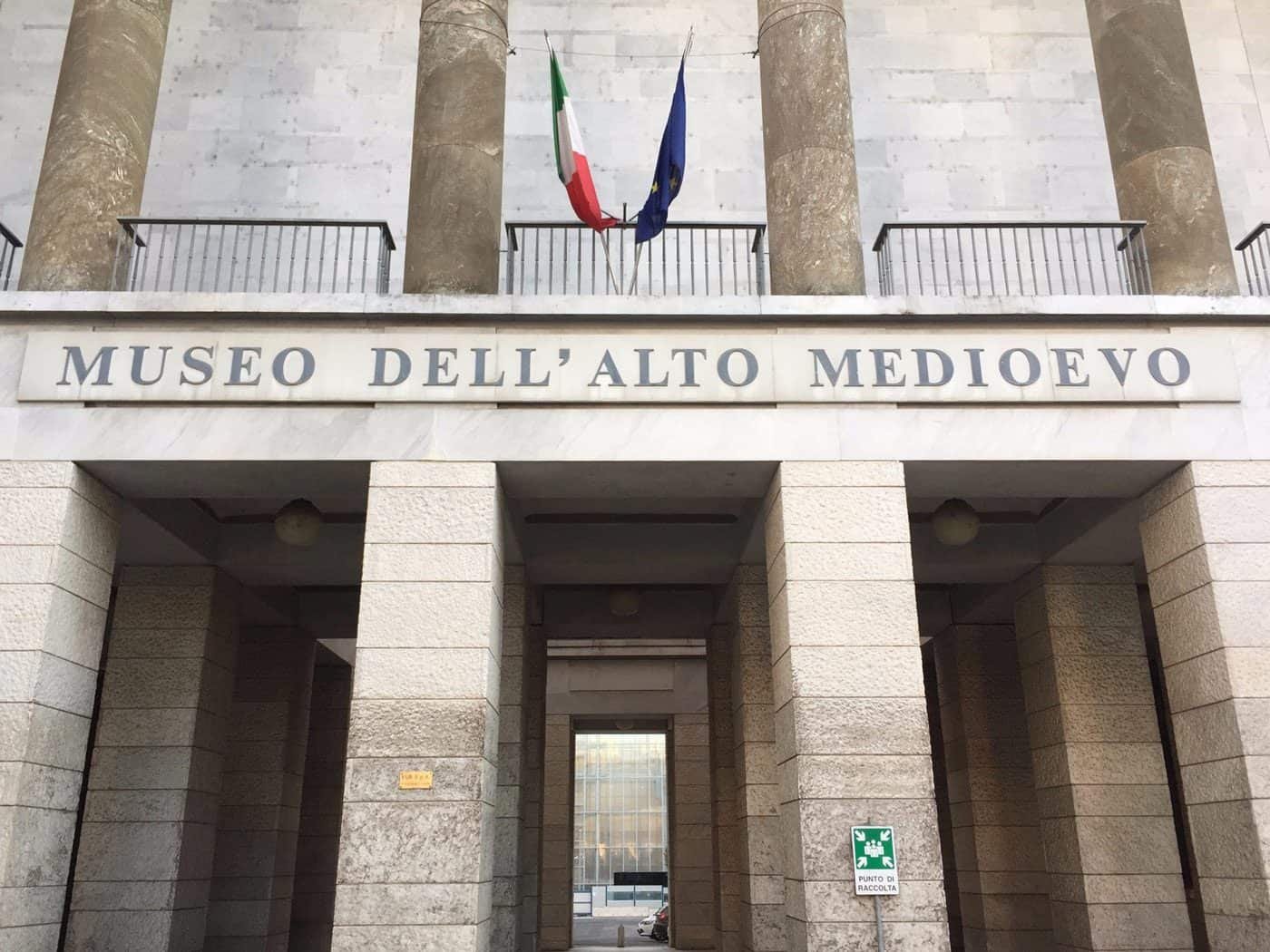
The address that matters is Piazza Guglielmo Marconi 14. The Palazzo delle Scienze is the rationalist volume on the long side of the square, the one with the deep portico and the staircase that climbs toward the atrium. The twin facing it, at number 8, is the Palazzo delle Arti e Tradizioni Popolari. Between the two runs the colonnade that holds the scenography of the square together. Whoever is still looking for the old address on Viale Lincoln risks circling the block: the public entrance and the ticket office are on Piazza Marconi.
Metro, bus and car for the Museum of the Early Middle Ages
The useful metro B stop is EUR Fermi. You come out, head up toward the center of the neighborhood and in eight or 10 minutes of flat walking you reach the square. If you prefer the bus, there are ATAC lines 30, 170, 671, 714 and 791, which all drop you a few steps away. By car, EUR is one of the rare Roman neighborhoods where parking doesn't become a moral problem: in the adjacent streets you park freely, and on Sunday mornings you find a spot almost in front of the portico. A warning: EUR is designed on the scale of the automobile and distances deceive. The Square Colosseum that you see at the end of the vista is a good quarter of an hour away at a brisk pace, not two minutes.
Hours, closing days and tickets for the Museum of the Early Middle Ages
The 8:00 opening is the real anomaly of this museum, and its best hidden quality. Rome opens late almost everywhere. Here at 8:15 the Lombard rooms are empty, the light comes in from the high windows and the attendant still feels like talking. Last entry is at 18:30, and Monday is a closing day. The full ticket costs €10, the reduced €2, there's a "friend" option at €5, and free admission applies to European Union citizens under 18, the first Sunday of the month and April 25. You buy it at the ticket office, in the two palazzi, and it's valid for the day: whoever arrives at nine and has the stamina can do the early medieval rooms, prehistory and popular traditions with a single entry ticket. Conditions and any changes should be checked on the museum's official website before leaving.
The MIC card is not valid at the Museum of the Early Middle Ages
This must be said without beating around the bush because it's the most frequent misunderstanding at the counter: the MIC card, the annual card at €5 reserved for residents, domiciled people and university students of the Metropolitan City of Rome, opens for free for 12 months the Roma Capitale Museum System, that is, the civic museums. The Museum of the Early Middle Ages is not civic. It's a state museum, it depends on the Ministry of Culture and is part of the Museo delle Civiltà. At the cash desk the MIC card is of no use here. It is useful instead at the Capitoline Museums, at the Centrale Montemartini, at the Markets of Trajan and at the other municipal institutions. Conversely, here the calendar of state free days applies, and on the first Sunday of the month you get in without paying. It's a detail that anyone living in Rome should note down, because the complete list of free occasions is gathered in the page on free museums in Rome.
What the Museum of the Early Middle Ages "Alessandra Vaccaro" is
It's the archaeological museum of Rome's post-classical age: the one that gathers the objects produced between the 4th and 14th centuries, with the center of gravity largely shifted to the centuries between the 6th and 10th. It was born from a precise choice, and for its time a brave one: to give the capital a place where the ancient world does not end with Constantine but transforms, and where the materials of that transformation, often small, often metal, often funerary, can be read in sequence. The core comes from the National Roman Museum, which until the 1960s kept at the Baths of Diocletian the Lombard grave goods of Nocera Umbra and Castel Trosino. In 1967, with the inauguration at the Palazzo delle Scienze, those materials found a space of their own.
The museum exhibits mostly objects from Rome and central Italy. It's a fact to keep in mind on entering, because it explains the mental geography of the route: here the early Middle Ages is not that of European textbooks, with barbarian kingdoms and great migrations told from above, but that of two Apennine cemeteries, of a handful of Roman churches stripped over the centuries, of two papal farms in the countryside north of the city and of a luxury hall at Ostia that collapsed before it was even finished.
Alessandra Melucco Vaccaro, the archaeologist the museum is named after
The name that appears in the official title is that of Alessandra Melucco Vaccaro, born in Rome on April 4, 1940 and died in Rome on August 29, 2000. She graduated from the Sapienza with a thesis on Roman sarcophagi in 1962, a student of Ranuccio Bianchi Bandinelli, and attended the National School of Archaeology in 1962 and 1963. An archaeologist inspector at the Superintendency of Tuscany in 1969, in 1974 she was appointed director of the Museum of the Early Middle Ages in Rome, a post she held until 1979. In 1976 she was elected deputy in the 7th legislature on the lists of the Italian Communist Party. From 1979 to 1994 she directed the archaeological services of the Central Institute for Restoration, and from 1994 to 2000 she was archaeologist director at the Ministry for Cultural and Environmental Heritage.
It's not a plaque biography. Melucco Vaccaro excavated the Lombard necropolis of Chiusi-Arcisa in 1971, worked on the materials from Castel Trosino and Nocera Umbra, took part in the campaigns at the Etruscan sanctuary of Pyrgi and directed restorations that anyone with a memory of the 1980s recalls: the marbles of Roman monuments, the Riace Bronzes, the Tomb of the Diver at Paestum. Her Archeologia e restauro, from 1989, remains a book that is studied. She wrote Il Museo dell'Alto Medioevo in 1975, I Longobardi in Italia. Materiali e problemi in 1982 and volumes of the Corpus della scultura altomedievale. Naming these rooms after her means saying that the museum is also a laboratory of method, not just a showcase of objects.
From the National Roman Museum to the Palazzo delle Scienze
The 1967 transfer was no ordinary move. Taking the Lombard grave goods out of the Baths of Diocletian meant removing them from the logic of the great encyclopedic museum and entrusting them to a display designed for them, with chronological sequence as the guiding thread. That's the reason the route, still today, reads like an argument: you enter late antique Rome, pass to the necropolises, climb to the Carolingian marbles, end in the countryside and in Egypt. Whoever has visited the Crypta Balbi, where the National Roman Museum later built its story of the early medieval city, will recognize two different and complementary ways of approaching the same problem: there the urban stratigraphy, here the objects and the funerary contexts.
2016 and the birth of the Museo delle Civiltà
Since September 2016 the early medieval museum has merged, together with other institutions, into the Museo delle Civiltà. It's a state container that today is divided into collections with renewed names: Prehistory and Protohistory, Paleontology and Litho-Mineralogy with the ISPRA collections, African, American, Asian and Oceanian Arts and Cultures, Italian Popular Arts and Traditions, Early Middle Ages, Former Colonial Museum, Contemporary Arts and Cultures. In daily practice Romans keep calling the individual museums by the old names, and they're not wrong: the Luigi Pigorini Prehistoric and Ethnographic Museum and the Lamberto Loria Museum of Popular Arts and Traditions have independent and very long histories. In 2017 the collections of the Giuseppe Tucci Museum of Oriental Art also arrived in the same Palazzo delle Scienze, which was previously at Palazzo Brancaccio, on the Esquiline.
The room-by-room route of the Museum of the Early Middle Ages
The route develops across nine spaces, numbered with Roman numerals from Room I to Room VIII plus the large opus sectile hall. The logic is chronological and by context: each group of rooms corresponds to a moment and a type of documentation. Whoever enters with 45 minutes in their pocket should do at least Rooms II and III and the final hall. Whoever has two hours should go through them in order and take the time to read the captions, which here are dry but serious.
Room I. Late antique Rome at the Museum of the Early Middle Ages
You begin with the city between the 4th and 6th centuries. The room lines up three imperial portraits, some votive and funerary inscriptions and a gold crossbow brooch with openwork decoration. The brooch deserves a long stop: the crossbow brooch is the cloak fastener of late antique officials and officers, an object of rank before it was an ornament, and in the gold version with openwork it becomes the visual signal of a career. Seeing it next to the imperial portraits makes clearer than 10 pages what the service aristocracy of the late empire was: people who made themselves recognized by what they wore.
The portraits, for their part, tell the end of a tradition. The Roman portrait of the 3rd and 4th centuries progressively loses its naturalistic rendering and gains enormous eyes, smooth surfaces, geometries. It's not technical decline, it's another program of representation, the one that will lead to the faces of Ravenna and to Byzantine sculpture. The inscriptions complete the picture with their language, in which Christian formulas begin to supplant pagan ones without ever erasing them completely. If you have already seen the collections of Palazzo Massimo alle Terme, the comparison is illuminating: there the classical portrait in its full season, here the moment when the code changes.
Rooms II and III. Nocera Umbra and Castel Trosino at the Museum of the Early Middle Ages
These are the rooms that justify the museum's existence. They display the grave goods of the two largest Lombard necropolises of central Italy, datable between the end of the 6th and the 7th century, with weapons, jewelry, ivories, glass, bronze vessels and pottery. It's the core of excellence, and that's not a courtesy phrase: outside northern Italy there is no other comparable concentration of Lombard material displayed together in Europe.
The necropolis of Nocera Umbra was identified in 1897 at the locality Portone, along Via delle Moglie, and excavated between 1897 and 1898. The reference publication is that of Angelo Pasqui and Roberto Paribeni, from 1918. There are 169 burials in 165 tombs, with a chronology that runs from the foundation of the Duchy of Spoleto, shortly after 572, to the years between 620 and 630. The male burials yield the spatha, the long double-edged sword, and the shield boss. The richest add helmet, cuirass and bow. Among the pieces that are remembered are a folding saddle in inlaid iron, a rock crystal ring, the ivory reliquary from tomb 23 and the bronze lamp with the cross and the rooster from tomb 30. That lamp alone is worth the ticket: the rooster is a symbol of Christian vigilance, and finding it in a Lombard tomb of the early 7th century says how rapid and disorderly the conversion of that world was.
The necropolis of Castel Trosino, on the heights above Ascoli Piceno, came to light in April 1893 at the locality Santo Stefano and was then systematically investigated by Raniero Mengarelli, who identified 190 tombs. The materials cover a span from the end of the 6th century to the first third of the 8th, with the greatest concentration in the 7th. There are 16 warrior burials documented and a rich female sample: bow brooches, disc brooches, cross brooches, zoomorphic brooches, gold belts, little gold crosses sewn on the funeral veil and L-shaped gold foils. Tomb 119, in all probability, contained the remains of the head of the fara, the armed kin group that formed the Lombard social unit: he had helmet, cuirass and gauntlet.
How to really read a Lombard grave assemblage
Here the professional advice is to look at the display cases with an idea in your head, otherwise they become a jewelry store without names. The Lombard funerary assemblage is not a treasure. It's a public statement about the social position of the dead person, staged by the living in front of the community. Weapons tell military rank and the right to bear them. Female ornaments tell belonging to a family and sometimes geographic origin, because brooches follow recognizable regional fashions. Imported objects, glass, bronzes, ivories, tell access to exchange circuits that passed through the Byzantine Mediterranean. The gold crosses, very thin, sewn on the veil that covered the face, are the most debated clue: they appear in a Lombard setting between the 6th and 7th centuries, and for many scholars they signal a Christianity still to be negotiated, more an emblem than a profession of faith.
An observation in front of these display cases: look at the state of preservation of the ironwork. The swords and shield bosses reach us corroded, flaking, often reassembled. The gold, on the other hand, is intact, shining, perfect. It's no accident and it is the reason the collective imagination of the Lombards is made of gold: the noble metal survives, iron does not, and our idea of that world is filtered through the chemistry of the soil.
Rooms IV and V. The Carolingian reliefs of the Museum of the Early Middle Ages
A change of material and scale. Rooms IV and V gather a sizable group of marble reliefs from the architectural decoration of the churches of Rome and Lazio, deeply renewed in the age that art historians call the Carolingian renaissance, between the 9th and 10th centuries. They are plutei, small pilasters, screens, small arches, cornices: the liturgical furnishings that marked off the presbytery, the schola cantorum, the altar enclosures.
The repertoire is one you learn to recognize in an afternoon and then see everywhere in Rome: ribbon interlace of two or three strands, tendrils, rosettes, palmettes, jeweled crosses, peacocks, griffins. The carving is on two planes, with the background lowered and the design left in surface relief, and it produces an embroidery effect on stone. It isn't sculpture in the classical sense. It's ornament that organizes sacred space. Whoever wants to see the living context of these marbles should go to Santa Maria in Cosmedin, where the schola cantorum is still in place, and to the Basilica of Santa Prassede, a papal building site of the early 9th century, to understand what it meant then to rebuild a church from scratch.
A historical note that clarifies why these pieces ended up in a museum. Roman churches have been rebuilt many times: in the 13th century with the Cosmati, in the 16th and 17th with the great Baroque building sites, in the 19th with the restorations. Each rebuilding took apart the previous furnishings. The Carolingian marbles survived because they were reused as building material, walled into bell towers, turned upside down in floors, cut to make steps. They were recovered one by one, often in the 19th and 20th centuries, and their reassembly is still today a subject of study in the Corpus della scultura altomedievale.
Rooms VI and VII. The domuscultae of Santa Cornelia and Santa Rufina
Here the museum shows its least spectacular and most intelligent side. Rooms VI and VII display furnishings and everyday objects from two farm estates of papal foundation in the Roman Campagna, the domuscultae of Santa Cornelia and Santa Rufina, created between the end of the 8th and the 10th century to supply the city and surviving with other functions until the full Middle Ages.
The domusculta is a large agricultural estate of the papal patrimonies, typical of the centuries between the 8th and 10th. The best-documented case is Capracorum, founded in 780 by Pope Adrian I, who led the Church from 772 to 795, to stem the crisis in Rome's supplies. On the site rose the church dedicated to San Cornelio, with two building phases, then progressively abandoned: in 1448 the place is remembered only as Casale sancto Cornelio, and the monastery lived until the second half of the 13th century. The excavations were carried out between 1961 and 1964 by the British School at Rome.
The value of these display cases lies entirely in the fact that you see the ordinary: cooking pottery, keys, knives, door hardware, spindle whorls, bricks. It's the material with which the economic history of a territory is written, and in Rome it's rare to be able to see it on display. This is the most underrated section of the museum and the most useful for understanding how the city survived when it stopped being the center of the world: not with triumphs, with granaries.
Room VIII. Coptic textiles and reliefs
Room VIII houses the Coptic collection: reliefs and textiles that exemplify the artistic production of late antique and early medieval Egypt, between the 5th and 10th centuries. The textiles are the star pieces, and they are also the reason the room is kept in half-light: light destroys fibers and dyes, and in a textile collection low lighting is not a flaw of the display, it's a required precaution.
Look at the clavi and the orbiculi, that is, the decorative bands and roundels applied to linen tunics with inserts of colored wool. The subjects mix a by now stylized classical repertoire, vine scrolls, dancers, animals, with Christian motifs. It's the same story as the portraits of Room I told in another material: ancient forms that simplify, flatten, become sign. The section of limestone reliefs, with niches, pediments, capitals, lets you glimpse the architecture of the Egyptian monasteries, one of the laboratories of the monasticism that would then reach the West.
The Porta Marina opus sectile hall at the Museum of the Early Middle Ages
It's the piece that on its own justifies the trip to EUR, and it should be said right away that this isn't a floor to look at from above: it's an entire reconstructed hall, walls included. The opus sectile decoration, that is, inlays of cut and fitted colored marbles, comes from the southwestern area of Ostia Antica, outside Porta Marina, where it was discovered in 1959, and covers a rectangular room with an apse at the back that belonged to an aristocratic residence. The dating is to the late 4th century AD. The decorated surface measures about 146 square meters. In the museum's route the hall has been included since October 2006, and the reassembly of the marble cladding in the museum's spaces took place between 2006 and 2009.
Why the reassembly is as much a masterpiece as the original
A wall covered with inlays that collapses doesn't leave a mosaic. It leaves thousands of thin little slabs, scattered face down, mixed with collapses of mortar and brick. Putting it back together is not a job of patience, it's a job of method: you have to record the position of each fragment in the deposit, reconstruct the order of the fall and from that work back to the sequence of registers on the wall. The reconstruction is owed to a generation of Italian archaeologists and restorers, and it spread around the world the fame of a rare manual skill, the child of a centuries-old tradition of the building site. In front of that wall you look at an ancient work and, at the same time, a piece of the history of 20th-century restoration.
What you see in the panels
The decoration is organized in several registers that alternate false architecture, geometric sequences and figured panels. The most famous subjects are the scenes of fighting between animals, with a large feline biting a herbivore: a tiger attacking a bull, according to the current reading. There is also a bearded male face, with the head ringed by a nimbus, which scholars have interpreted in two opposite ways, as an image of Christ or as a portrait of an ancient philosopher, comparable to the figures of Homer and the sages that circulated in the same period. It's not an idle dispute: on the answer depends if that hall was a reception room of a cultured private individual or a space already shot through with Christianity. In the museum the piece is presented without forcing the interpretation, and I find that a correct choice.
The marbles and where they came from
The raw material is the real imperial story of the hall. The inlays use polychrome marbles from different provenances, cut with metal saws, finished and mounted on a support, then set into fresh plaster. Recognizing them is an exercise you learn: the red porphyry comes from Mons Porphyrites, in the Egyptian eastern desert. The green serpentine, the stone that marble workers call green porphyry, from the Peloponnese. The giallo antico from Numidia, present-day Tunisia. The pavonazzetto from Phrygia, in Anatolia. The cipollino from Euboea. A wall at Ostia contains, literally, the economic geography of the late antique Mediterranean. Whoever has walked in the Ostia Antica archaeological park and seen the late antique domus with their sectile floors will understand at once what is missing down there and what is preserved here.
A building never finished
The detail I most like to tell is that the hall, in all probability, was never completed. The coins found in the context, issues of Magnus Maximus from the years between 383 and 388, and of Eugenius, between 392 and 394, place the construction and the collapse at the end of the 4th century. Building-site materials and unfinished surfaces indicate that work was interrupted halfway. Someone, at Ostia, in the years when the Western empire was entering its final crisis, was spending a fortune to clad in rare marbles a hall that never saw completion. There's no better metaphor for the century this museum tells.

The Palazzo delle Scienze, the building that houses the Museum of the Early Middle Ages
The container deserves as much attention as the contents. The Palazzo delle Scienze was built between 1938 and 1943 to host the Exhibition of Universal Science as part of the 1942 Rome Universal Exposition, the event known as E42 that never took place because of the war. The project is attributed to the signatures of Luigi Brusa, Gino Cancellotti, Eugenio Montuori and Alfredo Scalpelli. It is one of the most coherent examples of Italian rationalist architecture and of the urban planning of those years: continuous portico, travertine, proportions calculated on the perspective of the square.
The decorations of the Palazzo delle Scienze
Inside, the decorative apparatus is first-rate and almost nobody looks at it. In the atrium are the mural paintings by Valerio Fraschetti devoted to the applications of science and to Galileo's school. On the monumental staircase runs a polychrome stained-glass window by Giulio Rosso made of 54 rectangular panels, with an astronomical subject. In the Salone d'Onore is the inlay of Italian stones and marbles by Mario Tozzi: a scene divided into panels with the disciplines of Cosmography, Physics, Physiology, Paleontology and Zoology, and in the center Minerva with an open book and a quill. Tozzi worked in Italy on mural decoration projects between 1935 and 1944. That a museum of the early Middle Ages lives inside a figurative manifesto of scientific modernity is a contradiction worth savoring.
What is closed today and what is open
The rooms of the African, American and Oceanian Arts and Cultures collections, on the first floor of the Palazzo delle Scienze, are closed for works: legal checks on the new anti-seismic devices, construction of the new fire-prevention and air-conditioning systems, restoration of the historic window frames and re-display of the collections. Completion is expected for winter 2026, and the work will allow the number of works on display to double. In the meantime, at the entrance of the Palazzo delle Scienze, a rotating selection of masterpieces from those collections is visible under the title "In corso d'opera". The Palazzo delle Arti e Tradizioni Popolari remains accessible with the same hours, Tuesday to Sunday from 8:00 to 19:00. The early medieval rooms are visited as usual: whoever comes for the Lombards and the opus sectile finds what they are looking for.
A curiosity about the Museum of the Early Middle Ages "Alessandra Vaccaro" - Museo delle Civiltà
The curiosity concerns the woman whose name appears on the plaque. Alessandra Melucco Vaccaro directed this museum from 1974 to 1979, and in the middle of that directorship, in 1976, she was elected deputy to the Chamber on the lists of the Italian Communist Party. Not an archaeologist who goes into politics and disappears from the profession: in the same years she wrote the volume on the museum, in 1975, and kept working on the Lombard materials, before moving on to the Central Institute for Restoration and working on the Riace Bronzes and the Tomb of the Diver at Paestum. When she died, on August 29, 2000, she was 60 years old and was archaeologist director at the Ministry.
There's a second, subtler curiosity, which you appreciate only by standing in the middle of the rooms. This is a museum of the Middle Ages housed in a building designed to celebrate modern science, inside a neighborhood built for a universal exposition that never took place. Giulio Rosso's astronomical stained glass on the staircase and Mario Tozzi's Minerva in the Salone d'Onore speak of progress, of measure, of the future. 20 meters further on are the little gold crosses sewn on the funeral veil of a 7th-century Lombard woman. Rome is full of overlays, but this is one of the most violent and least noticed, because the public walks in looking at the signs and never raises its head.
Third curiosity, for those who love numbers: the Lombards you see here are not Roman. They come from Umbria and the Marche, from Nocera Umbra and Castel Trosino, that is, from two Apennine frontier communities between the Duchy of Spoleto and the Byzantine territories. The most important set of Lombard goldwork in central Italy is kept in EUR, 200 kilometers from where it was found, and the communities of origin remind people of it at every useful opportunity. In 1997, for the centenary of the discovery, the necropolis of Nocera Umbra was celebrated with a major exhibition and a volume, Umbria longobarda, which remains the bibliographic reference.
Something nobody tells you about the Museum of the Early Middle Ages "Alessandra Vaccaro" - Museo delle Civiltà
That the ticket is valid for the whole complex, on the same day, and almost nobody takes advantage of it. With €10 you enter the early medieval rooms, the prehistoric and ethnographic collections and, crossing the square, the Palazzo delle Arti e Tradizioni Popolari. Many visitors pay, do 40 minutes of Lombards and leave convinced they've exhausted the museum. It's a mistake of household economics before it's one of culture: in the same square there are three national museums and a single turnstile.
The second thing nobody mentions is the schedule. The 8:00 opening is a Roman anomaly and you should use it. At 8:15 on a Tuesday in November, in the rooms at Nocera Umbra, you're alone. At 11:30 on the same day there can be three middle school classes on an educational visit, and in tight spaces like these the difference is brutal. The museum has no lines, but it has moments when silence is needed, and the goldwork display cases require being able to bend down and stand still for 30 seconds without someone waiting behind you.
The third, the most technical, concerns the lighting. The room of the Coptic textiles is kept deliberately dim and many visitors cross it grumbling under their breath. Textile fibers and ancient dyes degrade with exposure to light in a cumulative and irreversible way: every hour of strong lighting is taken away for good from the life of the object. The dimness is not neglect, it's preventive conservation. The right way to visit that room is to walk in, stand still for a minute letting your eye adjust, and only then move closer to the display cases. Whoever does it sees the colors. Whoever walks straight through sees gray and leaves unhappy.
My advice for visiting the Museum of the Early Middle Ages "Alessandra Vaccaro" - Museum of Civilizations
Arrive at opening, at 8:00, on a weekday that isn't Monday. Go straight up to the first floor and, against every instinct, don't start with room I: go directly to the opus sectile hall and stay there 20 minutes, alone, in the morning light. It's the piece that demands the most mental energy and the most eye, and if you tackle it at the end of the route, after an hour of display cases and tiny goldwork, you'll look at it tired. Once that's done, go back and walk the rooms in order: late antique Rome, the Lombards, the Carolingian marbles, the papal countryside, the Copts. The second viewing of the hall, at the end, will be something else, because by then you'll have understood which century you're looking at.
Allow 90 minutes to do things properly, two hours if you like to read everything. Then, with the same ticket, go downstairs and cross over. A good sequence for a morning at EUR is this: early medieval rooms, coffee at the bar on the square, Palazzo delle Arti e Tradizioni Popolari, lunch, and in the afternoon a walk to the EUR lake as far as the Square Colosseum. It's a full day, it costs 10 euros in tickets and it doesn't involve a single line.
Two practical warnings. The first: if you come with a class or a group, book, because the rooms are small and more than 25 people at a time don't work well in them. The second: avoid the first Sunday of the month if you're after quiet. Free admission fills the museum with families, which is wonderful news for the cultural life of the city and terrible news for anyone who wanted half an hour of silence in front of a fibula. If instead the goal is to bring the kids and spend nothing, the first Sunday is exactly the right day.
Another well-known fact, yet rarely mentioned
That the so-called Dark Ages, in this museum, are the least dark thing there is. The phrase was born in Humanism, with Petrarch, to indicate the distance between ancient greatness and the present, and the 19th century turned it into a historical judgment that still circulates in barroom talk: barbarians, ignorance, decadence. Then you walk into room II, look at a worked shield boss, a rock crystal ring, an ivory reliquary, a folding saddle in inlaid iron, and the judgment no longer holds. Those objects require specialized workshops, long supply chains, patrons able to pay for them and a social code capable of reading them.
The fact itself is very well known to specialists: historiography has taken apart the idea of the Dark Ages for at least 50 years. Yet it remains little cited in current popular writing, because the story of the fall is more convenient. It says something simple, it has a culprit, it lends itself to metaphors about the present. The truth documented by the display cases of this museum is less marketable and more interesting: between the 6th and 10th centuries Italy doesn't stop producing, it stops producing the same things. The consumption of white marble drops, monumental public building collapses, and at the same time fine metalworking explodes, a new ornamental sculpture develops, and agricultural production is reorganized around the large church estates.
The domuscultae of room VI are the most elegant proof. A pope, Hadrian I, in 780 founds a state-run farm to guarantee bread for the city: it means there is an administration, a land register, bookkeeping, a capacity for planning. It's not the act of a world in the dark. It's the act of a power that has understood that grain will no longer arrive from Africa by sea and organizes the alternative 20 kilometers from the walls. Whoever wants to see the sequel to this story in the landscape should go to the Abbey of Farfa, the great monastic foundation in Lombard territory that became a landholding power in Sabina.
The right photo to take at the Museum of the Early Middle Ages "Alessandra Vaccaro" - Museum of Civilizations
The one photograph you'll take home isn't a display case: it's the opus sectile hall shot from the back, so that the frame holds together the floor and at least two registers of wall. Stand on the axis of the room, as far back as possible, and keep the camera low, at chest height: the inlays are made to be looked at by someone walking, and a high viewpoint flattens them. No flash, which is forbidden and on top of that ruins the rendering of the polished marbles by returning a white reflection in the middle of the image. On the other hand the light here is constant and there's no need to hurry: raise the ISO, lean on the doorjamb and take two or three long-exposure shots.
The second shot I recommend is a tight detail of the panel with the feline attacking the herbivore. Fill the frame with the scene, cutting out the geometric borders: what you see up close is that the musculature of the animal is obtained by placing together small slabs of different marbles, not by carving the stone. It's a photo that explains the technique better than a caption, and in a travel album it's worth double.
Outside, the image to take is the perspective of the colonnade of Piazza Guglielmo Marconi with the two buildings facing each other. Go in the first hour of the morning or the last of the afternoon, when the raking sun carves the travertine and the shadows of the columns draw on the paving. At noon the square turns flat and white, unreadable in a photograph. If you have a long lens, look for the alignment between the portico and the stele in the middle of the square. And a piece of advice that has more to do with common sense than technique: inside the rooms, the goldwork display cases are a nightmare for reflections. Rest the lens almost against the glass, perpendicular, and cover with your free hand the light source reaching you from behind. It works better than any filter.
Some important events that took place here in history
The first event is the birth of the institute itself. In 1967 the Museum of the Early Middle Ages was inaugurated in the Palazzo delle Scienze at EUR, transferring materials that belonged to the National Roman Museum. It's a date that has to be read in context: the Italy of the 1960s discovers medieval archaeology as an autonomous discipline, and Rome gets a museum of post-classical archaeology just as that field of study is born in the universities. The museum was not a storeroom for what didn't fit elsewhere: it was a scientific stance.
The second event is the directorship of Alessandra Melucco Vaccaro, from 1974 to 1979, and the publication in 1975 of the volume that bears the name of the museum. These are the years in which the institute defines its own profile and in which the Lombard material begins to be studied by context, no longer as a collection of gold. In 1982 the same scholar signs I Longobardi in Italia. Materiali e problemi, which is the mature fruit of that work.
The third event is the arrival of the opus sectile from Porta Marina. The decoration, discovered in Ostia in 1959, was added to the museum's route starting in October 2006, and between 2006 and 2009 the marble cladding was reassembled in the spaces of the institute. A museum that doubles its international appeal thanks to a work of the late 4th century is a rare event in the life of an Italian public institution, and here it happened quietly.
The fourth event is institutional and the most recent: since September 2016 the museum has merged into the Museum of Civilizations, together with the prehistoric ethnographic museum, the museum of popular arts and traditions and the other EUR institutes. In 2017 the oriental art collections that had been at Palazzo Brancaccio also arrived at the Palazzo delle Scienze. In 2011 the collections of the dissolved African museum had already merged into it, and are now at the center of a long job of critical review of the colonial materials. And the fifth event is still under way: the construction site affecting the first floor of the Palazzo delle Scienze, with new anti-seismic devices, fire-prevention and air-conditioning systems, restoration of the historic window frames and a new installation, which at the end will allow the number of works on display to double.
Who has passed through the Museum of the Early Middle Ages "Alessandra Vaccaro" - Museum of Civilizations
The first name is the one on the plaque. Alessandra Melucco Vaccaro, a student of Ranuccio Bianchi Bandinelli, inspector in Tuscany from 1969, director of this museum from 1974 to 1979, member of the Chamber of Deputies from 1976, then head of the archaeological services of the Central Institute for Restoration from 1979 to 1994 and archaeologist director of the Ministry from 1994 until her death in 2000. She walked these rooms every day for five years and she conceived them.
Then there are the people who never set foot at EUR and without whom these rooms would be empty. Raniero Mengarelli, who from 1893 systematically investigated the Castel Trosino necropolis and identified 190 tombs in it. Angelo Pasqui, who excavated Nocera Umbra between 1897 and 1898, and Roberto Paribeni, who with him signed in 1918 the publication that is still the reference today. They were archaeologists of the late 19th and early 20th century, trained in a classical archaeology that took little interest in the Lombards: yet they excavated and published with a care that, a century later, makes it possible to reread their contexts.
There are the English. Between 1961 and 1964 the British School at Rome excavated the domusculta of Capracorum and the church of San Cornelio, in the countryside north of Rome, as part of the great territorial survey of southern Etruria that changed the way the Italian historical landscape is studied. What you see in rooms VI and VII comes from there.
There are the artists of the palace, who decorated these spaces before they became a museum: Valerio Fraschetti with the wall paintings in the atrium, Giulio Rosso with the stained-glass window of the staircase and its 54 astronomical panels, Mario Tozzi with the marble inlay of the Salone d'Onore, watched over by a Minerva with a quill. And there are the architects, Luigi Brusa, Gino Cancellotti, Eugenio Montuori and Alfredo Scalpelli, who between 1938 and 1943 built a palace for a science exhibition that was never held.
Finally there are the protagonists who left no name but left a face. The chief of the fara buried in tomb 119 at Castel Trosino, with helmet, cuirass and gauntlet. The woman from Nocera Umbra with the rock crystal ring. The unknown owner of the Porta Marina hall, who at the end of the 4th century bought porphyry from Egypt and giallo antico from Numidia for a room he never saw finished. They are, in the end, the ones who really passed through here.

How to really visit the Museum of the Early Middle Ages
How long the visit to the Museum of the Early Middle Ages takes
90 minutes is the honest measure for the early medieval rooms alone, opus sectile included. With 45 minutes you can do a targeted visit: rooms II and III for the Lombards, the final hall for the inlays. With two hours you read everything, including the captions and the room panels. If you add the prehistoric and ethnographic route and the building across the way to the ticket, the day is full and you have no energy left for anything else: EUR is not a neighborhood for grab-and-go visits.
The Museum of the Early Middle Ages with kids
It works, as long as you pick the right angle. Lombard weapons and shields are a magnet for kids between seven and 12, and the opus sectile hall is told perfectly as a giant puzzle that fell to pieces and was put back together after centuries, which is exactly the truth. The museum has educational activities and workshops, and anyone traveling with children would do well to check the calendar before arriving. The route is short, there are no endless staircases, there are no crowds: three conditions that, with little ones, are worth more than any interactivity. Under six, though, the dim light of the Coptic room and the density of the goldwork display cases make the visit tiring: better to aim for the Luigi Pigorini Prehistoric Ethnographic Museum, in the same building, which has an immediate hold.
Accessibility at the Museum of the Early Middle Ages
The museum publishes a Plan for the Elimination of Architectural Barriers, with a report, an analysis of routes and the location of interventions, and carries on projects dedicated to vulnerable audiences, from artistic mediation for the elderly to workshops for people with Alzheimer's. For operational detail, meaning elevators, equipped restrooms and wheelchair routes, it's best to make a call ahead to +39 06 549521 or send a message to mu-civ@cultura.gov.it: the complex is large, the two buildings have different solutions and the construction site under way can temporarily change the internal routes.
When to go and when to avoid the Museum of the Early Middle Ages
The best time is the first hour of the morning on a weekday, from October to May. The worst time is a midweek morning in spring, when school groups fill the corridors, and the first Sunday of the month for anyone looking for silence. In summer the museum is a refuge: the rooms are cool, the neighborhood is empty because the offices close, and at 8:30 on an August Tuesday you can find yourself the only visitor on the first floor. Saturday afternoon is a good window: on weekends EUR empties of workers and doesn't fill up with tourists.
What to see around the Museum of the Early Middle Ages
Within a 10-minute walk there is the Palazzo delle Arti e Tradizioni Popolari, included in the ticket, and a little farther the rationalist district with its perspectives. In a quarter of an hour you reach the Square Colosseum, that is the Palazzo della Civiltà Italiana, and the EUR lake with its park, the Japanese cherry trees and the walk on the water. In summer the Piscina delle Rose is a few steps away. Anyone who wants to continue on the archaeological theme should take the train to Ostia Antica and look, in the southwestern area of the park, for the area outside Porta Marina where the inlays they have just seen come from.
The Museum of the Early Middle Ages and Rome's other early medieval sites
A visit to these rooms makes sense if you put it in a series with three or four other places in the city. At the Crypta Balbi, in the Sant'Angelo district, the National Roman Museum tells the transformation of an urban block from the Theater of Balbus to the medieval monastery: it is the stratigraphic counterpart of what you see here in the form of objects. At Santa Maria Antiqua, at the foot of the Palatine, there are the most important early medieval frescoes in the city, with the famous palimpsest wall. At the Basilica of Santa Prassede you see the great building campaign of Paschal I, at the start of the 9th century, with the mosaics of the Chapel of San Zeno: it is the context for which the marbles of rooms IV and V were carved.
Add the Baths of Diocletian, where the Lombard grave goods were kept before 1967 and where the National Roman Museum displays epigraphy and protohistory, and Palazzo Altemps for the chapter on collecting. Anyone who wants to organize everything into a coherent itinerary can save the stops on the My Trip page and build two Roman days that, for once, don't go through the Colosseum.
Quick questions about the Museum of the Early Middle Ages "Alessandra Vaccaro" - Museum of Civilizations
How much is a ticket to the Museum of the Early Middle Ages?
Full price is 10 euros, reduced is 2 euros, with a "friend" option at 5 euros. Admission is free for European Union citizens under 18, on the first Sunday of every month and on April 25. You buy at the ticket offices of the two buildings during opening hours.
What are the opening hours of the Museum of the Early Middle Ages?
Tuesday to Sunday, from 8:00 to 19:00, with last entry at 18:30. Closed on Monday.
Is the Museum of the Early Middle Ages open today or closed for works?
The early medieval rooms can be visited. On the first floor of the Palazzo delle Scienze, instead, the rooms of the African, American and Oceanic Arts and Cultures collections are closed for works, with completion expected in winter 2026. A rotating selection of those works is displayed at the entrance under the title "In corso d'opera".
Where exactly is the Museum of the Early Middle Ages?
In the Palazzo delle Scienze, Piazza Guglielmo Marconi 14, EUR district, Rome. The Palazzo delle Arti e Tradizioni Popolari, included in the same ticket, is at number 8 of the same square.
How do I get to the Museum of the Early Middle Ages by public transportation?
Metro B, EUR Fermi stop, then an eight- or 10-minute walk. Alternatively ATAC buses 30, 170, 671, 714 and 791.
Is the MIC card valid at the Museum of the Early Middle Ages?
No. The MIC card gives free entry to the civic museums of the Roma Capitale Museum System. The Museum of the Early Middle Ages is a state museum of the Ministry of Culture and is not part of that circuit.
Is admission free on the first Sunday of the month?
Yes, the museum applies the state free-admission calendar and on the first Sunday of every month entry is free. It is also free on April 25.
Do I need to book a visit to the Museum of the Early Middle Ages?
Not for a self-guided visit. For groups and school classes booking is advisable, because the rooms are small.
How much time do I need to visit the Museum of the Early Middle Ages?
90 minutes for a full, unhurried visit, 45 for a targeted visit to the Lombard rooms and the opus sectile, two hours if you read all the panels.
Is the ticket also valid for the other museums of the Museum of Civilizations?
Yes, the same ticket gives access to the routes of the two buildings on the day of issue. It's worth taking advantage of: it's the best way to understand the complex.
What is the opus sectile of Porta Marina?
It's the cladding in inlays of colored marble of a hall in an aristocratic residence in Ostia Antica, discovered in 1959 outside Porta Marina and datable to the late 4th century AD. It covers about 146 square meters and was reassembled in the spaces of the museum between 2006 and 2009.
Can you take photographs at the Museum of the Early Middle Ages?
Photography without flash and without a tripod for personal use is the norm in Italian state museums. Flash damages the materials and in the textile room it is particularly harmful. For professional or commercial shooting an authorization is needed, which you request from the museum.
Is the Museum of the Early Middle Ages wheelchair accessible?
The museum has adopted a Plan for the Elimination of Architectural Barriers and carries on accessibility projects. For detail on routes, elevators and facilities it's best to call +39 06 549521 before the visit, also because the construction site under way can temporarily change the internal itineraries.
Is the Museum of the Early Middle Ages suitable for kids?
Yes from age seven up: weapons, shields and the inlay hall work very well. Under six the visit can be tiring, and in the same building the prehistoric and ethnographic route offers a more immediate hold.
What is the difference between the Museum of the Early Middle Ages and the Crypta Balbi?
The Crypta Balbi, part of the National Roman Museum, tells the transformation of a block of Rome through archaeological stratigraphy. The Museum of the Early Middle Ages displays objects and contexts, mostly funerary, from Rome and central Italy. They are complementary: the city and the things.
Why are the Lombards of Umbria and the Marche displayed in Rome?
Because the grave goods from the necropolises of Nocera Umbra and Castel Trosino, excavated in 1897 and starting in 1893 respectively, entered the collections of the National Roman Museum and were transferred to EUR with the inauguration of the museum in 1967.
Who was Alessandra Vaccaro?
Alessandra Melucco Vaccaro (Rome, 1940 - Rome, 2000), an archaeologist and restoration scholar, was director of this museum from 1974 to 1979, member of the Chamber of Deputies from 1976, then head of the archaeological services of the Central Institute for Restoration and archaeologist director of the Ministry. The museum bears her name.
Is there a coat check or luggage storage at the Museum of the Early Middle Ages?
Backpacks and bulky bags must be left according to the instructions of the staff at the entrance. For travel-size luggage it's best to ask ahead at the museum's number, because state museums do not guarantee storage for suitcases.
Do you wait in line at the Museum of the Early Middle Ages?
Practically never. It's one of the least crowded national museums in Rome, which is lucky for the visitor and a shame for the museum.
Is there a bar or a cafe?
Internal services may vary during the works under way in the complex. On the square and in the adjacent streets there is no shortage of bars, and the neighborhood is also well served for lunch.
How long does the opus sectile route take?
The hall alone takes 15 or 20 minutes, but it's the kind of room where it's worth staying longer than you had planned.
Is a guide worth it for the Museum of the Early Middle Ages?
Yes, more than in other museums. The early medieval collections need context: without someone explaining what a fara is, why a fibula changes shape from region to region and how to read a cladding in inlays, many display cases stay mute. There are periodic guided tours organized by the museum and by cultural associations.
Can the museum be visited in a day together with Ostia Antica?
Yes, with a bit of organization. Museum in the morning at opening, train from Piramide station or from the stops of the Lido railway, afternoon in the excavations. It's the smartest pairing you can make, because it ties the inlays to the city that produced them, and anyone who wants to stay for dinner has the village of Ostia Antica a short walk from the excavations.
The verdict
The Museum of the Early Middle Ages is one of those places in Rome that pay the price of competition. In a city with the Colosseum, the Vatican Museums and the Galleria Borghese, a museum of Lombard goldwork and late antique inlays at EUR will never make the first 10 lines of a general guidebook. And that is precisely what makes it precious: you walk in at eight in the morning, you pay 10 euros, there is no line, and you spend an hour and a half in front of materials that in any other European capital would be the jewel of a national museum.
If I had to name a single reason to take metro B and come all the way here, it wouldn't be the gold, however extraordinary: it would be the Porta Marina hall. Nowhere else is there a late antique room clad in opus sectile preserved and recomposed in this way. Go early, stand still, and look at it thinking that someone was still finishing it when the Western Empire had only a few decades of life ahead. Then step out onto the portico, look at the rationalist square built for an exposition that was never inaugurated, and tell me if it isn't the most Roman thing that has happened to you this year.
Article written by the editorial team of TourLeaderPro, contact them for Private/Corporate/V.I.P. Tours and Experiences.
Planning a trip to Rome? The English-language guides to visiting the city are on ItalyPlanner.com.