Piscina delle Rose
In short. Piscina delle Rose is on Viale America, in the heart of Rome's Europa district, commonly called Eur, a few steps from the artificial lake that gives the whole area its name.
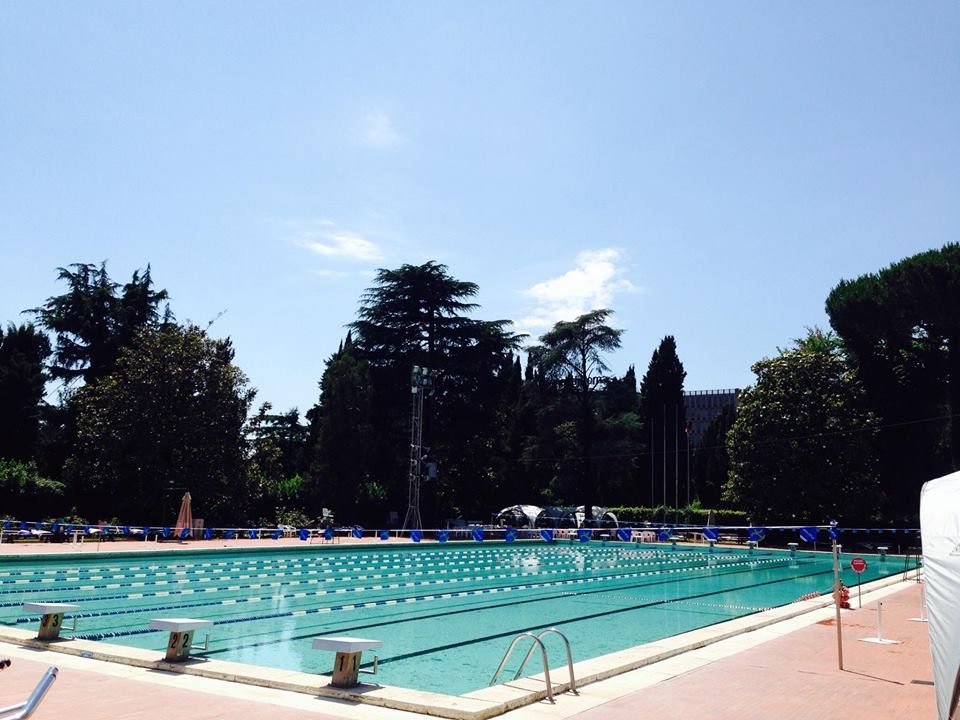
Piscina delle Rose is on Viale America, in the heart of Rome's Europa district, commonly called Eur, a few steps from the artificial lake that gives the whole area its name. It's a regulation pool, 50 meters by 25, built between 1958 and 1960 to host training and some of the group-stage matches of the water polo tournament at the Rome 1960 Olympic Games. The name has nothing poetic or random about it: it comes from the solarium next to the pool, decorated with flower beds and rose-shaped floral motifs, which gave the facility the nickname it still carries today. It's part of the Eur system of sports facilities together with the nearby Palazzo dello Sport, and it's a few minutes' walk from Eur Lake and from the Palazzo della Civiltà Italiana, the so-called Square Colosseum. For anyone who loves twentieth-century sports history, and for anyone who simply wants a public pool in a green, monumental setting, this facility holds two different Romes in one place: the Olympic Rome of 1960, made of reinforced concrete and building records, and the more informal one of summer days spent diving, sunbathing and lounging on sunbeds a short walk from one of the most photographed neighborhoods in the city.
Where to find Piscina delle Rose and how to get there
The Eur district takes up a large area south of the historic center, between Via Cristoforo Colombo and Via Laurentina, and has its own subway line. Getting to Piscina delle Rose from anywhere in Rome is therefore easy, and you don't need a car unless you're coming from outside the city or prefer to get around on your own.
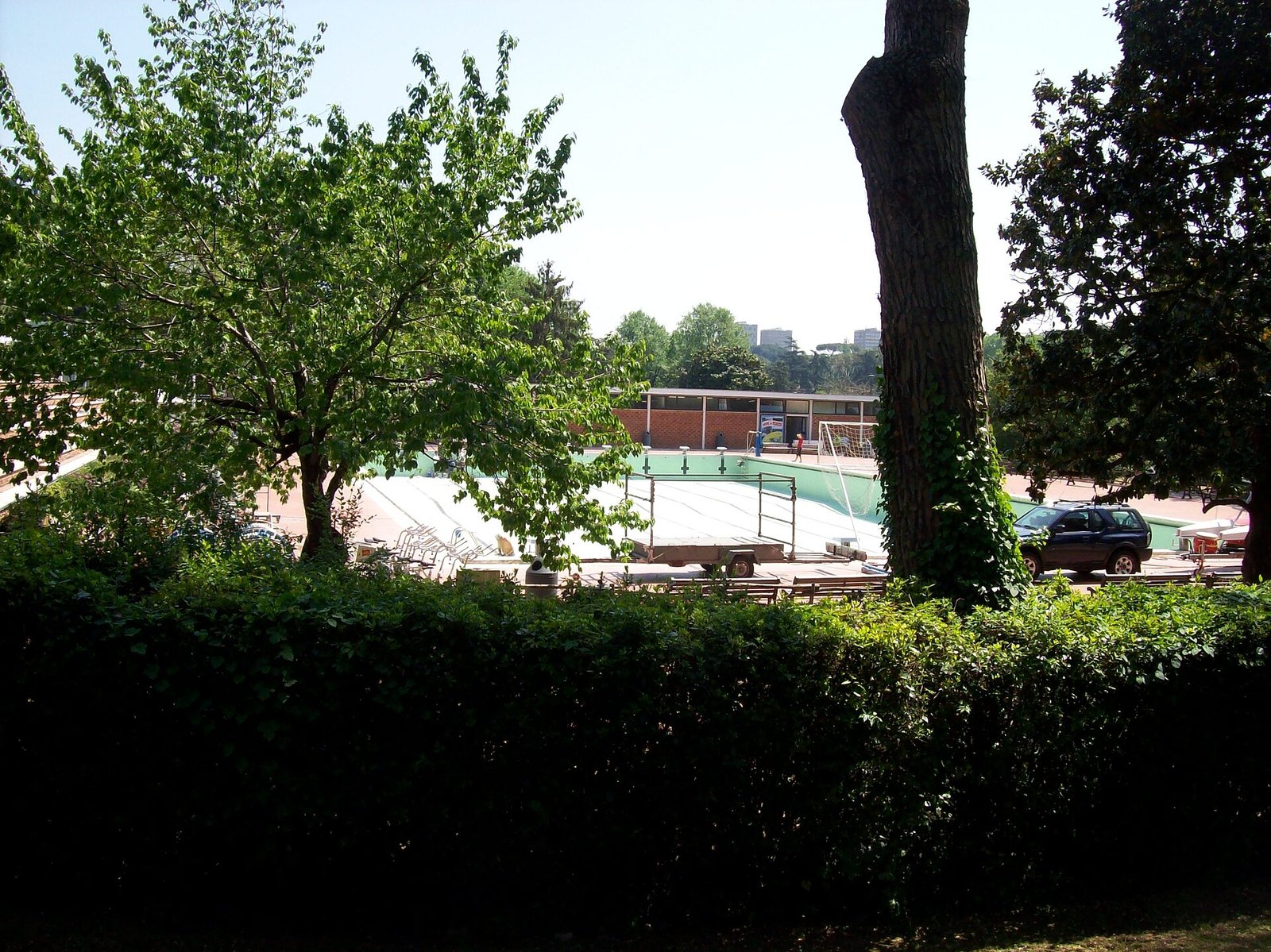
By subway: Line B and the Eur stops
Subway Line B runs through the whole district with four stops: Eur Magliana, Eur Palasport, Eur Fermi and Eur Laurentina. The most convenient stop for Piscina delle Rose is Eur Palasport, from which you reach the facility in about 10 minutes on foot along Viale America toward the lake. Alternatively, you can get off at Eur Fermi and cross the district past the Palazzo della Civiltà Italiana, a slightly longer route that lets you see one of the most photographed monuments in Rome without any detour. From Termini station the subway trip, with one change, takes about half an hour.
By car and by bus
If you come by car, the facility faces Viale America, a short distance from Via Cristoforo Colombo junction, the road that connects Eur to central Rome and continues toward the Ostia coast. Several city bus lines cross the district and stop near the lake. If you're staying in the central area, though, the subway is still the quickest option, because it avoids the traffic on Via Colombo at rush hour and on summer weekends, when the district fills up with people heading to the lake or to the nearby Eur Social Park.
On foot, from the lake and the Eur monuments
If you spend the day at Eur, Piscina delle Rose is a natural stop on a longer walk. The artificial lake, with its tree-lined perimeter, is a few minutes away on foot. The basilica of Saints Peter and Paul, with its dome that dominates the district from the top of the hill, is about 20 minutes' walk away, and so is the Museum of Civilizations. If you like walking, you can build an itinerary that touches all these points in a few hours, without ever straying far from Line B.
Eur Lake, the pool's direct accomplice
Anyone planning the visit would do well to treat Piscina delle Rose and Eur Lake as one large space, because that's exactly how they were conceived and used since 1960. The artificial lake, dug during the years the district was built, isn't just an ornamental body of water. During the Olympic Games it hosted the canoeing events, which thus took place, a few hundred meters away, alongside the swimming disciplines and the water polo played in the nearby pool. Period footage from the Istituto Luce, documenting the canoe races held right on Eur Lake, conveys well the idea of an entire section of the district conceived as a single hub for water sports, with the pool, the lake and the surrounding green areas making up one large open-air facility.
Useful distances to keep in mind
For those coming from outside Rome, a few distances help place the facility within the city. From the historic center, the Colosseum or Imperial Forums area, Piscina delle Rose is about 20 minutes away by subway with one change. From Fiumicino airport the quickest connection is the train to Roma Termini and from there Line B to Eur, for a total time of around an hour. From Ciampino airport it's better to take a road transfer to a subway station, with times that vary depending on traffic on Via Appia Nuova and the Grande Raccordo Anulare. If you're staying at a hotel in the Eur area, which is more and more common given the district's proximity to the trade fair and business hubs, the pool is practically at your doorstep.
What Piscina delle Rose really is: an Olympic facility built for Rome 1960
A bit of clarity is needed here, because the name suggests a garden with an ornamental pool, while in reality this is a regulation sports facility, built with competition criteria and not merely decorative ones. The pool measures 50 meters in length by 25 in width, the standard measurements required for international swimming and water polo competitions, and it's made of reinforced concrete following the construction techniques of the time. The solarium with the rose flower beds, which surrounds the pool on the side facing the lake, is the part that gave the facility its popular name, and it's both an urban park and a relaxation area for those who use the facility.
The design and construction between 1958 and 1960
The pool was designed by the architect Sergio Buonamico together with the engineers Guido Gigli and Giorgio Biuso, and built in record time between 1958 and 1960 to be ready for the Olympic Games. The total cost was 90 million lire of the time, a major sum for a single swimming facility in those years. The original structure included a fixed grandstand with 2,000 seats, to which a temporary grandstand with 1,850 seats was added during the Olympics to absorb the crowds expected for the water polo tournament.
The decision to build a second large swimming facility at Eur, far from the historic sports hub of the Foro Italico in the north of the city, answered a specific need: to decentralize the Olympic facilities and give the Eur district, born in the 1930s for a universal exposition that was never held, a sports role on top of the monumental and residential one it already had. The result is that Rome 1960 left two distinct swimming hubs as a legacy, the historic one at the Foro Italico and the more recent one at Eur.
The Eur district around the pool
Understanding Piscina delle Rose means understanding the district it sits in. Eur was born in the late 1930s as the site of the Universal Exposition planned for 1942, a monumental urban planning project that the Fascist regime imagined as a showcase of the new Italy. The war stopped everything halfway, leaving standing only some of the planned buildings, among them the Palazzo della Civiltà Italiana, designed by Giovanni Guerrini, Ernesto Bruno La Padula and Mario Romano and now one of the most recognizable architectural symbols of Rome. After the war the district was completed and converted to mixed use, residential, business and sports, and the 1960 Olympics were precisely the occasion to equip it with modern facilities such as this pool and the nearby Palazzo dello Sport, signed by Pier Luigi Nervi and Marcello Piacentini. For a broader picture of the district, it's worth reading the page dedicated to Eur, Universal Exposition Rome.
From the exposition that never was to a district of offices and homes
The 1942 Universal Exposition project, which gave Eur its acronym, was meant to celebrate 20 years of the regime with a monumental urban layout made of perspective axes, travertine buildings and classicizing statuary: an architectural language we now call Italian rationalism and which, with the war stopping the works halfway, remains especially vivid precisely because the project was never completed according to the original design. After the war the political choice was not to tear down what had already been built, but to complete the district by adapting it to new functions, first residential and business, then sports as well with the occasion of the 1960 Olympics. The result is a district that today hosts ministries, headquarters of large companies, the central state archive and embassies, mixed with sports facilities, parks and homes, an extremely rare case in Roman urban planning of rebuilding an entire section of the city starting from a project left unfinished for an event that never took place.
The Palazzo dello Sport, the pool's sports twin
The Palazzo dello Sport, designed by the engineer Pier Luigi Nervi together with the architect Marcello Piacentini and built between 1957 and 1960, is the structure that best tells, along with Piscina delle Rose, the construction season that made Eur a true Olympic hub. The great ribbed dome roof, a masterpiece of Nervi's structural engineering, hosted the basketball games during the Olympics and in the following years became one of the largest indoor venues in the city, used for major sports events and concerts. Walking from Piscina delle Rose to the Palazzo dello Sport, a few minutes along Viale America, means physically crossing two of the most concrete legacies the 1960 Olympics left to the Eur district.
The Rome 1960 Olympics at Piscina delle Rose
During the 1960 Games, held between August 25 and September 11, Piscina delle Rose was not the main venue for the swimming events, which remained the Olympic Swimming Stadium at the Foro Italico. It was instead a training facility for the aquatic sports athletes and the venue for part of the group-stage matches of the water polo tournament, the discipline that more than any other has tied the name of this pool to Roman Olympic history. The teams entered in the tournament played at several facilities at the same time to complete the group schedule in a short time, and Piscina delle Rose was one of the two pools involved in this phase of the tournament.
The facility also hosted the training sessions of many athletes competing in the aquatic disciplines of the Games, at a time when the Eur district, with its wide green spaces and its closeness to the lake, had become a sort of second logistical base for water sports, complementary to the Foro Italico. It's in this context that one of the most frequently cited historical images tied to the pool should also be read, that of the Australian swimmer Dawn Fraser pictured during a training session at the facility, direct evidence that the pool was fully part of the Games' logistical program and not a mere backup facility.
The Settebello and the Olympic gold of Italian water polo
The Rome 1960 water polo tournament remains, for Italian sport, one of the most celebrated chapters of the whole edition of the Games: the Italian national team, nicknamed the Settebello, won the gold medal in front of the home crowd, a result that the Italian Swimming Federation still remembers today as one of the founding pages of national aquatic sport. The group-stage matches also played at Piscina delle Rose were therefore part of the path that led the team to the final success, then played at the main Foro Italico facility: a detail that links, even if indirectly, this peripheral Eur pool to one of the most remembered sporting triumphs in Italian Olympic history.
A curiosity about Piscina delle Rose
The popular name by which everyone knows this facility, Piscina delle Rose, doesn't appear in any original project as an official designation: it arose spontaneously from the flowered solarium that surrounds the pool, laid out with rose flower beds that in the 1960s must have looked like an almost exotic touch next to a reinforced-concrete sports facility. It's one of those cases, not rare in Rome, where the popular nickname ends up completely replacing the technical name, so much so that today finding the official designation of the time requires consulting the project papers, while anyone in Rome, when asking for directions, understands right away what is meant by simply saying Piscina delle Rose.
There's also a lesser-known detail about the size: the 50 by 25 meter pool is not a format chosen at will, but the standard required by the international swimming federation for Olympic-level competitions, the same found in the big pools built around the world for the Games. Seeing this regulation size framed by a rose garden, in a district born to celebrate a universal exposition that never happened, is one of the most curious contrasts in the whole Eur complex.
Something nobody tells you about Piscina delle Rose
Anyone arriving at Eur thinking they'll find a facility unchanged since 1960 is left disoriented: Piscina delle Rose has gone through decades of different managements, renovation works and, more recently, years of legal disputes that no tourist guide tells in full. In 2007 Ente Eur, the owner of the facility, carried out a renovation that added an indoor pool and a restaurant next to the original open-air pool, widening the offer well beyond the simple summer swimming for which the facility had been conceived.
What is rarely told is that in recent years the management of the facility ended up at the center of a long-running legal case, with an operator that occupied the structure without paying the fee due, building up a considerable debt toward the owner. The dispute ended with an order to vacate the property, carried out in September 2023, followed by the publication, by Eur Spa, of a new tender to reassign the management of the facility. On some points of this affair, in particular the exact chronology between the suspension of the first tender and the carrying out of the eviction, the sources don't fully agree: some place a first suspension of the release procedures as early as the spring of 2023, others make the decisive moment coincide with the clearing of the premises in the autumn of the same year. What is certain is that the new assignee, identified through a public tender with a base annual fee on the order of about 239,000 euros, committed to carrying out at its own care and expense the works to restore the facility to full functionality and to remove the unauthorized construction done by the previous management.
Another detail few people know concerns the double soul of the facility: on one side the swimming facility open to the public, with swim courses, a fitness area and summer swimming. On the other, the home of a sports club that uses the pool for competitive training, including top-level women's water polo teams and the rowing and canoeing activities that also make use of the nearby lake. So it's not just a pool for summer swimming, but a true multipurpose sports center set in one of the most monumental districts of Rome.
Finally, there is an aspect that rarely makes it into general tourist guides: Eur is not just a district to photograph, it's also one of the areas of Rome where ministries, headquarters of large public and private companies, the central state archive and several museums are concentrated, from the Museum of Civilizations to the Museum of Prehistory and Protohistory. This means that on weekdays Piscina delle Rose also lives off an audience different from the purely tourist one: office workers from the area who use the facility on their lunch break or after work, university students from nearby faculties, families living in neighboring districts. It's a detail that helps explain why, unlike many other large historic Italian pools that have become almost exclusively postcard attractions, this one remains a living facility used daily, before being a monument to visit.
The advice I give you for visiting Piscina delle Rose
The most useful advice I can give is not to treat Piscina delle Rose as an isolated stop, but as part of a wider walk through the Eur district, which on its own deserves a good half day. Get off at the Eur Fermi or Eur Palasport stop of subway Line B, start from the Palazzo della Civiltà Italiana, continue toward the lake walking alongside it at an easy pace, and arrive at the pool as the last stop before heading back to the subway. It's a route that in a couple of hours combines rationalist architecture, urban green space and Olympic sports history, three different faces of the same district that are rarely told together.
A second piece of advice, practical and often underestimated: before organizing a visit tied to swimming, swim courses or a specific event, it's best to check directly with the current management for hours, rates and access arrangements, because the facility has changed operator several times in recent years and the information found online, including that reported in news articles, can turn out to be outdated within a single season. If instead you simply want to see the facility and the rose solarium without swimming, you can do so by walking along the outer perimeter, which faces Viale America directly and is visible even without going in.
A third piece of advice concerns how to experience the district more than the pool itself: Eur is one of the few sectors of Rome designed from the start to be covered on foot along wide tree-lined avenues, with broad sidewalks and generous crossings, very different from the alleys of the historic center. It's therefore worth arriving in comfortable shoes and allowing for a walk of several kilometers if you really want to touch all the main points, from the lake to the Palazzo della Civiltà Italiana, from the pool to the Palazzo dello Sport, without relying only on public transport for short trips. If you're traveling at a very hot time of year, you'll do well to concentrate the walking part in the cooler morning hours, leaving the rest of the day to the pool or to the shade of the gardens around the lake.
Management, closures and reopenings of Piscina delle Rose
Retracing the management history of this facility also means understanding why, at different times, Piscina delle Rose has been described as closed, in dispute or about to reopen: they are all true snapshots, but taken at different moments of a longer story. The owner of the structure, today as originally, is Eur Spa, a company held in large majority by the Ministry of Economy and Finance and in a smaller share by Roma Capitale, which entrusts the operational management of the facility to private parties through public tender.
Between the late 2000s and the following decade, management was entrusted to a company that, according to what the local press has reconstructed, is said to have ended up occupying the facility without regularly paying the fee due to the owner. The affair dragged on in court for a prolonged period, until the order to vacate the property carried out in September 2023 by a court bailiff on the order of the civil section of the Rome court. On this point the sources differ slightly on the intermediate dates of the dispute, some placing a first suspension of the procedures as early as the spring of 2023 because of practical difficulties in carrying out the clearing of the premises: the sources don't agree on the chronological detail, but they all agree that the actual release of the facility took place during 2023.
Once the dispute ended, Eur Spa published a new public tender for awarding the management of the structure, with the stated aim of carrying out works to restore, make more efficient and relaunch the complex, as well as removing the unauthorized construction done by the outgoing management. The tender provided for a base annual fee on the order of about 239,000 euros and required the awardee to take direct charge of the works to recover the full functionality of the facility. Following this step, management was entrusted to the sports club Sis Roma, in collaboration with a consulting firm, which brought the facility back to public use with swim courses, a renewed fitness area and summer swimming, reopening the swimming season in June 2024 and continuing with the following season in the spring of 2025. It must be said clearly that these are historical data tied to past seasons, not an indication of hours or rates to be considered valid today: anyone planning a visit must check the updated situation directly with the management in charge at the time of travel, because it's not possible to establish with certainty, on the basis of the available sources, whether the facility is open today under the same arrangement described for the 2024 and 2025 seasons.
One element on which the sources do agree concerns the nature of the management fee: it's a public facility granted in concession, not a private property, and each operator that follows is required to respect conditions set by Eur Spa, including those on extraordinary maintenance and on removing any unauthorized construction accumulated by the previous management. This mechanism, which took years to enforce in the case of the operator evicted in 2023, is the reason why the recent history of the facility tells more of administrative disputes than of sporting events: a trajectory common to several large Roman public structures built for a specific event and then entrusted, in the following decades, to a sequence of private concessionaires with mixed results.
Another well-known fact, yet rarely cited
That Piscina delle Rose is a 1960 Olympic facility is known by more or less everyone who lives in Rome or visits Eur. What is cited far less often is the role this kind of structure played in transforming the city's sporting image after the war. Rome arrived at the 1960 Games with a district, Eur precisely, that had remained for years a half-finished construction site, an unfinished testimony of a political project that failed along with the regime that conceived it. The Olympics gave the municipality and the State the occasion and the funds to complete that district with a new use, sporting and public, that had nothing to do with the monumental rhetoric of the 1930s.
Piscina delle Rose, together with the Palazzo dello Sport, represents exactly this passage: a modern, functional sports facility, designed for an international event, built inside a district whose main architecture, like the Palazzo della Civiltà Italiana, told of a completely different era and a completely different ideology. It's a fact few people line up, but it explains well why walking around Eur today means crossing two different Romes in the same afternoon: the monumental one of the 1930s and the sporting and public one of the 1960s, which coexist here a few hundred meters from each other.
The right photo to take at Piscina delle Rose
The frame that best captures this place is not the close-up of the pool, which looks like any Olympic pool in the world, but the shot that holds together the long stretch of water, the solarium with the rose flower beds on the edge and, in the background, the profile of the Eur district with its squared architecture. It's a photograph that tells sport and urban planning together, two elements that can't be separated here.
The best time is late morning or early afternoon on days when the facility is open to the public, when the light is high and even and the water surface clearly reflects the lines of the grandstand. If you prefer a more architectural image, you can stop on the outer perimeter along Viale America, from where the complex is seen as a whole, with the green of the solarium standing out sharply from the concrete of the service structures. To widen the shot to the context, it's worth a few more steps to the lake, including in the same photo walk the silhouette of the Palazzo della Civiltà Italiana that dominates the district from afar.
Some important events that happened here in history
The first event, the most significant, is the construction of the facility itself between 1958 and 1960, carried out in very tight time to meet the Olympic deadline: a building site that is part of the great infrastructure mobilization Rome undertook in the late 1950s to be ready to host the Games, along with the construction of the nearby Palazzo dello Sport and many other sports and road works across the city.
The second event is the actual running of the Olympic Games, between August 25 and September 11, 1960, when Piscina delle Rose went into operation as a training venue for aquatic sports and as the stage for some of the group-stage matches of the water polo tournament, helping to relieve the schedule of the competitions held at the same time at the city's other large swimming facility, the one at the Foro Italico.
The third event, much more recent, is the renovation carried out in 2007 by Ente Eur, which added to the original open-air pool an indoor pool and a restaurant, permanently widening the functions of the facility and transforming it from a simple Olympic legacy into a sports facility in use throughout the year, no longer tied only to the summer season.
The fourth event is the conclusion, during 2023, of the long legal dispute over the management of the facility, with the release of the structure carried out by the court bailiff and the publication that followed of a new public tender by Eur Spa: a step that marked, according to the reports of the time, the start of a relaunch phase for the facility after years of management uncertainty, with the management awarded to the sports club Sis Roma and the reopening of the swimming season in June 2024.
The fifth event, less spectacular but no less relevant for understanding the district, concerns the completion of Eur as a whole during the 1950s: the district that hosts Piscina delle Rose went in a few years from a suspended, semi-abandoned construction site to a fully functioning residential, business and sports district, a process of urban transformation with few comparisons in Rome for speed and scale, and which had in the 1960 Olympics its moment of greatest acceleration and its most visible public test.
Who has passed through Piscina delle Rose
Among the most cited photographic records of the facility's history is the Australian swimmer Dawn Fraser, one of the greatest figures of world swimming of those years, pictured during a training session in the Eur pool on the occasion of the 1960 Games: an image that confirms how Piscina delle Rose was fully part of the Olympic logistics and not a mere secondary facility kept apart from the Foro Italico.
Over the following decades, generations of athletes have passed through Piscina delle Rose, using the facility for competitive training in swimming, water polo, rowing and canoeing, thanks also to the closeness of Eur Lake, which makes it possible to alternate pool training with open-water training. In recent years the structure has hosted the training sessions and competitions of the women's water polo team of the sports club that now manages the facility, bringing the pool back to a competitive function very close to the one it was originally designed for in 1960. More generally, the pool has seen, season after season, thousands of Romans who made it the reference public pool of the Eur district, a role that, leaving the years of litigation aside, remains the common thread of its whole history.
The technicians who in the 1950s designed the new system of Eur facilities also deserve a place in this list, because without the choices made by those who then had to complete in very tight time an entire district left half-finished by the war, this pool simply wouldn't exist. The architect Sergio Buonamico and the engineers Guido Gigli and Giorgio Biuso, by signing the pool project, left Rome a facility that has gone through more than 60 years of the city's sports and administrative history while remaining, in substance, faithful to the original design.
The architecture and spaces of Piscina delle Rose
Seen from above, the pool fits almost geometrically into the overall layout of the district, with the elongated rectangle of the pool aligned with Viale America and the solarium forming a green band between the sports structure and the trees that line the nearby lake. This regular layout, typical of Eur's urban planning, is found identically in many other corners of the district, from the great straight avenues to the buildings aligned on precise perspective axes, and it's part of the reason why anyone who photographs Eur from above, with a drone or simply from a high floor of one of the surrounding buildings, recognizes at a glance the compositional logic conceived in the 1930s and never really abandoned in the following decades.
Beyond its sports function, Piscina delle Rose is also a small compendium of Roman architecture of the second half of the twentieth century. The reinforced-concrete pool, with its fixed tiered grandstand, belongs to the same construction family as the nearby Palazzo dello Sport, with technical solutions designed for large crowds and intensive use during the Olympic event. The solarium with the rose flower beds, which surrounds the pool on the side facing the lake, introduces instead a completely different register, closer to a public garden than a sports facility, and it's precisely this contrast between the concrete of the pool and the flowering green of the solarium that makes the facility recognizable compared with any other Olympic pool built in the same period in Italy.
The indoor pool and the restaurant added in 2007
The renovation promoted by Ente Eur in 2007 added to the original complex an indoor pool, designed to extend use of the facility into the cold months, and a restaurant overlooking the open-air pool area. From an architectural point of view it's a modern expansion, distinct in materials and language from the original 1960 structure, which coexists with it without overlapping the historic design of the main pool and the solarium. For those visiting the facility today, this layering between Olympic construction and contemporary extension is an integral part of what you see, and it's a good example of how Eur's sports facilities have been adapted over time to uses different from those they were originally conceived for.
When to go to Piscina delle Rose
Piscina delle Rose, by its nature, is tied to the summer season: the main open-air pool is designed for swimming in the warm months, when the facility is open to the public with sunbeds, umbrellas and bar service. The swimming seasons of recent years have generally opened between the end of May and the beginning of June, but these dates, like all seasonal information tied to a management that may change, should be checked directly with the facility before organizing a visit, without assuming they match those of a previous year.
Outside the summer season, the Eur district can still be visited with the same intensity, because the value of the area doesn't depend on the pool alone: the lake, the rationalist buildings and the museums of the area can be visited all year, and walking around Piscina delle Rose on a winter day, with the solarium bare and the pool possibly closed to the public, is still an experience that lets you appreciate the facility's architecture without the crowds of the swimming season.
The weekend remains the time of greatest crowds for swimming, particularly in July and August, when many Romans who don't go to the sea choose Piscina delle Rose as the nearest alternative and the less demanding one in terms of travel time. Anyone who wants to avoid the crowds can aim for weekdays or the early morning hours, following the same logic that applies to any large public facility in the city: arriving early means finding more space, shorter lines at the ticket counters and more relaxed service from the staff.
Piscina delle Rose with kids
When the facility is open to the public for the summer season, the presence of swim courses and a fitness area also designed for families makes the structure a practical choice for those looking for an alternative to the sea on Roman weekends. As with any information tied to hours and available services, it's still best to check in advance with the management whether the children's activities are running during the period of the visit, because they may vary from one season to the next.
Accessibility
The facility, by its nature as a large public sports structure built in the modern era, generally has flat routes and wide outdoor spaces around the pool. The specific provision of services for people with disabilities, such as dedicated changing rooms or aids for entering the water, should nonetheless be checked directly with the management in charge at the time of the visit, because it may have changed over the course of the management changes the facility has gone through in recent years.
Piscina delle Rose and the district's evening events
In the summer months the Eur district, besides daytime swimming at the pool, also offers an evening entertainment program tied to the nearby Eur Social Park, which sits next to the lake area with events, live music and initiatives designed to extend the day beyond the pool's closing time. Anyone organizing a day trip to Eur can therefore build a program that starts with a morning swim, continues in the afternoon with a visit to the district's monuments and ends in the evening with an outdoor event near the lake, thus using the whole day without having to change area of the city.
What's around Piscina delle Rose
A few steps away is Eur Lake, an artificial body of water surrounded by a large wooded park, a usual destination for running, walks and free time for those who live or work in the district. Continuing toward the heart of Eur you come to the Palazzo della Civiltà Italiana, the famous Square Colosseum, one of the most photographed buildings in Rome and a symbol of the rationalist architecture of the 1930s.
A short distance away stands the Palazzo dello Sport, signed by Pier Luigi Nervi and Marcello Piacentini, built like Piscina delle Rose in view of the 1960 Games and today used for large sports events and concerts. Not far away is the basilica of Saints Peter and Paul, with its imposing dome visible from much of the district, and the Museum of Civilizations, which holds ethnographic and archaeological collections in one of Eur's historic buildings. For those who want to extend the day with a moment of evening leisure, the Eur Social Park organizes events and entertainment in the summer months a short distance from the lake. Anyone who instead wants to compare this sports hub with the city's historic one can read the page dedicated to the Foro Italico and the Olympic Stadium, the other great sporting heart born or relaunched on the occasion of the Roman Olympics.
Anyone looking for a quieter break after the walk between pool and lake can stop along the tree-lined paths that surround the body of water, appreciated by locals for the morning run or for a rest in the shade on the hottest days. The combination of monumental architecture, well-kept green space and sports facilities still in use makes the area around Piscina delle Rose one of the stretches of Rome where the original urban plan, however unfinished compared with the ambitions of the 1930s, can still be read very clearly almost a century later.
Quick questions about Piscina delle Rose
Where exactly is Piscina delle Rose?
On Viale America, in the Eur district of Rome, a few minutes' walk from the artificial lake and the Palazzo della Civiltà Italiana.
Why is it called Piscina delle Rose?
The name comes from the solarium next to the pool, laid out with rose flower beds since its construction, which gave the facility the nickname it's still known by today.
When was Piscina delle Rose built?
Between 1958 and 1960, in preparation for the Rome 1960 Olympic Games, designed by the architect Sergio Buonamico and the engineers Guido Gigli and Giorgio Biuso.
How big is the pool?
It's a regulation pool 50 meters long by 25 wide, the standard size required for international swimming and water polo competitions.
What role did the pool play at the 1960 Olympics?
It hosted the training of athletes in the aquatic disciplines and part of the group-stage matches of the water polo tournament, alongside the Olympic Swimming Stadium at the Foro Italico.
Is Piscina delle Rose open to the public today?
Based on the available sources it's not possible to establish with certainty the current state of the facility: in recent years it has gone through periods of different management, a long legal dispute that ended in 2023 and a reopening to the public in the 2024 season, continued in the 2025 season under a new management. Anyone who wants to organize a visit must check the updated situation directly with the facility at the time of travel.
How do you get to Piscina delle Rose by public transport?
By subway Line B, getting off at the Eur Palasport or Eur Fermi stop and continuing on foot for a few minutes along Viale America.
What is near Piscina delle Rose?
Eur Lake, the Palazzo della Civiltà Italiana, the Palazzo dello Sport, the basilica of Saints Peter and Paul and the Museum of Civilizations, all reachable on a walk of a few minutes.
Does Piscina delle Rose have an indoor part?
Yes, since 2007, when a renovation promoted by Ente Eur added an indoor pool and a restaurant to the original open-air pool.
Who runs Piscina delle Rose today?
After the public tender that followed the end of the 2023 dispute, the management was assigned to the sports club Sis Roma in collaboration with a consulting firm, which reopened the facility in the 2024 season. Any later management changes should be checked with updated sources.
Who is the swimmer pictured training at Piscina delle Rose?
One of the most frequently cited historical images shows the Australian Dawn Fraser during a training session at the facility on the occasion of the 1960 Olympic Games.
Why does Eur have two large swimming hubs, one at the Foro Italico and one at Piscina delle Rose?
To decentralize the 1960 Olympic facilities and give the Eur district, completed precisely in view of the Games, a sports role independent of the historic hub of the Foro Italico, in the north of the city.
Is Piscina delle Rose suitable for those visiting Eur as tourists?
Yes, even without swimming: the outer perimeter, facing Viale America, can be seen while walking and is a natural stop on an itinerary that includes the lake, the Palazzo della Civiltà Italiana and the Palazzo dello Sport.
What is the Eur district and where does the name come from?
The acronym stands for Esposizione Universale Roma, the name of the great event planned for 1942 and never held because of the war. The district was then completed after the war as a residential, business and sports area.
Who designed the Palazzo della Civiltà Italiana near the pool?
The architects Giovanni Guerrini, Ernesto Bruno La Padula and Mario Romano, in the 1930s, as the symbol building of the 1942 Universal Exposition project.
Which Olympic discipline made the pool famous, besides swimming?
Water polo: Piscina delle Rose hosted part of the group-stage matches of the 1960 tournament, which Italy, the Settebello, won by taking the gold medal.
Is Eur Lake also connected to the pool from a sporting point of view?
Yes: during the 1960 Olympics the lake hosted the canoeing events, while the nearby pool was devoted to swimming and water polo, in a single large sector dedicated to water sports.
How much did it cost to build Piscina delle Rose in 1960?
The total cost was 90 million lire of the time, a significant sum for a single swimming facility built in less than two years.
How many seats did the pool's grandstand have at the Olympics?
2,000 seats in the fixed grandstand, to which a temporary grandstand with 1,850 seats was added specially for the 1960 Games.
The Eur district, with its history suspended between a universal exposition that was never celebrated and an Olympics that did take place, remains one of the most interesting corners of Rome for those looking for something different from the historic center. Piscina delle Rose is a concrete chapter of it: a sports facility born in a few months for an international event, survived decades of management changes, disputes and works, and arrived today remaining, in substance, what it was in 1960, a regulation pool surrounded by a rose garden, in the middle of one of the most photographed districts of the capital.
Frequently asked questions about Piscina delle Rose
Where exactly is Piscina delle Rose?
Piscina delle Rose is on Viale America, in the Eur district of Rome, a few minutes' walk from the artificial lake and the Palazzo della Civiltà Italiana. The Eur district takes up a large area south of the historic center, between Via Cristoforo Colombo and Via Laurentina, and has its own subway line.
Why is it called Piscina delle Rose?
The popular name Piscina delle Rose doesn't appear in any original project as an official designation: it arose spontaneously from the flowered solarium that surrounds the pool, laid out with rose flower beds since the facility was built in the 1960s. It's one of the cases, not rare in Rome, where the nickname ended up replacing the technical name.
When was Piscina delle Rose built?
Piscina delle Rose was built between 1958 and 1960, in very tight time to meet the Olympic deadline of the Rome 1960 Games. The pool measures 50 meters in length by 25 in width, the regulation measurements required for international swimming and water polo competitions, and it's made of reinforced concrete.
Is Piscina delle Rose always open?
Piscina delle Rose, by its nature, is tied to the summer season: the main open-air pool is designed for swimming in the warm months, when the facility is open to the public with sunbeds, umbrellas and bar service. Over the years the structure has also gone through decades of different managements, renovation works and periods of legal dispute, so seasonal opening dates should be checked year by year.
Who has frequented Piscina delle Rose?
Among the most cited photographic records of the history of Piscina delle Rose is the Australian swimmer Dawn Fraser, one of the greatest figures of world swimming of those years, pictured during a training session in the Eur pool on the occasion of the 1960 Olympic Games, confirming the facility's role in the Olympic logistics.
How do you get to Piscina delle Rose?
Piscina delle Rose is easily reached by subway on Line B, getting off at the Eur stops such as Eur Fermi or Eur Palasport. It's a simple route that doesn't require a car, except for those coming from outside the city or who prefer to get around the district on their own.
What is near Piscina delle Rose?
A few steps from Piscina delle Rose is Eur Lake, an artificial body of water surrounded by a large wooded park, a usual destination for running and walks. Continuing toward the heart of Eur you come to the Palazzo della Civiltà Italiana, the famous Square Colosseum, one of the most photographed buildings in Rome.
Article written by the editorial team of TourLeaderPro, contact them for Private/Corporate/V.I.P. Tours and Experiences. For a guided walk in the Eur district, through rationalist architecture and Olympic history, with a licensed tour leader, start from the TourLeaderPro contact page. Tour operators building itineraries in Rome will instead find the consulting service in the section dedicated to tour operators.
Planning a trip to Rome? The English-language guides to visiting the city are on ItalyPlanner.com. For those thinking in terms of days outside the historic center there's the guide to the best day trips from Rome, while those who want to discover other modern districts of the city will find useful ideas in the section dedicated to places to visit in Rome.
Contact Information
Viale America, 20
Roma Roma Città, Roma Città