Temple of Antoninus and Faustina
In short. The Temple of Antoninus and Faustina stands on the northern side of the Roman Forum, along Via Sacra, between the Basilica Aemilia and the Temple of Divus Romulus, and it is probably the monument that best explains, all at once, what…
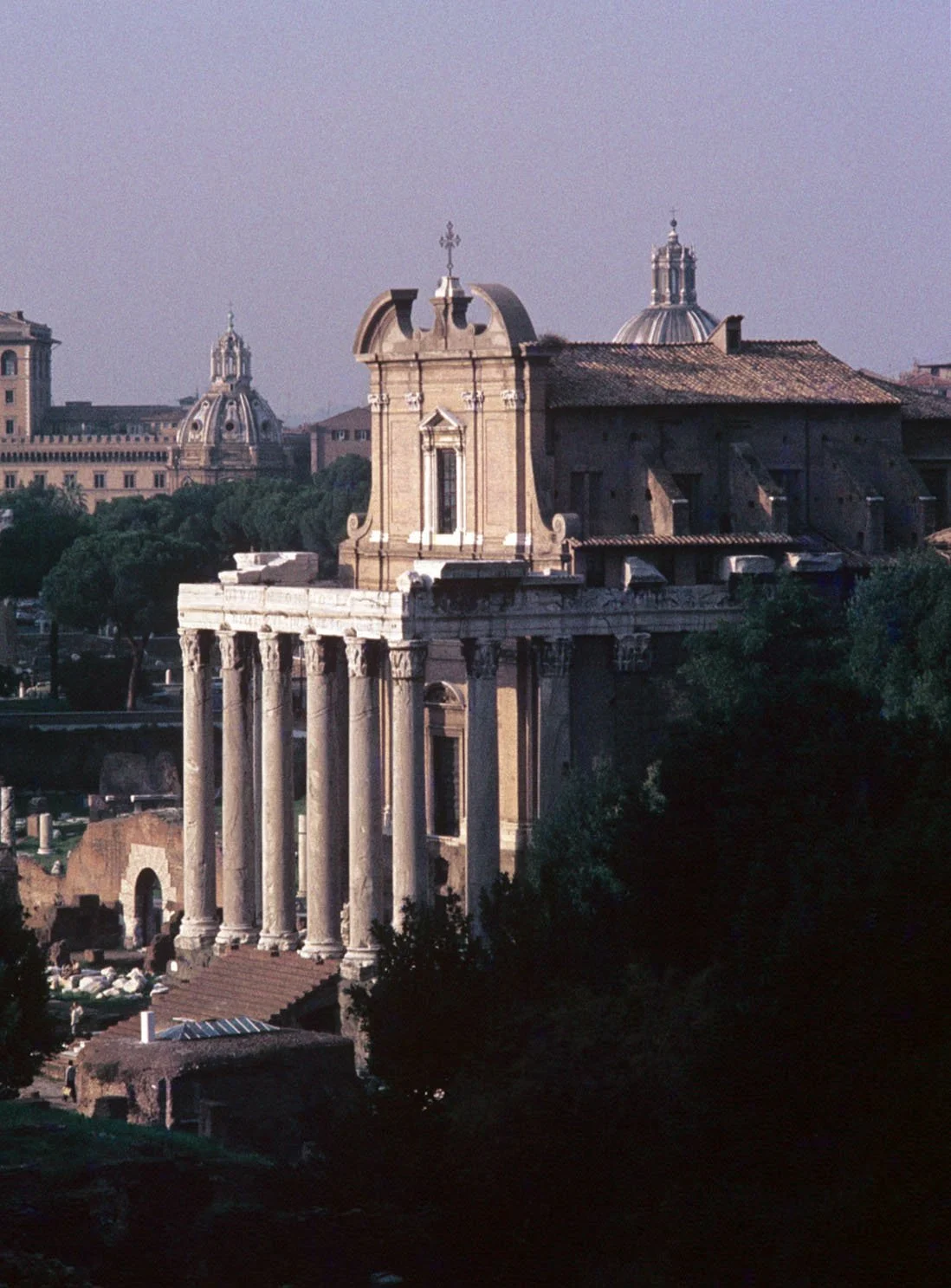
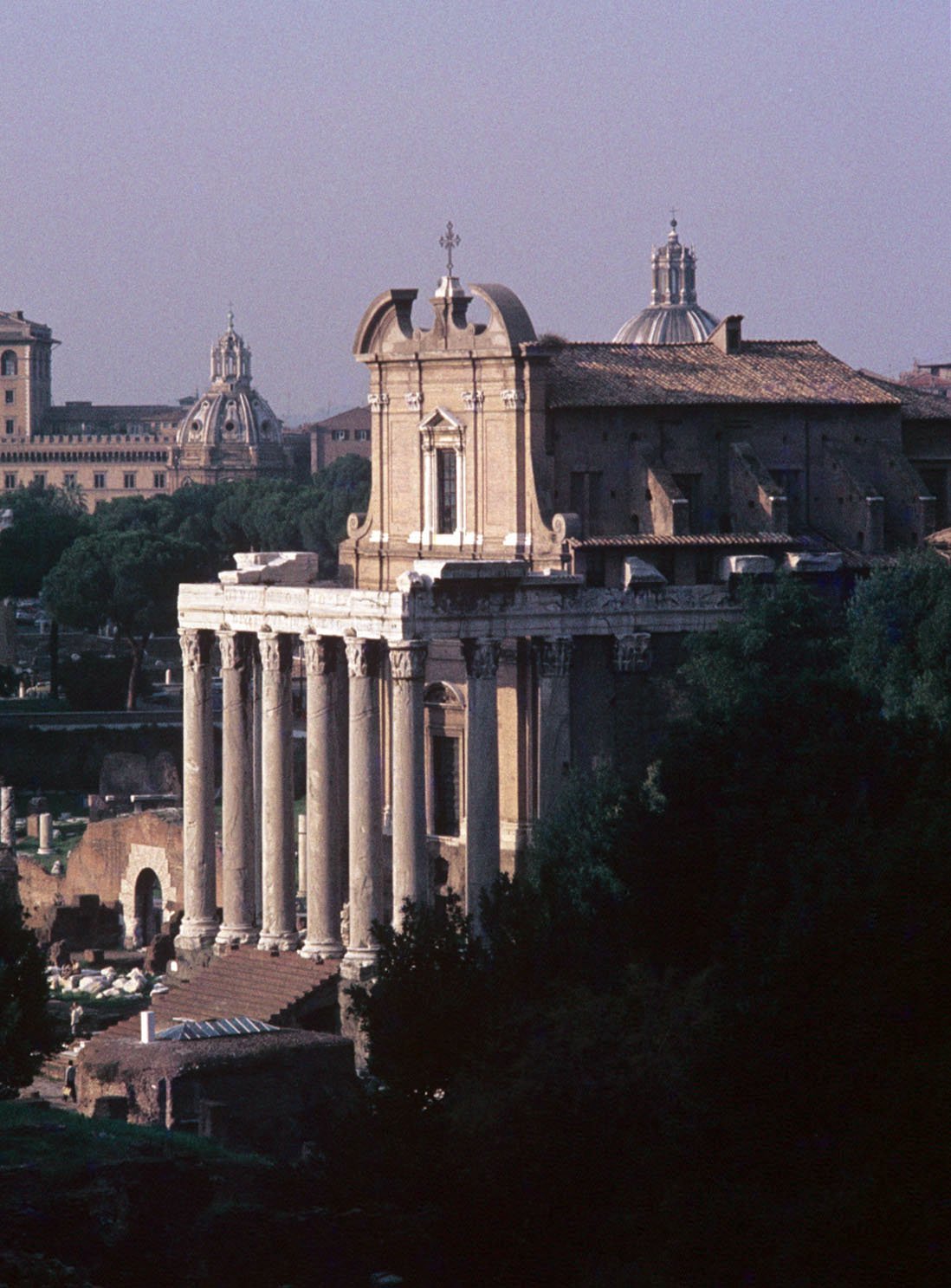
The Temple of Antoninus and Faustina stands on the northern side of the Roman Forum, along Via Sacra, between the Basilica Aemilia and the Temple of Divus Romulus, and it is probably the monument that best explains, all at once, what the word stratification means when applied to Rome. From outside you see six enormous columns of veined gray marble, 17 meters high, with the Corinthian capitals still in place and, above them, an architrave carved in large letters with the dedication of the Roman Senate to an empress who died in the 2nd century. Above that architrave, wedged inside the temple like an oyster in its shell, rises the Baroque facade of a 17th-century church, San Lorenzo in Miranda, with its pediment, its windows and a door that opens onto empty air several meters above the excavation floor, with no steps leading up to it and no way of reaching it from the Forum side. The lines that follow tell what this building really is, when it was built and for whom, what exactly its inscription says and why it was written at two different times, what those diagonal grooves marking the columns are and why scholars disagree about them, how a pagan temple became the seat of a guild of pharmacists, and why its door is now suspended in midair. Anyone looking instead for a guide to the whole archaeological area, with all the other monuments, the tickets and the routes, will find it in the page on the Roman Forum, where this temple appears as one of the stops on the tour: here we talk only about it, and in much greater depth.
Where the Temple of Antoninus and Faustina is and how to get there
The temple occupies the north side of the Roman Forum square, facing Via Sacra, with its facade turned south toward the center of the archaeological area. A few meters behind it runs Via dei Fori Imperiali: this means the monument sits exactly on the boundary between the paid archaeological enclosure and the public street, and it is one of the very few buildings in the Forum that you can see well, in full and for free, while staying outside the perimeter of the site. The entrance to the church that occupies it, San Lorenzo in Miranda, does not in fact open onto the Forum but on the opposite side, on Via in Miranda, a small side street that branches off Via dei Fori Imperiali.
On foot from the center of Rome
From Piazza Venezia, at the foot of the Altar of the Fatherland, you take Via dei Fori Imperiali and in about 10 minutes of perfectly flat walking you reach the temple, with the ruins of the Imperial Forums on your left, including Trajan's Forum and Trajan's Markets, and on your right the balcony overlooking the Roman Forum. From the Colosseum the walk is even shorter, five or six minutes going up Via dei Fori Imperiali toward Piazza Venezia. From the Capitoline Hill you can walk down the slope that leads to the Forum or go straight to the panoramic terrace behind Palazzo Senatorio, from which the temple can be seen at an angle together with the whole ancient square.
By public transportation
The nearest subway stop is Colosseo, on line B, from which it is a five-minute walk. Anyone arriving from Termini therefore has the simplest solution possible: subway B toward Laurentina, two stops, and then the last stretch on foot along Via dei Fori Imperiali. Above ground, many bus lines serve Piazza Venezia and the Colosseum area, while Via dei Fori Imperiali is pedestrianized on the days and at the times set by the city, a condition that makes the walk much more pleasant but changes periodically and is worth checking before you plan. If you come by car from outside Rome, you'd do well to leave it in a park-and-ride lot connected to the subway: the whole Forums area is a restricted traffic zone and parking nearby is in practice impossible.
Tickets, hours and access: what you really need to see it
The Temple of Antoninus and Faustina is inside the archaeological area of the Roman Forum, managed by the Colosseum Archaeological Park, so to get close to it you need the ticket for the circuit that also includes the Colosseum and the Palatine Hill. It is, however, one of the rare monuments of the Forum that you can also see well for free, from outside the enclosure, because its front faces a part of the ancient square that is visible from the street above.
The Colosseum Archaeological Park ticket
The standard ticket of the Colosseum Archaeological Park is a single one for the three sites, is valid for 24 hours and allows one entry per area, that is, one for the amphitheater and one for the Roman Forum and Palatine Hill complex. The information published by the authority gives a full price of 18 euros, with a reduction to 2 euros for European Union citizens between 18 and 25 years old and free entry for European Union citizens under 18, plus the presale fee when you buy online. Entry to the Colosseum is at a booked time slot, while the Forum and Palatine area is visited before or after, on a single admission. Prices and conditions change over time and are worth checking on the Park's official website before you buy, because they are the data most subject to change of all those reported here.
The entrances and how much time you need
There is more than one access gate to the Forum and Palatine complex and they are not all open at the same time in every period of the year: the most used is the one at Largo della Salara Vecchia, on Via dei Fori Imperiali, which leads straight onto the Forum square right at the Basilica Aemilia and therefore a few dozen meters from the temple. Whoever enters from there can reach the monument in two minutes of walking. For the temple alone, 10 or 15 minutes of attentive stopping are enough, including a walk around the podium, reading the inscription and looking at the grooves on the columns. For the whole Forum area you need at least an hour and a half, and whoever adds the Palatine Hill should plan on half a day.
Can you visit the church of San Lorenzo in Miranda?
The church of San Lorenzo in Miranda, which occupies the cella of the temple, is not a parish church open to the public with continuous hours: it is the church of the Nobile Collegio Chimico Farmaceutico, the old Collegio degli Speziali, and it faces Via in Miranda 10, on the side opposite the Forum. The Collegio organizes guided visits of the church, its historic seat and its collections, by reservation, and publishes on its website the contacts to use, including an email address dedicated to reservations and a phone number for the seat. A fixed opening calendar, with days and hours published as valid all year round as happens for a museum, does not appear to be published: whoever wants to go in has to contact the Collegio and arrange the visit, and any precise hour given elsewhere should be taken with caution, because an official published hour does not appear to exist. From inside the archaeological area, in any case, the church cannot be visited: the door you see from the Forum is walled off from the outside world by several meters of empty space.
What the Temple of Antoninus and Faustina is
The Temple of Antoninus and Faustina is a Roman temple of the 2nd century AD, erected in the Roman Forum at the will of the Senate in honor of Faustina the Elder, wife of the emperor Antoninus Pius, and later dedicated also to the emperor himself after his death and his deification. It is the best-preserved temple in the entire Roman Forum, and the reason for its preservation is precise and verifiable: a Christian church settled in its cella, and ancient buildings that became churches stopped being quarries for building material.
The podium, the stairway and the altar
The temple stands on a high podium built of tuff blocks, originally clad on the outside with marble slabs that have now almost entirely disappeared, leaving the inner masonry exposed. The front was reached by a tall stairway, and the one you see today is a modern reconstruction in brick, not the ancient marble flight of steps: it is a detail worth knowing before photographing it, because to the naked eye it is easily mistaken for the original structure. In the middle of the stairway a few brick remains of the altar survive, the element on which the public sacrifice took place and which in a Roman temple always stood outside, in front of the building, not inside the cella: a point that almost always surprises anyone who imagines the ancient temple as a gathering place for worshippers on the model of the Christian church, when instead the cella was the house of the deity and the rite was celebrated in the open air.
The six cipollino columns
The columns of the pronaos of the Temple of Antoninus and Faustina are monolithic, smooth and not fluted, 17 meters high, with Corinthian capitals, and are made of cipollino marble from Euboea, the Greek island where the Karystos quarries were located. Cipollino owes its popular name to the look of its veining, in overlapping greenish layers that recall the cross section of an onion, and it was one of the colored marbles most used in imperial public building. Six are counted on the front, arranged in a hexastyle pronaos, and two more stand on each side according to the current archaeological description. Some English-language sources speak of eight monolithic columns in all, so anyone comparing several guides will find slightly different counts depending on which columns are included. The fact on which all sources agree, and which is also what strikes you on the spot, is the height: 17 meters corresponds to a building of five or six stories, and it is the reason this colonnade remains the tallest still standing in the whole Roman Forum.
The frieze with the griffins
Above the columns runs the entablature, decorated with a continuous frieze carved with garlands, facing griffins and sacrificial implements. Some descriptions add acanthus scrolls and candelabra to the repertoire. It is a decorative band of very high quality, and its later fortune is a chapter of its own: between the 16th and 19th centuries this frieze was copied, drawn and reinterpreted by generations of European artists and decorators, becoming one of the reference models for classical ornament. Anyone wandering through Roman villas and palaces recognizes, once they have learned the motif, griffins and candelabra clearly derived from here in stuccoes and cornices of a much later period. To see it well you need a telephoto lens or, failing that, the patience to look at it against the light at the hours when the sun strikes it from the side.
What was above and what is missing
The upper part of the temple, that is, the pediment and the crowning, is lost, but the coins minted in the period tell us what it was like: on the apex of the temple stood a quadriga, at the sides two winged Victories, and two more statues were placed on bases beside the access stairway. Inside the cella, in the center, the cult statue of Faustina sat enthroned. None of this has survived, and the numismatic source remains the only handhold for imagining the full appearance of the building: it is an exemplary case of how ancient coins, often treated as collectors' material, are instead first-hand architectural documents for archaeologists.
The inscription: two dedications 20 years apart
The architrave of the Temple of Antoninus and Faustina carries one of the most famous and most legible inscriptions in the whole Roman Forum, and its peculiarity is that it was written at two different times, about 20 years apart, leaving on the stone the visible trace of the addition. It is one of the few cases in which a visitor with no epigraphic training at all can see with their own eyes, from below, the physical sign of a historical change.
The first line written: DIVAE FAVSTINAE EX S C
The original text, carved when the temple was erected, was dedicated only to the empress and read DIVAE FAVSTINAE EX S C, that is, to the divine Faustina, by decree of the Senate. The formula ex senatus consulto, abbreviated in the final two letters, indicates that the construction and the dedication were decided by the Roman Senate, not privately decided by the emperor: an institutional detail that said a lot to a Roman of the 2nd century, because it signaled that the deification of the deceased was a public act of the State and not a family tribute. The word divae, feminine of divus, indicates precisely that Faustina had been consecrated among the gods, that is, deified after death according to a procedure by then codified in imperial practice.
The line added above: DIVO ANTONINO ET
When Antoninus Pius died, in 161, the emperor was in turn deified and the temple was dedicated to him as well. To do this the inscription was not rewritten: a line was added above the existing one, with the words DIVO ANTONINO ET, that is, to the divine Antoninus and, so that the whole text read as a joint dedication, DIVO ANTONINO ET DIVAE FAVSTINAE EX S C. It is a thoroughly practical solution of lapidary economy, and for that very reason revealing: instead of redoing the architrave, the available space in the upper band, which had remained free, was used.
Why the addition can be recognized with the naked eye
Anyone looking at the architrave from below, from Via Sacra, sees two lines of letters that do not stand in exactly the same relation to the cornice: the upper line, the one with Antoninus's name, occupies a band that in the original layout was not meant to hold text, and this produces a perceptible discrepancy in the overall composition. It is the detail to look for when you arrive in front of the temple, best with binoculars or with your phone's zoom: you don't need to know Latin, you just need to observe how the two lines live together. Whoever has the patience to stop and look at it for a minute is looking, literally, at the moment when a monument dedicated to a woman became a monument dedicated to an imperial couple.
141, 142 or 144: why the dates don't always match
On the founding date of the temple, the popular sources do not all give the same year, and it is worth explaining why. The current archaeological description places the empress's death and the resulting decision of the Senate in 141. Some studies instead place the death of Faustina the Elder at the end of October 140, with construction started immediately afterward and the dedication completed around 144. The Nobile Collegio Chimico Farmaceutico, which has owned the church for almost six centuries, gives 142 on its website. The differences are explained by the fact that the building site of a temple lasted years and that one source may refer to the empress's death, another to the senatorial decision, and yet another to the dedication of the finished building. Anyone looking for a single, definitive date will not find it: the decade is firmly that one, the exact year depends on which event is being dated, and here the range is reported instead of arbitrarily choosing one.
A curiosity about the Temple of Antoninus and Faustina
On the temple's columns, at a height of a few meters above the ground, deep diagonal grooves can be seen cutting across the smooth surface of the cipollino. They are the detail that most intrigues anyone who stops to look at the monument up close, and they are also the point on which two different readings exist, both worth reporting because the more widespread one is not necessarily the one archaeologists consider correct.
The traditional reading: the ropes of the attempted demolition
The explanation you hear told most often, and which has circulated in guides and oral accounts for generations, is that those grooves are the marks left by the ropes with which, in the Middle Ages, people tried to bring down the colonnade to recover its materials, and that the attempt failed because the monolithic columns held. Some versions of the same story add a religious motive, that is, the wish to destroy a pagan temple, and present the episode as a resounding failure of the demolishers. It is a fascinating reading and has the merit of being memorable, but it has to be labeled for what it is: a tradition, reported even by authoritative sources as a hypothesis, not a fact documented by an account from the time. It should be added, in its favor, that attempts of this kind on the ancient monuments of Rome are historically attested, and that the idea is therefore not far-fetched in itself.
The archaeological reading: housings for attached structures
The current archaeological description proposes a different and far less spectacular explanation: the grooves would be the traces of superfetations, that is, of constructions added at a later period, probably wooden, which occupied that part of the temple after its abandonment. Put differently, not ropes pulling at the columns, but beams and wooden structures set into the marble to attach roofs, lean-tos or living quarters to the ancient building, exactly as happened to dozens of Roman monuments reused as homes, workshops and warehouses between the Middle Ages and the modern age. A variant of this same reading, reported in English-language descriptions, suggests that the grooves served to anchor a makeshift roof over the portico.
How to look at them on the spot
The grooves are best seen from below and from the side, when the raking light fills them with shadow and sets them off from the pale background of the marble: at noon, with the sun directly overhead, they almost disappear. Anyone who wants to make sense of them on their own can ask the right question, which is not how deep they are but how they are oriented: a groove left by a rope under tension and a recess cut to house a beam have different geometries, and observing the direction is more instructive than any caption. The fact remains that the question is not closed and that the two readings continue to coexist in popular accounts, with the first far more popular than the second: knowing that both exist is already more than most visitors know.
Something nobody tells you about the Temple of Antoninus and Faustina
The door of the church that you see from the Roman Forum, set into the Baroque facade above the ancient columns, cannot be opened and leads nowhere: beneath it there is nothing left to set a foot on, and between the threshold and the ground below there are several meters of empty space. It is the detail that most strikes anyone who notices it, and almost nobody notices it unless it is pointed out.
Six meters of empty space below the threshold
The explanation lies entirely in the excavations. When the church was built and then rebuilt, the ground level in the Roman Forum was much higher than today's, because centuries of debris, collapses and fill had gradually buried the ancient square under a deep layer: it was the time when the area was called Campo Vaccino and was used as pasture. A staircase was built to allow access to the portico from the Forum side, and for centuries it worked. The archaeological excavations, which brought back to light the original imperial-era level, lowered the walking surface by several meters and made that access simply unusable. The available descriptions give a distance of about six meters between the bronze door and the foot of the ancient flight of steps, and the result is a door that opens onto the void like a ship's hatch.
The graffito of Hercules and the lion
There is a second detail that practically everyone misses. On one of the columns, the central one on the left, there are graffiti depicting statues, perhaps those once present in the temple or in its immediate vicinity, and among them you can recognize Hercules with the Nemean lion, that is, the hero wrestling with the first of his 12 labors. They are tiny marks, hard to spot without knowing where to look and even harder to photograph, but their existence says something important: a Roman public monument was also a surface on which people carved, drew and left marks, exactly as happens today, with the difference that those marks have become archaeological documents.
The advice I give you for visiting the Temple of Antoninus and Faustina
The most useful advice is counterintuitive: look at the temple twice, from two different points, first from above and then from below. They are two different monuments depending on where you stand, and whoever sees it from only one side misses half of what the temple has to say.
First from above, for free, then from below, with the ticket
From the sidewalk of Via dei Fori Imperiali, which runs higher than the level of the excavation, the temple is seen almost head-on and the relationship between the ancient colonnade and the Baroque facade is perfectly readable: you immediately understand what is Roman and what is 17th-century, and you catch the anomaly of the suspended door. From Via Sacra, inside the archaeological enclosure, you lose this overall view but gain the scale: the 17-meter columns seen from below, from the foot of the podium, produce an effect that is completely flattened from above. The ideal route is therefore to stop for a few minutes on the street before going in, and then return beneath the temple once inside.
How to fit it into your route through the Forum
Whoever enters from Largo della Salara Vecchia meets the temple almost immediately, on the left, just past the Basilica Aemilia. This is a good thing, because the temple works very well as the first monument of the tour: it is intact, it is tall, it has a legible inscription and it tells in a single glance the theme that will then run through the whole visit, namely the superimposition of layers. From there you continue along Via Sacra toward the Temple of Divus Romulus, the Basilica of Maxentius and the Arch of Titus, or you go down toward the Regia and the House of the Vestals. If you have little time and must choose, this is one of the three or four monuments of the Forum that it is not wise to skip.
From pagan temple to the church of San Lorenzo in Miranda
The transformation of the temple into a church is the reason the building still exists, and its chronology deserves to be told at length, because it is more uncertain than the plaques let on. The church of San Lorenzo in Miranda is dedicated to the Roman deacon Lawrence, a martyr of the 3rd century, and is attested by written sources only from the 11th century onward, although the occupation of the temple may go back much further.
The 7th century, the 8th or the 11th: an open dating
The available descriptions indicate that the temple may have been reused as a church as early as the 7th century, and some place the settlement between the 7th and the 8th. Others insist that the documentary attestation is only from the 11th century. The difference is not small, because it is four centuries, but it reflects a normal situation in the history of Roman churches: the worship use of a building often precedes by a long time the first written mention we have of it. Whoever reads a flat date should know they are reading a choice among hypotheses.
Why San Lorenzo
The dedication to Lawrence is explained by a tradition holding that the deacon was condemned to death at this very spot. Lawrence, according to the traditional account, was the deacon in charge of administering the property of the Church of Rome who, when asked to hand over the treasures of the ecclesia, presented the poor of the city saying that those were the treasures, and for this he was executed in 258 during the persecution of Valerian. Rome has dedicated many churches to him, including the patriarchal basilica of San Lorenzo fuori le Mura and San Lorenzo in Lucina: the small church set into the temple of the Forum belongs to this family of dedications, and its location depends on a traditional placing of the trial, not on an archaeological fact.
The name in Miranda
The curious epithet in Miranda, which ended up giving its name also to the small side street from which you enter, derives according to the current explanation from the fine view one enjoyed from here over the Forum, from the Latin verb mirari in the sense of to admire, to look with wonder. It is an explanation that makes sense if you think of the height at which the church stood before the excavations: raised above Campo Vaccino, with the ancient colonnade framing the view, the position must really have been among the most remarkable in medieval and modern Rome. As with many etymologies of Roman place names, it should be taken as an accredited traditional explanation and not as a documented certainty.
1536 and the visit of Charles V
In 1536 Rome prepared for the solemn entry of the emperor Charles V, and for the occasion the city worked on the ancient monuments along the route of the procession, clearing and cleaning the area of the Forums. In that context it was decided to restore as far as possible the original forms of the temple: three of the chapels of the church that occupied the pronaos had already been demolished, and other additions were removed too. 10 years later, in 1546, an arch of blocks that in the Middle Ages connected the building to the neighboring structures was also demolished. It is a significant episode because it shows how already in the full 16th century there existed an idea, albeit a scenographic one and tied to a political event, of giving ancient monuments back their Roman appearance.
1602 and Orazio Torriani's building site
The 16th-century arrangement did not last. Because of the progressive burial of the area, which kept raising the ground level around the building, in 1602 the church was rebuilt in Baroque forms to a design by Orazio Torriani, raising it by six meters and occupying the cella and the first columns of the pronaos. Torriani gave it a single nave with side chapels, and the result is the facade you now see rising above the ancient architrave. A detail that scholars gladly point out is that the intervention, though substantial, was relatively respectful of the Roman layout: the apse was never built, and the structure of the ancient cella has therefore been preserved in its original form.
The Collegio degli Speziali and the Nobile Collegio Chimico Farmaceutico
The church of San Lorenzo in Miranda has belonged for almost six centuries to the guild of Roman pharmacists, and this is the fact that makes the Temple of Antoninus and Faustina a unique building also from the institutional point of view: a Roman imperial temple that is, today, the historic seat of a professional college.
The grant of Martin V
In 1429, according to the Collegio itself on March 8 of that year, Pope Martin V granted the church to the Universitas Aromatariorum, that is, the guild of the speziali, the sellers of spices, simples and medicines who were the direct ancestors of modern pharmacists. Some sources give the following year, 1430, probably because of the way the year was counted in the documents of the time: the range 1429 and 1430 appears regularly in the descriptions. Following this grant the side chapels were built that a century later would be demolished on the occasion of the visit of Charles V.
The museum, the archive and the prescription signed by Raphael
The Collegio still uses today the rooms adjacent to the church to house a museum and a historical archive. The museum holds collections of albarelli, that is, majolica pharmacy jars, bronze mortars, laboratory instruments, antique glassware, medals, prints and paintings. The archive holds centuries of guild documentation, and the piece cited most often is a prescription signed by Raffaello Sanzio. The fact that the document of a prescription written for the most famous painter of the Roman Renaissance is kept inside a temple of the 2nd century gives a good measure of how many layers of history this building contains at the same time.
The paintings: Pietro da Cortona and Domenichino
Inside the church are paintings by leading authors of the Roman 17th century. On the high altar is the Martyrdom of San Lorenzo by Pietro da Cortona, dated 1646, one of the absolute protagonists of the Roman Baroque, the artist of the ceiling of Palazzo Barberini and of the church of Santi Luca e Martina. In one of the chapels is a Madonna and Child with Saints by Domenichino, dated 1626, and the collection includes other canvases on Marian and Christological subjects. These are works that cannot be seen from the Forum and that require access from the side of Via in Miranda, that is, prior contact with the Collegio.
Another well-known fact, yet rarely cited
In front of the Temple of Antoninus and Faustina, in one of the few areas of the Forum left free of buildings, lies a protohistoric necropolis of 41 burials, discovered in 1902 by Giacomo Boni, and it is probably the most important archaeological find ever made in the Roman Forum from the standpoint of the history of the city's origins. Anyone passing in front of it crosses an Iron Age cemetery without realizing it.
41 tombs and a thousand years before the temple
The burial ground lies at the southeast corner of the temple and is made up of 41 burials attributable to at least three different periods. The oldest, 25 of them, are pit tombs with cinerary urns and trench tombs for inhumation, and date between 1020 and 980 BC, that is, to the Latial period IIA1. Another 12, used for the burial of children, date from the end of the 8th and the 7th century BC. The last four, also with children's remains, fall between the 6th and the 5th century BC. This means that on the spot where an imperial temple of the 2nd century AD rose, the dead were being buried more than a thousand years earlier, when Rome as a city did not yet exist and on the surrounding hills there were villages of huts.
The flower beds that outline the tombs
The detail to look for on the spot is very simple and escapes almost everyone: the area of the necropolis is covered with grass beds that roughly reproduce the outlines of the tombs below. Whoever knows this can stop and read, in the layout of the lawn, the plan of an Iron Age cemetery. Whoever doesn't sees only a patch of green among the ruins. It is perhaps the cheapest of museum tricks and one of the most effective, and it needs no panel to work, as long as someone explains it.
The right photo to take of the Temple of Antoninus and Faustina
The right photo is the one that holds both layers at once, that is, the Roman colonnade and the Baroque facade above it, and it is taken from Via dei Fori Imperiali, not from inside the archaeological site. It is the only framing that explains the monument without needing a caption.
The framing of the stratification
From the sidewalk that runs above the Forum, at the level of the Basilica Aemilia, you can compose a shot that includes, from bottom to top, the ancient podium, the six cipollino columns, the architrave with the inscription and the 17th-century front with the door suspended in the void. It's best to keep the vertical format, because the subject is much taller than it is wide, and it's best to avoid a strong wide angle, which makes the verticals converge and unbalances the relationship between the parts. If you have the chance to choose the time, early morning offers soft frontal light and the greatest chance of finding the sidewalk free.
The diagonal grooves on the columns
The third shot is the one almost nobody takes: a detail of the grooves that cut across the shaft of the columns, framed from the side so that the shadow digs them out. It is a photo that has to be sought out, because depending on the hour the grooves are very easy to see or almost invisible, and it's best to try it both from below, from Via Sacra, and from the side, where the relationship between the groove and the curve of the column becomes more readable.
Some important events that happened here in history
The history of this place is measured in millennia and not in centuries, and its key episodes all fit within a handful of verifiable dates: an Iron Age necropolis, a senatorial dedication of the 2nd century, a second dedication 20 years later, the settlement of a church, a papal grant of the 15th century, two building campaigns between the 16th and 17th centuries and three excavation campaigns between the 19th and 20th centuries.
141: the Senate decrees the temple for Faustina
On the death of Faustina the Elder the Senate decreed her deification and the erection of a temple in the Roman Forum, with the inscription DIVAE FAVSTINAE EX S C documenting its public origin. Faustina thus became, according to the current reading, the first Roman empress to have a permanent presence in the Roman Forum, in a place, that is, that until then had been almost exclusively the domain of male politics and public religion. Antoninus Pius also established in her memory the Puellae Faustinianae, a charitable institution for orphan girls, on the model of the imperial alimenta.
176 and the 3rd century: the honorary statues in the pronaos
Ancient sources record that in the pronaos of the temple honorary statues were erected to figures of the imperial ruling class: to Titus Pomponius Proculus Vitrasius Pollio in 176, to Marcus Bassaeus Rufus shortly afterward, and to Gallienus Salonino shortly after the middle of the 3rd century. Some of these bases are now arranged on the podium of the temple, and it is a detail that explains how Roman public space worked: the portico of a temple was not just an entrance, it was a gallery of civic memory where the city displayed its illustrious men.
From 1801 onward: the excavations and the lowering of the ground
Excavation campaigns in the area follow one another from the beginning of the 19th century onward, with dates that the different descriptions place at 1801 or 1810 for the first phase, and from 1876 for the systematic campaigns that brought the imperial level back to light. This is the process that made access to the church from the Forum side unusable and that produced the difference in height of about six meters between the bronze door and the foot of the ancient flight of steps.
1902: Giacomo Boni discovers the necropolis
Giacomo Boni, who directed the excavations of the Roman Forum from 1898, identified in 1902 the protohistoric burial ground in front of the temple, one of the decisive finds for reconstructing the earliest phases of the Roman settlement. Boni introduced into the Forum the method of stratigraphic excavation and the systematic use of graphic and photographic documentation, and his campaign on the necropolis is one of the most cited examples of this approach applied to a complex urban context.
Who has passed through the Temple of Antoninus and Faustina
Listing who has passed through here means crossing almost 3,000 years of different people, from the Iron Age communities who buried their dead on this spot to the Roman pharmacists who still hold their institutional meetings here today. It is perhaps the best way to understand how much a single building can contain.
Faustina the Elder
Annia Galeria Faustina, wife of Antoninus Pius, is the person for whom the temple exists. Her marriage to Antoninus was presented by imperial propaganda as a model of conjugal harmony, to the point that newlyweds were shown an altar at which to pray. A letter attributed to the emperor states that he would have preferred to live in exile on the island of Gyaros with her rather than on the Palatine without her. After her death the Senate deified her and dedicated this temple to her, and the emperor established in her name the charitable work for orphan girls. In worship the figure of Faustina was associated with Ceres, and the cult statue depicted her seated on a throne in the center of the cella.
Antoninus Pius
Born in Lanuvium on September 19 of the year 86 and dead in Lorium on March 7 of 161, Antoninus Pius reigned from 138 to 161 and his is considered the era of greatest stability of the Roman empire. He governed frugally, avoided great extravagance and did not launch any new imposing urban reforms in Rome, and for that very reason his wife's temple remains one of his most visible public works in the capital. He was deferential toward the Senate throughout his reign, and the inscription ex senatus consulto that you read on the architrave is consistent with this style of government.
Marcus Aurelius
It was Marcus Aurelius, who succeeded Antoninus Pius in 161, who had the dedication to his adoptive father added to the architrave of the temple. Marcus was also the nephew of Faustina the Elder, as the son of her brother, and his family story directly links the two people to whom the temple is dedicated. Anyone who wants to follow his trail in Rome will find, not far away, the Column of Marcus Aurelius in Piazza Colonna, the monument celebrating his Danubian campaigns, and the original equestrian statue kept in the Capitoline Museums.
What to see around the Temple of Antoninus and Faustina
The temple is not visited alone: it stands in the middle of one of the densest square kilometers of history on the planet, and the monuments around it can all be reached in a few minutes on foot. The page on the Roman Forum tells about them one by one and explains how to organize the complete route. Here it is enough to point out the immediate neighbors, those literally next door.
The Temple of Divus Romulus and Santi Cosma e Damiano
A little farther along Via Sacra you come to the Temple of Divus Romulus, a circular brick building that still preserves its original bronze door, still working, because it became the vestibule of the basilica of Santi Cosma e Damiano, which faces Via dei Fori Imperiali on the other side and holds an apse mosaic of the 6th century among the most important in Rome. It is the same mechanism as the Temple of Antoninus and Faustina, applied to a different building, and visiting the two in sequence is the clearest way to understand it.
The Basilica of Maxentius and the Arch of Titus
Continuing along Via Sacra toward the Colosseum you meet the three colossal vaults of the Basilica of Maxentius, the building whose spans of 30 meters influenced Renaissance architecture and which today hosts shows and installations, and farther on the Arch of Titus, with the famous reliefs of the triumph over Jerusalem. From there you exit toward the Colosseum and the Arch of Constantine.
The Imperial Forums across the street
On the opposite side of Via dei Fori Imperiali lie the Imperial Forums proper, that is, the monumental squares built by the emperors next to the Republican Forum: Trajan's Forum with Trajan's Column, the Trajan's Markets that house the Museum of the Imperial Forums, and not far away the Domus Romane di Palazzo Valentini. Anyone who wants to widen the loop still further will find to the south the Circus Maximus and, beyond it, the Forum Boarium with the Arch of Janus and the basilica of Santa Maria in Cosmedin with the Mouth of Truth.
Frequently asked questions about the Temple of Antoninus and Faustina
What is the Temple of Antoninus and Faustina?
The Temple of Antoninus and Faustina is a Roman temple of the 2nd century AD located in the Roman Forum, on the north side of the ancient square, dedicated by the Senate to the empress Faustina the Elder after her death and later also to the emperor Antoninus Pius. It is the best-preserved temple in the Forum because the church of San Lorenzo in Miranda settled in its cella, and it keeps six columns 17 meters high with the original dedicatory inscription.
How much does the ticket to see the Temple of Antoninus and Faustina cost?
The Temple of Antoninus and Faustina is inside the Roman Forum area and is reached with the Colosseum Archaeological Park ticket, which also includes the Colosseum and the Palatine Hill, listed at the full price of 18 euros, valid for 24 hours with a single entry per area. A reduction to 2 euros is provided for European Union citizens between 18 and 25, and free entry for European Union citizens under 18. Prices change over time and should be checked on the Park's official website.
Can you see the Temple of Antoninus and Faustina for free?
Yes, the Temple of Antoninus and Faustina can be seen for free from the sidewalk of Via dei Fori Imperiali, which runs above the Roman Forum right at the monument. From there you can see well the columns, the inscription on the architrave and the Baroque facade of the church with the door suspended in the void. To get close to the podium and see it from below, along Via Sacra, you do need the archaeological area ticket.
Why is the church door in the Temple of Antoninus and Faustina suspended in the air?
The door of the church of San Lorenzo in Miranda, inside the Temple of Antoninus and Faustina, hangs in the void because the archaeological excavations lowered the walking surface of the Forum by several meters, bringing it back to the imperial-era level. The staircase built in the medieval and modern period to reach the portico from the Forum side thus became unusable, and between the bronze door and the foot of the ancient flight of steps there is now a difference in height of about six meters.
What are the diagonal grooves on the columns of the Temple of Antoninus and Faustina?
The diagonal grooves that cut across the columns of the Temple of Antoninus and Faustina have two different readings. The most widespread tradition attributes them to the ropes with which, in the Middle Ages, people supposedly tried to bring down the colonnade to recover its materials, without succeeding. The current archaeological description instead considers them traces of added structures, probably wooden, attached to the temple after its abandonment, and one variant suggests they served to anchor a makeshift roof.
Can you go inside the church of San Lorenzo in Miranda?
The church of San Lorenzo in Miranda, which occupies the cella of the Temple of Antoninus and Faustina, belongs to the Nobile Collegio Chimico Farmaceutico and is entered from Via in Miranda 10, not from the Roman Forum. The Collegio organizes guided visits by reservation of the church, the seat and the collections, giving on its website the contacts to use. A fixed, published opening calendar does not appear to be available: it is best to contact the Collegio directly.
How tall are the columns of the Temple of Antoninus and Faustina?
The columns of the Temple of Antoninus and Faustina are 17 meters high, monolithic and smooth, in cipollino marble from the Euboea quarries, with Corinthian capitals. They are the tallest colonnade still standing in the whole Roman Forum and correspond roughly to the height of a building of five or six stories. Six are counted on the front, in a hexastyle pronaos, with two more on each side.
What does the inscription on the Temple of Antoninus and Faustina say?
The inscription on the architrave of the Temple of Antoninus and Faustina reads DIVO ANTONINO ET DIVAE FAVSTINAE EX S C, that is, to the divine Antoninus and the divine Faustina, by decree of the Senate. The two lines were not written together, however: the dedication to Faustina is the original one, while the upper line with Antoninus's name was added after the emperor's death in 161, and the discrepancy between the two can still be recognized by looking at the architrave from below.
Is the Temple of Antoninus and Faustina suitable for children?
The Temple of Antoninus and Faustina works well with children because it offers concrete elements that are easy to point out: a door that opens onto the void, the grooves on the columns with two different explanations to choose from, a line of writing added above another. The Forum area, however, has no shade, with uneven ground and long stretches on foot, so it's best to avoid the middle of the day in the hot months and bring water.
One last piece of advice for planning your itinerary
The Temple of Antoninus and Faustina is not a destination in itself, it is the monument worth using as a key to reading at the start of a visit to the Roman Forum: five minutes spent here, understanding how a temple of the 2nd century became a church of the 17th century without ceasing to be a temple, make everything you will see in the following hour much easier to understand. Anyone with little time in Rome who has to choose would do well to include it in a continuous route linking the Colosseum, the Forum and the Capitoline Hill, rather than looking for it as a separate stop.
Anyone planning a wider itinerary in the center of Rome, combining this stop with the other stops in the central archaeological area, can find useful planning tools on Tour Leader Pro, while for a broader picture of transportation and destinations in Lazio, Italy Planner is a good resource.