Basilica of Saints Cosmas and Damian
In short. The Basilica of Saints Cosmas and Damian faces onto Via dei Fori Imperiali at the level of the Roman Forum, and it is one of the few churches in Rome that was not built: it was carved out.
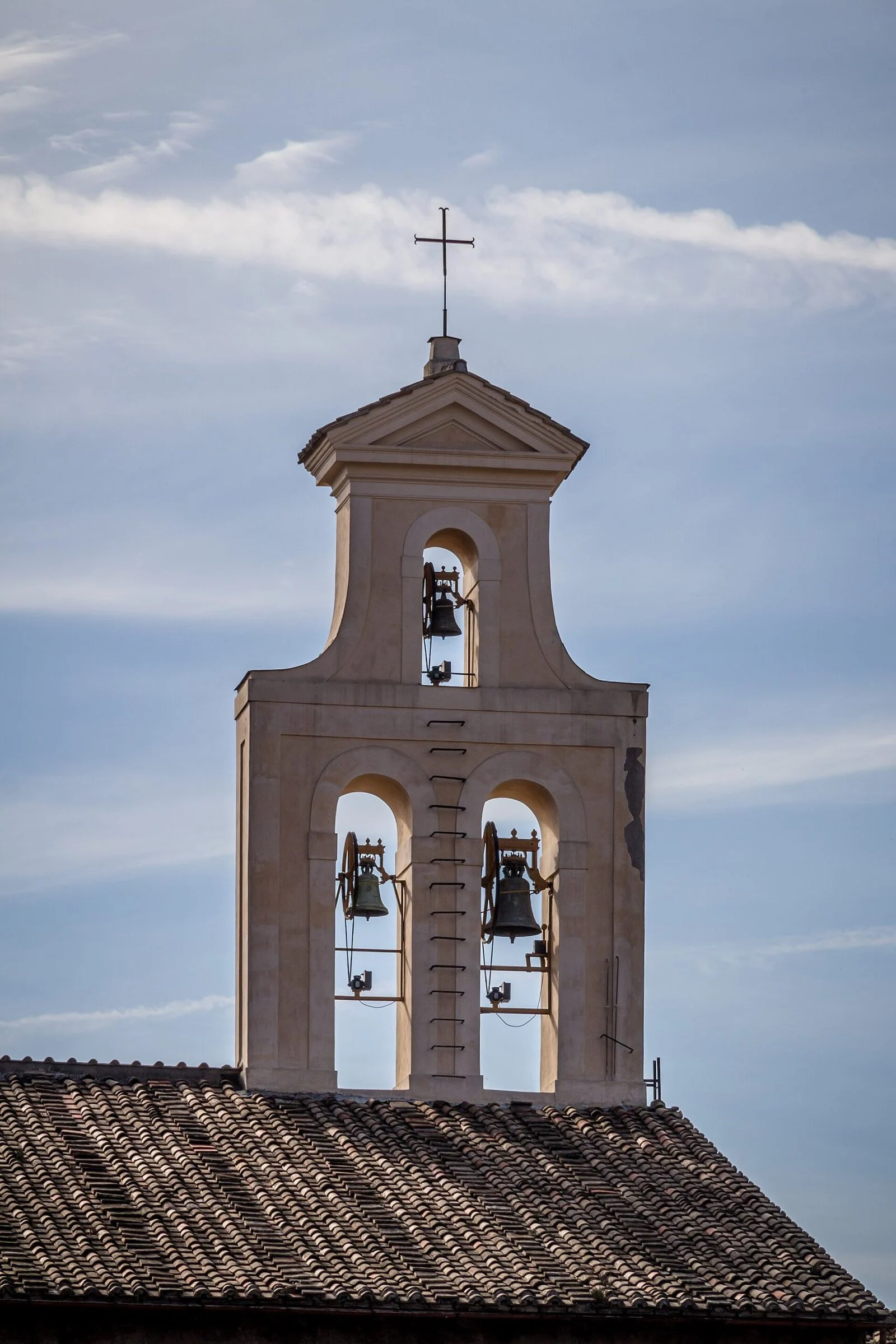
The Basilica of Saints Cosmas and Damian faces onto Via dei Fori Imperiali at the level of the Roman Forum, and it is one of the few churches in Rome that was not built: it was carved out. In 527 Pope Felix IV obtained from the Ostrogothic king Theodoric, or from his daughter Amalasuntha depending on the source, two adjoining Roman buildings and turned them into a single Christian place of worship. One was a rectangular hall of the Templum Pacis, Vespasian's Forum of Peace, the very hall on whose wall the marble Forma Urbis was posted, the plan of Rome incised under Septimius Severus. The other was the rotunda that everyone calls the temple of Divus Romulus, built by Maxentius at the start of the 4th century and still closed today by its original bronze door. The result was the first church set up inside the monumental area of the Forum, a gesture worth as much as a political declaration. Inside, in the apse basin, shines a 6th-century mosaic that art historians consider one of the decisive turning points of all medieval Roman art: Christ descending on a stair of red and blue clouds, Peter and Paul presenting to him the two martyr physicians, the pope holding the model of the newly founded church. 11 centuries later, Pope Urban VIII had the floor raised by seven meters to save the building from the dampness of the Forum, and in doing so cut the basilica in two: above, the baroque church you visit today, below, the ancient church left buried. In the entrance corridor, finally, there is an 18th-century Neapolitan nativity scene that very many Romans know better than the mosaics. The lines that follow tell how these layers came about, what you really see on entering, and how to organize the visit without wasting time.
Where the Basilica of Saints Cosmas and Damian is and how to get there
The official address of the Basilica of Saints Cosmas and Damian is Via dei Fori Imperiali 1, and this detail alone tells a story: the entrance you present yourself at today is not the ancient one. The church was born facing the Roman Forum, with access through the rotunda of the temple of Divus Romulus and its bronze door. The present front, on the opposite side, dates from the 1940s, when the layout of the imperial area imposed by the new boulevard made it necessary to open a passage on the side of the modern city. Whoever arrives today therefore enters from the back of the ancient building, and this inversion is the first thing to keep in mind to understand everything else.
On foot from the Colosseum and the center
From the Colosseum you arrive in five or six minutes going up Via dei Fori Imperiali on the right side, the one that skirts the archaeological area. You pass in front of the brick mass of the Basilica of Maxentius and shortly after, on the left of the pedestrian roadway, the 17th-century facade with the baroque portal appears. From the Capitoline Hill the walk is slightly longer and goes downhill, skirting the Forum of Trajan and the Trajan's Markets. Anyone coming from Piazza Venezia has in front of them a straight line of under 10 minutes, without a single turn.
By public transport
The useful subway stop is Colosseo, on Line B, from which you walk up along the boulevard. The Cavour station, also on Line B, lets you off on the opposite side, on the Suburra side, and forces you to come down via Via degli Annibaldi or via the Salita del Grillo depending on the route chosen. The surface lines serving Piazza Venezia and Largo Corrado Ricci all let off a few minutes' walk away. The stretch of Via dei Fori Imperiali in front of the basilica is largely pedestrianized, so the last bit is on foot anyway.
An entrance that is easy to miss
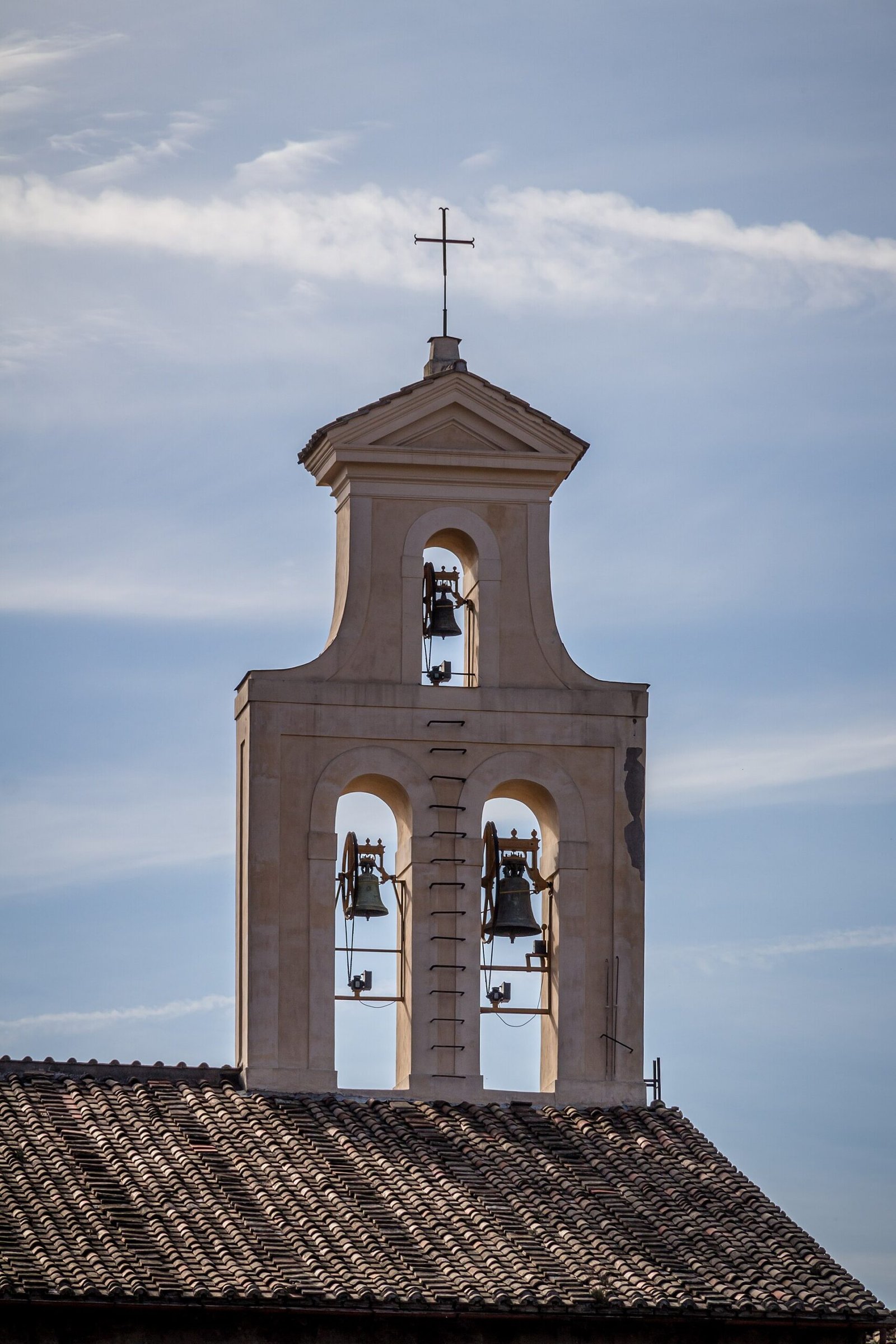
The facade of the basilica is not monumental and doesn't announce itself from afar. It is a sober front, wedged into the flank of the convent, in the middle of a promenade where everyone looks the other way, toward the forums. Very many visitors walk past the portal without seeing it, because their eyes are on the ruins to the right. The most convenient landmark is the entrance to the archaeological area at Largo della Salara Vecchia: the church is a little farther on, going up toward Piazza Venezia. A second landmark is the low, round dome of the so-called temple of Romulus, clearly visible from inside the Forum: the basilica is the volume attached behind it.
Two Roman buildings and a single church: how the basilica came to be
The Basilica of Saints Cosmas and Damian was created in the 6th century from the union of two preexisting, distinct Roman structures: a rectangular hall belonging to the Templum Pacis complex and the rotunda known as the temple of Divus Romulus, which opened onto Via Sacra. It is not a church built next to ancient ruins, but a church that is those ruins, readapted with the least possible intervention. It is one of the most radical and best preserved reuse operations in the whole of late antique Rome.
The hall of the Forum of Peace
The Templum Pacis was erected by Vespasian in the years immediately following the Jewish War, and it was not a forum in the commercial sense of the term. It was a large porticoed square with gardens, pools and halls intended to house works of art and book collections. The sources describe it as one of the richest places in the city. Along its side toward the Velia opened a number of rectangular halls, and one of these, in brick masonry, is the main body of the present basilica. The walls that those entering today see plastered and decorated in 17th-century fashion are, in essence, walls of the Flavian age.
The wall of the Forma Urbis
The back wall of that hall supported the Forma Urbis Severiana, the marble plan of Rome incised between 203 and 211 on about 150 slabs, over a surface about 13 meters high by 18 wide. The slabs were anchored to the wall with metal clamps, and the clamp holes are still legible on the masonry: it is the only physical evidence remaining in place of that extraordinary document. The surviving fragments, more than a thousand, are not here. The first find dates to 1562 and today the main core is displayed in the Museo della Forma Urbis, opened in 2024 in the Celio archaeological park.
The rotunda called the temple of Divus Romulus
The second building is the brick rotunda facing Via Sacra, with a concave hemicycle facade, two red porphyry columns at the sides of the entrance and reused Corinthian capitals. Tradition attributes it to Maxentius, who is said to have dedicated it around 309 to his son Valerius Romulus, who died very young and was deified. The identification is not unanimous, however. Other scholars have recognized in it the temple of the Penates on the Velia, or the temple of Jupiter Stator, also on the strength of a fragment of a dedicatory inscription to Constantine. The dome is the only one of the Roman age preserved in the Forum area.
The bronze door that still works
The rotunda keeps the original bronze doors of the Roman age, with a lock mechanism that is reported to be still working. They are among the very few ancient specimens of this type surviving in the world. It was through that door that for centuries people entered the basilica, because the rotunda served as the vestibule of the church. Today the relationship is reversed: the rotunda belongs to the visiting route of the Forum archaeological area and not of the church, and the internal passage between the two spaces is not part of the ordinary visit.
Why right here
Setting up a church in the monumental heart of ancient Rome, in 527, was not a neutral operation. The Forum was still the symbolic center of the city, with its temples, the Curia, the honorary statues. The first Roman Christian basilicas had arisen on the outskirts, on imperial properties outside the walls or at the edges of the built-up area. Bringing Christian worship into the Forum, reusing imperial structures donated by a Gothic king and with the implicit consent of Byzantine power, meant declaring that that space had changed owner. Saints Cosmas and Damian are, in this sequence, the first Christian place of worship established in the forum area.
The two titular saints
Cosmas and Damian were two physician brothers of eastern origin, martyred according to tradition during the persecution of Diocletian, at the start of the 4th century. The Greek tradition calls them anargyroi, that is, without silver, because they are said to have treated people free of charge. Their cult was very widespread in the East and was imported to Rome in the full Byzantine age. The dedication of the basilica is therefore also a signal of cultural belonging, a bridge with Constantinople at a time when Rome lived under Ostrogothic rule. The liturgical memorial falls on September 26 in the Roman calendar.
The 6th-century apse mosaic: what you see
The mosaic of the apse basin of the Basilica of Saints Cosmas and Damian dates to the years of the pontificate of Felix IV, between 526 and 530, and is one of the largest and best preserved early Christian mosaics in Rome. It occupies the whole vault of the apse with six larger-than-life figures on a deep blue ground, and the first effect it produces is not narrative but physical: the glass-paste surface returns the light irregularly, and the figures seem to move depending on the point of the nave from which you look. Whoever enters distracted notices it late, because from the door the basin stays in shadow. Whoever approaches the presbytery sees it light up.
Christ on the clouds
In the center stands Christ, in golden robes, with the scroll of the law in his left hand and his right raised in the gesture of address, the one with which in imperial iconography the sovereign spoke to the troops. He is not seated on a throne nor enclosed in a mandorla. He stands upright on a stair of clouds that shade from the bright red of the base to the blue of the top, like a sky at sunset. It is a solution without direct precedents in Rome, which alludes at once to the ascension and to the return at the end of time, and which in the following centuries would be taken up and simplified dozens of times.
Peter, Paul and the two physicians
At the sides, Peter and Paul, recognizable by the physiognomic features fixed by Roman tradition, present to Christ the two titular saints. Paul accompanies Cosmas, Peter accompanies Damian. The two physicians advance with veiled hands and hold the crowns of martyrdom. The gesturing is that of late antique court ceremonial, where nobody presents himself to the sovereign alone but is introduced by a dignitary. The scene, read this way, is not an assembly of saints: it is an audience.
Felix IV with the model and Saint Theodore
At the far left, Pope Felix IV offers the model of the church, one of the first Roman examples of this motif that would become the signature of patrons throughout the Middle Ages. At the opposite end appears Saint Theodore, an eastern martyr, another presence signaling the link with Byzantium. The figure of the pope, however, is largely a remaking. In modern-era restorations it was recomposed, and whoever looks carefully notices that the drapery and the flesh tones do not have the same pace as the other figures. The sources agree that the surviving ancient part of this figure is minimal.
Palms, phoenix and the River Jordan
At the two ends of the scene stand two palms, the tree of paradise in the biblical tradition, and on the one at right perches a phoenix with a radiate nimbus, a symbol of resurrection. At the feet of the figures flows the Jordan, indicated by a band of rippled water, while the ground is a green meadow dotted with small plants. The whole does not represent an earthly place: it is a description of paradise built with signs legible to anyone, even to those who couldn't read.
The Lamb and the 12 lambs
Below the main scene runs a band with the Agnus Dei at the center, on a rise from which descend the four rivers of paradise, and six lambs on each side proceeding toward him: they are the 12 apostles. This band, in its original condition, was wider than the one you see today, because in the 17th century the raising of the floor and the remaking of the presbytery involved cutting the lower portion of the mosaic. Whoever observes the basin is therefore looking at a work amputated at the base, recomposed to make it coincide with a new church.
The dedicatory inscription
Below the band of lambs runs the epigraph in gold letters on a blue ground, in distichs: Aula Dei claris radiat speciosa metallis, in qua plus fidei lux pretiosa micat, Martyribus medicis populo spes certa salutis venit et ex sacro crevit honore locus, obtulit hoc Domino Felix antistite dignum munus ut aetheria vivat in arce poli. The sense is that the hall of God shines with precious metals, but within it a more precious light gleams, that of faith. That to the physician martyrs the people owe the certain hope of salvation. And that Felix offers this gift to the Lord so that he may be granted to live in the heavenly dwelling. The wording of the text varies slightly from one edition to another and some popular sites report rewritten versions: it's best to trust the epigraphic transcriptions.
Why this mosaic set the standard
Art historians consider the basin of Saints Cosmas and Damian the model to which almost all the great Roman apse mosaics of the following centuries look. The scheme, that is, the central standing Christ, the two prince apostles introducing the titular saints, the patron with the model, the lower band with the lambs, the phoenix on the palm, is found taken up with minimal variants in the Basilica of Santa Prassede at the start of the 9th century, and from there passes to other Carolingian-era Roman building sites. It is one of the cases in which a single work defines a visual grammar that stays in use for more than half a millennium, up to the medieval and modern revivals.
The triumphal arch mosaic and the Apocalypse
On the arch that frames the apse of the Basilica of Saints Cosmas and Damian a second mosaic is preserved, later than the basin and far less known, which the sources date to the end of the 7th century. The subject is the appearance of the Lamb of God according to the text of the Apocalypse: the Lamb on a throne with the seven seals, the seven lampstands, four angels and the symbols of the evangelists, all on a gold ground. Whoever enters tends not to look up because the basin immediately captures attention, and so this part goes almost unnoticed.
What survived and what didn't
The preserved portion is only a part of the original program. The 17th-century works cut here too, because the new vault and the new layout of the presbytery imposed a reduction of the surface. Some figures described by the ancient sources, in particular the 24 elders of the Apocalypse offering their crowns, are today missing or reduced. The restoration directed by Vitaliano Tiberia and concluded in 1994 focused precisely on this arch, distinguishing the ancient tesserae from those inserted in the baroque age through analysis of the mortars.
The coffered ceiling and the Barberini bees
Looking up toward the nave you see the carved and gilded wooden ceiling made in the 1630s, with at the center the canvas of the glory of Saints Cosmas and Damian attributed to Marco Tullio Montagna and, in the decoration, the coat of arms of Urban VIII. The Barberini bees on the axis of a church founded in the 6th century are a reminder of how layered the building is: under a 17th-century ceiling, inside Flavian walls, with a Justinianic mosaic at the far end.
A curiosity about the Basilica of Saints Cosmas and Damian
The most surprising curiosity of the Basilica of Saints Cosmas and Damian is that the wall against which the largest topographical plan of antiquity leaned is still in its place, and is an integral part of the church. The Forma Urbis Severiana covered a wall of about 230 square meters, rendering Rome plan by plan, block by block, with a precision no other ancient document has matched, and for centuries nobody knew where it had been posted. The answer was here: on the wall that now separates the basilica from the area of the Forum of Peace, where the holes of the pegs that held the slabs remain legible.
A plan lost and found in pieces
Of the Forma Urbis more than a thousand fragments remain today, the first of which re-emerged in 1562, and together they represent a small fraction of the original surface. For generations scholars have worked to recompose it like a puzzle without a box, fitting together pieces from different excavations. Since 2024 the main core has a home of its own in the Museo della Forma Urbis, set up in the Celio archaeological park, where the fragments are laid over a large modern plan of Rome that allows them to be placed geographically. The starting wall, instead, stays here, mute.
One thing nobody tells you about the Basilica of Saints Cosmas and Damian
The thing almost no guide says is that the apse mosaic of the Basilica of Saints Cosmas and Damian is not seen as it was seen in the 6th century, and not because of light: it has been shortened. When in the 17th century the floor was raised by seven meters, the basin stayed where it was but the walking level rose up to meet it, and the lower band of the mosaic, the one with the lambs and the epigraph, was reduced to make room for the new presbytery. Today's visitor looks at the work from a height that was not foreseen by whoever designed it.
The changed proportions
The consequence is that the relationship between the height of the figures and the height of the gaze is different from what was originally intended. Christ on the clouds was meant to loom over the assembly from much higher up, with the stair of clouds opening a vertical thrust that is now compressed. In the present church, lower in the nave and with a raised presbytery, the effect is closer and more comfortable for reading details, but it loses the theological distance that the 6th-century building site had calculated.
What it means to look at a remounted mosaic
It is not an isolated case: almost all the great Roman mosaics have gone through remakings, additions and relocations, and some figures observed today as ancient are in fact modern-era recompositions. In the basin of Saints Cosmas and Damian the figure of the patron pope is the most evident example. Recognizing the boundary between ancient and remade is an exercise that changes the way of looking at all Roman mosaic art, from the Basilica of Santa Maria Maggiore to the Mausoleum of Santa Costanza.
The second layer nobody looks at
There is then a second element that systematically goes unnoticed: the lower church, that is, what remains of the 6th-century basilica left under the 17th-century floor, where the ancient paving level and traces of frescoes are preserved. Whoever enters for the mosaic often leaves without knowing that under their feet is another church, 11 centuries older than the one they are in.
My advice for visiting the Basilica of Saints Cosmas and Damian
The most useful practical advice for the Basilica of Saints Cosmas and Damian is to check the hours before leaving. The basilica's official site indicates opening every day from 10:00 to 13:00 and from 15:00 to 18:00, with a midday closure that catches very many visitors unprepared. Anyone arriving at 13:30 after spending the morning in the archaeological area finds the portal closed. Since it is a church run by a religious community, hours may vary for celebrations, holidays and works, so a check by phone or on the basilica's site before the visit avoids a wasted trip.
The right time of day
The light that matters is the light that reaches the apse basin, and it is not direct natural light: the apse is lit artificially and the mosaic looks best when the eye has adapted to the dimness of the nave. The best time is therefore the one when the church is emptiest and quietest, typically the first half hour after opening in the morning or in the afternoon. You need to give the eye two or three minutes of stillness before judging the mosaic: seen in a rush just after coming in, it looks like much less than it is.
How much time you really need
For the nave and the mosaic alone 20 minutes are enough, and they are 20 minutes well spent. Adding the Neapolitan nativity scene and the lower church brings it comfortably to 45 minutes or an hour. It is not a visit that stands comparison with the time required by the Roman Forum or the Colosseum, and for that very reason it works very well as an insert: it is the kind of stop that fits between two big visits without undoing the day's program.
How to combine it with the Roman Forum
The most sensible combination is with the central archaeological area. From inside the Roman Forum you can see very well the rotunda of the so-called temple of Romulus with its bronze door, which is the ancient half of this church. Looking at it from there and then entering the basilica from the opposite side, or vice versa, is the only way to really understand how the building is made. You must, however, allow for two tickets and two distinct routes, and for the fact that the rotunda inside the Forum opens according to the rules of the archaeological park, not those of the parish.
The raising of the floor under Urban VIII and the lower church
The intervention that most changed the Basilica of Saints Cosmas and Damian is the raising of the floor by about seven meters wanted by Pope Urban VIII and carried out around 1632, with a design attributed to Orazio Torriani and direction by Luigi Arrigucci. The reason was not aesthetic but hydraulic: the Forum area, reduced to pasture under the name Campo Vaccino, was silted up and marshy, and the ancient church now lay much lower than the surrounding ground, invaded by dampness and seepage. Raising the walking level to bring it to the exterior level was the radical solution chosen by the Barberini building site.
A church cut in two along its height
The result is that the building doubled. Above arose the baroque church you visit today, with a single nave and three chapels per side, a gilded coffered ceiling and a 17th-century high altar. Below remained sealed everything that stood at the ancient level, that is, the floor of the 6th-century basilica and the lower portions of the Roman walls. It is not a crypt built to hold burials, as in so many Roman churches: it is the original church that became underground by subtraction of height.
What you see in the lower church
In the lower spaces are preserved the paving level prior to the Cosmatesque age, traces of archaic frescoes belonging to the early phase and an altar from the early medieval period. The impression you get is very different from that of the upper church: the space is low, bare, still legible as a readapted Roman structure. It is the part of the building where the Templum Pacis is felt the most.
The chapels and furnishings of the upper church
In the upper nave there are three chapels per side, dedicated according to the sources to Saint Barbara, Saint Alexander and Saints Rosa and Rosalia on the left side, to the Crucifix, to Saint John the Evangelist and to Saint Anthony of Padua or to Saint Francis on the right. The high altar, made in 1637, is attributed to Domenico Castelli. Above it is a panel with the Madonna and Child of the Roman school, which the sources place in the last quarter of the 13th century, an object of devotion with the title Madonna della Salute.
The cloister and the convent
Next to the church stands the convent of the Friars of the Franciscan Third Order Regular, who have kept the complex since the building was entrusted to their order in the early 16th century. The cloister has a rectangular plan, with six arches on the long sides and three on the short sides, and at the center a fountain made of superimposed circular basins decorated with grotesque masks and lion heads. On the walls are preserved 17th-century frescoes with stories of Saint Francis and of Blessed Lucchese attributed to Francesco Allegrini. Access to the cloister and the convent spaces is not as free as that of the church: it depends on the arrangements of the religious community and in many cases it is visited only on special openings or arranged guided visits.
The 18th-century Neapolitan nativity scene
The Neapolitan nativity scene of the Basilica of Saints Cosmas and Damian is an 18th-century work donated to the basilica in 1939 by the Neapolitan couple Cataldo and Perricelli, and it is on permanent display, that is, it is not taken down after the holidays. It is one of the best-known historic nativity scenes in Rome and appears among the places flagged in the campaigns of the Fondo Ambiente Italiano. For a not insignificant share of Roman visitors it is the real reason for the visit, even more than the mosaics.
What makes it Neapolitan
The 18th-century Neapolitan nativity scene is not a hut with three figures: it is a populated theater, where the nativity is one episode in the middle of an entire village in action. The figures, indicatively between 30 and 40 centimeters tall, are built with head and limbs in hand-painted terracotta, a body of wire covered over and clothes of fabric sewn to measure. There are vendors, innkeepers, musicians, farmyard animals, ancient ruins used as backdrop. Typical characters such as the sleeping shepherd, called Benino, and the Romani fortune-teller belong to the codified repertoire of this tradition.
The theft and the restoration
In 1988 the nativity scene was the object of a theft that took away part of the figures and furnishings. Recovering the whole took years. The sources report a restoration and integration of the missing parts overseen by Giulio Strauss, which allowed the work to be made available to the public again from 1994.
Hours and access to the nativity scene
The nativity scene is in the entrance spaces of the basilica and, according to the official site, follows the same hours as the church and the lower part, that is, every day from 10:00 to 13:00 and from 15:00 to 18:00. No admission ticket advertised online appears to be indicated, but for works of this kind a request for an offering for maintenance is frequent, and at some times of year access may be regulated differently for reasons of attendance. Anyone organizing the visit mainly for the nativity scene does well to phone the basilica the day before, particularly in the Christmas period when attendance grows and guided visits multiply.
The other historic nativity scenes of Rome
Rome keeps some permanent historic nativity scenes, and the one of Saints Cosmas and Damian is habitually cited together with the monumental one in the Basilica of Santa Maria in Aracoeli, where devotion revolves around the figure of the Santo Bambino, and with other nativity scenes in churches of the center.
Another well-known fact, yet rarely cited
It is known to insiders, and almost never told to visitors, that the present entrance of the Basilica of Saints Cosmas and Damian on Via dei Fori Imperiali is a 20th-century work, opened when the gutting of the district and the construction of the great artery between Piazza Venezia and the Colosseum changed forever the relationship between the church and the city. The sources name the architect Gaetano Rapisardi as the author of the new layout of the access, with a dating referred to the mid-1940s. Until then you entered from the Forum side.
What the new boulevard entailed
Via dei Fori Imperiali was opened in the 1930s by demolishing the Alessandrino district and isolating the imperial archaeological complexes. For the churches located in that area it was a revolution: some were demolished, others were moved, still others, like this one, found themselves with one flank suddenly facing a boulevard and with the historic entrance left inside a fenced archaeological area. The solution was to open a new portal on the opposite side.
The reversal of the route
The consequence is that today the visitor walks through the basilica in the opposite direction to the original order. In the 6th century you entered from the rotunda, crossed the circular vestibule and found yourself facing the apse with the mosaic at the end of the perspective. Today you enter from the far end and walk toward the presbytery. It's no small difference: the mosaic was built to be seen after a route, not as soon as you crossed a threshold.
Why the rotunda now belongs to the Forum
The administrative division follows the physical division: the rotunda with the bronze door falls within the area under the archaeological park and is visited with the Roman Forum entry tickets, while the church above is run by the Franciscans and has free access during opening hours. Two different managements for two halves of the same ancient building: it is one of the most peculiar situations in all Roman topography, and explains why much information online turns out to be contradictory.
The right photo to take at the Basilica of Saints Cosmas and Damian
The most recognizable photograph of the Basilica of Saints Cosmas and Damian is the frontal shot of the apse basin taken from the nave, with Christ on the clouds at the center and the six figures lined up against the blue ground. It is a difficult photo, because the apse is lit artificially and the mosaic surface returns the light irregularly, creating reflections that the sensor reads as pinpoint overexposures. It's best to rest the camera or phone on a stable support, reduce the exposure by one stop from the automatic reading and avoid the flash altogether, which flattens the volumes and bounces off the tesserae.
The detail worth more than the whole
If the overall shot doesn't work, the fallback is the detail: the nimbed phoenix on the palm, Christ's raised hand, the model of the church in the pope's hands, the row of lambs. In mosaic, details stand up to zoom better than they do in painting, because the grain of the tesserae becomes itself the subject. A tight frame on the model, among other things, shows immediately how the basilica looked in the 6th century, and it is the only ancient image of the building we have.
The rotunda seen from the Forum
The second photo to take is not shot inside the church. It is shot from the archaeological area, framing the concave facade of the rotunda with the porphyry columns and the bronze door, perhaps with the mass of the Basilica of Maxentius behind. It is the image that explains the double nature of the building better than any caption, and in the raking light of late afternoon the brick of the rotunda turns orange.
Some important events that happened here in history
The history of the Basilica of Saints Cosmas and Damian reads as a sequence of four or five dates that changed the building irreversibly: the foundation of 527, the donation of the Roman buildings by the Ostrogothic court, the great building site of Urban VIII between 1626 and 1632, the opening of the new entrance in the mid-20th century and the scientific restorations of recent decades. Between one date and the next there are centuries in which the church remained the Christian point of reference of a Forum that was meanwhile turning into pasture.
527: birth in the heart of the Forum
Pope Felix IV consecrated the church between 526 and 530, in 527 according to the most commonly accepted sources. The donation of the buildings is attributed to Theodoric the Great, who died in 526, or to his daughter Amalasuntha, who in those years exercised the regency for her son Athalaric. Popular sources attribute the act now to one, now to the other, and the most prudent wording is the one that speaks of the Ostrogothic court. The church was sometimes called the basilica of Felix after the name of its founder.
The Byzantine age and the cult of the physician saints
In the following centuries the basilica became one of the poles of the cult of the healing saints in Rome, in continuity with a function the area had already had in the pagan age, when recourse to temples for healing was common practice. The triumphal arch mosaic, dated to the end of the 7th century, testifies that the decorative building site went on well beyond the foundation and that the church kept receiving major investment in the full Byzantine age, when Rome was a peripheral duchy of the Eastern empire.
1626 and 1632: the Barberini building site
It was an earth-removal campaign in the surrounding area, conducted around 1626, that aggravated the church's dampness problems and made the intervention urgent. Urban VIII entrusted the work to craftsmen who raised the floor, built the new vault, added the pilasters, remade the presbytery and gave the nave the baroque look it keeps. In the same period the Franciscans had the adjacent convent built. It is the intervention that saved the building and also the one that erased its ancient spatiality.
The 20th century: the boulevard and the nativity scene
The 1930s brought the opening of Via dei Fori Imperiali and the radical transformation of the urban context. 1939 brought the donation of the Neapolitan nativity scene. The 1940s brought the new layout of the entrance. In a little over a decade the basilica changed orientation, public and function within the city: from a church facing an archaeological area to a church facing one of the busiest streets in Rome.
The last decades: restorations and monitoring
The restoration of the triumphal arch mosaics directed by Vitaliano Tiberia was concluded in 1994, using analysis of the mortars to distinguish the original tesserae from the baroque additions, and in the same year the nativity scene became visible again after the theft of 1988. In the following years non-invasive diagnostic campaigns have been carried out on the mosaic surfaces, along with consolidation works on the foundation ground along the flank of the building, with permanent monitoring systems for the state of the structures.
Who has passed through the Basilica of Saints Cosmas and Damian
Through the Basilica of Saints Cosmas and Damian, in 15 centuries, very different categories of people have passed: popes and Gothic kings in the founding phase, medieval pilgrims seeking healing, artists and antiquarians of the modern age who came to copy the mosaic, archaeologists and topographers obsessed with the wall of the Forma Urbis, and finally the restorers who in recent decades have worked tessera by tessera. Each of these presences has left a legible trace in the building.
Felix IV, Theodoric and Amalasuntha
The three names of the foundation are those of a pope and two Ostrogothic rulers. Felix IV is the patron, and is portrayed in the mosaic with the model. He is one of the few 6th-century popes of whom we have a contemporary image, though heavily restored. Theodoric and Amalasuntha represent the political power that grants the buildings. The coexistence of an Arian court and a Chalcedonian papacy is one of the knots of the century, and the basilica is one of its material consequences.
The Franciscans of the Third Order Regular
The religious community that keeps the complex is that of the Friars of the Franciscan Third Order Regular, present here since the early 16th century. They are the ones who commissioned the 17th-century convent, who received the Neapolitan nativity scene as a gift in 1939 and who today manage opening, celebrations and welcome. The basilica is also the seat of the cardinal title of Saints Cosmas and Damian, which dates back to the early Middle Ages and which in recent years has been assigned to Cardinal Mario Grech.
Scholars, restorers and today's visitors
In the last 30 years the recurring name is that of Vitaliano Tiberia, who led the restoration of the triumphal arch mosaics and devoted a specific publication to it. Alongside him, the teams of restorers and the diagnostic laboratories that mapped the mosaic surfaces. Today's public is divided into two sharp, barely overlapping groups: those who come for the mosaic, often students and enthusiasts of late antique art, and those who come for the nativity scene, in the vast majority Romans and families.
Around the basilica: the Roman Forum, the Forum of Peace and the rest
The Basilica of Saints Cosmas and Damian sits exactly on the hinge between two monumental systems: behind it the Republican and imperial Roman Forum, in front the belt of the Imperial Forums that runs from the Forum of Peace to the Forum of Trajan. This position explains its form and its history better than any other consideration: it is a church that occupies the connecting space between two great ancient building projects, and that has been preserved precisely because it used them as walls.
The Forum of Peace, the most forgotten of the Imperial Forums
The Templum Pacis is the least visible of the imperial complexes, because it lies largely beneath Via dei Fori Imperiali and beneath modern buildings, and because it keeps no standing columns or recognizable tiers like the nearby Forum of Trajan. Excavation campaigns of recent decades have brought significant portions to light, including part of the garden with the pools. Anyone who wants to go deeper will find materials and reconstructions at the Imperial Forums Museum set up in Trajan's Markets.
The Roman Forum a few meters away
On the other side, the rotunda of the basilica opens onto Via Sacra, inside the perimeter of the Roman Forum. Among the immediately neighboring monuments are the Basilica of Maxentius, the temple of Antoninus and Faustina incorporated into the church of San Lorenzo in Miranda, the area of the Regia and, toward the far end, the Arch of Titus and the climb to the Palatine. The Mamertine Prison is at the opposite end, at the foot of the Capitoline Hill.
Other churches built inside Roman buildings
The case of Saints Cosmas and Damian is not unique in Rome, and is in fact the progenitor of a series. The Basilica of San Clemente keeps beneath the medieval church an early Christian basilica and below that Roman buildings with a mithraeum. The Basilica of Santa Maria in Cosmedin incorporates structures of the Statio Annonae. The Arch of Janus in the Forum Boarium shows the same logic applied to a civic monument turned into a fortress. Lining these places up is an effective way to understand how Rome kept using itself.
A half-day itinerary
A combination that works well starts from the Colosseum, continues with the Roman Forum and the Palatine, exits toward Largo della Salara Vecchia, enters the basilica for the mosaic and the nativity scene, and ends going up toward the Capitoline Hill and the Capitoline Museums. It is about three kilometers in all, almost entirely on pedestrian routes, with modest changes in level except the final climb.
Frequently asked questions about the Basilica of Saints Cosmas and Damian
How much does it cost to enter the Basilica of Saints Cosmas and Damian?
The Basilica of Saints Cosmas and Damian is a church in active use and it doesn't appear that a visit to the nave requires a ticket advertised online. The basilica's official site gives no entrance fees. For the nativity scene and the lower spaces an offering for maintenance may be requested, and guided visits organized by outside parties have a cost of their own. It's best to ask directly at the basilica before the visit.
What are the hours of the Basilica of Saints Cosmas and Damian?
The official site of the Basilica of Saints Cosmas and Damian indicates opening every day from 10:00 to 13:00 and from 15:00 to 18:00, with the same time slot valid for the church, the nativity scene and the lower part. Since it is a church run by a religious community, hours may change for celebrations, holidays or works. It's best to check them with the basilica before setting out.
How do you get to the Basilica of Saints Cosmas and Damian by public transport?
The Basilica of Saints Cosmas and Damian is most conveniently reached by subway Line B, Colosseo stop, from which you walk up Via dei Fori Imperiali in five or six minutes. The Cavour stop, also on Line B, lets off on the opposite side, toward the Monti district. The surface lines serving Piazza Venezia and Largo Corrado Ricci arrive a few minutes' walk away, because the stretch in front of the church is pedestrian.
Can you visit the lower church of Saints Cosmas and Damian?
The lower spaces of the Basilica of Saints Cosmas and Damian, created by the raising of the floor by seven meters carried out in the 17th century, are normally included in the visiting route during the opening hours indicated by the basilica. They preserve the floor of the ancient church, traces of frescoes and an early medieval altar. Actual accessibility may vary, and anyone with mobility difficulties should find out beforehand because the level is reached by stairs.
Why is the mosaic of Saints Cosmas and Damian so important?
The apse mosaic of Saints Cosmas and Damian is important because it fixes an iconographic scheme that the great Roman mosaics that followed took up for centuries: Christ standing on clouds at the center, Peter and Paul presenting the titular saints, the patron pope with the model of the church, the lower band with the Lamb and the 12 lambs. It is found, with variants, in the Roman mosaic building sites of the 9th century such as Santa Prassede.
Is the Neapolitan nativity scene of Saints Cosmas and Damian visible all year round?
Yes, the Neapolitan nativity scene of the Basilica of Saints Cosmas and Damian is on permanent display and is not taken down at the end of the Christmas holidays. It is an 18th-century work donated to the basilica in 1939, hit by a theft in 1988 and returned to the public after restoration in 1994. In the Christmas period attendance grows noticeably and guided visits organized by outside associations multiply.
Can you take photographs in the Basilica of Saints Cosmas and Damian?
In the Basilica of Saints Cosmas and Damian photography without flash is generally tolerated as in many Roman churches, but the notices posted on site and the staff's instructions always apply, and during celebrations filming should be avoided. The flash is also discouraged for practical reasons, because it bounces off the tesserae of the mosaic and off the glass of the nativity scene, spoiling the image.
Are the basilica and the temple of Romulus the same thing?
The Basilica of Saints Cosmas and Damian and the so-called temple of Divus Romulus are two parts of the same ancient complex, but today they have separate access and management. The rotunda with the original bronze door is inside the archaeological area of the Roman Forum and is visited according to the rules of the archaeological park, while the church is reached from the entrance on Via dei Fori Imperiali and is run by the Franciscan friars.
Is it suitable for a visit with children?
The Basilica of Saints Cosmas and Damian works well with children above all thanks to the Neapolitan nativity scene, which is a scene populated with figures, animals and trades and reads like a story with no need for historical explanations. The visit is short, indoors and with no queues, which makes it a good break between two more demanding archaeological stops such as the Roman Forum and the Colosseum.
One last piece of advice for those organizing the itinerary
The Basilica of Saints Cosmas and Damian is at its best if you treat it for what it is, that is, a short, dense stop within a broader route, and not a destination in itself. 20 minutes are enough for the mosaic, an hour for the whole complex, and in exchange you take home the understanding of a mechanism that repeats everywhere in Rome: a Roman building that becomes a church, a church that is lifted seven meters, a mosaic that dictates the rule for 500 years of later art. Anyone who already has the Roman Forum planned has the basilica literally a step from the enclosure, and not adding it to the tour almost always means not having noticed it was there.
Anyone putting together a broader itinerary among the Forums area, the Colosseum and the Capitoline Hill, and who needs to fit together hours, distances and minor stops like this one, will find useful planning tools at Tour Leader Pro, while for a general picture of transport, connections and destinations in Lazio, Italy Planner is a good resource.