Church of Santa Francesca Romana
In short. The Church of Santa Francesca Romana looks onto the Roman Forum from the eastern flank of the archaeological area, a few meters from the Basilica of Maxentius and a stone's throw from the Colosseum, with its Romanesque brick bell tower…
The Church of Santa Francesca Romana looks onto the Roman Forum from the eastern flank of the archaeological area, a few meters from the Basilica of Maxentius and a stone's throw from the Colosseum, with its Romanesque brick bell tower rising above the ruins and, for those arriving from Via dei Fori Imperiali, one of the most recognizable profiles in the whole archaeological landscape. Its official name is another one, and older: Santa Maria Nova, that is, the new Santa Maria, so called to distinguish it from the old one, Santa Maria Antiqua, which stood a few dozen meters farther on at the foot of the Palatine and was abandoned after an earthquake in the ninth century. The church we see today was therefore born as a replacement for another church, and it grew inside and on top of the largest temple ancient Rome ever built, the one dedicated to Venus and Roma. Inside are two superimposed Marian icons, one of them among the oldest preserved in the city, two stone slabs that hagiographic tradition links to the knees of Saint Peter, the tomb of the pope who brought the papacy back from Avignon, and the body of the saint who has been the patron of motorists since 1925. The lines that follow tell what you really see on entering, what is verified and what instead belongs to legend, and how to organize the visit without wasting time.
Where the Church of Santa Francesca Romana is and how to get there
The church is in Piazza di Santa Francesca Romana, on the eastern edge of the Roman Forum, at a point that belongs at once to the archaeological area and to the living city: you enter from a square reachable from outside the archaeological enclosure, without a ticket, while the side and the apse look down on the ruins of the Forum from above. It is an unusual position, which explains many misunderstandings: the church is inside the Forum by position and by history, but it is not part of the paid visiting route of the archaeological park, and that is why so many visitors see it only from afar, from below, without realizing that you can go in.
On foot from the Colosseum
The simplest route starts from the Colosseum. From the amphitheater's square you take the climb that runs along the side of the archaeological area, the so-called Clivo di Venere Felice, and in five or six minutes of walking on a gentle slope you reach the square in front of the facade. Those coming instead from Piazza Venezia walk along Via dei Fori Imperiali keeping to the right, pass the remains of the Basilica of Maxentius with its three enormous vaults and find the turn that leads to the churchyard. In both cases these are short walks, but it must be said that the last stretch is uphill and on uneven ground, something to keep in mind with strollers or mobility difficulties.
By public transport
The most convenient metro stop is Colosseo, on Line B, from which you walk a few minutes going up toward the Forum. From Termini just two stops on Line B in the direction of Laurentina are enough. For those moving on the surface there are the bus lines that run along Via dei Fori Imperiali and Via Labicana, with stops right next to the Colosseum. There is no parking in the immediate vicinity: the whole area is pedestrian or heavily restricted traffic, and Via dei Fori Imperiali is closed to private traffic, a detail that, as we will see further on, has had consequences even on the most famous of the traditions tied to this church.
Do you need the Roman Forum ticket?
To enter the Church of Santa Francesca Romana you do not need the Roman Forum ticket: the church is a place of worship with an independent entrance from the outer square, and the visit is free. The integrated Colosseum, Roman Forum and Palatine ticket is instead needed for the archaeological route that stretches at the foot of the church, and those who want to see both must allow for two distinct entries, at different times or in any case with two exits and two entrances. Anyone already visiting the Forum with the ticket can admire the apse and the bell tower from below, along Via Sacra, but to enter the church they have to leave the archaeological area and climb back up from outside.
From the Temple of Venus and Roma to the church: why it was born here
The Church of Santa Francesca Romana stands on the northern side of what was the Temple of Venus and Roma, the largest temple of ancient Rome, designed by the emperor Hadrian in person, begun in AD 121, inaugurated in 135 and completed in 141 under Antoninus Pius. Understanding this passage is the key to understanding everything else: the church was not built next to an ancient monument, it was built inside it, progressively occupying its spaces until the temple became, materially, the load-bearing structure and the materials warehouse of the Christian building.
The largest temple of ancient Rome
The measurements help to imagine the scale of the vanished building. The podium on which the complex rested measured about 145 meters in length by 100 in width, and the peristyle, that is, the colonnade surrounding the temple proper, measured roughly 110 meters by 53, with 10 columns on the short sides and 21 on the long sides. It was a decastyle temple, a very rare formula in Rome, and its plan followed Greek models more than Italic ones, consistent with Hadrian's philhellenic taste. The most singular point is that it had two cellae side by side and set back to back: one housed the statue of Venus Felix, the other that of Roma Aeterna, facing in opposite directions, one toward the Colosseum and one toward the Forum.
The cella of Roma Aeterna is still there
The western cella, that of the goddess Roma, has not been lost: it was absorbed into the monastery attached to the church and today houses the Antiquarium Forense, the museum of finds from the excavations of the Forum. Large porphyry columns still mark its walls and flank the apse, and you can see a stretch of original floor and part of the brick base on which the cult statue stood. The eastern cella, better seen from outside toward the Colosseum, is less well preserved but keeps part of the stuccoes of the apse semi-dome. Anyone visiting the Roman Forum with the ticket and arriving here is walking, almost without noticing, inside the perimeter of a Hadrianic temple.
The plundering and the collapse
The end of the temple comes by degrees. In 625 Pope Honorius I had its bronze roof tiles removed to redo the roof of the old basilica of St. Peter in the Vatican: an episode that says well how, already in the seventh century, the great pagan buildings were considered above all quarries of fine material. In the ninth century an earthquake completed the job, reducing the temple to a ruin. It is exactly at this moment and in this space that the Christian church begins to take its definitive form.
From Santa Maria Antiqua to Santa Maria Nova: the replacement
The Church of Santa Francesca Romana was born as a replacement for Santa Maria Antiqua, the early Christian church at the foot of the Palatine that was made unusable by the earthquake of the mid-ninth century. The story is one of the clearest cases, in all of Rome, of the transfer of an ecclesiastical title from a damaged building to a new one, with its relics, its rights and even its cult images.
What Santa Maria Antiqua was
Santa Maria Antiqua is a church carved out in the sixth century inside rooms of the Domitianic age at the foot of the Palatine, and it functioned as a palatine chapel in the Byzantine period, after the reconquest of Rome by Justinian's troops. It preserves a cycle of frescoes of exceptional importance: of the roughly 1,000 square meters originally, about 250 survive, datable between the middle of the sixth and the ninth century, among them the first known depiction of the Madonna enthroned and the famous palimpsest wall with four superimposed painting phases. It is the most important testimony we have of Byzantine art that survived the iconoclast season opened in 726.
The earthquake of 847 and the transfer of the title
The earthquake that struck Rome in 847 caused part of the overlying structures to collapse onto Santa Maria Antiqua, which was abandoned. Pope Leo IV then transferred the title to a church built anew not far away, carved out of the portico of the Temple of Venus and Roma above an older oratory. The sources place the original oratory under the pontificate of Pope Paul I, so between 757 and 767, with a dedication to Saints Peter and Paul tied precisely to the tradition that placed here the episode of Simon Magus. In the 10th century the building was enlarged and received the dedication to the Madonna with the name of Santa Maria Nova.
Why "nova" for a thousand years
The name Santa Maria Nova is one of Rome's most durable toponymic paradoxes: it indicates a building that is new only in relation to another, older one, and it has remained in use for more than a millennium. The dedication to Santa Francesca Romana is superimposed only in the 17th century, with the saint's canonization in 1608 and the translation of her relics into the crypt, but the old name was never erased: the Diocese of Rome continues to use the denomination Santa Maria Nova alongside the current one, and anyone looking for the church in official documents or in the lists of cardinalatial titles often finds it under the old name. In many reference works it is also listed as Santa Francesca Romana al Palatino, to distinguish it from another Roman parish with the same dedication.
The Romanesque bell tower: five stories above the Forum
The bell tower of Santa Francesca Romana is a Romanesque brick bell tower with five stories above the roofline, placed on the left side of the church next to the high altar, and it is the element that makes the church recognizable from the whole archaeological area. On the dating the sources agree substantially but not identically: most studies place it around the middle of the 12th century, while the Italian encyclopedia entry describes it as 13th-century and links it to the renovation promoted by Pope Honorius III at the beginning of the 13th century. The range, in practice, goes from the middle of the 12th to the first decades of the 13th century.
What it looks like
The structure is the classic one of Roman Romanesque bell towers: a brick tower with a square shaft, lightened as it rises by ever wider openings. The upper stories have double-mullioned windows, that is, openings divided by small columns that multiply toward the top, in a progression that serves both to reduce the weight of the masonry and to give the tower visual thrust. Above the belfry openings on the two sides of the top story, those facing the two ends of the church, there are two small aedicules, each formed by an arch with a pediment on imposts and marble small columns supported by brackets.
Porphyry crosses and colored ceramic discs
The detail that most deserves binoculars, or at least your phone's zoom, is the decoration of the masonry: the stories are ornamented with porphyry crosses and glazed ceramic discs of different colors, set into the brick. It is a decorative technique typical of Roman bell towers of the High Middle Ages, found for example in that of Santa Maria in Cosmedin, and it used reused materials and imported ceramics to get color effects at a low cost. Up close the discs look like colored buttons sewn onto the brick. From afar, in the low light of the afternoon, the tower takes on a vibration that bare brick would not have.
The facade by Carlo Lambardi: the travertine of 1615
The facade of the Church of Santa Francesca Romana is the work of Carlo Lambardi, was made of travertine and the sources date it to 1615, as part of a campaign of works begun by the Olivetan monks under the pontificate of Paul V and tied to the saint's canonization, which took place in 1608. The architect's name appears in the sources in two spellings, Lambardi and Lombardi, and it is worth knowing this so as not to think they are two different people.
What you see from the square
The front is entirely clad in travertine, with two pairs of pilasters marking the surface and a pediment crowned with statues. Above the entrance portico runs a balcony, an element anything but decorative: it served for ostensions and blessings toward the square, a liturgical and at the same time scenic function very common on Roman facades between the late 16th and early 17th century. The entrance proper is organized as a low body of a single order, with the large arched opening in the center framed by pilasters of the Composite order and two side passages slightly set back.
A detail on the interior structure
The church originally had three naves and was transformed into a single nave onto which eight side chapels open, obtained by closing the old aisles with walls. It is a transformation typical of the Counter-Reformation, which favored unified, easily controlled spaces over the articulation of the medieval basilica, and it explains why the interior looks today more intimate and more Baroque than the history of the building would lead you to expect.
The icon of the Madonna Glykophilousa: two superimposed paintings
The Church of Santa Francesca Romana preserves one of the oldest Marian icons in Rome, which arrived here from Santa Maria Antiqua and remained hidden for centuries under another icon covering it: the discovery came during a restoration carried out around 1949 and 1950, when it was realized that the panel venerated on the high altar was in fact a double painting. It is the most fascinating story in the whole church, and also the one scholars argue about most.
What happened in the restoration
The icon on the high altar was about to be freed of a 19th-century repainting, dated to 1805, when examination of the panel revealed that the medieval image had in turn been laid over a much older version. The two paintings were separated, and the older one is now kept in the sacristy, while the medieval image remained on the altar. In practice, the same panel held two icons from very distant eras, one on top of the other, and the second had stayed invisible for about 700 years.
The datings: where the sources do not agree
On the dates the sources diverge and it is worth reporting both. The Italian encyclopedia entry dates the ancient icon to the fifth century and places the restoration in 1949, describing the one on the altar as a work of the Tuscan school of the 12th century. The specialist reference work on the churches of Rome instead dates the altar icon to the 12th century and holds that the one underneath is probably of the sixth century, placing the restoration in 1950. The English-language entry speaks of an icon of the early fifth century coming from Santa Maria Antiqua. The solid fact, shared by all versions, is this: the lower panel is late antique or early medieval, so between the fifth and sixth century, and the upper panel is of the High Middle Ages. Anyone who states a single date with confidence is oversimplifying.
Glykophilousa or Hodegetria: a question of gesture
The name by which the image is best known, Madonna Glykophilousa, means "of tenderness" in Greek and indicates the iconographic type in which the Virgin presses her cheek to that of the Child in an affectionate gesture. It must be pointed out, however, that the specialist reference work considers this definition inexact and classifies the image as an archaic version of the Hodegetria type, the one in which the Madonna points to the Child with her hand, presenting him as the way. The difference is not a specialists' quibble: it tells if the image belongs to the affective or the doctrinal strand of Byzantine Marian painting. Here the entry reports both readings, because both are supported by serious sources.
A curiosity about the Church of Santa Francesca Romana
The most solid curiosity concerns the name: the Church of Santa Francesca Romana is officially called Santa Maria Nova, that is, the new one, and it has been new for about 1,100 years. The name was chosen in the 10th century to distinguish it from Santa Maria Antiqua, which was already ancient then, and it was never dropped even after the second dedication in the 17th century.
The painter buried without a tomb
There is a second, less known curiosity. In this church was buried in 1427 Gentile da Fabriano, one of the greatest painters of International Gothic, author of the Adoration of the Magi now in the Uffizi. No trace remains of his tomb. In the 1950s a slab was placed on the floor of the nave recalling the painter's burial inside the basilica: it is not the original tomb, it is a sign placed in remembrance. Walking over it without noticing is the fate of almost all visitors.
The confessio paid for by a pope's sister
Third curiosity: the saint's confessio, the little shrine under the presbytery, was designed by Gian Lorenzo Bernini on commission from Agata Pamphilj, sister of the then reigning pope, Innocent X. It is not a detail of local color: it tells how much weight the cult of Francesca Romana had in Baroque Rome, to the point of attracting resources and names of the caliber of Bernini to a church that many visitors today do not even know they can visit.
The stones with the imprints of Saint Peter's knees
On the right wall of the presbytery of the Church of Santa Francesca Romana two slabs of dark stone are walled in, which hagiographic tradition identifies as the imprints left by the knees of Saint Peter while he prayed. They are one of the most curious and least publicized objects in the whole Roman Forum, and they must be presented for what they are: a relic of tradition, not a dated archaeological find.
The legend of Simon Magus
The story, which belongs to hagiographic tradition and not to documented history, holds that the magician Simon Magus challenged the apostles to prove that his powers were superior to theirs, and that he tried to levitate in front of the crowd. Saint Peter is said to have knelt among the people asking God to humble the magician, and Simon fell to the ground and met his death. Tradition places the episode at precisely this point of Via Sacra, and on this basis Pope Paul I is said to have dedicated here, in the eighth century, an oratory to Saints Peter and Paul.
What historical research says
It must be said clearly: there is no historical proof of the episode, which does not appear in the Gospels and belongs to the apocryphal literature of the Acts of Peter, late and hagiographic texts. The two slabs have not been dated as ancient imprints and there is no scientific reason to attribute them to a specific person. Their interest is another, and it is enormous: they document how an oral tradition fixed itself on a precise spot of the Forum, generated a building of worship and survived for more than 1,200 years until it materialized in two stones displayed in a church.
Something nobody tells you about the Church of Santa Francesca Romana
What almost no one says is that the former monastery attached to the Church of Santa Francesca Romana houses the Antiquarium Forense, the museum of finds from the Roman Forum, set up in the early 20th century by the archaeologist Giacomo Boni in spaces confiscated from the monks after 1870. Church and archaeological museum therefore coexist in the same building complex, with two separate administrative histories and two different doors.
How it happened
When Rome became the capital of the Kingdom of Italy, the unified State expropriated many ecclesiastical properties, and the Olivetan monastery attached to the church was among them: the sources place the seizure in 1873. Only a small part of the old building remained in use to the monks, a situation that still holds. In the freed spaces, in the early 20th century, Giacomo Boni, the great excavator of the Forum, set up the Antiquarium to display the materials that were coming out of the digs. The result is that under the same roof there are a still-active monastic community and a state archaeological collection.
Why it is important to know before going
The first practical effect is that the hours are different and independent: the church follows its own, the museum follows those of the archaeological park, and access to the Antiquarium is included in the route of the Roman Forum and Palatine, not in the visit to the church. The second is that many guides, speaking of the church, describe as part of it rooms that belong to the museum route, and vice versa. The third is that anyone who wants to see the cella of the Temple of Roma with the porphyry columns has to enter from the archaeological area, not from the church door. Those specifically interested in the finds from the Palatine can also look to the Palatine Museum, which has a different collection and a separate site on the hill.
The interior: apse mosaic, chapels and Cosmatesque floors
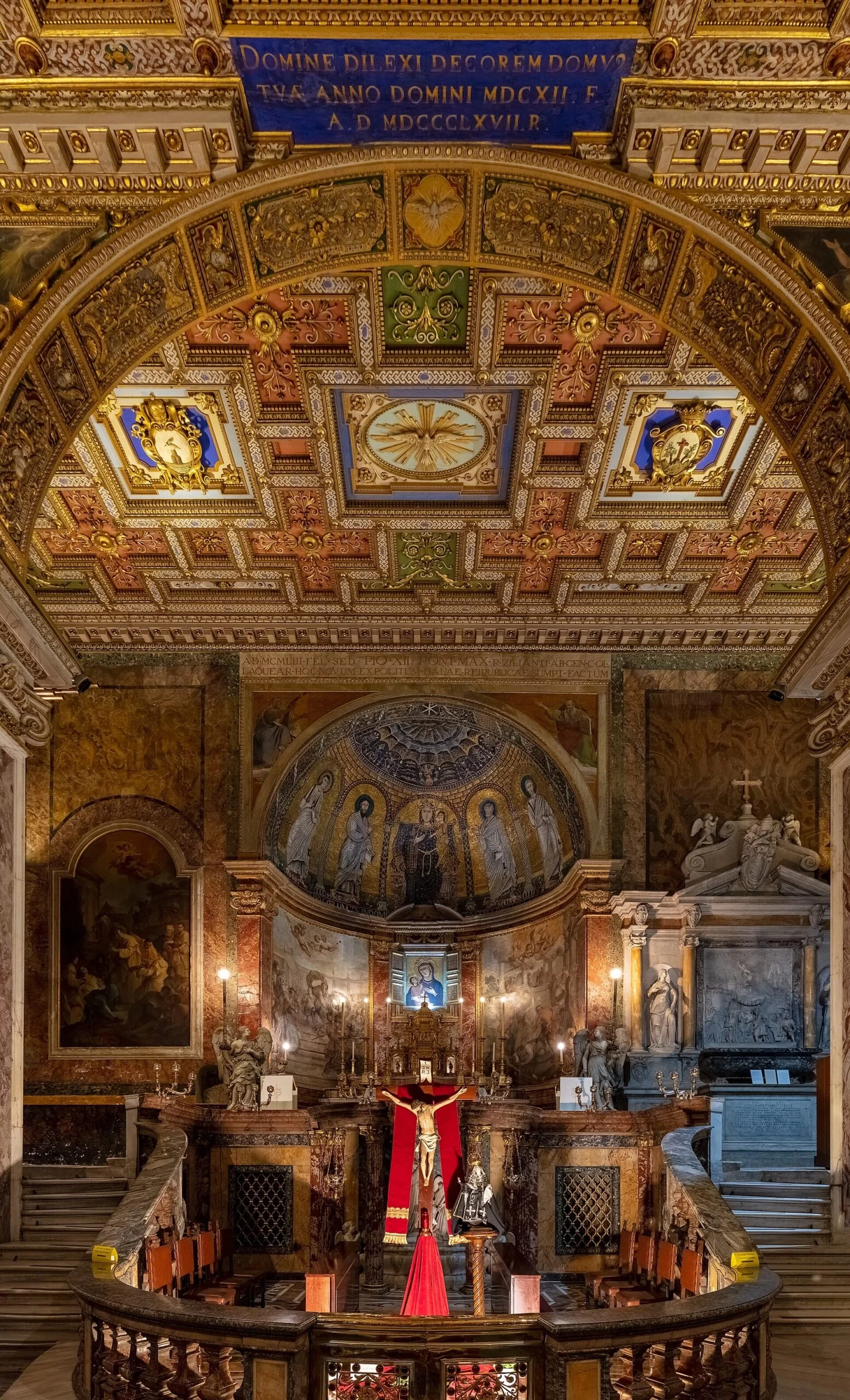
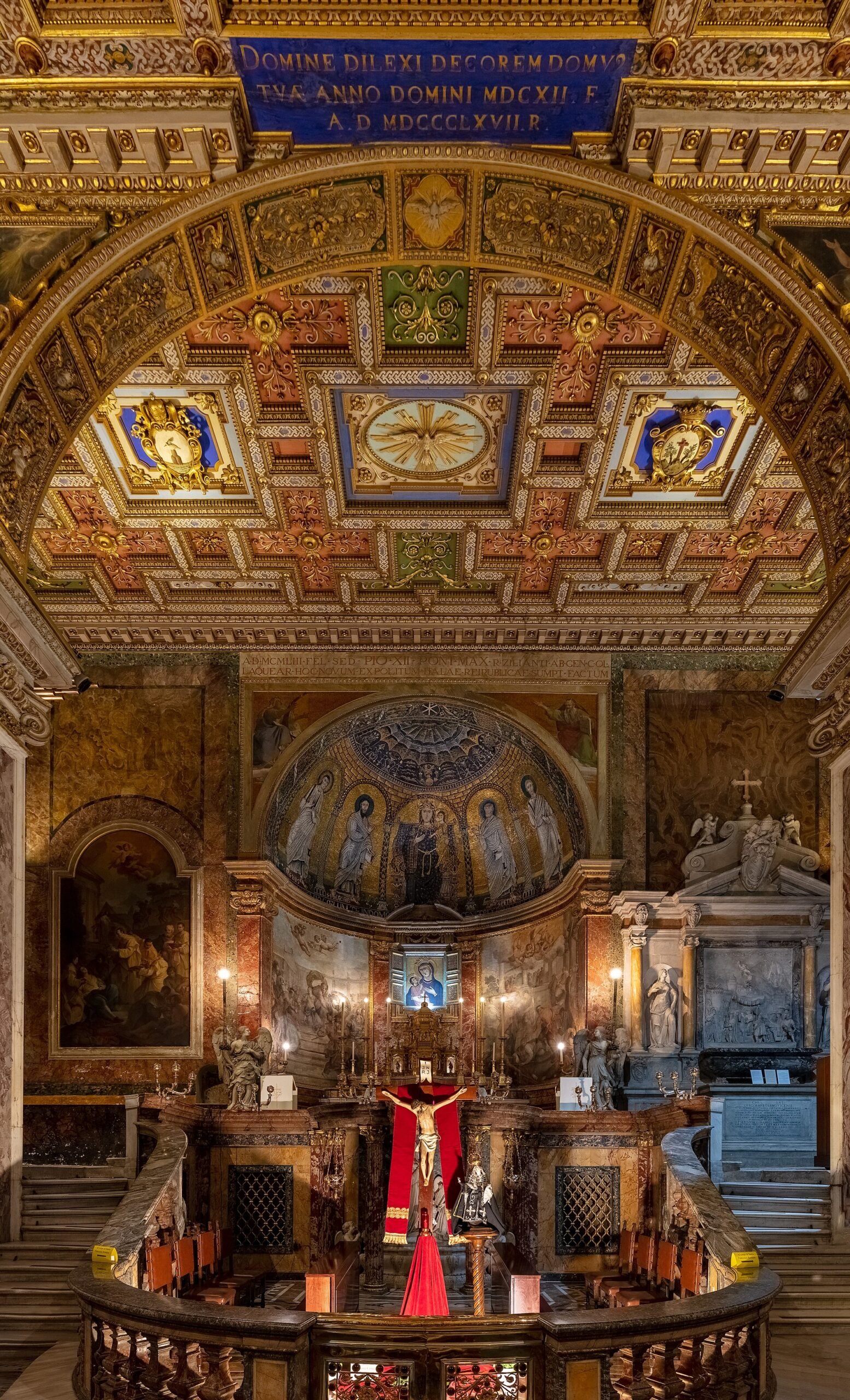
The interior of the Church of Santa Francesca Romana has a single nave with eight side chapels, a double staircase rising to the presbytery and, in the apse semi-dome, a medieval mosaic depicting the Madonna and Child flanked by saints. The feeling on entering is of a 17th-century space that keeps, as in a display case, much older pieces.
The apse mosaic
Here too the sources do not coincide, and it is worth saying so. The Italian encyclopedia entry dates the apse mosaic and the triumphal arch one to the 10th century, while the specialist reference work on the churches of Rome assigns them to the 12th century and proposes the date 1161, describing the Madonna and Child among the apostles James, John, Peter and Andrew, with an architectural background of arcades of Byzantine ancestry. Other entries link it to the 13th-century works of Honorius III. The range is therefore wide, from the 10th to the 13th century, with the 12th century as the hypothesis most recurrent in studies today.
The Cosmatesque floor
Part of the floor is Cosmatesque, that is, made with the inlay technique of colored marbles that in Rome bears the name of the Cosmati family, and a substantial portion of it, restored, is preserved in the presbytery. In the nave a fragment dated to 1216 remains, while much of the surface was redone in gray and red marbles during the restoration of 1953. Recognizing which parts are original and which are 20th-century is an exercise that pays off: the ancient design is irregular, with tesserae of unequal size and a pattern that follows the hand, while the redo is regular and cold.
The chapels and altarpieces
Among the chapels, the one dedicated to the Nativity preserves an altarpiece by Carlo Maratta, flanked by two canvases by Domenico Maria Canuti with episodes from the life of Saint Bernard Tolomei, the founder of the Olivetans. In the chapel dedicated to Saint Gregory the Great there is a painting by Angelo Caroselli with the pope. In the Chapel of the Crucifix, the first on the right, the altarpiece with the Crucifixion and the painting of Saint Bernard Tolomei on the right wall are by Giuseppe Maria Crespi, while the Holy Family on the left is again by Canuti. In the vault of the first chapel on the right a very damaged fresco with the Doctors of the Church is visible, attributed to Melozzo da Forlì.
What is kept in the sacristy
The sacristy holds some of the most precious pieces: the ancient icon detached in the mid-20th-century restoration, the Miracle of Saint Benedict by Pierre Subleyras, an 18th-century painting, the Trinity with Blessed Bernard Tolomei and Angels by Giacinto Brandi, executed between 1665 and 1670, and a painting with Pope Paul III and the English cardinal Reginald Pole, attributed by some sources to Jacopino del Conte and by others to Perino del Vaga. Access to the sacristy is not guaranteed and depends on the availability of the community: it is best to ask without expecting an automatic yes.
Bernini's confessio and the crypt of Santa Francesca
Under the presbytery of the Church of Santa Francesca Romana opens the confessio designed by Gian Lorenzo Bernini and finished in 1649, where the saint's body is kept, visible in the crypt through a glass. It is the devotional heart of the church and the reason why, in the 17th century, the old Santa Maria Nova changed its name.
The lost statue and the one we see
The original statue was of gilded bronze and was the work of Bernini himself. It was removed and destroyed in 1798, during the French occupation of Rome, when the precious metal of the churches was requisitioned on a large scale. The one we see today is a marble copy made by Giosuè Meli in 1866, placed as part of a 19th-century restoration. Whoever enters thinking they will see a Bernini, in short, sees a Meli: it is information that almost no sign in the church gives clearly.
The saint's body
In the crypt the body of Santa Francesca Romana is displayed clothed and protected by a glass. The specialist sources underline a detail of method: the Olivetans never reassembled her relics with wax to make them look like a living body, as happened elsewhere, and what you see is the skeleton dressed in the habit of the Oblates. A breviary open to a specific psalm is placed between the hands, in reference to the episode, from devotional tradition, in which the saint could not finish reading it because she was continually interrupted by household duties.
The tomb of Pope Gregory XI, the pope who brought the papacy back to Rome
In the right transept of the Church of Santa Francesca Romana is the tomb of Pope Gregory XI, the pontiff who in 1377 brought the papal seat back from Avignon to Rome, made by Pietro Paolo Olivieri and placed here in the 1580s at the expense of the Roman Senate. It is the monument of greatest historical weight in the whole church.
Who Gregory XI was
Gregory XI was the last French pope and the last of the so-called Avignon period: his return to Rome, which the sources place on January 17, 1377, closed almost 70 years of papal residence in Provence. He died little more than a year later, and at his death the Western Schism opened, which would divide Latin Christendom for decades. The Roman monument therefore celebrates an event, not a long season of government: the return.
The monument and its date
Here too the sources differ by a year: the Italian encyclopedia entry dates the work to 1584, while the specialist reference work reports that the monument was signed and dated 1584 but placed in the church in 1585. It is not a real contradiction, it is the distance between the date of execution and that of installation. The marble monument consists of a central relief panel flanked by columns and by two allegorical statues identified as Faith and Hope. The four Ionic columns in Siena yellow are not the originals: they replaced in 1900 those in giallo antico.
Why in this church
The choice of location is not accidental. The Church of Santa Francesca Romana looks onto the Forum, the symbolic heart of ancient and municipal Rome, and it was the church where the saint most identified with the city rested. Placing the monument to the pope of the return here meant welding together three elements: ancient Romanness, civic sanctity and the legitimacy of the Roman seat of the papacy. Those who want to follow the same thread can continue toward the Capitoline Hill and the Basilica of Santa Maria in Aracoeli, which is the church of the Senate and the Roman people par excellence.
My advice for visiting the Church of Santa Francesca Romana
The most useful practical advice for the Church of Santa Francesca Romana is not to treat it as an independent stop but as the free, indoor pause inside a day devoted to the Roman Forum and the Colosseum, while checking the opening hours on site or with the monastic community, because they vary and are not guaranteed.
The hours: what can really be said
The specialist sources indicate indicative opening in the morning and early afternoon bands, with a midday closure, and explicitly note that the hours are variable and change with the seasons. The Sunday Mass is indicated at 11:00. Since there is no stable official schedule published on an ongoing basis, this entry does not give a precise one: those short on time who do not want to risk a wasted trip should make a phone call or a check on the same day. Inventing an hour, here, would be the quickest way to make the reader lose time.
When it is best to go
The best moment is first thing in the morning, for two independent reasons. The first is the light: the facade faces in such a way that in the early hours the travertine and the brick of the bell tower receive a raking light that shows them off. The second is the crowd: the whole area around the Colosseum saturates by mid-morning, and the climb toward the church, which is already little frequented on its own, becomes much more pleasant when the main flow has not yet formed. Late afternoon is the second-best choice, with the risk however of finding the church already closed.
How to fit it into the itinerary
The most efficient fit is this: visit the Colosseum with a timed ticket, then enter the Roman Forum from the gate near the Arch of Constantine, walk the internal route to the Basilica of Maxentius and Santa Maria Antiqua, exit and climb back up to the church from the outer square. In this way you see the old church and the new church in the right order, and the story of the transfer of the title becomes evident instead of abstract.
Accessibility
Access is from a raised square reachable by a climb, and inside the church has level changes, in particular the double staircase that leads to the presbytery and the descent to the crypt. Those with mobility problems should allow for the fact that the nave is flat and visitable, while the presbytery and crypt involve steps. A prior check with the community is the surest way to avoid surprises, given that no detailed official information on accessibility appears to be published on a stable basis.
Who Santa Francesca Romana was
Francesca Bussa de' Leoni, later married name Ponziani, was born in Rome in 1384 and died on March 9, 1440: she is the founder of the community of the Oblates of Tor de' Specchi and was canonized on May 29, 1608 by Pope Paul V with the bull Caelestis aquae flumen. She is a patron of Rome together with Saints Peter and Paul.
The Oblates and Tor de' Specchi
On August 15, 1425, with nine companions, she offered herself as an oblate of the Virgin in the basilica of Santa Maria Nova in the Forum, that is, in this church. For eight years the Oblates continued to live in their respective families. Only in March 1433, having bought a house in Rione Campitelli at the foot of the Capitoline, did they begin community life. Francesca joined them three years later, at the death of her husband, and took over their leadership. The monastery of Tor de' Specchi, in Via del Teatro di Marcello, still exists and has never been suppressed.
Another well-known fact, yet rarely cited
Santa Francesca Romana has been the patron of motorists since 1925 by the will of Pope Pius XI, and the blessing of the cars on March 9 traditionally takes place in Piazza del Colosseo, not on the square of the church: the first official celebration dates to 1928. It is the fact that almost everyone knows halfway and that is worth clarifying.
Why motorists
The patronage comes from the tradition according to which the saint saw her own guardian angel, who protected her from dangers and lit her way as she crossed the streets of Rome at night. It is a hagiographic image, not a historical fact, and must be labeled as such. But the logical leap that in 1925 led from the angel with the lantern to the night driver was immediate and, it must be said, very effective.
What form the blessing takes today
The ceremony has turned into a symbolic and representative rite. The sources describe a blessing that takes place in the presence of the city authorities and that concerns a limited number of vehicles chosen as representatives of the different categories: law enforcement vehicles, emergency vehicles, cars from the ATAC fleet, taxis and a limited number of private cars, given as 15 for the 2018 edition. It is no longer, therefore, the line of private motorists who parked as close as possible to the church to have their car blessed.
Why it changed
A specialist reference work on the churches of Rome observes that the custom of bringing the car to the church has gradually declined and that the closure of Via dei Fori Imperiali to private traffic has in all likelihood made the mass version of the rite impracticable. The explanation is convincing: without vehicle access to the area you cannot physically bring the vehicle in front of the facade. The form that survived, in Piazza del Colosseo and with representative vehicles, is the practical answer to a traffic constraint.
What it was not possible to verify
It was not possible to verify from an official source the program of the most recent editions, nor to confirm the time and arrangements of the edition for the current year: anyone wishing to take part on March 9 should refer to the communications of the monastic community and the city in the preceding days. On the same March 9, again according to the sources, the monastery of Tor de' Specchi opens to the public and the Oblates celebrate the ancient rite of the blessing of the ointment and the ribbons for women in childbirth, distributing them to the faithful.
The right photo to take at the Church of Santa Francesca Romana
The best photograph of the Church of Santa Francesca Romana is not the one of the facade, but the one that takes the Romanesque bell tower from below, from inside the Roman Forum, with the vaults of the Basilica of Maxentius on the left: it is the framing that explains in a single frame the relationship between the medieval church and the imperial ruins it rests on.
The framing from the Forum
The shooting point is along Via Sacra, in the stretch between the Basilica of Maxentius and the exit toward the Arch of Titus. From there the bell tower emerges above the ancient podium, and framing vertically you manage to keep in the field the Roman brickwork below, the medieval masonry in the middle and the sky above the belfry. The best light is that of the late afternoon, when the sun arrives raking from the west and sets the colored ceramic discs apart from the brick background.
Inside
Inside, the subjects that hold up best are the coffered ceiling painted in blue, red and gold, photographed from the center of the nave pointing upward, and the staging of the double staircase with the confessio in the center. For both you need a steady hand or a support, because the light is scarce and the flash, besides being almost always forbidden, would flatten everything. Before shooting, though, you must check that photography is allowed: it is an active place of worship and the rule is set by the rector.
Some important events that took place here in history
The history of the Church of Santa Francesca Romana can be read as a sequence of replacements: a temple that gives way to an oratory, an oratory that inherits the title of a collapsed church, a Marian church that takes the name of a city saint, a monastery that yields its spaces to an archaeological museum.
From 121 to 141: Hadrian's temple
The construction of the Temple of Venus and Roma begins in AD 121 on a design by the emperor Hadrian himself, is inaugurated in 135 and completed in 141 under Antoninus Pius. To make room for the building site it was necessary to move the bronze colossus of Nero, about 35 meters tall beyond the base, an operation the ancient sources describe as carried out with the help of 24 elephants. Those who want to follow the thread of the colossus and its context will find the sequel at the Domus Aurea, the Neronian palace of which this sector was the atrium.
10th century and 13th century: enlargements and bell tower
In the 10th century the building is enlarged, receives the Marian dedication with the name of Santa Maria Nova and sees the creation of the apse and its decoration. At the beginning of the 13th century, under Pope Honorius III, the church undergoes a wide-ranging renovation that includes, according to this reconstruction, the construction of the bell tower, which other sources move earlier to the middle of the 12th century.
1612, 1615, 1638, 1649: the Baroque season
The coffered ceiling is dated 1612. The travertine facade by Carlo Lambardi is completed in 1615. In 1638 the saint's body is placed in the confessio, which will be finished in 1649 on a design by Bernini. In 1584 the monument to Gregory XI by Pietro Paolo Olivieri had already been executed, and in 1585 it was placed.
1873, early 20th century, 1933 and 1953
In 1873 the unified State seizes the Olivetan monastery. In the early 20th century Giacomo Boni creates the Antiquarium Forense in its spaces. Between 1933 and 1935 the Temple of Venus and Roma is the subject of the general restoration directed by Antonio Muñoz during the works to open Via dei Fori Imperiali, with the re-raising of 22 columns of the outer portico. In 1949 and 1950 the restoration of the icon reveals the double painting. In 1953 much of the floor of the nave is redone.
Who has passed through the Church of Santa Francesca Romana
Through the Church of Santa Francesca Romana have passed, in chronological order, an architect emperor, medieval popes, a painter of International Gothic, a Roman saint, Gian Lorenzo Bernini and the archaeologist who excavated the Forum: few places in Rome line up names so distant from one another within the same perimeter.
Popes Paul I, Leo IV, Gregory V and Honorius III
Paul I founds the oratory dedicated to Saints Peter and Paul between 757 and 767. Leo IV transfers here the title of Santa Maria Antiqua after the earthquake. Under Gregory V, between 996 and 999, the denomination of Santa Maria Nova is consolidated. Honorius III promotes the great renovation of the early 13th century.
Gian Lorenzo Bernini and Agata Pamphilj
Bernini designed the confessio, completed in 1649, and sculpted its bronze statue, later destroyed. The patron was Agata Pamphilj, sister of Pope Innocent X. It is a minor intervention in the Bernini catalog, but placed at a strategic point of Roman devotion.
Giacomo Boni
The archaeologist Giacomo Boni, who from 1898 directed the excavations of the Roman Forum and who brought Santa Maria Antiqua back to light, set up the Antiquarium Forense in the spaces of the former monastery. His work has in effect rejoined, on the ground, the new church and the ancient church from which it derives.
What to see around the church
The Church of Santa Francesca Romana is located at the point of greatest monumental density in Rome: within 300 meters there are the Colosseum, the Arch of Constantine, the Basilica of Maxentius and the eastern entrance of the Roman Forum.
In the archaeological area
With the integrated ticket you visit the Roman Forum, the Palatine with the Palatine Museum and the Colosseum. Inside the route you meet the Basilica of Maxentius and Santa Maria Antiqua, which is the stop to pair in order to truly understand this church.
The nearby churches
A few dozen meters away, on the opposite edge of the Forum, is the Basilica of Santi Cosma e Damiano, also carved out inside Roman buildings and with an apse mosaic of exceptional quality. A little farther up, toward the Colle Oppio, are San Pietro in Vincoli with Michelangelo's Moses and, toward the Celian, the Basilica of San Clemente with its three superimposed levels. Toward the Capitoline you meet the Mamertine Prison and the museum site of the Imperial Forums at the Markets of Trajan.
Frequently asked questions about the Church of Santa Francesca Romana
How much does it cost to enter the Church of Santa Francesca Romana?
Admission to the Church of Santa Francesca Romana is free, because it is a place of worship and not a paid museum site. The integrated Colosseum, Roman Forum and Palatine ticket concerns the archaeological area that stretches at the foot of the church and is not needed to enter the church, which is reached from the square outside the archaeological area.
What are the hours of the Church of Santa Francesca Romana?
The hours of the Church of Santa Francesca Romana are not fixed and vary with the seasons and with the life of the Olivetan monastic community that serves it. The specialist sources indicate indicative opening in the morning and early afternoon with a midday closure, and a Sunday Mass at 11:00, while noting that the hours change often: it is best to check on the same day before going.
How do you get to the Church of Santa Francesca Romana by public transport?
You reach the Church of Santa Francesca Romana by metro Line B, Colosseo stop, from which it takes a few minutes on foot going up the climb that runs along the archaeological area. On the surface the bus lines that run along Via dei Fori Imperiali and Via Labicana are useful. There is no parking nearby, because the whole area is pedestrian or heavily restricted traffic.
Why is the Church of Santa Francesca Romana also called Santa Maria Nova?
The Church of Santa Francesca Romana is also called Santa Maria Nova because in the 10th century it received the Marian dedication with this name, chosen to distinguish it from Santa Maria Antiqua, the older church at the foot of the Palatine made unusable by the earthquake of 847. The dedication to the saint was added in 1608, the year of the canonization, without erasing the previous name.
How long does it take to visit the Church of Santa Francesca Romana?
To visit the Church of Santa Francesca Romana 20 or 25 minutes are enough, and half an hour in total if you add the view of the bell tower and the Forum from the square. The building has a single nave with eight side chapels, and the time is concentrated on the presbytery, the stones of Saint Peter, the confessio with the crypt and the tomb of Gregory XI.
Can you see the body of Santa Francesca Romana?
The body of Santa Francesca Romana is visible in the crypt of the church, under the presbytery, clothed and protected by a glass. The Olivetans never reassembled the relics with wax to give the impression of a living body, and what you see is the skeleton in the habit of the Oblates. The descent to the crypt involves steps.
Is the blessing of the cars on March 9 still held?
The blessing of the cars tied to Santa Francesca Romana, patron of motorists since 1925 by the will of Pius XI, is traditionally celebrated on March 9 in Piazza del Colosseo and not on the church square, in symbolic form and in the presence of the city authorities, with vehicles representing law enforcement, emergency services, ATAC, taxis and a limited number of private cars. The program of the most recent editions should be checked year by year.
Is the Church of Santa Francesca Romana suitable for children?
The Church of Santa Francesca Romana is suitable for children, because the visit is short, free and indoors, and works well as a break inside a day at the Roman Forum. The elements that catch attention are the stones with the supposed imprints of Saint Peter's knees, the painted ceiling and the crypt. Keep in mind the steps of the presbytery and the climb to reach the square.
Can you take photographs inside the church?
In the Church of Santa Francesca Romana the possibility of photographing depends on the rules set by the rector and posted at the entrance, as in all Roman churches in use. Generally flash, tripods and filming during services are avoided. In the absence of signs the simplest thing is to ask whoever looks after the church before shooting, especially near the high altar and the crypt.
One last tip for planning the itinerary
The Church of Santa Francesca Romana gives the most when you visit it right after the Roman Forum and not before: everything you see inside, from the icon that arrived from Santa Maria Antiqua to the stones gathered along Via Sacra, makes sense only if you have just walked among the ruins those objects come from. It is a short, free stop, and for this reason it is one of the few that can be added to an already full program without having to remove another.
If you are lining up several stops in the archaeological center and want to organize them into a coherent route among the Colosseum, the Forum and the Capitoline, you may find useful planning tools on Tour Leader Pro, while for a broader picture of transport and destinations in Lazio, Italy Planner is a good resource.