Church of Santi Luca e Martina
In short. The Church of Santi Luca e Martina is at Via della Curia 2, inside the Roman Forum, backed up against the Arch of Septimius Severus and a few dozen meters from the Mamertine Prison.
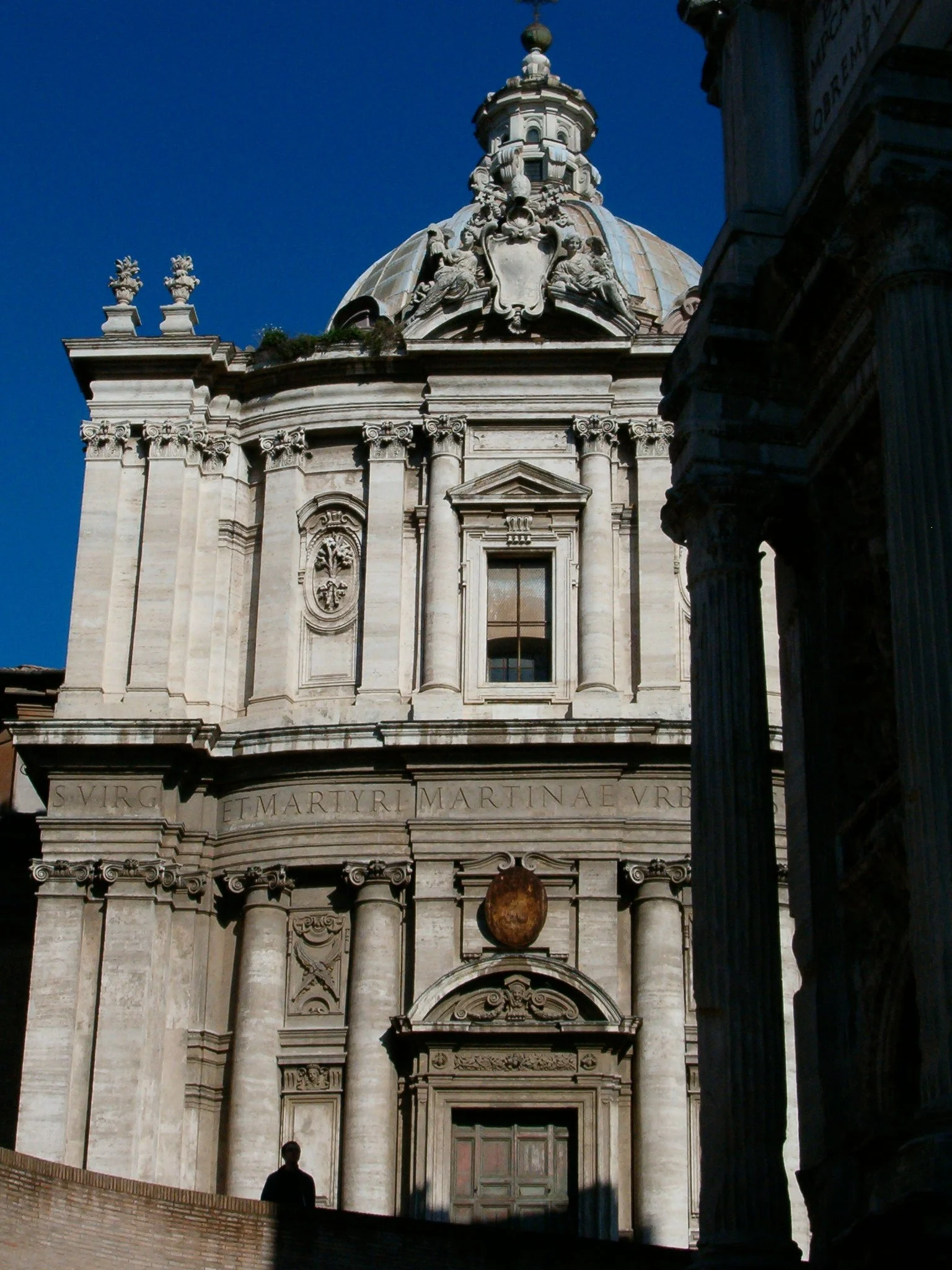
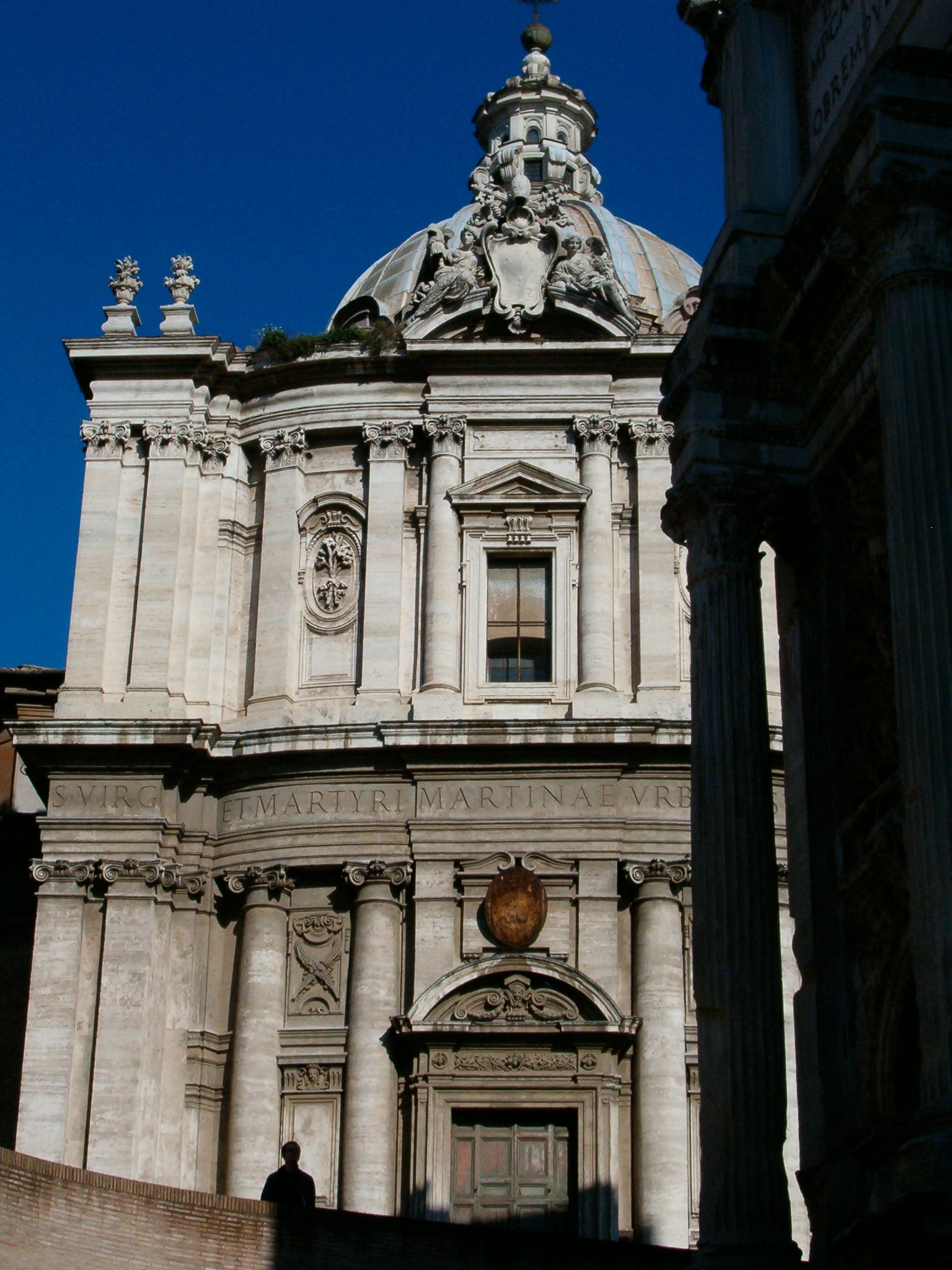
The Church of Santi Luca e Martina is at Via della Curia 2, inside the Roman Forum, backed up against the Arch of Septimius Severus and a few dozen meters from the Mamertine Prison. The address comes from the listing on the Rome city tourism portal, which also gives the contacts of the Accademia Nazionale di San Luca, 06 6798848 and 06 6798850, and the email segreteria@accademiasanluca.it. The hours are the thing you need to know before anything else, because they change your whole day. The same institutional source, and along with it the rectory page published by the parish of San Marco Evangelista al Campidoglio, state that it is open on SATURDAY, from 9:00 to 18:00 from October to April and from 9:00 to 20:00 from May to September. Saturday. One day out of seven. If you walk past on a Tuesday afternoon and find the main door closed, it's not bad luck, it's the normal routine of this building.
We say it right away because it is the most common mistake: people arrive in front of the Church of Santi Luca e Martina, see that travertine facade bulging outward as if it were breathing, try the door, find it closed and conclude that the place is abandoned. It is not abandoned. It is simply open when the Accademia decides, and the Accademia has owned that church since 1588 by bull of Sixtus V. If you want to go in, Saturday is your day.
On the Saturday hours the sources don't entirely agree: the Rome city portal and the rectory page say 9:00, while the wiki of Rome's churches (romanchurches.fandom.com) writes that the church can be visited on Saturday from 8:00 to 20:00. Better not to show up at 8:05 taking it for granted that it will be open. On Masses the situation is even less certain, because the only detailed indication available (again romanchurches, which attributes it to diocesan data from June 2018) gives Mass at 16:30 on Saturdays and on the eves of feast days from October to April, and at 18:00 from May onward. That data is eight years old: call the Accademia before counting on it.
Where exactly the Church of Santi Luca e Martina is and how to get there
Via della Curia is one of those Roman streets that exist on paper more than in people's heads. It is the lane that descends from the Largo Corrado Ricci side toward the Forum, in that triangle of land left standing between Via dei Fori Imperiali and the archaeological enclosure. The Church of Santi Luca e Martina stands on it, isolated, with the apse facing the Comitium and the facade turned toward whoever arrives from above. It has no square in front. It has no churchyard. It has a patch of gravel and a few column drums tossed there by whoever was digging 90 years ago.
The simplest way to get there is the metro. Colosseo stop, and since December 2025 things have changed for the better: the Rome city portal reports that the line C station at Colosseo opened on December 16, 2025, is located on Via dei Fori Imperiali between the Colosseum and the Basilica of Maxentius, and is directly connected to the existing line B stop. Four levels underground, down to 32 meters deep, and inside it an exhibition route curated by the Colosseum Archaeological Park. The station's hours, again according to that listing, are 5:30 to 23:30 Monday through Thursday and on Sunday, and 5:30 to 1:30 on Friday and Saturday. From there you walk up Via dei Fori Imperiali for a little under a quarter of an hour, with the Forum on your left, and you reach Largo Corrado Ricci.
On buses the answer is awkward: no institutional page publishes the list of lines serving that stretch of Via dei Fori Imperiali, neither the Rome city portal nor the Roman Forum and Palatine listing. Check atac.roma.it or call the single number 06 0608, which the city portal lists as active every day from 9:00 to 19:00. The operational truth is this anyway: in that area the transport that always works is the metro, and your legs do the rest.
Do you get into the Church of Santi Luca e Martina with the Roman Forum ticket?
No, and this is the point that confuses the most people of all. The Church of Santi Luca e Martina is physically inside the Roman Forum area but has its own entrance, on Via della Curia, and it is a place of worship owned by the Accademia Nazionale di San Luca: it is not part of the paid visiting route of the Colosseum Archaeological Park. You don't need a ticket and you don't need a reservation. You only need it to be Saturday. Anyone who buys the Forum ticket hoping to find the church open inside it usually ends up empty-handed, because they are two different administrative worlds sharing the same piece of land.
How long does it take to walk from the Colosseum to the Church of Santi Luca e Martina?
A good quarter of an hour at a normal pace, 20 minutes if it's August and the sun is beating down on the asphalt of Via dei Fori Imperiali, which is a street without a decent tree for half the route. You come out of the metro, keep the Forum on your left, walk toward Piazza Venezia, and the Church of Santi Luca e Martina appears when you have almost reached Largo Corrado Ricci: you recognize it because it is the only Baroque thing in the middle of a sea of ancient bricks, with a dome sticking up above street level. Practical advice: do it early in the morning, because that stretch of sidewalk at midday in summer is an oven and there is no shade to take shelter in.
Is the Church of Santi Luca e Martina accessible to people with mobility difficulties?
n/a. No institutional source states the church's accessibility conditions: the Rome city portal refers generically to the section dedicated to accessible Rome without giving specific details on this building. The upper church has a flight of steps in front and the crypt is reached by two staircases going down from the sides of the presbytery, so the lower level involves steps in any case. For the Accademia Nazionale di San Luca at Palazzo Carpegna, on the other hand, the official site states a free stairlift service and accessible restrooms on the ground floor, with a reservation at prenotazioni@accademiasanluca.it or on +39 06 6798850. For the church you are better off phoning and asking.
When it is really open, and why almost always it isn't
Let's be clear about something mass tourism doesn't know how to handle: there are extraordinary buildings in Rome that are open very little, and the Church of Santi Luca e Martina is the textbook case. It is not a museum, it has no ticket seller, it has no full-salary custodian. It is the church of an academy of artists whose seat is elsewhere, at Palazzo Carpegna near the Trevi Fountain, and which opens this building on Saturday and on special occasions.
The special occasions count, and in 2026 there were verifiable ones. On the website of the Accademia Nazionale di San Luca, the guided tours page lists OPEN HOUSE ROMA 2026 from May 16, 2026 at 10:00 to May 23, 2026 at 16:00, with guided tours of Palazzo Carpegna and the Church of Santi Luca e Martina. The same page lists NOTTE DEI MUSEI 2026 on May 23, from 20:00 to 23:30. These are the two windows in which this church stops being a half-closed building and becomes a place that is told aloud. If you are planning a trip to Rome for next spring, note them down now, because they sell out.
Why is the Church of Santi Luca e Martina open only on Saturday?
Because it is not a parish: it is a rectory that depends on the parish of San Marco Evangelista al Campidoglio, and it has been owned by the Accademia Nazionale di San Luca since 1588. A building without a resident community around it, in the middle of an archaeological area where nobody lives, has no pastoral reasons to stay open every day and doesn't have the resources to do it. Saturday is the compromise: there is the vigil Mass, there is a volunteer or someone in charge on duty, and whoever wants to go in can go in. A detail you rarely read: in the 1950s and 1960s the Church of Santi Luca e Martina was closed almost all the time and in terrible condition, and the wiki of Rome's churches says it explicitly, that in the mid-20th century it was rarely found open and was falling into ruin. Compared with that, a guaranteed Saturday is huge progress.
Is it worth calling before going to the Church of Santi Luca e Martina?
Yes, without beating around the bush: hours change often, so check before you leave. The sources give two different sets of numbers. The Rome city portal and the Accademia give 06 6798848 and 06 6798850, which are the numbers of the secretariat at Palazzo Carpegna. The site arte.it, on the other hand, gives the number 06 6795205 for the church. Which of the two answers faster is not known: try the Accademia's secretariat, which is the source closest to the owner of the building. If you go on a weekend with a holy day of obligation, or around January 30, which is the feast of Saint Martina, ask for confirmation twice.
What is the difference between the Church of Santi Luca e Martina and the seat of the Accademia di San Luca?
They are two buildings about a kilometer and a half apart, and mixing them up costs you half a day. The Church of Santi Luca e Martina is in the Roman Forum, at Via della Curia 2. The seat of the Accademia Nazionale di San Luca, with its painting gallery, is at Palazzo Carpegna, at piazza dell'Accademia di San Luca 77, that is, around the corner from the Trevi Fountain. The official site of the Accademia states that the gallery is open Tuesday to Friday from 15:00 to 19:00 and on Saturday from 10:00 to 19:00, with tickets on accademiasanluca.vivaticket.it, scheduled guided tours at 10 euros plus admission, and private tours at 150 euros for groups of up to 25 people. To get to Palazzo Carpegna the same page indicates metro A, Barberini stop, and bus lines 52, 53, 61, 63, 71, 80, 85, 119, 160, 492 and 630 at the Tritone stop. Note the difference in regime: the gallery is open four and a half days a week, the church one.
How much time does it take to visit the Church of Santi Luca e Martina?
40 minutes if you do it properly, an hour and a quarter if you start reading the plaques in the crypt. It is not a big church: the plan is a Greek cross with four apses, so from a single point, in the middle, you see practically everything there is to see up above. Two things eat up the time: the dome, which will keep you with your nose pointed up much longer than you think, and the lower level, which is a whole other church and not a basement. If you have exactly 40 minutes, spend 15 upstairs and 25 downstairs: that is the right ratio, for the reasons explained further on.
A curiosity about the Church of Santi Luca e Martina
Pietro da Cortona wanted a tomb for himself. Period. He didn't want to build one of the masterpieces of Roman Baroque, he wanted a funerary chapel for himself, and to get it he had offered to pay out of his own pocket for the rebuilding of the lower church. It was 1634, he had just been elected Prince of the Accademia di San Luca, and the deal was the kind made between gentlemen: you redo the lower floor at your own expense, we leave you a place to end your days.
Then, while digging, bones turned up. And not just any bones: they were identified as the relics of Saint Martina, the martyr to whom the church had been dedicated since the 7th century, together with those of two companions, Concordius and Epiphanius. From that moment the project changed scale. The official page of the Accademia Nazionale di San Luca puts it in precise words: the discovery aroused great interest, Pope Urban VIII ordered the enlargement of the project, and what was supposed to be a simple funerary chapel became a complex church, with an upper church in a Greek cross plan with a dome at the center of the transept and a richly decorated lower church. An architect set out to dig his own tomb and came out of it with a papal commission.
On the exact date of the discovery the sources don't agree. The page of the Accademia Nazionale di San Luca gives October 24, 1634. The Italian Wikipedia entry dedicated to the Church of Santi Luca e Martina gives October 25, 1634. A one-day difference, which changes little for us and quite a lot for historians.
Who was Saint Martina and why does the Church of Santi Luca e Martina carry her name?
Saint Martina was a Roman martyr. According to the Roma Segreta entry, she died in Rome around 228 under Emperor Alexander Severus. The church that bears her name already existed in the 7th century, long before Saint Luke was added to it: the evangelist arrived only in 1588, when Sixtus V assigned the building to the Università dei Pittori, which had made Saint Luke its patron because tradition has him as the author of a portrait of the Virgin. Since then the title has been double and the Church of Santi Luca e Martina holds together a 3rd-century martyr and the patron saint of painters. Her feast falls on January 30.
Why did the Accademia di San Luca get this particular church?
Through an urban-planning compensation, and the story is very Roman. The painters' company had its church of San Luca on the Esquiline, and had occupied it since 1477 according to the wiki of Rome's churches. Sixtus V, the pope who redesigned half of Rome with pickaxes and straight streets, had it demolished to free up the space in front of Santa Maria Maggiore. The painters needed another seat, and in 1588 a papal bull assigned them the old church of Santa Martina at the Forum. In exchange for a demolished church they got a ruined one, which however stood in an absurdly prestigious spot. The Accademia, which according to the English Wikipedia entry had been founded in 1577, then took almost 50 years to find the money to rebuild it.
Who designed the Church of Santi Luca e Martina?
Pietro Berrettini, known as Pietro da Cortona, born in 1596 and died in 1669, a painter even before an architect. But the design history has two stages. Before him, according to Roma Segreta, Ottaviano Mascherino had put his hand to it, who at the end of the 1500s had begun rebuilding by raising the floor level so as to create an underground space below for burials: that choice is the technical reason why today the Church of Santi Luca e Martina has two floors. The Accademia's page adds that Cortona had thought of a circular scheme already in the 1620s, and that the actual project started in 1634. After his death the direction passed to his pupil Ciro Ferri.
What was here before: the Comitium, the Curia, the Secretarium Senatus
This is the most curious piece to tell, because the Church of Santi Luca e Martina sits on top of the most politically dense place of Western antiquity and almost nobody notices.
The wiki of Rome's churches, which on this is the most detailed source, reconstructs the stratigraphy like this: here was the Comitium, the political center of Rome from at least the 7th century BC. Here rose the Curia Hostilia, the first hall of the senate. Then the Curia Cornelia. Then Julius Caesar built the Curia Iulia next to it. In late antiquity the space housed shops and the Secretarium Senatus, which the same source describes as a reserved court for examining the conduct of senators. An inscription records the reconstruction of the Secretarium by Nicomachus Flavianus the Younger at the beginning of the 5th century, with a restoration by Annius Eucharius Epiphanius in 414.
On exactly where the church stands, the sources don't agree. Roma Segreta writes that the Church of Santi Luca e Martina rises where the Curia Hostilia stood. The Rome city tourism portal and the site Laboratorio Roma instead indicate the Secretarium Senatus, and Laboratorio Roma is explicit: the church was founded by Pope Honorius I in the hall of the Secretarium Senatus. They are two different identifications of the same piece of ground, and the debate exists.
Is the Church of Santi Luca e Martina the Curia Iulia?
No, although the mix-up is common. The Curia Iulia is the other building, the brick one, tall and squared, which stands a few meters further toward the Forum and which in the Middle Ages became the church of Sant'Adriano al Foro. The Church of Santi Luca e Martina is the Baroque building with the dome and the curved facade. They stand side by side, they share the history of the Comitium, but they are two separate things. A small detail that links the two: according to the Rome city portal listing on the Curia Iulia, it was Pope Honorius I who consecrated it as a church around 630, that is, the same pope to whom the founding of Santa Martina is attributed. Honorius I converted two senate buildings into churches, one next to the other. It doesn't happen often.
Can you visit the Curia Iulia together with the Church of Santi Luca e Martina?
Yes, and it is one of the most useful tips, because the calendars line up luckily. The Rome city portal states that the Curia Iulia (church of Sant'Adriano al Foro) is open from Saturday to Monday, with these hours: March 1 to 26 and October 1 to 29 from 9:30 to 16:30, last entry at 16:15. March 27 to September 30 from 9:30 to 18:15, last entry at 18:00. October 30 to February 28 from 9:30 to 15:30, last entry at 15:15. The Church of Santi Luca e Martina opens on Saturday. Saturday is the only day of the week when you can have both open, and they are 50 meters from each other. Be careful though: the Curia Iulia is inside the paid perimeter of the Colosseum Archaeological Park, the church is not.
How much does the Roman Forum ticket cost in 2026?
n/a. Beware of reseller prices, which add fees and don't match the official price. The 2026 hours of the Roman Forum and Palatine, according to the Rome city portal, are these: March 1 to 28, 2026 from 9:00 to 17:30. March 29 to September 30, 2026 from 9:00 to 19:15. October 1 to 24, 2026 from 9:00 to 18:30. October 25, 2026 to February 28, 2027 from 9:00 to 16:30. Last entry one hour before closing, closed on December 25, 2026 and January 1, 2027. The entrances listed are Via Sacra, Via della Salara Vecchia 5 and 6, Via di San Gregorio 30, and tickets are bought on ticketing.colosseo.it or by calling 06 21115843.
Something nobody tells you about the Church of Santi Luca e Martina
This church ended up alone because the emptiness was made around it, and the emptiness was made on purpose, in a hurry, with bulldozers, in the 1930s.
Until then the Church of Santi Luca e Martina was not an isolated object in the middle of ruins: it was wedged into a fabric of buildings, and one of those buildings was the seat of the Accademia di San Luca, which stood right next to it and used the church as its spiritual home and as the burial place of its members. Then Via dell'Impero was opened, today Via dei Fori Imperiali, and the whole neighborhood was swept away. The official page of the Accademia Nazionale di San Luca reports that in 1932 and 1933 the adjacent buildings were demolished for the construction of Via dell'Impero, isolating the church, and adds a detail you almost never find in the guidebooks: in May 1932 Mussolini intervened directly, interrupting the works on a new building for the Accademia. The Accademia moved to Palazzo Carpegna in 1934.
The wiki of Rome's churches says it even more curtly: the buildings near the church, including the seat of the Accademia, were demolished by the Fascist government in 1932, and the church was left as an isolated structure surrounded by fragmentary ancient ruins. So when you stand in front of the Church of Santi Luca e Martina and find it strange, suspended, as if it didn't belong to the place where it stands, you are right: it doesn't belong there anymore. They made it a monument to itself by taking away the surrounding city that gave it meaning.
Why does the Church of Santi Luca e Martina seem out of place in the Roman Forum?
Because it is, and not through any fault of its own. The Roman Forum we visit today is the result of two centuries of excavations that removed everything that had been built on top of the ancient: medieval churches, palaces, vegetable gardens, houses. The Church of Santi Luca e Martina is one of the very few post-ancient things that survived inside that perimeter, together with the readapted Curia Iulia and a few others. It survived because it was a recognized masterpiece and because it belonged to an institution that had a say. Everything that stood around it, and that gave it context, was pulled down. The result is a Baroque building floating in the middle of an archaeological landscape with which it had no intention of dialoguing.
What did Romans in the 1600s see when they arrived at the Church of Santi Luca e Martina?
Not the Forum. In the 1600s the area was the Campo Vaccino, with the ground level many meters higher than today, the columns of the temples buried up to half their height and herds really grazing there. The convex facade of the Church of Santi Luca e Martina, with its curve pushing forward, was designed to be seen up close, in a narrow space, by someone arriving along a street and suddenly finding it right on top of them: it is an effect of surprise that has been lost today, because we see it from far away, from a street 30 meters wide, in the middle of emptiness. Pietro da Cortona had also designed side wings that would have covered the transverse arms of the cross, and which according to Laboratorio Roma were never built. That facade is a piece of urban theater left without a theater.
Why does the Church of Santi Luca e Martina have two floors?
For a practical reason that later became a grand one. According to Roma Segreta, it was Ottaviano Mascherino, at the end of the 1500s, who raised the walking level to create below a space meant for burials: the Accademia needed a place to bury its academicians, and the way to get it was to lift the floor. When Pietro da Cortona put his hand to it in 1634 that space already existed as a funerary cellar, and he turned it into a real church, with polychrome marbles, a gilded bronze altar and a vault that imitates the Pantheon. The lower floor of the Church of Santi Luca e Martina is not a crypt in the sense of an underground chamber: it is a second sacred building under the first.
Pietro da Cortona, the church he built around himself
To explain to someone what Roman Baroque is without taking them to Saint Peter's, this is the right place. The Church of Santi Luca e Martina is the building where you see best that the Baroque is not decoration stuck on top of a box: it is the box itself that moves.
Pietro Berrettini da Cortona was first of all a painter, and one of the greatest of his century: the vault of Palazzo Barberini is his. When he designs a building he thinks like a painter, that is, he thinks about how the light falls and how the eye moves. In the Church of Santi Luca e Martina this shows in a detail that always surprises: the interior of the upper church is almost entirely white. No frescoes on the walls, no colored marble, no intrusive gilding. The English Wikipedia entry notes it with a touch of astonishment, that an interior of white stucco is surprisingly austere for the painters' academy. It's true, and it is a deliberate choice: Cortona gave up color to leave all the work to form, to the columns, the cornices, the ribs of the dome.
The chronology of the building site, according to the wiki of Rome's churches, the most analytical source, is this: works started in 1635. In 1639 the lower part of the facade and the entrance were completed, with the crypt already well advanced. Between 1640 and 1648 everything stopped because of the flight of Cardinal Francesco Barberini after the accusations of embezzlement. Resumption in 1648 under the responsibility of Giovanni Battista Soria, with Cortona in a supervisory role. Main structure completed in 1658. Dome built in the 1660s. At Cortona's death in 1669 the building was substantially finished. Decorations concluded in 1679 under Ciro Ferri. 44 years. The Accademia's page confirms the conclusion in 1679, 10 years after Cortona's death, and specifies that the decoration continued in the 1700s and 1800s.
How much did the Church of Santi Luca e Martina cost and who paid?
The total bill does not appear to be published. Only one figure is known, and it comes from the English Wikipedia entry: Cardinal Francesco Barberini allocated 6,000 scudi for the construction. The same source reports that Pope Urban VIII, that is, Maffeo Barberini, the cardinal's uncle, visited the building site in November 1634, a few weeks after the discovery of the relics. According to the Italian Wikipedia entry, moreover, Pietro da Cortona continued to benefit the church even through his will, leaving it significant financial endowments. So the funding is a mix of papal money, cardinal's money and the architect's personal money. The rest of the figures are n/a.
Why are there bees on the dome of the Church of Santi Luca e Martina?
Because bees are the Barberini coat of arms, and the Barberini paid. The Rome city tourism portal describes the dome as resting on a circular drum decorated with the emblem of the Barberini bee. It is the 17th-century way of signing a building: whoever put in the money also puts their coat of arms, and puts it up high, where everyone sees it and nobody can remove it. In Rome there is an old Latin saying about the Barberini and what they took from the ancients to build the modern, of uncertain attribution. The bees, though, are really there, and they are the visual proof that this church is a family operation.
Is the Church of Santi Luca e Martina Pietro da Cortona's masterpiece?
The sources define it as one of the masterpieces of Roman Baroque architecture: so writes arte.it, and in similar terms the Rome city portal, which speaks of a masterpiece of Roman Baroque. If it is his absolute masterpiece, that is a judgment, not a fact, and our opinion is clear: as an architect yes, this is the best thing he did, because it is the only building where he could decide everything, from the plan to the facade to the crypt, without having to fit his work into someone else's construction. Santa Maria della Pace has a more spectacular facade but it is a graft onto a pre-existing church. Here instead he had a free hand for 35 years.
The advice I give you for visiting the Church of Santi Luca e Martina
Go on Saturday morning early, around 9:30, and go down into the crypt RIGHT AWAY. Before looking at the dome, before sitting down, before anything. The reason is a matter of light and of people.
The upper church is white. White works at any hour, in any light, and it won't run away from you. The lower church instead is an environment of polychrome marbles and gilded bronze, and it needs rested eyes: if you go down after 20 minutes spent looking at white stucco lit from above, your pupils are closed and the crypt will seem dark and confusing. If instead you go down as soon as you enter, with your eye still used to the outside, it takes you two minutes to adapt and then you see the colors. Trust me: it's a huge difference and it costs nothing.
The second part of the advice concerns people. The Church of Santi Luca e Martina never has lines, but on a Saturday morning in spring there may be a study group or an organized visit from the Accademia, and in the crypt a group of 20 people takes up all the available space: those corridors are narrow. At 9:30 the risk is low, at 11:30 it is high. Third part: bring something to cover your shoulders if it's August, because it is a place of worship and the rule applies here too, and besides the crypt is really cool, much more than the street.
What is the best time to visit the Church of Santi Luca e Martina?
Saturday morning, by 10:30. It is the only day it is open according to the institutional sources, and early in the morning you have three advantages together: the light enters from the lantern of the dome at an angle you no longer have in the afternoon, the Forum area is not yet saturated with groups, and you are not yet cooked by the heat if it's summer. The afternoon has only one advantage, that the church stays open until 18:00 in winter and until 20:00 in summer according to the Rome city portal, so if you only have the late afternoon go anyway. But if you can choose, choose the morning.
What must I absolutely see inside the Church of Santi Luca e Martina?
Three things, in this order. The first is the altar of the crypt: according to Laboratorio Roma it is a carved bronze altar decorated with inlays of precious stones, made to a design by Pietro da Cortona by Giovanni Artusi, and the wiki of Rome's churches describes it as a freestanding altar of gilded bronze embellished with lapis lazuli and sardonyx. The second is the statue of Saint Martina by Niccolò Menghini, from 1635, which according to Laboratorio Roma is inspired by the Saint Cecilia of Stefano Maderno: it is a reclining figure, as if asleep. The third is the dome seen from below, with the four pendentives. If you have time for only one thing, the altar of the crypt.
Do I need to book to enter the Church of Santi Luca e Martina?
For the ordinary Saturday opening no: you go in through the door and that's it, and there is no ticket. You need to book for the extraordinary openings, and the source says so: on the website of the Accademia Nazionale di San Luca the 2024 Notte dei Musei is listed as by reservation only, and the guided tours of Open House Roma follow the calendar and the rules of the initiative. For group visits or for access outside opening hours you must write to segreteria@accademiasanluca.it or call the Accademia's numbers. The exact conditions for a group visit to the church do not appear to be published: ask directly.
Can you take photos inside the Church of Santi Luca e Martina?
n/a. There is no published regulation on photographs inside the Church of Santi Luca e Martina. The sensible behavior in a church owned by an academy, open with reduced staff, is this: no flash, no tripod, no filming during Mass, and if there is someone at the entrance ask them first. In the crypt the flash is useless anyway because it flattens the marbles and ruins your photo. We'll come back to this in the chapter dedicated to photographs.
The crypt, that is, the church under the church
It is downstairs that the Church of Santi Luca e Martina becomes something different from all the other churches in Rome.
You go down from two doors at the sides of the presbytery. The wiki of Rome's churches describes the mechanism precisely: from the two doors you pass into two small chapels whose floors extend to form the upper landings of the main staircases that descend to the lower church. Below you find a central octagonal hall, which lies exactly under the dome, and from it corridors lead to a cross-shaped sanctuary chapel dedicated to Saint Martina. Laboratorio Roma dates the crypt to 1657 and 1659 and describes it like this: it repeats the Greek cross scheme of the upper church, adding two cross-vaulted corridors meant for burials, with walls entirely covered in polychrome marbles and a vault with foreshortened coffering and a central oculus recalling the Pantheon.
That foreshortened coffering is the thing to look at first. It is a painter's trick: the coffers are drawn in forced perspective to make the vault seem higher than it is, and the oculus in the center closes the game by recalling the Pantheon, which is 700 meters away as the crow flies. An architect quoting the most famous Roman monument in the city inside an underground space the size of a living room.
Can you go down into the crypt of the Church of Santi Luca e Martina?
When the church is open, yes, and it is the main reason it is worth waiting for Saturday. It is not a crypt closed behind a grate like many you find in Rome: you go down, you walk, you go around the altar. A note on management, reported by only one source: Eventi Culturali Magazine writes that the upper church belongs to the Accademia di San Luca and is open for worship, while the crypt is run by the Conservatorio di Sant'Eufemia. The claim does not appear to be confirmed by institutional sources, so treat it as an indication to verify, not as an established fact.
What is inside the altar of the crypt of the Church of Santi Luca e Martina?
The relics of Saint Martina, according to the sources, and with her those of the martyrs Concordius and Epiphanius. The rectory page published by San Marco Evangelista al Campidoglio says that the richly decorated lower church is dedicated to Saint Martina and that her relics are kept in the main altar. The wiki of Rome's churches adds that these are the relics of Martina, Concordius and Epiphanius, presumably discovered during the works of 1634. Note that presumably: it is the caution of someone who knows that discoveries of relics in the 1600s often had an economic function too. The English Wikipedia entry says it almost openly, that the discovery seemed aimed at attracting funding. The historiographical doubt, in any case, exists.
Who made the bronze altar of the crypt?
The design is by Pietro da Cortona, the execution by a silversmith. On the name the sources differ slightly: Laboratorio Roma writes Giovanni Artusi, the wiki of Rome's churches writes Giovanni Canale Artusi. It is probably the same person with a name reported in different ways, but it is not certain. On the materials the two sources complement each other: gilded bronze with inlays of precious stones, lapis lazuli and sardonyx, and according to the wiki a double-sided alabaster cameo relief with the visions of Saint Martina. Laboratorio Roma also attributes the bas-reliefs with Saint Martina to Cosimo Fancelli. It is the most precious object in the whole Church of Santi Luca e Martina and it stands in the spot that the fewest people reach.
Who is buried in the crypt of the Church of Santi Luca e Martina?
Academicians, that is, painters, sculptors and architects. The wiki of Rome's churches lists among the monuments of the crypt that of Giovanni Battista Soria from 1651, with a portrait bust, and that of Filippo Albacini from 1858, inaugurated in 1880. The Italian Wikipedia entry says more generically that the remains of artists of the Accademia rest there. The site info.roma.it adds to the burials of the church the painter Lazzaro Baldi and the architect Luigi Canina. The crypt of the Church of Santi Luca e Martina is in essence the cemetery of an artistic institution, and this makes it a document on the history of Roman art more than a devotional place.
Where is Pietro da Cortona buried?
Here, but on exactly where the sources don't agree. The English Wikipedia entry writes that Cortona's burial is marked by a stone slab inside the main entrance, with a commemorative bust in the lower church. The wiki of Rome's churches places his monument at the end of the right corridor of the crypt, with a bust by Bernardo Fioriti and a long inscription. Laboratorio Roma speaks of a rich funerary monument in the crypt carried out by Luca Berrettini from a design by Ciro Ferri. The three descriptions are not entirely mutually exclusive, because a tomb slab and a commemorative monument can stand in two different spots of the same building, but the names of the executors differ. What is certain, and on which all the sources agree, is that Pietro da Cortona is buried in the Church of Santi Luca e Martina, that is, in the building he had started to rebuild precisely in order to have a tomb.
Another well-known fact, yet rarely cited
The fact is this: the altarpiece of the main altar is not an original, it is a declared copy. And almost nobody says it out loud.
Above the altar of the upper church there is a painting that represents Saint Luke the evangelist painting the Madonna: the right subject for the painters' church, because tradition makes Saint Luke the first portraitist of the Virgin and therefore the patron of those who paint. But that picture, according to the Italian Wikipedia entry, is a copy of the painting attributed to Raphael, and is the work of Antiveduto Gramatica. The wiki of Rome's churches adds the detail that closes the circle: the original is kept by the Accademia. That is, the real picture is at Palazzo Carpegna, inside the gallery of the Accademia Nazionale di San Luca near the Trevi Fountain, and in the church there is the copy.
This is well known among art historians and ignored by everyone else, and it's a pity, because it tells of a very concrete choice: an institution that has a precious painting and a church open one day a week in the middle of an archaeological area decides to keep the painting safe in its own seat and to put a declared copy in the church, painted moreover by a painter who had himself been Prince of the Accademia. It is not a deception, it is a conservation policy centuries old. If you want to see the original you have to go to Palazzo Carpegna and pay the gallery ticket.
Is the picture of Saint Luke painting the Madonna really by Raphael?
The attribution has been debated for a long time and the sources treat it with caution: the Italian Wikipedia entry speaks of the famous painting by Raphael, the English entry and the wiki of Rome's churches speak of a copy by Antiveduto Grammatica of the original kept by the Accademia without committing on the absolute authorship. What can be said with certainty is that the picture you see in the Church of Santi Luca e Martina is not the original, however one wants to attribute it, but the 17th-century copy. Who painted the original is a matter for specialist studies.
Who was Antiveduto Gramatica?
A Roman painter of the early 1600s, whom the sources cite among the artists present in the Church of Santi Luca e Martina together with Filippo Della Valle and Camillo Rusconi: info.roma.it lists him. The name Antiveduto is one of those 17th-century names that seem invented and are instead real, and by itself is worth the trip as an anecdote to tell at dinner. Quite a few stories circulate about him, including those about his relationship with Caravaggio, but they are not confirmed by reliable sources and should not be taken as facts. The solid fact is that the altarpiece of the main altar of the Church of Santi Luca e Martina is his.
What to look at inside, work by work
A reasoned inventory, with the source of each attribution. It is not a complete list.
In the upper church, the pendentives of the dome carry four allegories in stucco relief of the evangelists. The Rome city portal and the Italian Wikipedia entry attribute the whole to Camillo Rusconi. The wiki of Rome's churches is more analytical and distinguishes design from execution: design by Camillo Rusconi, execution by Giuseppe Rusconi for Saint Matthew, Filippo della Valle for Saint Mark, Giovanni Battista Maini for Saint Luke and Saint John, with completion in 1730. The site info.roma.it instead places the reliefs between 1727 and 1732. The dates don't coincide perfectly.
On the main altar, besides the altarpiece by Antiveduto Gramatica, the wiki of Rome's churches describes a pair of Corinthian alabaster columns supporting an entablature with verde antico marble, and above it the white marble statue of Saint Martina by Nicola Menghini, stretched out as if sleeping. Laboratorio Roma places the statue of Saint Martina from 1635, the work of Niccolò Menghini, in the upper transept, and indicates its model as the Saint Cecilia of Stefano Maderno. The two sources place it in slightly different spots: when you are there, look in both places, and in any case you can't go wrong because it is the only reclining figure in the building.
The side chapels. The wiki of Rome's churches attributes to Lazzaro Baldi the altar of the right chapel, from 1682, with Saint Lazarus Zographos subjected to torture, and to Sebastiano Conca the altar of the left chapel from 1740, with Saint Sebastian. The Italian Wikipedia entry speaks of the Virgin Assumed and Saint Sebastian by Sebastiano Conca, datable around 1740, with the chapel inaugurated on October 18, 1733. Laboratorio Roma instead writes that Sebastiano Conca donated in 1720 a large painting with the Ascension of Mary. Three dates, 1720, 1733 and 1740, for works that could be the same or two different ones: the knot remains open.
Alessandro Algardi. Laboratorio Roma speaks of a terracotta relief with the dead Christ, the Virgin and God the Father, donated in 1698 and placed on the altar facing the access corridor. The wiki of Rome's churches speaks of a terracotta bas-relief with the Deposition in the octagonal hall and of a terracotta sculpture with Saints Concordius and Epiphanius in a side chapel. The English Wikipedia entry places a relief by Algardi in the sacristy. Here too the placements don't coincide. What all the sources agree on is that in the Church of Santi Luca e Martina there are terracotta works by Algardi, who was Bernini's great rival and a sculptor who gave his best in terracotta.
Are there works by Bernini in the Church of Santi Luca e Martina?
None of the sources cited attribute works by Gian Lorenzo Bernini to this church, so the answer is no. There is Alessandro Algardi instead, who was Bernini's direct competitor in mid-17th-century Rome, and there is the architecture of Pietro da Cortona, who with Bernini and Borromini forms the trio that invented Roman Baroque. If you are looking for an itinerary on the three, the Church of Santi Luca e Martina is the Cortona stop par excellence, and a short distance away you have the hand of Borromini and that of Bernini all over half the city. But in here the master of the house is only one.
Why is the interior of the Church of Santi Luca e Martina all white?
Because Pietro da Cortona decided so, and because recent restorations worked to bring the building back to its original tones. The English Wikipedia entry describes the upper church as an interior of white stucco, surprisingly austere for a painters' academy, and contrasts it with the richness of color, marble and gilded bronze of the lower church. The wiki of Rome's churches adds that recent restorations brought the interior back to its original limestone-colored scheme, while partly keeping the 18th-century contrast between white and pale blue for the vaults and pendentives. The Accademia's page speaks of work on the dome and the drum in 2014 and 2015 that restored the warm colors and original tones of Cortona's stuccoes. So the white you see today is a warm white, not a hospital white, and it is the result of documented restoration choices.
When was the Church of Santi Luca e Martina restored?
Several times, and fairly continuously from the 1980s to today. Laboratorio Roma indicates work starting in 1985 on the small lantern, on the lead-sheet exterior covering of the dome and on all the other roofing, and between 1996 and 1999 the restoration of the underground spaces by the Soprintendenza, with the recovery of the intensity of the colors of the polychrome marbles. The wiki of Rome's churches speaks of repairs to the dome in 1985 by the Comune, of the restoration of the crypt in the three years after 1996 and of the restoration of the main interior completed by 2008. The page of the Accademia Nazionale di San Luca says that the restorations begun from the mid-1980s involved the crypt and the upper body, finishing in 2009, and that the latest work, in 2014 and 2015, concerned the dome and the drum. On 2008 or 2009 the sources differ by a year: it is a detail.
The right photo to take at the Church of Santi Luca e Martina
The right photo is not the one everybody takes, that is, the front facade shot from Via dei Fori Imperiali with the phone held up over the railing. That is a flat photograph: the wall is far away, the sun beats straight down on it for half a day, the curve of the facade can't be read and you take home a gray postcard.
The right photo is at an angle, from below, from the Forum side, with the Church of Santi Luca e Martina set in relation to something ancient. The best spot is the one where you can keep in the same frame the Baroque dome and a piece of Roman ruin: the Arch of Septimius Severus if you are inside the archaeological area, or the brick mass of the Curia Iulia. The reason is simple: that church makes no sense alone, because it was isolated by force in the 1930s. If you photograph it alone, you photograph a building without context. If you photograph it together with the ancient, you photograph the history of Rome in one frame: 1,600 years of distance between two walls that touch.
Time of light. The facade faces so that early in the morning it catches a raking, warm light on the travertine, and travertine in raking light is one of the most beautiful materials to photograph that exist, because its holes cast shadows and the stone looks alive. Around noon the same facade becomes a white slab with no relief. In the late afternoon in summer it works again, but in winter the church at that hour is already closed. Operational conclusion: if you want the photo AND you want to go in, Saturday morning solves both.
Can you take photos inside the crypt of the Church of Santi Luca e Martina?
No published regulation appears, so n/a on the formal permission, and the practical rule is the one already stated: ask whoever is on duty at the entrance. On technique, though, the opinion is firm. No flash. The crypt is covered in polychrome marbles and gilded bronze, surfaces that reflect, and a frontal flash gives you back a white blotch in the center of the frame and the rest black. Rest the phone or the camera on a stable surface, raise the exposure a little, and let the artificial light that is there do the work. If your phone has a night mode, this is exactly the place where it is needed.
Where can you best see the dome of the Church of Santi Luca e Martina from?
From inside, by tipping your head back under the center of the Greek cross: that is where the structure can be read, because the dome is furrowed with ribs and joins the drum, as Laboratorio Roma writes, through a kind of crown above which the lantern enclosed by scrolls stands out. From outside, the best spot is a little raised: going up toward the Campidoglio, or from the edge of Largo Corrado Ricci, the dome emerges above street level and stands out from the background. If you are inside the archaeological area of the Forum with a ticket, try looking at it from below as you climb back toward the Arch of Septimius Severus: from there the Church of Santi Luca e Martina seems much taller than it is, because the ground has dropped by quite a few meters compared with the 1600s.
Can you see the Church of Santi Luca e Martina from the Campidoglio?
Yes, and it is one of the best ways to understand its position. Go up to the Capitoline Hill by the Capitoline Cordonata, cross the square and take the road that turns around the back, behind Palazzo Senatorio: from there the view opens onto the Roman Forum from above, and the dome of the Church of Santi Luca e Martina is recognized at once because it is the only curved thing in a panorama made of straight columns and broken walls. It is a free view open to everyone, and from there you understand in two seconds the relationship between the church, the Curia Iulia and the rest of the Forum. If you then want to go into the Capitoline Museums, you are already on the spot.
Some important events that happened here in history
It is not a church for great papal events: it is a church of a category, of a guild, and its history is made of episodes that weigh more on the history of art than on political history. Here they are in chronological order, with the source for each.
- 7th century. Foundation of the church of Santa Martina, attributed to Pope Honorius I, who reigned from 625 to 638. So say the Rome city portal, the Italian Wikipedia entry and Laboratorio Roma, the latter specifying that the foundation took place in the hall of the Secretarium Senatus. Careful: arte.it instead speaks of a foundation in the 6th century, which is incompatible with the dates of Honorius I, and the wiki of Rome's churches notes that the attribution to Honorius is often asserted but remains hypothetical, proposing as an alternative a dating to 677 under Pope Donus on the basis of a lost mosaic that showed Saint Martina between the two pontiffs. The sources do not agree.
- 1256. Restoration and new consecration by Pope Alexander IV, after a period of decay. The Italian Wikipedia entry and the English entry report it.
- 1477. The painters' company occupies the church of San Luca on the Esquiline, according to the wiki of Rome's churches.
- 1577. Foundation of the Accademia di San Luca, according to the English Wikipedia entry.
- 1588. Sixtus V demolishes San Luca on the Esquiline to arrange the square in front of Santa Maria Maggiore and with a bull assigns the church of Santa Martina at the Forum to the painters. From that moment the title becomes double. So say the page of the Accademia Nazionale di San Luca, the Rome city portal, Roma Segreta, Wikipedia and the wiki of Rome's churches: it is the most solid piece of data in the whole reconstruction.
- 1634. Pietro da Cortona is elected Prince of the Accademia and obtains permission to rebuild the lower church at his own expense to make it his own funerary chapel.
- October 24 or 25, 1634. During the excavations, the remains attributed to Saint Martina and to the martyrs Concordius and Epiphanius come to light. The Accademia's page gives the 24th, the Italian Wikipedia entry the 25th.
- November 1634. Pope Urban VIII visits the building site, according to the English Wikipedia entry, which also reports the allocation of 6,000 scudi by Cardinal Francesco Barberini.
- 1635. Start of construction of the new church to a design by Pietro da Cortona.
- 1639. Lower part of the facade and the entrance completed, crypt well advanced, according to the wiki of Rome's churches.
- 1640 and 1648. Building site stopped because of Cardinal Barberini's flight to France after the accusations of embezzlement, same source. The English Wikipedia entry places the cardinal's Parisian exile between 1645 and 1648 and also notes Cortona's absence, in Florence between 1639 and 1647. Here too the chronologies don't entirely coincide.
- 1657 and 1659. Construction of the crypt in its present form, according to Laboratorio Roma.
- 1658. Main structure of the upper church completed, according to the wiki of Rome's churches.
- 1664. Completion of the convex facade, according to the Italian Wikipedia entry and Roma Segreta.
- 1669. Death of Pietro da Cortona. The building is substantially complete. Direction passes to Ciro Ferri.
- 1679. Conclusion of the decorative works, 10 years after the architect's death, according to the Accademia's page and the wiki of Rome's churches.
- 1698. Donation of the terracotta relief by Alessandro Algardi, according to Laboratorio Roma.
- Around 1730. Completion of the allegories of the evangelists in the pendentives. The wiki of Rome's churches says 1730, info.roma.it gives the period between 1727 and 1732.
- May 1932. Mussolini personally intervenes, interrupting the works on the new Accademia building, according to the official page of the Accademia Nazionale di San Luca.
- 1932 and 1933. Demolition of the adjacent buildings for the opening of Via dell'Impero. The church is left isolated.
- 1934. The Accademia moves to Palazzo Carpegna.
- 1985. First restoration work on the small lantern and on the roofing of the dome.
- From 1996 to 1999. Restoration of the underground spaces by the Soprintendenza.
- 2008 or 2009. Conclusion of the restoration of the interior of the upper church. The sources differ on the year.
- 2014 and 2015. Restoration of the dome and the drum, with the recovery of the original tones of the stuccoes.
- December 16, 2025. Inauguration of the metro line C station at Colosseo, connected to line B, according to the Rome city portal. It changes the way to get to this area.
- May 16 to 23, 2026. Guided tours of Palazzo Carpegna and the Church of Santi Luca e Martina for Open House Roma 2026, according to the website of the Accademia Nazionale di San Luca.
- May 23, 2026. Notte dei Musei, from 20:00 to 23:30, same source.
Did the Church of Santi Luca e Martina suffer damage during the war?
n/a. No source documents war damage to the Church of Santi Luca e Martina, so it can't be said either that it suffered any or that it came through unscathed. What the sources do document for the 20th century is damage of another kind, urbanistic and administrative: the demolitions of 1932 and 1933 and the progressive neglect of the mid-century, with the wiki of Rome's churches explicitly writing that in the mid-20th century the church was rarely found open and was falling into ruin. The revival begins with the restorations of the 1980s.
Has the Church of Santi Luca e Martina ever been closed for a long time?
In fact yes, for decades, even if not in the formal sense of a decreed closure. The picture that emerges from the sources is that of a building that after the Accademia's move to Palazzo Carpegna in 1934 loses its daily function, remains in the middle of an archaeological area with no inhabitants and deteriorates, until the restorations begun in 1985 and carried on in successive waves for 25 years. The current regime, opening on Saturday, is the point of balance reached after that long period. It is also the reason the same recommendation holds: always check before you leave, because a building with this history can change its hours without anyone writing it on the front page.
Who has passed through the Church of Santi Luca e Martina
This is a church of artists, and the list of who has passed through is in large part the list of who made Roman art between the 1600s and the 1800s. Here are the names documented by the sources, with the source beside each, without famous names added just to make volume.
Pietro Berrettini da Cortona, 1596-1669. Prince of the Accademia in 1634, designer of the building, and buried here. He is the man who decided every line of this place. The official page of the Accademia Nazionale di San Luca indicates him as the author of the renewal and recalls that he had devised a circular scheme as early as the 1620s.
Pope Urban VIII, that is, Maffeo Barberini. The English Wikipedia entry reports that he visited the building site in November 1634. The Accademia's page says it was he who ordered the enlargement of the project after the discovery of the relics. The bees on the drum of the dome are his family coat of arms.
Cardinal Francesco Barberini, the pope's nephew, who according to the English Wikipedia entry allocated 6,000 scudi for the works, and whose flight after the accusations of embezzlement, according to the wiki of Rome's churches, blocked the building site for eight years. A patron whose political fall can be read in the construction times of a building.
Ciro Ferri, pupil of Pietro da Cortona, who took over the direction after 1669 and finished the decorations by 1679, according to info.roma.it and the wiki of Rome's churches.
Alessandro Algardi, sculptor, present with terracotta works for which the sources give different locations but do not dispute their existence.
Antiveduto Gramatica, author of the altarpiece of the main altar with Saint Luke painting the Virgin.
Nicola or Niccolò Menghini, author of the reclining statue of Saint Martina, from 1635.
Cosimo Fancelli, to whom Laboratorio Roma attributes the bas-reliefs with Saint Martina in the crypt.
Camillo Rusconi, Giuseppe Rusconi, Filippo della Valle, Giovanni Battista Maini, authors, in different roles, of the allegories of the evangelists in the pendentives.
Lazzaro Baldi, painter, author of the altar of the right chapel in 1682 and buried here according to info.roma.it.
Sebastiano Conca, painter, author of an altarpiece in the left chapel, with the conflicting dates already noted.
Giovanni Battista Soria, architect, who according to the wiki of Rome's churches directed the building site from 1648 and has in the crypt a monument of 1651 with a portrait bust.
Giovanna Garzoni, miniaturist and painter of still lifes, with a monument of 1670 attributed to Mattia De Rossi. She is the only female name that appears among the monuments cited by the sources, and by itself says quite a lot about how the Accademia worked.
Luigi Canina, 19th-century architect and archaeologist, indicated among those buried by info.roma.it.
Filippo Albacini, sculptor, with a monument of 1858 inaugurated in 1880 according to the wiki of Rome's churches.
Carlo Pio Balestra, with a monument of 1786 by Tommaso Righi, same source.
Benito Mussolini, and it's not a provocation: the official page of the Accademia Nazionale di San Luca reports that in May 1932 he intervened directly, interrupting the works on the new academy building. A brief passage with enormous consequences, because it is from there that the present isolation of the Church of Santi Luca e Martina comes.
Did Raphael pass through the Church of Santi Luca e Martina?
No, and the chronology rules it out: Raphael died in 1520, the church was assigned to the Accademia in 1588 and rebuilt from 1635. The link with Raphael is indirect and concerns the painting of Saint Luke portraying the Virgin, attributed to him and kept by the Accademia, of which the church has the copy by Antiveduto Gramatica. Every now and then you read that a Raphael is to be found in the Church of Santi Luca e Martina: it's not so, and whoever writes it has not read the sources.
Did Caravaggio work in the Church of Santi Luca e Martina?
None of the sources cited attribute works to him here, and the chronology makes it unlikely, given that Caravaggio died in 1610 and the present church was built from 1635. If you are looking for Caravaggio in Rome you have to go elsewhere: to the Church of San Luigi dei Francesi for the Saint Matthew cycle, or to Santa Maria del Popolo. The Church of Santi Luca e Martina belongs to the generation after, the one that had already digested Caravaggio's lesson and was going somewhere else.
Does the Church of Santi Luca e Martina appear in any film?
n/a. No reliable source documents film shoots in this church. That the area of the Roman Forum and the Imperial Forums has been used endless times by the movies is obvious, but it's another thing to say that the interiors of the Church of Santi Luca e Martina appeared in a specific film. If someone tells you so, ask them for the source.
How to fit the Church of Santi Luca e Martina into a Roman day
Now the practical part. The Church of Santi Luca e Martina opens on Saturday and stands in a spot where, within 400 meters, you have more things to see than you can digest. The problem is not finding something to do: it is not wearing yourself out.
Half-day itinerary: the Saturday of the Forums
Start at 9:00 from the Colosseo metro, line B or line C. Walk up Via dei Fori Imperiali looking at the Palatine on the left and the Imperial Forums on the right. At 9:30 you are at the Church of Santi Luca e Martina, which has just opened: crypt first, upper church after, 40 minutes. At 10:20 you come out and go down to the Mamertine Prison, which is about a hundred meters away and is worth it for the face kids make when they understand what that hole was for. Around 11:30 you go up to the Campidoglio and look out over the Forum from the back of Palazzo Senatorio: from there you see again from above the dome you just looked at from below, and it's a small coup de théâtre. Lunch in Monti, not at the Forums, where the prices are what they are.
Full-day itinerary: from the Forum to the Accademia
The morning as above, up to the Campidoglio. In the afternoon you close the circle by going to Palazzo Carpegna, which according to the Accademia's official site is open on Saturday from 10:00 to 19:00: it is behind the Trevi Fountain and you get there on foot in 25 minutes from the Campidoglio, or by metro A, Barberini stop, if you prefer. There you see the Accademia's gallery and finally understand why the church you visited in the morning is the way it is: same owner, same history, same names on the plaques. It is the only Roman day that gives you the complete picture of this institution, and nobody suggests it because it requires connecting two distant points of the city.
And if it's not Saturday?
Then you won't see the inside of the Church of Santi Luca e Martina, and you might as well plan differently instead of running into a closed door. In that case the classic archaeological tour makes sense, with the Colosseum, the Forum and the Palatine, and the visit to the Trajan's Markets with the Museum of the Imperial Forums, which is one of the most underrated museums in Rome and which almost no foreign tourist puts on the program. Of the church you are left with the facade from outside, which anyway looks good from the railing of Via dei Fori Imperiali, and the promise to come back on a Saturday.
Our opinions, including the uncomfortable ones
First: the Roman Forum seen through the ticket is overrated for someone who goes once and without a guide. We say it because too many people come out of there saying it's just rocks. If you have two days in Rome and nobody to explain what you are looking at, the combined ticket has you walking three hours under the sun among ruins that don't speak for themselves, and you come out tired and vaguely disappointed. Better two hours done well with someone who tells you the story, or alternatively the free tour from above, from the Campidoglio and from Via dei Fori Imperiali, plus the Church of Santi Luca e Martina, which is free, stands right there and gives you an emotion that rocks don't.
Second: the Church of Santi Luca e Martina is underrated in an almost comical way. In Rome there are Baroque churches with a line outside that have half the architectural quality of this one. Here there is never a line, you don't pay, and inside you have a building that in the history of architecture textbooks stands next to Sant'Ivo alla Sapienza and San Carlino. The reason nobody goes is trivial: it opens one day a week and nobody knows it. If you arrive informed, you have one of the best ratios between what you see and what you spend in the whole city.
Third: the dome is not the most beautiful thing. It is very beautiful, but the real invention is the crypt. The upper church you can compare with 10 other centrally planned Roman churches. The lower church, with those marbles, that bronze, that coffered vault in forced perspective, has few comparisons. If someone tells you the crypt is optional, that someone hasn't seen the crypt.
Fourth: stay away from restaurants with the tourist menu in six languages along Via dei Fori Imperiali and around Piazza Venezia. It's obvious advice that nonetheless keeps being useful, because that is one of the areas of Rome where you eat worst and pay most. Go up to Monti, which starts 200 meters away, or go down toward the Velabro and the Forum Boarium. Five more minutes of walking and everything changes.
Is the Church of Santi Luca e Martina worth it if I only have three days in Rome?
If one of those three days is a Saturday, yes, preferably in the morning. 30 or 40 minutes, free, in a spot you pass through anyway because you are going to the Colosseum or the Campidoglio. The opportunity cost is almost zero. If instead none of your three days is a Saturday, let it go and don't upend your schedule: there are 20 other things in Rome that will give you equal satisfaction with fewer complications. It is not a church worth reorganizing a trip for. It is a church worth reorganizing a morning for.
Is the Church of Santi Luca e Martina suitable for children?
Halfway. The upper church for a child is a tall white room, and it doesn't last long. The crypt instead works well, because you go underground, there are corridors, there are tombstones, and the idea that under a church there is another church full of buried people is exactly the kind of thing that sticks with an 8-year-old. If you have kids, pair it with the Mamertine Prison, which is a few dozen meters away: the combination of underground plus underground holds the floor for a good hour. One warning: the crypt stairs are real stairs, not ramps, so with a stroller you have a problem.
Which churches to see near the Church of Santi Luca e Martina?
Within a few minutes' walk there are the Curia Iulia turned into Sant'Adriano al Foro, which is visited with the Archaeological Park ticket during the hours given above, and the Church of San Giovanni Decollato toward the Velabro, which has a very particular history tied to the confraternity that assisted those condemned to death. Going up to the Campidoglio you find Santa Maria in Aracoeli at the top of its flight of 124 steps, which is a lot and you feel every one. Going up toward Monti instead you reach San Pietro in Vincoli, where Michelangelo's Moses is. They are all on foot, all within a radius of less than half an hour.
What is the relationship between the Church of Santi Luca e Martina and the Mamertine Prison?
A relationship of physical closeness, not of shared history. The official page of the Accademia Nazionale di San Luca places the church in the Roman Forum near the Mamertine Prison: they are a few dozen meters apart, on the same strip of land at the foot of the Campidoglio. But the Mamertine Prison, or Tullianum, is an underground space of the Republican age tied to the tradition of Saint Peter's imprisonment, while the Church of Santi Luca e Martina is a 17th-century Baroque building on late-antique foundations. You put them in the same walk because they are close, not because they tell the same story.
The practical picture in a table
The main data, with the source beside each, in one place. Hours change often: check before you leave.
| Item | Detail | Source (August 2026) |
|---|---|---|
| Address | Via della Curia 2, Roma | Rome city tourism portal, info.roma.it |
| Opening | Saturday 9:00-18:00 from October to April. Saturday 9:00-20:00 from May to September | Rome city tourism portal, rectory of San Marco Evangelista al Campidoglio |
| Alternative hours stated by another source | Saturday 8:00-20:00 | romanchurches.fandom.com |
| Admission | free, no ticket, no reservation for the ordinary opening | arte.it indicates free admission |
| Phone | 06 6798848 and 06 6798850 (Accademia secretariat). 06 6795205 given by arte.it | Rome city tourism portal, arte.it |
| segreteria@accademiasanluca.it | Rome city tourism portal | |
| Ownership | Accademia Nazionale di San Luca since 1588 | Accademia Nazionale di San Luca |
| Canonical status | rectory within the parish of San Marco Evangelista al Campidoglio | Italian Wikipedia, sanmarcoevangelista.it |
| Architect | Pietro Berrettini da Cortona, 1596-1669. Completion by Ciro Ferri | Accademia Nazionale di San Luca, info.roma.it |
| Building site | from 1635, facade 1664, decorations concluded 1679 | Accademia Nazionale di San Luca, Wikipedia, romanchurches.fandom.com |
| Feast of Saint Martina | January 30 | romanchurches.fandom.com |
| Nearest metro | Colosseo, lines B and C. Line C station opened on December 16, 2025 | Rome city tourism portal |
| Bus lines | n/a, no institutional source lists them for this stretch | none |
| Roman Forum ticket 2026 | n/a | none |
Frequently asked questions about the Church of Santi Luca e Martina
Is the Church of Santi Luca e Martina open today?
If today is Saturday, very probably yes, during the hours given above. If today is not Saturday, almost certainly not. The Accademia publishes the calendar of extraordinary openings on its own site in the events section. Exceptions exist, and in 2026 they were Open House Roma from May 16 to 23 and the Notte dei Musei on May 23. Outside those windows, Saturday is the rule. Phone the Accademia's secretariat if you have only one day available and can't afford a wasted trip.
Is the Church of Santi Luca e Martina consecrated and is Mass celebrated there?
Yes, it is open for worship: both the official page of the Accademia Nazionale di San Luca, which writes that the church remains open for worship, and the rectory page published by the parish of San Marco Evangelista al Campidoglio say so. On the times of the services the only data available is old: romanchurches.fandom.com reports, attributing it to the diocese and dating it to June 2018, Mass at 16:30 on Saturdays and on the eves of feast days from October to April and at 18:00 from May onward. Eight years is a long time. If you are going for the Mass and not for the architecture, call first.
Can you get married in the Church of Santi Luca e Martina?
n/a. No institutional source states whether and under what conditions the Church of Santi Luca e Martina grants wedding ceremonies. Since it is a rectory owned by an academy and not a parish, it is likely that the procedure goes through both the parish of San Marco Evangelista al Campidoglio and the Accademia itself, but that is a deduction, not a verified fact. Whoever really wants to know should write to segreteria@accademiasanluca.it.
What is the best place to understand the Church of Santi Luca e Martina before going in?
The gallery of the Accademia Nazionale di San Luca at Palazzo Carpegna, and it's not a clever answer: it's that in there you understand who the people were who built this church for themselves. You see their portraits, their paintings, their names. Then you go back to the Forum, enter the church, go down to the crypt and read the same signatures on the tombstones, and at that point the Church of Santi Luca e Martina stops being a nice anonymous building and becomes the place where a specific group of people decided to be buried.
Can the Church of Santi Luca e Martina be seen from inside the paid Roman Forum?
You see it very well from outside, walking along Via Sacra toward the Arch of Septimius Severus: from there you have the apse and the side, and it is the best perspective for understanding how much the ground level has changed between the 1600s and today. But the church's main door opens onto Via della Curia, that is, toward the top, toward Largo Corrado Ricci, and that is where you have to go to enter. Don't count on leaving the archaeological area and reentering with the same ticket: on the reentry rules there is no verified data, and common sense says to organize the visit to the church before or after, not in the middle.
Why is the church called Santi Luca e Martina and not Santa Martina?
Because the title has built up in layers. First it was Santa Martina, from the 7th century, dedicated to the Roman martyr. In 1588 Sixtus V assigned it to the Università dei Pittori di San Luca, which had just lost its own church on the Esquiline, and the name of the painters' patron was added to that of the original titular. The Rome city tourism portal puts it this way: the painters added the dedication to Saint Luke the evangelist. Since then it has been called the Church of Santi Luca e Martina, and it is a name that tells exactly its story: an ancient building handed over to a modern guild.
Is the Church of Santi Luca e Martina the oldest church in the Roman Forum?
It can't be stated with certainty: the late-antique and early medieval foundations of that area are quite a few. What the sources say is that the foundation of Santa Martina dates to the 7th century, and that the nearby Curia Iulia was consecrated as a church by Honorius I around 630. They are two very close dates. Anyone who tells you with confidence which of the two came first is probably oversimplifying: the wiki of Rome's churches, as already said, casts doubt even on the attribution to Honorius of the foundation of Santa Martina and proposes 677 under Pope Donus.
What can you see of the ancient church inside the Church of Santi Luca e Martina?
Little, and scattered. The wiki of Rome's churches notes in the left corridor of the crypt an inscribed tablet dedicated to Saint Gaudentius and a fragment of a pluteus from the medieval church. A pluteus is a chancel barrier slab, the kind of piece that survives in Roman churches when everything else has been demolished. The same source reports that in the ancient church there was a mosaic with Saint Martina between Pope Honorius and Pope Donus, which is the element on which the hypothesis of the dating to 677 is based: that mosaic is no longer there today. The rest of the 7th-century fabric was swallowed up by the 17th-century reconstruction.
What does the name Via della Curia mean?
It recalls the Curia, that is, the hall of the Roman senate, which stood exactly right next to it: the Curia Iulia built by Caesar, and before it the Curia Hostilia and the Curia Cornelia in the reconstruction given by the wiki of Rome's churches. It is a street naming that tells the truth, which is not a given in Rome. When you give a taxi driver the address Via della Curia 2, be ready to explain where it is anyway, because it is a small inner street and not everyone knows it by heart: it is easier to be taken to Largo Corrado Ricci and do the last meters on foot.
Is it worth going back to the Church of Santi Luca e Martina more than once?
For most visitors once is more than enough. But if you come to Rome often, or if you live there, there is a reason to go back: the light. This church in January, with the low sun coming in from the lantern around noon, is a different building from the one you see in July with the light beating straight down. It is an effect that Pietro da Cortona calculated and that almost nobody bothers to observe today. Go twice in two different seasons and you will understand why a painter who designs architecture does a different job from an architect who just designs.
All in one line: the Church of Santi Luca e Martina is the most important Baroque building in Rome that you can visit for free, with no line, one day a week, inside the Roman Forum. The price to pay is planning ahead. Whoever plans ahead gets in.
Before you go
Three things to put on the calendar. First: is it Saturday? If the answer is no, postpone. Second: have you phoned or checked the website of the Accademia Nazionale di San Luca for extraordinary openings? Hours change often, check before you leave: it is the thing that ruins the most visits. Third: when you enter, go straight down to the crypt.
Contact Information
Via della Curia,
Roma Roma Città, Roma Città