San Benedetto in Piscinula
In short. San Benedetto in Piscinula is a very small church on Piazza in Piscinula, in the Trastevere district, about 100 meters from where Ponte Cestio comes out, and therefore from the Tiber Island.
San Benedetto in Piscinula is a very small church on Piazza in Piscinula, in the Trastevere district, about 100 meters from where Ponte Cestio comes out, and therefore from the Tiber Island. Anyone passing by on the way to the center of Trastevere almost always misses it: the facade is 19th-century, low, plastered, and announces nothing. Behind it, instead, is a medieval building with eight reused columns all different from one another, remains of a 12th-century Cosmatesque floor, a side chapel with a detached Marian fresco transferred to canvas, and a bell tower with mullioned windows that Roman guides have pointed to for at least a century and a half as the smallest in the city. Inside that bell tower is a bell that many sources date to 1069 and that is commonly presented as the oldest in Rome. On these two records it's best to be clear right away, because they are catalog claims repeated from text to text rather than data verified by a public survey: in the lines that follow we explain what can be said with reasonable certainty and what remains a traditional attribution.
The church bears the name of Benedict of Nursia through a tradition that links it to the Anicii family and to the saint's youth, who is said to have lived and prayed here before withdrawing to Subiaco. It is tradition, not documented history, and we treat it as such throughout the page: without mockery, because it shaped the building, its devotion and even its orientation, but also without passing it off as an established fact. The rest of the page concerns concrete things: how to get there, when it is really open, what you see inside, how much time you need, what was found in the restorations of 2000 and how to photograph a dark interior without flash.
Where San Benedetto in Piscinula Is and How to Get There
San Benedetto in Piscinula has its address at Piazza in Piscinula 40, in Rome, in Rione XIII Trastevere, and is reached on foot in under two minutes from the Trastevere end of Ponte Cestio. The square is an irregular quadrilateral on a slight slope, closed on one side by the church and on the other by the Casa dei Mattei, the medieval little palace with the loggia and mullioned windows that almost everyone photographs, mistaking it for the main monument of the place.
On Foot from the Tiber Island
The most natural route starts from the Tiber Island. You cross Ponte Cestio, the Roman bridge that connects the island to the right bank, go down to Lungotevere degli Anguillara and take Via della Lungaretta right away or, better, turn left into the alley that comes out in Piazza in Piscinula. It's barely 200 meters. Anyone arriving instead from the left bank passes by Ponte Fabricio, the bridge of 62 BC that links the Ghetto to the island, and continues with the same crossing: in all, from Piazza Mattei to the church door, it is 10 minutes at an easy pace.
By Public Transport
Tram 8 is the most convenient: the useful stop is the one at Piazza Gioachino Belli, three minutes on foot from the church, and the terminus on the opposite bank is at Piazza Venezia, below the Capitoline Hill. Along the Lungotevere also run the bus lines that connect Trastevere with the historic center and with Trastevere station. The metro does not serve the district: the nearest useful stop is Circo Massimo on line B, from which you walk about 10 minutes crossing Ponte Palatino, or take a surface vehicle. Anyone getting off at Circo Massimo has the advantage of already being inside a sensible itinerary, because from the valley of the Circus Maximus you pass to the Forum Boarium and from there to the river in a few minutes.
By Car, and Why You Shouldn't Try
Trastevere is largely a limited-traffic zone, with electronic gates active at different hours between weekdays and weekends, and Piazza in Piscinula is a funnel of alleys where free parking does not exist. Anyone arriving from outside Rome is quicker leaving the car in a park-and-ride lot connected to the metro and finishing the trip by public transport. By taxi or with a chauffeured car you can get as far as Lungotevere degli Anguillara, but the last stretch is still on foot, because the alleys around the square are not entered.
How Not to Get the Wrong Square
Piazza in Piscinula is easily confused with the neighboring little squares, all identical to anyone who doesn't know the district. Three landmarks make it recognizable at a glance: the Casa dei Mattei, with its two-order loggia and reused medieval windows. The mullioned bell tower that pokes up low above the church roof, visible only when you are already inside the square. And the barrel-shaped little fountain on the short side. If you see a plastered church facade with three windows and a simple portal, and above to the right an almost domestic little bell tower, you have arrived.
Hours, Admission and Who Runs the Church Today
San Benedetto in Piscinula is a church with active services, not a museum, and admission is free: there is no ticket office, no mandatory reservation for the individual visitor, and no continuous hours as at an archaeological site. Since May 31, 2003 the church has been entrusted to the Heralds of the Gospel, a community of pontifical right that celebrates there and keeps it open according to its own calendar. This is the most important thing to know before setting out, and the reason you won't find a table of hours on this page.
Why We Don't Publish a Schedule
The opening hours of a church entrusted to a religious community depend on celebrations, volunteer availability and the liturgical calendar, and change without notice. The tables circulating on tourist portals are often years out of date. The only serious way to proceed is to phone or write to the church the day before: the contact given by the community is the number 06 58331609. Anyone who wants a guided visit of the interior, with access to the chapel of the Madonna and to the cell, must ask for it in advance, because it is granted by appointment and compatibly with services.
What to Expect If You Arrive Without Warning
It often happens that you find the door closed, especially in the early afternoon. In that case the square can still be visited, and the bell tower is seen from outside with no problem. The practical advice we give is simple: if San Benedetto in Piscinula is the reason for your trip to Trastevere, phone first. If instead it is a stop within a wider route that includes San Crisogono and Santa Maria in Trastevere, put it at the end and accept the risk, which is reasonable.
Why It's Called in Piscinula: The Basins, Not the Fish
The church's nickname, in Piscinula, comes from ancient Roman water structures present in the area, piscinulae, that is small basins or baths, and has nothing to do with fishing on the Tiber. It is one of those Roman place names that have preserved for a thousand years the memory of a lost function: the square in turn takes its name from the church, and the church takes it from the ground it was built on.
What the Piscinulae Were
In Latin piscina means a water basin, and in an urban context it designates both the pools of a bath complex and the basins for collecting and settling water. The diminutive piscinula therefore points to structures of modest size, plausible in a densely inhabited riverside area like this one. Trastevere in the imperial age was a district of warehouses, river depots, tanneries and tenement housing, with a strong presence of Eastern and Jewish communities: small water installations were part of the ordinary equipment of such a district.
The Archaeological Evidence, and Its Limits
Under and around the church, remains of ancient walls reused in the foundations and medieval structures have been recognized, and it is on this basis that the idea of a preexisting Roman installation took hold. How extensive it was, what exactly it served for and to which century it dates remains undetermined, because in this corner of Trastevere there is no extensive, published excavation that would allow the plan of the ancient building to be reconstructed. Anyone who tells you that under the church lie the baths of the house of the Anicii is using tradition as if it were an excavation report.
A Place Name That Survived Changes of Ownership
The formula in Piscinula appears in medieval sources together with the church's title and served to distinguish it from the other Roman churches dedicated to Benedict. Rome is full of these topographical surnames: Santa Maria in Cosmedin, San Giorgio in Velabro, Santa Maria in Aracoeli. In all these cases the second element of the name is older and more stable than the first, because it describes the place and not the dedication, and the dedication can change while the place stays. You can verify the same logic a few minutes from here, at the basilica of Santa Maria in Cosmedin and the basilica of San Giorgio in Velabro, both across the river in the Forum Boarium.
The Benedictine Tradition: The Anicii, the Cell and What the Sources Really Say
The tradition linking San Benedetto in Piscinula to the youth of Benedict of Nursia is old, deeply rooted and not documented by contemporary sources: it should be told as tradition, because it is the reason the church exists in this form, and it should be kept distinct from established history. According to this tradition the church stands on the site of the domus Aniciorum, the house of the senatorial Anicii family, and preserves the cell in which the young Benedict is said to have lived and prayed during his stay in Rome, before leaving the city and withdrawing to the Aniene valley.
What the Main Source on Benedict Says
The oldest biography of Benedict is the second book of the Dialogues of Gregory the Great, written at the end of the 6th century, so about 50 years after the saint's death. Gregory tells that Benedict, born in Nursia to a distinguished family, was sent to Rome for liberal studies, was disgusted by it and left the city to seek solitude, stopping first at Effide and then in the cave of Subiaco. This is the historically attested core. Gregory names no houses, no districts, no church in Trastevere.
Where, Then, Does the Link with the Anicii Come From
The connection between Benedict and the gens Anicia is a later construction, from a monastic milieu, which served to give the founder of Western monasticism a first-rank Roman lineage. The Anicii family was in fact one of the most powerful in late antique Rome and produced consuls, senators and at least one pope. Attributing Benedict to it meant rooting the Benedictine order in the city's nobility. Modern studies consider this connection a hagiographic elaboration, not a prosopographical fact, and the same goes for locating the family house right here.
The Cell Called Saint Benedict's
In the church there really is a very small room, a cubiculum, indicated by devotion as the saint's room. It is a cramped space, with a low vault, reachable from a side passage near the chapel of the Madonna. The walls that make it up are ancient and there is no reason to doubt they belong to a building phase well earlier than the church visible today. That this room is Benedict's room is a devotional identification, consolidated by centuries of worship and lacking proof.
How We Treat This Kind of Material
A tradition is not a lie. It is a cultural fact that produces material consequences: in this case it oriented the building, drew pilgrims, justified restorations, determined the dedication. Anyone visiting the church looks at a structure built around a story, and this makes it more interesting, not less. The job of the writer is to say which part is document and which part is devotion, and to leave the reader free to be moved all the same. Anyone who wants to see where the story ends and Benedictine history really begins must go up to Subiaco, where the Sacro Speco preserves the cave and the fresco cycles, or go down to the abbey of Montecassino, rebuilt after 1944. The starting point remains Norcia.
A Curiosity About San Benedetto in Piscinula
The most cited curiosity concerns the bell: the one at San Benedetto in Piscinula is traditionally indicated as the oldest bell in Rome, dated to 1069 and with a diameter of about 45 centimeters. The datum has circulated for decades in guides, articles and tourist board sheets, and has also been picked up by repertories of records. Before taking it as certain, though, you have to look at how it is made.
What Can Be Stated and What Cannot
It can be stated that in the bell tower there is a very small and very old bell, bearing an inscription, and that the current reading of that inscription gives an 11th-century date. It cannot be stated, on the basis of what is publicly consultable, that it is the oldest tower bell in the world or even just in Rome: this is a catalog claim, that is, a sentence every text has copied from the previous one without any accessible comparative survey existing. Whoever writes these pages has found the same formula repeated identically in dozens of secondary sources, and no primary source that supports it.
The Problem of the Inscribed Date
There's more, and it has to be said. The sources do not agree on the reading of the date. Most give 1069, but at least one encyclopedia entry reports that the older of the two bells present bears an inscription in Gothic characters readable as 1019, while the larger bell carries the date 1465. A difference of 50 years on a corroded medieval inscription surprises nobody who has worked on epigraphs, and the discrepancy between the two readings is for us more instructive than the record: it says the datum circulates without almost anyone having gone to check it on the bronze.
Why a Small Bell Survived
A recurring explanation links the bell's survival precisely to its small size. In 1084 the Norman troops of Robert Guiscard devastated large sectors of Rome, and the bronze of the big bells was valuable loot, meltable and resalable. An object 45 centimeters in diameter, in a domestic bell tower overlooking a little square in Trastevere, was hardly worth the risk. It is a plausible reconstruction and consistent with what we know of the sack of 1084, not a documented fact: we record it as a traditional explanation.
The Bell Tower: The Smallest in Rome, According to a Formula to Be Handled with Care
The bell tower of San Benedetto in Piscinula is a small brick tower on a square plan with two orders of mullioned windows, assigned by the current literature to the 12th century, and is commonly described as the smallest bell tower in Rome. Here too the formula is a catalog one: there is no published survey of the heights of all Roman bell towers to confirm it, and the same sentence is found applied elsewhere with similar ease. What can be said by looking at it is that it is indeed tiny, out of proportion on the small side compared with the church, and that among Roman Romanesque bell towers it represents the extreme case of reduced scale.
How It's Made
The structure repeats in miniature the scheme of the Roman Romanesque bell tower: brick body, cornices of bricks laid in a sawtooth pattern, mullioned openings divided by a small column with a capital. The difference from the larger models is all in the scale. The bell tower of Santa Maria in Cosmedin, for instance, has seven orders of windows and is seen from all over the Forum Boarium. The one of San Crisogono dominates Viale Trastevere. This one here is barely glimpsed, and only when you enter the square.
Why It Was So Small
The reason is budget and space. San Benedetto in Piscinula was never a titular basilica nor a great papal foundation: it was a neighborhood church, set in a dense building fabric, with no free area around it and no patrons able to finance a tower 20 meters tall. The bell tower served to call the faithful of a few streets, and was sized for that. Anyone looking for a comparison with a tower built instead to be seen from far away can look at that of the Santi Quattro Coronati, on the Caelian Hill, which began as a defensive structure as well as a bell tower.
What to Look at from Below
From the square you can make out with the naked eye the small columns of the mullioned windows, different from one another in material and capital, as happens almost always in medieval Roman structures built with salvaged materials. With a modest telephoto lens you can read the masonry texture and see the fragments of ancient marble set into the cornices. These are details that vanish in a photograph taken with the phone's wide-angle from three meters away, and that is why almost everyone goes home with a photo in which the bell tower looks like a chimney.
What the Interior Is Like: Eight Columns, a Surviving Floor, a Crooked Plan
The interior of San Benedetto in Piscinula is laid out on three aisles divided by eight reused columns, with the central nave noticeably wider than the side ones and an irregular plan that isn't square on any side. Anyone who enters expecting the regularity of a basilica is disoriented for a few seconds, and rightly so: that irregularity is the main information the building hands over, because it tells of a construction wedged into preexisting structures instead of laid out on free ground.
The Columns, All Different
The eight columns come from Roman buildings dismantled and reused, and no two are identical. The marble changes, the diameter, the height of the shaft and above all the capitals, which belong to different eras: some are ancient, others medieval, some reworked to fit a shaft that was not theirs. To compensate for the differences in height the builders worked on bases and plinths, an expedient that is still easy to read walking along the nave and looking at the point where the column meets the floor. This way of building is the norm in medieval Rome, not an exception, and it is found on a monumental scale at Santa Sabina on the Aventine, where however the columns were chosen from a homogeneous series, and in a freer form in the basilica of Santa Cecilia in Trastevere.
The Cosmatesque Floor
The Cosmatesque floor of San Benedetto in Piscinula is dated by the current literature to the 12th century and survives only in part of the main nave, not over the whole surface of the church. It is a fact worth knowing before going in, because anyone who arrives imagining a continuous carpet like that of other medieval Roman churches is disappointed and then doesn't look at what is there. What is there are fields of red porphyry and green serpentine, larger discs framed by bands of tesserae, and a design that in some stretches breaks off abruptly where later interventions cut through the work.
The Tomb Slabs in the Floor
Set into the floor are burial slabs of Trastevere families, among them the Mattei, who had a house on the same square, and the Castellani. The inscriptions are worn by passing feet and illegible in several places. It is a detail worth a two-minute stop: it says this was not a pilgrimage church but the parish of a piece of the district, where a small group of families had themselves buried for generations.
The Chapel of the Madonna
On the left opens a chapel dedicated to the Madonna, reached through a door with a Cosmatesque frame, with its own inlaid floor assigned to the 12th century. It holds a fresco of the Madonna and Child that the current sheets date to the 14th or early 15th century and that was detached from the wall and transferred to canvas, a 19th- and 20th-century conservation technique that saved many Roman wall paintings at the price of their original legibility. Devotion links this image to the prayer of the young Benedict, which is consistent with the traditional story and chronologically impossible, given that the painting is at least 800 years later.
The Apse Area and the Rediscovered Paintings
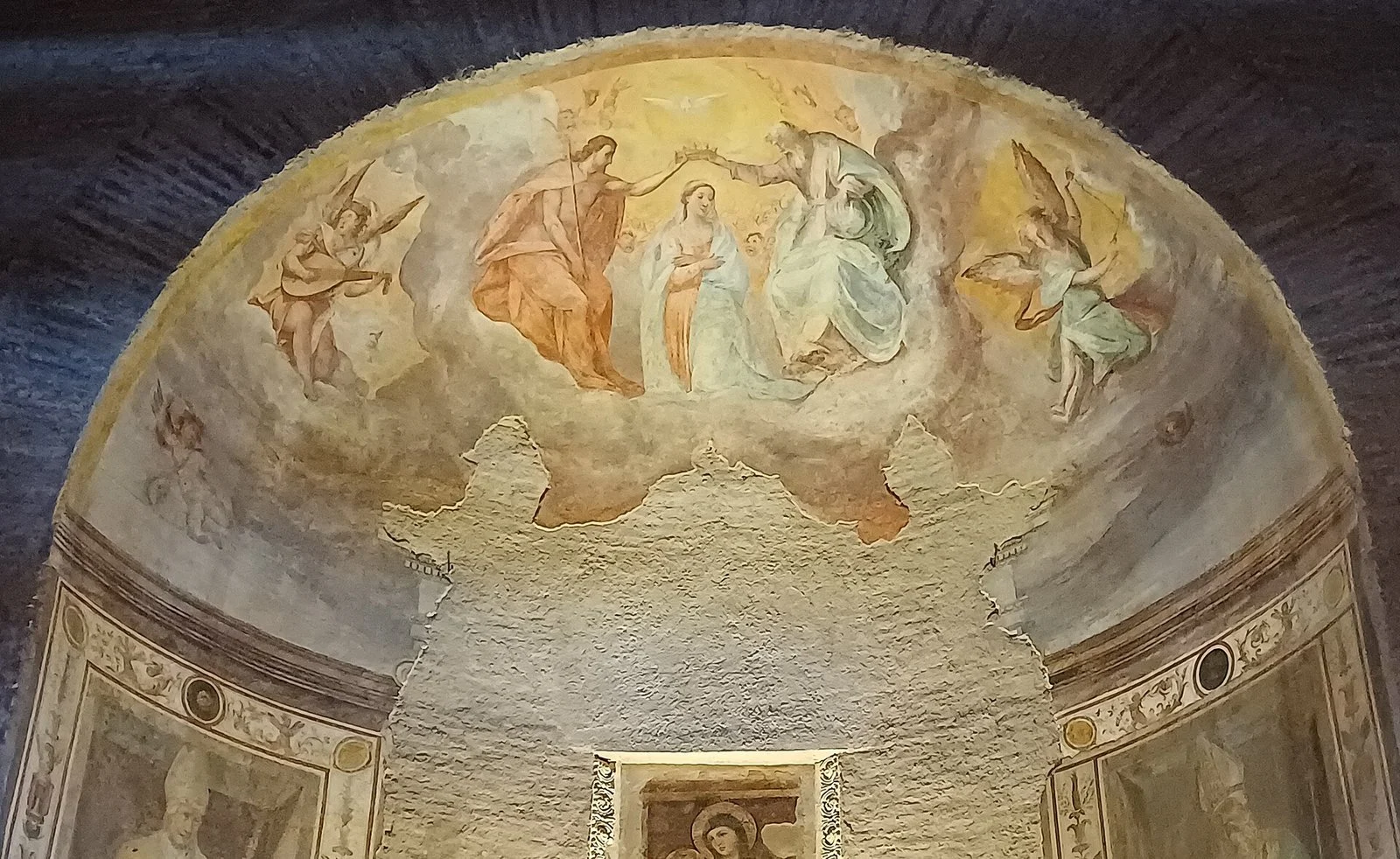
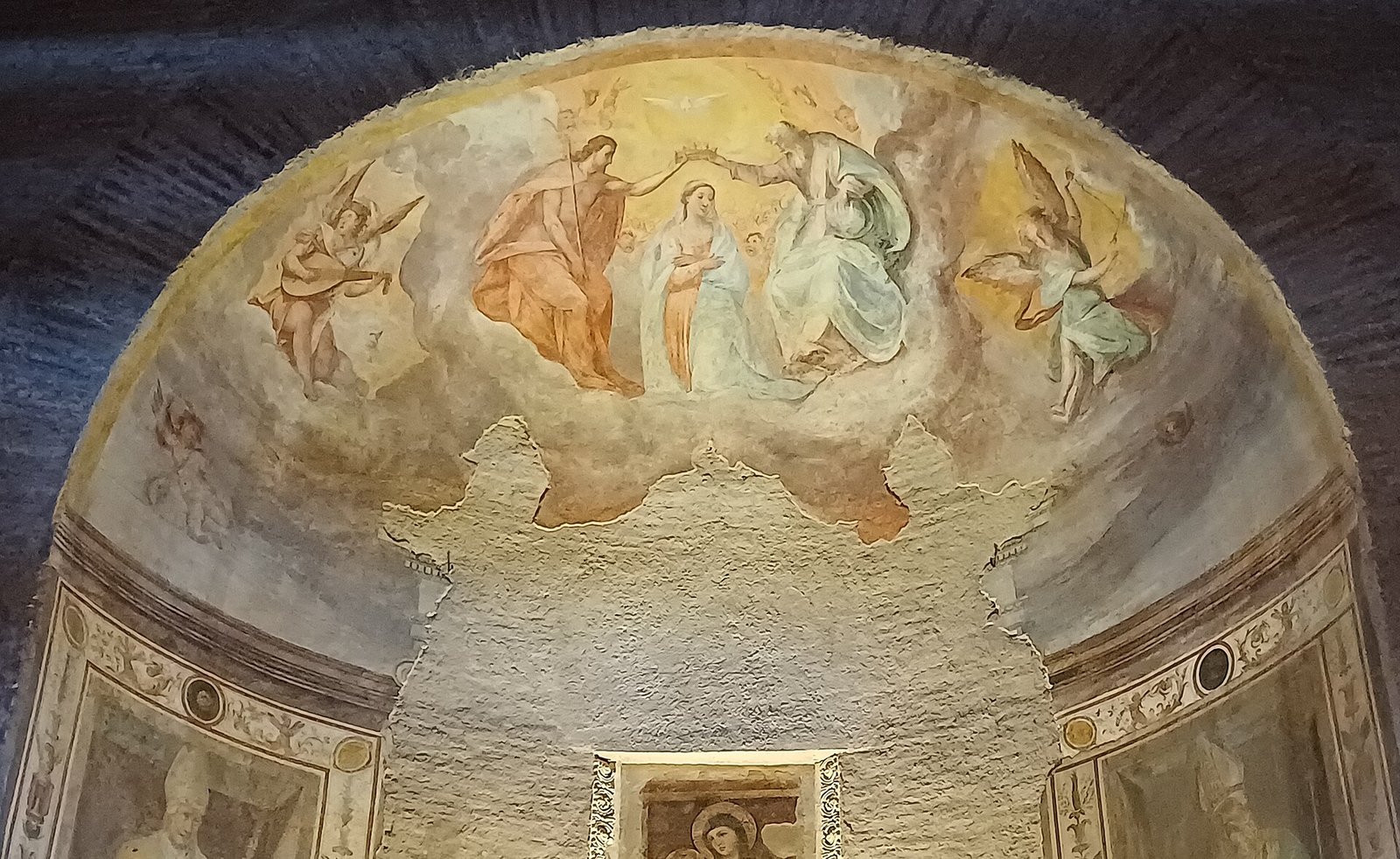
On the apse area the sources diverge, and we say so openly. Some sheets report in the apse basin a 16th-century Coronation of the Virgin, which re-emerged during the restorations started around 2000. Other descriptions place to the right of the apse a 15th-century painting with Saint Andrew, the Madonna and Child and the kneeling patron. The two reports don't exclude each other, because they could refer to different works in the same sector of the church, but we have not found a publication that puts them in order. Anyone going in would do well to ask the community what they are looking at, instead of trusting a caption found online.
The Restorations of 2002 and 2007
The work carried out between the early 2000s and 2007 freed the nave walls from the encrustations of the modern era, bringing back into view the medieval facings and some fragments of fresco that had been covered in the 18th century. It is the reason the interior you see today doesn't resemble the one described by 20th-century guides: 19th-century taste had plastered and uniformed, the recent restoration chose the opposite road. Not all art historians agree with operations of this type, which favor one phase at the expense of the others, and the discussion is open on many Roman building sites.
One Thing Nobody Tells You About San Benedetto in Piscinula
The thing no guide writes is that San Benedetto in Piscinula ceased to be a parish in 1824, by decision of Pope Leo XII, and stayed practically abandoned for the following decade: the 1844 restoration comes from there, from a building at risk of being lost, not from a beautification program. This explains almost everything that confuses the visitor today.
The Suppression of the Parish and Its Consequences
The reorganization of Roman parishes wanted by Leo XII drastically reduced the number of the city's parish churches, merging small communities into larger churches. San Benedetto in Piscinula, which had been a parish since 1386, lost the function and with it the income, the permanent clergy and the reason anyone looked after it. A church without a parish, in the Rome of those years, was a property that decayed in silence.
The Restoration of 1844
The 1844 intervention was directed by Pietro Camporese the Younger, a Roman architect active in the first half of the 19th century, and involved the rebuilding of the facade according to a scheme of neoclassical sobriety. It is the facade you see today, and it hides the medieval building instead of announcing it. The choice has its own logic: consolidating and covering cost less than restoring, and the taste of the time attributed no aesthetic value to the medieval brick facing. The practical result is that for 180 years the church has gone unnoticed by thousands of people a day.
My Advice for Visiting San Benedetto in Piscinula
The practical advice is just one and is worth more than all the others: phone the community's number first, 06 58331609, and organize the visit to San Benedetto in Piscinula around the answer they give you, not around a schedule found on a portal. Everything else comes after.
The Right Time of Day
If the church is open, the best window is early in the morning, before Trastevere fills up. The square is narrow and receives direct light for only a few hours: in mid-morning the sun comes in from the Lungotevere side and lights the facade, while in the afternoon the square goes into shadow and the interior becomes very dark. To see the Cosmatesque floor you need light, and the light in this church is whatever there is: there is no museum-grade lighting system.
How Much Time to Allow
For the interior, 20 minutes is enough if you look carefully, 30 if someone opens the chapel and the cell for you. The square deserves another 10 minutes, for the Casa dei Mattei and the front of the bell tower. An hour is already a generous visit. Anyone who offers you San Benedetto in Piscinula as a half-day stop is selling you filler.
How to Fit It into a Sensible Tour
The sequence we recommend starts from the Tiber Island, crosses Ponte Cestio, touches Piazza in Piscinula, goes up Via della Lungaretta to Santa Maria in Trastevere and ends with Santa Cecilia in the Ripa sector. That is two and a half hours of slow walking, four churches and two Roman bridges. Anyone with more time adds San Crisogono with its underground level and goes up the Janiculum for sunset.
The Verdict, Without Beating Around the Bush
San Benedetto in Piscinula can't carry a trip to Rome on its own and is not the most beautiful church in Trastevere: Santa Maria in Trastevere has mosaics this church can't even come close to. Its value is of another kind. It is a small building where you can read with the naked eye the way Rome built itself on top of itself, and you read it in 20 minutes, free, with no line. On that ground it is worth more than much more famous monuments. Anyone coming to Rome for the first time with three days should put it last. Anyone returning who wants to understand the city should put it first.
Another Well-Known Fact, Yet Rarely Cited
The well-known fact is that San Benedetto in Piscinula appears in written sources very late compared with the date tradition gives it: the first sure mention is in the Liber Censuum, the register of the Roman Church's revenues compiled by Cencio Camerario in 1192. Between Benedict's presumed youth, which can be placed around the end of the 5th century, and the first document naming the church, almost 700 years of documentary silence pass.
What the Liber Censuum Is
The Liber Censuum is the inventory of the properties and the dues owed to the Apostolic See, compiled by the chamberlain Cencio, the future Pope Honorius III. For the religious topography of Rome it is a capital source, because it lists the city churches with their fiscal obligations and lets us know which existed at that date. A church that appears there, in 1192, existed and was active. A church that does not appear did not necessarily not exist, but there is no proof of it.
What the Architecture Says Where the Document Is Silent
The wall structures and the bell tower place the visible building between the end of the 11th and the 12th century, therefore a few decades ahead of the first written mention. Local tradition speaks of a chapel already existing in the early medieval period, sometimes referred to the 8th century, but here we are again in the field of claims not verifiable with publicly available means. The honest sequence is this. Ancient structures reused, of uncertain date. Romanesque church between the 11th and 12th century. Document in 1192. Parish in 1386. Suppression in 1824. Restoration in 1844. Reopening in 1939. Entrustment in 2003. Restoration concluded in 2007.
Why Documentary Silence Proves Nothing
Early medieval Rome left very few archives. Fires, sackings and the dispersal of ecclesiastical holdings erased the ordinary documentation of whole eras, and most of the minor Roman churches appear in the records only when someone starts to survey them for fiscal reasons. The absence of a document earlier than 1192 does not prove the church wasn't there, it proves that no written trace of it remains. This distinction is the difference between a work of history and a legend with footnotes.
Comparison with the Nearby Churches
The same documentary jump is observed in the neighboring Trastevere churches. The basilica of San Crisogono preserves beneath the current floor an early Christian phase that is easy to read, but there too the documentary sequence is patchy. The church of Sant'Agata in Trastevere and the church of Santa Maria della Scala tell of later phases of the same district. It is by looking at them in a row that you understand how Trastevere stratified, without any single church being enough to explain it.
The Right Photo to Take at San Benedetto in Piscinula
The right photo at San Benedetto in Piscinula is not the frontal facade: it is the oblique framing from the corner of the square that puts together the front of the church, the little mullioned bell tower and the Casa dei Mattei, that is the three elements that tell the place in a single shot. Taken from the wrong side, the same square looks like any courtyard.
The Shooting Point
Stand on the short side of the square, toward the alley that goes down to the Lungotevere, and step back until the bell tower enters the frame above the roofline. You need a moderately wide focal length, around 24 or 28 millimeters equivalent, because the space is tight and an extreme wide-angle distorts the verticals of the medieval loggia. If you use the phone, stay on the main lens and not the ultra-wide.
The Light
The square is closed in by buildings on all sides and receives direct sun for a limited window in the morning. The best moment is when the sun lights the facade while the opposite side is still in shadow: you get a contrast that separates the bell tower from the sky. In the late afternoon the square is uniformly in shadow, the rendering is flat and the whites of the plaster turn gray. On overcast days the situation is paradoxically better for the brick details.
Photographing Inside
Inside the church the rule is the usual one in churches with active services: no flash, no tripod without permission, no shooting during services. We know of no particular photographic restrictions declared by the community, but the minimum courtesy is to ask before starting to shoot, all the more in a space where those praying and those photographing are two meters apart. The Cosmatesque floor photographs well only with plenty of natural light, framing from a low, oblique angle to bring out the inlays.
Some Important Events That Happened Here in History
The history of this church is made not of great events but of a succession of administrative and material thresholds, each of which changed its function: the Norman sack of 1084, the fiscal mention of 1192, the erection as a parish in 1386, the suppression of 1824, the restoration of 1844, the reopening of 1939, the entrustment of 2003 and the conclusion of the works in 2007.
1084: The Sack by Robert Guiscard
In 1084 the Norman troops called to Rome to help Gregory VII devastated large areas of the city. Trastevere and the river zone were affected. It is in that context that the traditional explanation for the survival of the small bell is placed, too modest to be worth a raid. The urban damage of that year was such that whole areas of Rome were rebuilt in the following decades, and the Romanesque phase of the building is well explained within that season of reconstruction.
1192: The Church Enters the Registers
With the Liber Censuum of Cencio Camerario the church officially enters the accounts of the Apostolic See. From that moment it is a documented legal subject, with obligations and rights, and its story can be followed in the records.
1386: The Parish
The erection as a parish church in 1386 is the moment of greatest local relevance. The parish meant baptism registers, burials, tithes, a community defined by streets. The tomb slabs of the Trastevere families set into the floor belong to this long phase, which lasts more than four centuries.
1824 and 1844: The Fall and the Recovery
The suppression of the parish decided by Leo XII in 1824 is the deepest rupture in the history of the building, and the following decade of abandonment could have ended in demolition, as happened to other minor Roman churches in the same century. The restoration entrusted in 1844 to Pietro Camporese the Younger saved the structure and gave it the neoclassical face it keeps.
The 20th Century and the Recent Restorations
The reopening for worship in 1939, the structural consolidation of the bell tower in 1985 and the cycle of restorations of the early 2000s, carried out under the direction of professionals commissioned by the entrusted community and concluded in 2007, gave back the medieval walls of the nave and the fresco fragments covered in the modern era. It is the phase that produced the church you visit today.
Who Passed Through San Benedetto in Piscinula
The people really documented in connection with San Benedetto in Piscinula are few and almost all from the second millennium: Cencio Camerario, who records it in 1192 and will become Pope Honorius III. Pope Leo XII, who suppresses its parish in 1824. The architect Pietro Camporese the Younger, who restores it in 1844. Cardinal Camillo Ruini, who on May 31, 2003 entrusts its care to the Heralds of the Gospel. Benedict of Nursia, who gives the church its name, belongs instead to tradition and not to documentation.
Benedict of Nursia, as a Traditional Figure
Of Benedict's Roman presence we know only what Gregory the Great writes: that he came to study in Rome and that he left. The location of his house and his cell at this spot in Trastevere is consolidated devotion, not historical fact, and as such we record it. The fact remains that the Benedictine cult kept this building alive through centuries in which nobody would have defended it for artistic reasons.
The Families of the District
The Mattei, who take their oldest house from the square, and the Castellani are the families you read on the floor slabs. The Mattei were one of the most influential houses of late medieval and modern Rome, and their name recurs throughout the area between the river and the Ghetto, where the Turtle Fountain in Piazza Mattei still carries their mark.
Travelers and Scholars
In the Roman guides of the 19th and early 20th century the church appears as a minor stop on Benedictine itineraries, cited almost always for the cell and the bell. It did not attract painters or view-makers to a degree comparable with the monuments of the center: Piazza in Piscinula does not appear in the repertory of Roman views the way Piazza Navona or the Colosseum do. It remained a neighborhood church, and the neighborhood is what you still see.
The Heralds of the Gospel
The community that runs the church today has been here since 2003 and promoted the cycle of restorations concluded in 2007, as well as organizing guided visits on request. It is a fact that concretely changes the visitor's experience: the church is not run by a heritage superintendency or a museum body, and whoever opens the door does so for pastoral reasons. Behaving accordingly is the minimum form of respect.
The Square and the District Around It
Piazza in Piscinula is one of the few squares in Trastevere left outside the evening circuit of bars and restaurants, and you can feel it: at noon it is almost empty, in the evening it is a place people pass through. Besides the church, the Casa dei Mattei faces onto it, a medieval building with an upper loggia, mullioned windows and ancient fragments set into the facings, reworked several times and the object of a heavy restoration intervention in the modern era.
What You Reach in Five Minutes
Five minutes on foot away are Ponte Cestio, the Tiber Island with the basilica of San Bartolomeo, Ponte Fabricio and the remains of Ponte Rotto in the middle of the river. On the other side you quickly reach San Crisogono, the cloisters of San Cosimato and the Museo di Roma in Trastevere. Anyone heading down toward Ripa meets San Francesco a Ripa and, on Sunday morning, the Porta Portese market.
In Summer, on the River
In the summer months the Tiber embankments host open-air events, and Isola del Cinema takes over Tiber Island with its outdoor screens. Anyone visiting the church in the late afternoon in July or August will find the route to the river already lively, and can end the day under Ponte Garibaldi or by walking up toward Ponte Sisto.
Eating nearby: how to choose in Trastevere
Trastevere is one of the areas of Rome most exposed to passing tourism, and Piazza in Piscinula is less than 200 meters from the streets where the pressure is highest. Here we don't name restaurants, on purpose: a list of names goes stale in a few months and teaches nothing. Instead we give you the signs that let you spot a trap in 10 seconds, from the outside, without going in.
The five signs
The first is the woman rolling fresh pasta in the window or right on the sidewalk: it's a stage-managed lure aimed at passersby, not a clue about the kitchen. The second is the menu with photos of the dishes, which is meant for people who don't read Italian and so tells you who the place is aimed at. The third is the tout at the door inviting you to sit down: a place that works with its own customers doesn't need to stop people in the street. The fourth is hours running nonstop from morning to night, with no kitchen break, which is impossible with a normal kitchen crew. The fifth is about location: places set in front of the most photographed monuments often charge prices calibrated to the tourists in front of them, with items not priced on the menu or different price lists for inside and outside.
The chains in the center
In the center of Rome the chain model has multiplied, with the same sign repeated in several spots, an identical menu and a line managed with ticket numbers. The phenomenon exists and is plainly visible in Trastevere too. There is only one useful observation: Romans don't go there.
The test that always works
Look at who is sitting at the tables and what language they order in. A place full of Romans at two in the afternoon on a Tuesday says more than any review. If you want a starting point that's already filtered, you can check Daniele Dezi's personal list on Google Maps, a curated, unsponsored collection.
Frequently asked questions about San Benedetto in Piscinula
How much does it cost to enter San Benedetto in Piscinula?
Entrance to San Benedetto in Piscinula is open and free: the church is an active place of worship, not a museum site, and there is no ticket office. Guided visits of the interior are arranged in advance with the community that looks after it, by calling 06 58331609. Any offerings are voluntary and go toward maintaining the building.
What are the opening hours of San Benedetto in Piscinula?
The hours of San Benedetto in Piscinula depend on the services of the community that runs it and don't follow a fixed museum schedule, so they need to be checked directly with the church before you go. The phone number is 06 58331609. The timetables published on tourist portals are often out of date: we don't list them so as not to mislead you.
How do I get to San Benedetto in Piscinula by public transport?
You can reach San Benedetto in Piscinula by tram 8, getting off at Piazza Gioachino Belli and walking about 3 minutes, or by the buses along the lungotevere. There is no metro in Trastevere: the closest stop is Circo Massimo on line B, from which it's about 10 minutes on foot across Ponte Palatino. From Tiber Island it takes just 2 minutes over Ponte Cestio.
Is it true that San Benedetto in Piscinula has the smallest bell tower in Rome?
The bell tower of San Benedetto in Piscinula is described by guides and tourist listings as the smallest in Rome, and it is certainly tiny, but this remains a catalog claim repeated from text to text, with no published survey of the heights of Rome's bell towers to confirm it. The structure, in brick with two tiers of mullioned windows, is dated to the 12th century.
Is the bell of San Benedetto in Piscinula really the oldest in Rome?
The bell of San Benedetto in Piscinula is traditionally dated to 1069 and presented as the oldest in the city, but the sources disagree: an alternative reading of the Gothic inscription gives 1019, while the second bell bears the date 1465. The record is a traditional attribution, not a fact confirmed by a public comparative appraisal.
Did Saint Benedict of Nursia really live at San Benedetto in Piscinula?
The stay of Saint Benedict of Nursia in the house on which San Benedetto in Piscinula stands is a devotional tradition, not documented history. Gregory the Great, the only ancient source on his life, tells that Benedict studied in Rome and left the city, without naming any house or neighborhood. The cell preserved in the church has been venerated as his since the Middle Ages and can't be dated with certainty.
How long does it take to visit San Benedetto in Piscinula?
Visiting San Benedetto in Piscinula takes 20 minutes, which becomes half an hour if the community also opens the chapel of the Madonna and the cell. Adding the piazza, with the Casa dei Mattei and the view of the bell tower, brings it to about 40 minutes. It's a stop to fit into a walk around Trastevere, not a visit that takes up a morning.
Is San Benedetto in Piscinula accessible to people with disabilities?
Access to San Benedetto in Piscinula from the piazza has a minimal difference in level, but the interior rooms are narrow and the passages to the side chapel and the cell are tight and hard to get through in a wheelchair. If you have particular needs, it's best to mention them when you call, so you know in advance which parts of the church can be reached.
Who wrote this page
This page is edited by the team at Tour Leader Pro, the Rome-based project office that designs and coordinates visits, itineraries and cultural events in Rome and Lazio. The hours, fares and access conditions given here were checked against the official sources named in the text as of the publication date: it's best to recheck them before you go, because they change often. If you find outdated information, let us know.
If you are building a Roman itinerary that ties together the medieval churches of Trastevere, the bridges of Tiber Island and the Forum Boarium area on the opposite bank, on Tour Leader Pro you will find the tools to organize timing, groups and permits, including cases where access depends on a religious community and has to be arranged in advance.
To place the stop in a wider trip, with the connections between Rome, Subiaco and the other Benedictine sites of Lazio and central Italy, a useful planning resource is Italy Planner.