Ponte Garibaldi
In short. Ponte Garibaldi connects Lungotevere dei Cenci, on the side of the Regola district and the Jewish Ghetto, to Piazza Gioacchino Belli and the start of Viale Trastevere.
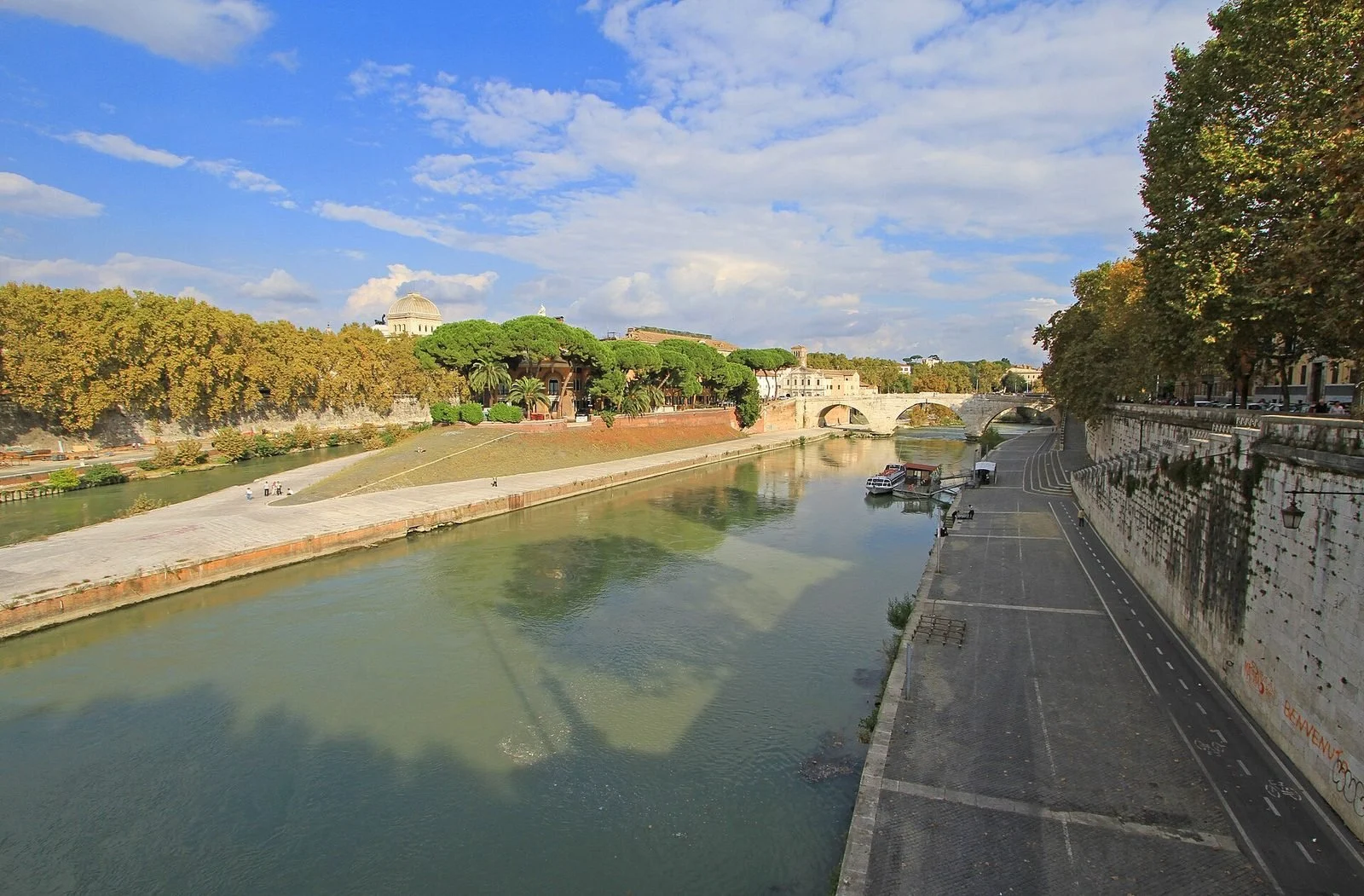
Ponte Garibaldi connects Lungotevere dei Cenci, on the side of the Regola district and the Jewish Ghetto, to Piazza Gioacchino Belli and the start of Viale Trastevere. It's the bridge of trams and buses: anyone entering Trastevere by public transport passes through here, nine times out of 10, without noticing. It was inaugurated on June 6, 1888, to a design by the engineer Angelo Vescovali, but the bridge you cross today is not the nineteenth-century one. Between the early 1950s and the end of the decade it was rebuilt almost entirely in reinforced concrete and widened, and this is the thing almost no page writes. You don't pay, there are no opening hours, there's nothing to book. It isn't even a beautiful bridge, and there's no need to pretend otherwise: its value lies entirely in the viewpoint it offers, with Tiber Island upstream and Ponte Sisto downstream.
Where Ponte Garibaldi is and how to get there
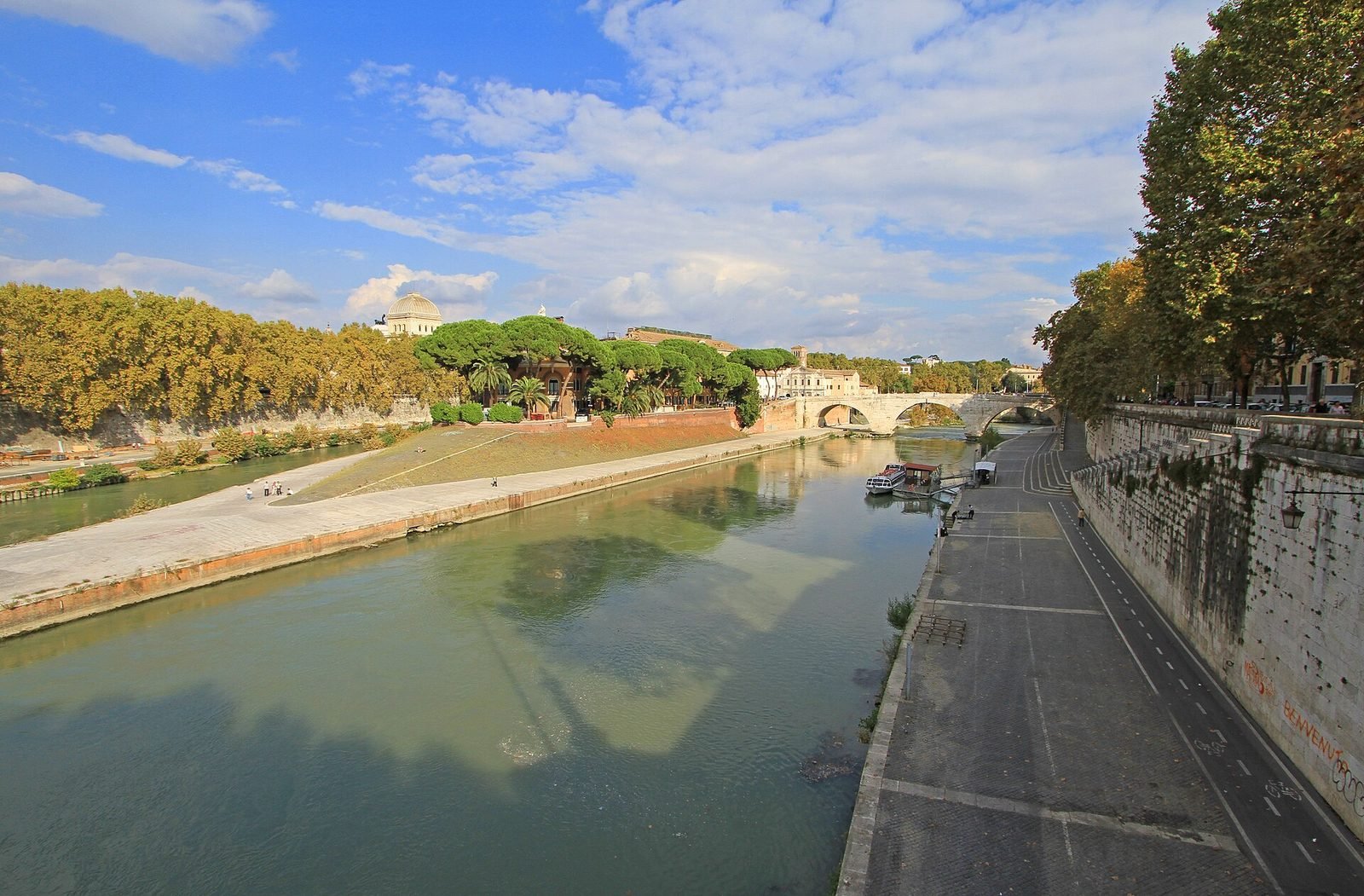
Ponte Garibaldi crosses the Tiber between Lungotevere dei Cenci, on the left bank, and Piazza Gioacchino Belli on the right bank, just downstream of Tiber Island and just upstream of Ponte Sisto. It's the direct link between the axis of Via Arenula, which runs down from Largo di Torre Argentina, and Viale Trastevere, which leads toward Trastevere station and the Gianicolense district. Anyone arriving on foot from the historic center runs into it without looking for it: it's the natural end of Via Arenula.
On foot, which remains the most sensible way
From the Pantheon it's a walk of about 20 minutes, passing through Largo di Torre Argentina and taking Via Arenula down to the river. From Campo de' Fiori eight minutes are enough, cutting through Via dei Giubbonari and Via dei Pettinari, or through Via dei Falegnami and the Portico d'Ottavia. From the Capitoline Hill you get there in a quarter of an hour, going down Via del Teatro di Marcello and then along the river.
If you're coming from Trastevere, the south end is in Piazza Belli, 30 seconds from Santa Maria in Trastevere by way of Via della Lungaretta. From Piazza Trilussa, that is from the end of Ponte Sisto, it's 200 meters of riverside road.
By tram 8 and by bus
Tram 8 crosses Ponte Garibaldi in full: it's the line that runs the whole length of Viale Trastevere, from Casaletto to the terminus in the center, and the bridge is the point where it passes from the Trastevere district to the opposite bank. The useful stops are those at Piazza Sonnino and Piazza Belli on the Trastevere side, and those along Via Arenula on the other. Among the buses that go over it, the reference sources list lines H, 780 and 781, besides the lines that run along the riverside roads and stop just before the ends of the bridge.
By car, bicycle, scooter
Arriving by car is the worst choice of all. The bridge is inside or at the edge of the limited traffic zone of the historic center and the Tridente, depending on the point of entry, the riverside roads are through roads with parking bans almost everywhere, and the nearest usable parking is paid and far enough from the bridge to make the car pointless. Anyone who really needs a private vehicle should do the math first: the nearest subway, line B at the Circo Massimo stop, takes less time on foot than it takes to find a parking spot.
Real accessibility
The bridge is flat and has no steps, so you can cross it in a wheelchair or with a stroller with no obstacles on the roadway of the bridge. The problem is the ends: the pedestrian crossings at Piazza Belli and at the junction with Lungotevere dei Cenci have traffic lights and turning traffic, and at rush hour the green time is what it is. The sidewalks are usable but not wide, and two people can't comfortably pass each other when others come the opposite way.
What Ponte Garibaldi is: the 1888 bridge and today's
Ponte Garibaldi is a road bridge about 120 meters long, with a single pier in the middle of the river and two almost equal spans. It was approved by the City of Rome in 1884, built between 1884 and 1888 to a design by the engineer Angelo Vescovali, and opened to the public on June 6, 1888, together with the opening of Via Arenula, the street the bridge had been conceived for.
Vescovali's design
The original structure had two metal spans resting on a central pier and two abutments, with piers and abutments faced in travertine. It's the same technical solution adopted in the same years for the other bridges of post-unification Rome, and that's no accident: Angelo Vescovali also signed Ponte Palatino, built between 1886 and 1890 a few hundred meters downstream from the Forum Boarium.
The measurements that circulate for the nineteenth-century bridge are about 121 meters long by 20 wide. Some of the local sources add that, at the inauguration, its width made it the third widest bridge in the world after two bridges over the Seine in Paris. It's a claim that comes up often but doesn't seem to rest on a verifiable technical source, and we report it as such.
The name, and the name it didn't get
The bridge is named after Giuseppe Garibaldi, and the dedication was read from the start in a Risorgimento key, referring to the defense of the Roman Republic of 1849 fought on the Janiculum, the hill that overlooks the Trastevere end of the bridge. Anyone who wants the context of those months will find it at the Museum of the Roman Republic and Garibaldian Memory, a few minutes' climb from here.
On the initial name the sources differ. Some reconstructions report that the bridge had been christened Ponte alla Regola in the plan, after the district onto which the left-bank end opens. Others point to a first dedication to Umberto I, later dropped also because another Roman bridge would have been given that name a few years later. We found nothing that lets us choose between the two versions, and we give both.
The columns with the victories
The descriptions of the nineteenth-century bridge recall four columns topped with spheres placed at the ends, with the names and dates of eight Garibaldian victories carved on them, and among these they cite the Volturno and Bezzecca. A commemorative plaque is recorded as placed on July 18, 1908. The rebuilding of the 1950s changed the parapets and finishes, and we can't say with certainty how much of that apparatus survived and in what position: anyone passing should look at the ends carefully, because it's the kind of detail nobody points out and that gets lost among the poles of the tram's overhead line.
The bridge you cross today is not the 1888 one
This is the point missing from almost every page on Ponte Garibaldi: the structure you walk on today is a work of the 1950s, not of 1888. Vescovali's two metal spans were replaced by two shallow arches in reinforced concrete, and in the same works the roadway was widened. You still read around that the bridge is nineteenth-century, and formally that's true for the layout and the piers, but anyone looking at the deck is looking at something barely 70 years old.
The 13 centimeters that started the works
The reason for the work is documented and concrete: the left arch had sagged by about 13 centimeters under the weight of traffic. That's little in absolute terms and a great deal for a metal deck born in the 1880s, sized for carriages and the first trams, and which within 60 years ended up carrying buses, trucks and a volume of car traffic no designer of the time had in mind. The sources place the sagging around 1953.
The works, and the dates the sources don't agree on
On the time span of the rebuilding the sources differ, and it's best to say so openly. The most widespread reconstruction puts the works between 1953 and 1958, counting the whole process from the sagging to the final reopening. Other entries narrow the actual construction site to the years between 1955 and 1957. The two versions are compatible if you distinguish between the start of the surveys and procedures and the physical execution of the works, but none of the sources consulted spells this out, so we report both and don't choose.
The names differ too. Some of the sources attribute the structural calculation of the new arches to the engineer Giulio Krall, a specialist in reinforced concrete structures. Others involve a team led by Bruno Zevi in the project. The two indications don't exclude each other, because on a public work of that kind the person who signs the calculation and the one who sets up the architectural design can be different, but we have no documentary evidence that allows us to reconstruct the roles precisely.
What was built
The new deck consists of two shallow three-hinged arches in reinforced concrete, each with a span of about 55 meters. The metal centering used to build them was embedded in the final structure, which is an economical solution typical of those years: instead of dismantling the temporary formwork, you make it work inside the pour. The roadway went to about 23 meters, with new safety parapets in place of the nineteenth-century ones.
Three meters of widening on an urban bridge is not a detail: it's a lane. It's that operation that made possible the current coexistence of two directions of vehicle traffic, the tram right-of-way and the sidewalks, and that definitively turned Ponte Garibaldi from a showpiece bridge into a traffic junction.
Why almost nobody writes it
The reason is prosaic. The rebuilding of the 1950s didn't change the name, didn't change the position and didn't change the silhouette in any striking way: two spans are still two spans. Tourist entries stop at the founding date because that's the one that answers the question people type, and the twentieth-century update falls outside the Risorgimento story that the bridge's name carries with it. The result is a page of history removed out of editorial laziness, not out of reticence.
Anyone who wants to see the difference with a nineteenth-century bridge that has stayed as it was will find it a few hundred meters away, at Ponte Palatino and at Ponte Cestio, the latter rebuilt in 1892 but with a layout and a language completely different from that of reinforced concrete.
Why Ponte Garibaldi was built: Via Arenula, Viale del Re and the station
Ponte Garibaldi comes from a traffic plan, not from a plan for urban decor. At the end of the nineteenth century Rome had been the capital for only a few years and Trastevere was connected to the rest of the city only through the two bridges of Tiber Island, that is Ponte Fabricio and Ponte Cestio, through Ponte Sant'Angelo much farther upstream, and through Ponte Sisto, narrow and without adequate outlets for vehicles. A district of tens of thousands of inhabitants depended on medieval and ancient crossings.
The gutting of Via Arenula
Via Arenula was opened in the same stretch of years by cutting through the fabric of the Regola district, and with it vanished alleys, blocks and part of the layout that had built up over centuries between San Paolo alla Regola and the river. The logic was that of all the great European capitals at the end of the century: open straight axes that public transport could run along, connect the stations, give air and sewers to neighborhoods that lacked them. The historic city paid the cost, in demolitions.
The same operation, on the opposite bank, produced Piazza Belli and then Viale del Re, today Viale Trastevere. The avenue was opened in 1890, two years after the bridge, and served to connect the center with Trastevere station, inaugurated the same year. To build it, many of the district's homes were demolished, along with a bastion of the Janiculum walls. It was called Viale del Re until 1944, then Viale del Lavoro, and since 1946 it has carried its current name.
The bridge before the avenue
The chronological sequence is worth stating, because it explains the shape of the area: first the bridge, in 1888, then the avenue, in 1890. For two years Ponte Garibaldi landed on a fabric that was still medieval, and it was the avenue that was built to reach it, not the other way around. That's the reason why Piazza Belli and Piazza Sonnino have that uncertain geometry, with nineteenth-century buildings set beside a thirteenth-century tower: they are the suture point between two different operations carried out at two different times.
Piazza Belli and Piazza Sonnino
The Trastevere end opens onto Piazza Gioacchino Belli, which according to historical reconstructions was called Piazza del Muro Nuovo in eighteenth-century maps and then Piazza d'Italia around 1890, before taking the poet's name. Right behind it begins Piazza Sidney Sonnino, which marks the start of Viale Trastevere and on which stands the Torre degli Anguillara, a thirteenth-century tower restored in 1902 and entrusted since 1921 to the cultural institution Casa di Dante, hence the name by which many know it.
A curiosity about Ponte Garibaldi
The most concrete curiosity of Ponte Garibaldi is hydraulic: the central pier of the bridge appears to be connected to Tiber Island by an artificial quay, that is a submerged or semi-submerged structure that links the foot of the pier to the downstream tip of the island. You can't see it from the street, and indeed nobody notices it, but it explains why the river in that stretch behaves the way it does.
What a quay like that does
Tiber Island divides the Tiber into two branches, and the two branches don't carry the same water. Regulating how the flow is split between the left branch and the right branch serves to protect the banks, to keep either one from silting up, and to control speeds at the ancient bridges, which have narrow spans and wide piers. Ponte Garibaldi sits immediately downstream of the point where the two branches rejoin, and its central pier falls right on the line of that confluence.
The movable sills
Between 1998 and 2003, in the left branch of Tiber Island, movable sills were built to improve the distribution of flows near the bridge. It's an intervention invisible to passersby, documented in the technical records on the river, and it tells something that holds for all Roman bridges: real maintenance is almost never seen, because it lies below the waterline.
The bridge as a measuring point
Anyone leaning over the upstream parapet during a flood sees the phenomenon very well: the current arrives split on the two sides of the island, comes back together under the bridge with an evident whirl on the line of the pier, and sets off compact toward Ponte Sisto. In winter floods the level rises until it laps the quays, and with high water the left branch is the part worth looking at, with the surviving arch of the Ponte Rotto upstream turning into a barrier.
Something nobody tells you about Ponte Garibaldi
Ponte Garibaldi is noisy in a way photographs don't convey, and the noise doesn't come mainly from cars: it comes from the tram. Line 8 passes frequently, the train running on the rails of the bridge produces a rumble that travels through the deck, and anyone stopping on the sidewalk to look at the river feels it coming in their feet before their ears.
How much noise there really is
The practical consequence
You cross Ponte Garibaldi and look at it, you don't linger on it: you stop 50 meters farther on, on Tiber Island or on the quay of Piazza Trilussa, where the noise drops suddenly. Anyone bringing a school group should give the explanation before climbing onto the bridge, because on the bridge nobody will hear it.
And the matter of the sidewalks
The widening of the 1950s went almost entirely to the roadway. The sidewalks remain narrow for the volume of pedestrians who use them, especially on weekend evenings when Trastevere fills up and the bridge becomes the channel for entering and leaving the district. At those hours pedestrian flow is in effect single-lane alternating, and anyone going against the current ends up stepping into the roadway. With a child by the hand, keep them on the inside, away from the edge.
It's not a beautiful bridge, and it has to be said
Sincerity serves better than courtesy here. Ponte Garibaldi has a reinforced concrete deck with no particular architectural quality, anonymous safety parapets, tram overhead-line poles that cut across every frame, and a wide roadway that pushes cars to speed. Anyone who comes to Rome with the idea of seeing a monumental bridge should go to Ponte Sant'Angelo or to Milvian Bridge. Here the value is something else: it's an observation point and a transport hub, and judging it by its looks means judging it for what it never was.
The advice I give you for visiting Ponte Garibaldi
The practical advice on Ponte Garibaldi is one and simple: stand on the upstream sidewalk, the one that looks toward Tiber Island, and not on the downstream one. The difference between the two sides is sharp and it's not a matter of taste: on one side there's the outline of the island with its two ancient bridges, on the other a more anonymous stretch of river that closes on Ponte Sisto.
Which side to stand on, exactly
The right sidewalk is the east one, on the side facing the Ghetto and the island. From there you frame, in order of distance, the downstream tip of Tiber Island with the Basilica of San Bartolomeo and the Fatebenefratelli hospital, the two arches of Ponte Cestio, and on the left bank the square aluminum dome of the Synagogue of Rome, which from this angle is the most recognizable thing on the bank.
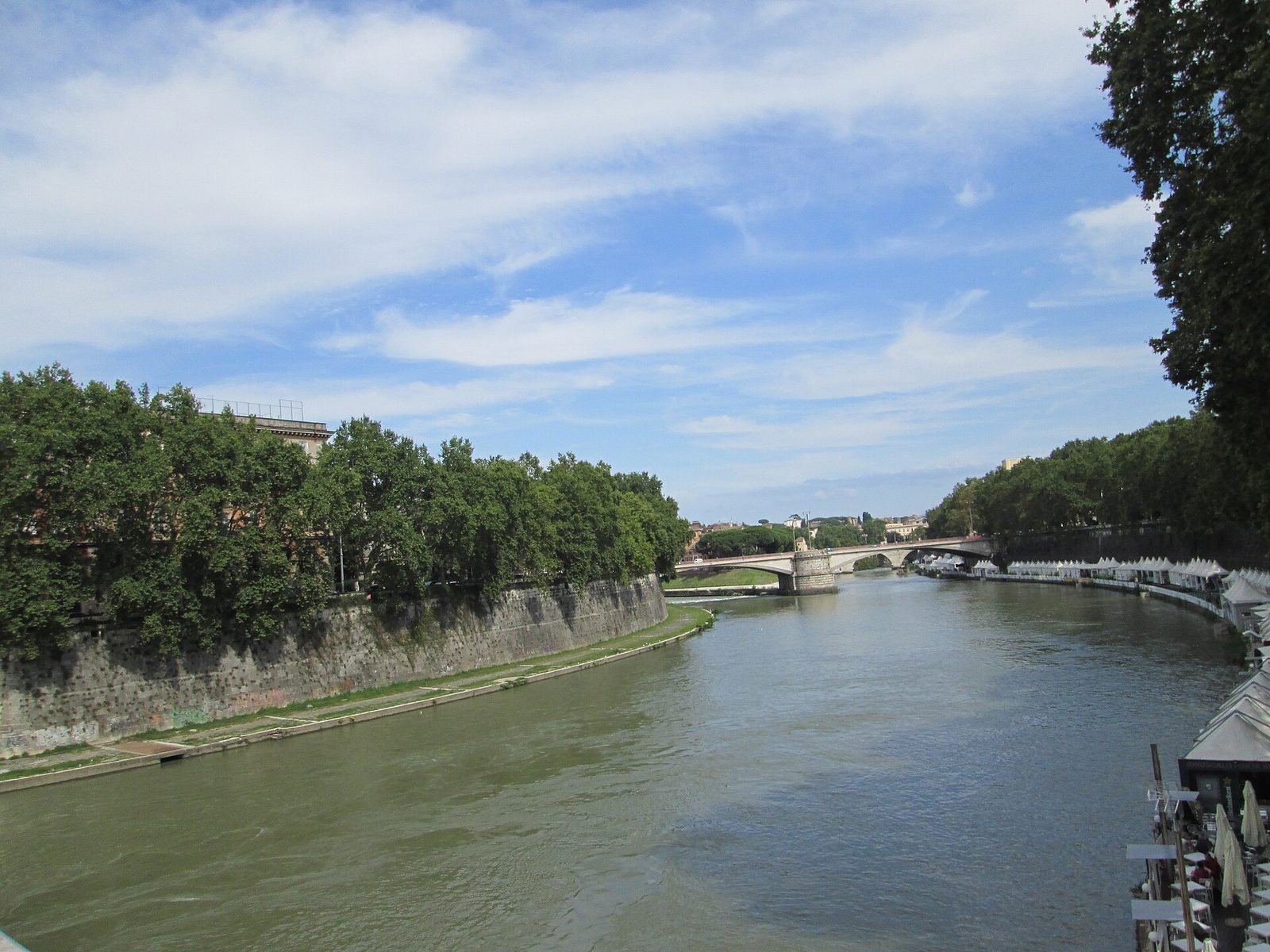
From the opposite sidewalk, toward downstream, you see Ponte Sisto in line and, above the right bank, the profile of the Janiculum. The claim often circulates that from here you can see the dome of San Giovanni dei Fiorentini: the river downstream bends, and the field of view closes much sooner, so we don't give it as certain and invite you to check it with your own eyes before repeating it.
The right time
The first hour after dawn is the moment when the bridge is really usable: traffic is still light, the sidewalks are clear and the low light from the east lights up the Ghetto bank and the flank of the island.
Avoid the middle hours of a summer day: the bridge has no shade along its whole length, the concrete and asphalt give back heat and there's not a single drinking fountain on the roadway of the bridge. The nearest fountains are in Piazza Belli and on Tiber Island.
The loop we recommend
A loop that works and closes in a good hour and a half of walking starts in Via Arenula, crosses Ponte Garibaldi on the upstream sidewalk, goes down to Piazza Belli, continues along the riverside road upstream to Ponte Cestio, climbs onto Tiber Island, crosses it, exits onto Ponte Fabricio in the Ghetto, and heads back toward the river passing in front of the Portico d'Ottavia and the Theater of Marcellus. Anyone with an extra hour continues to the Turtle Fountain in Piazza Mattei and returns by Via dei Falegnami.
The Trastevere variant, if you only have time for one of the two banks, is even simpler: Piazza Belli, Via della Lungaretta, Santa Maria in Trastevere, then Santa Maria della Scala and the descent to Piazza Trilussa, with a return along the riverside road to the bridge. The overall picture of the district is in our page on Trastevere, which covers what we can only mention here.
A clear verdict, since one is needed
Ponte Garibaldi is overrated as a destination and underrated as a place to pass through. Nobody should plan a stop to see it, and anyone looking for it on a map of things to do is working from the wrong list. But anyone building an itinerary between the Ghetto and Trastevere crosses it anyway, and so it's worth crossing it consciously: from the right side, in the right light, knowing that the bridge under your feet is from the 1950s and that the plaque on the parapet remembers a girl killed in 1977. These are three pieces of information that turn a two-minute crossing into something you remember.
Another well-known fact, yet rarely cited
Ponte Garibaldi exists in its current form only thanks to the Tiber embankment walls, and the embankment walls are the public work that changed Rome more than any other after Unification. It's a fact everyone knows and almost nobody connects to the individual bridges, which without that intervention wouldn't stand the way we see them.
What there was before
Before the masonry embankments the Tiber entered the city with low banks, mooring quays, floating mills, vegetable gardens and houses pressed against the water. Below the Ghetto and below Trastevere the river was part of daily life: people washed in it, traded on it, drowned in it. Floods reached into the low districts regularly and left mud and disease. The great flood of December 1870, a few months after the capture of Rome, was what made the decision politically unavoidable.
The price paid
The hydraulic works began in 1876 and went on for decades. The result is that Rome no longer floods, and the cost is that Rome lost its physical relationship with its river: the embankment walls are high, blind, and turn the Tiber into a canal visible only from the top of the bridges or by going down to the quays. Ponte Garibaldi is the exact child of that logic, and its flat deck, high above the water, is there to stay above flood level.
Where to see the before
The comparison can be made in two places, both a few minutes away. The first is the Museo di Roma in Trastevere, which holds material on vanished Rome and the views that document the banks before the embankments. The second is the quays under the bridge, when they are open: from below you can read the height of the embankment wall and understand how much city was cut away. The opening of the quays is not guaranteed all year, and after winter floods they stay closed even for weeks, for the removal of the mud.
Anyone who wants the full picture of what the Tiber has become as a public space will find it in the summer program on the banks, which every year occupies the stretch between Ponte Sublicio and Ponte Sisto: our entry is Lungo il Tevere Roma 2026, and it concerns the stretch immediately downstream of this bridge.
The right photo to take at Ponte Garibaldi
The photo that counts at Ponte Garibaldi doesn't frame the bridge: it uses it as a shooting point. The image that works is the one taken from the upstream parapet toward Tiber Island, with the downstream tip of the island in the center, the arches of Ponte Cestio behind and the dome of the Synagogue closing the composition on the left.
Where to stand, exactly
On the upstream sidewalk, about a third of the way along the bridge starting from the Trastevere end. At that point the perspective lines up the island with Ponte Cestio without the parapet cutting the base of the buildings, and the tram line poles stay behind you instead of inside the frame.
What light to choose
The best light is that of the first hour of the morning, which comes from the east and hits the flank of the island and the Ghetto bank from the side, separating them from the background. In the middle hours the sun is high, the river flattens and the concrete of the parapet burns out at the top right. In the evening the scene reverses: the backlight from downstream draws the silhouettes of the bridges well, but loses all detail on the facades.
At night the contrast between the cold street light of the bridge and the warmer light of the island is hard to manage: you decide at the start which of the two planes to expose for. We cover the city after sunset in the page on Rome at Night.
The other frames that hold up
The first is tram 8 passing, shot with a long exposure to leave a trail: it's an urban photo and gives the right idea of what this bridge is. The second is from below, from the quays, when they are open: from there the two shallow arches of the 1950s read for what they are, and the difference from the masonry arches of the neighboring bridges becomes evident.
What doesn't work
The overall photo of the bridge seen from the side doesn't work. To get it you'd need a shooting point on the bank at the same height, and the embankment wall prevents it: from the quays you're too low, from the riverside road you're behind the road parapet, from the other bridges you're too far and trees and poles get in between. The frontal photos of the bridge you see around are almost all taken from Tiber Island or by a drone, and drones over the historic center of Rome are subject to restrictions: anyone thinking of it should check the rules in force first, because the area is among the most restricted in the city.
Some important events that happened here in history
The history of Ponte Garibaldi is short compared with that of Rome's ancient bridges, and is concentrated in a little over a century. We give the dates that are documented, indicating where the sources disagree.
May 16, 1884: the resolution
The City of Rome approves the construction of the new bridge between the Regola district and Trastevere. It's the first major bridge decided by the administration of the capital city, within the program of work on the Tiber begun in 1876 after the flood of December 1870.
June 6, 1888: the inauguration
Ponte Garibaldi is opened to the public, at the same time as the opening of Via Arenula. The design is by the engineer Angelo Vescovali. The structure has two metal spans on a central pier, piers and abutments faced in travertine, about 121 meters long by 20 wide.
1890: Viale del Re and the station
Two years later Viale del Re, today Viale Trastevere, is opened to connect the bridge with the new Trastevere station inaugurated the same year.
May 4, 1913: the Belli monument
The monument to the poet is inaugurated in Piazza Gioacchino Belli, the work of the Sicilian sculptor Michele Tripisciano, in travertine and marble. The statue is placed on a tall base, with the right hand resting on a reconstruction of the parapet of Ponte Fabricio, recognizable from one of the four-faced herms that mark its balustrade.
1953 and following years: the sagging and the rebuilding
The left arch sags by about 13 centimeters under the weight of traffic. The rebuilding of the two spans in reinforced concrete follows, with shallow three-hinged arches with a span of about 55 meters, metal centering embedded in the structure, new parapets and widening of the roadway to about 23 meters. The sources give the span 1953-1958 or, more narrowly, the years 1955-1957.
May 12, 1977: the death of Giorgiana Masi
On the evening of May 12, 1977, at 19:55, in Piazza Gioacchino Belli, at the Trastevere end of the bridge, Giorgiana Masi, an 18-year-old student, is killed by a .22 caliber bullet. The chapter that follows reconstructs the event as far as it has been established.
1998-2003: the movable sills
In the left branch of Tiber Island, movable sills are built to regulate the distribution of flows near the bridge. It's the last significant structural intervention documented in the immediate surroundings of Ponte Garibaldi.
The plaque on the bridge: May 12, 1977
On the parapet of Ponte Garibaldi there is a plaque that remembers Giorgiana Masi. People crossing the bridge almost always walk past it without seeing it, and the reason we mention it is simple: it's the only element of this bridge that asks the passerby to stop, and a page that stays silent about it tells the story of the place by half.
What has been established
On May 12, 1977, a sit-in was under way in Rome, called by the Radical Party and by sections of the extra-parliamentary left to collect signatures for a number of referendums. The demonstration was held in violation of the ban on political demonstrations imposed in Lazio after the clashes of the previous April 21, and thousands of officers in riot gear were deployed in the area. At 19:55, in Piazza Gioacchino Belli, Giorgiana Masi was hit in the abdomen by a .22 caliber bullet and died shortly afterward in the hospital. She was 18 and a fifth-year student at a science high school.
What has not been established
The judicial inquiry was closed on May 9, 1981, with a declaration that proceedings could not go forward, since those responsible for the crime remained unknown. There are opposing reconstructions of that evening and a political debate that has lasted for decades. It's not the business of a tourist page to take a position, and we don't: we report the fact, the date, the outcome of the case, and stop there.
How to behave when passing
Every year, on May 12, a commemoration is held in Piazza Sonnino, and during those hours the area in front of the bridge is occupied by a sit-in. Anyone who happens to be in the center that day should take into account that traffic on Viale Trastevere may be diverted and that tram 8 may be restricted. For the rest, the plaque stays there all year and asks for nothing more than a glance.
Who has passed through Ponte Garibaldi
Ponte Garibaldi is not a bridge of great names, and it would be wrong to build one. The figures tied to it in a documented way are few, and almost all technical: whoever designed it, whoever rebuilt it, whoever was put up in front of its end in the form of a statue.
Angelo Vescovali
Engineer, author of the 1884-1888 design. His name comes up on several bridges of post-unification Rome, including Ponte Palatino, and his language is that of nineteenth-century Italian engineering: metal spans on masonry piers faced in travertine, wide spans, piers reduced to the minimum so as not to obstruct the river. His work here has been almost entirely replaced, and this is one of the few pages that credits him with it anyway.
Giuseppe Gioachino Belli
The Roman-dialect poet, who lived from 1791 to 1863, never saw this bridge: he died 25 years before it was built. His statue has looked at the Trastevere end since 1913, leaning on a fake parapet that reproduces that of Ponte Fabricio, the bridge his Rome actually used to get across to Trastevere. It's a detail worth a 30-second stop: the sculptor chose to portray him leaning on an ancient bridge, not on the new one built behind his back.
Michele Tripisciano
Sculptor born in Caltanissetta in 1860 and died in 1913, author of the Belli monument inaugurated on May 4 of that same year. The complex includes the bas-reliefs with the Tiber and with Pasquino and the two side fountains. The Teatro Belli, a little farther on inside Trastevere, bears the same name as the poet and has no connection with the monument.
Giulio Krall and the technicians of the 1950s
Some of the sources attribute to Giulio Krall the calculation of the new reinforced concrete arches, others involve a group led by Bruno Zevi in the design. The indications don't exclude each other and we can't assign the roles precisely, but the point remains: the current bridge is the work of postwar Italian engineers, and its real authorship is not what the name and the date in the reference works lead you to believe.
Who passes every day
The most honest answer to the question is that every day tens of thousands of Romans pass over Ponte Garibaldi on their way to work, students getting off the tram at Piazza Sonnino, nurses and patients heading to the Fatebenefratelli on the island, and tourists entering Trastevere without knowing they have crossed the Tiber. This bridge serves the city more than it represents it, and that is its nature.
What's around Ponte Garibaldi
Ponte Garibaldi has the rare advantage of having two interesting districts at its two ends, less than five minutes' walk on each side.
On the left bank: Regola and the Ghetto
Coming off the bridge toward Via Arenula you're inside the Regola district, and turning right along the river you enter the Ghetto in three minutes. Here are the Portico d'Ottavia, the Theater of Marcellus, the Synagogue with the Jewish Museum of Rome and Via del Portico d'Ottavia with its shops. The historical picture of the neighborhood is in our page on the Jewish Ghetto of Rome.
On the other side of Via Arenula, toward the west, in a few minutes you reach Campo de' Fiori and the Galleria Spada, with its Borromini perspective, and going on you meet Piazza Navona and the rest of the center. Toward the north, 10 minutes away, are Largo di Torre Argentina with its sacred area and the cat sanctuary that occupies it.
Upstream: Tiber Island
Going up the riverside road for 300 meters you reach Ponte Cestio and climb onto Tiber Island, which is the place to go if you want to be on the river without the noise. On the island are the Basilica of San Bartolomeo, the Fatebenefratelli hospital and the close-up view of Ponte Fabricio, the Roman bridge of 62 BC that has stayed in continuous use. From the downstream tip of the island you see Ponte Garibaldi head-on, and it's the only comfortable point from which to photograph it in full.
On the right bank: Trastevere
Piazza Belli and Piazza Sonnino are the north gate of Trastevere. From there Via della Lungaretta takes you in five minutes to Santa Maria in Trastevere, the heart of the district, and a little beyond are Santa Maria della Scala and the Museo di Roma in Trastevere in Piazza Sant'Egidio. Going south instead you reach the Basilica of Santa Cecilia and, farther on, the Church of San Francesco a Ripa with Bernini's Ecstasy of the Blessed Ludovica Albertoni. On Sunday mornings, in that same direction, there's the Porta Portese market.
Toward the west, going uphill, you meet the Villa Farnesina with the frescoes of Raphael and his workshop, the Galleria Corsini across from it, the Botanical Garden and the climb to the Janiculum with the Acqua Paola Fountain.
How to fit it into a day
Ponte Garibaldi works as the hinge of a half day, not as a stop. The scheme we recommend to those short on time is morning in the Ghetto and on Tiber Island, crossing the bridge around 1 p.m., afternoon in Trastevere. Anyone coming from the south who has already seen the Forum Boarium and the Mouth of Truth can go up the river and use this bridge as a turning point. Anyone counting euros will find the free alternatives lined up in our page on Free Rome: crossing Ponte Garibaldi, like looking at it, costs nothing.
Anyone instead looking for a bridge to see for itself and not for what you see from on top of it has several in the city: Ponte Sant'Angelo with Bernini's angels in front of Castel Sant'Angelo, Ponte Fabricio for antiquity, Ponte Milvio for history and Ponte della Musica for the contemporary.
Eating around Ponte Garibaldi: how to choose
Around Ponte Garibaldi it's very easy to eat badly, and the reason is the location. The two ends open onto Via della Lungaretta on one side and Via Arenula on the other, that is onto two very high-traffic corridors, and a corridor always produces the same kind of offer: places that live off customers who will never come back. We don't name any businesses, as an editorial choice. A list goes stale in a few months and teaches nobody anything. We give the criteria, which stay valid.
The five signs that point to a trap
The first sign is the lady rolling out fresh pasta in the window or at a little table set in the street. It's a lure for passersby, not a kitchen: that pasta almost never ends up on the plates in the dining room, and the real craft isn't practiced in front of the door.
The second is the menu with photographs of the dishes, displayed outside or brought to the table. It's for people who don't know the names and won't come back, and it almost always goes together with a menu translated into six languages with the same 50 dishes you find 200 meters farther on.
The third is the tout at the door, the one who invites you to sit down while you walk. A place that has to stop people in the street has a filling problem, and the problem is never the kitchen.
The fourth is the all-day schedule from morning to night, with no break between lunch and dinner. A kitchen that works well closes in the afternoon, because it has to prepare. Whoever stays open all the time serves things already made.
The fifth is about position: places set in front of famous monuments. Here that means the tables with a view of the river and those looking onto the most photographed squares of the district. The price in there follows what you see from the table, and the price list can change between inside and outside, with unpriced items and surcharges that appear only on the bill. Ask the price before sitting down, always, and it's not rude.
The franchises of the center
Around this bridge there are, as in all of central Rome, chains with the same sign repeated in several spots, identical menu and a line with a number ticket at the entrance. They work because they're reassuring and because they show up at the top of searches. The fact to keep in mind is simple: Romans don't go there. The reason isn't snobbery, it's arithmetic: at those prices and in those quantities a Roman knows they can eat better 200 meters away, in a place that doesn't need a line to fill up.
The criterion that always works
The simplest criterion remains looking at who is sitting there and in what language they order. If at 13:30 the tables are occupied by people who speak Italian and whom nobody stopped in the street, the place holds up. If they're all foreigners with the phone resting on the tablecloth, you keep walking another five minutes. In Rome five minutes on foot completely changes the picture, and here they're enough to get out of the flow of passersby and enter the upper part of Trastevere or, on the other bank, the side streets of the Regola district.
Anyone who wants an already selected reference can consult the personal list of Daniele Dezi on Google Maps: it's a curated collection, built over the years in the field, not sponsored and with no commercial agreements with the places listed. For the cheapest way to eat well in the city, the neighborhood markets remain, and the full picture is in our page on Rome's markets.
Frequently asked questions about Ponte Garibaldi
How much does it cost to visit Ponte Garibaldi?
Crossing Ponte Garibaldi is free, because it's a public road bridge and not a site with a ticket office. There are no entrances, opening hours or bookings: you reach it from Lungotevere dei Cenci on the left bank or from Piazza Gioacchino Belli on the Trastevere side, at any hour of the day and night. The only possible expense is the public transport ticket to get there.
When was Ponte Garibaldi built?
Ponte Garibaldi was built between 1884 and 1888 to a design by the engineer Angelo Vescovali and inaugurated on June 6, 1888, together with the opening of Via Arenula. The original structure had two metal spans on a central pier, with travertine facing. Between the early 1950s and the end of that decade the spans were rebuilt in reinforced concrete and the roadway was widened.
Is the bridge you cross today the original one from 1888?
The bridge you cross today at Ponte Garibaldi is not the nineteenth-century structure: Vescovali's two metal spans were replaced by shallow three-hinged reinforced concrete arches, each with a span of about 55 meters, and the roadway was taken to about 23 meters. The cause was the sagging of about 13 centimeters of the left arch. The sources place the works between 1953 and 1958, or between 1955 and 1957.
What can you see from Ponte Garibaldi?
From Ponte Garibaldi, looking upstream, you see the downstream tip of Tiber Island with the Basilica of San Bartolomeo and the Fatebenefratelli hospital, the arches of Ponte Cestio and, on the left bank, the square dome of the Synagogue of Rome. Looking downstream you frame Ponte Sisto with the profile of the Janiculum behind it. The sidewalk worth using is the upstream one, toward the island.
How do I get to Ponte Garibaldi by public transport?
You get to Ponte Garibaldi by tram 8, which crosses it running along Viale Trastevere and Via Arenula, with stops at Piazza Sonnino and Piazza Belli. The reference sources also indicate the passage of buses on lines H, 780 and 781. The nearest subway is line B at the Circo Massimo stop, about 15 minutes on foot. Atac routes and diversions change often: it's best to check them the same day.
How much time do I need for Ponte Garibaldi?
Crossing Ponte Garibaldi takes just two or three minutes on foot, since it's about 120 meters long. Anyone who wants to stop and look at the river, read the 1977 plaque on the parapet and take a few photographs toward Tiber Island should allow a quarter of an hour. The bridge is not a stop to plan on its own: it gives much more as part of a route between the Ghetto and Trastevere, which takes half a day.
Is Ponte Garibaldi suitable for children?
You can cross Ponte Garibaldi with children, but you have to keep the layout in mind: the sidewalks are narrow, vehicle and tram traffic is continuous and noisy, and the parapet is high, so a small child can't see the river without being lifted. The signalized crossings at the two ends have turning traffic. For a quiet stop it's best to move to Tiber Island, a three-minute walk away.
Is Ponte Garibaldi wheelchair accessible?
Ponte Garibaldi is accessible by wheelchair and with a stroller, because the roadway of the bridge is flat and has no steps along its whole length. The difficulties are at the ends, where the pedestrian crossings at Piazza Gioacchino Belli and at the junction with Lungotevere dei Cenci have traffic lights with short green times and turning traffic. The sidewalks are passable but narrow at the busiest hours.
Can I take photographs at Ponte Garibaldi?
At Ponte Garibaldi you can photograph freely, since it's an outdoor public space with no filming restrictions. The limit is practical: the sidewalk is narrow and a tripod obstructs it, so it's best to rest the camera on the parapet. For drone shots, the restrictions in force over the historic center of Rome apply, and should be checked beforehand. The best light toward Tiber Island is that of the first hour of the morning.
Who wrote this page
This page is edited by the editorial team of Tour Leader Pro, the Roman project office that designs and coordinates visits, itineraries and cultural events in Rome and Lazio. Hours, rates and access conditions given here are verified at the date of publication against the official sources indicated in the text: it's best to recheck them before leaving, because they change often. If you find an out-of-date piece of information, let us know.
Anyone building an itinerary that combines the Ghetto, the bridges over the Tiber and Trastevere, and has to fit the stops around opening hours, travel times, tram lines and guided tours, will find planning tools and operational support at Tour Leader Pro, which works on Rome and Lazio with groups, schools and corporate trips.
For the wider picture, that is connections between Italian cities, travel times and destinations beyond Lazio, a good planning resource is Italy Planner, especially useful to anyone fitting Rome into a multi-stop trip and deciding how many days to give to each.