Teatro Belli
In short. Since 1972 the Teatro Belli has occupied a building in Piazza di Sant'Apollonia, in the heart of Trastevere, which in the 1800s was already a performance hall and which before that, from the 1500s, had been a monastic complex.
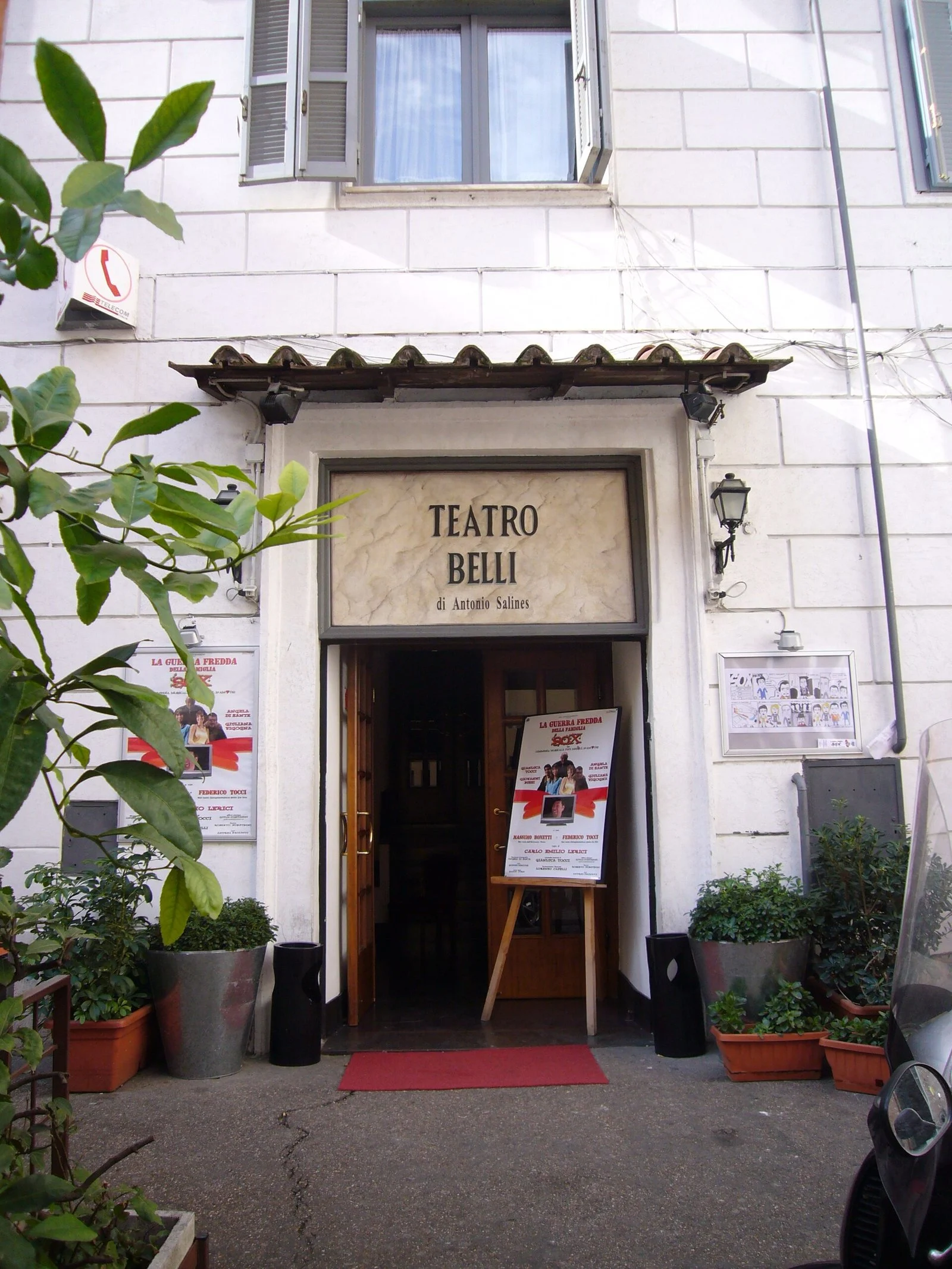
Since 1972 the Teatro Belli has occupied a building in Piazza di Sant'Apollonia, in the heart of Trastevere, which in the 1800s was already a performance hall and which before that, from the 1500s, had been a monastic complex. 147 seats, a stage a few steps from the front rows, a name that recalls the Roman-dialect poet Giuseppe Gioachino Belli: these three facts are enough to understand why generations of Romans consider this theater a fixed point of the city, well beyond the perimeter of the big billings. Around it, the neighborhood offers other reasons to stop: the Basilica of Santa Maria in Trastevere, the Basilica of Santa Cecilia, the Museo di Roma in Trastevere and the climb toward the Janiculum.
Whoever knows Trastevere only for its crowded alleys in the evening struggles to imagine that, a couple of steps from that confusion, there is an almost silent little square where for more than 50 years spoken-word theater and contemporary drama have been staged. The Teatro Belli does not appear in general tourist guides as often as Santa Maria in Trastevere or the Janiculum, and yet for those involved in Roman theater it represents a reference point as solid as the city's big institutions, precisely by virtue of its long history and the continuity of its artistic management.
Where the Teatro Belli is and how to get there
The Teatro Belli is at Piazza di Sant'Apollonia 11/a, 00153 Rome, in the heart of the Trastevere district, a few dozen meters from Ponte Garibaldi and from the network of alleys that leads toward Santa Maria in Trastevere. The address is not that of a theater born in a peripheral neighborhood and then absorbed by the city: it is that of a square that has always had a precise physiognomy, closed, intimate, and that today coexists with the café tables of the venues and with the evening comings and goings typical of this part of Rome.
By bus and tram
The most practical way to reach Piazza di Sant'Apollonia remains surface public transport. The lines that cross Viale di Trastevere and the adjacent lungotevere stop a few hundred meters from the theater, and from there you continue on foot along a short route dense with glimpses, among low facades, votive shrines and signs of historic trattorias. Whoever arrives from the center, from Piazza Venezia or the Corso, can get off at Largo Argentina and cross Ponte Garibaldi: it is a 10-minute walk that is worth doing calmly, without hurry, because the entrance to Trastevere from this side gives one of the best first looks at the neighborhood.
By car and on foot from Trastevere
Arriving by car is not the most convenient choice: the area around the theater falls within the Trastevere limited traffic zone, and parking in the surrounding streets is scarce and often reserved for residents. Whoever travels in their own car does better to leave it in one of the paid parking lots along the Tiber or beyond Viale Trastevere and reach Piazza di Sant'Apollonia on foot. Whoever is instead already staying in Trastevere, as happens to many visitors who choose the neighborhood precisely for its evening atmosphere, finds the theater within walking distance from almost every address in the district: the square is a small secluded open space, off the most beaten streets, and for this very reason the first time it happens that you walk past it without noticing.
From outside Rome: airports and Termini station
Whoever arrives in Rome from Fiumicino airport can take the Leonardo Express train to Termini and from there continue by taxi or surface transport to Trastevere. The overall trip, airport included, generally takes between 50 minutes and an hour and a quarter depending on traffic and connections. From Ciampino the most convenient link is a direct bus toward the center or a taxi, while whoever is already staying in the historic center or in Trastevere can reach Piazza di Sant'Apollonia with a simple walk, often the quickest solution given the closeness of the main tourist districts to the river.
Trastevere before arriving at the theater
Whoever arrives a few minutes early, which is recommended given the small size of the hall, can use the time to cross Piazza Trilussa and the stretch of lungotevere that leads toward Ponte Sisto, or venture into the minor alleys that connect Viale di Trastevere to Piazza di Sant'Apollonia. It is a short route, 10 minutes at a slow pace, but enough to perceive the character of the district: low houses, carefully peeling plaster, sacred shrines on street corners, bicycles leaning against walls. It is not a neighborhood designed for haste, and the Teatro Belli, with its discreet entrance on a minor square, is probably its most coherent expression.
The history of the Teatro Belli, from church to stage
Before being a theater, the building in Piazza di Sant'Apollonia was a place of worship. On the site originally stood a small church dedicated to Santa Maria de Oliva, with an attached monastery. In 1582 the noblewoman Paluzza Pierleoni had a new church built on that same spot dedicated to Sant'Apollonia, a Christian martyr of the third century venerated as protector against toothache, and the square took the name it still carries today. The spaces of the monastery, run by a branch of the Franciscan Third Order, remained active for centuries as a place of cloistered life.
The name of Sant'Apollonia and the square
Saint Apollonia, the Christian martyr of the third century to whom the original church was dedicated, is remembered by tradition for the torture suffered before martyrdom, which according to hagiography included the shattering of her teeth: hence her traditional invocation as protector against toothache, a cult very widespread in early modern Rome. The square that today hosts the theater keeps the name of that church, vanished for centuries, in one of the many Roman cases in which place names survive the building that generated them. Walking today in Piazza di Sant'Apollonia nothing remains of the church's 16th-century facade, but the name, engraved on the street plaque, continues to tell that first phase of the place's history.
From convent to 19th-century theater hall
In the 1800s the church was demolished and the ground floor of the convent complex was transformed into a performance hall. It is a passage that concerns many Roman religious buildings over the course of the century, but which here left a particularly solid trace: on the stage of that hall performed leading actors of Italian theater of the era, among them Gustavo Modena, one of the reformers of 19th-century acting, and Ermete Novelli, among the most celebrated star performers of the theater at the end of the century. Leopoldo Fregoli also performed there, the inventor of the lightning-fast transformation that would give its name to fregolismo, together with other performers of variety and revue, among them Ettore Petrolini.
This passage, from religious space to performance hall, is not an isolated episode in 19th-century Rome. With the end of the Papal State and the administrative changes of the century, several convents and deconsecrated churches of the city changed use, and Trastevere, the working-class neighborhood par excellence, saw several of these buildings turn into places of popular entertainment, film studios, small halls for variety. The difference, in the case of Piazza di Sant'Apollonia, is that this theatrical vocation never truly went out, not even in the years when the hall changed name and function.
The 1900s: the Amor cinema and the nightclub
With the arrival of the cinematograph the hall changed function again: in 1910 it becomes a movie theater with the name Amor, one of the many small neighborhood cinemas that dotted Rome in the first decades of the century. A few decades later, the space undergoes a further transformation, becoming a nightclub. It is the murkiest phase of its history, the least documented and least told by the available sources, before the return to the theatrical vocation that would fix its current name.
The available sources do not allow us to reconstruct precisely the exact duration of this nightclub parenthesis, nor the names of those who ran it. It is a documentary gap that concerns several small Roman spaces of that period, often transformed and retransformed several times in a few decades, and it makes the recovery work begun at the end of the 1960s all the more significant, when the building was by then in evident decay.
The recovery by Antonio Salines
At the end of the 1960s the actor and director Antonio Salines, born in La Spezia in 1936 and graduated from the Silvio D'Amico Academy in 1959, takes over the building together with Magda Mercatali. The space was in difficult condition, and the recovery work takes time: the theater reopens to the public in January 1972 with the name Teatro Belli. From that moment Salines becomes its artistic director for over 40 years, devoting himself with continuity to the programming and care of the hall until the last years of his life.
It must be said that the available sources place the acquisition of the building between 1969 and 1970, with the official reopening set for January 1972: a margin of one or two years between the purchase and the inauguration date that corresponds to the time materially needed for a restoration carried out on a building in compromised condition, without the resources of a large public body but with the direct work of the person who would then direct it artistically for four decades.
A curiosity about the Teatro Belli
Between 1910 and the return to the theatrical vocation in 1972, the hall in Piazza di Sant'Apollonia carried for a period the name Amor, as a neighborhood cinema: few of those who today buy a ticket for the Teatro Belli know that, 60 years earlier, the same space screened films under a sign that had nothing to do with the Roman-dialect poet or with spoken-word theater. The real curiosity concerns the physical continuity: the same walls hosted in succession a cloistered convent, a hall for 19th-century variety, a neighborhood cinema, a nightclub and finally a resident theater, without the building ever substantially changing place or entirely losing its vocation as a public space for performance.
If you try to line up all the functions this single address has had, the result is almost comic in its variety: a church dedicated to a patron saint of teeth, a cloistered Franciscan monastery, a hall for 19th-century drama and variety, a neighborhood cinema named Amor, a nightclub of which little is known, and finally a resident theater dedicated to one of the greatest Italian dialect poets. Hardly another address in Trastevere can claim an equally long sequence of reinventions, all enclosed in the space of a single building that has never stopped being, at bottom, a place where people gather.
One thing nobody tells you about the Teatro Belli
Around Piazza di Sant'Apollonia a local tradition has long circulated, reported by several sources of neighborhood history, according to which in the rooms of the old monastery two female figures tied to celebrated personalities of 18th- and 19th-century Rome found hospitality in different eras: the Fornarina, the woman loved by Raphael according to popular tradition, and Lorenza Feliciani, wife of the famous adventurer and occultist Cagliostro. It must be said clearly that this is a local tradition, not a fact documented with certainty by primary historical sources, and it must be treated as such: a neighborhood legend, not an established fact. It remains, however, a detail that almost nobody tells to those entering the hall on the evening of the show, and it is precisely the kind of information that makes Piazza di Sant'Apollonia less anonymous than it appears on a first distracted pass.
The monastery of the Poor Clares and cloistered life
Beyond the legend, there are more solid data on the daily life of the monastery before its transformation: like many early modern Roman women's convents, the one attached to the church of Sant'Apollonia followed a rule of strict enclosure, with an inner garden, cells arranged around a cloister and an access to the church reserved for the nuns through a grille separated from the public nave. Of that original layout, after centuries of successive transformations, almost nothing remains visible from the outside: the building that today hosts the theater has a sober, almost anonymous facade, which gives no hint of the stratification of functions it encloses.
The advice I give you for visiting the Teatro Belli
The Teatro Belli has 147 seats, and this substantially changes how it's best to organize yourself compared with a large Roman theater. With a hall so intimate every row is close to the stage, but seats run out quickly when the title on the billing is highly anticipated or when it is the last performance of a historic series like Trend.
How and when to book
The practical advice is simple: book at least a week ahead for weekend shows, and check directly on the theater's website the box office hours, open from Tuesday to Sunday before the start of the performances. Whoever arrives in Rome for a few days and wants to fit an evening of theater into an itinerary already packed with visits does well to check the billing before leaving, because the programming changes from week to week and some titles stay on stage only a few days.
What to expect from the hall
Whoever is used to the big Italian-style theaters, with boxes and galleries, will find here a different experience: a single stalls area, close to the stage, where the actor is seen and heard without filters. It is a format that rewards contemporary spoken-word theater and texts that work on the word more than on the scenic apparatus, and it is also the reason the Teatro Belli has been considered for decades a reference space for the less conventional drama in Rome. I advise arriving with a margin of 10 or 15 minutes, because entry into the hall is orderly but the lobby space is small, and whoever arrives at the last moment risks having to wait outside.
Who it's best to go with
The Teatro Belli suits an audience that appreciates spoken-word theater, contemporary drama and texts less immediate than the great classical repertoire. It is not, put differently, the right theater for those looking for a light entertainment show to pair with a generic tourist evening: the programming requires a minimum of curiosity toward texts often little known to the general public, and for this very reason it rewards those who arrive wanting to discover something new. I advise looking carefully at the show's synopsis before booking, especially during the Trend series, where the British texts offered are often unpublished in Italy and the level of experimentation can be high.
The best time to go
The season of the Teatro Belli generally covers the period from autumn to spring, with the official opening placed at the beginning of October and the closing toward the end of the following spring. Whoever visits Rome in summer therefore usually finds the hall stopped from the regular billing, although occasional off-season events may be organized. The advice, in this case, is to check the theater's calendar directly before planning the visit, especially if the trip is concentrated in the hottest months of the year.
Who Antonio Salines was and the rebirth of the theater
The recent history of the Teatro Belli largely coincides with the biography of one man. Antonio Salines was born in La Spezia on July 1, 1936 and graduated from the Accademia Nazionale d'Arte Drammatica Silvio D'Amico in 1959. In the same year he founded with Carmelo Bene the company I Ribelli, one of the first experiences of self-managed theater in Italy, debuting as Scipio in Camus's Caligula. In the following years he works with Vittorio Gassman, brings to television adaptations of Pirandello and Rozov, and performs on prestigious stages such as the Piccolo Teatro di Milano and the Arena di Verona.
The company I Ribelli and the beginnings with Carmelo Bene
The founding of the company I Ribelli, in 1959, together with Carmelo Bene, places Salines from the very beginning in a line of independent theater, far from the large public structures and the more traditional circuits. It is a biographical fact that helps to understand, many years later, the choice to take over and relaunch by himself a small neighborhood theater like the one in Piazza di Sant'Apollonia, instead of limiting himself to a career as a performer in the large institutional theaters where he had also worked. The Teatro Belli is born, in this sense, as the natural continuation of a path begun in the 1950s: that of an actor who always looked for a space of his own, run autonomously, where to build an artistic line coherent over time.
The restoration and the later renovations
After the acquisition of the building at the end of the 1960s and the reopening in January 1972, Salines returns several times to work on the hall: in 1984, 1988, 1999 and 2010 the theater is renovated to bring it up to standards of comfort and safety, without giving up the intimate character that has marked it from the origin. It is work done by successive stratifications, not with a single intervention, and it is consistent with the history of a building that in earlier centuries had already changed function several times while always remaining a public space.
The recognition and the passing
In 2019 Antonio Salines receives the Maschera d'oro as best lead performer in theater, a recognition that comes as the crowning of a career lasting over 60 years. Salines dies on June 22, 2021 at the age of 84. Since 2015 he had also taken over the direction of the theater season of the Teatro Gentile in Cittanova, while keeping the primary bond with the Roman hall he had brought back to life. Today the company that carries forward the activity of the Teatro Belli refers, together with the historic figure of Salines, to performers such as Carlo Emilio Lerici and Francesca Bianco, who for years worked alongside him on the artistic side.
A theater designed to last
It is striking, retracing this biography, the consistency with which a single artistic director guided a hall of this size for such a long period, more than 40 years. In the landscape of small Roman theaters, often marked by frequent changes of management, temporary closures and reopenings under different names, the continuity guaranteed by Antonio Salines represents an exception. It is also the reason why, still today, many Romans associate the name of the Teatro Belli not only with the Roman-dialect poet but also, inevitably, with the figure of the actor who brought it back to life and who guided it almost to the threshold of 90 years old.
The name of the theater and the link with Giuseppe Gioachino Belli
The name chosen for the theater reborn in 1972 is not random: it recalls Giuseppe Gioachino Belli, the Roman poet who lived between 1791 and 1863, author of more than 2,000 sonnets in Romanesco that tell the working-class Rome of his time with a raw and direct realism. Belli is the literary voice most identified with Trastevere and with the popular districts of 19th-century Rome, the chronicler in verse of taverns, markets, priests, working-class women and nobles, written in a language that is studied today in universities and still recited in Roman theaters.
Trastevere, Romanesco and the language of Belli
Opening a theater a couple of steps from Santa Maria in Trastevere and naming it after the poet who more than any other gave voice to this social fabric is a choice that explains itself through geography. The neighborhood that surrounds Piazza di Sant'Apollonia is the same one Belli described in his sonnets: narrow alleys, workshops, the river a couple of steps away, a precise and recognizable way of speaking that is still heard today in the markets and historic trattorias of the district. It is no accident, for that matter, that a short distance from here, beyond Ponte Garibaldi, stands the monument dedicated to the poet, one of the symbolic reference points for those who want to understand the link between Trastevere and its literary tradition in dialect.
Where to learn more about the poet
Whoever wants to learn more about Giuseppe Gioachino Belli finds in Trastevere many natural starting points: the monument dedicated to him beyond Ponte Garibaldi, the plaques that recall the places linked to his biography in the district, and the very atmosphere of the neighborhood, which two centuries later still preserves recognizable traces of the working-class Rome told in his sonnets. The Teatro Belli, with its name and its location, fits naturally into this route, while remaining first of all a place of contemporary theater production and not a museum dedicated to the poet.
Who Giuseppe Gioachino Belli was
Born in Rome in 1791 and died in 1863, Giuseppe Gioachino Belli led for much of his life an existence as a civil servant, before devoting himself with growing intensity to writing in the Roman dialect. His sonnets, more than 2,000 according to the critical tradition, portray with a chronicler's precision the working-class Rome of his time: the language of the taverns, life in the districts, the minor trades, the daily relationship with the ecclesiastical power that governed the city. Belli wrote in a living dialect, learned and at the same time popular, and precisely because of this double nature his work has come down to today as one of the richest documents on the speech and mentality of 19th-century Rome. The poet's original verses are not reproduced here, but whoever wants to approach his work finds a natural starting point in a theater that carries his name, in the heart of the neighborhood those verses told.
For those organizing a stay in Rome and wanting to build a coherent itinerary among theater, history and neighborhood, it can be useful to rely on tools designed specifically for moving through the city with judgment, like the travel planning resources of Italy Planner, or, for those who accompany organized groups or work in the tourism hospitality sector, the professional materials provided by Tour Leader Pro.
Another well-known fact, yet rarely cited
Many of the visitors who attend a show at the Teatro Belli today know that the hall is tied to the figure of Antonio Salines, but few dwell on a fact that is nonetheless written, with some variation, in several sources on the history of Roman theater: the stage in Piazza di Sant'Apollonia already hosted in the 1800s, a century before the Salines management, some of the most important performers of Italian theater and variety, from Gustavo Modena to Ermete Novelli, from Leopoldo Fregoli to Ettore Petrolini. The history of the Teatro Belli, in short, does not begin in 1972: it begins much earlier, with a century of performance that preceded the current name and that made that hall, even before it was called that, a place where theatrical Rome met.
The programming, Trend and the series of the Teatro Belli
The Teatro Belli is today a space that alternates contemporary drama, reworkings of classics, civic theater and more experimental languages, with a season that traditionally opens in autumn and continues until late spring. The 2025 and 2026 season, for example, began on October 1, 2025 with a billing described by the theater itself as a journey among emotions, rereadings of classics, civic theater and new languages, able to address different audiences over the course of the season.
Trend, new frontiers of the British stage
Among the long-running festivals hosted at Teatro Belli, the most recognizable is Trend, nuove frontiere della scena britannica, an annual overview devoted to contemporary English-language drama from the United Kingdom. Over the years the festival has reached many editions, with documentation available for the 14th, the 16th and the 17th, a sign of continuity that has spanned more than a decade and a half of programming. It's precisely this systematic openness to the English-speaking stage, maintained steadily season after season, that sets Teatro Belli apart from most other Roman theaters of similar size, and makes it a reference point for anyone who follows contemporary international drama beyond Italy's borders.
How the festival works
Each edition of Trend offers a selection of recent British plays, often in their Italian premiere, presented as staged readings, full productions or meetings with translators and scholars of English-language theater. The festival's approach is both popularizing and specialized: on one hand it introduces the Roman public to authors who rarely reach the programs of the bigger theaters, on the other it builds over time a small permanent observatory on new UK playwriting. The documented editions, from the 14th to the 17th, typically fall in the last part of the calendar year, between October and December, a period that over the years has become a fixed point for those who follow the theater's programming regularly.
The rest of the program
Alongside Trend, the theater's regular programming includes productions by its long-standing company and guest shows, often signed by names who have been working on the Roman independent scene for years. The small size of the hall makes it possible to host projects that would hardly find room in larger theaters, aimed at a more niche audience that is no less loyal for it. It's a trait Teatro Belli shares with other small historic theaters in Rome, but here it comes with a continuity of artistic management rarely matched in the city.
The right photo to take at Teatro Belli
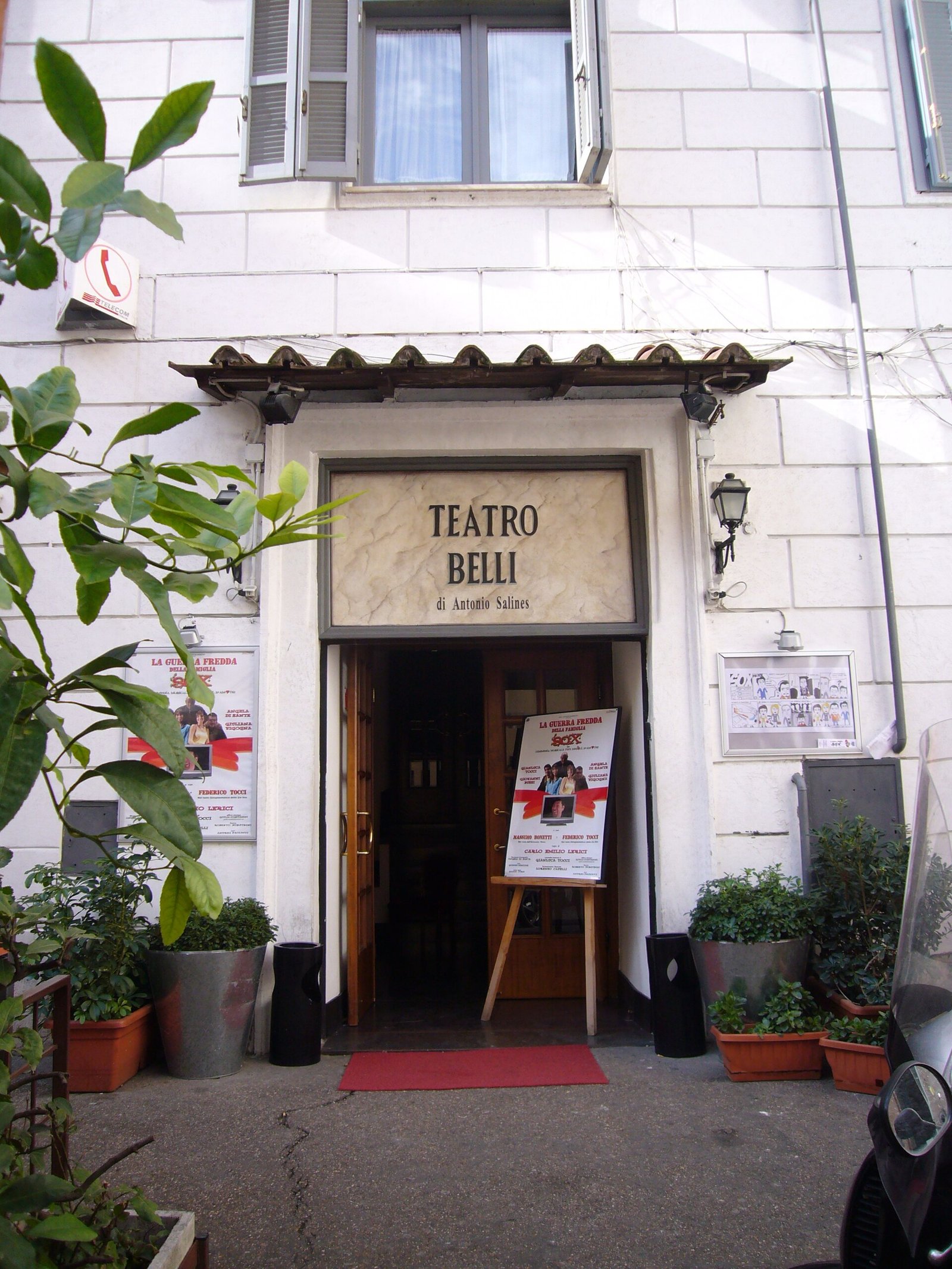
The right photo to take at Teatro Belli isn't shot inside the hall, where filming during the show isn't allowed anyway, but outside, in the small Piazza di Sant'Apollonia, with the theater's sign and the plain facade of the building in the background. It's a small, secluded view, very different from the more obvious postcards of Trastevere: no monumental fountains, no crowded staircases, just a genuine corner of the neighborhood, with the colorful shutters of the surrounding houses and the late-afternoon light filtering low between the narrow buildings.
The best time of day
The best time for this photo is the hour before the evening shows begin, when the square fills with people waiting outside the box office and the theater's lights start coming on while it's not yet fully dark outside. It's an image that tells you well what going to the theater in Trastevere means: not the solemn entrance of a grand Italian-style opera house, but an almost homey, neighborhood moment, worth capturing precisely for its small scale.
A detail to look for
Before or after taking the shot, it's worth raising your eyes to the upper floors of the building that houses the theater: the windows and the proportions of the facade still preserve, faintly, the sobriety typical of Roman convent architecture, very different from the showy facade you'd expect from a building born as a theater. It's a small visual clue to the layering of functions told on these pages, and it's the reason why, when you photograph Teatro Belli, you always end up photographing a piece of Trastevere's religious and social history too.
Evening light on Piazza di Sant'Apollonia
On summer evenings, when performances start later because of the heat, the light filtering between the buildings of the square takes on a warm tone that many amateur photographers look for instinctively, without knowing in advance that this particular framing works best right in front of the theater's entrance. It's a detail worth keeping in mind if you visit Trastevere in the hottest months of the year and want to take home an image different from the usual postcards of the neighborhood.
Some important events that happened here in history
The sequence of events that have marked the history of the building on Piazza di Sant'Apollonia spans four and a half centuries, and it's worth going through it in order to understand how layered this corner of Trastevere is.
From the 16th to the 19th century
In 1582 the noblewoman Paluzza Pierleoni has the church of Sant'Apollonia built on the site of an earlier church dedicated to Santa Maria de Oliva, with an attached monastery entrusted to a branch of the Franciscan Third Order. The complex remains active as a place of worship and cloistered life for over two centuries. In the course of the 19th century the church is demolished and the ground floor of the convent building becomes a performance hall, hosting performers such as Gustavo Modena, Ermete Novelli, Leopoldo Fregoli and Ettore Petrolini.
The 20th century and the rebirth as Teatro Belli
In 1910 the hall becomes the Amor movie theater. It then passes, in a later and less documented period, to a nightclub. At the end of the 1960s Antonio Salines and Magda Mercatali buy the building, by now in a run-down state, and start its restoration. The theater reopens to the public in January 1972 under the name Teatro Belli. In the following years the hall is renovated four times, in 1984, 1988, 1999 and 2010, to bring it up to comfort standards without altering its historic character.
The most recent years
In 2019 Antonio Salines receives the Maschera d'oro as best lead performer in theater. On June 22, 2021 Salines dies at the age of 84, after more than 40 years as artistic director of the theater he had brought back to life. The long-standing company continues the activity of Teatro Belli, which in the 2025 and 2026 season, opened on October 1, 2025, continues to offer a program of contemporary drama, new readings of the classics and international festivals such as Trend, nuove frontiere della scena britannica.
Who has passed through Teatro Belli
Through its many centuries of life, the hall on Piazza di Sant'Apollonia has seen some of the most important figures of the Italian stage parade through. In the 19th century, when the building was still a hall without its present name, Gustavo Modena, one of the fathers of modern Italian acting, and Ermete Novelli, among the most celebrated actors of the late-century theater, performed there. In the same period Leopoldo Fregoli, the quick-change artist who gave his name to "fregolismo," and Ettore Petrolini, future giant of revue and Roman comic theater, also passed through.
It's worth recalling, if only to put these names in context, that they are some of the most important figures in the history of Italian entertainment between the 19th and 20th centuries. Gustavo Modena is considered one of the founders of modern Italian acting, able to move past the emphatic declamation typical of early 19th-century theater in favor of a more natural and measured delivery. Ermete Novelli, a star performer and company head, led for decades one of the most important companies of Italian theater. Leopoldo Fregoli took the art of lightning-fast stage transformation to the international level. Ettore Petrolini, finally, would become one of the absolute symbols of Roman theatrical identity in the 20th century, with characters that stayed in collective memory well beyond his time. Knowing that all of them, at different moments, trod the same stage that now hosts Teatro Belli adds no small historical weight to a hall that, seen from outside, might look like just a small neighborhood theater.
The Antonio Salines era
With the reopening of 1972, the name most tied to Teatro Belli is that of Antonio Salines, who was its artistic director for over 40 years. Before devoting himself to Roman theater, Salines had founded with Carmelo Bene the company I Ribelli, one of the first Italian experiences of self-managed theater, and had worked alongside Vittorio Gassman, staging adaptations of Pirandello in the theater and on television. Next to him, in the artistic running of the theater, performers such as Carlo Emilio Lerici and Francesca Bianco have joined over time.
The international authors of the Trend festival
Thanks to the Trend festival, nuove frontiere della scena britannica, over the years Teatro Belli has also become a point of contact between Rome and new English drama, hosting texts and authors of contemporary UK theater across successive editions that have passed the mark of 15 years of continuous activity.
The Belli's loyal audience
People who have been going to Teatro Belli for years often describe the same feeling: that of entering a place where the audience knows each other, where the box office remembers the faces of the subscribers, where the distance between those sitting in the stalls and those performing on stage is reduced to the bare minimum. It's a trait that belongs more to the culture of small neighborhood theaters than to that of the big city programs, and one that Teatro Belli has kept steadily from 1972 to today, despite the generational changes in artistic management and the four renovations the hall has gone through.
Roman independent theater and the role of Teatro Belli
Rome has a dense network of small and medium-sized theaters, often born from private initiatives and backed by resident companies that handle the programming season after season. In this landscape Teatro Belli holds a particular position, because of the combination of the building's long history, which predates by a century the birth of the theater as we know it today, and the continuity of an artistic management that has lasted over four decades under the same leadership.
One of the smallest and longest-lived halls
With 147 seats, Teatro Belli is among the most intimate halls on the Roman theater circuit, far from the size of the big traditional theaters like the Argentina or the Eliseo. It's precisely this small scale, together with the continuity of artistic direction, that has allowed the theater to build over time a precise identity, tied to contemporary drama and to playwriting less traveled by the big circuits, without having to bend to the box-office logic that necessarily conditions larger halls.
The relationship with city institutions
Over the years Teatro Belli has also built collaborations with Rome's academic world: the agreement signed with Sapienza University, which provides discounted ticket prices for students and university staff, is a concrete example of how a small independent hall can stay open to a younger audience without giving up its own artistic line. It's a management model that many small Roman theaters have adopted in recent years, but at Teatro Belli it has roots in a tradition of openness to the university and student public that goes back well before these agreements were formalized.
Trastevere around Teatro Belli, what to see before and after
An evening at Teatro Belli naturally lends itself to a walk through the rest of Trastevere, a neighborhood that offers within a few blocks some of the most important traces of medieval and Baroque Rome.
Churches and museums a few minutes on foot
A few steps from the theater is the Basilica di Santa Maria in Trastevere, one of the oldest churches in the city dedicated to the Madonna, with the famous mosaics that decorate its apse. Continuing south you reach the Basilica di Santa Cecilia, built, according to tradition, on the house of the Roman martyr saint. If you have time for a museum stop, you can visit the Museo di Roma in Trastevere, devoted to the daily life and folk traditions of the district, including those recounted in the very verses of Giuseppe Gioachino Belli. Two other less well-known but very appealing churches, the Church of Sant'Agata in Trastevere and the Church of San Francesco a Ripa, complete a route you can do entirely on foot in under an hour. The latter holds inside one of the most intense sculptural works by Gian Lorenzo Bernini, the statue of Blessed Ludovica Albertoni, visible in a dimly lit side chapel that heightens its dramatic character.
Trattorias and the district's evening life
Trastevere has also always been one of the Roman neighborhoods with the highest concentration of historic trattorias and osterias, many of which still serve the dishes of Roman popular tradition that Giuseppe Gioachino Belli himself described in his sonnets: pajata, coda alla vaccinara, rigatoni with pajata, carciofi alla romana in season. Having dinner in one of these trattorias before or after a show at Teatro Belli is a natural way to end the evening, and it's a habit that very many regular theatergoers have kept for years, walking between the hall and the tables of some place a stone's throw from Piazza di Sant'Apollonia.
Toward the Janiculum
If you feel like getting away a little from the web of alleys and looking for a view over the city, the climb to the Janiculum Hill starts a few minutes from the theater and rewards you, at the top, with one of the widest panoramas over Rome, with the dome of St. Peter's on one side and the historic center on the other. Many people pair this climb with an evening at the theater precisely because it lets you see the city from above before or after the show, closing the day with a viewpoint different from the enclosed one of the hall on Piazza di Sant'Apollonia.
The Fontana dell'Acqua Paola
Along the climb to the Janiculum, anyone setting out from Teatro Belli meets the Acqua Paola Fountain, one of Rome's great monumental fountains, built in the 17th century as the crowning of the ancient Trajan aqueduct, later restored in the Baroque era. It's a stop many visitors discover by chance just as they tackle the climb to the lookout, and it deserves a few minutes' pause before continuing toward the top of the hill.
Frequently asked questions about Teatro Belli
Where exactly is Teatro Belli?
Teatro Belli is at Piazza di Sant'Apollonia 11/a, in the heart of the Trastevere district, a few minutes on foot from Ponte Garibaldi and Santa Maria in Trastevere. The square is small and secluded, easily reached both on foot from the historic center and by the surface lines that stop along Viale di Trastevere.
How many seats does Teatro Belli have?
Teatro Belli has 147 seats, a small capacity that places it among the most intimate theaters in Rome. The single hall, with no boxes or galleries, puts every spectator at close range from the stage, a format that favors contemporary drama over large-scale productions.
Why is it called Teatro Belli?
Teatro Belli takes its name from Giuseppe Gioachino Belli, the Roman poet who wrote more than 2,000 sonnets in Romanesco that told the story of the popular Rome of the 19th century. The name was chosen at the reopening in 1972 and reflects the direct link between the theater, Trastevere and the dialect tradition that this part of Rome has always preserved.
When did Teatro Belli reopen in its current form?
Teatro Belli reopened to the public in January 1972, after Antonio Salines and Magda Mercatali had bought the building, then in run-down condition, and overseen its restoration. Since then the hall has kept a continuous program, interrupted only for further renovation work in the following years.
What was the Teatro Belli building before it became a theater?
Before housing Teatro Belli, the building had been a church and a monastery dedicated to Sant'Apollonia, built in 1582 on the site of an earlier church dedicated to Santa Maria de Oliva. In the 19th century the church was demolished and the ground floor became a performance hall, which in the 20th century also became a neighborhood movie theater under the name Amor.
Who played or acted at Teatro Belli in the 19th century?
Even before it was called Teatro Belli, the hall on Piazza di Sant'Apollonia hosted in the 19th century some of the most important performers of Italian theater of the time, including Gustavo Modena, Ermete Novelli, Leopoldo Fregoli and Ettore Petrolini. This century of activity before the current name is often overlooked by people who go to the theater today, but it's documented by sources on the hall's history and is a fundamental part of it.
What is the Trend festival at Teatro Belli?
Trend, nuove frontiere della scena britannica, is Teatro Belli's long-running festival devoted to contemporary drama from the United Kingdom. Over the years it has reached many successive editions, with continuous activity of more than 15 years, and it remains one of the traits that most distinguish this theater's programming from other small Roman halls.
Who was Antonio Salines?
Antonio Salines was the actor and director who re-founded Teatro Belli in 1972 and led its artistic direction for over 40 years, until his death in June 2021. Before devoting himself to Roman theater he had founded with Carmelo Bene the company I Ribelli and had worked with Vittorio Gassman, receiving in 2019 the Maschera d'oro as best lead performer.
Is Teatro Belli still active today?
Teatro Belli is fully active and offers a new season every year, with the 2025 and 2026 program starting on October 1, 2025. The program alternates new readings of the classics, civic theater, new languages and the Trend festival devoted to the contemporary British stage, carried on by the theater's long-standing company.
How do you buy tickets for Teatro Belli?
Tickets for Teatro Belli are bought at the hall's box office, open Tuesday through Sunday before the performances begin, or through the online booking channels listed on the theater's official website. With only 147 seats available, booking a few days ahead is especially recommended for weekend shows.
What is there to see near Teatro Belli?
Around Teatro Belli are some of the most representative places in Trastevere: the Basilica di Santa Maria in Trastevere with its medieval mosaics, the Basilica di Santa Cecilia, the Museo di Roma in Trastevere and the climb that leads to the Janiculum. If you arrive a bit early or stay after the show, you can visit one of these places on foot in a few minutes.
Is Teatro Belli suitable for people who don't speak Italian well?
Teatro Belli mainly puts on shows in Italian, including those based on foreign texts presented in translation during the Trend festival. If you don't have a good command of Italian you may still find it interesting to see a show in a historic hall in Trastevere, but it's good to know in advance that no subtitles or simultaneous translation are provided.
Does Teatro Belli have a direct link to the work of Giuseppe Gioachino Belli?
Teatro Belli takes its name from the poet but is not a museum or an archive devoted to his work: it's a drama theater in every respect, with a program that ranges across contemporary Italian and foreign authors. The link with the Romanesco poet remains mostly symbolic and geographic, tied to the fact that it stands in the heart of the same Trastevere that Belli described in his sonnets.
How long does a show at Teatro Belli last on average?
Shows at Teatro Belli generally follow the standard length of contemporary Italian drama, between an hour and a quarter and two hours, intermission not included when there is one. Since it's a small hall, start times are kept precisely, so it's a good idea to show up well ahead of time so you catch the first scenes.
Is Teatro Belli accessible to people with mobility difficulties?
Teatro Belli, like many historic buildings in central Rome that were born for functions other than theater, has architectural features tied to its 19th-century convent origin. People with specific accessibility needs do well to contact the box office directly before booking, so as to get up-to-date information on any easier routes and on the seating layout in the hall.