Portico of Octavia
In short. The Portico of Octavia is the monumental enclosure that Augustus had rebuilt in the southern Campus Martius and dedicated to his sister Octavia, on top of an older portico erected by Quintus Caecilius Metellus Macedonicus after the…
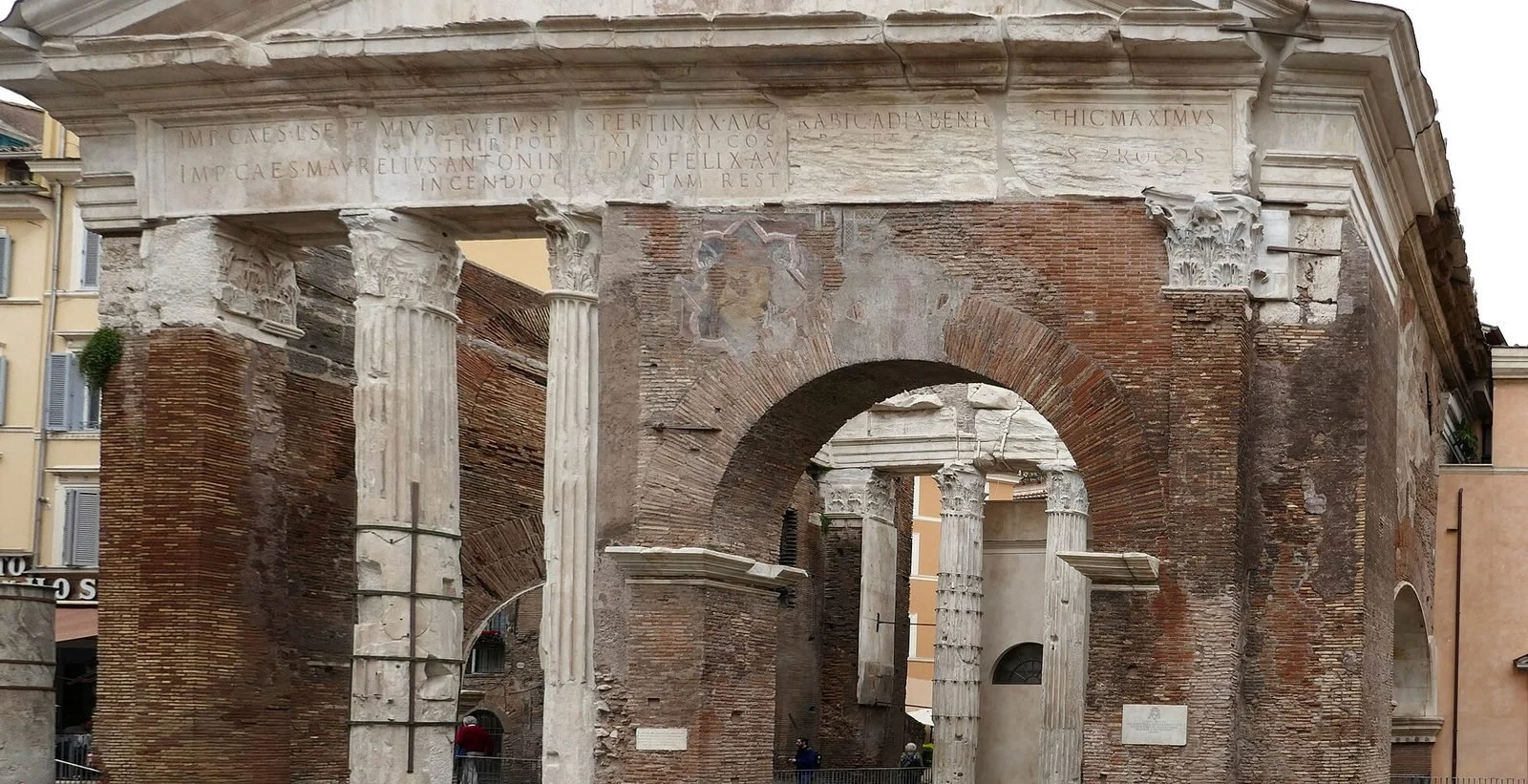
The Portico of Octavia is the monumental enclosure that Augustus had rebuilt in the southern Campus Martius and dedicated to his sister Octavia, on top of an older portico erected by Quintus Caecilius Metellus Macedonicus after the triumph over Macedonia in 146 BC. What you see today along Via del Portico d'Ottavia, at the entrance to what from 1555 to 1870 was the Jewish enclosure of Rome, is a small part of the complex: the entrance propylaeum with its Corinthian columns and pediment, the large brick arch that replaces two of them, and behind it the archaeological area with the foundations of the temples of Juno Regina and Jupiter Stator. Inside this ruin, over 1,200 years, were squeezed a church, a fish market, the gate of a closed quarter and, on the morning of October 16, 1943, the assembly point for a deportation. Few stones in Rome have absorbed so much history in so little space, and almost none of the people who pass by to photograph the columns know what they are looking at.
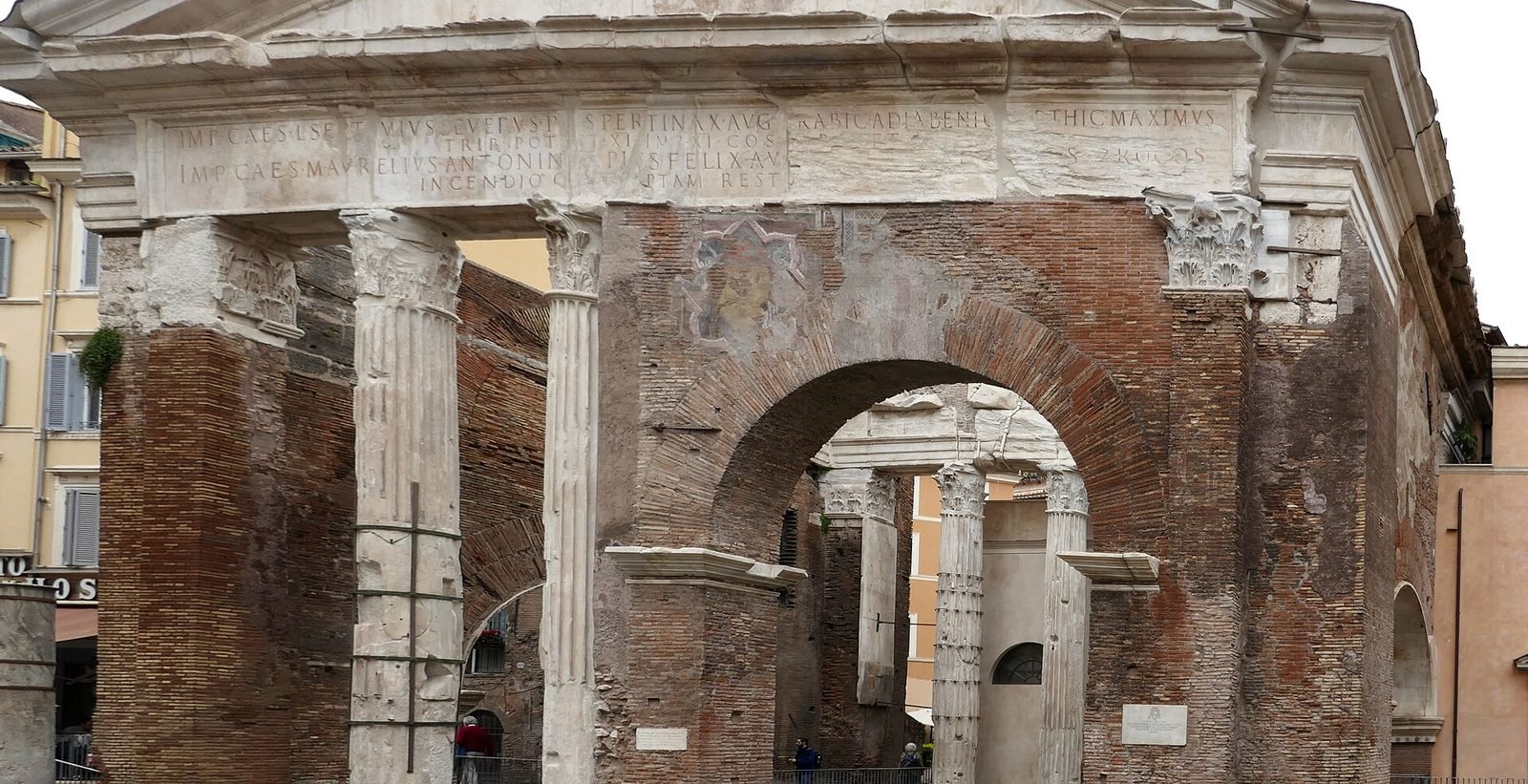
This page explains what the complex was in Roman times, how it was transformed in the Middle Ages and the modern age, what remains and how to visit it today. Access data for the archaeological area is managed by the Capitoline Superintendency for Cultural Heritage and changes fairly often: here you will not find invented hours or rates, but an indication of where to check them before leaving.
Where the Portico of Octavia is and how to get there
The Portico of Octavia is on Via del Portico d'Ottavia, in the Sant'Angelo district, between the Theater of Marcellus and the Lungotevere de' Cenci, about 200 meters from the river. It is the corner of Rome between the Capitoline Hill behind it, Ponte Fabricio in front and Tiber Island right after: a flat, narrow zone, built on the flood plain of the Tiber, where the ancient level lies several meters below the present one.
On foot from the center
From Largo di Torre Argentina you arrive in just under eight minutes going down Via Florida, Via dei Falegnami and Via Sant'Angelo in Pescheria. From Piazza Venezia the route is even shorter, 10 minutes along Via del Teatro di Marcello, and has the advantage of taking you under the arches of the Theater of Marcellus, which was the Portico of Octavia's next-door neighbor already in the Augustan age. Anyone coming from Trastevere crosses Ponte Fabricio, cuts across Tiber Island and finds themselves on the threshold of the district in under five minutes from the opposite embankment.
From the Colosseum the distance is about 1.3 kilometers, 20 minutes at a normal pace along Via dei Fori Imperiali and then Via del Teatro di Marcello. From the Pantheon you walk just under a quarter of an hour crossing Largo di Torre Argentina.
By public transport
The reference hub is Largo di Torre Argentina, where most of the surface lines crossing the historic center from east to west converge, plus the terminus of tram 8, which connects Trastevere and Casaletto. Tram 8 continues to Piazza Venezia, a 10-minute walk from the portico. The nearest metro station is Colosseo, on line B, from which it is a 20-minute walk. Alternatively, get off at Circo Massimo, also line B, and walk back up along Via del Teatro di Marcello.
The numbering of surface lines in Rome changes more often than you would think, with detours tied to construction sites in the center: it is best to check the updated route on the transport company's website or app the same day, instead of trusting a list printed the year before. For a general picture of tickets and validation rules, see our page on getting around Rome.
What the Portico of Octavia is: an enclosure of temples, not a colonnade for passing through
The Portico of Octavia was a porticus, that is, a quadriporticus: a rectangle of double colonnades enclosing an open space with two temples, two libraries and a series of service buildings. The Italian word is misleading, because it makes you think of a loggia along a street. Here it was a closed enclosure, as big as an entire city block, with a monumental entrance on a short side: a place for pausing, for displaying works of art, for meeting and for worship, not a covered passage.
Size and plan
Archaeologists' reconstructions assign to the Augustan enclosure a rectangle of about 119 meters by 132, with the long side parallel to the river. The measurements vary by a few meters depending on the reconstruction followed, because a large part of the perimeter lies under modern buildings and is known only from fragments of the Forma Urbis, the Severan marble plan of Rome engraved at the beginning of the 3rd century, of which fragments survive precisely for this sector of the Campus Martius. The colonnade was double, that is, with two rows of columns, and ran along all four sides.
The two temples inside the enclosure
Inside the quadriporticus stood side by side, with their fronts facing south, the temple of Juno Regina and the temple of Jupiter Stator. The first, farther west, went back to the dedication of 179 BC by Marcus Aemilius Lepidus. The second, to the east, was built by the Greek architect Hermodorus of Salamis and is remembered by ancient sources as the first temple built entirely of marble in Rome. Of the two buildings only the concrete foundations remain today, readable in the archaeological area behind the propylaeum, with stretches of the podium and a few architectural elements reassembled on the ground.
The libraries and the curia
The complex included two libraries, one Greek and one Latin, and a meeting hall that the sources call the Curia Octaviae. The libraries are mentioned by ancient authors as part of the cultural endowment of the enclosure, in the wake of the Augustan project that gave Rome public reading spaces on the Hellenistic model. Their exact placement within the perimeter is still debated: the wall remains preserved under the modern buildings are not enough to fix it with certainty, and scholars' proposals differ.
From the portico of Metellus to that of Octavia: how the complex came about
The first building on this area was the Porticus Metelli, built in 146 BC by Quintus Caecilius Metellus Macedonicus with the spoils of the war that had ended Macedonian resistance. It was, as far as is known, the first monumental quadriporticus in Rome, and it was born as a container for two temples that already existed and as a showcase for the works of art brought from Greece. A century and a half later, Augustus had it rebuilt from scratch and named it after his sister.
Who Octavia was
Octavia the Younger, elder sister of Octavian Augustus, was a political figure as well as a family one: married first to Gaius Claudius Marcellus and then, in 40 BC, to Mark Antony as the seal of the Brundisium agreement between the triumvirs, she found herself at the center of the break between her brother and her husband. At her death, placed by the sources between 11 and 9 BC, she received public honors. The dedication of the portico in her name must be read within the Augustan program of celebrating the family: in the same way the theater next to it bore the name of her son, Marcellus, who died very young in 23 BC.
When it was rebuilt
The Augustan rebuilding is placed by scholars between 33 and 23 BC, in a range that depends on how the reports of the literary sources are cross-checked. The funds came from the spoils of the campaign in Dalmatia: it is the report that ancient authors repeat, even if the precise wording varies. The name of the patron remained Octavia's, but the project and the money were her brother's, following a practice of attributing public buildings to women that in the Augustan age was not rare.
The works of art it contained
Pliny the Elder, in the Naturalis Historia, lists among the works visible in the complex a bronze group by Lysippus depicting the companions of Alexander fallen at the Granicus, brought to Rome by Metellus from Macedonia, together with sculptures attributed to Praxiteles and other Greek masters. The exact list is a matter of philological discussion, because Pliny's passages are concise and the names of the buildings of the Campus Martius overlap. What can be said with certainty is that the enclosure functioned as a public gallery of Greek sculpture: a way, for the republican aristocracy first and for the princeps later, of showing Romans the spoils of the eastern conquests.
The fires and the restoration by Septimius Severus and Caracalla
The Portico of Octavia burned at least twice. The first fire is that of AD 80, under Titus, which devastated a wide sector of the Campus Martius: a restoration of the Flavian age followed. The second, more serious for this building, is the fire of 191 under Commodus. The reconstruction that followed is the one that still stands today, and it is dated precisely because it bears its signature on the architrave.
The inscription of 203
On the architrave of the propylaeum runs a monumental inscription in which Septimius Severus and Caracalla declare they have restored the building damaged by fire: the Latin formula is incendio corruptam restituerunt. The imperial titulature engraved in the text, with the list of titles assumed by the two Augusti, allows the intervention to be fixed at AD 203. It is one of the cases where a Roman monument dates itself, with no need for stylistic deductions: the text is still legible now, from the street, by raising your eyes above the columns.
What the propylaeum looked like
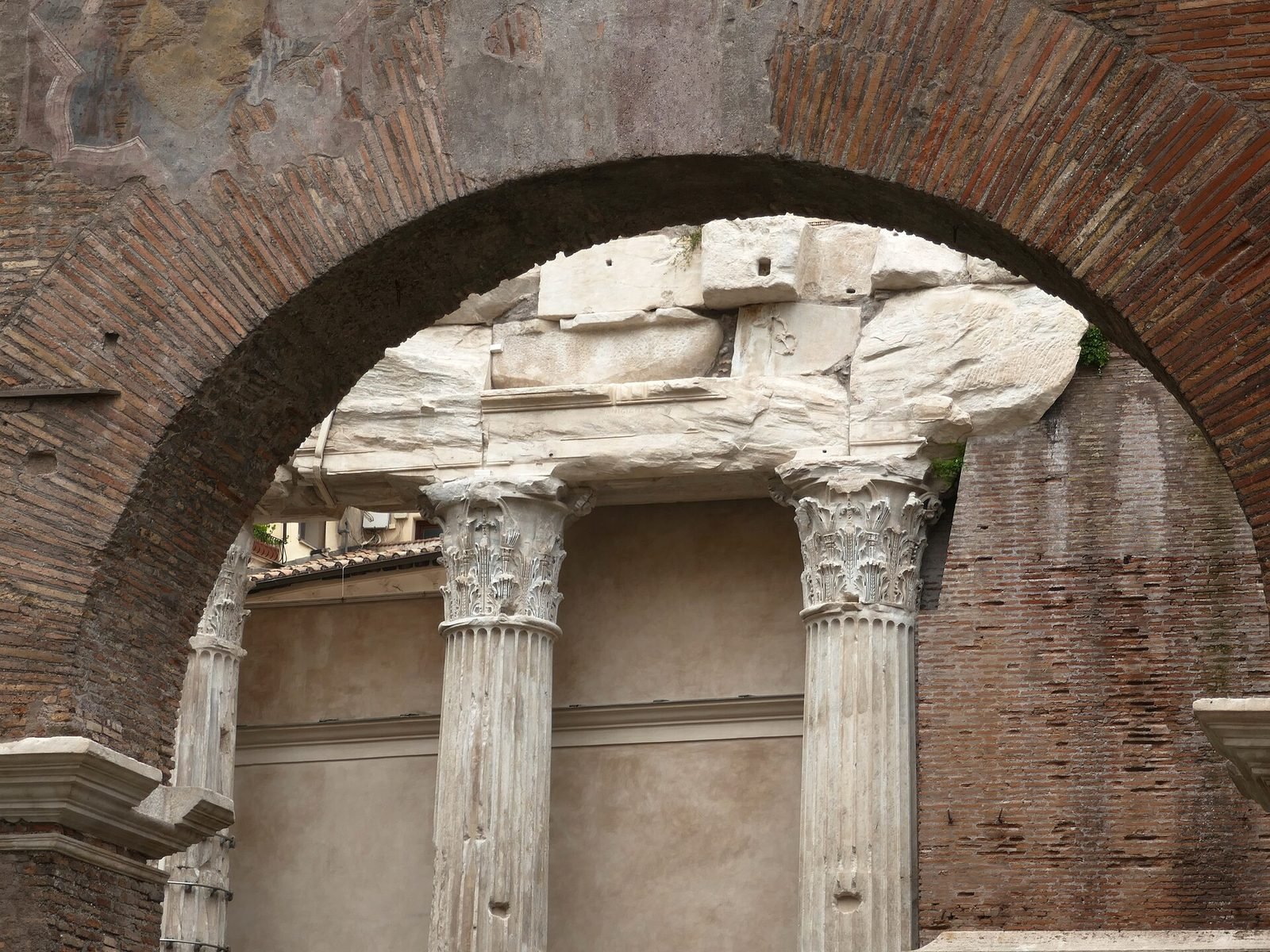
The Severan propylaeum was an entrance with two fronts, with four Corinthian columns on the facade on each side and two corner pilasters, topped by a triangular pediment. You crossed it by passing between the columns and emerged inside the enclosure. Today the front facing the street preserves three columns standing on the left side and the remains of the pediment, while on the right side the missing columns are replaced by the large brick arch.
The brick arch and its date
Here a clarification is needed that many captions skip. The brick arch that today closes the right flank of the propylaeum is not part of the Severan construction: it is a later rebuilding, made to patch the collapse of two columns. The scholarly tradition links it to the earthquake that struck Rome in 1349, the same one that brought down a stretch of the outer ring of the Flavian amphitheater, but no inscription confirms it and scholars debate if the work is slightly earlier or later. In texts you often find the formula "medieval arch": it is the most cautious definition, and it is worth keeping to it.
The fish market and the church of Sant'Angelo in Pescheria
Between the early Middle Ages and the 19th century the Portico of Octavia was Rome's fish market: the wholesale and retail fish market was held inside and around the ruins of the enclosure, on stalls made from slabs of ancient marble. It is from this function that the name of the church inside it, Sant'Angelo in Pescheria, derives, and that the medieval name of the whole quarter derived.
A church inside a Roman portico
The church was founded in the 8th century carved directly out of the rooms of the portico, backed against the propylaeum. The current date is 755, under Pope Stephen II, but part of the literature moves it by some 15 years, to 770 and Stephen III: the two versions coexist in the reference works and there is no way to choose one without forcing the sources. The dedication is to the archangel Michael, a title that in the early medieval Roman period often appears in buildings of reused structures.
The church has kept for centuries its three-aisle layout on reused columns. Inside remain fragments of frescoes from the medieval and 15th-century periods, with debated attributions: some guides attribute a Madonna to Benozzo Gozzoli, but the attribution is not shared by all scholars and it is best to report it as a proposal. Opening hours are irregular and tied to services: it is often found closed in the afternoon, and there is no stable published calendar.
The plaque with the measure of the fish
On the outer flank of the church, toward the propylaeum, is set a marble slab with a Latin inscription that established a rule of the market: the heads of fish longer than the slab itself, up to and including the first fins, had to be delivered to the Conservators, that is, the Capitoline magistrates who sat at the Palazzo dei Conservatori. The head of the large fish, which is the part you make broth with, was in practice a tax in kind on the choice catch.
What remained of the portico in the Middle Ages
The ancient enclosure was never entirely demolished: it was lived in. The columns ended up incorporated into the walls of houses, the spaces between columns were filled in, the upper floors of the shops leaned on the Roman architrave. It is the same fate as the Theater of Marcellus, turned into a fortress by the Pierleoni and then into the palace of the Savelli, and of the church of San Nicola in Carcere, built over three republican temples of the Forum Holitorium, whose columns still emerge from the flanks of the building. In this stretch of the city reuse is the rule, and preservation is a side effect of reuse.
The serraglio of the Jews: 1555, the bull of Paul IV and the forced sermons
On July 14, 1555 Pope Paul IV promulgated the bull Cum nimis absurdum, which established in Rome a compulsory closed enclosure for the city's Jews. The area chosen was precisely this one: the band of blocks between the Portico of Octavia, the Tiber and Piazza Giudia, already inhabited by part of the community. The quarter was walled in, given a few gates that closed at sunset and reopened at dawn, and took the official name of serraglio of the Jews. It lasted, with very brief interruptions, until 1870.
What the bull provided
The 1555 text imposed compulsory residence in the enclosure, the distinctive sign on clothing, the ban on owning real estate outside the quarter, the limitation of permitted trades to a few activities, among them the trade in rags and used clothing, and the ban on having more than one synagogue. The consequences for health and urban planning were heavy: the area is the lowest in the historic center, was flooded by the Tiber's floods regularly, and the housing density grew abnormally there for three centuries, with houses raised floor upon floor on an unchanged footprint.
The forced sermons
Among the obligations imposed on the community was that of attending Christian sermons of conversion. In Rome they were held in several places, and the church of Sant'Angelo in Pescheria, the one inside the portico, was one of the main ones: a set number of men and women had to present themselves on set days, as a rule Saturday, and listen. The chronicles report the use of checks and sanctions for those who did not show up or did not pay attention. The obligation was abolished by Pius IX in 1847, in the brief season of reforms that preceded 1848.
From 1870 to the demolition of the quarter
With the breach of Porta Pia and the end of temporal power, the enclosure was opened and the restrictions fell. A few years later, between 1888 and the early 20th century, the old quarter was demolished almost entirely as part of the sanitary clearance of the area and the construction of the Tiber embankment walls. In place of the maze of alleys came the regular blocks you see now, and between 1901 and 1904 the Synagogue of Rome, the Tempio Maggiore, was built, with its square dome that is today the visual landmark of the district from the river. The history of the community and of the quarter is told at length on our page on the Jewish Ghetto of Rome, which concentrates on the urban area as a whole, while this page stays on the monument.
The Jewish Museum of Rome, housed in the basement of the Tempio Maggiore, preserves the silverwork, textiles and documents of the five scole of the enclosure: it is the necessary complement to a visit to the portico, because it explains with objects what here can be read only in the stones.
October 16, 1943
On the morning of Saturday, October 16, 1943 German police forces surrounded the area of the former Jewish enclosure and raided the houses starting at half past five. The people detained were gathered and taken to the Military College of Palazzo Salviati, on Via della Lungara. Two days later, on October 18, a convoy left Tiburtina station for Auschwitz. The figures established by historical research speak of 1,259 people detained that day, of whom 1,023 were deported after a selection, and of 16 survivors on return. The reference works vary by one or two units on each of these numbers, depending on the counting criteria, and there is no single shared figure down to the last digit.
What had happened in the weeks before
On September 26, 1943 the SS command in Rome summoned the leaders of the Jewish community and imposed the delivery of 50 kilograms of gold within 36 hours, presenting it as a guarantee against deportations. The gold was collected in the quarter, house by house, with contributions also from non-Jewish citizens, and delivered on September 28. 20 days later the deportation happened anyway. This is the point that separates the facts from the common account: the extortion was not a failed negotiation, it was a cover.
The facts and the common account
Around October 16 unverified stories have circulated for decades: the exact number of people who escaped, the role of individual warnings that arrived the evening before, the responsibility of the Italian authorities in compiling the lists. On some of these points research has reached solid conclusions, on others the historiographical debate is open and based on partial documentation. Anyone writing about this place has a duty to keep the two things separate: the numbers of the deportation are documented, the detailed reconstructions of the preceding hours must be attributed to the source that supports them.
The roundup did not affect only the Sant'Angelo district: it also struck Trastevere, Testaccio, the Portico and other districts of the city where Jewish families lived. Reducing it to the perimeter of the old enclosure is a widespread and mistaken approximation.
How to visit this layer of history
On the streets of the district are set the stumbling stones, brass plaques 10 centimeters on a side placed in front of the last known home of each deported person, with name, date of birth, date of arrest and fate. You meet dozens of them between Via del Portico d'Ottavia and the side streets. You look at them standing, read them and move on: nothing more is expected, and nothing more is needed.
To go deeper we recommend two stops tied to this story, both outside the district: the Historical Museum of the Liberation on Via Tasso, set up in the rooms of the SS prison, and the Mausoleum of the Fosse Ardeatine, where on March 24, 1944 335 people were killed, among them many Roman Jews arrested in the preceding weeks. A wider map of the Roman sites tied to the memory of the 20th century is on our page on the places of memory in Rome, and documents and archives can be consulted at the Casa della Memoria e della Storia in Trastevere.
The 20th-century excavations and the archaeological area today
The present appearance of the monument dates from between 1926 and 1932, when the demolitions to isolate the Theater of Marcellus and the opening of Via del Mare swept away the houses backed against the portico. The operation freed the columns and destroyed the urban fabric that had preserved them: it is the classic contradiction of Roman urban archaeology of the 1920s and 1930s, also plainly visible at Trajan's Markets and around the Mausoleum of Augustus.
The ancient level under the street
Entering the archaeological area you go down a few meters relative to street level. It is the measure of the fill accumulated over 20 centuries of Tiber floods and of rebuilding on top of rubble: the Roman floor on which the visitors to the enclosure walked lies well below the level of the doorways of the modern houses. The same difference in level is seen at the Crypta Balbi, not far away, where the stratigraphy from the Roman age to the 20th century is presented museum-style floor by floor and is the best lesson you can get on how the subsoil of this part of the city works.
Access, hours and rates: where to check
The archaeological area of the Theater of Marcellus and the Portico of Octavia is managed by the Capitoline Superintendency for Cultural Heritage. Opening hours are seasonal and have been changed several times in recent years, and access to the inner route does not coincide with the visibility of the propylaeum, which can be seen at any moment from the street without paying anything. We do not publish hours or rates here for this very reason: they must be checked on the Superintendency's website or at the city's information number before setting out. Anyone organizing a low-budget outing can combine this stop with our page on free museums in Rome.
A curiosity about the Portico of Octavia
The most solid curiosity concerns the name of the street, which in old Romanesco was not Via del Portico d'Ottavia but, for the whole period of the closed enclosure, a set of alleys with names tied to trades and families. The current street name is recent and comes from the archaeological rediscovery: the street was given the name of the Roman monument that faces onto it, erasing from the official place names three centuries of the quarter's history. It is a choice that comments on itself.
The fish, the head and the Conservators
On the slab set in the wall at the side of the church is the rule already mentioned: fish heads longer than the slab to be delivered to the Capitoline magistrates. What is usually not told is the culinary reason. In Roman cooking the head of the large fish, with the cheeks and the neck part, is the piece you make broth and soup with: handing it to the Conservators meant giving up the part that nourished, not the scrap. The rule was a tax disguised as a hygiene regulation.
Something nobody tells you about the Portico of Octavia
Almost no guide explains that the monument you photograph from the street is only the gate of an enormous enclosure, and that the rest of the quadriporticus still exists: it is inside the cellars, the spine walls and the courtyards of the buildings around. The blocks between Via del Portico d'Ottavia, Via di Sant'Angelo in Pescheria and the Lungotevere rest in part on the Roman foundations, and stretches of colonnade are incorporated into private masonry. They cannot be visited and are not signposted.
My advice for visiting the Portico of Octavia
The practical advice is one: don't come to see the Portico of Octavia on its own, and don't come at noon. The monument takes just under 20 minutes. The district around it deserves two and a half hours. The best light on the propylaeum arrives in the late afternoon, when the low sun cuts the architrave from the west and the Severan inscription becomes legible even to the naked eye from the street.
The route we recommend, in order
You begin at the Theater of Marcellus and its arches, go down to the portico, enter the district along Via del Portico d'Ottavia as far as the Synagogue, go down to the Lungotevere and cross Ponte Fabricio, which is the oldest Roman bridge in Rome still in use, to Tiber Island. From there you can finish in Trastevere by way of Ponte Cestio, or head back and climb toward Piazza Mattei and the Turtle Fountain, which is three minutes away and which almost everyone skips.
When to come
The district is crowded on weekends, especially between 13:00 and 15:00, when the outdoor tables of Via del Portico d'Ottavia occupy the sidewalk and the street becomes hard to cross with a stroller. On Saturday the neighborhood has a different rhythm for religious reasons: part of the community's activities is closed. The quietest moment for the monument is early morning on weekdays, when however the light is less favorable for photographing the architrave.
The verdict, no beating around the bush
The Portico of Octavia is one of the most underrated monuments in the center of Rome and one of the most mistreated by its own recent fame. The street that bears its name has become a food showcase for tourists, and the monument risks serving as a backdrop for lunch photos. Anyone who comes with half an hour and a good reconstruction in mind takes home more than someone who spends three hours sitting at a table.
Another well-known fact, yet rarely cited
The temple of Jupiter Stator enclosed in this precinct is remembered by ancient sources as the first temple in Rome built entirely of marble, the work of the Greek architect Hermodorus of Salamis in the second half of the 2nd century BC. It is a fact that appears in every handbook and that almost no on-site caption reports, yet it changes the meaning of the visit: here is the point where Roman architecture passes from tufa and travertine to marble, that is, the moment when Rome begins to look like the idea we have of it.
The right photo to take at the Portico of Octavia
The photograph that works here is not the one straight on to the propylaeum, which everyone takes from half a meter from the fence and which squashes the columns against the white sky. The shot that gives the monument back is the one from the opposite side of the street, shifted slightly toward the Theater of Marcellus, with the lens raised a little: the whole pediment gets in, the brick arch gets in, and the bell tower of the church peeking out behind gets in.
Time and light
The propylaeum is oriented to receive direct light in the late afternoon. In the summer months the useful window is between 18:00 and sunset, in winter between 15:00 and 16:30. The low light brings out the letters of the Severan inscription on the architrave, which at noon stay flat and illegible. Anyone who wants the inscription in focus should use a modest telephoto, around 120 millimeters equivalent, because the architrave is high and distant.
The three framings we recommend
The first is the vertical crop on the front of the propylaeum, with the columns running off the top edge and the fence excluded by crouching down a meter. The second is the brick arch shot three-quarters, which makes the difference in material between the medieval brick and the Roman marble readable. The third, the most interesting, is the overlap: from the sidewalk in front of the church you frame in the same shot the ancient colonnade, the medieval apse and a lived-in 20th-century balcony. Three eras in a single shot, no editing.
What to avoid
Avoid the extreme wide angle from below pointing up, which makes the columns fall backward and turns the pediment into a distorted triangle. Avoid weekend lunchtime, when the tables and outdoor seating fill the frame. And a rule of respect: the stumbling stones may be photographed, the residents of the district may not, nor may the religious services in progress inside the churches or at the Synagogue.
Some important events that happened here in history
The Portico of Octavia has been the stage for at least six documented episodes that left a mark on the history of Rome, spread over 22 centuries. We report them in chronological order, indicating which are certain and which are reported only by late sources.
146 BC: the triumph of Metellus
After the victory over Macedonia, Quintus Caecilius Metellus celebrated the triumph and invested part of the spoils in the construction of the city's first monumental quadriporticus, with the bronze group by Lysippus brought from Dion. It is the moment when Greek sculpture enters Rome as public urban furnishing.
AD 203: the imperial restoration
Septimius Severus and Caracalla rebuilt the propylaeum after the fire, leaving the inscription that can still be read. In the same year the Roman Forum saw the dedication of the Arch of Septimius Severus, named for the same imperial pair: 203 is a year of Severan construction sites across the whole lower city.
8th century: the founding of the church
The building of Sant'Angelo in Pescheria inside the rooms of the portico marks the monument's passage from civil to religious function, and its survival. Churches built inside ruins are the reason a good part of ancient Rome's architecture has come down to us.
May 19, 1347: Cola di Rienzo
According to the chronicle of the Anonimo Romano, in the night between May 19 and 20, 1347, the eve of Pentecost, Cola di Rienzo heard the Mass of the Holy Spirit at Sant'Angelo in Pescheria and from there set out toward the Capitoline Hill with his followers to proclaim popular government. The march set off from this church, inside this portico. It is the episode that ties the monument to the political history of the Roman Commune.
July 14, 1555: the bull of Paul IV
With Cum nimis absurdum the compulsory enclosure is born, and the portico becomes its threshold. For three and a half centuries this Roman monument works as the physical and symbolic limit of a closed quarter.
October 16, 1943: the roundup
The roundup in the district and the deportation to Auschwitz are the gravest episode in the recent history of this corner of the city, and the reason the stumbling stones between Via del Portico d'Ottavia and the side streets number in the dozens.
Who has passed through the Portico of Octavia
Through the Portico of Octavia have passed, leaving verifiable documents, republican generals, emperors, Latin scholars, medieval chroniclers, 18th-century engravers and 19th-century watercolorists. There is no need to invent anecdotes: the list of documented passages is enough on its own.
Augustus, Octavia and the Severans
The patron and the dedicatee of the Augustan enclosure, and then the imperial pair who rebuilt it in AD 203, are the names engraved in stone or handed down by the sources. Augustus tied this block to the memory of his sister and his nephew Marcellus, in a program that also includes the Theater of Marcellus and, farther north, the Mausoleum of Augustus.
Pliny the Elder
The Naturalis Historia describes the Greek sculptures kept in the complex and is the main source for knowing what was inside the enclosure. Pliny wrote as a compiler, not as a critic: his list is worth as an inventory, with the inevitable ambiguities between neighboring buildings and homonyms.
Cola di Rienzo and the Anonimo Romano
The notary who in 1347 took power in Rome set out from this church, and the chronicler who wrote about it in Roman vernacular, the Anonimo Romano, is the source that tells us. His chronicle is one of the founding texts of vernacular prose in Rome.
Piranesi, Vasi and Roesler Franz
Giovanni Battista Piranesi engraved the propylaeum in his 18th-century views, when it was still smothered by shops. Giuseppe Vasi included it in his topographical plates. Ettore Roesler Franz, in the series of watercolors devoted to the Rome that was disappearing under the embankment walls and the demolitions, documented the district and its streets shortly before they were torn down. Part of that series is held in the municipal collections and can be seen at the Museo di Roma in Trastevere.
Eating on Via del Portico d'Ottavia: how to choose without getting fleeced
Via del Portico d'Ottavia is one of the streets in Rome most exposed to food tourism, and it should be approached with some criteria. We do not name venues: a list of places goes stale in a few months and, on a street where management changes, becomes a source of mistakes. We give instead the signals that anyone can read from outside before sitting down.
The five signals of a tourist place
The first signal is the woman rolling out the pasta sheet in the window or on the sidewalk: it is a lure designed for photography, not a clue to a kitchen. The second is the menu with photographs of the dishes, often laminated and translated into six languages: it serves those who do not know what they are ordering, and whoever designs a menu like that has already decided who their customer is. The third is the person at the entrance who invites you to sit and recites the dishes: a place with regular clientele does not need to stop people on the street.
The fourth signal is continuous opening from morning to night with no kitchen break: a Roman kitchen works in two services, and whoever never closes is reheating, not cooking. The fifth, the most expensive, is the position in front of the monument: tables placed in the view of the columns often show items without prices on the displayed list, with the price discovered at the bill, and it happens that the inside list differs from the outside one. Asking the price before ordering, out loud, is legitimate and nobody takes offense.
The chains in the center
In the center of Rome a model of dining with repeated signage has spread, with the same menu in several points of the city, the line managed with a ticket number and service calibrated to fast table turnover. The fact to note is simple: Romans do not go there. The reason concerns the ratio between what you pay and what you get, and it shows already in the displayed list. We do not name names and recommend not looking for them.
The simplest criterion there is
Before sitting down, look at who is seated and in what language they order. If at the tables there are only foreigners with backpacks and phones in hand, you are in front of a place built for them. If there are families speaking Italian with a Roman accent, people greeting the staff by name, and at least one table of elderly people, it is a different kind of place. It works everywhere in the city, even outside the center, and is more reliable than any online rating.
For those who want an already filtered starting point, we point to Daniele Dezi's personal list on Google Maps: it is a curated collection, updated by hand and not sponsored, with no commercial agreements with the places listed. A more general picture of areas and price ranges is on our page on where to eat in Rome, and for the neighborhood markets, which remain the cheapest way to eat well in the city, we refer you to the page on Rome's markets.
What Roman Jewish cooking is
The gastronomic tradition of the district comes from two crossed constraints: Jewish dietary rules and the poverty imposed by the rules of the enclosure. From the separation of meat and dairy comes a cuisine that fries in oil instead of butter. From the restrictions on trades and income comes the use of cheap cuts, seasonal vegetables and discarded parts turned into a dish. The result is a recognizable repertoire: the whole artichoke fried and opened like a flower, the battered salt cod fillets, the anchovies with endive, the zucchini dressed with vinegar and mint, and the dry-dough sweets with candied fruit and almonds.
The Roman artichoke is seasonal: it is found from late winter to late spring, and outside that window whoever offers it is working with preserved or imported product. It is another criterion for reading the menu: if in August the district's signature dish is on the menu as if nothing were wrong, you have a piece of information about the place.
What to see around the Portico of Octavia
The Sant'Angelo district is the smallest in Rome and can be crossed in a quarter of an hour, but it concentrates in a few hectares a density of monuments that elsewhere would occupy an entire neighborhood.
Less than five minutes on foot
Besides the Theater of Marcellus and the Synagogue, within 300 meters you find the Turtle Fountain in Piazza Mattei, the church of San Nicola in Carcere above the temples of the Forum Holitorium, and the Tiber front with Ponte Fabricio and the view of Ponte Rotto, the isolated arch in the middle of the river that remains of the Pons Aemilius. Heading north you reach Largo di Torre Argentina in five minutes, with the republican sacred area and its colony of cats, and Campo de' Fiori in eight.
In 20 minutes on foot
Toward the Capitoline Hill you climb to the basilica of Santa Maria in Aracoeli by the 13th-century staircase. Toward the river you pass to Tiber Island and the church of San Bartolomeo all'Isola. Toward the south you enter the Forum Boarium with the Arch of Janus, the Mouth of Truth and Santa Maria in Cosmedin. On the other bank begins Trastevere, with Santa Maria in Trastevere a quarter of an hour from the bridge.
Anyone who wants to understand the stratigraphy of this part of the city before or after the visit will find at the Crypta Balbi, eight minutes away, the museum that explains better than any other how a Roman block becomes a medieval block and then a modern one. On the other side, anyone who prefers to finish with a panoramic climb has the Aventine 20 minutes away, beyond the Circus Maximus.
Frequently asked questions about the Portico of Octavia
What is the Portico of Octavia?
The Portico of Octavia is a monumental quadriporticus in Rome, rebuilt by Augustus between 33 and 23 BC and dedicated to his sister Octavia, which enclosed the temples of Juno Regina and Jupiter Stator, two libraries and a meeting hall. It stood on the site of an older portico erected by Quintus Caecilius Metellus in 146 BC. Today what is mainly preserved is the entrance propylaeum, on Via del Portico d'Ottavia.
Where is the Portico of Octavia and how do you get there?
The Portico of Octavia is on Via del Portico d'Ottavia, in the Sant'Angelo district, between the Theater of Marcellus and the Lungotevere de' Cenci. The most convenient transport hub is Largo di Torre Argentina, eight minutes on foot, served by the surface lines of the center and by tram 8. The nearest metro station is Colosseo, line B, 20 minutes on foot. The whole area is in a limited traffic zone.
How much does it cost to visit the Portico of Octavia and what are the hours?
The propylaeum of the Portico of Octavia can be seen for free from the street at any time, while access to the inner archaeological area depends on the calendar of the Capitoline Superintendency for Cultural Heritage, which has changed it several times in recent years. We do not publish hours or rates because they change from season to season: they must be checked on the Superintendency's website before setting out, along with any closures for works.
How long does it take to visit the Portico of Octavia?
For the Portico of Octavia 10 minutes are enough if you limit yourself to the propylaeum seen from the street, and about 40 if the inner archaeological route is accessible. A tour that also includes the church of Sant'Angelo in Pescheria, the stumbling stones of the district, the Synagogue seen from outside and the Jewish Museum takes a good three hours. We recommend treating it as a stop on a route, not as an isolated destination.
Why is the Portico of Octavia called that if Augustus built it?
The Portico of Octavia bears the name of Octavia the Younger, sister of Augustus, because the princeps named the rebuilding after her in honor of his sister, following an Augustan practice of dedicating public buildings to the women of the imperial family. The project and the financing were Augustus's, who used the spoils of the Dalmatian campaign. Octavia was not the actual patron of the work.
What is the relationship between the Portico of Octavia and the Jewish Ghetto of Rome?
The Portico of Octavia marked the entrance of the Jewish enclosure established in Rome in 1555 by the bull Cum nimis absurdum of Paul IV and in force until 1870. The Roman monument worked for over three centuries as the threshold and limit of the closed quarter, and the church of Sant'Angelo in Pescheria, carved out inside the portico, was one of the venues of the conversion sermons imposed on the community, abolished in 1847.
Can you enter the church of Sant'Angelo in Pescheria?
The church of Sant'Angelo in Pescheria, built in the 8th century inside the rooms of the Portico of Octavia, has irregular openings tied to services, with no stable published calendar. It is often found closed in the afternoon. Anyone who cares about seeing the interior should check on site or inquire at the parish, and allow for having to come back at another time of day.
Is the Portico of Octavia accessible to people with mobility problems?
The Portico of Octavia can be observed without difficulty from the sidewalk of Via del Portico d'Ottavia, which is flat, while the inner archaeological route goes down a few meters below street level on irregular paths and ancient surfaces. The accessibility conditions of the route should be asked directly of the Capitoline Superintendency, because they depend on the current setup and may vary.
What is there to see near the Portico of Octavia?
Near the Portico of Octavia are the Theater of Marcellus, the Synagogue of Rome with the Jewish Museum, the Turtle Fountain in Piazza Mattei, San Nicola in Carcere, Ponte Fabricio and Tiber Island, all within 10 minutes on foot. A little farther are Largo di Torre Argentina, the Crypta Balbi and, toward the south, the Forum Boarium with the Arch of Janus and the Mouth of Truth.
Who wrote this page
This page is edited by the editorial team of Tour Leader Pro, the Roman project office that designs and coordinates visits, itineraries and cultural events in Rome and Lazio. Hours, rates and access conditions given here are checked at the publication date against the official sources named in the text: before leaving it is worth rechecking them, because they change often. If you find an outdated piece of information, let us know.
Anyone building an itinerary that holds together the Roman monument, the history of the district and the stops of 20th-century memory can rely on the planning tools and the coordinated visits of Tour Leader Pro, which works in Rome and Lazio on thematic routes and on groups with specific needs, including accessibility.
To place the stop within a wider trip, with travel times between Rome and the rest of Lazio, rail connections and destinations reachable in a day, a good resource is Italy Planner, which deals with planning at the regional and national scale.