Piazza Venezia
In short. Piazza Venezia is the point where five major roads of Rome meet in front of the Vittoriano: Via del Corso, Via dei Fori Imperiali, Via del Teatro di Marcello, Corso Vittorio Emanuele II and the route of Via Cesare Battisti toward Via Nazionale.
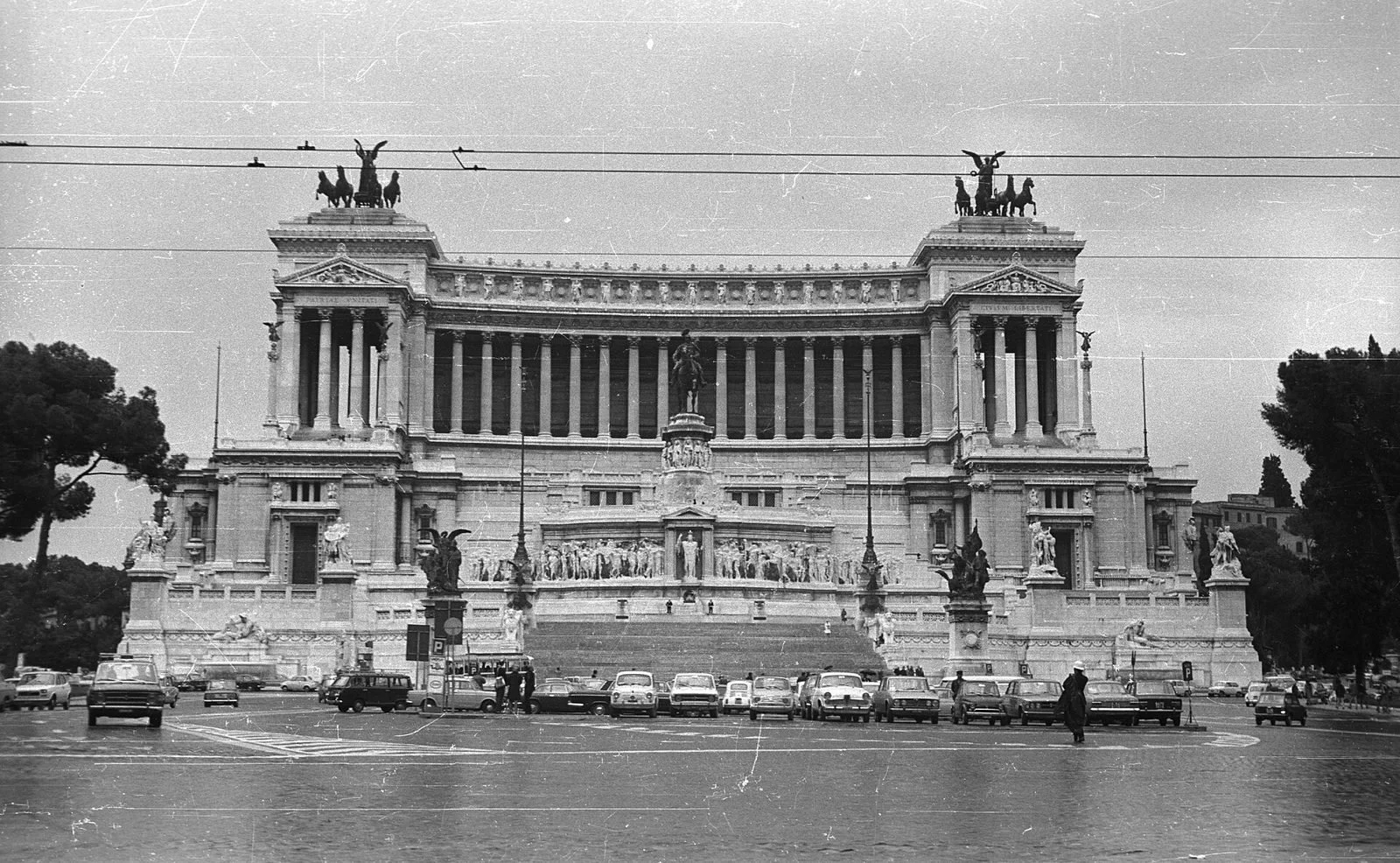
Piazza Venezia is the point where five major roads of Rome meet in front of the Vittoriano: Via del Corso, Via dei Fori Imperiali, Via del Teatro di Marcello, Corso Vittorio Emanuele II and the route of Via Cesare Battisti toward Via Nazionale. It's a square that almost everyone crosses and almost no one looks at, because you come here to go somewhere else. Its four fronts, though, tell five centuries of urban history compressed into 200 meters, and under the asphalt there's a metro C construction site that in 2033 is supposed to give back a museum station. The lines that follow explain how this square was formed, what you see from each side, what is closed and what you can really visit.
Where Piazza Venezia is and how to get there
Piazza Venezia sits at the meeting point of three of Rome's rioni, Pigna, Trevi and Campitelli, at the foot of the northern slope of the Capitoline Hill. From here the ground rises on the right toward the Capitoline Hill and the Capitoline Cordonata, descends on the left toward Via del Corso and the Campo Marzio, and opens at the far end onto the vista of the Forums. It's the junction that divides the Renaissance Rome of the Campo Marzio from the archaeological Rome of the Forums and the Palatine.
On foot, from the landmarks of the center
From the Pantheon you get there in just under 10 minutes, via Largo di Torre Argentina and Via delle Botteghe Oscure or via Via del Corso. From the Trevi Fountain the shortest route goes through Via delle Muratte and takes a little over 10 minutes. From the Colosseum you walk along Via dei Fori Imperiali for about a kilometer, a good 15 minutes, with the Vittoriano at the end of the street as a visual goal. From Piazza del Popolo the straight stretch of Via del Corso measures about 1 kilometer and 600 meters: 25 minutes without stopping at the shop windows.
By public transport
Piazza Venezia has no metro stop. The closest stations are Colosseo on line B, about a kilometer along Via dei Fori Imperiali, and Cavour, also on B, slightly farther. If you're coming from Termini, you can take bus 40 Express or the 64 to the stops at Largo di Torre Argentina or Corso Vittorio Emanuele, three minutes on foot from the square. Tram 8, which connects Trastevere and the Gianicolense, has its terminus right by the square, on Via dell'Ara Coeli. The metro C construction site, however, has changed many stops and some routes: since November 8, 2025 several lines have been moved to Via delle Botteghe Oscure and others diverted or terminated elsewhere. Before setting out it's worth checking the updated route on Atac's website or app, because in this phase the changes are frequent and not always posted at the stops.
By car, by taxi and the ZTL
Getting to Piazza Venezia by private car is the worst choice. The square lies inside the ZTL Centro Storico and traffic is squeezed by the construction site: since November 16, 2025 traffic under Palazzo Venezia is one-way on four lanes, a layout planned until 2031. There is no useful surface parking within a few hundred meters. From outside Rome it's best to leave the car in a park-and-ride on metro B and get off at Colosseo, walking the last kilometer along the Forums. For the access rules and the hours of the restricted periods we refer you to our page on ZTL and cars in Rome, and for transport alternatives to the page how to get around Rome. The square is flat and the sidewalks are wide, but the crossings are long and the temporary walkways around the construction site change often. Anyone with mobility difficulties will find general information on the page Accessible Rome.
How the square is laid out: the four fronts, one at a time
Piazza Venezia has a roughly rectangular plan, elongated in the north-south direction, and each of its sides belongs to a different era. That's why the square is hard to photograph in full and even harder to describe: whoever looks at it from one corner sees one thing, whoever crosses it diagonally sees another. It's best to take it apart side by side.
The backdrop: the Vittoriano
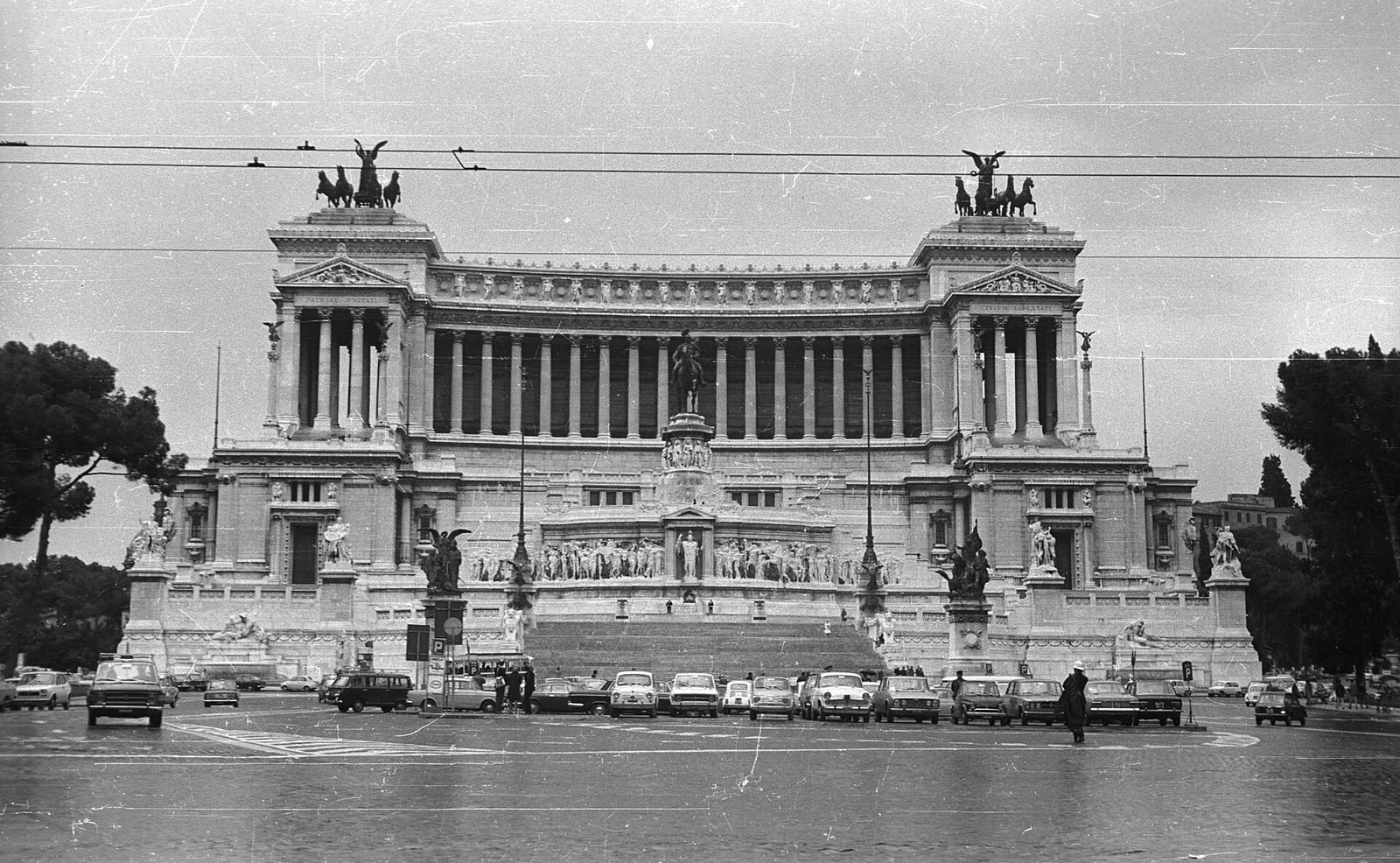
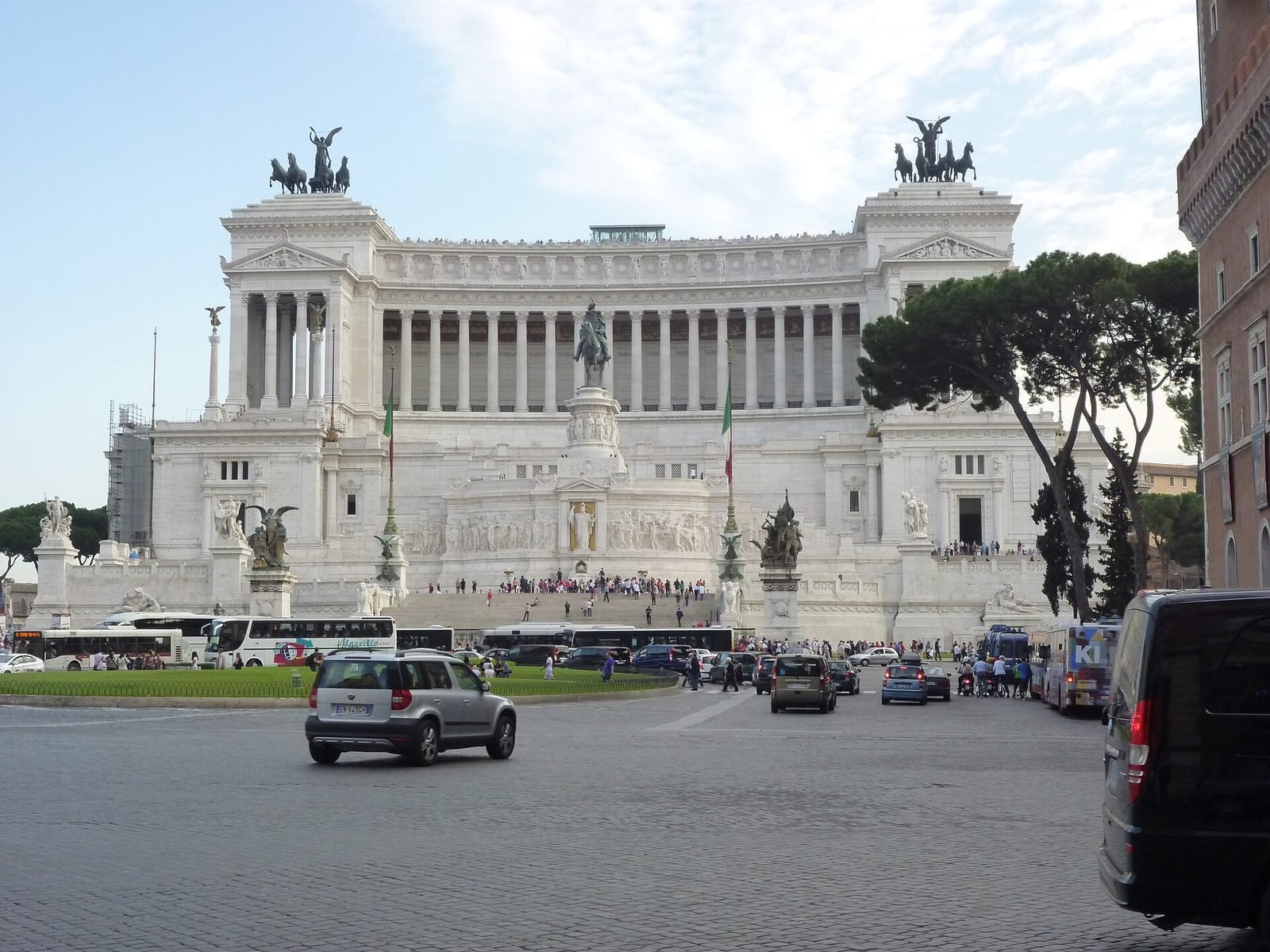
The south side is entirely occupied by the Vittoriano, about 135 meters wide and 70 high, which become 81 counting the quadrigas on the propylaea. Rather than closing off the square, it replaces it. The central staircase, 41 meters wide, climbs to the Altare della Patria and from there to the colonnaded portico. The stone is botticino marble from Brescia: the center of Rome is ocher, yellow and brick, the Vittoriano is white.
The west side: Palazzo Venezia
The western front is that of Palazzo Venezia, the 15th-century mass of brick and travertine with the crenellated turret at the corner. The main facade, the one on Piazza Venezia, measures about 77 meters in length by around 30 in height. It's the oldest building on the square among those still standing and the one that gave it its name.
The east side: the Palazzo delle Assicurazioni Generali
Facing Palazzo Venezia stands a building that looks like its twin and is four centuries younger: the Palazzo delle Assicurazioni Generali, from 1906-1911. Porticoes, mullioned windows, cornices and even a square tower are copied from the building across the way, to obtain a symmetry that had never existed in the historic square.
The north side: Palazzo Bonaparte and the start of the Corso
The northern front is the lowest and the most ordinary, and for that reason goes unnoticed: it's the 17th-century Palazzo Bonaparte, at the corner with Via del Corso, recognizable by the small glassed-in corner balcony, green, jutting out over the sidewalk. Next to it opens the start of Via del Corso, the straight road that leads to Piazza del Popolo.
The center: the flower bed and the tree
In the middle of the square, between the lanes, an elliptical flower bed is arranged in the tricolor with plants and flowers. In December it hosts the city's Christmas tree, which was moved to Piazza del Colosseo between 2006 and 2012 for the first metro C construction sites. The full picture is on the page about Christmas in Rome.
Palazzo Venezia: the cardinal, the embassies, the balcony
Palazzo Venezia was built starting in the mid-1400s for the Venetian cardinal Pietro Barbo, titular of the nearby Basilica of San Marco, who in 1464 would become pope with the name of Paul II. The main work falls between 1455 and 1467, with later additions. It's the first great civil palace of the Roman Renaissance, and it's also a hybrid building, because it joins the defensive logic of a castle, with the crenellated tower and the small windows low down, to the new language of porticoed courtyards and cross-mullioned windows. The corner tower, called the Torre della Biscia, dates from 1470. The palace has a history of use that few Roman buildings can match: papal residence, then embassy of the Republic of Venice from 1564, then Austrian embassy after the Treaty of Campo Formio of 1797 and until 1916, when the Italian state confiscated it in the middle of the war.
The palace that changed three flags
With the 1564 concession to the Serenissima, the square, which until then was called Piazza di San Marco, gradually took the name Piazza Venezia. The 1916 confiscation, instead, came in the thick of the First World War, when Austria-Hungary was the enemy: a military act before a cultural one.
The balcony everyone recognizes
The central balcony of the facade on Piazza Venezia is probably the best-known balcony in Italy, and for a reason that has nothing to do with architecture. From 1929 Mussolini set up his office in the Sala del Mappamondo, on the first floor, and from that balcony he delivered the speeches that marked the worst dates in 20th-century national history: on May 9, 1936 the proclamation of the empire after the aggression against Ethiopia, on June 10, 1940 Italy's entry into the Second World War. That balcony is a place of memory before it is a photographic subject, and the way Rome has worked through this part of its history is told on the page about places of memory in Rome. The square was adapted to that function: in the 1930s it was renamed Foro d'Italia, traffic was blocked and the space filled with rallies convened at fixed times.
What you can visit today, and where this page ends
Palazzo Venezia is today part of the VIVE institute, which brings the palace and the Vittoriano under a single management. The single VIVE ticket costs 18 euros full price, 5 euros reduced for the 18-24 age group, free under 18 and for the other categories provided by law. It allows one entry to each site and is valid for seven days from issue. Hours Monday to Sunday, 9:30 to 19:30, last entry at 18:45. The entrances are at Via del Plebiscito 118 and Piazza San Marco 49.
We stop here on purpose. We deal with the palace as a building and its architectural history on the page dedicated to Palazzo Venezia, and with the collections, the rooms and the exhibition route on the page of the National Museum of Palazzo Venezia. This page tells the story of the square, that is, the relationship between the palace and the space in front of it.
Restorations under way: check before going up
Part of the monumental rooms of Palazzo Venezia, including the Sala del Mappamondo, the Sala delle Battaglie and the Sala Regia, has been affected by a restoration site that in 2026 also included guided visits on the scaffolding led by the restorers, within the VIVE Cantiere Aperto program, by reservation and on limited dates. Before showing up at the ticket office expecting to see the Sala del Mappamondo, it's worth checking the notices on vive.cultura.gov.it: the state of the individual rooms changes from month to month.
The Palazzetto Venezia, moved bodily
This is the story that makes Piazza Venezia a textbook case of 19th-century urban planning, and almost nobody tells it to the tourists who pass through. The Palazzetto Venezia, built from 1467 at the wish of Paul II as the southern wing and enclosed garden, the viridarium, of the San Marco complex, originally stood against the southeastern flank of Palazzo Venezia. It was exactly where the open space in front of the Vittoriano was to be.
Taken apart and rebuilt a few hundred meters away
The solution adopted was not demolition but anastylosis: the building was taken apart starting in 1909, cataloged piece by piece and rebuilt on the opposite side of the palace, toward Piazza San Marco and Via del Plebiscito. The work finished around 1913, and the date most often read for the transfer is 1911, the year of the Vittoriano's inauguration. The operation was directed by the architects Camillo Pistrucci, Ludwig Baumann and Jacques Oblatt.
What changed in the reassembly
The reconstruction was not an exact copy. The original trapezoidal plan was regularized into a square plan, and each side of the courtyard lost an arch compared with the original. Anyone entering the courtyard of the Palazzetto, one of the quietest places in the center 50 meters from the city's worst traffic, looks at a 15th-century building that is authentic in its materials and slightly false in its proportions. Since 2006 the Palazzetto has been part of the route of the Palazzo Venezia museum.
The Vittoriano and the neighborhood that no longer exists
The Vittoriano was inaugurated on June 4, 1911 for the 50th anniversary of Italian Unification, but its story begins 30 years earlier and ends 25 years later. The first competition, announced in 1880, drew 311 projects and was won by the Frenchman Henri-Paul Nénot, with a result that was later annulled. A second competition in 1884 drew 98 proposals and led to the final selection, from which Giuseppe Sacconi of the Marche emerged as winner. The first stone was laid on March 22, 1885. Sacconi died in 1905, six years before the inauguration, and the work was only completed in 1935.
The demolitions: 19,200 square meters of city
To make room for the monument and the square in front of it, an urban sector of about 19,200 square meters on the northern flank of the Capitoline Hill was demolished. Gone were the convent of the Aracoeli, the 16th-century tower of Paul III and a network of streets that now exist only on historical maps: Via della Pedacchia, Via di Testa Spaccata, Via della Ripresa dei Barberi, Via Macel de' Corvi, where Michelangelo had lived, as well as stretches of Via Giulio Romano, Via San Marco and Via Marforio. Nearby, the house of Giulio Romano and the workshop of Pietro da Cortona also fell.
On the eastern side fell the Palazzo Bolognetti-Torlonia, erected by the Torlonia in 1827 and considered among the richest palaces of 19th-century Rome. Francesco Podesti's frescoes were detached and moved to the Museo di Roma, and Canova's sculptural group ended up at the Galleria Nazionale d'Arte Moderna. In its place rose the Palazzo delle Assicurazioni Generali. Anyone looking at the square today sees a unified scene and believes it has always been that way. It was instead a maze of alleys, row houses and convents, enclosed and uphill, in which the Basilica of San Marco and Palazzo Venezia were the only prominent features.
The equestrian statue and the lunch inside the horse
The equestrian statue of Victor Emmanuel II was modeled by Enrico Chiaradia and completed, after his death in 1901, by Emilio Gallori. It was cast in bronze obtained from cannons of the Royal Army and put in place between 1907 and 1910. Before it was closed, a group of people ate a meal inside the horse's belly. The chronicles speak of about 20 diners, and the photograph has been circulating for more than a century. It's the detail that gives the scale of the object.
The Unknown Soldier
On November 4, 1921 the remains of the Unknown Soldier were interred under the statue of the goddess Roma, at the Altare della Patria, at the end of a train journey from Aquileia that turned into a collective pilgrimage. About a million people took part in the Roman ceremony. Since then the tomb has been guarded by an honor guard, with the changing of the guard every hour, and by two eternal flames. It's the only point of the square where the behavior of visitors changes on its own: voices drop without anyone asking.
Going up to the top
Access to the Vittoriano and its garden is free, every day from 9:30 to 19:30 with last entry at 18:45. On some dates between June and September 2026 the opening was extended until 23:30. The climb to the Terrazza delle Quadrighe is by panoramic elevators and requires a separate admission ticket. The fare changes over time and should be checked on the official website, because secondary sources report figures that differ from one another. We talk about the interior museums, the Museo Centrale del Risorgimento and the exhibition spaces on the pages dedicated to the Altar of the Fatherland, to the Brasini Wing of the Vittoriano complex and to the Central Museum of the Risorgimento. Here we're only interested in what you see from above, and we say that further on.
The Insula of the Ara Coeli, re-emerged from the demolitions
On the left flank of the Vittoriano, between the monument and the Aracoeli staircase, a brick building emerges from street level that looks like any ruin and is instead one of the very few Roman apartment blocks for ordinary people to survive above ground: the Insula of the Ara Coeli, datable to the 2nd century AD. It wasn't discovered by an archaeological dig but freed by the demolitions carried out between 1929 and 1933 to isolate the Capitoline Hill.
What life was like inside
Four floors of the building remain. Scholars believe it originally had at least five, perhaps more. On the ground floor ran a row of shops, the tabernae, with an estimated area of around 400 square meters. Above the shops there was a mezzanine, on the third level larger apartments, on the fourth a corridor onto which opened three-room dwellings, with a plan comparable to that of certain Roman apartments today. Estimates speak of about 380 people housed at the same time. The higher you went, the less you paid and the worse you lived, the opposite of the modern penthouse, because water only reached the street and the stairs were made of wood.
You can't visit it today
This must be said clearly, because many guides in circulation say the opposite: since May 1, 2024 the Insula of the Ara Coeli has been temporarily closed to the public for the start of the work planned under the PNRR, as the Sovrintendenza Capitolina notes on its page for the monument. It can't be booked, it isn't included in any ticket and you can't enter even on days of special opening. From the outside you can still see a lot: the arches of the shops, the holes of the floor beams and, leaning against the flank, the wall of the medieval church that was built on top of it. To find out if it has reopened, the number to call is 060608, answered from 9:00 to 19:00.
The Basilica of San Marco, hidden inside the palace
The Basilica of San Marco Evangelista al Campidoglio is the oldest construction on the square and also the hardest to spot, because its facade looks onto Piazza San Marco, the small side widening right by Palazzo Venezia, and anyone arriving from Piazza Venezia mistakes it for part of the palace. The foundation dates to 336, under Pope Mark, whose name it bears. In 833 Pope Gregory IV rebuilt it, and from that phase the apse mosaic remains, where the pope appears with a square halo, a sign that at the time of the depiction he was still alive, next to St. Mark and Christ.
The blessing loggia and the Colosseum marble
The Renaissance facade with the blessing loggia was commissioned by Paul II around 1466. The traditional attribution to Leon Battista Alberti has been called into question by recent studies, which point instead to Francesco del Borgo. The material is the striking fact: the marbles of the loggia come from the Colosseum and the Theater of Marcellus, reused according to a practice that in 15th-century Rome was routine.
The ceiling and Canova
Inside, the 15th-century coffered wooden ceiling, with the coats of arms of Paul II, is one of only two 15th-century wooden ceilings preserved in Rome, along with that of Santa Maria Maggiore. In the nave is the funerary monument to Leonardo Pesaro, from 1796, a work by Antonio Canova: a young Canova, in a church nobody visits, 100 meters from the most photographed monument on the square. Anyone following the Canova thread in Rome will find the other stops on the pages about the Casa di Canova and the Atelier Canova Tadolini.
The basilica's opening hours follow parish ones and change with the seasons and with celebrations. We don't give them because we weren't able to confirm them with an up-to-date official source. The practical rule that works almost always in the churches of the center is to try in the late morning or late afternoon, avoiding the middle of the day.
Palazzo Bonaparte and the little balcony of Letizia Ramolino
Palazzo Bonaparte, at the corner of Piazza Venezia and Via del Corso, was built between 1657 and 1677 to a design by Giovanni Antonio De Rossi for the marquises D'Aste, and stayed in the family until 1760, then passing to the Rinuccini. In 1818 it was bought by Maria Letizia Ramolino, Napoleon's mother, for 27,000 gold piastres. She lived there until her death in 1836.
The window from which she watched the square
The detail that makes this palace recognizable is the covered corner balcony, glassed in and painted green, jutting out at first-floor height on the corner toward the Corso. It wasn't part of the original design: it appears to have been added after 1675, because it doesn't appear in the engraving that Giovanni Battista Falda devoted to the building in those years. Tradition has it that Letizia Ramolino, a widow and by then almost blind, spent her days there watching the carriages pass in the square below. It's a story to be taken for what it is, a consolidated tradition more than a fact documented in its details, but the use of the covered balcony, sheltered from wind and from stares, makes it plausible.
From residence to exhibition venue
After the Bonapartes the palace passed to the Misciattelli marquises in 1905, then to INA Assitalia in 1972 and to Assicurazioni Generali in 2013. Since 2019, restored, it has hosted a continuous program of temporary exhibitions with an admission fee. It's one of the few chances to enter a private palace overlooking the square, and the route goes through the noble rooms. Current exhibitions and tickets are on the page Palazzo Bonaparte.
The Palazzo delle Assicurazioni Generali and the lion of Padua
The palace that closes the square on the east was built between 1906 and 1911 on a conception by Giuseppe Sacconi, the same as the Vittoriano, with the executive design by Guido Cirilli assisted by Arturo Pazzi and Alberto Manassei. The task was scenographic: to give the new space a second front that answered Palazzo Venezia, taking up its porticoes, mullioned windows, cornices and even the square tower. The result lies about its own date of birth with remarkable ease, and holds up well enough against the comparison to fool most passersby.
The relief that went through two wars
Above the main entrance is set a lion of St. Mark in relief, from the 1500s, which wasn't carved for this building: it comes from the Portello Novo tower of the walls of Padua. In 1797 French troops threw it into the city moat, from which it was later recovered. Bought by the insurance company, it was placed here as a reminder of the company's Venetian origin. In a square called Venezia because of a vanished embassy, it's the most explicit sign and the least noticed.
Madama Lucrezia, the madonnella and the street-level details
At the corner between Palazzo Venezia and the Basilica of San Marco, leaning against the wall in Piazza San Marco, there is a colossal female bust of Roman date, about three meters high, mutilated and corroded: it's Madama Lucrezia, the only female figure among the six talking statues of Rome. The subject is uncertain: the hypotheses range from the goddess Isis to a priestess of hers to the empress Faustina. The name comes from Lucrezia d'Alagno, mistress of Alfonso V of Aragon, who moved to Rome after the king's death in 1458 and received the statue as a gift. At her feet, from the 1500s, the anonymous notices of the pasquinades were posted at night. The full route is on the page about the talking statues of Rome.
The madonnelle and other minor signs
Rome has hundreds of sacred shrines set into street corners, the madonnelle, and the area around Piazza Venezia preserves several examples among Via del Plebiscito, Via di San Marco and the alleys toward the Capitoline Hill. Some are devotional, others served as public lighting before street lamps, because the oil lamp lit in front of the image lit up the intersection.
The metro C construction site and Hadrian's Auditoria
The Venezia station of line C is the most complex construction site of the Roman metro and will be one of the museum stations of the T2 section, with exhibition spaces for the finds made during the excavation. The numbers give the measure of the problem: the station will reach about 45 meters in depth from street level, and the overall volume of archaeological excavation planned for the five stations of the section is on the order of 165,000 cubic meters.
Where the work stands
Work on the Venezia-Colosseo sub-section started in June 2023. The first macro-phase completed, on the Palazzo Venezia side, 89 diaphragm walls between station and shaft plus 33 temporary diaphragm walls. The second began on November 17, 2025 and, according to the published schedule, will continue until July 2031. On February 25, 2026 the construction site of the Mazzini-Venezia sub-section was also started. Delivery of the station is given as 2033. These are program dates, not promises: on a project of this kind, slippage is the norm.
What has come out of the excavations
The excavations of the current phase have yielded a 19th-century underground space, palace cellars, stretches of Roman road, 15th-century bronze coins with the effigy of Paul II and remains of glass and lime working. The find that changed the textbooks, though, is older: between 2007 and 2011, digging at Piazza Madonna di Loreto, a step from the Trajan's Column, a large portion of a great public building of the Hadrianic age emerged.
Hadrian's Auditoria
They are three large rectangular halls arranged along a curving street, with tiered seating on the two long sides and a central corridor from which the speaker spoke. The floors were of large slabs of gray granite framed by giallo antico marble, the wall facings of polychrome marbles, the roofs vaulted with brick ribbing and a second floor topped by a terrace. The stamps on the bricks date the construction to the years 123 and 125 AD, in the full swing of Hadrian's reign. The layout of the tiers recalls the Athenaeum that Hadrian had built in Athens, and on this basis archaeologists have proposed recognizing here the Athenaeum of Rome, the public school of rhetoric and law recalled by ancient sources. Other rooms of the same complex had already been intercepted in the early 1900s under the Palazzo delle Assicurazioni Generali.
Can you see them? No, and it's best to know before
The area falls under the jurisdiction of the Parco archeologico del Colosseo, but it isn't open for ordinary visits: it has no ticket, no hours and doesn't appear among the Park's visitable sites. The project plans for the site to be incorporated into the future Venezia station and made visible from the concourse through a glass case, with connecting tunnels toward Palazzo Venezia, the Vittoriano museum and the area of the Forums. Until then anyone who arrives hoping to go down and see Hadrian's Athenaeum stays outside the fence. For the Rome you can really visit below street level we refer you to the page on underground Rome and to the one on the Crypta Balbi, which is five minutes on foot away and shows the urban stratification from the Roman theater to the medieval convent.
The Torre delle Milizie, the Forums and the backdrop
Looking southeast, beyond the Vittoriano, the brick silhouette that pokes out above the rooftops is the Torre delle Milizie, built in the 1200s on the structures of the Trajan's Markets. It's the lay bell tower of the neighborhood, visible from half of Rome, and it leans because of a settling of the ground it rests on. A fire and a medieval earthquake made it lose its upper level.
You can't go inside
The tower can't be visited: the notice published by the Imperial Forums Museum at Trajan's Markets has said so for years and doesn't appear to have been revoked. It can be seen well from the outside, from the Giardino delle Milizie and from the terrace of the Markets, and in good light also from the top of the Vittoriano. The history of the tower and the legends about it, including the popular one that puts Nero there watching Rome burn, a tradition with no chronological basis since the tower is 1,000 years later, are in our page on the Leaning Tower of Rome.
What lines up behind the square
From the square starts the vista along Via dei Fori Imperiali, opened in the 1930s with another gutting that sacrificed the Alessandrino neighborhood. Along that axis you meet the Trajan's Forum, the Casa dei Cavalieri di Rodi above the Forum of Augustus, Santi Cosma e Damiano and finally the entrance to the Roman Forum and the Palatine. On the opposite side of the Vittoriano, instead, rise the Aracoeli staircase toward Santa Maria in Aracoeli and Michelangelo's cordonata toward the Capitoline Museums and the Palazzo dei Conservatori.
The traffic, the traffic cop's platform and the real life of the square
Piazza Venezia is famous all over the world for a not very noble reason: it's one of the most chaotic intersections in Europe, and it is so because of geometry before volume of vehicles. Five routes converge on an elliptical space and produce a continuous flow that regulates itself by proximity, with pedestrians crossing in the gaps left free.
The pizzardone on the platform
In the middle of the intersection, toward the start of Via del Corso, there is a raised circular platform from which a city traffic officer directs traffic by hand. It was installed in the late 1920s, motorized in 2006 with a mechanism that lowers it below street level at the end of the shift, and put back into operation in March 2021 after about a year's stop for maintenance. The officer on the platform isn't there every day or at all hours: it depends on shifts and traffic, so it's not an appointment on which to build a visit. When he's there, it's the most Roman thing you can see in this square. The platform entered the collective imagination with Roman Holiday in 1953 and with Il vigile in 1960, in which Alberto Sordi plays Otello Celletti. The thread between Rome and the big screen is on the page Rome in the movies.
A curiosity about Piazza Venezia
The name of the square has changed at least three times, and one of the intermediate names came from a basin. In the 1400s the open space was called Piazza di San Marco, from the basilica. Then it became Piazza della Conca di San Marco, because in 1455 Cardinal Pietro Barbo had a large basin of ancient granite placed there, the conca precisely, reused as a drinking trough and as a public fountain. Only after 1564, when Pius IV granted the palace to the Republic of Venice for its embassy, did the place name shift definitively to Piazza Venezia.
The race of the barberi ended here
Until the end of the 1800s, during Carnival, riderless horses started from Piazza del Popolo and ran along the whole Corso. The finish was right here, where men stationed with large canvas sheets stopped them. That spot was called the Ripresa dei Barberi, and it gave its name to a street that the demolitions for the Vittoriano wiped out. The race was abolished at the end of the century because of the accidents it caused: name and street disappeared together.
Something nobody tells you about Piazza Venezia
The Palazzetto Venezia you see today next to the basilica isn't where it was built. It was taken apart starting in 1909 and rebuilt on the opposite side of Palazzo Venezia, a few hundred meters away, with the work finished around 1913. It's the biggest building move in modern Roman urban history, and there is no sign in the square that tells it.
Why it's important to know
Because it changes the way the whole square is read. The present layout is just over a century old: the backdrop dates from 1911, the eastern front from 1906-1911, the palazzetto was relocated between 1909 and 1913 and the southern side was created by demolishing about 19,200 square meters of urban fabric. Of the old layout only Palazzo Venezia, the basilica and Palazzo Bonaparte remain in their original position.
The tally of losses
In the balance sheet of that operation must be put the convent of the Aracoeli, the tower of Paul III, the Palazzo Bolognetti-Torlonia of 1827, the houses of Michelangelo and Giulio Romano, the workshop of Pietro da Cortona and about 10 streets. In the opposite column, the stretch of Servian Wall preserved inside the foundations and the Insula of the Ara Coeli, which without those demolitions would still be buried under the houses. The judgment depends on which column you look at first, and ours is that the first is longer than the second.
My advice for visiting Piazza Venezia
The practical advice is only one: you don't look at Piazza Venezia while standing in Piazza Venezia. From street level, squeezed between the lanes, the Vittoriano is seen in foreshortening and the square is unreadable. The point from which you understand it is the upper terrace of the monument, or the first landing of the Cordonata Capitolina, free and two minutes' walk away.
The order we recommend
You enter the Vittoriano by the central staircase, free entrance, and climb to the level of the portico. From there, to reach the top, you take the panoramic elevators with the dedicated admission ticket. Then you go down on the left flank, walk past the Insula dell'Ara Coeli, closed but visible from the outside, and go around behind Palazzo Venezia to enter Piazza San Marco, where the basilica, Madama Lucrezia and the museum entrance are. The tour without museums takes an hour. With terrace and museum it comes to a full three hours.
The time that changes everything
The facade of Palazzo Venezia faces east and gets the good light early in the morning. The Vittoriano faces north and stays in shade almost all day, but toward sunset the botticino marble lights up yellow for about 20 minutes. The terrace is at its best in the last hour before closing, when the low light sets off the domes. In August, at noon, the staircase is an oven without a meter of shade: it's best to arrive at opening, at 9:30, or at the evening openings when they are active.
What is overrated and what is not
Let's say the uncomfortable part too. The Vittoriano seen from below is the least interesting thing in the complex, and the interior museums are uneven. The Basilica of San Marco, which nobody visits, has a 9th-century mosaic, a 15th-century ceiling among the two left in Rome and a Canova. For the same time spent, it gives much more. And for a view in a single hour, the terrace of the Capitoline Museums or the Giardino delle Milizie cost less and give a more understandable panorama, because they frame the Forums instead of towering over them.
Another well-known fact, yet rarely cited
That the Vittoriano is nicknamed the typewriter everyone knows. What is rarely cited is the technical reason for its color: botticino marble was used, quarried in the province of Brescia, in place of the travertine and Carrara marble originally planned. The choice raised controversy even at the time, because the Minister of Public Works Giuseppe Zanardelli was from Brescia, and the suspicion of regional favoritism accompanied the construction site for years.
Why it still matters
It matters because botticino doesn't age like Roman stones. Travertine oxidizes and darkens, bricks warm up in color, while botticino stays white and reflects. It's the reason the monument keeps looking new after more than a century, and why in photographs of Piazza Venezia it always comes out overexposed compared with the rest. Anyone photographing here must meter the light on the marble and not on the average of the scene, otherwise everything around comes out black.
The right photo to take of Piazza Venezia
The photograph that works at Piazza Venezia is not the frontal one of the Vittoriano, which everybody takes from the center of the square and which gives a white wall with no depth. It's best to climb the first stretch of the Cordonata Capitolina, turn around and frame the square from above with Palazzo Venezia on the left, the Palazzo delle Assicurazioni Generali on the right and the straight stretch of Via del Corso fleeing north. You understand in a single frame how the space is built, and the climb is free.
The other three framings worth taking
The second is from the Terrazza delle Quadrighe, with the domes of the center and the Forums below. The third is from the far end of Via dei Fori Imperiali toward the monument, early in the morning, when the street is almost empty and the white takes light from the east. The fourth is at street level, with a telephoto lens: the traffic cop's platform with the traffic blurred around it. Drone shooting over the historic center is not allowed.
Some important events that took place here in history
For a century Piazza Venezia was the political stage of Italy, and the list of dates that have passed through it is longer than that of any other Roman square. The main ones, in order.
The 1900s
On March 22, 1885 the first stone of the Vittoriano is laid. On June 4, 1911 the monument is inaugurated for the 50th anniversary of Unification. In 1916 the Italian state confiscates Palazzo Venezia from Austria. On November 4, 1921 the remains of the Unknown Soldier are interred, in front of about a million people. From 1929 Mussolini sets up his office in the Sala del Mappamondo: from the palace balcony he announces the proclamation of the empire on May 9, 1936 and the entry into war on June 10, 1940. In 1935 the work on the monument ends. Between 1929 and 1933 the demolitions to isolate the Capitoline Hill bring the Insula dell'Ara Coeli back to light, and in the same years the opening of Via dell'Impero wipes out the Alessandrino neighborhood.
Who has passed through Piazza Venezia
The list of people who have lived, worked or spoken in this square holds together popes, ambassadors, artists and actors, and covers five centuries.
Popes, artists and residents
Pietro Barbo, titular cardinal of San Marco and then Pope Paul II, who built the palace and reshaped the basilica. The ambassadors of the Serenissima from 1564 and the Austrian ones until 1916. Michelangelo Buonarroti, who lived on Via Macel de' Corvi, on the side later demolished. Giulio Romano, whose house was in the same area. Pietro da Cortona, who had a workshop here. Antonio Canova, present in the basilica with the 1796 monument to Leonardo Pesaro. Maria Letizia Ramolino, Napoleon's mother, who lived in Palazzo Bonaparte from 1818 to 1836. We come back to Michelangelo and his relationship with this part of the city on the page Michelangelo in Rome.
The 1900s, in public
Benito Mussolini, from 1929 to 1943. Alberto Sordi, who in 1960 made the traffic cop's platform a piece of Roman identity. And the millions of nameless people who have passed through this intersection, from those of November 4, 1921 to whoever crosses it every morning on the way to work.
Frequently asked questions about Piazza Venezia
How much does it cost to visit Piazza Venezia?
Piazza Venezia is a public space and can be crossed free of charge at any hour, as can access to the Vittoriano and its garden, which have no ticket. You only pay for the museums: the single VIVE ticket, which includes the Vittoriano and Palazzo Venezia with the temporary exhibition, costs 18 euros full price and 5 euros reduced for the 18-24 age group, and is free under 18. It's valid for seven days from issue.
What are the Vittoriano's hours at Piazza Venezia?
The Vittoriano, which closes Piazza Venezia on the south side, is open every day from 9:30 to 19:30, with last entry at 18:45. The same hours apply to Palazzo Venezia. Between June and September 2026 evening openings until 23:30 were scheduled on selected dates, with last entry at 22:45. Official ceremonies can mean temporary closures: updated notices are on the VIVE website.
How do you get to Piazza Venezia by public transport?
Piazza Venezia has no metro station: the closest are Colosseo and Cavour, both on line B, about a kilometer away. On the surface the area is served by several bus lines, including the 40 Express and the 64 from Termini with a stop at Largo di Torre Argentina, and tram 8 with its terminus on Via dell'Ara Coeli. Because of the metro C construction site many stops have been moved: it's worth checking the route on the Atac app before setting out.
Can you go up to the top of the Vittoriano and how much can you see?
Yes, you go up to the Terrazza delle Quadrighe of the Vittoriano, at the top of the monument that dominates Piazza Venezia, with panoramic elevators equipped with a dedicated admission ticket, different from the free entrance to the monument. From above you see the Imperial Forums, the Palatine, the Colosseum, the dome of St. Peter's and the rooftops of the center. The elevator fare changes over time: it should be checked on the official website before showing up.
Can you visit the Insula dell'Ara Coeli next to Piazza Venezia?
No: the Insula dell'Ara Coeli, the multi-story Roman building that emerges beside the Vittoriano, has been temporarily closed to the public since May 1, 2024 for the start of the work planned under the PNRR, as the Sovrintendenza Capitolina indicates. It can't be visited by reservation or with guided tours. From the outside the arches of the shops and the upper floors remain readable. To find out if it has reopened you can call 060608, from 9:00 to 19:00.
Can you see Hadrian's Auditoria found under the square?
Hadrian's Auditoria, discovered between 2007 and 2011 during the metro C excavations at Piazza Madonna di Loreto next to Piazza Venezia, are not open for ordinary visits and have neither a ticket nor hours. The project plans for them to be incorporated into the future Venezia station and made visible from the concourse through a glass case. Until then they can only be seen from outside the construction fence.
When does the metro C construction site at Piazza Venezia end?
The construction site of the Venezia station of metro C, open at Piazza Venezia since 2023, has a second macro-phase started on November 17, 2025 and planned until July 2031, while delivery of the station is given as 2033. The new one-way traffic layout under Palazzo Venezia will remain in force until 2031. These are program dates and on works of this scale slippage is frequent.
How much time does it take to visit Piazza Venezia and is it suitable for children?
To go around Piazza Venezia and its four fronts, including the Basilica of San Marco and Madama Lucrezia, about 60 minutes is enough. With the climb to the terrace and the Palazzo Venezia museum it comes to three hours. With children the panoramic elevators and the changing of the guard at the Unknown Soldier, which happens every hour, work well. Watch out at the crossings: traffic is heavy and strollers need the accessible routes on the side of Via del Teatro di Marcello.
Can you take photos and videos at Piazza Venezia?
At Piazza Venezia you can photograph freely outdoors, including the Vittoriano, Palazzo Venezia and the traffic cop's platform, with no authorization needed for personal use. In the museums the rules change from room to room and may ban flash and tripods, in particular in temporary exhibitions with works on loan. Drone shooting over the historic center is not allowed. For commercial use or with professional equipment you need a permit from the body that manages the site.
Who wrote this page
This page is edited by the team of Tour Leader Pro, the Roman project office that designs and coordinates visits, itineraries and cultural events in Rome and Lazio. The hours, fares and access conditions given here are verified at the date of publication against the official sources indicated in the text: before setting out it's worth rechecking them, because they change often. If you find outdated information, let us know.
Anyone organizing a whole day around this square, or who has to fit Piazza Venezia together with the Forums, the Capitoline Hill and the Corso in a tight time, will find the operational side on Tour Leader Pro: guided visits, group accompaniment, management of permits and coordination of entries to sites that require reservation. It's the work we do every day in this quadrant of the city, and it's also the reason why on these pages you find verified hours and opening statuses instead of generic descriptions.
If instead you're building a longer trip, with Rome as one stop among other Italian cities, the reference project is ItalyPlanner, where you find itineraries, travel times between regions and advice on how to distribute the days. To stay in Rome, instead, you can continue with our pages on Rome in a day, three days in Rome and free Rome, which collect the routes that pass through here.