Christmas in Rome: markets, nativity scenes, lights and Masses
In short. Christmas in Rome is not a single day. It's a period a month long, which opens on December 8 with the feast of the Immaculate Conception and closes on January 6 with the Epiphany.
Christmas in Rome is not a single day. It's a period a month long, which opens on December 8 with the feast of the Immaculate Conception and closes on January 6 with the Epiphany. Within this span the city changes rhythm twice. In the first half of December the lights go on, the displays go up in Piazza Navona and under the colonnade of St. Peter's, and the center fills with Romans buying gifts. Between December 24 and 26, instead, Rome suddenly empties out: shops close, traffic vanishes, public transport runs on a reduced schedule and almost only the churches stay open. Anyone arriving in the city these days without knowing it risks finding shutters down in front of places they took for granted. The pages that follow lay out what really happens: the Pope's homage at the column of the Immaculate Conception, the tree and nativity scene in St. Peter's Square, the historic nativity scenes of churches and museums, Piazza Navona market, the free tickets for papal celebrations, what stays open on December 25 and 26 and January 1, how transport works and what people eat. The dates mentioned are only the fixed ones of the calendar: the programs of individual editions change every year and should be checked against official sources.
The calendar: from the Immaculate Conception to the Epiphany
The Roman Christmas period has 5 fixed dates: December 8 (Immaculate Conception), December 25 (Christmas), December 26 (St. Stephen's Day), January 1 (Mary, Mother of God, the civil holiday of New Year's Day) and January 6 (Epiphany). They are all holy days of obligation and at the same time holidays with civil effects, which means closed offices, holiday transport schedules and different rules for museums and shops. Everything else, from the markets to the lights to the concerts, moves within this frame but changes from year to year.
The dates that never move
December 8 effectively opens the season: it's the day when many lights are switched on, when the tree is traditionally put up at home, and when Rome sees the papal homage at Piazza Mignanelli and the opening of the main Christmas exhibitions. December 24 is not a legal holiday, but from early afternoon the city behaves as if it were. December 25 and 26 are the two days of widest closure of the year, together with January 1. January 6 closes the cycle and coincides, for generations of Romans, with the Befana of Piazza Navona.
December 8: the Pope's homage in Piazza di Spagna
On December 8 the Pope goes to the column of the Immaculate Conception, which is not inside Piazza di Spagna but in the adjacent Piazza Mignanelli, in front of the Spanish embassy to the Holy See. The Diocese of Rome gives the afternoon, around 16:00, as the usual time of the papal homage, and traces the custom back to 1953, under Pius XII. It's one of the few occasions in the year when the Pope leaves the Vatican for a public appointment in the historic center, and the area is closed to traffic and guarded for several hours.
The monument and its history
The monument was inaugurated on December 8, 1857, 3 years after Pius IX proclaimed the dogma of the Immaculate Conception (December 8, 1854). The design is by the architect Luigi Poletti. The bronze statue of the Virgin that crowns the shaft is the work of the sculptor Giuseppe Obici. The column is ancient: a reused marble shaft, which came out of an 18th-century dig in the Campo Marzio area, and which diocesan sources put at around 12 meters in height. The monument reads well from the staircase of Trinità dei Monti and from street level on Via dei Due Macelli.
The firefighters at dawn
Before the Pope, the firefighters arrive. The Rome Provincial Command of the fire brigade climbs the monument early in the morning, around 7:00, with the aerial ladder, and lays a wreath of flowers on the statue's arm. The gesture recalls the firefighters who in 1857 physically raised the column: the Diocese of Rome speaks of 220 men employed. It's a moment well attended by Romans and much less by tourists, and you can see it well without barriers if you arrive by 6:45.
The Pope's afternoon
In the afternoon the Pope lays flowers at the foot of the monument and prays before the Virgin. Access to the barricaded area is regulated by the police and requires no ticket, but the gates fill up well in advance and the checks can be long. We recommend showing up at least 2 hours early and being ready for the fact that, if you don't get into the central sector, you'll see little of the homage. In that case it's better to move to the staircase, from which you look over the whole square.
What to see the same day
On December 8 the Tridente is already fully decorated. A few minutes on foot away are the Keats Shelley House at the foot of the staircase, the shop windows of Via dei Condotti and the walk toward Piazza del Popolo along Via del Corso. If you'd rather avoid the crush, you can go up to the Pincio and come back through Villa Borghese. December 8 is a holiday and the state museums follow holiday hours, while the Vatican Museums stay closed, because the date falls within their calendar of fixed closures.
The tree and nativity scene in St. Peter's Square
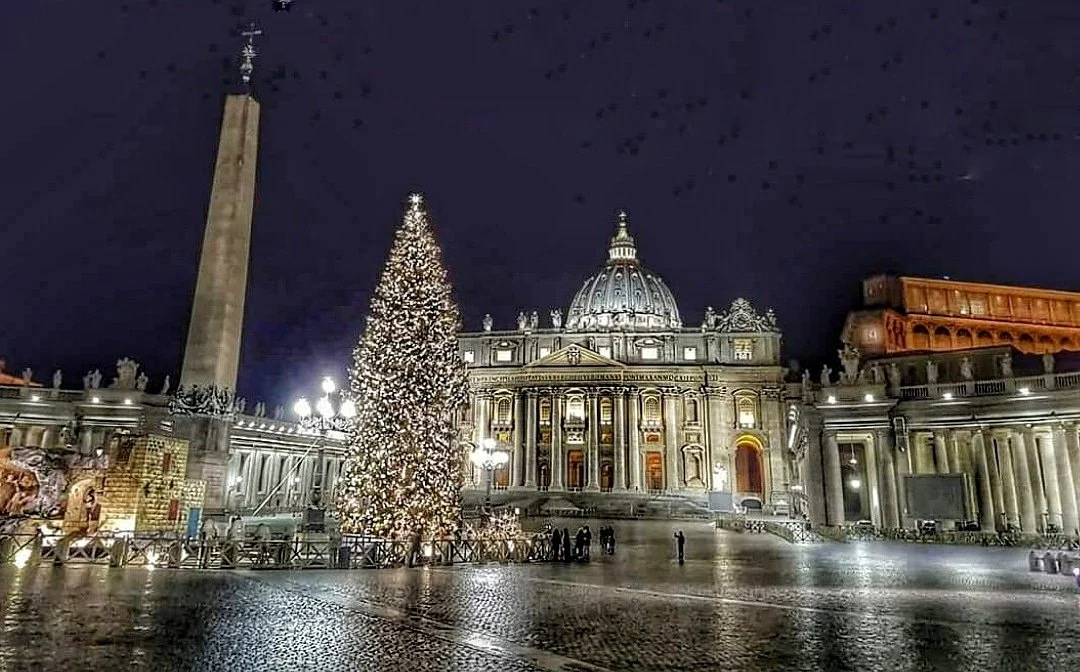
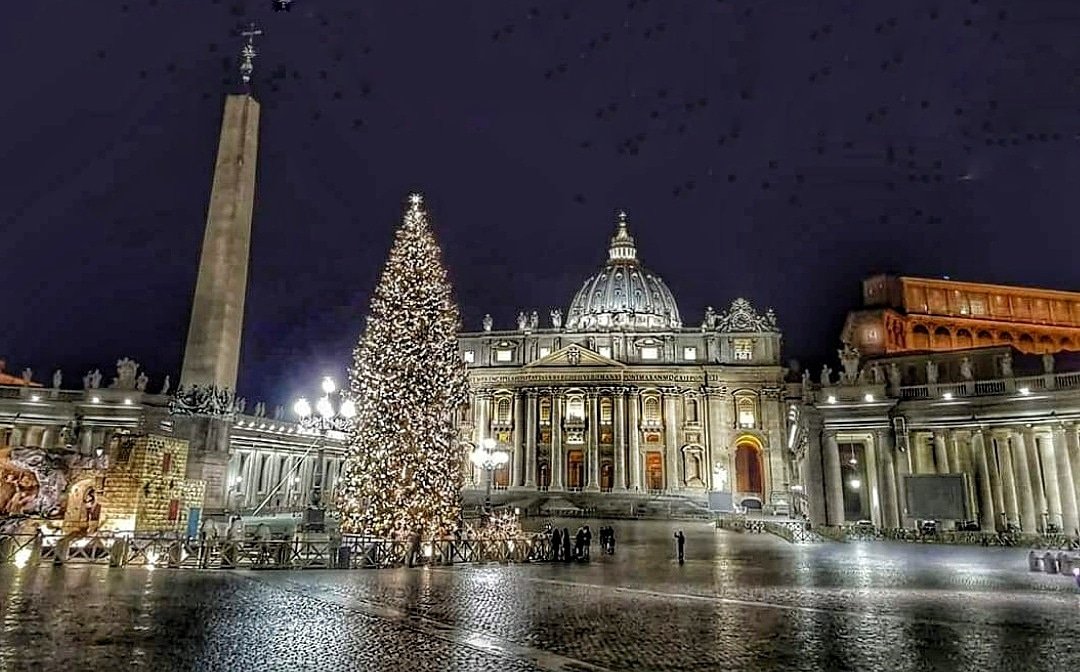
The Christmas tree and the monumental nativity scene in St. Peter's Square are a recent tradition: the historical note of the Vatican Press Office has it begin in 1982, at the express wish of John Paul II. The nativity scene is set up at the foot of the Vatican obelisk, inside the embrace of Bernini's colonnade, and the tree is placed to its right. The fir is each year the gift of a different European mountain region, and each year the design of the nativity scene also changes, entrusted to a different community, diocese or country.
When they are lit
The inauguration, with the lighting of the tree and the unveiling of the nativity scene, usually takes place in the first half of December, late in the day, in the presence of the delegations that donated the tree and the display. The exact date changes from year to year and is announced by the Press Office Bulletin a few weeks beforehand. There is no fixed day, and anyone planning the trip around that evening has to check. Likewise the date of dismantling is not fixed: the display stays up for the whole Christmas season, but the day it's removed has to be checked each time. To see the tree and the nativity scene you need no ticket and don't have to enter the basilica. You stay in the square, where however the security gates form lines in the middle hours of December weekends. The best light for photos is the sunset light.
Getting there and continuing on
The nearest metro stop is Ottaviano, on line A, from which you walk about 10 minutes. Alternatively, there's the Roma San Pietro railway station and the surface lines running along Via della Conciliazione and Piazza Pia. On the same walk you pass Santo Spirito in Sassia, Castel Sant'Angelo and the Auditorium Conciliazione, which in December often hosts Christmas concerts. If you want an overall view of Vatican City, you can instead go up the Janiculum Hill, from which the dome stands out against the profile of the rooftops.
Rome's historic and artistic nativity scenes
Rome preserves the oldest sculpted nativity scene known to art history, the marble group that Arnolfo di Cambio made in 1291 for Nicholas IV, today visible for free in Santa Maria Maggiore. Around that core the city has built over the centuries a network of very different nativity scenes: 18th-century Neapolitan figures, popular reconstructions born inside a municipal depot, international exhibitions, a small private museum in the basement of a church. Almost all are free admission or by offering, but many have tight hours and should be checked before you set out.
Arnolfo di Cambio's nativity scene at Santa Maria Maggiore
Arnolfo di Cambio's nativity scene is kept in the basilica of Santa Maria Maggiore and is visited without a ticket, along with the rest of the church. It was commissioned in 1291 by Pope Nicholas IV and sculpted in marble. Of the original group the figures of Saint Joseph, the ox, the donkey and the 3 Magi remain. The Madonna with Child that you see in the center today is an addition of the second half of the 16th century. For about 4 centuries the sculptures stood in the Oratory of the Nativity, the crypt under the basilica's Sistine Chapel. After the restoration of the early 2000s they passed to the Museum of the basilica and, since Christmas 2020, have been placed back inside the Sistine Chapel, by the altar of San Girolamo. The choice was declaredly liturgical and not museum-driven: the nativity scene has gone back to being in a place of worship. The basilica is tied to Christmas for a second reason too: under the main altar is kept the relic venerated as the Holy Crib, some wooden boards that tradition relates to the manger of Bethlehem, hence the ancient title of Santa Maria ad Praesepem. It is a devotional tradition centuries old, not an established archaeological fact.
The Bambinello of Santa Maria in Aracoeli
The Santo Bambino of Santa Maria in Aracoeli is a wooden statuette about 60 centimeters tall that Romans have called er Pupo de Roma for centuries. Popular tradition has it that it was carved at the end of the 15th century from the wood of an olive tree of Gethsemane by a Franciscan friar, and that it was painted by angels while the author slept. It is precisely a tradition, not a historical fact. The statue was solemnly crowned on May 2, 1895 by Cardinal Mariano Rampolla. The original Bambinello was stolen in February 1994 and has never been found. What you see today in the nativity chapel is a copy, and this is the first thing to know before climbing the 124 steps of the staircase.
The children's little sermons
The liveliest tradition of the Aracoeli doesn't concern the statue but the children. In the days between Christmas and Epiphany the youngest climb onto a platform in front of the nativity scene and recite poems, prayers and short sermons addressed to the Bambinello, in front of their parents and anyone in the church. Letters arrive for the statue from all over the world. The times of the little sermons are not standardized and have to be asked at the sacristy. The basilica is reached from the Aracoeli staircase or, with less effort, from the Capitoline Hill, passing by the Capitoline Museums and the Altar of the Fatherland.
The Neapolitan nativity scene of Santi Cosma e Damiano
The basilica of Santi Cosma e Damiano, facing Via dei Fori Imperiali, keeps a large 18th-century Neapolitan nativity scene with terracotta figures roughly between 30 and 40 centimeters tall, dressed in fabrics and hand painted. Unlike almost all the others, it isn't taken down after the holidays: it stays set up all year in a room attached to the basilica. Access to the nativity scene and the underground levels may be subject to a contribution and to times different from those of the church. They have to be checked with the religious community that runs it. The location is convenient for those visiting the Trajan's Markets, the Trajan's Column or the Colosseum.
The Presepe dei Netturbini
The Presepe dei Netturbini is at Via dei Cavalleggeri 5, a few minutes from the colonnade of St. Peter's, and was born in 1972 on the initiative of Giuseppe Ianni, a sanitation worker, together with some colleagues. It isn't a miniature diorama for a shop window: the layout measures about nine and a half meters in length and includes a hundred or so little tuff houses, lit up, 54 streets, three rivers, seven bridges and four aqueducts. It can be visited all year but only by reservation, through the visit booking service of the municipal waste company. A subtitled video guide and an Italian sign language version are available. Every year, in the Christmas period, the nativity scene receives a blessing rite.
The 100 Presepi exhibition
The international exhibition known in Rome as the 100 Presepi really exists and today is held in the Vatican, with the title 100 Presepi in Vaticano. Admission is free and no reservation is needed. In recent editions it gathers more than 130 works from about 20 countries, made with the most disparate materials, from Japanese paper to banana fiber to glass. The show has changed venue several times, from the exhibition spaces of Piazza del Popolo to Via della Conciliazione area and finally to the colonnade of St. Peter's Square. It usually opens on December 8 and closes around the Epiphany, with continuous hours during the day and earlier closing on December 24 and 31. The venue, dates and exact times change from edition to edition and should be read on the official announcement for the current year.
The Museo del Presepio
The Angelo Stefanucci International Typological Museum of the Nativity Scene is a private museum in the basement of the church of Santi Quirico e Giulitta, at Via Tor de’ Conti 31/A, a short distance from the Forum of Augustus. Born in the mid-1950s through the work of Angelo Stefanucci and run by the Associazione italiana amici del presepio, it gathers dozens of nativity scenes from around the world along with books, medals and themed stamps. It is open with very limited hours, which expand in December. Check the opening calendar, because outside those windows the museum is closed.
Nativity scenes in churches: how to get your bearings
Between the Immaculate Conception and the Epiphany almost all of Rome's churches set up a nativity scene, and many do it with old figures kept in the parish. There is no complete official list, and church hours don't match those of museums: many close at lunch and reopen in the late afternoon. A reasonable itinerary in the center takes in Santa Maria sopra Minerva, Sant’Ignazio di Loyola, the church of the Gesù, San Marcello al Corso, San Lorenzo in Lucina and San Luigi dei Francesi. We recommend not promising yourself times: you stop by when you're in the area, and you go in if it's open.
Piazza Navona market: what's left
The Christmas fair of Piazza Navona still exists, takes place around the Fountain of the Four Rivers and closes on January 6 with the arrival of the Befana, but it has little to do with the one Romans remember from the 1970s and 1980s. It's the point on which we're most often asked for confirmation, and the honest answer is that the festival has been sharply scaled down, has gone through years of suspensions and administrative disputes, and today is a municipal event with a number of stalls far lower than the historical one.
From Piazza Sant’Eustachio to Piazza Navona
The Befana fair is documented in Rome in the 19th century in Piazza Sant’Eustachio, a few tens of meters from the current site, and Giuseppe Gioachino Belli speaks of it in his sonnets. The move to Piazza Navona happened because of the growing success of the event, but the sources don't agree on the date: some place it in the last decades of the 19th century, others in the 20th. At the stalls they sold sweets, toys, figurines for the nativity scene, tree decorations, stockings to fill and sugar coal, which has remained the festival's most recognizable souvenir.
The numbers and the controversies
The administrative story of the fair is public and documented. The stands were historically 103. With the 2015 reform they fell to 55, of which about 48 of a commercial nature, and the assignment was suspended after a substantial part of the spots turned out to be assigned to people linked to the same family group of vendors, with an intervention by the national anti-corruption authority. In the following years there were tenders, appeals to the regional administrative court, a seizure of the stalls for violating safety rules and at least one year with no market. The most recent tenders by Roma Capitale give points to young people, women and artisans and push the offering toward crafts. If you arrive expecting an Alpine-style market you'll be disappointed: the square is beautiful, the fair is small and the quality of the goods is the subject of recurring criticism in the city press.
What you find today
In recent editions the festival opens in the first days of December and continues until January 6. For a recent edition the city administration indicated the square open from 9:00 to 1:00 on weekdays and until 2:00 on pre-holiday days and holidays. Beside the stalls there are spaces for associations and public services, workshops and readings for children run by the Biblioteche di Roma, shows and evening concerts. Times, number of spots and program change every year with the tender and should be checked on the Roma Capitale website.
It's worth remembering that Piazza Navona is in itself one of the best things to see in December, fair or no fair: Bernini's Fountain of the Four Rivers, the Borromini facade of Sant’Agnese in Agone and, below street level, the Stadium of Domitian, the structure that gave the square its elongated shape. A few minutes away are the Pantheon, Campo de’ Fiori and Sant’Andrea della Valle.
Lights, shop windows and shopping streets
The lights in the center of Rome are largely financed by private sponsors selected through a public notice from the City, and this explains why the light design changes noticeably from one year to the next: there is no historic display repeated the same way. The switch-ons are concentrated between the end of November and December 8, and the lights stay on until the Epiphany, with the main axis being the Tridente between Piazza del Popolo and Piazza Venezia.
Via del Corso and the Tridente
Via del Corso is the spine of Roman Christmas shopping and on December weekends it becomes impassable in the middle hours: you walk at a crawl between Piazza Venezia and Largo Chigi. If you want to walk it calmly, do it early in the morning or after 20:00. The side streets are often more interesting: Via Frattina, Via Borgognona, Via della Croce and Via del Babuino, all between Piazza di Spagna and the Corso.
Via dei Condotti and luxury
Via dei Condotti is the street of the big fashion houses and every December hosts light displays financed by the brands based there. It's the point where evening photographs concentrate, with the perspective toward the staircase and Trinità dei Monti at the end. The same logic holds for the Galleria Alberto Sordi, across from Piazza Colonna, which in December always sets up a tree under the Liberty-style vault and is a good covered alternative on rainy days.
Piazza Venezia and the Campidoglio
The city's official tree is set up in Piazza Venezia, in front of the Altar of the Fatherland and beside Palazzo Venezia. It's the one Romans have learned to comment on every year on social media, after the famous controversy over the 2017 fir nicknamed Spelacchio. The square is a long-term construction site for the works of the new metro line, so pedestrian circulation in the area changes often. A short distance away are the National Museum of Palazzo Venezia and the climb to the Capitoline Hill, with the Palazzo dei Conservatori.
Real markets, not Christmas markets
If you're shopping for the Christmas Eve dinner, skip the tourist stalls and go to the neighborhood markets: the Nuovo Mercato Testaccio, the Nuovo Mercato Esquilino for spices and dried fruit, the market of Campo de’ Fiori in the historic center. For secondhand and vintage there's still Porta Portese, on Sunday morning. In the days before December 24 the food markets are packed from first thing in the morning: it's when Romans buy the fish for the vigil.
Alternatives to the center
If the Tridente is too crowded, the neighborhoods offer a more workable Christmas: Trastevere with its decorated alleys around Santa Maria in Trastevere, Rione Monti with its artisan shops, Testaccio for eating, Coppedè for a short and unusual walk. EUR in December usually hosts an ice-skating rink and light displays around the little lake.
Midnight Mass, tickets and Urbi et Orbi
Tickets for the liturgical celebrations presided over by the Pope and for the general audiences are always free. The Holy See says so explicitly, and anyone who sells them does so illegally. The request is made to the Prefecture of the Papal Household. Anyone promising guaranteed access for a fee is selling something they can't deliver.
How to request tickets
The official channel indicated today by the Holy See for lay faithful is the online portal of the Prefecture of the Papal Household, which handles the request for tickets for general audiences and for the Holy Father's liturgical celebrations. You create an account, choose the celebration and submit the request. Bishops, priests and deacons instead go through the Office for the Liturgical Celebrations of the Supreme Pontiff, with a dedicated platform. Many guides still describe the old procedure by letter or fax with pickup at the Prefecture office at the Portone di Bronzo, on the right side of the colonnade. That reference remains valid as a physical point, but the reservation today has to be submitted through the portal. For the Christmas celebrations requests open weeks in advance and the number of seats is limited. Anyone who moves in late December is unlikely to get a ticket.
What the ticket gives and doesn't give
The ticket gives the right to enter, not an assigned seat: the sectors fill in order of arrival and the checks take time. For a celebration inside the basilica it's best to show up 2 or 3 hours before the stated time. Bulky bags are not allowed, and there is no convenient baggage deposit nearby. Dress must respect the basilica's access rules: shoulders and knees covered, for men and women.
The Mass of Christmas night
The so-called Midnight Mass in St. Peter's has not been celebrated at midnight for many years, and its time has changed several times. In some recent years it was set at 19:30, in others at 22:00. So there is no fixed time to report, and any guide that gives one as stable is unreliable. It has to be read every year on the calendar of celebrations published by the Holy See. The same goes for Roman parishes, which celebrate Mass in the night between December 24 and 25 at very different times, often preceded by a vigil.
The Mass of the day and the Urbi et Orbi
On December 25 at noon the Pope gives the Urbi et Orbi blessing from the central loggia of St. Peter's basilica, preceded by a message. Unlike the night Mass, this appointment has a time that has been stable over time. To attend in the square you need no ticket, you just pass the security checks. The square fills in the hours before, and anyone who arrives right at noon stays on Via della Conciliazione, where in any case big screens are installed. The Urbi et Orbi blessing, given only on a few occasions a year, comes with the granting of the plenary indulgence under the conditions set by the Church.
Te Deum, January 1 and Epiphany
On December 31 in the late afternoon, the first vespers of the solemnity of Mary, Mother of God are celebrated in St. Peter's with the singing of the Te Deum of thanksgiving for the year past. The Pope, by custom, then goes to St. Peter's Square to visit the nativity scene. January 1 is the solemnity of Mary, Mother of God and also World Day of Peace, with a Mass presided over by the Pope in the basilica in the morning. On January 6 the solemnity of the Epiphany is celebrated, again in St. Peter's. All these times have to be checked on the official calendar. Here we give them as placement within the day, not as certain times.
The other basilicas
If you can't get into St. Peter's, there are alternatives of great liturgical and artistic weight. Rome's cathedral is St. John Lateran, with the nearby Holy Stairs. The other two papal basilicas are Santa Maria Maggiore, which on Christmas night has a direct link with the relic of the Crib, and Saint Paul Outside the Walls. Holy Cross in Jerusalem, with the relics of the Passion, is also worth a stop. None of these churches publishes a Christmas Mass schedule that is stable from year to year. Check the websites of the individual basilicas in the days before.
What's open and what's closed
On December 25 Italian state museums are closed by national rule, while December 26 and January 6 they are regularly open. On January 1, in recent years, state cultural sites have opened, often with reduced or afternoon hours. The Vatican Museums follow their own calendar and stay closed on December 8, 25 and 26 and on January 1 and 6. This is the difference that wrecks the most visits: on December 26 the Colosseum is open and the Vatican Museums are not.
State museums
The Colosseum, the Roman Forum, the Palatine, the Galleria Borghese, Ostia Antica and the other institutes of the Ministry of Culture close on December 25. On December 24 and 31 they stay open but close early in the afternoon. On January 1 the openings were confirmed in recent seasons, with shortened hours. For the Galleria Borghese, which can be visited only by reservation in time slots, the January 1 window is particularly narrow. The first Sunday of the month is still free in January too, and it falls in the first days of the year. It's one of the most crowded days of the season.
Civic museums and Roma Capodarte
The Musei in Comune system of Roma Capitale (the Capitoline Museums, the Museo dell’Ara Pacis, the Museo di Roma, the Musei di Villa Torlonia and the others) closes on December 25 and reserves for January 1 a dedicated program, Roma Capodarte, with free admission and a hundred or so initiatives spread among the museum sites, the archaeological sites and the municipi. In recent editions the main museums kept extended afternoon and evening hours that day. It's the best way to spend January 1 in Rome, and it costs nothing.
Churches, shops, restaurants
Churches are open on December 25 and 26, with hours dictated by the celebrations. During Mass times tourist visits are suspended or heavily limited, and in many basilicas access to the museum routes and the excavations is closed. Shops close on the 25th and largely on the 26th and January 1 too. In the historic center and in tourist areas some businesses stay open. Restaurants that work on December 25 almost always offer a fixed Christmas menu at a set price, with reservation required. They are few and fill up well in advance. On-duty pharmacies and emergency rooms work normally.
Transport on the odd days
The Roman public transport service changes significantly between December 24 and January 1, and the pattern has repeated with few variations in recent years. On December 24 the metro closes around 23:30 while buses and trams stop at 21:00, with a few lines extended. On December 25 the service is split into two bands, roughly from 8:30 to 13:00 and from 16:30 to 21:00. On December 26 it goes back to the normal holiday schedule. On December 31 the metro runs until 2:30 at night for New Year's and some surface lines stay in service until the same hour. On January 1 the service starts later, around 8:00, and continues on a holiday schedule. The pattern is stable, but the precise numbers need to be confirmed every year on the transport company's Christmas plan.
Getting around the city and from the airports
On December 25, with public transport in bands, taxis are few and waits are long. If you have a flight or a train in those hours, book the transfer days ahead. Trains and buses to and from the airports run on holidays too, at reduced frequencies. The options are gathered in the page on Rome's airports and connections to the center. In the center, between December 8 and the Epiphany, traffic closures for events and for weekend pedestrianization are frequent and are decided by orders issued a few days ahead.
The Christmas Eve dinner, the lunch and the Roman sweets
The Roman holiday table clearly distinguishes the vigil from Christmas Day. The evening of December 24 is traditionally meatless, with fish as the star, while on December 25 people eat rich. It's a distinction that comes from the Church's fasting discipline and that in Roman homes has survived as a food habit even where the religious motive has been lost.
The vigil and the lunch
The classic Roman vigil menu includes capitone, the large female eel, fried or stewed, salt cod fried in batter, broccoli, artichokes and clams. December 25, instead, opens with a soup in broth, tortellini or cappelletti, and continues with oven-roasted abbacchio with potatoes. In the days before December 24 the fish stalls of the neighborhood markets work at full speed and prices go up. If you want to buy well, buy on December 22 or 23, early in the morning. Christmas lunch remains the meal of the home. The restaurants that offer it are a minority and anyone who wants to eat out has to book weeks ahead.
The traditional sweets
The Roman Christmas sweet par excellence is the pangiallo, a compact mixture of almonds, walnuts, hazelnuts, pine nuts, raisins, candied fruit, honey and chocolate, held together by a little flour and covered with a yellow glaze based on saffron. Popular tradition links it to the Roman festivals of the winter solstice and to the cult of the Sun. It's a suggestive and widespread story, but not an established historical fact, and it should be taken for what it is. Alongside the pangiallo you find the panpepato, of Umbrian origin but by now at home in Rome, spicier thanks to cinnamon, black pepper, cloves and nutmeg. The mostaccioli, hard cookies descended from the ancient mustaceum made with must. And the nociate and nocchiate, little nougats of walnuts or hazelnuts with honey. Torrone and panettone complete the table, but they're not Roman in origin. They all keep well for weeks, which makes them a practical gift to take away.
January 6: the Epiphany and the Befana
The Epiphany closes the Christmas period and in Rome it's a double festival, religious and popular. In the morning solemn Masses are celebrated in the basilicas, in the afternoon the Befana arrives in Piazza Navona, where in recent editions the City has set the arrival at 14:00. The figure of the Befana, an old woman who brings sweets to good children and coal to bad ones, is an Italian popular tradition grafted onto the Christian feast of the Magi, not a character of the Gospel account.
The blessing from the Aracoeli
At Santa Maria in Aracoeli, on January 6, after the solemn Mass the Bambinello is carried in procession and the city receives the blessing from the top of the staircase, which looks toward Piazza d’Aracoeli and the Campidoglio. It's one of the oldest city rites still practiced and one of the least advertised. The times are not standardized and have to be asked directly at the basilica.
With children
January 6 is the day best suited to children of the whole period: the square, the sweets, the sugar coal, the shows. As an alternative, or in addition, the Bioparco inside Villa Borghese, the Luneur Park amusement park and, for those who want open space without a ticket, Villa Doria Pamphilj work well. The Presepe dei Netturbini, with its scale of detail, is an attraction that children look at much longer than a museum.
Outside Rome, in Lazio
If you have an extra day and want to trace the tradition to its origin, you can go to Greccio, in the Rieti area, where in 1223 Francis of Assisi staged the representation of the Nativity that is at the origin of the nativity scene as we know it. The sanctuary can be visited and in the Christmas period hosts reenactments. In the same area are Rieti and the Abbey of Farfa. Closer to Rome, Subiaco, Tivoli and Frascati organize living nativity scenes and markets that change every year.
Three half days, already organized
The Christmas period has short days, unpredictable closures and slow transfers. It's better to think in themed half days instead of lists of monuments. The three routes that follow are on foot and compatible with winter hours.
Vatican morning
Start from the Ottaviano metro, St. Peter's Square with the tree and the nativity scene, the nativity exhibition under the colonnade, the basilica if the line allows, then on foot to Via dei Cavalleggeri for the Presepe dei Netturbini if you've booked, and back toward the Tiber passing by Castel Sant'Angelo. The Vatican Museums and the Vatican Gardens require a morning of their own and a reservation.
Nativity scene afternoon
You begin at Santa Maria Maggiore with Arnolfo di Cambio's group and the relic of the Crib, go down through Rione Monti, stop at the Museo del Presepio on Via Tor de’ Conti if it's open, continue toward Santi Cosma e Damiano for the Neapolitan nativity scene and finish by climbing to Santa Maria in Aracoeli. It's about three kilometers, almost all downhill, with a view of the illuminated Trajan's Markets.
Lights evening
From sunset: Piazza del Popolo and Santa Maria del Popolo, Via del Babuino to Piazza di Spagna, Via dei Condotti, the Trevi Fountain, Piazza Colonna and the Galleria Alberto Sordi, then Via del Corso to Piazza Venezia. With a detour you add the Pantheon and Piazza Navona. Do it after 19:00, when the Corso has emptied, never between 16:00 and 19:00 on a Saturday.
If it rains
December in Rome is on average rainy. The most solid covered alternatives are the Capitoline Museums, the Museo di Roma, the Palazzo Venezia and, by reservation made well in advance, the Quirinal Palace. The churches of the center, open and free, remain the best fallback. Sant’Ignazio, the church of the Gesù, Santa Maria sopra Minerva and Santa Maria in Cosmedin are all a few minutes from one another.
Frequently asked questions about Christmas in Rome
When do the Christmas holidays start and end in Rome?
The Christmas period in Rome runs from December 8, the solemnity of the Immaculate Conception, to January 6, the day of the Epiphany. On December 8 the main lights are switched on and the Pope pays homage to the column of the Immaculate Conception in Piazza Mignanelli. On January 6 the Befana arrives in Piazza Navona and at the Aracoeli the city is blessed. The intermediate dates of markets, exhibitions and concerts change every year.
Do tickets for papal Christmas celebrations cost money?
No. Tickets for general audiences and for liturgical celebrations presided over by the Pope are always free, as the Holy See explicitly states. They are requested from the Prefecture of the Papal Household, for lay faithful through the Prefecture's own online portal. Anyone who sells them or promises guaranteed access for a fee is acting illegally. Seats are limited and for Christmas the requests must be submitted weeks in advance.
What time is Midnight Mass in St. Peter's?
The Mass of Christmas night in St. Peter's is no longer celebrated at midnight and has no fixed time. In recent years it was set at 19:30 and in others at 22:00. The exact time is published every year in the Holy See's calendar of celebrations, usually in November. You need a free ticket from the Prefecture of the Papal Household and it's best to show up 2 or 3 hours early for the checks.
Does the Christmas market in Piazza Navona still exist?
Piazza Navona market still exists and usually runs from the first days of December to January 6, but it is greatly scaled down compared with the past. The stands were historically 103 and since the 2015 reform have fallen to 55. The fair has gone through suspensions, appeals and a year with no setup, and recent tenders push toward crafts. Anyone expecting a Christmas market in Alpine style will be disappointed.
Where can you see Rome's oldest nativity scene?
Rome's oldest nativity scene is the marble group sculpted by Arnolfo di Cambio in 1291 for Pope Nicholas IV, kept in the basilica of Santa Maria Maggiore and visible for free all year. Since Christmas 2020 it has been inside the basilica's Sistine Chapel, by the altar of San Girolamo. Of the original group Saint Joseph, the ox, the donkey and the 3 Magi remain. The Madonna with Child dates to the late 16th century.
Is the Bambinello of the Aracoeli you see today the original?
No. The Santo Bambino of Santa Maria in Aracoeli on display today is a copy, because the original wooden statuette was stolen in February 1994 and has never been found. The original, about 60 centimeters tall, had been solemnly crowned on May 2, 1895. Popular tradition, not historically confirmed, had it carved from the wood of an olive tree of Gethsemane at the end of the 15th century.
Are Rome's museums open on December 25 and 26 and January 1?
Rome's state museums are closed on December 25, open on December 26 and January 6, and in recent seasons have also opened on January 1 with reduced hours. The Vatican Museums follow a different calendar and stay closed on December 8, 25 and 26 and on January 1 and 6. The civic museums of Roma Capitale close on December 25 and on January 1 take part in Roma Capodarte with free admission.
How do the metro and buses work in Rome on December 25?
On December 25 Rome's public transport runs in reduced bands, roughly from 8:30 to 13:00 and from 16:30 to 21:00, with a long afternoon break. On December 24 buses and trams stop at 21:00 and the metro around 23:30. On December 31 the metro runs until 2:30. The pattern repeats from year to year, but the exact times need to be confirmed on the Christmas plan published by the transport company.
What do people eat in Rome at Christmas?
In Rome the vigil of December 24 is traditionally meatless, with capitone, fried salt cod, broccoli and artichokes, while on the 25th people eat soup in broth with tortellini or cappelletti and oven-roasted abbacchio with potatoes. The typical sweets are the pangiallo, rich in dried fruit, honey and saffron glaze, the spiced panpepato, the mostaccioli and the nociate. Panettone and torrone complete the table but are not of Roman origin.
Who wrote this page
This page is put together by the editorial team of Tour Leader Pro, the Rome-based project office that designs and coordinates visits, itineraries and cultural events in Rome and Lazio. The times, fares and access conditions given here were checked against the official sources named in the text as of the publication date. Before you leave it's best to recheck them, because they change often. If you find outdated information, let us know.
If you're building a Roman itinerary for the Christmas period, crossing the celebrations in the Vatican with the historic nativity scenes, the lights of the Tridente and the special openings of the museums, you can find planning tools and operational support on Tour Leader Pro, which handles the organizational side of visits and groups in Rome and Lazio.
For a broader picture of transport, airport connections and the destinations in Lazio reachable in a day from Rome, from Greccio in the Rieti area to the Castelli Romani, Italy Planner is a good resource, especially useful for those traveling in winter who have to deal with reduced hours.