Galleria Alberto Sordi
In short. The Galleria Alberto Sordi opens onto Piazza Colonna, halfway along Via del Corso, with its other entrances at Largo Chigi 19 and on Via di Santa Maria in Via at numbers 34 and 42, in the Colonna district, 00187 Rome.
The Galleria Alberto Sordi opens onto Piazza Colonna, halfway along Via del Corso, with its other entrances at Largo Chigi 19 and on Via di Santa Maria in Via at numbers 34 and 42, in the Colonna district, 00187 Rome. You enter on foot, and it's free: it's a private commercial passage open to the public, not a museum, so there's no ticket, no reservation, and no card of any kind that gets you anything in here. Hours follow those of the shops, usually within the 9-21 window every day, with differences from one store to another and separate hours for the four restaurants. Before planning a fixed-time stop around it, it's best to check the gallery's official website, galleriaalbertosordi.com, or call the management at +39 06 69190769 (email direzione@galleriaalbertosordi.it). You can get there on Metro Line A, getting off at Barberini or Spagna and walking about 10 minutes. From the pedestrian terminal in Piazza San Silvestro, served by many surface bus lines, it's just under 200 meters. From Piazza Venezia, go up Via del Corso for about 700 meters. Cars and taxis don't reach the door: the area is inside the limited traffic zone of the Historic Center, and Via del Corso is pedestrian.
If you're putting together a walking tour of the center, the gallery fits in well with the other Tourist Attractions of the district: Piazza Colonna in front, Montecitorio behind it, and Trevi Fountain seven minutes' walk away.
What the Galleria Alberto Sordi Is Today
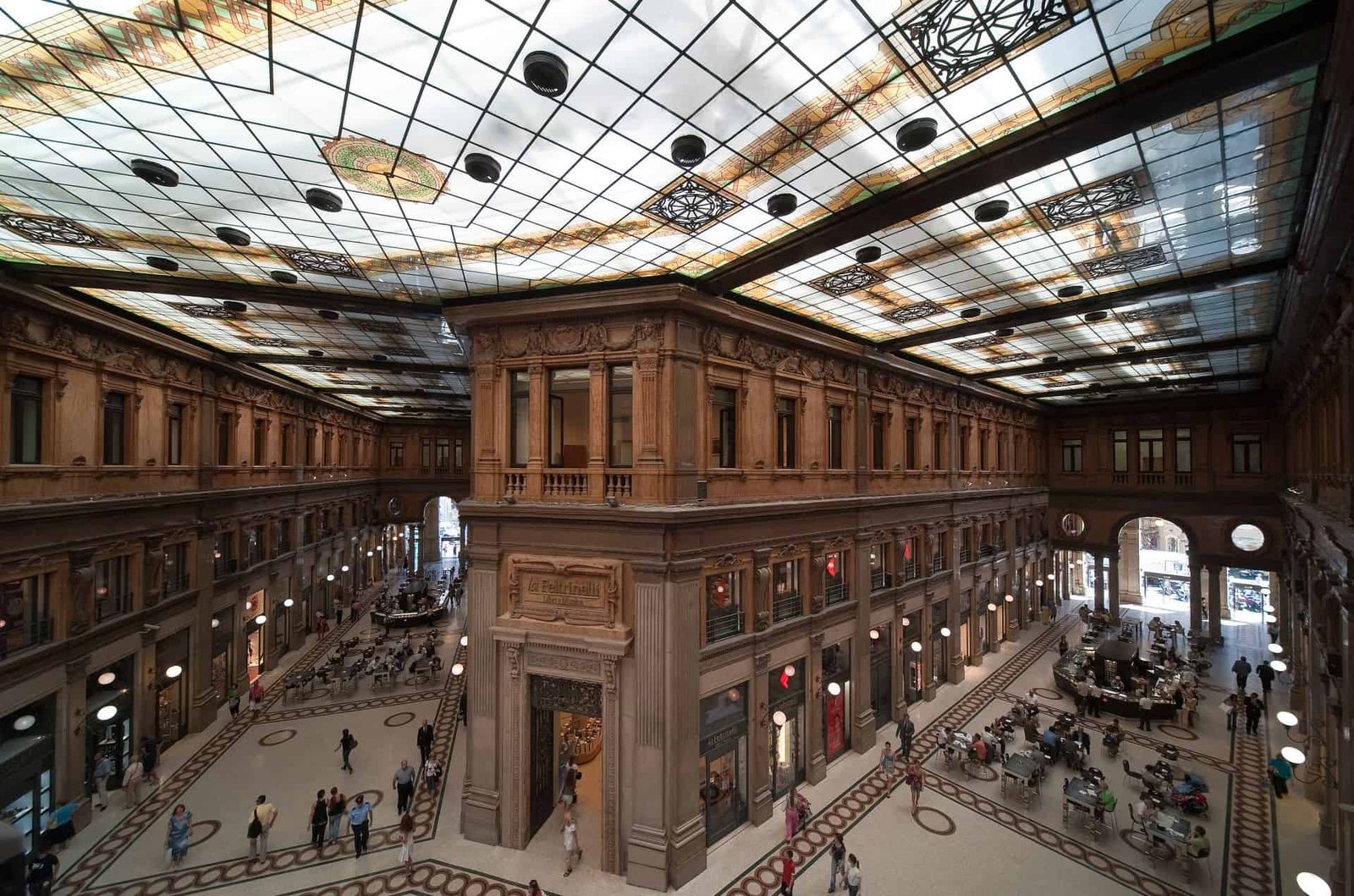
Let's clear up right away the misunderstanding that brings thousands of tourists in here every day: the Galleria Alberto Sordi is not a cultural site, it's a luxury shopping center built inside an early 20th-century building of distinction. The distinction is there, and it's remarkable: the glass roof, the skylights, the mosaic floors, the three-arm layout. But what you visit is a covered walkway of about 10,000 square meters with shops inside, and anyone who arrives expecting to find paintings, statues, or Alberto Sordi memorabilia will leave disappointed within four minutes. That said, four minutes is exactly the time it takes to cross it, and they're four minutes well spent: it's one of the very few Liberty interiors visible in Rome for free, without asking anyone's permission.
The gallery reopened to the public on January 23, 2024, after almost a year of construction, with a ceremony attended by Mayor Roberto Gualtieri and Minister Adolfo Urso. The commercial property belongs to the Fondo Megas, managed by Prelios SGR, whose sole unitholder is the Fondazione Enasarco, the pension fund of commercial agents. The redevelopment project was designed by L22 Retail, a unit of the Lombardini22 group, and approved by the Capitoline Superintendency for Cultural Heritage and the Special Superintendency for Archaeology, Fine Arts and Landscape. The work aimed for BREEAM In-Use certification and projected annual revenue at full operation above 100 million euros, about 200 direct jobs, and more than 600 indirect jobs.
The figure that tells you best what has happened here, though, is another one: the commercial units have gone from 27 to 15. That's not a technical detail, it's a snapshot of a crisis. The gallery of the 2000s, the one Romans remember with the two bar islands in the middle and the little tables under the glass, had almost twice as many shops as today, many of them small, independent, Roman businesses. The new model calls for a few very large stores, some over 2,000 square meters, and rents that in 2022 were quoted at around 1,500 euros per square meter per month. Under those conditions, anyone who isn't a multinational can't make it.
The shops in the Galleria Alberto Sordi today
The official list of shops is fairly short today, and it's worth reading in full because it changes often. In clothing and accessories there are Uniqlo, Calvin Klein, Mango and Havaianas. Uniqlo occupies the most prized spot in the gallery, 1,300 square meters on three floors in the corner facing Largo Chigi, which until 2022 was the bookshop: it's the Japanese brand's first Roman location, after its Italian debut in Milan in September 2019. The bookshop hasn't disappeared entirely, since it reopened under another brand name, Mondadori Store, while the large toy space belongs to Hamleys, the London chain founded in 1760, which has one of its very few Italian locations here.
Six storefronts across 10,000 square meters is not many, and it shows. Visitors who come in today still find windows being fitted out, surfaces temporarily covered, and stretches of the arcade where there is nothing to look at except the architecture. The commercial occupancy rate announced at the reopening was above 85 percent, but the leasing of the remaining spaces is still handled by two agencies, Dils and Savills, and that alone tells you the filling isn't finished. In our opinion the gallery works very well today as architecture and mediocrely as shopping. If you're looking for real shopping, the brands are all along the 300 meters of via del Corso just outside, with more choice and no stairs to climb.
The four food and drink outlets in the Galleria Alberto Sordi
Food and drink is the part that holds up best, and it's also the area where the project took the biggest bet. There are four outlets, each with a clear idea of its positioning. Iginio Massari Alta Pasticceria brings to Rome the name of the best-known pastry chef from Brescia, with a team that includes his children Debora and Nicola. It's the right place for a panettone to give as a gift, or for a breakfast that costs three times what the bar down the street charges and, in return, you'll remember. Antica Focacceria San Francesco is the Palermo brand of Sicilian street food, the one with the spleen sandwich and the arancine. Rossopomodoro serves Neapolitan pizza as a chain, with the predictable results of a chain. Stendhal Milano, opened in July 2024, is the real restaurant, with a Milanese approach.
A practical tip that is worth more than a review: there are no longer any tables inside the gallery. The two central bar islands that occupied the transept were removed in the renovation, precisely to clear the view under the glass vault. Anyone who expects to sit in the middle of the gallery with a coffee, looking up at the skylights, as you could do until 2022, will go without. Today you sit inside the restaurants, not inside the gallery.
What happened to the historic shops in the Galleria Alberto Sordi
This is the first question Romans ask, and it deserves a full answer. The gallery closed its doors for good on August 31, 2022, for the construction work, but the emptying had started earlier. The two bars run by the Vanni group, which were the meeting place par excellence of the building, did not renew. Lorenzo Vanni publicly said that the negotiations had stalled over rents of around €1,500 per square meter per month, and that the plan to make it a place devoted to regional Italian food and wine had found no hearing. The Feltrinelli bookstore announced its closure at the end of June 2022 and never came back. Its space, 1,300 square meters over three floors, is now a Japanese clothing store.
Anyone who knew the gallery before 2022 will therefore find a place that is deeply different: the same vaults, the same glass, the same floor, a completely different life. This is an issue that concerns the whole Historic Center of Rome and not only this building, and anyone who walks down via del Corso can see it for themselves, storefront after storefront. Our verdict on this is clear: the architectural restoration was done well, but the selection of tenants was done with the yardstick of a suburban shopping mall transplanted into a monument. The gallery comes out beautiful and a little mute.
How to get to the Galleria Alberto Sordi
The location is about as central as a place in Rome can be, and this makes the trip easy from any point in the Historic Center. The most elegant way in is from the main front, under the raised portico facing Piazza Colonna: you climb a few steps, pass under the arch, and the view of the gallery opens all at once. The most convenient way, if you're coming from Trevi Fountain or the Quirinale, is instead the rear entrance, from via di Santa Maria in Via.
The entrances to the Galleria Alberto Sordi
There are four entrances, and knowing them changes the way you read the building. The first, the monumental one, faces Piazza Colonna and via del Corso. The second opens onto Largo Chigi, where the corner is taken up by the largest store. The other two are at the back, on via di Santa Maria in Via: one comes out right in front of the church of the same name, the one with the Well and the miracle of the brick with the image of the Virgin Mary, and the other at the intersection with via dei Sabini. This layout is not accidental: the gallery was born as an urban shortcut, a covered public passage that cuts through a block that was otherwise impenetrable and connects the Corso with the network of alleys toward Trevi. It is infrastructure dressed up as commercial architecture.
How long it takes to walk from the other squares
From the Pantheon it's barely six minutes, passing through Piazza di Pietra and the Temple of Hadrian. From Piazza di Spagna it's 10 minutes downhill along the Corso. From Trevi Fountain, seven minutes, taking care to slip into Via delle Muratte rather than the crowds on Via del Tritone. From Palazzo Doria Pamphilj, four minutes. From Sant'Ignazio di Loyola, three. From the Quirinal Palace, 12 minutes downhill, much more uphill, and anyone short of breath should keep that in mind.
How much does it cost to enter the Galleria Alberto Sordi
Zero. You don't pay anything, you don't book anything, you don't need any ID, and you don't go through a ticket office because there isn't one. It's worth insisting on one point, because it's the question I get asked most often: the Galleria Alberto Sordi is privately owned commercial property, and no Rome museum card has the slightest effect here. The cards that give free or reduced admission to municipal and state museums are for museums. Here there's nothing to discount because there's nothing to pay. Anyone who offers you a ticket to visit the gallery is selling you hot air.
The only real cost is whatever you decide to leave in a shop or on a table. And here I have to give the warning that an honest guide must give: we're inside the most expensive square mile in the city, and restaurant prices reflect that. A coffee served at the table in this area can cost three or four times what you'd pay at the counter in a neighborhood bar 400 meters away. It's not a scam, it's the rent of a prime location. Knowing you're paying for it is different from paying without realizing it.
A curiosity about the Galleria Alberto Sordi
The best curiosity concerns something that was never built here. When, in the last quarter of the 19th century, the city government expropriated and demolished the palace that occupied this side of Piazza Colonna, the cleared site became the favorite playground of the urban planners of Rome as the capital city. Among the ideas that circulated for that empty lot was one that makes people smile today and shudder at the same time: making it the central railway station of the city. Not a convenient terminus, but a central station, with tracks that were supposed to reach all the way here, 200 meters from Montecitorio and a stone's throw from the Pantheon.
The idea was dropped, and anyone who has seen Termini at rush hour understands it was a good thing. But the fact that someone took it seriously says everything about the mood of those years. Rome had become the capital in 1871, the Chamber of Deputies had settled in Montecitorio, and this stretch of the city was considered the new administrative center of a country that was inventing itself from scratch. Piazza Colonna was meant to be the forum of Third Rome, with executive power at Palazzo Chigi, legislative power at Montecitorio, the press at Palazzo Wedekind and, on the fourth side, something representing modernity. In the end it fell to commerce and finance.
There's a second curiosity, smaller, that almost no one notices even though it's right under your feet. The mosaic floor you walk on repeats a small emblem: a Corinthian capital flanked by a letter G. It's the gallery's logo, that is, the commercial signature of a building, set into the floor design the way family coats of arms were set into the churches of noble families. Look at it next time: it's the exact point where 20th-century architecture stops imitating the aristocracy and starts imitating the company. It's worth taking a moment to look down, about 10 seconds.
The history of the Galleria Alberto Sordi, from 1872 to the first stone
The story begins in 1872, a year after Rome was proclaimed capital, when enlarging Piazza Colonna was proposed to suit the new needs of the neighborhood, which had changed suddenly with the arrival of the Chamber of Deputies in the nearby Palazzo di Montecitorio. To enlarge the square, something had to be torn down. That something was a large palace that closed off the side facing the Corso.
Palazzo Piombino and its demolition
The building was called Palazzo Piombino, the recent name of an older structure also known as Palazzo Spada al Corso or Palazzo Giustini Spada. Sources vary between the late 16th century, with a traditional attribution to Giacomo Della Porta, and the height of the 17th century. It had changed its name in 1819, when it was bought by the Duke of Piombino, of the Boncompagni Ludovisi family. Demolition was proposed in 1882 and the owners fought it for a long time. An agreement came only in 1888, and the bulldozers, to use a word that didn't exist back then, did the rest toward the end of that decade.
The Boncompagni didn't lose out. They rebuilt their palace elsewhere, on the land subdivided from Villa Ludovisi, and that new Palazzo Piombino Margherita is today the seat of the United States Embassy on Via Vittorio Veneto. It's worth keeping this in mind when you pass the stern facade of that building: in a sense, it is the relocated twin of the palace that no longer stands in Piazza Colonna.
70 projects and no winner
There were more than 20 years between the demolition and the construction, and they were 20 years of design chaos. For the site, about 70 designs were initially submitted, and none of them was approved. A later competition rewarded a design by the architects Penso and Minozzi, but it fell through for lack of backers. Then as now, the problem wasn't drawing, it was paying. In the meantime, the empty lot was used for temporary arrangements. In 1904, for the visit of French president Émile Loubet, a small garden was planted there with archaeological remains on full display. In 1911, for the National Exhibition marking the fiftieth anniversary of Unification, a temporary pavilion with a theater and a beer hall was set up there.
It's worth pausing on this detail, because it's delightful and nobody tells it: where Japanese clothing is sold today, 115 years ago there was a beer hall with an attached theater, put up for a fair. The recreational fate of this piece of ground is, evidently, older than the building that covers it.
Dario Carbone, the Architect-Entrepreneur
The turning point came in 1908 with Dario Carbone, an architect from Livorno who had come from the construction of Via XX Settembre in Genoa. Carbone presented a proposal that was finally credible and managed to get it through the city government led by Ernesto Nathan, the secular, reform-minded mayor who governed Rome from 1907 to 1913. His strength was presenting himself in a role that was new, at least for the Roman scene: architect, building contractor and real estate developer all in one person. He wasn't bringing a drawing, he was bringing a deal.
It was a farsighted choice, because obstacles came pouring in: criticism from the critics, economic crises, artistic controversies, political battles and, finally, a world war. Carbone got past all of them and delivered to the city a late eclectic architecture that, despite its endless gestation, has a wealth of typological layout and decorative features still largely legible today, from the floors to the skylights. In 1911 the city council approved the project, which was later subjected to variations and changes. The real construction took place between 1914 and 1922.
The Opening on October 20, 1922
The Galleria was opened on October 20, 1922. To Romans it looked like a temple of finance and commerce: shops on the ground floor, bank offices on the upper floors, everything just completed after years of work. Imposing on the Corso, it presented itself as a multifunctional building of enormous dimensions, intended for offices and commerce alike, born out of a heated debate that had been going on since the early years of Rome as capital and from a project of exceptional ambition.
The date is worth dwelling on. October 20, 1922 is eight days before the March on Rome of October 28. This gallery is therefore, literally, the last great civic architecture inaugurated in liberal Italy, and a few weeks later the country that had built it no longer existed. That's why architecture historians define it as both the last architecture of Giolittian Rome and the first of twentieth-century Rome: a hinge between two worlds, built without knowing it.
The Construction Site That Only Finished in 1940
The 1922 opening, however, didn't coincide with the end of the work. The building was fully completed only in 1940, under the direction of architect Giorgio Calza Bini. 18 years of finishing, adjustments and completions after the ribbon cutting: a record that Roman construction sites have since beaten many times, but which at the time set the standard. Anyone who walks in today therefore sees a building that took 68 years to come into being, counting from the first proposal of 1872, and that in the meantime has carried along three generations of clients, two regimes and a war.
The Architecture of the Galleria Alberto Sordi, Read on Foot
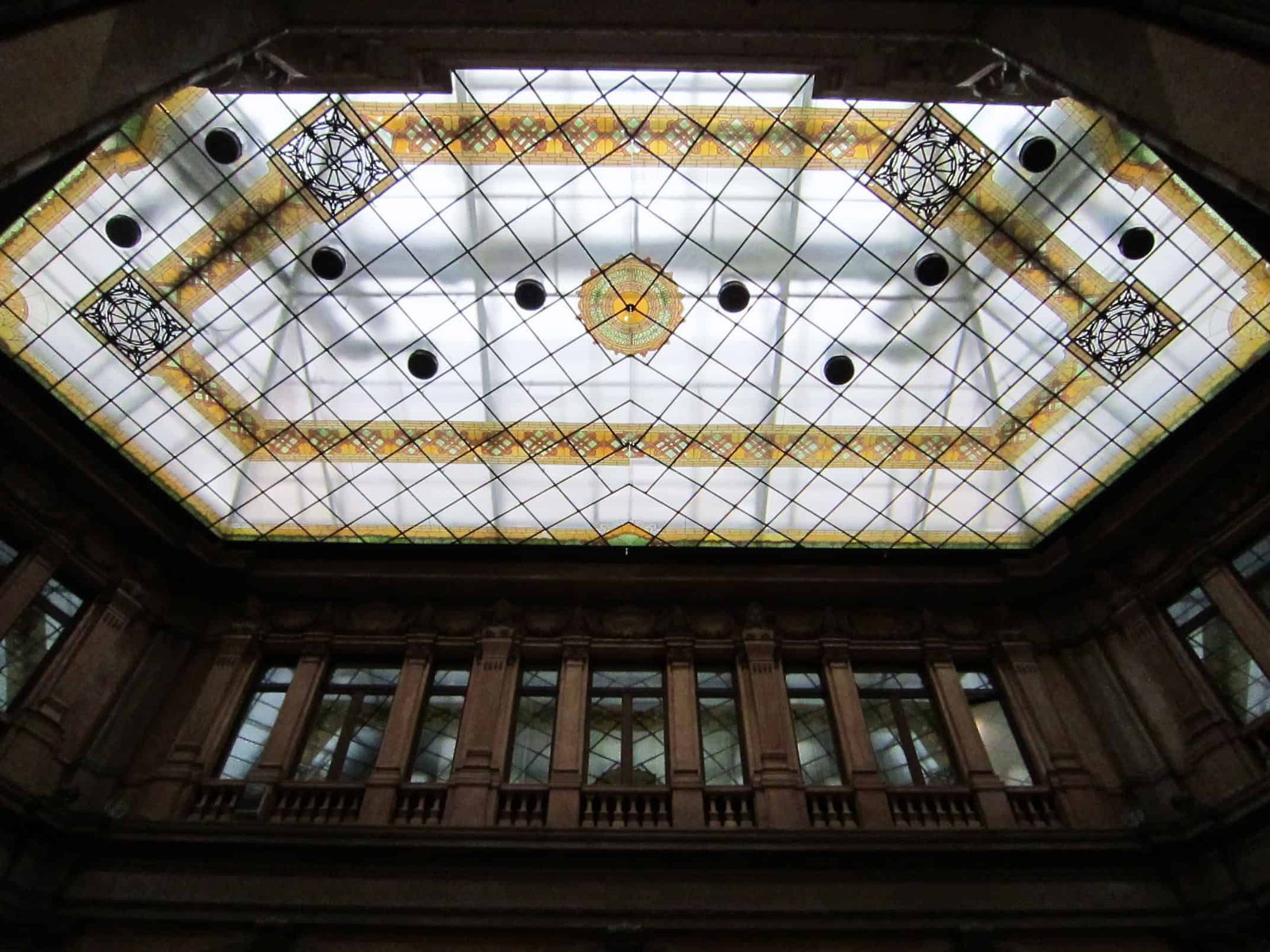
Now for the part that really matters, and that almost no guided tour covers, because everyone passes through here on the way to somewhere else. The Galleria Alberto Sordi is a serious piece of architecture, and it should be read in four moves: the plan, the roof, the glass, the floor. 10 minutes in all, if you know where to look.
The Y-Shaped Plan of the Galleria Alberto Sordi
The most unusual feature is the plan. Nearly all nineteenth-century Italian galleries have a cross plan, with four equal arms and a dome at the intersection: as in Milan, as in Naples. Here, instead, the layout is Y-shaped, a choice forced by the shape of the lot. From the raised portico of piazza Colonna, a single arm runs deep into the block. At a certain point it splits into two symmetrical arms that diverge in a V and reach the two opposite corners of the building's rear side, along via di Santa Maria in Via. The result is that there is no single viewpoint that takes it all in: you have to walk, and with every step the perspective rearranges itself.
This asymmetry is the real reason the gallery doesn't photograph well with a smartphone in automatic mode, and it photographs beautifully if you take 30 seconds. The best spot to understand the layout is the fork: stop where the arm splits, turn your back on the main entrance, and look at the two branches opening up. It is the only place in Rome where a 20th-century commercial interior offers you a double perspective like a Baroque church.
The Glass Vaults and Skylights of the Galleria Alberto Sordi
The roof is the highlight. The ceilings keep their glass panels with the original stained-glass windows, and it is one of the few examples of Art Nouveau visible in Rome, a city that took part in the Liberty period sparingly and with some embarrassment, being too busy coming to terms with antiquity. The design of the stained glass works with zenithal light: at noon the gallery is lit almost only from above, and the light falls on the floor in colored patches that shift with the hours.
The restyling added a new artificial lighting system, designed to highlight the architectural elements instead of simply lighting the merchandise. It works, especially after sunset, when the gallery becomes a tube of warm light visible from the Corso. If I had to point out the noticeable difference between the gallery of 2019 and the one today, I would say that before you saw the shops, and now you see the building.
The Mosaic Floors and Decoration
The current floor is not the one from 1922. It is a remake with mosaic-style motifs, which picks up the logic of Roman mosaic and applies it to a commercial passage, with the emblem of the capital and the G repeated as a signature. The original decorative features survive mostly up high: cornices, stucco, and iron and glass elements. The 2023 restoration focused in particular on the mosaics and stucco, and it was accompanied by the removal of the glass closing doors at the entrances that had been installed during the previous restoration, the one from 2003.
On this last point I give a blunt verdict, because it is the kind of choice on which a guide has to take a position: removing the glass doors was the best decision of the entire project. Those doors turned a public passage into a shop entrance and discouraged anyone who had no intention of buying. Without them, the gallery goes back to being what it was built to be: a covered street.
Liberty, Eclecticism or Late Eclecticism
A word on terminology, so you don't look foolish. In current publications the Galleria Alberto Sordi is called liberty, internationally Art Nouveau, and in studies of architectural history it is called late eclecticism. These are not synonyms. Late eclecticism is the grammar of the building, which quotes classical and Renaissance repertoires with freedom. Liberty is the vocabulary of certain details, especially those in iron and glass and the stained glass. Calling it generically liberty is an acceptable simplification, as long as you know there is something else underneath, and that the something else is the reason the building still holds up well next to what surrounds it.
One Thing No One Tells You About the Galleria Alberto Sordi
Here are two, and the first changes the way you look at it. The gallery you walk through doesn't belong only to a real estate fund. In the records of the Presidency of the Council of Ministers, the complex called Galleria Alberto Sordi, formerly Galleria Colonna, is listed as jointly owned by the State and the Megas Fund. This is not a courtesy formula. In 2021 the Presidency of the Council tendered and awarded, for about €190,000, the contract for the detailed design and safety coordination of the building called Galleria Colonna, at largo Chigi 19. So above the shop windows and skylights there are government offices, and the door on largo Chigi is an entrance of the Italian State. You are walking through a building that is half public and that borders, wall to wall, the seat of the Prime Minister.
The second thing concerns the name, and it produces an enormous number of mix-ups every year. Until 2003 this building was called Galleria Colonna, after the square. In Rome, however, there is another Galleria Colonna, which has nothing to do with this one: it is the private picture gallery of the Colonna princes, at via della Pilotta 17, one of the three great Roman patrician collections still housed in the palace that holds them. Searching online for Galleria Colonna regularly leads people to one while they believe they are going to the other, and you can see tourists arriving here dressed for a museum visit, with a ticket already bought for another address. If someone sets a meeting at the Galleria Colonna, ask which one: the distance is 800 meters, and the disappointment is guaranteed.
I'll add a third thing, minor but practical. The gallery is covered, sheltered, and can be crossed almost in a straight line, which makes it one of the best refuges in the Historic Center during a summer downpour or in the middle hours of July. It is useful for exactly that: five minutes of respite without spending anything, without standing in line, and without setting foot in a church, which with 45 people in tow is not always a good idea.
The advice I give you for visiting the Galleria Alberto Sordi
My advice comes down to one thing, and it's about timing. Come early in the morning, between nine and 10 30, on a weekday. At that hour the shops have just opened, the tourist flow on Via del Corso hasn't started yet, and the light comes in through the skylights at an angle that shapes the gallery instead of flattening it. Around noon the passage turns into a river, on Saturday afternoons it's a crush, and under those conditions the architecture simply disappears behind the heads.
The second tip is about method: enter from Piazza Colonna and leave from Via di Santa Maria in Via, not the other way around. The main entrance is designed as a theatrical backdrop, with the raised portico and the steps that make you move slightly upward before you go in. The rear entrances are service entrances and have no effect at all. Crossing it in the right direction costs nothing and changes how you perceive the building. Once you exit at the back, you find yourself a short walk from Via delle Muratte, that is, on the natural route to Fontana di Trevi: the route also works logistically.
The third tip is a recommendation to avoid wasting time. Don't come here expecting a memorial to Alberto Sordi. The naming is a civic tribute, not an exhibit: there is no permanent exhibition about the actor, there is no museum, and there are no stage costumes of his. Anyone looking for Sordi will find him elsewhere in the city, in the places tied to his life story and his home. Here you find his name on a plaque and the memory of an emotional bond between an actor and a part of the city. That's a lot, but you need to know it beforehand.
Alberto Sordi and the gallery that bears his name
The link between the actor and this building is not a posthumous marketing gimmick, and it is the part of the story that deserves the most care. Alberto Sordi was born in Rome on June 15, 1920, in Trastevere, in via San Cosimato. His father was an orchestra musician at the Teatro dell'Opera, and his mother was a teacher. A middle-class family with music in the house, a detail that is less decorative than it seems: his voice was the son's first working instrument. Before becoming the face of the commedia all'italiana, he worked as a voice actor for Metro Goldwyn Mayer, lending his voice to Oliver Hardy. That wheezy, lovable voice that generations of Italians have believed was authentic is his own.
The theater inside the gallery
A theater hall, the Teatro Galleria, operated inside this building, and according to the most widely held account, it was right there that Sordi took his first steps in his career. It's a piece of information that circulates in encyclopedia entries and in writing about Rome, and it should be taken for what it is: a report consistent with the actor's biography and with the building's function, not an archival document. It is quite consistent, though. In the first half of the twentieth century, the Galleria Colonna was the reference point for performers on the Roman stage: people passed through here, let themselves be seen, waited for a booking, and found out who was putting on what. In practice, it was the informal employment office of Roman show business, except that instead of counters there were café tables.
Polvere di stelle, the film that begins and ends here
Sordi's most explicit expression of affection came in 1973 with Polvere di stelle, a film he directed and starred in as Mimmo Adami, alongside Monica Vitti in the role of Dea Dani. It's the bitter story of two avanspettacolo performers caught up in World War II: the company captured by Nazi-Fascist forces during a tour in Abruzzo, the performances in Bari, the liberation of Rome, the arrival of the big companies that sweep away the small ones, and finally the sale of the stage costumes. A film that ends with two artists stripping themselves of their trade.
That film begins and ends in this gallery. Sordi chose the Galleria Colonna as the narrative setting because it was the place where that world really gathered: shooting here meant telling the viewer, without a single line of dialogue, that his characters belonged to the tribe of avanspettacolo. Anyone who watches Polvere di stelle again after passing through here will recognize the layout, and the overlap between the building filmed in 1973 and the one you walk through today is one of the most instructive exercises you can do on this piece of Rome.
The naming in December 2003
Alberto Sordi died on February 24, 2003, and his funeral was one of those events that mark a date in Rome's collective calendar. That same year the gallery, closed for some time and coming out of a restoration, became accessible again: it reopened to the public in the first days of December 2003, and on December 7 the naming ceremony took place, presided over by Mayor Walter Veltroni and attended by the actor's sister, Aurelia Sordi. From that day on, the sign reads Galleria Alberto Sordi, although for an entire generation of Romans it still says Galleria Colonna and will keep saying it for a long time.
A note on the anniversary, which the manager commemorates every year: on June 15, 2026, the gallery marked 106 years since the actor's birth. It's a minor ritual, lasting one window display and one post, but it shows the name wasn't put there just to fill a plaque.
Another well-known fact, yet rarely mentioned
The well-known fact is that the Galleria Alberto Sordi belongs to the family of major Italian commercial galleries of the nineteenth and early twentieth century: the Galleria Vittorio Emanuele II in Milan, the Galleria Umberto I in Naples, and then Genoa, Turin, Bologna. Everyone says so. What is rarely mentioned is the consequence, which is chronological and merciless: the Roman gallery arrives last, and arrives half a century late. Milan inaugurated its own in 1867, designed by Giuseppe Mengoni, with the first stone laid on March 7, 1865 and the entrance arch finished only in 1878. Naples inaugurated the Galleria Umberto I on November 19, 1890, designed by engineer Emmanuele Rocco. Rome arrives in 1922. When the ribbon is cut here, the building type of the covered commercial gallery has already been invented, perfected, exported across half of Europe, and partly overtaken by department stores.
This delay is not accidental and explains many things about Rome. The city that the other capitals were transforming with civic architecture for commerce was, until 1870, a papal capital with a different economy and a different clientele. Galleries arise where there is a middle class that buys. In Rome that middle class formed later, in a hurry and poorly, on the wave of the building fever of the 1880s and the speculation that followed. The result is that the building was born with a problem of identity: too late to be a nineteenth-century gallery, too full of quotations to be modern architecture.
The practical consequence for visitors is that this building should be viewed as a case study and not as a Roman version of the Milan Gallery. Anyone who arrives from Milan and expects the same thing on a smaller scale is left disoriented. There is no octagon here, no central dome, no urban living room with historic cafés. Instead there is an irregular layout, adapted to the impossible shape of a lot in the Historic Center, with decorative quality concentrated up high. They are two buildings that look alike only in the caption.
A second well-known and rarely mentioned fact concerns its original function. Everyone calls it a commercial gallery. Few remember that in 1922 the most profitable part of the building was the bank offices on the upper floors. Commerce on the ground floor was the lure, and finance on the upper floors was the business model. A century later, with the State as co-owner and government offices in place of the banks, the logic has remained identical: the covered public passage is the bait, and the real value is above.
The 2022-2024 Restyling, Told Properly
The recent chapter deserves to be told with the dates in order, because it explains the gallery you find today and because it is full of figures that usually stay in the press releases.
The Closure of August 31, 2022
In June 2022 the project was already public: more restaurants, fewer shops, removal of the central island bars with the tables that took up a substantial part of the transit area. The gallery closed permanently on August 31, 2022 for a construction site expected to take about a year. The two bars of the Vanni group had already left, and the Feltrinelli bookshop had announced its closure at the end of June. Anyone who passed through the Corso in autumn 2022 found the doors shut and a sign. For a year and a half, the covered shortcut between Piazza Colonna and Via di Santa Maria in Via did not exist.
From 27 to 15 Units
The project by L22 Retail, presented in September 2022, reorganized about 10,000 square meters by reducing the commercial units from 27 to 15, with the stated goal of hosting historic brands of the capital alongside national and international brands from different merchandise categories. The reduction, industry operators explained, came from the deep crisis of the previous years combined with rising rents. On the architectural side, the intervention included removing the external glass walls to restore continuity between inside and outside, redoing the storefronts, modernizing the systems, structural work, and a new lighting system. The investment was reported at 10 million euros, charged to the Megas Fund.
The Reopening of January 23, 2024
The gallery was inaugurated on Tuesday, January 23, 2024 with a ceremony closed to the public. Along with Mayor Gualtieri and Minister Urso, there were the president of the Enasarco Foundation Alfonsino Mei, the general director Antonio Buonfiglio, the president of the Prelios group Fabrizio Palenzona, the chief executive of Prelios SGR Patrick del Bigio, the chairman of the Culture Committee of the Chamber of Deputies Federico Mollicone, the president of Anica Francesco Rutelli and, representing Roman cinema, Christian De Sica. The mayor called the operation a piece of the Rome that was getting ready for the Jubilee. For the occasion, the gallery hosted until February 23, 2024 a sculpted robot reproduction of Antonio Canova's Amore and Psiche, which is exactly the kind of operation that divides opinion: spectacular, debatable, much photographed.
The Numbers of the Galleria Alberto Sordi as a Commercial Venue
The figures the property uses to persuade brands to take a space tell you better than any description why this address is worth so much. Via del Corso, right here in front, records 198,000 passersby a day, Via del Tritone 27,000, and Via Cola di Rienzo, on the other bank of the Tiber, 40,500. Within a 15-minute walk there are 669 shops and 14 points of cultural interest, and the city as a whole attracts 34 million tourists a year. Dizzying numbers, which also explain why the rent per square meter is out of reach for anyone without the backing of an international group.
The Right Photo to Take at the Galleria Alberto Sordi
The right photo is not the one everyone takes, that is, the head-on shot from Piazza Colonna entrance with the main arm in central perspective. It comes out symmetrical, it comes out orderly, and it looks identical to 10,000 others. The right photo is taken at the point of bifurcation, where the single arm splits into the two V-shaped branches. From there, frame one of the branches at an angle, holding the camera high so that the glass roof fills at least half the frame. The Y-shaped plan creates an asymmetrical vanishing line that no other Italian gallery can give you, because all the others are symmetrical.
On the technical side, there are two tips. The first: expose for the glass roof, not for the floor. The difference in brightness between the glass canopy and the walking surface is huge, and phone auto settings tend to blow out the glass to save the floor, producing a flat white sky, which is exactly the interesting part that gets lost. Tap the screen on the brightest point and let the shadows drop. The second: the best time is early morning for the colored zenith light, or alternatively half an hour after sunset, when the new artificial lighting holds up against the blue sky and the gallery becomes a lantern seen from Via del Corso.
A secondary shot that few people take but that is worth the effort: the floor, shot from above looking down, with the emblem of the capital and the letter G at the center. It's a detail nobody posts, and it tells the story of the building better than a panorama. And a practical warning: shop windows are private commercial surfaces, and in some stores the staff ask you not to photograph the interiors. Outside, under the glass canopy, there's no problem.
Some Important Events That Happened Here in History
The first event doesn't concern the building but the ground it stands on, and it concerns light. On October 30, 1866, Piazza Colonna hosted Rome's first experiment in public electric lighting. These were the last years of the Papal State, four years before Porta Pia, and the square you see as you leave the portico became the urban laboratory for a technology that would only come into permanent use in July 1912. You walk over the floor of a building designed to be lit from above, in a square that served as Rome's first guinea pig for electric light.
The second event is the demolition, which in Rome is always a political matter. Between 1882 and the end of the decade, the clash between the Comune and the Boncompagni Ludovisi family over the demolition of Palazzo Piombino played out. The Comune won, the owners got their price, and the operation set the precedent for the whole season of sventramenti that would transform the center of Rome into the capital city. Anyone looking for the exact moment when the papal city starts becoming the ministerial city will find it here, in a real estate dispute that lasted six years.
The third event is the two temporary arrangements of the void left by the demolition, which in urban history are worth more than you might think. In 1904, for the visit of French President Émile Loubet, a small garden with exposed archaeological remains was laid out on the site: an antiquity setting built to order for a state guest, an exercise in theatrical diplomacy that Rome has mastered for centuries. In 1911, for the National Exhibition of the 50th anniversary of Unity, a temporary pavilion with a theater and a beer hall was set up there. Two ephemeral events, two functions that the permanent building would inherit: representation and consumption.
The fourth event is the inauguration on October 20, 1922, with its deadly historical timing. Eight days later, on October 28, came the March on Rome. None of those who cut the ribbon, among them councillors of the Capitoline administration and bank executives, could imagine that the country would change regime before the end of the month. The building went through that transition without stopping, and its completion work continued until 1940, under an Italy different from the one that had conceived it.
The fifth event is the long decline of the late 20th century, which Romans over 50 remember best. Between the 1980s and 1990s, elegant shops and cafés closed one after another, the passage fell into disrepair and became a nighttime shelter for homeless people and those living on the margins. The gallery ended up closing for good. That the capital's commercial living room, 100 meters from the seat of government, became a place to avoid after sunset says something about Rome in those years that no book of urban history can say better.
The sixth event is the rebirth of December 2003: reopening after restoration and, on December 7, the ceremony naming it after Alberto Sordi, with Mayor Walter Veltroni and the actor's sister, Aurelia. The seventh is the second death and the second resurrection: definitive closure on August 31, 2022, almost a year and a half of construction, and reopening on January 23, 2024. Two full cycles of abandonment and return in 20 years: few Roman buildings have such an eventful history in such a short time.
Who Passed Through the Galleria Alberto Sordi
Let's start with who wanted it. Ernesto Nathan, mayor of Rome from 1907 to 1913 and the first non-Catholic mayor of the city, backed the project by Dario Carbone when the city council had to choose among dozens of options. Carbone, a native of Livorno, came from the construction site on Via XX Settembre in Genoa and presented himself in Rome as architect, builder, and property developer all at once: a figure who was new to the Roman scene of the time and who would become the norm in the decades that followed. Giorgio Calza Bini directed the final phase of the work until its completion in 1940.
Then there are those who came here for work. In the first half of the 20th century, the Galleria Colonna was the gathering place of Rome's performing artists: variety stage actors, comedians, singers, agents, people waiting for a job. Alberto Sordi, who according to biographical tradition made his debut in the theater housed inside the building, was part of that world before becoming its most famous portrait. In 1973 he returned here with a movie camera to shoot the opening and closing scenes of Polvere di stelle, with Monica Vitti by his side: two of the greatest performers in Italian cinema worked under these glass roofs.
Émile Loubet, President of the French Republic, passed through Piazza Colonna in 1904, and for his visit the area of the future gallery was turned into an improvised archaeological garden. Walter Veltroni, mayor of Rome, presided over the December 7, 2003 ceremony that gave the building the name it bears today, alongside Aurelia Sordi. On January 23, 2024, the reopening brought together Mayor Roberto Gualtieri, Minister Adolfo Urso, Anica president Francesco Rutelli, Federico Mollicone, chair of the Chamber of Deputies Culture Committee, the leaders of Fondazione Enasarco Alfonsino Mei and Antonio Buonfiglio, those of Prelios Fabrizio Palenzona and Patrick del Bigio, and Christian De Sica, who brought with him the surname of another dynasty of Roman cinema.
Finally, the anonymous passersby, who are the real protagonists of a building like this. 198,000 people a day walk along Via del Corso in front of the portico, and a substantial share of them go in, cross, and come out without knowing what it's called or why. A shopping gallery has no visitors, it has foot traffic. That's its nature, and also its limit.
Piazza Colonna: What You See When You Leave the Galleria Alberto Sordi
It would be a mistake to cross the gallery and move on without stopping for 30 seconds under the portico. Piazza Colonna is one of the densest places in Rome: each side tells a different piece of history, and the gallery is the fourth side, the modern one, the one that arrived last.
The Column of Marcus Aurelius
At the center of the square stands the monument that gives it its name: the column erected by the Senate and the Roman People in honor of Marcus Aurelius, raised after the emperor's death in 180, and in any case before 193. It measures 41.9 meters in total height, of which 29.60 is the shaft, and it's made of 20 drums of Carrara marble. The spiral relief tells of victorious wars against the Germanic peoples and the Sarmatians. Inside the shaft runs a spiral staircase of 203 steps, lit by 56 slits, leading to a platform at the top. In 1589 Pope Sixtus V had Domenico Fontana carry out the restoration and replaced the bronze statue of the emperor with one of Saint Paul: the base, due to an antiquarian error, attributed the monument to Antoninus Pius.
A reading tip for anyone with five minutes: walk around the column and look at the relief from the bottom up. The figures get larger and simpler as they climb, because ancient sculptors corrected the perspective for viewers on the ground. It's the same principle that governs apse mosaics, and seeing it work on a civic monument is a small, free lesson in art history.
Palazzo Chigi and Palazzo Wedekind
On the north side stands Palazzo Chigi, seat of the Presidency of the Council of Ministers. It was begun in 1578 to a design by Matteo Bartolini, with advice from Giacomo Della Porta and later Carlo Maderno. It passed through several owners, and in 1659 it was bought by the Chigi family, who had it enlarged by Felice Della Greca and Giovan Battista Contini. The Italian state acquired it in 1917. The courtyard has a fountain with the oak branches of the Della Rovere and the heraldic symbols of the Chigi.
On the east side stands Palazzo Wedekind, built on the site of the Temple of Marcus Aurelius and recognizable by its portico of 12 Ionic columns. 11 come from Veii and date to the Augustan age. The twelfth was assigned by Pius IX in 1847 to the church of San Francesco a Ripa. The portico was added under Gregory XVI, with work by Pietro Camporese completed in 1838. The building long housed the post office, which moved to Piazza di San Silvestro in 1876. It then passed to the banker Wedekind, who gave it his name, and since 1945 it has been home to the newspaper Il Tempo.
The Fountain of Giacomo Della Porta
Toward the Corso, the fountain in the square was commissioned by Gregory XIII from Giacomo Della Porta and is fed by the Acqua Vergine, the same aqueduct that supplies the Trevi Fountain. In the initial design it was meant to hold the Marforio, the large ancient river god statue. In the end the result was a composition with groups of dolphins and basins, with parts carved in the nineteenth century by Achille Stocchi. It is a fountain that almost no one looks at, squeezed between pedestrian traffic and the bulk of the column. Yet it is the only sixteenth-century survivor at ground level in the entire square.
What's Around the Galleria Alberto Sordi Within a 10-Minute Walk
This is perhaps the strongest point of the address, and it's worth taking advantage of it. Leaving from the back, on Via di Santa Maria in Via, you're already inside the network of streets that leads to the Trevi Fountain: seven minutes of alleys, turning onto Via delle Muratte. Along the same line, a few dozen meters away, is the Galleria Sciarra, a covered courtyard from the late nineteenth century with walls entirely frescoed. It's the other glass-roofed gallery in the rione and, for those who like the genre, it's the comparison you have to make.
Leaving from the main facade and turning left, it takes four minutes to reach Piazza di Pietra and the colonnade of the Temple of Hadrian, then the Pantheon. On the right, going up the Corso, 10 minutes lead to Piazza di Spagna. Behind the gallery, toward the west, is Palazzo Montecitorio with its Egyptian obelisk in the middle of the square. To the south, still along the Corso, in five minutes you reach Palazzo Doria Pamphilj, which is the exact opposite of this building: a private collection you visit for a fee inside a family palace. And three minutes away is Sant'Ignazio di Loyola with the fake dome by Andrea Pozzo, which is the most astonishing thing you can see for free in this part of the city.
The Galleria Alberto Sordi with Children
With children the gallery works, and it works for a specific reason: there's Hamleys, the London toy chain founded in 1760, with a large space designed for spending time. If you're facing a day in Rome with small children, knowing there's a covered, free spot with a toy store and four places to eat something within 30 meters is worth a lot, especially in August or in the rain.
A note from someone who accompanies families: entering Hamleys with a child under 10 has a predictable cost, and it isn't the entrance ticket. If the day includes other stops, plan for a longer stop than expected, and for some negotiating. Practically speaking, strollers move around without problems, the floor is smooth and continuous, and the arcades are wide enough not to create bottlenecks except during peak weekend hours.
Accessibility and Services of the Galleria Alberto Sordi
The main entrance from Piazza Colonna is under a raised portico, so there are a few steps. The rear entrances on Via di Santa Maria in Via and the one on Largo Chigi are at different levels. They are the most convenient route for people with mobility difficulties or pushing a stroller or wheelchair. Inside, once you're in, the space is level and continuous along all three wings. Individual shops have their own entrances, and some are on several floors with stairs and internal elevators. Conditions vary from shop to shop.
Regarding restrooms, the situation changed with the renovation, and it's best to check on site or with the management at the gallery's number. In the previous layout there was a block of restrooms accessible to the public, but the current arrangement of the spaces is different. There are no cloakrooms or luggage storage. It's a commercial passage, not a museum, and anyone arriving with a trolley will have to keep it with them. Wi-fi and other services depend on the individual shops.
When to Go and When to Avoid the Galleria Alberto Sordi
The best time is early on a weekday morning, and that's what makes the difference between seeing a building and pushing through a crowd. The second good time is a winter evening, when via del Corso has its lights on and the lit gallery works like a theater set.
There are three times to avoid. Saturday afternoon, when the Corso turns into a procession and the gallery becomes a funnel. Sale days, summer and winter, for the same reason multiplied. And the Christmas period during the central hours, when the shopping crowd adds to the tourist crowd. If you're in Rome at those times and still want to see the gallery, go in at opening time: it's the only window when the place breathes.
One last seasonal consideration. In the middle of August, with 40 degrees on the Corso, this covered passage becomes objectively valuable, and the property itself has made it a theme in its summer communications. It's not a cultural reason to come, it's a physical one, and in a city that tests everyone in summer, it's worth as much as a cultural reason.
The Galleria Alberto Sordi and the Galleria Sciarra: which one
The question comes up often and the answer is clear. If you have time for only one of the two glass-roofed galleries in the rione, go to the Galleria Sciarra. The reason is simple: the Sciarra is a covered courtyard that is entirely frescoed, with a painted cycle that reads from top to bottom, and it has no equivalent in Rome. The Galleria Alberto Sordi is a much larger building and more important in terms of urban planning, but its decoration is concentrated in the glass and the floors, so it impresses less at first sight. The Sciarra takes five minutes to see and stays with you for years.
That said, you can visit both in the same quarter hour, because they're a few hundred meters apart and both are free. The smart route is: enter the Galleria Alberto Sordi from piazza Colonna, exit at the back onto via delle Muratte, Galleria Sciarra, and from there Fontana di Trevi. 20 minutes in all, two glass-roofed interiors and one of the most famous fountains in the world. For time spent against things seen, you won't find much better in Italy.
Quick questions about the Galleria Alberto Sordi
How much does a ticket for the Galleria Alberto Sordi cost
It costs nothing. There is no ticket because there is no ticket office: the gallery is a private commercial passage open to the public, and you can enter freely through all four entrances.
Do the Roma Pass or other tourist cards work at the Galleria Alberto Sordi
They don't, and not because they're excluded: there is simply nothing to discount here. The cards give access to museums and archaeological sites. The Galleria Alberto Sordi is a private commercial gallery with free entry. If someone sells you an entrance, priority access or a paid visit to the gallery, you aren't buying anything real.
What are the opening hours of the Galleria Alberto Sordi
Hours depend on the businesses located there: the daily opening indicated is within the 9-21 range, with differences between shops and food and beverage venues. For certain hours, the reference is the gallery's official website or the management office at +39 06 69190769.
Where exactly is the Galleria Alberto Sordi
On piazza Colonna, halfway along via del Corso, in the Colonna rione. The other entrances are at largo Chigi 19 and on via di Santa Maria in Via at numbers 34 and 42, postal code 00187.
Why the Galleria Alberto Sordi was called Galleria Colonna
After the name of the square it opens onto, piazza Colonna, which in turn takes its name from the Column of Marcus Aurelius. The name change took place in December 2003, after the actor's death.
When was it named after Alberto Sordi
The ceremony was held on December 7, 2003, presided over by mayor Walter Veltroni and with the participation of the actor's sister, Aurelia Sordi. The reopening to the public after the restoration took place in the days just before.
Who was Alberto Sordi and what does he have to do with this gallery
Alberto Sordi, born in Rome on June 15, 1920 and died on February 24, 2003, was one of the absolute protagonists of commedia all'italiana. The link to the building runs through the theater hall that operated here, where, according to biographical tradition, he took his first steps, and through the 1973 film Polvere di stelle, which both opens and closes right here.
Is there an Alberto Sordi museum inside the Galleria Alberto Sordi
No. The naming is a civic tribute and doesn't involve any museum display: inside the gallery there are no memorabilia, stage costumes or permanent exhibitions dedicated to the actor.
How many shops are in the Galleria Alberto Sordi today
The redevelopment project reduced the commercial units from 27 to 15. The official list published by the management today includes six shopping brands and four food and beverage venues. The leasing of the spaces still available has been entrusted to two real estate agencies.
Which shops are in the Galleria Alberto Sordi
Uniqlo, Calvin Klein, Mango, Havaianas, Mondadori Store and Hamleys for shopping, Iginio Massari Alta Pasticceria, Antica Focacceria San Francesco, Rossopomodoro and Stendhal Milano for food. The list changes fairly often.
Does the Feltrinelli bookstore in Galleria Alberto Sordi still exist
No, it closed in 2022 and did not reopen after the renovation. Its space, 1,300 square meters on three floors at the corner toward Largo Chigi, is now occupied by the Japanese clothing store. A bookstore has come back to the gallery anyway, under a different sign.
When did Galleria Alberto Sordi reopen after the renovation
On January 23, 2024, after the final closure on August 31, 2022 and almost a year and a half of construction work.
Who owns Galleria Alberto Sordi
The commercial part belongs to the Megas Fund, managed by Prelios SGR, whose sole unit holder is the Enasarco Foundation. In the records of the Presidency of the Council of Ministers, however, the complex appears as held in co-ownership by the State and the fund: above the shop windows there are public offices.
How much time do you need to visit Galleria Alberto Sordi
Four minutes are enough to walk through it. To really look at it, with the floor plan, the stained-glass windows, the skylights and the floor, you need 10 or 15. If you go into a store, the calculation changes and it no longer depends on me.
Can you take photos inside Galleria Alberto Sordi
Under the glass roof yes, no problem and no permits. Inside the individual stores the owner's rule applies, and in some of them the staff ask you not to photograph the interiors. For professional shoots with equipment or a tripod you need an agreement with the management.
Is Galleria Alberto Sordi wheelchair accessible
The interior is flat and continuous along the three arms, with a smooth floor. The main entrance on Piazza Colonna is under a raised portico with steps: the easiest way in is through the entrances on Largo Chigi and Via di Santa Maria in Via. The individual stores have their own conditions, some on several levels.
Are there public restrooms in Galleria Alberto Sordi
The layout of the facilities changed with the 2023 renovation: it's best to ask on site or at the management office. There are no coat checks or luggage storage, though.
Is Galleria Alberto Sordi good for children
Yes, especially because of the large toy store and because it's a covered space, free and with no lines. Strollers and baby carriages get around without difficulty.
What is the difference between Galleria Alberto Sordi and the Galleria Colonna of Palazzo Colonna
They're two different things, about 800 meters apart. This one was the Galleria Colonna until 2003 and remains a free commercial passage on Piazza Colonna. The Galleria Colonna proper is the private picture gallery of the Colonna princes at Via della Pilotta 17, which you can visit for a fee on limited days and hours.
What is the difference between Galleria Alberto Sordi and Galleria Sciarra
The Sciarra is a covered courtyard from the late 1800s, much smaller, with walls entirely painted: it makes more of an impression at first sight. Galleria Alberto Sordi is enormously bigger and counts above all for its urban layout, its glass roof and the role it has had in the history of the city. Both are free and a few minutes' walk apart.
Is the food good in Galleria Alberto Sordi
You eat in a predictable way, which in central Rome is already an achievement. Four signs, all chains or well-known brands: high-end pastry, Sicilian street food, Neapolitan pizza and a Milanese-style restaurant. None of them is a Roman trattoria, and whoever wants Rome's cooking has to go out and walk.
Are the little tables still under the glass roof of Galleria Alberto Sordi
No. The two central bar islands with the little tables, which until 2022 were the classic meeting point of the building, were removed in the renovation to free up the interior view. Today you sit inside the venues.
How big is Galleria Alberto Sordi
The total area covered by the redevelopment is about 10 thousand square meters. Some of the larger stores exceed 2,000 square meters on their own.
What architectural style is Galleria Alberto Sordi
It's commonly called Liberty, or Art Nouveau, and in architectural history studies late Eclectic. The original stained-glass windows of the roof are among the few examples of Art Nouveau visible in Rome. The general layout is Eclectic in origin.
Who designed Galleria Alberto Sordi
Dario Carbone, an architect from Livorno, whose 1908 proposal was approved by the Capitoline council in 1911. The completion of the building, in 1940, took place under the direction of Giorgio Calza Bini. The 2022-2024 renovation is signed by L22 Retail, of the Lombardini22 group.
Is Galleria Alberto Sordi worth visiting
It's worth walking through, which is different from visiting. It costs nothing, takes 10 minutes, is on the way of anyone going down the Corso and shows an early twentieth-century glass interior that has few comparisons in Rome. Anyone who arrives expecting a museum or a temple of shopping will be disappointed in both cases.
If I have to say how I see it: this gallery is today the most beautiful corridor in Rome and one of its least successful shopping centers. Go in for the architecture, look up, look down, and then leave through the back and go spend your money at a shop that still belongs to someone who lives in this city. The building deserves it, and so does the city.
Article written by the editorial team of TourLeaderPro, contact them for Private/Corporate/V.I.P. Tours and Experiences.
Planning a trip to Rome? English-language guides to visiting the city are on ItalyPlanner.com.