Auditorium Conciliazione
In short. The Auditorium Conciliazione is at Via della Conciliazione 4, in Rome, in the Borgo district, a few dozen meters from St.
The Auditorium Conciliazione is at Via della Conciliazione 4, in Rome, in the Borgo district, a few dozen meters from St. Peter's Square. The venue's switchboard answers at 06 684391 and the email address published by the management is info@auditoriumconciliazione.it. The offices are based at Borgo Sant'Angelo 5. It's not a museum and you don't tour it: it's a concert and performance hall, so you get in with the ticket for that evening. The physical box office at Via della Conciliazione 4 appears to be closed, and tickets are bought online or at the authorized points of sale listed on the official site. On the night of the show a sales desk opens an hour before the start. By metro, line A serves the area with the Ottaviano and Lepanto stops, both a quarter of an hour's walk away. On the surface, bus lines 23, 40, 62, 64, 280 and 982 stop in the area, and the regional rail lines FL3 and FL5 reach San Pietro. If you drive, plan on paid parking: Piazza Adriana six minutes on foot, the Terminal Vaticano at Via Urbano VIII 16 five minutes, the Parking Gran Melia at Via del Gianicolo 2 eight minutes, the garage at Via Vespasiano 17C 10 minutes, Piazza Cavour nine. The program changes season by season. Dates, titles and prices are checked on the official site, auditoriumconciliazione.it, because you wouldn't find them here updated to the day you're reading.
If you're building a Roman evening around a concert, the overview of the city's halls is collected on the Rome theaters page, and it's worth comparing this hall with the city's other great music machine, the Auditorium Parco della Musica.
What the Auditorium Conciliazione really is
Let's start with a widespread misunderstanding. The Auditorium Conciliazione is not a hall owned by the City and not a hall of the Italian State: it is a hall carved out inside a building of the Holy See, on a street that was born from a treaty between two States. This explains many things, starting with the fact that for years the same space hosted both the pope's audiences and Beethoven's symphonies, and that today you find yourself inside a building that on the upper floors houses nunciatures, embassies to the Holy See and Vatican newsrooms.
The current function is that of a large-capacity multipurpose theater: symphonic and chamber concerts, popular music, dance, theater, musicals, film screenings, televised award ceremonies, conferences, corporate presentations and gala dinners. Management has been entrusted since 2004 to the company I Borghi Srl, which took over from the Administration of the Patrimony of the Apostolic See, and the reopening to the public after the works was in 2005. In its first 20 years of management the hall reports about 2,000 shows and an attendance of around 250,000 spectators a year: numbers of a big theater, not of a neighborhood hall.
The verdict, plain: the Auditorium Conciliazione is the Roman hall with the best balance of acoustics, comfort and location. It doesn't have the contemporary architectural allure of the Cavea on Viale de Coubertin, and those looking for the society event often look elsewhere. But to hear an orchestra without making two metro changes, and walking out in front of Bernini's colonnade, there isn't much better in the city.

How to get to the Auditorium Conciliazione
The Auditorium Conciliazione by metro
Line A is the right one, but no stop drops you at the door. From Ottaviano you walk down Via Ottaviano, keep in the direction of the dome and in 12 or 15 minutes you're on Via della Conciliazione: a simple route, all flat, with the advantage of crossing St. Peter's Square and arriving at the hall with your eyes already full. From Lepanto the distance is similar and you pass by Castel Sant'Angelo, which lit up in the evening repays the quarter-hour walk. If you arrive from Termini, take line A toward Battistini and get off at one of the two. If you arrive from Fiumicino you have two ways: the train to Termini and then the metro, or the regional FL1 with a change at Trastevere for the FL3 or FL5 and getting off at San Pietro station, from which you walk up in about 10 minutes.
The Auditorium Conciliazione by bus
The lines serving the area are the 23, the 40, the 62, the 64, the 280 and the 982. The 40 and the 64 are the two routes that connect Termini to the Vatican and are also the most crowded in the city: if you travel with tickets and wallets in your pockets, keep your hands on your bags, it's practical advice and not a cliché. The 23 and the 280 run along the Tiber and are the most convenient choice if you're coming from Trastevere, Testaccio or Piazza Mancini. The 62 comes from the center along Corso Vittorio. On the evenings of a big show, with 1,700 people leaving together, the stop on the Lungotevere clogs quickly: walking five more minutes toward Piazza Cavour saves 20 minutes of waiting.
Walking to the Auditorium Conciliazione
From the Pantheon it's a 25-minute walk via Ponte Sant'Angelo, and it's one of the most beautiful evening routes in Rome. From Piazza Navona it's 20 minutes. From the Janiculum Hill you come down in a quarter of an hour along Via del Gianicolo and Borgo Santo Spirito, with the dome appearing and disappearing between the buildings. From Castel Sant'Angelo it's barely five minutes, in a straight line.
Parking near the Auditorium Conciliazione
The area is a restricted-traffic zone in several spots and finding a spot on the street is an exercise in optimism. The four solutions the management itself indicates are the paid public area of Piazza Adriana six minutes away, the Terminal Vaticano at Via Urbano VIII 16 five minutes away, the Parking Gran Melia at Via del Gianicolo 2 eight minutes away and the garage at Via Vespasiano 17C 10 minutes away. Piazza Cavour, nine minutes away, is added to these. The Terminal Vaticano is the biggest and is designed for tourist coaches, so on show nights it's the one that handles the exit best. Rates and night closing times change: check them when you book, because finding the barrier down at midnight is the worst thing that can happen to you after a good concert.
Tickets and box office of the Auditorium Conciliazione
There is only one golden rule: you buy the ticket beforehand. The box office at Via della Conciliazione 4 appears to be closed and sales go through online channels and the authorized resellers that the venue lists on its site. On the night of the show a desk opens an hour before the start, but for the big titles that desk is mostly for pickup, not for sales. Prices vary enormously from night to night, because the hall hosts symphonic concerts as well as stand-up comedy and musicals: there is no single price list for the Auditorium Conciliazione, there is the price of the individual event, published on the event page.
If you need seats reserved for people with disabilities, the management asks you to write to the venue's email address when the show page doesn't already give the instructions. It's a procedure that works, but it has to be done a few days ahead: the dedicated seats are a fixed number and on big nights they run out.
One last recommendation from a professional: be wary of anyone who offers you tickets outside the channels the venue indicates. For a hall of 1,700 seats that sells out several times a year, the parallel market exists and prices are inflated by as much as three times.

The spaces of the Auditorium Conciliazione, one by one
The Main Hall of the Auditorium Conciliazione
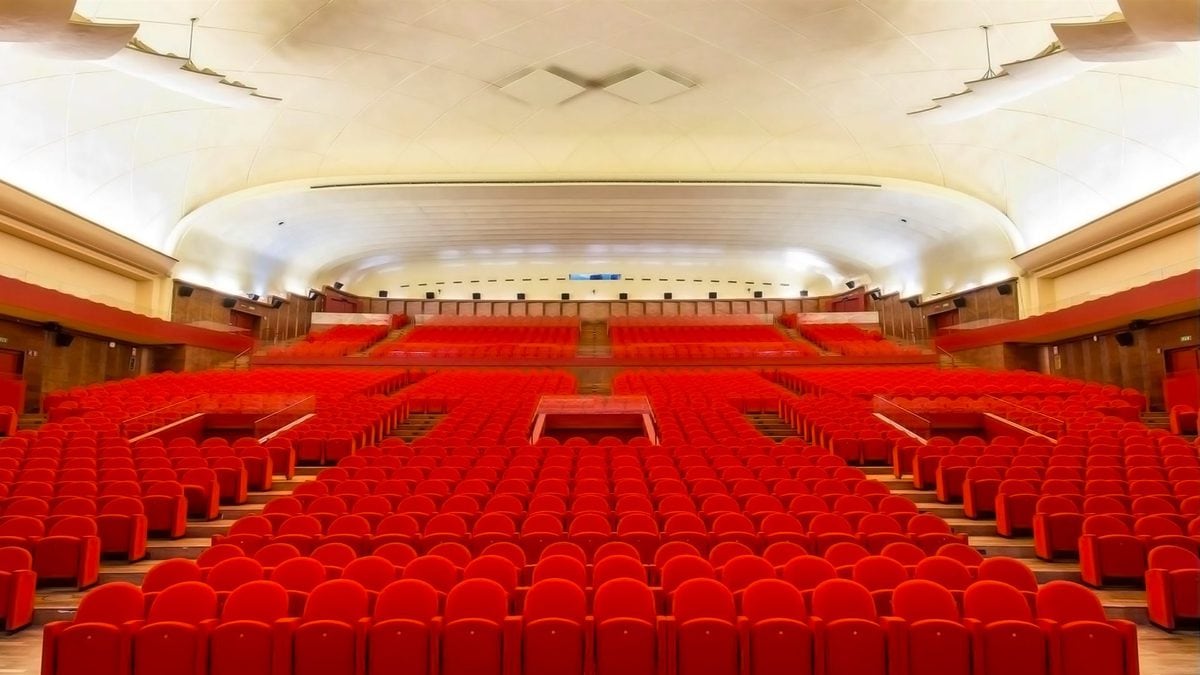
It's the reason you come here. The Main Hall was rebuilt from top to bottom in the renovation completed in 2005, to a design by the Lazzarini Pickering studio, and today the official site puts it at around 1,750 seats. The stalls cover about 1,500 square meters, the stage exceeds 300 square meters and is served by a control room and a screen for film projection of about 90 square meters, with a high-resolution amplification and sound diffusion system. The hall is modular: a system of paneling reduces it to about 1,000 seats or to about 500, so that a conference of 300 people doesn't get lost inside an empty bowl.
The acoustics are its best card. It's a hall designed for symphonic music in an era when long reverberation was a value, and the renovation corrected it without deadening it: the woodwinds can be heard, the strings don't blur together, speech stays understandable even in the last rows. Visibility is good almost everywhere, with the sole exception of the side ends of the first rows, where part of the stage is hidden. If you can choose, better the rows from the 12th to the 20th in the center: that's where the sound arrives already blended.
The Foyer of the Auditorium Conciliazione
800 square meters, 10 screens that project images and that also serve to carve the space into smaller rooms. In ordinary life it's the lobby where you wait for the second bell. In the venue's commercial life it's a room for conferences, press conferences and gala dinners for up to 400 or 500 guests, and for standing cocktails for up to 1,000. It's also the place where the venue shows its double nature: a pharmaceutical congress in the morning, the foyer of a concert in the evening.
The Sala del Lucernario of the Auditorium Conciliazione
An intimate space, on the right of the Foyer, covered by the skylight that gives it its name and enhanced by the photographic works of Silvio Wolf, a Milanese artist who has worked for decades on the threshold between light and image. It's used for small meetings, meetings with speakers, press conferences with limited attendance. It's the room that occasional visitors never see and that instead tells better than any other the management's choice to treat contemporary art as part of the furnishings, not as a separate exhibition.
The Buvette of the Auditorium Conciliazione
On the opposite side from the Sala del Lucernario, open for every public or private event, the Buvette is a small space, with about 20 seats, designed for cocktails and standing buffets after press conferences or before shows. Don't expect a train station bar: it's a well-kept room, and on important nights it becomes the spot where half of Rome's entertainment world meets.
The Chorus Cafè and Visionarea
The complex hosts two realities that have a life of their own. The Chorus Cafè is the restaurant bar of the building, an elegant lounge a couple of steps from the basilica, tied to the name of Massimo D'Addezio, bartender awarded in 2008 as Best Bar in the World in Virtuoso's Best of the Best ranking, and to an international-style cuisine. Visionarea Art Space is instead the exhibition space dedicated to contemporary art, which over the years has presented Italian and foreign photographers and artists such as Paolo Ventura, Massimo Vitali, Pier Paolo Calzolari and Julia Fullerton-Batten. Hours and exhibitions on view change constantly and are checked on their respective sites.
Dressing rooms, choir hall and technical services
Below the level of the stalls the complex has dressing rooms, administrative offices, a recording studio and a media library, plus a choir hall of about 400 square meters. These are spaces closed to the public, but they explain why this hall continues to be chosen for television shoots: it has everything a production needs without having to bring it from outside.

The building that houses the Auditorium Conciliazione
Palazzo San Pio X, the container
The hall is set into Palazzo San Pio X, the block that occupies the left side of Via della Conciliazione going up toward the basilica, opposite the Azione Cattolica building. It was built between 1948 and 1950 to a design by Marcello Piacentini and Giorgio Calza Bini, in time for the Jubilee of 1950, and it's one of the extraterritorial properties of the Holy See. The correct name is Palazzo San Pio X, after Pope Giuseppe Sarto. The wording Palazzo Pio XII that you read around is an established mistake. On the upper floors today there are offices of the Dicastery for Communication, the newsrooms of the Osservatore Romano and Vatican News, the studios of Vatican Radio and the embassies to the Holy See of Canada and Taiwan.
The original idea was that of a large service building: offices and a hotel for pilgrims, in the logic of a street that had to handle the flow of the holy years. The auditorium was born as part of that program, with the dual purpose of hall for papal audiences and concert hall, and with a name that for the first years was Auditorium Pio.
Via della Conciliazione and the Spina di Borgo
To understand the Auditorium Conciliazione you have to know what was there before. Until 1936 the Spina di Borgo wedged itself between Borgo Vecchio and Borgo Nuovo, a dense medieval block that hid the basilica until the last step: you came out into St. Peter's Square suddenly, and Bernini's colonnade burst before your eyes. Mussolini struck the first pickaxe blow on October 28, 1936, the architects Marcello Piacentini and Attilio Spaccarelli directed the work, and about 600,000 cubic meters of historic buildings disappeared. With them went Piazza Scossacavalli, and buildings like Palazzo dei Convertendi and Palazzo Rusticucci were dismantled and rebuilt elsewhere, in versions that resemble the originals only in part. The street was inaugurated for the Holy Year of 1950 and took its name from the Lateran Pacts of 1929.
The judgment of architectural historians on that operation remains severe, and I share it: the surprise effect of the colonnade was traded for a monumental perspective that Bernini had not foreseen and that weakens his invention. But it's also the reason why this hall exists today, and why you reach it walking along one of the most photographed straight stretches in Europe. If you want to measure the difference, take a couple of steps toward Santo Spirito in Sassia and slip into the surviving alleys of Borgo: the old city is still there.
The history of the Auditorium Conciliazione
1950: the inauguration
The hall opened in 1950, the year of the Jubilee, and was inaugurated under the pontificate of Pius XII, who used it as a hall for general audiences. The inaugural concert of the symphonic season had Fernando Previtali on the podium and Arthur Rubinstein at the piano: a debut that in a Rome still full of rubble was worth a political manifesto as well as a musical one. In the first seasons Sergiu Celibidache, Paul Hindemith, Peter Maag and Ildebrando Pizzetti stepped onto that stage. The repertoire was classical, the audience bourgeois, and the hall was, simply, the concert hall of the capital.
1958: Santa Cecilia arrives
In 1958 structural problems at the Teatro Argentina forced the Accademia Nazionale di Santa Cecilia to look for a home elsewhere, and the choice fell here. From the 1958-1959 season the Accademia's Symphony Orchestra took up permanent residence in the Auditorium Conciliazione, and from 1982 the chamber music season also moved into these rooms. For 45 years Rome's symphonic music lived inside a building of the Holy See: a fact that today seems curious and that back then seemed natural.
2003: the departure for the Parco della Musica
In February 2003 the Accademia's concert activity moved to the Auditorium Parco della Musica designed by Renzo Piano. The Conciliazione lost in one blow its resident orchestra and its subscriber audience. It was a painful passage, and for a couple of years the hall risked becoming an empty container.
2004 and 2005: the rebirth
In 2004 the management passed from the Administration of the Patrimony of the Apostolic See to the company I Borghi Srl, with the Province of Rome among the shareholders. There followed 10 months of construction work, with the upgrading of the mechanical, electrical and special systems and the redoing of the interiors signed by the Lazzarini Pickering studio. The hall reopened to the public on April 29, 2005 with the award night of the David di Donatello, which that year celebrated its 50th edition. Since then the programming has changed skin: alongside classical music, theater, dance, musicals, stand-up, film previews and television have come in.
The 20th anniversary
On November 13, 2025 the venue celebrated 20 years of the current management with a concert by the Cappella Musicale Pontificia Sistina, the pope's choir, in a program that ran from Gregorian chant to contemporary music. An elegant way to remember that this hall, before being a theater, is a room of the Holy See.
What you see at the Auditorium Conciliazione
The programming of the Auditorium Conciliazione is deliberately wide. You find the symphonic season of guest ensembles, piano recitals, chamber music, but also Italian singer-songwriters on theater tours, jazz, world music, international dance companies, musicals, drama, comedy, book presentations and screenings with the author in the room. To this is added the conference side, which by day fills the hall with conventions and assemblies.
Two events have made the hall familiar even to those who have never set foot in it. The first is the David di Donatello ceremony, the biggest prize in Italian cinema, which returned here in 2005 and which tied the hall's image to the red carpet of Via della Conciliazione. The second is the Christmas Concert, the evening of music and charity broadcast by Canale 5, which has been recorded in this hall for years and brings every December Italian and international voices under the acoustic dome of the Main Hall.
The practical advice is always the same: check the calendar on the official site before planning the evening, because a hall that does 2,000 shows in 20 years changes its program every week and any list written today would be old tomorrow. If you want a comparison with the city's other halls, start from the Roman theaters page and look at the Teatro Sistina for musicals, the Teatro Brancaccio for singer-songwriter tours and the Rome Opera House for opera.
A curiosity about the Auditorium Conciliazione
The real curiosity is that this was the pope's audience hall before one built for the purpose existed. From 1950 on, Pius XII received pilgrims here at general audiences, and the hall was designed precisely for that double use: an auditorium to fill with the faithful on Wednesday and with symphony subscribers in the evening. Only in 1971, with the opening of the Paul VI Audience Hall designed by Pier Luigi Nervi just beyond the colonnade, did the papal function move away and the Conciliazione remain a concert hall and nothing else.
The detail that makes it interesting is architectural. A hall designed to hold thousands of people listening to a single voice, and a hall designed to hold thousands of people listening to 100 instruments, have different acoustic needs: the first wants speech intelligibility and short reverberation, the second wants long reverberation and blend. Piacentini and his collaborators had to hold the two together, and the compromise can still be heard today in a space that is very clear on speech and at the same time generous enough on strings. The 2004 and 2005 renovation worked on that compromise instead of erasing it.
I add a second curiosity, minor but telling: the name. For the first decades the hall was called Auditorium Pio, after the pope who had inaugurated it. The formula Auditorium Conciliazione, which is the official one today, comes from the street, and the street comes from the Lateran Pacts. In the name of this concert hall is therefore set an international treaty of 1929: it happens to few halls in the world.
Something nobody tells you about the Auditorium Conciliazione
That almost nobody looks up, and that the real architectural show is not the hall but the entrance. The portal on Via della Conciliazione is designed with the same monumental grammar as the rest of the street, travertine and proportions calibrated on the perspective toward the basilica: if you go in running five minutes before the second bell, you will never notice. Arrive 20 minutes early, stop on the opposite sidewalk and look at the facade of Palazzo San Pio X in its entirety. It's the best way to understand that you're entering a State building, not a neighborhood theater.
The second piece of information nobody will give you concerns the exit. When the Main Hall sells out, the outflow of almost 1,700 people spills onto a narrow sidewalk and a street where evening traffic is already heavy. If you have a train or the last metro to catch, you would do well to sit near a side exit, or to accept missing the last two minutes of applause. On big-event nights it's also worth knowing that the stretch of Via della Conciliazione in front of the hall can be closed for public order reasons, especially if something is going on at the Vatican: in those cases the taxi doesn't get to the door and the most realistic pickup point is Piazza Pia or Largo Giovanni XXIII.
Third thing, and perhaps the most useful: the hall can be seen even without buying a ticket for an evening show, because it hosts conferences open to the public, presentations and free meetings by registration. They are occasions announced with little notice and little publicity. If you live in Rome and want to get to know the Auditorium Conciliazione without spending, you can keep an eye on the official calendar and catch one of those dates.
The advice I give you for visiting the Auditorium Conciliazione
First tip, on seats. In the Main Hall the best area is the central stalls between the 12th and the 20th row: far enough from the stage for the sound to arrive already fused, close enough to make out faces. The first five rows often cost more and are worth less, because under the proscenium the orchestra's balance falls apart and your neck notices after two hours. The extreme side rows pay for a covered portion of the stage. If the budget is tight, prefer a rear row in the center to a forward row at the side.
Second tip, on timing. Arrive 40 minutes early. Not for the line, which is usually reasonable, but because the quarter of an hour in St. Peter's Square before the concert is worth as much as the concert. The square at sunset, with the colonnade lighting up and the tourists thinning out, is one of the most beautiful things Rome offers for free, and from the door of the hall it's 300 meters.
Third tip, on dinner. The area is a tourist trap and the restaurants of the first 100 meters of Via della Conciliazione are all equal in the worst way. If you want to eat well before or after, cross toward Borgo Pio, the parallel street to the north, or go up toward the Prati district, where quality goes up and prices go down. Alternatively there's the bar restaurant inside the complex, which is a convenient and well-kept choice, but it needs a reservation.
Fourth, on clothing. There's no code, you see everything, but on gala nights and televised award ceremonies the audience dresses up, and showing up in sightseeing clothes will make you feel out of place. On popular-music nights it doesn't matter at all.

Another well-known fact, yet rarely cited
That this hall was for 45 years the home of the Accademia Nazionale di Santa Cecilia, and that the history of Italian music in the second half of the 20th century passed almost entirely through here. Enthusiasts know it, guidebooks say it, and then it's forgotten as soon as the Parco della Musica is mentioned. Yet between 1958 and 2003 the program of this hall was the symphonic program of the capital: the Italian premieres, the great guest conductors, the tours of foreign orchestras visiting Rome passed through Via della Conciliazione, not elsewhere.
The corollary that is rarely cited is that the 2003 move was not a painless relocation. A concert hall is not a warehouse: it has an audience that has gotten used to it, acoustics that performers know by heart, a network of habits. When the Accademia moved, the Conciliazione had to reinvent itself from scratch, and the choice to bet on contemporaneity in all its creative forms, from dance to music to visual arts, comes from there. The very presence of a permanent exhibition space dedicated to contemporary art inside an auditorium is a consequence of that crisis.
There is also a fact that local historians know and visitors ignore: in February 2001, even before the renovation, this hall hosted a week-long residency of the Berlin Philharmonic under Claudio Abbado, filmed by cameras. For a week the orchestra considered the best in the world worked and played in a Roman hall that two years later would lose its own orchestra. It's one of those short circuits that make places interesting.
The right photo to take at the Auditorium Conciliazione
The right photo is not the one of the facade, which up close flattens and doesn't do it justice. The right photo is taken from the opposite sidewalk, the one on the side of Santa Maria in Traspontina, positioning yourself so that the entrance of the Auditorium Conciliazione fills the foreground on the right and the dome of St. Peter's closes the end of the perspective. You need a moderately wide-angle lens and patience, because buses pass constantly on the straight stretch. The right time is what photographers call the blue hour: 20 minutes after sunset, when the street lamps are already lit and the sky is not yet black. In that quarter of an hour the travertine turns warm, the dome stays readable and the entrance lights balance with the natural light.
The second photo, the one nobody takes, is from inside the Foyer toward the outside, with the 10 screens on behind you and the street glimpsed beyond the glass walls. It tells the double nature of the place better than any portrait of the facade.
Beware of a rule that applies everywhere and is enforced here: during shows you don't photograph and don't film. It's not a formality, it's a matter of rights over the productions and the performances, and the hall staff step in. Photos are taken before the third bell, in the common areas, and after the final applause if the staff allows. If you need to shoot for work, the correct way is to ask for accreditation from the venue's press office a few days ahead.
Some important events that happened here in history
1950, the inauguration. The hall opens in the year of the Jubilee, inside a building just finished, on a street just finished. Pius XII uses it as the hall for general audiences and the city finds its new concert hall here. The inaugural concert of the symphonic season is conducted by Fernando Previtali, with Arthur Rubinstein seated at the piano. In the immediately following seasons Sergiu Celibidache, Paul Hindemith, Peter Maag and Ildebrando Pizzetti take the podium.
1958, the move of Santa Cecilia. The structural problems of the Teatro Argentina push the Accademia Nazionale di Santa Cecilia to move its symphonic season here starting from the 1958-1959 concert year. It is the event that changes the nature of the place: from a multipurpose hall it becomes the symphonic hall of Rome.
1971, the end of the papal function. With the entry into service of the Audience Hall designed by Pier Luigi Nervi, the general audiences leave this hall. The Auditorium Conciliazione remains a theater in every respect.
1982, chamber music arrives too. The Accademia's chamber season moves into these rooms, completing the transfer of the concert activities.
February 2001, the Berlin Philharmonic. Claudio Abbado brings the Berlin orchestra here for a week-long residency, filmed. It is one of the highest episodes in the recent history of the hall.
February 2003, the departure. Santa Cecilia's concert activity moves to the Auditorium Parco della Musica. 45 years of residency come to an end.
2004, the change of management. The company I Borghi Srl takes over from the Administration of the Patrimony of the Apostolic See, with the Province of Rome among the shareholders, and opens a 10-month construction site.
April 29, 2005, the reopening. The renewed hall reopens to the public with the David di Donatello ceremony, at the 50th edition of the prize. From that evening the Conciliazione returns to the circuit of national television events.
The years of the second life. From 2006 on the stage hosts, among many others, the concerts of Ennio Morricone, the work of conductors like Lorin Maazel, the dance of Roberto Bolle and of the Martha Graham Dance Company, the concerts of Franco Battiato, Ornella Vanoni, Anastacia and the Simple Minds, as well as film previews and award ceremonies. The Christmas Concert broadcast by Canale 5 brings the hall into Italian homes every December.
November 13, 2025, the 20th anniversary. The Cappella Musicale Pontificia Sistina, the pope's choir, celebrates 20 years of the management with a program that crosses 15 centuries of sacred music, from Gregorian chant to the contemporary repertoire.
Who has passed through the Auditorium Conciliazione
The list is long and crosses worlds that don't speak to each other. Let's begin with the popes: Pius XII inaugurated the hall and held audiences there for years, and his successors used it until 1971, when the function passed to Nervi's hall. The papal presence has never entirely ceased, because the choir of the Sistine Chapel returned to sing here in November 2025 for the 20th anniversary.
Then the conductors. Fernando Previtali conducted the inaugural concert of the symphonic season. In the first seasons Sergiu Celibidache passed through, along with the composer and conductor Paul Hindemith, the Swiss Peter Maag and the Italian Ildebrando Pizzetti. In the years of Santa Cecilia's residency Leonard Bernstein, Herbert von Karajan, Igor Stravinsky, Aldo Ceccato, Giuseppe Sinopoli, Riccardo Muti and Myung-Whun Chung stepped onto that podium. In 2001 Claudio Abbado arrived with the Berlin Philharmonic. After the reopening the hall also hosted Lorin Maazel.
At the piano, the name that opens the list is Arthur Rubinstein, present at the inaugural evening of 1950: one of the most important pianists of the century in a Rome that was getting back on its feet after the war.
In the second life of the hall, after 2005, the register changes. Ennio Morricone conducted his own music here between 2006 and 2008, in that season of concerts that turned him from a film-score composer into a full-house theater phenomenon. Roberto Bolle has danced here, as has the company founded by Martha Graham. Franco Battiato, Ornella Vanoni, Anastacia and the Simple Minds have sung here. The David di Donatello ceremony has brought here, year after year, almost all of Italian cinema, from directors to actors to technical crews. The Christmas Concert has brought dozens of Italian and international voices through here.
One name deserves a line of its own: Silvio Wolf, the artist whose photographic works accompany the Sala del Lucernario. He is not a passing guest, he is a permanent presence, and he stands as a statement of intent from a management that chose to treat contemporary art as part of the house.
Accessibility of the Auditorium Conciliazione
The venue is partially accessible to people with mobility disabilities: the route has a few steps and a few ramps, and an elevator reaches the first-floor rooms. The stalls have reserved seats, in limited number, which are booked by contacting the venue when the event page doesn't already give the procedure. The practical advice is to move at least three or four days ahead and to say if a seat for a companion is needed.
For those who have difficulty walking but don't use a wheelchair, the delicate point is the stretch between the parking and the entrance: Piazza Adriana and the Terminal Vaticano are five or six minutes' walk on regular sidewalks, while the route from the Gianicolo involves a demanding descent. By taxi you can get almost to the door, barring extraordinary street closures.
The Auditorium Conciliazione with children
It depends on the show, and the hall doesn't publish a minimum age valid for everything. In general musicals, afternoon concerts and screenings are suitable from age six or seven up. The evening symphonic concerts, which last two hours with an intermission, test even adults. A practical rule for families: if the show ends after 22:30, think it over carefully, because getting home from Via della Conciliazione isn't quick in any direction.
The advantage, with children, is the location. You can build the afternoon around a walk in Vatican City, a stop at the Castle and then the theater. The drawback is that in the immediate surroundings there is no real green space where they can run before the show: the first is the garden of Castel Sant'Angelo, on the other side of the Lungotevere.
What to see near the Auditorium Conciliazione
A 10-minute walk covers a quantity of things that elsewhere would take a day. St. Peter's Basilica is 300 meters away, with Bernini's colonnade closing the perspective of the street. The Vatican Museums and the Sistine Chapel have their entrance on Viale Vaticano, on the opposite side of the walls, about a 20-minute walk. The Vatican Gardens can only be visited by reservation and with a guide. Castel Sant'Angelo is five minutes away and its terrace gives the best view over the city. Santo Spirito in Sassia, with the ancient hospital, is a couple of steps away along Borgo Santo Spirito. Going up, the Janiculum Hill offers the lookout and the noon cannon shot. Toward the center, across the bridge, you reach Piazza Navona in a quarter of an hour and the Chamber of Deputies at Montecitorio in 20 minutes.
When to go to the Auditorium Conciliazione
The strong season runs from October to May, with the peak between November and April. In summer activity thins out, because Rome moves music outdoors and the competition of the arenas is unsustainable for any indoor hall. December is the busiest month, because of television recordings and Christmas concerts, and also the hardest for traffic in the area: if you come the week before Christmas, allow half an hour more to get there.
The day of the week matters less than elsewhere, because the audience is largely local. The typical start time is early evening, but it changes with the genre: televised award ceremonies have times dictated by the broadcast schedule and may ask for entry well in advance. The worst period of all for those who want to move around calmly is that of the big Vatican events, when the street is closed and the area becomes impassable to vehicles.

Quick questions about the Auditorium Conciliazione
Where is the Auditorium Conciliazione
At Via della Conciliazione 4, 00193 Rome, in the Borgo district, 300 meters from St. Peter's Square. The venue's offices are based at Borgo Sant'Angelo 5.
What is the phone number of the Auditorium Conciliazione
The switchboard published by the venue is 06 684391. The email address is info@auditoriumconciliazione.it.
How many seats does the Auditorium Conciliazione have
The Main Hall has more than 1,750 seats in the full configuration. The figure the venue gives today is slightly above 1,750. The hall can be modulated with a paneling system to about 1,000 or to about 500 seats.
How do you get to the Auditorium Conciliazione by public transport
Metro line A, Ottaviano or Lepanto stops, then 12 or 15 minutes on foot. Buses 23, 40, 62, 64, 280 and 982. Regional trains FL3 and FL5, getting off at San Pietro station.
Where do you buy tickets for the Auditorium Conciliazione
Online and from the authorized resellers indicated by the venue on its official site. The box office at Via della Conciliazione 4 appears to be closed. On the night of the show a sales desk opens an hour before the start.
How much does a ticket for the Auditorium Conciliazione cost
There is no single price: each show has its own price list, because the hall hosts very different genres. The price is read on the event page on the official site.
What time does the box office of the Auditorium Conciliazione open
On show nights the sales desk opens an hour before the start. Outside show hours the physical box office is not operating.
Is the Auditorium Conciliazione wheelchair accessible
It is partially accessible: there are a few steps and a few ramps, and an elevator serves the first-floor rooms. Reserved seats are limited in number and are booked by writing to the venue, a few days ahead.
Can you take photographs at the Auditorium Conciliazione
In the common areas yes, before and after the show. During performances photographs and filming are not allowed. To shoot for professional purposes you ask the press office for accreditation.
How long does a show at the Auditorium Conciliazione last
It depends on the genre. A symphonic concert generally lasts two hours with an intermission, a popular music concert between 90 minutes and two hours, a theater show around 100 minutes. Television ceremonies can exceed three hours.
Do you need to book to visit the Auditorium Conciliazione
The Auditorium Conciliazione is not visited like a monument: you get in with the ticket for a show or with registration for a conference open to the public. There are no ordinary guided tours of the building.
What is the best seat in the hall at the Auditorium Conciliazione
The central stalls between the 12th and the 20th row. The first rows are too far under the stage and the extreme side ones lose a portion of the scene.
Is there a coat check at the Auditorium Conciliazione
The coat check service is activated depending on the event and the season. On winter nights with big crowds it is normally available. It's worth checking on the show page or asking the staff at the entrance.
Is there a bar or a restaurant at the Auditorium Conciliazione
Yes. The complex hosts the Chorus Cafè, bar and restaurant, and has the Buvette for cocktails and buffets tied to events. For the restaurant it's worth booking.
Where do you park near the Auditorium Conciliazione
Paid public area of Piazza Adriana six minutes away, Terminal Vaticano at Via Urbano VIII 16 five minutes away, Parking Gran Melia at Via del Gianicolo 2 eight minutes away, garage at Via Vespasiano 17C 10 minutes away, Piazza Cavour nine minutes away.
Is the Auditorium Conciliazione suitable for children
It depends on the show. Musicals, screenings and afternoon concerts work from age six or seven. The evening symphonic concerts are demanding. Also consider the exit time and the trip home.
What is the difference between the Auditorium Conciliazione and the Auditorium Parco della Musica
They are two different structures and far apart. The Auditorium Conciliazione is a single hall of over 1,700 seats inside a building of the Holy See in Borgo. The Parco della Musica, on Viale de Coubertin, is a complex of three halls designed by Renzo Piano with an open-air cavea, and it has been the seat of the Accademia Nazionale di Santa Cecilia since 2003.
Who runs the Auditorium Conciliazione
The company I Borghi Srl, since 2004, which took over from the Administration of the Patrimony of the Apostolic See. The reopening to the public after the works was in 2005.
Who owns the building of the Auditorium Conciliazione
The Holy See. The hall is inside Palazzo San Pio X, one of the extraterritorial properties of the Holy See, built between 1948 and 1950 to a design by Marcello Piacentini and Giorgio Calza Bini.
Why is it called Auditorium Conciliazione
From the name of the street, Via della Conciliazione, which recalls the Lateran Pacts of 1929. In the first decades the hall was known as Auditorium Pio, after Pius XII, who inaugurated it.
Has the pope ever held audiences at the Auditorium Conciliazione
Yes. From 1950 until 1971 the hall also functioned as the hall for papal audiences, before the Audience Hall designed by Pier Luigi Nervi came into service.
Where is the David di Donatello ceremony held
The venue has changed over time. The Auditorium Conciliazione has hosted the ceremony since the reopening of April 29, 2005, which coincided with the 50th edition of the award. The venue of the current edition is checked every year on the award's official channels.
Can you rent the Auditorium Conciliazione for an event
Yes. The venue has a commercial office dedicated to congresses, conferences, assemblies, presentations and gala dinners, and makes available the modular Main Hall, the 800-square-meter Foyer, the Sala del Lucernario and the Buvette.
How long does it take to walk from the Auditorium Conciliazione to St. Peter's
Three or four minutes. The basilica is at the end of the street, about 300 meters away.
Is there an art exhibition at the Auditorium Conciliazione
The complex hosts Visionarea Art Space, a space dedicated to contemporary art, with its own exhibition program. Calendar and hours are checked on the Visionarea site.
When is the best time to go to the Auditorium Conciliazione
Between October and May, with the densest programming from November to April. In summer activity is reduced. December is the busiest month and the most complicated for traffic in the area.
Frequently asked questions about the Auditorium Conciliazione
Where is the Auditorium Conciliazione?
The Auditorium Conciliazione is at Via della Conciliazione 4, 00193 Rome, in the Borgo district, 300 meters from St. Peter's Square. The venue's offices are based at Borgo Sant'Angelo 5, while the hall is housed inside Palazzo San Pio X, on the left side of the street going up toward the basilica.
How do you buy a ticket for the Auditorium Conciliazione?
For the Auditorium Conciliazione the box office at Via della Conciliazione 4 appears to be closed, and sales go through online channels and the authorized resellers listed on the venue's official site. On the night of the show a desk opens an hour before the start, but for the most requested titles it serves mainly for picking up tickets already bought, not for direct sales.
How do you get to the Auditorium Conciliazione by metro?
You get to the Auditorium Conciliazione by metro line A, getting off at the Ottaviano stop. From there you follow Via Ottaviano in the direction of the dome of St. Peter's and in 12 or 15 minutes on foot, all flat, you reach Via della Conciliazione, also crossing St. Peter's Square.
How many seats does the Main Hall of the Auditorium Conciliazione have?
The Main Hall of the Auditorium Conciliazione, rebuilt in the renovation completed in 2005 to a design by the Lazzarini Pickering studio, has, according to the official site, about 1,750 seats. The stalls cover about 1,500 square meters and the stage exceeds 300 square meters.
Is the Auditorium Conciliazione wheelchair accessible?
The Auditorium Conciliazione is partially accessible to people with mobility disabilities: the route has a few steps and a few ramps, while an elevator reaches the first-floor rooms. The stalls have reserved seats in limited number, to be booked by contacting the venue at least three or four days ahead.
Is the Auditorium Conciliazione suitable for children?
It depends on the show, because the Auditorium Conciliazione doesn't publish a minimum age valid for the whole program. In general musicals, afternoon concerts and screenings are suitable from age six or seven up, while the evening symphonic concerts, which last about two hours with an intermission, test even adults.
What is there to see near the Auditorium Conciliazione?
A 10-minute walk from the Auditorium Conciliazione is St. Peter's Basilica, 300 meters away, with Bernini's colonnade closing the perspective of the street. The Vatican Museums and the Sistine Chapel have their entrance on Viale Vaticano, on the opposite side of the walls, about a 20-minute walk away.
When is the best time to go to the Auditorium Conciliazione?
The strong season of the Auditorium Conciliazione runs from October to May, with the peak between November and April. In summer activity thins out, because Rome moves music outdoors, while December is the busiest month for television recordings and Christmas concerts, as well as the hardest for traffic in the area.
The final verdict on the Auditorium Conciliazione
My advice is to arrive in St. Peter's Square half an hour early, look at the colonnade and then go back in for the concert. That sequence, the square and then the hall, is the reason I recommend the Auditorium Conciliazione to anyone who has only one Roman evening to spend on music. It's not the most modern hall in the city and it's not the most fashionable. But it's the only one where you come out of the second half and find yourself, after 50 steps, in front of the illuminated basilica. If I had to choose just one thing to do here, I'd choose a symphonic concert in November, central stalls, and a walk on the bridge on the way back.
If you're organizing an evening like this inside a wider trip, the team of TourLeaderPro in Rome builds tailor-made itineraries and also handles the exclusive experiences for small groups. If you travel in English, on ItalyPlanner you'll find the guide to the best things to do in Rome, a 3-day itinerary and the comparison of the Vatican visit options, useful if you want to combine the morning at the Museums with the evening at the concert.
Article written by the editorial team of TourLeaderPro, contact them for Private/Corporate/V.I.P. Tours and Experiences.
Planning a trip to Rome? The English-language guides for visiting the city are on ItalyPlanner.com.